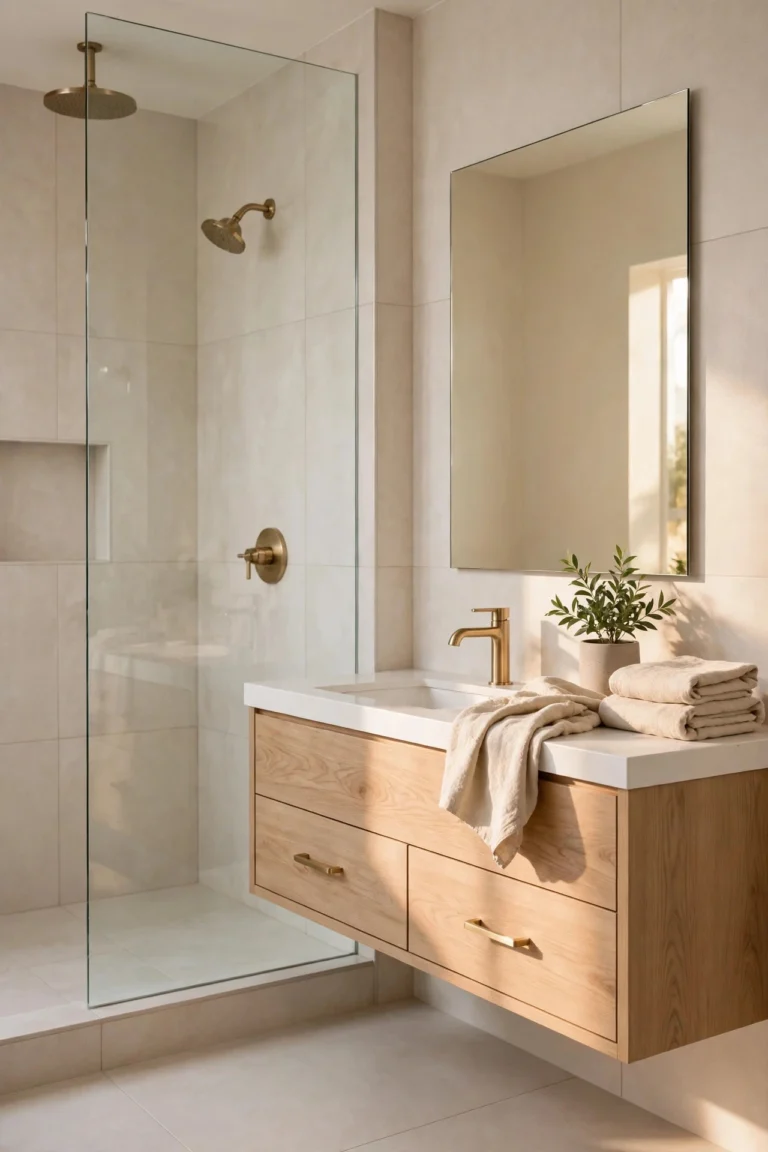
How to Do Budget Home Decorating That Looks Expensive
Budget home decorating is not about spending less on everything — it is about spending nothing where it costs nothing, spending little where little works, and spending properly on the one or two pieces that set the whole room's tone. The expensive-looking rooms in magazines are rarely expensive all the way through: they are edited, layered and lit well, and most of the pieces in them cost less than the coffee table they sit on.
Below are 22 budget home decorating ideas organised by price tier — free changes first, then under $25, under $50 and under $100 — followed by room-by-room budgets and the splurge-versus-save rules that keep a tight budget from looking tight. Every idea carries real prices, exact measurements and the mistakes that make cheap decor look cheap, like buying five small things instead of one good one. A whole living room can be transformed for $100 to $150, a bedroom for $80 to $120, and the free ideas alone change a room more than a shopping trip does.
Looking for more inspiration? Our Nest Decorz homepage gathers the latest home decor ideas, seasonal decorating guides and room-by-room styling tips in one place — start there and explore.
Quick answers
– Start with the free changes — decluttering, rearranging furniture and shopping your own home change a room more than any purchase, and they cost nothing at all. – Spend on one hero piece per room — one good lamp, one large mirror or one quality throw does more for a room than five small accessories bought to fill a gap. – Buy secondhand for the big pieces — solid wood furniture, lamps and mirrors are cheapest at thrift stores and estate sales, where $25 buys what costs $150 new. – Keep a 60-30-10 colour rule — 60 percent neutral base, 30 percent secondary colour, 10 percent accent, so cheap pieces look deliberate instead of random. – Budget $100 to $150 per room — spend the most on textiles and lighting, the least on accessories, and keep $20 in reserve for the fix you did not expect.
1. How Do You Make a Room Look Expensive for Free?
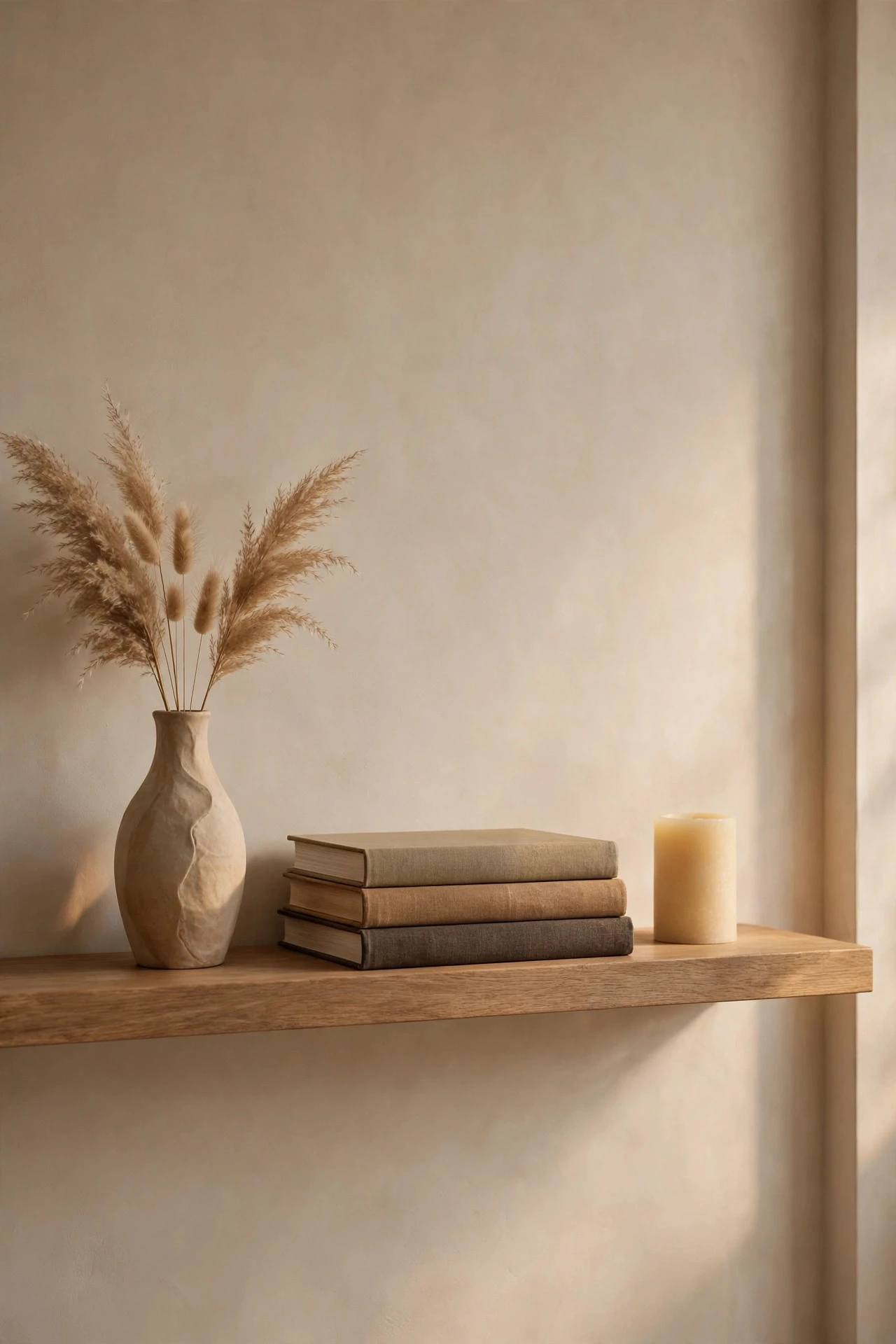
Make a room look expensive for free by removing one item in three from every surface and shelf, because expensive rooms are edited rooms. Clear the coffee table to one tray and one book, take half the objects off open shelves, and remove anything broken, faded or kept out of habit — the room reads calmer, larger and more intentional.
Editing works because the eye reads empty space as confidence: a room with three deliberate objects looks designed, while a room with twelve small ones looks like a shop shelf. Start with the surfaces you see from the doorway — the coffee table, the mantel, the top of the dresser — and put the removed pieces in a box, not in another room, so you can see whether you miss them after a week. Most people never take the box back out. Keep only objects with a job: a lamp that lights, a book you read, a vase that holds flowers. Everything else is clutter wearing a nicer name.
2. How Should You Rearrange Furniture to Make a Room Feel New?
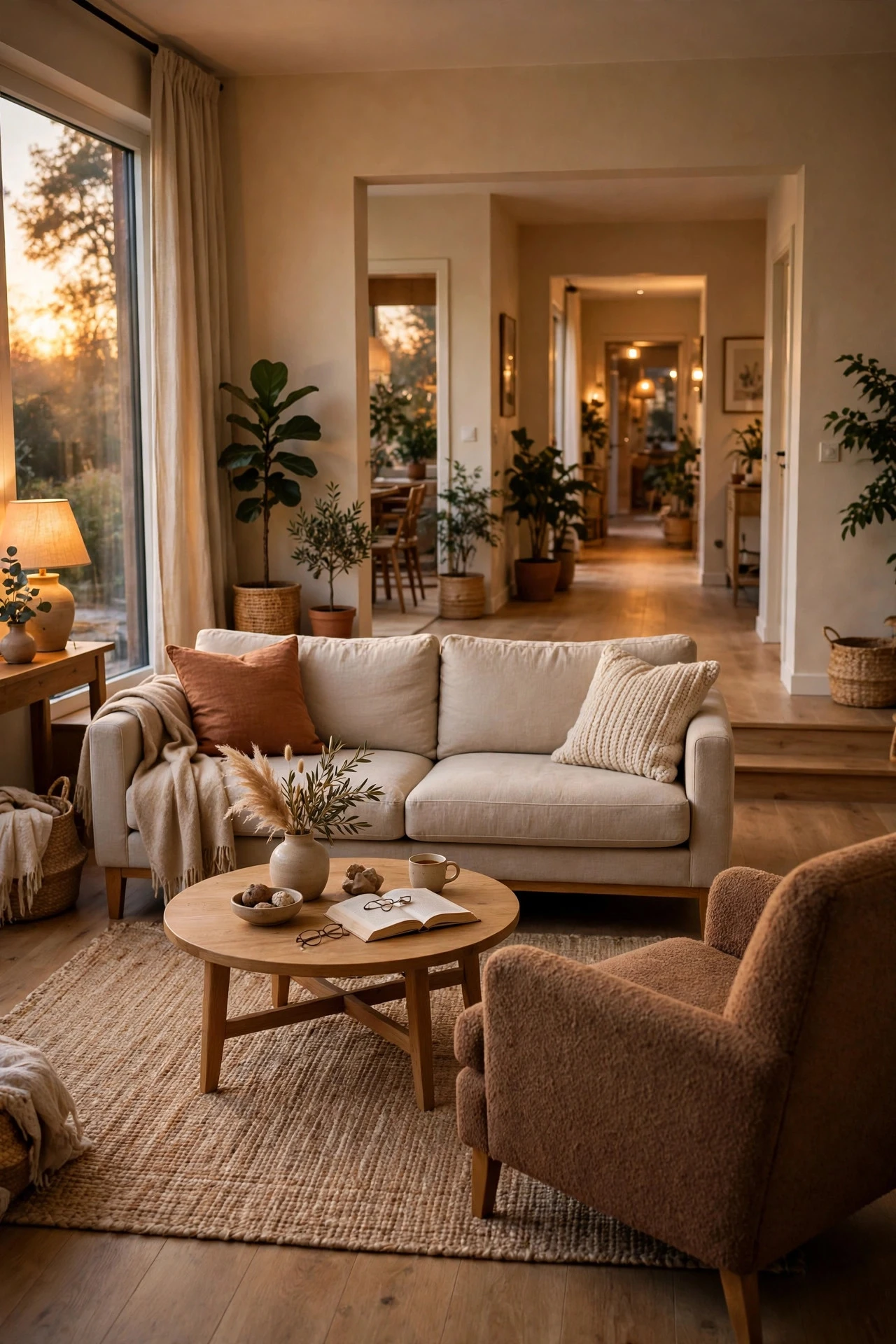
Rearrange furniture to make a room feel new by pulling the sofa 15 to 20 cm away from the wall and angling one chair toward it, so the seating forms a conversation group instead of a waiting room. A floating arrangement with a walkway behind it makes a small room feel larger, because the eye reads the gap as space.
Measure before you move anything: leave 75 to 90 cm for main walkways and 45 cm between the sofa and the coffee table, so knees clear and drinks stay in reach. Try the bed on the opposite wall, swap the armchair to the window side, or turn the desk to face the room instead of the wall — each move changes the light and the view for free. Take a photo from the doorway after each arrangement and compare them, because the camera sees what your eyes stop noticing after ten minutes. The interior design principle behind this is simple: arrangement is design, and a room's layout is worth more than its contents.
3. What Does It Mean to Shop Your Own Home?
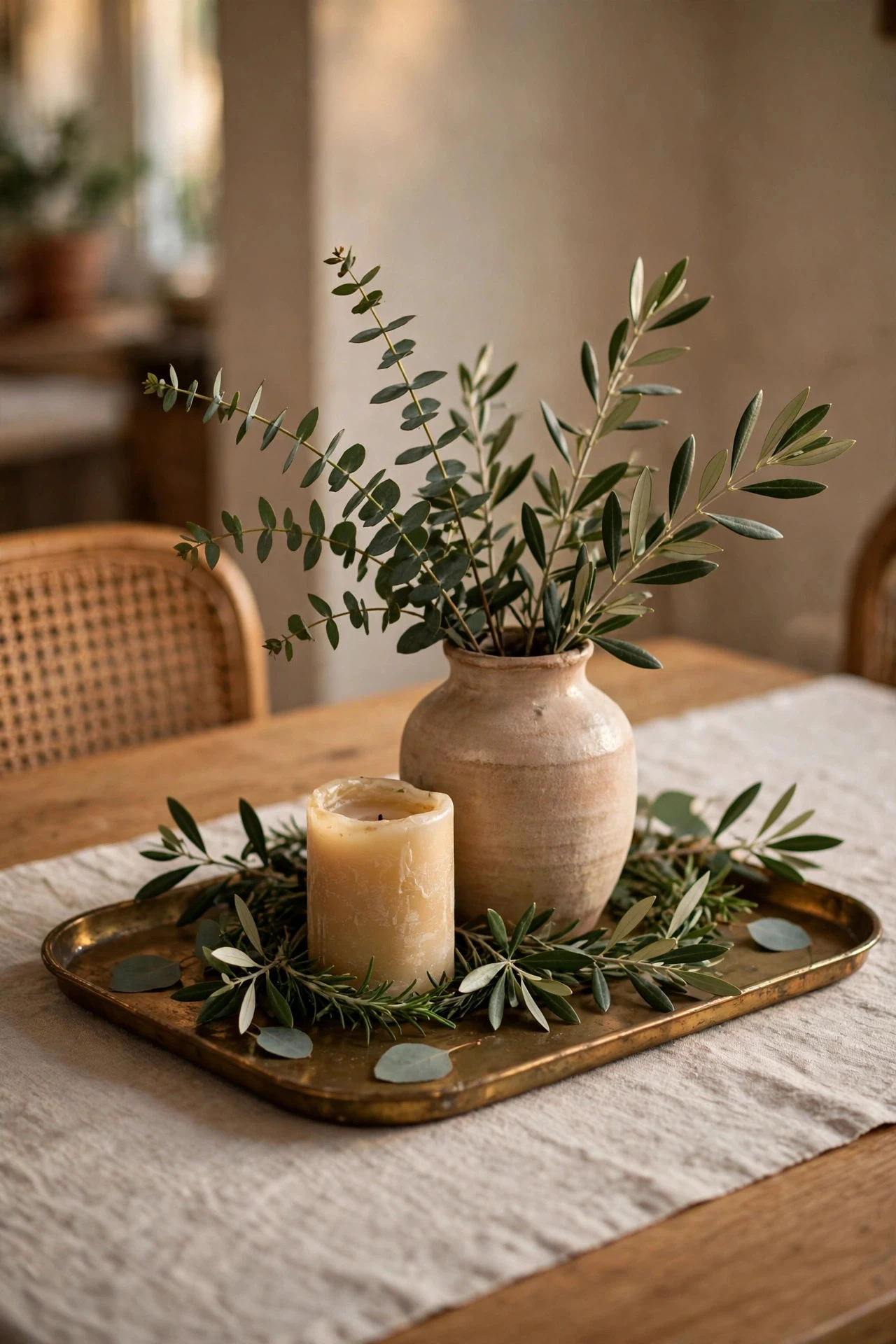
Shopping your own home means moving objects between rooms instead of buying new ones: the vase from the bedroom becomes the dining table centrepiece, the spare throw from the guest room warms the living room sofa, and the hallway print fills the blank wall above the desk. You already own the pieces — they are just in the wrong rooms.
Walk through the house with a laundry basket and collect anything that is not earning its place: candle holders, trays, baskets, books, small art, spare cushions. Then place one item at a time where there is a visible gap — a bare shelf, a dark corner, a plain side table — and stop when the gap feels finished. A brass tray that looked tired on a bedroom dresser looks intentional on a coffee table with a candle on it, because context changes value. This trick works best with objects you stopped seeing: move them and they become new again, and the only cost is twenty minutes of carrying things around the house.
4. Can Cleaning Really Change How Expensive a Room Looks?
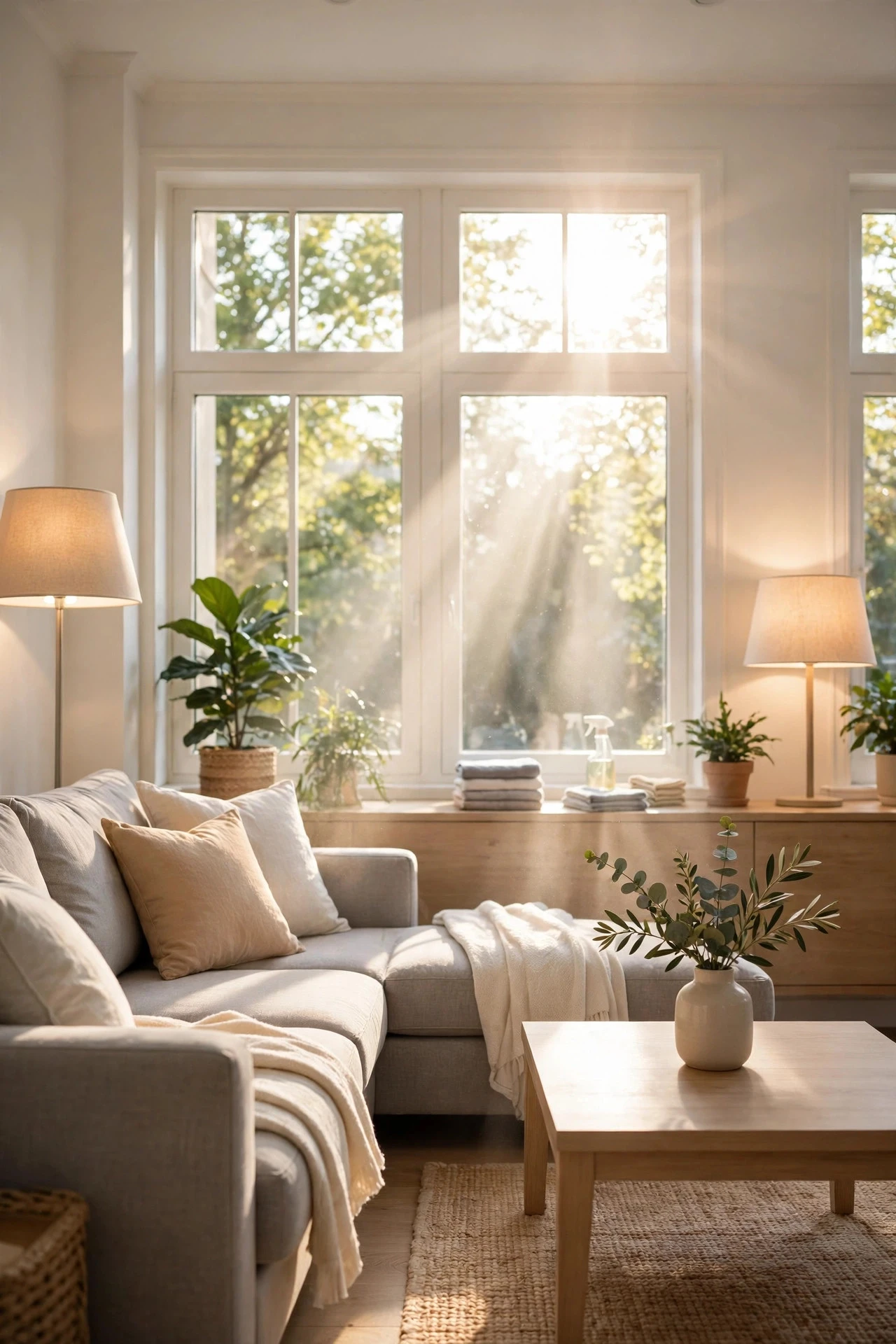
Cleaning changes how expensive a room looks more than any purchase, because dust, streaks and grime read as neglect even on good furniture. Wash the windows, dust the light fittings, wipe the skirting boards and clean the glass on framed art — a clean room reflects more light, and light is what makes rooms look expensive.
Work top to bottom in one room at a time: ceiling corners and light fittings first, then shelves and surfaces, then floors last, so dust falls down and gets picked up once. Clean the lampshades — a dusty shade blocks up to a third of the light — and swap any dead or mismatched bulbs for warm-white 2700K LEDs, about $8 for a pack of four, so every lamp in the room glows the same colour. Steam-clean or vacuum the rug, polish the wood, and open the curtains fully: daylight is free, and a clean window lets in noticeably more of it than a dirty one. These 22 cozy home decor ideas for a warm inviting home all start from the same base — a clean, well-lit room — and none of them work in a dusty one.
5. How Do You Restyle Shelves and Walls Without Buying Anything?
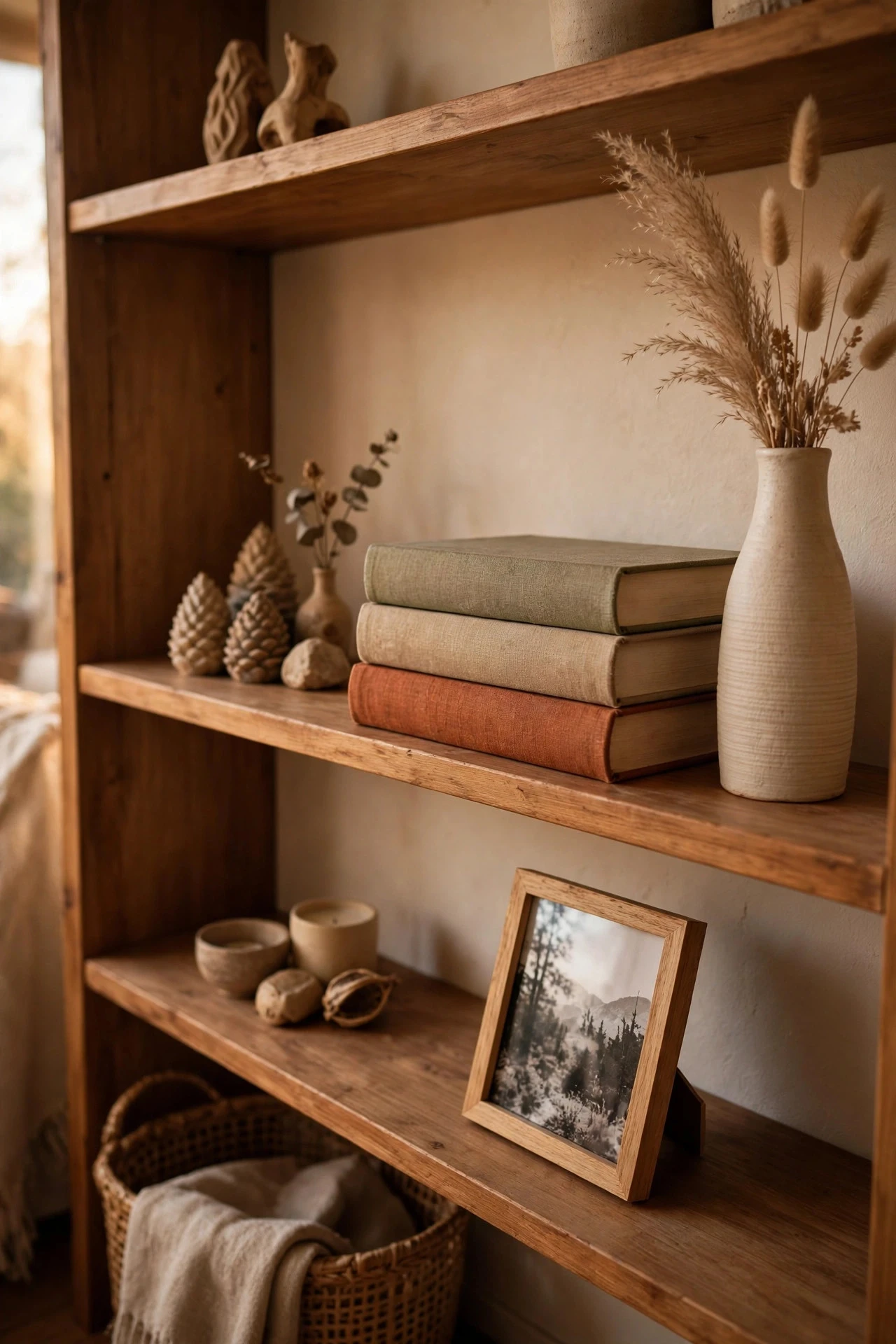
Restyle shelves and walls without buying anything by grouping what you already own in odd numbers and varying heights: three books stacked flat, a tall vase beside them and a small framed photo leaning in front. Odd-numbered groupings and height variation look designed, while rows of same-height objects look like storage.
Take everything off one shelf or wall, then put back only a third of it, arranged in groups of three or five with 10 to 15 cm of empty space between groups — the gaps are what make each group read as deliberate. Lean art instead of hanging it: a framed print leaned on a shelf or a dresser looks relaxed and expensive, and it costs nothing to move. Swap the art between rooms too — the landscape from the bedroom over the sofa, the abstract from the living room in the hallway — because a picture in a new place reads as a new picture. Keep the shelf nearest the television or the bed the quietest, with one object only, so the eye has somewhere to rest.
6. Where Do You Find the Best Budget Cushion Covers?
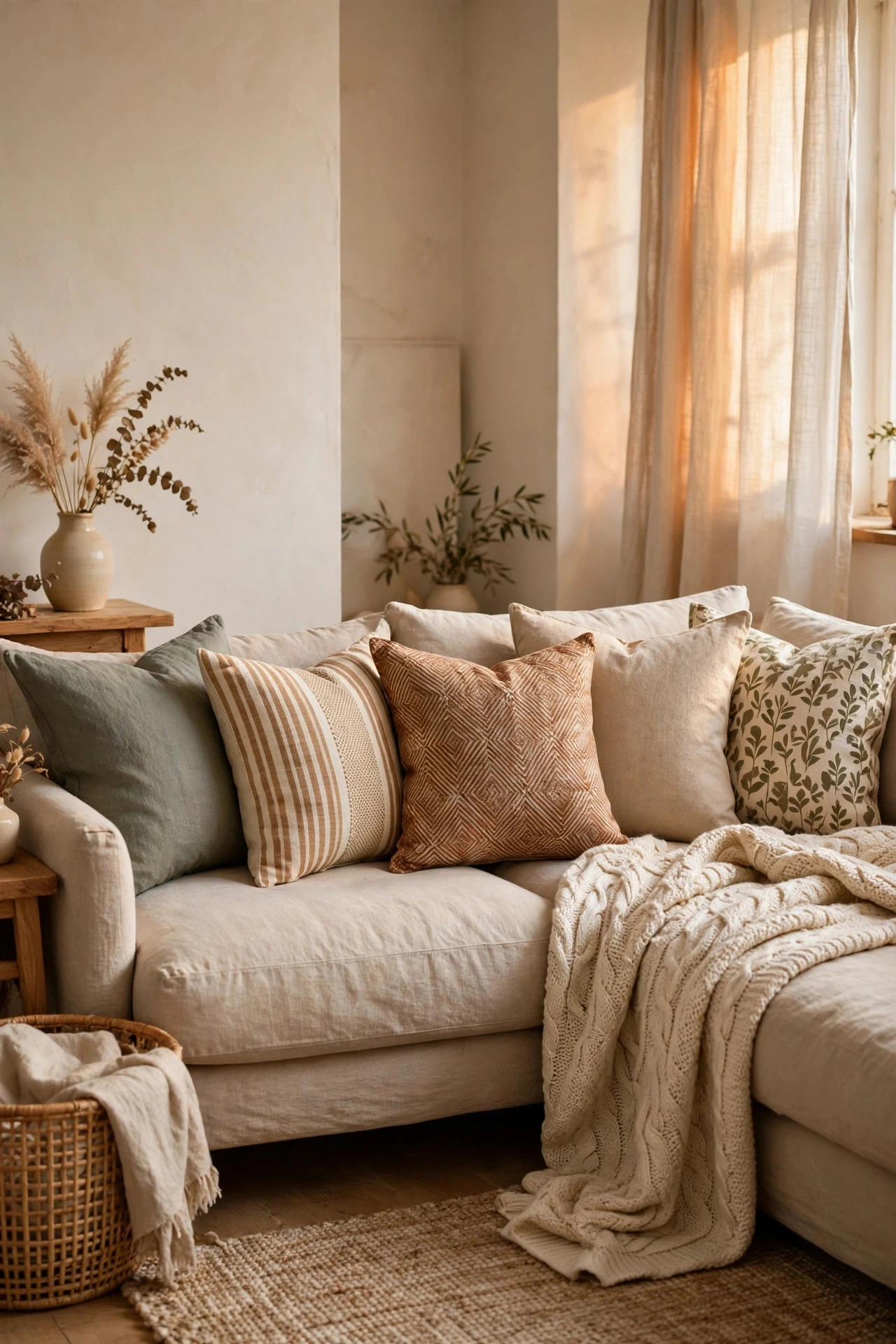
Find the best budget cushion covers at thrift stores, discount home stores and end-of-line sales, where linen-blend and cotton covers cost $5 to $10 each instead of $25 to $40 new. Covers are the cheapest way to change a room's colour story, because you keep the insert you already own and change only the skin.
Buy covers in two sizes — 45 cm square for the sofa and 30 by 50 cm lumbar for the bed or armchair — and choose natural fabrics with texture: linen, cotton canvas, washed cotton or a subtle weave, because texture reads as quality while shiny polyester reads as cheap. Mix one solid, one pattern and one texture in the same colour family, and use the 60-30-10 rule: the sofa colour is the 60 percent, the cushion pattern is the 30 percent, and one small accent cushion is the 10 percent. Wash new covers before use — they soften and sit better — and keep a spare set in a different colour for a seasonal change that costs nothing extra. A sofa dressed with three good covers looks like a new sofa; a sofa with six cheap ones looks like a sale rack.
7. How Can Paint Transform a Piece of Furniture for Under $25?
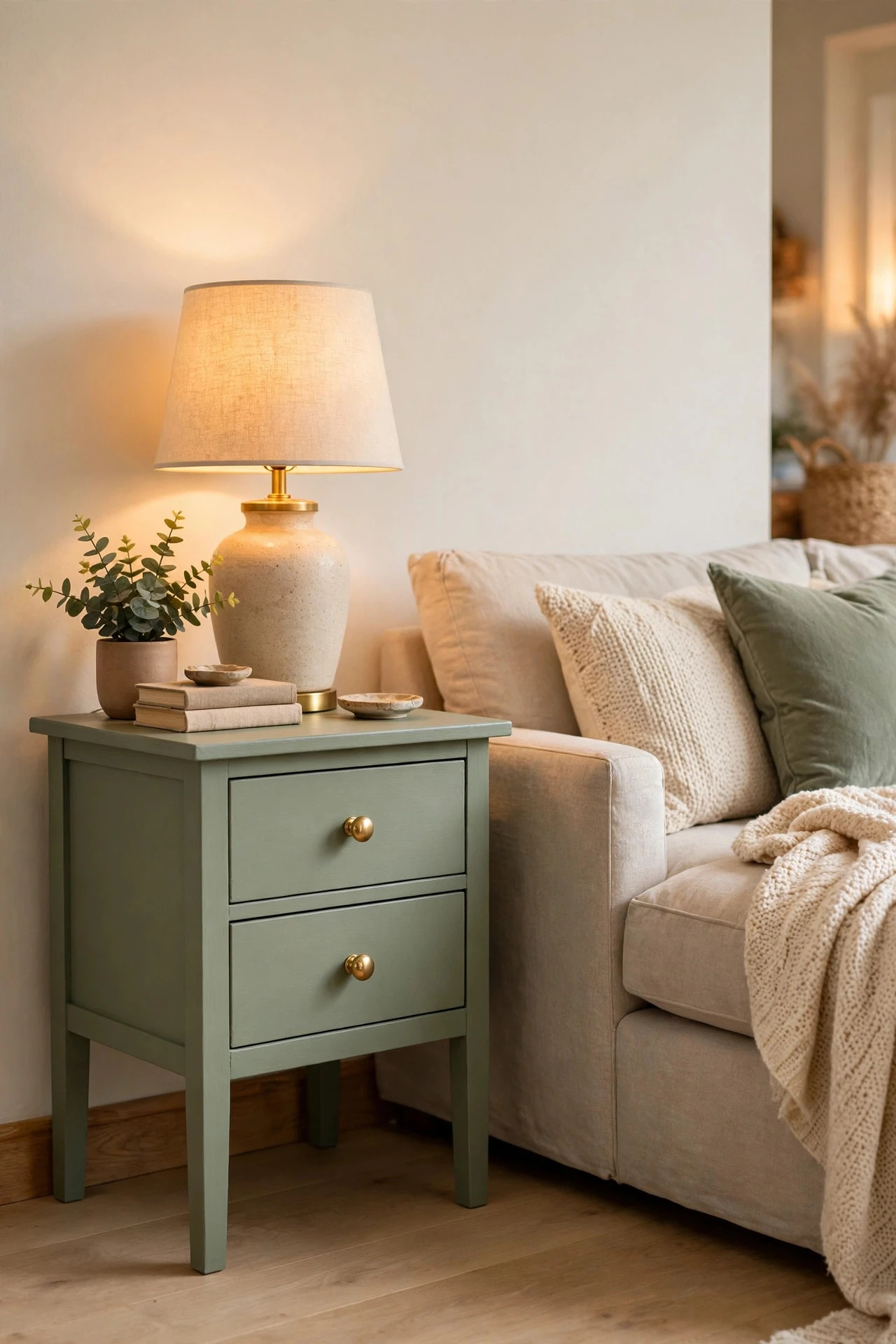
Paint transforms a piece of furniture for under $25 because a $15 tin of chalk paint or furniture paint plus a $5 brush turns a dated thrift-store find into the room's best piece. A tired wooden side table, a scratched nightstand or a pine bookcase becomes a deliberate colour accent once it is painted and waxed or sealed.
Sand lightly with 120-grit paper, wipe the dust off, and apply two thin coats rather than one thick one — thin coats dry flat and do not drip, while a thick coat peels within months. Choose one painted piece per room in a colour already in the room's palette: sage green on a bedside table, deep navy on a bookcase, matte black on a tray table. Replace the knobs too — a pair of brass or ceramic knobs costs $6 to $10 and is the detail that makes a painted piece look bought, not made. Let the paint cure for 24 hours before you use the piece, and never paint the top of a table you eat or work at without a clear sealant, because unsealed paint marks on first contact with a mug.
8. What Can Peel-and-Stick Paper Do on a Budget?
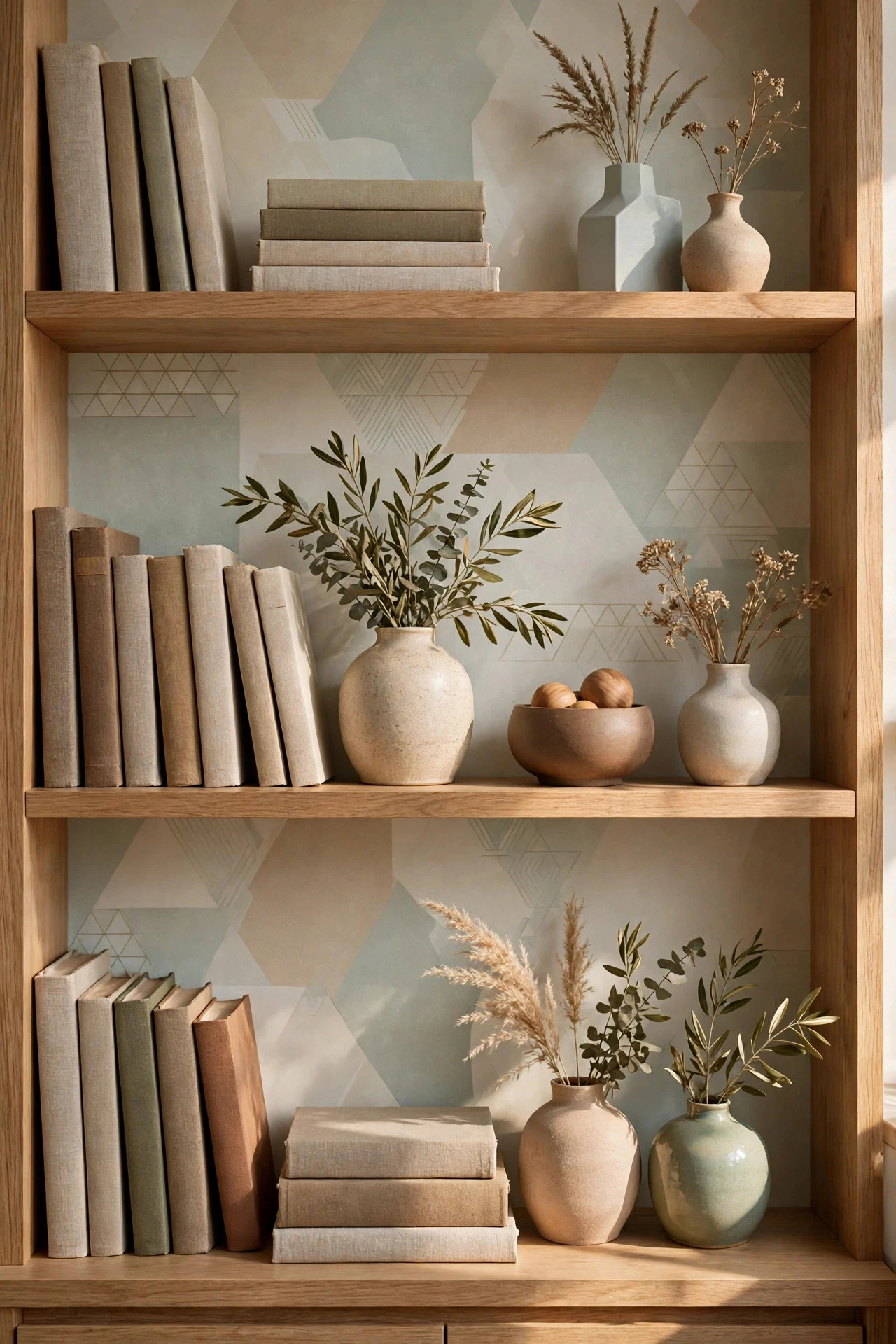
Peel-and-stick paper does the job of wallpaper, tile and new drawer fronts for $10 to $20 a roll, and it peels off cleanly when you move out or change your mind. One roll covers an accent wall behind a bed, a kitchen backsplash, a bookshelf back panel or a tired dresser front — the surfaces that set the tone.
Apply it to a clean, dry, smooth surface, and measure twice: cut the roll 5 cm longer than the surface, stick the top edge first, then smooth downward with a credit card to push out air bubbles. Choose patterns with a small repeat — a subtle geometric, a linen texture, a marble effect — because large bold prints show every misalignment and read as temporary. The best budget use is inside a bookcase or on a single drawer front, where a $12 roll gives a $100 look in the exact spot the eye lands. Avoid peel-and-stick on textured walls or near a stove: it will not grip texture, and heat loosens the adhesive. A thrift store dresser plus one roll of peel-and-stick paper is the classic $30 furniture flip, and it works because the paper does the decorating while the wood does the quality.
9. How Do Plants Make a Home Look Expensive on a Small Budget?
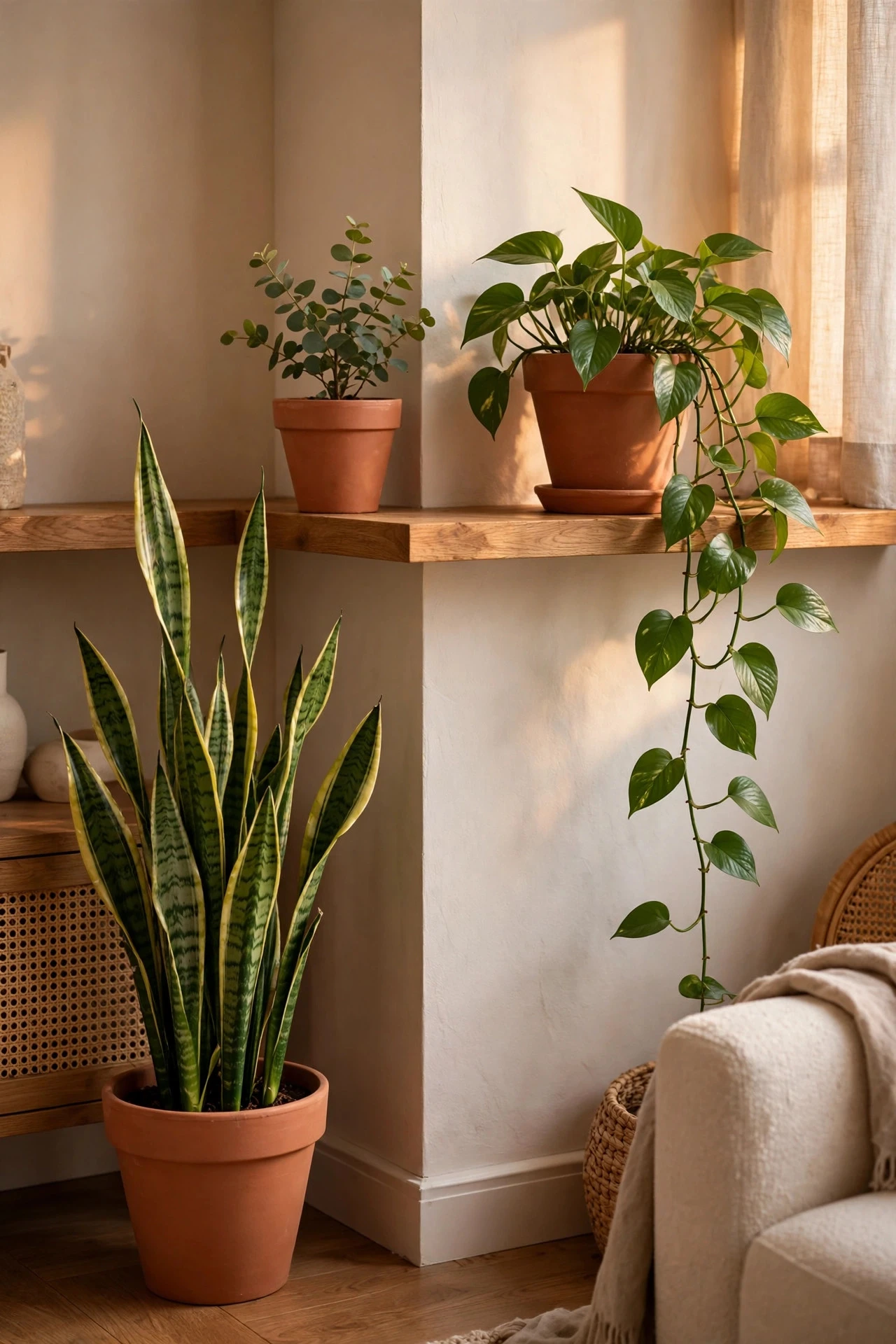
Plants make a home look expensive on a budget because a $8 pothos or snake plant in a $5 ceramic pot adds life, height and colour that no object can copy — and a room with living things reads as cared for. Three plants at different heights do more for a room than three new accessories at the same price.
Start with forgiving plants: pothos, snake plant, ZZ plant and spider plant all survive low light and irregular watering, and a 15 cm nursery pot costs $5 to $10. Put the tallest plant on the floor beside the sofa or in an empty corner, one medium plant on a side table or shelf, and one trailing plant on top of a bookcase so it spills downward. Use matching or same-colour pots — three terracotta pots, three white ceramic pots — because matching pots make mixed plants look like a collection instead of a clearance shelf. Water only when the top 2 cm of soil is dry, and wipe the leaves monthly: dusty leaves look tired, glossy leaves look expensive. If you kill plants, buy a good faux olive branch or eucalyptus stem for $10 to $15 — one convincing faux stem beats three dying real ones.
10. How Do You Make Your Own Wall Art for Under $25?

Make your own wall art for under $25 by framing what you already have: a page from a beautiful book, a piece of fabric, a pressed leaf or a large photo printed at a copy shop for $5. A $12 frame around a $5 print looks identical to a $60 shop print, because the frame does the expensive-looking work.
Choose one large piece over several small ones — a single 50 by 70 cm frame above the sofa has more impact than six small frames scattered around the room. Print in black and white for a cohesive gallery feel, or pick one colour from the room and repeat it in the art. Hang at eye level: the centre of the art should sit 145 to 150 cm from the floor, and the bottom edge should clear the sofa back by 15 to 20 cm. If you have no printer, use fabric: a metre of linen or a patterned cotton remnant stretched over a $10 canvas frame is instant textile art, and it adds the texture that flat prints cannot. The rule for DIY art is the same as for bought art: one confident piece beats a wall of hesitant ones.
11. What Is the Best $50 You Can Spend on a Living Room?
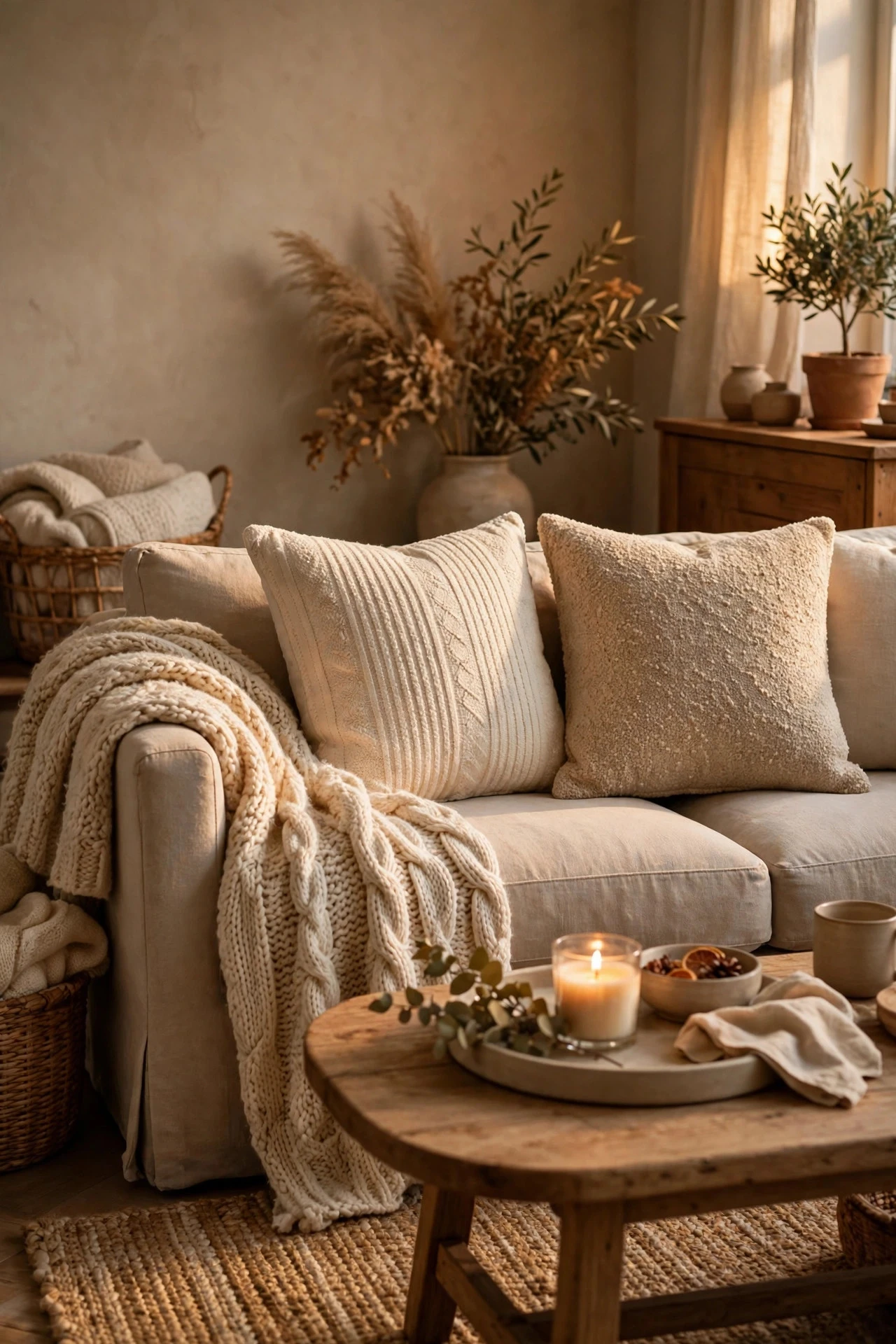
The best $50 you can spend on a living room is a cushion-and-throw combination: two new cushion covers at $10 each and one quality throw at $25 to $30, because textiles are the biggest visible surface after the sofa itself. New textiles change the colour, the texture and the temperature of the whole room in one move.
Choose the throw first, because it is the largest piece: a chunky knit, a waffle weave or a washed linen throw in a warm neutral, about 130 by 180 cm, draped over one arm of the sofa and folded in thirds so it reads as a layer, not a pile. Then pick cushion covers that pull one colour from the throw and one from the rug, so the three textiles talk to each other. Spend the last $10 on a tray or a candle to anchor the coffee table, so the soft new textiles have something solid beside them. This is the $50 that photographs best, too — textiles catch light and shadow in a way hard surfaces cannot, which is why every styled room in a magazine leads with them.
12. How Do You Layer a Rug on a Budget?
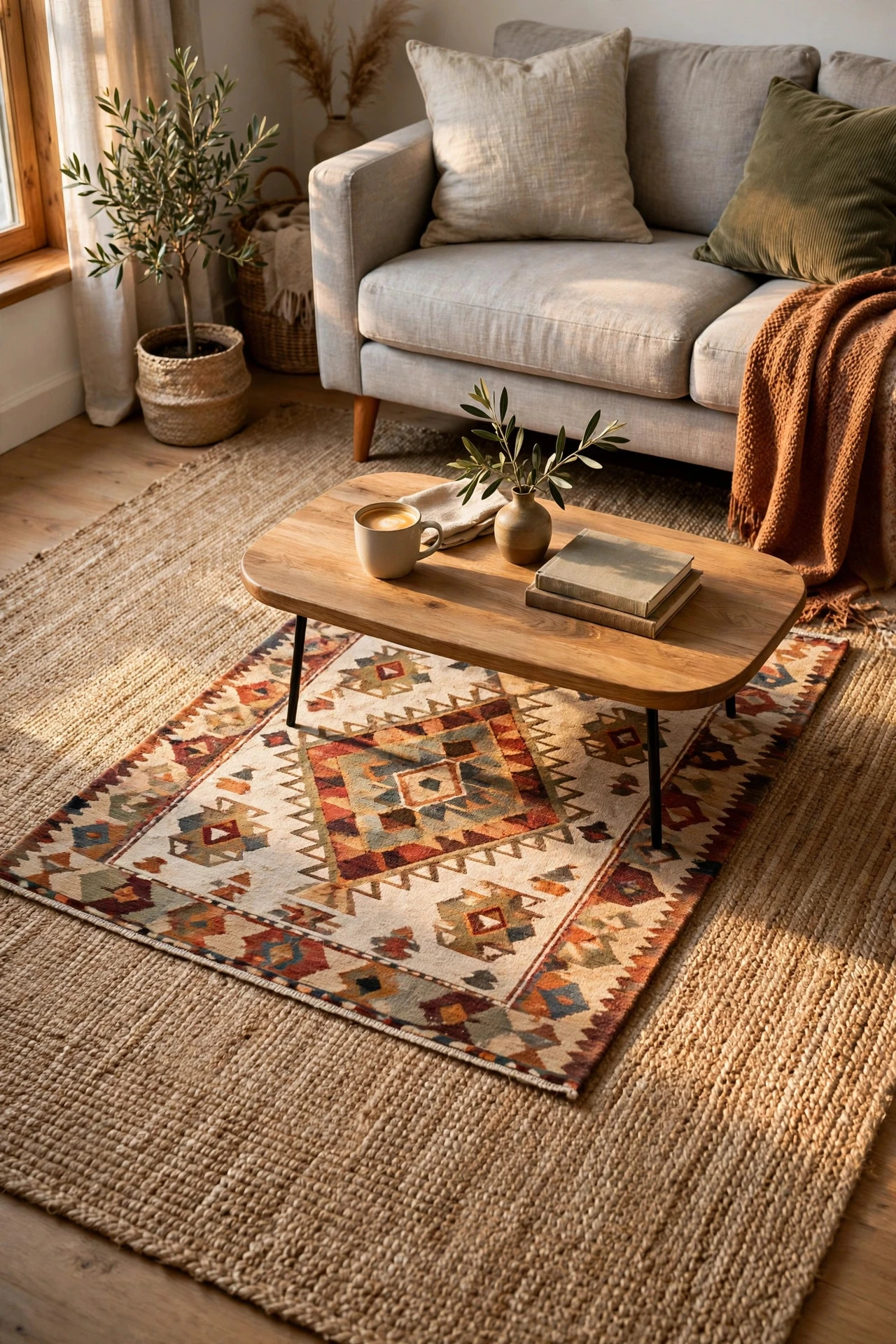
Layer a rug on a budget by placing a patterned rug, 120 by 180 cm at $30 to $45, on a plain rug you already own, or a jute base at $40 to $60. Layering adds pattern and texture without the $200 price of a large statement rug, and it is the fastest way to define a seating area.
Let the bottom rug extend 15 to 20 cm beyond the top rug on all sides, and keep the top rug's pattern bold — a vintage-style print, a geometric, a faded Persian look — because the bottom layer should be quiet and the top layer should do the talking. Centre the layered pair under the coffee table with the front legs of the sofa sitting on the rug, so the seating group reads as one zone. These 22 living room rug ideas to ground your seating area show how rug size and placement change a room, and layering follows the same rules at half the price. Avoid layering two thick-pile rugs — the stack slides and trips — and use a $8 rug pad underneath so nothing moves when someone walks across it.
13. Where Should You Buy Secondhand Lighting?
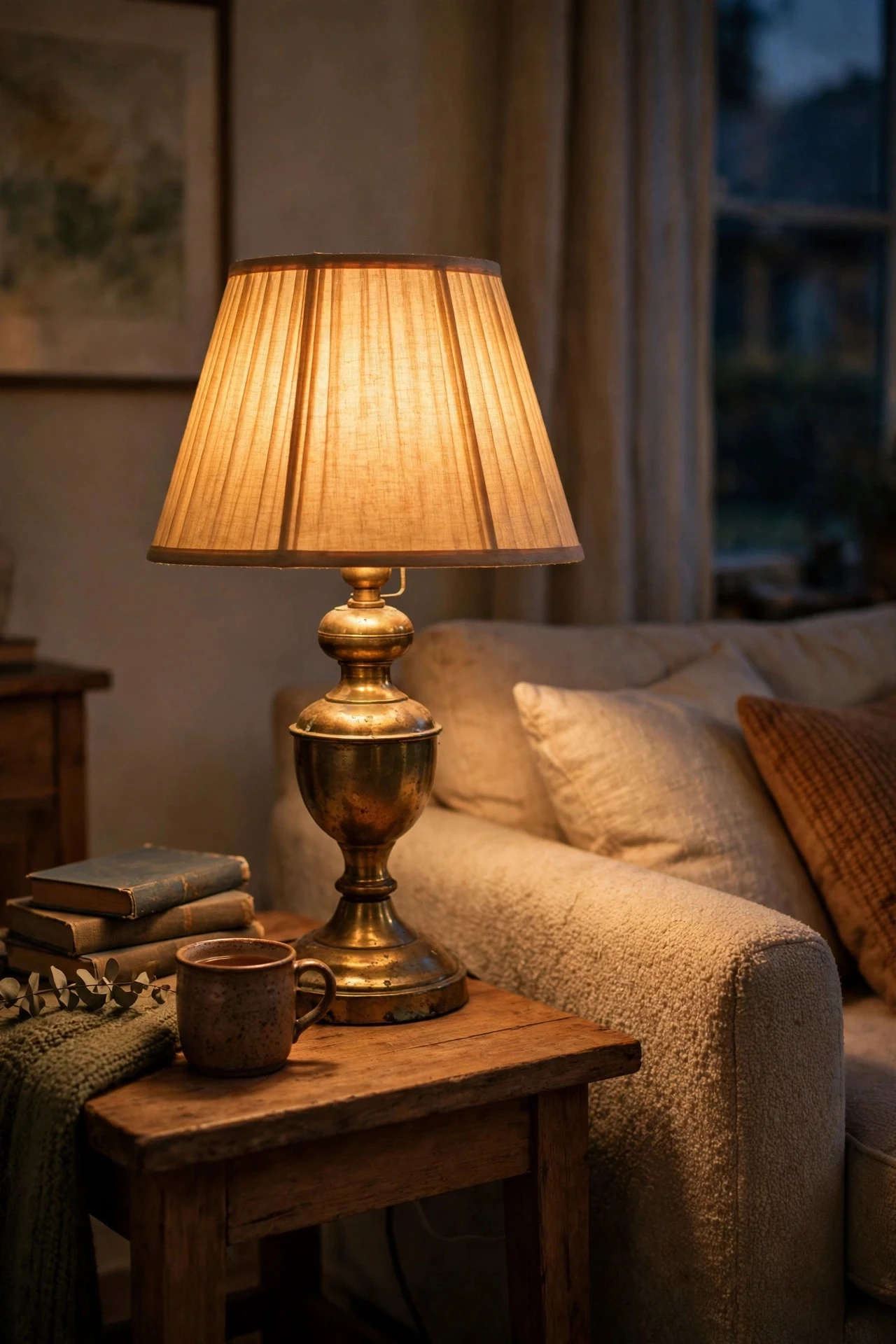
Buy secondhand lighting at thrift stores, estate sales, flea markets and online secondhand marketplaces, where a solid brass or ceramic table lamp costs $10 to $20 instead of $60 to $120 new. Lighting is the best secondhand category, because a lamp's value is in its shape and its shade, and both survive decades if the wiring is sound.
Check three things before you buy: switch the lamp on in the shop, look for frayed cord or a cracked socket, and make sure the shade is straight and unstained — a new shade costs $15 to $25, so a damaged shade eats the saving. Spend the money you save on the bulb: a warm-white 2700K LED in a thrifted lamp gives the same glow as a designer lamp, because the light is what you actually see. One good lamp at $15 on a side table, plus a $10 floor lamp from the same source beside the sofa, gives a room its evening layer for $25 total. These 22 dream house decor ideas for a home that feels like you treat lighting as the room's jewellery — and jewellery is the one thing worth buying secondhand, because the metal and the glass outlast the price tag.
14. Why Is a Budget Mirror Worth More Than Budget Art?

A budget mirror is worth more than budget art because it doubles the light in a room, reflects the best view and makes the space feel larger — and a $30 to $45 discount-store mirror does all of it, while a $30 print just fills a wall. Mirrors are the only decor item that improves the room around them.
Hang one large mirror, at least 60 by 90 cm, opposite a window or beside it at a slight angle, so it catches daylight and throws it across the room — a mirror opposite a blank wall reflects a blank wall, which is worse than nothing. Lean a tall mirror in a bedroom corner for $40 to $60, or hang a round mirror above a console table in the entryway for $25 to $35. Check the frame before you buy: a simple black, gold or wood frame looks expensive, while an ornate plastic frame with a fake antique finish looks like a prop. Keep the mirror clean — streaks show instantly at this size — and never hang a mirror where it reflects clutter, because it doubles that too.
15. How Do You Paint a Room for Under $100?
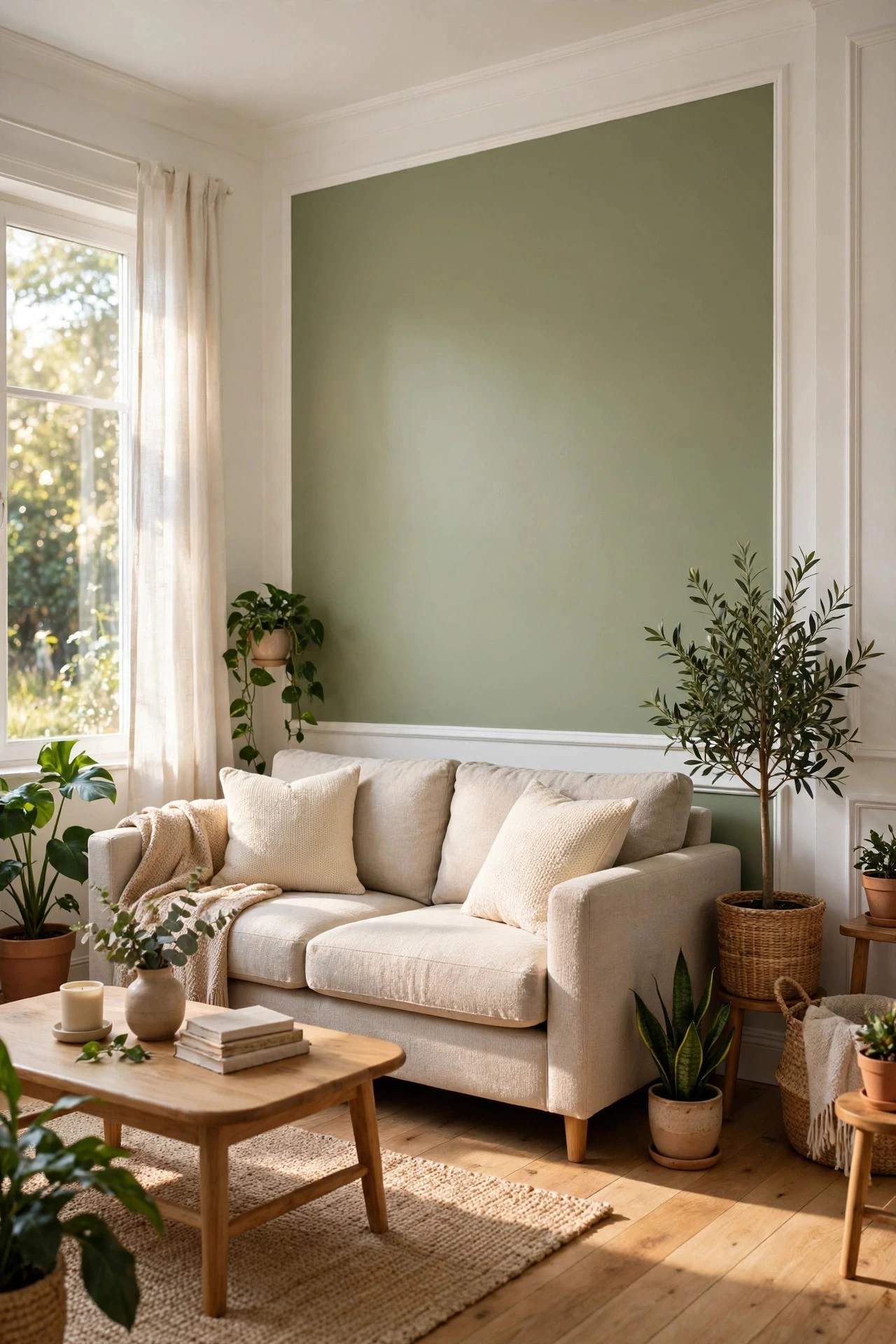
Paint a room for under $100 by buying a 4-litre tin at $40 to $55, a $10 roller set and a $5 roll of painter's tape, and painting an accent wall or a small room yourself. Paint is the highest-impact purchase in decor: one tin changes the colour of every wall, every photo and piece of furniture in the room.
Choose a warm neutral — warm white, greige, soft sage or pale clay — because warm neutrals make cheap furniture look better, while cool grey makes it look colder and cheaper. Paint a test patch 60 cm square and live with it for two days in morning and evening light before you commit, because paint changes colour with the light and the small swatch lies. Cut in the edges with a brush first, then roll in W-shaped strokes, and do two thin coats with four hours of drying between them. Skip the ceiling and the trim if the budget is tight — a fresh wall colour with clean white trim reads as a full repaint, while a painted ceiling nobody notices eats $30 of paint. One weekend, one tin, one room transformed.
16. How Do You Find a Secondhand Furniture Score?

Find a score by checking thrift stores, estate sales and online marketplaces on weekday mornings, when new stock appears and the weekend crowd has not arrived. Solid wood pieces — a $30 oak table, a $40 dresser, a $25 wooden chair — are the scores to chase, because solid wood can be sanded, painted and repaired, while flat-pack furniture cannot.
Test before you buy: open every drawer, sit on every chair, wobble the table and smell the piece — musty wood can be aired out, but a wobbly frame is a repair bill. Measure the piece and the doorway it must pass through, and bring a tape measure every time; a $30 dresser that does not fit through the door is a $30 mistake. Budget $10 to $15 for the fix: new knobs, a tin of wax, a set of felt pads, because the small repairs are what make a secondhand piece look bought rather than rescued. A solid wood dresser at $40 plus $15 of knobs and paint is a $55 piece that would cost $250 new, and it will outlast the new one.
17. What Curtains Make a Room Look Expensive on a Budget?
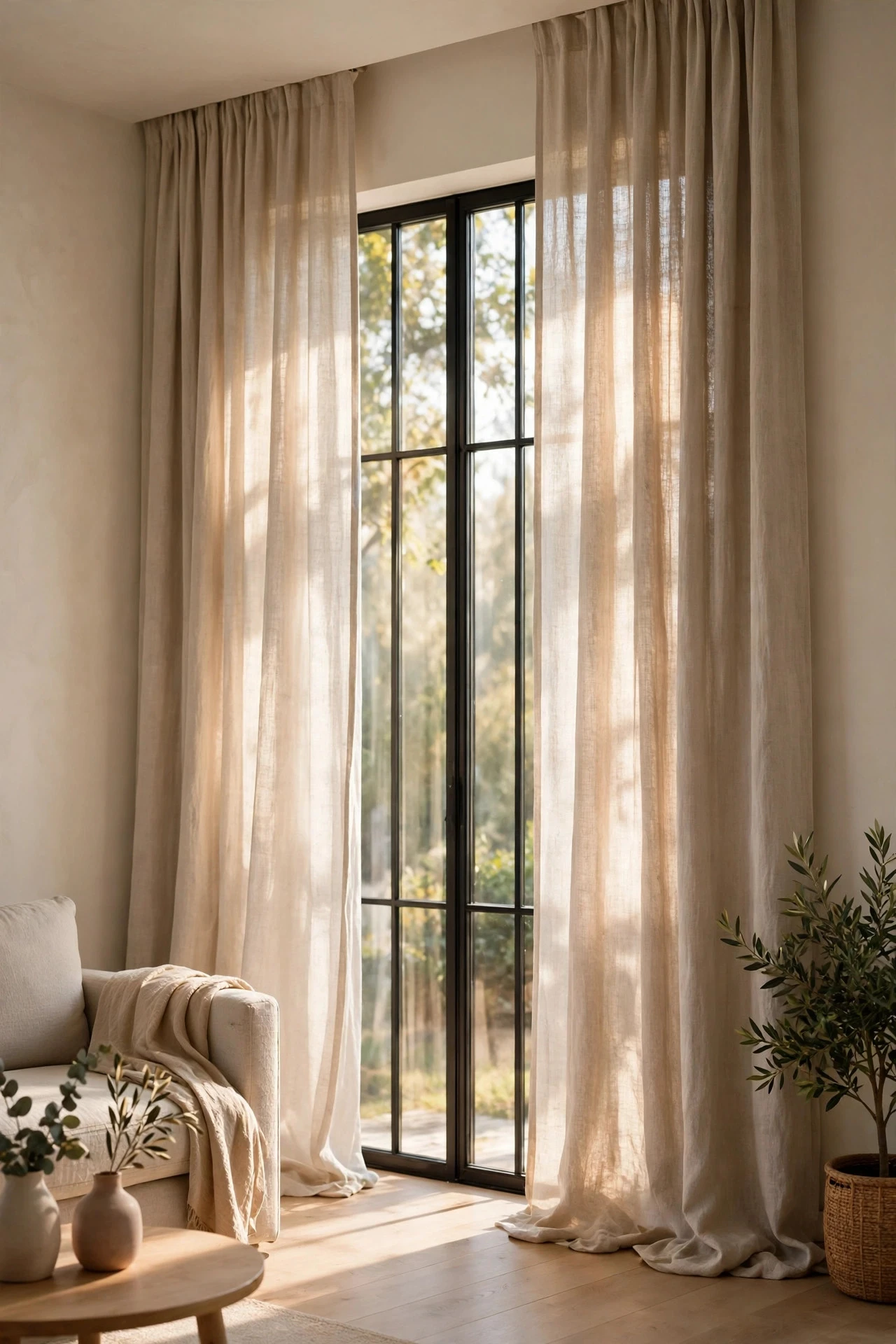
Curtains make a room look expensive when hung high and wide in a weighted fabric: hang the rod 10 to 15 cm above the frame and 15 to 20 cm wider each side, so the window looks larger and the curtains frame it. A $30 to $45 pair of linen-look curtains, hung properly, beats a $150 pair hung badly.
Buy curtains 15 to 20 cm longer than the drop to the floor, so they just kiss the floor — curtains that stop at the sill look unfinished, and curtains pooling on the floor collect dust. Choose a solid colour one shade darker or lighter than the wall, because a solid curtain reads as calm and expensive while a busy pattern fights the rest of the room. Use a simple black or brass rod at $15 to $20, and hang the panels so the fabric falls in even folds — pinch the top of each panel and space the folds evenly before you push the curtain along the rod. One window dressed this way changes the whole room's proportions, which is why designers spend on curtains before they spend on art.
18. How Do You Decorate a Living Room on a $100 Budget?

Decorate a living room on a $100 budget by spending $30 on textiles, $25 on lighting, $25 on one secondhand piece and $20 on greenery and candles — the four categories that set the room's tone. Textiles warm it, lighting glows it, one piece grounds it, and greenery makes it feel alive, and together they read as a finished room.
Start with the free changes first: edit the shelves, pull the sofa off the wall, move the art — then spend in this order, because order matters. Buy the throw and cushion covers first, because they are the largest visible change; then the thrifted lamp, because evening light is when the room is actually used; then the plant, because it fills the corner the sofa left empty; and the candle last, because it is the finishing touch, not the foundation. Keep a $10 reserve inside the $100 for the tape, the batteries or the bulb you forgot. A living room done this way does not look like a $100 room — it looks like a room where someone made decisions, and decisions are what expensive rooms are made of.
19. How Do You Decorate a Bedroom on an $80 Budget?
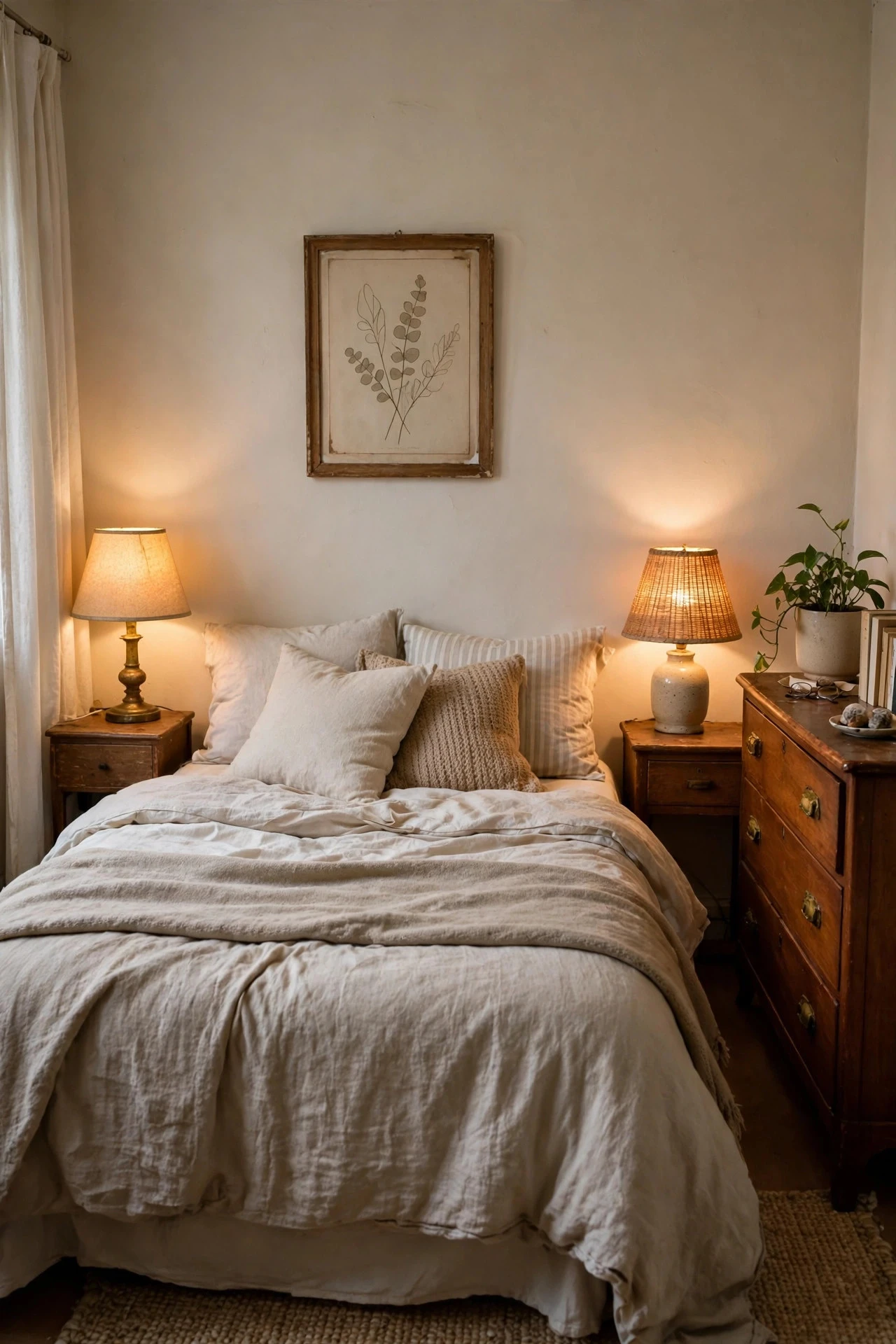
Decorate a bedroom on an $80 budget by spending $30 on bedding, $20 on lighting, $15 on one piece of art or a mirror and $15 on a plant and a candle. The bedroom is the easiest room to transform, because the bed is 60 percent of what you see, and new bedding is the fastest change in the house.
Choose bedding in a solid warm white or a soft neutral, with one textured layer on top — a waffle throw, a quilted coverlet or a linen-look duvet — because layered bedding looks like a hotel bed while a single flat duvet looks like a student room. Add two matching bedside lamps at $10 each from a thrift store, or one good lamp and a $5 stack of books as a bedside table, and hang the art or mirror above the bed at 145 to 150 cm centre height. These 22 guest bedroom ideas to make visitors feel at home use the same formula — layered bedding, warm light, one honest piece of art — and it works in a guest room or a master bedroom because the bed does most of the talking. Finish with the plant on the dresser and the candle on the nightstand, and the room is done.
20. How Do You Refresh a Kitchen and Bathroom for $50?
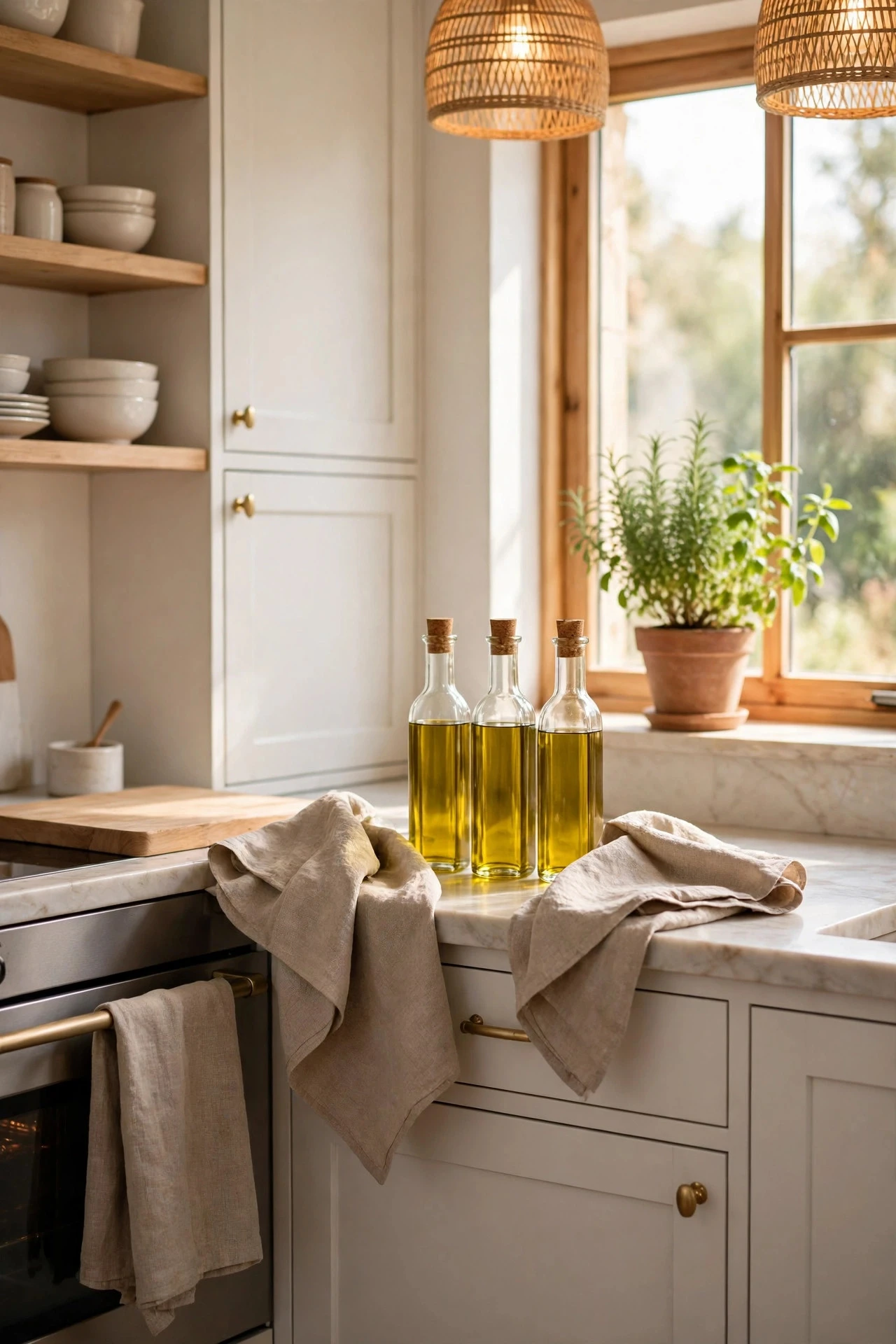
Refresh a kitchen and bathroom for $50 by spending $15 on new textiles, $15 on storage that looks like decor and $20 on one small upgrade in each room. Kitchens and bathrooms are the hardest rooms to decorate cheaply, because they are full of fixed surfaces — so change the things that move, and the room follows.
In the kitchen, swap the tea towels and the dishcloths for matching linen-look ones at $10, put the oils and soaps in matching bottles at $5, and add a $5 herb plant on the windowsill. In the bathroom, spend $10 on matching towels, $5 on a soap dispenser and a tray, and $5 on a small plant that likes humidity, like a pothos. These 22 small kitchen storage ideas that make every inch work and these 22 small bathroom storage ideas that make every inch work both show the same trick: matching containers and folded textiles turn a working room into a styled one, because the eye reads matching as deliberate. Keep the counters clear — one tray, one plant, one soap — and the $50 refresh looks like a $200 one.
21. What Should You Splurge On and What Should You Save On?
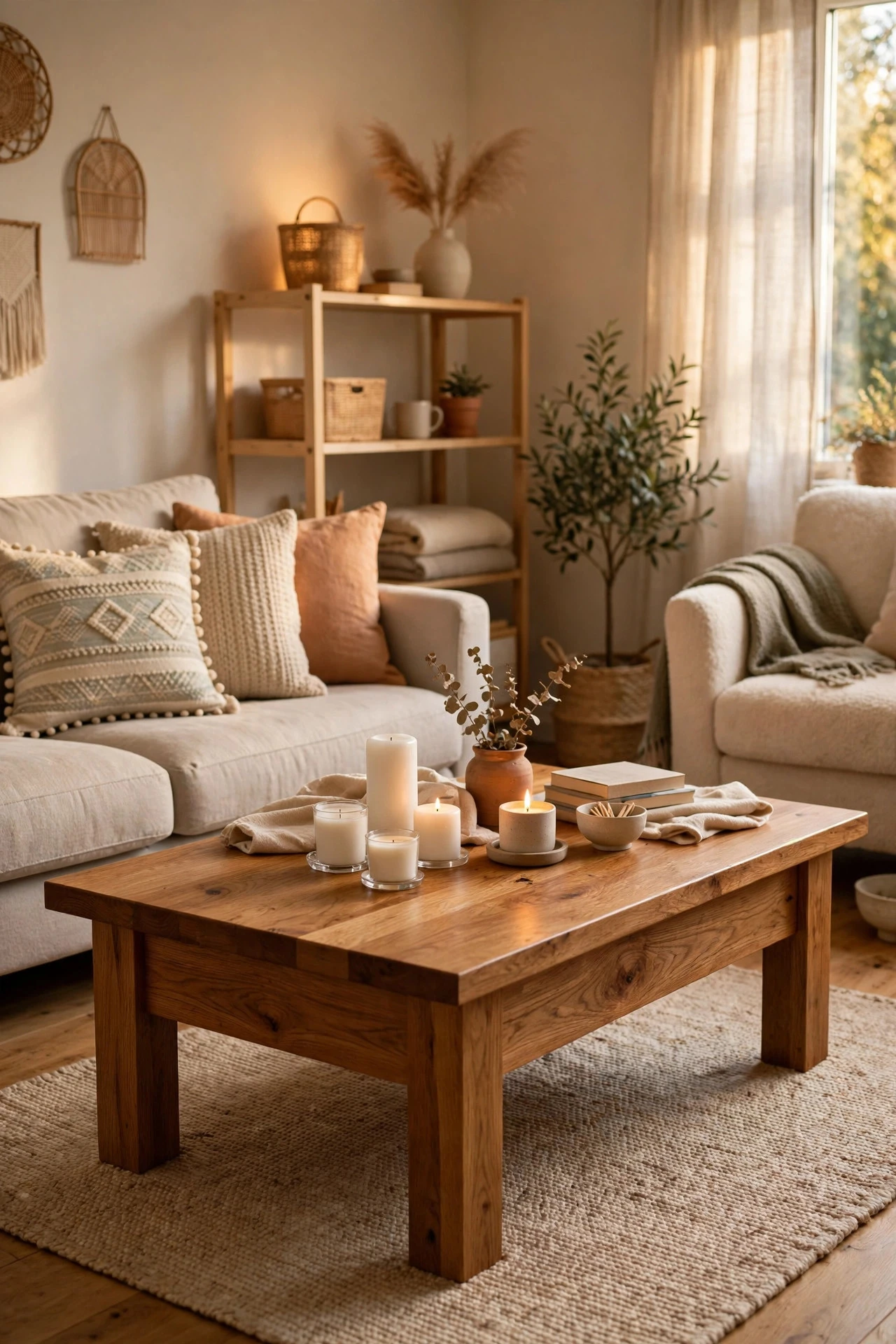
Splurge on pieces you touch and sit on, and save on pieces you only look at: spend on the sofa, the mattress and the lamp you use every evening, and save on cushions, candles and art, because those change with the seasons. The rule: if your body meets it daily, buy quality; if your eye meets it rarely, buy cheap.
A $300 secondhand solid-wood table beats a $90 flat-pack one, because the solid table lasts twenty years and the flat-pack lasts two — the cost per year is lower on the expensive piece. A $40 rug pad under a $60 rug is a splurge worth making, because the pad stops the rug sliding and makes it feel twice as thick. Save on trend pieces: the patterned cushion, the coloured vase, the seasonal candle — buy those at $5 to $10, enjoy them for a year, and replace them without guilt. Never splurge on something because it is on sale, and never save on something because it is boring: the boring pieces — the mattress, the rug pad, the light bulbs — are the ones that decide whether the room actually works.
22. How Do You Plan a Whole-Home Budget That Actually Works?
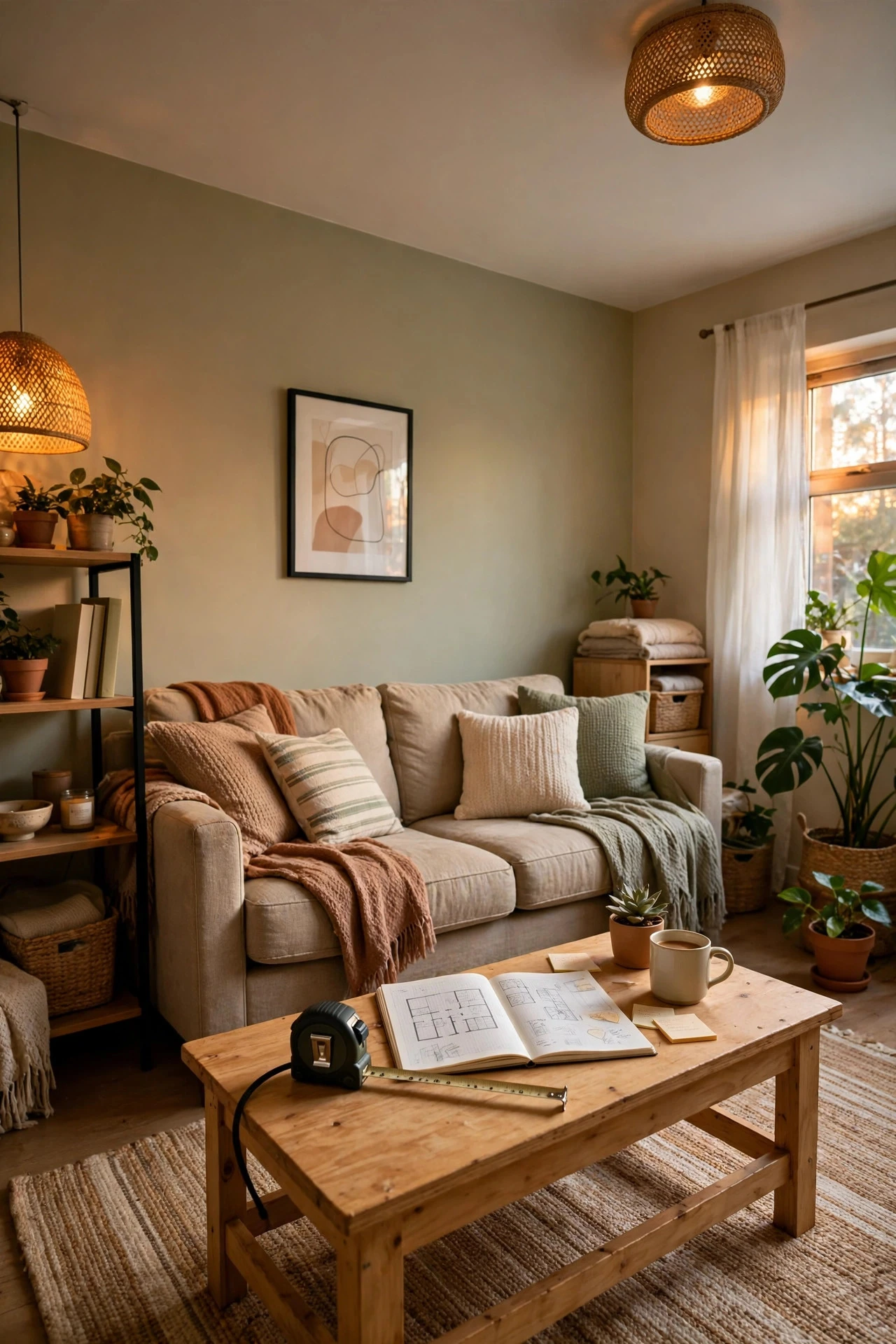
Plan a budget that works by setting one total number first — $300 to $500 is realistic for the whole house — then dividing it by room, living room most, hallway least. A total stops the drip of $15 purchases adding up to $400 without changing a room, because every purchase has to earn its place in the plan.
Write the plan on paper: room, budget, the one hero piece, the three supporting purchases and the free changes, with a date for each room. Do one room at a time, finish it completely, and live with it for two weeks before starting the next — a finished room teaches you what the next room needs, and a half-finished house teaches you nothing. Keep 10 percent of the total in reserve for the fix you did not expect: the broken lamp, the wrong paint colour, the rug that is 10 cm too short. The plan is not about being strict; it is about being deliberate, because a deliberate $300 home looks better than an accidental $1,000 one, and the difference is visible from the doorway.
Practical Tips
Set the budget before you shop, not after: decide the total, divide it by room, and write the numbers on your phone, because a budget decided in the shop is a budget already broken. Shop with measurements, not guesses — room width, window height, sofa length, table height — and carry a tape measure, because a $20 cushion cover that does not fit the cushion is a $20 waste, and a $30 curtain that is 10 cm too short is a $30 lesson.
Check thrifted pieces properly before you pay: switch the lamp on, open the drawer, sit on the chair, smell the wood, and look for the maker's mark on the back, because a solid piece with a small fix is a bargain and a broken piece with a big fix is a project you did not want. Buy the hero piece first and the accessories last, because the hero decides the room and the accessories only fill the gaps — five $10 accessories bought before the $50 lamp are $50 that should have been the lamp. Keep every receipt for two weeks, and keep the tags on until the piece is in place, because the return window is your safety net when a colour looks different at home.
The most common money wastes are the ones that feel like bargains: three small rugs instead of one right-sized one, six cheap cushions instead of three good covers, a set of matching accessories that match nothing else in the room, and anything bought because it was on sale rather than because it was on the list. Buy one good thing, live with it for a week, then buy the next — slow buying is the cheapest buying there is.
Final Thoughts
Budget home decorating is not a compromise — it is a skill, and the skill is deciding where the money goes and where it does not. The free changes cost nothing and change the most, the thrifted pieces carry the quality, the textiles carry the warmth, and the one good lamp carries the evening. Spend deliberately, buy slowly, and let the room tell you what it needs next.
Frequently Asked Questions
How much money do I need to decorate a home on a budget?
You can transform one room for $80 to $150 and a small home for $300 to $500, if you start with the free changes and spend on textiles, lighting and one hero piece. The free ideas alone — decluttering, rearranging and shopping your own home — change a room more than a $100 shopping trip, so do those first.
What is the first thing to buy when decorating on a budget?
Buy textiles first: a quality throw and two cushion covers, because they are the largest visible surface after the sofa and they change the room's colour and texture in one move. Then buy lighting, because a warm lamp changes the room after dark, and then one secondhand hero piece, because a solid table or lamp grounds everything else you add.
Where can I find cheap home decor that does not look cheap?
Find cheap home decor that does not look cheap at thrift stores, estate sales and end-of-line sales, and choose natural materials — solid wood, linen, cotton, ceramic, brass — over shiny plastic and fake finishes. Matching pots, matching containers and a consistent colour story make inexpensive pieces look deliberate, while mixed cheap finishes look like a clearance shelf.
How do I make a small room look expensive on a budget?
Make a small room look expensive by editing hard, using one large mirror for double light, and choosing one hero piece over five small ones. Keep the colour story to two colours plus one metallic, hang curtains high and wide, and leave 10 to 15 cm of empty space on every shelf, because empty space reads as confidence.
Should I buy secondhand furniture or new budget furniture?
Buy secondhand solid wood furniture over new budget furniture, because solid wood can be sanded, painted and repaired, while flat-pack furniture cannot. A $40 solid wood dresser plus $15 of paint and knobs outlasts a $90 flat-pack dresser by years, and it looks better too. Check every drawer, sit on every chair and measure the doorways before you pay.
How do I stop overspending when decorating on a budget?
Stop overspending by setting one total budget before you shop, writing a list per room with one hero piece and three supporting purchases, and buying one room at a time. Keep 10 percent in reserve for mistakes, keep receipts for two weeks, and wait a week between purchases — slow buying is the cheapest buying.