How to Style a Whimsical Bedroom That Feels Grown-Up, Not Childish
A whimsical bedroom is not a child's room with the volume turned down. It is an adult bedroom that keeps a sense of story — colour-drenched walls, a scalloped headboard, a moon-and-stars motif repeated with discipline — and pairs that playfulness with grown-up materials: real velvet, solid wood, linen, brass. The difference between magical and childish is restraint. One motif, one tight palette, and quality in every piece.
This guide is for adults who want a bedroom with personality: renters, first-home owners, and anyone whose room currently feels safe but forgettable. Every idea below answers a specific question first, then gives you the detail to act on — named paint colours from Farrow & Ball and Benjamin Moore, real measurements in feet and inches, and honest price ranges in pounds, so you can start with one change today or plan the whole room.
Looking for more inspiration? Our Nest Decorz homepage gathers the latest home decor ideas, seasonal decorating guides and room-by-room styling tips in one place — start there and explore.
Quick answers
– One motif, repeated three times: pick celestial, mushroom, or circus stripes — and use it in exactly three places, no more. Repetition makes it feel designed; a fourth appearance makes it a theme park. – Colour drenching is the shortcut: paint walls, skirting and ceiling in one jewel tone and the room instantly feels storybook, even with plain furniture. – Keep the palette tight: one jewel tone, one soft neutral, one metallic — every pattern and object must sit inside those three. Whimsy without a palette is clutter. – Spend on the bed and the light: a scalloped headboard and one characterful lamp carry the whole look; cushions and prints are the cheap supporting cast. – Grown-up means quality materials: velvet, linen, solid wood and brass read adult; shiny polyester, plastic and cartoon prints read like a children's room.
1. How Do You Colour-Drench a Bedroom in One Jewel Tone?

Paint the walls, skirting boards and ceiling in the same jewel tone — teal, deep plum or dusty rose — in a matte finish, and the room instantly feels like a storybook setting. Try Farrow & Ball Inchyra Blue No. 289 for deep teal, or Benjamin Moore Vintage Wine 1257 for warm plum.
Colour drenching works because it removes visual interruptions: no white ceiling line, no pale skirting breaking the mood. Use one finish throughout so the colour reads as one continuous surface, and keep the bed linen pale — cream or oatmeal — so the bed glows against the saturated walls. A 12-square-metre bedroom needs about 5 litres of paint for two coats, costing £45–£70. If the room faces north, choose the warmest jewel tone you like; cool teal in a north-facing room can turn grey by mid-afternoon.
2. What Makes a Scalloped Headboard Look Grown-Up?
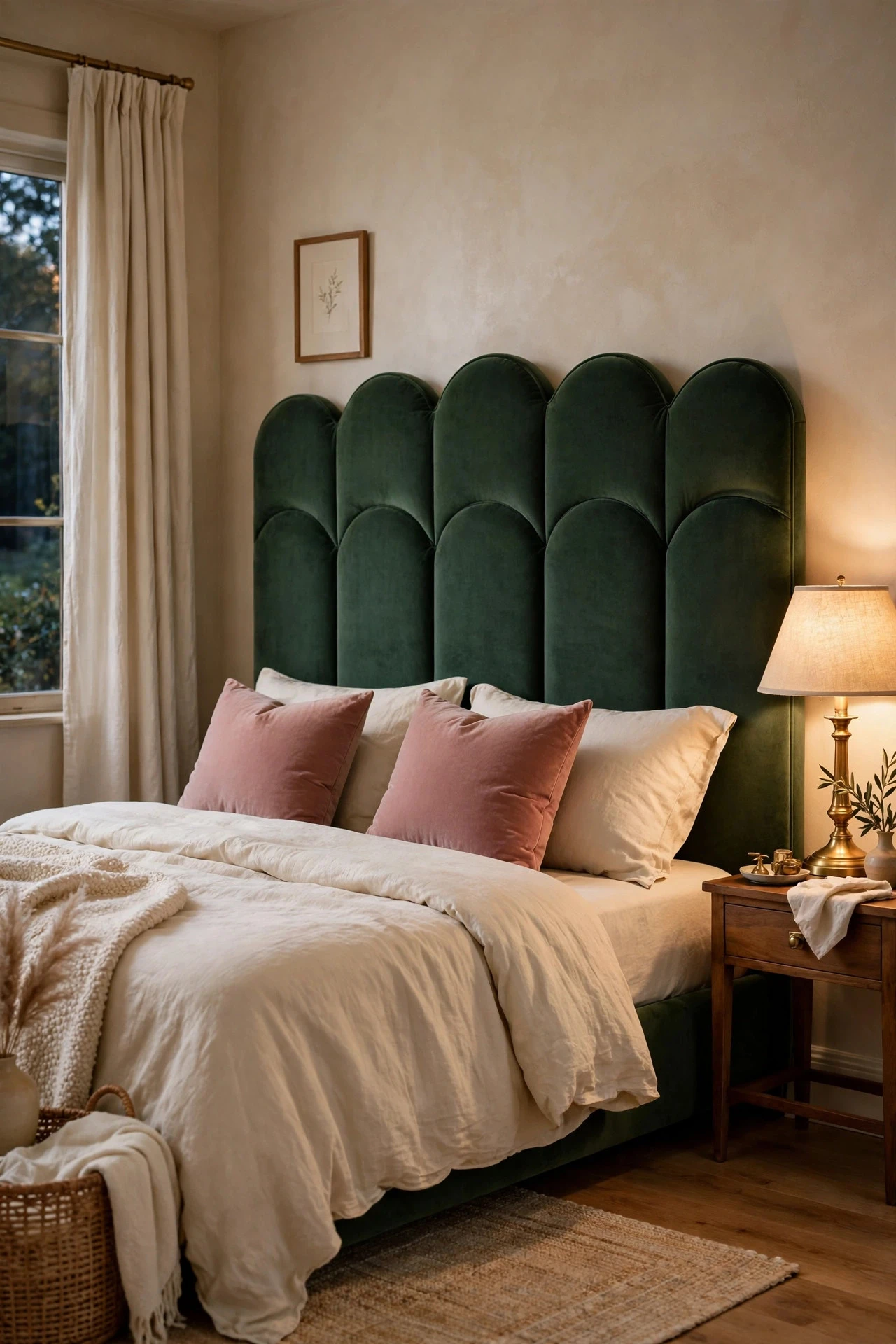
Choose a tall scalloped headboard in a solid, adult fabric — forest-green velvet, dusty-rose linen or deep-teal bouclé — 120–140 cm high for a double bed and 150 cm for a king, with wide, shallow scallops rather than small, frilly ones. The scallop is the whimsy; the scale and the fabric are what keep it grown-up.
Small, tight scallops in a pale pink read nursery. Wide scallops — each arc 25–30 cm across — in a rich, matte fabric read like vintage French furniture. Expect £250–£600 for a quality upholstered scalloped headboard, or £120–£200 for a slip-on cover if you want to test the shape first. Mount it so the top sits 15–20 cm above your pillows when propped for reading. For more ways to make the bed the star, our bedroom headboard ideas for a bed that looks designed cover panel, wingback and upholstered styles that pair well with a scallop.
3. How Do You Use a Celestial Motif Without It Looking Like a Nursery?
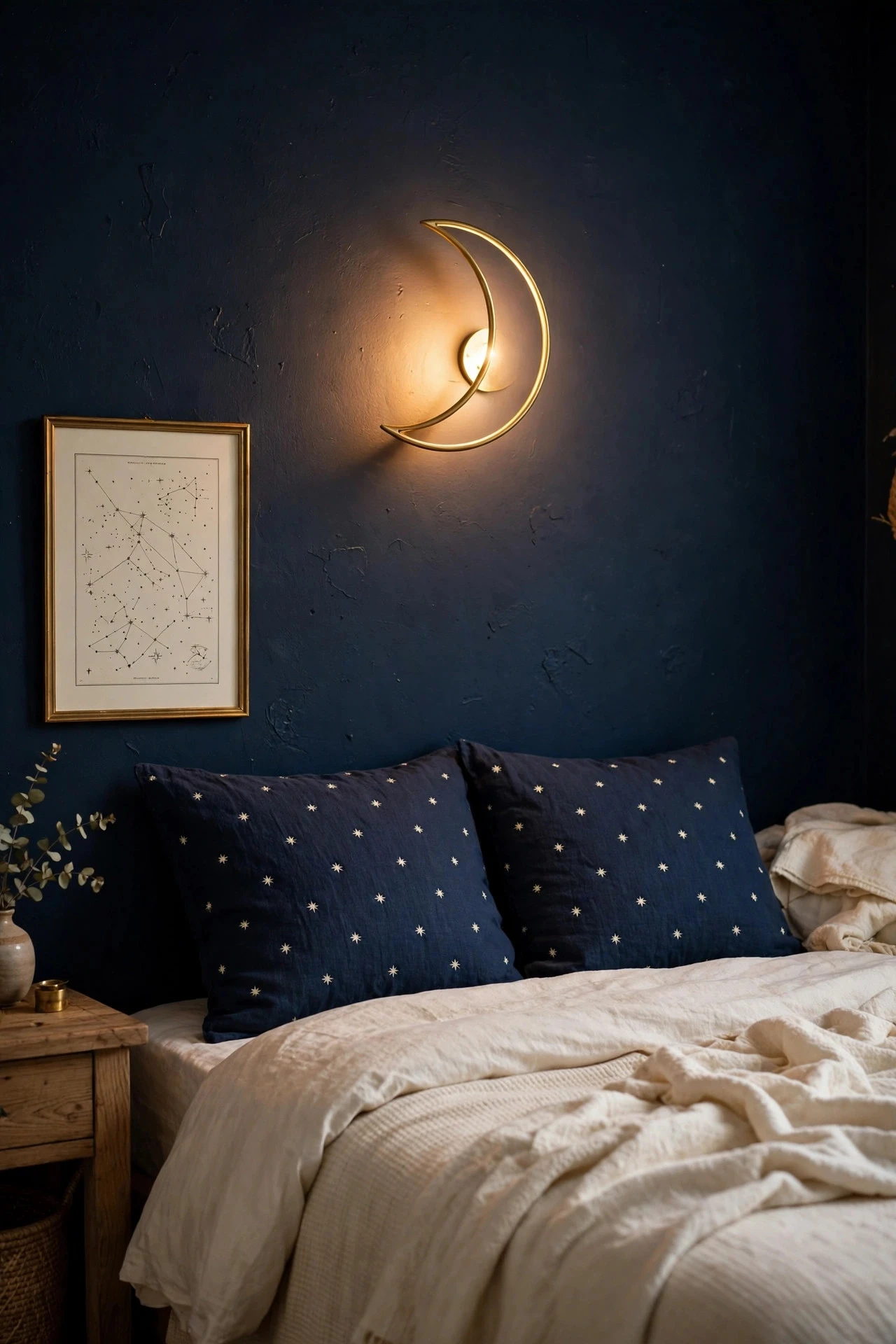
Use moons and stars as a quiet, repeated motif in adult materials: a brass crescent-moon wall light, star-patterned linen cushions in one colour, and a single framed constellation print. Keep the palette midnight blue, cream and brass, and never use glow-in-the-dark stickers or cartoon moons.
The celestial motif works for adults when it feels astronomical rather than decorative — think observatory, not nursery ceiling. A brass crescent-moon sconce (£40–£90) above the bed is the hero piece; pair it with two cushions in a small star print on navy linen (£20–£35 each) and one framed print of a real constellation, such as Orion or Cassiopeia, in a thin brass frame. Limit the motif to those three appearances. Avoid gold glitter, plastic stars and anything that glows, and keep the rest of the room plain so the motif reads as a deliberate thread, not a collection.
4. Can Mushroom Decor Work in an Adult Bedroom?
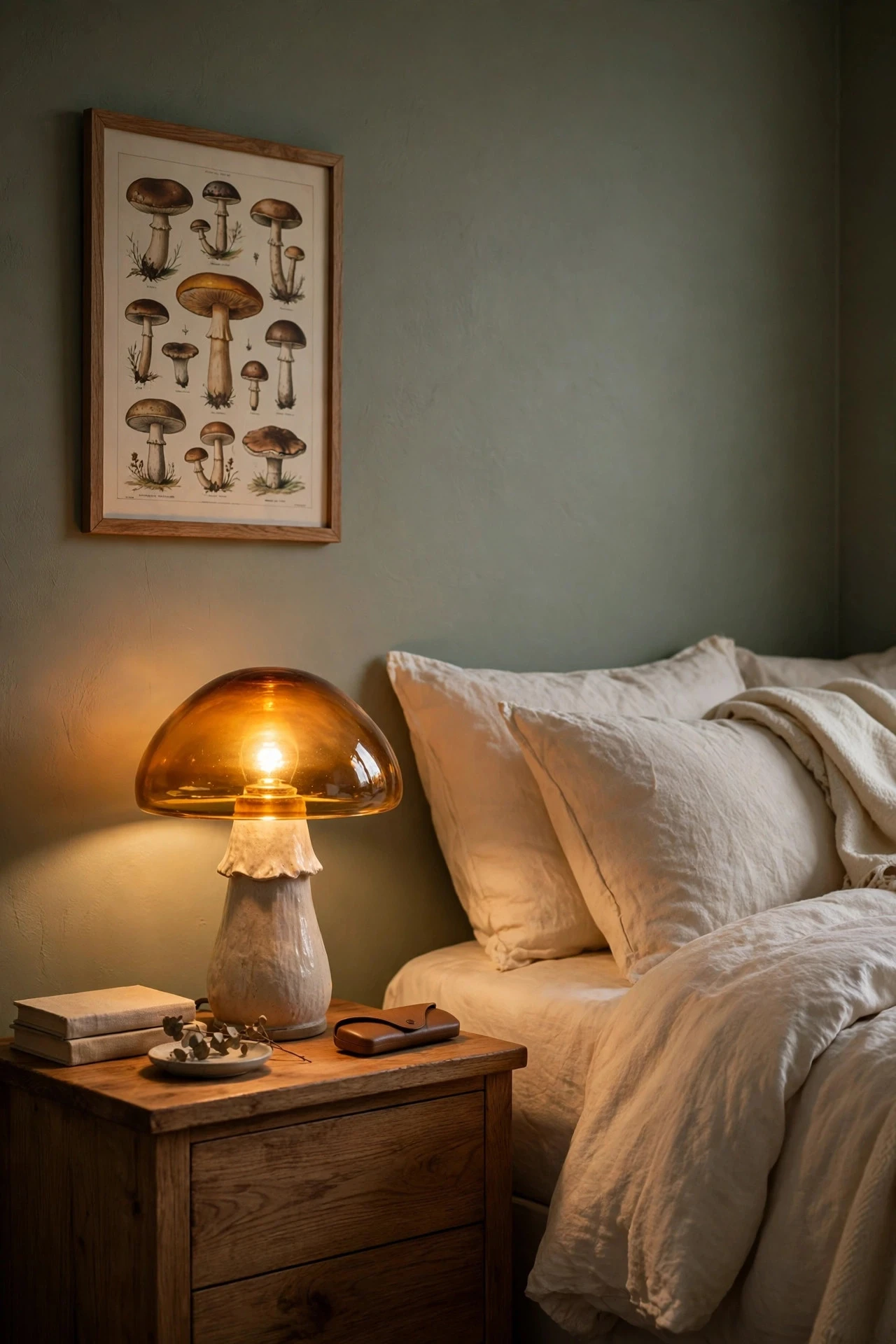
Yes, when the mushrooms are sculptural rather than cute: a mushroom table lamp with a hand-blown glass or ceramic cap in amber, sage or cream, a single framed vintage mycology print, and a toadstool-shaped cushion in velvet. Avoid cartoon mushrooms, bright red caps with white spots, and anything marketed as a children's night light.
Mushroom decor has moved firmly into adult interiors because the shape is sculptural — a curved cap on a slim stem is a pleasing silhouette in any room. The classic is the mushroom lamp: a ceramic or glass table lamp 35–45 cm tall on the nightstand, with a warm 2700K bulb inside the cap so it glows like a lantern. Expect £50–£120 for a quality ceramic mushroom lamp, or £25–£45 for a smaller glass version. Two mushroom moments are charming; five make the room a forest floor.
5. How Do Circus Stripes Stay Playful Instead of Childish?
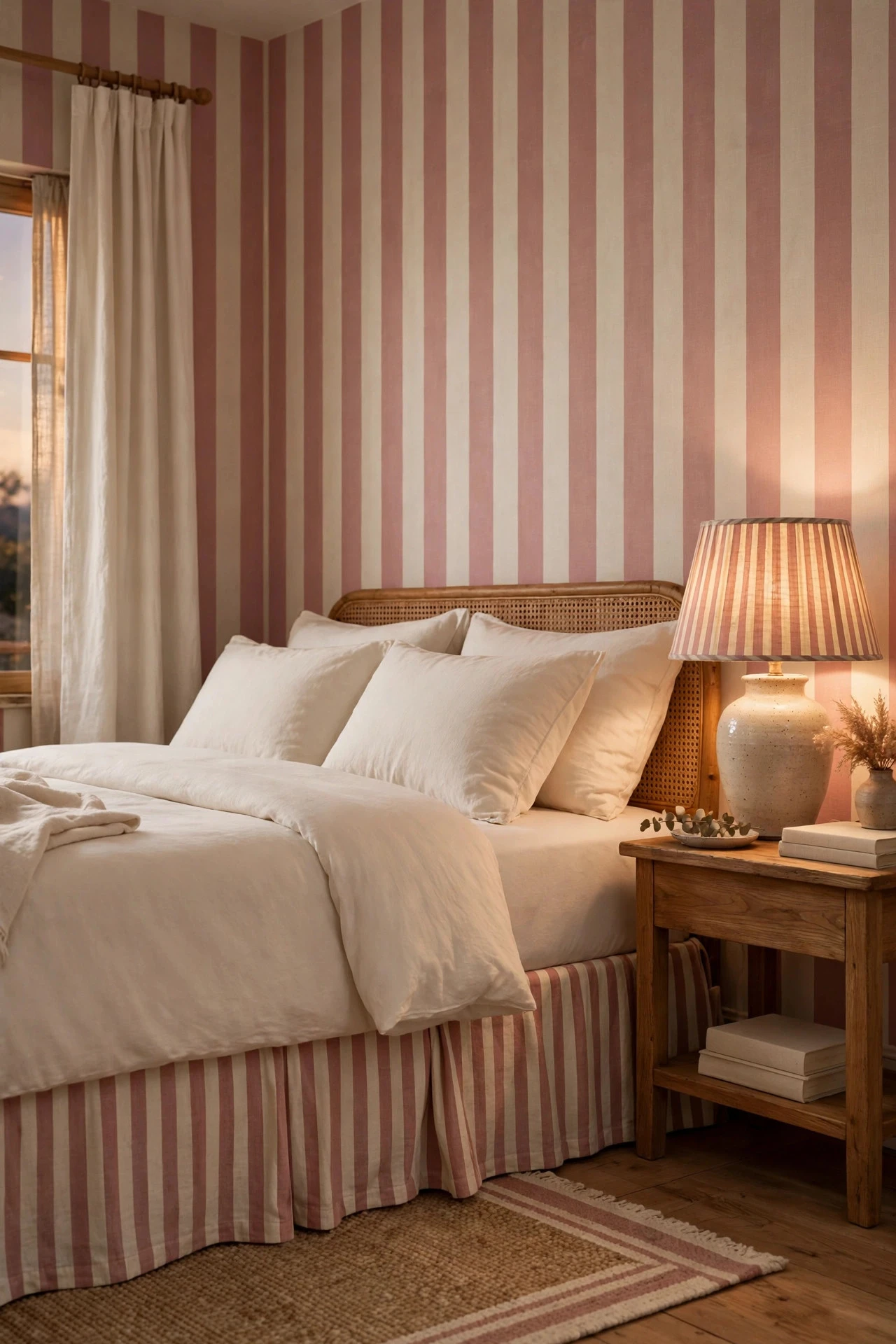
Use wide, tonal stripes — cream and dusty rose, or sage and cream — on one element only, such as the bed skirt, a single curtain panel, or a striped lampshade. Keep the stripe width 8–12 cm, the colours muted, and the rest of the room plain so the stripes read as a tailored detail.
Narrow, high-contrast red-and-white stripes belong on a fairground stall; wide, soft stripes in a muted palette belong in a grown-up bedroom. The safest application is a striped lampshade (£25–£50) on a plain ceramic base, or a striped cotton bed skirt in dusty rose and cream that adds a tailored line under the mattress. Never stripe two elements in the same room: a striped bed skirt plus striped curtains plus a striped rug is a circus tent, and the room stops feeling like a place to sleep.
6. What Are the Rules for Mixing Patterns in a Whimsical Bedroom?

Mix three patterns maximum, in three different scales, all inside one tight palette: one large-scale print (floral wallpaper or a mural), one medium print (striped or checked bedding), and one small print (a star or dot cushion). Every pattern must share at least one colour with the others.
Pattern mixing fails when the patterns fight for attention, and the fix is scale and shared colour. Start with the largest pattern — a mural or floral wallpaper behind the bed — then add a medium pattern at half its scale, such as a striped duvet in the same dusty rose, and finish with a small pattern, like a star-print cushion in cream and navy. If two patterns share no colour, they will clash no matter how pretty each one is alone. Keep plain linen bedding as the buffer between patterned pieces so the eye has somewhere to rest.
7. Does a Canopy Bed Suit a Whimsical Bedroom?
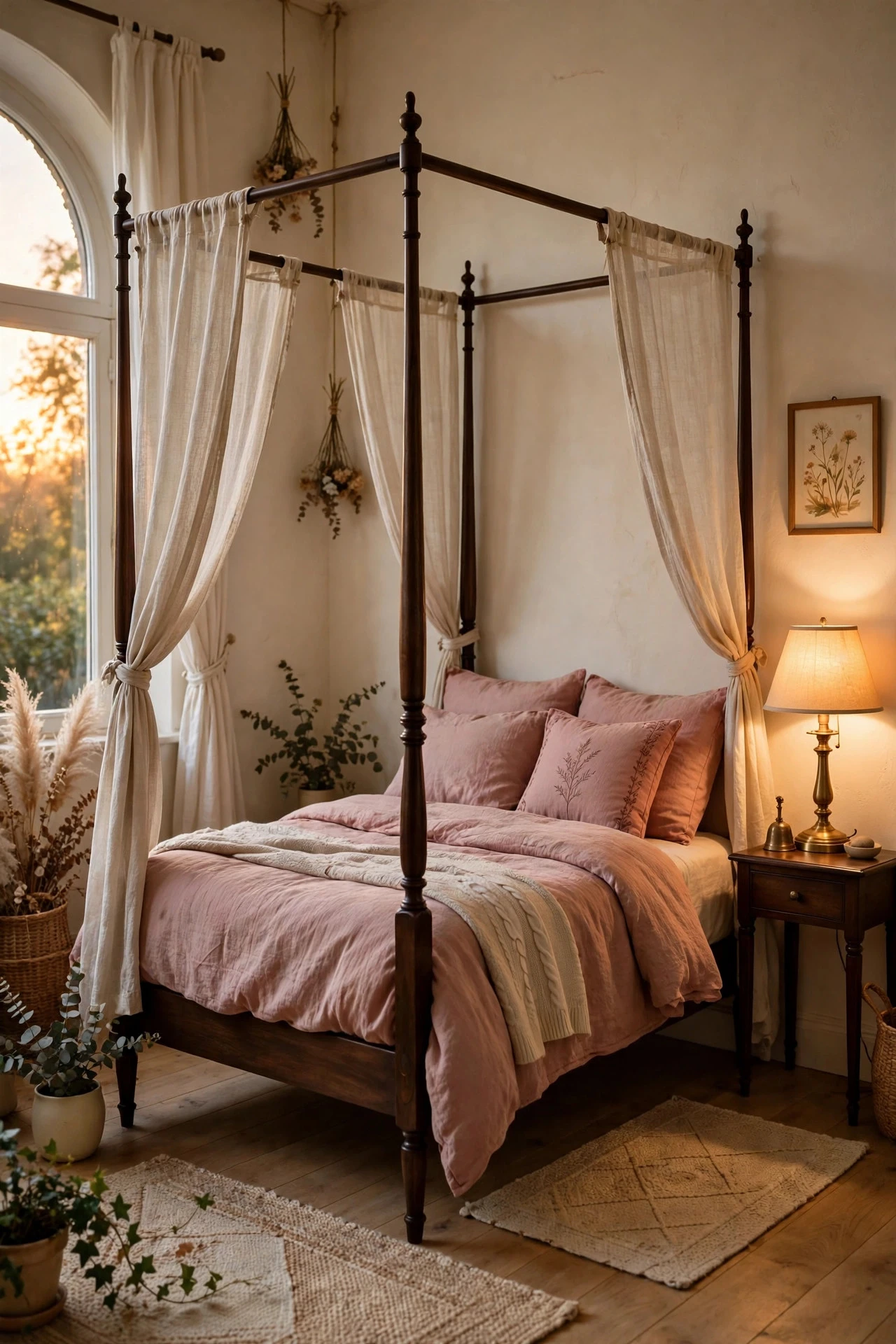
Yes — a slim, four-poster canopy bed in dark wood or matte black, draped with sheer linen or left bare, gives a whimsical bedroom its storybook frame. Choose a frame with straight, simple posts, 200–210 cm tall, and avoid ornate carving, plastic finials or heavy velvet drapes that close the bed in.
The canopy is the most storybook piece of furniture you can own, and its success depends on lightness. Sheer linen panels (£40–£80 for a set) hung from the top rails soften the frame without blocking light, and they can be tied back during the day. A canopy bed needs a room at least 3.5 m long, with 30 cm clear at the foot and on both sides, or it crowds the room. If space is tight, a half-canopy — posts only at the head end, 120 cm tall — gives the same feeling in a smaller footprint for £400–£900.
8. How Do You Paint Furniture for a Whimsical Bedroom?
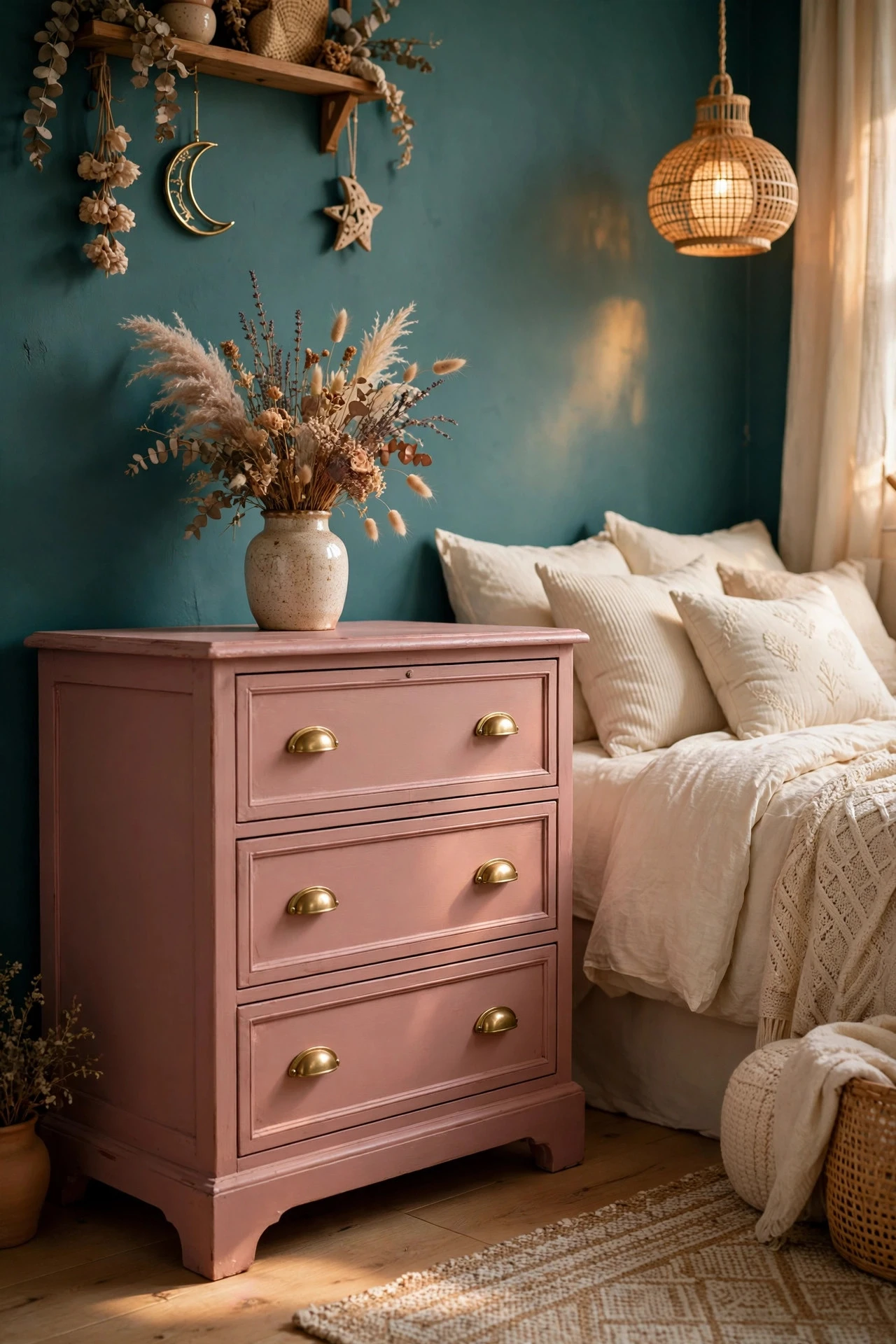
Paint one piece of furniture — a chest of drawers or a nightstand — in a jewel tone that matches your wall, using Farrow & Ball Estate Eggshell or Annie Sloan Chalk Paint, sealed with clear wax. Leave the other furniture in wood or a neutral colour so the painted piece reads as a deliberate accent.
A painted dresser is the cheapest way to inject storybook colour without repainting a wall, and it works because it is contained: one object, one colour, one clear idea. Sand the piece lightly, apply two thin coats, and finish with wax or a matte sealant so the surface survives daily use. Budget £30–£50 for paint and materials if you do it yourself, or £150–£300 for a professional respray. Avoid painting every piece the same colour; a matching painted set looks like a children's furniture range.
9. How Do Fairy Lights Look Grown-Up in a Bedroom?
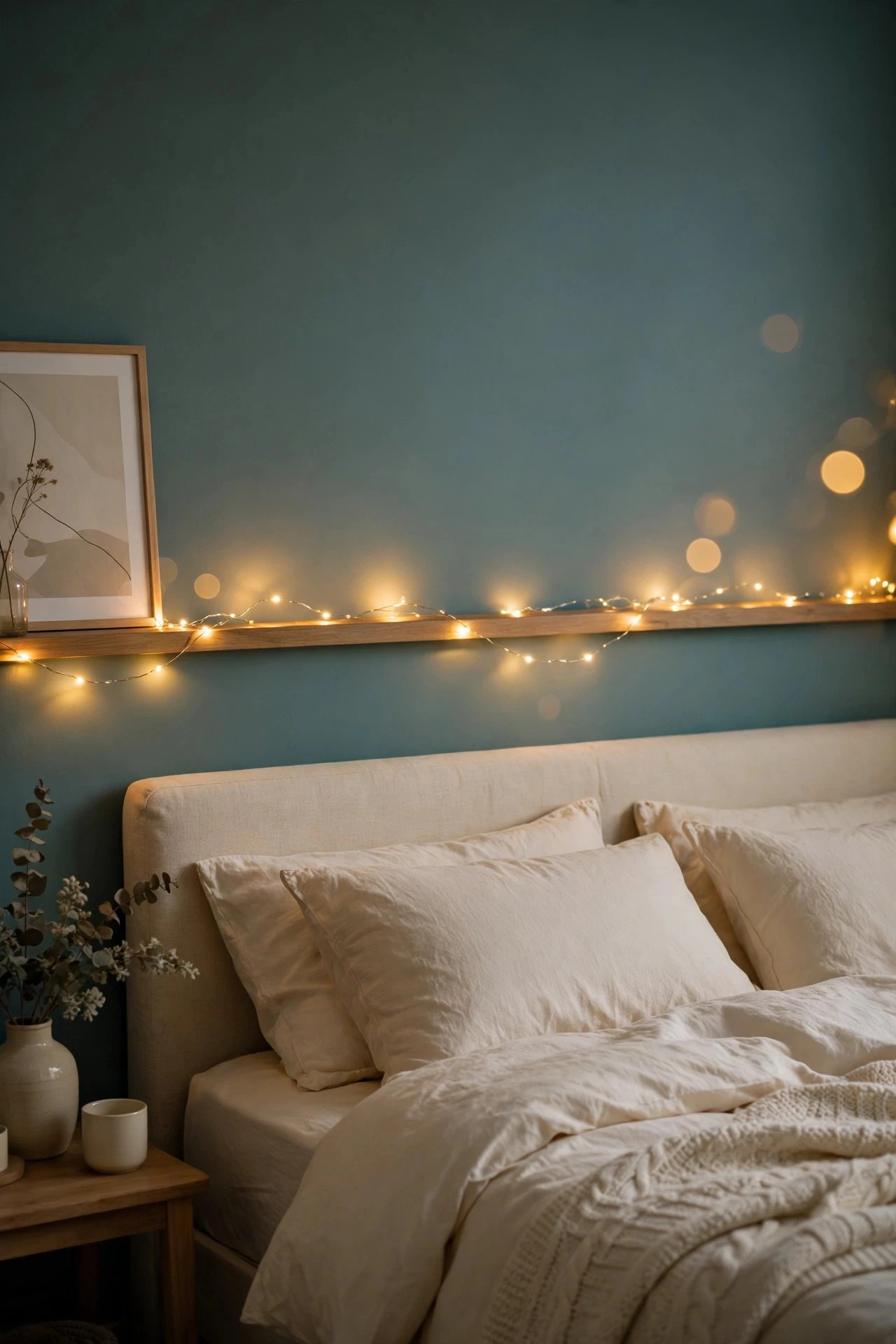
Use warm-white fairy lights with intention, not abundance: one strand draped along a picture ledge, woven through a headboard, or inside a glass cloche on the dresser. Choose 2700K warm white, 100-count strands with a small battery pack or a discreet plug, and never outline the ceiling, the window frame and the mirror all at once.
Fairy lights turn childish when they are everywhere and grown-up when they are one deliberate glow. Avoid coloured lights, flashing modes and star-shaped bulbs — plain warm-white micro LEDs on a copper wire are the most elegant option, costing £8–£20 per strand. Keep the rest of the room's lighting layered and warm so the fairy lights are an accent, not the main light source. For the full lighting picture, our bedroom lighting ideas for a warm, restful glow explain how to layer bedside, ceiling and accent light at 2700K.
10. How Do You Build a Whimsical Gallery Wall?

Hang five to seven framed pieces in a loose grid above the dresser or on the wall opposite the bed, mixing one motif print, one botanical illustration, one vintage print and two small mirrors, all in matching thin brass or dark-wood frames. Keep a 5 cm gap between frames and centre the arrangement at eye level, about 150 cm from the floor.
A gallery wall is where whimsy earns its place, because a collection of small, curious images feels like a storybook brought to life. The discipline is in the frames: identical frames in one finish make wildly different images feel like a set, while mixed frames make the wall feel accidental. Budget £60–£120 for five to seven ready-made frames and prints. Hang the largest piece first, centred, then build outward, and step back after every two frames to check the balance before adding more.
11. How Do You Layer Bedding in a Whimsical Bedroom?
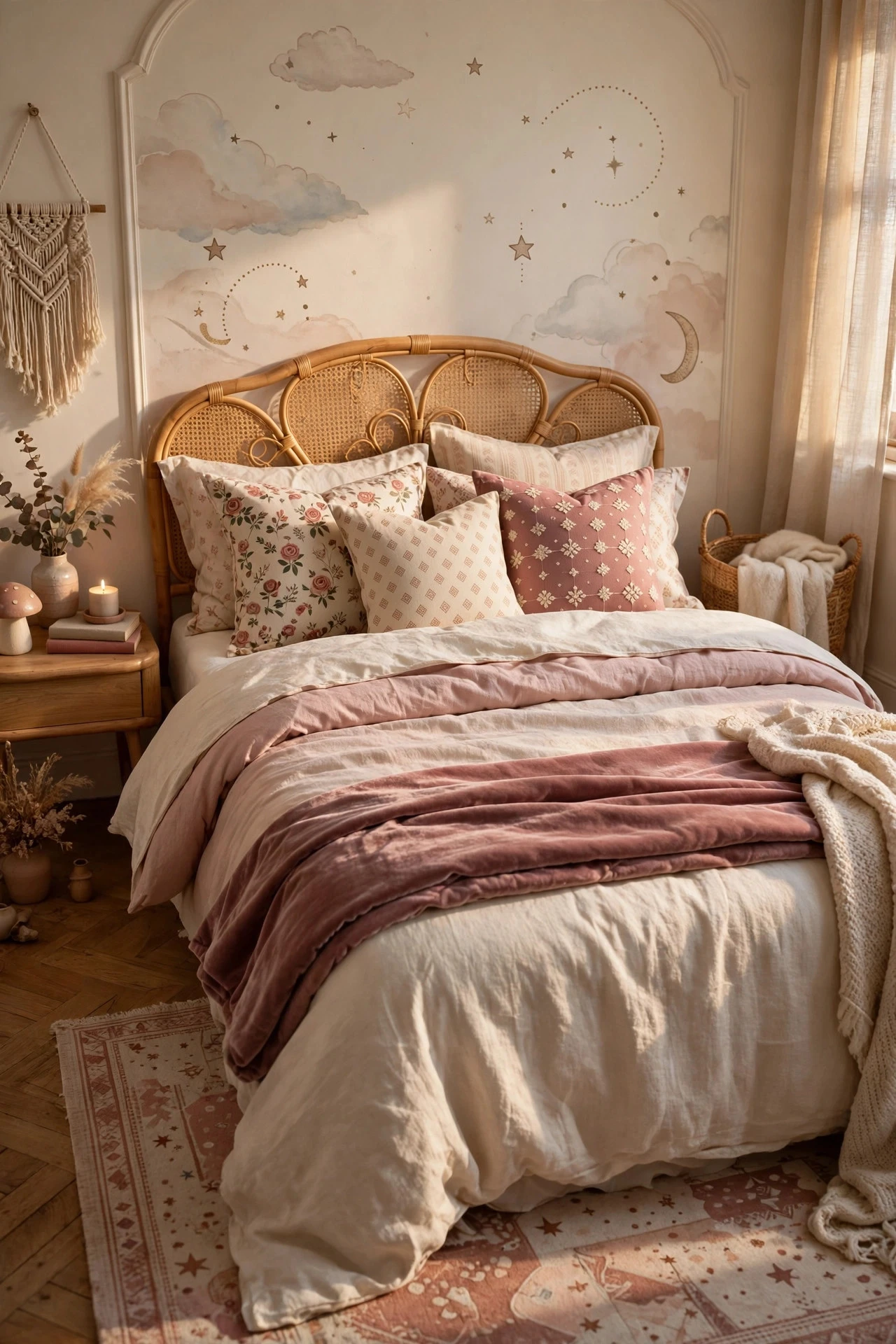
Layer cream linen sheets, a duvet in your main jewel tone or a soft floral print, a contrasting throw folded across the foot, and three cushions in mixed patterns that share one colour. The order matters: pale closest to the skin, pattern or colour as the main cover, and the motif as the top accent.
Layered bedding is where a whimsical bedroom becomes touchable, and the layer order is what keeps it calm. Start with white or oatmeal linen sheets — linen's slub texture stops jewel tones from looking slick. Add a duvet in washed cotton or linen: a dusty-rose duvet against teal walls, or a small floral print in sage and cream. Fold a velvet throw across the bottom third of the bed, not the middle, so it reads as a deliberate band of colour. Finish with three cushions in a 2-1 arrangement: two in your medium pattern and one small cushion carrying the motif. Wash velvet-look throws separately and never tumble-dry them.
12. Which Wallpaper Works Best for a Storybook Bedroom?
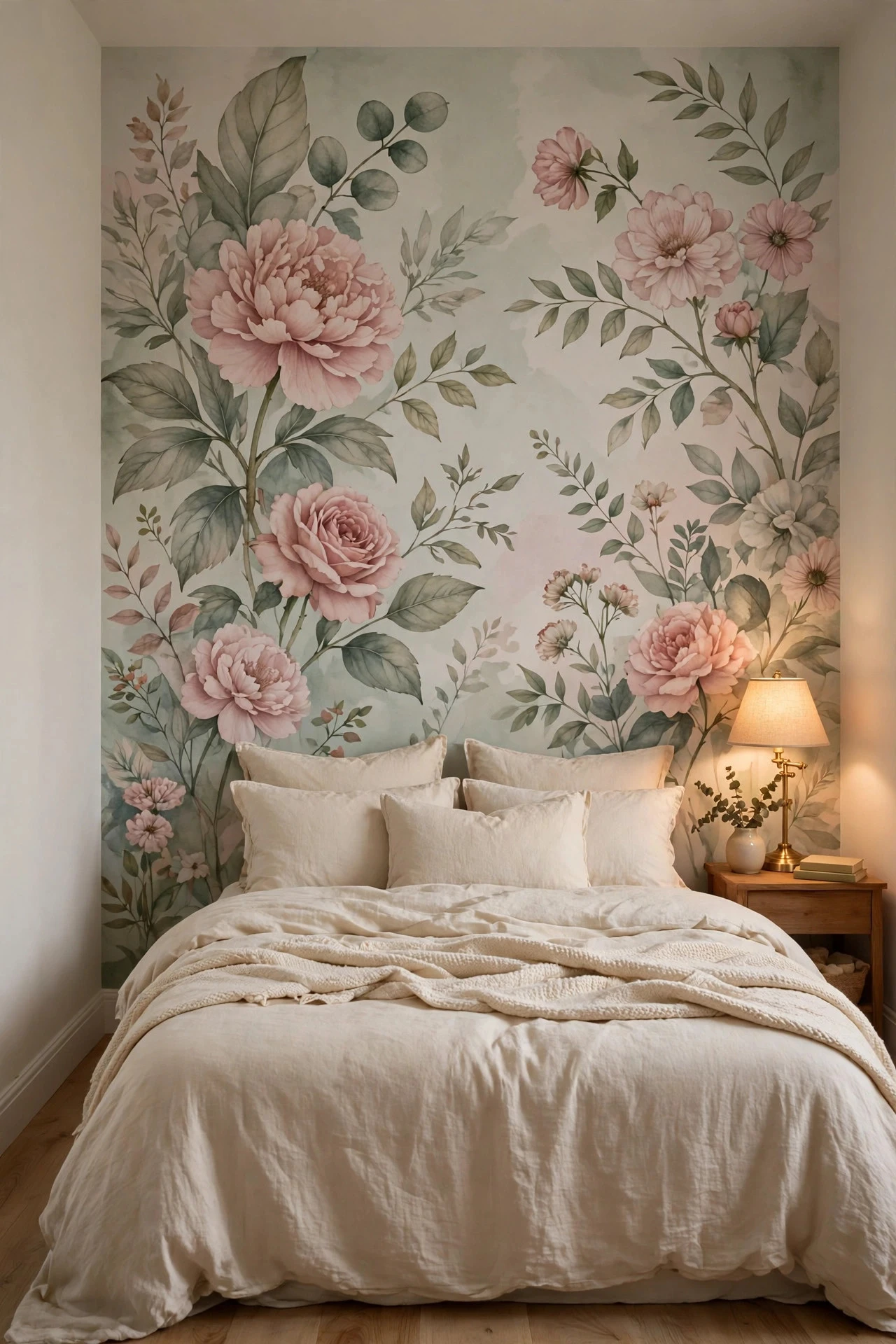
Choose a mural or a large-scale floral wallpaper in your palette — a woodland scene, oversized blooms, or a toile de Jouy print — on the wall behind the bed only, with the other three walls painted in a plain colour pulled from the paper. A mural costs £80–£200 for one wall, and a roll of quality wallpaper costs £25–£60.
Toile de Jouy, the classic French scenic print, is the most grown-up option: its single-colour scenes in dusty rose or sage on cream read as heritage, not nursery. Wikipedia's toile page explains the print's history as a furnishing fabric. Hang wallpaper only behind the bed, keep the pattern scale large, and paint the other walls a plain colour from the paper so the room feels balanced, not busy.
13. How Do You Create a Reading Nook in a Whimsical Bedroom?
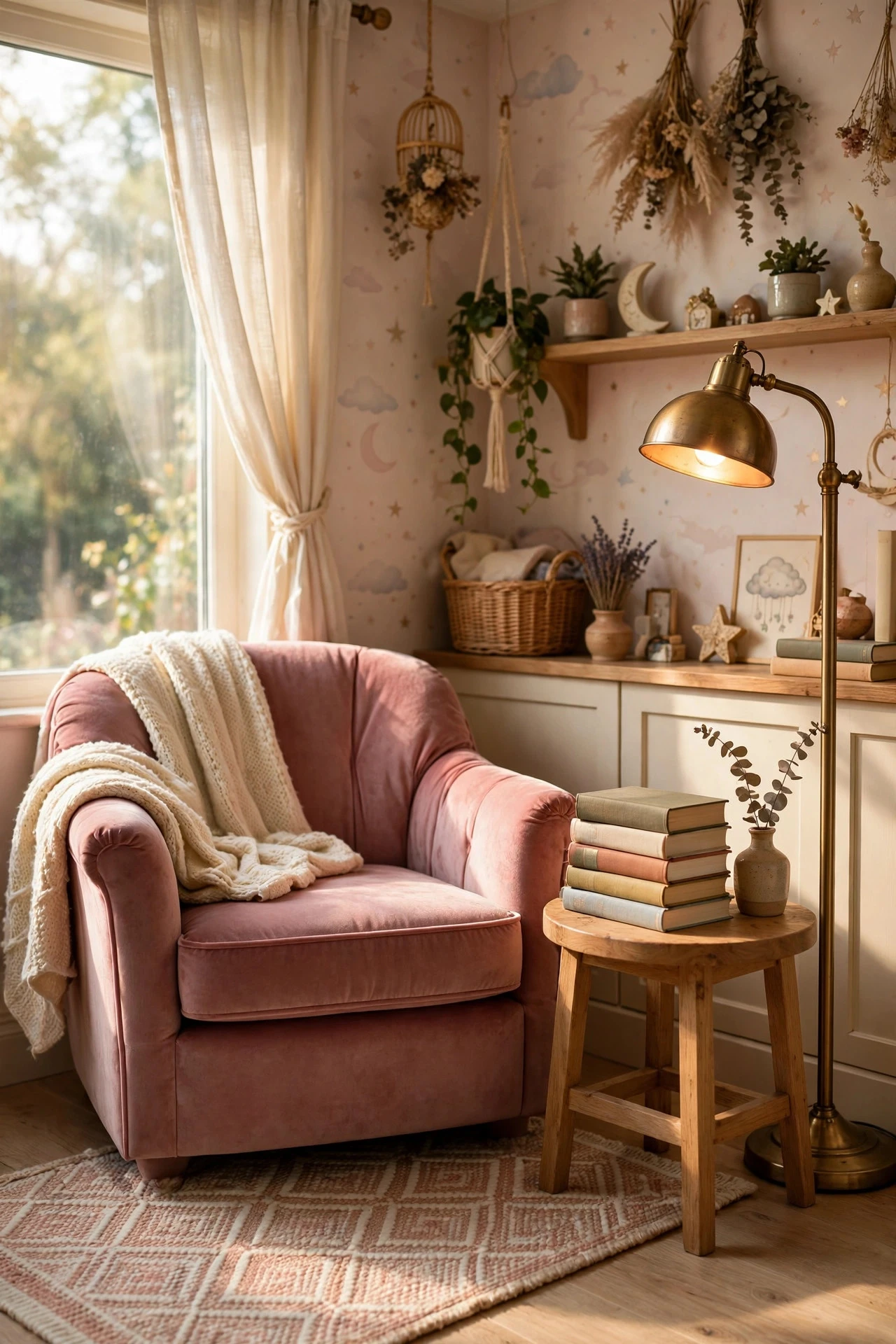
Place a compact armchair in velvet or bouclé in your jewel tone in the brightest corner, with a brass floor lamp at 2700K, a small wooden side table, and a throw in your motif colour folded over the arm. The chair should be 70–80 cm wide so it fits a bedroom corner without blocking the bed or the door.
A reading nook gives the whimsical scheme a second moment away from the bed, and it proves the style works beyond bedding. A velvet armchair costs £200–£450, while a good second-hand chair can be found for £100–£250 and re-covered in a plain velvet. Position the chair at a slight angle to the wall, not flat against it, with the floor lamp behind the chair's left shoulder if you are right-handed. Add a stack of two books on the side table — the nook should look used, not staged.
14. What Lighting Has Personality in a Whimsical Bedroom?
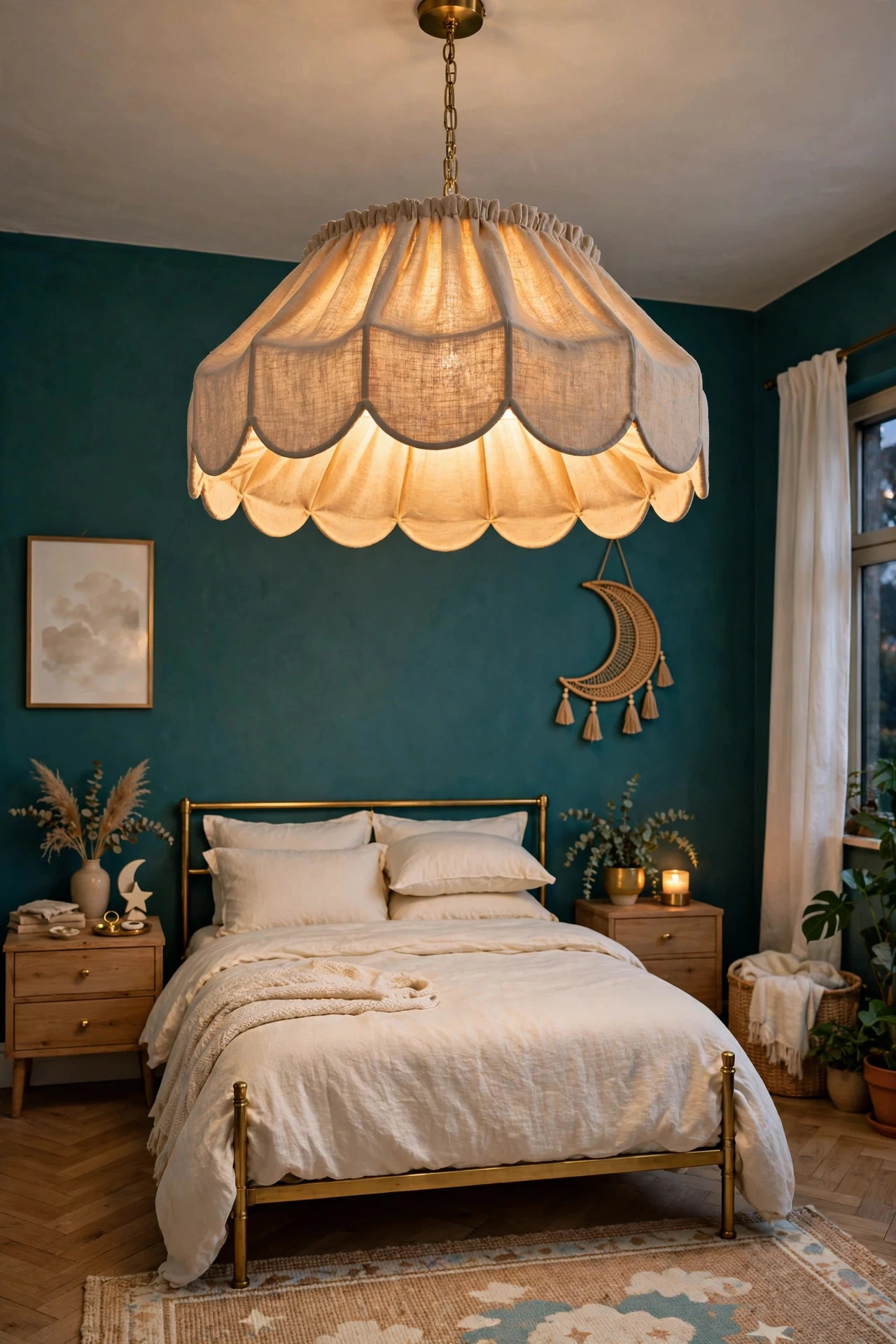
Choose one characterful light as the room's statement — a mushroom lamp, a brass crescent-moon sconce, a scalloped pendant shade, or a rattan pendant with a fringed edge — and keep every other light plain and warm at 2700K. One playful light is a signature; three playful lights compete and the room feels like a shop display.
Lighting with personality works the same way as the motif rule: one hero, the rest supporting. A scalloped pendant shade in linen (£40–£90) over the centre of the room, or a mushroom lamp on the nightstand, gives the room its storybook moment the second you walk in. Fit dimmable 2700K LED bulbs (around £5–£10 each) in every fitting, and put the ceiling light on a dimmer (£15–£30 for the switch, fitted by an electrician if you are not confident). Warm light is what makes jewel tones glow; cool white light flattens them into grey.
15. How Do Mirrors Add Whimsy to a Bedroom?
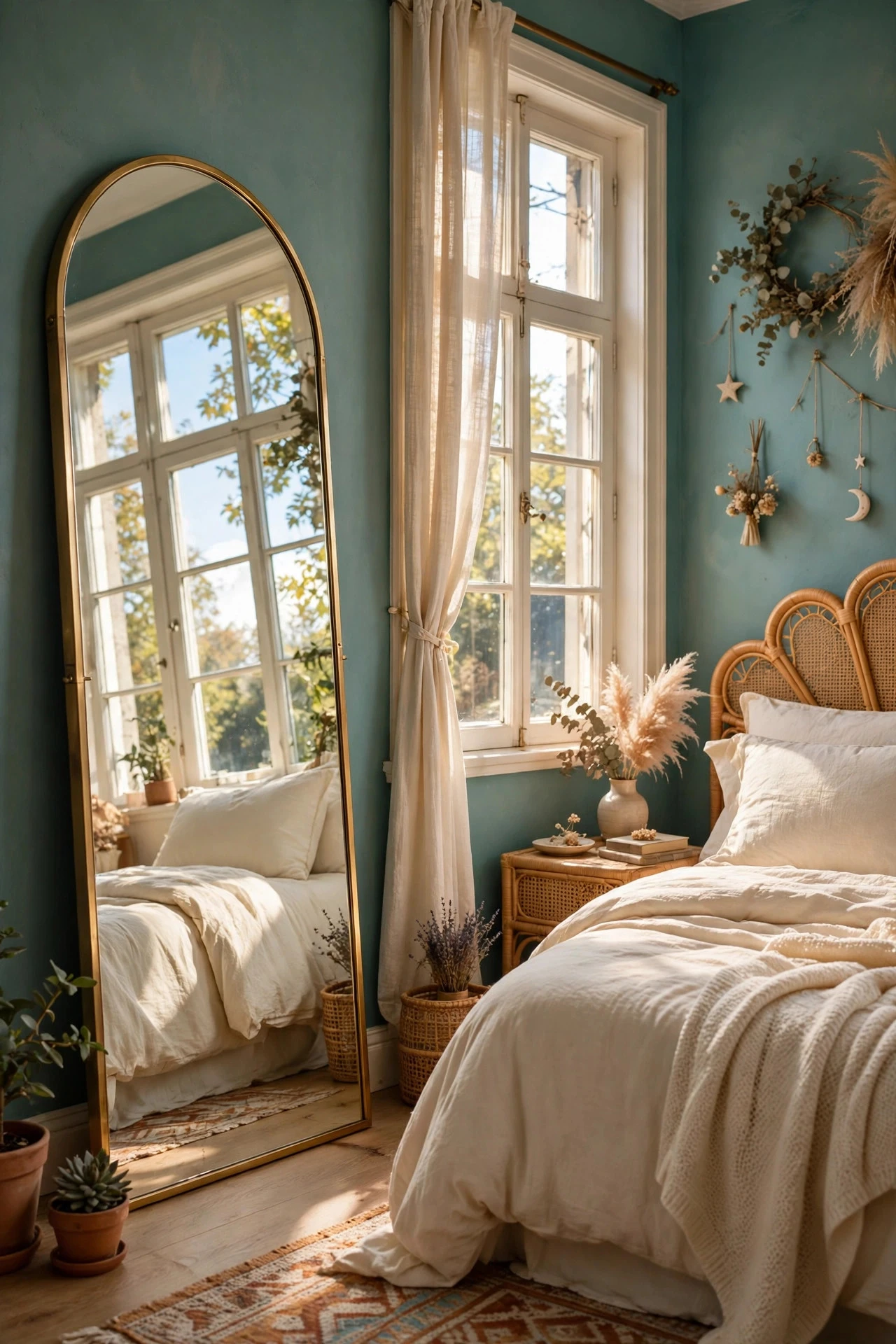
Use a mirror with a playful frame — an arched mirror, a scalloped-edge mirror, or a sunburst mirror in brass — hung opposite the window to bounce light, or leaning against the wall at 150–170 cm tall. One statement mirror is enough; a wall of small decorative mirrors reads as clutter.
Mirrors do two jobs in a whimsical bedroom: they add the playful shape, and they bounce light around a colour-drenched room that needs it. An arched mirror (£80–£200 for a 150 cm tall version) echoes the scalloped headboard and the canopy curves, tying the room's shapes together. Hang it opposite the window so it reflects daylight, or lean a full-length arched mirror against the wall beside the dresser for a dressing moment. Keep the mirror's reflection considered: it should show the bed or the window, not a pile of laundry or an open wardrobe.
16. Where Do Vintage Finds Fit in a Whimsical Bedroom?
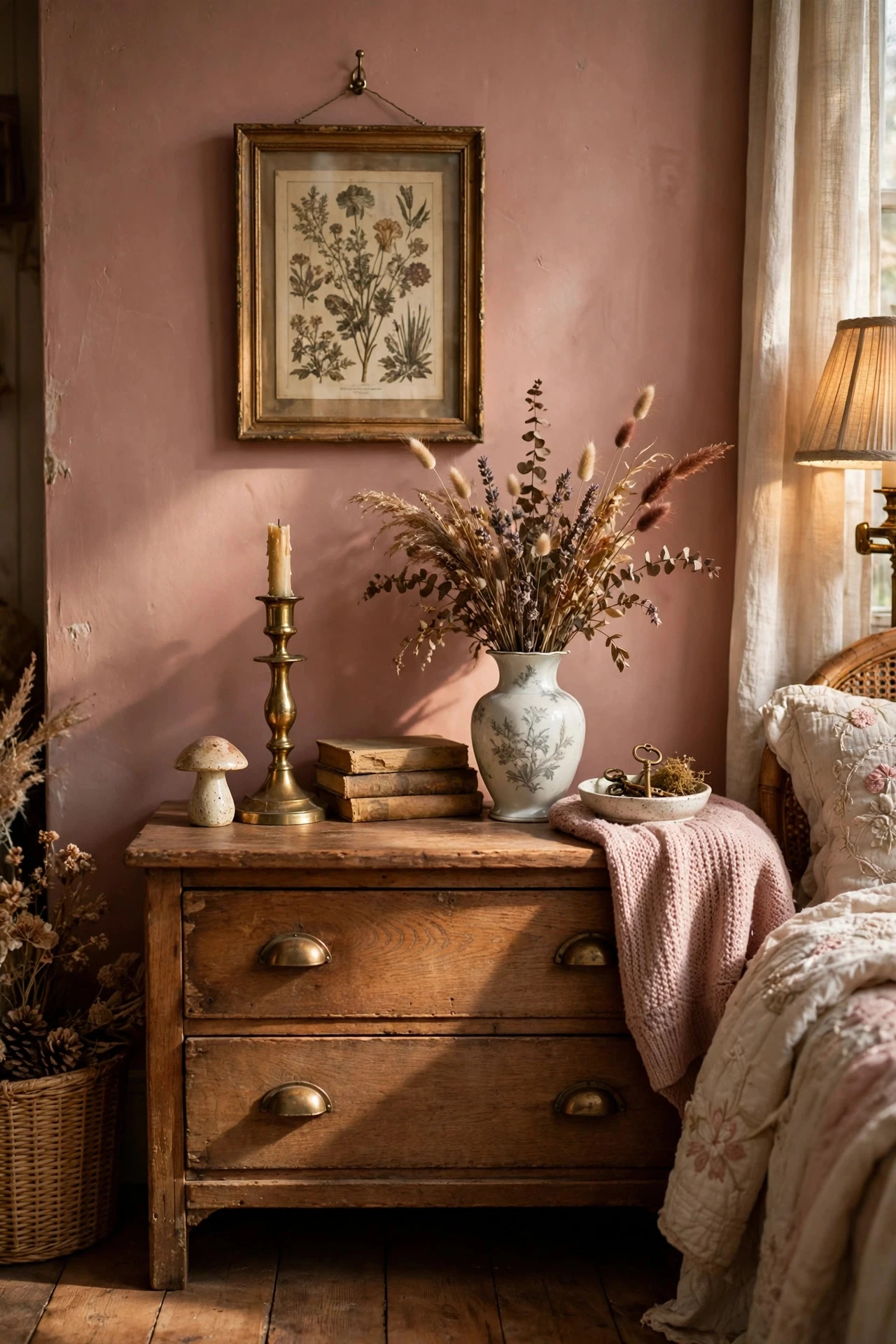
Use one or two genuine vintage pieces — a brass candlestick, a porcelain vase, a wooden jewellery box, or a framed antique print — as the room's "collected" layer. Buy from charity shops, flea markets or auction sites, and choose pieces with patina and wear rather than perfect reproductions.
Vintage finds are what separate a whimsical bedroom from a themed one, because they add age and imperfection to a scheme that could otherwise feel too new and too matched. A brass candlestick (£10–£25) on the dresser, a porcelain vase with dried stems (£15–£30), or a small wooden jewellery box with a worn finish tells the eye this room was gathered over time. The rule is two pieces maximum in a bedroom — a third vintage object tips the room toward antique shop. For contrast with the newer burgundy scheme we covered recently, our burgundy and green bedroom ideas show how the same vintage pieces work in a jewel-tone room.
17. How Can Renters Add Whimsy Without Painting?
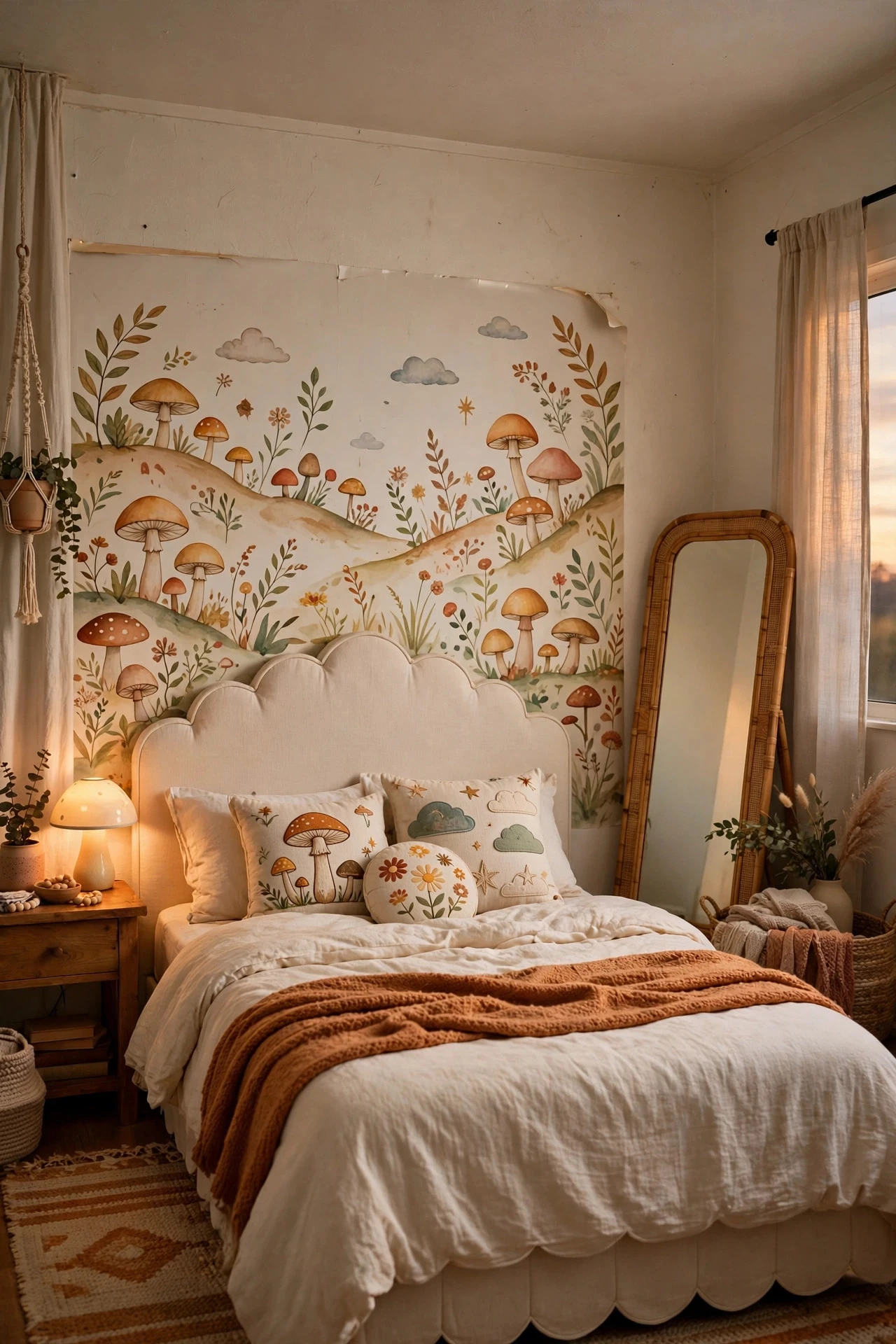
Renters can build the whole look with textiles and removable pieces: a scalloped headboard cover, peel-and-stick mural wallpaper behind the bed, a mushroom lamp, motif cushions, and a striped bed skirt. Nothing needs paint, drilling or landlord permission beyond a wallpaper check.
Renting does not mean living in beige, and whimsy is one of the easiest styles to achieve without permanent changes. Start with the bed: motif cushions, a jewel-tone throw and a scalloped headboard cover (£60–£120) transform it in an afternoon. Add peel-and-stick mural wallpaper (£25–£45 per roll) on the wall behind the bed — it removes cleanly and gives you the storybook wall without paint. Use Command strips for framed prints rather than nails, and a tension rod inside the window recess for curtains if you cannot drill. A mushroom lamp and one framed constellation print complete the look, and every piece moves with you when the tenancy ends.
18. How Do You Style Whimsy in a Small Bedroom?
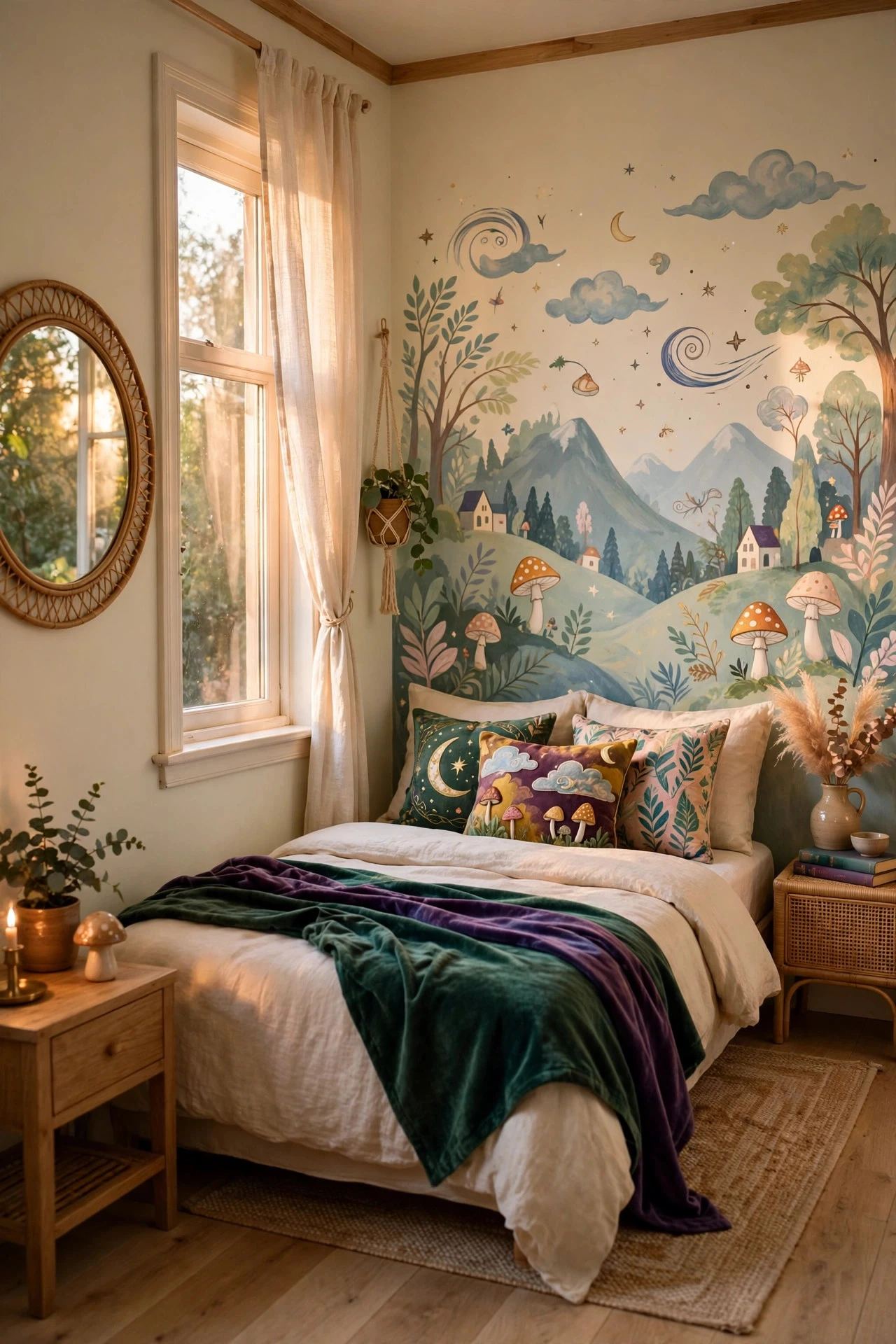
Keep the whimsy to textiles and one wall: motif cushions, a jewel-tone throw, one framed print, and a peel-and-stick mural or painted feature wall behind the bed. Paint the other walls pale cream or soft sage, use a mirror opposite the window, and keep the floor clear so the room feels bigger than it is.
Small bedrooms punish saturated colour and heavy furniture, but they do not forbid whimsy. The trick is to keep the dark, playful colours low and small, and the pale colours high and large. Use a low-profile bed frame with no bulky headboard — or a slim scalloped headboard that adds shape without bulk — and under-bed storage for the clutter that kills a small room's charm. For layout ideas that make a tiny room feel bigger, our small bedroom ideas cover low beds, mirrors and storage that pair well with this style.
19. How Much Does a Whimsical Bedroom Makeover Cost?

A cushion-and-throw refresh costs £80–£150; a mid-range makeover with curtains, a rug, bedding and a statement lamp costs £400–£700; a full refresh with a scalloped headboard, mural wallpaper and a canopy or painted furniture costs £900–£1,400. Start with textiles, then the wall, then furniture — textiles give the biggest visual change per pound.
Budgeting in stages is the practical way to build this style, because the storybook feeling works at every spend level. Stage one (£80–£150): two motif cushions, a jewel-tone throw, and a mushroom or moon lamp — the room reads whimsical within an afternoon. Stage two (£400–£700): add a mural or painted feature wall, a patterned rug and a linen duvet set. Stage three (£900–£1,400): add the scalloped headboard, a canopy frame or painted dresser, and framed vintage prints. Buy the hero pieces first and the accessories last — a beautiful headboard with plain bedding looks better than cheap bedding with expensive cushions.
20. How Do You Keep a Whimsical Bedroom Curated, Not Cluttered?

Apply the rule of three: one motif, three appearances; one jewel tone, three pattern scales; three objects maximum on any surface. Every new object must earn its place by sharing the palette or the motif — if it does neither, it does not enter the room.
Whimsy tips into clutter faster than any other style, because every playful object feels like it belongs. The defence is a hard limit, applied before you buy. Before adding anything, ask two questions: does it share my palette, and does it carry my motif or my main texture? If the answer to both is no, leave it in the shop. Keep nightstands to a lamp plus one object, the dresser to three objects, and the walls to one gallery or one mural — never both. Our guide on how to style a boho bedroom that feels collected, not cluttered covers the same restraint principles for a looser, layered style.
21. Which Textiles Make Whimsy Feel Luxurious?

Choose velvet, linen, bouclé and washed cotton in your palette, layered together: a velvet throw, linen bedding, a bouclé cushion and a cotton rug. Texture is what stops a playful room from feeling cheap, and it costs nothing in colour budget — four textures in the same palette feel richer than four colours in the same fabric.
A room with one motif and one palette can look flat if every surface is smooth, so texture does the work that extra colour would normally do. Layer at least four textures: something soft (velvet), something nubby (bouclé or wool), something smooth (brass or ceramic), and something natural (linen or rattan). A bouclé cushion in cream (£20–£35) against a velvet throw in dusty rose shows how texture contrast creates depth even when the colours are close. The rule is: new texture, same palette — never introduce a texture in a colour outside your scheme.
22. What Finishing Touches Complete a Whimsical Bedroom?
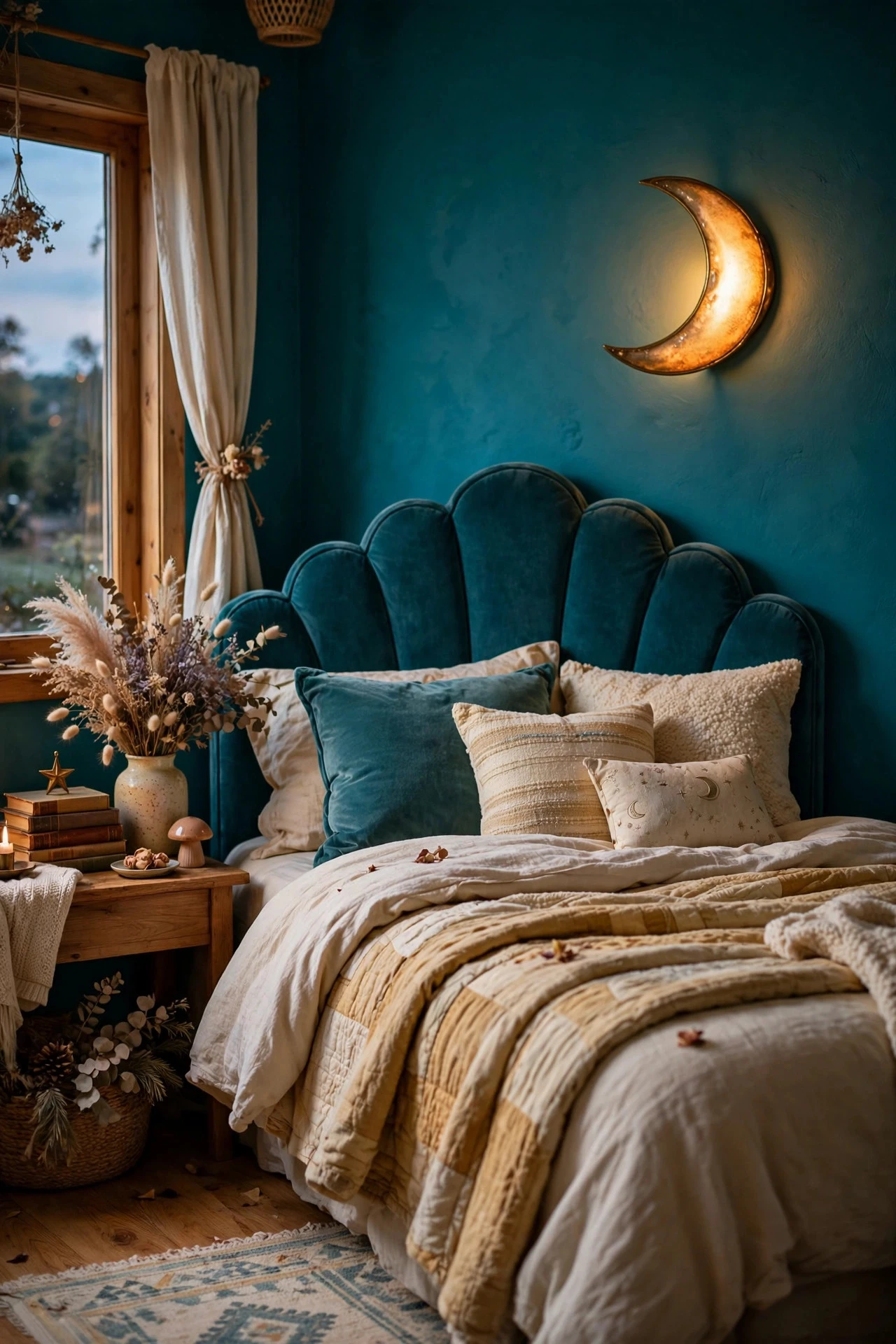
Finish with three small, deliberate details: a scented candle in a ceramic vessel on the nightstand, a small vase of dried flowers or eucalyptus on the dresser, and a beautiful book or two stacked on the bedside table. Each touch should repeat your palette or your motif, and nothing else should be added after them.
Finishing touches are the last 5% of the room, and they matter because they are the objects you touch and smell every day. A candle in a ceramic vessel (£15–£30) in your jewel tone, a vase of dried eucalyptus (£10–£20) that needs no watering, and a stack of two books with covers in your palette turn a styled room into a lived-in one. For guest-room versions of this style, our guest bedroom ideas to make visitors feel at home show how the same finishing touches work when the room must welcome a stranger.
Practical tips for a whimsical bedroom
Start with the cheapest change and live with it for a week. Buy motif cushions before you commit to a mural — cushions cost £20–£35 each and can be returned if the motif feels wrong.
Watch for the three mistakes that make whimsy look childish. First, too many motifs: celestial plus mushroom plus stripes in one room is a theme park, not a bedroom — pick one. Second, shiny polyester fabrics: cheap velvet-look cushions shine under lamplight, while real cotton velvet absorbs light and looks deep. Third, cartoon prints: anything with a face, a speech bubble or a character belongs in a children's room.
Keep the room calm by keeping dark colours low and small and pale colours high and large, and by leaving the top third of the walls empty. Store out-of-season textiles in a lidded box under the bed so the room never accumulates spare cushions. See House Beautiful's bedroom ideas and ELLE Decor's bedroom ideas for how designers balance bold colour with grown-up furniture.
Final thoughts
A whimsical bedroom works for adults when one motif, one tight palette and quality materials do the storytelling. Start with cushions and a lamp, add the mural or the colour-drenched wall, and buy the scalloped headboard last — the room will feel magical, personal and unmistakably grown-up.
Frequently Asked Questions
How do I make a whimsical bedroom look grown-up and not like a child's room?
Use one motif repeated three times, a tight palette of one jewel tone, one neutral and one metal, and adult materials — velvet, linen, solid wood and brass. Avoid cartoon prints, glow-in-the-dark stars, plastic and shiny polyester. Wide scallops, muted stripes and vintage prints read as storybook for adults; small frills and bright primary colours read as a nursery.
What is the best paint colour for a whimsical bedroom?
Farrow & Ball Inchyra Blue No. 289 for deep teal, or Benjamin Moore Vintage Wine 1257 for warm plum, used across walls, skirting and ceiling in a matte finish. Both read as rich and storybook in daylight and warm under 2700K lamplight. Test a 60 cm square swatch for two days first.
Can I have a whimsical bedroom in a rented home?
Yes — use a scalloped headboard cover, peel-and-stick mural wallpaper behind the bed, motif cushions, a mushroom lamp and a striped bed skirt. Nothing needs paint or drilling, and every piece moves with you. Use Command strips for framed prints, check your tenancy agreement before applying removable wallpaper, and keep the motif to three appearances so the room stays curated.
How many patterns can I mix in a whimsical bedroom?
Three maximum, in three different scales, all sharing at least one colour: one large print such as a mural or floral wallpaper, one medium print such as striped bedding, and one small print such as a star cushion. Keep plain linen bedding between patterned pieces so the eye has somewhere to rest.
Is a celestial bedroom too childish for an adult?
Not when the motif is treated as astronomy rather than decoration: a brass crescent-moon sconce, star-patterned linen cushions in one colour, and one framed print of a real constellation such as Orion. Keep the palette midnight blue, cream and brass, avoid glitter and glow-in-the-dark stars, and limit the motif to three appearances so it reads as a deliberate thread.
How much should I budget for a whimsical bedroom makeover?
A cushion-and-throw refresh costs £80–£150, a mid-range makeover with a mural, rug, bedding and statement lamp costs £400–£700, and a full refresh with a scalloped headboard, mural wallpaper and a canopy or painted furniture costs £900–£1,400. Start with textiles for the biggest visual change per pound, then the wall, then furniture, buying hero pieces before accessories.