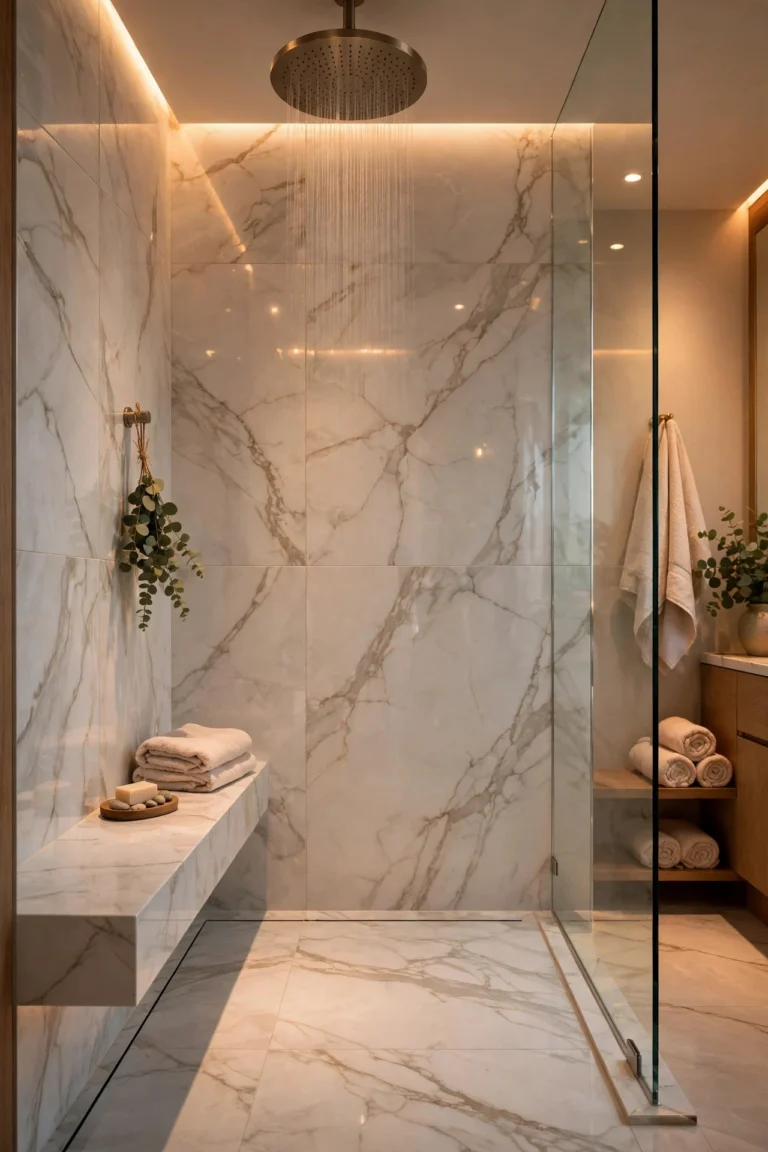
22 70s Living Room Ideas That Feel Retro, Not Dated
A 70s living room is back — but the version worth living in is not a costume set. The real 1970s look was warm, low-slung and tactile: shag rugs under bare feet, rattan chairs by the window, burnt orange against avocado green, and lamps that glowed amber instead of glaring white. Done well, it feels relaxed and confident. Done badly, it feels like a fancy-dress party that never ends.
The trick is editing. Most guides confuse 70s style with mid-century modern, pile on every retro cliché at once, and never mention a budget. This guide does the opposite. Every idea below separates the two eras clearly, gives you real measurements and real costs, offers a renter-friendly swap where it matters, and tells you what to avoid so the room reads as intentional, not accidental.
Looking for more inspiration? Our Nest Decorz homepage gathers the latest home decor ideas, seasonal decorating guides and room-by-room styling tips in one place — start there and explore.
Quick answers
– 70s vs mid-century: mid-century is 1950s–60s, tapered legs and teak; 70s is low, plush, earthy and textured — shag, rattan, macramé and bold pattern. – Pattern rule: one bold pattern per sightline, two at most in the whole room, always with a solid to rest the eye. – Budget honestly: a full 70s refresh runs $800–$2,500; a renter-friendly refresh with textiles and lighting runs $250–$600. – Easiest win: a shag rug and warm 2700K lighting change the room more than any single piece of furniture. – Avoid the costume: skip the lava lamp, the bead curtain and the full avocado suite — pick two or three retro notes, not twelve.
1. How Do You Tell 70s Style Apart From Mid-Century Modern?
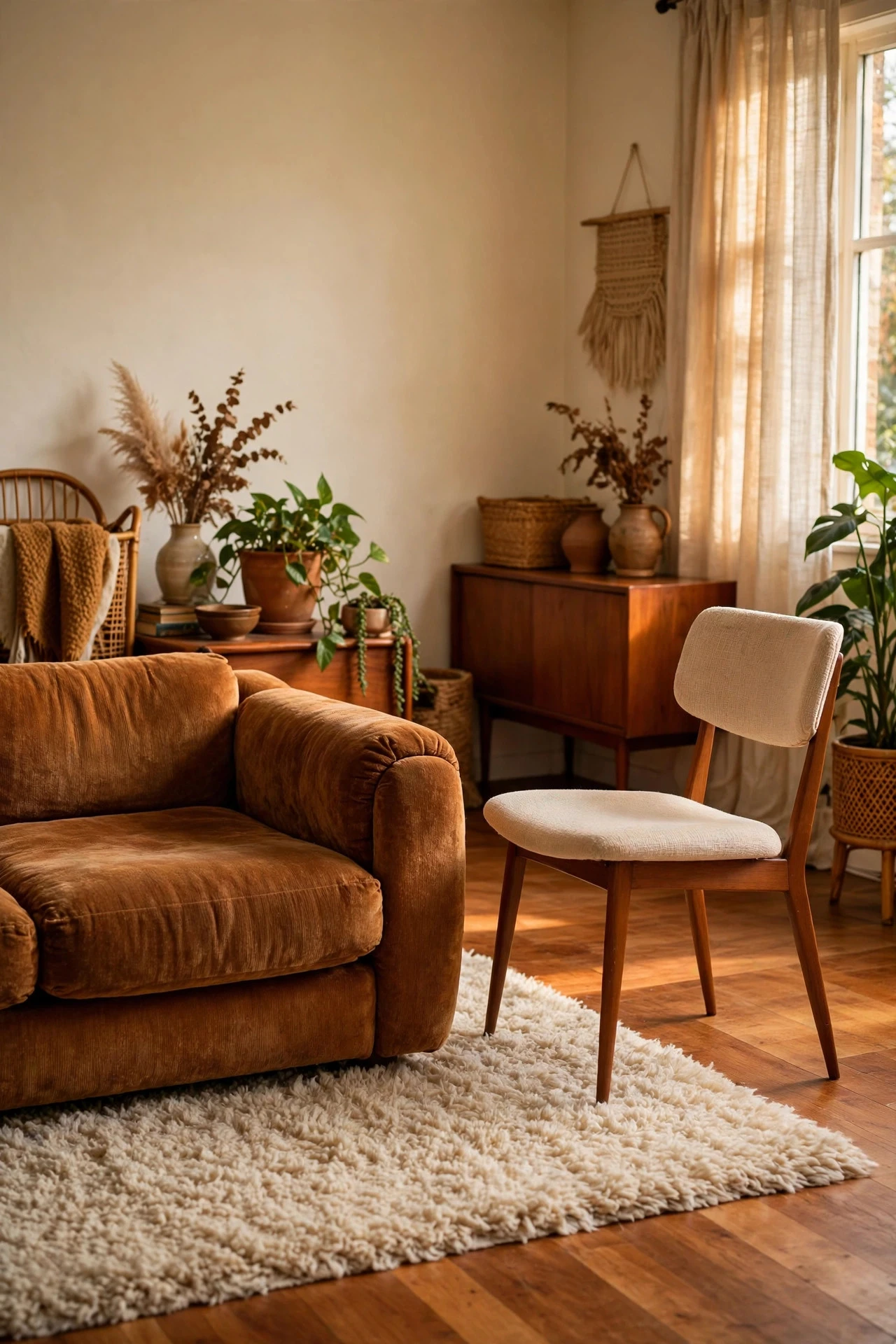
The confusion costs people real money, because the two eras ask for different furniture. Mid-century modern is the 1950s and 60s: tapered wooden legs, teak and walnut, clean lines, and a restrained palette. The 1970s reacted against all of that — sofas got lower and deeper, legs disappeared under plush upholstery, and colour went earthy and loud: burnt orange, avocado green, mustard yellow and chocolate brown.
The quick test is the silhouette. If the piece stands on slim, splayed legs and looks light, it is mid-century. If it sits low and heavy, with chunky cushions, a shaggy texture or a rattan frame, it is 70s. The decade itself was a reaction to post-war minimalism, and the history of the 1970s shows a culture turning toward warmth, craft and informality. Buy the era you actually want: mixing one low 70s sofa with a teak mid-century sideboard works, but a room full of tapered-leg pieces is not a 70s room at all.
2. How Much 70s Pattern Is Too Much in One Room?

One bold pattern per sightline is the rule that keeps a 70s living room from tipping into chaos. A geometric barkcloth curtain, a psychedelic swirl cushion, or a bold floral wallpaper can each carry a room — but two of them in the same view compete, and three make the eye tired. Pick your hero pattern, then let everything else be a solid or a quiet texture.
A practical split is 60 per cent solids, 30 per cent texture and 10 per cent bold pattern. That means a plain burnt-orange sofa, a shag rug in cream, and one set of patterned curtains — or a patterned accent chair with solid cushions around it. Keep the pattern scale consistent too: a large-scale 70s geometric on the curtains pairs badly with a tiny retro print on the cushions. If you already own two bold patterns you love, separate them with a solid — a plain throw, a neutral rug — so each gets its own breathing space.
3. How Do You Choose a Low 70s-Style Sofa?

A true 70s sofa sits low: a seat height of 15 to 17 inches, a back height under 30 inches, and deep seats of 24 to 26 inches that invite lounging rather than perching. Look for a chunky, low-profile frame in burnt orange, chocolate brown or olive velvet, or a cream bouclé if you want the look without the colour commitment. Avoid anything with tall, visible legs — that is mid-century territory.
Measure before you fall in love: leave at least 30 inches of walkway in front of the sofa and 18 inches between the sofa and the coffee table. A three-seater at 84 to 96 inches wide suits most living rooms; anything over 100 inches needs a room at least 14 feet wide. Budget $600–$1,500 for a good new low sofa, or $150–$400 for a solid vintage find that you re-cover. For fitting advice that applies to any era, these tips on how to choose a living room sofa that fits your room and your life cover measuring and proportion in detail.
4. What Makes a Shag Rug Work Without Looking Like a Costume?

A shag rug works when it is the only shag in the room. One high-pile rug in cream, rust or chocolate anchors the seating area, feels wonderful underfoot, and immediately signals 70s — but a shag rug plus a shag cushion plus a shag throw reads as a theme park. Let the rug do the talking and keep the rest of the textiles flat or woven.
Size it properly: the front legs of the sofa and chairs should sit on the rug, which usually means an 8 x 10 foot rug for a standard three-seater arrangement, or 9 x 12 feet for a larger room. Pile height of 1.5 to 2 inches gives the look without swallowing small objects, and a low-pile or flat-weave border makes vacuuming easier. Budget $150–$400 for a quality wool-blend shag, or $60–$120 for a good synthetic. For placement and sizing rules, see these living room rug ideas to ground your seating area. Avoid white shag in a house with pets — it greys within a month.
5. How Do You Use Burnt Orange Without Overwhelming the Room?

Burnt orange is the signature 70s colour, and the mistake is using it everywhere at once. Treat it as an accent, not a base: one burnt-orange sofa or armchair, a pair of burnt-orange cushions, or a single curtain panel — then balance it with cream, warm wood and olive or chocolate. About 10 to 20 per cent of the room's colour should be burnt orange; the rest stays neutral and warm.
Pair it deliberately. Burnt orange loves avocado green and mustard yellow in small doses, but all three at full strength fight each other. The calmer route is burnt orange with cream walls, a walnut coffee table and a cream shag rug, letting the orange pop against quiet surroundings. If you are nervous, start with textiles — cushions, a throw, a lampshade — which cost $40–$100 total and can be swapped in an afternoon. Paint is the commitment: one burnt-orange accent wall costs $30–$60 in paint and changes the whole room, so test a large swatch and live with it for a week first.
6. How Do You Bring In Rattan and Wicker the Right Way?
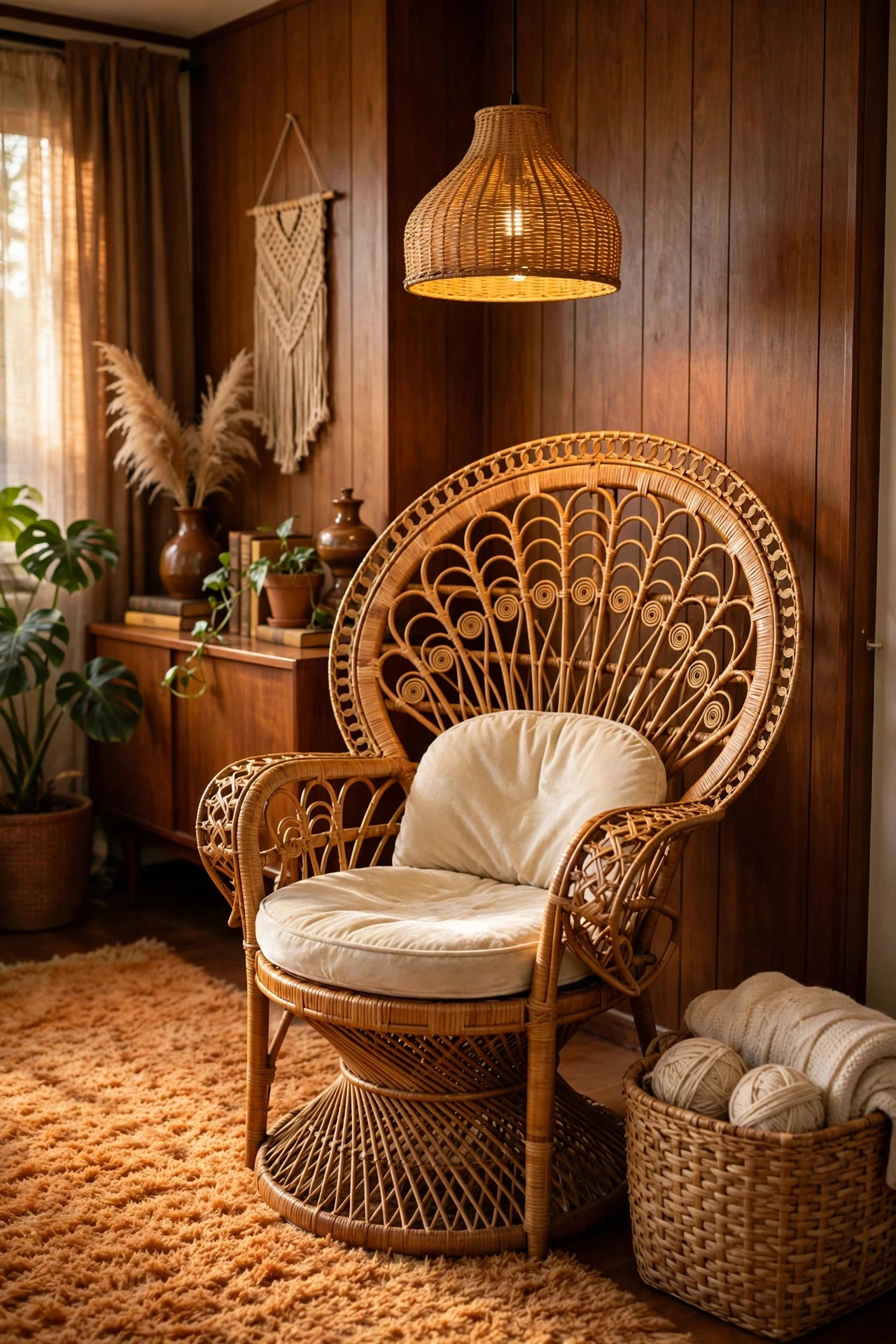
Rattan is the most forgiving 70s material because it reads as texture rather than theme. One rattan peacock chair, a rattan armchair, or a pair of rattan side chairs adds instant 70s character without demanding that the rest of the room comply. Rattan itself is a climbing palm, light, strong and warm-toned, which is why it suits the decade's earthy palette so well.
Use it in two or three places at most: a chair, a pendant shade, and a storage basket. More than that and the room starts to feel like a conservatory. A genuine vintage peacock chair costs $150–$400, while a good reproduction runs $120–$250; check the joints and cane wrapping before buying second-hand, since repairs are fiddly. Pair rattan with soft upholstery — a velvet cushion on a rattan chair, a linen throw over the arm — so the hard weave does not dominate. Avoid plastic imitation rattan outdoors-in; it looks flat under indoor lighting and fools nobody up close.
7. What Is the Best 70s Colour Palette for a Small Living Room?
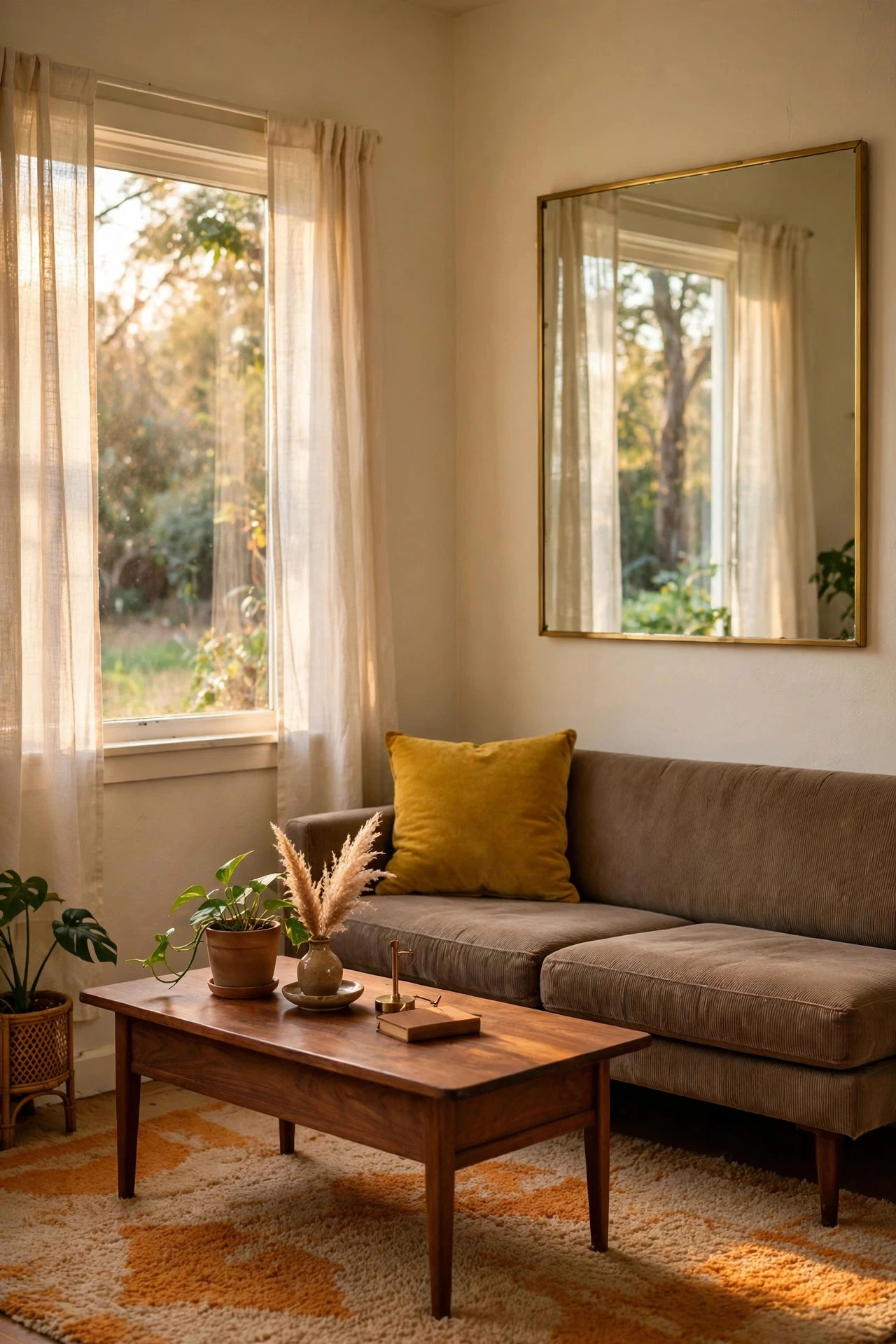
A small room needs the 70s palette edited down to three colours: one warm neutral, one earthy mid-tone and one bold accent. Cream or warm white walls, a walnut or teak wood tone, and a single hit of burnt orange or mustard keep the decade's warmth without shrinking the space. Dark avocado or chocolate on all four walls will make a small room feel like a cave.
Keep the darkest colour low — on the rug, the sofa or the lower half of the room — and the lightest colour high, on walls and ceiling, which preserves a sense of height. Mirrors help enormously: one large mirror opposite the window bounces light and doubles the sense of space. If you love the full 70s palette, use it in accessories — cushions, art, a throw — and keep the big surfaces pale. Budget $0 for this rule if you are only rearranging, or $30–$60 for a tin of warm-white paint. Avoid glossy paint finishes, which show every mark; a matte or eggshell finish suits the soft 70s mood better.
8. How Do You Style a Macramé Wall Hanging Without the Cliché?
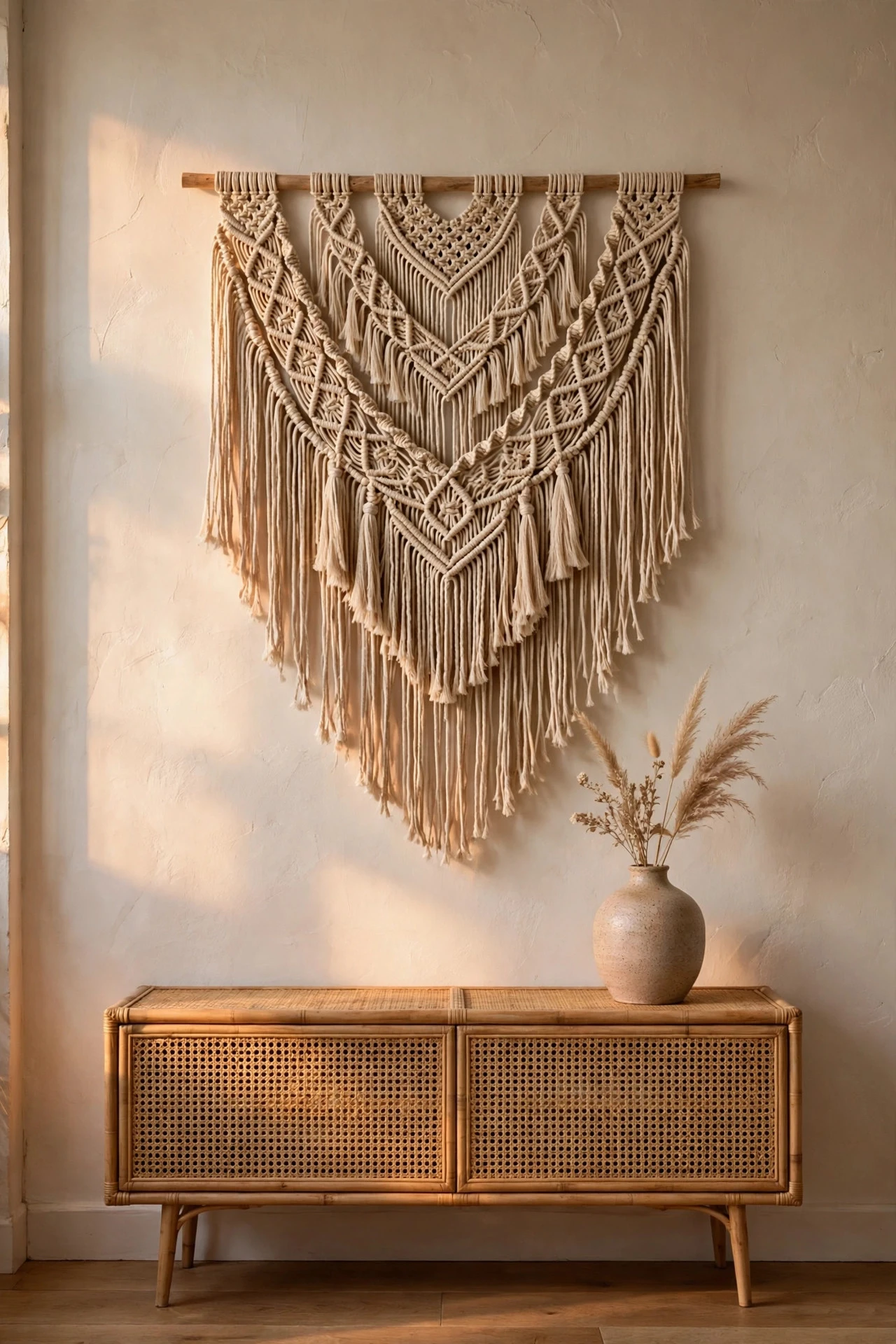
One macramé piece, hung with space around it, is a 70s statement. Five macramé pieces plus a macramé plant hanger plus a macramé lampshade is a cliché. Choose the largest, best-made piece you can afford — a 24 x 36 inch hanging in undyed cotton reads as craft, while a small, thin one reads as an afterthought — and give it a bare wall where it is the only decoration.
Hang it at eye level, centred at 57 to 60 inches from the floor, above a low console or a rattan chair rather than above the sofa, where it competes with cushions. A handmade large hanging costs $60–$150; a good vintage one from a thrift shop can be $20–$40, but check for yellowing and dust, which are hard to clean out of knotted cotton. Pair it with a plant or a ceramic vase below and stop there. Avoid macramé in the same colour as the wall — it disappears — and avoid synthetic shiny cord, which looks cheap next to real cotton.
9. How Do You Pick 70s Lighting That Actually Lights the Room?

The 70s loved mood lighting, which is lovely until you try to read. The fix is layering: one statement piece for character, plus practical light for living. A mushroom lamp, an arc floor lamp or a rattan pendant gives the retro note; add a warm 2700K bulb in each and a small reading light by the sofa, and the room works after dark.
Keep every bulb at 2700K warm white — cool white kills the 70s warmth instantly and makes burnt orange look muddy. A mushroom lamp costs $40–$120 new, or $25–$60 vintage; a rattan pendant shade runs $30–$80 plus fitting. Hang pendants 30 to 36 inches above a coffee table or 7 feet from the floor over open space, and put the main lights on a dimmer so the room can shift from bright to cosy. Avoid coloured bulbs and lava lamps as primary lighting; they are fun for an hour and useless for an evening. Avoid a single overhead light with no other source — it flattens the room and shows every flaw.
10. How Do You Mix Vintage 70s Finds With New Furniture?

The mix works when the vintage pieces are the character and the new pieces are the comfort. A genuine 70s sideboard or peacock chair brings patina no reproduction can fake; a new low sofa, a new rug and new lighting bring the comfort and safety standards vintage pieces sometimes lack. Aim for roughly one-third vintage, two-thirds new, so the room feels curated rather than excavated.
Check vintage upholstery carefully: smell it, sit in it, and budget $200–$400 for professional re-covering if the frame is good but the fabric is tired. Wooden vintage pieces are the safest buys — solid teak, walnut or oak from the 70s lasts decades and only needs oil or wax. When you buy second-hand, measure the doorway as well as the room; 70s sideboards are often deeper than modern ones at 18 to 20 inches. Avoid buying a full matching vintage suite — it reads as a showroom, not a home — and avoid vintage electricals unless they have been professionally rewired.
11. What Flooring Suits a 70s Living Room Best?

Warm wood is the safest 70s floor: honey oak, walnut or teak boards, or a good wood-effect laminate, give the decade's earthy base without the maintenance of the era's more extreme choices. If your floor is already carpeted, a large shag or flat-weave rug over it is the 70s move — the rug defines the seating area and hides a tired carpet underneath.
The authentic 70s options — cork tiles and bold patterned carpet — are harder to live with now. Cork is warm and quiet underfoot but dents and stains, and a full-room patterned carpet commits you to one look for years. If you love cork, use it in a small area or as a feature, not wall to wall. Budget $3–$8 per square foot for laminate, $6–$12 for engineered wood, or $150–$400 for the rug-only route. Avoid grey-toned flooring with a 70s palette; cool grey fights burnt orange and avocado, while warm wood lets them glow.
12. How Do You Dress 70s Windows With Curtains?

70s windows want weight and pattern: floor-length curtains in a bold geometric or floral barkcloth, hung high and wide so the window looks bigger. Mount the rod 4 to 6 inches above the window frame and extend it 6 to 8 inches past each side, so the curtains stack clear of the glass when open. The curtain length should just kiss the floor — 1 inch above it at most — for the relaxed 70s drape.
Choose a lined fabric if the room gets strong sun; unlined barkcloth fades fast and the pattern bleaches unevenly. A pair of ready-made patterned curtains costs $60–$150, while custom floor-length panels run $200–$400. If pattern on the curtains feels too much, use solid mustard or rust velvet instead and let the pattern live on a cushion. For hanging heights, rod choices and fabrics that flatter a living room, these living room curtain ideas cover the details. Avoid short curtains that stop at the sill — they chop the window and date the room in the wrong way.
13. How Do You Add a 70s Accent Wall That Feels Modern?

A 70s accent wall works when it is one wall, one treatment, and the rest of the room stays calm. The safest choice is a single wall in burnt orange, olive or chocolate matte paint, behind the sofa, with the other three walls in warm white. Bolder options are a geometric wallpaper in a 70s pattern, or wood panelling in warm walnut — but pick one, never two.
Keep the accent wall mostly bare or hang one large piece of art on it; a busy wall plus busy decor is the fastest route to a costume set. Paint costs $30–$60 and a weekend; a feature wallpaper costs $100–$300 installed for one wall; peel-and-stick wallpaper, $50–$120, is the renter-friendly version and removes cleanly. If you want more depth, these living room accent wall ideas that transform a plain wall show panelling, paint and texture options that work with retro schemes. Avoid accent walls on the wall with the television — the contrast strains the eyes — and avoid painting all four walls in the bold colour.
14. How Do You Style a Fireplace in a 70s Living Room?

A fireplace is the natural focal point for a 70s living room, and the decade's styling suits it: a low, wide mantel dressed with ceramics, candles and a single sculptural object, not a crowded shelf of small things. Keep the mantel styling to three heights — a tall vase or candlestick, a medium ceramic, and a low stack of books — so the eye moves across it easily.
Warm materials matter here: terracotta, brass, smoked glass and dark wood all sit comfortably with a fire. Hang one large piece of art or a round mirror above the mantel, centred and 6 to 12 inches above the shelf, and keep the hearth clear except for a log basket or a pair of andirons. If the fireplace is unused, fill it with candles in glass hurricanes or a cluster of plants for the same glow without the heat.
15. What Coffee Table Works in a 70s Living Room?

A 70s coffee table is low, chunky and warm: a walnut or teak slab, a smoked-glass top on a timber base, or a rattan-and-glass combination, sitting 14 to 16 inches high — lower than most modern tables. The height matters because the sofa is low too; a standard 18-inch table towers over a 15-inch seat and ruins the relaxed line of the room.
Size it to the sofa: the table should be about two-thirds the sofa's length, and sit 14 to 18 inches away from it so legs fit comfortably. A vintage teak coffee table costs $100–$300, a good reproduction $150–$350, and a simple DIY slab on hairpin legs $80–$150. Style it lightly — a stack of two books, a ceramic bowl, and one small plant — and leave at least a third of the surface empty, so the table is usable. Avoid glass-only tables with no timber or texture; they read as 80s, not 70s, and show every fingerprint. Avoid a table so large it blocks the walkway to the sofa.
16. How Do You Add Plants the 70s Way?

Plants are the easiest authentic 70s note, because the decade practically invented the indoor jungle. Group them rather than scattering them: a cluster of three to five plants in terracotta and ceramic pots on a plant stand or a low shelf, with trailing plants — pothos, spider plant, philodendron — at the top so the leaves cascade. The 70s look is abundance in one corner, not one lonely succulent on a windowsill.
Choose pots in terracotta, mustard ceramic or woven baskets, and keep the planters consistent in tone so the group reads as one display. A hanging macramé plant holder is the one macramé exception worth making — a single trailing plant in a corner, hung at eye level, is the classic 70s image. Budget $50–$150 for a starter group of three to five plants with pots. Avoid fake plants in a 70s room; the whole point of the look is living texture, and plastic leaves betray it instantly. Avoid placing plants where they block the television or the main walkway.
17. How Do You Display 70s Art and Posters Without a Time Capsule?

One or two large pieces of 70s art beat a wall of small retro posters. Choose a single bold print — a geometric sunburst, a 70s travel poster, an abstract in burnt orange and brown — in a large frame, at least 24 x 36 inches, and hang it where it is the first thing you see from the doorway. Scale is what separates a gallery from a dorm room.
Frame everything simply: thin timber, black or brass frames, with a generous mount, so the art looks collected rather than taped up. A vintage poster costs $20–$60, a quality reproduction print $40–$100, and a good frame $30–$80. If you love several posters, rotate them seasonally instead of hanging them all at once — one on display, the rest stored flat. Avoid unframed posters pinned or taped to the wall, which reads as a student flat, and avoid hanging art above eye level; centre it at 57 to 60 inches from the floor.
18. How Do You Make a 70s Living Room Renter-Friendly?
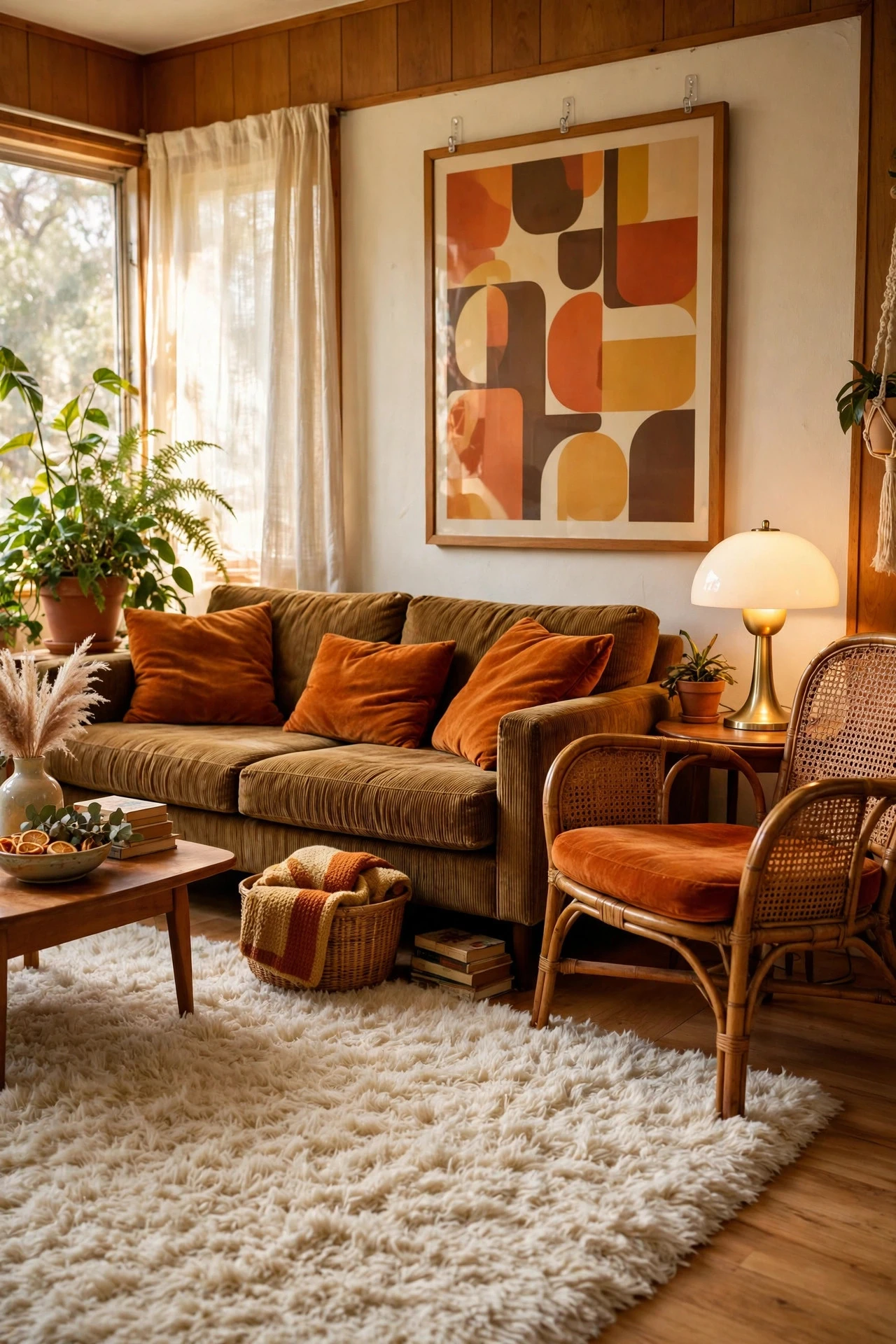
Renters can get the full 70s look without touching a wall or a floor. The entire scheme can live in things you take with you: a shag rug, burnt-orange cushions and a throw, a rattan chair, a mushroom lamp, and one large framed poster hung from removable hooks. Nothing needs a drill, a paint tin or a landlord's permission.
Peel-and-stick wallpaper on a single wall is the one semi-permanent option worth considering — $50–$120, removable, and genuinely transformative — but test a strip behind furniture first and never apply it to fresh paint. Use removable adhesive hooks rated for the frame's weight, and photograph the walls before you hang anything. A renter refresh costs $250–$600 all in, and every piece moves with you. Avoid painting, drilling into tile, or gluing anything to the walls; a 70s look is not worth a deposit. Avoid buying furniture sized for a rental you will leave — keep the big pieces neutral and the retro notes portable.
19. What Is the Budget for a Full 70s Living Room Makeover?

A full 70s living room makeover honestly costs $800–$2,500, and the split matters more than the total. The sofa is the biggest single cost at $600–$1,500 new, followed by the rug at $150–$400, lighting at $100–$300, and textiles, art and accessories at $150–$400. Buying vintage for the sideboard, coffee table and chairs can cut the total by a third, but add $100–$200 for cleaning, re-oiling or re-covering.
Spend in this order if the budget is tight: rug first, lighting second, textiles third, and the sofa last — the rug and the light change the feel of the room for a fraction of the sofa's price. Track the budget on paper before you buy anything, and leave 10 per cent unspent for the finishing touches you only notice once the big pieces are in. Avoid buying everything from one shop in one weekend; a room bought in a day looks like a showroom. Avoid the cheapest vintage sofa you can find — re-covering a bad frame costs more than buying a good new one.
20. How Do You Layer Textures So the Room Feels Cosy, Not Cluttered?

Texture is the 70s secret weapon, and the rule is contrast with restraint: pair a soft texture with a hard one, and a smooth one with a rough one, in each seating zone. Velvet cushions against a rattan chair, a shag rug under a smooth timber table, a nubby wool throw over a leather-look sofa — each pairing gives the eye something to feel without adding another colour or pattern.
Limit yourself to four textures in the room: for example, velvet, rattan, shag and timber. A fifth texture — leather, macramé, cork — can work if it replaces one of the four rather than joining them. Keep the textures in the same warm family; cool chrome or glass against warm shag feels like two rooms arguing. The cost is low, since texture mostly lives in textiles: a velvet cushion is $20–$40, a wool throw $40–$80. Avoid covering every surface in a different texture, which reads as clutter, and avoid matching textures exactly — a velvet sofa with velvet cushions and a velvet throw is flat, not cosy.
21. How Do You Keep a 70s Living Room From Feeling Dark?

The 70s palette is naturally dark, so light has to be designed in, not hoped for. Start with the walls: warm white or pale cream on at least three walls, with the dark colour confined to one accent wall or to furniture. Then add light in layers — a mirror opposite the window, sheer linen panels behind the heavy curtains, and warm 2700K bulbs in every lamp, on dimmers.
Keep the window dressing light during the day: sheer panels let daylight through while the heavy patterned curtains frame the window rather than covering it. A large mirror, at least 30 x 40 inches, opposite or beside the window, doubles the daylight and is the single cheapest brightness fix at $60–$150. Avoid dark wood on every surface — balance a walnut table with a cream rug — and avoid heavy dark curtains drawn across the whole window, which is the fastest way to make a 70s room feel like a basement.
22. What Should You Avoid in a 70s Living Room?

The avoid-list is what separates a retro room from a costume set. Skip the lava lamp, the bead curtain, the full avocado bathroom suite dragged into the living room, and any item bought purely because it says "70s" on the label. Skip matching sets — a sofa, chair and curtains all in the same burnt-orange pattern is a showroom, not a home. And skip the irony: if you do not genuinely like a piece, it will look like a joke within a month.
The subtler mistakes matter more. Avoid more than two bold patterns, more than three retro clichés, and any single item that dominates the room — a giant sunburst mirror, a neon sign, a shag rug in a colour that fights the sofa. Avoid cool grey and cool white entirely; they clash with every warm 70s tone. And avoid buying the whole room at once. A 70s living room should look collected over time, because the originals were. Start with the rug and the light, live with them for two weeks, then add the next layer.
Practical tips for a 70s living room
Buy the rug and the light first. A shag rug and warm 2700K lighting change the feel of the room for a few hundred dollars, before you commit to a sofa or a paint colour. Live with them for two weeks before buying the next layer.
Test paint and fabric in the room, not the shop. Burnt orange and avocado shift dramatically under your own lighting. Buy a sample pot and a cushion first, and look at them morning, noon and evening before committing.
One bold pattern per sightline. If you can see two bold patterns from the sofa, remove one. Solids and textures are what let a bold pattern breathe.
Keep the vintage third, not the whole. One-third vintage character pieces and two-thirds new comfort keeps the room liveable and stops it reading as a museum or a fancy-dress set.
Photograph the room before you change it. A phone photo shows proportion and clutter problems your eyes miss in person, and it gives you a record of what each change actually did.
Final thoughts
A 70s living room works when it feels warm, low and lived-in — not when it ticks every retro box. Pick two or three notes you genuinely love, a shag rug, a rattan chair, a burnt-orange accent, give them room to breathe, and let the rest of the room stay calm and modern. That is the difference between retro and dated, and it is a room you will still love in five years.
Frequently Asked Questions
How do I make a 70s living room look retro without looking dated?
Pick two or three authentic 70s notes — a low sofa, a shag rug, rattan or burnt orange — and keep everything else calm and modern. One bold pattern per sightline, warm 2700K lighting and plain walls around the retro pieces stop the room reading as a costume set. Edit hard: if a piece only says "70s" and adds nothing you love, remove it.
What is the difference between 70s style and mid-century modern?
Mid-century modern is the 1950s and 60s: tapered legs, teak and walnut, clean lines and restrained colour. The 1970s went lower, plusher and earthier — deep low sofas, shag rugs, rattan, macramé and bold burnt orange, avocado and mustard. The test is the silhouette: slim splayed legs mean mid-century, low and chunky means 70s.
How much does a 70s living room makeover cost?
A full makeover costs $800–$2,500, with the sofa the biggest single expense at $600–$1,500 new. A renter-friendly refresh with a rug, lighting and textiles runs $250–$600, and buying vintage sideboards, chairs and coffee tables can cut the full total by about a third. Spend on the rug and lighting first; they change the room most for the least money.
Can I do a 70s living room in a rented home?
Yes, and it is one of the easiest retro styles to rent with. The whole look can live in portable pieces: a shag rug, burnt-orange cushions, a rattan chair, a mushroom lamp and a framed poster on removable hooks. Peel-and-stick wallpaper on one wall is the only semi-permanent option, and it removes cleanly if you test it first.
What colours go with burnt orange in a 70s living room?
Burnt orange pairs best with cream, warm wood, olive and chocolate brown — keep it to 10 to 20 per cent of the room's colour so it pops without overwhelming. Mustard and avocado can join in small doses, but all three at full strength fight each other. Avoid cool grey and cool white, which clash with every warm 70s tone.
Is a shag rug practical in a living room?
Yes, if you choose the right pile and size. A 1.5 to 2 inch pile in cream, rust or chocolate is comfortable underfoot and easy to vacuum, and an 8 x 10 foot rug fits most seating arrangements with the sofa's front legs on the rug. Avoid white shag with pets or children, and keep it as the only shag in the room so the look stays intentional.