22 Living Room Christmas Decor Ideas to Make Your Home Feel Festive
The living room is where Christmas actually happens. It is where the tree stands, where presents pile up on Christmas morning, where the family gathers around the fire with hot chocolate and where guests form their first impression of your home in December. Living room Christmas decor is not about buying the most ornaments — it is about making one room feel warm, layered and intentional, so every corner earns its place and nothing looks like clutter.
Below are 22 living room Christmas decor ideas organised by zone — tree corner, mantel and fireplace, coffee table, shelves and walls, windows, seating and textiles, and lighting and scent — with real prices, exact measurements and the mistakes that make a room look busy instead of beautiful. Most ideas cost under $30 each, and the whole room can be transformed for $150 to $250. Nothing here needs a renovation, and every idea works in a standard living room of 200 to 400 square feet.
Looking for more inspiration? Our Nest Decorz homepage gathers the latest home decor ideas, seasonal decorating guides and room-by-room styling tips in one place — start there and explore.
Quick answers
– Start with the tree corner and the mantel — those two focal points carry 80% of the festive feeling; everything else is supporting decoration. – Pick one colour story and repeat it three times — two main colours plus metallic gold or silver, echoed in the tree, the mantel and the cushions, makes the room look designed. – Warm light beats bright light — 2700K to 3000K fairy lights, candles and lamps make the room glow; cool white light makes it look like an office in December. – Leave breathing room — a styled surface is two-thirds full and one-third empty; overfilling the mantel, coffee table or shelves is the most common Christmas decorating mistake. – Budget $150 to $250 for the whole room — spend the most on the tree and the mantel, and use greenery, ribbon and candles for the rest.
1. Where Should the Christmas Tree Go in the Living Room?

Place the Christmas tree in the corner nearest the room's main seating, at least 30 cm from the wall and clear of walkways, radiators and the television. The best spot is usually the corner diagonally opposite the sofa, so the tree is visible from the front door and from every seat without blocking the TV or the fireplace.
Measure before you buy: a 180 cm tree needs a footprint of about 100 cm in diameter, plus 15 cm of breathing room around the base for the skirt and presents. Avoid the corner behind the door, where the tree gets knocked every time someone walks in, and avoid placing it directly in front of a window — backlighting turns the tree into a silhouette by day and hides the ornaments. If your living room has a bay window, the bay itself is the classic tree spot, but keep the tree 20 cm clear of the glass so condensation does not dampen the branches.
2. What Size Christmas Tree Fits a Standard Living Room?

Choose a tree that is 30 to 45 cm shorter than your ceiling, so a 240 cm ceiling takes a 180 to 210 cm tree, and match the width to the room: a slim tree (70 to 90 cm wide) suits a flat or a small living room, while a full tree (110 to 130 cm wide) needs a room of at least 300 square feet.
The Christmas tree tradition of bringing an evergreen indoors goes back centuries, but a modern artificial tree — PVC or PE branches, hinged for folding — holds its shape, drops no needles and packs away flat. Budget $80 to $200 for a good 180 cm pre-lit artificial tree with warm-white LEDs, and check the tip count: 800 to 1,000 tips gives a full look, while under 500 tips looks sparse no matter how many baubles you add. These 22 Christmas tree ideas for a warm stylish home show how tree height, shape and lighting change the whole room.
3. How Do You Choose a Christmas Tree Colour Scheme?

Choose a Christmas tree colour scheme by picking two colours plus one metallic, then using them in a 60-30-10 ratio: 60% your main colour, 30% your second colour and 10% metallic. Classic pairings are deep red and forest green with gold, navy and silver with white, or burgundy and blush with copper — and the scheme should echo your living room's existing sofa, rug and curtains.
Use three ornament sizes — large 10 cm baubles deep inside the branches for depth, medium 6 to 8 cm baubles in the middle, and small 4 cm baubles at the tips — and repeat each colour at least five times around the tree so the eye reads it as a pattern, not a random scatter. Add one non-bauble texture per scheme: velvet ribbon, wooden ornaments or dried orange slices break up the shine and stop the tree looking like a shop display.
4. How Do You Style a Tree Skirt and the Presents Underneath?

Style the tree skirt and presents by choosing a skirt that extends 15 to 20 cm beyond the tree's widest branches, then arranging wrapped presents in three sizes — large at the back, medium in the middle, small at the front — so the base reads as a layered display rather than a pile. A skirt in velvet, faux fur or woven jute costs $20 to $40 and hides the tree stand completely.
Wrap presents in two papers only, both from your colour scheme, with one ribbon colour tying them together — mismatched cartoon paper under a sophisticated tree is the fastest way to cheapen the room. Stand one or two tall presents upright at the back for height, lay flat boxes in front, and tuck a few sprigs of faux greenery or pinecones between the boxes to fill gaps. If you have no presents yet, use empty boxes wrapped in scheme paper as placeholders so the base never sits bare.
5. How Do You Hang Garland on a Mantel Without It Slipping?
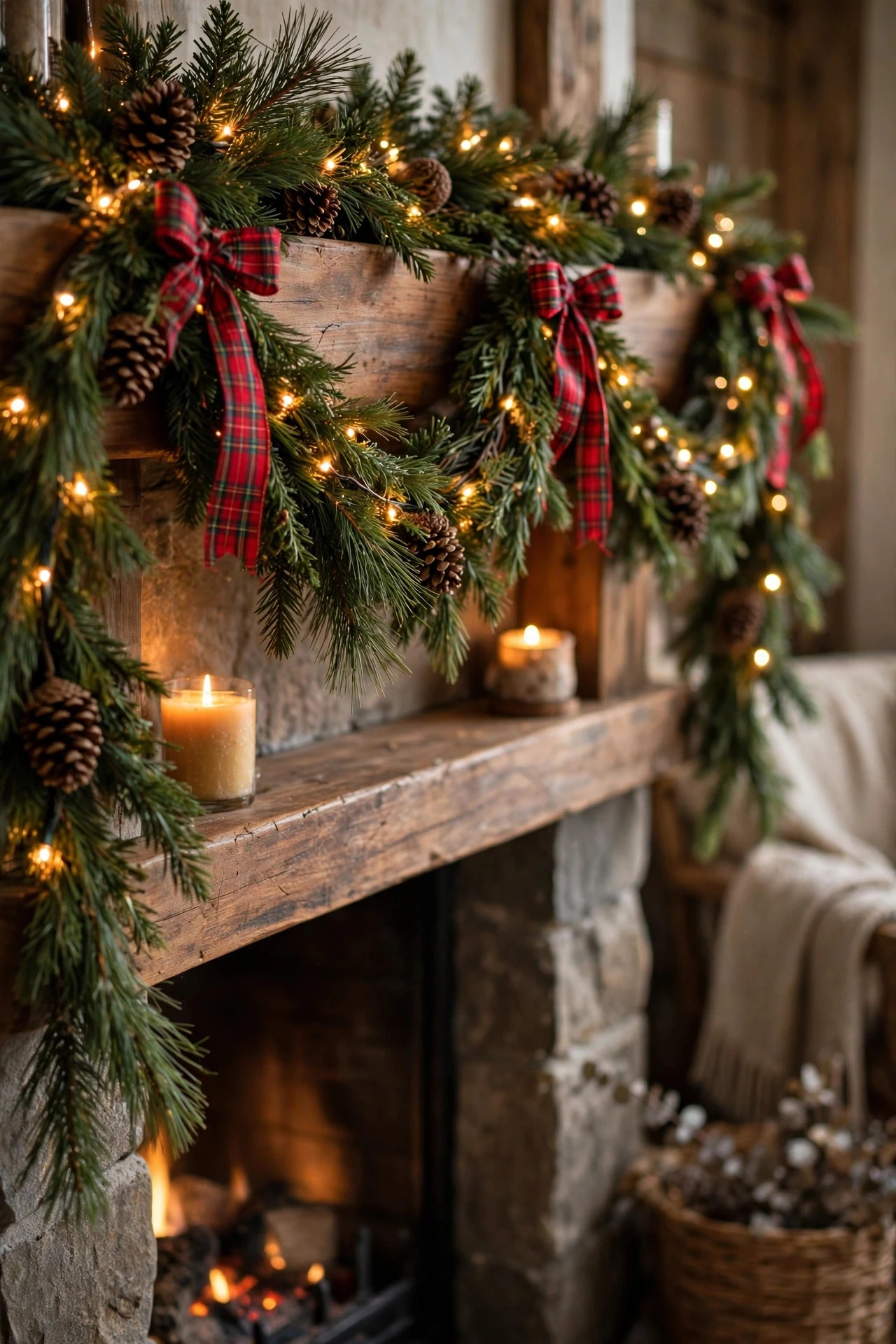
Hang mantel garland by anchoring it with three removable adhesive hooks — one at each end and one in the centre — then draping it in a gentle swag that dips 15 to 20 cm below the mantel edge at its lowest point. A 270 cm faux pine garland costs $25 to $40, fits a standard 120 to 150 cm mantel with ends spilling over each side, and fluff it for ten minutes before hanging so it looks full.
Weave a strand of warm-white fairy lights through the garland first, while it is still on the floor, so the lights sit inside the greenery rather than dangling in front of it. Add clusters of three ornaments — pinecones, small baubles or dried orange slices — wired into the garland every 30 cm, and finish with a ribbon bow at each end. The Spruce's Christmas mantel decorating ideas also recommend layering a second, thinner garland over the first for depth. These 22 Christmas fireplace decor ideas for a warm festive hearth show how garland, stockings and hearth styling work together as one fireplace composition.
6. How Do You Hang Stockings on a Mantel Safely?

Hang stockings on a mantel with weighted stocking holders — not adhesive hooks — placing one holder every 30 to 40 cm and keeping the stocking clear of the firebox opening by at least 15 cm. A set of four cast-iron or brass holders costs $25 to $45, and each one should weigh at least 500 grams so a filled stocking cannot drag it off the edge.
Match the stockings to your colour scheme, not to each other: knit stockings in cream, red and green with one metallic thread look collected and personal, while four identical stockings look like a shop set. Hang the largest stocking in the centre and taper sizes outward for a gentle arc. Never hang a stocking from the mantel with a nail or a screw, and never drape stockings over a lit fire: if your fireplace is in use, move the stockings to a sideboard or a wall hook until the fire is out and the mantel is cool.
7. What Goes on the Fireplace Hearth at Christmas?

Style the fireplace hearth with a low, fire-safe arrangement: a log basket or a woven basket of birch logs on one side, a pair of lanterns with LED candles on the other, and a flat woven mat or a folded faux-fur throw in front of the firebox. Keep everything at least 30 cm from the firebox opening, and never place paper, fabric or dried foliage inside that zone.
Fill a $30 to $50 rattan or metal log basket with birch logs — pale bark reads brighter than dark oak — and tuck a sprig of faux pine on top. Lanterns in black metal or brass, 25 to 35 cm tall, with flameless candles inside, give the hearth a glow even when the fire is not lit. If your fireplace is decorative and never used, you can fill the firebox itself with a cluster of pillar candles at three heights, or a stack of fairy lights in a glass hurricane — but never do either in a working fireplace.
8. How Do You Style a Christmas Coffee Table Centrepiece?
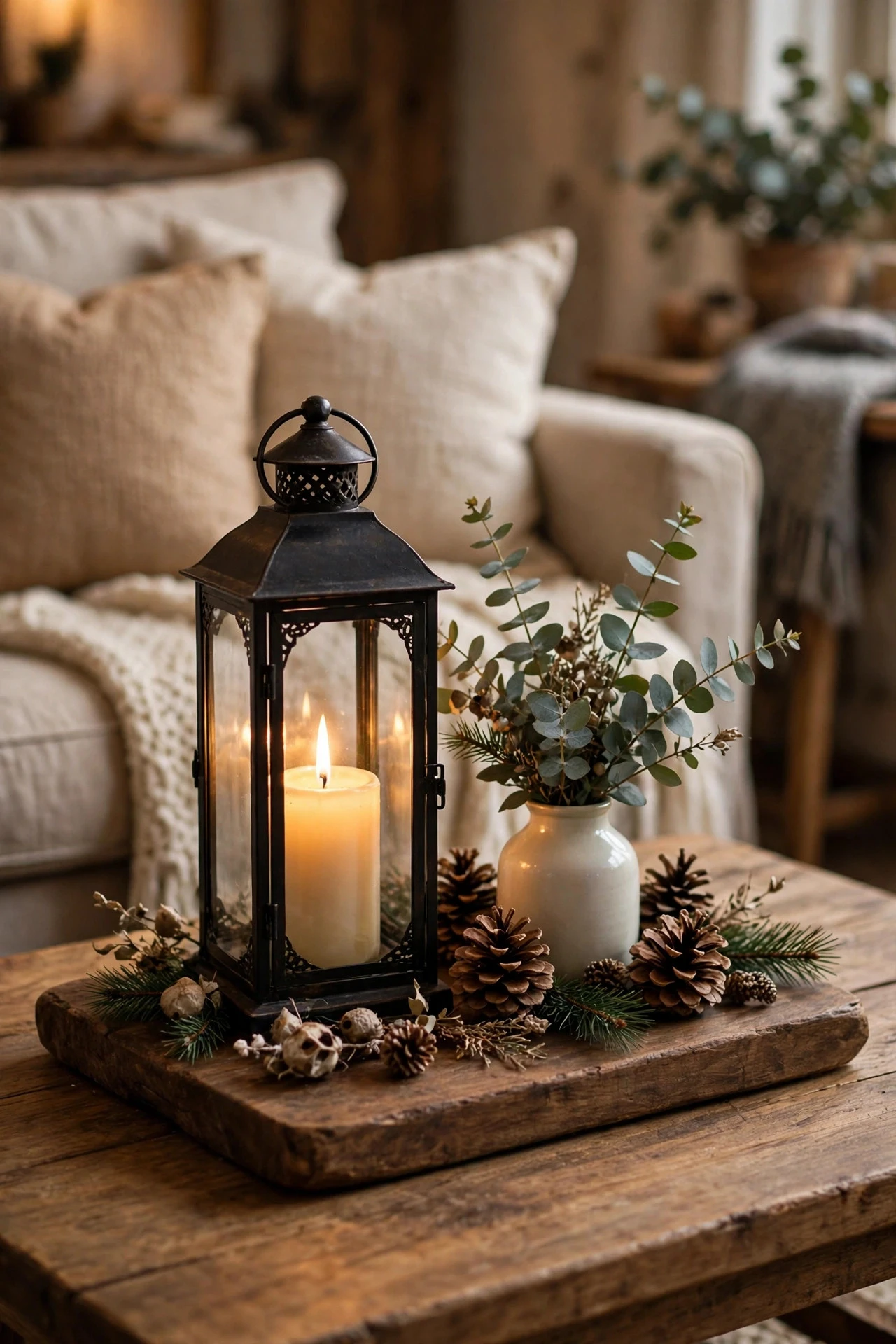
Style a Christmas coffee table centrepiece on a tray, because a tray contains the decoration and leaves the rest of the table usable for mugs and books. Start with a round or rectangular tray 40 to 50 cm wide — wood, brass or woven rattan — then build in three heights: a tall candle or a small tree in the centre, medium greenery or a vase around it, and low baubles or pinecones filling the gaps.
The three-height rule is what separates a styled centrepiece from a pile of decorations: one tall element (a 25 cm candle lantern or a 30 cm mini tree), two medium elements (a small vase of eucalyptus, a stack of two books), and low fillers (pinecones, 4 cm baubles, a sprig of berries) that stop the tray looking empty. Keep it under 30 cm tall so it never blocks the view across the sofa, and leave one-third of the table clear. These Christmas coffee table decor ideas for a festive centrepiece show tray layouts, book stacks and greenery combinations that work on round, square and rectangular tables alike.
9. Why Does a Tray Make Christmas Coffee Table Styling Easier?
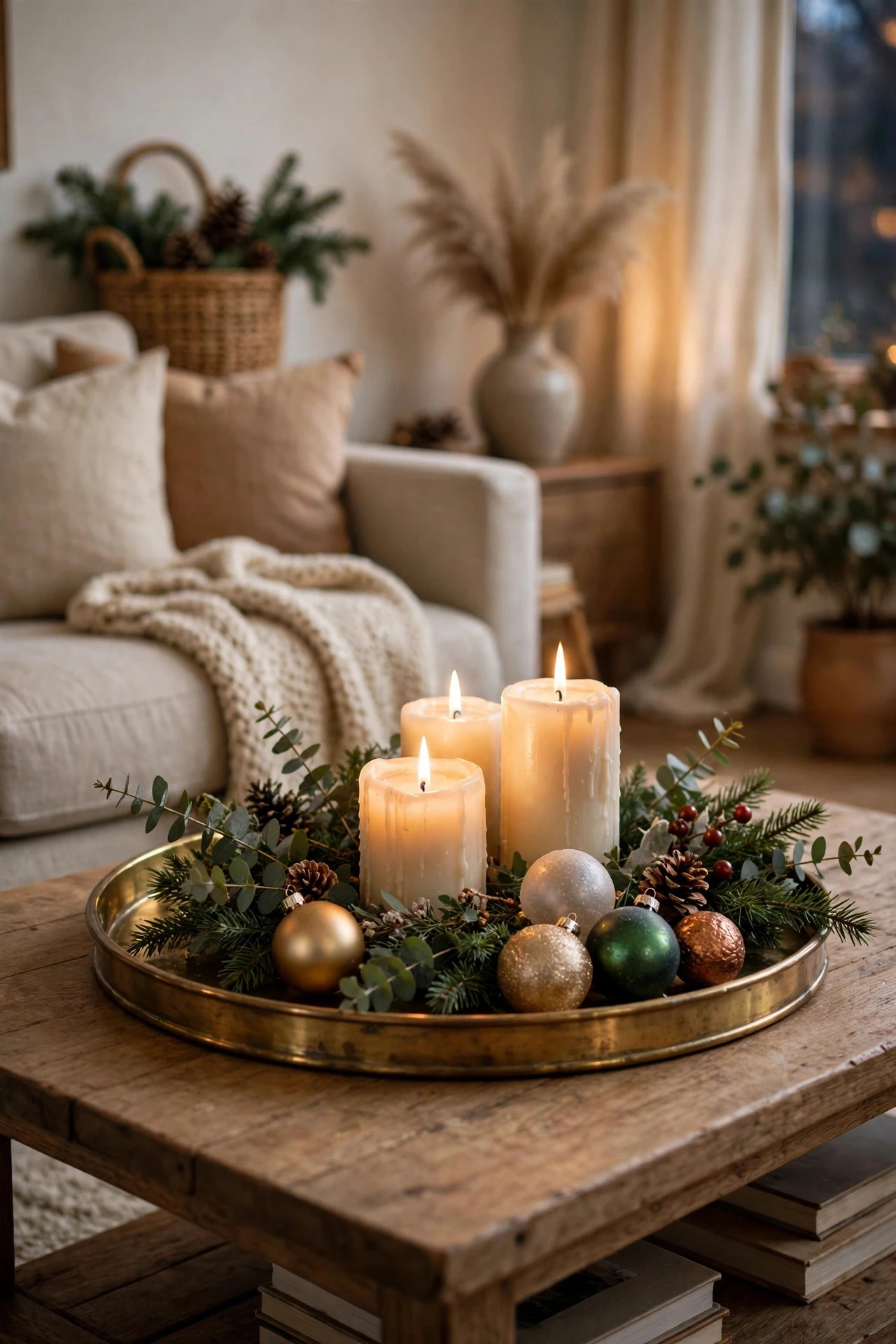
A tray makes Christmas coffee table styling easier because it turns a scattered collection of candles, greenery and ornaments into one movable unit — lift the tray and the whole centrepiece moves, so the table can be cleared for a board game or a meal in five seconds. A tray also protects the tabletop from candle wax, pine sap and water rings.
Choose a tray with a raised edge of at least 3 cm, so baubles and pinecones stay put when someone bumps the table. Wood trays in walnut or oak suit a traditional room, brass or mirrored trays suit a glamorous room, and woven seagrass suits a relaxed, farmhouse-style living room. Budget $20 to $35 for a good tray, and size it to the table: the tray should cover about one-third of the tabletop, never more than half.
10. How Do You Use Candles on a Coffee Table Without the Mess?

Use candles on a coffee table by grouping them in odd numbers on a heatproof surface — a ceramic plate, a slate tile or a metal tray — and choosing pillar candles or flameless LED candles over tapers, which drip. Three pillar candles at heights of 10, 15 and 20 cm cost $12 to $20 as a set, and a cluster of three reads as intentional where a single candle looks like an afterthought.
Place the group at one end of the tray, not the centre, so the other end holds greenery or a book stack. Surround the base with a ring of faux greenery or a few pinecones to hide the candle plates, and keep the flames at least 15 cm from any fabric, paper or dried foliage. Flameless candles with a remote and timer are safer with children or pets — set them for 5 pm to 10 pm and the room lights itself. Never leave a real candle burning in an empty room, and trim the wick to 5 mm before each lighting so the flame stays small and clean.
11. How Do You Style Living Room Shelves for Christmas?

Style living room shelves for Christmas by editing first and decorating second: remove one item in three from each shelf, then add one festive piece per shelf — a small wreath, a candle, a sprig of greenery or three baubles in a bowl — so the shelves look seasonal without looking stuffed. A shelf that is 90% full of everyday objects plus Christmas decor looks cluttered; a shelf that is 60% full looks curated.
Work in odd numbers and repeat your colour scheme across the shelves: if the tree is red and gold, put a red candle on the top shelf, a gold bauble bowl on the middle shelf and a red ribbon on the bottom shelf, so the eye travels down in one story. Lean a small framed print or a Christmas card against the back of the shelf for depth, and drape a single strand of greenery along the front edge of one shelf only — greenery on every shelf overwhelms the room. Keep heavy books at the ends as bookends, and never block a shelf's function — the remote and glasses stay put.
12. How Do You Swap Wall Art for Christmas Without Rehanging Everything?

Swap wall art for Christmas by replacing just one or two framed pieces with seasonal prints, or by layering a small Christmas print in front of an existing frame on a picture ledge. A set of two or three framed winter prints costs $25 to $45, and swapping prints inside existing frames takes ten minutes and no new holes in the wall.
Choose prints that match your room's palette — a snowy forest in muted greens, a vintage Santa illustration, a simple typographic "Merry Christmas" in your scheme colours — and keep the frames the same as the rest of the room so the swap looks deliberate. A picture ledge is the easiest version: lean the Christmas print in front of the everyday art, and swap it back in January without touching a nail. On a gallery wall, change only the smallest frame — one seasonal piece makes the room feel like a home that celebrates, not a Christmas shop.
13. How Do Mirrors and Metallic Decor Make a Living Room Feel Brighter?
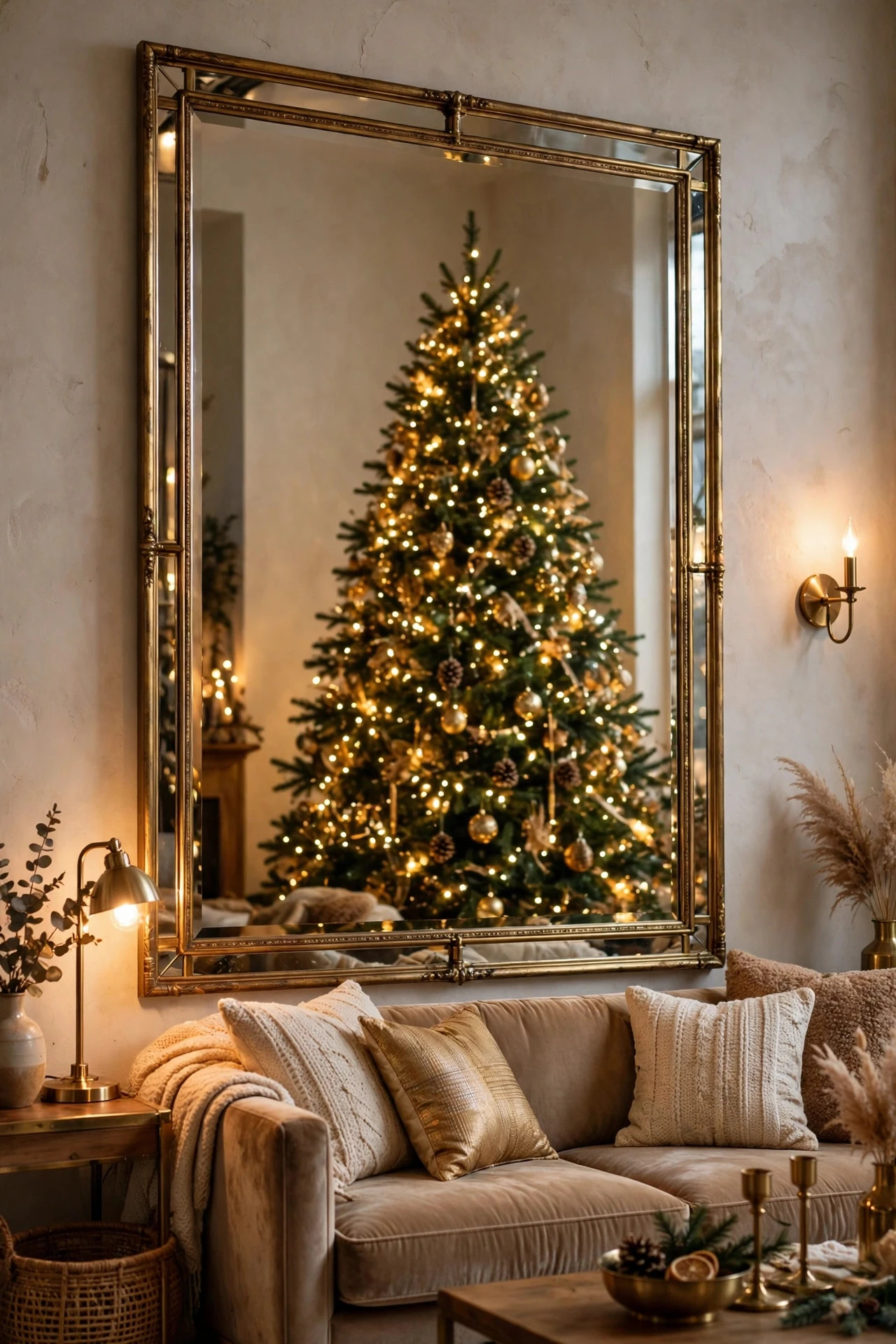
Mirrors and metallic decor make a living room feel brighter at Christmas because they double the light: a mirror opposite the tree or the window reflects the fairy lights and doubles their glow, while gold, brass and silver baubles bounce warm light into the room's dark corners. In December, when daylight ends by 5 pm, reflective surfaces do more work than any extra lamp.
Hang or lean one large mirror — 60 by 90 cm or bigger — on the wall opposite the tree, and watch the tree's lights appear twice. Add metallic accents in three places, not thirty: a brass tray on the coffee table, gold baubles on the tree, and a silver candlestick on the mantel. Too much metallic turns the room into a mirror ball; three deliberate touches read as luxury.
14. How Do You Decorate Living Room Windows for Christmas?

Decorate living room windows for Christmas by framing them, not filling them: a strand of warm-white fairy lights around the frame, a small wreath hung inside the glass on a suction hook, and a row of LED candles on the sill. The window is the room's light source, so anything that blocks the glass makes the room darker and smaller in December.
Run the lights around the frame, not across the pane, so you can still open the window for air, and use clear adhesive clips spaced every 30 cm for even scallops. A wreath 30 to 40 cm across suits a standard window — larger wreaths overwhelm it — and a suction hook rated for 2 kg holds it safely on the glass. Add three LED pillar candles on the sill, spaced 20 cm apart, which glow in the glass at night and double the light visually.
15. What Belongs on a Christmas Window Sill?

A Christmas window sill needs only three things: a row of LED candles, a low garland or a line of greenery, and one small decorative object — a mini tree, a reindeer figure or a glass hurricane with fairy lights. A sill is usually 15 to 20 cm deep, so anything taller than 30 cm blocks the light and anything wider than the sill risks falling.
Lay a flat garland of faux pine along the sill first, then place three LED candles at different heights on top of it — 10, 15 and 20 cm — so the light steps up like a staircase. Add one statement piece at one end, such as a 25 cm ceramic tree or a small lantern, and leave the other end clear so the arrangement does not look symmetrical and stiff. Keep real candles off the sill entirely — curtains hang close to most windows — and dust it first, because greenery on a dusty sill looks tired within a week.
16. How Do Throws and Cushions Change a Living Room for Christmas?

Throws and cushions change a living room for Christmas faster than any other single swap, because the sofa is the room's largest surface after the walls. One chunky knit throw in cream or cranberry, folded over the sofa arm, plus two cushions in your scheme colours, makes the whole room read as Christmas before a single ornament is hung.
Choose textures that say winter: velvet, faux fur, chunky knit and wool, in two colours from your scheme plus one neutral. A throw 130 by 170 cm costs $25 to $45 and should drape over one arm and across the seat, not cover the whole sofa — a sofa buried under fabric looks like it is in storage. Use three cushions: one large 50 cm solid, one medium 45 cm patterned, one small metallic or velvet lumbar. These 22 living room rug ideas to ground your seating area show how the rug under the sofa and the textiles on it work together to anchor the whole seating zone.
17. Should You Layer a Rug for Christmas?

Layer a rug for Christmas only if the base rug is neutral and flat — lay a smaller, festive rug or a faux-sheepskin throw on top, at a slight angle, to create a cosy winter layer under the coffee table. Layering works when the top rug is at least 30 cm smaller on every side than the base rug, so the base rug reads as a border around it.
A faux-sheepskin rug, about 60 by 90 cm, costs $25 to $40 and instantly softens a hard floor or a flat-woven rug for the season. Place it half under the coffee table and half in front of the sofa, where bare feet land on Christmas morning. Never layer two patterned rugs, and never stack thick pile on thick pile — it ripples and trips. If your base rug is already patterned or plush, skip layering and add the festive feeling with a throw and cushions instead; the rug's job is to ground the seating, not to carry the Christmas theme on its own.
18. How Do You Make a Cosy Christmas Reading Nook in the Living Room?
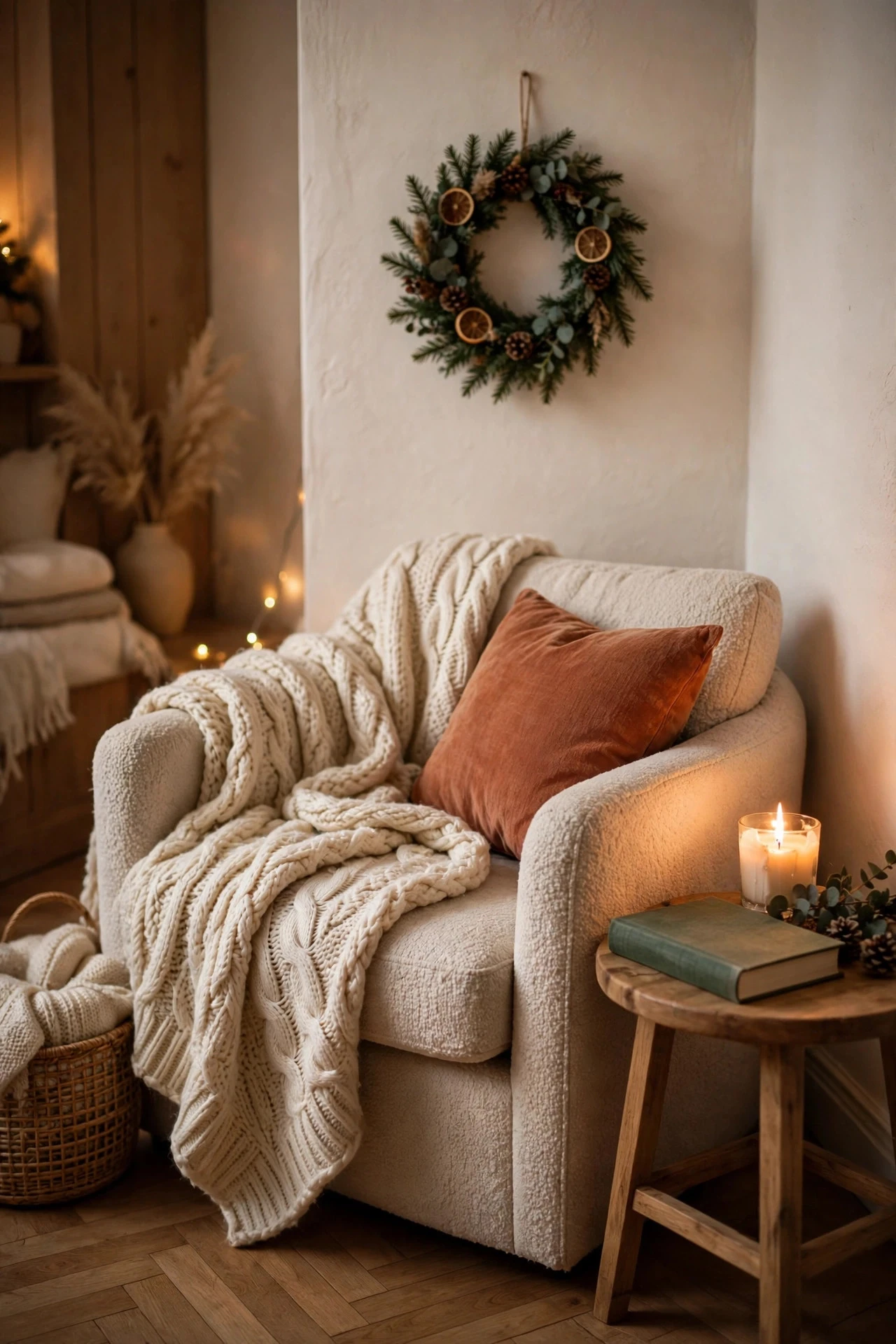
Make a Christmas reading nook by claiming one armchair and its corner: a throw over the arm, a cushion behind your back, a small side table with a candle and a book, and a floor lamp or a strand of fairy lights behind the chair. A nook needs only 100 cm of floor space, and it gives the living room a quiet corner that balances the busy tree and mantel.
Place the chair at a slight angle to the room, not flat against the wall, so the nook feels like a destination rather than a leftover. Put the side table on the chair's right side — the natural reaching side for most people — and keep the tabletop to three things: a candle, a mug and a book. Hang a small wreath on the wall above the chair or drape a short garland along the windowsill behind it, so the nook has its own vertical decoration.
19. How Do You Layer Living Room Lighting for Christmas Evenings?
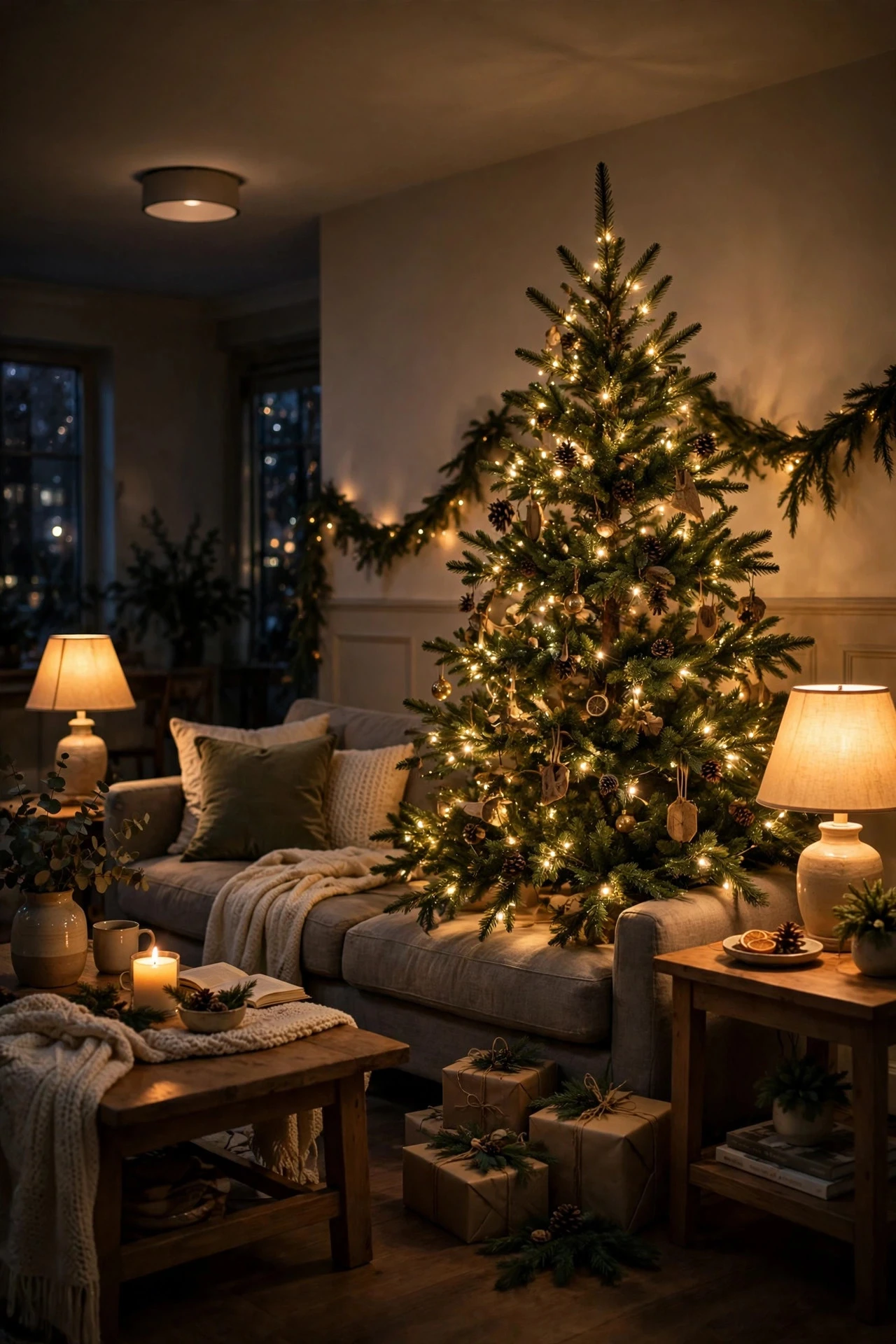
Layer living room lighting for Christmas by using three sources at once: the ceiling light dimmed to half, two table lamps with warm bulbs, and fairy lights or candles as the third layer. One light source alone — especially a bare ceiling light — flattens the room and kills the festive mood, while three layers at different heights make it glow.
Swap ceiling bulbs for warm-white 2700K LEDs and fit a $15 dimmer — the cheapest lighting upgrade in the house. Place one lamp on each side of the sofa, or one on the sideboard and one on a bookshelf, so the light pools in the corners instead of blasting from the centre. Then add the Christmas layer: fairy lights on the tree and mantel, LED candles on the coffee table and windowsill. House Beautiful's living room lighting ideas show the same three-layer principle in rooms of every style. These 22 living room lighting ideas for a warm layered glow apply the same layering to year-round living rooms, and the Christmas version simply adds fairy lights and candles as the third layer.
20. How Do You Use Lanterns and Candles Safely Around Children and Pets?

Use lanterns and candles safely by choosing enclosed lanterns with glass panels and flameless LED candles in any room where children or pets move freely, and by placing real candles inside a lantern or a hurricane glass, never open on a surface. A pair of metal lanterns, 25 and 35 cm tall, costs $20 to $35 and turns an open flame into a contained glow.
Put lanterns on the floor beside the fireplace or sofa — never on a low table where a tail or small hand can reach them. For real candles, use a stable, heavy holder, keep the flame at least 30 cm from curtains, throws and paper, and never leave the room with a candle burning. Battery candles with a remote are the practical answer for most family living rooms: set the timer for 5 pm to 10 pm, and the room lights itself every evening without a single match.
21. How Do You Add Christmas Scent Without Overwhelming the Room?

Add Christmas scent with one source, not three: a reed diffuser in pine, cinnamon or orange on the sideboard, a simmer pot on the hob for an hour before guests arrive, or a scented sachet in the linen cupboard — never all three at once, or the room smells like a candle shop. A reed diffuser costs $10 to $15, lasts four to six weeks, and gives a steady background scent without a flame.
Place the diffuser where air moves — near a doorway or on the sideboard opposite the sofa — and flip the reeds once a week to refresh it. For a stronger scent before a party, simmer orange peel, cinnamon sticks, cloves and a star anise in water on the hob for twenty minutes, then carry the warm pot to the living room and set it on a trivet. BHG's Christmas scent ideas recommend scenting by room, so the hallway smells of pine and the living room of cinnamon and orange.
22. How Do You Make the Whole Living Room Feel Cohesive, Not Random?

Make the whole living room feel cohesive by repeating your colour scheme in at least three places, your metallic in at least two, and your greenery in at least two — tree, mantel and cushions for colour; tray and candlesticks for metallic; garland and window sill for greenery. Cohesion is repetition with variation, not matching everything exactly.
Stand in the doorway: the eye should travel from tree to mantel to sofa without hitting a colour or style from a different house. If one corner looks wrong, it is usually because it introduces a new colour or a new metallic — remove that one piece and the room snaps together. Leave one surface completely undecorated — the sideboard, the TV unit or the bookshelf top — so the eye has somewhere to rest. These 22 Christmas room decor ideas for every room in your home show how the same colour story carries from the living room into the hallway and the bedroom, so the whole house feels like one Christmas, not five separate ones.
Practical Tips
Buy the greenery first and the baubles second, because greenery decides the shape of the room — the garland length, the tree fullness, the wreath size — while baubles only fill the gaps. Measure the mantel, the window and the coffee table before you shop, and write the numbers on your phone; a garland that is 30 cm too short looks worse than no garland at all. Keep a small box of spare hooks, wire, ribbon and batteries in the living room through December, because something always slips.
Set a take-down date before you put anything up. The students of Christmas decorating who enjoy it most take the tree down in the first week of January, while it still feels festive, not in late January when it feels like a chore. Photograph the finished room from the doorway, so you can repeat the layout next year, and label every storage box with its contents and its zone — tree, mantel, coffee table — so next December you open one box per zone and the room comes together in an afternoon.
Final Thoughts
A festive living room is not about how much you buy; it is about how well a few chosen pieces fit the room, the people who live in it and the way you actually spend December evenings. Start with the tree corner and the mantel, repeat one colour story three times, light the room in warm layers, and leave space for the living to happen — your living room will feel like Christmas, and it will still feel like home.
You may also like: our 22 Christmas fireplace decor ideas for a warm festive hearth and our 22 Christmas tree ideas for a warm stylish home carry the same colour stories and warm lighting into the two focal points of the room.
Frequently Asked Questions
How much does it cost to decorate a living room for Christmas?
A festive living room costs $150 to $250: $80 to $200 for a good artificial tree if you need one, $25 to $40 for mantel garland, $20 to $35 for a coffee table tray and candles, and $25 to $45 for throws and cushions. If you already own the tree, the room costs $80 to $120, because greenery, ribbon and candles do most of the work.
When should you start decorating your living room for Christmas?
Start decorating your living room for Christmas in late November, two to three weeks before Christmas Day, so the room feels festive without the tree shedding or the greenery drying out. Put the tree and mantel up first, then add the coffee table, cushions and windows over the following week. Take everything down in the first week of January.
How do you decorate a small living room for Christmas without clutter?
Decorate a small living room by choosing a slim tree 70 to 90 cm wide, decorating only the tree corner and the mantel, and leaving the coffee table to a single tray. Use vertical decoration — garland, wall prints and window lights — instead of floor pieces, and keep one surface completely clear so the room keeps its breathing room.
What is the best Christmas colour scheme for a living room?
The best Christmas colour scheme is the one that matches your living room: deep red and forest green with gold suits a traditional room, navy and silver with white suits a cool modern room, and burgundy and blush with copper suits a warm glamorous room. Pick two colours plus one metallic, use them in a 60-30-10 ratio, and repeat them in the tree, mantel and cushions.
Are real candles safe in a living room at Christmas?
Real candles are safe only inside a lantern or hurricane glass, on a stable heatproof surface, at least 30 cm from curtains, throws and paper, and never left burning in an empty room. In a house with children or pets, flameless LED candles are the safer choice — they give the same warm glow with a remote and a timer, and no flame at all.
How do you store living room Christmas decor after the holidays?
Store living room Christmas decor by zone in labelled boxes: tree ornaments wrapped in tissue in one box, mantel garland coiled loosely in another, and cushions and throws washed and folded flat in a third. Keep baubles in divided boxes or wrapped in tissue, coil fairy lights loosely in zip bags, and store everything in a dry place so it is ready to use next December.