22 Modern Bathroom Ideas for a Clean, Timeless Look
A modern bathroom should feel calm the moment you walk in. Clean lines, honest materials and good light do more than any trendy fixture ever will. The best modern bathrooms are not stark white boxes — they are warm, practical rooms where every surface is easy to clean and every choice still looks good ten years from now.
Timeless modern design is about restraint with warmth. Think large-format tile instead of busy mosaic, a floating vanity instead of a bulky cabinet, matte black or brushed brass instead of shiny chrome everywhere. Add one natural material — oak, travertine, linen — and the room stops feeling clinical and starts feeling like a spa.
This guide walks through 22 ideas that work in real homes, from compact apartments to generous primary suites. Each one includes the measurements, materials and budgets that actually matter, so you can plan with confidence rather than guess.
Looking for more inspiration? Our Nest Decorz homepage gathers the latest home decor ideas, seasonal decorating guides and room-by-room styling tips in one place — start there and explore.
Quick Answers
– Start with the layout, not the fixtures: a walk-in shower, a floating vanity and clear walkways matter more than any single tap or tile. – Warm minimalism wins: pair large-format tile and flat-front cabinetry with wood, stone or linen so the room feels calm, not cold. – Use real measurements: 60 cm of clear space in front of a vanity, a 76 cm shower opening and a 76–81 cm vanity height keep a modern bathroom comfortable. – Layer the light: ceiling light for tasks, sconces at face height for the mirror, and a dimmer so the room works at 6 a.m. and at 10 p.m. – Spend where it shows: invest in tile, the vanity and the shower glass; save on accessories, mirrors and hardware you can swap later.
1. How Does a Floating Vanity Change a Small Bathroom?
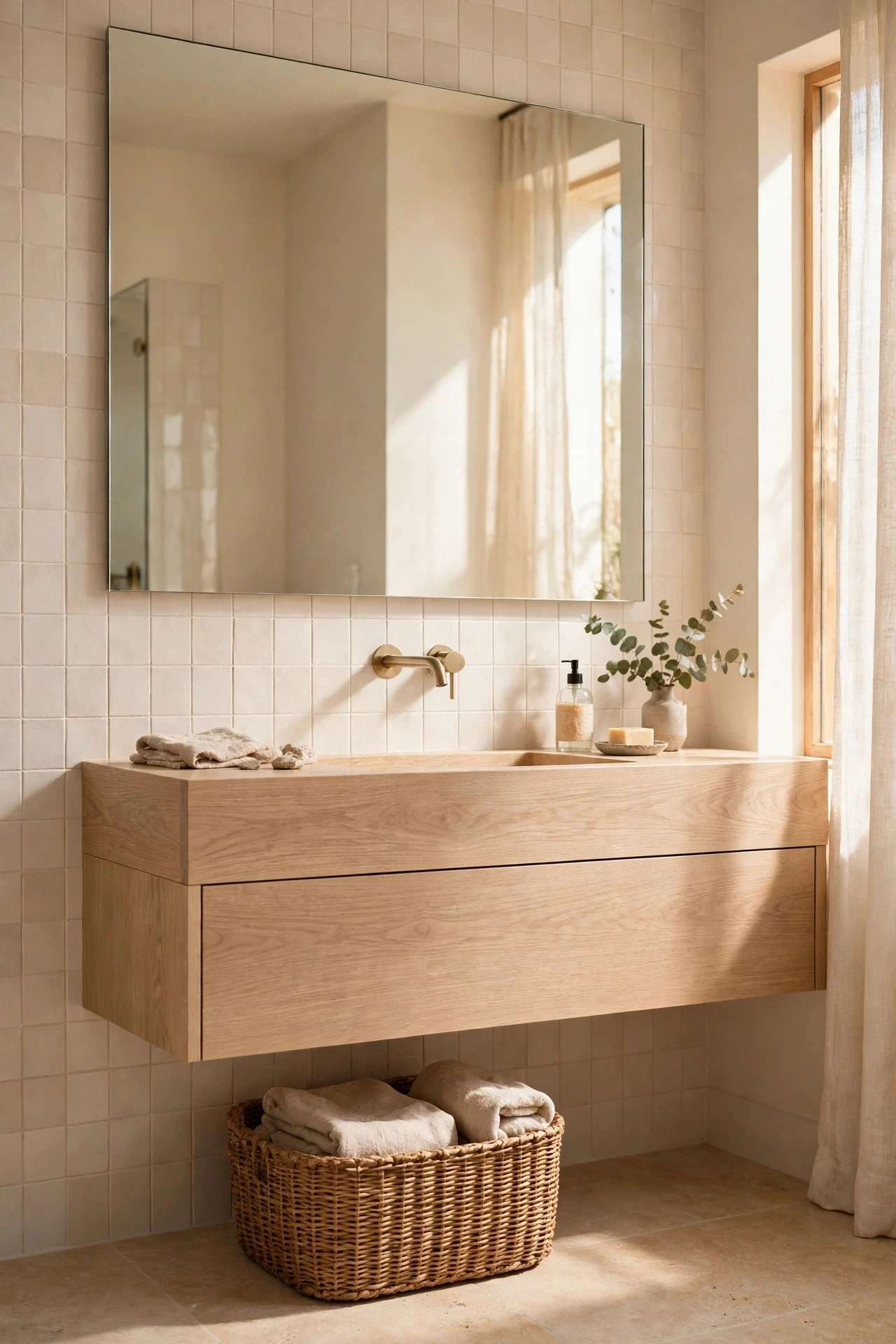
A floating vanity makes a small bathroom feel larger because the floor runs underneath it, so your eye reads the whole room instead of stopping at a bulky cabinet. The open space below also makes mopping easier and gives you a spot for a basket or a small stool.
Choose a wall-hung unit 60–90 cm wide for a single sink, or 120–150 cm for a double, mounted at 76–81 cm from the floor to the top of the counter. Oak, walnut or a warm white lacquer finish keeps the look soft; flat-front drawers with push-to-open hardware keep the lines clean. Pair it with a wall-mounted tap to free up counter space, and leave at least 60 cm of clear floor in front. If your wall is not solid, add blocking inside the studs before tiling — a floating vanity full of toiletries is heavy, and it must be fixed to structure, not just plasterboard. For more vanity inspiration, see our luxury bathroom vanity ideas.
2. What Makes a Walk-In Shower Feel Luxurious?

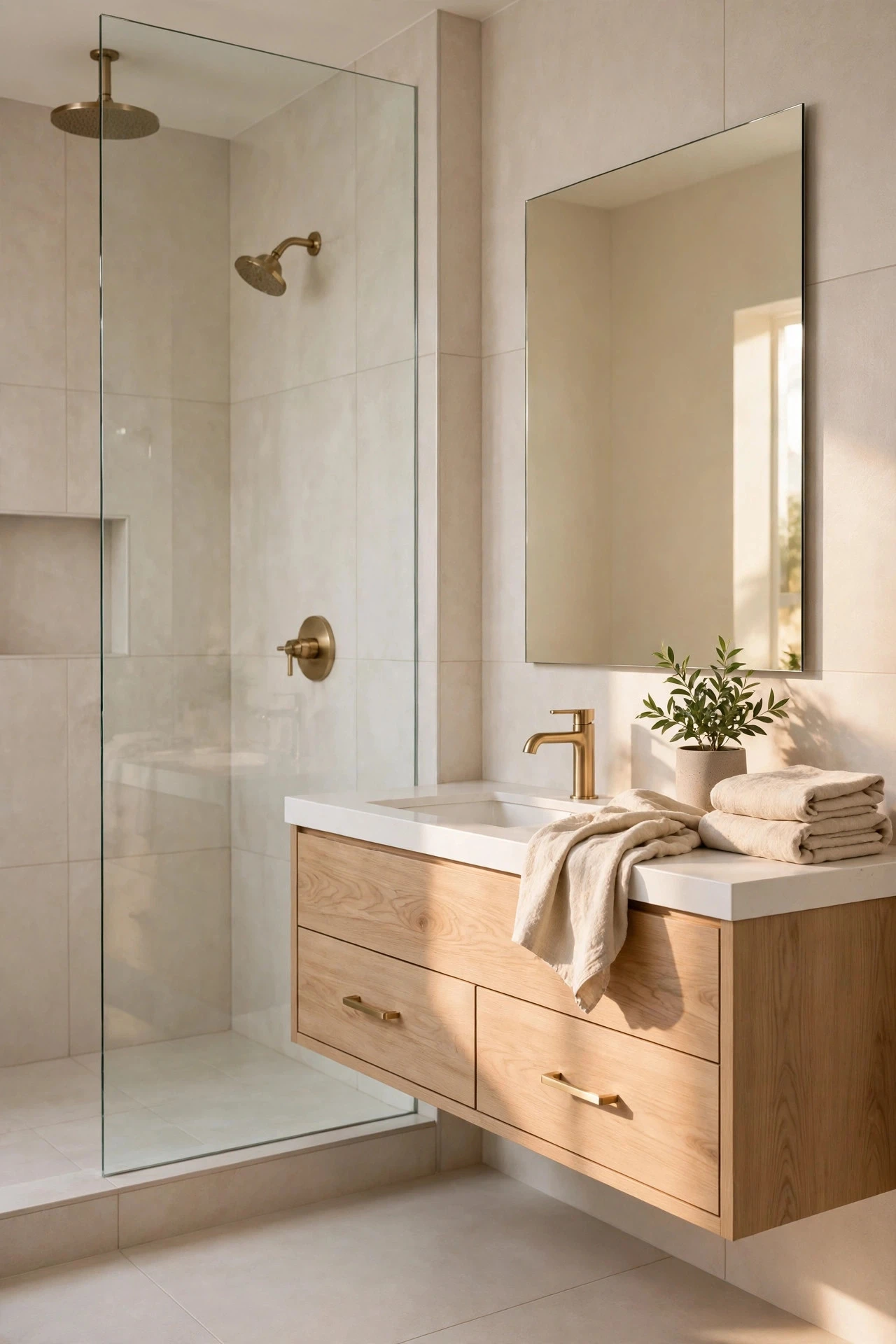
A walk-in shower feels luxurious when it has space, a single fixed glass panel and a rain head positioned so you never stand in a cold draught. The absence of a door or curtain makes the whole bathroom feel bigger, and the continuous floor makes cleaning far simpler.
Aim for a shower area at least 90 x 120 cm, with an opening of 76 cm or more. A 10 mm frameless glass panel, fixed to the wall or ceiling, keeps the view open. Large-format porcelain tiles on the floor (60 x 60 cm or 60 x 120 cm) with a matching linear drain create a seamless wet-room look, and a built-in niche at elbow height keeps bottles out of sight. Keep the shower head at 200–210 cm high, add a handheld on a slide rail for rinsing, and choose a thermostatic mixer so the temperature never spikes. A small teak bench or a fold-down seat adds comfort without breaking the clean lines.
3. Why Is Large-Format Tile the Modern Default?
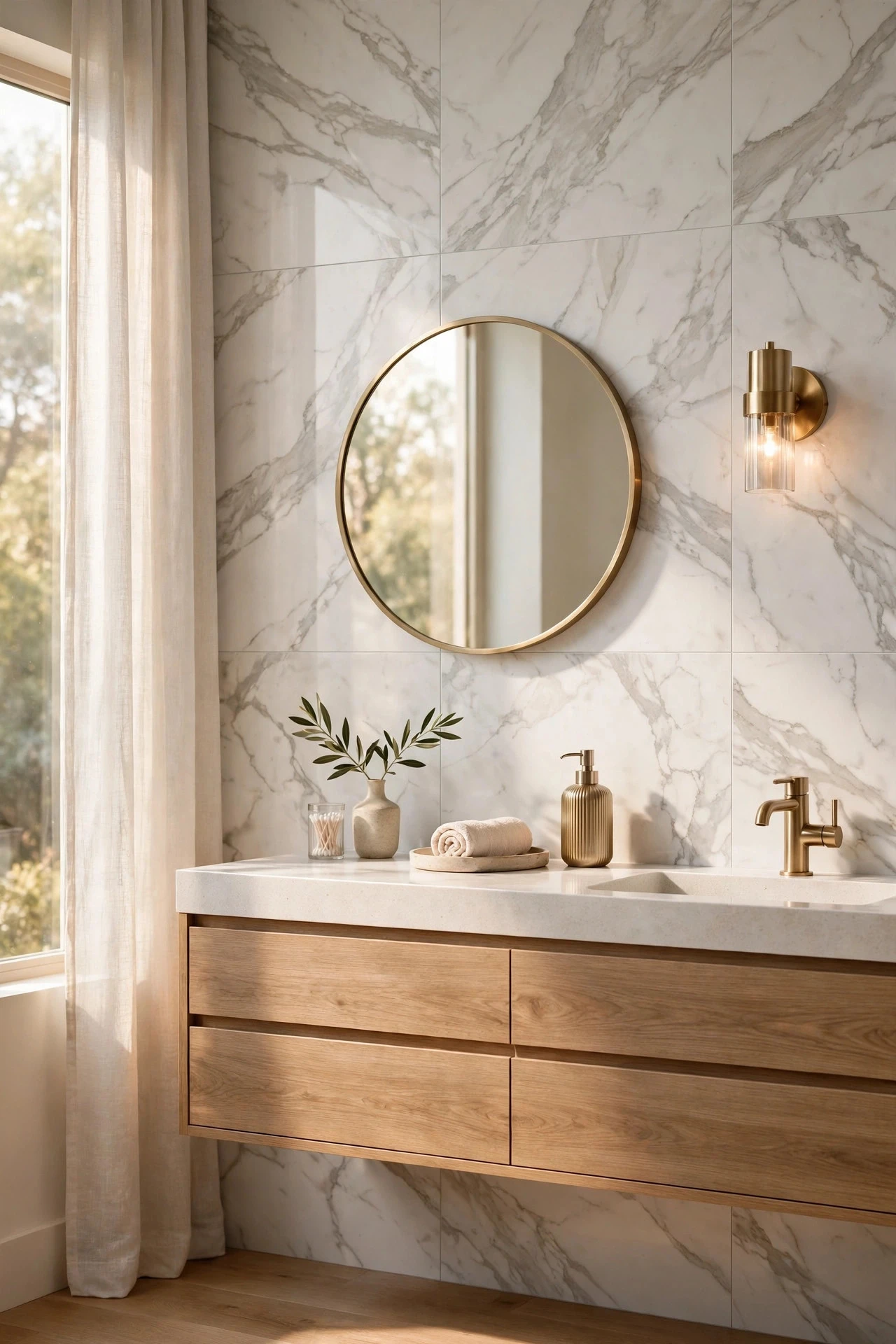
Large-format tile is the modern default because fewer grout lines mean a calmer surface, less cleaning and a room that looks bigger. A 60 x 120 cm porcelain tile on the wall reads almost like a stone slab, especially with matching grout and rectified edges.
Use the same tile on the floor and partway up the walls for a wrapped, architectural feel, and reserve a contrasting tile for one feature — behind the vanity or inside the shower niche. Porcelain is the practical choice: it resists water, stains and scratches, and it comes in convincing marble, travertine and concrete looks. Budget roughly $8–$25 per square foot for good porcelain, plus installation, and order 10% extra for cuts and breakage. Avoid tiny mosaic on large areas — it adds grout, cost and visual noise. Our guide to modern bathroom tile ideas shows how different sizes and finishes change the feel of the room.
4. How Do You Add Warmth Without Losing the Modern Look?
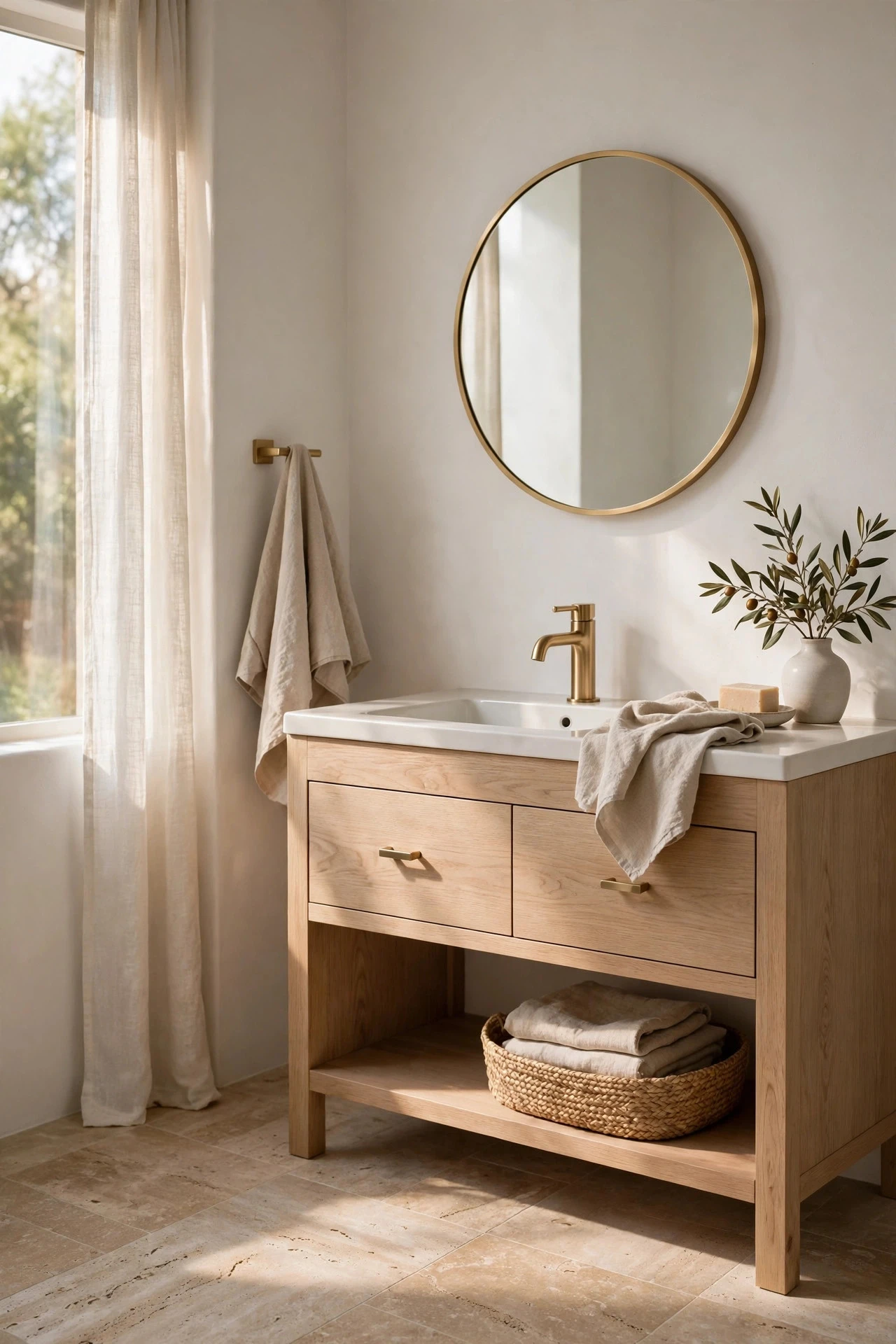
Warmth in a modern bathroom comes from natural materials used sparingly: one wood tone, one stone, one soft textile. The contrast between cool tile and warm oak is what stops the room feeling like a laboratory.
Try a white oak vanity against matte white walls, a travertine-look tile on the floor, and brushed brass taps. Add a linen hand towel, a woven basket and a wooden bath mat, and the room instantly feels lived-in. Keep the palette to three or four tones — warm white, one wood, one stone and one metal — and repeat each at least twice so nothing looks like an afterthought. Avoid mixing too many wood tones or too many metals; two metals maximum, one dominant and one accent. If your bathroom has no window, warm-white lighting at 2700–3000K does the same job as sunlight, softening white tile and pale stone.
5. What Is the Right Vanity Height for a Modern Bathroom?
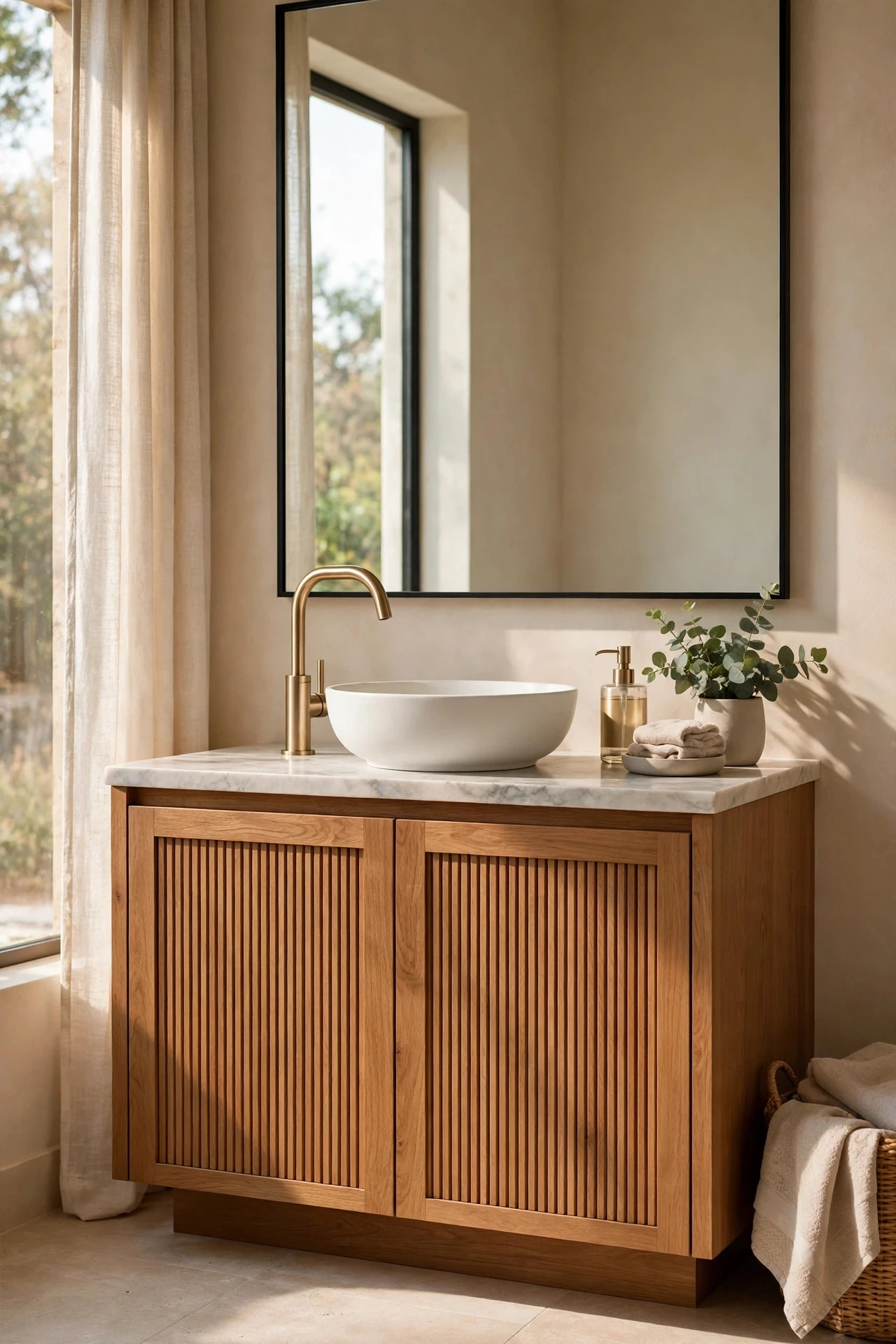
The right vanity height for most adults is 81–86 cm to the top of the counter, including the basin. The older 76 cm standard feels low once you add a vessel basin, and a taller vanity is kinder on backs during long routines.
Measure from the floor to the rim of the basin, not just to the countertop. A vessel basin sitting on the counter adds 12–15 cm, so the cabinet beneath should be lower — around 70–76 cm. For a shared bathroom, a double vanity at 150 cm wide gives each person 75 cm of elbow room. Wall-hung vanities can be set to the exact height that suits the household, which is one reason they are so popular. If children use the bathroom, add a sturdy step stool rather than lowering the vanity for everyone. A comfortable height, a clear mirror at eye level and good task lighting matter more than any decorative detail.
6. How Can Matte Black Fixtures Stay Timeless?
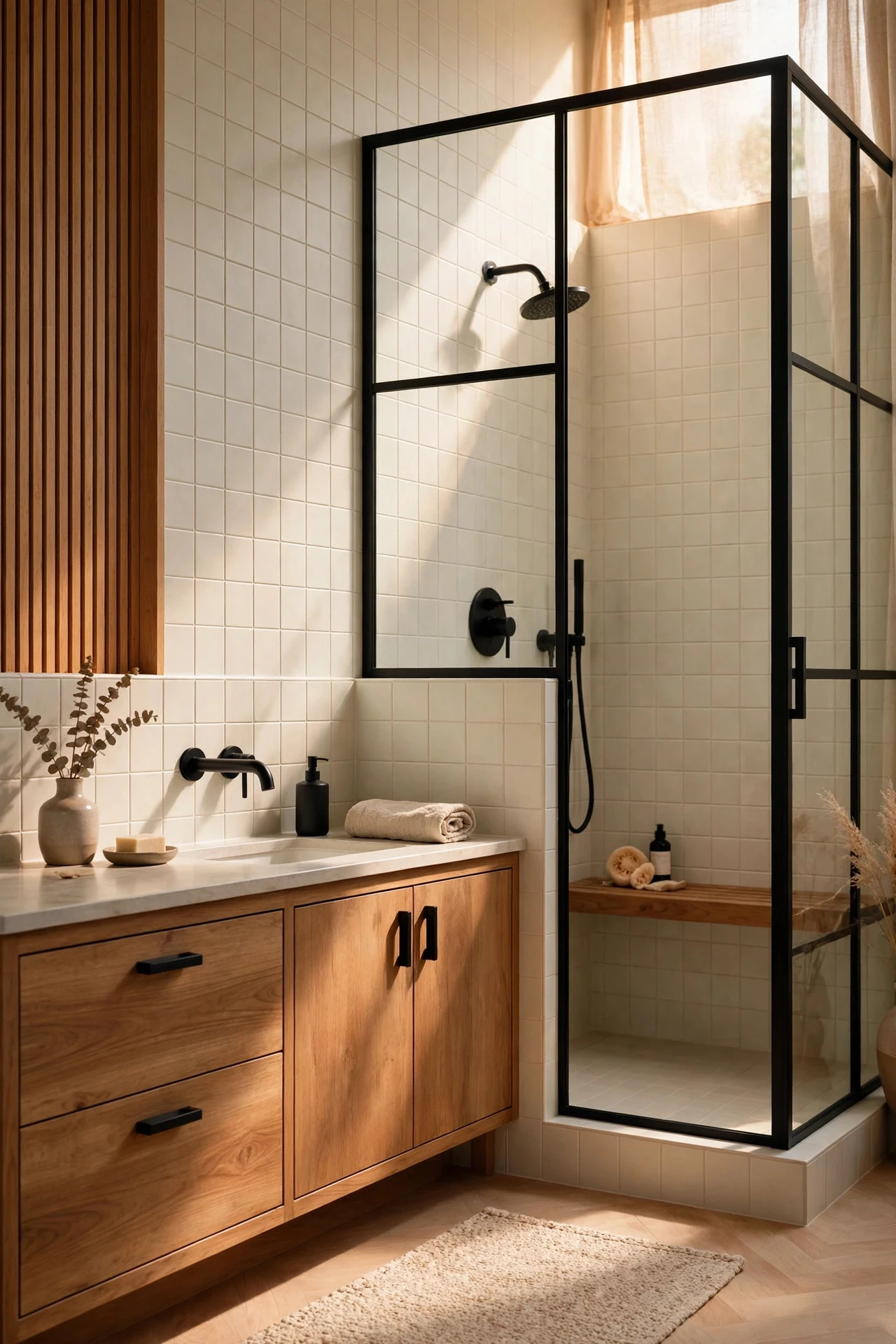
Matte black fixtures stay timeless when they are used as a single strong accent against pale tile and warm wood, not as a theme repeated on every surface. One black tap, one black shower frame and black cabinet pulls are enough to anchor the room.
Choose powder-coated brass or stainless steel with a matte black finish from a reputable maker — cheap black finishes chip and show limescale. Wipe taps dry after use in hard-water areas, and avoid abrasive cleaners that dull the coating. Balance black with a lighter metal in small doses, such as brushed nickel on the towel ring, or keep everything black and let the tile and wood do the softening. Matte black works best in bathrooms with good light, since it absorbs rather than reflects. In a very small, windowless bathroom, use black sparingly — a tap and mirror frame only — so the room does not feel darker.
7. What Lighting Layers Does a Modern Bathroom Need?
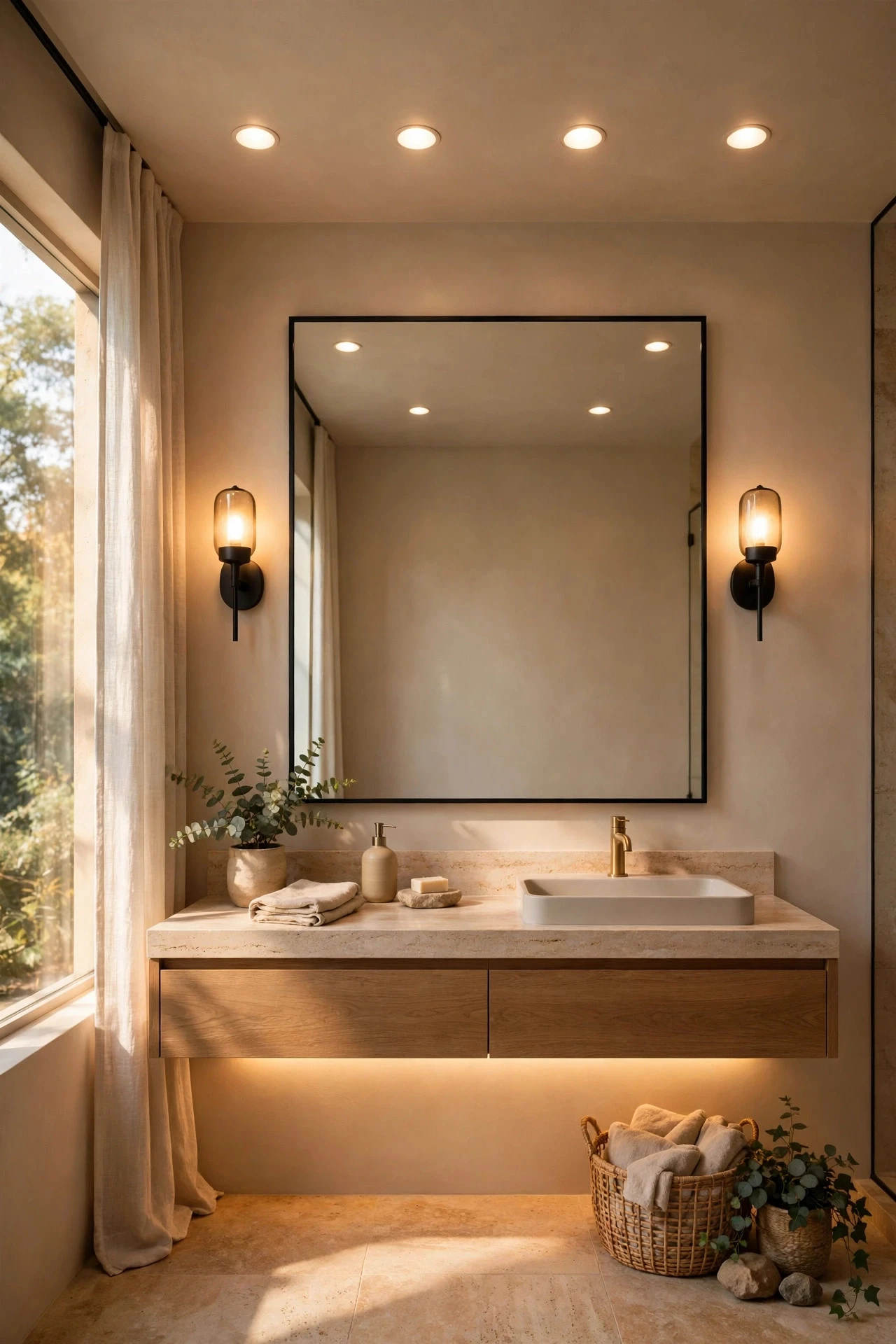
A modern bathroom needs three lighting layers: bright, even light at the mirror for grooming, general ceiling light for the whole room, and a soft low light for evenings. One overhead fitting alone creates shadows on your face and makes the room feel flat.
Mount sconces or a vertical LED bar at face height on either side of the mirror, around 150–165 cm from the floor, so light falls evenly without shadows. Add a dimmable ceiling light or recessed downlights on a separate circuit, and consider a low-level light in the shower niche or under the vanity for night-time use. Warm white (2700–3000K) flatters skin and stone; cool white (4000K) is better only inside a shower or over a makeup area. Put the mirror lights and the ceiling lights on separate dimmers, and use IP44-rated fittings in wet zones. Good lighting is the cheapest way to make budget tile look expensive.
8. How Do You Design a Wet Room That Actually Works?
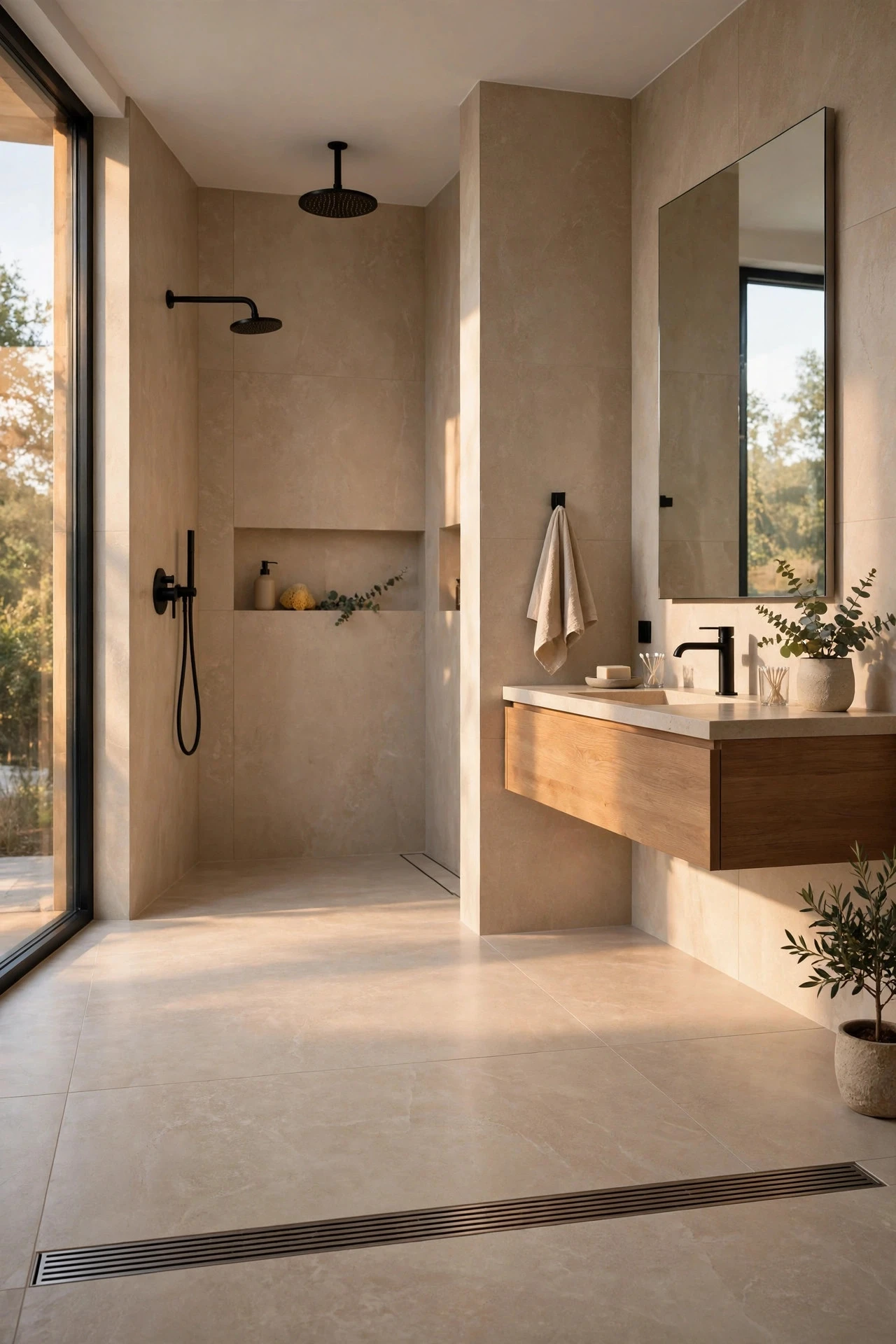
A wet room works when the whole floor is tanked, the gradient falls gently toward a linear drain, and the shower area is large enough that water stays where it belongs. Done well, it is the most accessible and easiest-to-clean bathroom layout there is.
Plan for a minimum shower zone of 120 x 120 cm inside a room of at least 4–5 square metres, with the floor sloping 1–2% toward the drain. Use a single continuous floor material — large porcelain tiles or a poured resin floor — with no step or threshold. Tank the walls to at least 180 cm in the shower area and the floor across the whole room, and choose a linear drain along one wall so the fall is simple and the tile cuts are clean. Keep the vanity and toilet outside the direct spray zone, and add underfloor heating so the wet floor dries quickly. Wet rooms suit ground-floor bathrooms and walk-in showers best; check your floor structure before committing.
9. Why Does a Frameless Mirror Make the Room Feel Bigger?
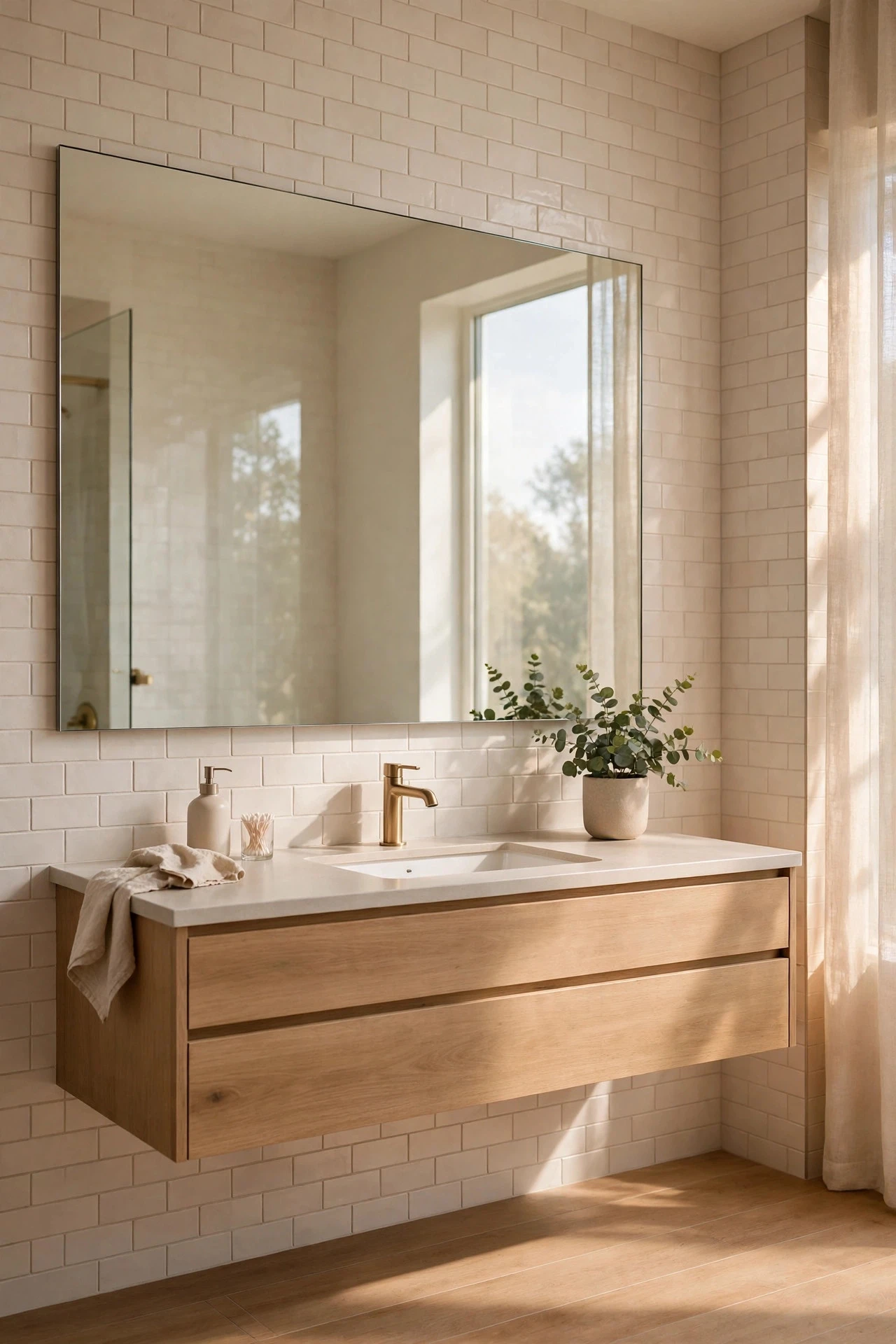
A frameless mirror makes a bathroom feel bigger because it reflects light and the opposite wall without a heavy border breaking the view. A large, simple mirror turns a small bathroom into a room that feels twice its size.
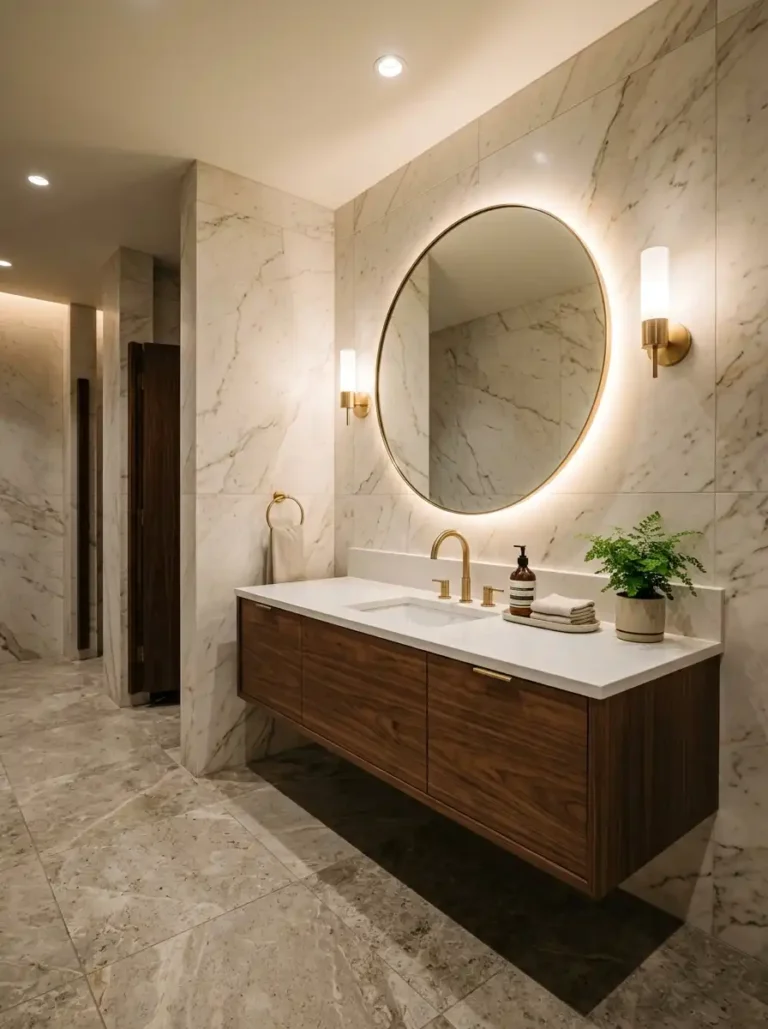
Hang the mirror as wide as the vanity, or run it wall to wall above a double vanity for a hotel look. The bottom edge should sit 10–15 cm above the splashback, and the centre should be at eye level, around 150–160 cm from the floor. Backlit mirrors add a soft glow and remove the need for separate sconces, but keep the light warm and dimmable. Avoid ornate frames in a modern bathroom — a thin metal edge in brushed brass or matte black is enough. If the mirror fogs, a demister pad behind it solves the problem for very little money. For more ways to use mirrors, read our bathroom mirror ideas.
10. How Do You Style a Modern Bathroom on a Small Budget?
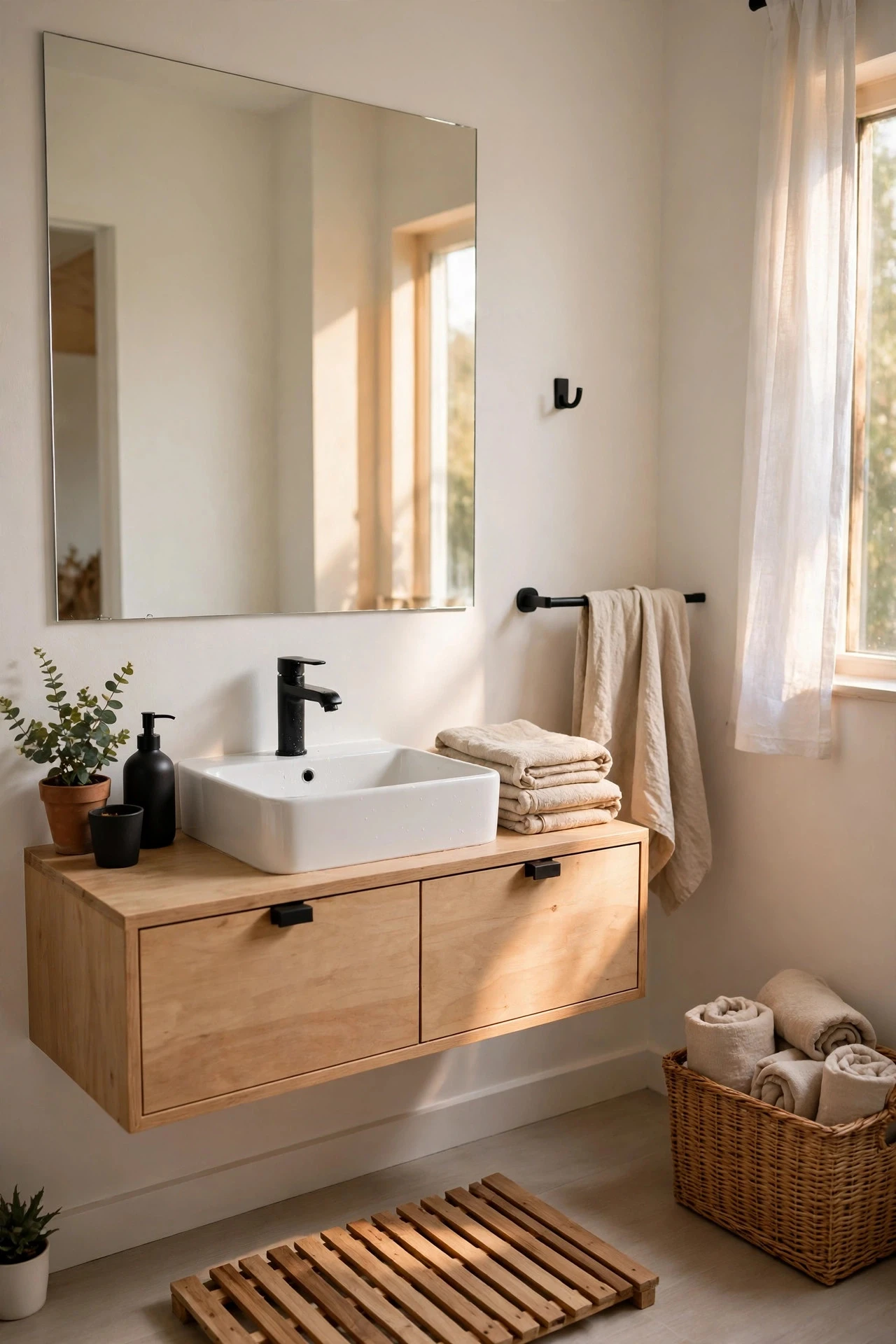
A small-budget modern bathroom starts with paint, hardware and lighting, not a full rip-out. Fresh warm-white paint, new cabinet pulls, a large mirror and a good shower curtain or glass panel can transform a dated room for a few hundred dollars.
Replace chrome towel bars and cabinet handles with matte black or brushed brass, swap a builder-grade mirror for a large frameless one, and add a wooden bath mat and linen towels in one calm colour. Paint the vanity in a warm greige or deep green, and change the light fitting to a simple opal globe or a pair of sconces. If the tile is sound but ugly, a tile-paint or a peel-and-stick tile over the splashback buys time until a full renovation. Spend the biggest share of the budget on anything you touch daily — the tap, the shower head and the mirror light — and save on decorative accessories that are easy to change later.
11. What Is the Best Shower Niche Design?

The best shower niche is a wide, low shelf built into the wall at elbow height, tiled in the same tile as the shower so it disappears into the design. It keeps bottles off the floor and out of sight, which is the whole point of a clean modern bathroom.
Build the niche 30–45 cm wide and 30–60 cm tall, with the bottom shelf at 90–110 cm from the shower floor so you can reach it without bending. Slope the shelf very slightly toward the shower so water drains instead of pooling, and use a single piece of stone or a large tile for the shelf surface — grout lines on a niche shelf trap soap and mould. A vertical niche with two shelves suits a shared shower; a single wide niche suits a solo user. Line the back of the niche in a contrasting tile or stone only if you want it to be a feature — otherwise, matching tile keeps the wall calm and the room feeling larger.
12. How Do You Choose a Modern Freestanding Tub?
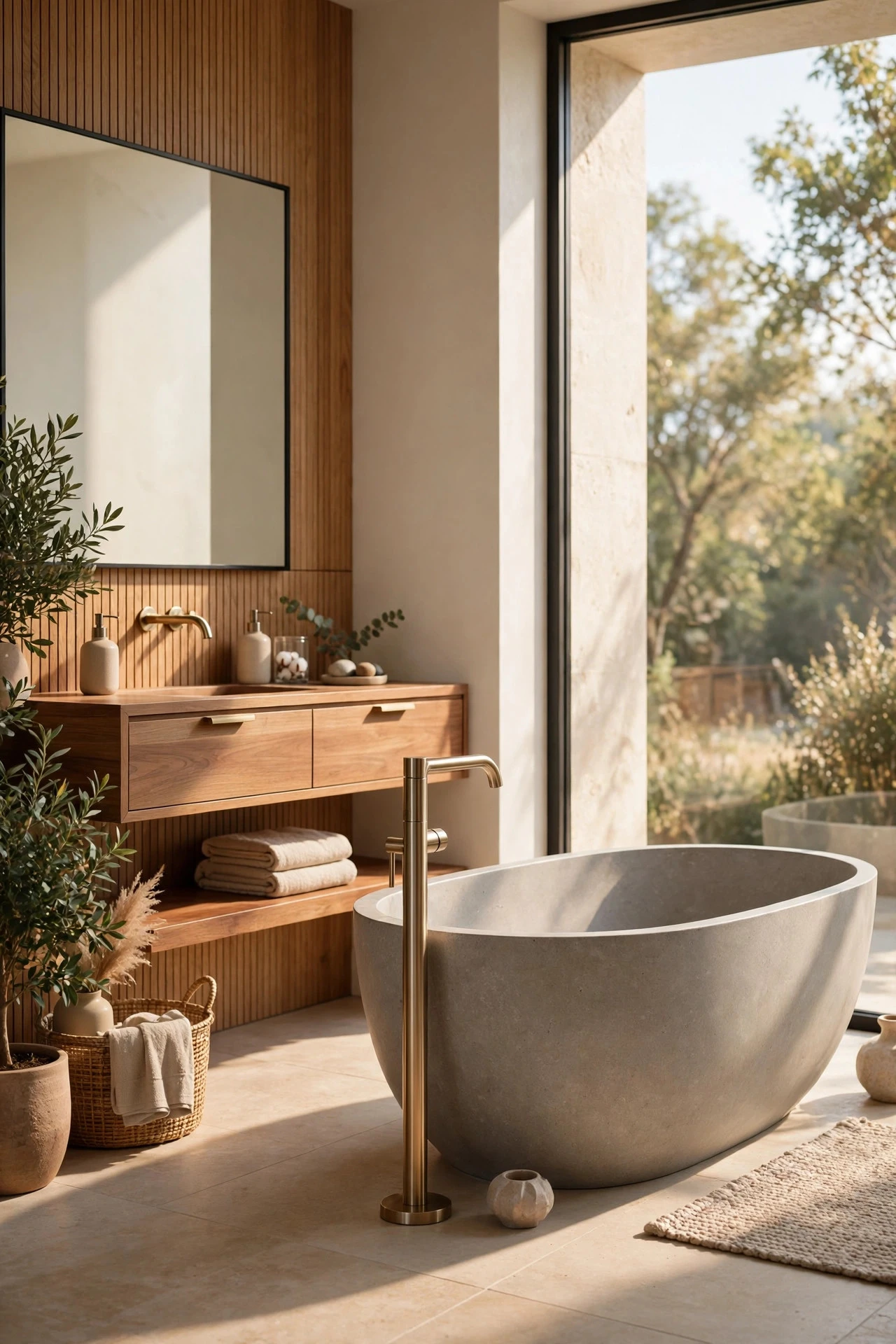
A freestanding tub suits a modern bathroom when the room is large enough to walk around it, the floor can take the weight, and the plumbing can be routed through the floor. It becomes a sculpture in the room rather than a box in the corner.
Allow at least 15–20 cm of clear space around the tub for cleaning, and a room of at least 8–10 square metres so it does not crowd the shower and vanity. Oval stone-resin or acrylic tubs are lighter and warmer to the touch than cast iron, and easier to install on upper floors. A freestanding tap with a hand shower, mounted on the floor beside the tub, keeps the lines clean. Place the tub near a window if you have one, with a small stool and a folded towel nearby. In a small bathroom, skip the freestanding tub — a good shower and a deep inset tub serve you better than a cramped showpiece.
13. Why Is Warm Minimalism Better Than Stark White?
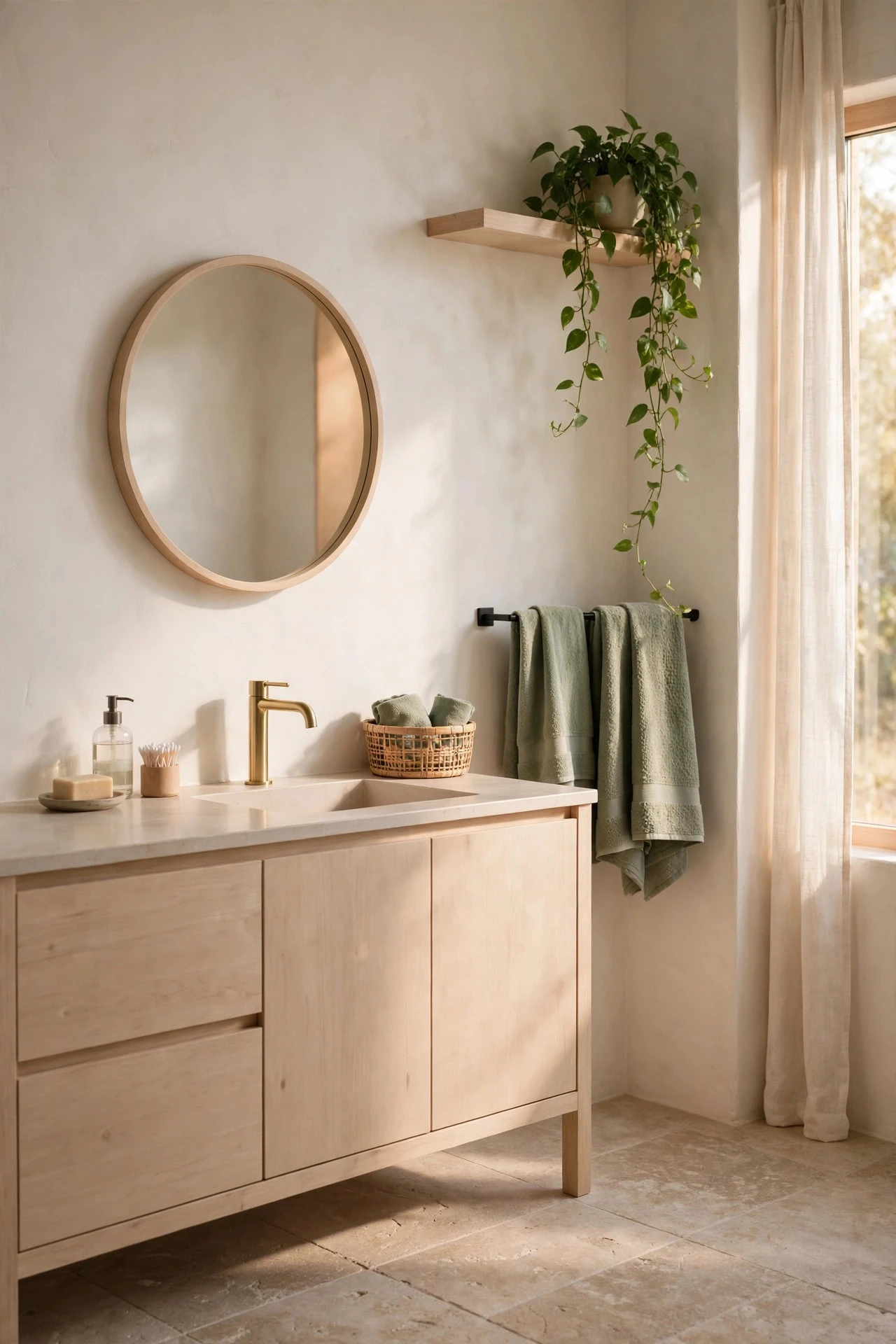
Warm minimalism is better than stark white because it keeps the calm of minimalism while adding the texture and colour that make a room feel comfortable. Pure white on every surface reflects light harshly and shows every water mark, while warm tones forgive both.
Build the palette on warm white walls, a pale wood vanity, a stone-look floor and one soft accent — sage, clay or dusty blue — in towels and accessories only. Keep surfaces mostly matte: matte tile, matte paint, matte taps. The texture does the work that colour used to do, so the room stays interesting without pattern or clutter. Add a plant that tolerates humidity, such as a pothos or a fern, and a woven basket for towels. The result is a bathroom that feels like a spa, not a showroom, and one that will not date when the next colour trend arrives. Our luxury bathroom decor ideas show how to layer warmth without adding clutter.
14. How Do You Make a Small Bathroom Look Bigger?

A small bathroom looks bigger when the floor is visible, the mirror is large, and the colour palette stays light and continuous. Every visual break — a dark floor, a bulky cabinet, a busy tile — makes the room feel smaller.
Run the same large-format tile on the floor and up one wall, use a floating vanity and a wall-hung toilet, and hang a mirror as wide as the vanity. A clear glass shower panel instead of a curtain keeps the sightline open, and a single recessed shelf replaces a cluttered caddy. Keep the palette to two or three light tones, and store everything behind closed doors. Good lighting matters more in a small room: a bright ceiling light plus mirror sconces removes the shadows that shrink a space. For a full set of space-saving tricks, see our small bathroom ideas.
15. What Storage Works in a Modern Bathroom Without Clutter?

Modern bathroom storage works when it is built in, closed and at the right height. A tall recessed cabinet beside the mirror, deep vanity drawers and one open shelf for display are enough for most households.
Use deep drawers with dividers for toiletries, a tall pull-out for tall bottles, and a mirrored cabinet with internal lighting and a shaver socket. A recessed niche in the shower and a small shelf above the toilet add storage without taking floor space. Keep the countertop almost clear — a soap dispenser, one plant and one tray is plenty. Store daily items at waist height and rarely used items up high, and decant products into matching bottles so the open shelf looks calm. Avoid open shelving for everything: dust and humidity make it hard to maintain, and a wall of bottles is the fastest way to undo a clean modern look.
16. How Do You Pick the Right Modern Tap?

The right modern tap is one that matches your basin, your water pressure and your hand — and that you can clean in seconds. A single-lever mixer with a smooth, flat spout suits most modern bathrooms and is easier to use with wet hands than separate hot and cold taps.
Choose the spout height and reach to match the basin: a vessel basin needs a tall tap, a shallow inset basin needs a short one, and the water should land in the centre of the basin, not on the edge. Brushed brass, matte black and brushed nickel hide water marks better than polished chrome. Check your water pressure before buying — a rain shower head needs good pressure or a pump, and a low-pressure system will make a beautiful tap feel weak. Buy from a brand with spare parts available, and keep the finish consistent across the basin tap, the bath tap and the shower mixer so the room feels intentional.
17. What Flooring Is Best for a Modern Bathroom?
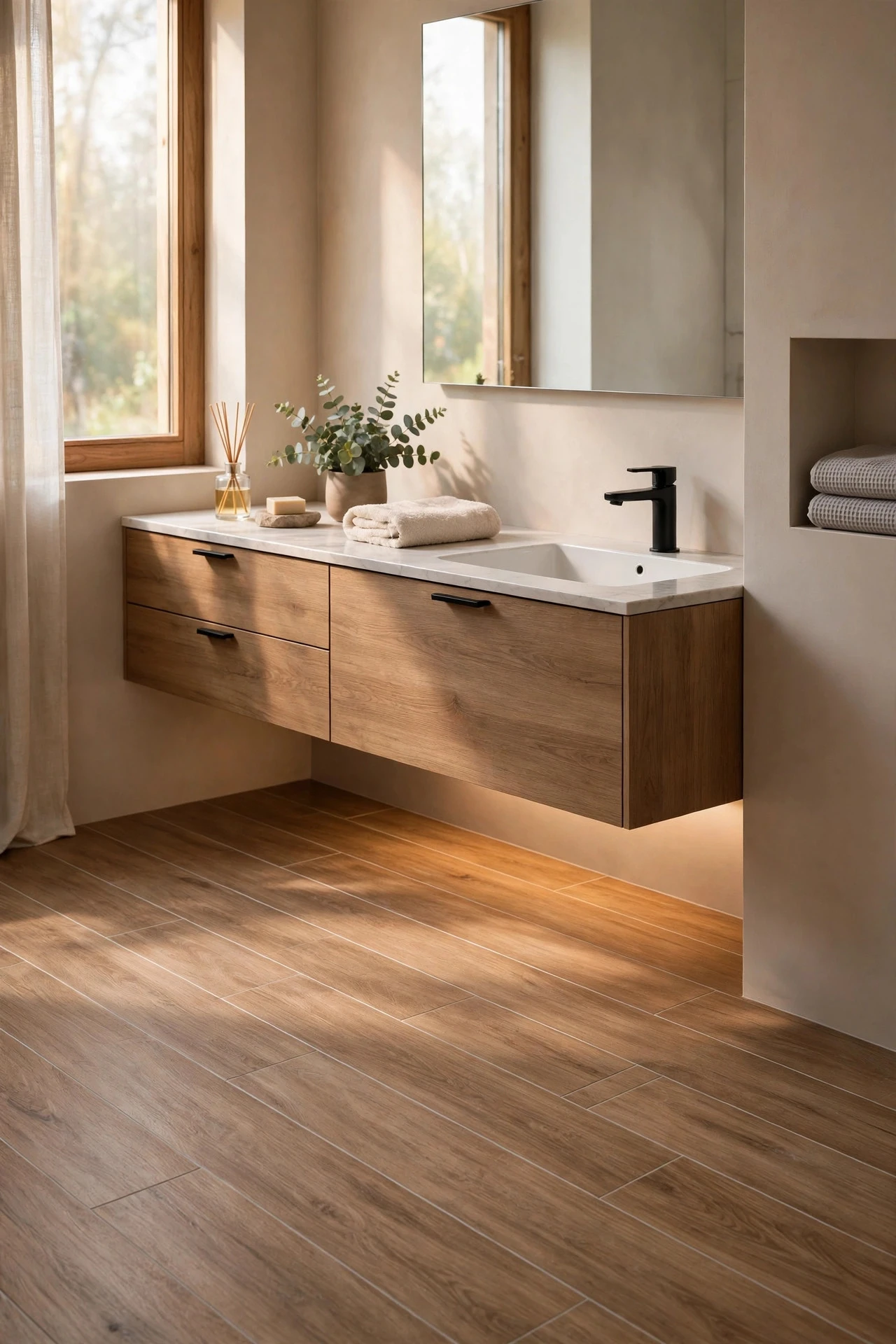
Porcelain tile is the best flooring for most modern bathrooms because it is waterproof, hard-wearing and available in large formats that suit the clean look. Wood-look porcelain gives you the warmth of timber with none of the water worries.
Choose a tile with a slip rating of R10 or higher for the floor, and a matt or lightly textured finish that stays grippy when wet. Large formats (60 x 60 cm or larger) reduce grout lines and make the room feel bigger, but they need a flat subfloor and a skilled tiler. Underfloor heating under porcelain makes the room comfortable in winter and dries the floor quickly after a shower. If you prefer real wood, use engineered oak only in a well-ventilated bathroom and keep it away from the shower. For rental-friendly options, a good vinyl plank over the existing floor can mimic stone or wood for a fraction of the cost, and it is easy to remove later.
18. How Do You Add Colour to a Modern Bathroom?
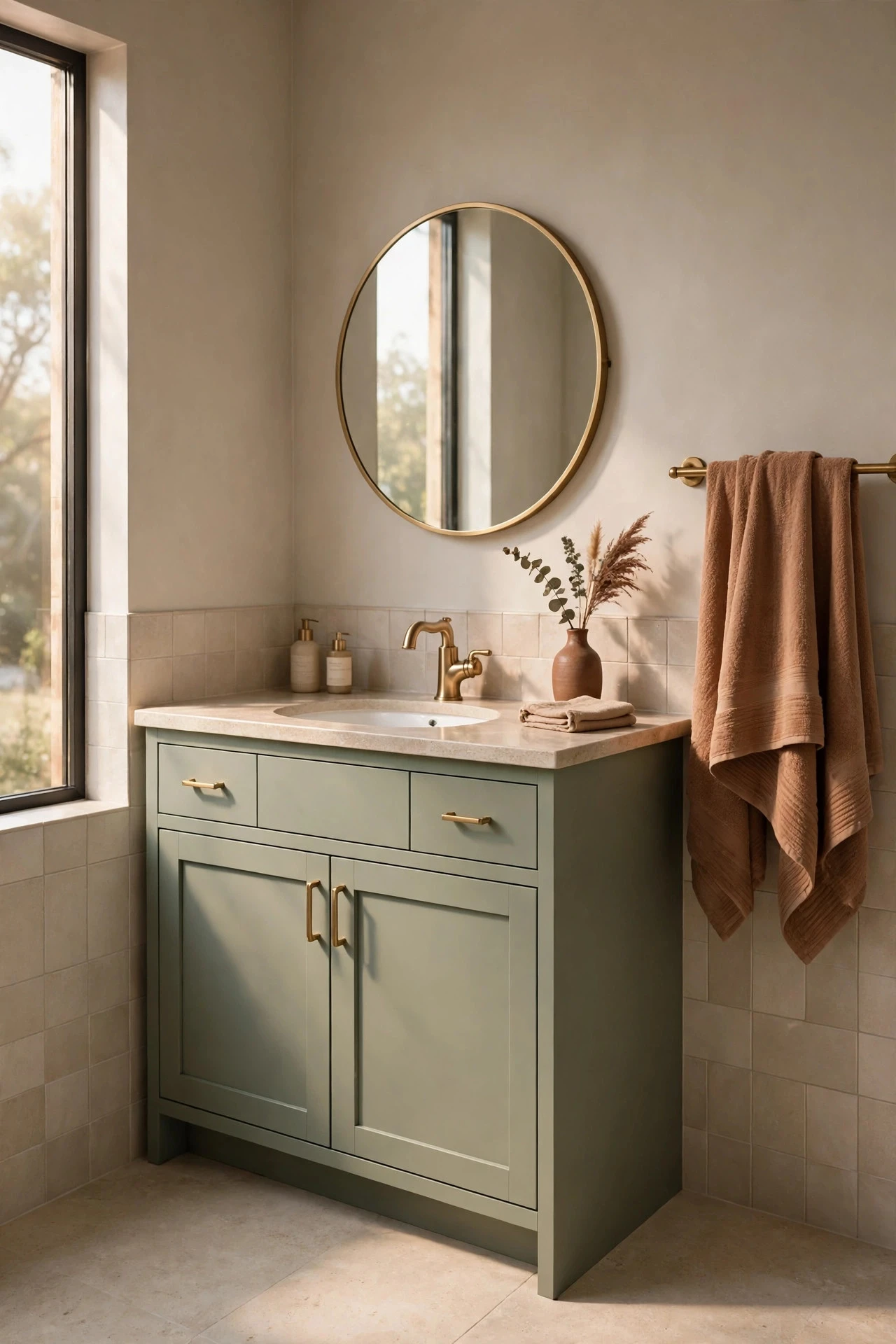
Colour in a modern bathroom works best as one calm accent repeated in small doses, not as a feature wall that fights the tile. A soft sage vanity, a clay-coloured towel set or a dusty blue bath mat adds personality without dating the room.
Paint the vanity or one piece of furniture in a muted tone — sage green, deep teal, warm terracotta — and keep the walls and tile neutral so you can repaint cheaply when tastes change. Repeat the accent in two or three places: towels, a vase, a bath mat. Avoid bright primary colours and busy patterns, which clash with the calm modern look and tire quickly. If you love pattern, use it once, on a small area such as the shower niche or the floor of a powder room, where it reads as a deliberate detail. Natural materials — green plants, terracotta pots, linen — add colour that never looks out of place.
19. What Makes a Double Vanity Work in a Shared Bathroom?
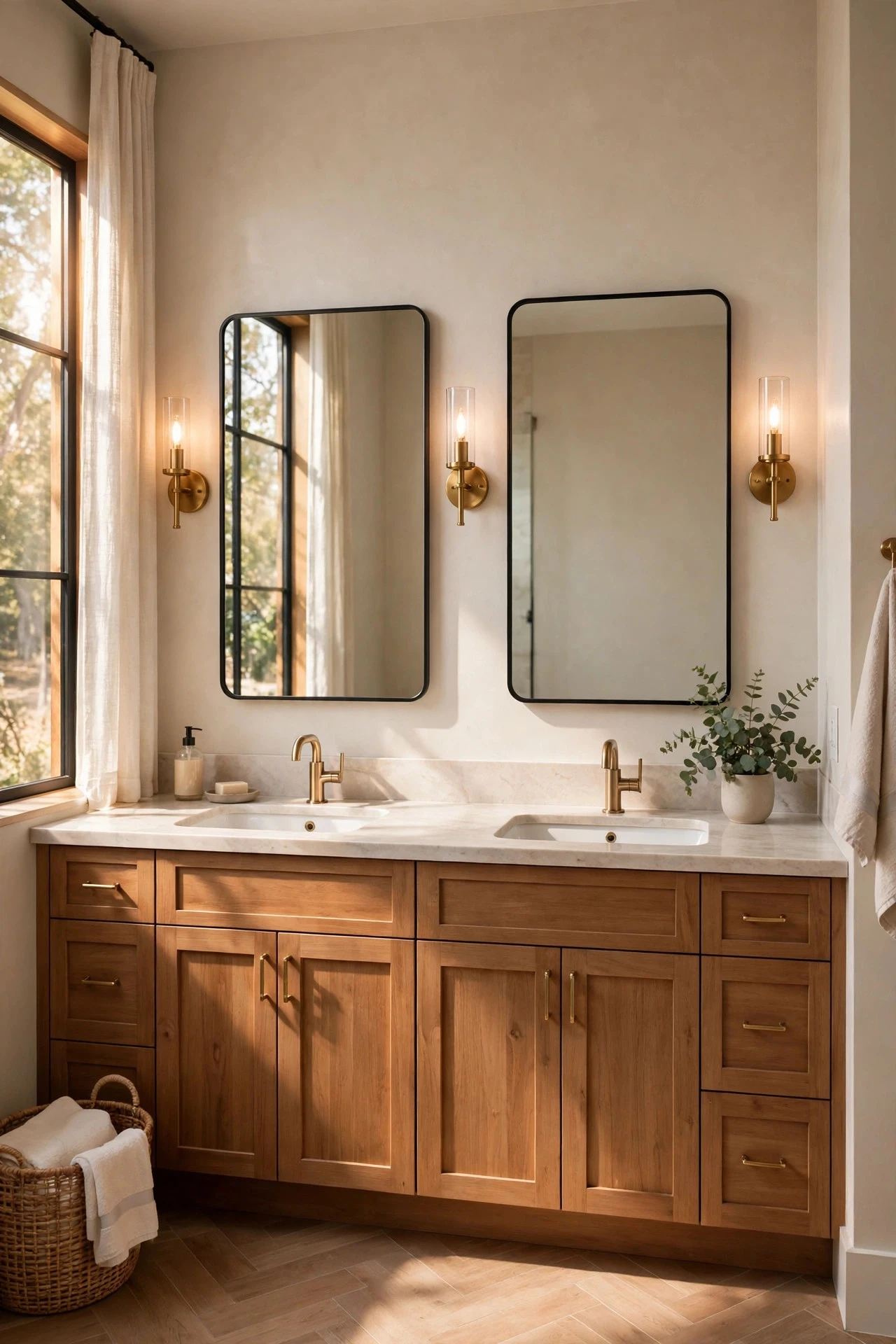
A double vanity works when each person has their own mirror, light and storage, and enough elbow room to use the sink without bumping the other. Two basins on one long counter only work if the counter is wide enough to give each person real space.
Plan for 150–180 cm of total width, with each basin centred 60–75 cm from the end and at least 75 cm apart. Give each side its own mirror and sconce, and its own drawer stack so toiletries never mix. A single long mirror above both basins looks sleek, but two separate mirrors define each zone better and are easier to light. Keep the countertop clear between the basins for shared items, and add a small shelf or tray for each person. If the room is too narrow for 150 cm, a single wide basin with two taps and a long mirror is a better compromise than two cramped basins.
20. How Do You Modernise a Bathroom Without a Full Renovation?

You can modernise a bathroom without a full renovation by changing the surfaces you see and touch most: the mirror, the lighting, the hardware and the vanity front. These four swaps change the character of the room for a fraction of a rebuild.
Start by replacing a small framed mirror with a large frameless or backlit one, then swap the light fitting for a simple modern design on a dimmer. Change cabinet handles, towel bars and the tap to one consistent finish, and paint the vanity in a warm neutral or a muted colour. Add a new shower head and a glass panel if you have a curtain, and lay a large bath mat over dated floor tile. Fresh grout or a grout pen on the floor tile can make an old floor look new. These changes cost hundreds rather than thousands, and they buy you years before a full renovation is needed. For a room that needs a bigger change, our tiny full bathroom ideas show how to fit a real tub into a small space.
21. What Plants Suit a Modern Bathroom?
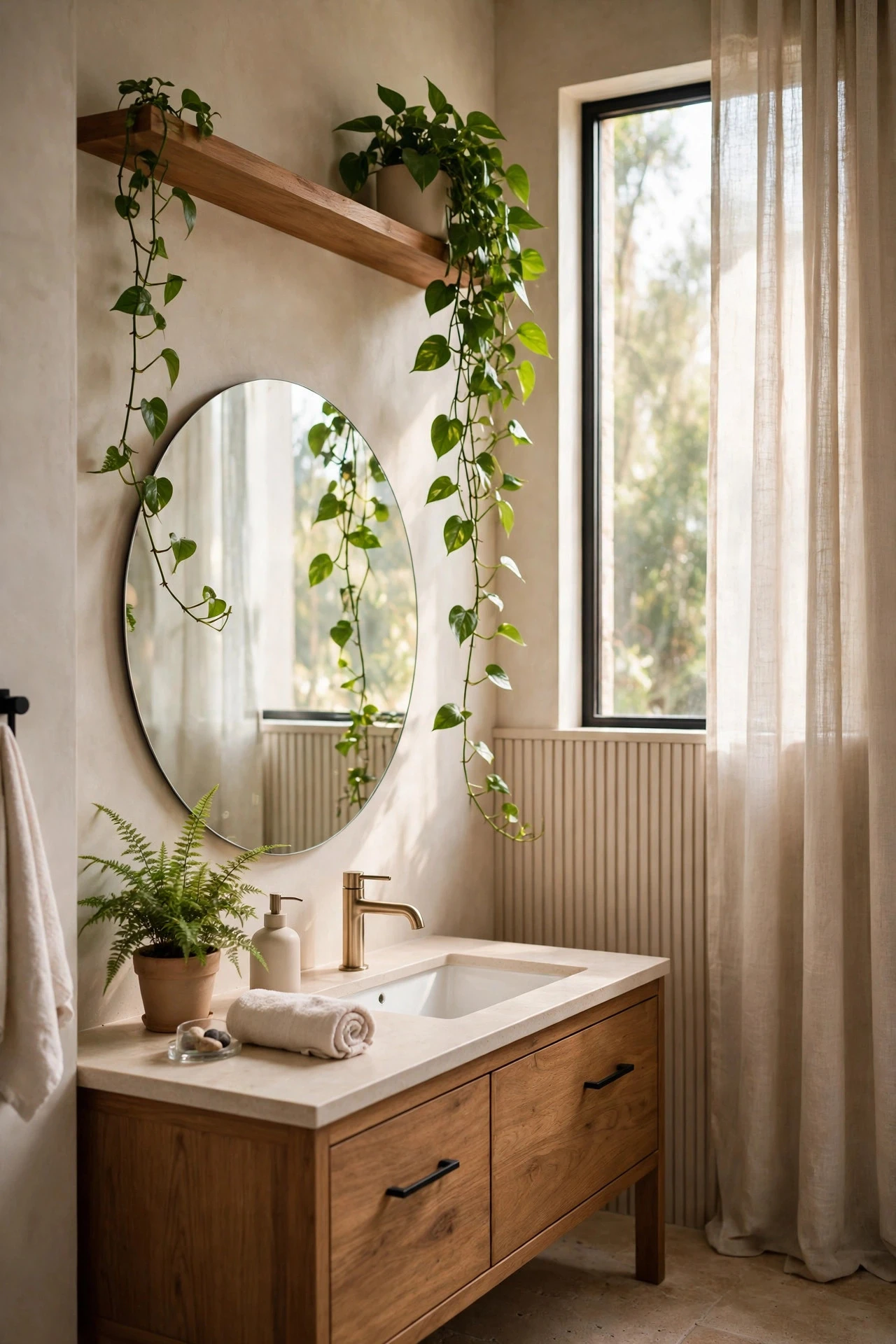
Bathroom plants suit a modern bathroom when they tolerate humidity, low light and occasional neglect, and when they are placed where water will not rot the pot. A single trailing plant on a high shelf adds life without clutter.
Pothos, spider plants, ferns and peace lilies all thrive in humid bathrooms, and they need only indirect light. Hang a pothos from a ceiling hook or let it trail from a shelf above the mirror, and keep the pot in a waterproof cachepot so water never reaches the shelf. Avoid plants that need direct sun or dry air, and avoid placing pots on the vanity where they block the mirror. One or two plants are enough — a bathroom full of greenery feels like a greenhouse, not a spa. If your bathroom has no window, choose a good faux plant instead; a convincing faux fern is better than a real plant slowly dying in the dark. The Spruce has a useful guide to plants that thrive in bathrooms, including light and watering needs.
22. How Do You Keep a Modern Bathroom Looking New?
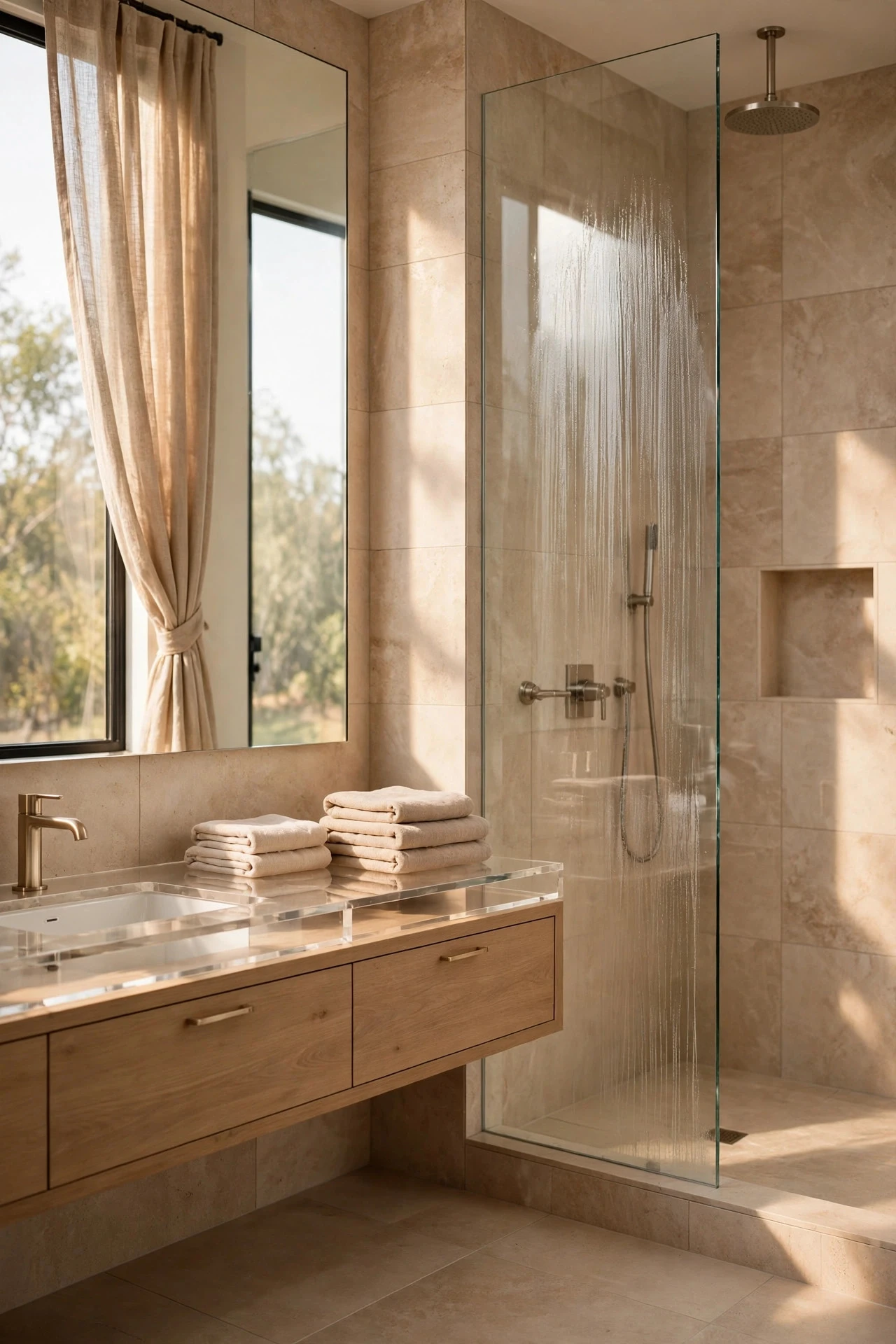
A modern bathroom stays looking new when the materials are easy to clean, the grout is sealed, and clutter never gets a chance to build up. The design does the hard work, but a simple weekly routine keeps it that way.
Squeegee the shower glass after use, wipe the tap dry to prevent limescale, and clean the floor with a pH-neutral cleaner that will not damage stone or grout sealer. Reseal grout once a year, and keep a small caddy under the sink for cleaning supplies so the routine takes five minutes. Store products behind closed doors, keep the countertop clear, and replace towels and the bath mat when they fade. Choose materials that age well — porcelain, solid brass, real wood — over finishes that peel or chip. A bathroom designed with cleaning in mind, with large tiles, a wall-hung toilet and a floating vanity, will look new for years with very little effort. Architectural Digest's bathroom guides offer more ideas on timeless bathroom design that ages gracefully rather than following a trend.
Practical Tips for Modern Bathrooms
Measure before you buy anything. Sketch the room to scale, mark the door swing, the window and the soil pipe, and check that you have at least 60 cm clear in front of the vanity and toilet, 76 cm of shower opening, and 90 cm of clear walkway where two people pass. Take the measurements to the showroom — a vanity that looks small in a warehouse can overwhelm a real bathroom.
Choose materials for the room you have, not the one in the photograph. Porcelain tile, quartz counters and solid brass taps survive steam, water and daily use; marble-look porcelain gives you the veining without the staining, and a quartz vanity top resists toothpaste and hair dye far better than marble. In a hard-water area, pick brushed or matte finishes that hide marks, and fit a water softener or a filter if limescale is a constant battle.
Light the room in layers and put everything on dimmers. Bright, even light at the mirror for mornings, a softer ceiling light for the day, and a low glow under the vanity or in the niche for the evening. Warm white at 2700–3000K flatters skin and wood; use IP44-rated fittings near water and keep switches outside the wet zone where possible.
Plan storage around your real routine, not an ideal one. Count the bottles, tools and towels you actually use, then give each a home — deep drawers for toiletries, a tall cabinet for cleaning products, a hook for each person's towel. A bathroom with a place for everything stays tidy with almost no effort, and a tidy bathroom always looks more modern than a cluttered one.
Final Thoughts
A modern bathroom that feels clean and timeless is not about following a trend — it is about good light, honest materials, sensible measurements and a layout that makes daily life easier. Start with the shower and the vanity, add warmth with wood and stone, keep the palette calm, and let the details earn their place. Do that, and the room will still look right in ten years' time.
Frequently Asked Questions
What is the cheapest way to make a bathroom look modern?
Paint the walls warm white, replace the mirror with a large frameless one, swap the tap and cabinet handles for one consistent matte finish, and change the light fitting to a simple modern design. These four swaps cost a few hundred dollars and change the whole character of the room.
How much does a modern bathroom renovation cost?
A cosmetic refresh costs $1,000–$3,000, a mid-range renovation with new tile, vanity and shower typically costs $8,000–$15,000, and a full high-end remodel can reach $20,000–$30,000 or more. Tile, plumbing moves and wet-room tanking are the biggest cost drivers, so keep the layout if you can.
What colour tile is best for a modern bathroom?
Warm white, pale grey and stone-look porcelain are the safest choices because they suit any vanity and never date. Large-format tiles in these tones make the room feel bigger, and you can add colour cheaply through towels, plants and accessories that are easy to change.
Can a small bathroom have a walk-in shower?
Yes, if the room is at least 1.5 x 2.4 metres and the shower zone is 90 x 120 cm with a 76 cm opening. Use a single fixed glass panel, large-format tile and a linear drain, and keep the vanity floating so the floor stays visible and the room feels open.
Is a floating vanity practical for a family bathroom?
Yes, provided it is fixed to solid blocking inside the wall and has deep drawers with dividers for toiletries. The open space below makes cleaning easier, and the vanity can be mounted at the exact height that suits the household, which is kinder on backs than a standard cabinet.
How do I keep matte black fixtures looking good?
Wipe taps dry after use, clean with a soft cloth and mild soap only, and avoid abrasive cleaners and limescale removers that dull the coating. In hard-water areas, a quick daily wipe prevents the white marks that show most clearly on a matte black finish.