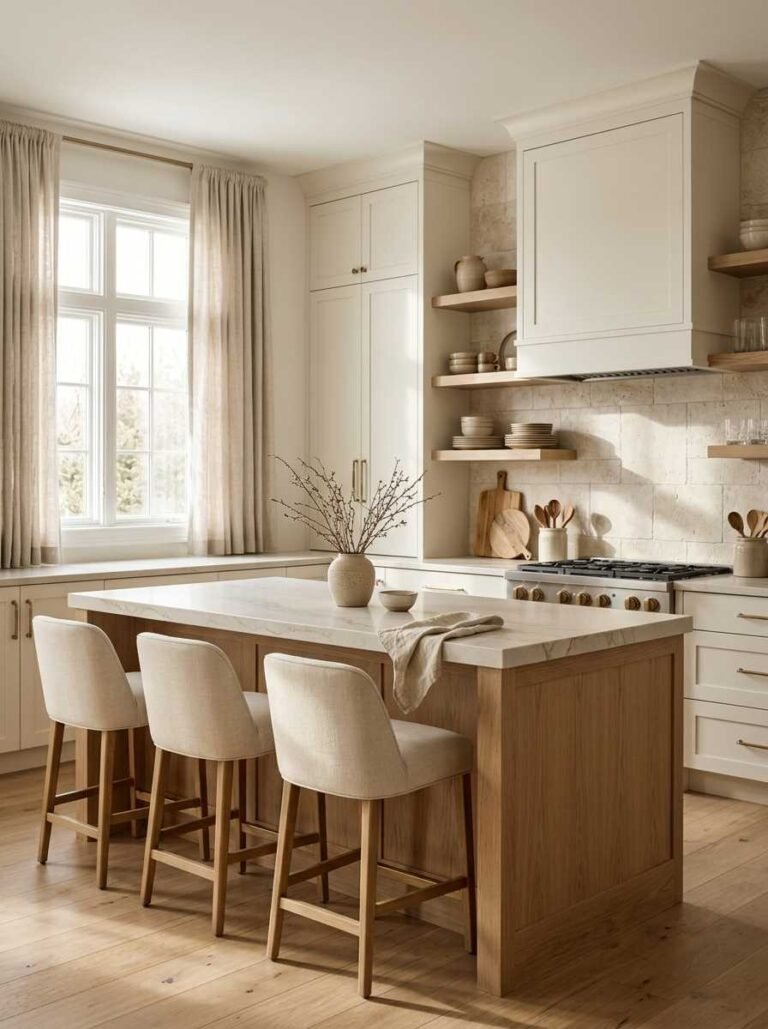
22 Vintage Entryway Furniture Ideas to Make Your Entrance Feel Timeless
The entryway is the first room anyone sees, and it is the one most homes get wrong. The hallway gets a coat hook and a shoe pile, the front door opens onto a blank wall, and the whole house is judged in the first three seconds by a space nobody designed. Vintage entryway furniture fixes that: a console table with a hundred years of patina, a hall tree that has held a thousand coats, a bench worn smooth by generations of people sitting down to lace their shoes — these pieces make an entrance feel collected rather than bought, and timeless rather than trendy.
Below are 22 vintage entryway furniture ideas organised by piece — consoles, hall trees, benches, mirrors, umbrella stands, coat racks, chests and lighting — with real prices, exact measurements and the thrifting checks that keep you from buying a fake or a wobbly antique. Most ideas cost under $150 each, and a whole entryway can be furnished for $300 to $600 with secondhand finds. Every idea works in a real hallway, narrow or wide, and every piece earns its place by doing a job: holding keys, hiding shoes, giving you somewhere to sit.
Looking for more inspiration? Our Nest Decorz homepage gathers the latest home decor ideas, seasonal decorating guides and room-by-room styling tips in one place — start there and explore.
Quick answers
– Start with a console table — a vintage console is the single highest-impact entryway piece: it holds keys, mail and a lamp, takes up only 25 to 35 cm of depth, and sets the style for everything else in the hall. – Choose patina over perfection — scratches, wear marks and a softened finish are what make vintage furniture look authentic; a piece that looks brand new is usually a reproduction. – Measure before you buy — hallways are narrow, doors swing and radiators sit where you least want them, so bring a tape measure to every flea market and thrift shop. – Mix eras, not styles — a 1920s oak console, a 1950s brass mirror and a woven seagrass basket work together because they share warm tones and honest materials, not because they match. – Budget $300 to $600 for the whole entryway — spend the most on the console or hall tree, and use mirrors, baskets and secondhand lighting for the rest.
1. What Makes a Console Table the Best First Piece of Vintage Entryway Furniture?

A console table is the best first piece of vintage entryway furniture because it does four jobs at once: it gives you a landing spot for keys and mail, a surface for a lamp, a display shelf for something beautiful, and a visual anchor that makes a bare wall look finished. A genuine vintage console costs $80 to $250 secondhand, measures 80 to 120 cm wide and only 25 to 35 cm deep, and fits hallways that cannot take a single extra centimetre.
Choose a console with a lower shelf or a drawer, because a plain tabletop looks lovely on day one and becomes a cluttered shelf by week three. Oak, walnut and mahogany consoles from the 1920s to the 1960s are the most common finds, and their warm wood tones suit almost any hallway paint colour. A console table has a long history as a wall-hugging display piece, which is exactly why it works in a hall: it was designed to sit against a wall and look good from the front. Avoid consoles deeper than 35 cm in a hallway under 120 cm wide, because the walkway shrinks to an uncomfortable squeeze and every coat catches the corner.
2. How Do You Choose a Hall Tree for a Busy Family Entryway?

Choose a hall tree for a busy family entryway by counting hooks and seats before you fall in love with the wood: one hook per person, one bench spot per child, and a shelf or box for each person's shoes. A solid wood hall tree from the 1940s to the 1970s costs $150 to $400 secondhand, stands 170 to 190 cm tall, and needs about 90 to 120 cm of wall width.
Look for cast-iron hooks rather than wooden pegs, because iron holds a heavy winter coat without sagging and survives a decade of daily grabbing. A bench with a lift-up lid is worth paying extra for, because it hides shoes, scarves and dog leads in one lift. Test the bench by sitting on it and rocking gently: a hall tree that wobbles on a shop floor will wobble worse on a hallway floor with a child climbing on it. These 22 small entryway ideas that make a tiny entrance feel grand show how a hall tree fits into a small space without blocking the door swing, so measure your door's arc before you buy.
3. How Can an Antique Bench Turn a Bare Hallway Into a Welcoming Entrance?

An antique bench turns a bare hallway into a welcoming entrance by giving the space a purpose beyond walking through it: somewhere to sit while you put on shoes, somewhere to set down a bag, somewhere that says people live here. A pine or oak bench from the 19th or early 20th century costs $60 to $180, measures 90 to 120 cm long and 30 to 35 cm deep, and slides under a window or along a wall without blocking the walkway.
Place the bench where it catches the first light from the front door, and add a folded wool throw and one cushion in a hard-wearing fabric like linen or leather — softness makes people stop, while bare wood makes them walk past. A church pew cut down to 100 cm is a classic budget find: pews were built to seat people for hours, so the proportions are generous and the wood is usually thick, honest pine. Check underneath for woodworm holes and run your hand along the seat for splinters; a bench you cannot sit on in bare legs is decoration, not furniture.
4. Where Should a Vintage Mirror Hang in an Entryway?

A vintage mirror should hang in an entryway on the wall opposite the front door or above the console table, at eye level — its centre about 150 cm from the floor — so it bounces light from the door into the hall and lets you check your appearance before you leave. A gilt, brass or walnut-framed mirror from the 1940s to the 1970s costs $40 to $150, and a 60 to 90 cm round or arched mirror suits most console widths.
Hang the mirror 10 to 15 cm above the console top, never touching it, so the lamp and mirror do not fight for the same space. A round mirror softens a hallway full of straight lines, while a tall arched mirror adds height to a low ceiling. Check the glass before you buy: a few foxing spots and a slightly cloudy edge are charming signs of age, but a cracked mirror or a silvered back peeling in sheets will keep deteriorating. Fix the mirror to a wall stud or use a picture hook rated for twice the mirror's weight — a falling mirror in a hallway is a safety problem, not just a mess.
5. What Is an Umbrella Stand — and Does a Vintage One Still Work?
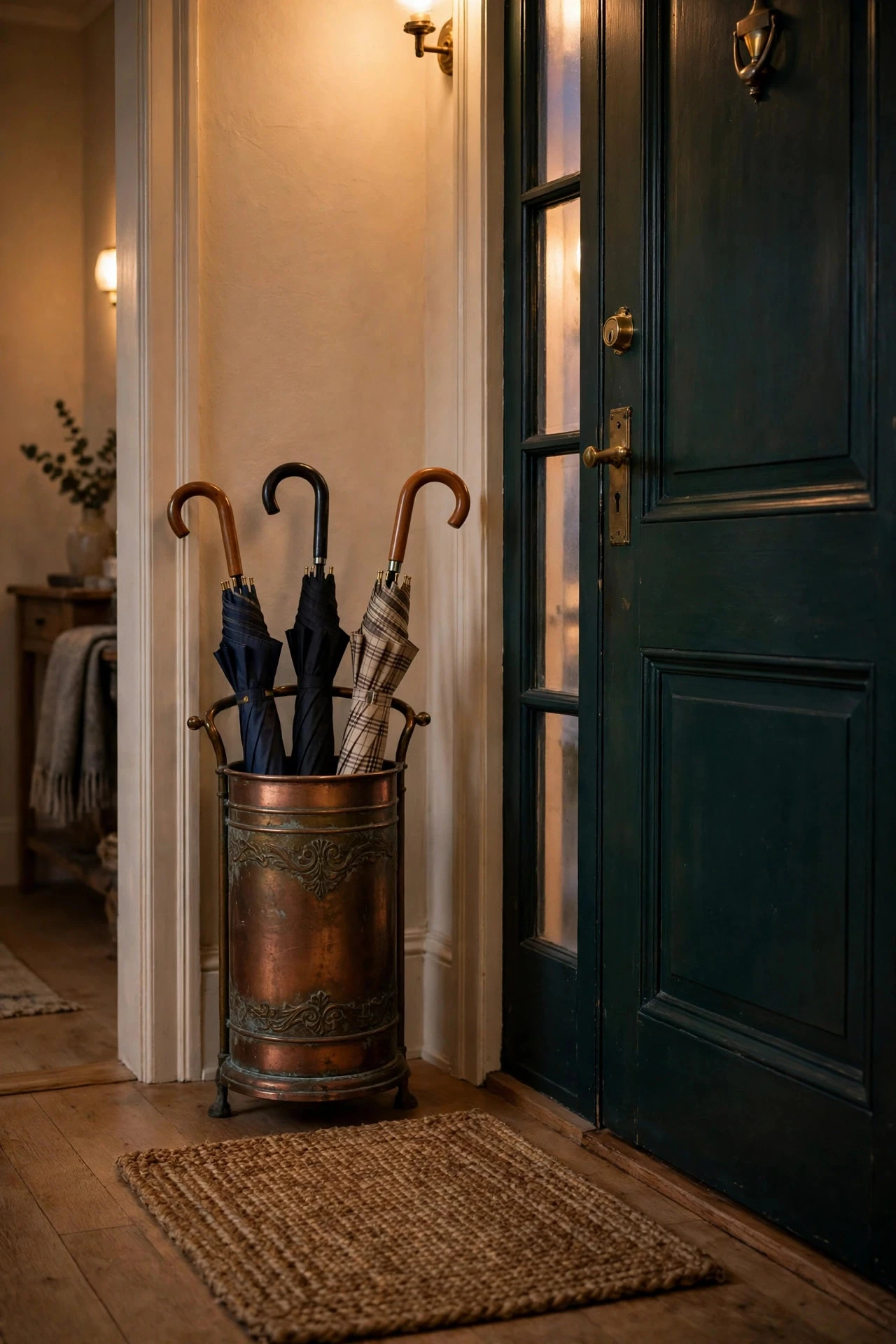
An umbrella stand is a tall, narrow container — usually ceramic, brass, copper or wood — that holds umbrellas upright by the front door, and a vintage one works just as well today as it did a century ago, because umbrellas have not changed shape. A brass or ceramic stand from the mid-20th century costs $25 to $80, stands 45 to 60 cm tall, and holds four to six umbrellas in a footprint of about 25 cm.
Place the stand in the corner beside the door, on the side your hand naturally reaches when you come in wet, and drop a folded towel or a shallow tray underneath to catch drips. Copper and brass stands develop a warm patina that suits vintage entryways perfectly — polish them only if you want shine, and leave them alone if you want character. A stoneware crock or a tall milk churn works as an umbrella stand too, which is why flea markets are full of them: any tall, heavy, waterproof container with a 20 to 30 cm opening does the job. Avoid lightweight plastic or thin tin stands, because a full stand tips over the first time someone grabs an umbrella in a hurry.
6. How Do You Style a Vintage Chest or Trunk as Entryway Furniture?
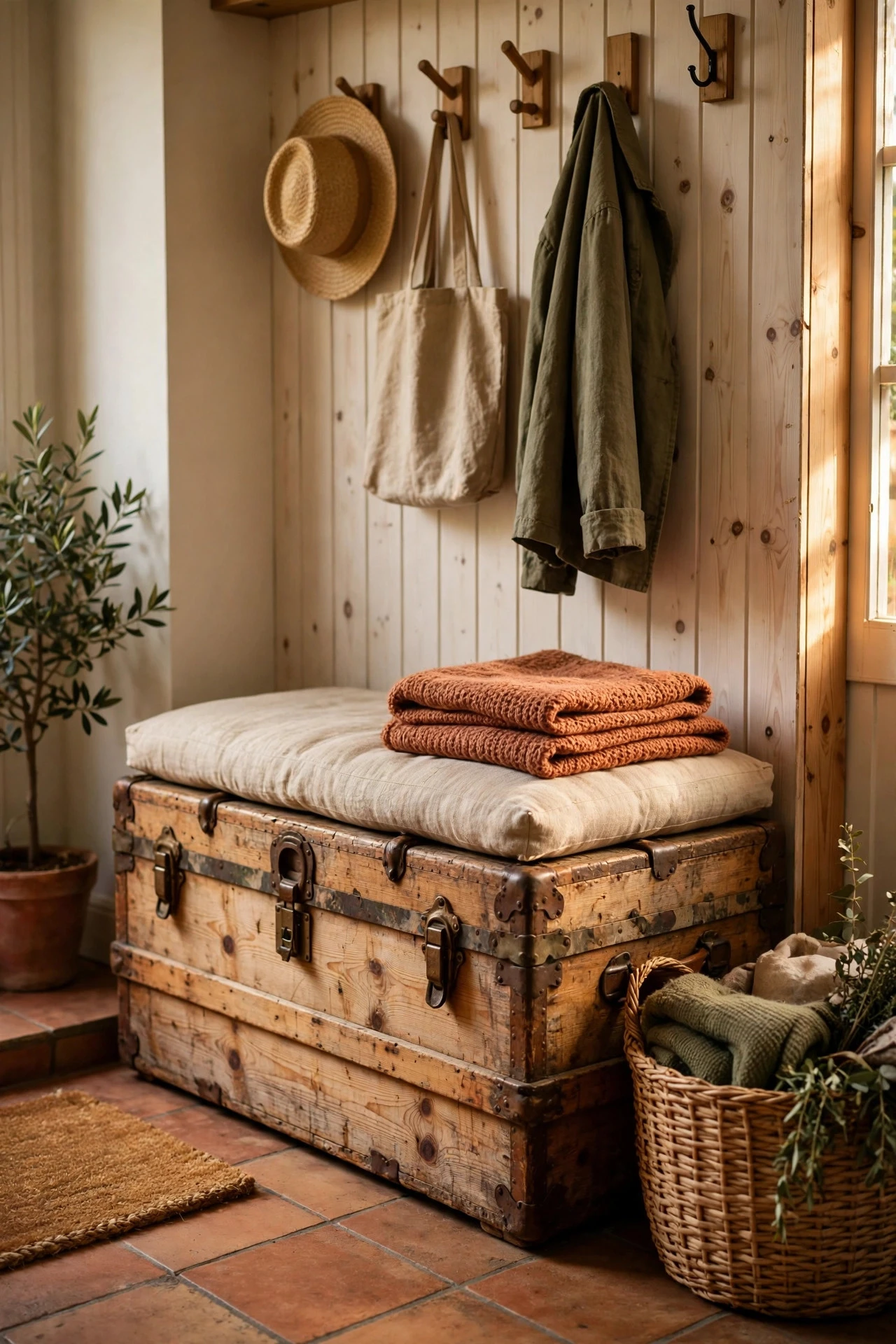
Style a vintage chest or trunk as entryway furniture by using it as a low bench with hidden storage: shoes, hats, gloves and dog leads inside, a cushion and a folded throw on top, and a basket beside it for the overflow. A pine or camphor-wood trunk from the early 20th century costs $70 to $200, measures 80 to 100 cm long and 40 to 50 cm deep, and doubles as the hallway's biggest storage box.
Keep the trunk's lid in good working order — check the hinges and the latch before you buy, because a lid that slams shut is a finger trap, and a lid that will not stay open is useless as a bench. Line the inside with cedar balls or a lavender sachet to keep stored shoes fresh, and place a tray on top so keys and sunglasses have a home that is not the dusty lid. A steamer trunk with leather straps and brass corners is the classic look, but a plain pine blanket box is cheaper and easier to repaint in a colour that matches your hall. Never block a fire exit or a radiator with a trunk: it needs 60 cm of clear space in front of it to open fully.
7. Which Vintage Coat Rack Fits a Narrow Hallway?
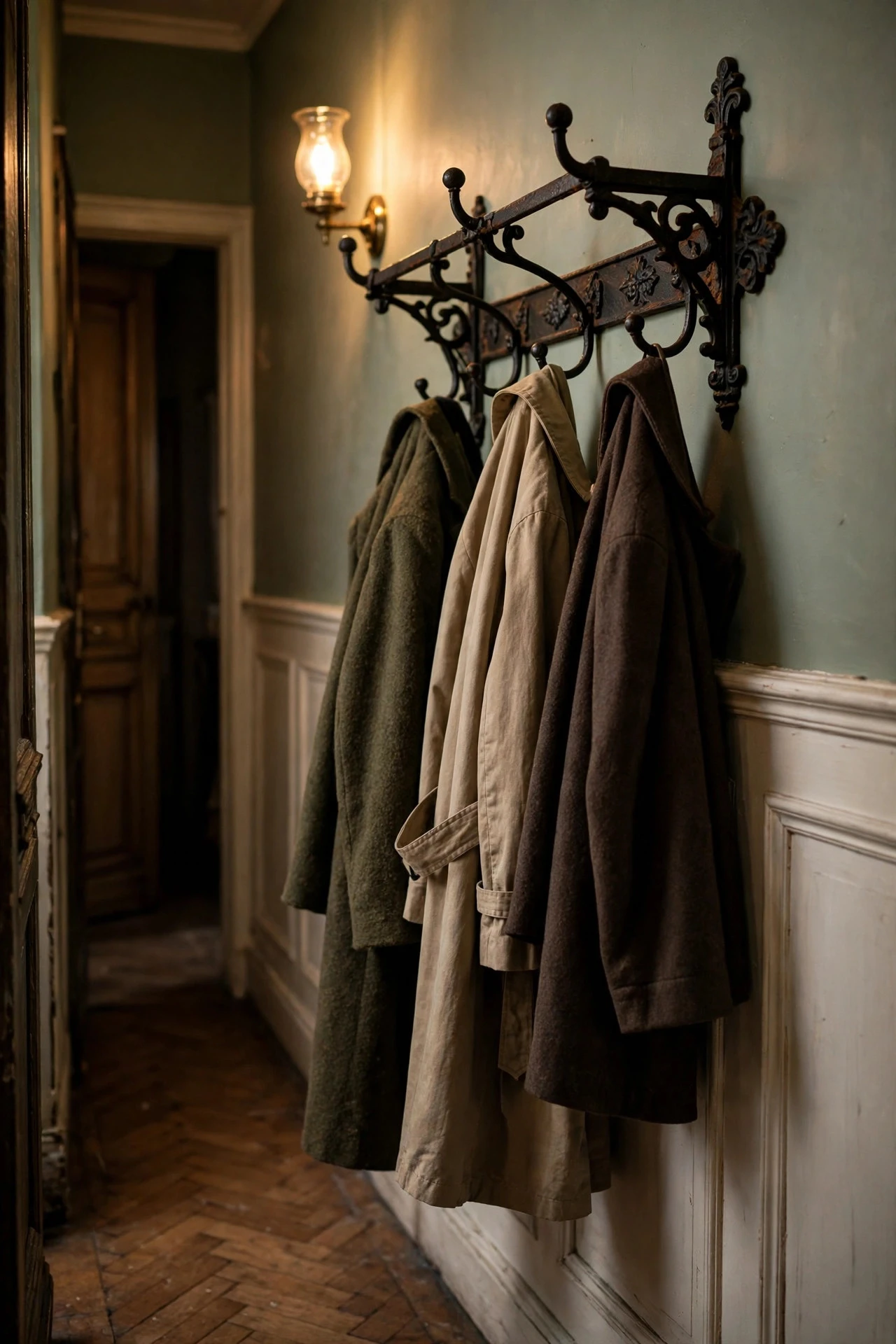
A wall-mounted vintage coat rack fits a narrow hallway best, because it holds four to six coats on 10 cm of wall depth, while a standing coat rack needs a 40 cm circle of floor and becomes an obstacle in a hall under 120 cm wide. A cast-iron or brass wall rack from the 1950s or 1960s costs $30 to $90, measures 60 to 90 cm wide, and mounts at 170 cm from the floor.
Mount the rack on a wall stud or with heavy-duty plasterboard fixings rated for at least 20 kg, because six wet winter coats weigh more than you think and a rack that pulls out of the wall takes the paint with it. Choose hooks that curve upward at the end — straight pegs let coats slide off, while hooked ends hold a bag strap, a scarf and a dog lead at once. If your hallway has no free wall, a slim standing coat tree with a weighted base works in a corner, but keep it at least 30 cm from the door swing. These 22 dream house decor ideas for a home that feels like you show how a single well-chosen vintage piece can set the tone for the whole house, and the coat rack is often that piece.
8. How Do You Add Vintage Lighting to an Entryway?
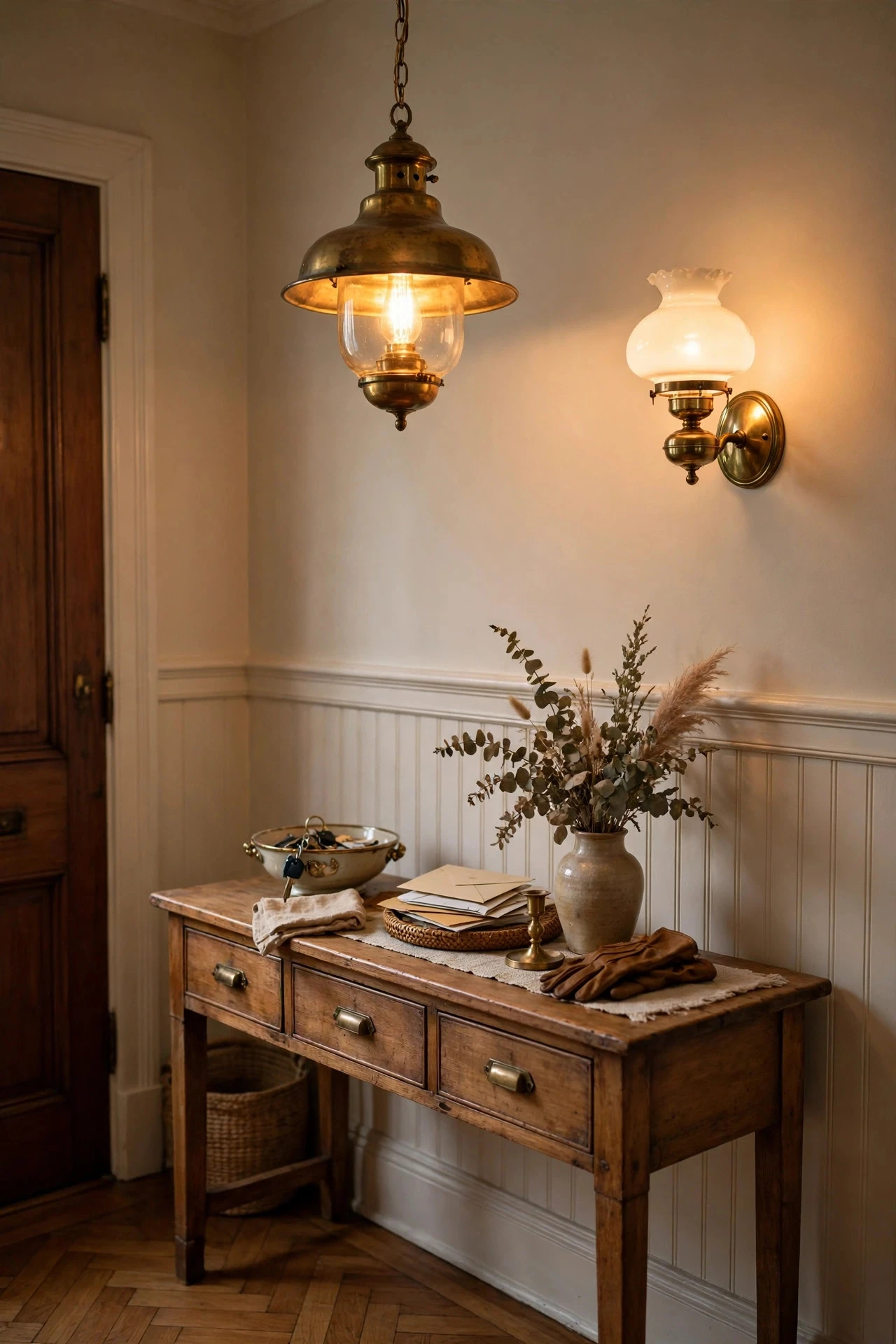
Add vintage lighting to an entryway with a single statement piece — a brass pendant, a milk-glass wall sconce or a small crystal chandelier — hung or mounted so its lowest point is at least 210 cm from the floor, so nobody bumps into it carrying a suitcase. A genuine vintage pendant or sconce costs $50 to $180 secondhand, and a warm 2700K bulb makes old brass glow and old wood look richer.
Check the wiring before you buy: vintage lights often need rewiring, which costs $20 to $40 at an electrician and is worth every penny, because frayed 1960s wiring in a hallway is a fire risk. A pendant works best in a hall with a ceiling above 240 cm, while a wall sconce suits a low ceiling or a narrow hall where a pendant would hang too low. Place the light so it washes the console and mirror, not the blank wall opposite — light on the furniture makes the entryway feel designed, while light on an empty wall just shows the scuffs. Always use a dimmer if you can, because a hallway light that is too bright feels like an interrogation room at 7 am.
9. What Size Runner Works With Vintage Entryway Furniture?
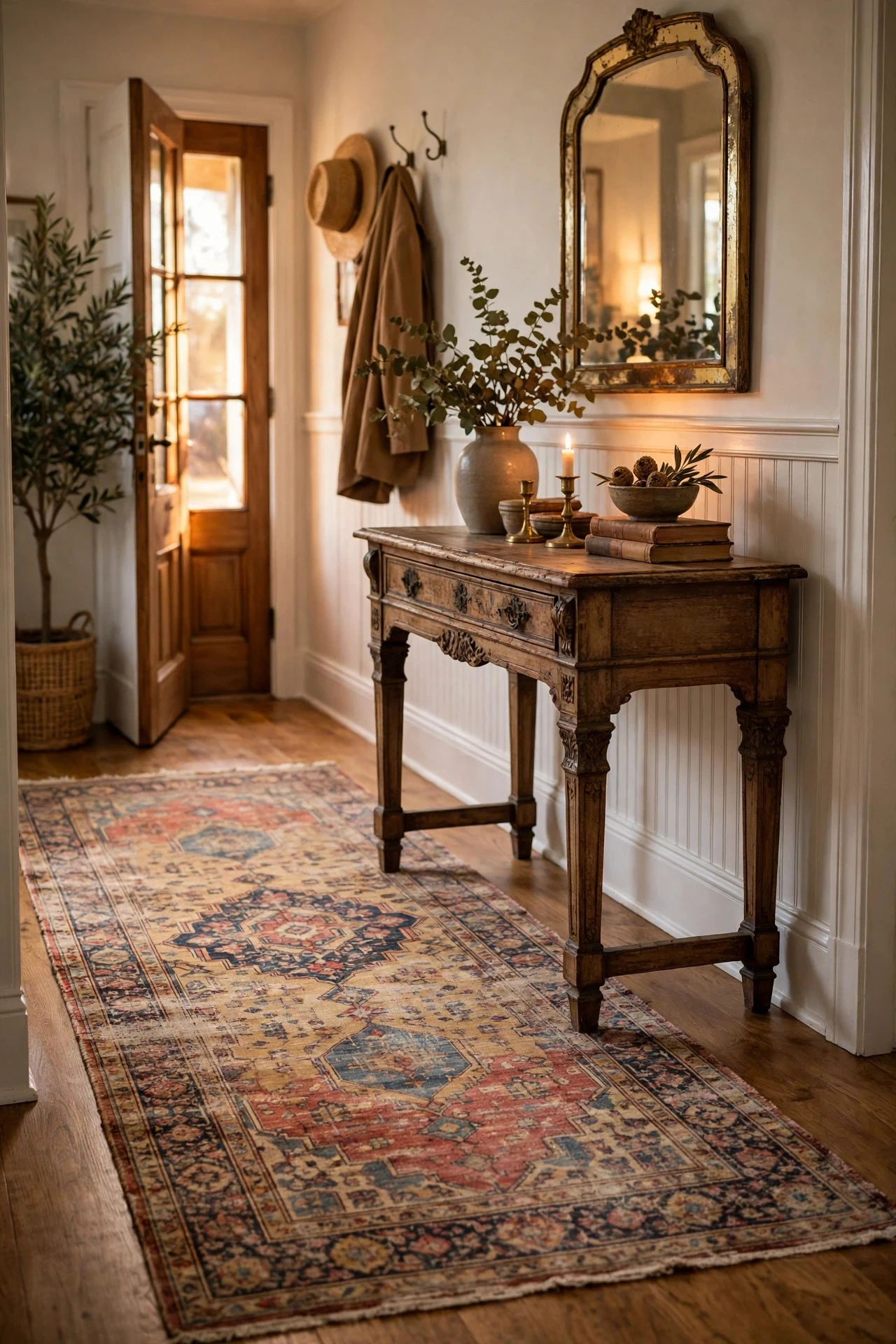
A runner for a vintage entryway should be 60 to 80 cm wide and 30 to 60 cm shorter than the hallway, leaving 15 to 30 cm of bare floor visible at each end, so the rug frames the furniture instead of swallowing it. A vintage-style wool or flatweave runner costs $80 to $200, and a faded Persian or kilim pattern is the classic pairing for antique wood.
Lay the runner so it runs from just inside the front door to just before the console or bench, with the furniture's front legs sitting on the rug and its back legs on the floor — that overlap is what ties the pieces together visually. Use a thin rug pad underneath, because a runner on a hard floor slides every time someone steps on it, and a sliding rug in a hallway is a trip hazard. Choose a pattern with at least one colour that matches the wood tone of your console or hall tree: a rust-red runner with a walnut console, a faded blue runner with oak. Avoid high-pile runners in an entryway, because they trap dirt, show footprints and make a door drag.
10. How Do You Use Baskets Under Vintage Entryway Furniture?
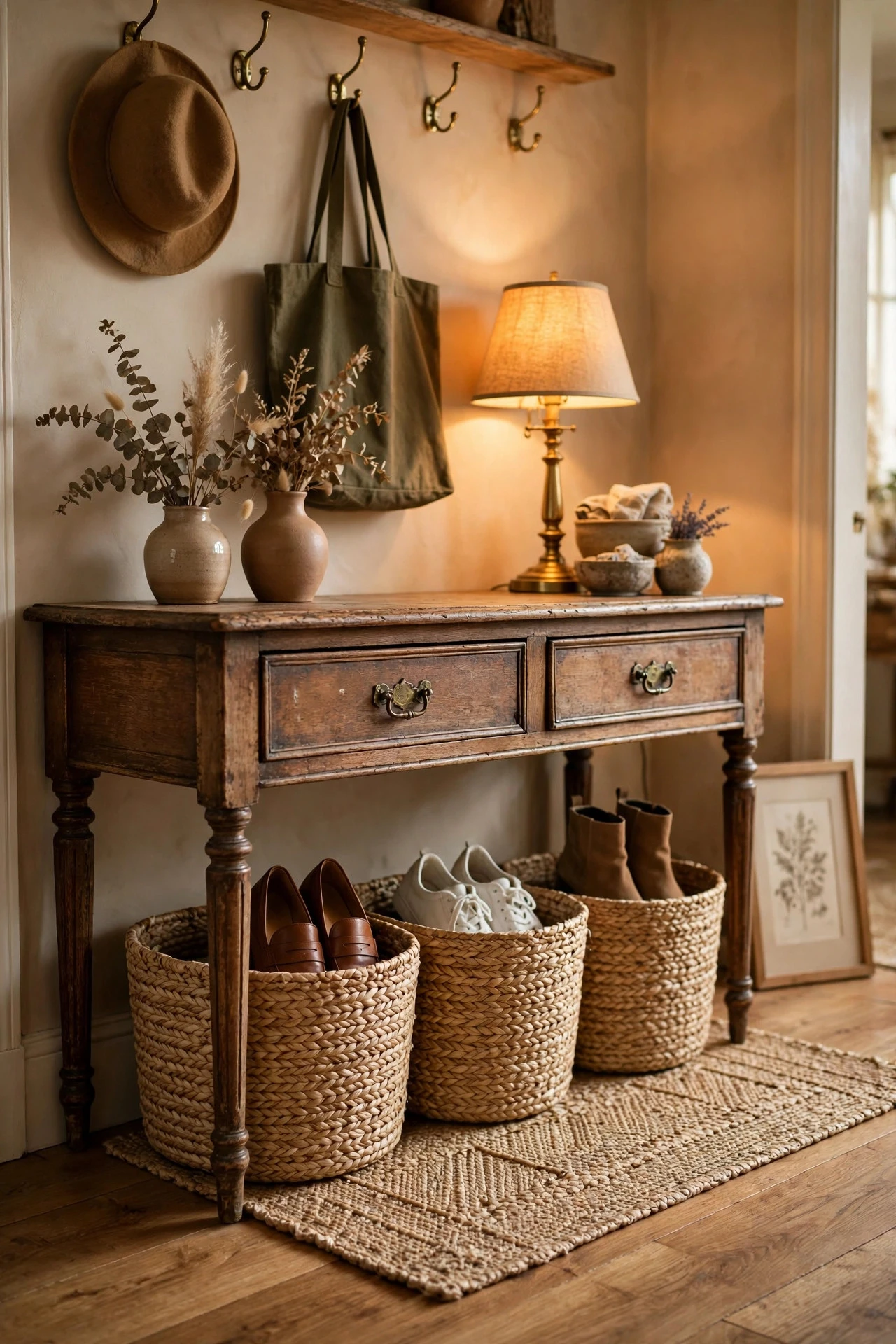
Use baskets under vintage entryway furniture as the hallway's hidden storage: one basket per person for shoes, one for hats and gloves, and one for the dog's leads and toys, each labelled or colour-coded so the system survives a busy morning. Seagrass, wicker and rattan baskets cost $15 to $40 each, measure 30 to 40 cm wide, and slide neatly under a console or bench with a 25 to 35 cm clearance.
Measure the gap under your furniture before you shop, because a basket 2 cm too tall will not fit and a basket 10 cm too short looks lost. Choose baskets with handles, so they pull out like drawers when you need what's inside, and line the shoe basket with a washable fabric bag to stop mud reaching the wicker. A basket of rolled-up throws beside the bench adds softness to a hallway full of hard wood and metal. These 22 cozy home decor ideas for a warm inviting home use the same basket-and-texture layering that makes an entryway feel lived in rather than staged, so borrow the trick: hard furniture, soft basket, one textile.
11. How Can You Tell a Genuine Antique Console From a Reproduction?

Tell a genuine antique console from a reproduction by checking five things: dovetail joints on the drawer (hand-cut, slightly uneven), a back panel made of rough, unfinished wood, screws with a single slot rather than a cross head, wear on the edges where hands have touched for decades, and a smell of old wood rather than fresh varnish. A genuine 1920s to 1960s console shows all five; a reproduction shows at most one.
Look underneath and behind the piece, because that is where fakers do not bother: a genuine console has a rough, dark back and hand-planed marks on the underside, while a reproduction has the same smooth finish everywhere. Check the drawer sides for saw marks and the drawer bottom for a single wide board rather than plywood — plywood in a drawer is a sure sign of modern manufacture. Do not pay antique prices for a piece that fails three of these checks, no matter how good it looks from the front. A well-made reproduction at reproduction prices is fine furniture; the problem is only ever the price tag.
12. What Is the Right Depth for a Console Table in a Narrow Entry?
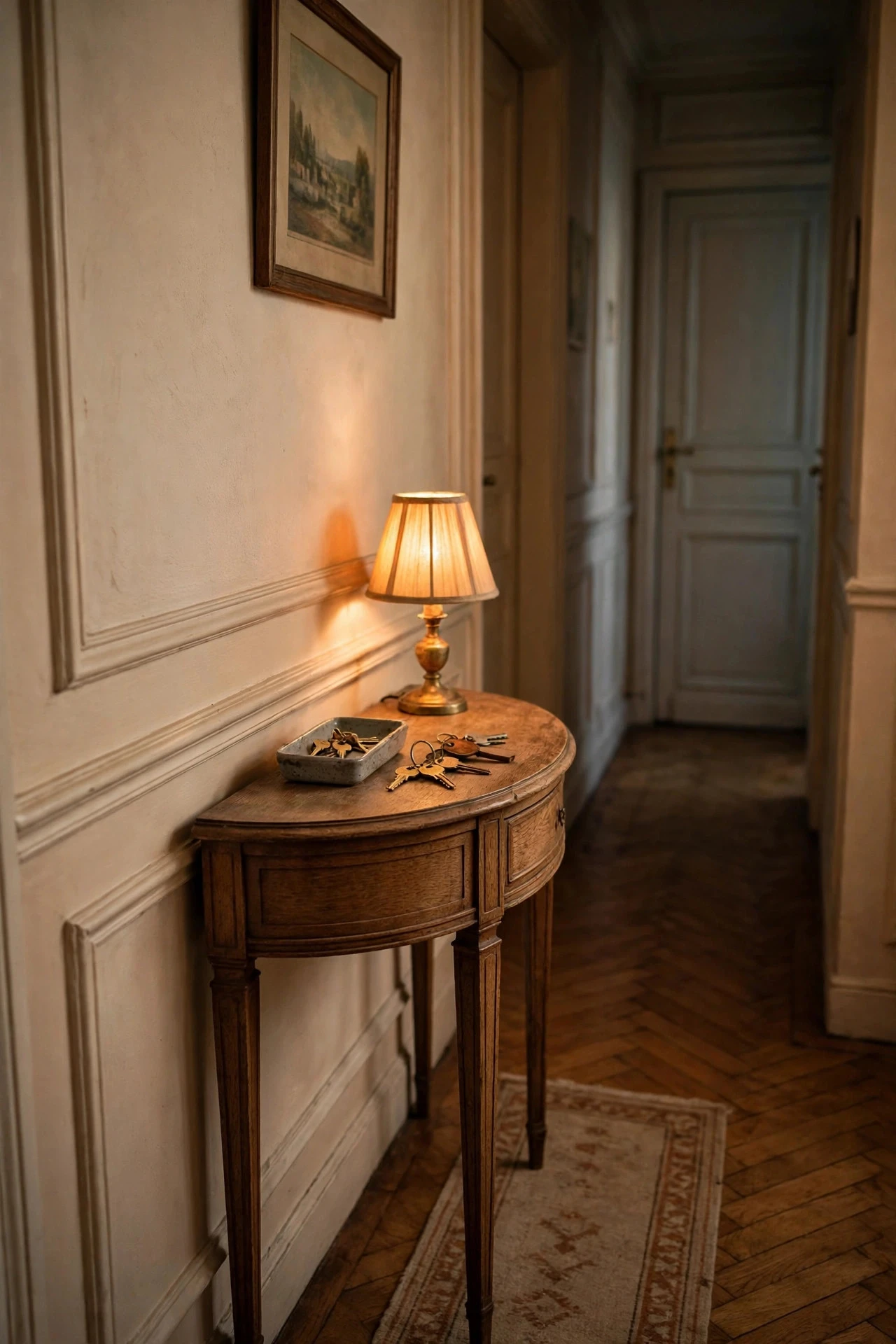
The right depth for a console table in a narrow entry is 25 to 30 cm, because a hallway needs at least 90 cm of clear walkway for one person to pass comfortably, and a standard 120 cm hallway leaves exactly that once a 25 to 30 cm console is in place. Demilune consoles, which are half-round and only 20 to 25 cm deep at their widest point, are the narrowest option and suit halls as tight as 100 cm.
Measure your hallway at its narrowest point — door frames, radiators and skirting boards all steal centimetres — and subtract 90 cm for the walkway; whatever is left is your maximum console depth. A console that is too deep makes everyone turn sideways to pass, and a console that is too shallow cannot hold a lamp and a key tray at the same time. If your hall is under 100 cm wide, skip the console entirely and use a wall-mounted shelf 15 cm deep with a mirror above it: the shelf holds keys and a candle, the mirror does the visual work, and the walkway stays clear.
13. How Do You Mix Vintage Eras in One Entryway Without Clashing?
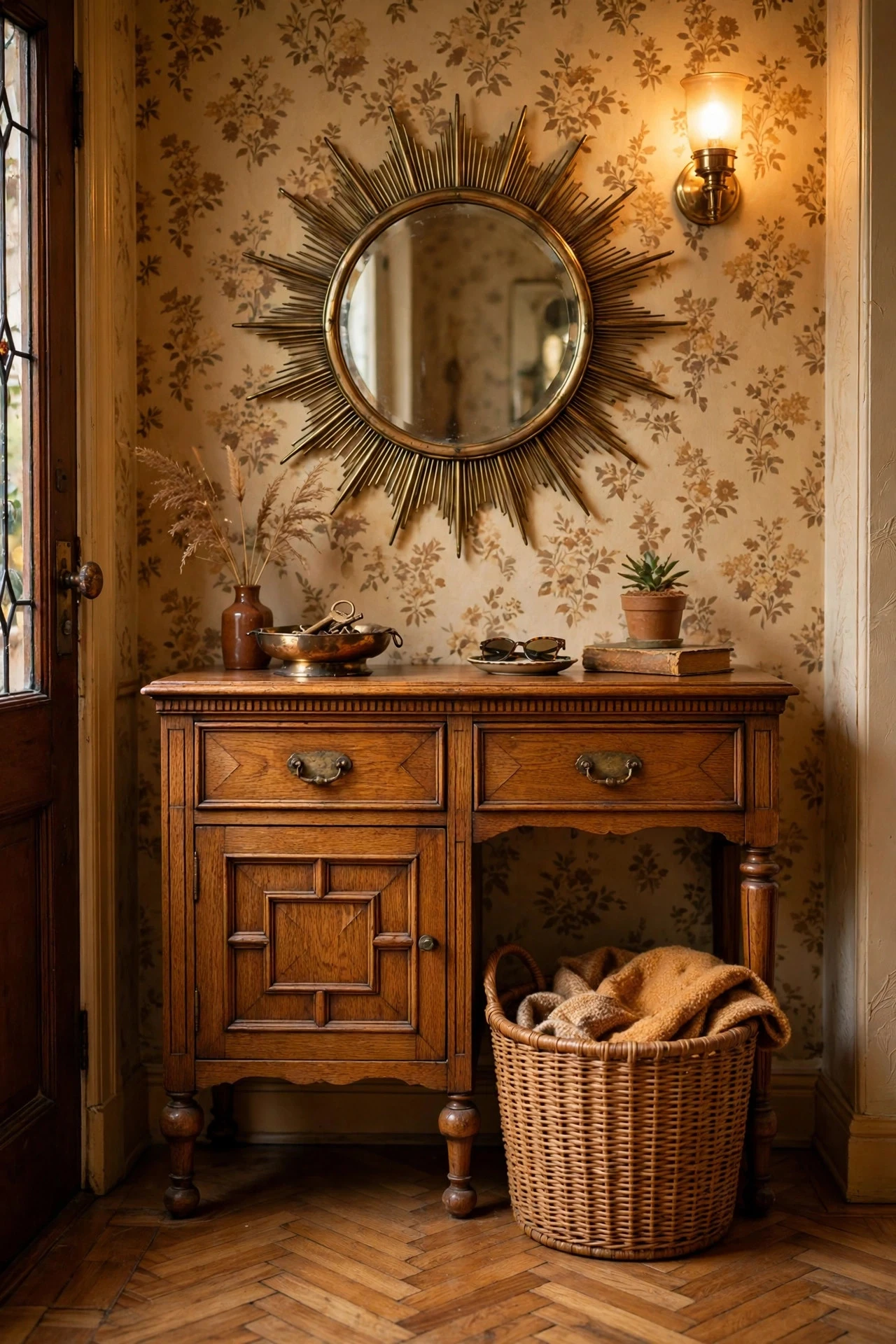
Mix vintage eras in one entryway by holding one element constant — wood tone, metal finish or colour — and letting the eras vary around it: a 1920s oak console, a 1950s brass mirror and a 1970s rattan basket work together because they share warm honey tones, even though they are fifty years apart. The rule is two eras per surface and three at most in the whole hall.
Repeat the constant element at least three times: brass in the mirror frame, the lamp base and the umbrella stand; or oak in the console, the bench and the picture frames. Avoid mixing two strong styles on the same piece — an ornate Victorian mirror above a stark mid-century console fights itself, while either piece alone with a quiet companion works beautifully. If a piece looks wrong, it is usually because its colour temperature clashes: cool grey wood next to warm honey oak, or chrome next to aged brass. The foyer has always been a room of mixed influences, because every generation added its own piece to the entrance, so a layered, collected look is historically correct — a matched set is the modern invention.
14. How Do You Furnish a Very Small Entryway With Vintage Pieces?

Furnish a very small entryway with vintage pieces by choosing three items only: a wall-mounted shelf or demilune console, a round mirror, and one basket — because a hall under 2 square metres cannot take a bench, a hall tree and a chest without becoming a storage room. A demilune console costs $50 to $120, a round mirror $40 to $90, and a basket $15 to $30, so the whole entry costs under $250.
Hang the mirror above the shelf at eye level, place a small tray on the shelf for keys, and tuck the basket underneath for shoes — three pieces, three jobs, nothing extra. Use the vertical space: a wall-mounted coat rack above the shelf and a picture ledge higher still, so the floor stays clear and the eye travels up. Keep the colour palette to two tones plus one metal, because a tiny hall shows every extra colour. A small entryway is not a failed entryway: it is a hallway that forces you to choose well, and three good vintage pieces beat ten mediocre ones every time.
15. How Do You Care for Patina on Vintage Wood and Metal?
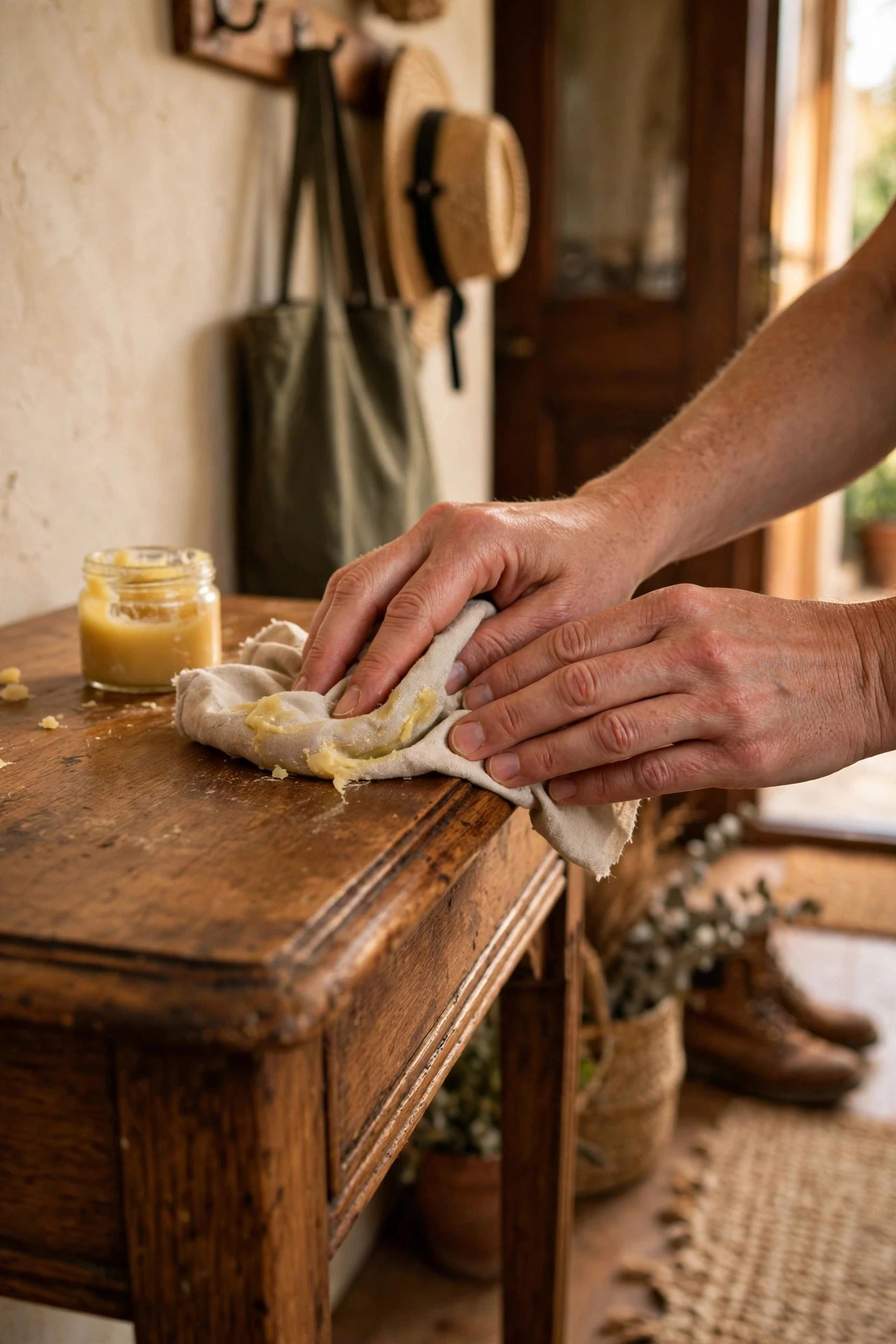
Care for patina on vintage wood and metal by cleaning gently and oiling rarely: dust wood with a dry cloth weekly, wipe it with a barely damp cloth monthly, and feed it with beeswax or a natural oil twice a year — never use silicone spray, because it builds up a cloudy film that dulls the finish permanently. Brass and copper need only a soft cloth; polish them only if you want shine, and leave the darkened patina alone if you want character.
Never sand a vintage piece to remove scratches, because the scratches are part of its history and sanding removes the aged surface that took decades to form. For water rings, rub a little mayonnaise or petroleum jelly into the mark and leave it overnight — the oil lifts the moisture out of the finish without stripping it. For metal, a paste of lemon juice and salt removes tarnish from brass in minutes, but test it on a hidden spot first, because it also removes the dark patina in the crevices that makes old brass look old. Store spare wax and cloths in the trunk or under the bench, so care takes two minutes instead of a trip to the cupboard.
16. Where Is the Best Place to Buy Vintage Entryway Furniture?

The best places to buy vintage entryway furniture are flea markets, estate sales and charity shops for the lowest prices, and reputable online marketplaces for the widest choice: expect $40 to $120 at a flea market for a console that costs $150 to $300 online, because online sellers add delivery and photography costs. Estate sales are the best source for hall trees and chests, because whole houses are cleared at once and large pieces sell cheaply on the last day.
Go early to estate sales for the best pieces and late for the best prices — the last hour often brings 50% discounts on anything still standing. At a flea market, check joints, drawers and wobble before you haggle, and bring a tape measure, a torch and a friend with a car, because the best finds are always the ones you cannot carry alone. Online, read the seller's reviews and ask for photos of the back, the underside and the drawer joints before you pay; a seller who refuses those photos is hiding something. These 22 living room rug ideas to ground your seating area use the same thrifting logic for textiles — buy the good bones secondhand, and spend the savings on the one new piece that ties the room together.
17. How Do You Style a Vintage Demilune Console in a Tight Corner?
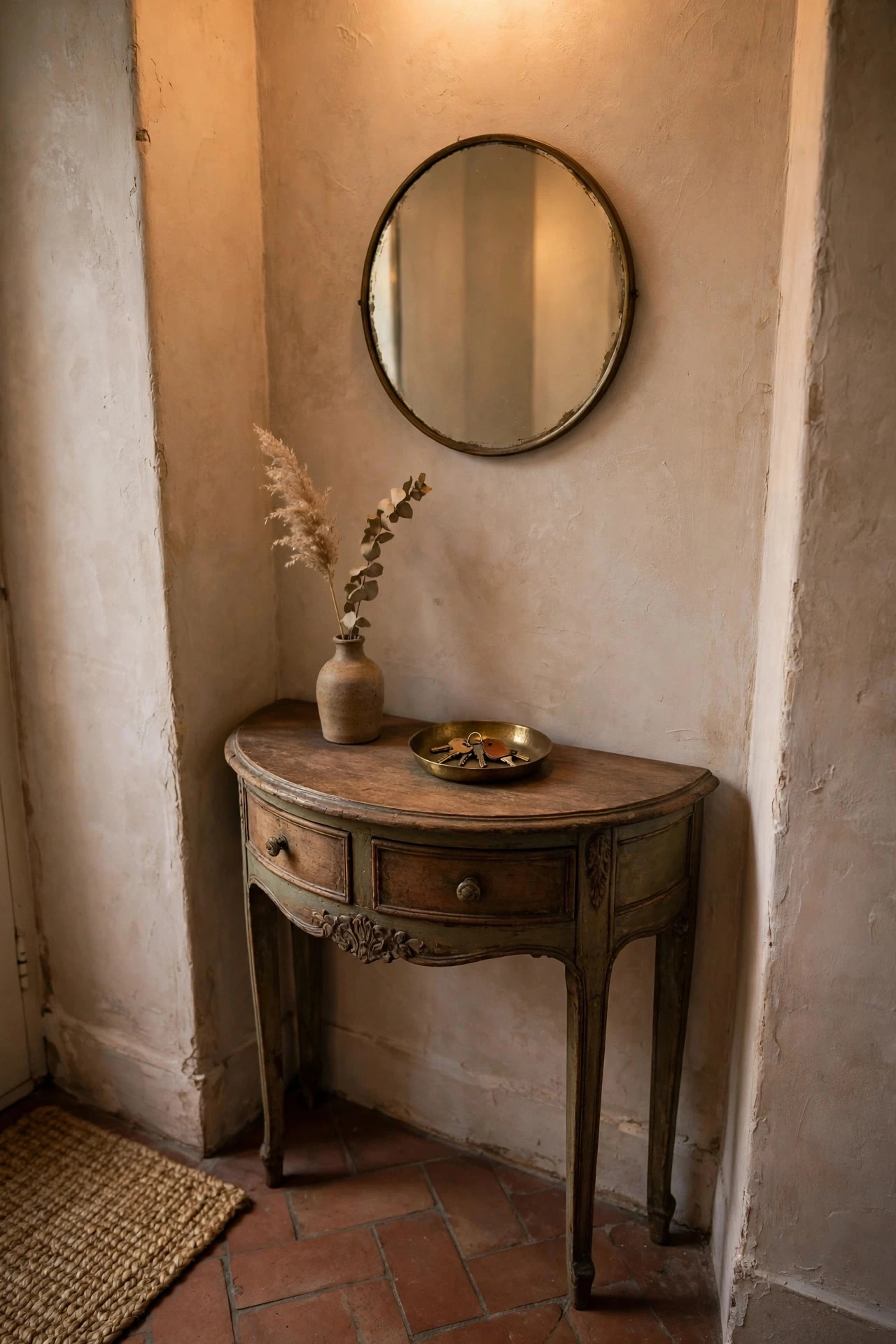
Style a vintage demilune console in a tight corner by treating it as a jewellery box for the hallway: one small lamp or candle, one tiny vase with a single stem, and a key tray — three objects, no more, because a half-round top only 20 to 25 cm deep cannot hold a crowd. A demilune console costs $50 to $150, measures 60 to 90 cm wide, and fits corners and narrow walls where a full console cannot go.
Hang a small round or arched mirror above it, 10 cm clear of the tabletop, so the corner reads as a designed vignette rather than a leftover space. A demilune in a corner works best with a runner or a small rug in front of it, because the rug pulls the corner into the room instead of leaving it stranded. Keep the wall beside the demilune clear of coat hooks, because a coat hanging over a demilune hides it entirely and turns a pretty piece into a coat stand. The half-moon shape is the point: it curves into the room and softens a hallway full of right angles, so let the shape show.
18. What Vintage Pieces Work Best in a Mudroom-Style Entry?

A mudroom-style entry works best with vintage pieces built for hard use: a solid pine bench with a lift-up lid, a row of cast-iron hooks on a reclaimed wood board, a galvanised metal boot tray, and a stoneware crock for umbrellas and walking sticks. These pieces cost $150 to $400 together secondhand, and they survive wet boots, muddy paws and school bags in a way that delicate gilt furniture never will.
Choose a boot tray 60 to 90 cm long with a raised edge, so muddy water stays in the tray and off the floor, and place it directly under the hooks so coats drip onto the tray, not the runner. A pine bench is better than an upholstered one in a mudroom, because pine wipes clean and dries out, while fabric holds damp and smells. Add a small chalkboard or a row of labelled hooks — one per person — because a mudroom only stays tidy when everyone knows exactly where their things belong. If the entry opens straight onto the garden, a vintage doormat in coir or rubber does more work than any furniture: it catches the mud before it reaches the bench.
19. How Do You Anchor a Vintage Entryway With a Statement Piece?

Anchor a vintage entryway with a statement piece by choosing one oversized object — a tall arched mirror, a carved oak hall tree, or a large framed vintage map — and letting everything else stay quiet around it. The statement piece should be the tallest or widest object in the hall, at least 150 cm tall or 90 cm wide, and it should sit on the wall you see first when the door opens.
Place the statement piece first, then add the console or bench underneath it, then the small objects last: lamp, tray, vase. If the statement piece is a mirror, keep the console styling minimal — a candle and a tray — because the mirror is doing the visual work. If the statement piece is a hall tree, keep the walls bare around it, because a busy wall next to a busy piece looks like a shop. One statement piece per entryway is the rule: two statement pieces compete, and the hall looks like a showroom instead of a home. The most common mistake is buying the statement piece last, after the hall is already full — buy it first, and the rest of the room falls into place.
20. How Do You Furnish a Vintage Entryway on a Budget?
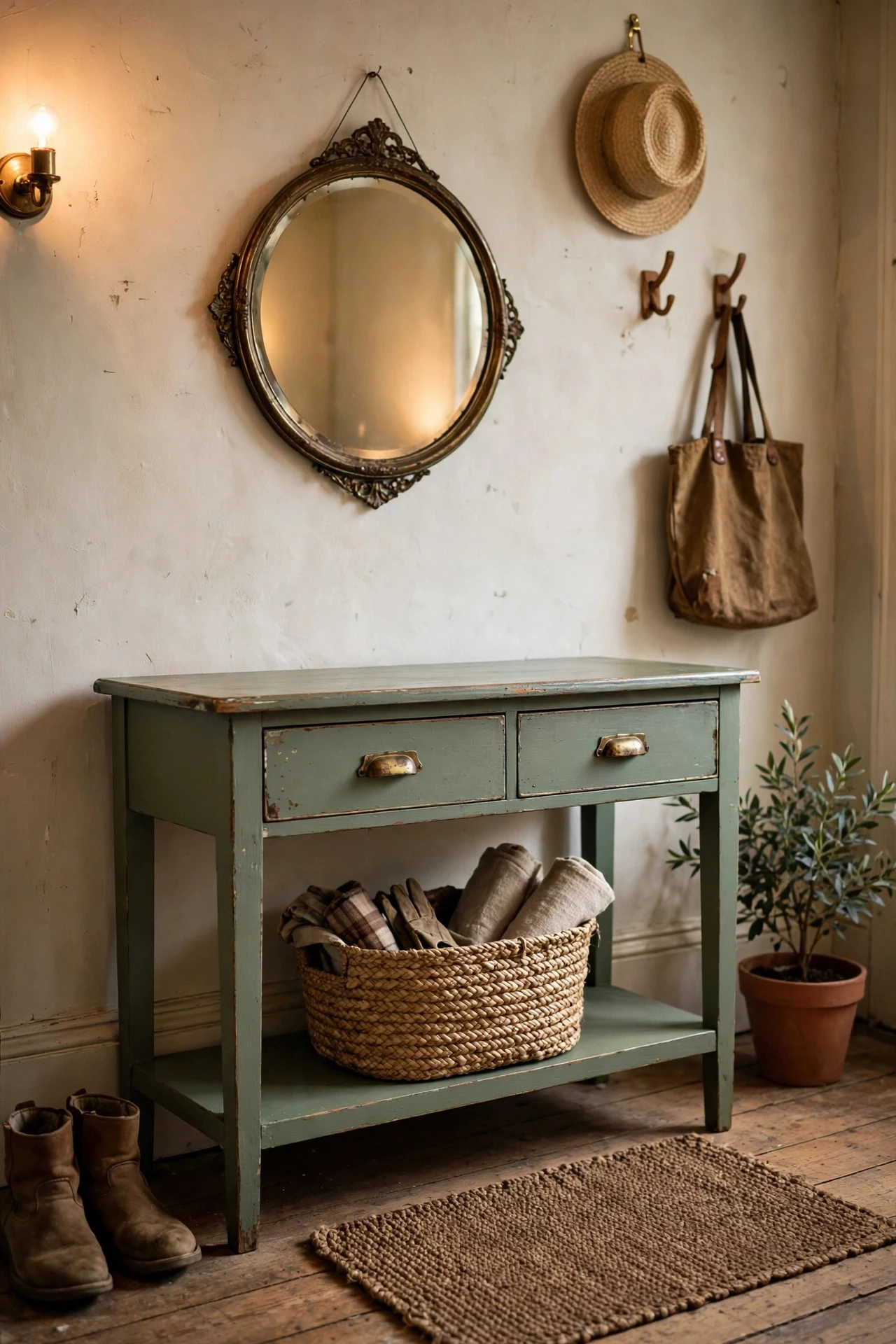
Furnish a vintage entryway on a budget by spending $150 to $300 in total: one $60 to $100 console or bench from a charity shop, a $25 to $40 mirror, a $15 to $30 basket, and a $10 to $20 umbrella crock, with paint and elbow grease doing the rest. The cheapest way to make a hallway look expensive is a good clean, a coat of paint on the walls, and one honest piece of old wood.
Paint is the budget decorator's best friend: a charity-shop console in a tired brown becomes a smart piece in sage green or charcoal, and a coat of chalk paint costs $15 and takes an afternoon. Hunt for the expensive-looking pieces in cheap places — brass mirrors, oak benches and stoneware crocks are common at car boot sales because sellers do not know what they are worth. Spend your money on the piece you touch every day — the console or the bench — and save on the pieces you only look at. A $10 secondhand mirror in a good frame beats a $100 new mirror in a flimsy one, because the frame is what you see.
21. How Do You Keep Vintage Entryway Furniture Safe for Kids and Pets Near the Front Door?

Keep vintage entryway furniture safe for kids and pets by anchoring tall pieces to the wall, choosing rounded edges over sharp corners, and keeping anything breakable above 120 cm or behind the console. A hall tree or a tall mirror must be fixed to a wall stud with an anti-tip strap, because a climbing toddler or a large dog can pull a freestanding piece over in seconds.
Place fragile objects — ceramic vases, glass candle holders, framed photos — at the back of the console against the wall, not at the front edge where a tail or a small hand can reach them. Use museum putty under lamps and vases, $5 a pack, so a bump moves nothing. Choose a bench with a soft-close lid or remove the lid entirely in a house with small children, because a slamming trunk lid is a finger trap. Keep the umbrella stand's contents blunt — no walking sticks with sharp ferrules at toddler height — and store shoes in closed baskets rather than open ones, because a dog will chew a shoe faster than you can say its name.
22. How Do You Make a Vintage Entryway Feel Cohesive, Not Cluttered?

Make a vintage entryway feel cohesive, not cluttered, by repeating your wood tone in at least three pieces, your metal finish in two, and your colour in two — console, bench and frames in the same oak; mirror, lamp and hooks in the same brass; runner and cushion in the same rust red. Cohesion is repetition with variation, not matching everything exactly.
Stand in the doorway and count the objects you can see: if there are more than twelve, remove three, because a hallway should feel like a pause before the house, not a shop display. Leave 15 to 20 cm of empty surface on the console, keep one wall completely bare, and let the runner's pattern be the only pattern in the room. If one piece looks wrong, it is usually because it introduces a new colour or a new metal — remove that one piece and the hall snaps together. A vintage entryway should feel like it grew over decades, with each piece earning its place, and that feeling comes from editing, not from buying more.
Practical Tips
Measure the hallway before you shop, and write the numbers on your phone: hall width at its narrowest point, the door's swing arc, the distance to the nearest socket, and the height of the skirting board. A console 5 cm too deep blocks the walkway, a mirror hung 10 cm too high reflects the ceiling, and a hall tree that blocks the door is a daily annoyance, not a feature.
Check every secondhand piece before you pay: open every drawer, sit on every bench, rock every table, look underneath and behind, and smell the wood for damp or mould. Bring a tape measure, a torch and a friend with a car to every flea market, because the best finds are always the ones you cannot carry alone. Budget in tiers — $150 to $300 for a charity-shop entry, $300 to $600 for a mixed secondhand entry, $600 to $1,200 for one genuine antique plus honest companions — and spend the most on the piece you touch every day.
Care for patina, not against it: dust weekly, feed wood with beeswax twice a year, leave brass unpolished if you like the darkened look, and never sand a vintage surface to remove a scratch. Keep a small box of spare hooks, felt pads, museum putty and beeswax under the bench, because something always loosens. Photograph the finished entryway from the front door, and label every basket so the system survives a busy Monday morning.
Final Thoughts
A timeless entryway is not about how much you spend; it is about how well a few honest, old pieces fit the hallway, the door and the way you actually come home every day. Start with a console, add a mirror and a bench, hide the shoes in baskets, and let the patina do the talking — your entrance will feel collected, not decorated, and it will still look right in ten years.
You may also like: our 22 small entryway ideas that make a tiny entrance feel grand and our 22 cozy home decor ideas for a warm inviting home carry the same collected, layered styling from the entryway into the rest of the house.
Frequently Asked Questions
How much does it cost to furnish a vintage entryway?
Furnishing a vintage entryway costs $300 to $600 with secondhand finds: $80 to $250 for a console or hall tree, $40 to $150 for a mirror, $60 to $180 for a bench, and $15 to $40 per basket. A charity-shop entry costs $150 to $300, while one genuine antique plus honest companions costs $600 to $1,200.
How do I know if vintage entryway furniture is genuine?
Check five things: hand-cut dovetail joints on the drawer, a rough unfinished back panel, single-slot screws, wear on the edges where hands have touched for decades, and a smell of old wood rather than fresh varnish. A genuine piece shows most of these; a reproduction shows at most one, and should never carry an antique price.
What size console table fits a narrow entryway?
A console table for a narrow entryway should be 25 to 30 cm deep, 80 to 120 cm wide and 75 to 85 cm tall, leaving at least 90 cm of clear walkway in the hall. Demilune consoles, only 20 to 25 cm deep, suit halls as tight as 100 cm wide, while halls under 100 cm are better with a 15 cm wall-mounted shelf.
Can I mix different vintage eras in one entryway?
Yes, you can mix vintage eras in one entryway by holding one element constant — wood tone, metal finish or colour — and letting the eras vary around it. A 1920s oak console, a 1950s brass mirror and a 1970s rattan basket work together because they share warm honey tones, so keep to two eras per surface and three at most in the hall.
How do I care for the patina on vintage entryway furniture?
Care for patina by dusting wood weekly with a dry cloth, wiping it with a barely damp cloth monthly, and feeding it with beeswax or natural oil twice a year. Never use silicone spray or sand the surface, because both destroy the aged finish. Leave brass unpolished if you like the darkened look, and polish it only if you want shine.
Where is the best place to buy vintage entryway furniture?
The best places are flea markets, estate sales and charity shops for the lowest prices, and reputable online marketplaces for the widest choice. Estate sales are best for hall trees and chests, because whole houses are cleared at once. Always check joints, drawers and wobble before you pay, and bring a tape measure and a torch.