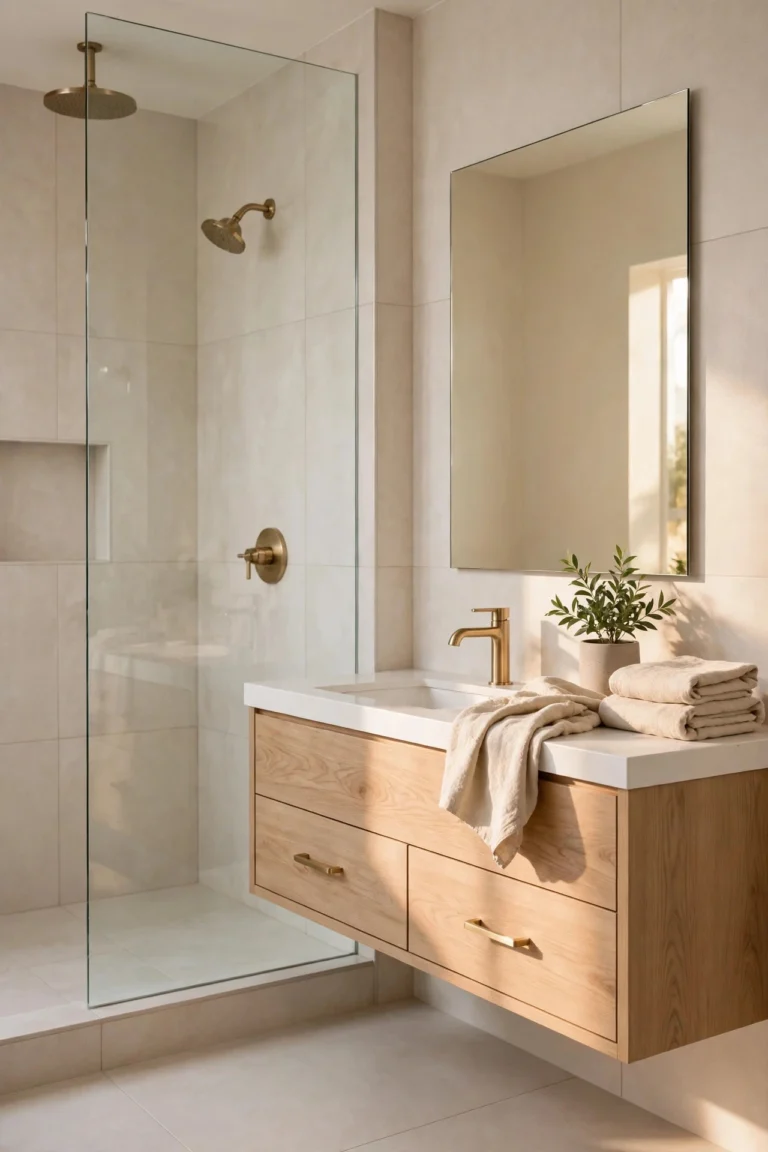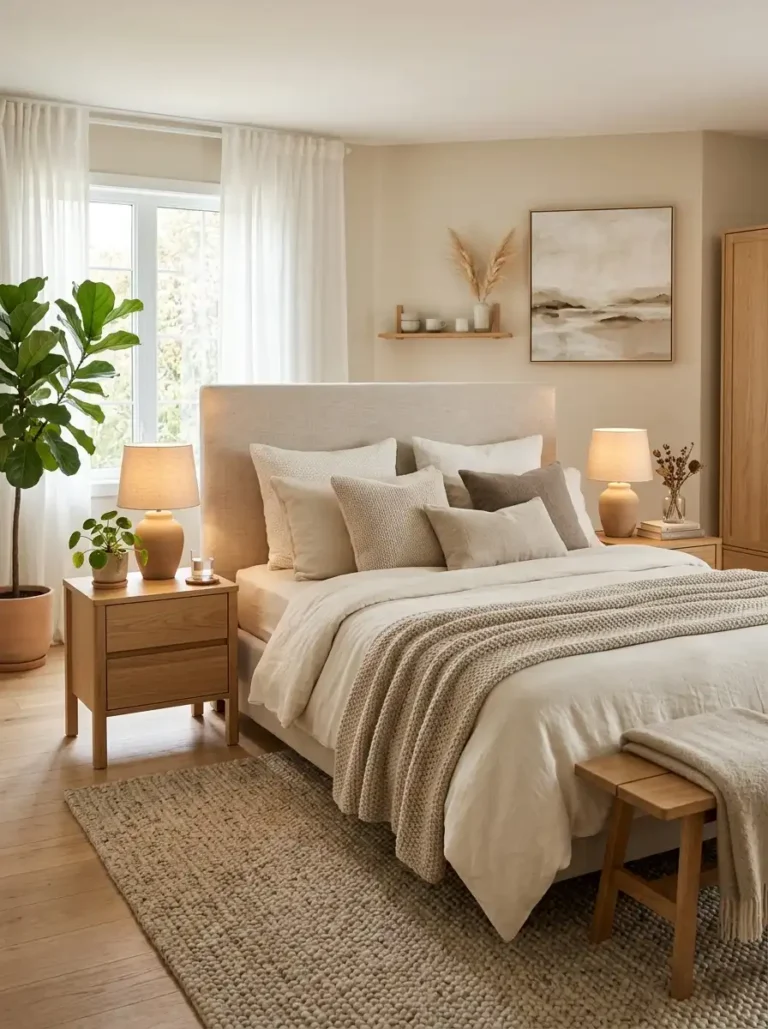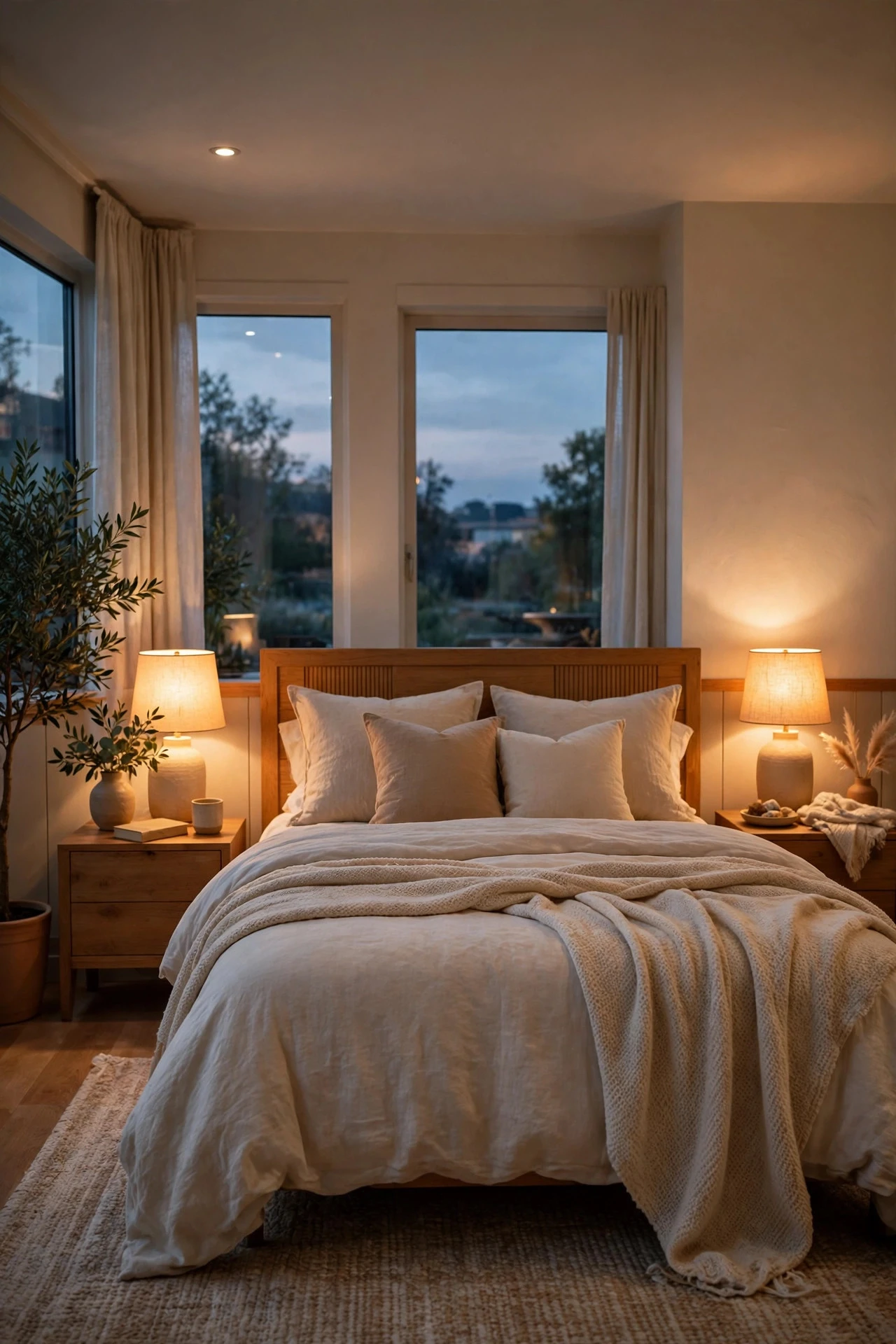
22 Bedroom Lighting Ideas for a Warm, Restful Glow
A bedroom asks more of its lighting than any other room. It has to be bright enough to get dressed by in the morning, soft enough to read by at night, and warm enough that switching it on at 11 pm does not feel like an alarm. Getting it right comes down to three things: the colour of the light, how many sources you layer, and whether you can dim them.
Looking for more inspiration? Our Nest Decorz homepage gathers the latest home decor ideas, seasonal decorating guides and room-by-room styling tips in one place — start there and explore.
Below you'll find 22 bedroom lighting ideas covering layered light, colour temperature, exact heights, dimmers and smart controls — with honest budgets in pounds, so your bedroom feels calm and restful at every hour. Every idea works whether you are starting from one bare ceiling bulb or planning a full rewire.
Quick answers
– Layer three kinds of light — ambient for the room, task for reading and dressing, accent for mood — instead of relying on one ceiling bulb. – Use warm white at 2700K for the bedroom — and go warmer, to 2200K, for bedside lamps and late evenings. – Put the main lights on a dimmer — ideally dim-to-warm bulbs that turn more golden as they dim. – Budget £80–£200 for a layered bedroom scheme, and £25–£60 for a bedside-only upgrade.
1. How Do You Layer Bedroom Lighting Properly?

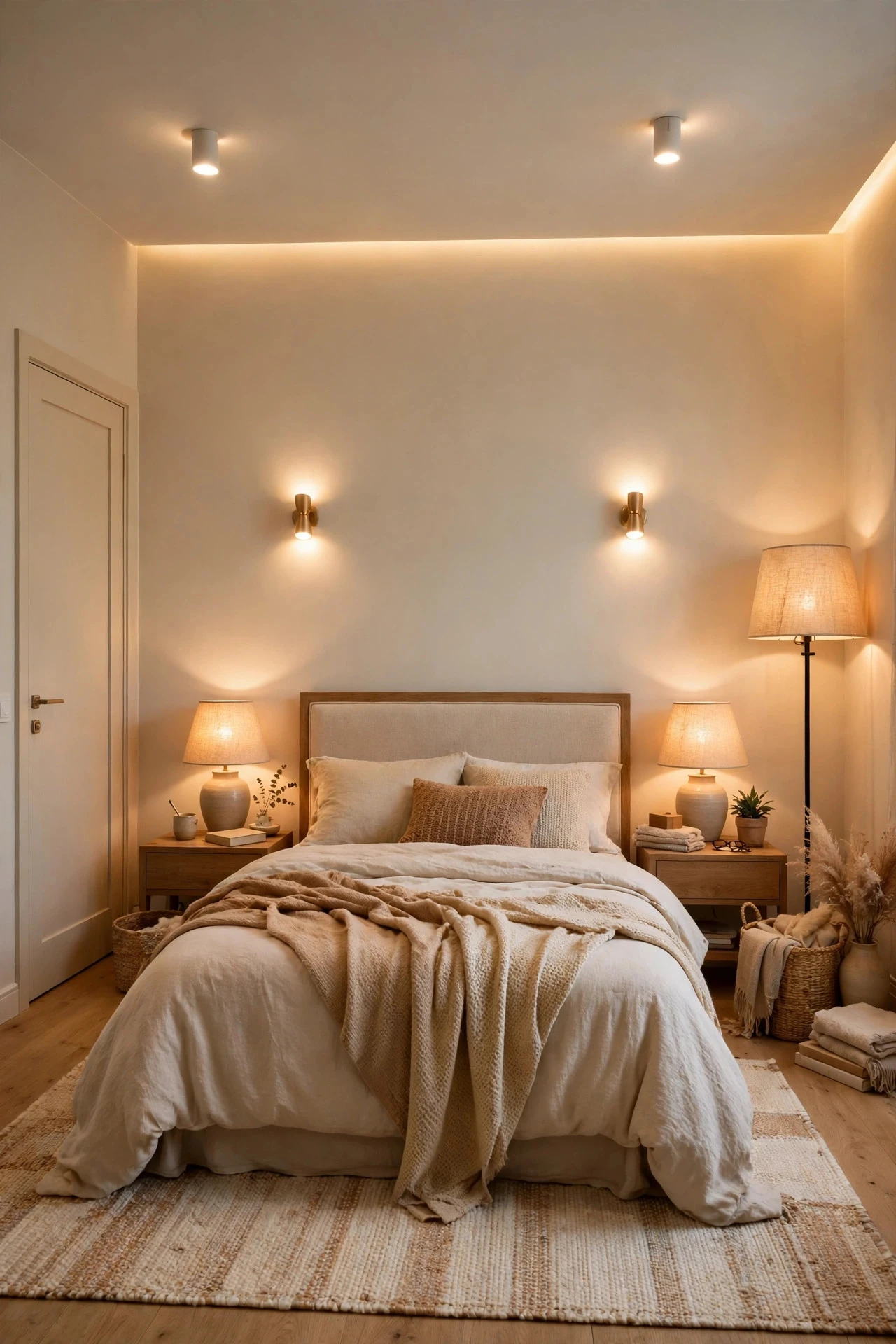
Layer bedroom lighting properly by building it from three sources that work together: ambient light that fills the room, task light focused where you need it, and accent light that picks out a feature. Most bedrooms are lit by one ceiling light, which is the main reason they feel flat — a single source cannot do three jobs.
Start with the ambient layer: a pendant, a ceiling fitting or downlights, bright enough for getting dressed and dimmable for the evening. Add task light next: bedside lamps or wall lights for reading, and a light at the dressing table. Finish with accent light: an LED strip behind the headboard, a picture light over artwork, or fairy lights on a shelf. A bedroom feels best when all three layers work at once, each on its own switch or dimmer, so you can turn the room from bright morning to soft evening without changing a bulb. Lighting design is the difference between a room that works and a room that only looks good in photos.
2. What Is the Best Colour Temperature for a Bedroom?

The best colour temperature for a bedroom is warm white at 2700K for the main lights, with bedside lamps and late-evening lights warmer still, at 2200K, which gives a soft golden glow close to candlelight. Colour temperature is measured in Kelvin (K): the lower the number, the warmer and more golden the light; the higher the number, the whiter and bluer it gets.
Keep cool white (4000K and above) out of the bedroom at night — it reads as office lighting and fights the relaxed mood you are trying to create. For a dressing area, 3000K looks a little crisper and works well for seeing colours accurately in the morning. The simplest upgrade in any bedroom is swapping a cool bulb for a warm one: a 2700K LED costs £3–£6, and it changes the room more than a new lamp. If you buy dim-to-warm bulbs, they slide from 2700K at full brightness to 1800K candlelight as you dim — the closest thing to a sunset in a bulb.
3. How Do You Choose Bedside Lamps?

Choose bedside lamps by height first: the lamp should stand about 60–70 cm tall in total, with the bottom of the shade roughly at eye level when you are sitting up in bed, so the light falls on the page rather than in your eyes. A lamp that is too tall glares; one that is too short lights the mattress instead of the book.
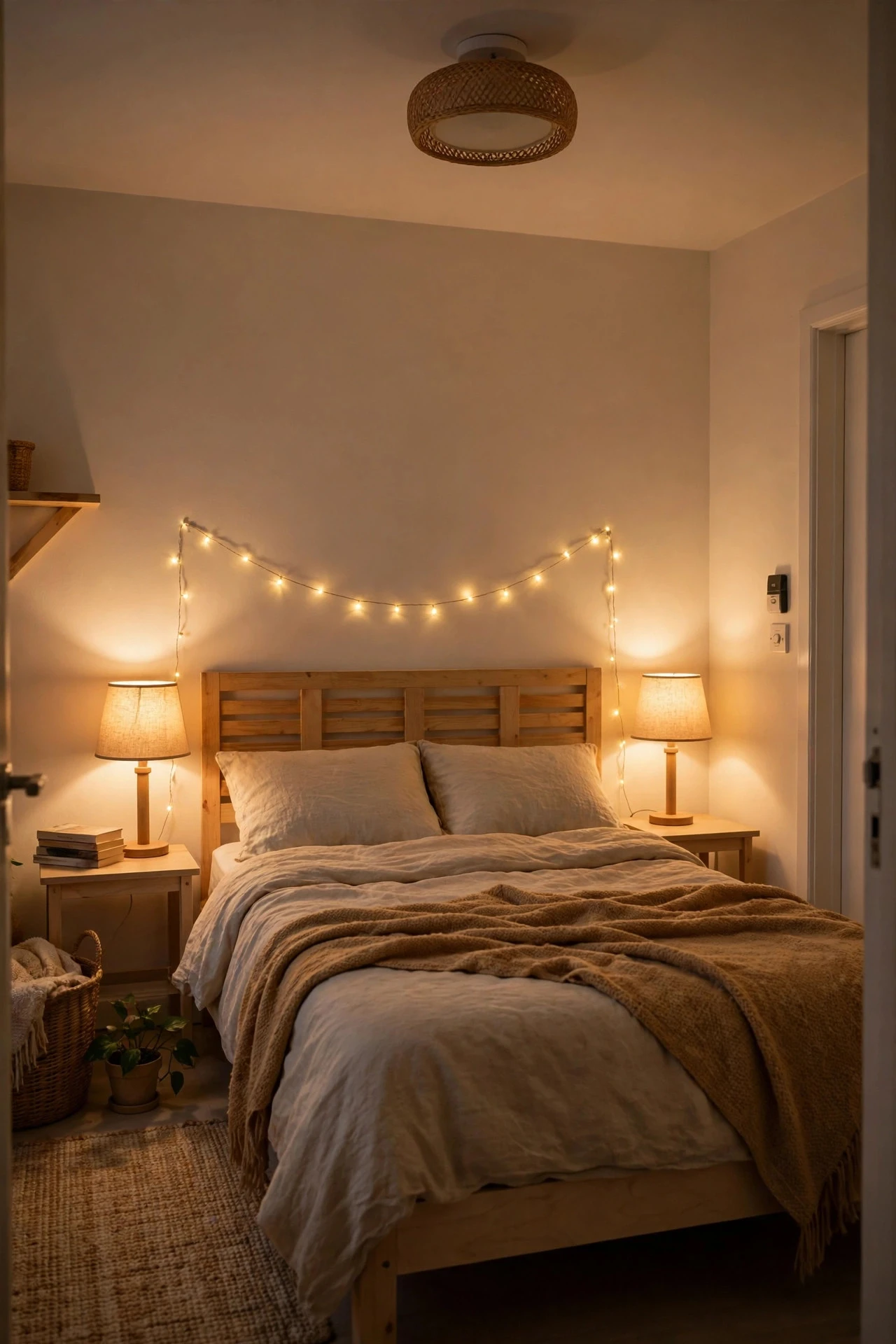
Pick a pair of matching lamps — one per side — for a finished look, with shades 25–30 cm across in a warm fabric that softens the light. Use a warm bulb, 2200–2700K, at 40–60 watts equivalent, and put each lamp on its own switch so one person can read while the other sleeps. A good pair of bedside lamps costs £40–£90; a single statement lamp costs £30–£60. The mistake to avoid is a lamp with a narrow base on a narrow nightstand — it topples the first time someone reaches for a glass of water in the dark.
4. Why Are Wall Sconces Better Than Bedside Lamps?
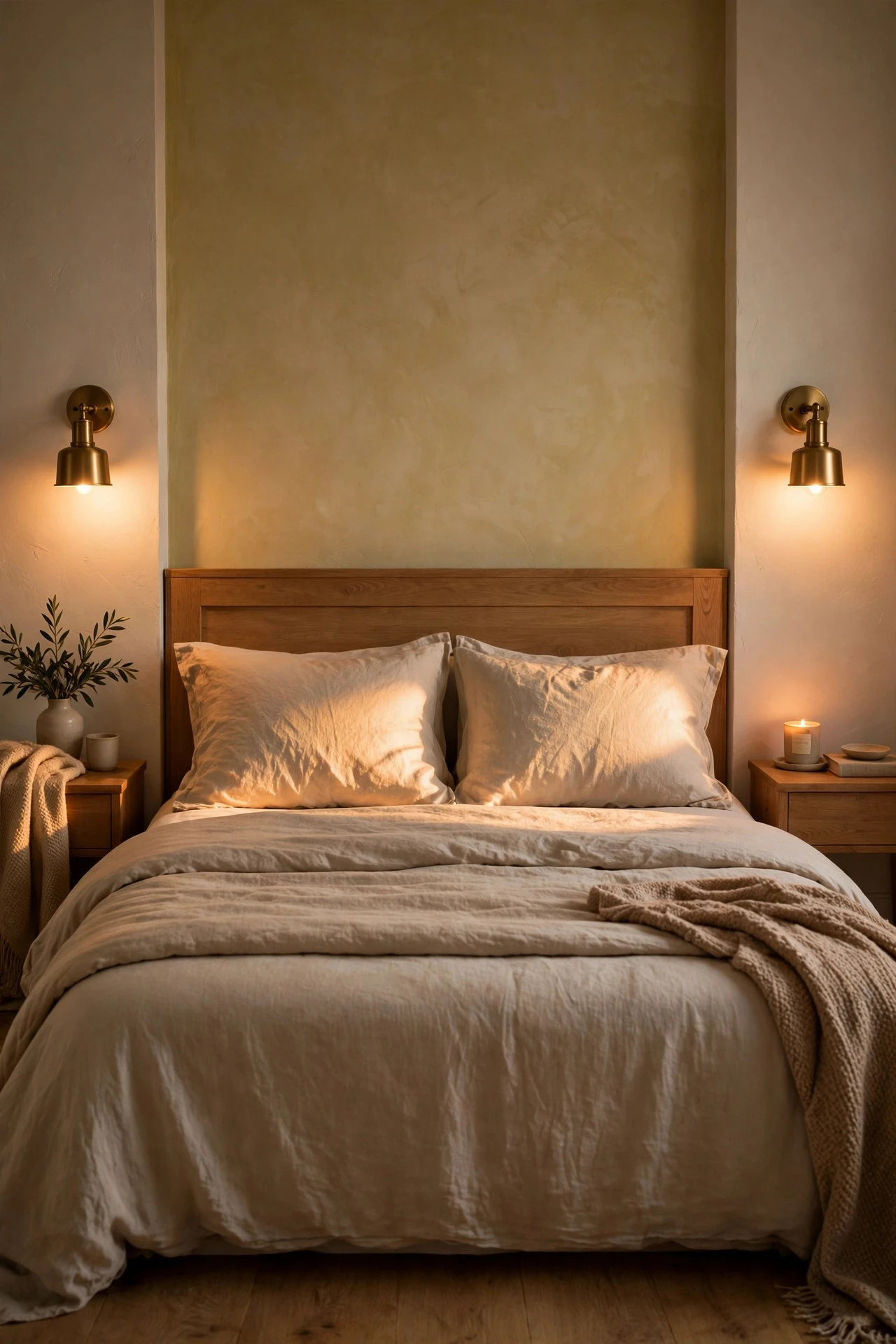
Wall sconces are better than bedside lamps in a small bedroom because they clear the bedside tables completely and put the light right where you read. A pair of wall lights either side of the bed, positioned slightly to the side of your head and a little above shoulder height when you are sitting up, lights the page without taking a centimetre of table space.
Choose sconces with an adjustable arm or a swing head, so each person can aim their own light, and use a warm bulb at 2200–2700K. Hardwired sconces cost £60–£150 a pair plus fitting; plug-in sconces with a cord cover cost £30–£60 a pair and need no electrician. For a small bedroom, sconces are the single best space-saving upgrade, and they make the bed wall look considered instead of bare. For the wall behind the bed, these 22 bedroom wall decor ideas for a calm, personal retreat show how to style the same wall when the lights are off.
5. How Low Should Pendant Lights Hang Beside the Bed?

Pendant lights beside the bed should hang with the bottom of the pendant about 70–80 cm above the nightstand surface, centred over the nightstand, so the light pools on the table without hanging in your line of sight when you sit up. A pendant hung low beside the bed looks considered and frees up the bedside table completely.
Hang one pendant on each side of the bed for symmetry, or a single pendant on one side if only one person reads. Use a small pendant — 15–20 cm across — with a warm bulb, and keep the cord or rod short enough that the pendant does not swing when the door closes. A pair of small pendants costs £50–£120; a single statement pendant costs £40–£90. The mistake to avoid is hanging pendants at ceiling height — they become a second ceiling light and lose the whole point, which is a low, intimate pool of light beside the bed.
6. How Do You Light a Bedroom Reading Corner?

Light a bedroom reading corner with a floor lamp and a small accent light working together: a floor lamp with an adjustable head, placed behind and to the side of the reading chair, plus a small table lamp or a picture light on the shelf beside it. A floor lamp is the easiest way to light a dark corner, especially the reading chair corner that most bedrooms have but few light properly.
Choose a floor lamp 140–160 cm tall with a warm bulb, and position it so the light falls over your shoulder onto the page, not into your eyes. Add a dimmer so the corner can go from bright reading light to soft evening glow. A good reading floor lamp costs £40–£80; a pair of lamps for a two-chair corner costs £80–£140. For a corner that feels like a retreat rather than a spare chair, these 22 bedroom reading nook ideas for a cosy, quiet corner show how to build the whole nook around the light.
7. What Is the Best Ceiling Light for a Bedroom?
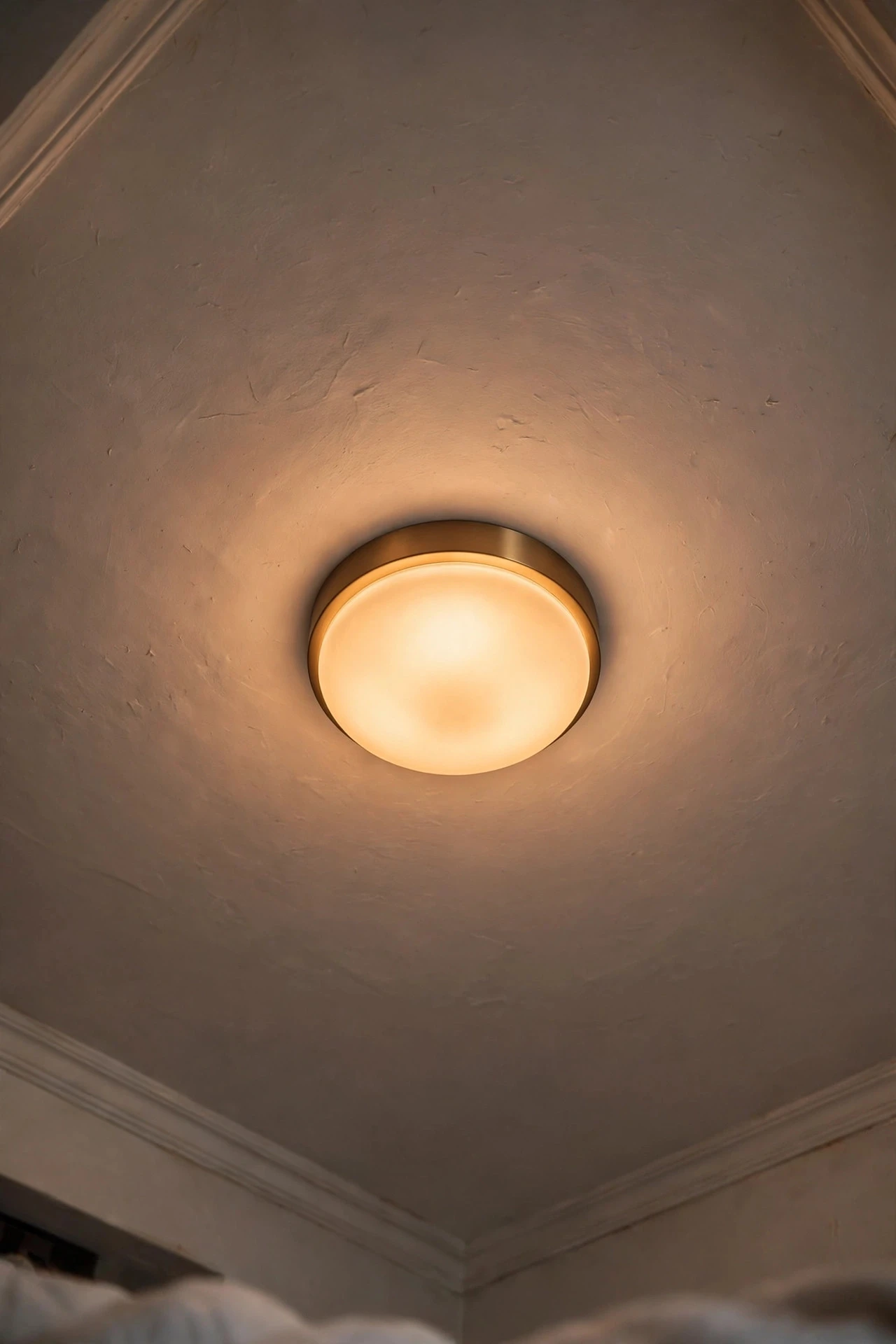
The best ceiling light for a bedroom is a dimmable fixture that spreads light evenly without glaring: a flush-mount or semi-flush fitting for low ceilings, a pendant or chandelier for high ones, and downlights for a clean, modern look with nothing hanging down. The fixture should be rated for two or three 60-watt equivalent LED bulbs, so it is bright enough for getting dressed and dimmable for the evening.
For a low ceiling, choose a flush fitting 30–40 cm across, hung tight to the ceiling so nobody bumps it. For a high ceiling, a pendant hung 2.1 m above the floor gives a focal point without overwhelming the room. Downlights need a dimmer to work in a bedroom — without one, they are either on or off, and on is too bright for 11 pm. A good ceiling fitting costs £40–£120; downlights cost £15–£25 each plus fitting. Always use a qualified electrician for any ceiling installation, and fit a dimmer at the same time — it is the cheapest upgrade with the biggest effect.
8. How Do You Use Dimmers in a Bedroom?
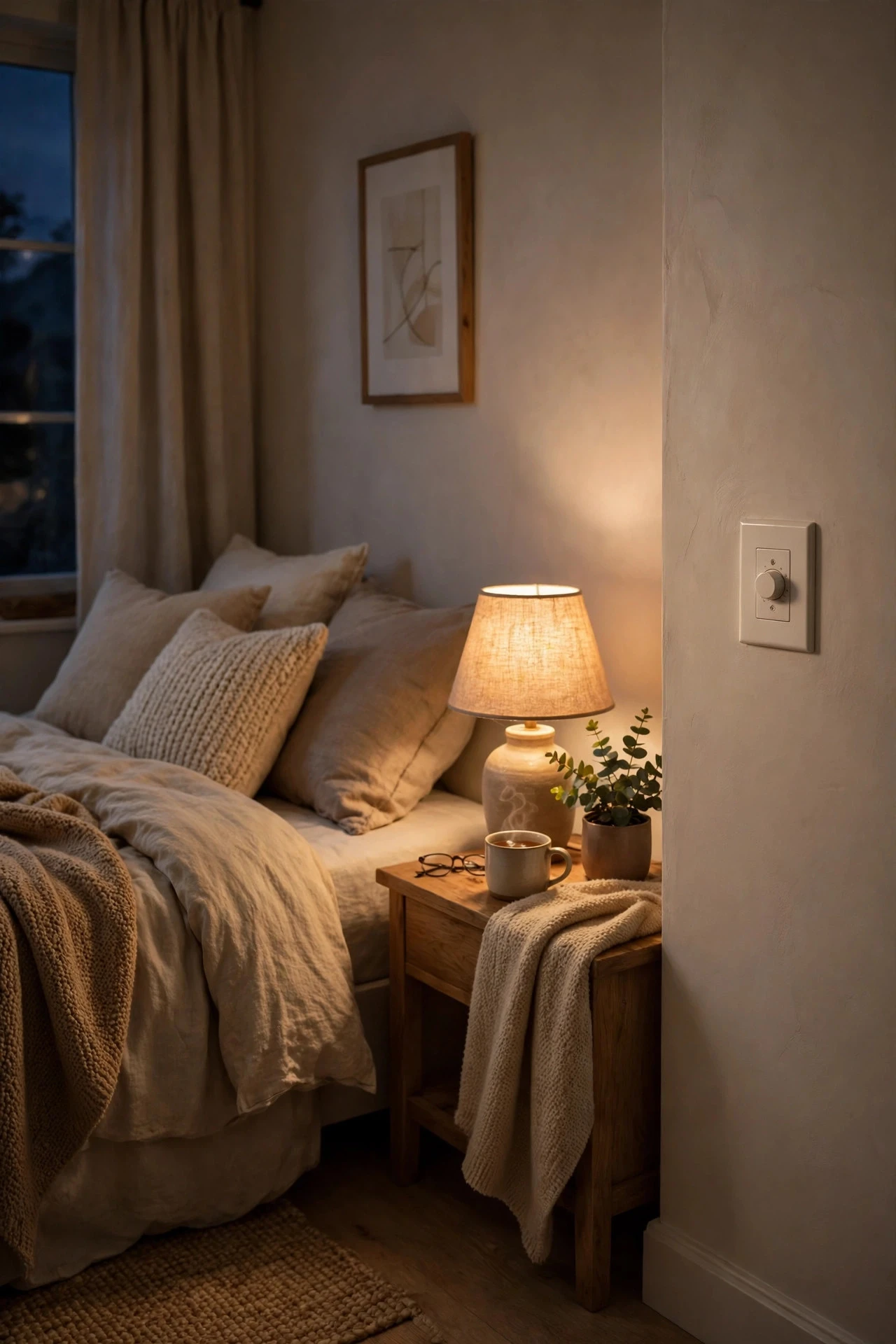
Use dimmers in a bedroom by fitting them on the main lights and the bedside lights, so the same fixtures give you bright morning light and soft evening glow. A dimmer switch lets you flick between a bright, functional morning and a soft evening using the same fixture, and it is the single most useful control in a bedroom.
Fit a rotary or touch dimmer rated for LEDs — old dimmers flicker with LED bulbs — and choose dim-to-warm bulbs that turn more golden as they dim, sliding from 2700K to 1800K. A dimmer switch costs £10–£20, plus £40–£80 for an electrician to fit it if you are not confident with wiring. Put the bedside lights on a separate dimmer from the ceiling light, so one person can dim their side without affecting the other. The mistake to avoid is dimming a non-dimmable bulb — it buzzes, flickers and dies early. Check the box: it must say dimmable.
9. How Do You Add LED Strips Without Making It Look Like a Gaming Room?
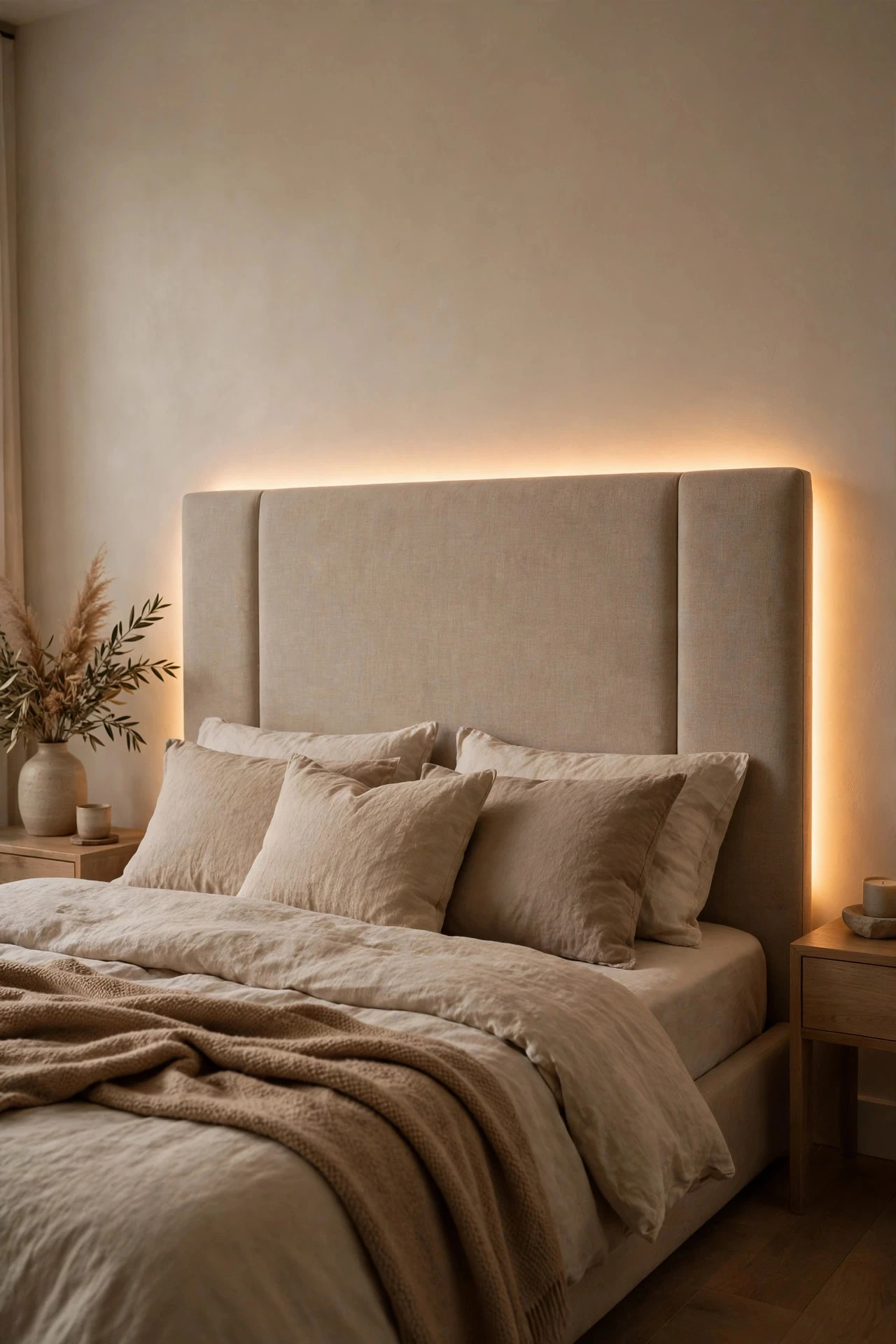
Add LED strips without making the bedroom look like a gaming room by hiding the source and showing only the glow: run a warm-white strip along the back of the headboard, under a floating shelf, or behind a dresser, so the furniture seems to float in a soft halo. LED strips are the secret weapon of modern bedroom lighting because they hide the source and show only the light.
Use warm white, 2700K, never RGB colour-changing strips, and put the strip on a dimmer so it can go from a soft glow to a barely-there shimmer. A 2 m strip with a driver costs £15–£30; two strips cover a headboard and a shelf. Stick the strip to the back of the furniture, not the wall, so the glow washes the wall evenly. The mistake to avoid is a visible strip — if you can see the dots of the LEDs, the strip is in the wrong place. Hide it, dim it, and keep it warm.
10. How Do You Light a Bedroom With No Ceiling Light?
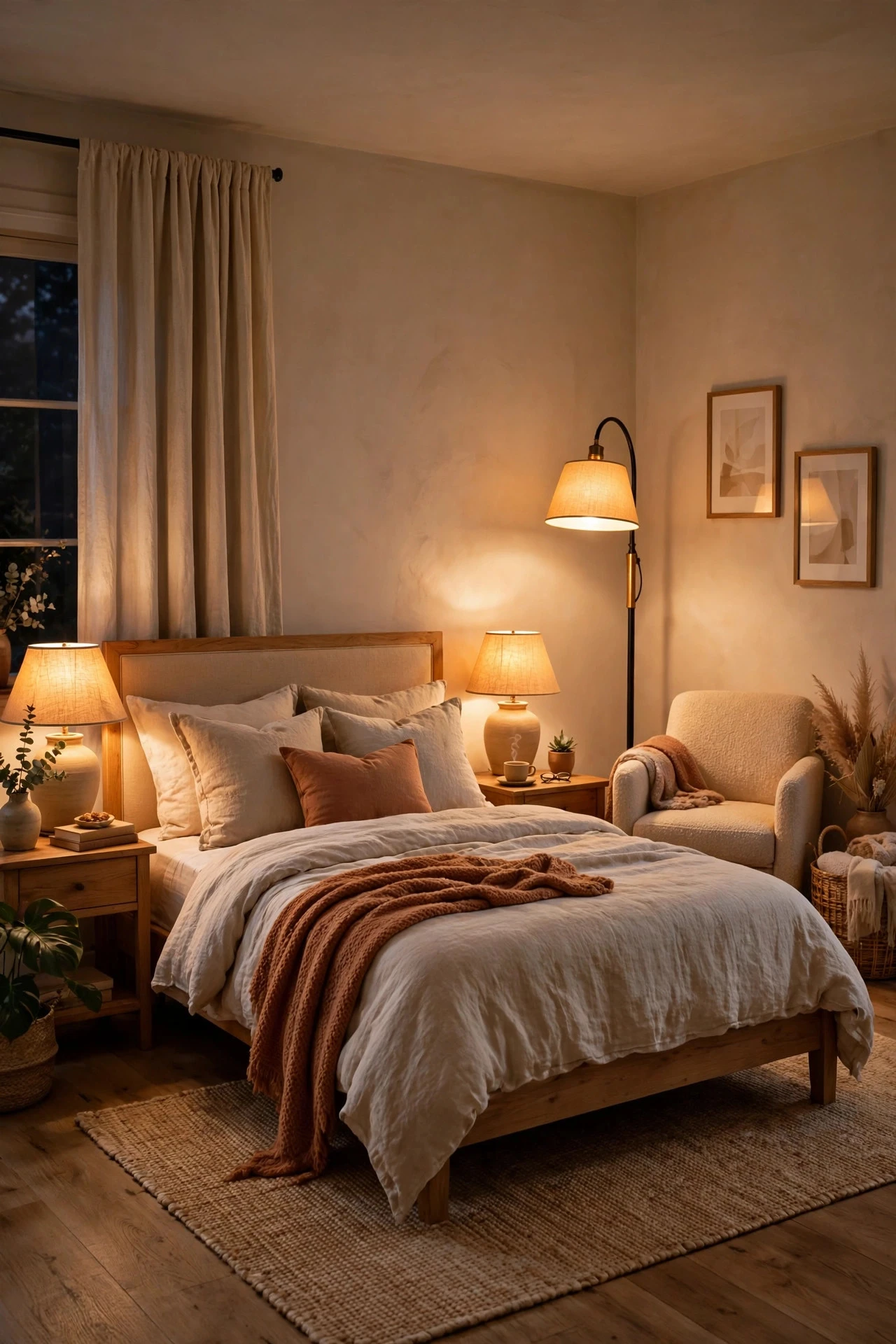
Light a bedroom with no ceiling light by building the ambient light from several softer sources placed around the room: a pair of table lamps, a floor lamp in the corner, and a diffused decorative light on a shelf, which combine to fill the room with gentle, even illumination that feels far more inviting than a single ceiling fixture. Some of the cosiest bedrooms skip the overhead entirely.
Start with two matching table lamps on the dresser and nightstand, add a floor lamp in the darkest corner, and finish with a small accent light — a mushroom lamp, a salt lamp or an LED strip behind the headboard. A plug-in wall sconce on each side of the bed adds task light without any wiring. A no-ceiling-light scheme costs £80–£150 in lamps, and it needs no electrician. The key is keeping every light warm and not too bright — three soft sources beat one harsh one, every time.
11. How Do You Light a Small Bedroom?
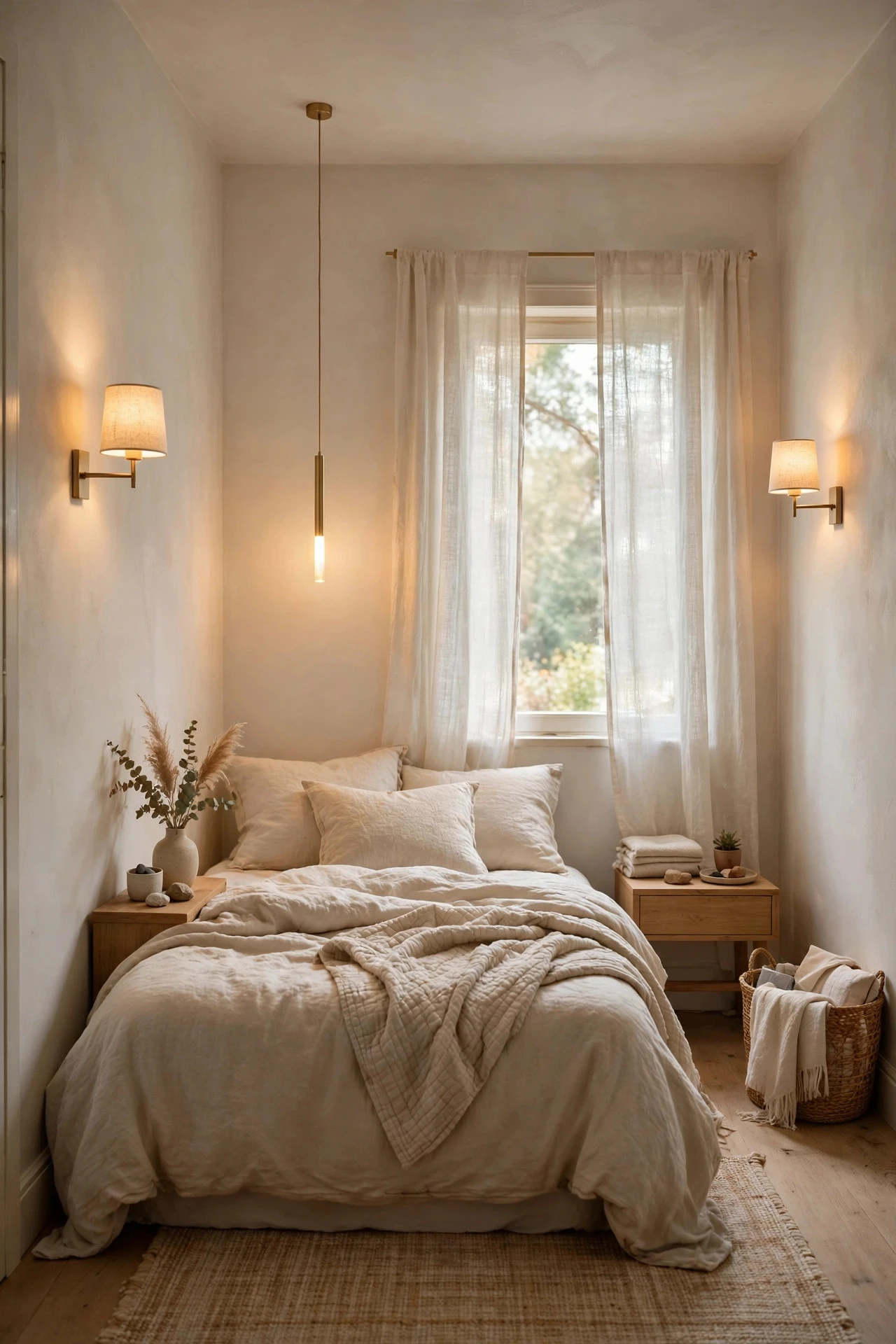
Light a small bedroom by keeping the light low and layered: wall sconces instead of bedside lamps, a slim pendant instead of a chandelier, and an LED strip behind the headboard instead of a floor lamp. Small bedrooms need the same three layers as big ones, but every fixture must earn its floor space.
Use built-in wall lights to free up the nightstands completely, and choose mini ceiling pendants — 15–20 cm across — hung over the areas that need the most light, either side of the bed instead of table lamps. A mirror opposite the window doubles the daylight, and a mirror above the dresser doubles the lamplight. A small-bedroom scheme costs £60–£120. For a small bedroom that feels bigger in every way, these small bedroom ideas that make a tiny room feel bigger show how light, mirrors and layout work together.
12. How Do You Light a Bedroom With a Sloped Ceiling?
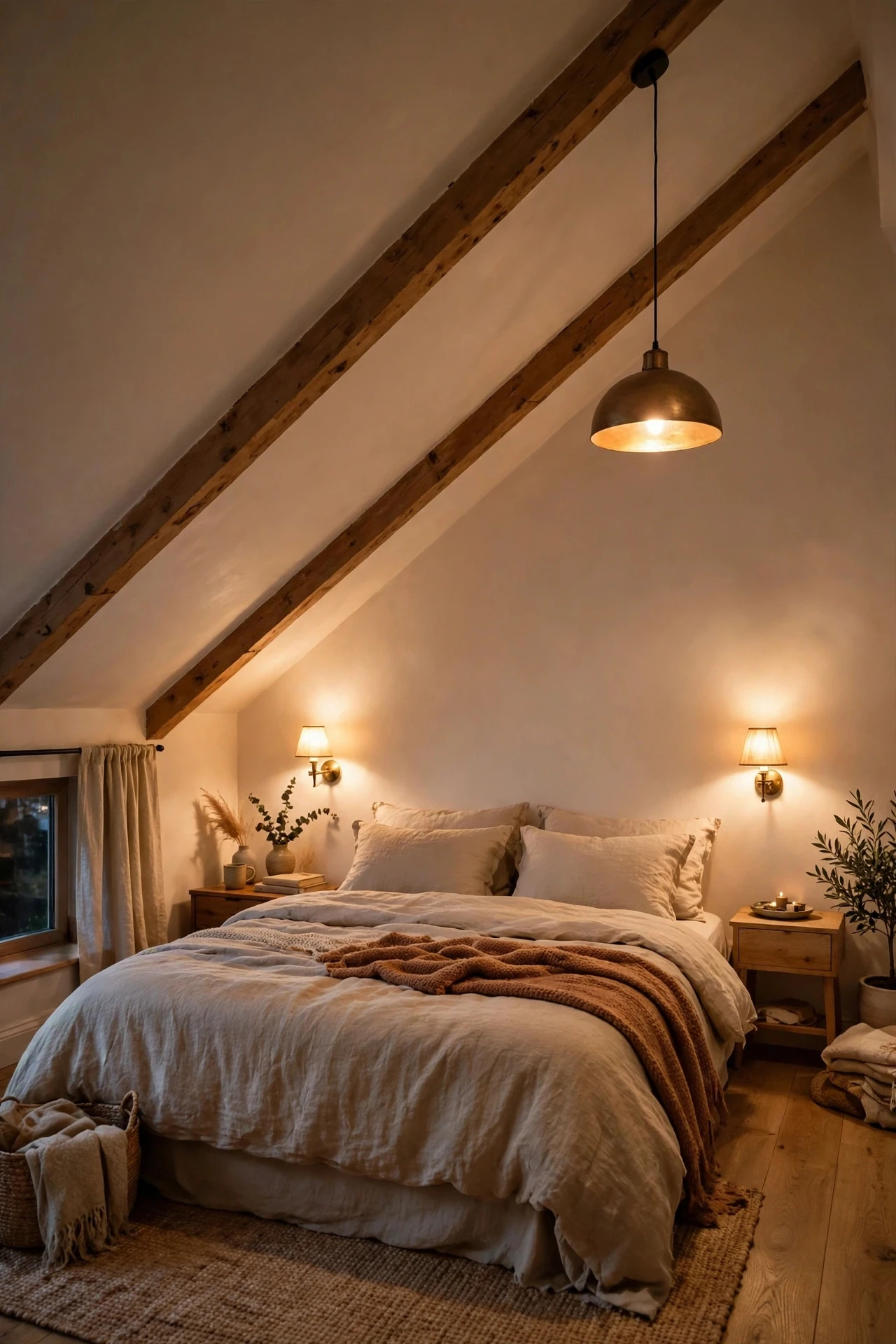
Light a bedroom with a sloped ceiling by working with the slope, not against it: use wall lights and floor lamps for the low side, where a pendant would hang too low, and a pendant or downlights for the high side, where there is room for a ceiling fixture. A sloped ceiling makes a single central light useless — it hangs at the wrong height and lights the wrong half of the room.
Put the bed on the high side if you can, so the pendant hangs over the bed at a proper height, and use a picture light or an LED strip on the low side to wash the wall. Adjustable wall sconces are the best tool for a sloped ceiling, because you can aim them where the light is needed instead of where the ceiling allows. A sloped-ceiling scheme costs £80–£150. Avoid a ceiling fan with a light on a sloped ceiling — the blades sit at an angle and the light swings. If you must have a central light, use a semi-flush fitting on the highest point.
13. What Is the Best Lighting for Getting Dressed?

The best lighting for getting dressed is bright, even and honest about colour: a ceiling light at 3000K for the dressing area, plus a full-length mirror with a light on each side, so you see yourself in the same light the world will see you in. Warm light flatters, but it lies about colour — a navy dress looks black under a 2200K bulb.
Use a 3000K bulb in the dressing area for accurate colour, and add a pair of vertical lights beside the mirror — wall sconces or a light bar — so your face and clothes are lit from both sides, not from above. A mirror with built-in LED lighting costs £80–£150 and does the job in one piece; a pair of sconces beside an existing mirror costs £40–£80. The mistake to avoid is a single overhead light above the mirror — it casts shadows down your face and clothes, and you will leave the house in the wrong colour. Light the person, not the ceiling.
14. How Do You Light a Dressing Table or Vanity?
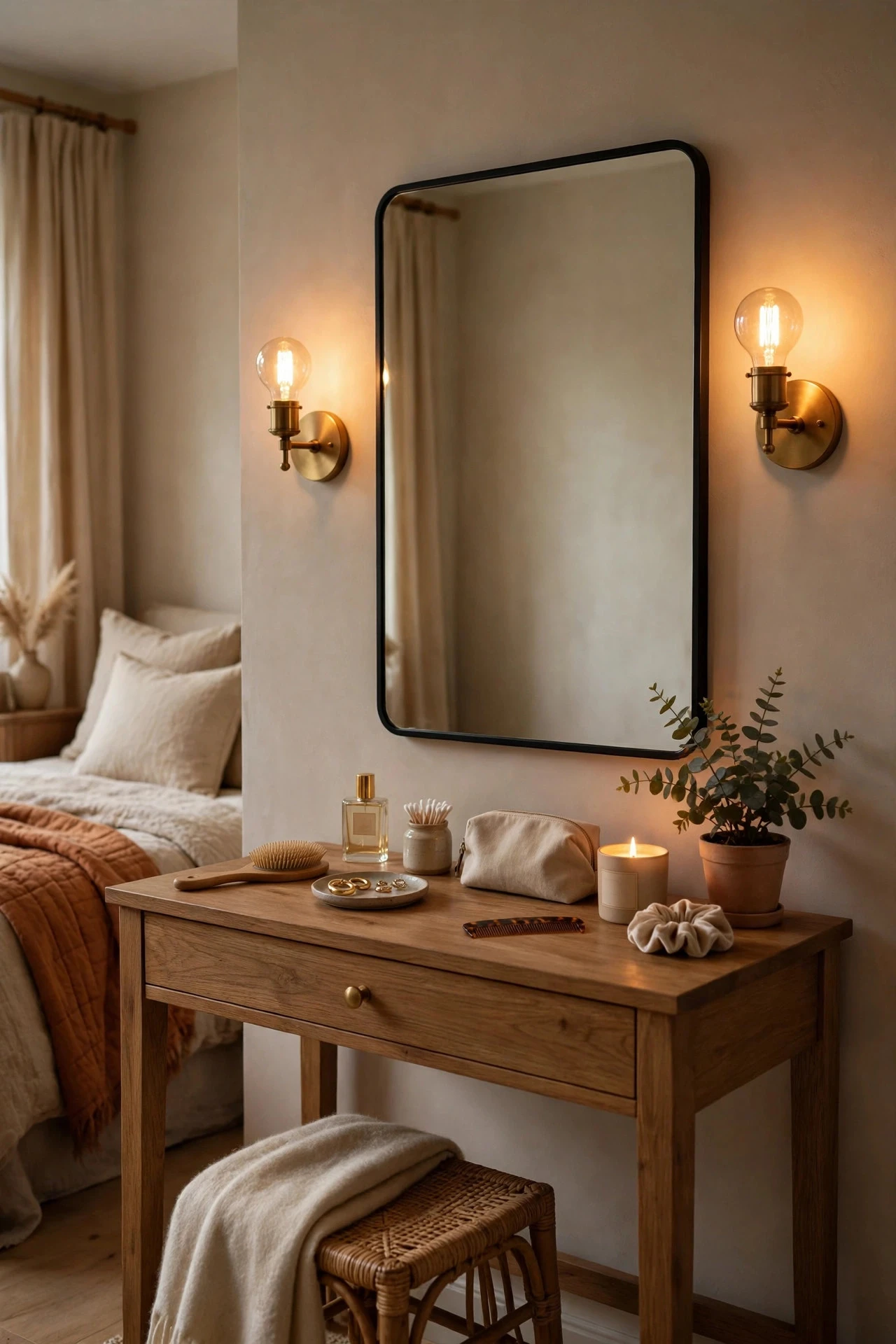
Light a dressing table or vanity with a pair of lights at face height, one on each side of the mirror, so your face is lit evenly without shadows. A single light above the mirror casts shadows down your face; two lights at eye level, about 150 cm from the floor, light your face the way a photographer's lights would.
Use wall sconces, a light bar, or a Hollywood-style mirror with bulbs around the frame — all three work, and the choice is style, not function. Choose 3000K bulbs for accurate colour, and put the vanity lights on a separate switch from the bedroom's main light, so you can do your makeup without waking anyone. A Hollywood mirror costs £60–£120; a pair of sconces costs £40–£80. Add a small table lamp on the dressing table for a soft glow in the evening, and keep the cables tidy — a dressing table with wires everywhere looks unfinished, however good the light is.
15. How Do You Use Fairy Lights in an Adult Bedroom?

Use fairy lights in an adult bedroom by treating them as accent light, not decoration: a single string of warm-white lights draped over the bed, around a shelf or through the headboard, on a timer, so the room gets a soft magical glow without looking like a student flat. For a quick, low-commitment update, you cannot beat fairy lights.
Drape one string — 3 m, warm white, battery or plug-in — along the headboard or around a mirror, and keep it to one wall. Two strings is the maximum for an adult bedroom; more than that, and the room starts to look like a party. A string of fairy lights costs £5–£10, and a timer plug costs £5. The mistake to avoid is cool white or colour-changing lights — they read as a dorm room. Warm white, one string, on a timer, and the bedroom feels like a boutique hotel, not a teenager's room.
16. How Do You Light a Bedroom for Better Sleep?

Light a bedroom for better sleep by going warm and dim in the last hour before bed: switch the main lights off, use bedside lamps at 2200K, and keep the room dark once you are in bed. Cool, blue light in the evening makes it harder to wind down, because it tells your brain it is still daytime — warm light tells it the day is ending.
Use dim-to-warm bulbs that slide to 1800K as they dim, put the bedside lamps on a timer so they switch off automatically, and fit blackout curtains or a blackout blind so street light does not undo the work. A salt lamp or a small amber night light gives a soft glow for getting up at night without waking you fully. A sleep-friendly lighting upgrade costs £20–£50 in bulbs and a timer. Avoid screens in the last hour — a phone screen at 6500K undoes an hour of warm lamplight in minutes. The bedroom should be the darkest, warmest room in the house at night.
17. How Do You Light a Children's Bedroom Safely?

Light a children's bedroom safely by keeping the lights out of reach and the cables out of sight: a ceiling light on a dimmer for the main light, a wall light above the bed for reading, and a small plug-in night light for the dark hours. Always use a qualified electrician for any lighting installation, and fit fixtures safely to current wiring regulations.
Choose shatterproof shades, keep table lamps off low tables a toddler can pull over, and use LED bulbs — they run cool, so a curious hand on a bulb does not burn. A star projector or a soft night light helps a child who is afraid of the dark, and a dimmer lets you check on them without switching the main light on. A children's bedroom scheme costs £50–£100. Avoid fairy lights in a cot or a toddler's bed — the wires are a strangulation risk — and keep all cables behind furniture. The safest bedroom is the one where a child cannot reach a bulb, a wire or a hot shade.
18. How Do You Add a Statement Chandelier?
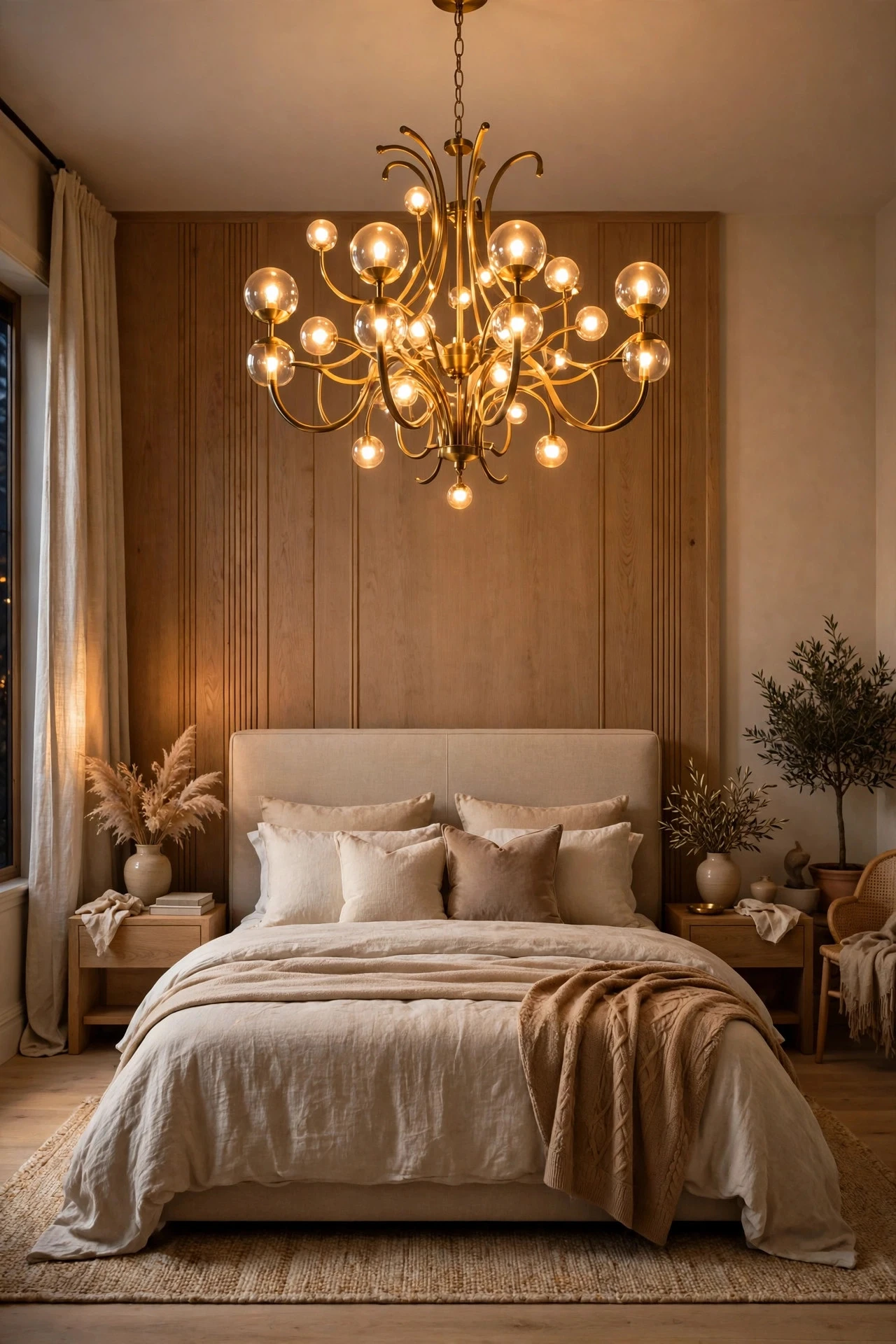
Add a statement chandelier by choosing one that fits the room: a chandelier 45–60 cm across for a standard bedroom, hung so its bottom sits 2.1 m above the floor, centred over the bed or the middle of the room. A central pendant in natural, rustic tones offers a warmer glow than glass droppers and suits vintage schemes beautifully.
A chandelier is the one fixture in a bedroom that can be purely decorative — it does not need to light the whole room, because the bedside lamps do that. Choose a dimmable chandelier with warm bulbs, and put it on its own dimmer so it can go from a bright centrepiece to a soft glow. A good bedroom chandelier costs £80–£200; a small crystal or rattan one costs £60–£120. The mistake to avoid is a chandelier that hangs too low — it dominates the room and everyone bumps it. If the ceiling is under 2.4 m, choose a flush fitting instead.
19. How Do You Light Artwork and Feature Walls?

Light artwork and feature walls with a picture light or a spotlight angled down the wall, so the art gets its own pool of light and the room gains depth. Accent light picks out a feature — a piece of art, a textured wall, a headboard — and it is the layer most people forget, and the one that makes the biggest visual difference.
Use a picture light 15 cm wider than the frame, mounted 15–20 cm above it, with a warm bulb at 2700K. For a textured wall, use a spotlight angled down from the ceiling, 30 cm out from the wall, so the light grazes the texture and the shadows show it off. A picture light costs £30–£60; a single spotlight costs £15–£25. The mistake to avoid is lighting every picture — pick one feature per wall, and let the rest of the room stay soft. For a feature wall that deserves its own light, these 22 living room lighting ideas for a warm, layered glow show the same accent techniques in the living room.
20. How Do You Use Smart Lighting in a Bedroom?

Use smart lighting in a bedroom by starting with the bulbs, not the system: two smart bulbs in the bedside lamps and one in the ceiling light, controlled by a phone app or a voice assistant, scheduled to dim at 10 pm and brighten at 7 am. Larger bedrooms benefit most from smart lighting that can be scheduled, dimmed or activated to suit the time of day.
Choose bulbs that dim to warm — 2700K down to 1800K — and set a "wind down" scene that dims the lights to 20% warm glow at bedtime, and a "wake up" scene that brightens them slowly in the morning. A smart bulb costs £10–£20 each; a starter kit with a hub costs £40–£70. Keep a physical switch as well — a bedroom that needs a phone to turn the light on is a bedroom that fails at 3 am. The mistake to avoid is automating everything at once; start with the bedside lamps, live with them for a month, and add the ceiling light only if you miss it.
21. How Do You Light a Bedroom Without Windows?
Light a bedroom without windows by faking daylight: a bright ceiling light at 3000K for the morning, warm bedside lamps at 2700K for the evening, and a daylight lamp or a lightbox on the dresser for the dark winter mornings. A windowless bedroom needs more light, not less, because there is no daylight to top it up.
Use a dimmer on every light, so the room can go from bright morning to soft evening, and add a mirror opposite the door to bounce the light around. A lightbox — a lamp that mimics daylight at 10,000 lux — costs £40–£80 and helps with dark mornings, used for 20 minutes after waking. Keep the walls pale and the bedding light, so the room reflects every bit of light it gets. A windowless bedroom scheme costs £100–£200. Avoid a single harsh ceiling bulb — it makes a windowless room feel like a cell. Layer the light, warm it up at night, and the room feels like a cocoon, not a cupboard.
22. How Much Does Good Bedroom Lighting Cost?
Good bedroom lighting costs £80 to £200 for a layered scheme: a dimmable ceiling fitting, a pair of bedside lamps or sconces, and one accent light like an LED strip or a picture light. A bedside-only upgrade — two lamps and warm bulbs — costs £25 to £60, and it changes the room more than any other single purchase.
Spend on the dimmer first, the bedside lamps second, and the accent light last. Smart bulbs add £10–£20 each, and an electrician costs £40–£80 per fitting if you need hardwired sconces or downlights. Fittings last for years, so the per-year cost is small — a £150 scheme over ten years costs £15 a year. Set a total budget before you shop, buy the bulbs in the same colour temperature, and keep the receipts: a bulb that flickers in the first month is a faulty bulb, not a bad scheme.
Practical Tips
Start with the bulbs, not the fittings: swap every cool bulb in the bedroom for a warm 2700K one, and the room changes in an afternoon for under £20. Then add the dimmer, then the bedside lamps, and only then the accent light — each layer builds on the last, and you can stop at any point and still have a better bedroom.
Keep a spare bulb for every fitting, and label the box with the colour temperature so you buy the same one next time. Clean the shades and the bulbs twice a year — dust on a bulb cuts the light by a fifth. For safety, always use a qualified electrician for hardwired work, and never overload a dimmer with more wattage than it is rated for. Set a total budget before you shop — £80–£200 covers a layered scheme, £25–£60 covers a bedside upgrade — and stick to it.
Final Thoughts
Bedroom lighting works when it is layered, warm and dimmable: an ambient light for the room, a task light for reading and dressing, and an accent light for mood, all in warm white, all on dimmers, all working together from bright morning to soft evening. Whether your bedroom is big or small, windowed or windowless, the rules stay the same — warm light, three layers, and a dimmer on everything.
You may also like: our 22 Christmas bedding ideas for a cosy, festive bedroom will help you layer the bed to match the light, so the whole bedroom feels calm and restful at every hour.
Frequently Asked Questions
What is the best light colour for a bedroom?
Warm white at 2700K is the best all-round light colour for a bedroom. For bedside lamps and late evenings, go warmer, to an extra warm 2200K, which gives a soft golden glow close to candlelight. Keep cool white at 4000K and above out of the bedroom at night, and put the main lights on a dimmer, ideally with dim-to-warm bulbs that turn more golden as they dim.
How many light sources should a bedroom have?
A bedroom needs at least three light sources: one ambient light for the whole room, one task light for reading or dressing, and one accent light for mood. Most bedrooms work best with four or five: a ceiling light, two bedside lamps or sconces, and one accent like an LED strip or a picture light. One ceiling bulb alone is never enough.
Should bedroom lights be dimmable?
Yes — put the main lights and the bedside lights on dimmers, so the same fixtures give you bright morning light and soft evening glow. A dimmer switch costs £10 to £20, plus fitting, and it is the single most useful control in a bedroom. Check the bulbs say dimmable, and use dim-to-warm bulbs that turn more golden as they dim.
How high should bedside lamps be?
A bedside lamp should stand about 60 to 70 cm tall in total, with the bottom of the shade roughly at eye level when you are sitting up in bed. That puts the light on the page rather than in your eyes. Wall sconces should sit slightly to the side of your head and a little above shoulder height when you are sitting up.
Are LED strips good for bedrooms?
Yes, if you hide the strip and keep it warm white at 2700K. Run the strip along the back of the headboard, under a floating shelf or behind a dresser, so you see only the glow, never the dots of the LEDs. Put the strip on a dimmer, and never use RGB colour-changing strips in a bedroom — they read as a gaming room, not a restful one.
What lighting helps you sleep better?
Warm, dim light in the last hour before bed helps you sleep better: bedside lamps at 2200K, dimmed low, with the main lights off. Cool blue light tells your brain it is still daytime, while warm light tells it the day is ending. Keep the room dark once you are in bed, use blackout curtains, and avoid screens in the last hour before sleep.