How to Style a Burgundy and Green Bedroom That Looks Rich All Year
Burgundy and green is one of the most confident colour pairings in bedroom design, and also one of the easiest to get wrong. Used well, wine-red and leaf-green create a room that feels layered, calm and expensive — the kind of jewel-tone bedroom that looks intentional in any month. Used badly, the same two colours fight each other and the room feels heavy, dark and muddled.
This guide gives you the exact decisions that make the pairing work: named paint colours from Farrow & Ball and Benjamin Moore, the 60-30-10 ratio that keeps burgundy and green balanced, real measurements for curtains, rugs and artwork, and realistic budgets for every change. Every idea below answers a specific question first, then explains the detail — so you can act on one idea today or plan the whole room.
Looking for more inspiration? Our Nest Decorz homepage gathers the latest home decor ideas, seasonal decorating guides and room-by-room styling tips in one place — start there and explore.
Quick answers
– Use the 60-30-10 rule: 60% a soft neutral or pale green, 30% your main green, 10% burgundy as the accent — never split burgundy and green 50/50. – Pick one burgundy hero and one green hero: a burgundy velvet headboard with sage walls, or a burgundy feature wall with forest-green bedding — not both at full strength. – Warm light is non-negotiable: 2700K bulbs keep burgundy wine-like and green botanical; cool white light turns both colours flat and grey. – Brass beats silver here: matte brass, antique gold and warm wood stop the jewel tones from feeling cold or theatrical. – Small rooms can do this: keep burgundy to textiles and one wall, use pale sage on the other walls, and let mirrors and light bedding do the lifting.
1. What Ratio of Burgundy to Green Keeps the Room Balanced?
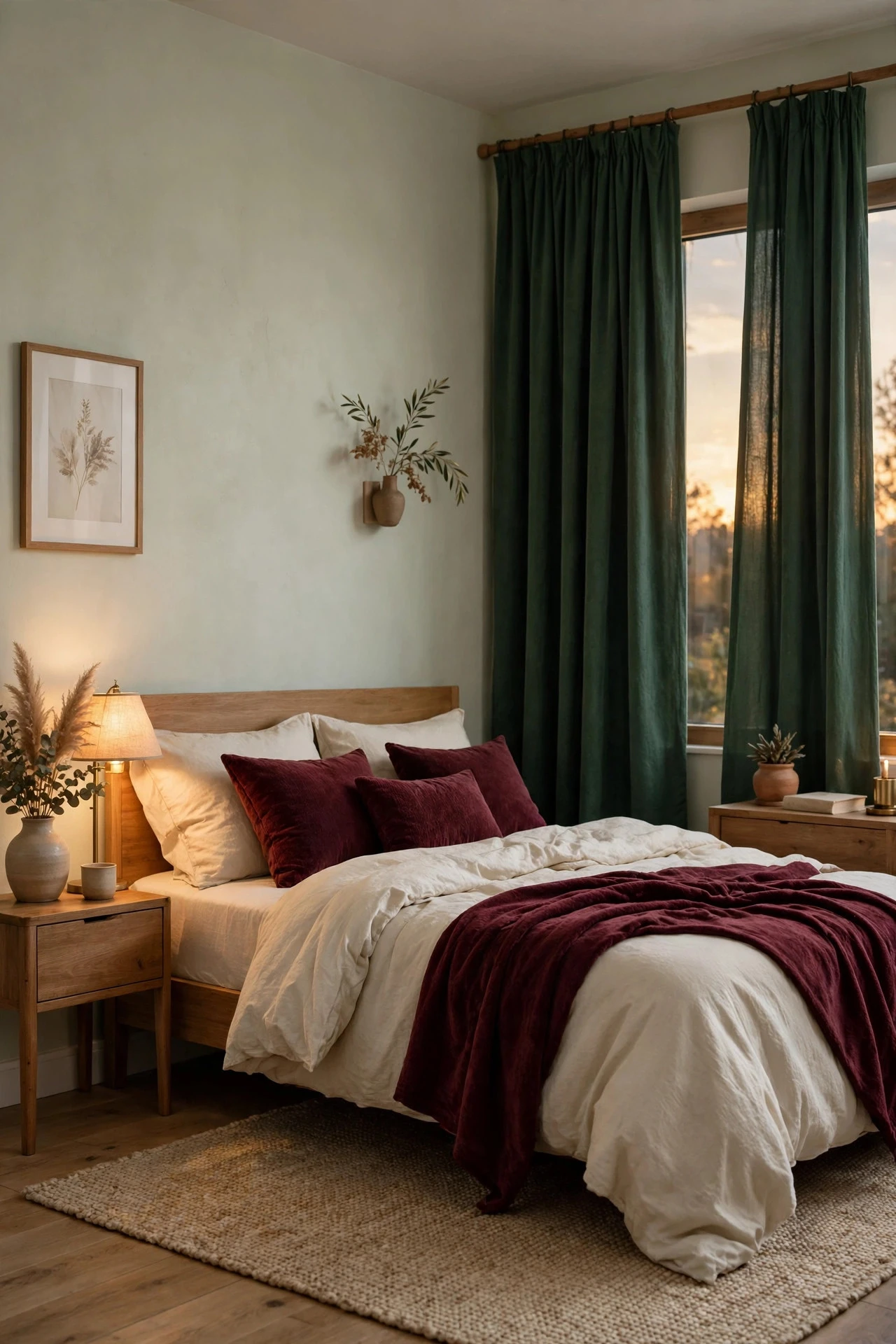
Use 60% neutral or pale green, 30% mid-tone green, and 10% burgundy. That means pale walls, green bedding or curtains as the secondary layer, and burgundy confined to the headboard, cushions, a throw and one piece of art. The room reads green-first and burgundy-rich, never split down the middle.
The 50/50 split is the single most common mistake with this pairing. Two saturated colours at equal strength compete for attention, and the eye has nowhere to rest. The 60-30-10 ratio solves it by giving one colour dominance and the other a supporting role. Try it in practice: sage walls (60%), forest-green curtains and a green wool throw (30%), then burgundy velvet cushions, and a burgundy lumbar pillow (10%). If the room still feels burgundy-heavy, remove one burgundy item rather than adding green — subtraction fixes balance faster than addition.
2. Which Burgundy Wall Colour Works Best as a Feature Wall?
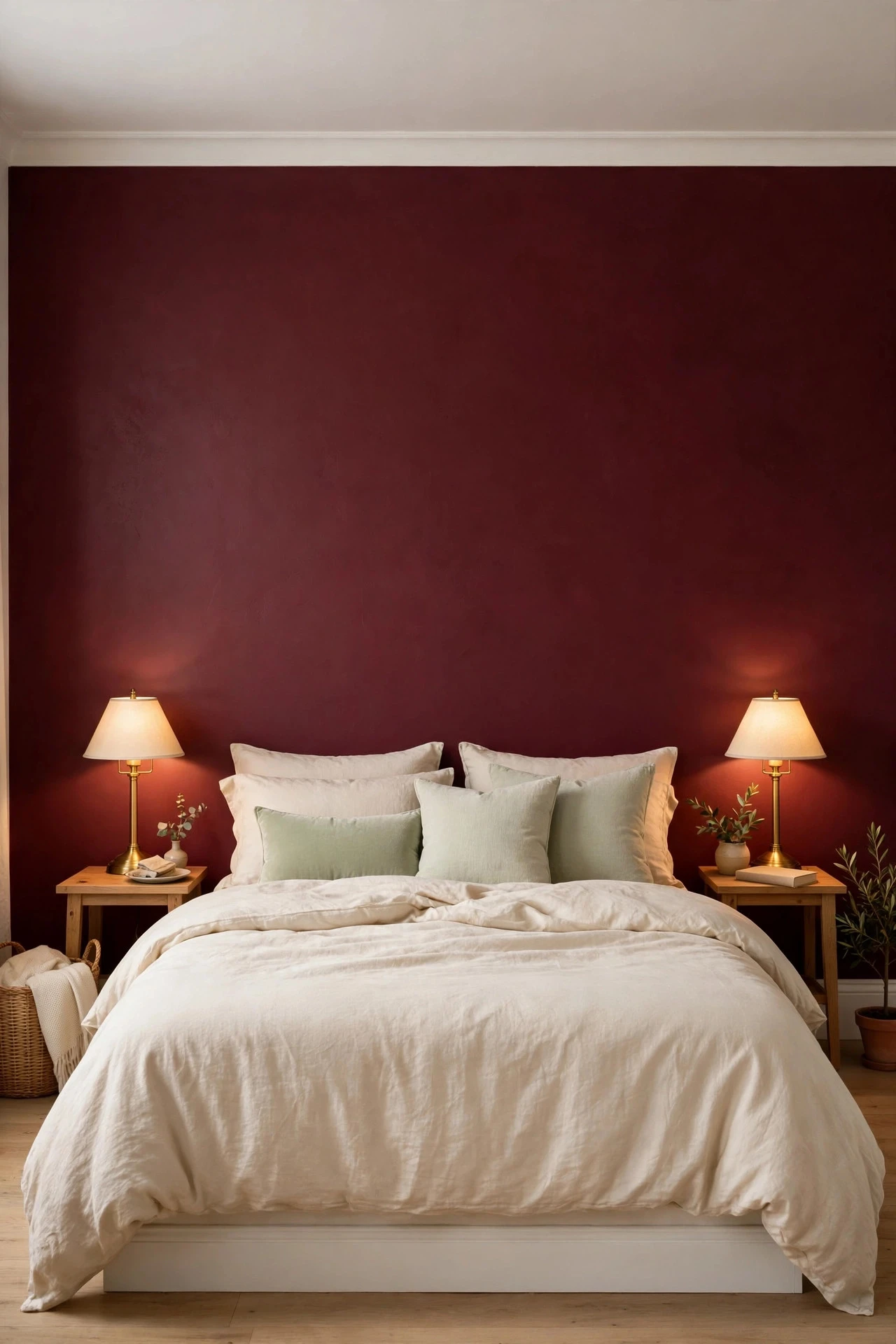
Farrow & Ball Preference Red No. 297 or Benjamin Moore New London Burgundy HC-61, in a matte or eggshell finish, on the wall behind the bed only. Both read as deep wine in daylight and warm plum under lamplight, without turning purple or brown. Paint one wall; leave the other three pale.
A burgundy feature wall works because it anchors the bed and gives the room a focal point, but the shade matters enormously. Cheap burgundy paints skew pink in daylight and muddy brown at night. Preference Red has a blue undertone that keeps it wine-like, while New London Burgundy leans slightly warmer and suits rooms with honey-toned wood floors. Test with a 60 cm square sample on the bed wall and live with it for two days, checking it at 8 a.m., midday and 9 p.m. under your actual bulbs. Budget around £45–£60 for a 2.5-litre tin, which covers one feature wall twice.
3. Sage or Forest Green — Which Green Pairs Better With Burgundy?
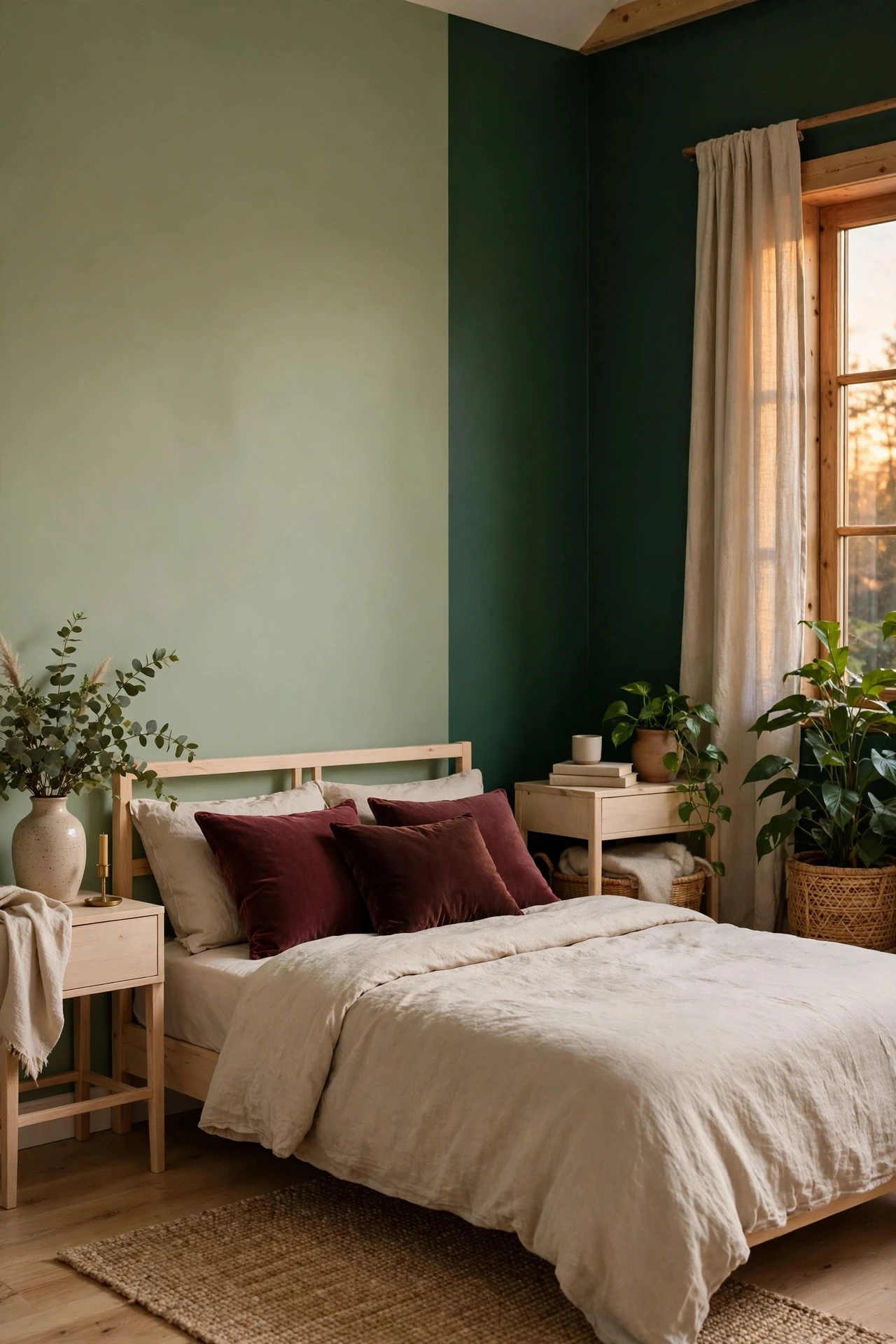
Sage green suits small and north-facing bedrooms; forest green suits large, bright rooms. Sage (try Farrow & Ball Vert De Terre No. 234) softens burgundy and keeps the room airy. Forest green (try Benjamin Moore Hunter Green 2041-10) deepens it and needs strong light and pale bedding to avoid heaviness.
The choice is really about light, not taste. Sage reflects more light, so a 10-square-metre bedroom with one window stays bright with sage walls and burgundy textiles. Forest green absorbs light, so it needs a south-facing window, a large mirror, or white bedding to lift it. A useful middle path is sage walls with forest-green velvet curtains — you get both greens, but at different depths, which adds the layering that makes jewel-tone rooms feel designed rather than matched.
4. How Do I Choose a Burgundy Velvet Headboard?
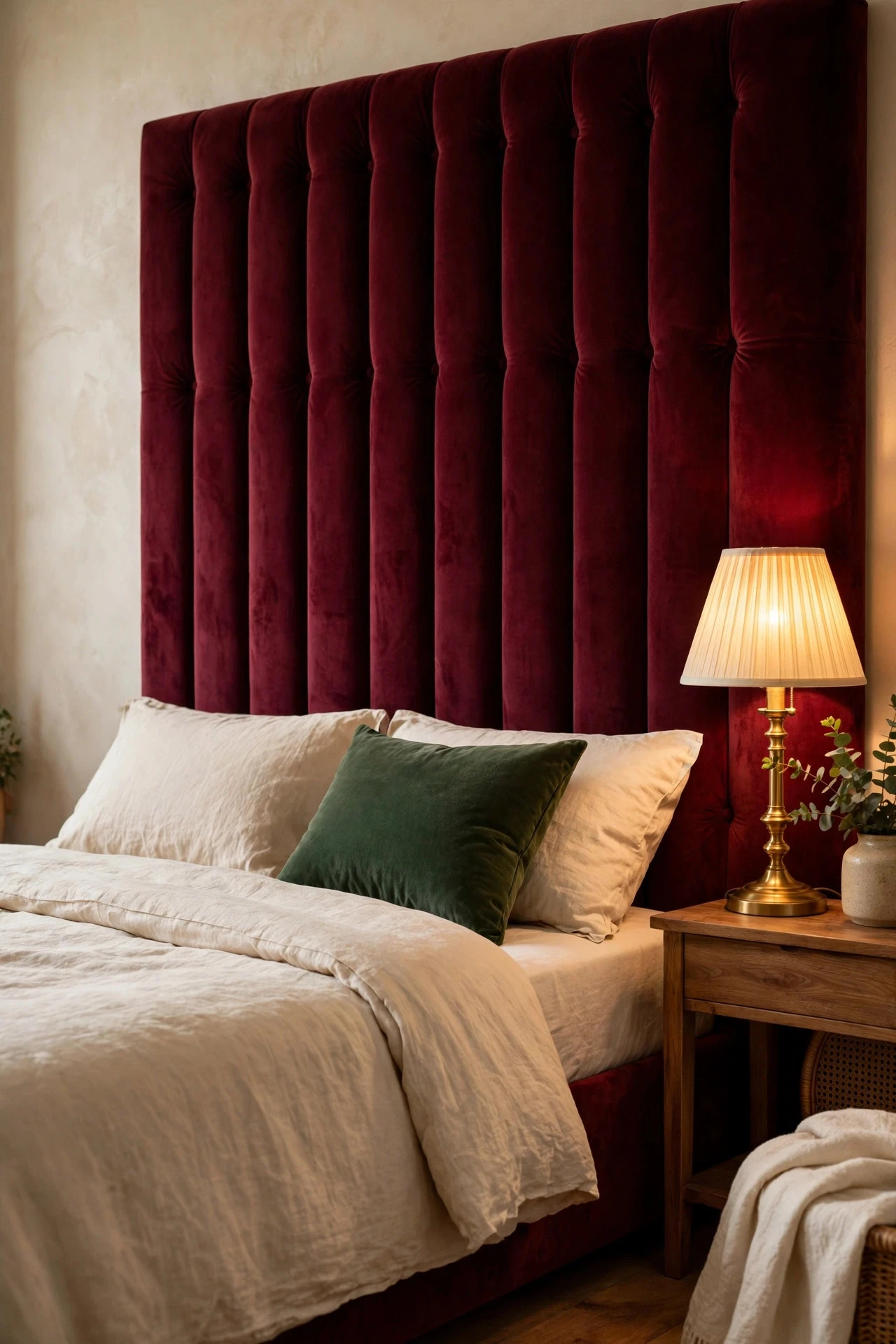
Choose a tall, channel-tufted or plain panel headboard in burgundy cotton velvet, 120–140 cm high for a double bed and 150 cm for a king, with the fabric running vertically so the nap catches light evenly. Avoid button tufting in very dark burgundy, and check the velvet is rub-tested to at least 40,000 Martindale cycles for durability.
A burgundy velvet headboard is the highest-impact single purchase in this scheme, and it earns its price because it does three jobs: colour anchor, texture contrast against smooth painted walls, and a soft backrest for reading. Expect £250–£600 for a quality upholstered headboard, or £120–£200 for a slip-on headboard cover in burgundy velvet if you want to test the colour first. Mount it so the top sits 15–20 cm above your pillows when propped for reading. Keep the wall behind it pale sage or warm white; a burgundy headboard on a burgundy wall disappears.
5. How Should I Layer Bedding in Burgundy and Green?
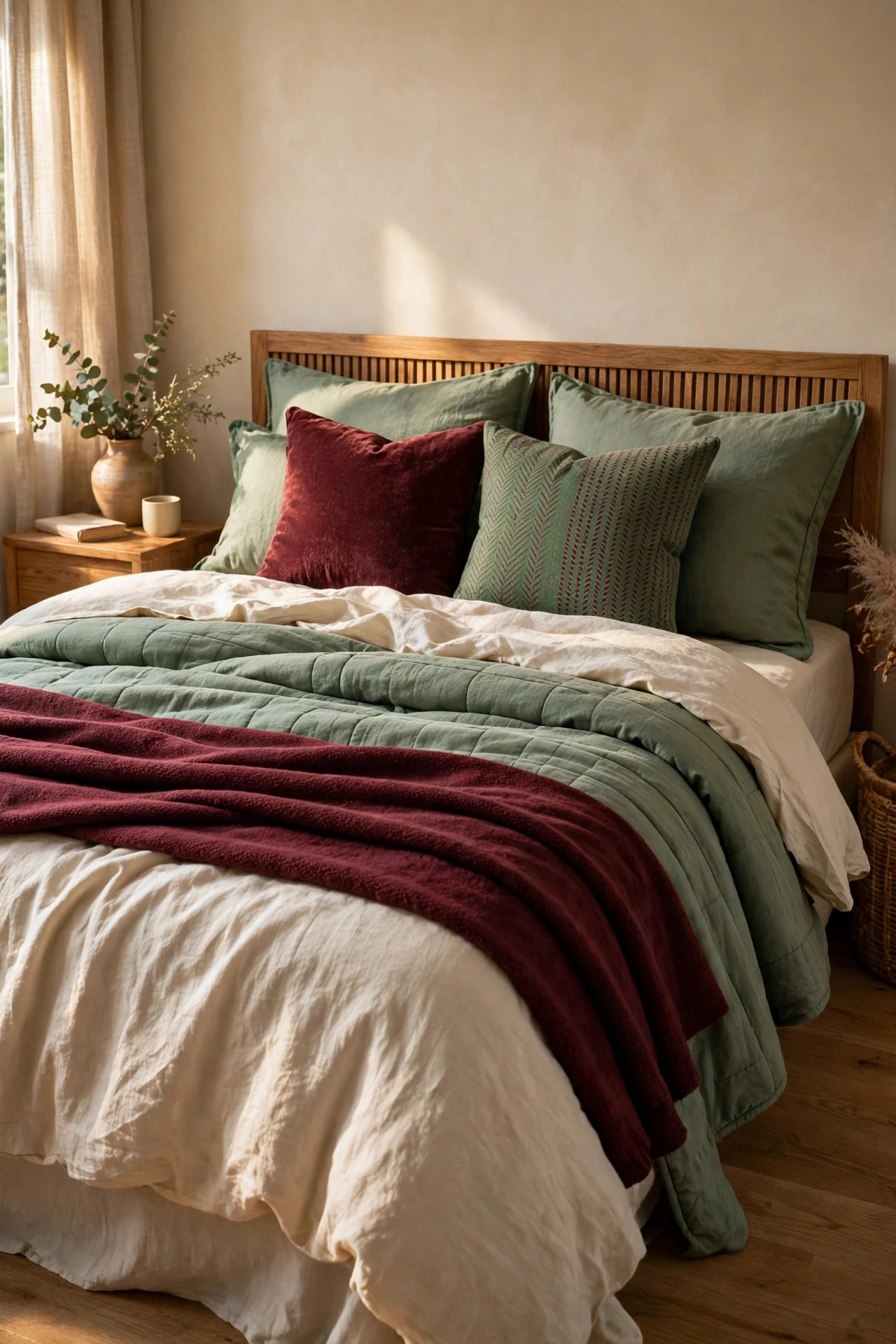
Layer cream linen sheets, a sage or forest-green duvet, a burgundy throw folded across the foot, and two burgundy cushions against two green ones. The order matters: pale closest to the skin, green as the main cover, burgundy as the top accent. Wash velvet-look throws separately and never tumble-dry them.
Layered bedding is where this palette becomes touchable rather than just visual, and the layer order is what keeps it calm. Start with white or oatmeal linen sheets — linen's slub texture stops the jewel tones from looking slick. Add a green duvet in washed cotton or linen; sage for a soft room, forest for drama. Fold a burgundy throw across the bottom third of the bed, not the middle, so it reads as a deliberate band of colour. Finish with cushions in a 2-2-1 arrangement: two green, two burgundy, one small cream lumbar in front.
6. Where Do Botanical Prints Fit in a Burgundy and Green Bedroom?
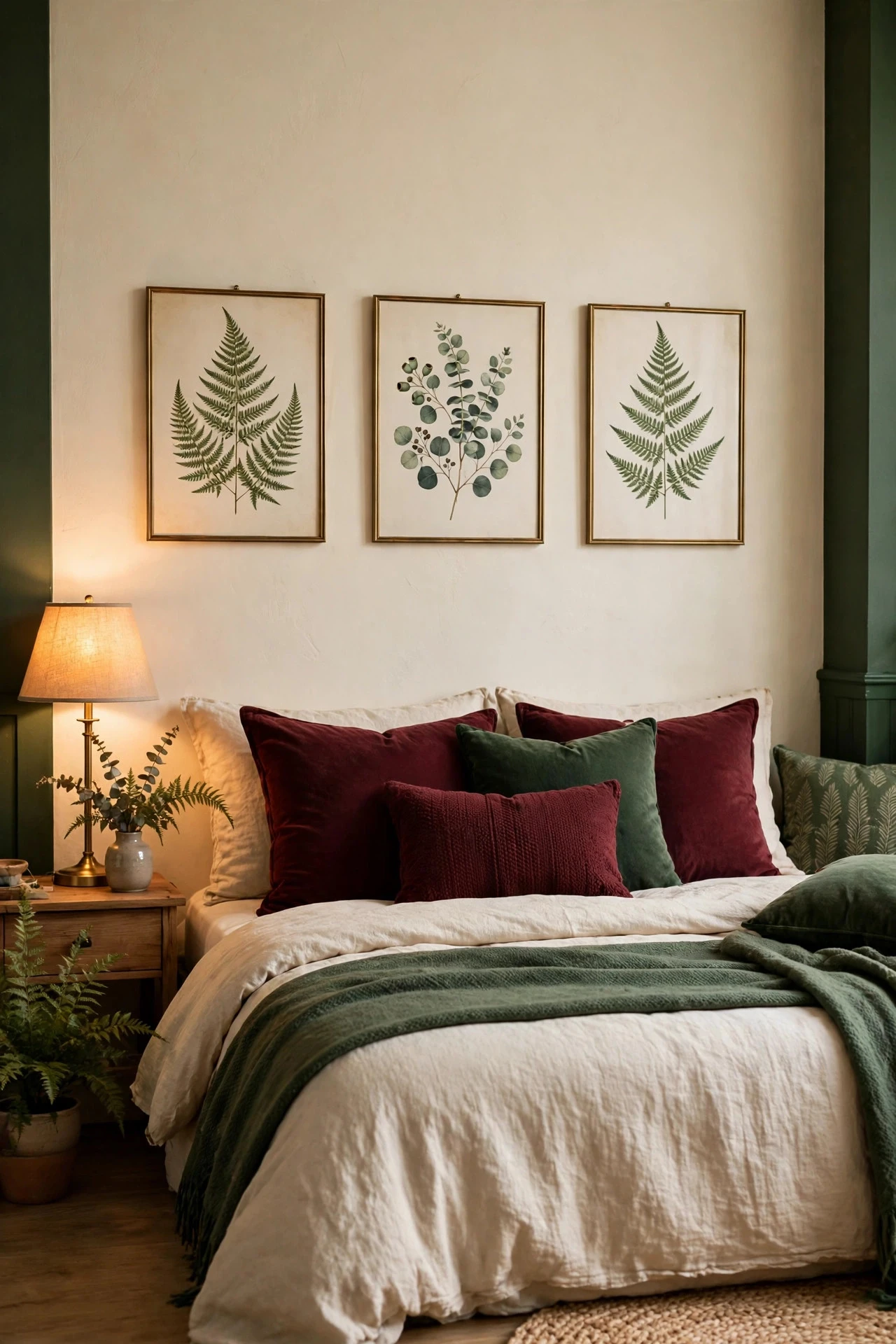
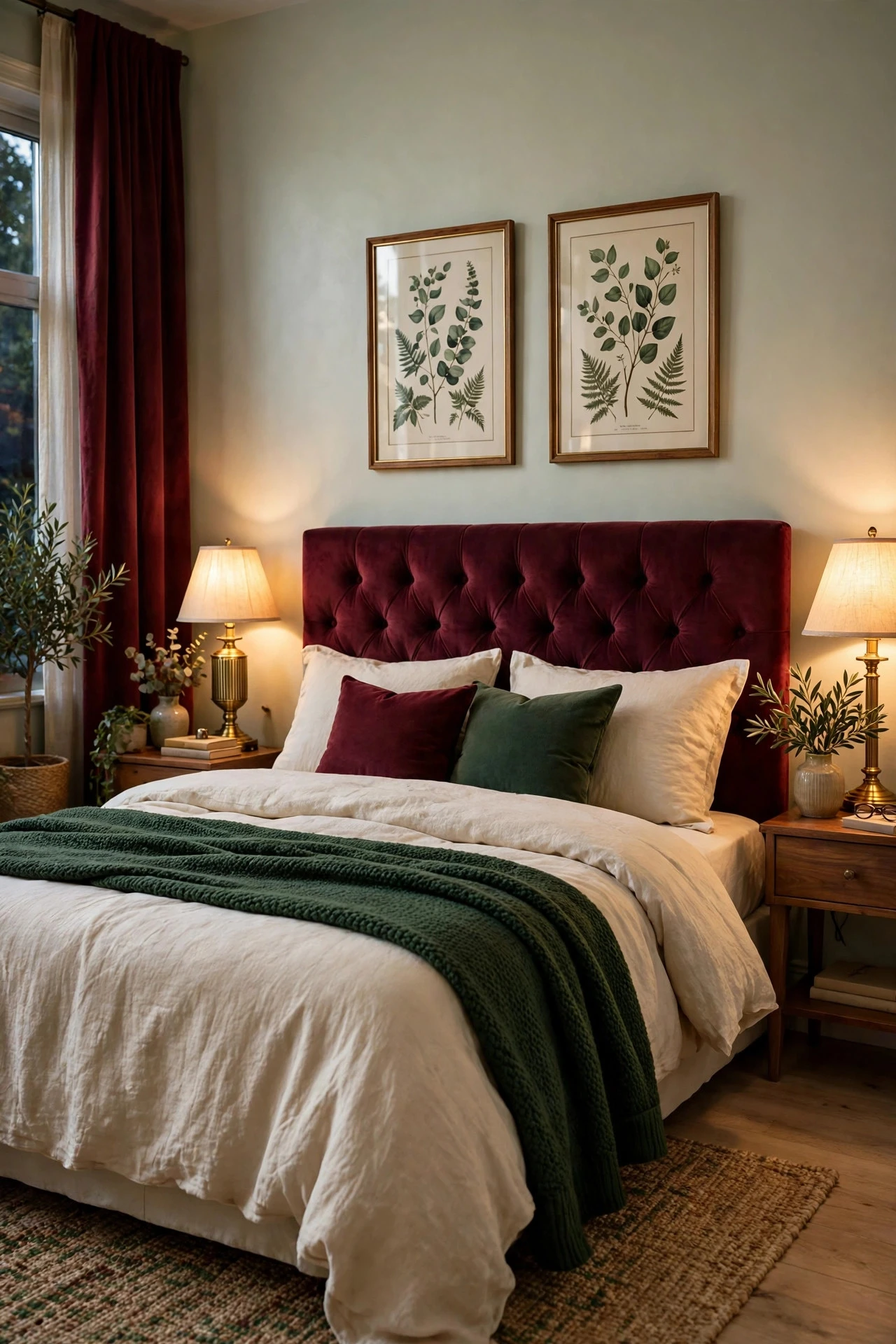
Use botanical prints as the bridge between the two colours: framed fern, eucalyptus or fig-leaf prints in deep green on cream paper, hung above the bed or on the wall opposite it, with thin brass or dark wood frames. Two or three prints in a row work better than one large canvas.
Botanical prints solve the hardest problem in this scheme — making burgundy and green feel like they belong together rather than colliding. Leaves are naturally green, and when printed on warm cream paper with burgundy-toned stems or a burgundy mount, the print literally contains both colours in one object. Hang a set of three A3 prints (42 × 30 cm each) with 5 cm gaps above a double bed, centred at eye level, about 150 cm from the floor to the centre of the middle print. Budget £25–£60 for the set framed, or £10–£20 for prints alone in ready-made frames.
7. Why Brass and Gold Accents Work With Burgundy and Green?
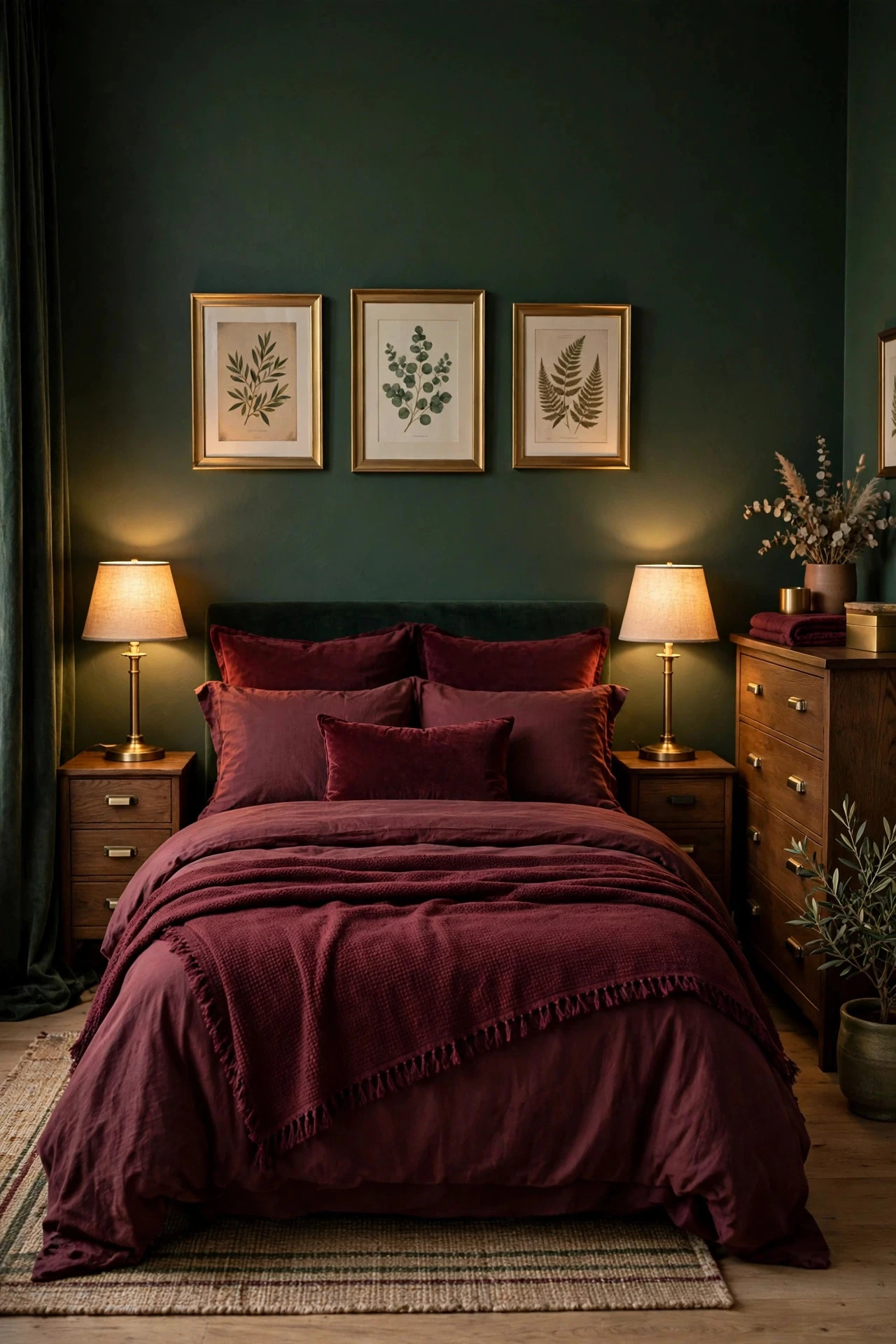
Brass and antique gold warm up both jewel tones and stop them from reading cold or flat. Use matte brass for lamps, drawer pulls, picture frames and a bedside tray, in small doses — three to five brass objects per room is enough. Polished chrome and silver cool the palette down and make burgundy look purple.
Metal choice is a quiet decision with a loud effect. Burgundy and green are both deep, saturated colours, and a cool metal like chrome creates a hard edge that fights them. Warm brass, by contrast, reflects the warm light you should already be using (see idea 11) and picks up the red undertone in burgundy. Practical swaps: brass bedside lamps (£40–£90 each), brass curtain rings, a brass-framed mirror, and antique-brass drawer knobs (£3–£6 each) on a plain chest of drawers. Keep the brass finish consistent — mixing polished brass, brushed brass and rose gold in one room looks accidental.
8. Which Plants Thrive in a Burgundy and Green Bedroom?
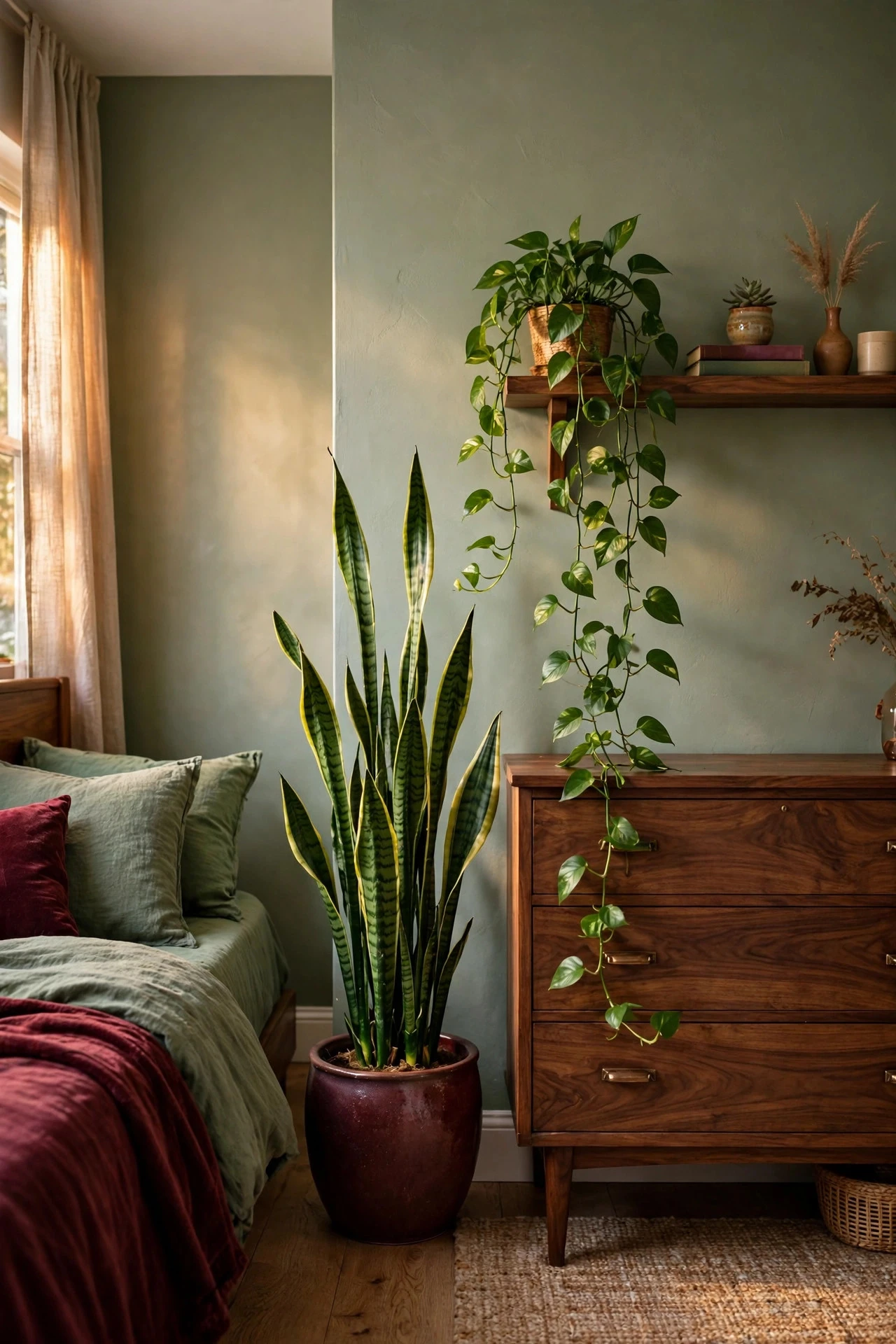
Choose low-light, bedroom-friendly plants that echo the green in the scheme: snake plants, pothos, ZZ plants and ferns. Place one tall snake plant (60–90 cm) in a burgundy ceramic pot beside the dresser, and a trailing pothos on a shelf or nightstand. Water sparingly — most bedroom plants die from overwatering, not neglect.
Plants do double duty here: they are living green that softens the formality of velvet and brass, and they justify the green in the palette as something botanical rather than decorative. Snake plants tolerate low light and irregular watering, needing water only every two to three weeks, and they release oxygen at night, which suits a bedroom. Pothos trails beautifully from a high shelf and needs only a small pot and indirect light. Put the largest plant in a burgundy or deep-green ceramic pot (£15–£30) so the pot itself carries the colour story.
9. What Rug Works Under a Burgundy and Green Bed?
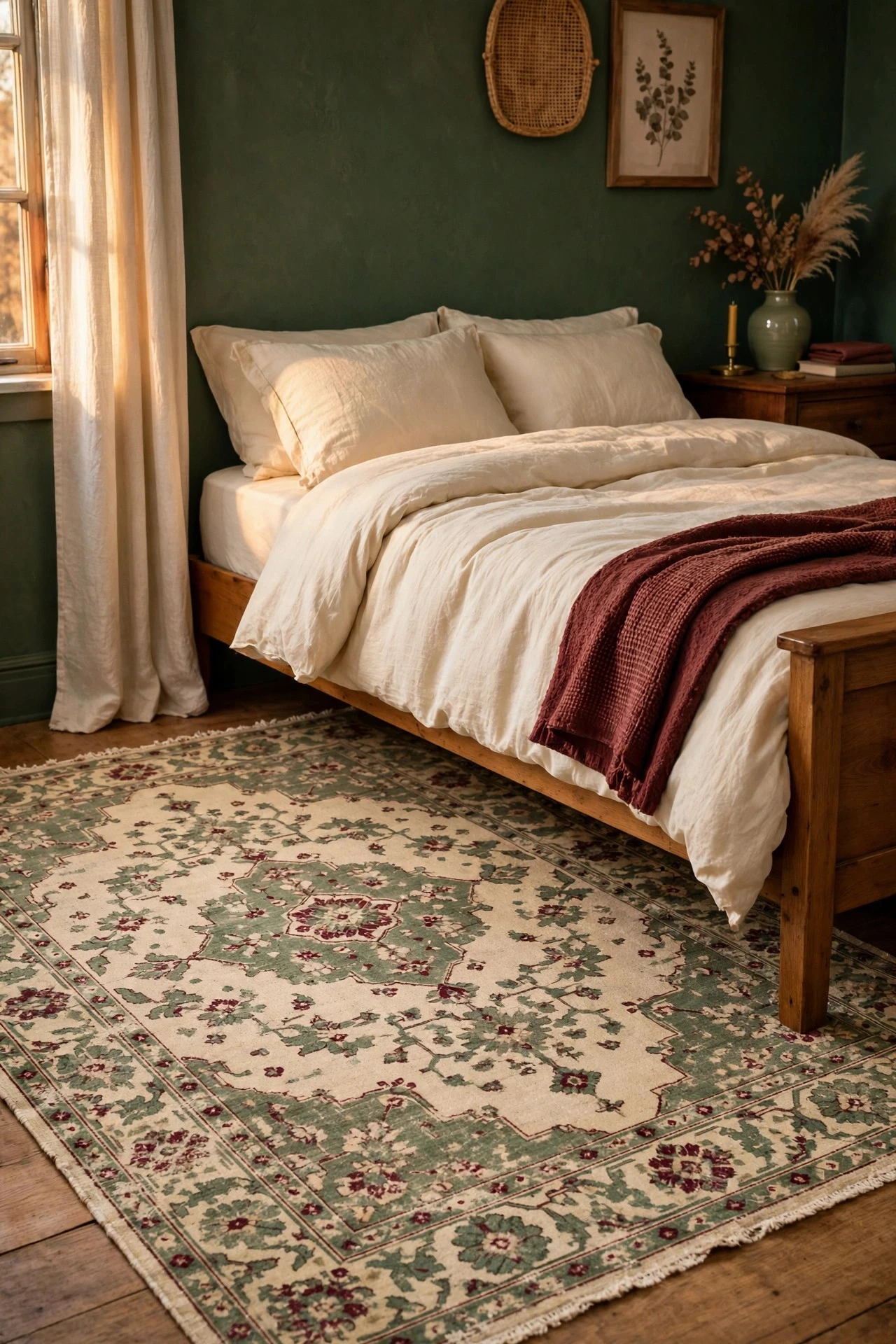
Choose a low-pile wool rug in a muted pattern — cream with sage and burgundy motifs, or a faded vintage-style rug — sized 160 × 230 cm for a double bed and 200 × 290 cm for a king, placed so it extends 45–60 cm beyond each side of the bed. Avoid solid burgundy or solid green rugs.
The rug is the largest textile in the room after the bedding, so a solid jewel-tone rug overwhelms everything else. A patterned rug with both colours in small doses ties the scheme together at floor level without dominating it. Vintage-style rugs with a faded, washed finish are ideal because their muted tones soften the contrast between burgundy and green. Place the rug so the front two-thirds sits under the bed and the remainder extends toward the foot, leaving 45–60 cm of rug visible on each side for bare feet in the morning.
10. How Do I Pick Curtains for Burgundy and Green Walls?
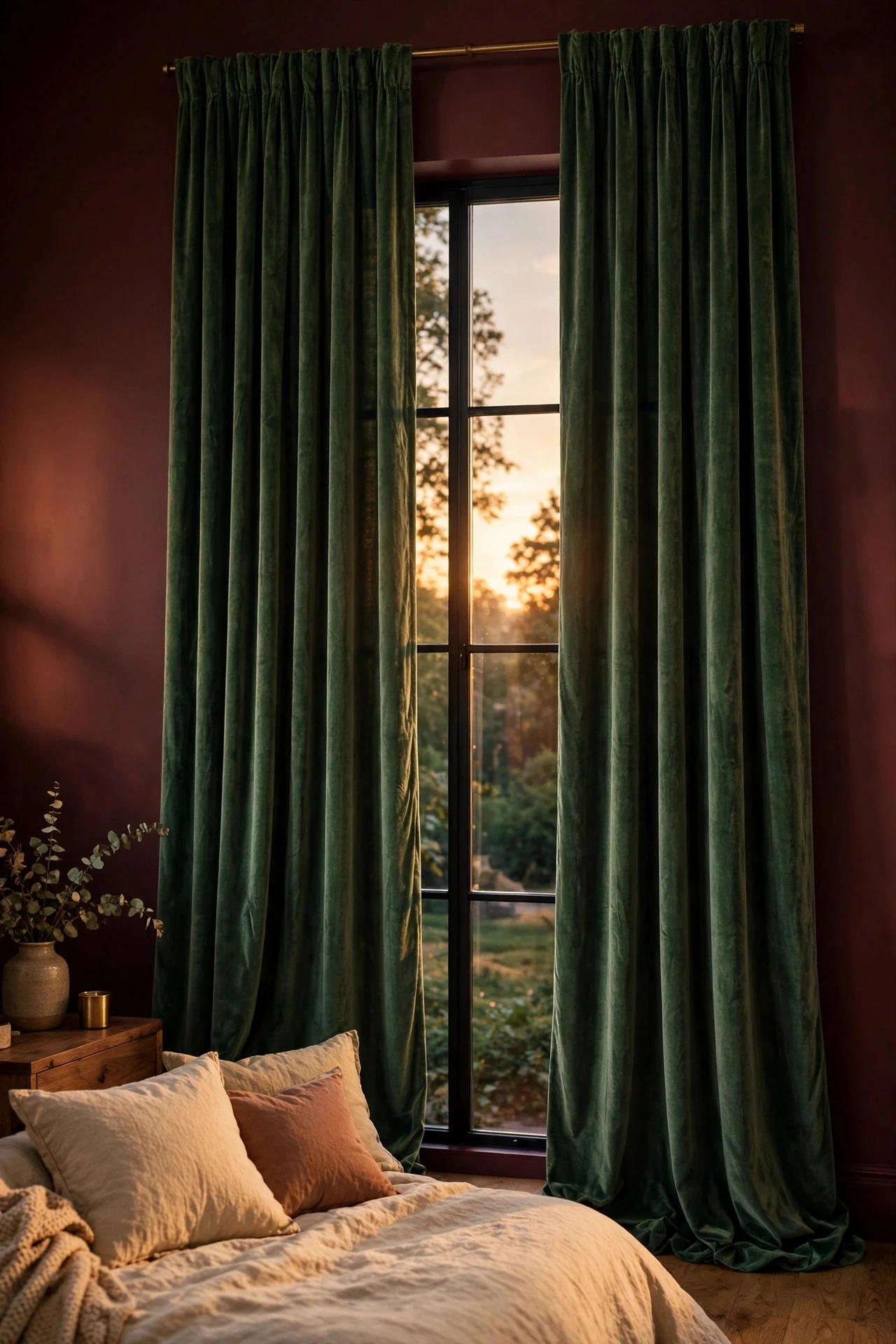
Hang full-length curtains in forest-green velvet or sage linen, mounted 10–15 cm above the window frame and 10–15 cm wider than the frame on each side, with the hem just kissing the floor. If the walls are burgundy, choose green curtains; if the walls are green, choose burgundy curtains — never match curtain and wall colour exactly.
Curtains are the second-largest colour block in the room, so they either balance the feature wall or double it. The rule is simple: curtains contrast the wall. Burgundy wall, green curtains; sage wall, burgundy or forest-green curtains. Velvet curtains (£60–£150 per pair) add weight and drama and insulate well, while linen curtains (£40–£100 per pair) keep the room lighter and suit sage walls. Hang the rod high and wide — 10–15 cm above the frame and beyond it on each side — so the window looks larger and the curtains frame the wall colour rather than covering it.
11. What Lighting Temperature Makes Burgundy and Green Look Rich?
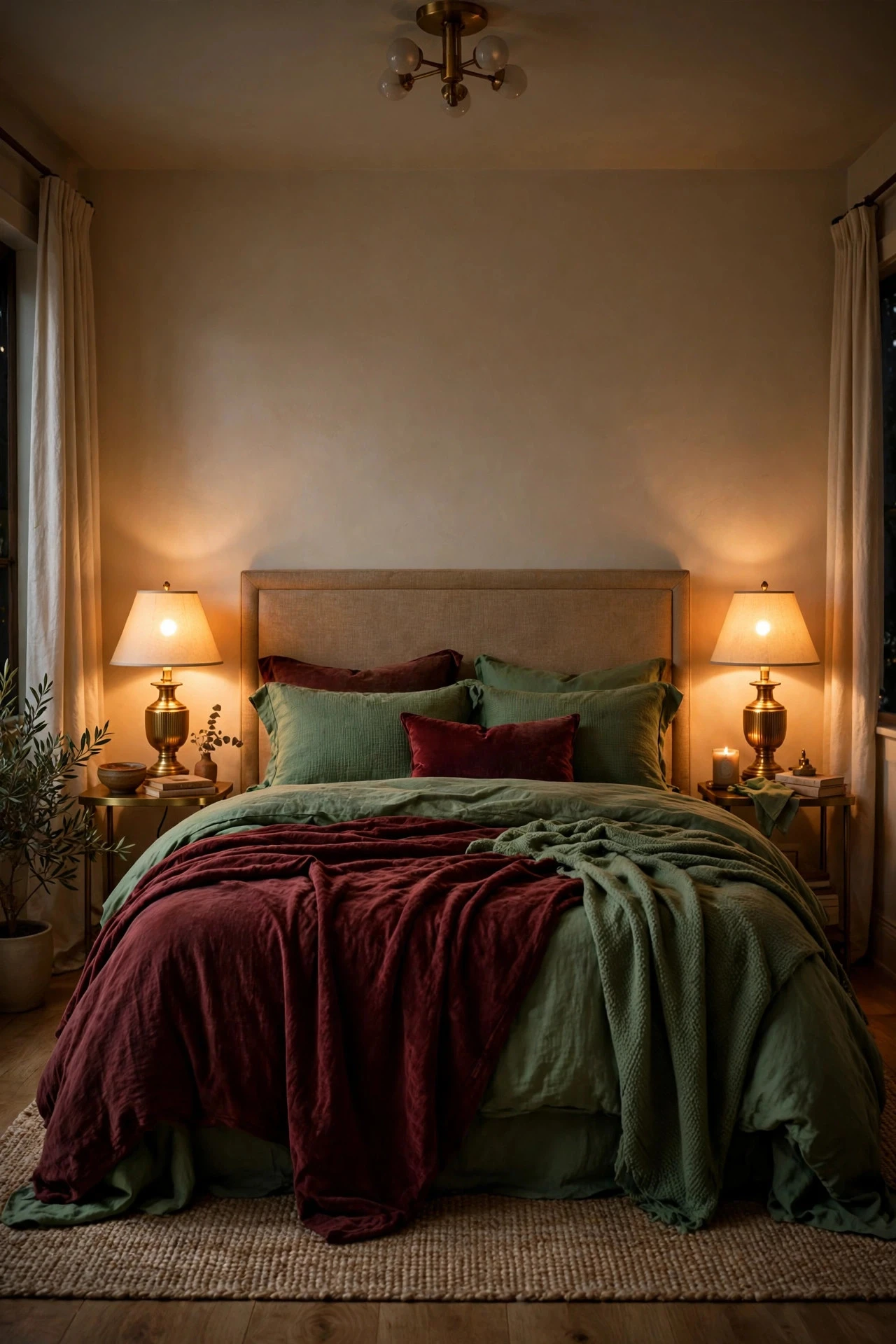
Use 2700K warm white bulbs everywhere in the bedroom — bedside lamps, ceiling light and any picture lights. Cool white (4000K and above) drains burgundy to a flat maroon and turns sage grey. Dimmer switches on the main light let you drop to a candle-like glow in the evening.
Light temperature is the invisible decision that makes or breaks this palette. At 2700K, burgundy reads as wine and green reads as leaf; at 4000K, both colours lose their warmth and the room feels like an office. Fit dimmable 2700K LED bulbs (around £5–£10 each) in every fitting, and put the ceiling light on a dimmer (£15–£30 for the switch, fitted by an electrician if you are not confident). Bedside lamps should sit at 2700K too, with linen or silk shades in cream or pale green that diffuse the light warmly.
12. How Can I Style Burgundy and Green in a Small Bedroom?
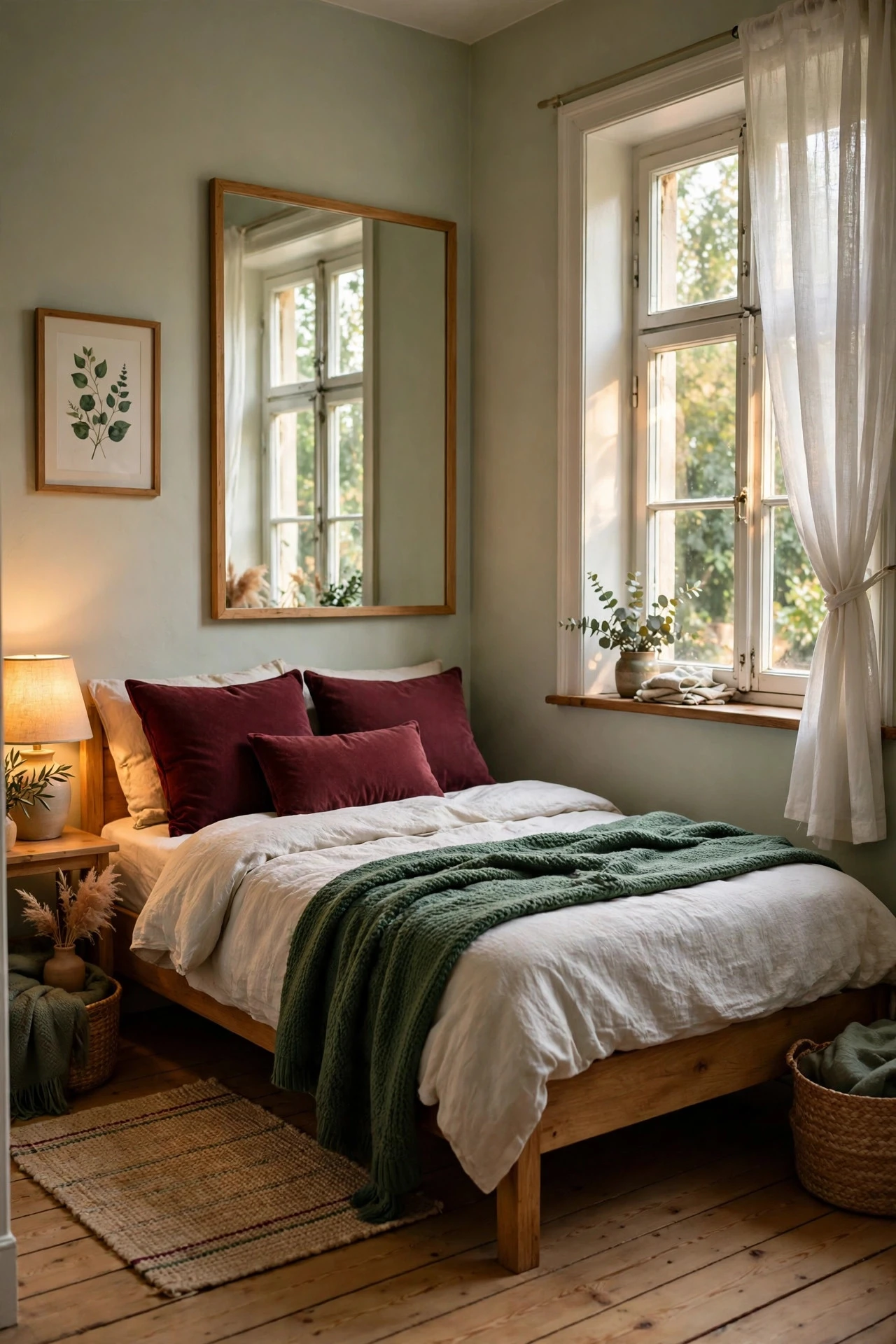
Keep burgundy to textiles only — cushions, a throw and one cushion-sized art print — paint the walls pale sage or warm white, and use a mirror opposite the window to bounce light. A small room needs the colours in small doses: one burgundy cushion per two green ones, and no burgundy wall.
Small bedrooms punish saturated colour, but they do not forbid it. The trick is to keep the dark colours low and small, and the pale colours high and large. Pale walls and a pale ceiling lift the room; burgundy at cushion and throw height grounds it without closing it in. Use a small bedroom layout that makes a tiny room feel bigger as the starting point — low-profile bed frame, no bulky headboard, under-bed storage — then add the colour on top. A 120 × 170 cm rug is enough for a small double; anything larger crowds the floor.
13. Can Renters Use Burgundy and Green Without Painting?
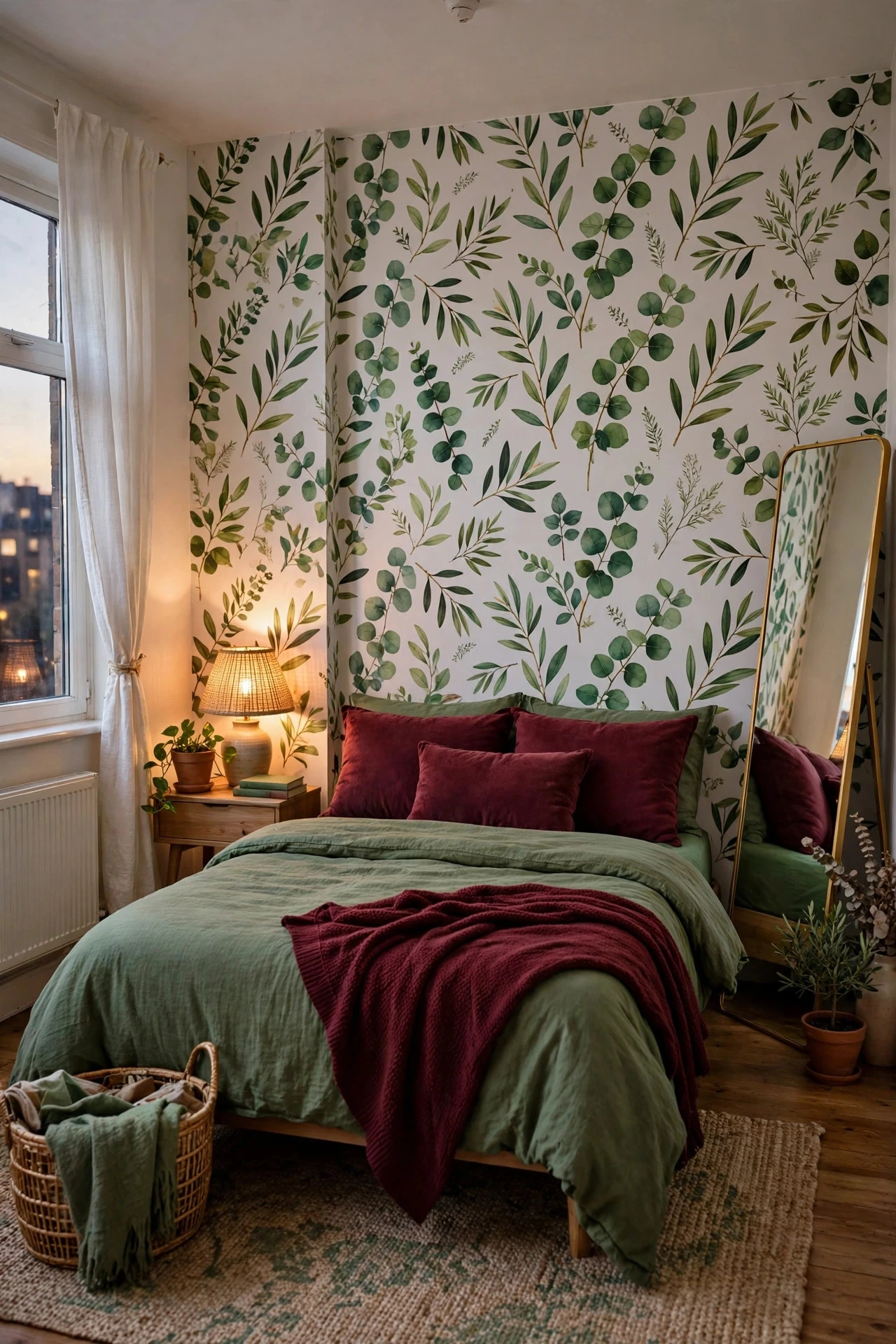
Yes — renters can build the whole scheme with textiles and removable pieces: burgundy velvet cushion covers, a green throw, burgundy curtains on a tension rod, removable peel-and-stick wallpaper in a botanical print on one wall, and a large leaning mirror. Nothing needs paint, drilling or landlord permission beyond the wallpaper check.
Renting does not mean living in beige. Start with the bed, which is the room's centrepiece: green bedding, burgundy cushions and a burgundy throw cost under £100 and change the room instantly. Add peel-and-stick botanical wallpaper (£25–£45 per roll) on the wall behind the bed — it removes cleanly and gives you the feature-wall effect without paint. Use Command strips for framed prints rather than nails, and a tension rod inside the window recess for curtains if you cannot drill. A burgundy velvet headboard cover (£60–£120) slips over an existing headboard and transforms it.
14. What Artwork Suits a Burgundy and Green Bedroom?
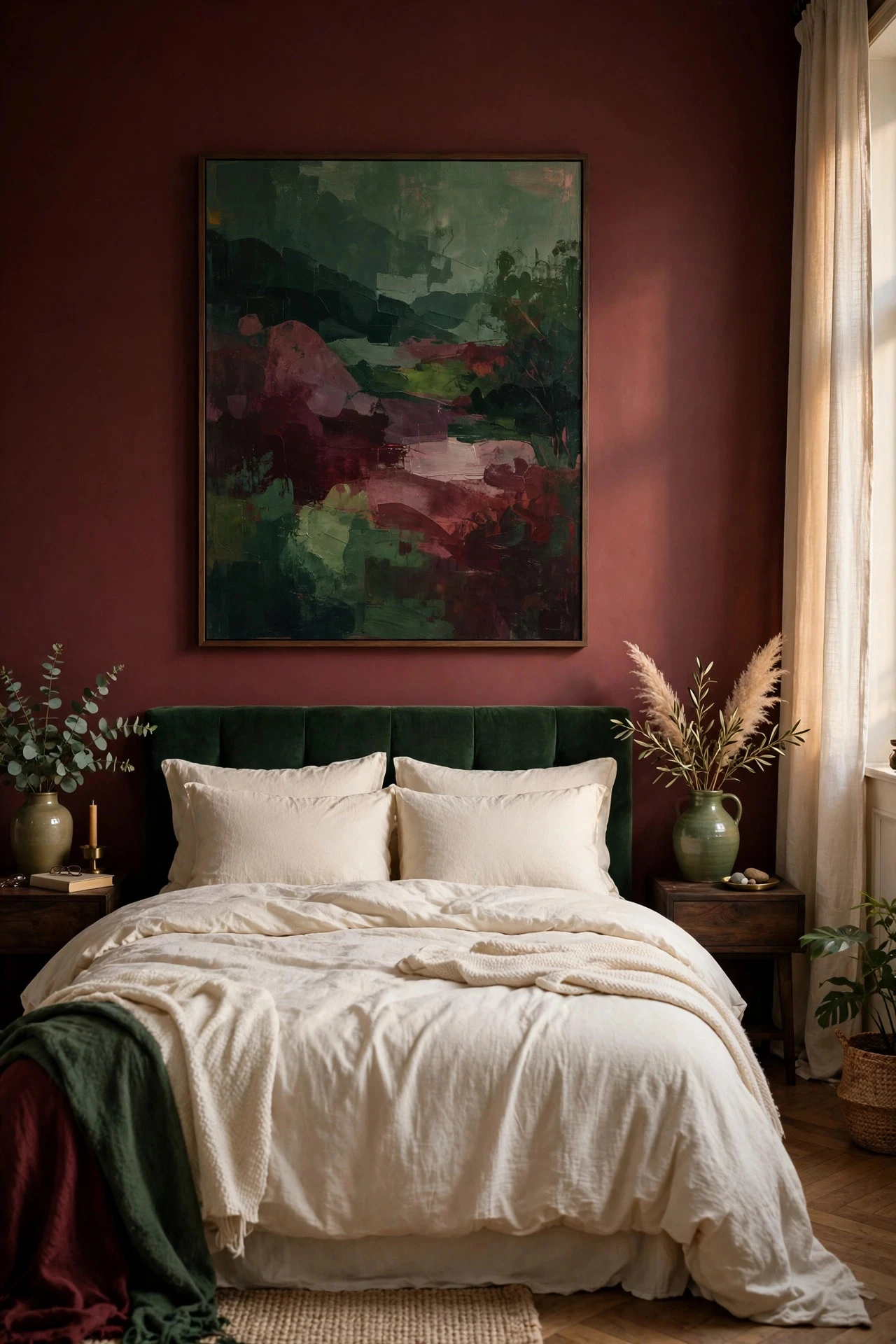
Choose artwork that contains both colours in one piece: botanical prints, abstract landscapes in deep green and wine, or vintage-style oil-painting reproductions with burgundy and green tones. Hang one large piece (70 × 100 cm) above the bed or a row of three smaller prints, in thin brass or dark-wood frames.
Artwork is the fastest way to prove the two colours belong together, because a single print can hold both. Look for pieces where green dominates and burgundy appears as an accent — a forest landscape with a wine-red sunset, or a botanical study with burgundy stems. Abstract art works if the colours are muted and the composition is calm; avoid bright, high-contrast abstracts that fight the velvet textures. Budget £30–£80 for a framed print, or £15–£30 for an unframed print in a ready-made frame. For ideas on making the bed wall the star, our bedroom accent wall ideas show how art and colour work together above the bed.
15. How Do I Style Nightstands in Burgundy and Green?
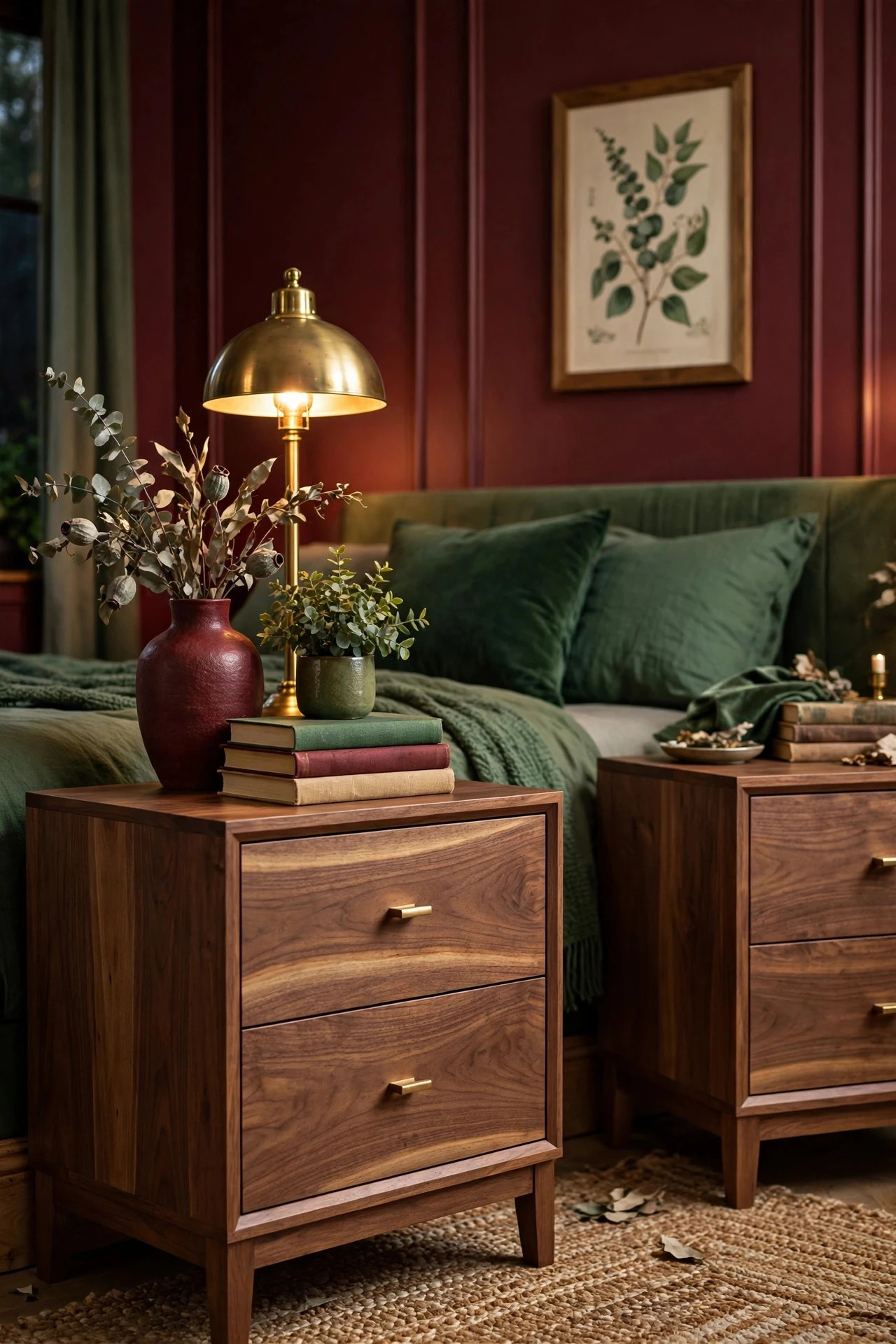
Keep nightstands simple and warm: a walnut or oak nightstand, a brass lamp with a cream shade, one burgundy object (a small vase, a book, a trinket box) and one green object (a small plant or a green ceramic dish). Two objects per nightstand is enough — clutter kills the rich, calm feeling.
Nightstands are small surfaces, so restraint matters more than elsewhere. A walnut nightstand (£80–£200) adds the warm wood tone that bridges burgundy and green; painted nightstands in sage or cream also work if the wood is already dark elsewhere. On each nightstand, place a brass lamp (2700K bulb, cream shade), then one burgundy and one green object — for example, a burgundy ceramic vase with dried eucalyptus on the left, and a small green potted plant on the right. Keep books stacked flat in twos, with the burgundy-spined book on top, and leave at least a third of the surface empty.
16. How Do I Create a Reading Corner in Burgundy and Green?
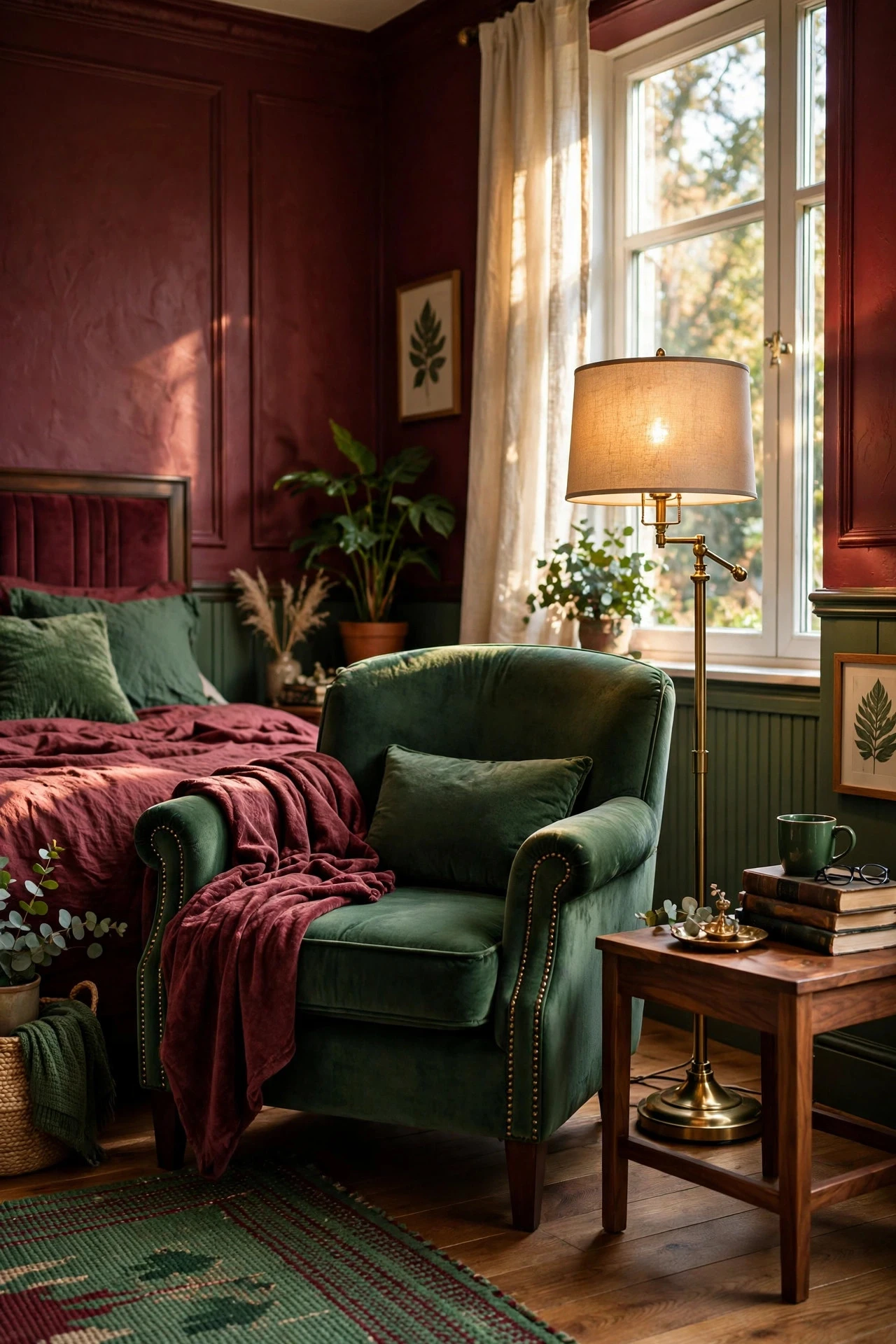
Place a compact armchair in forest-green velvet or burgundy leather in the brightest corner, with a brass floor lamp (2700K), a small walnut side table, and a burgundy or green throw folded over the arm. The chair should be 70–80 cm wide so it fits a bedroom corner without blocking the bed.
A reading corner gives the jewel-tone scheme a second moment in the room, away from the bed, and it proves the palette works beyond bedding. Choose the chair colour as the opposite of your headboard: burgundy headboard, green chair; green bedding, burgundy chair. A green velvet armchair costs £200–£450, while a good second-hand leather chair in oxblood or burgundy can be found for £100–£250 and reconditioned with leather balm. Position the chair at a slight angle to the wall, not flat against it, with the floor lamp behind the chair's left shoulder if you are right-handed.
17. What Bedding Colours Stop Burgundy From Looking Too Dark?
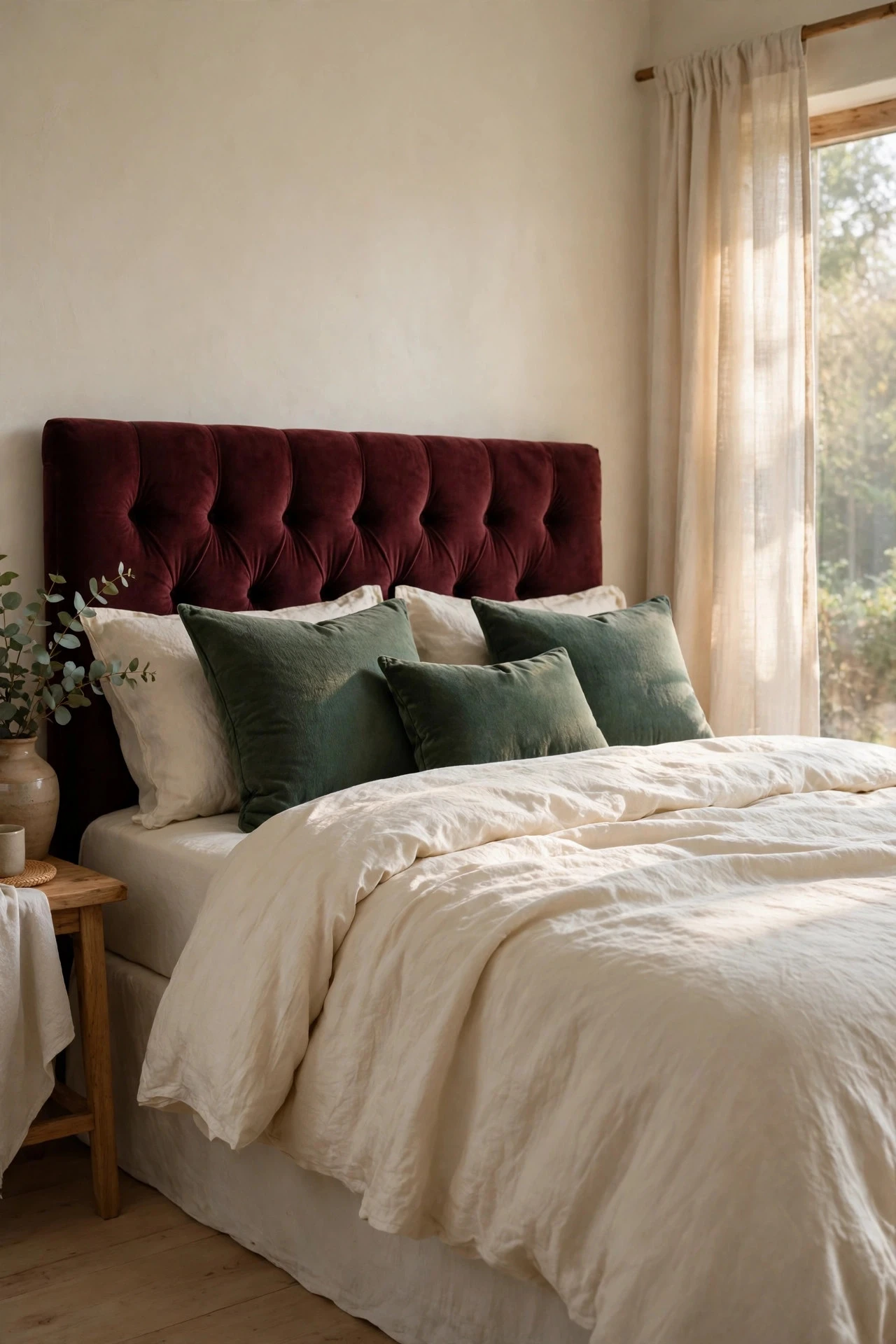
Cream, oatmeal, pale sage and soft white bedding stop burgundy from overwhelming the bed. Use a pale duvet cover as the base, then add burgundy only as cushions and a throw. A burgundy duvet cover with burgundy cushions and a burgundy throw is three layers of the same dark colour, and it will swallow the bed.
The bed is the largest surface in the room, so its base colour sets the room's brightness. Pale bedding reflects light back into the room and gives burgundy something to stand out against; dark bedding absorbs light and makes the whole bed a single dark block. For a full guide to layering bedroom light around pale bedding, see our bedroom lighting ideas for a warm, restful glow — the 2700K rule and lamp placement there apply directly to this palette.
18. How Do I Add Texture Without Adding More Colour?
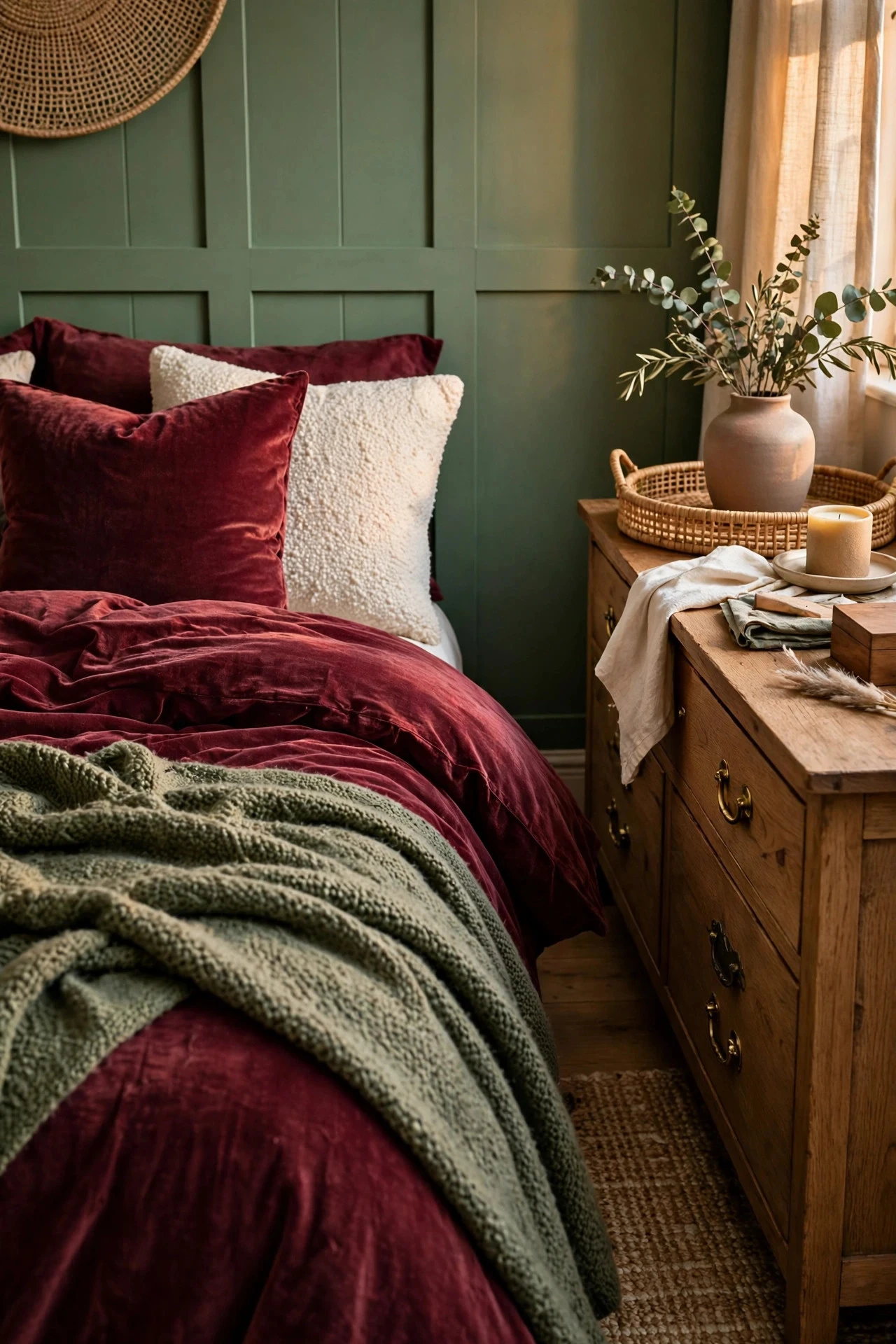
Add texture through materials, not colour: linen bedding, a wool throw, a velvet headboard, a rattan tray, a boucle cushion and a matte ceramic vase, all in cream, sage, burgundy or warm wood tones. Texture is what stops a two-colour room from looking flat, and it costs nothing in colour budget.
A room with only two colours can look flat if every surface is smooth, so texture does the work that a third colour would normally do. Layer at least four textures: something soft (velvet), something nubby (boucle or wool), something smooth (brass or ceramic), and something natural (linen, rattan or wood). A boucle cushion in cream (£20–£35) against a velvet burgundy cushion shows how texture contrast creates depth even when the colours are close. A rattan tray on the dresser (£15–£30) adds warmth without colour. The rule is: new texture, same palette.
19. Which Wood Tones Work With Burgundy and Green?
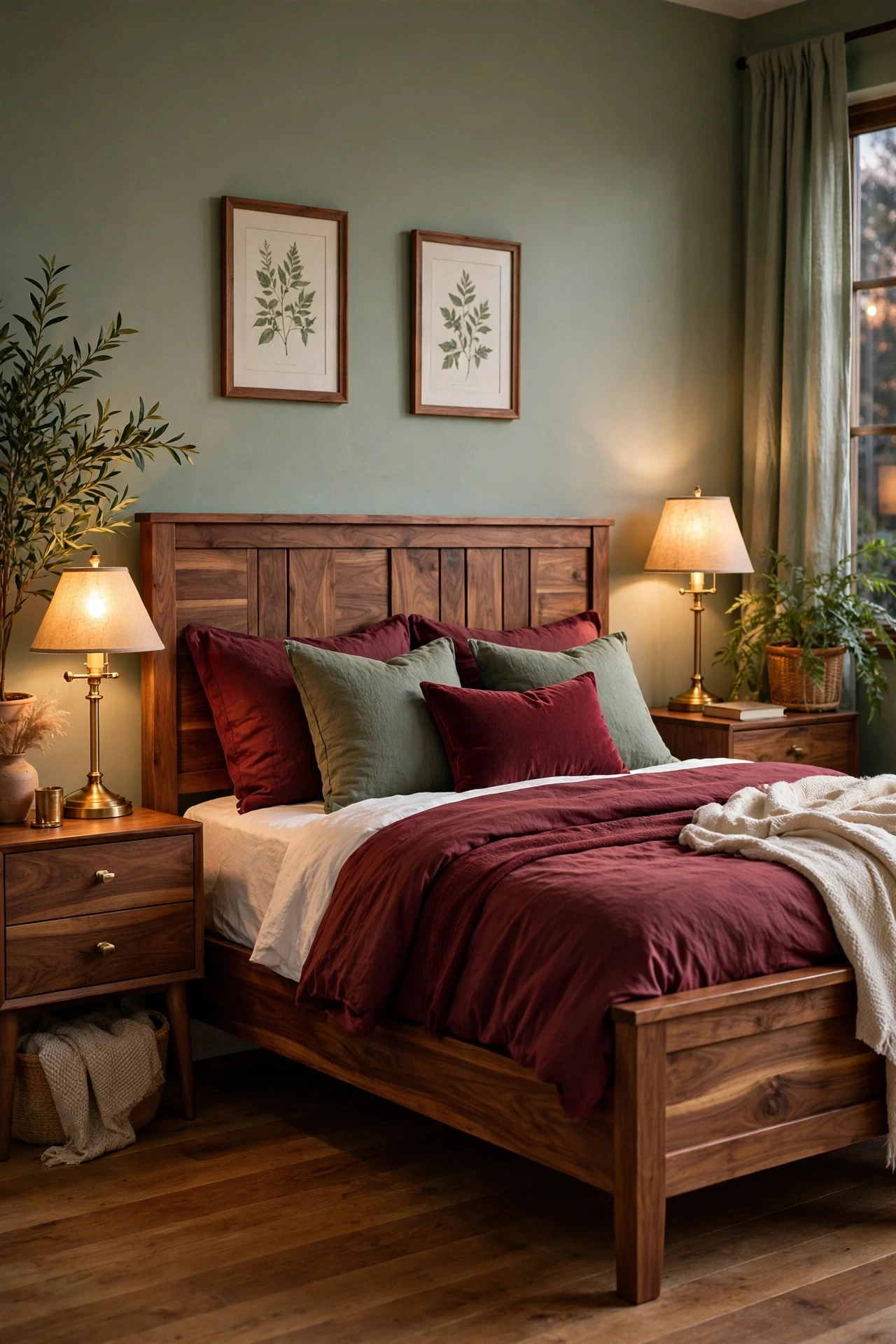
Warm medium woods — walnut, oak and honey-toned teak — work best. Walnut's deep brown echoes burgundy's depth, while pale oak lifts the green. Avoid grey-washed wood, whitewashed pine and cool ash, which clash with the warm jewel tones and make the room feel washed out.
Wood is the neutral that holds this palette together, and its undertone matters as much as its colour. Walnut (dark, warm, reddish-brown) is the natural partner for burgundy, while oak (pale, honey) partners with sage green. In practice, use one dominant wood — walnut for the bed frame and nightstands, or oak for the dresser and side table — and keep the other wood to small accents like a tray or a frame. Mixing walnut and oak in equal amounts looks accidental, so pick one as the main wood and the other as an accent.
20. How Do I Keep the Room Feeling Calm, Not Theatrical?
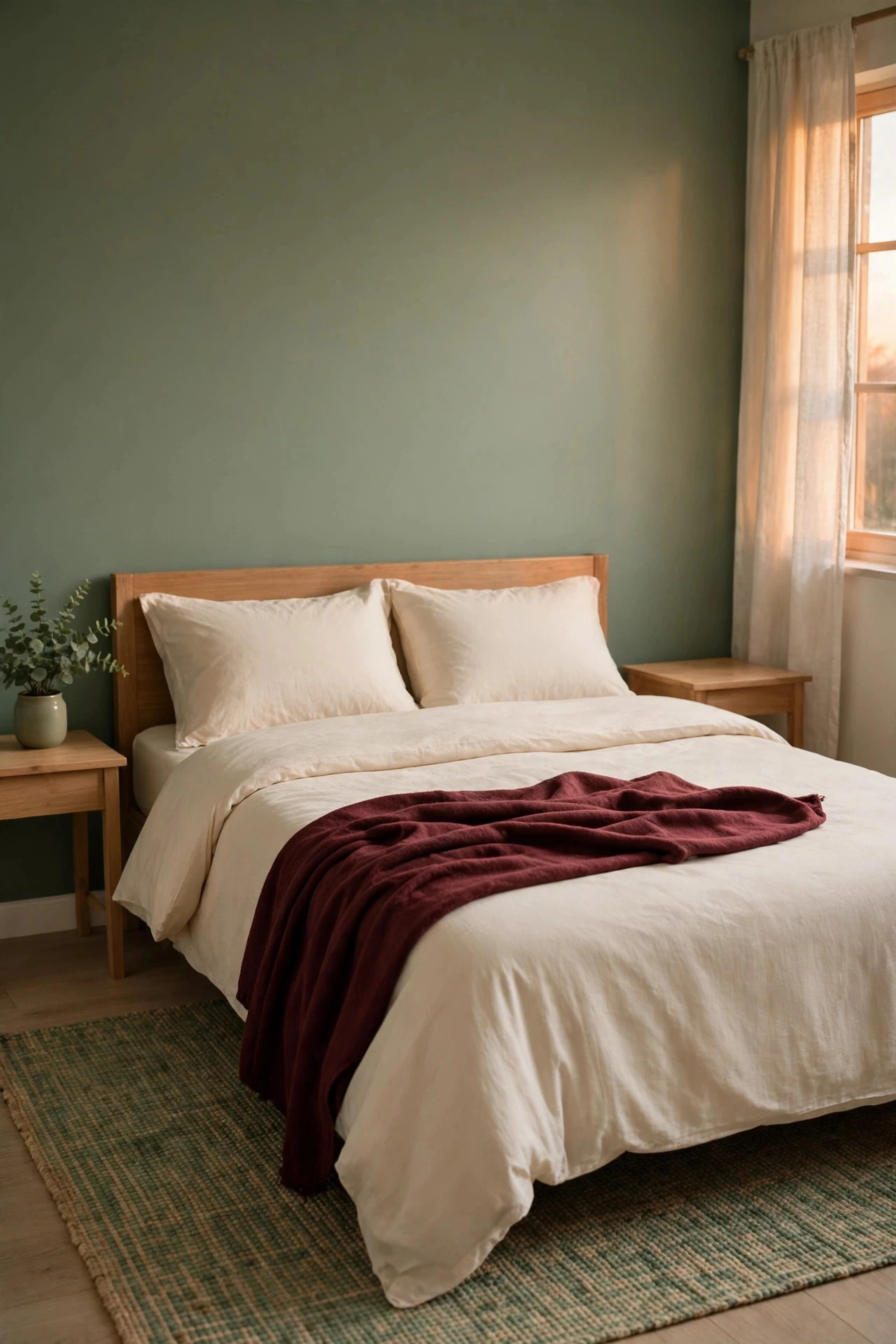
Keep burgundy to 10% of the room, use matte finishes instead of gloss, choose plain fabrics over ornate patterns, and leave empty space on every surface. Theatrical rooms come from too much dark colour, too much shine and too much stuff — calm rooms come from restraint, matte texture and breathing room.
The line between rich and theatrical is thin with jewel tones, and it is crossed by accumulation rather than by any single choice. A burgundy velvet headboard is rich; a burgundy velvet headboard plus burgundy curtains plus a burgundy rug plus gold tassels is a stage set. Use matte paint, matte brass and unpolished wood — gloss reflects light in hard spots that make dark colours look shiny and cheap. For a collected-not-cluttered approach to bedroom styling, our guide on how to style a boho bedroom that feels collected, not cluttered covers the same restraint principles in detail.
21. What Mistakes Make Burgundy and Green Look Cheap?
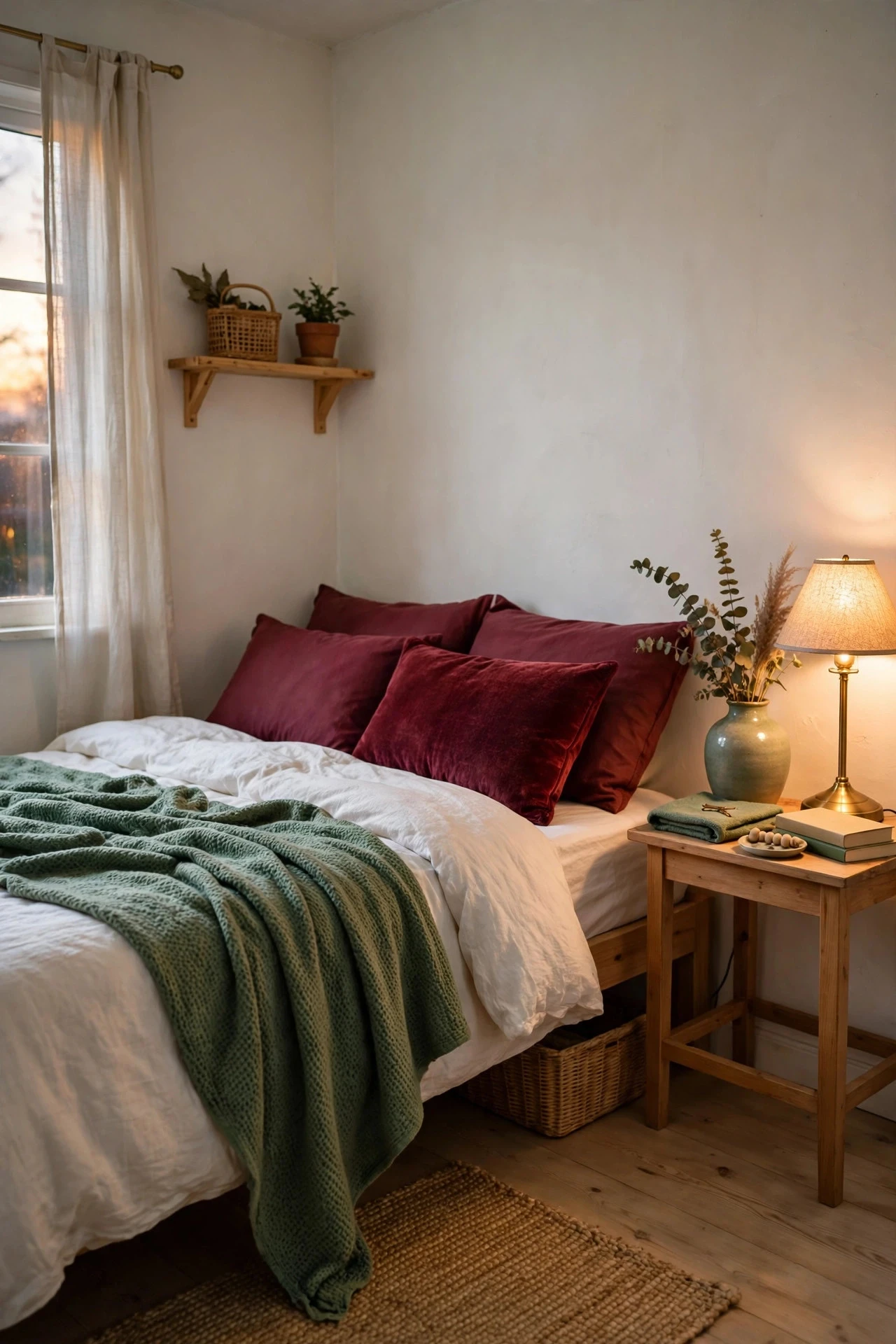
Matching burgundy and green in identical saturation, using shiny polyester velvet, pairing the colours with cool white light, and adding gold tassels, ornate frames or fake flowers. Cheap burgundy reads pink under cool light; cheap velvet shines instead of absorbing light; and too many matching accessories look like a boxed set.
The cheapest-looking version of this scheme is the one where everything matches. A burgundy-and-green bedding set, matching curtains, matching cushions and matching wall art from the same range looks bought, not designed. Buy the colours separately, in different materials and slightly different tones, and the room immediately looks more expensive. Other mistakes: polyester "velvet" (£10 cushion covers) that shine under lamplight — real cotton velvet absorbs light and looks deep, while polyester reflects it and looks thin. Cool-white bulbs, as covered in idea 11, are the fastest way to make burgundy look like cheap maroon.
22. How Much Does a Burgundy and Green Bedroom Makeover Cost?
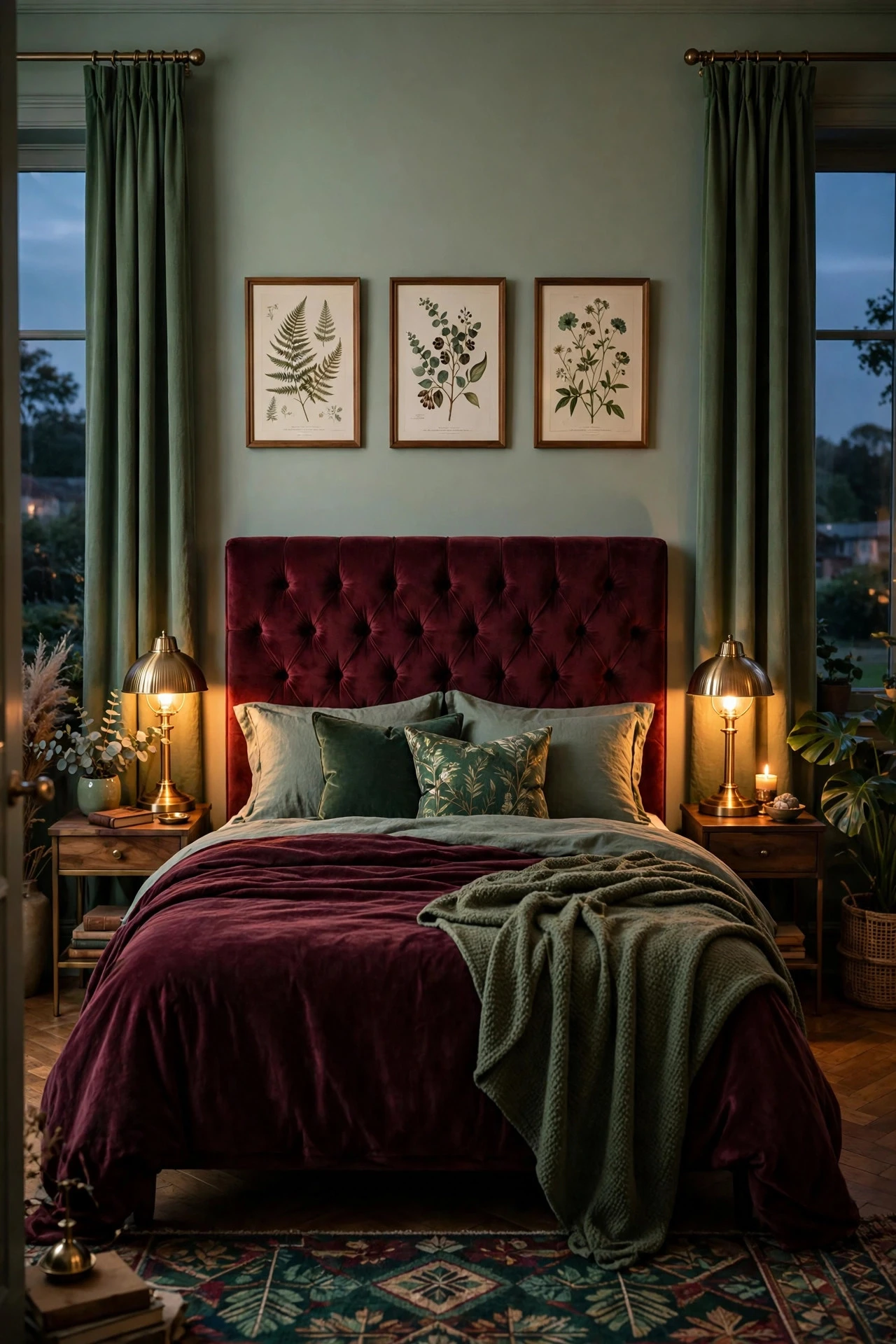
A cushion-and-throw refresh costs £80–£150; a mid-range makeover with curtains, rug and bedding costs £400–£700; a full refresh with a velvet headboard, feature-wall paint and lighting costs £900–£1,400. Start with textiles, then paint, then furniture — textiles give the biggest visual change per pound.
Budgeting in stages is the practical way to build this scheme, because the colour story works at every spend level. Stage one (£80–£150): two burgundy velvet cushion covers, a green throw, and a burgundy ceramic vase — the room reads burgundy and green within an afternoon. Stage two (£400–£700): add forest-green curtains, a patterned rug and a linen duvet set in cream or sage. Stage three (£900–£1,400): add the velvet headboard, feature-wall paint, brass lamps and framed botanical prints. For guest-room versions of this scheme, our guest bedroom ideas to make visitors feel at home show how the same palette works at a lower budget with fewer pieces.
Practical tips: budget, colour mistakes and keeping dark colours calm
Start with the cheapest change and live with it for a week. Buy cushion covers, not cushions — covers cost £15–£25 each and can be swapped if the shade is wrong. Paint a test patch, never a whole wall, on the first day.
Watch for the three colour mistakes that recur in this palette. First, burgundy that reads pink: its undertone is too blue and too light — choose a deeper, browner wine instead. Second, green that reads grey: sage with too much grey undertone looks dull under warm light — pick a sage with a clear green pigment, like Vert De Terre. Third, matching the two colours in identical fabric and saturation looks like a set — vary the fabric instead.
Keep dark colours from overwhelming a small room by keeping them low, small and matte. Burgundy belongs at cushion height and below; the walls and ceiling stay pale. Use a mirror opposite the window, keep bedding pale, and leave the top third of the walls empty. Clean velvet by brushing weekly with a soft clothes brush in the direction of the nap and blotting spills immediately with a dry cloth — never rub. For velvet care, see The Spruce's guide to cleaning velvet, and Wikipedia's burgundy colour page) explains the wine-red range. For headboard styles that suit a velvet statement piece, see our bedroom headboard ideas for a bed that looks designed.
Final thoughts
Burgundy and green work in a bedroom when green leads, burgundy accents, brass warms, and 2700K light ties it all together. Start with cushions and a throw, test your paint, and add the headboard last — the room will look rich, calm and intentional all year round.
Frequently Asked Questions
Does burgundy and green work in a bedroom all year round?
Yes, when it is framed as a jewel-tone scheme rather than a colour match. Sage or forest green with burgundy velvet, brass accents and warm 2700K light reads as botanical and wine-toned in every month. Keep the palette to green walls or bedding, burgundy textiles, and cream neutrals, and avoid adding any other strong colour that would tip the balance.
What is the best burgundy paint colour for a bedroom feature wall?
Farrow & Ball Preference Red No. 297 and Benjamin Moore New London Burgundy HC-61 are the safest choices, because both read as deep wine in daylight and warm plum under lamplight. Paint only the wall behind the bed, in a matte or eggshell finish, and test a 60 cm square sample for two days before committing to the full wall.
Should the walls be green or burgundy in a small bedroom?
Paint small bedrooms pale sage or warm white, and keep burgundy to textiles only — cushions, a throw and one small art print. A burgundy wall in a room under 12 square metres absorbs too much light and makes the room feel smaller. Add a mirror opposite the window and pale bedding to keep the space bright and open.
What colour bedding goes with a burgundy headboard?
Cream, oatmeal, pale sage or soft white bedding works best with a burgundy velvet headboard, because pale colours reflect light and let the burgundy stand out. Add a forest-green throw or two green cushions to tie the palette together, and avoid a burgundy duvet cover, which would make the whole bed one dark block.
Can I use burgundy and green in a rented bedroom?
Yes, renters can build the full scheme without painting: burgundy velvet cushion covers, green bedding, a burgundy throw, peel-and-stick botanical wallpaper behind the bed, and a velvet headboard cover. Use Command strips for frames and a tension rod for curtains, and check your tenancy agreement before applying any removable wallpaper.
How do I stop burgundy and green from looking too dark or heavy?
Keep burgundy to about 10% of the room, use matte finishes, choose plain fabrics over ornate patterns, and leave empty space on every surface. Pale bedding, a mirror opposite the window, and 2700K warm lighting lift the dark tones. If the room still feels heavy, remove one burgundy item rather than adding more green.