Bathroom Shelf Decor Ideas: How to Style Shelves That Work Hard
Bathroom shelves have to work harder than shelves in any other room. They need to keep everyday things within reach, survive steam and splashes, and still make the room feel calm instead of cluttered. The difference between a shelf that looks styled and a shelf that looks like storage is rarely money — it is arithmetic: the right heights, the right gaps, and the discipline to leave a third of the shelf empty.
Looking for more inspiration? Our Nest Decorz homepage gathers the latest home decor ideas, seasonal decorating guides and room-by-room styling tips in one place — start there and explore.
Below you'll find 22 bathroom shelf decor ideas covering floating shelves, tiled niches, above-toilet styling, vanity shelves and lighting — with exact heights, gaps and honest budgets in pounds, so your shelves look deliberate and survive the steam. Every idea works in a small bathroom, a powder room or a family bathroom.
Quick answers
– Follow the rule of three — a tall piece, a mid piece and a low piece, in odd numbers, with a third of the shelf left bare. – Mount the first shelf 25–30 cm above the tank — and leave 25–30 cm between stacked shelves in a small bathroom. – Choose ceramic, glass, stone or sealed wood — steam warps unsealed wood and delicate paper in days. – Budget £20–£60 to style existing shelves, and £60–£150 to add new floating shelves and style them.
1. How Do You Style a Single Shelf Above the Toilet?
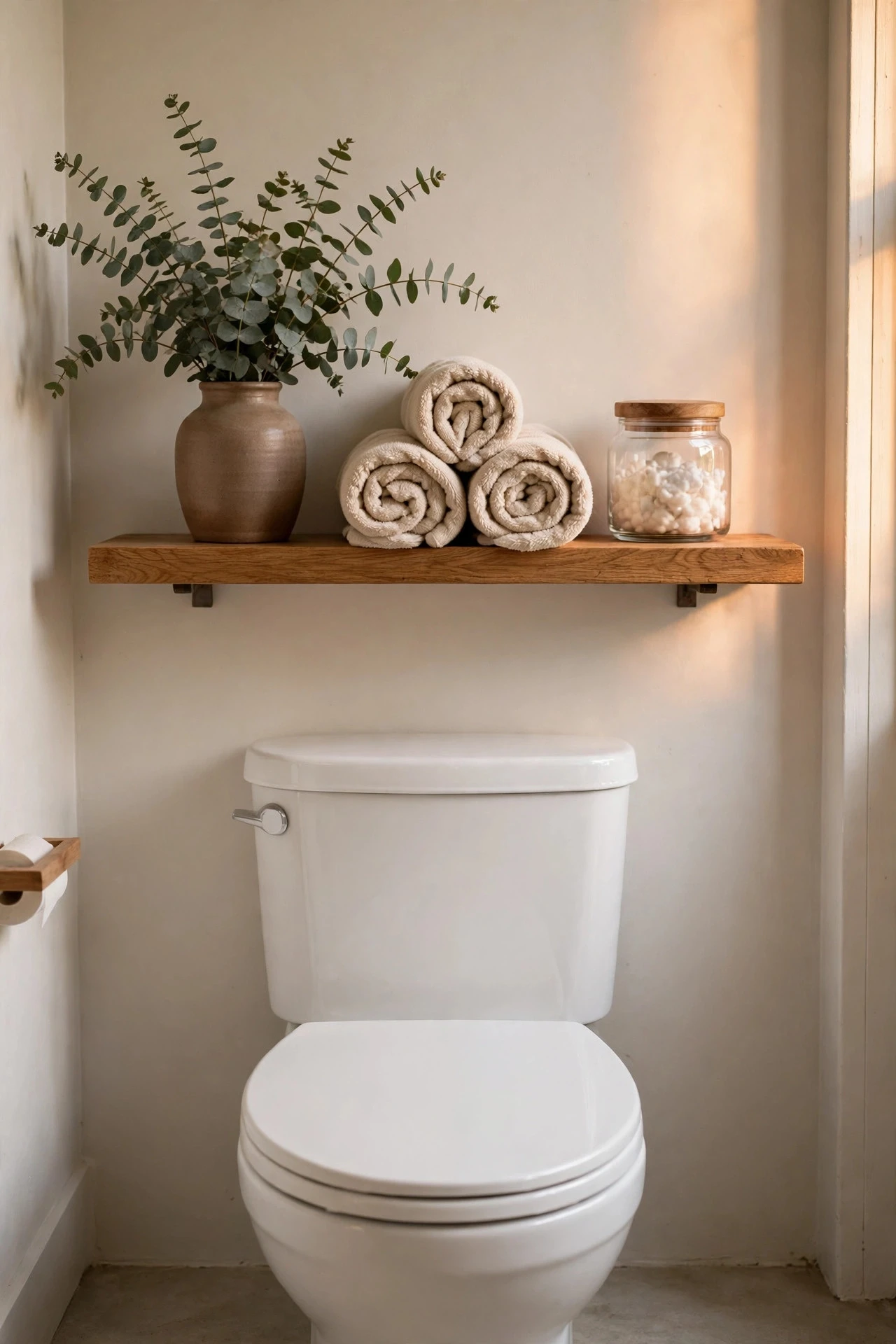
Style a single shelf above the toilet with three things at three heights: a vase of eucalyptus 25–30 cm tall at one end, three rolled towels about 10 cm high in the middle, and a lidded jar roughly the same height as the towels at the other end. Over-the-toilet shelf decor on a single board looks bare until it holds three things at three heights, and it looks cluttered the moment it holds five.
Place the tall piece toward one end and the towels in the middle, so the eye moves in a triangle — this is the Rule of Three, and it works because odd numbers read as intentional. Mount the board about 25–30 cm above the tank, and leave about a third of it empty: on a 60 cm shelf, that means a 20 cm gap at one end, enough to stop the arrangement from reading as storage. A single-shelf display costs £15–£30 in a vase, towels and a jar. The mistake to avoid is lining up five bottles in a row — that is a pharmacy shelf, not a styled one.
2. What Is the Rule of Three for Bathroom Shelves?
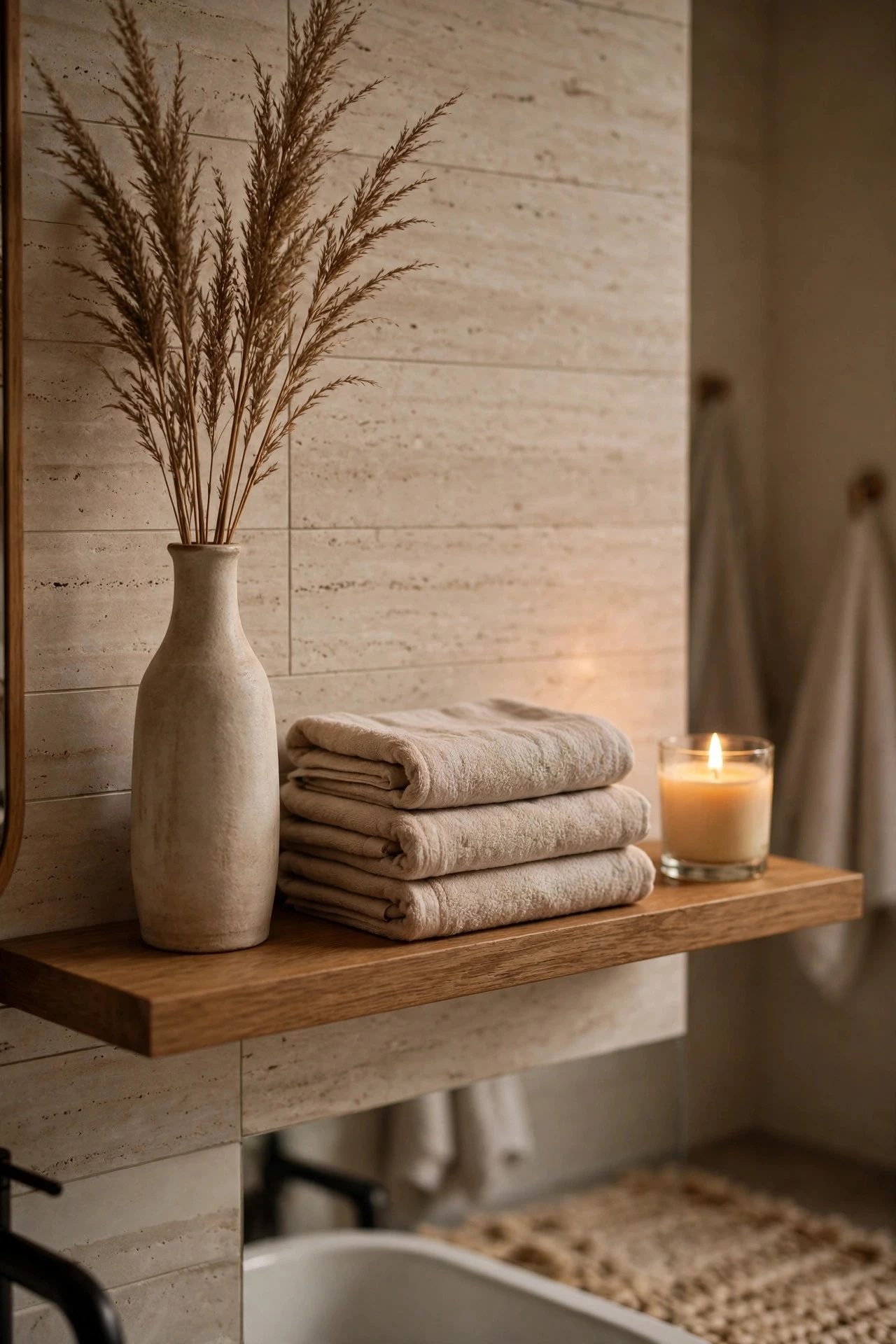
The Rule of Three for bathroom shelves is simple: group objects in threes, at three different heights, with one tall piece, one mid piece and one low piece, and leave a third of the shelf bare. A tall vase, a mid stack of towels and a low candle read as a composition; three objects at the same height read as a row.
Use the rule on every shelf, and vary which end the tall piece sits on from shelf to shelf, so the shelves do not mirror each other. The heights matter more than the objects: aim for roughly 30 cm, 15 cm and 8 cm, and keep the gap between the tallest piece and the shelf above it at least 10 cm, so nothing looks crammed. The rule works because odd numbers feel intentional to the eye, while even numbers feel like storage. It costs nothing — it is a way of arranging what you already own — and it is the single fastest way to make a bathroom shelf look styled.
3. How Do You Style a Shelf Above the Mirror?
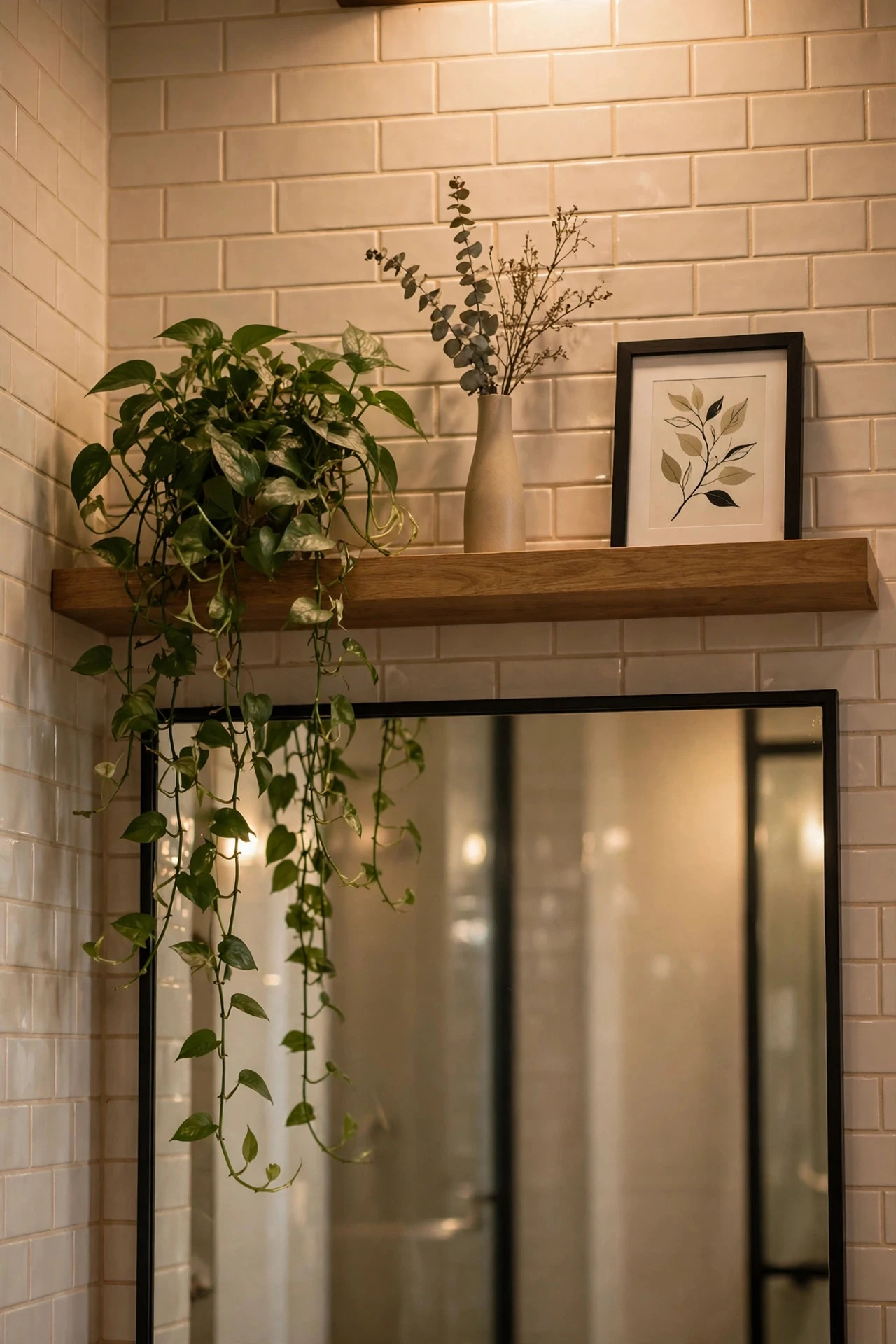
Style a shelf above the mirror by keeping it light and low: a small trailing plant, a slim vase with a single stem, and a small framed print leaning against the wall, with nothing taller than 20 cm, so the shelf does not crowd the mirror or block the light. A shelf above the mirror works best when it feels like a finishing touch, not a second storage unit.
Set the shelf 15–20 cm above the mirror's top edge, and choose a glass or slim wood shelf so it does not darken the mirror. Pick a frame with glass and a sealed back — steam warps unsealed paper and cardboard in days — and keep the objects to three, following the Rule of Three. A shelf above the mirror costs £15–£35 for the shelf and the styling. For the mirror itself, these 22 bathroom mirror ideas for a brighter, bigger-looking room show how the mirror and the shelf work together to bounce light around a small bathroom.
4. How High Should Bathroom Shelves Be?
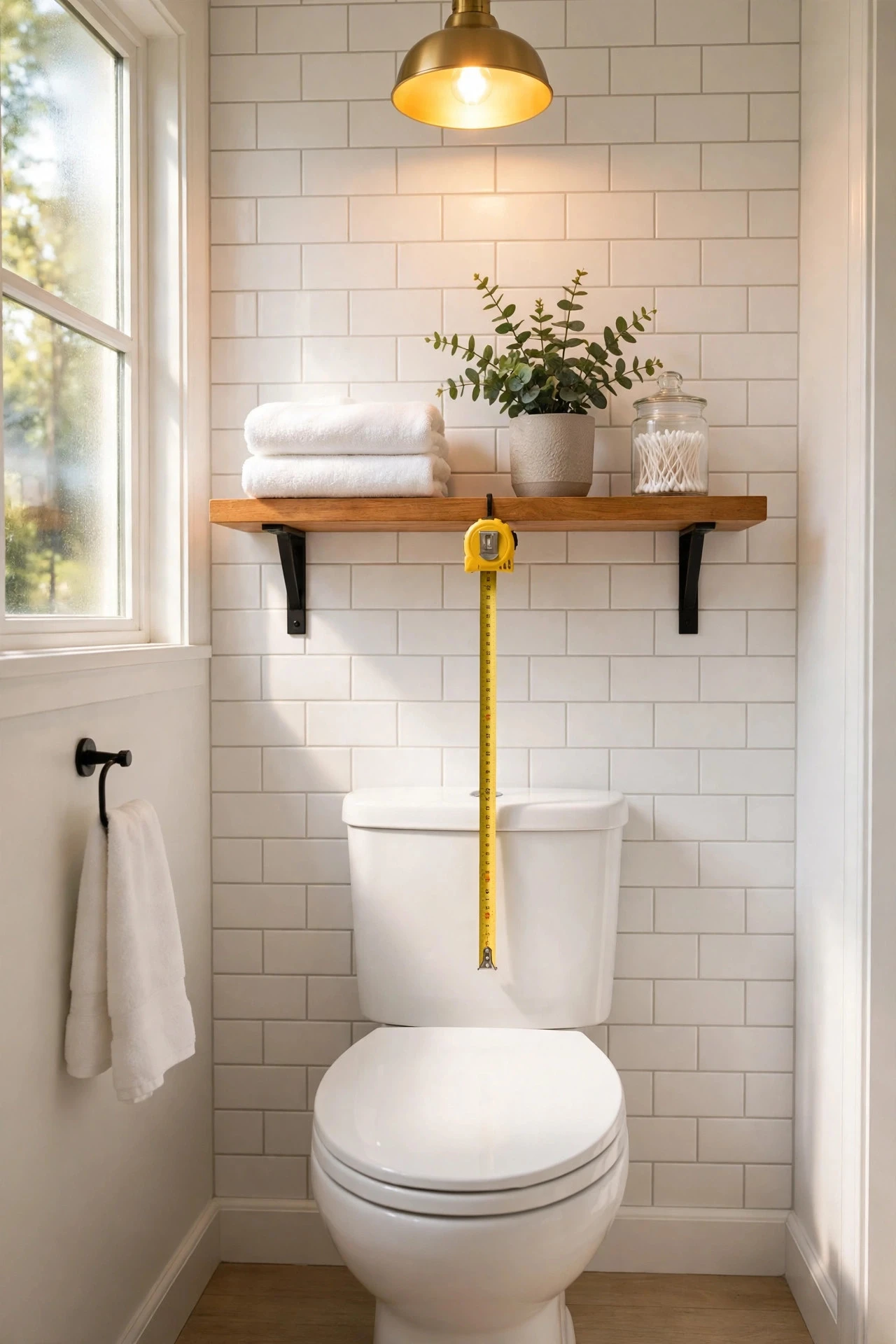
Bathroom shelves should be mounted with the first shelf 25–30 cm above the toilet tank, and with 25–30 cm between two stacked shelves in a small bathroom, or about 45 cm when you stop at two shelves. The heights decide whether the shelves feel useful or decorative — too low, and you bump your head; too high, and nothing on them is reachable.
For a shelf above the toilet, 25–30 cm above the tank leaves room to lift the lid and reach the towels. For shelves beside the mirror, mount the lowest shelf at shoulder height, about 150 cm from the floor, so the everyday items are at hand height. For a shelf above the bath, mount it 30–40 cm above the tub rim, so it holds a candle and a book without getting splashed. Measure twice and use a level — a shelf that slopes by even 5 mm looks wrong, and bottles slide. A spirit level costs £5, and it is the best money you will spend on the whole project.
5. How Do You Style a Tiled Shower Niche?
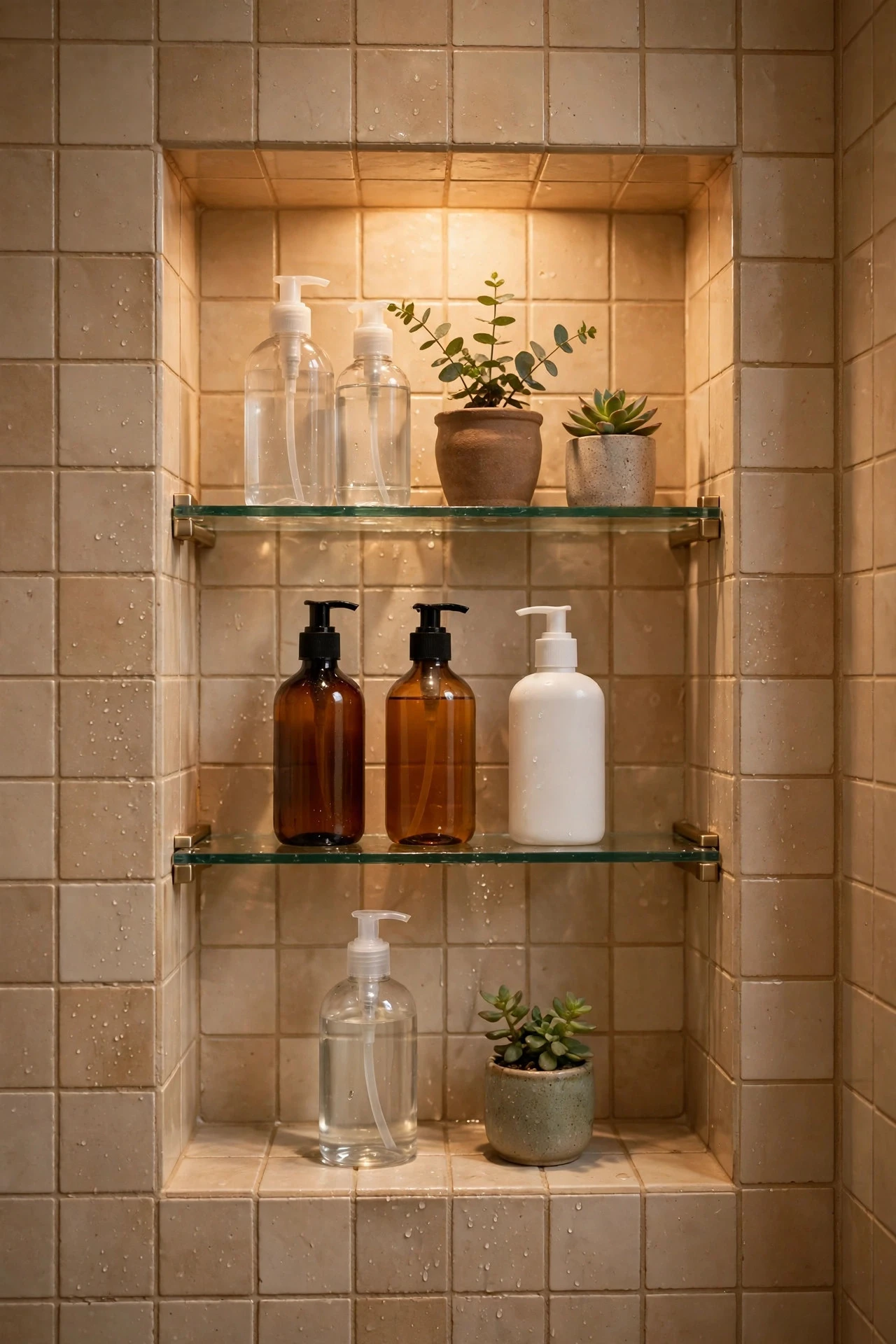
Style a tiled shower niche by dividing it with slim glass shelves and keeping it to three items per level: a bottle of shampoo, a bottle of conditioner and a small plant, or a soap dish, a razor and a candle. A shower niche becomes much more useful when it is divided with narrow glass shelves, and it looks better when each level holds fewer things.
Use the same tile as the shower walls for the niche, so it reads as part of the architecture rather than an add-on, and choose glass shelves 8–10 mm thick so they look weightless. Keep the bottles in matching dispensers — uniform bottles turn a jumble into a set — and add one small humidity-loving plant, like a pothos, on the top level. A tiled niche with glass shelves costs £40–£90 to build into a renovation, or £15–£30 to retrofit with a glass shelf and matching bottles. The bathroom is the one room where a niche is both storage and decoration, so style it like both.
6. How Do You Make Floating Shelves Look Intentional?
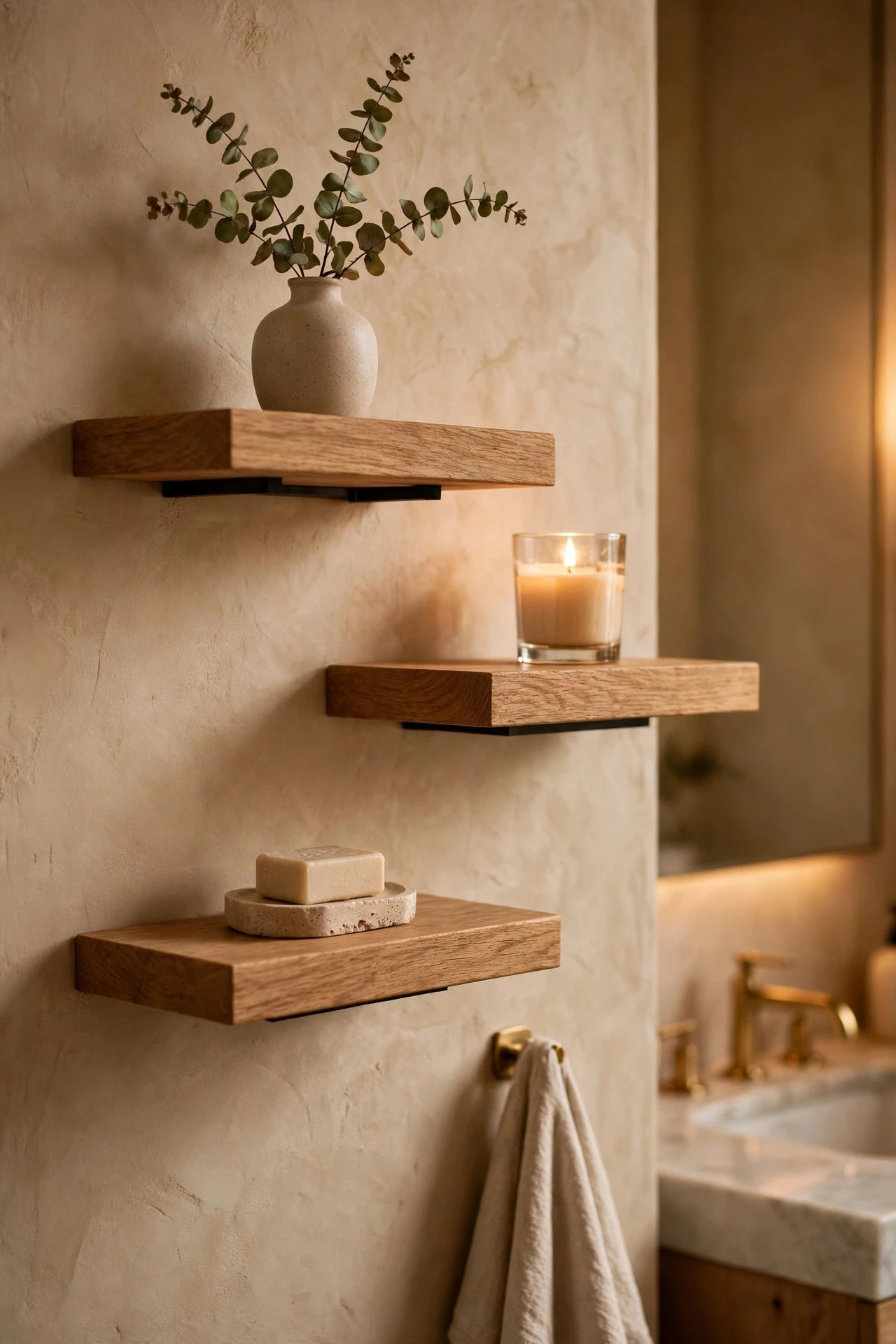
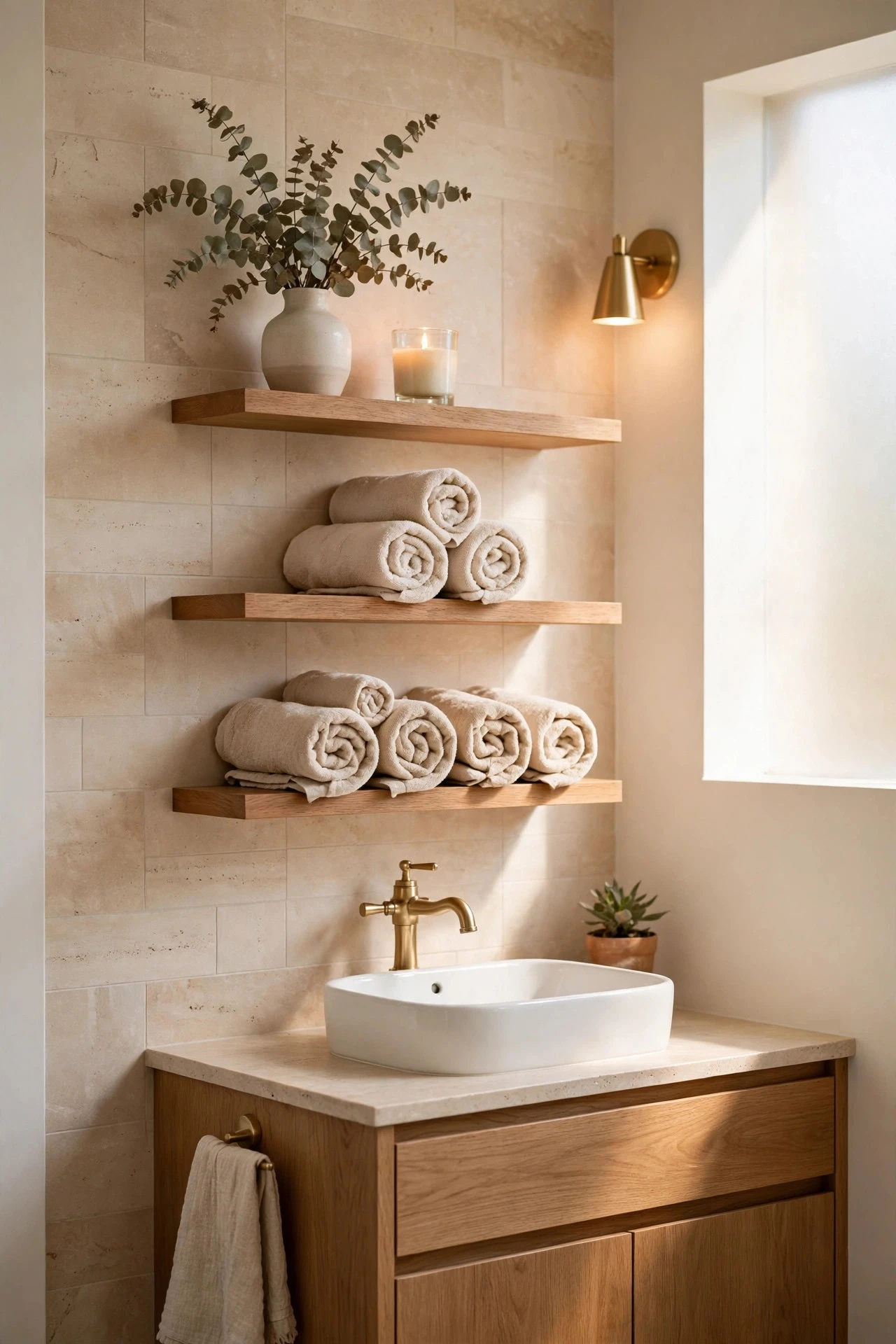
Make floating shelves look intentional by hanging them as a composition, not a column: stagger three short shelves at different heights, each holding a single object, instead of stacking them in a straight line. Staggered shelves read as a design choice; a straight column reads as a storage unit.
Space the shelves 25–30 cm apart vertically and 15–20 cm apart horizontally, so the eye moves between them, and keep each shelf to one or two objects. Use matching shelves — same wood, same finish — so the stagger is the only variation, and fix them with hidden brackets rated for at least twice the weight you plan to put on them. Three floating shelves cost £30–£60, plus £10–£15 for fixings. The mistake to avoid is hanging shelves at random heights with no pattern — stagger them, but keep the stagger even, so it looks deliberate rather than accidental.
7. What Belongs on the Top Shelf vs the Bottom Shelf?

Keep the top shelf pretty and the bottom shelf practical: a framed fern print and a pillar candle on the top shelf, with toilet paper in a wire basket and folded hand towels below. Aim for roughly 60 percent functional and 40 percent decorative across the pair, so the shelves look styled without losing their job.
The top shelf is the one people see first, so it holds the display: a plant, a candle, a framed print. The bottom shelf is the one people reach for, so it holds the everyday things: towels, toilet paper, spare soap. Use baskets and boxes on the bottom shelf to hide the practical items, and keep the top shelf free of anything with a label. A pair of shelves styled this way costs £20–£40 in baskets, a candle and a print. The mistake to avoid is putting the practical things on top and the pretty things at the bottom — nobody sees the pretty things, and the practical things look messy at eye level.
8. How Do You Style Shelves in a Small Bathroom?
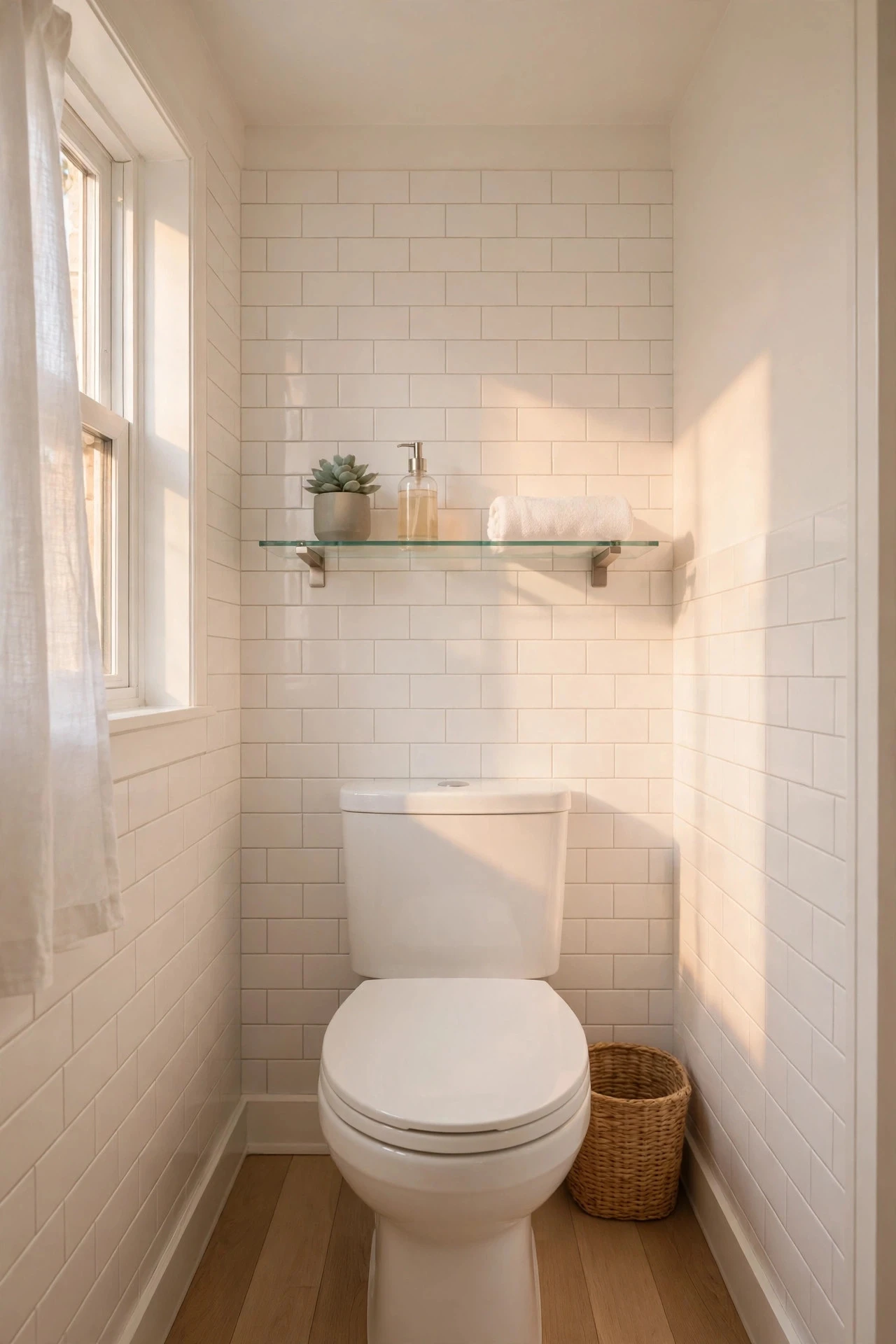
Style shelves in a small bathroom by choosing glass or slim wood shelves that keep the wall visually light, and by keeping each shelf to three objects with genuine breathing room between them. The most common mistake people make with above-toilet shelving is overcrowding — the shelf ends up looking like a storage dump rather than a design moment.
Use one floating shelf instead of two, mounted 25–30 cm above the tank, and style it with a tall vase, three rolled towels and a lidded jar — the same three-piece recipe as a big bathroom, just on one board. Add a small mirror or a light-coloured frame above the shelf to bounce light, and keep the wall around the shelf clear. A small-bathroom shelf display costs £15–£30. For a small bathroom that feels bigger in every way, these 22 small bathroom ideas that make a tiny bathroom feel bigger show how shelves, mirrors and layout work together.
9. How Do You Use Baskets on Bathroom Shelves?

Use baskets on bathroom shelves to hide the clutter and add texture: a woven basket for toilet paper, a fabric basket for spare towels, and a small lidded basket for the things nobody wants to see. Baskets bring warmth to a room full of hard surfaces, and they turn a pile of supplies into a single neat object.
Choose baskets that fit the shelf with 5 cm to spare on each side, so they slide in and out without scraping, and use the same material — rattan, seagrass or fabric — on every shelf, so the baskets read as a set. Label the baskets on the inside, not the outside, so the shelf looks calm from the room. A set of three baskets costs £15–£30. Rattan baskets are especially useful under a vanity, because they bring texture to a wood-finished vanity while hiding the smaller things that can quickly make an open shelf look messy. Avoid baskets without a liner in a steamy bathroom — damp seeps through the weave and stains what is inside.
10. How Do You Add Plants to Bathroom Shelves?

Add plants to bathroom shelves by choosing humidity-loving plants that thrive in steam: pothos, ferns, spider plants and orchids all love a bathroom, and a trailing pothos on a high shelf softens the hard surfaces in the room. Greenery is the one decoration that makes a bathroom feel alive, and it costs almost nothing.
Put the plant in a ceramic or glass pot with a saucer, so water does not mark the shelf, and keep it out of direct splash from the shower. A pothos costs £5–£10 and grows fast in a steamy bathroom; a small fern costs £6–£12 and suits a shaded shelf. Rotate the plant every week so it grows evenly, and wipe the leaves monthly — steam leaves a film that dulls them. Avoid plants that hate humidity, like succulents, which rot in a steamy bathroom. One plant per shelf is enough; two plants on one shelf compete, and the shelf starts to look like a greenhouse.
11. How Do You Style Glass Shelves?
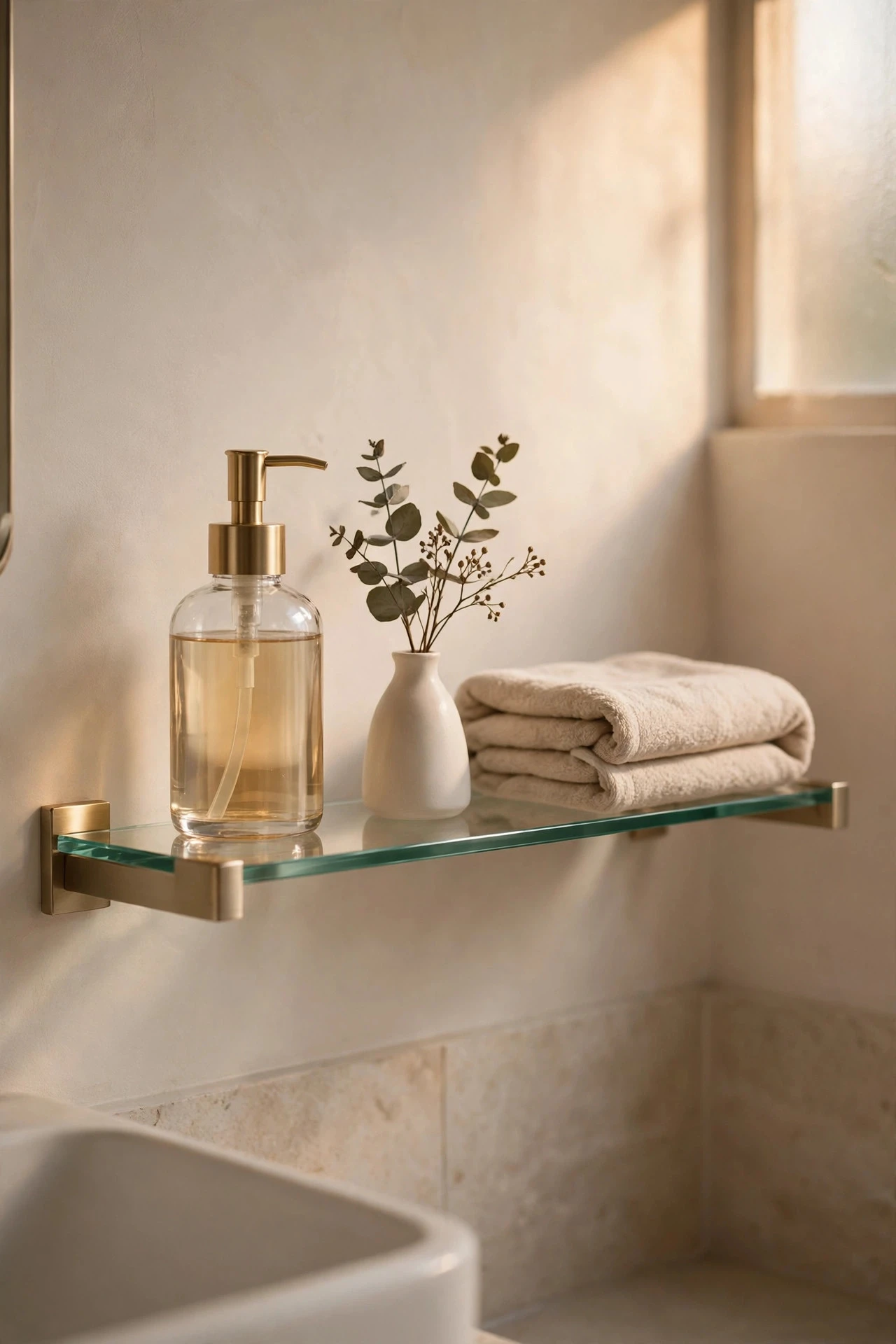
Style glass shelves by keeping them light and minimal: a soap dispenser, a small vase with a single stem, and a folded hand towel, with nothing heavy and nothing dark. A glass shelf keeps the wall visually light and gives just enough room for a few essentials, which is why it suits small and modern bathrooms best.
Use glass shelves 8–10 mm thick, fixed with chrome or brushed-nickel brackets, and keep the objects to three per shelf — glass shows everything, including the clutter underneath. Choose clear glass bottles and white towels, so the shelf reads as clean, and add one small green plant for a touch of life. A glass shelf costs £15–£30, plus £10 for brackets. The mistake to avoid is a glass shelf loaded with dark bottles and coloured towels — the shelf disappears and the clutter takes over. Glass works when it looks almost empty; if the shelf is full, use wood instead.
12. How Do You Style Open Shelves Under the Vanity?

Style open shelves under the vanity with baskets and rolled towels: a rattan basket for spare toilet paper, a stack of rolled white towels, and a small tray for the everyday bottles, all arranged so the shelf looks like a spa, not a cupboard. Open shelving beneath a vanity is a simple way to add storage without making the bathroom feel boxed in.
Roll the towels instead of folding them — rolled towels look like a hotel, folded towels look like a laundry pile — and keep the colours to white and one accent, so the shelf reads as calm. Use the bottom shelf for the heavy things, like spare towels and cleaning supplies in a basket, and the top shelf for the display: a candle, a small plant and a soap dish. An under-vanity shelf display costs £15–£30 in baskets and towels. For a vanity that anchors the whole bathroom, these luxury bathroom vanity ideas for a five-star vanity show how to choose the vanity the shelves sit under.
13. How Do You Create a Spa-Like Shelf?

Create a spa-like shelf with a white palette and natural textures: a bleached oak or painted white shelf, crisp rolled towels, eucalyptus sprigs in a ceramic bud vase, and a small tray of minimalist skincare products. A white shelf palette is the perfect canvas for a spa look, because it reads as clean and calm, and the eucalyptus adds a scent that survives the steam.
Use three white towels, rolled and stacked, a bud vase with two or three eucalyptus stems, and a wooden tray holding three skincare bottles in matching dispensers. Add a small candle in a glass jar, and keep the shelf to those five items — a spa shelf is defined by what is not there. A spa shelf costs £20–£35 in towels, a vase and a tray. Keep the towels white and the bottles minimal; coloured packaging breaks the spell. The mistake to avoid is a spa shelf with ten products on it — a spa has three products, not thirty.
14. How Do You Style a Moody, Dark Bathroom Shelf?

Style a moody, dark bathroom shelf by leaning into the drama: matte black shelving against deep charcoal or forest green walls, styled with dark glass perfume bottles, bronze candle holders and a single dramatic bloom in a slim vase. The powder room is the one space in a home where you can push the envelope, and a black shelf setup is one of the boldest ways to do it.
Use backlighting — an LED strip behind the shelf — to make the dark wall glow and the bottles shine, and keep the objects to three or four, so the shelf reads as curated, not crowded. A matte black shelf costs £20–£40, and the styling adds £15–£25 in bottles and a candle. Backlighting can completely change how bathroom shelving feels, especially in a room built around deeper colours and metal finishes. The mistake to avoid is a dark shelf with no light — it disappears into the wall, and the bathroom feels like a cave. Light the shelf, and the mood turns from dark to dramatic.
15. How Do You Style Corner Shelves?
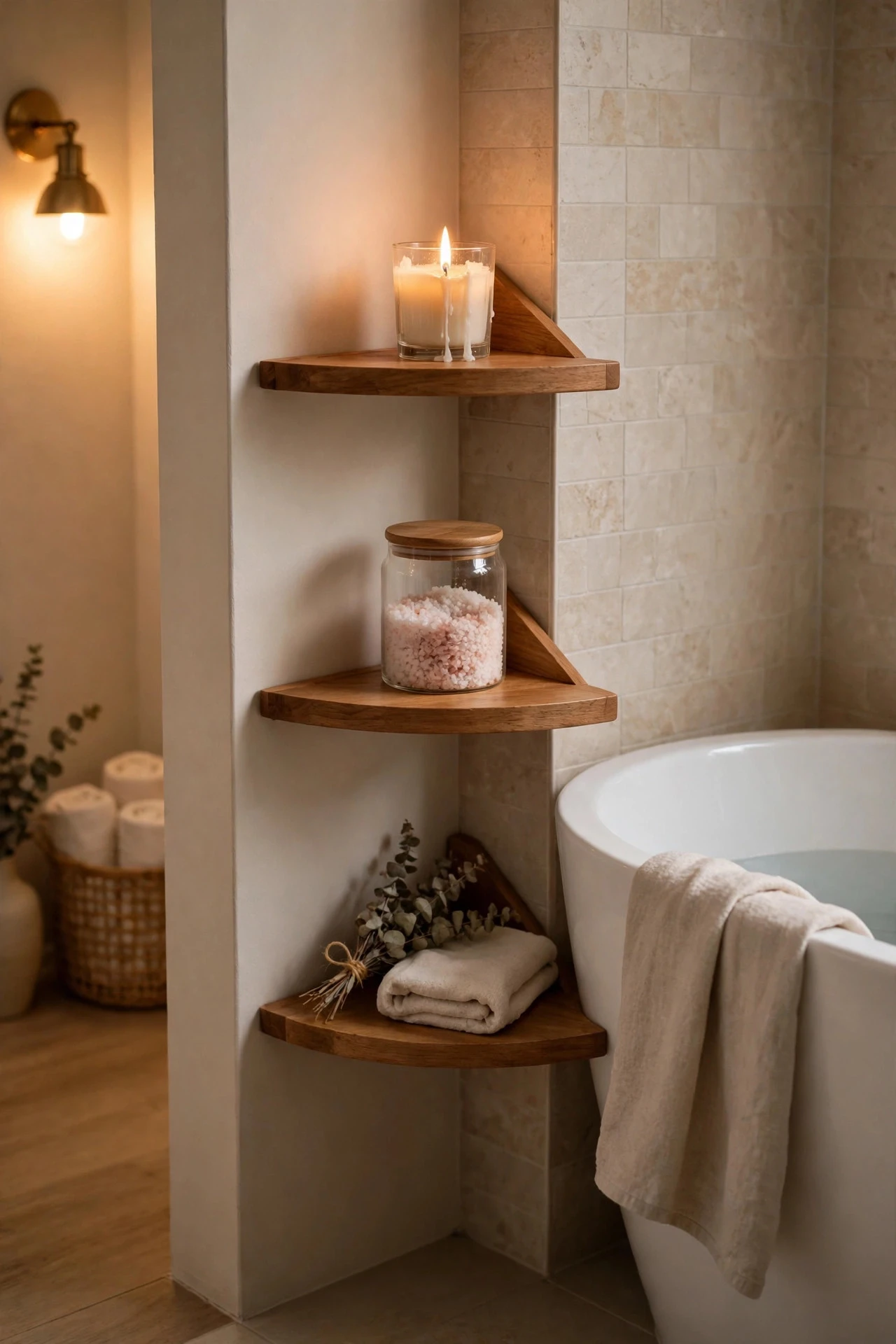
Style corner shelves by using the corner, not fighting it: a triangular shelf in the corner beside the bath or the vanity, holding a candle, bath salts and a small plant, turns wasted space into a display. Corners are often wasted space, and corner shelves can make the most of tight areas, especially around bathtubs or vanities.
Use two or three triangular shelves stacked 25–30 cm apart, each holding one object, so the corner reads as a tower rather than a pile. Choose glass or light wood, so the shelves do not darken the corner, and keep the objects small — a candle, a jar of bath salts, a bud vase. A set of corner shelves costs £20–£40. The mistake to avoid is a corner shelf loaded with bottles — the corner is small, and a loaded corner shelf looks like a chemist's window. One object per shelf, and the corner feels intentional.
16. How Do You Use Colour on Bathroom Shelves?
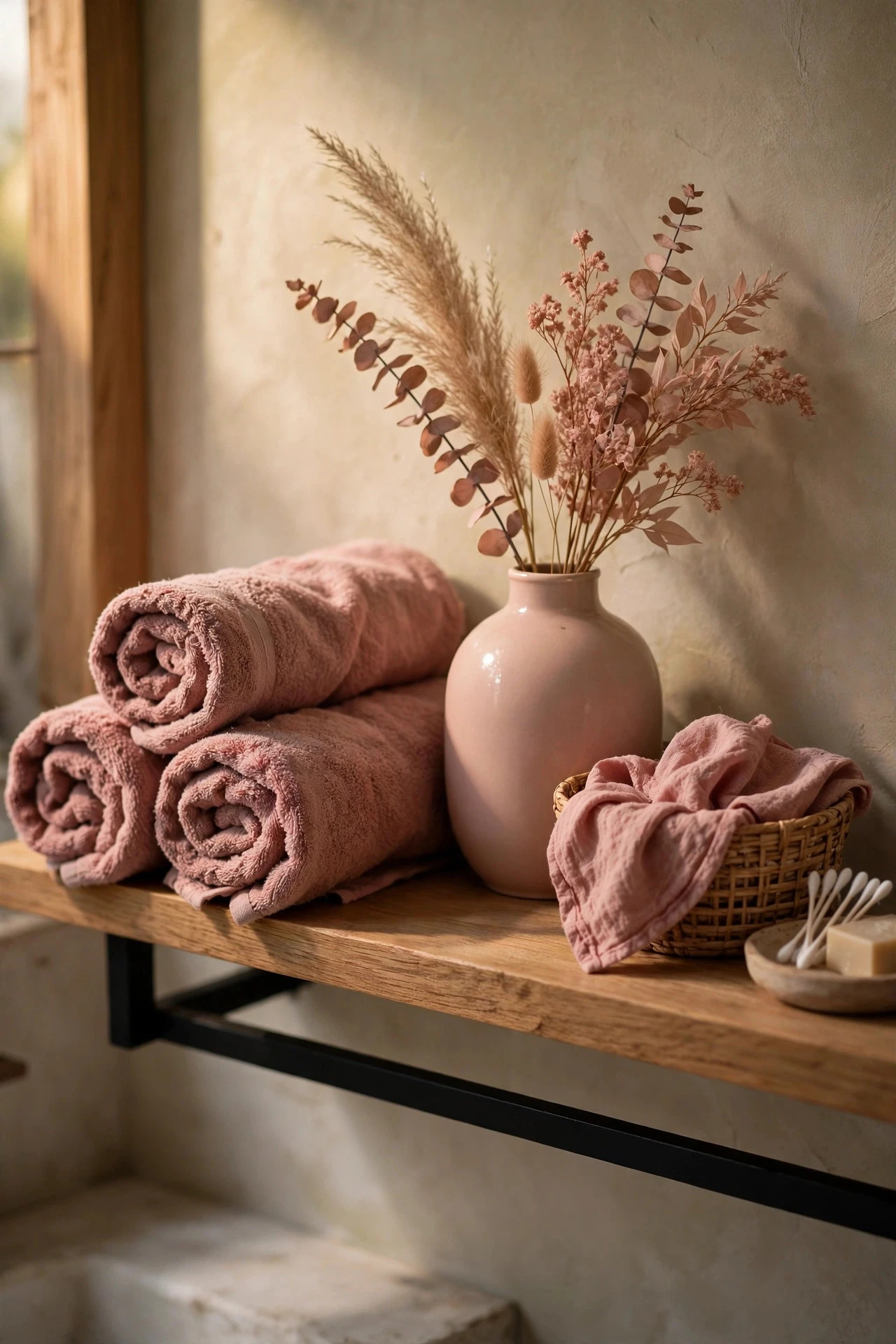
Use colour on bathroom shelves by picking one accent and repeating it: dusty rose towels and a blush vase, or sage green towels and a green ceramic soap dish, with everything else white or wood. In 2026, pink is trending in bathrooms — dusty rose, terracotta-pink and warm blush tones are appearing on shelves — and paired with the right neutrals, the effect is anything but juvenile.
Choose the accent from the room's existing colours — the towels, the tiles or the artwork — so the shelf ties the room together instead of introducing a new colour. Use the accent on two or three items per shelf, never on everything, and keep the shelf itself neutral. A colour accent costs £10–£20 in towels and a vase. The mistake to avoid is a different colour on every shelf — the bathroom ends up looking like a paint chart. One accent, repeated, is a scheme; five accents is a mess.
17. How Do You Style a Shelf in a Powder Room?
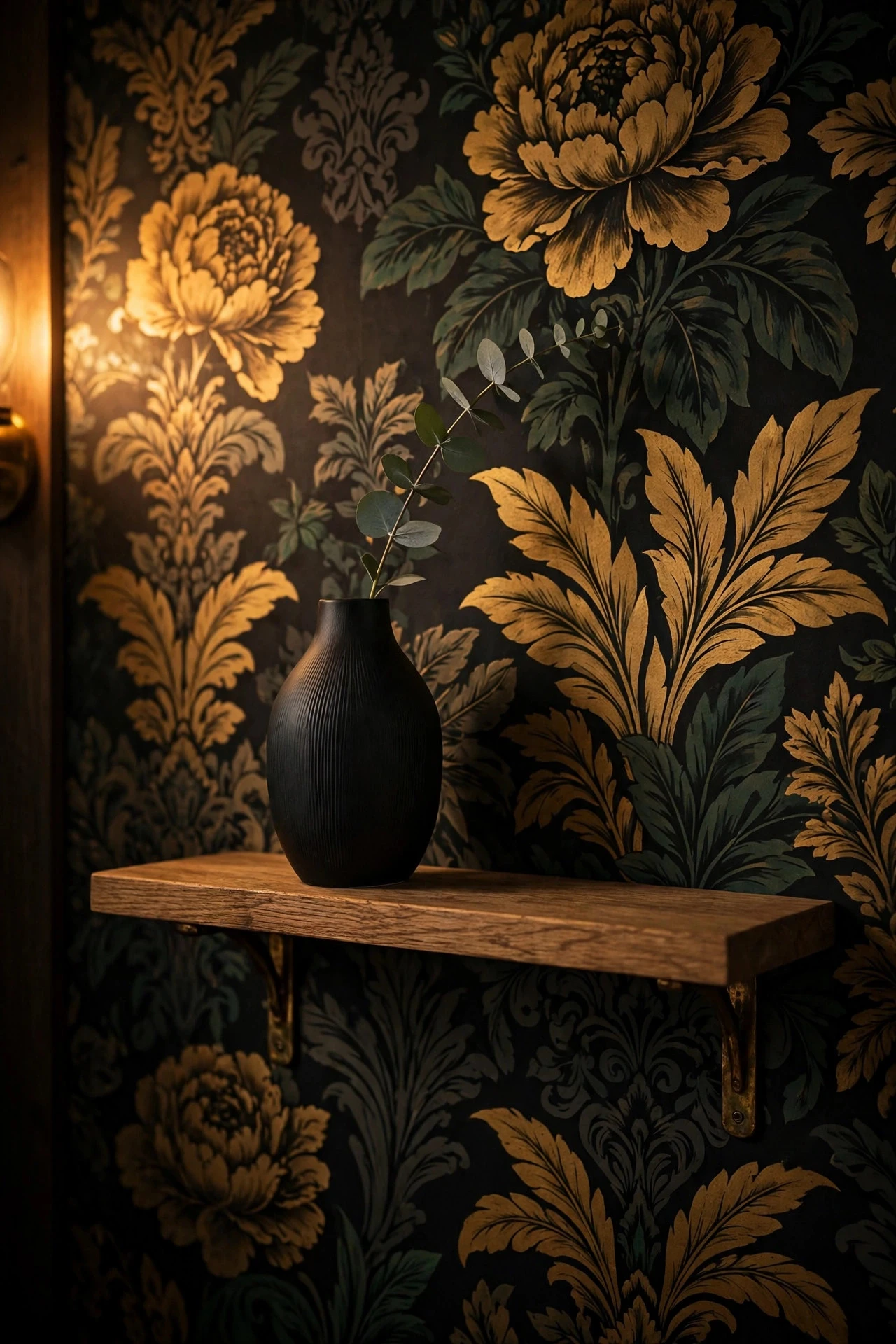
Style a shelf in a powder room boldly, because the powder room is the smallest room in the house and the one guests remember: a single shelf with a dramatic object — a black vase with one stem, a sculptural candle holder, a small framed print — against a bold wallpaper or a dark wall. A carefully placed shelf in a wallpapered powder room becomes part of a much bolder decorative composition.
Keep the shelf to two or three objects, and let the wallpaper do the work — the shelf is the frame, not the picture. Use a shelf that contrasts with the wall: a brass shelf on a dark wall, a black shelf on a patterned wall. A powder-room shelf costs £15–£30 for the shelf and the styling, and it is the cheapest way to make a small room memorable. Avoid practical items on a powder-room shelf — no spare toilet paper, no cleaning products. The powder room shelf is for show; the storage lives elsewhere.
18. How Do You Keep Bathroom Shelves From Looking Cluttered?

Keep bathroom shelves from looking cluttered by following one rule: each shelf holds no more than three to five objects, with genuine breathing room between them, and a third of the shelf stays empty. The most common mistake people make with bathroom shelving is overcrowding — the shelf ends up looking like a storage dump rather than a design moment.
Edit ruthlessly: take everything off the shelf, put back only the three best things, and move the rest to a cupboard. Use matching bottles and baskets to hide the variety, and keep the colours to two plus one metallic. If a shelf still looks cluttered with three objects, the objects are too big — swap one for something smaller, or remove it entirely. A styled shelf costs nothing to fix, because it is a matter of removing things, not buying them. The test is simple: step back to the doorway and look at the shelf. If your eye rests on one thing, it is styled. If your eye darts around, it is cluttered.
19. How Do You Style Bathroom Shelves for Christmas?
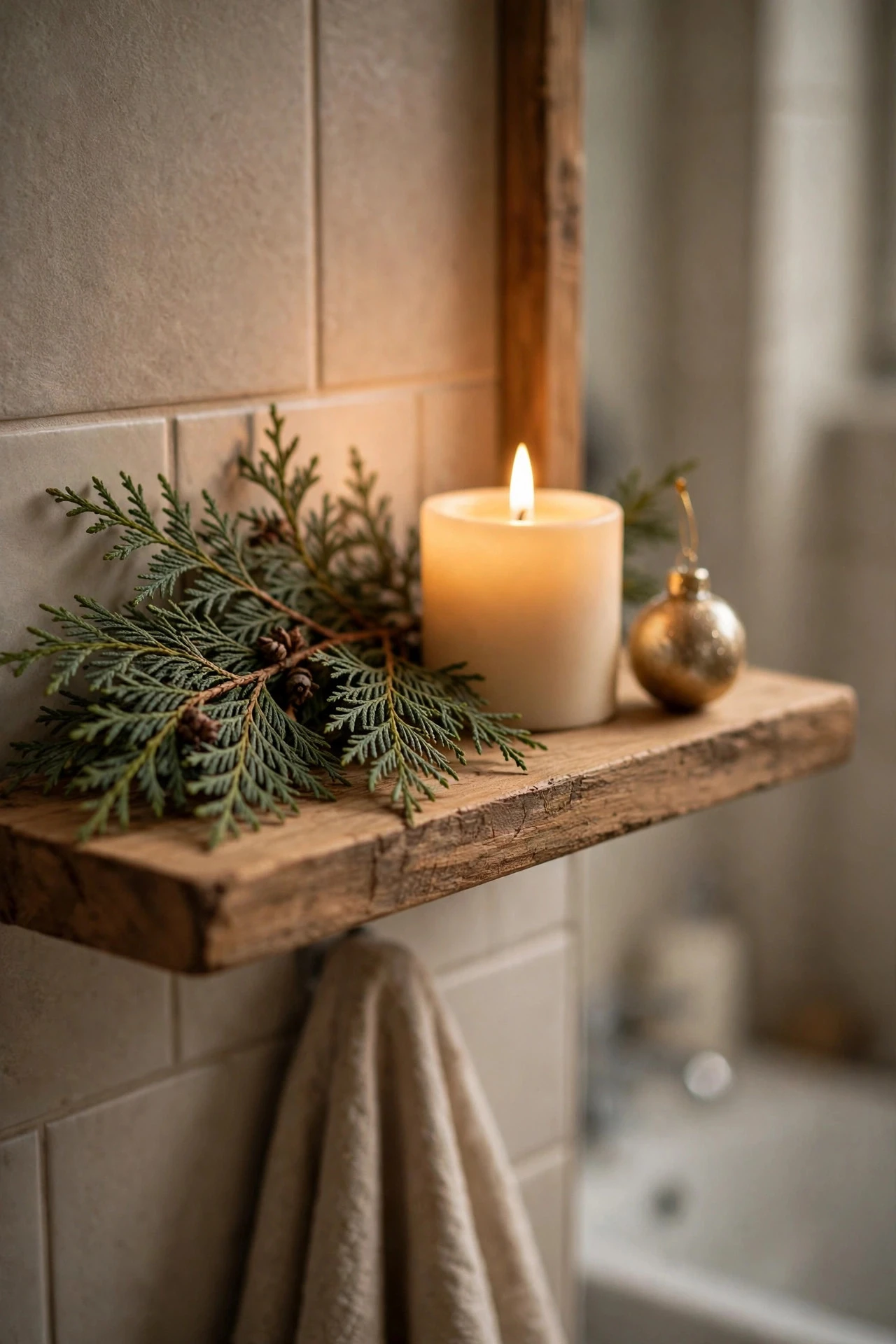
Style bathroom shelves for Christmas with three small touches: a sprig of cedar in a bud vase, a battery candle in a glass jar, and a small red or gold bauble on a ribbon, on one shelf only. The bathroom is the smallest room in the house, so Christmas on its shelves works only when it is a whisper, not a shout.
Use the same palette as the rest of the house — cedar green, warm white and one metallic — and keep the decorations off the shelf that holds the everyday bottles, so the Christmas touches do not get in the way of the morning routine. A Christmas shelf costs £5–£10 in greenery and a candle. Avoid paper decorations on a bathroom shelf — steam warps them in days — and avoid real candles near the shower curtain. For the whole bathroom at Christmas, these 22 Christmas bathroom decor ideas for a festive, spa-like room show how to dress the smallest room in the house for under £15.
20. What Materials Survive a Steamy Bathroom?
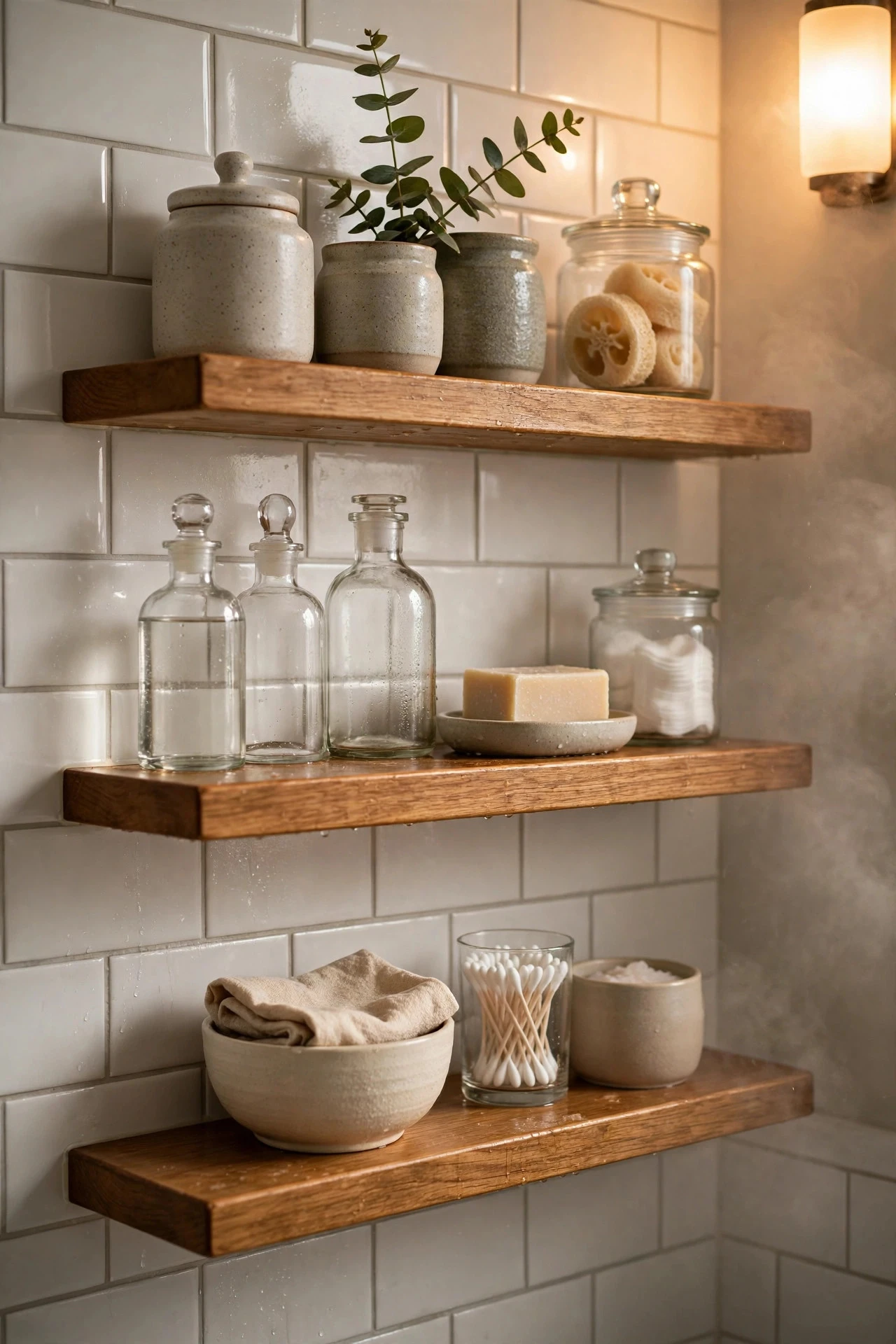
The materials that survive a steamy bathroom are ceramic, glass, stone and sealed hardwood — they take the humidity without complaint. Steam, splashes and limited depth mean every item on a bathroom shelf has to earn its place, and the material is the first test: if it warps, rusts or stains in steam, it does not belong on the shelf.
Use ceramic vases and soap dishes, glass jars and bottles, stone trays and sealed wood shelves — teak and bamboo survive steam better than pine or MDF, which swell and peel. Avoid delicate paper, unsealed woods and untreated metal, which rusts in weeks. A sealed wood shelf costs £20–£40; a ceramic vase costs £8–£15. Seal any wood shelf with two coats of waterproof varnish before you hang it, and re-seal it once a year. The mistake to avoid is a beautiful shelf in the wrong material — it looks good for a month, then warps, and the whole display has to come down.
21. How Do You Light Bathroom Shelves?

Light bathroom shelves with a warm LED strip under each shelf, so the shelf glows and the objects on it cast soft shadows on the wall below. Backlighting can completely change how bathroom shelving feels, especially in a room built around deeper colours and metal finishes — a lit shelf looks expensive, an unlit one looks like storage.
Use a warm-white strip, 2700K, stuck to the underside of the shelf, with the driver hidden behind the shelf or in the cupboard. A 1 m strip with a driver costs £12–£20 per shelf, and it runs on a plug, so no electrician is needed. For a shelf above the mirror, use a picture light instead — a strip under the shelf would glare in the mirror. Keep the light warm and dim, and put it on the same switch as the bathroom's main light, so it comes on with the room. The mistake to avoid is a cool-white strip — it makes the bathroom look like a laboratory. Warm light, hidden source, and the shelf glows.
22. How Much Does It Cost to Style Bathroom Shelves?
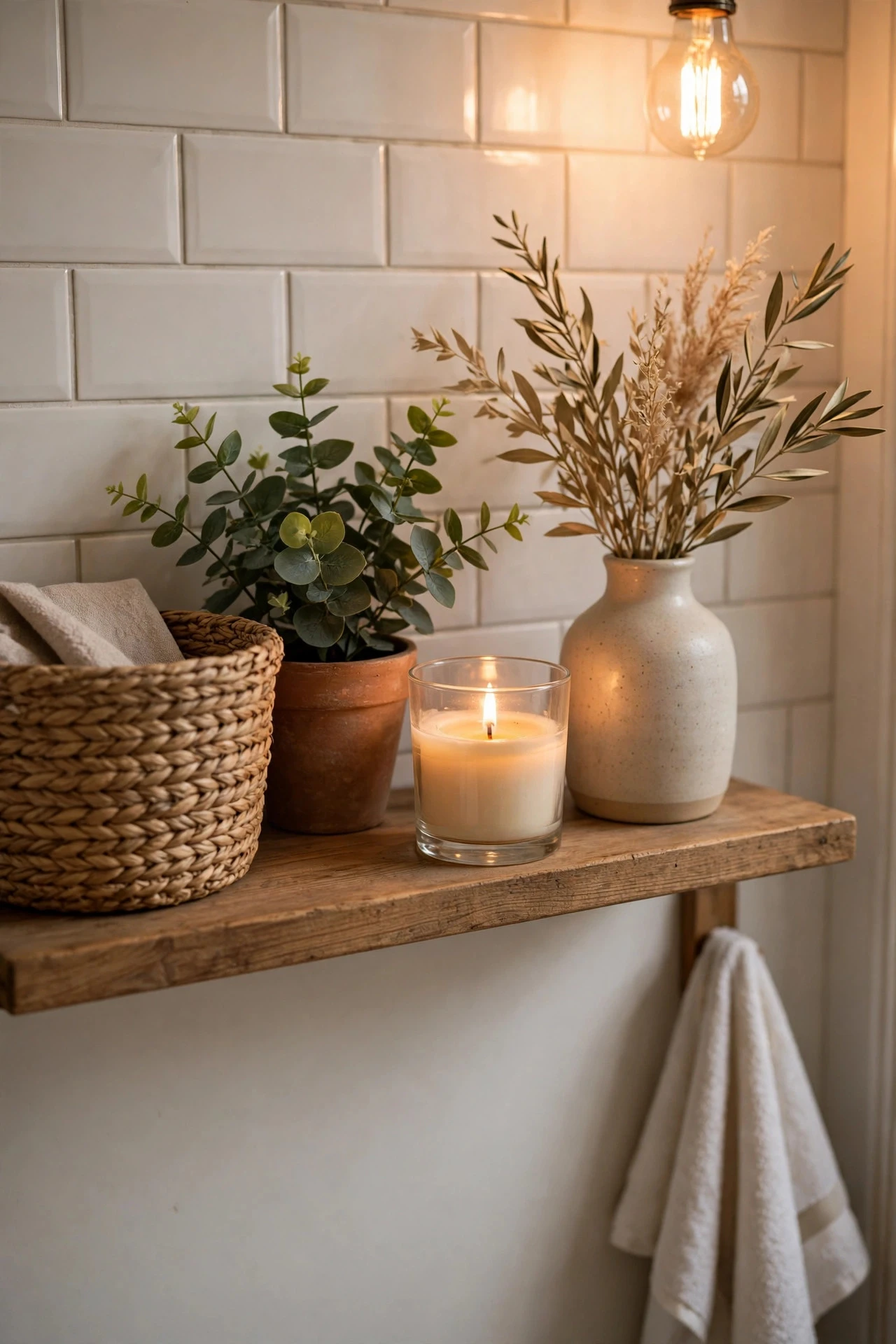
Styling existing bathroom shelves costs £20 to £60, covering a vase, a candle, a basket and a plant, with the rest coming from things you already own. Adding new floating shelves and styling them costs £60 to £150, depending on how many shelves you hang and whether you need an electrician for lighting.
Spend on the shelf first — a good shelf lasts for years — and on the baskets second, because they hide the clutter that ruins a styled shelf. The styling itself is cheap: a ceramic vase costs £8–£15, a candle £5–£10, a plant £5–£12, and the towels you already own. Set a total budget before you shop, buy the shelf and the baskets first, and add the decorative pieces last, when you can see what the shelf actually needs. For a bathroom that feels like a spa, these 22 modern bathroom tile ideas for a spa-like bathroom show how the tiles and the shelves work together.
Practical Tips
Start styling bathroom shelves by taking everything off them and putting back only the three best things — the fastest upgrade costs nothing, because it is a matter of removing things, not buying them. Then add one basket, one plant and one candle, and step back to the doorway to check the shelf: if your eye rests on one thing, it is styled.
Choose ceramic, glass, stone or sealed wood, and avoid delicate paper and unsealed woods that warp in steam. Mount the first shelf 25–30 cm above the tank, leave 25–30 cm between stacked shelves, and use fixings rated for at least twice the weight you plan to put on them. For storage, keep the practical things on the bottom shelf in baskets, and the pretty things on the top shelf where people see them. Set a total budget before you shop — £20–£60 covers styling existing shelves, £60–£150 covers new shelves and styling — and stick to it.
Final Thoughts
Bathroom shelf decor works when it follows the arithmetic: a tall piece, a mid piece and a low piece, in odd numbers, with a third of the shelf left bare, in materials that survive the steam. Whether your shelves are floating, glass, tiled niches or open vanity shelves, the rules stay the same — edit ruthlessly, repeat one accent, light the shelf warmly, and let the shelf breathe.
You may also like: our 22 luxury bathroom decor ideas for a spa-like retreat will help you pair the shelves with the right fixtures and finishes, so the whole bathroom feels brighter and more indulgent.
Frequently Asked Questions
How high should a shelf be above the toilet?
Mount the first shelf 25 to 30 cm above the toilet tank, so there is room to lift the lid and reach the towels. Leave 25 to 30 cm between two stacked shelves in a small bathroom, or about 45 cm when you stop at two shelves. Measure twice, use a level, and check the fixings are rated for at least twice the weight you plan to put on the shelf.
What do you put on bathroom shelves?
Put three things on each shelf at three heights: a tall piece like a vase of eucalyptus, a mid piece like rolled towels, and a low piece like a candle or a lidded jar. Keep the top shelf pretty and the bottom shelf practical, use baskets to hide supplies, and leave a third of the shelf empty so the display has room to breathe.
How do you keep bathroom shelves from getting cluttered?
Limit each shelf to three to five objects with genuine breathing room between them, and leave a third of the shelf empty. Take everything off, put back only the three best things, and move the rest to a cupboard. Use matching bottles and baskets to hide variety, keep the colours to two plus one metallic, and step back to the doorway to check the shelf.
What plants are good for bathroom shelves?
Pothos, ferns, spider plants and orchids all love a steamy bathroom, and a trailing pothos on a high shelf softens the hard surfaces in the room. Put the plant in a ceramic or glass pot with a saucer, keep it out of direct splash, and wipe the leaves monthly. Avoid succulents, which rot in a steamy bathroom, and keep to one plant per shelf.
Can you put wood shelves in a bathroom?
Yes, if the wood is sealed: teak and bamboo survive steam better than pine or MDF, which swell and peel. Seal any wood shelf with two coats of waterproof varnish before you hang it, and re-seal it once a year. Ceramic, glass and stone need no sealing and take the humidity without complaint, so they are the safest choice for a steamy bathroom.
How many items should go on a bathroom shelf?
Three to five items per shelf, with a third of the shelf left empty. Three is the ideal number: a tall piece, a mid piece and a low piece, in odd numbers, with genuine breathing room between them. More than five objects on one shelf reads as storage, not styling, however good the objects are.