Tree Topper Ideas: How to Crown Your Christmas Tree in Style
The tree topper is the smallest decoration on the Christmas tree and the one that draws the eye first. It crowns the tree, finishes the silhouette and tells everyone what kind of Christmas you celebrate — a classic star for tradition, an angel for nostalgia, a bow for a relaxed modern home. Yet it is also the decoration most people get wrong: too big, too heavy, leaning at an angle, or fighting the colour scheme instead of finishing it.
Below are 22 tree topper ideas with the sizing rule, the anchoring tricks and the exact measurements that keep every topper straight and in proportion, plus real prices for every style from a $12 DIY star to a $90 hand-blown finial. The rule to remember is simple: your topper should measure 10 to 15 percent of your tree's height, and the tree plus the topper should stop 5 to 10 cm below the ceiling. Get those two numbers right and almost any topper looks good.
Looking for more inspiration? Our Nest Decorz homepage gathers the latest home decor ideas, seasonal decorating guides and room-by-room styling tips in one place — start there and explore.
Quick answers
– Size the topper to the tree — a topper should be 10 to 15% of the tree's height: 18 to 27 cm on a 180 cm tree, and the tree plus topper should stop 5 to 10 cm below the ceiling. – Anchor it with wire, not hope — wrap green florist wire around the top branch and the topper's base, then twist it tight; most leaning toppers are simply unsecured. – Match the topper to the tree's style — slim trees need light, narrow toppers; full trees can carry heavy glass; flocked trees suit matte white or silver. – Weight is the hidden limit — a topper over 300 grams needs a stiffened branch or a support dowel, especially on real trees and tabletop trees. – Budget $15 to $40 for a beautiful topper — stars, bows and DIY crowns are the cheapest; hand-blown glass finials and lit angels cost $60 to $90.
1. What Size Tree Topper Should You Choose?
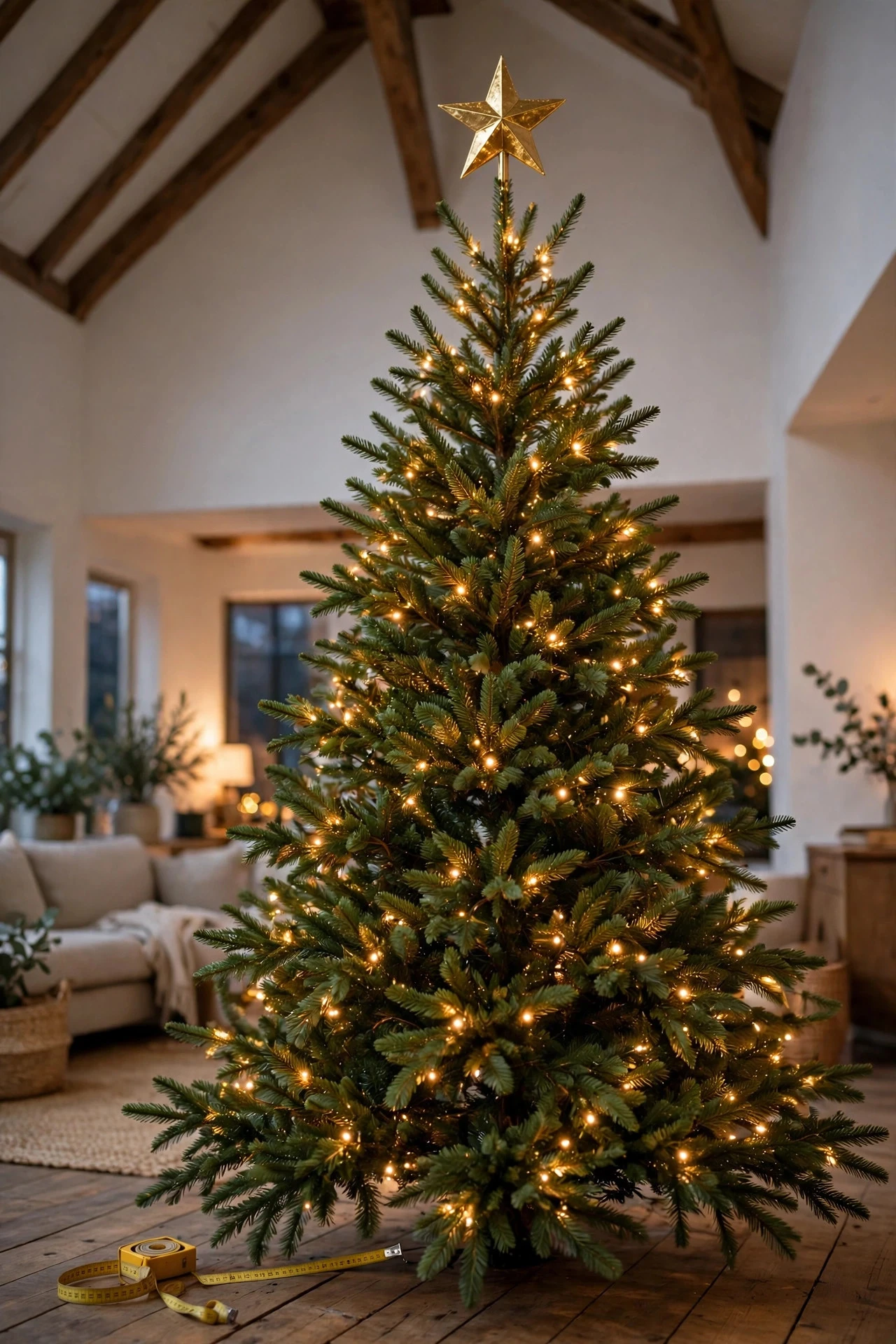
Choose a topper 10 to 15 percent of your tree's height — 18 to 27 cm on a 180 cm tree. The tree plus the topper should stop 5 to 10 cm below the ceiling, so a 240 cm ceiling takes a 180 cm tree with a topper no taller than 25 cm.
On a 150 cm tree the range is 15 to 22 cm, and on a 210 cm tree it is 21 to 32 cm. For width, keep the topper narrower than half the width of the tree's top 30 cm of branches — roughly 15 to 20 cm on a standard tree — so it reads as a crown, not a hat.
The most common mistake is buying a topper you loved in the shop without measuring it against your tree. A 35 cm star on a 150 cm tree looks like a lighthouse; a 12 cm finial on a 210 cm tree disappears completely. Measure your ceiling first, subtract the tree height, and write the maximum topper height on your phone before you shop.
2. How Do You Keep a Tree Topper Straight All Season?
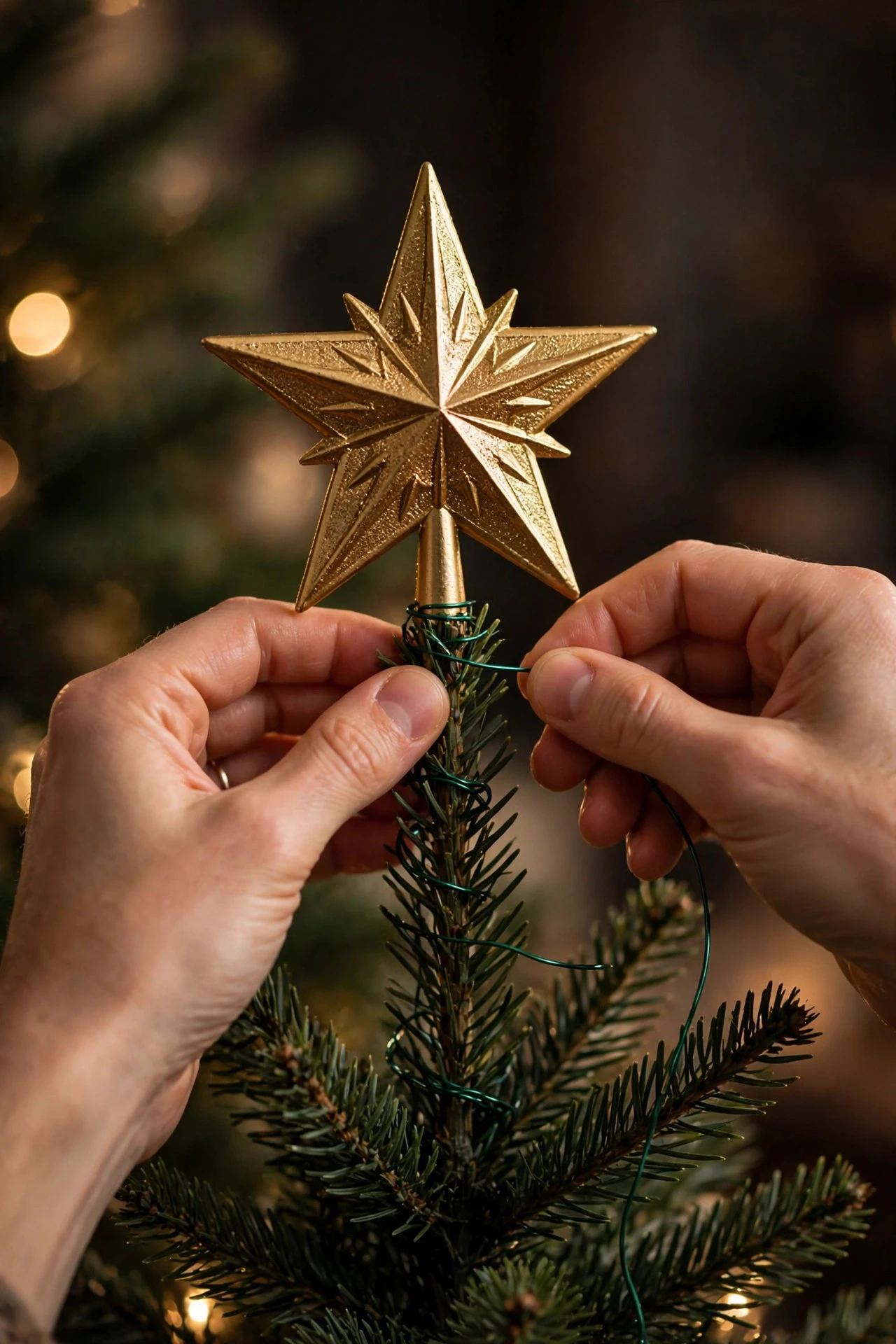
Keep a tree topper straight by wiring it to the top branch with green florist wire: thread the wire through the topper's base, wrap it twice around the topmost branch, and twist it tight with pliers. A cone or clip base alone cannot grip a tapered branch.
Bend the top branch itself before you fit the topper — on an artificial tree, fold the top 15 cm of the branch into a short vertical spike, so the topper slides down onto a straight post. On a real tree, trim the leader branch to 10 cm above the last side branches, leaving a clean straight stem. If the topper is heavy, add a 30 cm wooden dowel: push it down inside the tree's centre pole or tie it to the trunk with twine, then slide the topper onto the dowel. These 22 Christmas tree ideas for a warm stylish home show how a well-finished tree top completes the whole silhouette.
3. How Does a Classic Star Tree Topper Work?
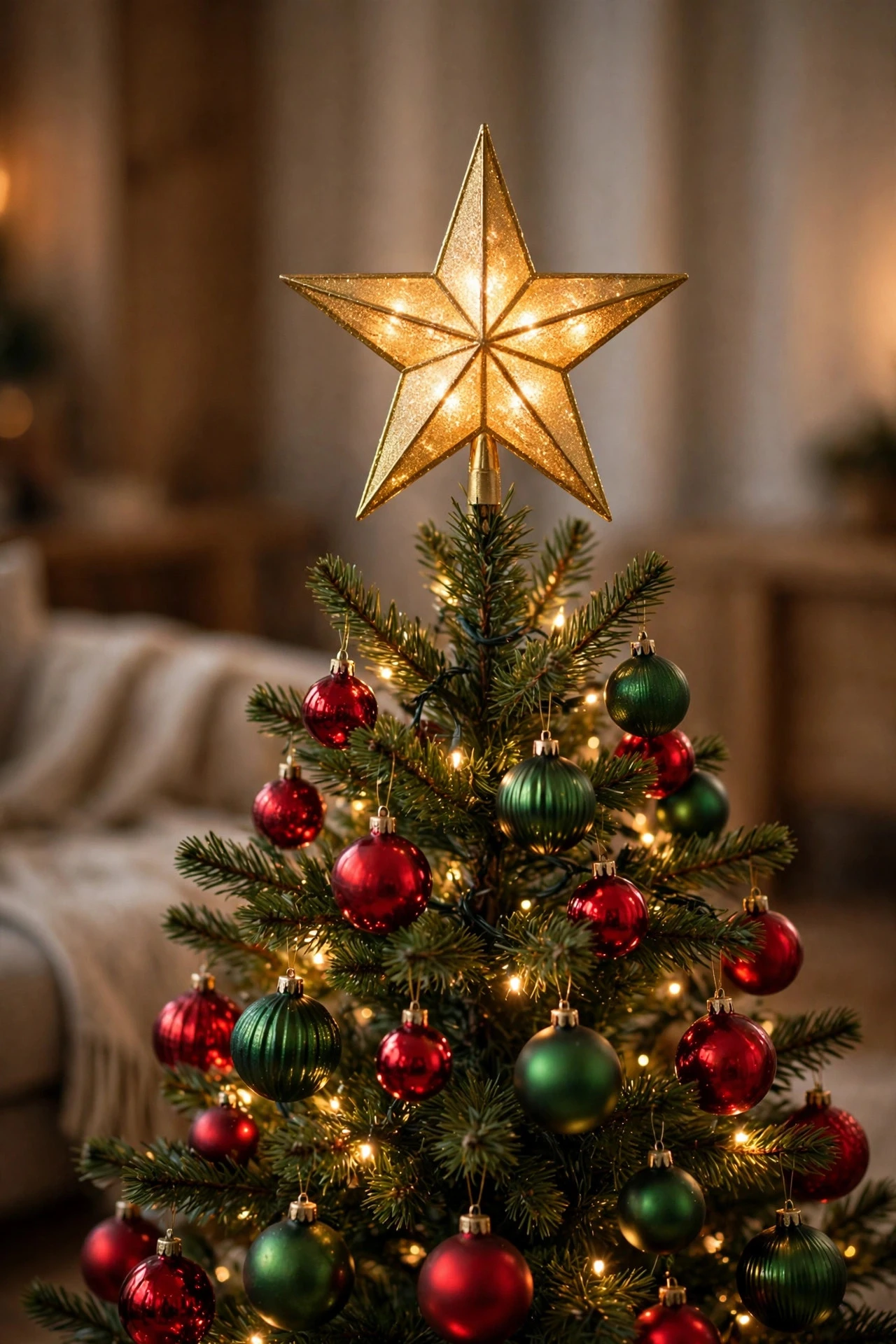
A classic star topper slides its hollow cone base over the tree's top branch, so the star sits upright and centred above the last row of branches. Choose a five-pointed star 18 to 25 cm tall for a 180 cm tree, in gold, silver or champagne, in metal or hard plastic.
Paper stars droop in humidity, and a star under 200 grams stays straight without extra wiring.
The star is the oldest tree-topper tradition, and it still suits almost every style: a brass star on a red and green tree, a silver star on a white and blue tree, a champagne star on a flocked tree. Prices run $15 to $35 for a good metal star, and $40 to $60 for a lighted one with warm-white LEDs built in. Avoid stars with loose glitter — it sheds onto the floor and the presents below. If your star leans, wrap one loop of florist wire around its base and the branch, as described in idea 2, and it will hold all season.
4. Why Choose an Angel Tree Topper?
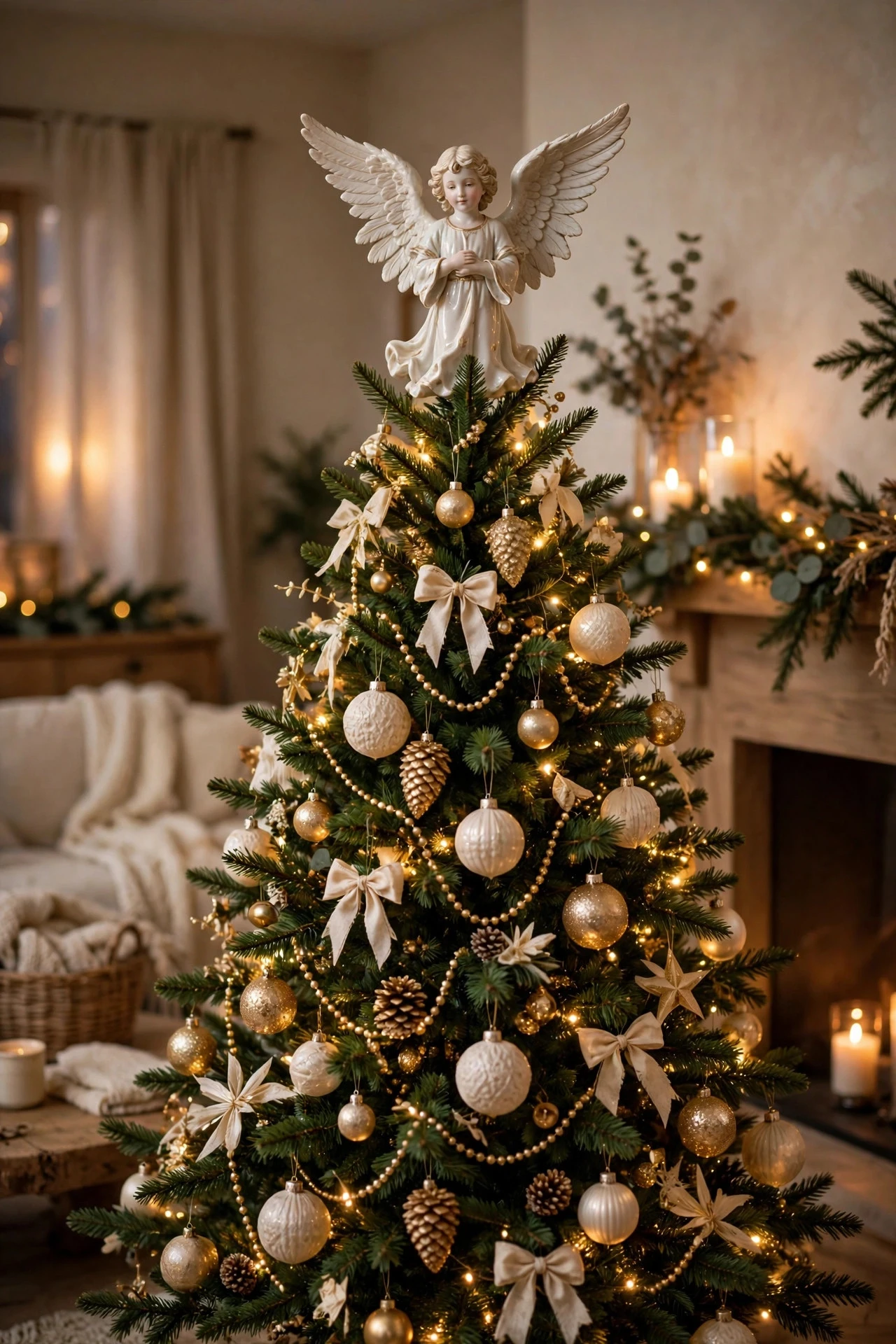
Choose an angel topper when you want a soft, traditional crown with movement — porcelain, resin or fabric angels catch the light and read as gentle from across the room, where a metal star reads as sharp. A good angel is 20 to 30 cm tall and weighs 200 to 350 grams.
A good angel topper costs $25 to $60, with hand-painted porcelain angels at the top of that range.
Angels suit traditional and nostalgic trees best: cream and gold angels on red and green trees, white angels on flocked trees, and vintage-style angels with feathered wings on trees with heirloom ornaments. Because angels are wider than stars — wingspans reach 15 to 20 cm — measure the width against your tree's top branches before buying, or the wings will push the upper branches sideways. Secure an angel with two wires, one on each side of its base, because its weight sits off-centre. Angels and heirloom ornaments work beautifully together on a traditional tree.
5. How Do You Style a Bow as a Tree Topper?

Style a bow topper by tying a large wired-ribbon bow — two loops of 25 to 30 cm each with two tails of 40 to 50 cm — wiring its centre to the top branch, then letting the tails cascade down the front of the tree for 60 to 80 cm.
Wired ribbon is essential: unwired ribbon collapses within a day, while wired edges hold their loops for the whole season.
A bow topper costs $10 to $25 in ribbon, and it is the most forgiving topper of all — there is no glass to break, no weight to anchor, and it suits relaxed, modern and farmhouse trees where a formal star would look stiff. Velvet ribbon in burgundy or forest green suits traditional trees; plaid ribbon suits farmhouse trees; sheer organza in champagne suits glamorous trees. Make the loops slightly uneven so the bow looks handmade, and add a sprig of faux pine in the centre to hide the wire.
6. What Is a Finial Tree Topper, and When Does It Work Best?
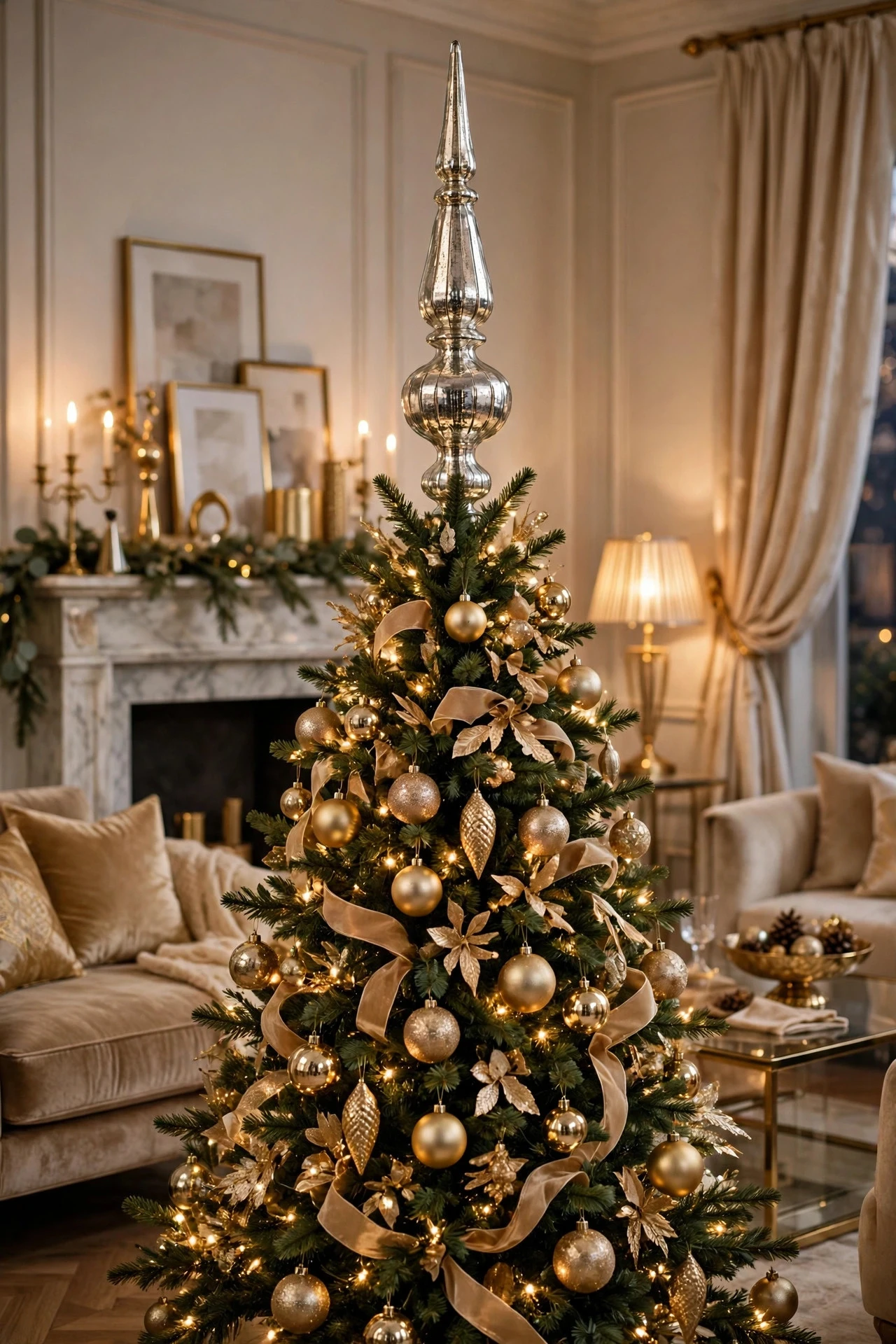
A finial tree topper is a tall, teardrop-shaped glass or metal ornament that slides over the top branch like a slender crown, usually 25 to 35 cm tall and 8 to 12 cm wide. It suits elegant, full trees and tall trees over 210 cm, where its height matches the scale.
It works best where a star would look too traditional — glamorous trees in gold and champagne, and minimalist trees with a tight colour scheme.
Finials cost $30 to $90, with hand-blown glass at the top end, and they are the heaviest common topper at 250 to 500 grams, so they need the dowel support from idea 2 on anything but the stiffest artificial tree. Their strength is reflection: a mirrored or mercury-glass finial catches the fairy lights and doubles the sparkle at the top of the tree. Buy one with a sturdy cone base at least 8 cm deep — shallow bases wobble — and never use a finial on a real tree with a soft, thin leader branch.
7. How Do You Make a DIY Paper Star Tree Topper?
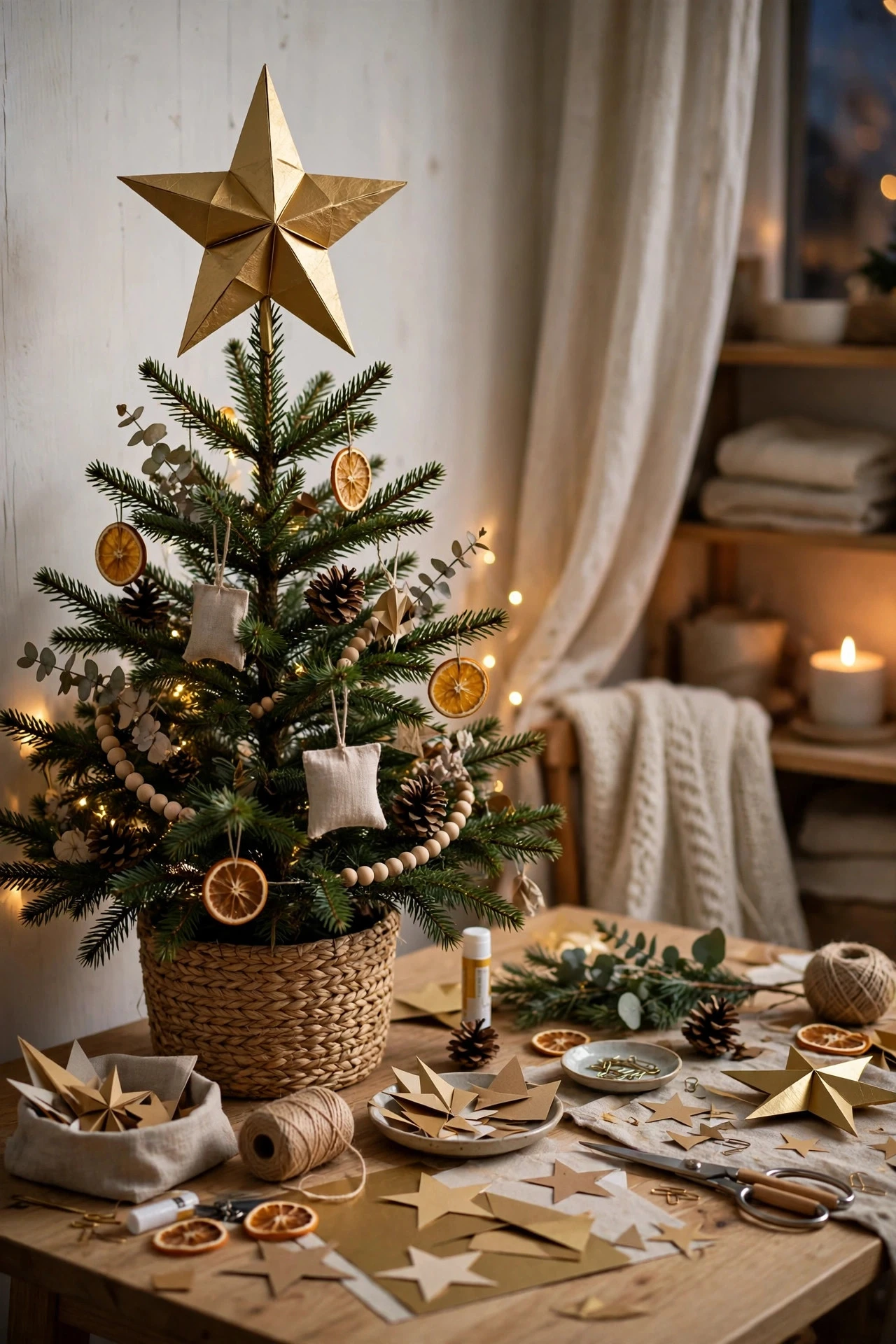
Make a DIY paper star by cutting five identical diamond shapes from heavy card or gold foil paper, scoring and folding each into a three-dimensional point, then gluing the points into a star and attaching a 10 cm cardboard cone to the back as the base.
The whole project costs $5 to $12, takes about an hour, and a star of 20 to 25 cm suits a 180 cm tree.
Use card of at least 250 gsm so the points hold their shape, and reinforce the centre with a second layer of card or a circle of hot glue. Gold, cream or kraft paper stars suit Scandinavian and minimalist trees; red and green stars suit children's trees. The advantage of a DIY star is control: you choose the exact size, colour and finish, and you can remake it every year for the price of a coffee. The Christmas tree has carried a star on top since the tradition spread across Europe, so a handmade star connects your tree to the oldest version of the custom.
8. Why Does a Wooden Tree Topper Suit a Rustic Tree?
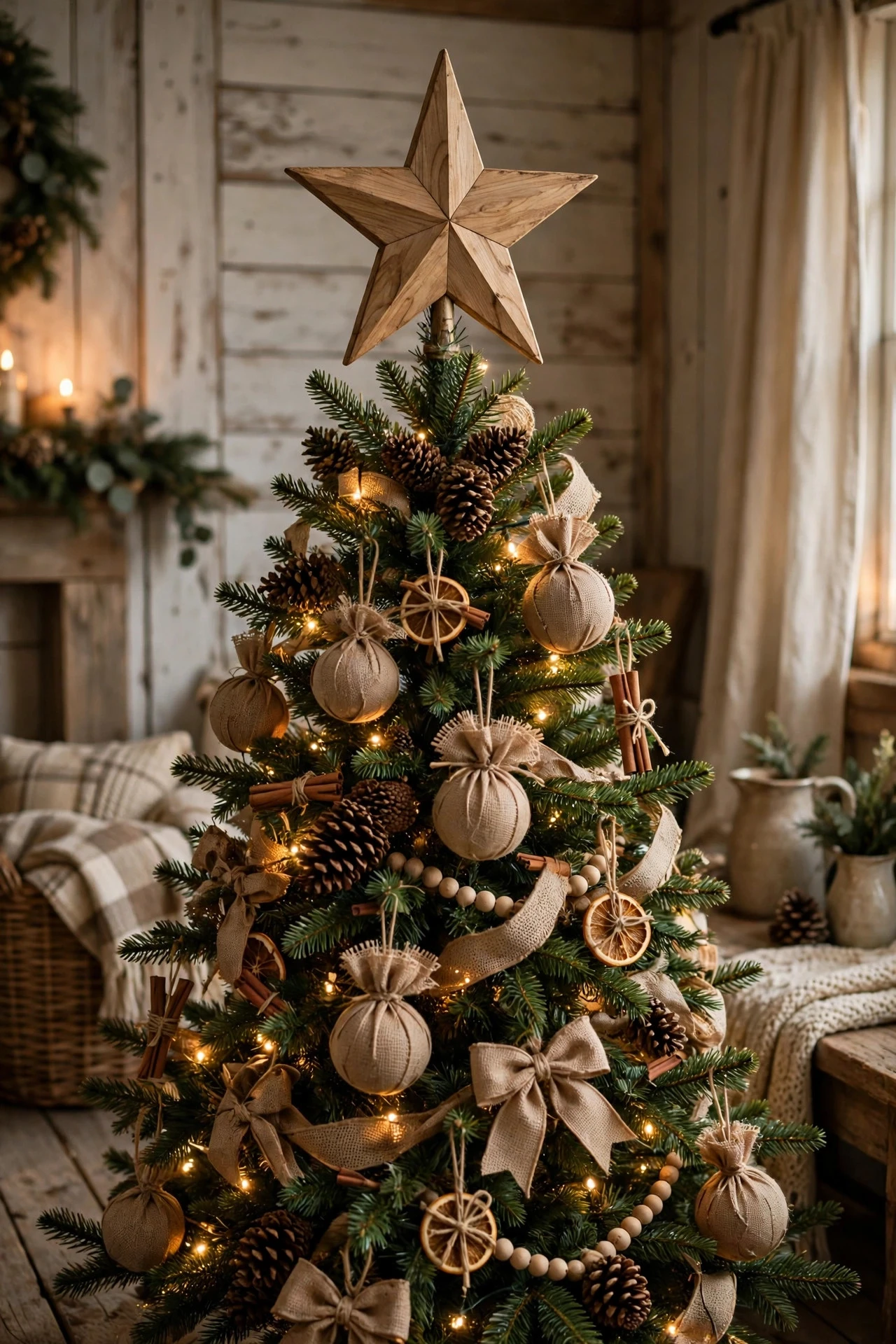
A wooden topper suits a rustic tree because its matte, natural texture balances the shine of baubles and fairy lights, and it never fights the other wooden ornaments — pinecone, burlap and twig — that define farmhouse and Scandinavian styling.
Wooden stars, snowflakes and reindeer toppers cost $12 to $30, weigh 100 to 200 grams, and sit easily on slim or real trees without extra support.
Look for toppers cut from birch plywood or reclaimed barn wood, 18 to 25 cm tall, with a sanded finish and a wide cone base. Painted wooden stars in cream or sage green suit a muted farmhouse palette; natural wood with a clear wax finish suits a Scandi tree with white and wood tones. Add a small burlap bow at the base to hide the joint between topper and branch. Avoid varnished wood with a high gloss — it reads as plastic under fairy lights, and the whole point of a wooden topper is its honest, matte texture.
9. How Do You Choose a Crystal or Glass Tree Topper?
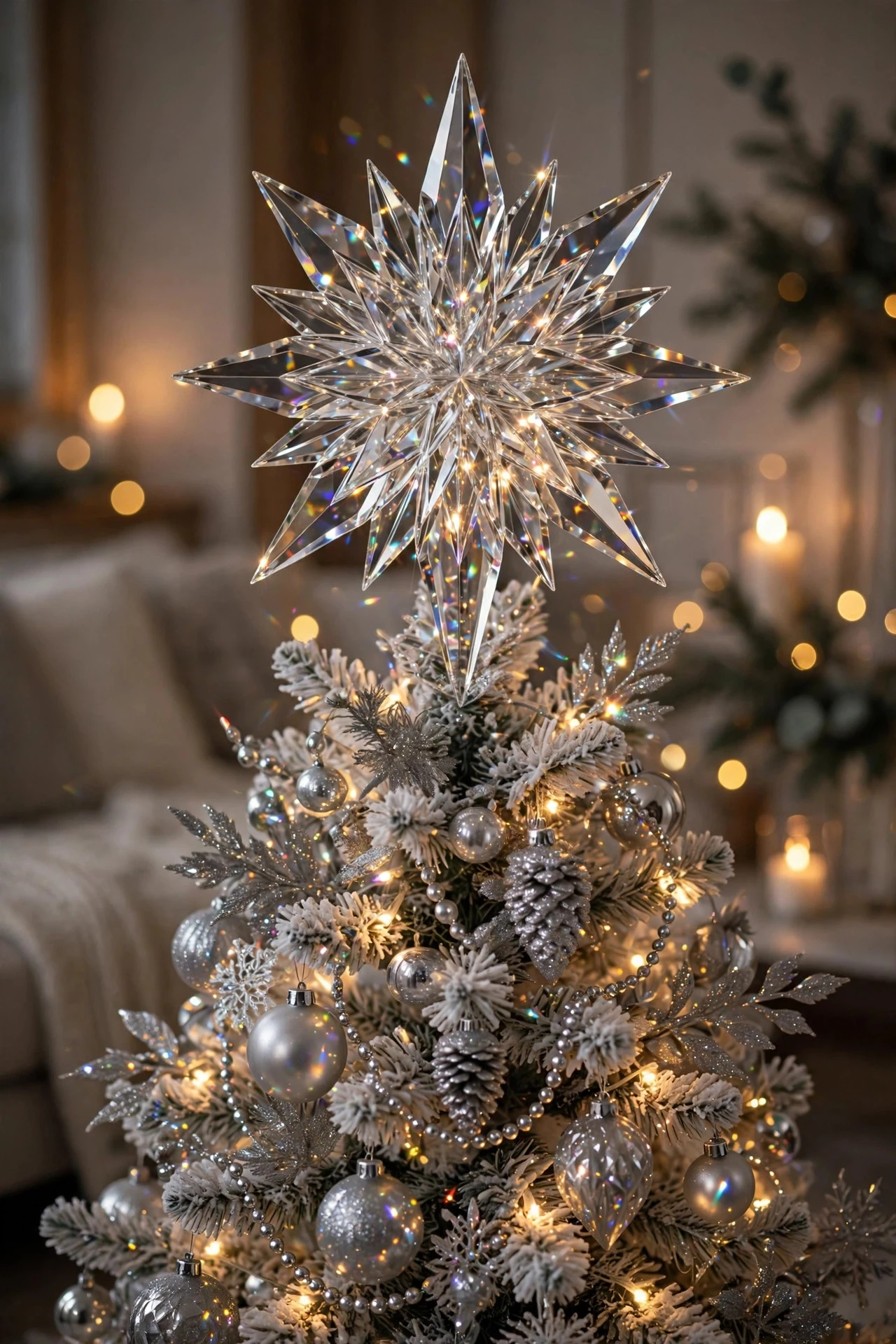
Choose a crystal or glass topper by checking three things: the weight, the base depth and the light. Pick one under 300 grams, a cone base at least 8 cm deep so it seats firmly, and hold it up to a light — good glass refracts into rainbow flecks, while cheap glass looks flat and grey.
Prices run $40 to $90 for hand-blown glass, and $25 to $45 for moulded crystal-look resin.
Glass toppers suit glamorous and modern trees best: a clear crystal star on a white and silver tree, a smoked-glass finial on a navy and gold tree, a champagne-gold glass angel on a flocked tree. Handle them with cotton gloves when fitting — fingerprints show on glass under fairy lights — and store them in their original box with tissue, never loose in a bag with baubles. If you have small children or a cat that climbs, choose resin instead of glass: it looks identical from two metres away and bounces instead of shattering.
10. Should Your Tree Topper Light Up?
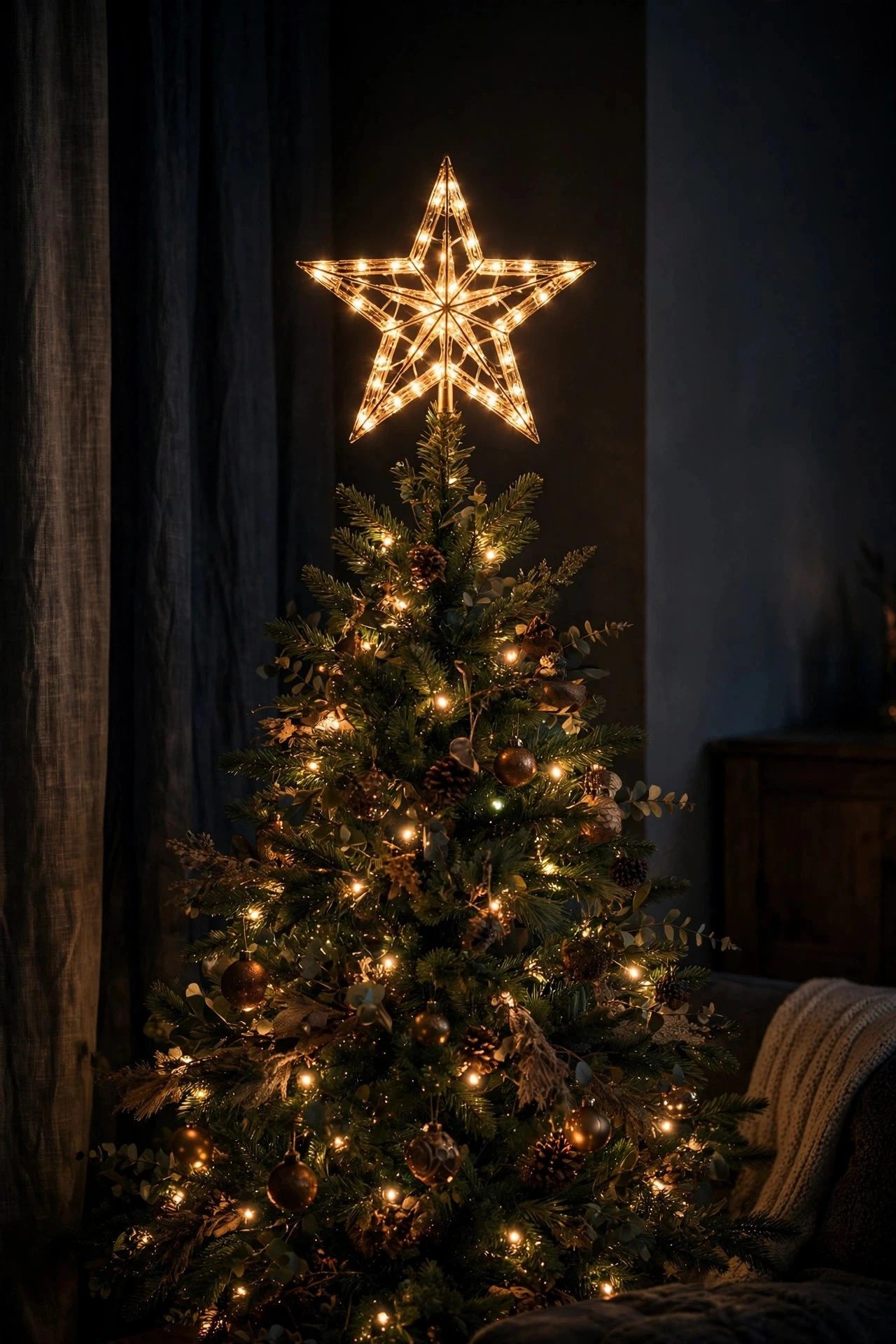
A light-up topper is worth it when your tree sits in a dark corner or you want the top of the tree to glow after the room lights go off — an LED star or angel adds a focal point of light at the very top, where the tree's own fairy lights are thinnest.
Lighted toppers cost $30 to $60, run on batteries or plug into the tree's light string, and use warm-white LEDs at 2700K to 3000K so they match the tree lights.
Battery toppers need two or three AA batteries and last about 30 hours on a timer — set the timer for 5 pm to 10 pm and they light themselves every evening. Plug-in toppers draw power from the tree's light set and never need batteries, but check the plug type matches your tree before buying. The one mistake to avoid is a cool-white LED topper on a warm-white tree: the colour clash is visible from the doorway. A glowing topper works with the rest of the room's layered lighting.
11. What Tree Topper Works Best on a Slim Tree?
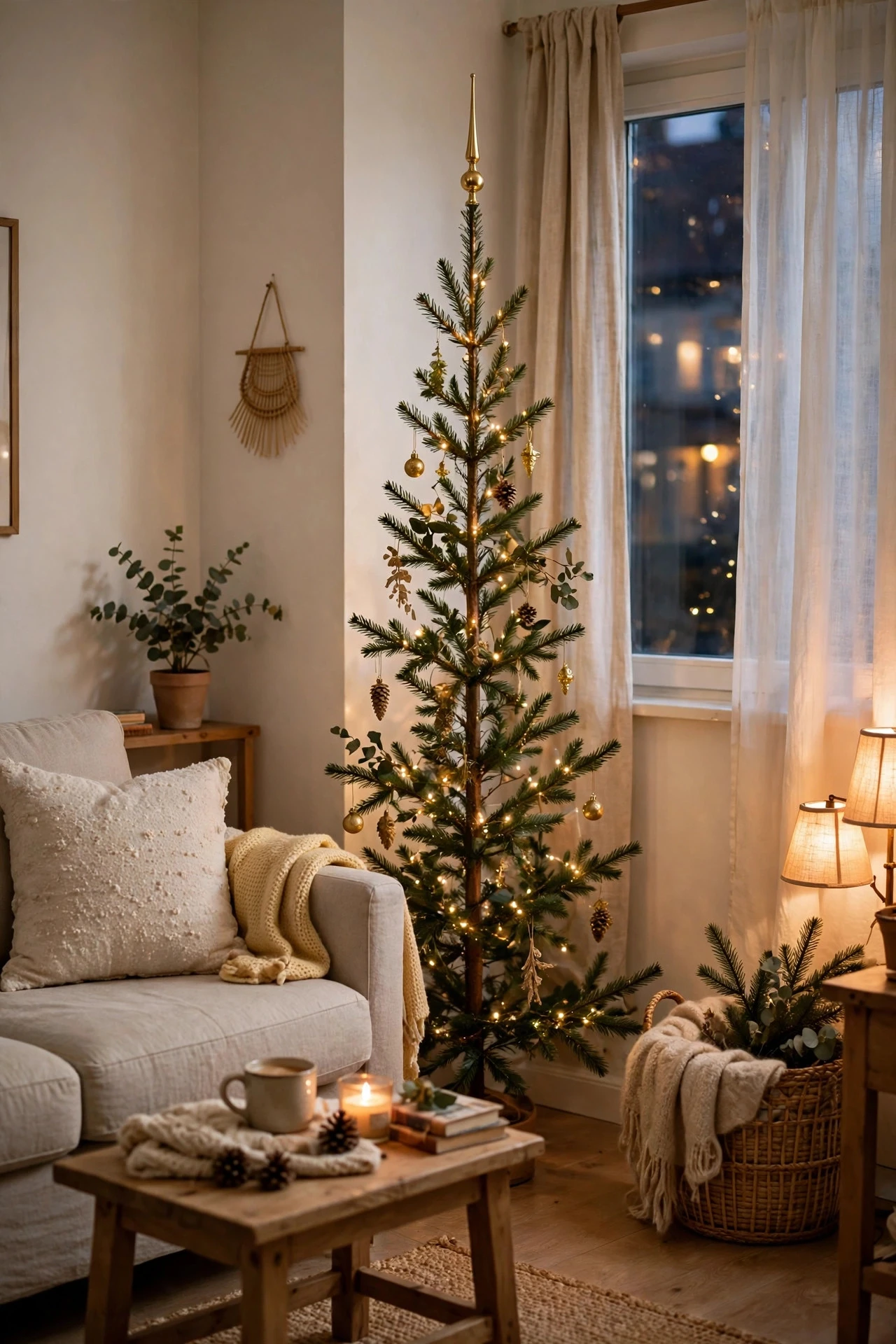
The best topper for a slim tree is a narrow, lightweight one — a slim star, a tall thin finial or a small bow — no wider than 12 to 15 cm and no heavier than 200 grams, because a slim tree's top branches are thin and close together.
A wide angel or a heavy glass topper will push the top branches outward and leave a visible gap between the topper and the tree.
Slim trees, 70 to 90 cm wide, are common in flats and small living rooms, and their topper should echo their vertical lines: a 25 cm slender finial in gold, a 20 cm narrow star with long points, or a small wired bow with tails cascading down the front. Keep the topper's height in the same 10 to 15 percent rule — 18 to 25 cm on a 180 cm slim tree — but choose the narrowest version of the style you like. A slim tree with a proportionate topper looks taller and more elegant than a full tree with the wrong topper.
12. How Do You Top a Flocked Christmas Tree?

Top a flocked tree with a matte white, silver or clear-glass topper, because flocking already gives the tree a snowy texture and a shiny coloured topper fights it. A white ceramic star or a silver finial reads as part of the frost, not as a separate object sitting on it.
A clear glass angel works too, and it disappears into the snow in the same way.
Flocked branches support toppers well, but the flocking sheds when you push a cone base down hard — brush the top branch clean first, then fit the topper gently and wire it in place. Avoid red or green toppers on a flocked tree: the colour contrast is so strong that the topper looks stuck on rather than belonging. A white bow with silver ribbon tails is the softest option and costs under $20, while a mercury-glass finial at $40 to $60 is the most glamorous. These flocked Christmas tree ideas show how the topper, the ornaments and the tree skirt should all share the same snowy palette.
13. Real Tree or Artificial Tree — Does the Topper Change?
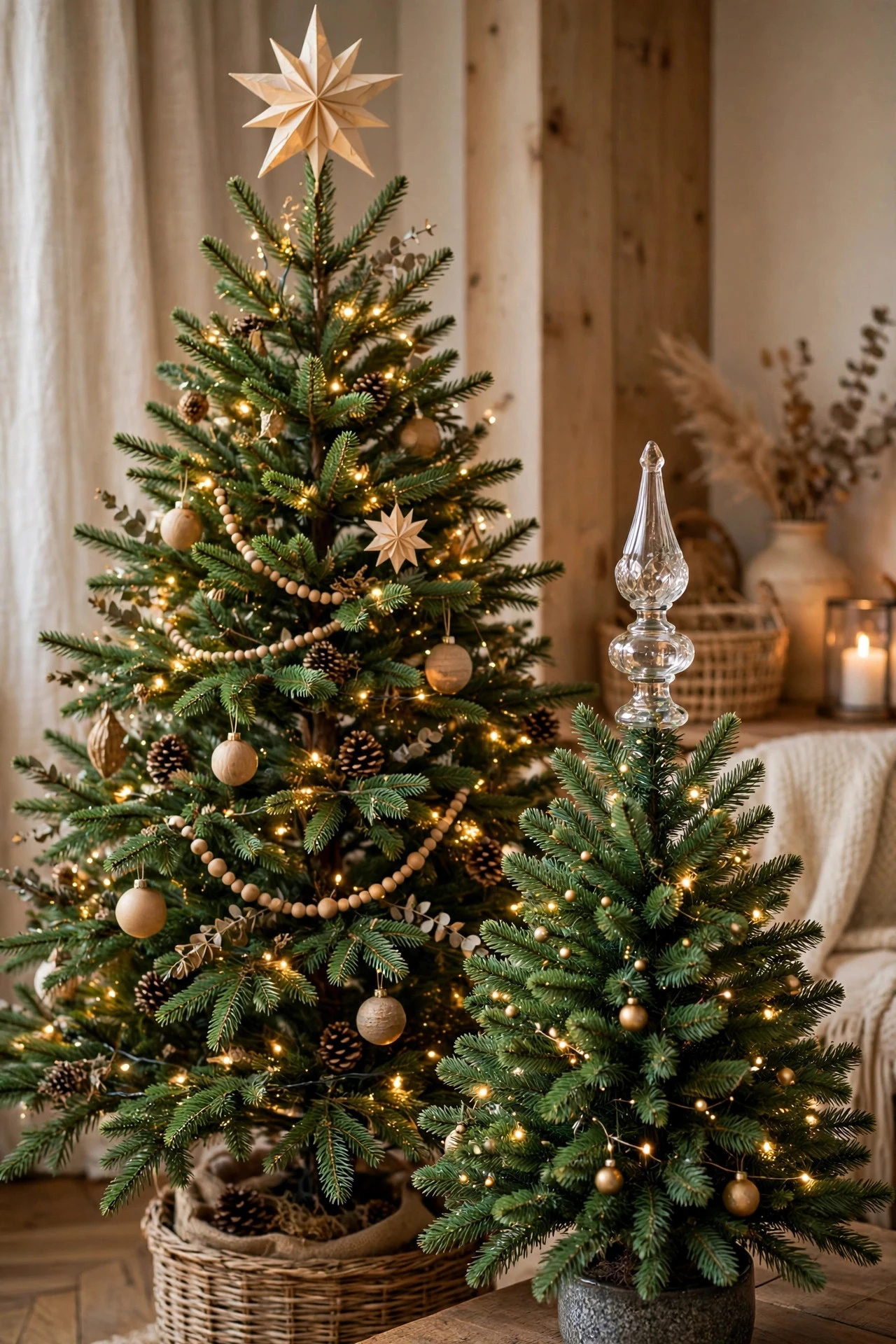
Yes, the topper changes with the tree type: a real tree has a soft, flexible leader branch that bends under weight, so it needs a topper under 250 grams — a paper star, a small bow or a light resin angel — plus a wire anchor.
An artificial tree has a stiff metal pole and hinged branches, so it can carry a heavy glass finial or a large lighted star of 400 to 500 grams with only a wire to keep it straight.
On a real tree, trim the leader to 10 cm above the last side branches and let the cut end dry for a day before fitting the topper, so sap does not glue the base to the branch. On an artificial tree, fold the top branch into a vertical spike and slide the topper's cone over it — the metal branch grips the cone better than a real branch ever will. The Christmas ornament tradition covers both tree types, but the engineering is different: real trees forgive nothing, artificial trees forgive almost everything.
14. How Do You Make a Ribbon Cascade Tree Topper?
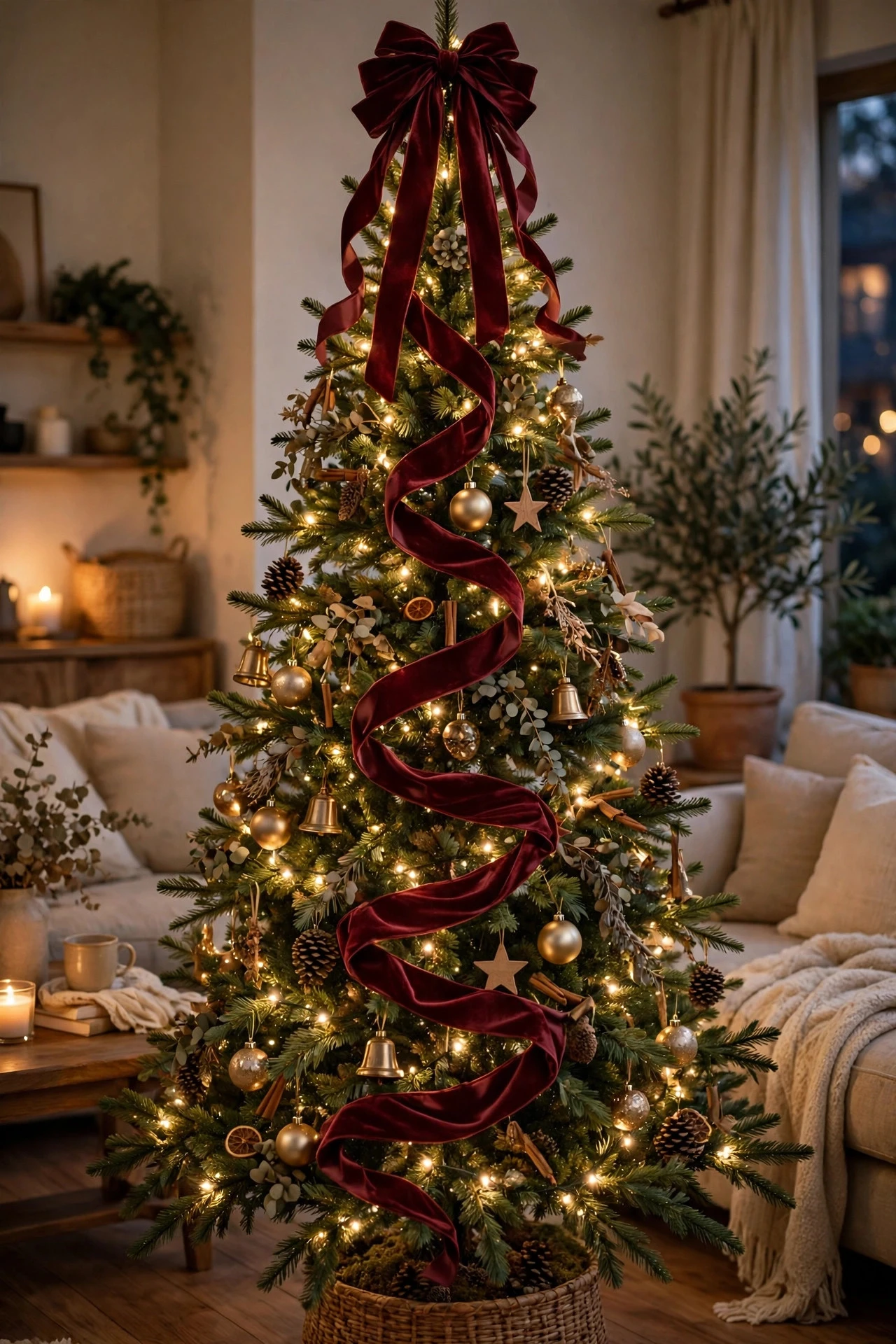
Make a ribbon cascade by wiring a large bow to the top branch, then cutting three to five ribbon tails of different lengths — 60 cm, 80 cm and 100 cm — and letting them spiral down the front of the tree, pinning each tail to a branch with a green twist tie every 25 cm.
The cascade turns the topper into a vertical decoration that connects the crown of the tree to its middle, and it costs $15 to $30 in wired ribbon.
Layer a narrow 2.5 cm metallic ribbon over the wide 6 cm velvet or satin ribbon for depth. Cut the ribbon ends into a V shape so they look finished, and keep the tails on the front face of the tree only — ribbon wrapped around the back is invisible and wasted. A cascade suits full trees best, where the ribbon has branches to rest on; on a slim tree, use two tails instead of five so the tree does not disappear behind ribbon.
15. Why Is a Snowflake Tree Topper So Popular Right Now?
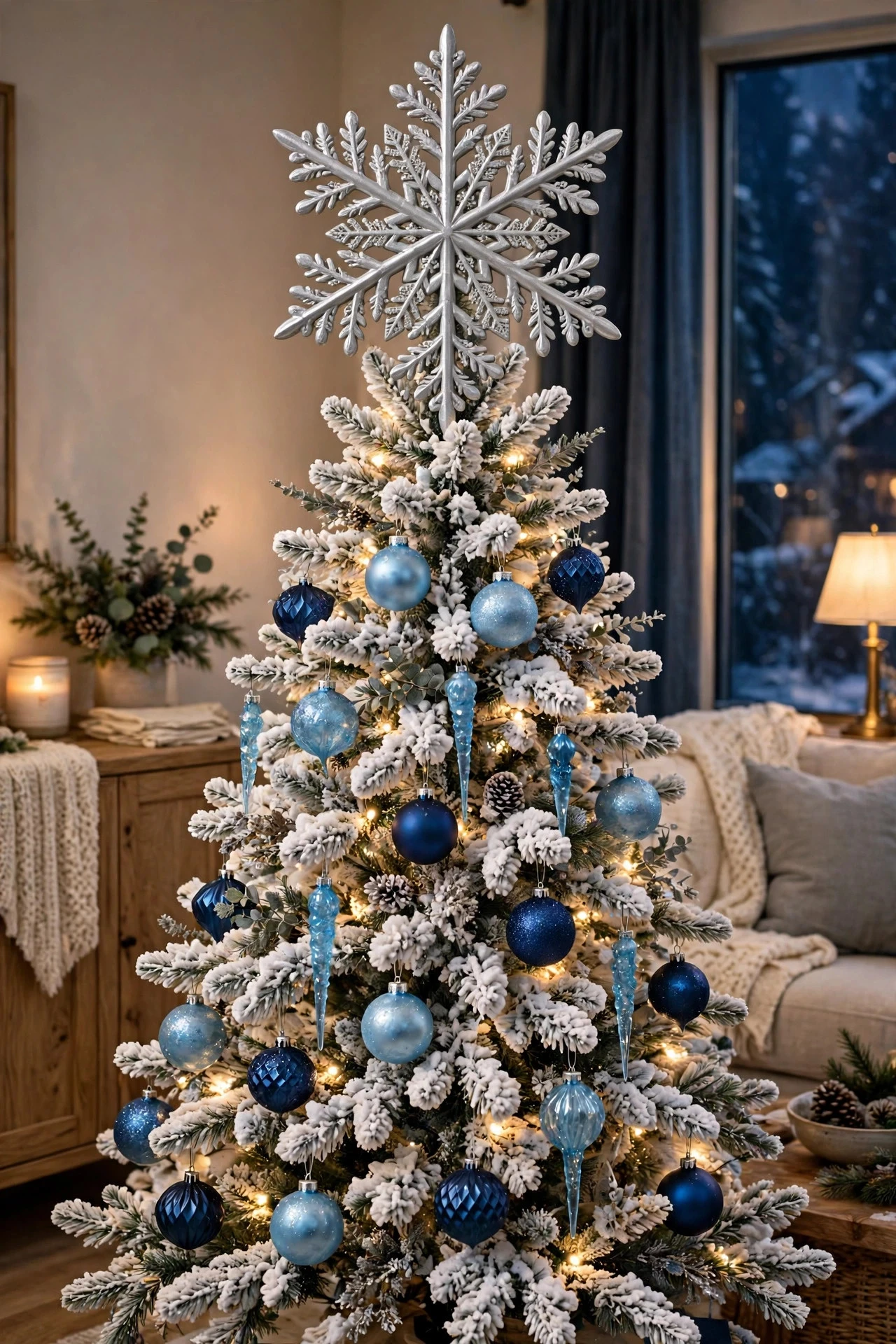
A snowflake topper is popular right now because it suits the winter-white and Scandinavian trees that dominate current decorating, and it reads as seasonal rather than religious — it works for any household, from white and silver to ice blue and navy.
Snowflake toppers cost $15 to $40, come in metal, wood and acrylic, and measure 20 to 30 cm across, so they suit trees of 180 cm and taller best.
Choose a matte-finish snowflake with a strong centre and six symmetrical arms — glossy plastic looks cheap under fairy lights, while matte metal or wood reads as crafted. Because a snowflake is wide and flat, it needs two wires to hold it upright, one on each side of its base, and it must face the room's main seating, not the wall. Pair it with snowflake ornaments lower on the tree, so the topper echoes the tree instead of standing alone, and keep the rest of the tree in cool tones — warm reds and golds clash with a snowflake's winter palette.
16. How Do You Style a Vintage or Antique Tree Topper?
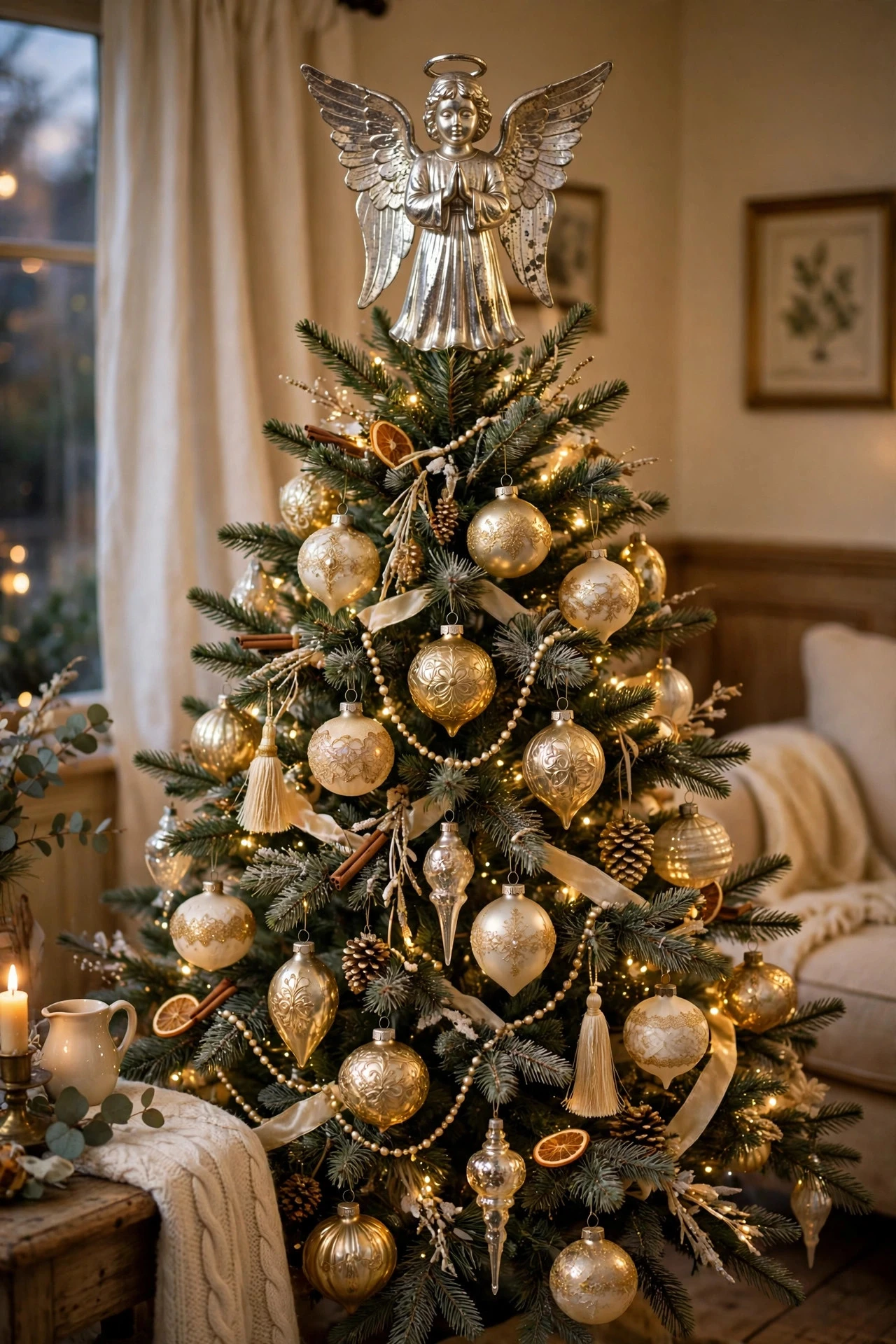
Style a vintage topper by letting it be the tree's single heirloom piece and keeping everything else simple — a 1950s glass angel, a mercury-glass star or a hand-painted porcelain topper carries its own history, and a tree crowded with modern glitter ornaments will drown it.
Genuine vintage toppers cost $40 to $120 at antique shops and online, while good reproductions cost $25 to $50.
Check a vintage topper before you buy it: look for a base that still fits a modern branch — old toppers were made for thinner real-tree leaders — and test the wiring on any lighted vintage piece, because old bulbs and frayed cords are a fire risk. Display a vintage topper on a tree with a muted palette — cream, gold and soft green — and add three or four vintage ornaments in the same era to tie it together. A traditional palette lets an heirloom topper shine without competition.
17. What Does a Modern Minimalist Tree Topper Look Like?
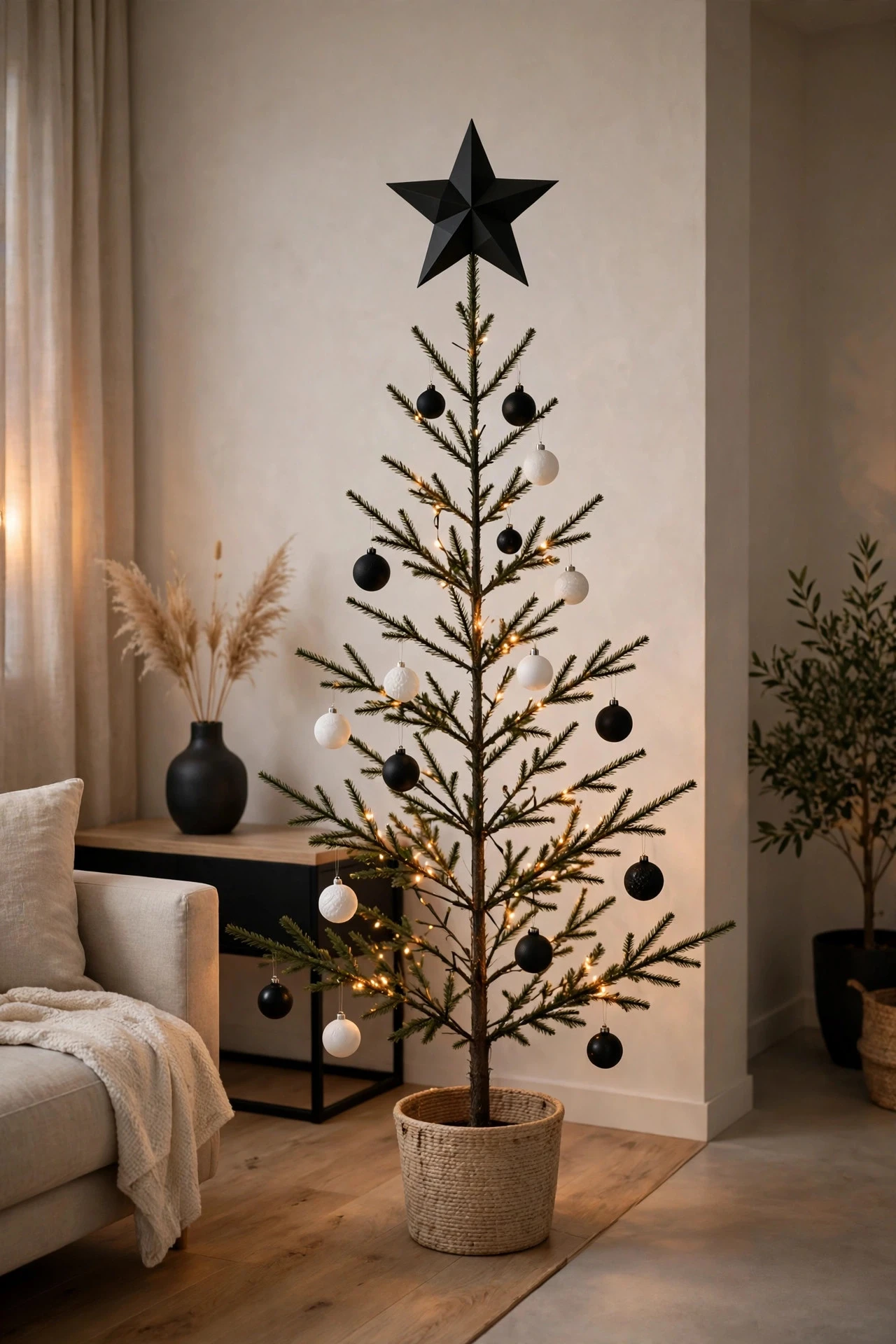
A modern minimalist topper is a single geometric shape in one material — a matte black metal star, a brushed-gold cone, a white ceramic sphere on a stem — with no glitter, no colour and no extra decoration. It measures 15 to 22 cm tall and suits trees in one or two colours with plenty of empty branch showing.
It costs $20 to $50.
The minimalist topper works because it respects the tree: on a sparse, design-led tree, a fussy angel or a glittery star would look like a mistake, while a clean geometric shape reads as intentional. Match the metal to the tree's ornaments — brushed gold with gold baubles, matte black with black and white baubles, white ceramic with a white and wood tree. Keep the topper's finish matte, because gloss reads as traditional and matte reads as modern, and wire it in place even though it is light — a minimalist topper that leans ruins the whole clean effect.
18. How Do You Top a Small Tabletop Christmas Tree?

Top a small tabletop tree with a topper no taller than 10 to 12 cm and no heavier than 100 grams, because a tabletop tree of 60 to 90 cm has thin branches and a narrow base that tips easily. A mini star, a tiny bow or a small wooden snowflake works.
A full-size topper will pull the tree over the first time someone brushes past the table.
The sizing rule scales down exactly: 10 to 15 percent of a 90 cm tree is 9 to 14 cm, so measure before you buy and ignore anything labelled "standard size". Use a topper with a clip base rather than a cone — clips grip thin tabletop branches better — and place the tree at least 15 cm from the table edge so a leaning topper cannot push it off. Tabletop toppers cost $5 to $15, and a DIY mini star from gold card is the cheapest option of all. A tabletop tree with a tiny topper can carry a whole bedroom or hallway.
19. How Do You Match a Tree Topper to Your Colour Scheme?
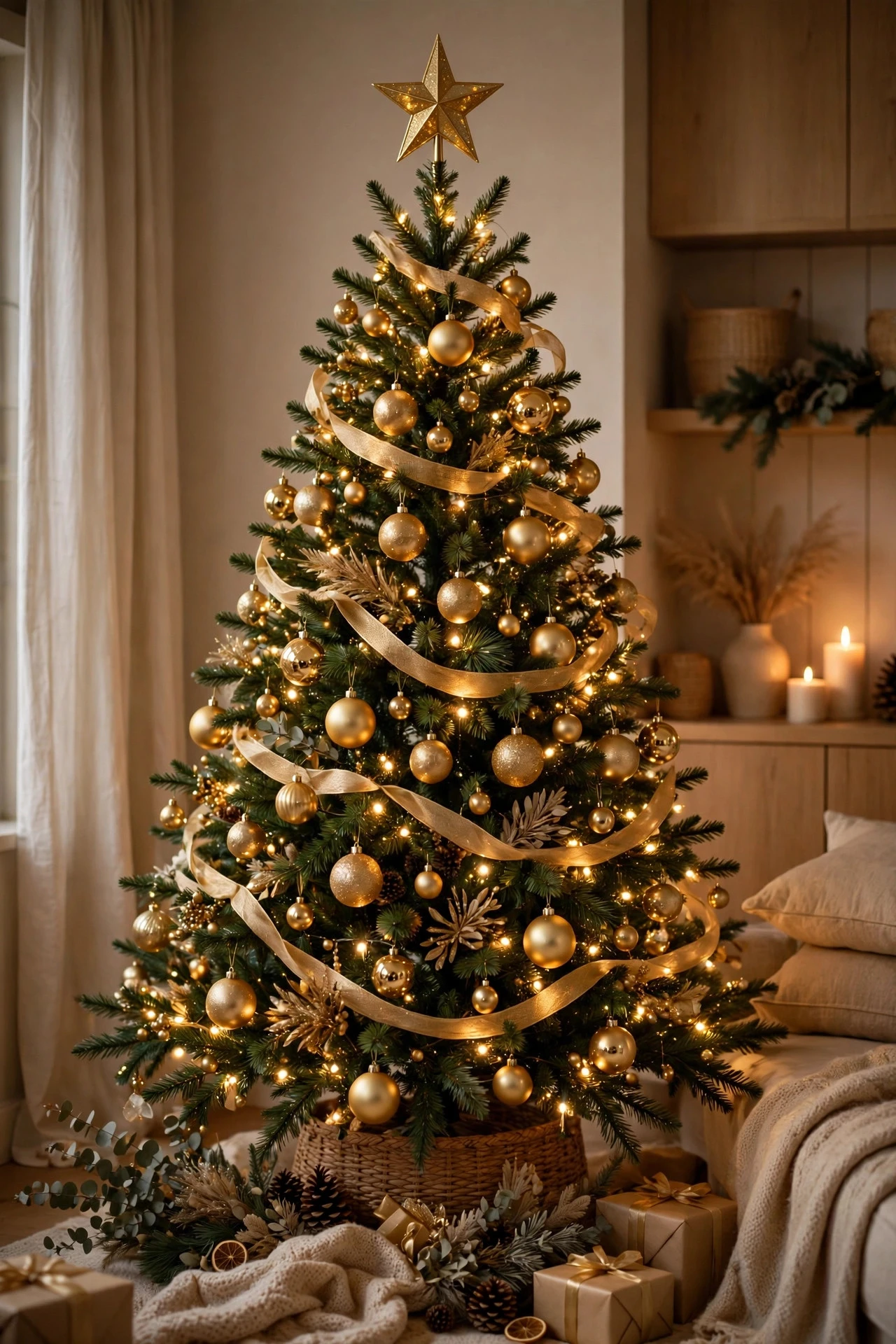
Match a topper to your colour scheme by making it the same metallic as your baubles and the same colour family as your ribbon: gold topper with gold baubles, silver topper with silver baubles, and a topper in your second colour only if that colour already appears at least five times on the tree.
A topper that introduces a brand-new colour looks like a mistake, not a statement.
Metallics are the safest choice: a gold, silver or champagne topper works with almost any palette, because metallics read as neutral at the top of a tree. If your tree is red and white, a red bow topper or a gold star both work; if your tree is navy and silver, a silver finial or a white star works, but a gold star would clash. Buy the topper after the baubles, so you can check the match in the room's actual light. These 22 tinsel Christmas tree ideas for a sparkling holiday home show how a metallic topper picks up the sparkle of tinsel without competing with it.
20. What Is the Best Tree Topper Under $25?
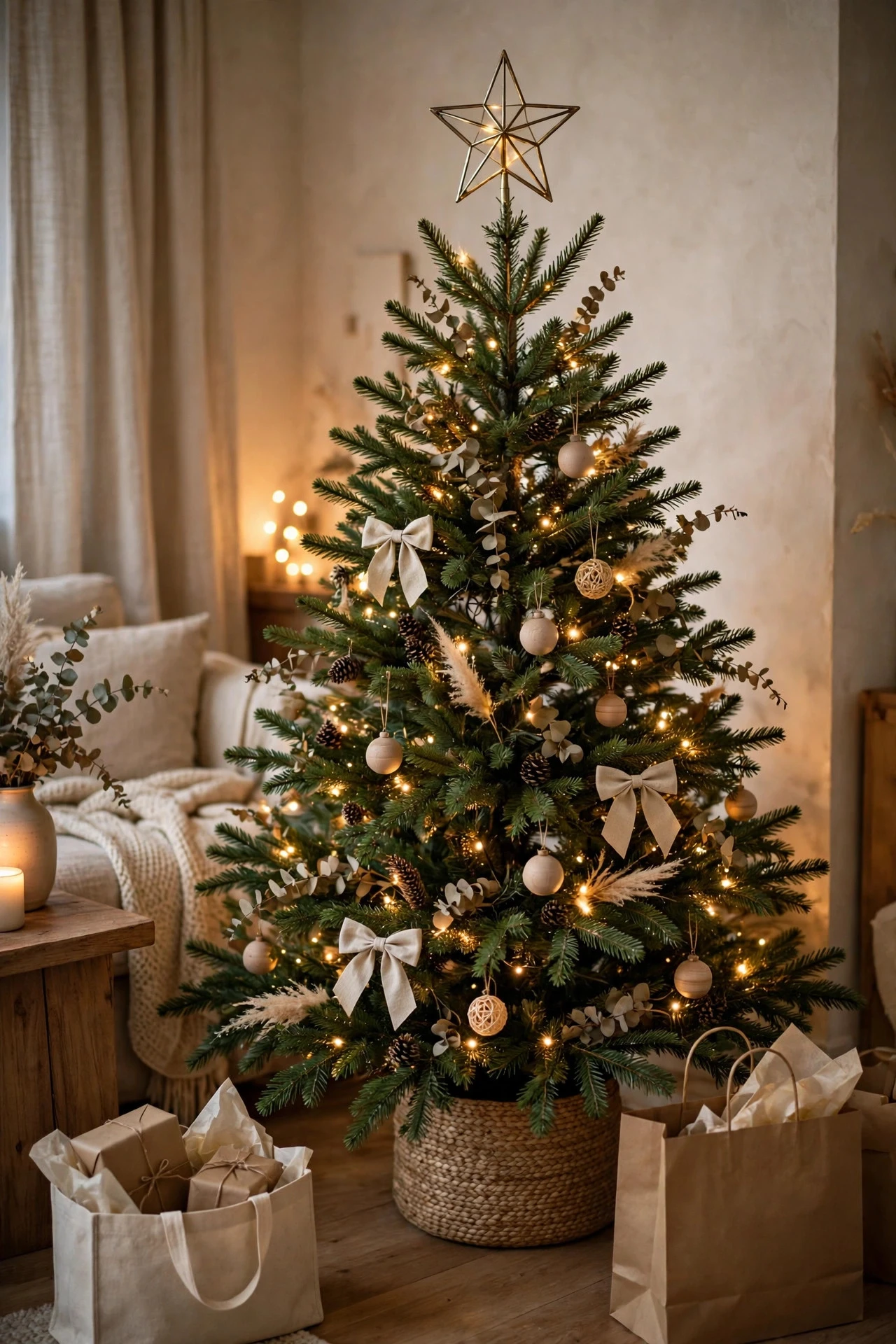
The best topper under $25 is a wired-ribbon bow or a metal star in a plain finish, because both look expensive at a low price and neither needs extra support. A good metal star costs $12 to $20, a wired-ribbon bow $10 to $18, and a wooden star $12 to $22.
All three suit a 180 cm tree and weigh under 200 grams, so they stay straight with a single wire.
Shop for toppers in the first week of November, when the full range is in stock and before the best designs sell out, and check discount stores and craft shops before department stores — the same metal star often costs half as much in a craft shop. Avoid toppers under $8: the cone base is usually too shallow, the glitter sheds, and the metal is thin enough to bend. A $15 star with a deep cone base and a solid finish will outlast a $7 star by years, and it looks better from the doorway on the first day.
21. When Should You Choose an Oversized Statement Topper?
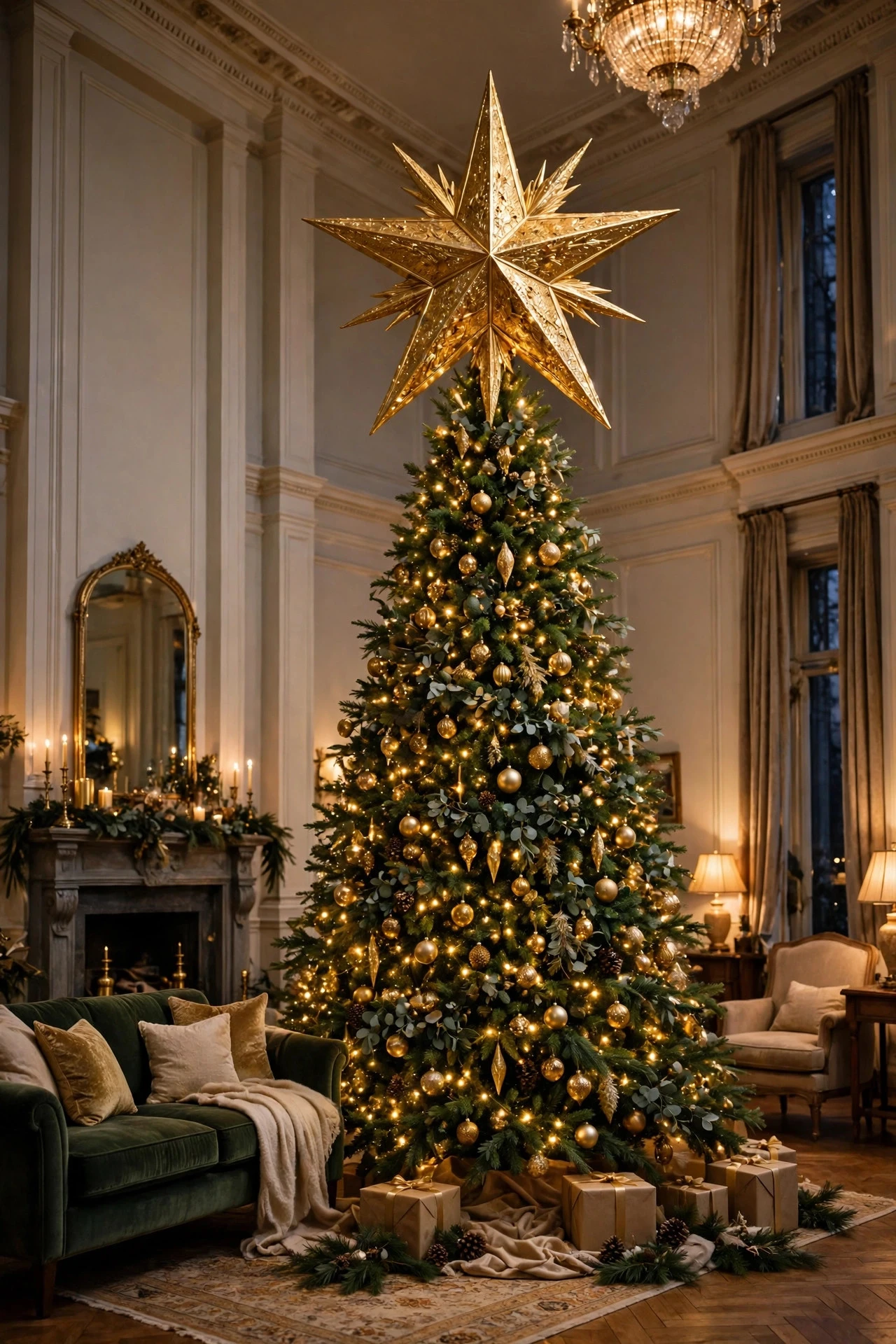
Choose an oversized statement topper — 30 to 40 cm tall, 15 to 20 percent of the tree's height — only on a tree of 210 cm or taller in a room with a ceiling of 270 cm or higher, where the topper has room to breathe and the tree is wide enough to balance it.
An oversized star or a dramatic feathered angel turns the top of the tree into the room's focal point, and it suits glamorous and maximalist trees where restraint is not the goal.
An oversized topper costs $50 to $90 and weighs 400 to 600 grams, so it always needs a dowel support and a wire anchor on both sides. The risk is proportion: on a 180 cm tree, a 35 cm topper looks like a hat, not a crown, and a narrow tree's top branches will splay outward. Test it before Christmas Eve — fit it, stand in the doorway and check the silhouette. If the topper is the first thing you see and the tree is the second, it is too big.
22. How Do You Store a Tree Topper So It Survives the Year?
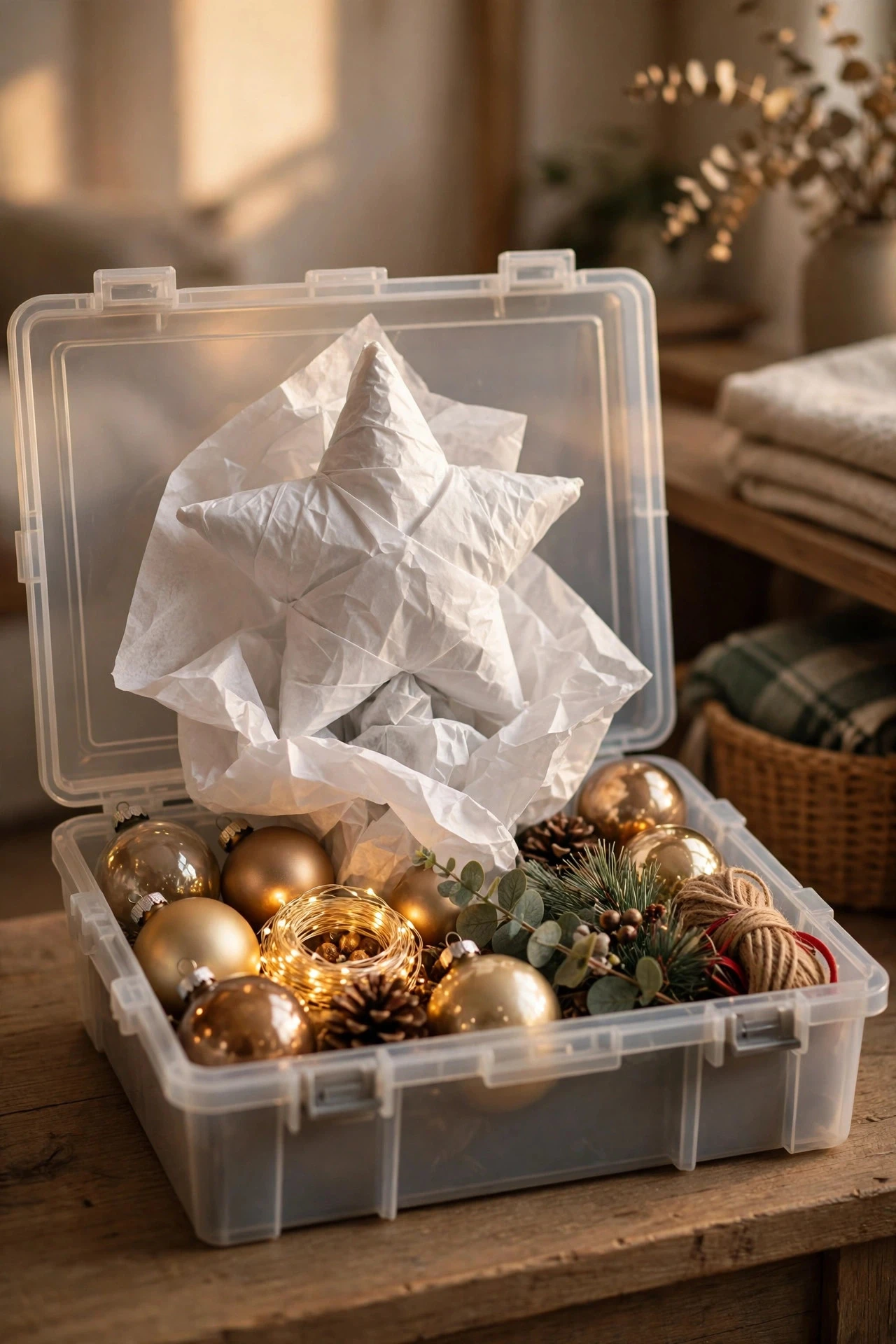
Store a topper so it survives the year by wrapping it in acid-free tissue, placing it in its original box or a rigid container with a lid, and storing that container on top of the other Christmas boxes — never underneath them, where the weight crushes glass and bends wire.
Glass and porcelain toppers need their own box; a star or bow can share a box with baubles if it is wrapped first.
Label the box "TREE TOPPER — FRAGILE" on two sides, and store it in a dry place at room temperature, because damp lofts tarnish metal and crack porcelain. Remove the batteries from any lighted topper before storing it, or they will leak and corrode the contacts by next December. Coil any ribbon tails loosely and wrap them in tissue so they do not crease — a creased ribbon never hangs straight again. A topper stored well lasts ten years or more, which makes even a $60 finial cheaper per year than a $10 star replaced annually.
Practical Tips
Measure twice and buy once: ceiling height minus tree height is your maximum topper height, and 10 to 15 percent of the tree's height is your ideal topper height — write both numbers on your phone before you shop. Always carry a roll of green florist wire and a pair of pliers in your Christmas decorating box, because almost every leaning topper is fixed in two minutes with a single wire. Fit the topper last, after the lights and baubles are on, so you can see the tree's finished silhouette and choose the topper that completes it rather than the one you liked in the shop.
Buy the topper in the first week of November while the full range is in stock, and keep the receipt and the box — a topper that does not fit your tree is the most commonly returned Christmas decoration, and shops will not take it back without the box. Photograph your tree from the doorway once the topper is on, so you can check the silhouette and remember the placement next year.
Final Thoughts
A tree topper is the smallest decoration on the tree and the one that finishes it. Choose the right size, wire it straight, match it to your colour scheme and store it well, and a $20 star will look better than a $90 finial that leans. The topper's job is to crown the tree, not to compete with it — get the proportions right and the whole tree looks taller, brighter and more deliberate.
You may also like: our 22 Christmas tree ideas for a warm stylish home and our 22 living room Christmas decor ideas to make your home feel festive carry the same sizing and styling rules from the top of the tree down to the living room floor.
Frequently Asked Questions
How big should a tree topper be?
A tree topper should be 10 to 15 percent of your tree's height: 18 to 27 cm on a 180 cm tree and 21 to 32 cm on a 210 cm tree. The tree plus the topper should stop 5 to 10 cm below the ceiling, so measure your ceiling and never choose a topper by eye alone.
How do you keep a tree topper from leaning?
Keep a tree topper straight by wrapping green florist wire around its base and the top branch, twisting it tight with pliers. On an artificial tree, fold the top branch into a vertical spike; on a real tree, trim the leader to 10 cm above the last side branches. Heavy toppers over 300 grams need a wooden dowel for support.
What is the most popular tree topper?
The star is the most popular tree topper, followed by the angel and the bow. Stars suit almost every tree style, angels suit traditional and nostalgic trees, and bows suit relaxed modern and farmhouse trees. Choose the style that matches your tree's colour scheme and the rest of your ornaments, not just the one you like in the shop.
Can a tree topper be too heavy?
Yes, a tree topper can be too heavy: anything over 300 grams will bend a real tree's leader branch and most tabletop trees, and anything over 500 grams needs a support dowel on a stiff artificial tree. Check the weight on the box before buying, and choose a lighter resin or paper topper if your tree is real or small.
What tree topper goes with a flocked tree?
A matte white, silver or clear-glass topper goes best with a flocked tree, because it reads as part of the snow rather than a separate object. A white ceramic star, a silver finial or a clear glass angel all work, while a bright red or green topper looks stuck on against the white flocking.
How much should you spend on a tree topper?
Spend $15 to $40 for a beautiful tree topper: metal stars, bows and wooden toppers sit in this range and last for years. Hand-blown glass finials and lighted angels cost $60 to $90 and suit a feature tree. A topper stored properly lasts ten years, so even a $60 topper costs only $6 a year.