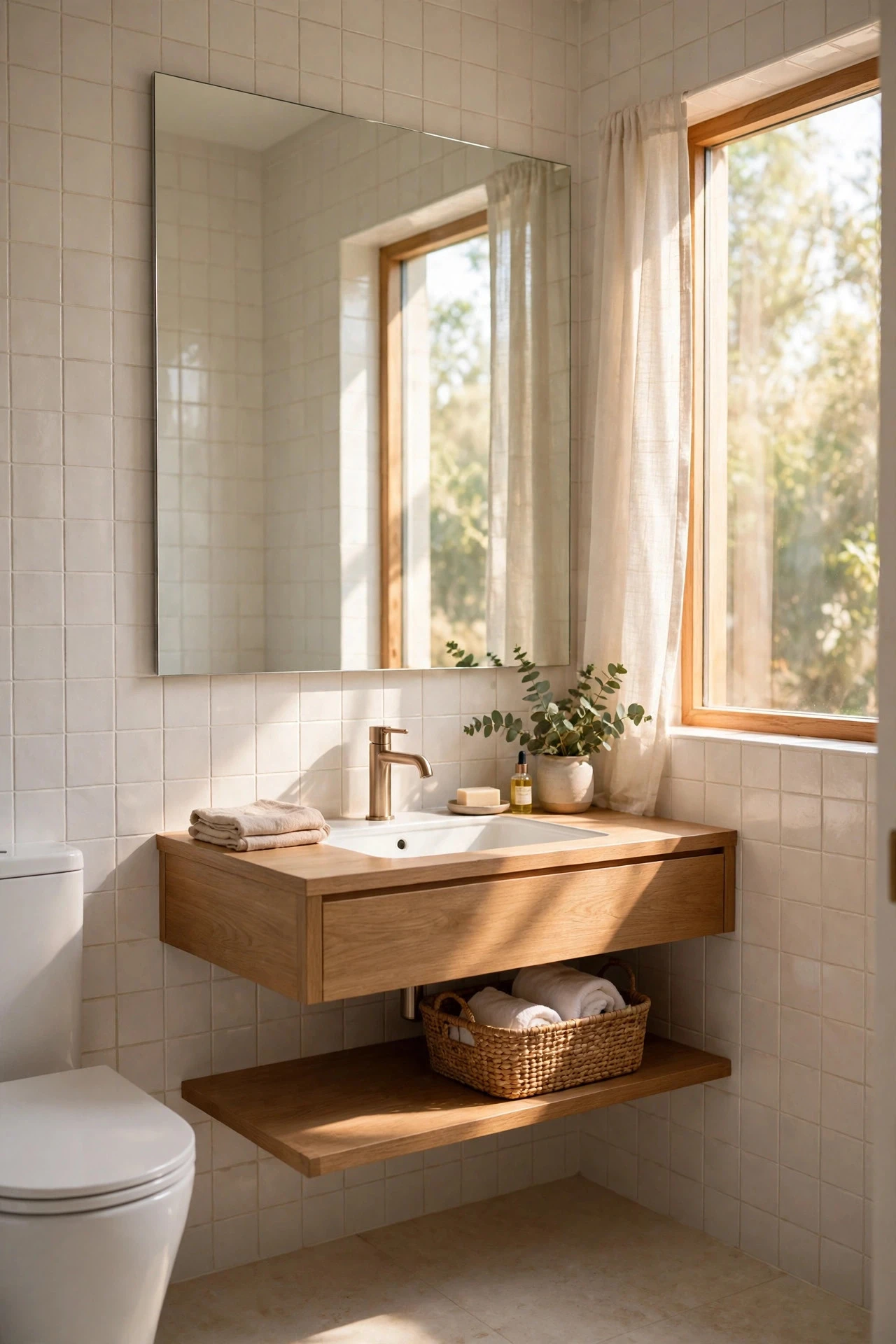
22 Small Bathroom Ideas That Make a Tiny Bathroom Feel Bigger
A small bathroom does not have to feel small. The rooms that feel cramped are rarely the smallest ones; they are the ones where every surface is broken up — a shower curtain here, a dark wall there, a bulky vanity, a dozen bottles on display — so the eye keeps stopping at edges and corners. The rooms that feel generous do the opposite: they show more floor, repeat one calm colour, use large surfaces, and hide clutter, so the eye travels across the whole room in one sweep. Almost every idea in this guide costs little, needs no structural work, and works in a rented bathroom as well as an owned one.
Looking for more inspiration? Our Nest Decorz homepage gathers the latest home decor ideas, seasonal decorating guides and room-by-room styling tips in one place — start there and explore.
Below are 22 small bathroom ideas, from mirrors and tiles to vanities, lighting, and storage, each with practical detail, approximate US costs, and one mistake to avoid. Start with the ideas that need no tools — colour, mirrors, and decluttering — and save the plumbing and tiling changes for a remodel, because the visual tricks alone can make a tiny bathroom feel noticeably larger.
1. A Large, Frameless Mirror Above the Vanity
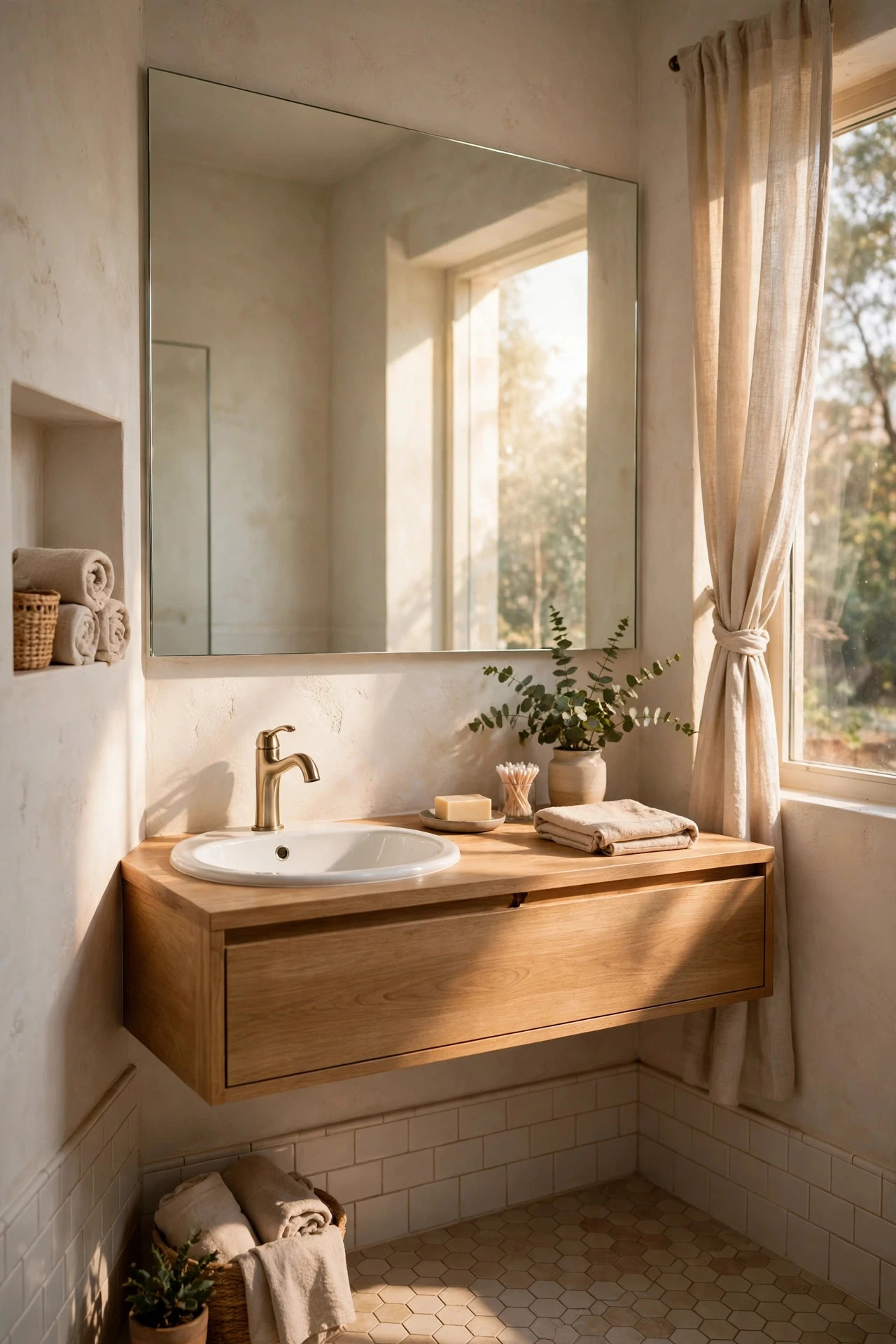
A large mirror is the oldest small-bathroom trick because it works: it doubles the reflected room, bounces light into dark corners, and removes a visual stopping point above the sink. Choose a mirror that spans most of the vanity width, mount it high enough to reflect light from a window or a sconce, and keep the frame frameless or very slim so the edge disappears into the wall. A large frameless mirror costs $60 to $150. The mistake to avoid is choosing a small, ornate mirror with a heavy frame, which reads as a picture on the wall and adds visual weight instead of depth.
2. Go Wall-to-Wall With Mirror Panels
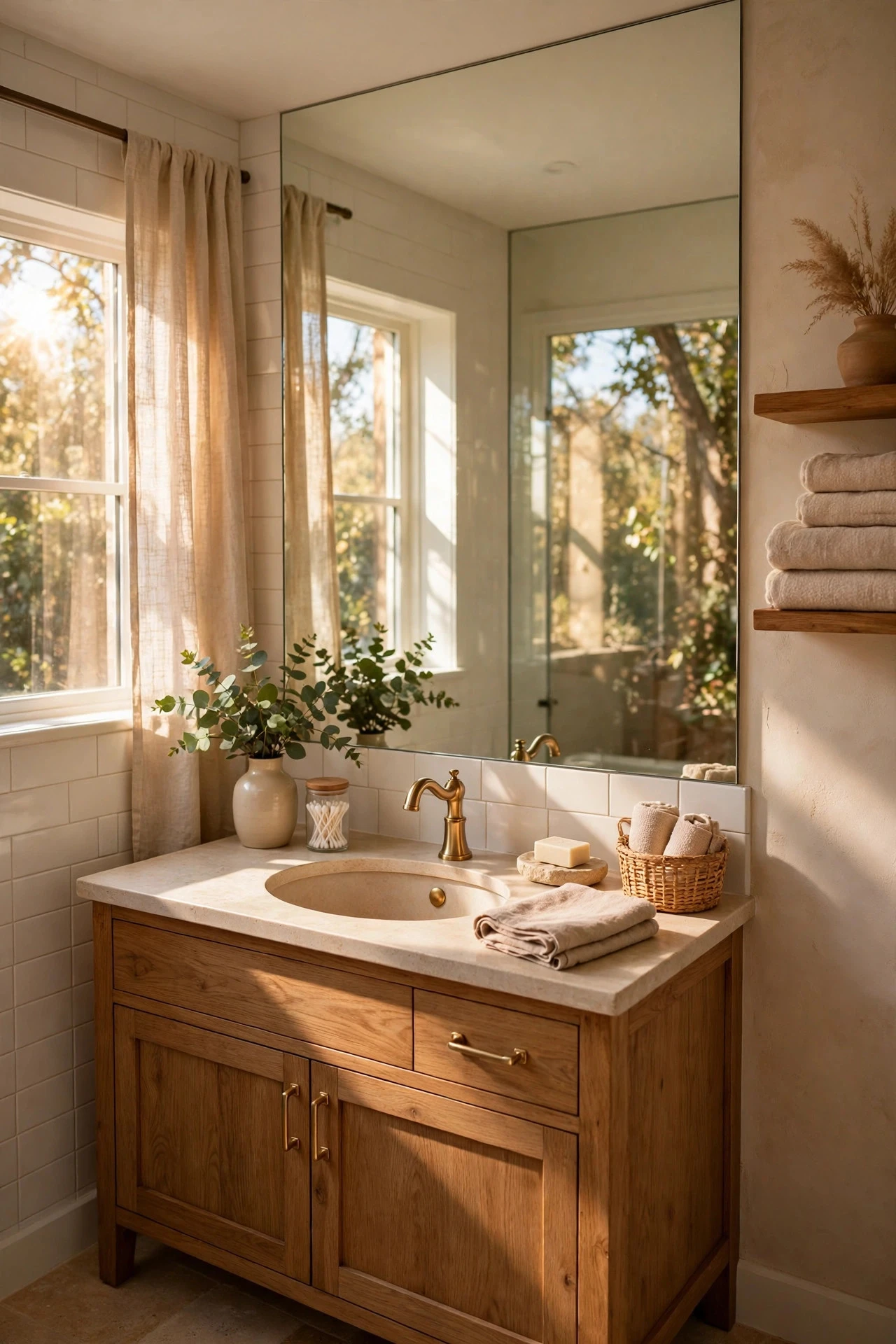
In a very small bathroom, one mirror wall — mirrored panels behind the vanity or across a whole wall — creates the illusion of a second room. Use mirror tiles or a single cut mirror panel, keep the surrounding walls calm and uncluttered so the reflection stays clean, and avoid placing the mirror directly opposite a cluttered shelf, which it will faithfully double. Mirror panels cost $80 to $200 installed or as a DIY panel. The mistake to avoid is mirroring a wall that faces the toilet, because the reflection makes the least attractive part of the room twice as prominent.
3. A Frameless Glass Shower Door or Panel
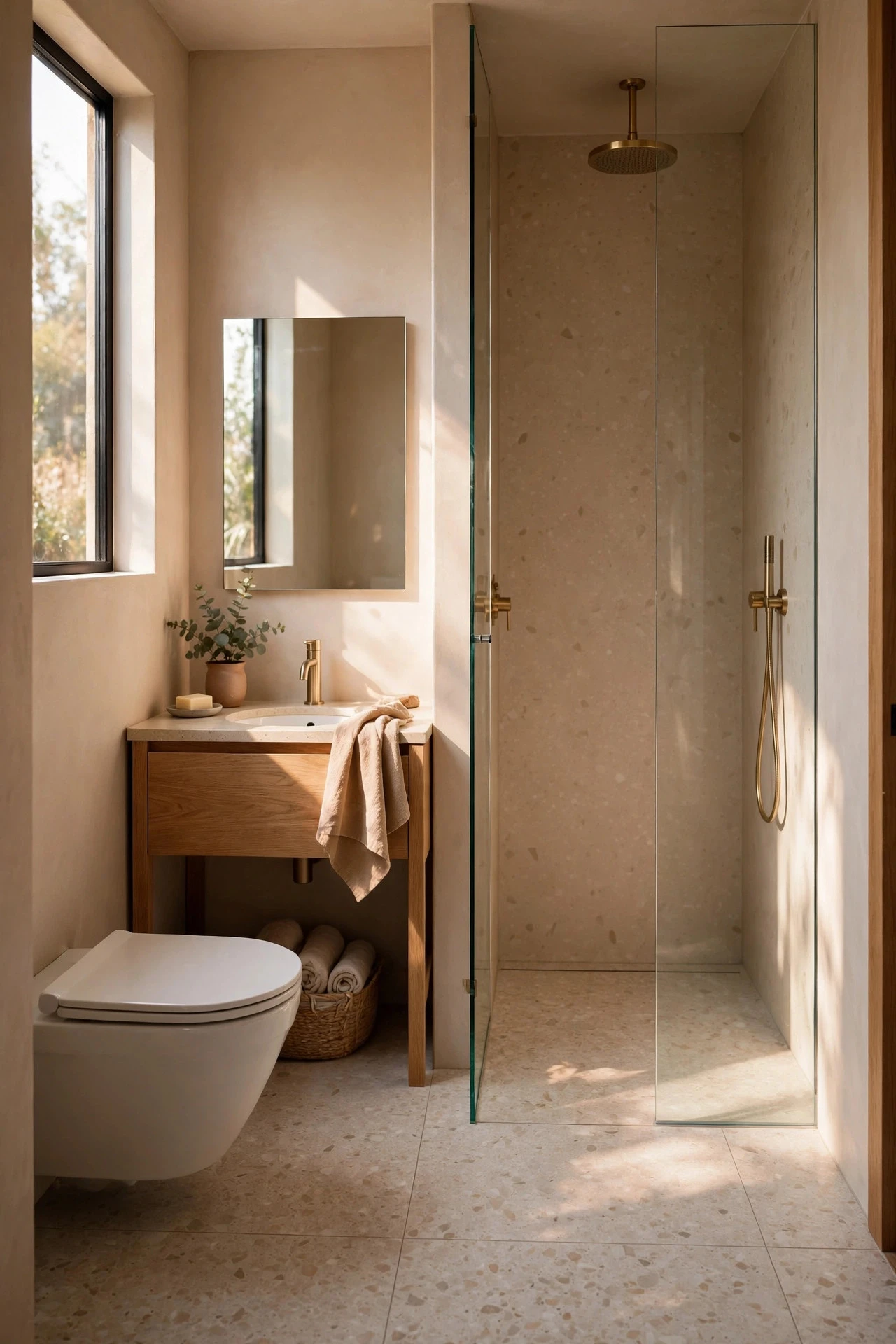
A shower curtain is an extra wall that cuts the room in half, while a frameless glass door or a fixed glass panel lets the eye travel to the back wall and makes the whole bathroom read as one space. Clear glass, minimal hardware, and a continuous floor tile into the shower complete the effect, and a squeegee kept in the shower keeps the glass clear. A frameless panel costs $250 to $600 fitted. The mistake to avoid is choosing frosted or heavily patterned glass, which blocks the sightline just as effectively as a curtain and loses the entire benefit of the glass.
4. A Floating Vanity That Shows the Floor
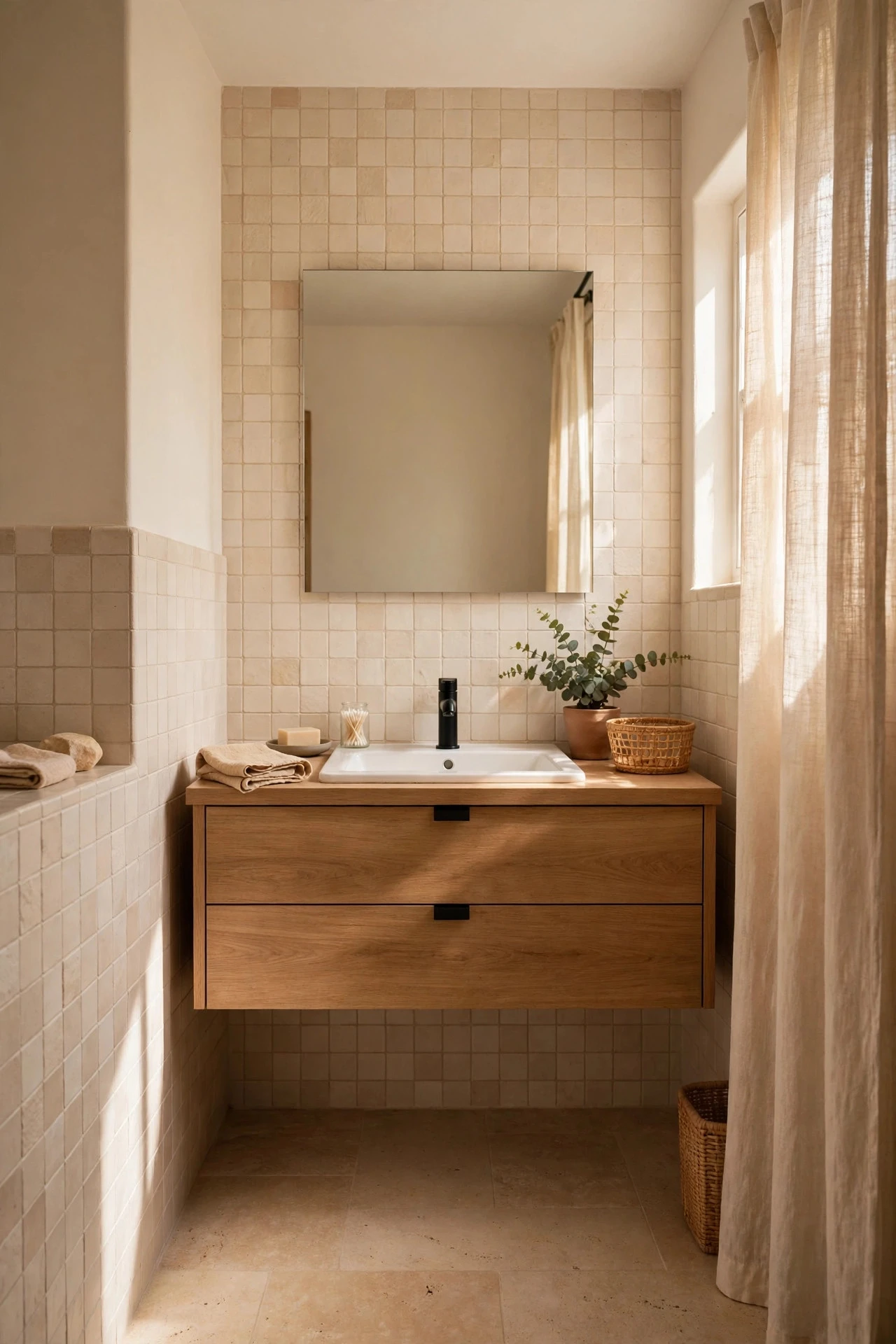
A floating, wall-hung vanity reveals the floor underneath, and visible floor is the strongest signal of space a small bathroom can give. The eye reads the continuous floor as one surface, the room feels lighter, and cleaning underneath becomes easy. Choose a vanity no wider than the space needs, in a light finish, with a single drawer rather than doors that swing into the room. A floating vanity costs $150 to $400. For a more luxurious take on the same room, these luxury bathroom decor ideas show how a floating vanity anchors a spa-like scheme. The mistake to avoid is fitting a floating vanity so low that the gap underneath collects clutter, because a gap full of bottles and boxes reads as mess, not as space.
5. A Wall-Hung Toilet for Visible Floor
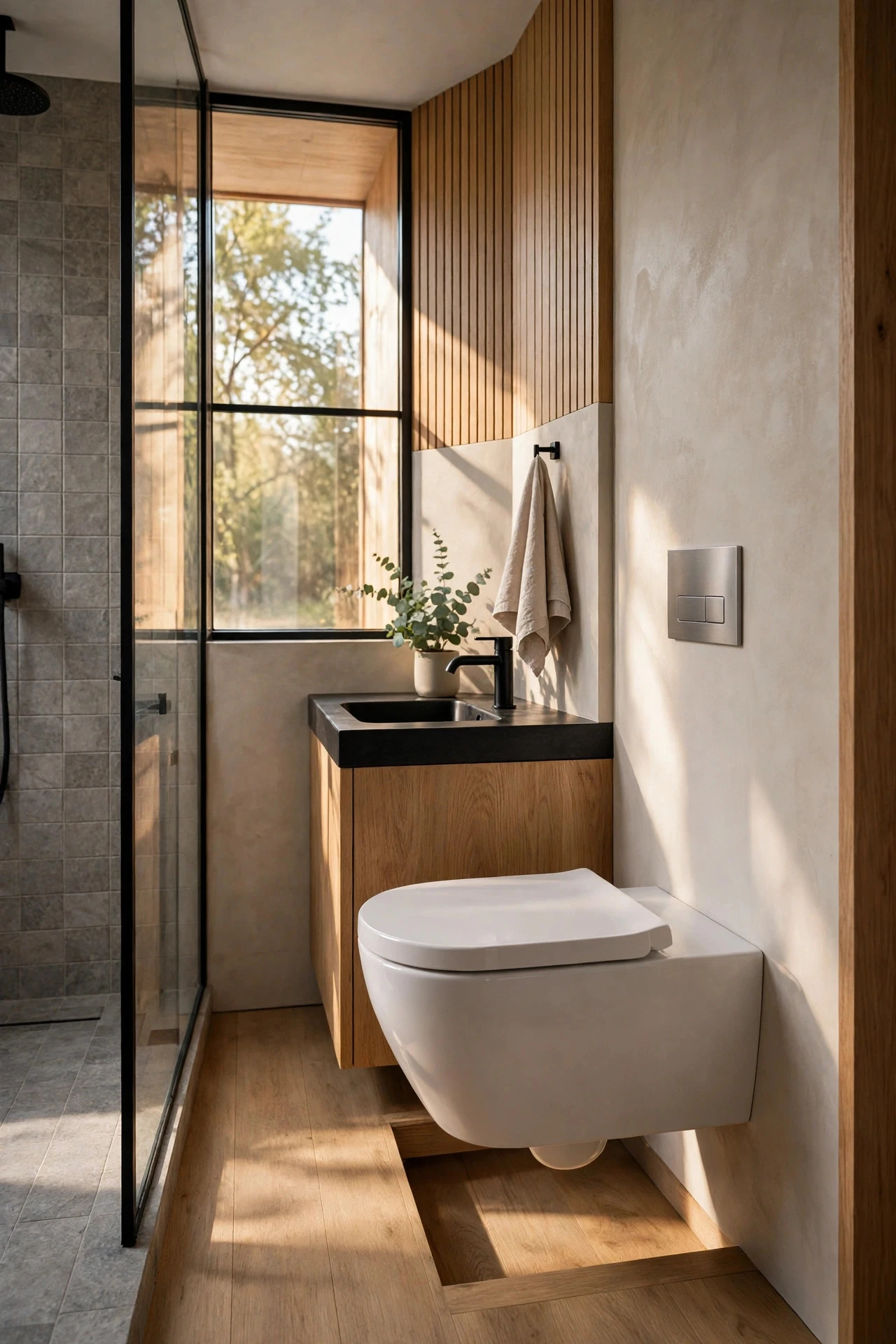
Like a floating vanity, a wall-hung toilet reveals floor beneath it and removes the bulky pedestal base that eats visual space in a small room. The cistern hides in the wall, the bowl floats above the floor, and the room gains both real and perceived space, especially when paired with continuous flooring. A wall-hung toilet and frame cost $300 to $700 fitted, so it suits a remodel rather than a refresh. The mistake to avoid is fitting one without checking the wall structure and plumbing first, because the frame needs a solid wall and the wrong installation is expensive to correct.
6. Large-Format Tiles With Fewer Grout Lines
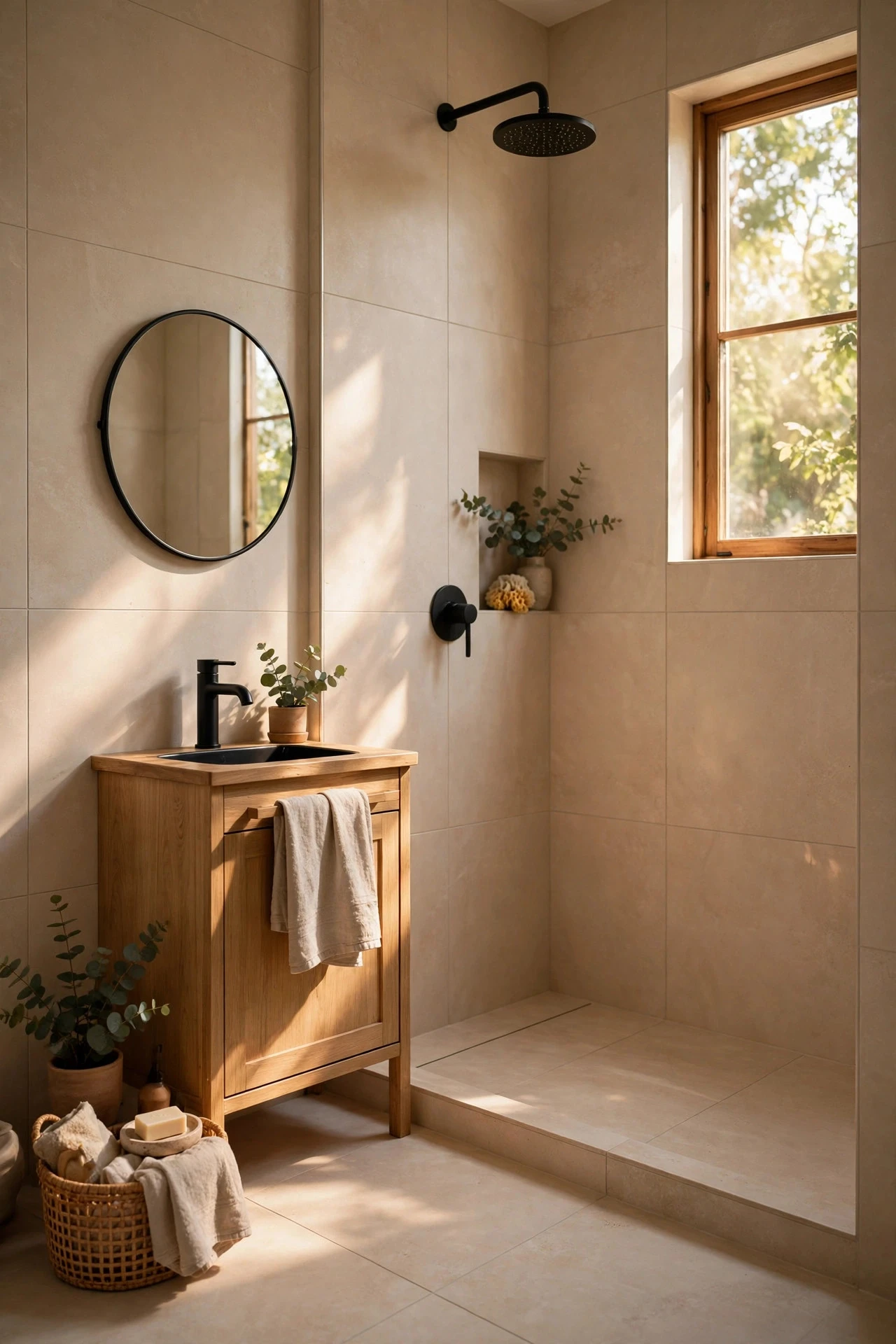
Small tiles mean hundreds of grout lines, and every grout line is a visual break that makes a small room feel busy and cramped. Large-format tiles — 600 by 600 millimetres or larger — reduce grout lines dramatically, and matching the grout colour to the tile makes the surface read as one calm plane. Use the same large tile on the floor and partway up the walls for the most seamless effect. Large tiles cost $5 to $15 per square foot for materials. The mistake to avoid is mixing several small, patterned tiles in one tiny room, because each pattern competes for attention and the room feels smaller with every added surface.
7. One Continuous Floor Into the Shower
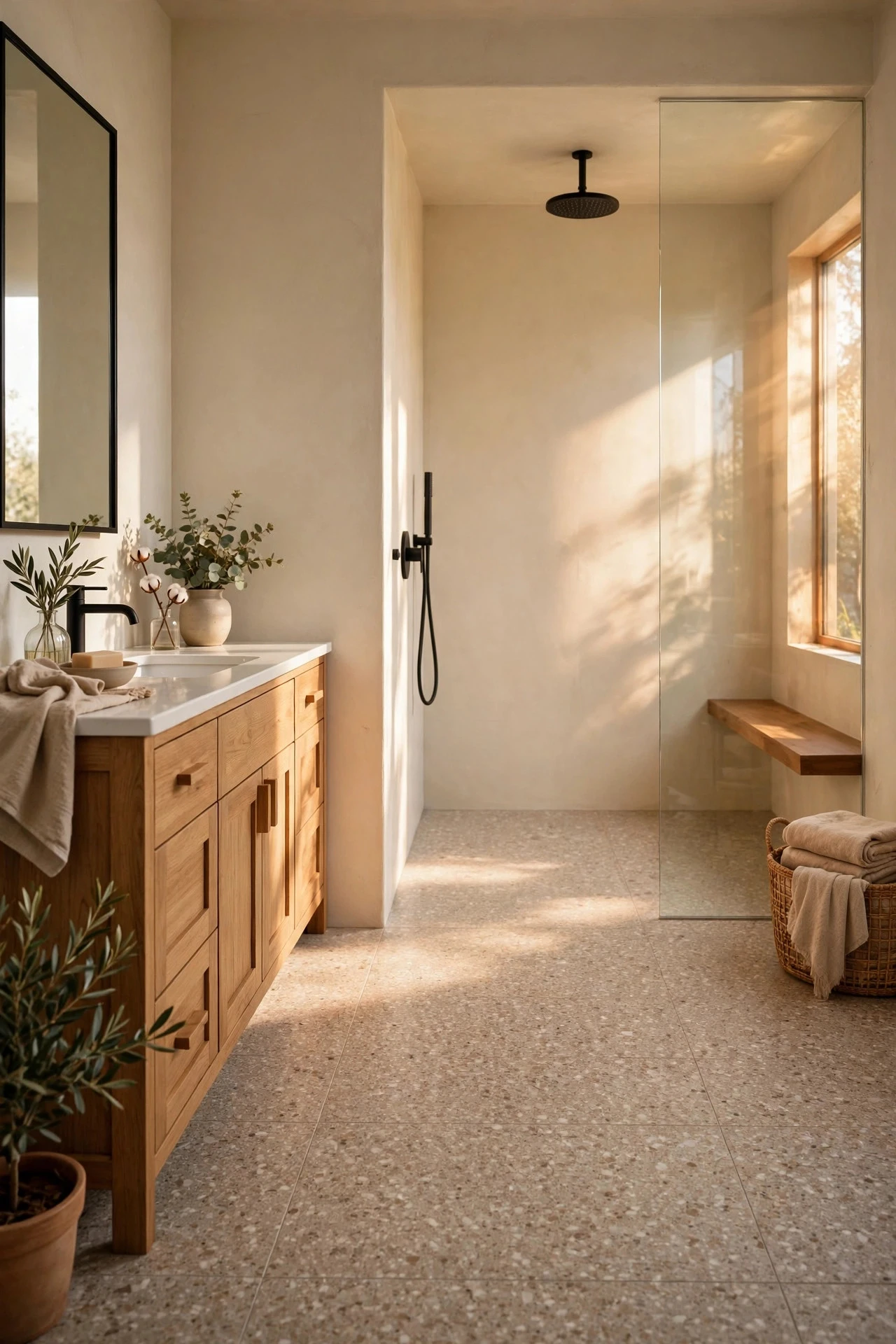
Continuing the same floor tile into the shower, with no threshold step and no change of material, removes the line that tells the eye where the bathroom ends and the shower begins. A level, walk-in shower floor with a linear drain completes the effect and makes the whole footprint read as one room. This is a remodel-level change, costing $500 to $1,500 as part of a shower rebuild. The mistake to avoid is adding a raised shower tray in a contrasting colour, which draws a hard line across the floor and shrinks the room visually even when the tray itself is small.
8. A Tone-on-Tone, Monochromatic Palette
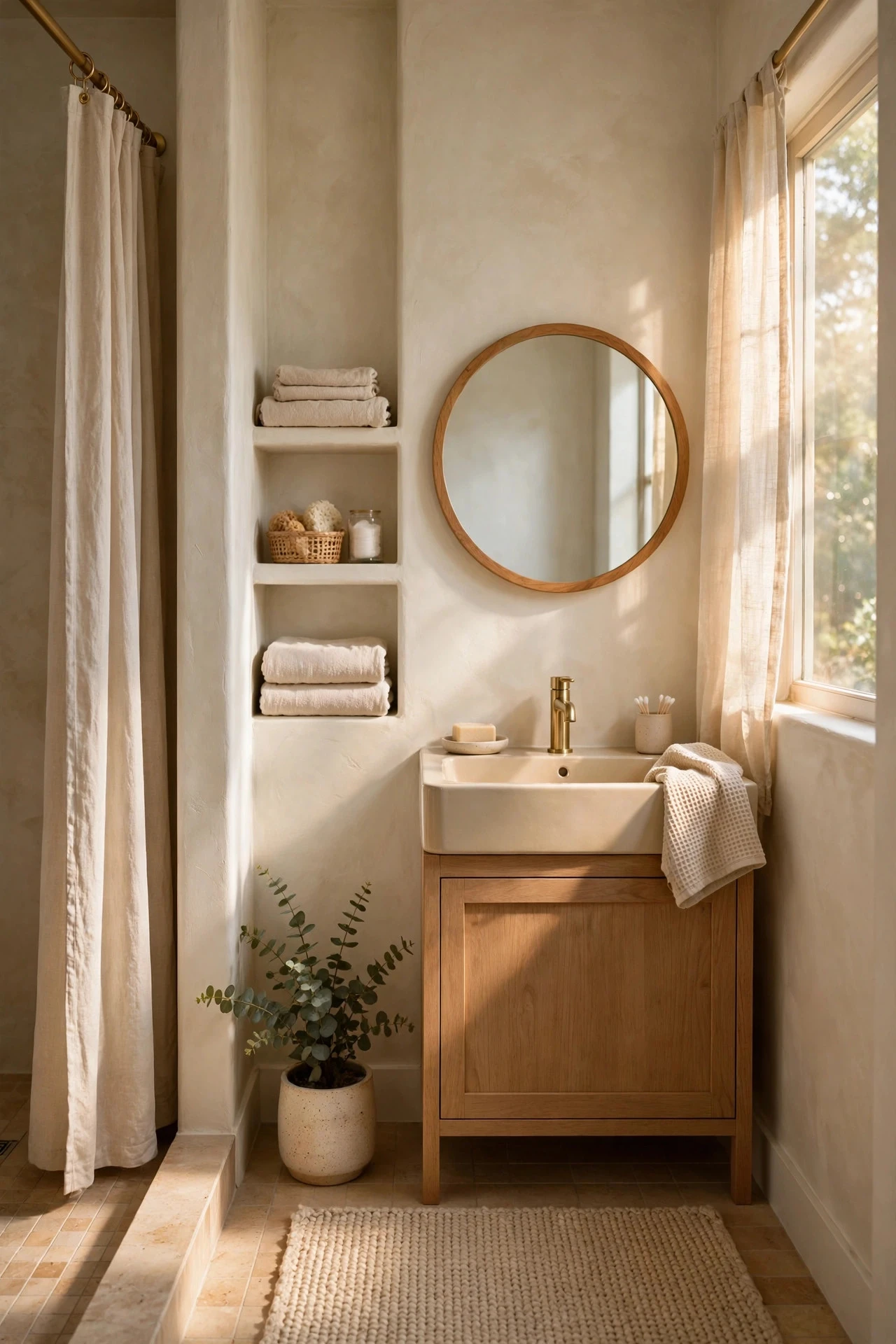
A single colour family — warm whites, soft greys, pale sage, or warm oatmeal — used across walls, tiles, and ceiling blurs the boundaries of the room, because there are no sharp contrasts to tell the eye where one surface ends. Vary the texture instead of the colour: matte tiles, a soft towel, a wooden stool, and a brushed-metal fitting all in the same tonal family. Repainting and re-towelling a palette costs $50 to $150. The mistake to avoid is pairing a dark feature wall with a bright white floor, because the sharp line between them highlights exactly where the room ends and makes the walls feel closer.
9. Paint the Ceiling the Same Colour as the Walls
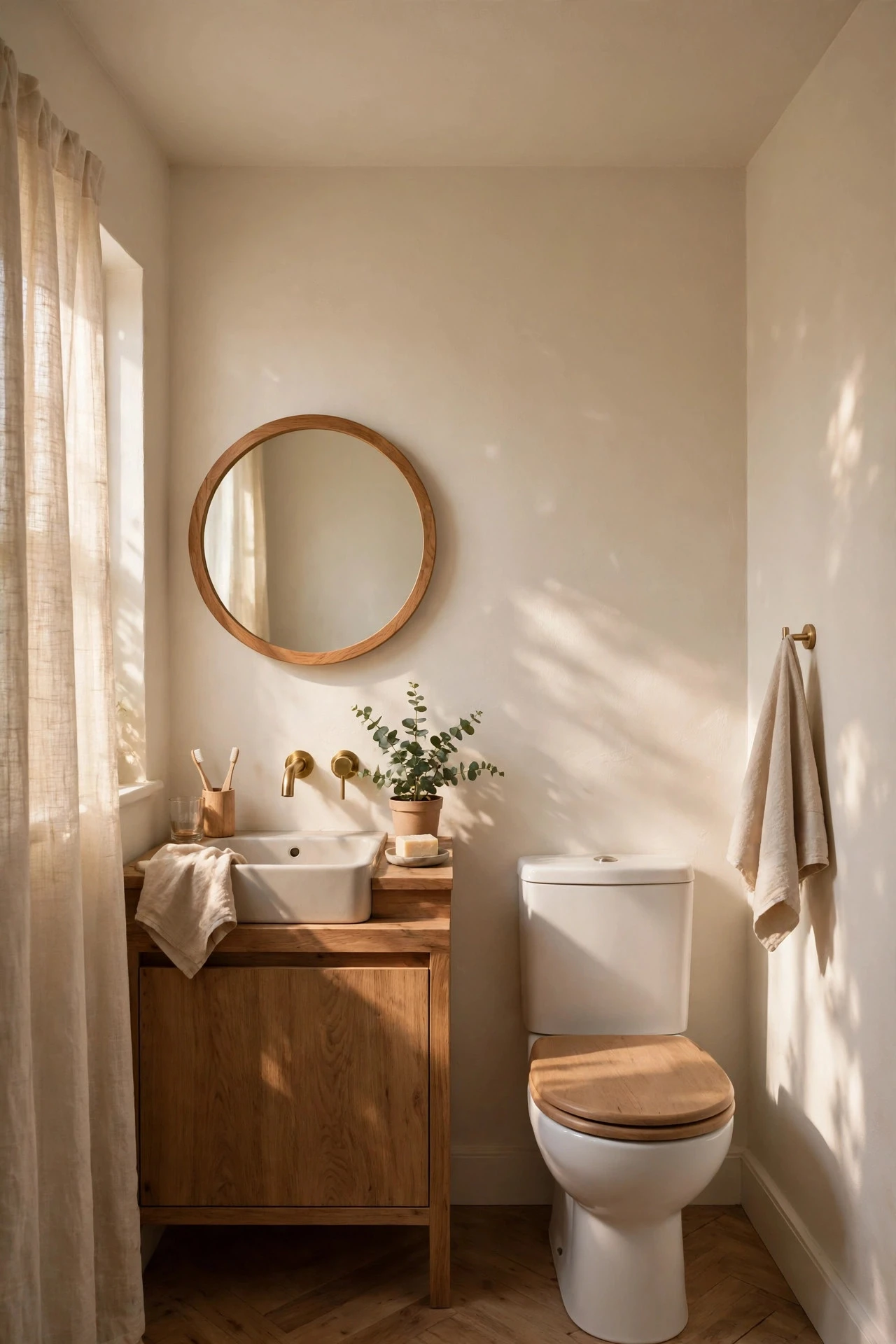
Painting the ceiling the same light colour as the walls removes the horizontal line at the top of the room and makes the ceiling feel higher, because the eye has no edge to stop at. Use a moisture-resistant bathroom paint in the same shade, or one shade lighter, and keep the finish matte or eggshell so it does not draw attention. A tin of bathroom paint costs $30 to $50. The mistake to avoid is painting the ceiling bright white against coloured walls in a small bathroom, which frames the room like a box lid and makes the walls feel lower and closer.
10. High-Gloss and Reflective Finishes
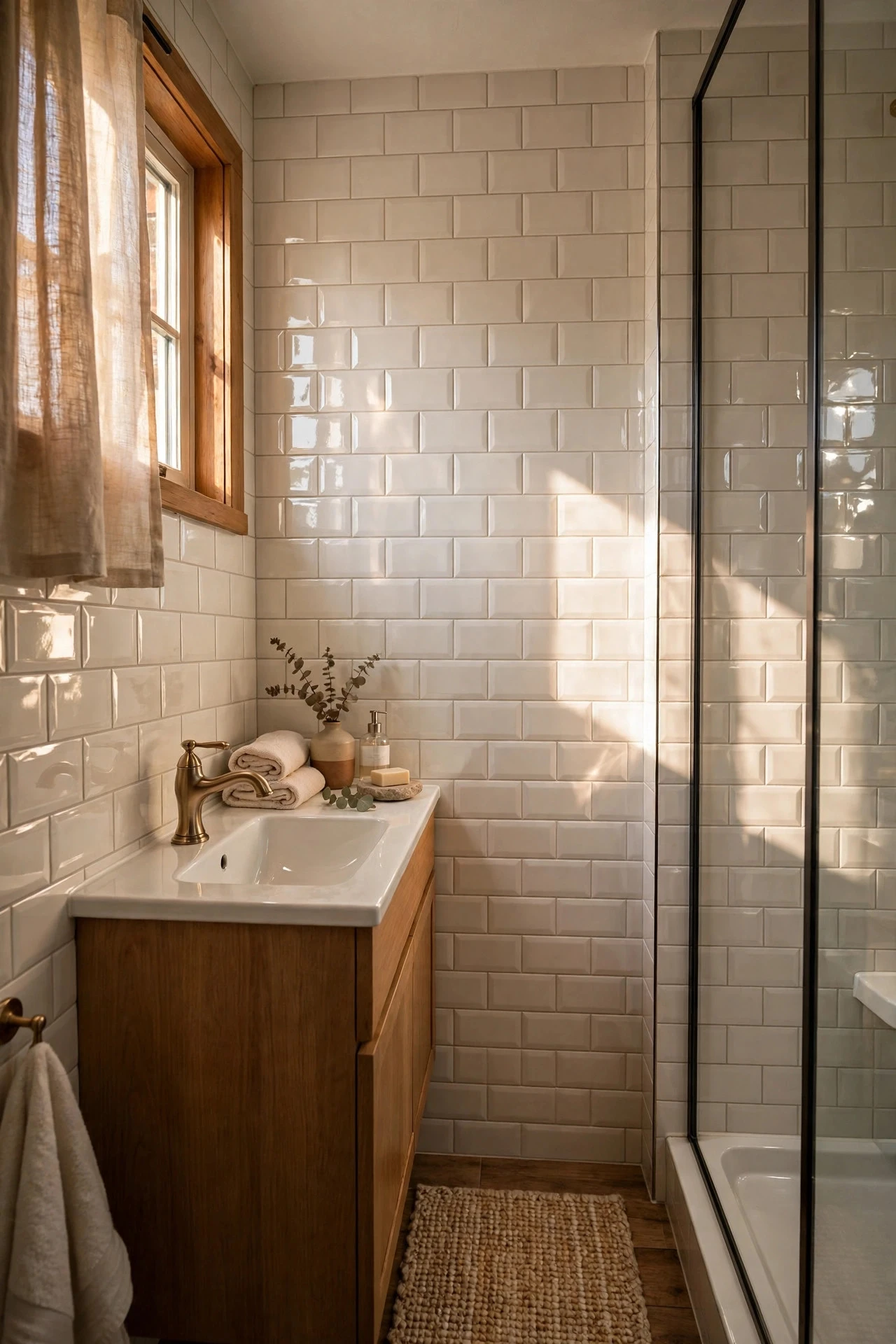
Glossy tiles, polished stone, and shiny porcelain bounce light around a small bathroom, adding brightness and depth that matte finishes absorb. A high-gloss wall tile behind the vanity, a polished countertop, and a reflective mirror together make the room feel lit from several directions at once. Gloss tiles cost similar to matte tiles, $5 to $12 per square foot. The mistake to avoid is using high gloss on the floor, which becomes slippery when wet, so keep gloss on walls and choose a matte or textured tile underfoot.
11. Layered Lighting: Task, Ambient and Accent
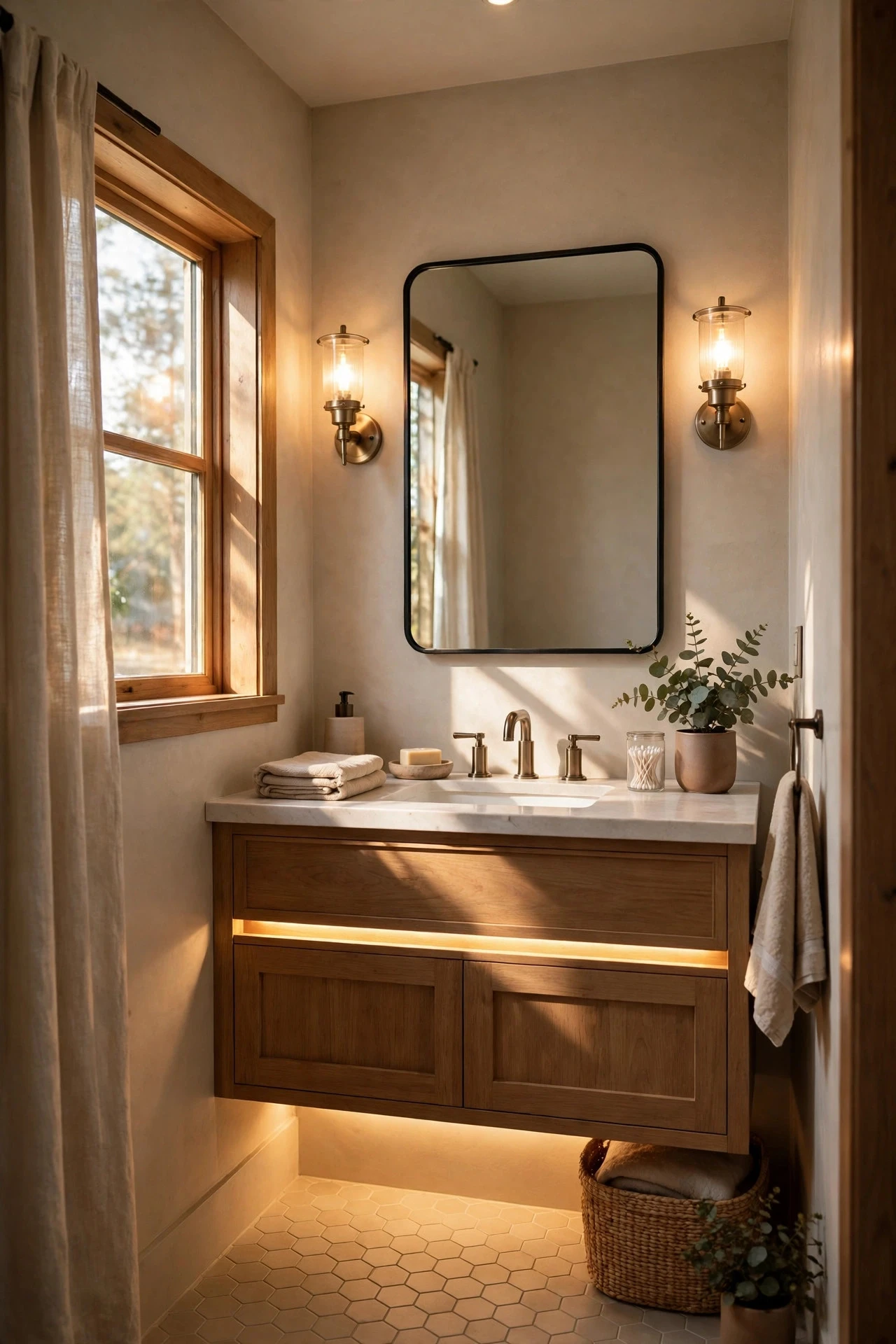
One central ceiling light makes a small bathroom feel flat and dingy, while three layers — task light at the mirror, ambient light from the ceiling, and accent light under a vanity or along a shelf — push the walls outward with light. Sconces beside the mirror give the most flattering face light, a flush ceiling fixture gives general light, and an LED strip under a floating vanity lights the floor. Sconces and strips cost $40 to $120. The mistake to avoid is fitting a single harsh, cool-white ceiling light, which casts shadows, flattens the room, and makes the bathroom feel like a utility space rather than a retreat.
12. A Backlit LED Mirror
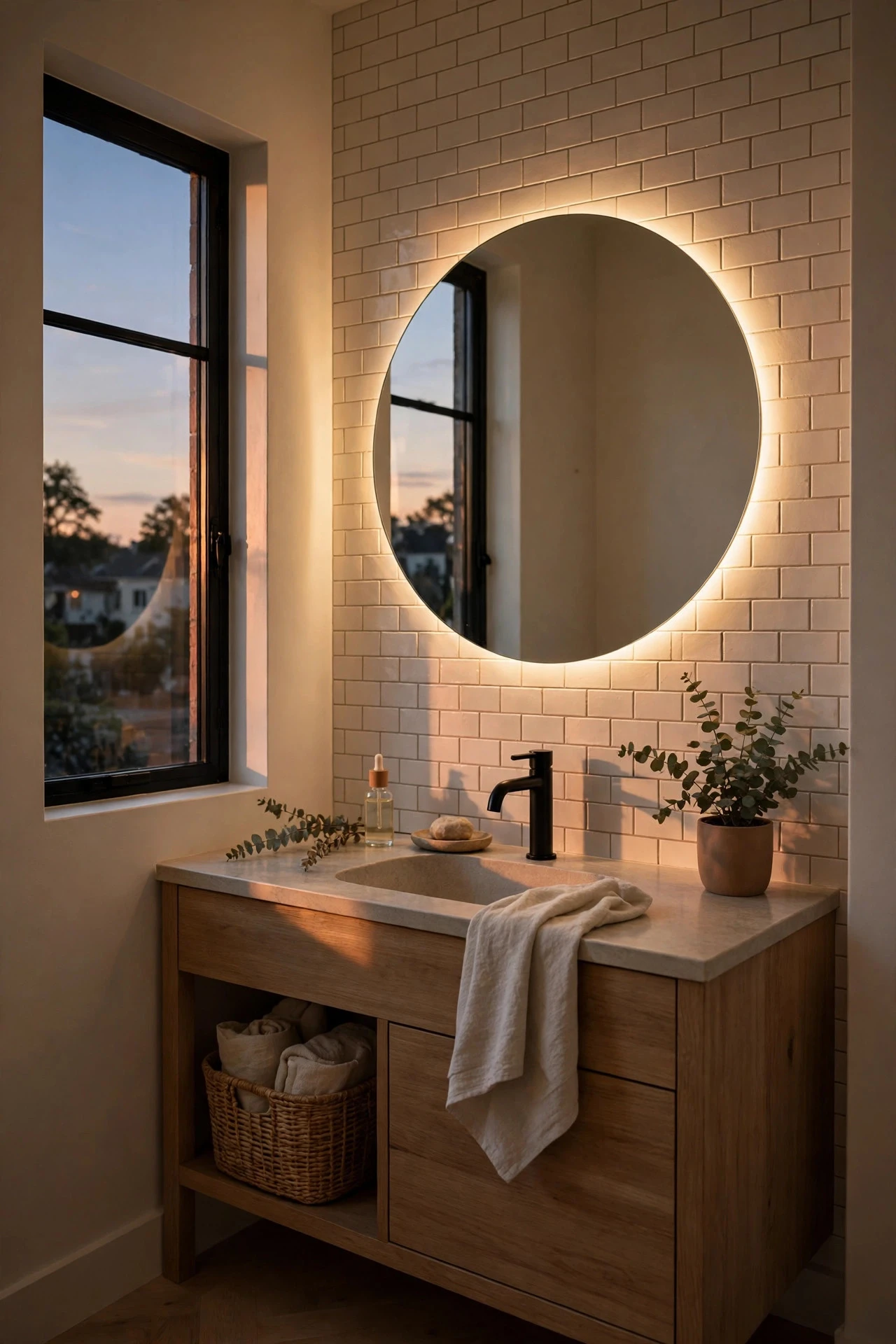
A backlit mirror combines two small-bathroom tricks in one fitting: a large reflective surface and a soft glow that eliminates shadows and makes the walls feel as if they are receding. The light is ideal for shaving and makeup, needs no separate sconces, and gives the bathroom a polished, hotel-like finish. Backlit mirrors cost $80 to $250. The mistake to avoid is choosing a backlit mirror with cool, blue-toned light, which makes skin look washed out and the room feel clinical, when warm 2700K to 3000K light feels calm and flattering.
13. Vertical Storage That Uses Wall Height
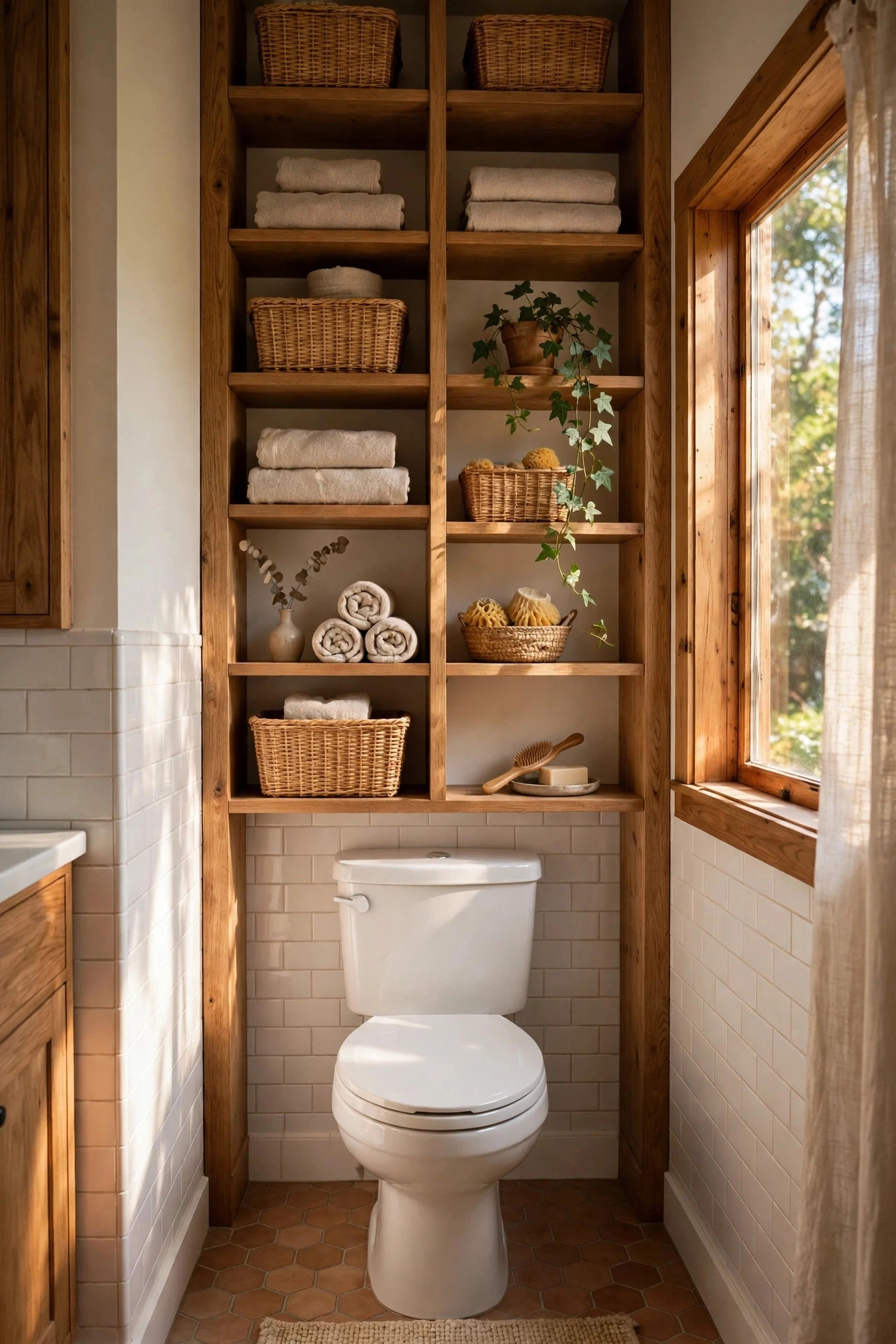
In a small bathroom, the walls above head height are the only unused space, so storage should go up, not out. A tall, slim cabinet, floating shelves above the toilet, or a ladder shelf uses vertical space without stealing floor area, and closed storage keeps the visual clutter down. A tall cabinet or shelf unit costs $60 to $180. For family-friendly storage that keeps shared bathrooms calm, these family bathroom ideas show how vertical storage works for several people at once. The mistake to avoid is filling every shelf to the edge, because overfilled shelves read as clutter and shrink the room, while shelves with breathing room read as styling.
14. Recessed Niches Instead of Shower Caddies
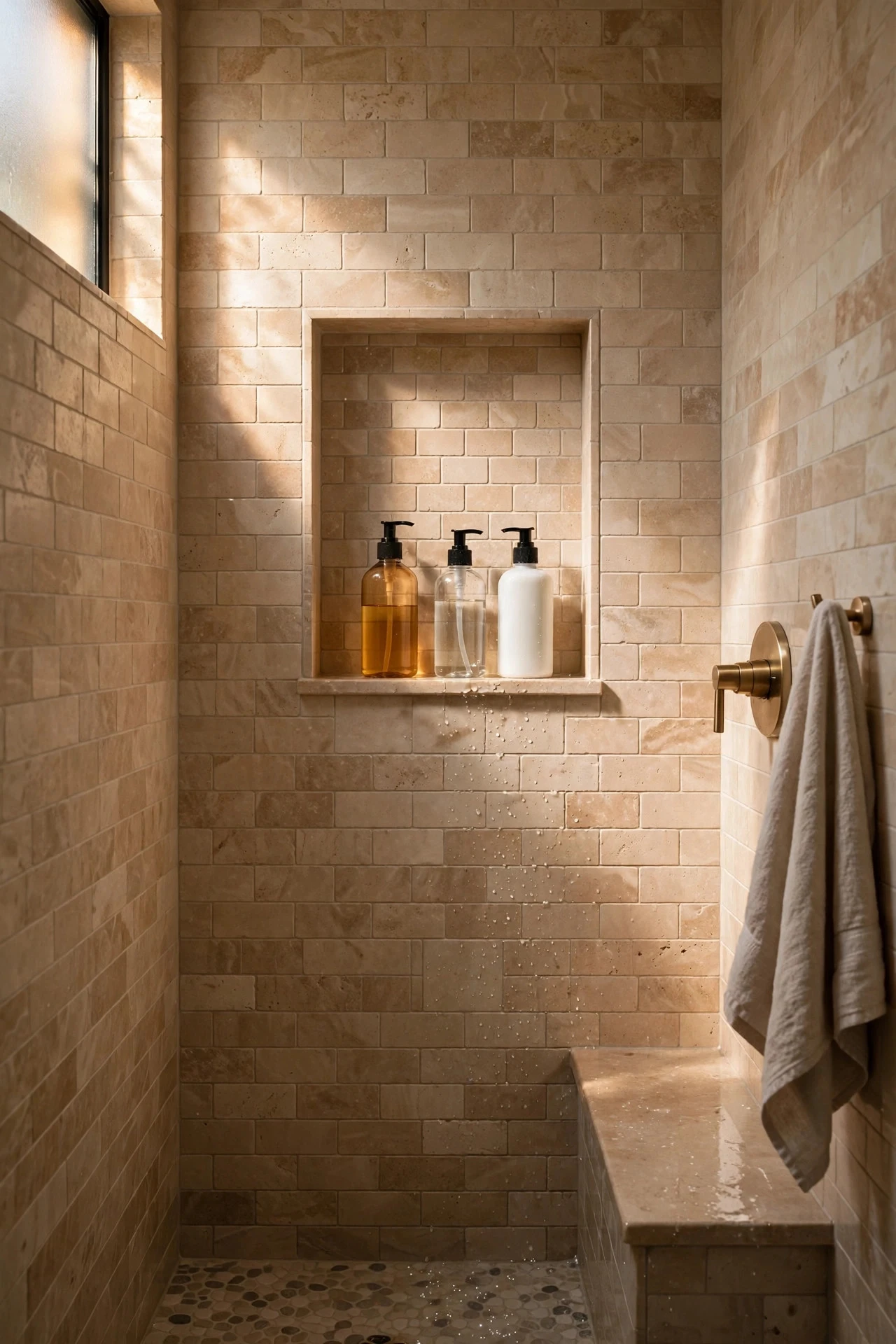
A recessed shower niche — a shelf set into the wall — holds shampoo and soap without a hanging caddy, a corner shelf, or bottles lined along the shower floor, all of which break up the shower's clean lines. Plan niches during a remodel, tile them in the same tile as the shower, and keep them at a reachable height with a slight slope so water drains. A niche adds $100 to $300 to a shower rebuild. The mistake to avoid is adding a niche after tiling by surface-mounting a box, which protrudes into the shower, catches elbows, and looks like an afterthought rather than a built-in detail.
15. A Corner Sink for Awkward Layouts
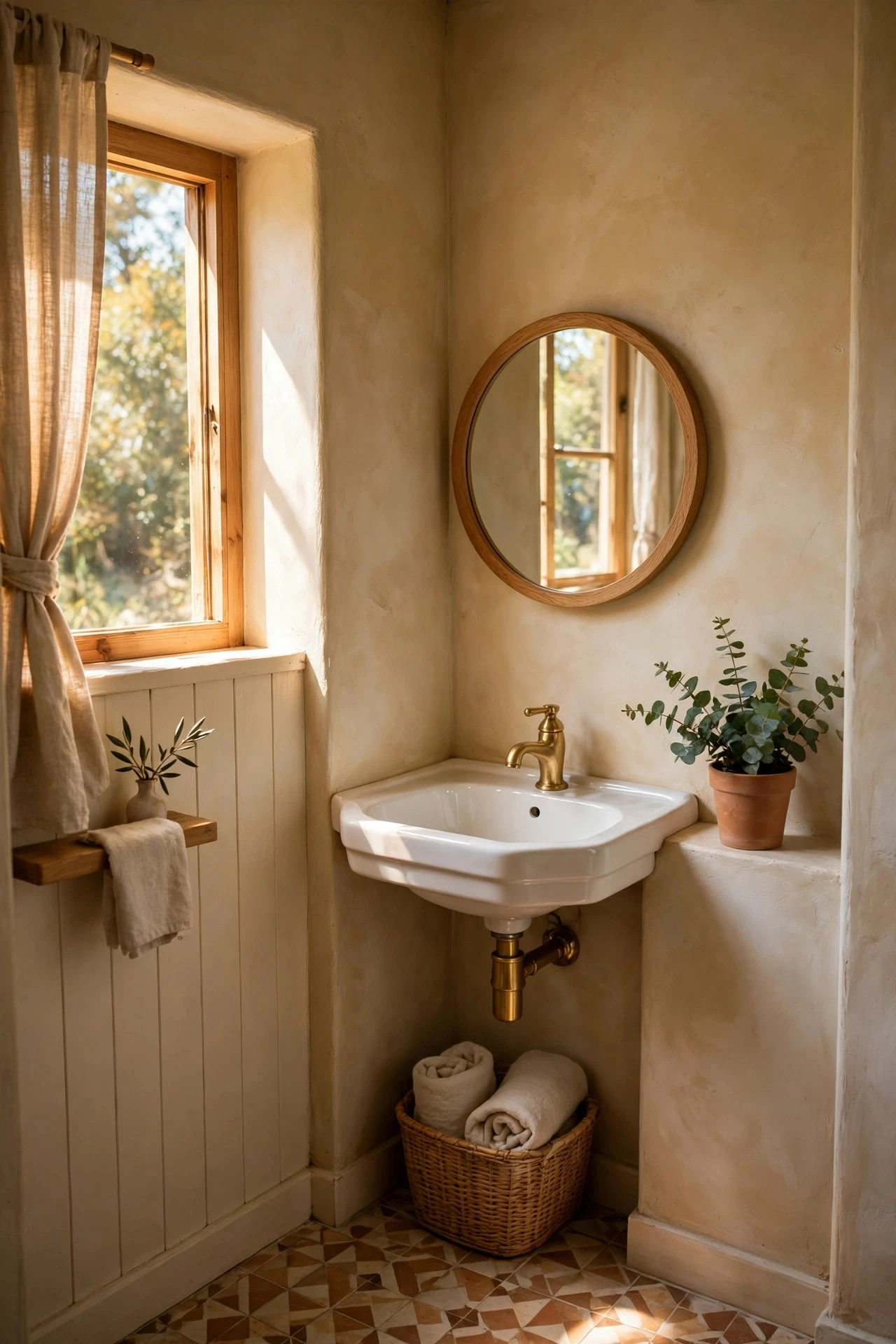
A corner sink turns the most awkward corner of a small bathroom into useful space and frees the main wall for storage or a larger mirror. Corner sinks suit powder rooms and half-baths where a full vanity would block the door swing, and a wall-mounted corner basin reveals even more floor. A corner sink costs $80 to $200. The mistake to avoid is fitting a corner sink so close to the toilet that elbows hit the wall, so measure the clearance — at least 15 inches from the centreline of the toilet to the side wall — before committing.
16. A Pocket Door or an Outward-Swinging Door
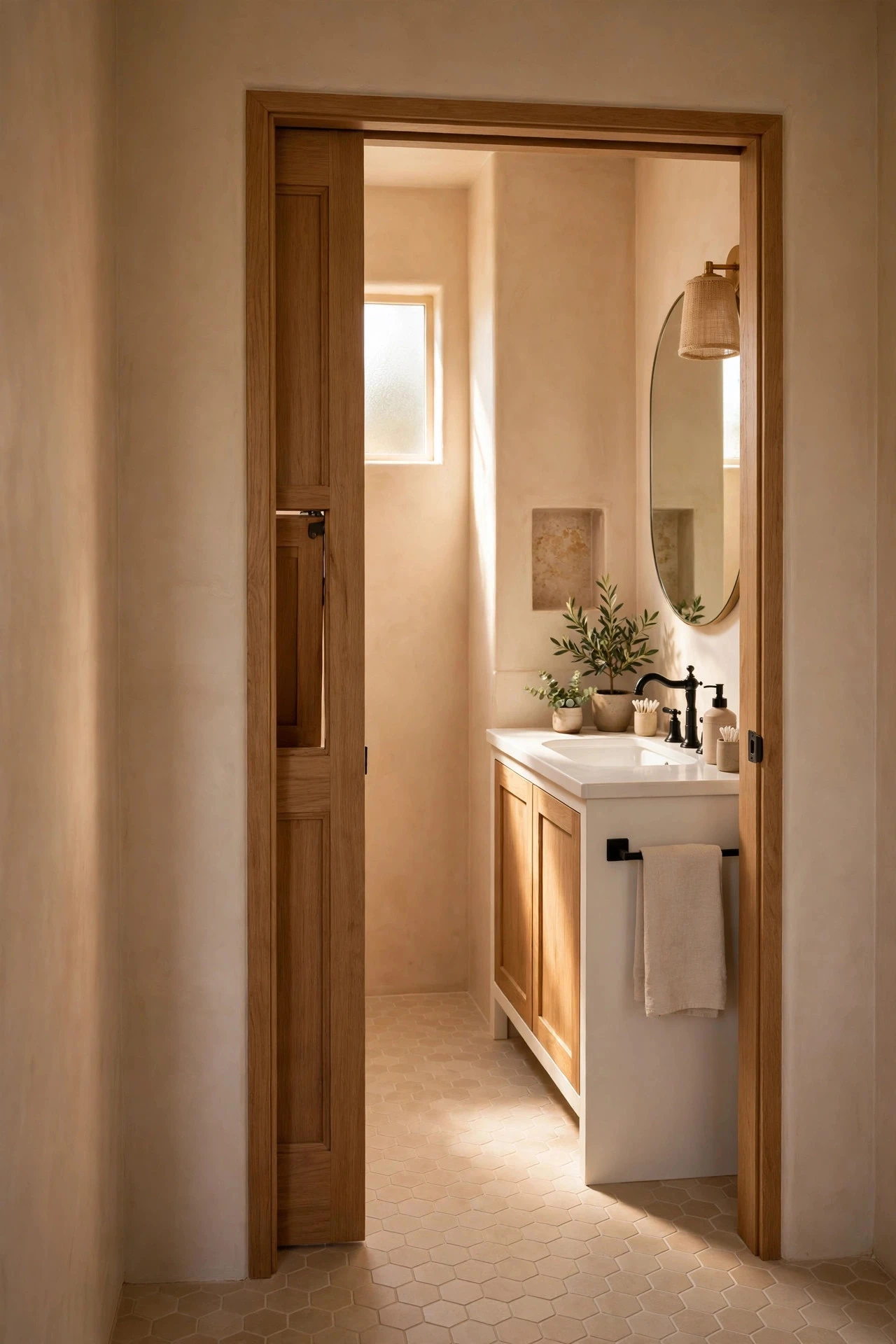
A door that swings into a small bathroom can block a third of the usable floor, so a pocket door that slides into the wall, or simply re-hinging the door to swing outward, instantly returns that space. A pocket door is a remodel job costing $200 to $500, while re-hinging an existing door costs little more than a new hinge set and an hour's work. The mistake to avoid is fitting a pocket door in a wall that carries plumbing or wiring, because rerouting services turns a simple job into a major one — check the wall before you cut.
17. Right-Sized Fixtures, Not Oversized Ones
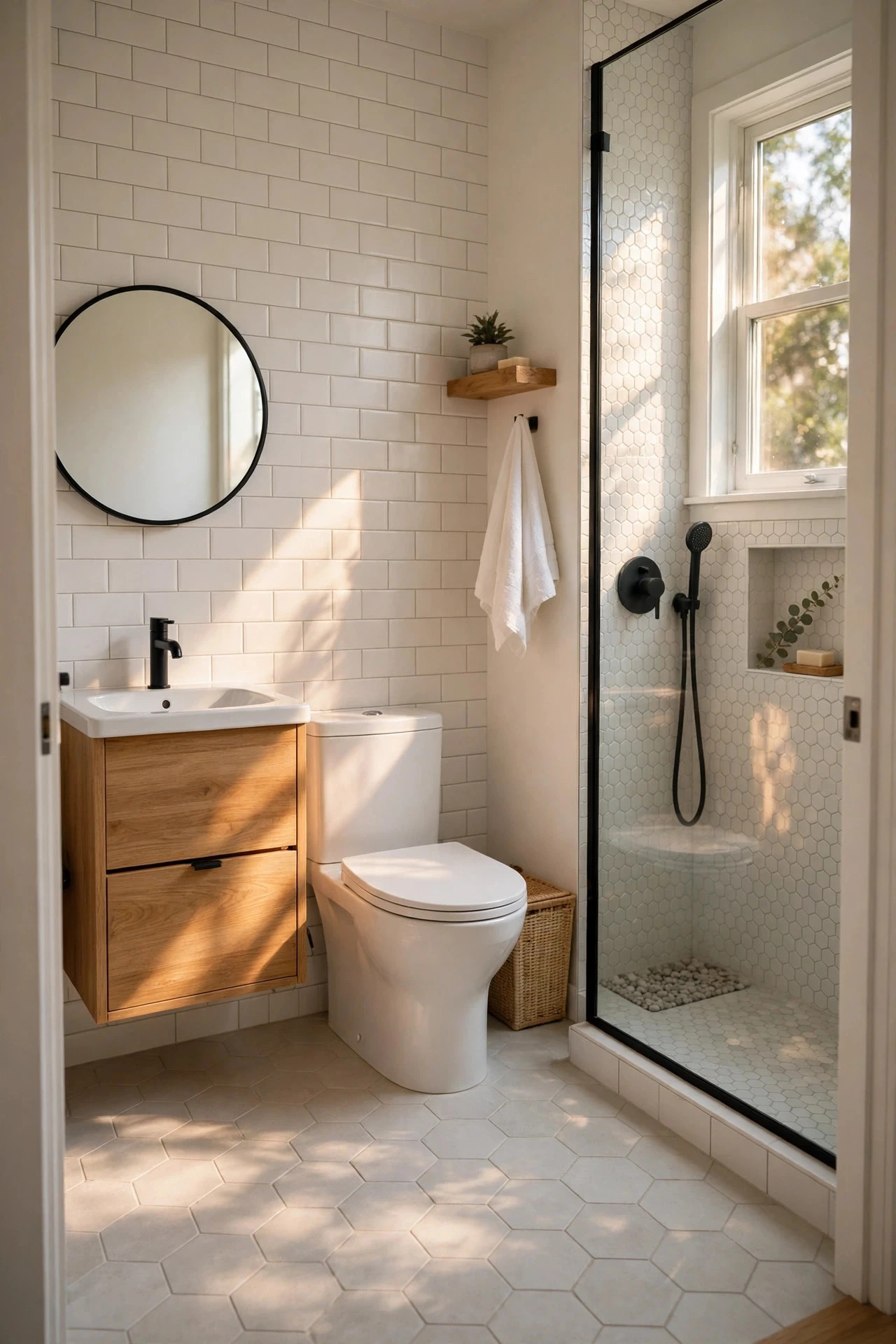
Oversized fixtures overwhelm a small bathroom: a deep vanity, a wide toilet, and a large basin together leave no room to move and make the walls feel closer. Choose compact, right-sized fixtures — a shallow vanity, a compact toilet, a small or trough basin — and leave clear floor space around each one, because empty floor reads as luxury in a small room. Compact fixtures cost similar to standard ones, $100 to $400 each. The mistake to avoid is keeping a standard-size bath or vanity "because it was already there" when a compact replacement would transform how the room feels and functions.
18. Clear Surfaces and Ruthless Decluttering
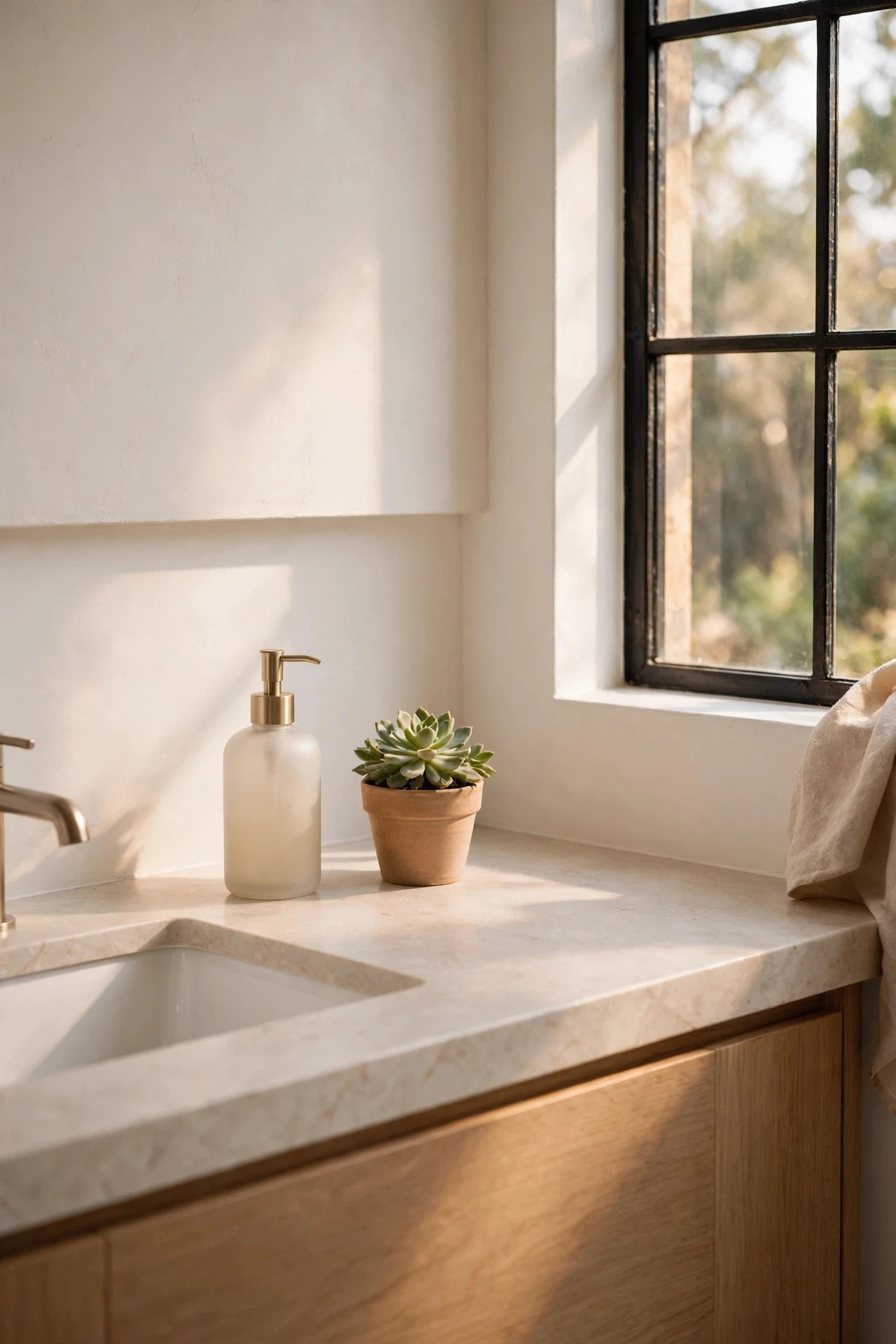
The cheapest small-bathroom transformation costs nothing: remove everything from the surfaces, keep only a soap dispenser and one small plant or candle, and move backup bottles to a linen closet or a closed cabinet. Clutter is visual noise, and every bottle, jar, and gadget on display breaks up the room's calm surfaces and makes it feel smaller. Storage boxes and a tray cost $10 to $30. The mistake to avoid is decluttering once and letting bottles creep back over a month, so set a weekly two-minute reset where everything returns to its closed home.
19. Vertical Stripes and Tall Paneling for Height
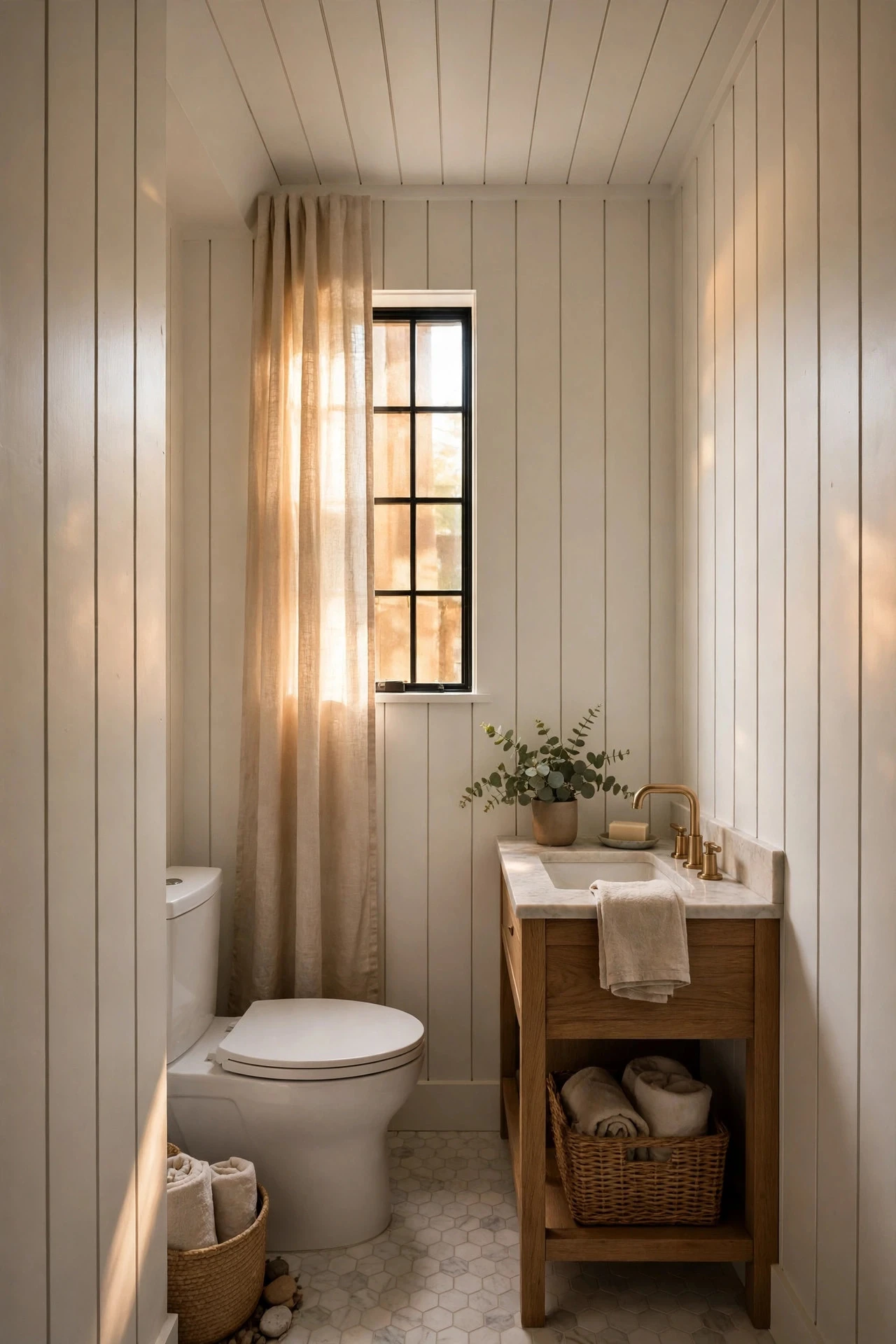
Vertical lines draw the eye upward and make a low ceiling feel taller. Vertical shiplap or beadboard paneling, tall narrow tiles, or a vertical stripe of wallpaper all create the same effect, especially when painted in the same light colour as the rest of the room. Paneling a feature wall costs $80 to $200 in materials. The mistake to avoid is using horizontal stripes in a small bathroom, which widen the walls visually but emphasise a low ceiling and make the room feel squat rather than tall.
20. A Small Plant and One Piece of Art
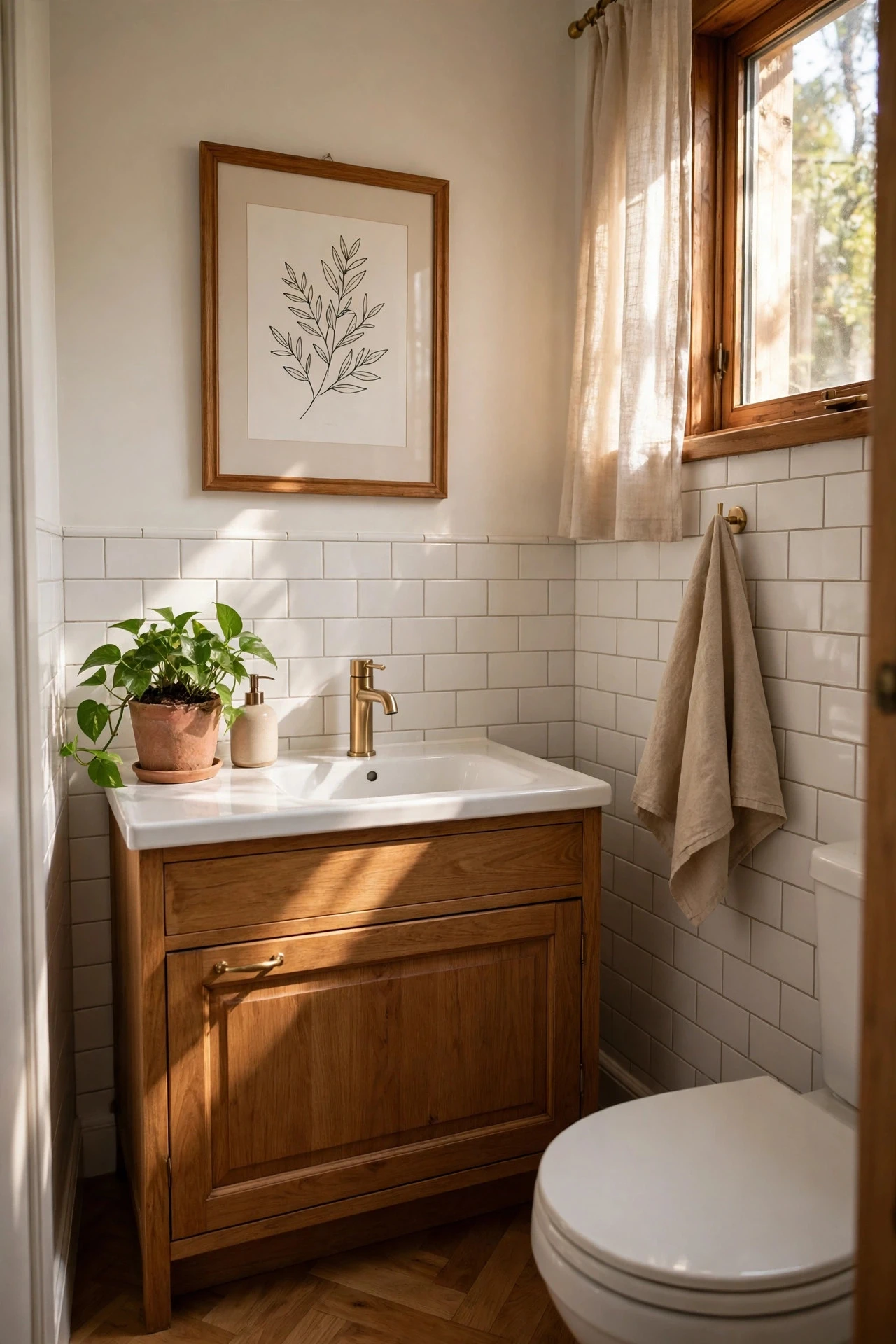
A small bathroom needs one living detail and one personal detail — a humidity-loving plant such as a pothos or fern, and a single framed print — and nothing more. The plant softens hard surfaces and adds a note of life, while one artwork gives the eye a focal point without cluttering the walls. A plant and a framed print cost $15 to $40. The mistake to avoid is filling a small bathroom with several plants and pictures, because each one adds visual weight and the room quickly feels like a crowded shelf rather than a calm retreat.
21. Warm Metal and Wood Accents for Warmth
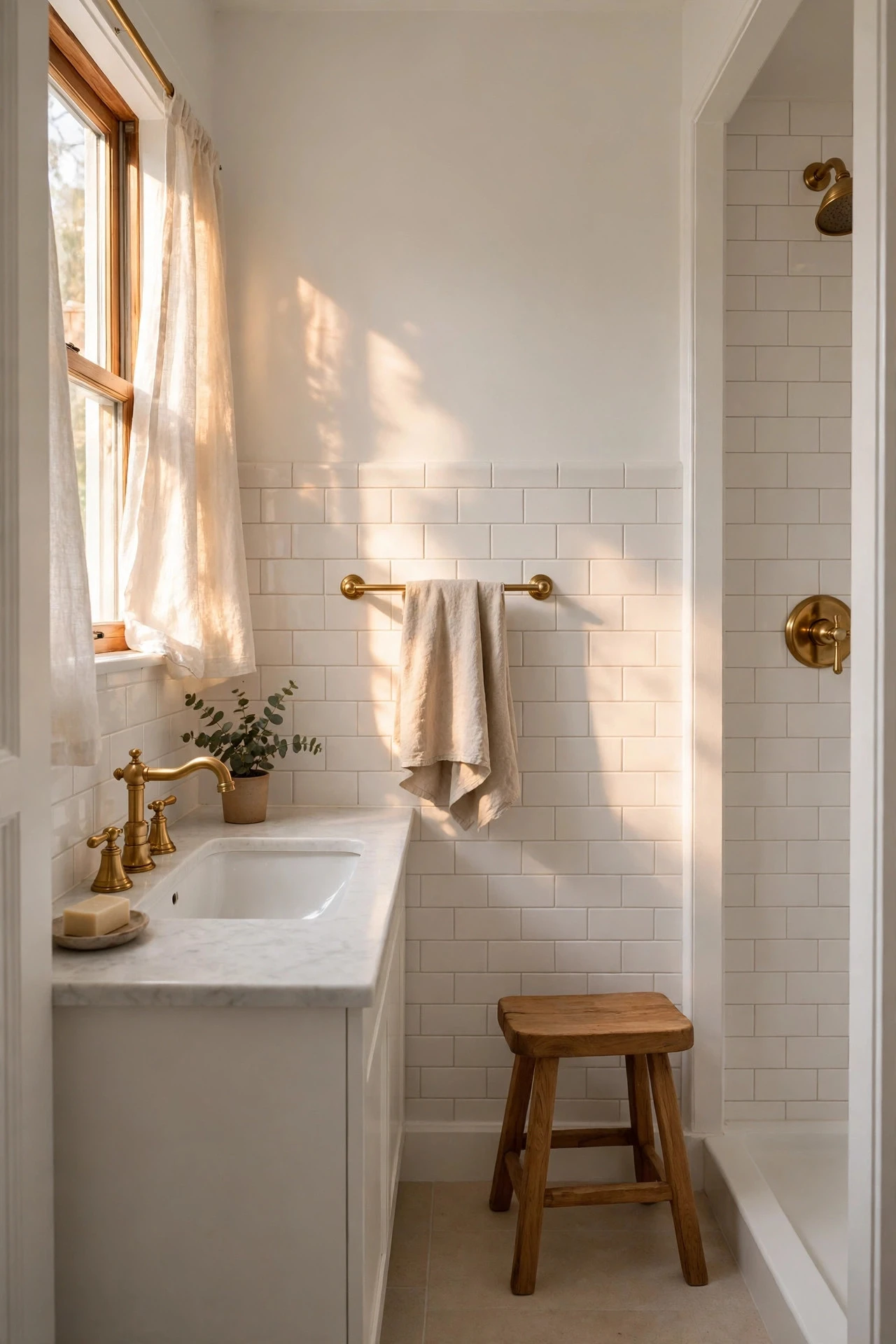
Small, all-white bathrooms can feel cold and clinical, so warm accents — brushed brass fittings, a wooden stool, a woven basket, a warm-toned mirror frame — add the warmth that makes the room feel inviting rather than sterile. Keep the accents to one metal and one wood tone, repeated two or three times, so the room stays calm. A brass fitting set, a stool, and a basket cost $50 to $120. For a retro take on warm bathroom styling, these retro bathroom decor ideas show how warm colour and vintage fittings work in a small space. The mistake to avoid is mixing three metals and two woods in one tiny room, because the mix reads as busy and unfinished and breaks the calm palette that makes the room feel larger.
22. The Weekly Reset That Keeps It Feeling Big
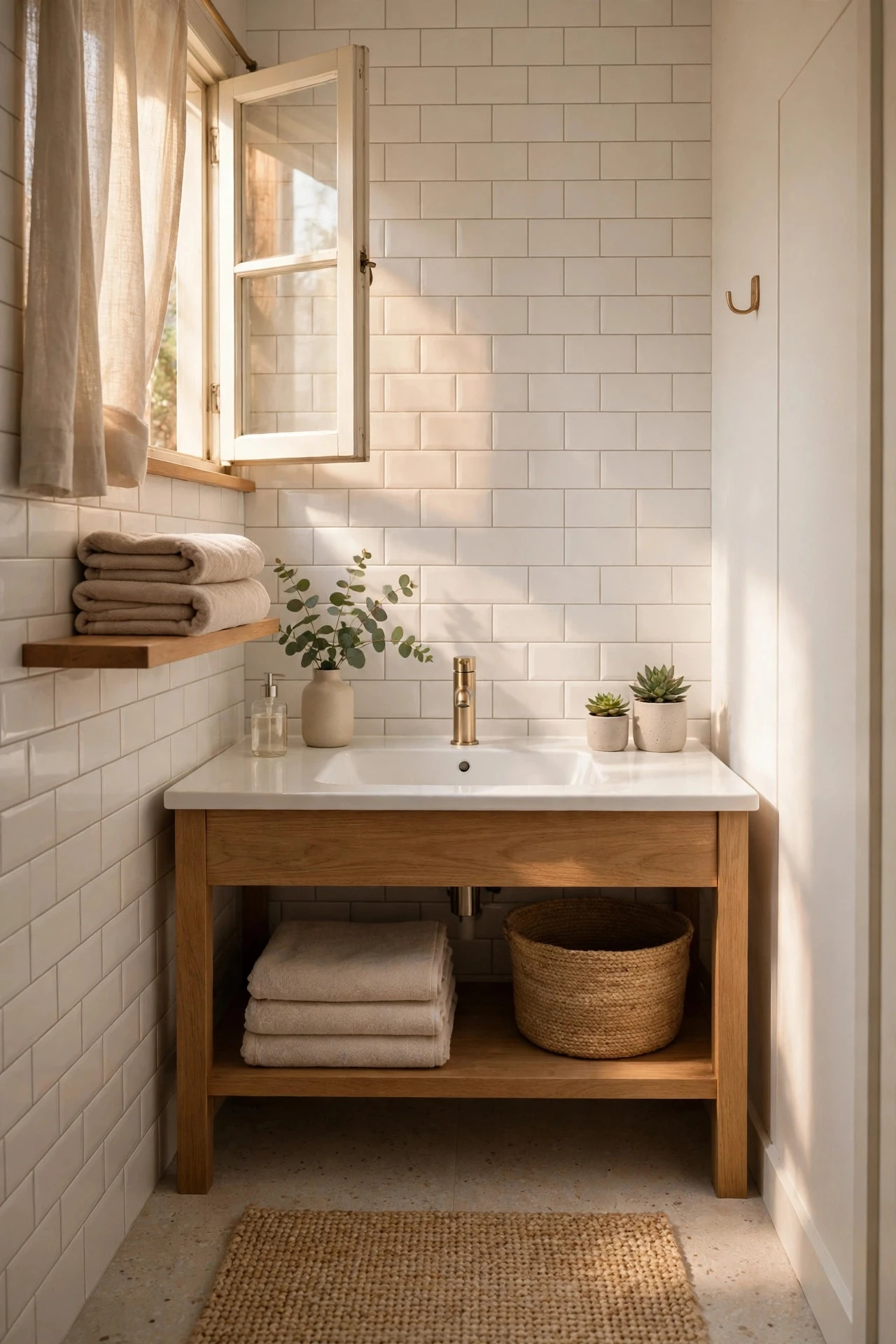
The final idea is a habit, not a purchase: a weekly five-minute reset that keeps the small bathroom feeling as large as the day it was styled. Wipe the mirror and glass, return every bottle to its closed home, fold or hang towels neatly, empty the bin, and check that nothing has crept onto the surfaces. A clean, clear bathroom always feels larger than a cluttered one, no matter how small the footprint. The cost is five minutes a week. The mistake to avoid is treating the reset as a deep clean, because a long, dreaded chore gets skipped, while a short, easy reset actually happens every week.
Practical Tips
Start with the no-cost, no-tool ideas and measure the difference before spending anything. Declutter every surface, paint the ceiling the same colour as the walls, and move the mirror higher or larger if you can, then live with the room for a week and notice what still feels cramped. That diagnosis tells you whether you need storage, lighting, or a fixture change, and it prevents spending on the wrong fix. For broader guidance on bathroom layouts, lighting, and storage, the bathroom guides at Houzz show real small bathrooms with dimensions and costs.
When you do spend, spend on the surfaces the eye reads first: the mirror, the floor, and the lighting. A large mirror, continuous flooring, and layered warm light transform how big a room feels for far less than a full remodel, and they work in rented bathrooms too when chosen as removable or surface-level changes. Keep the palette calm, the finishes consistent, and the clutter hidden, and let one warm accent — brass, wood, or a plant — give the room its personality. For material and finish advice that suits damp rooms, The Spruce explains which paints, tiles, and sealers cope best with bathroom humidity.
Measure before you buy anything that is fixed in place. A vanity that is two inches too wide, a mirror that overlaps a light switch, or a toilet that leaves no knee room will annoy you daily and cost money to correct, while ten minutes with a tape measure prevents all three. Note the door swing, the window position, and the plumbing locations, and take those measurements to the shop, because a small bathroom forgives nothing that does not fit.
Final Thoughts
A small bathroom feels bigger when the eye can travel without stopping: more visible floor, fewer grout lines, one calm colour, a large mirror, and clear surfaces. None of those ideas requires a large room or a large budget, and the cheapest ones — decluttering, painting the ceiling, and lighting the mirror well — make the biggest difference for the least money. Start with those, add storage that goes up instead of out, and save the structural changes for a remodel, keeping the room calm, warm, and easy to keep clear. The bathroom that feels generous is rarely the biggest one; it is the one where everything has a home and nothing is in the way.
You May Also Like: – 22 Luxury Bathroom Decor Ideas for a Spa-Like Retreat at Home – 22 Retro Bathroom Decor Ideas That Bring Back the Charm – 23 White Bathroom Ideas That Create a Bright, Elegant Space
Frequently Asked Questions
What is the best colour for a small bathroom?
Light, warm neutrals — soft white, warm grey, pale sage, or oatmeal — make a small bathroom feel larger because they reflect light and blur the boundaries between walls, floor, and ceiling. Use one colour family across the room, vary texture rather than colour, and add warmth with wood or brass accents so the room feels calm rather than clinical.
How can I make a small bathroom look bigger without renovating?
Declutter every surface, fit the largest mirror the wall allows, paint the ceiling the same colour as the walls, and layer warm lighting at the mirror and under the vanity. Those four changes need no plumbing or tiling, cost little, and make the biggest visual difference in a small bathroom.
Are large tiles better for a small bathroom?
Yes, large-format tiles with fewer grout lines make a small bathroom feel calmer and larger, because the eye reads one continuous surface instead of a busy grid. Match the grout to the tile, continue the same tile into the shower where possible, and keep gloss tiles on walls and matte tiles on floors for safety.
What size vanity is best for a small bathroom?
A floating vanity no wider than the space needs, with a shallow depth of 16 to 18 inches and a single drawer, suits most small bathrooms. It reveals floor underneath, keeps the room feeling open, and leaves clear space around the toilet and door swing, so measure the room and the door clearance before choosing.
How do I add storage to a tiny bathroom without clutter?
Use vertical storage — a tall slim cabinet, shelves above the toilet, or a recessed niche — and keep it closed where possible, so bottles and towels are hidden. Store backup supplies outside the bathroom, keep only daily items inside, and reset the surfaces weekly so clutter does not creep back.
What lighting is best for a small bathroom?
Layered warm lighting is best: sconces or a backlit mirror for task light at the face, a flush ceiling fixture for general light, and an LED strip under a floating vanity for accent light on the floor. Warm 2700K to 3000K bulbs flatter skin and feel calm, while a single harsh overhead light makes the room feel flat and small.