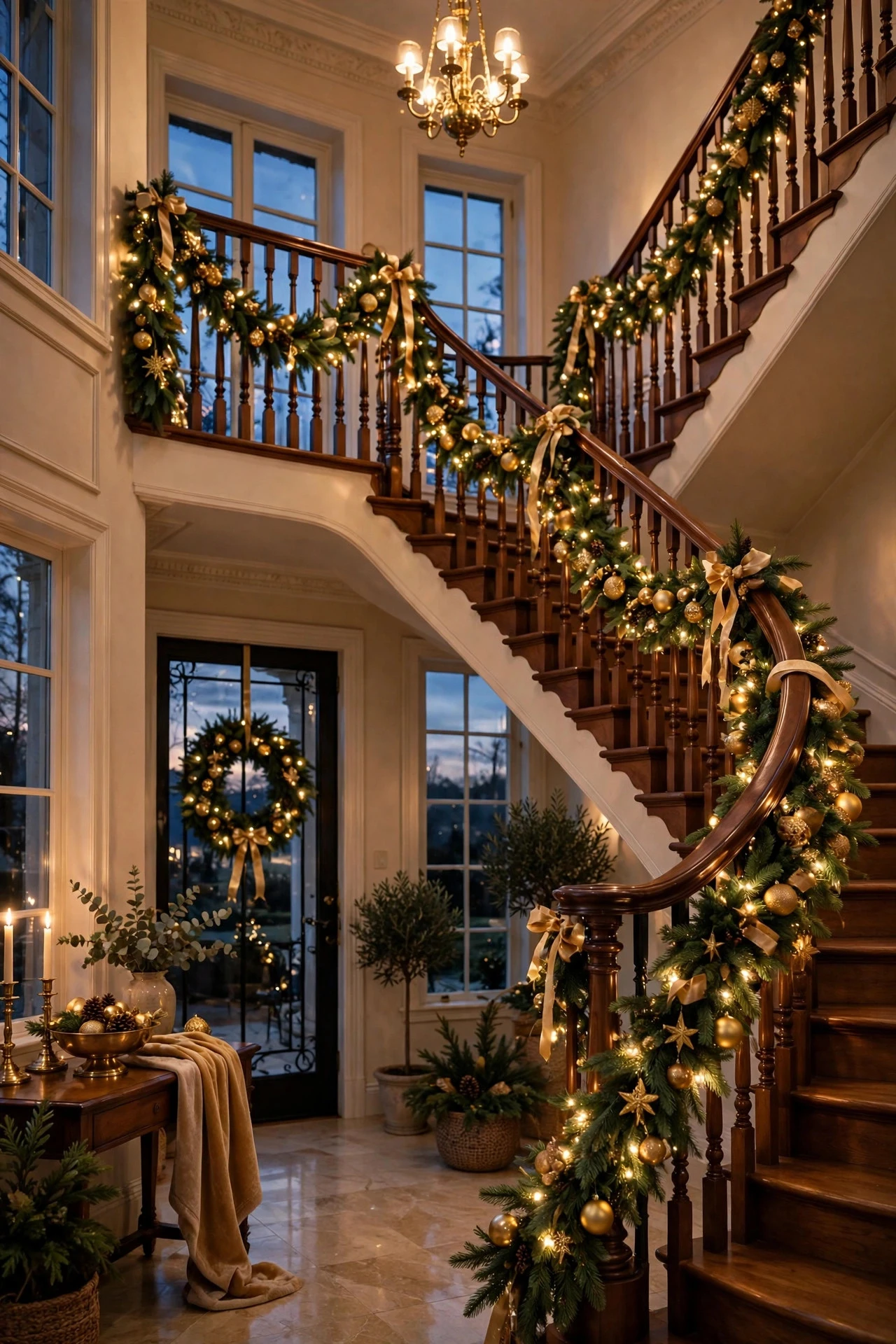
22 Garland on Staircase Ideas for a Grand Christmas Entrance
# 22 Garland on Staircase Ideas for a Grand Christmas Entrance
Nothing says Christmas has arrived quite like garland on a staircase. The moment the first swag goes up along the banister, an ordinary hallway becomes a grand entrance — green, glowing, and full of promise. Every trip up and down the stairs becomes a little ceremony, and guests pause on the landing just to take it all in. Whether your staircase is a straight flight, a sweeping curve, or a modest split-level run, garland is the single decoration that gives you the most drama for the least effort.
Looking for more inspiration? Our Nest Decorz homepage gathers the latest home decor ideas, seasonal decorating guides and room-by-room styling tips in one place — start there and explore.
Quick Answers
– Easiest garland on staircase: a pre-lit faux garland draped in gentle swags along the banister, tied with green floral wire every 18 inches — up in about 30 minutes with no ladder acrobatics. – Best greenery for a staircase: noble fir for fullness and needle retention, cedar for a soft, flowing drape, and eucalyptus for a modern look that dries beautifully. – How much garland do you need: measure the banister, add 25 percent for swag, and add 3 feet per newel post — a standard 12-foot banister needs about 18 feet of garland. – Safety rule that matters most: keep the handrail grippable — garland sits below or beside the rail, never wrapped over the top where hands need to grip.
1. How Do You Drape a Classic Banister Swag?
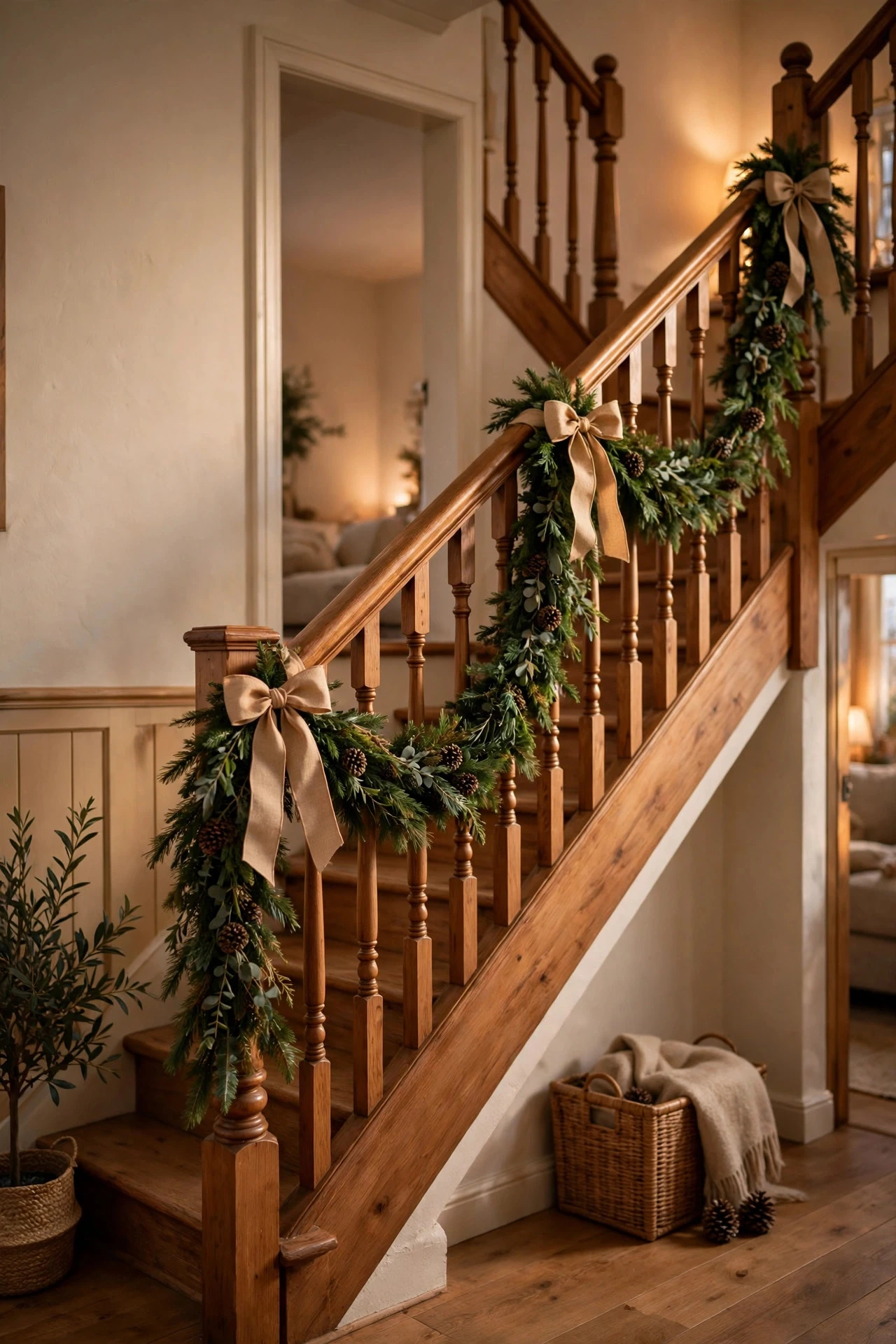
A classic banister swag is garland draped along the handrail in a series of gentle, even dips, with the lowest point of each swag falling 10 to 12 inches below the rail. Tie the garland to the balusters or the rail itself at each high point with green floral wire or zip ties, spacing the ties 24 to 30 inches apart so the swags hang in a regular, rhythmic pattern. Finish the swag ends by tucking them behind the newel posts for a clean, tailored look.
Start at the top of the stairs and work down, letting gravity help you shape each dip before you tie it off. A 9-foot garland covers roughly 7 feet of banister once swagged, so buy longer than you think you need. Never staple garland to a wooden banister, because the holes stay long after Christmas is over.
2. How Do You Measure a Staircase for Garland?
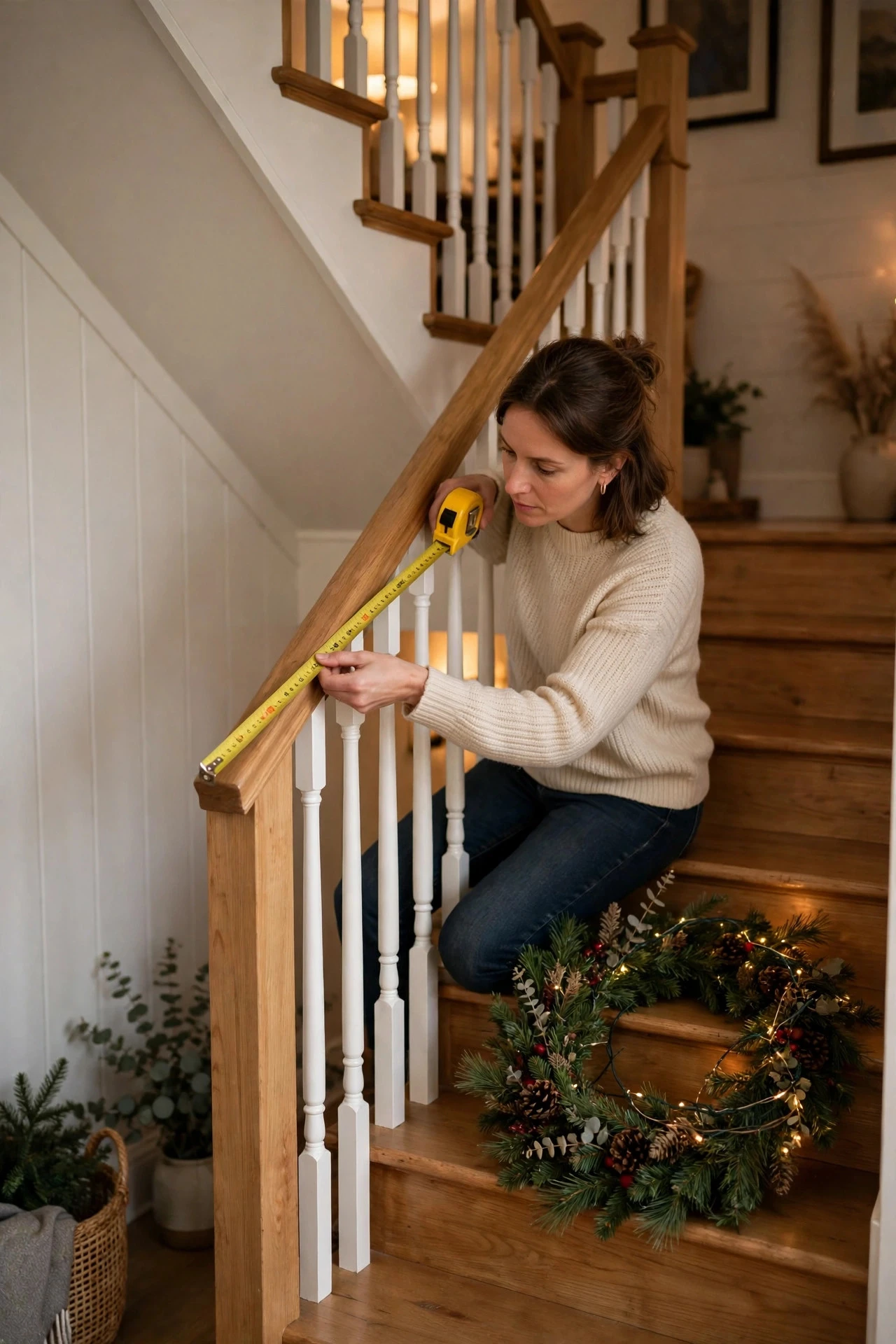
Measuring a staircase for garland starts with a flexible tape run along the handrail from the top newel post to the bottom one, following the slope of the rail rather than the floor. Write down that number, then add 25 percent for swag dips and another 3 feet for each newel post you plan to decorate. A straight 12-foot banister therefore needs about 18 feet of garland, while a curved rail needs a second measurement along the outside of the curve.
Count your balusters too, because they decide where the ties go — aim for a tie at every third or fourth baluster for an even look. Buy one extra 6-foot length as insurance, since garland always runs short at the bottom newel. Keep the receipt and the packaging, because unopened garland goes back easily.
3. Why Is Noble Fir the Best Garland for a Staircase?
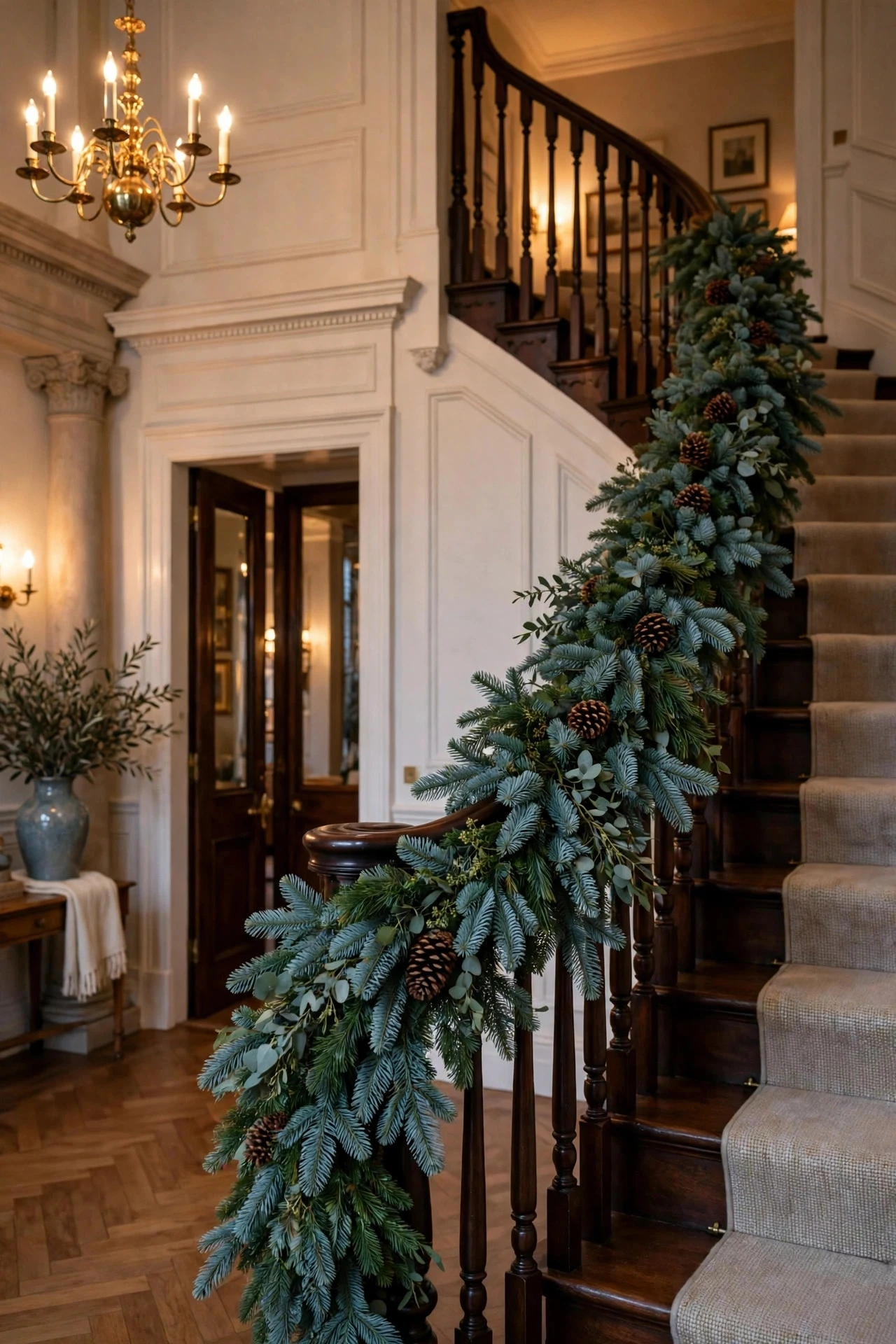
Noble fir is the best garland for a staircase because its branches are dense, its needles are short and sturdy, and it holds its shape for weeks without shedding all over the stairs. The deep blue-green colour photographs beautifully against warm wood, and the layered branches give the garland a full, expensive look even in a single strand. Fresh noble fir also carries the classic Christmas scent that no candle quite reproduces.
Buy noble fir garland by the foot from a garden centre or tree lot, and look for branches that spring back when you squeeze them. Mist it lightly every few days and keep it away from heating vents, which dry it out fast. A fresh noble fir garland lasts three to four weeks indoors, which covers the whole season if you put it up in early December.
4. How Does Cedar Garland Change a Staircase?
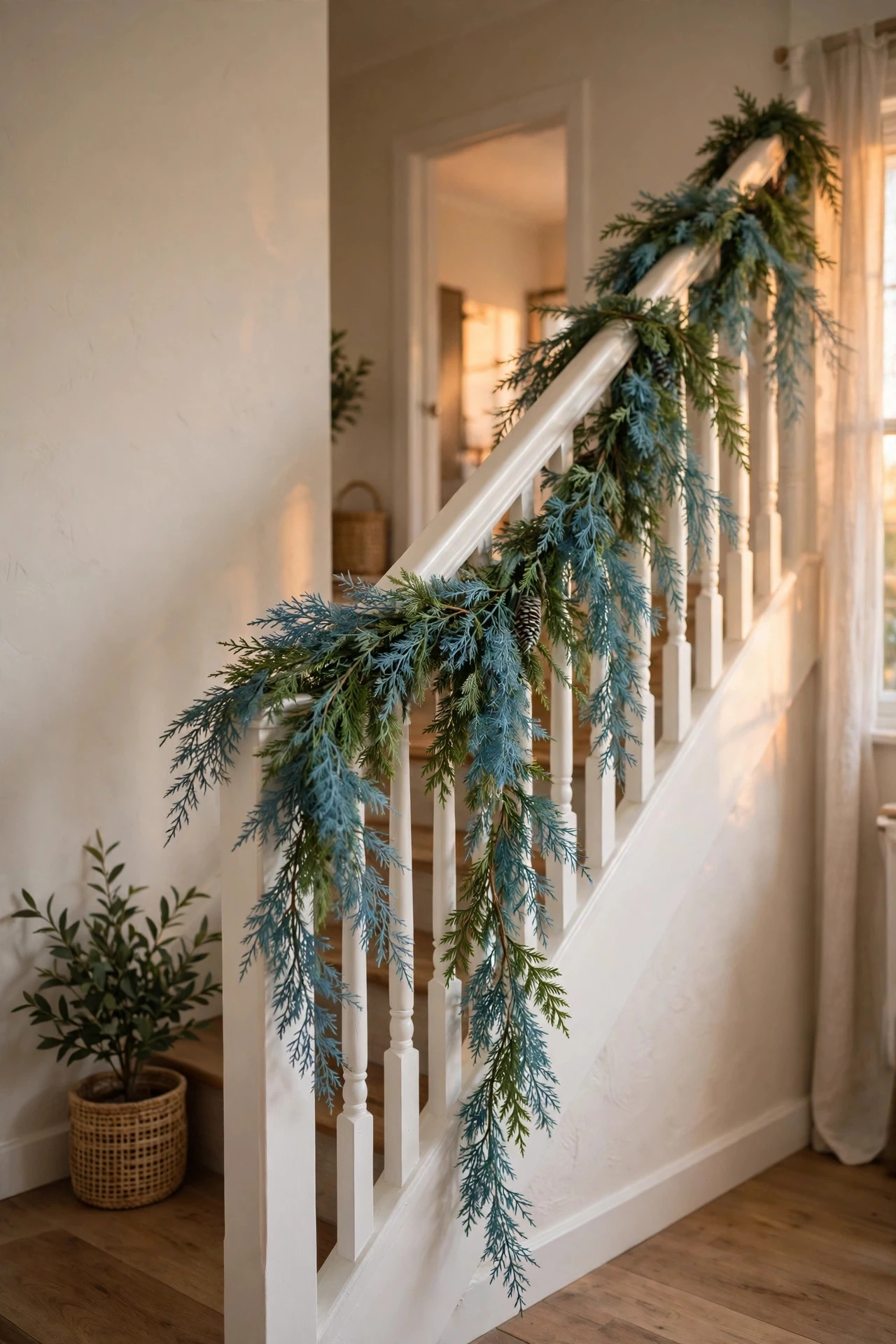
Cedar garland changes a staircase with its soft, flat, feathery sprays that fall in a graceful cascade instead of standing stiff and spiky. The blue-green colour is lighter and cooler than fir, so it suits white and grey staircases beautifully, and the scent is softer and woodier — more forest walk than Christmas tree lot. Cedar drapes naturally, which makes it the easiest greenery to swag without fighting the branches into shape.
Layer cedar over a plain fir base for the best of both worlds: fir gives fullness and structure, cedar gives movement and softness. Cedar dries gracefully rather than dropping needles everywhere, so it is the tidier choice for a staircase you use a dozen times a day. Pair it with a Christmas hallway decorating guide for a matching entryway, since cedar suits hallways as well as stairs.
5. Can Eucalyptus Garland Work on a Staircase?

Eucalyptus garland works beautifully on a staircase when you want a modern, airy look instead of the traditional dense evergreen. The round silver-green leaves catch the light, the scent is clean and spa-like, and the garland dries in place without losing its shape, so it still looks good in January. It is also far lighter than fir, which makes it ideal for a delicate wrought-iron or glass balustrade that heavy garland would overwhelm.
Use eucalyptus on its own for a minimalist staircase, or weave a eucalyptus strand through a fir garland for texture contrast — the round leaves against the pointed needles look wonderfully designed. Fresh eucalyptus costs about $20 to $30 for a 6-foot strand, and dried eucalyptus garland costs less and lasts for years. Avoid eucalyptus if anyone in the house is sensitive to strong scents, since the fragrance fills a stairwell fast.
6. How Do You Pick Faux Garland That Looks Real?
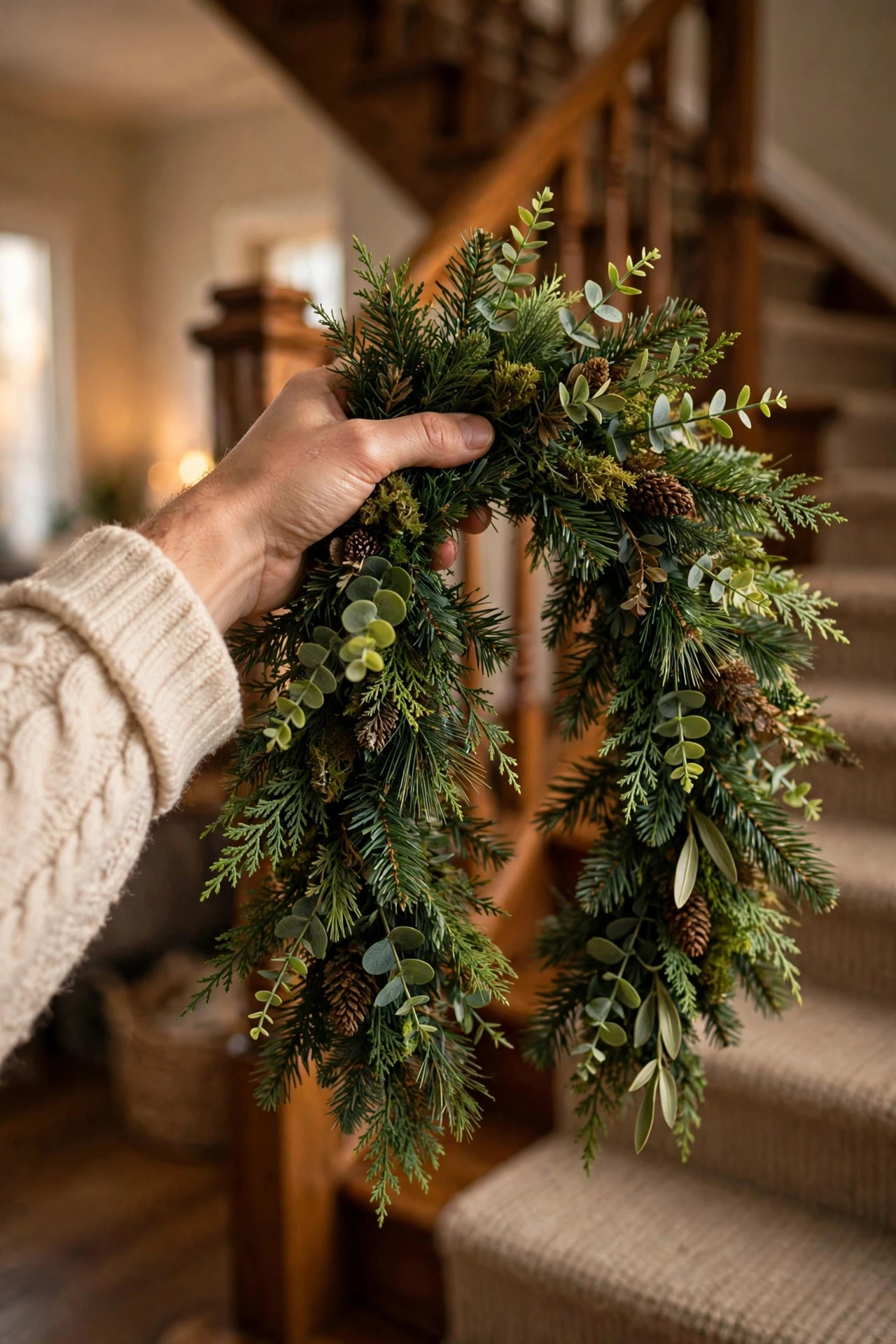
Faux garland that looks real starts with mixed tips: look for branches with at least three different needle lengths and two or three shades of green, because single-colour, single-length garland is what gives fake greenery away. Squeeze the garland in the shop — good faux garland feels full and springy, with a wire core you can bend and shape, while cheap garland feels flat and crackles. A 9-foot pre-lit faux garland in the $60 to $90 range is usually the sweet spot for quality.
Fluff every branch before you hang it, pulling tips outward and upward so no wire shows and the garland looks twice as thick. Good faux garland lasts five to ten seasons, which makes it cheaper per year than fresh greenery, and it never sheds on the stairs. The Spruce has a helpful guide to choosing artificial Christmas greenery if you want to compare types before you buy.
7. What Makes Pre-Lit Garland Worth It on a Staircase?

Pre-lit garland is worth it on a staircase because the lights are already woven evenly through the branches, so you never fight a separate light string into place or end up with dark patches. The glow from a pre-lit garland turns the whole staircase into a light feature at dusk, and the warm-white LEDs highlight the greenery instead of competing with it. Battery-operated pre-lit garland is the safest choice for stairs, since there is no cord to trip over or plug to reach.
Look for garland with at least 50 lights per 6 feet and a timer function, so it switches itself on at dusk and off after six hours. Choose warm white over cool white for a cosy glow that matches candlelight. Never use mains-powered garland with a cord running across a step, because the cord becomes a trip hazard in the dark.
8. How Do You Weave Ribbon Through Staircase Garland?

Weaving ribbon through staircase garland is the fastest way to add colour and pattern: choose a wired ribbon 2.5 to 4 inches wide, and thread it through the garland in loose loops, tucking it behind a branch every 12 inches so it appears and disappears like a river through the greenery. Wired ribbon holds its shape, so the loops stay plump and visible instead of flattening against the garland. Red velvet, gold mesh, and plaid are the classic choices, and each one changes the whole mood of the staircase.
Cut the ribbon into 3-foot lengths and weave each one separately, which is far easier than wrestling one long piece down the whole rail. Tie the ends into the garland with floral wire so they never dangle onto the steps. About 10 yards of ribbon dresses a standard staircase, and ribbon is reusable for years if you store it rolled rather than folded. Pair the look with the rest of your indoor Christmas decor ideas so the ribbon colour repeats through the house.
9. How Do You Style a Newel Post With Garland?
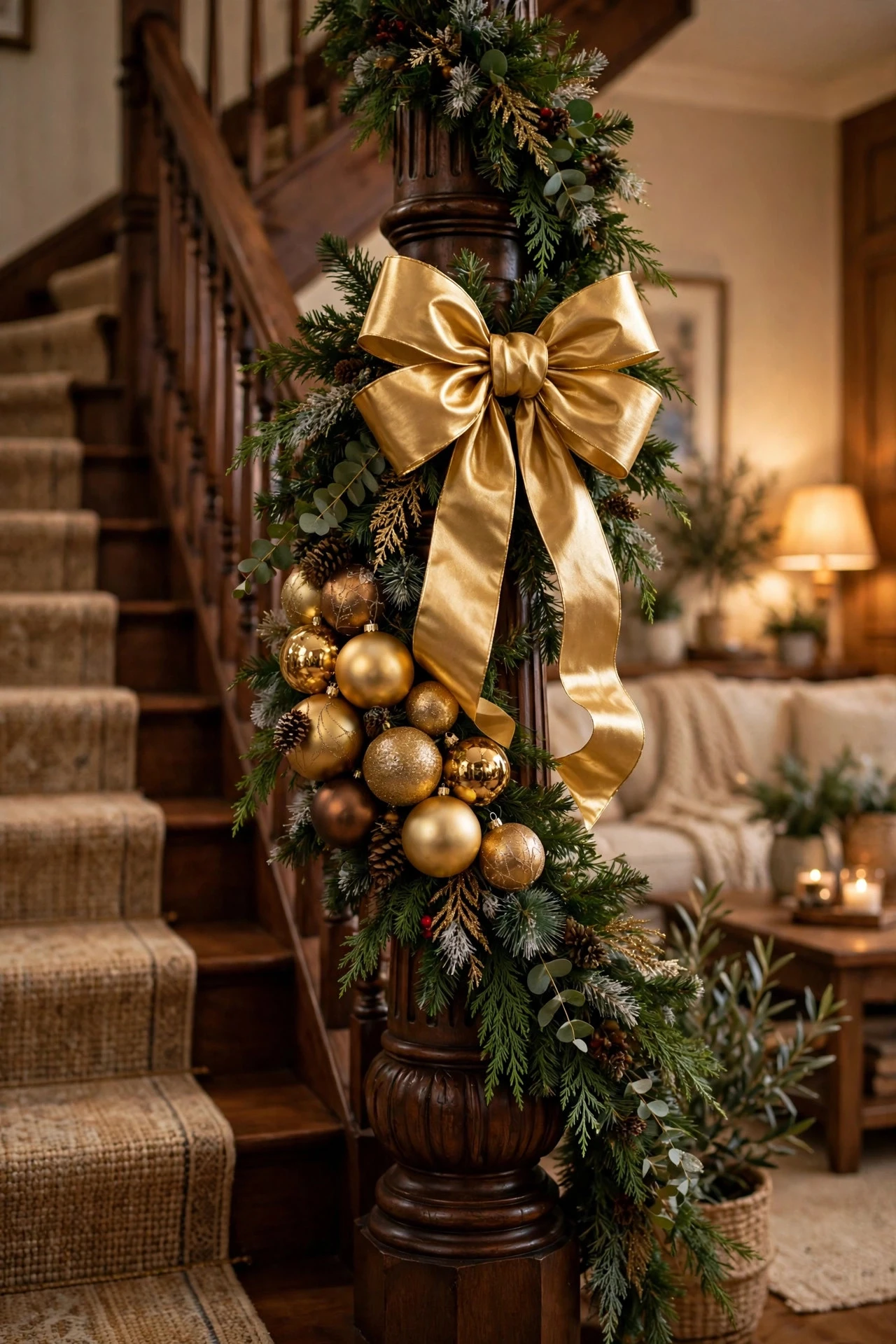
A newel post styled with garland becomes the exclamation mark of the whole staircase: wrap garland around the post in a loose spiral, finish with an oversized bow at the top, and let one tail of the bow fall 12 to 18 inches down the post. Add a cluster of three ornaments, a sprig of berries, or a small lantern at the base, and the newel post becomes a decoration in its own right rather than just the end of the banister.
Start the wrap at the bottom of the post and work upward, tucking the garland ends behind the bow so no wire shows. A bow made from 4-inch wired ribbon with loops at least 8 inches across reads as grand from the foyer; smaller bows disappear on a chunky post. Match the bow ribbon to the ribbon woven through the banister garland so the staircase reads as one design.
10. How Do You Add Ornaments to Staircase Garland?
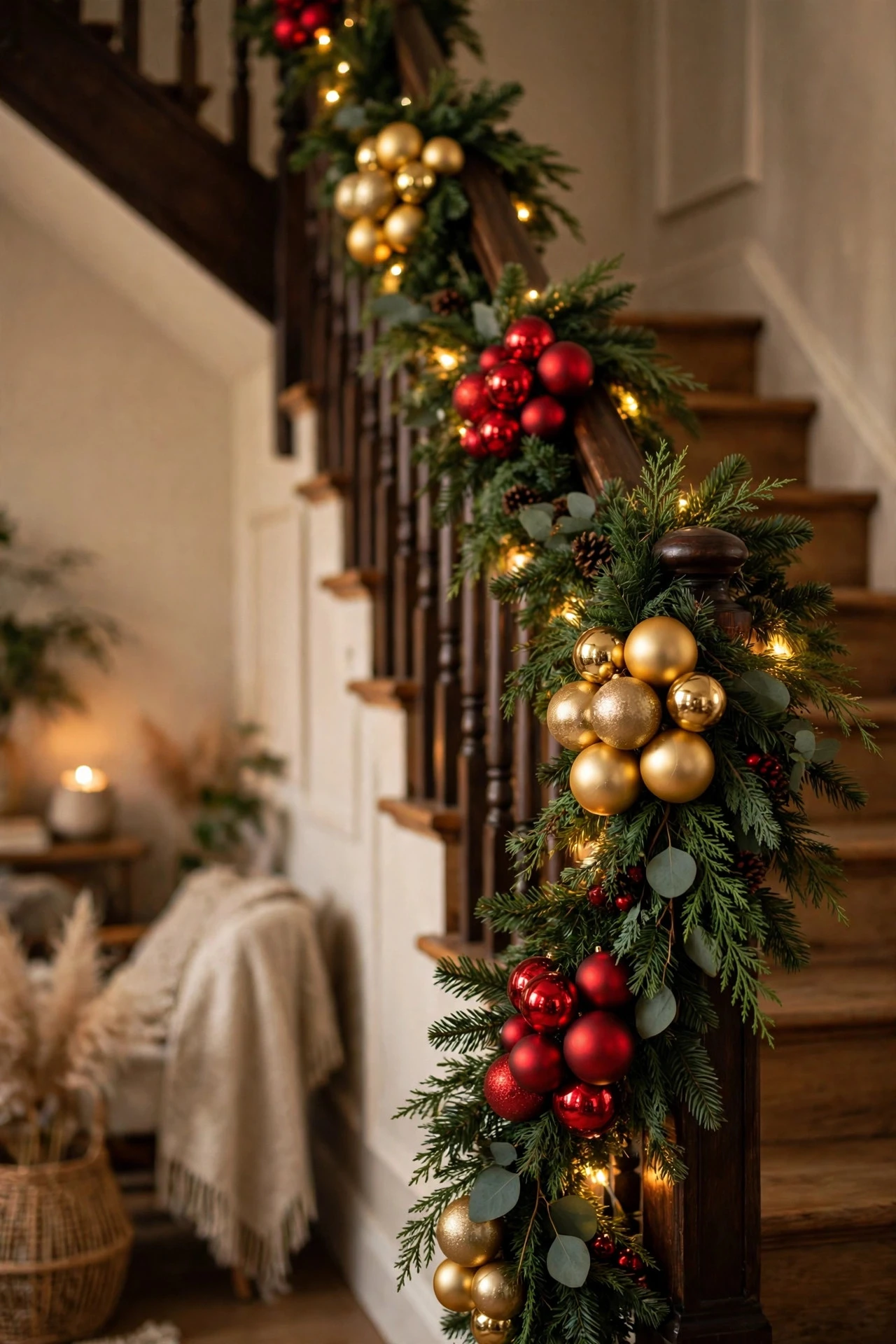
Adding ornaments to staircase garland turns a green swag into a jewel box: tuck shatterproof baubles into the garland in clusters of three, varying the sizes — one large 4-inch bauble, one medium, one small — and spacing the clusters 18 to 24 inches apart. The ornaments should nestle into the greenery so they look as if they grew there, not as if they were hung on hooks. Gold, deep red, and champagne are the classic staircase palette, and they catch the light from the garland's own bulbs.
Use shatterproof ornaments only, because a glass bauble dropped on a hard stair tread shatters into a hazard. Wire each ornament to a branch with a short length of floral wire rather than hanging it from its loop, so it cannot slip off when the banister vibrates. Count your ornaments before you start — a standard staircase needs 18 to 24 baubles for a full look.
11. What Do Pinecones and Berries Add to Garland?
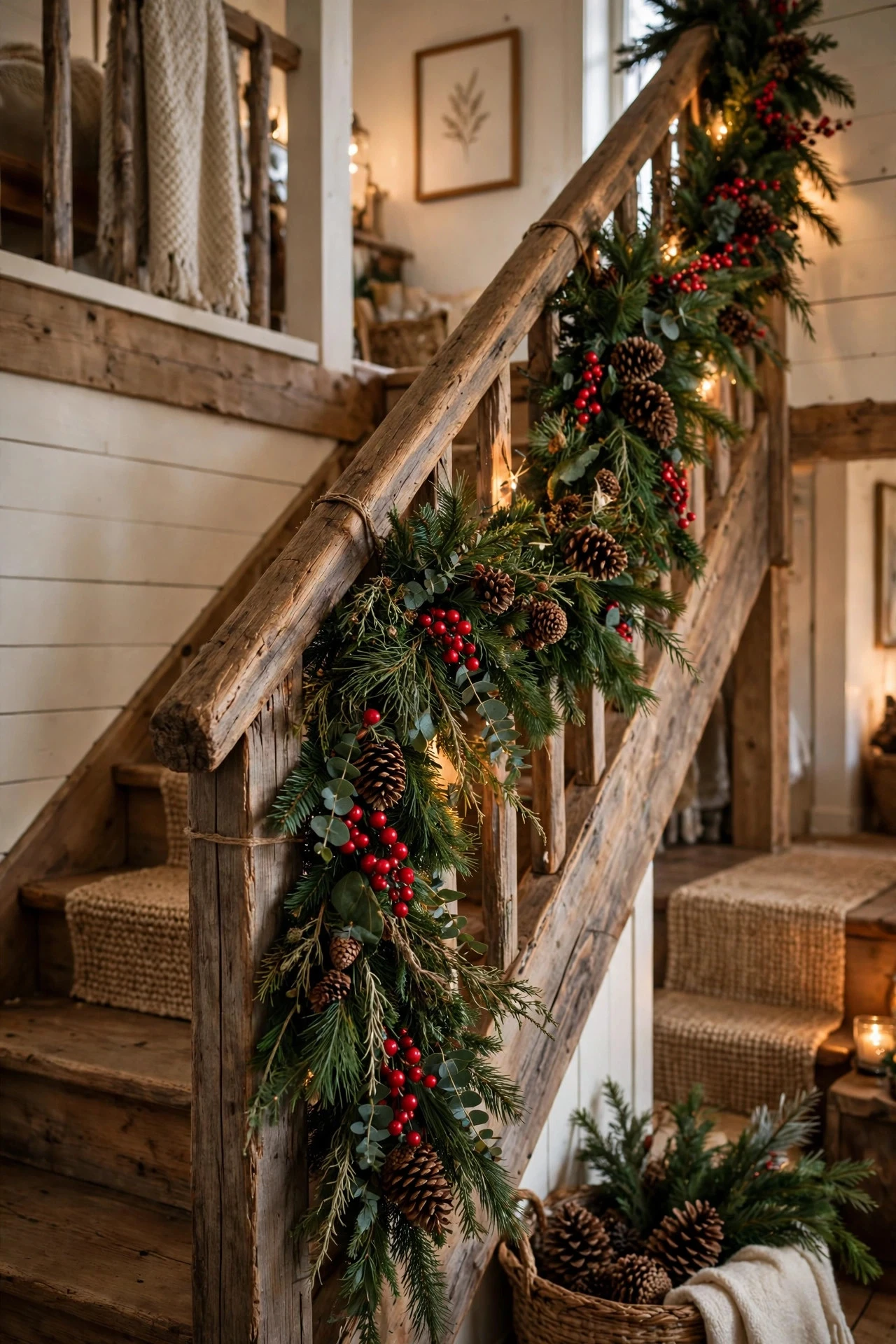
Pinecones and berries add texture and scent to staircase garland in a way that ornaments alone cannot: pinecones bring a rustic, woodland weight, while red berries — real holly, faux cranberries, or winterberry picks — add sharp pops of colour against the green. Tuck pinecones into the garland in pairs, wired in place so they sit at different angles, and add berry picks in clusters of three or five for a natural, gathered look.
Collect pinecones yourself and bake them at 200 degrees Fahrenheit for 30 minutes to kill any insects before wiring them in, or buy scented cinnamon pinecones for about $5 a bag. Faux berries are the safer choice on a staircase, since real berries drop and stain carpet. A garland with pinecones and berries needs fewer ornaments, which saves money and looks more expensive. The combination suits a living room Christmas decor scheme in the same rustic palette.
12. How Do You Cascade Garland Down a Stair Rail?
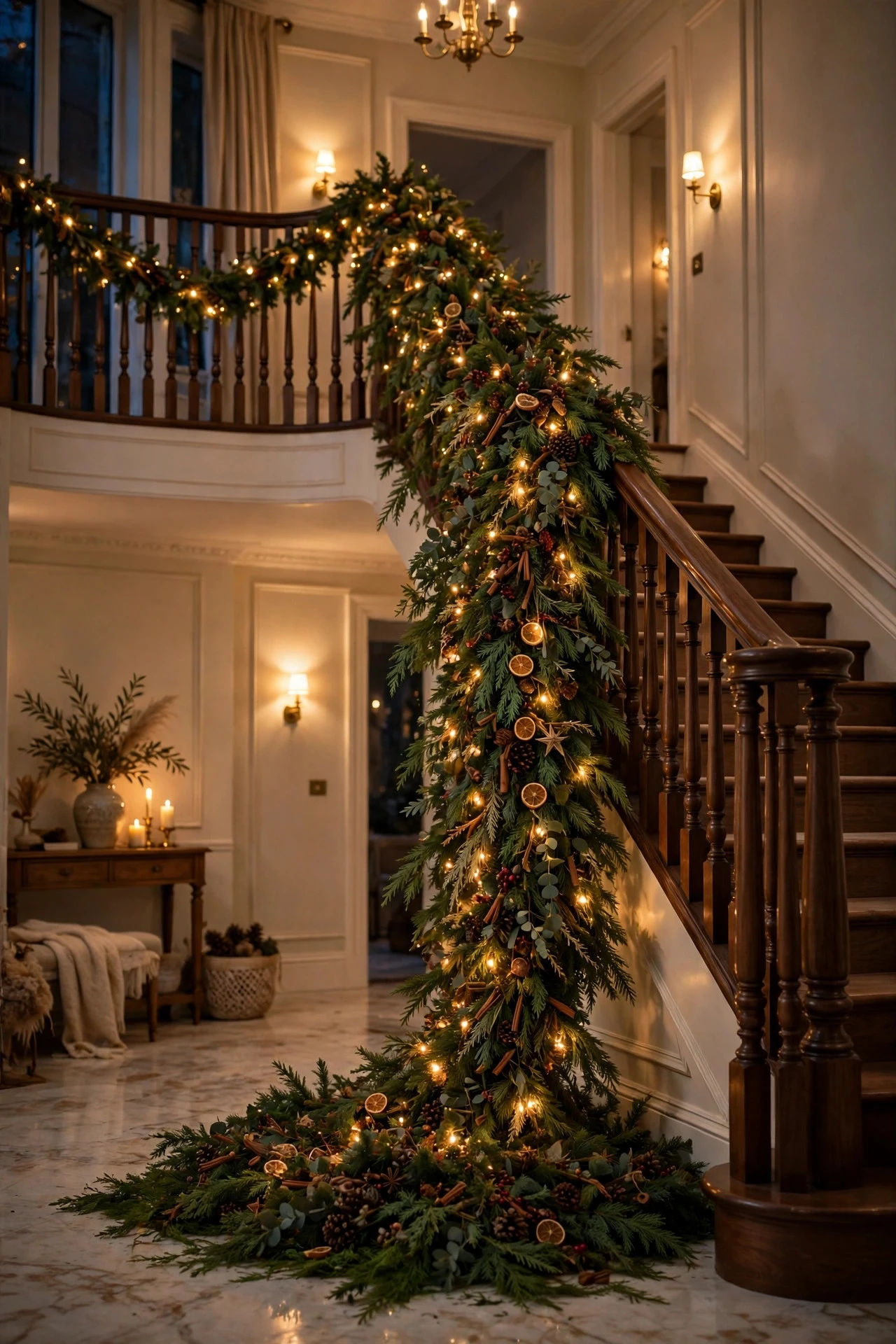
Cascading garland down a stair rail means letting one long strand fall vertically from the top newel post to the floor, pooling slightly at the bottom step like a green waterfall. Secure the garland at the top newel with a strong tie, let it drape in a gentle S-curve down the rail, and anchor it again at the bottom newel so the cascade holds its shape. The effect is dramatic and romantic, and it suits a grand entrance or a staircase photographed from the foyer.
Use a garland at least 12 feet long for a single cascade, and choose a flexible cedar or mixed-foliage garland that bends gracefully rather than a stiff fir that fights the curve. Never let the garland pool across a step where feet land, and never block the bottom newel with a pile of greenery that hides the handrail.
13. What Is a Newel-Post Topper, and How Do You Make One?

A newel-post topper is a compact arrangement that sits on top of the newel post like a little crown: a small bundle of greenery, a cluster of ornaments, a bow, and sometimes a candle lantern or a small Christmas figure. It turns the post into a focal point and gives the staircase a finished, deliberate look from every angle. A good topper is 12 to 18 inches tall — tall enough to see from the foyer, short enough not to wobble.
Build the topper on a small foam base or a wired bundle, then set it on the post cap and secure it with museum putty or a removable adhesive pad so it cannot be knocked off. Swap the topper for a Christmas chalkboard sign on the wall beside the stairs if your post caps are too small or rounded to hold an arrangement safely.
14. How Do You Garland a Spiral Staircase?
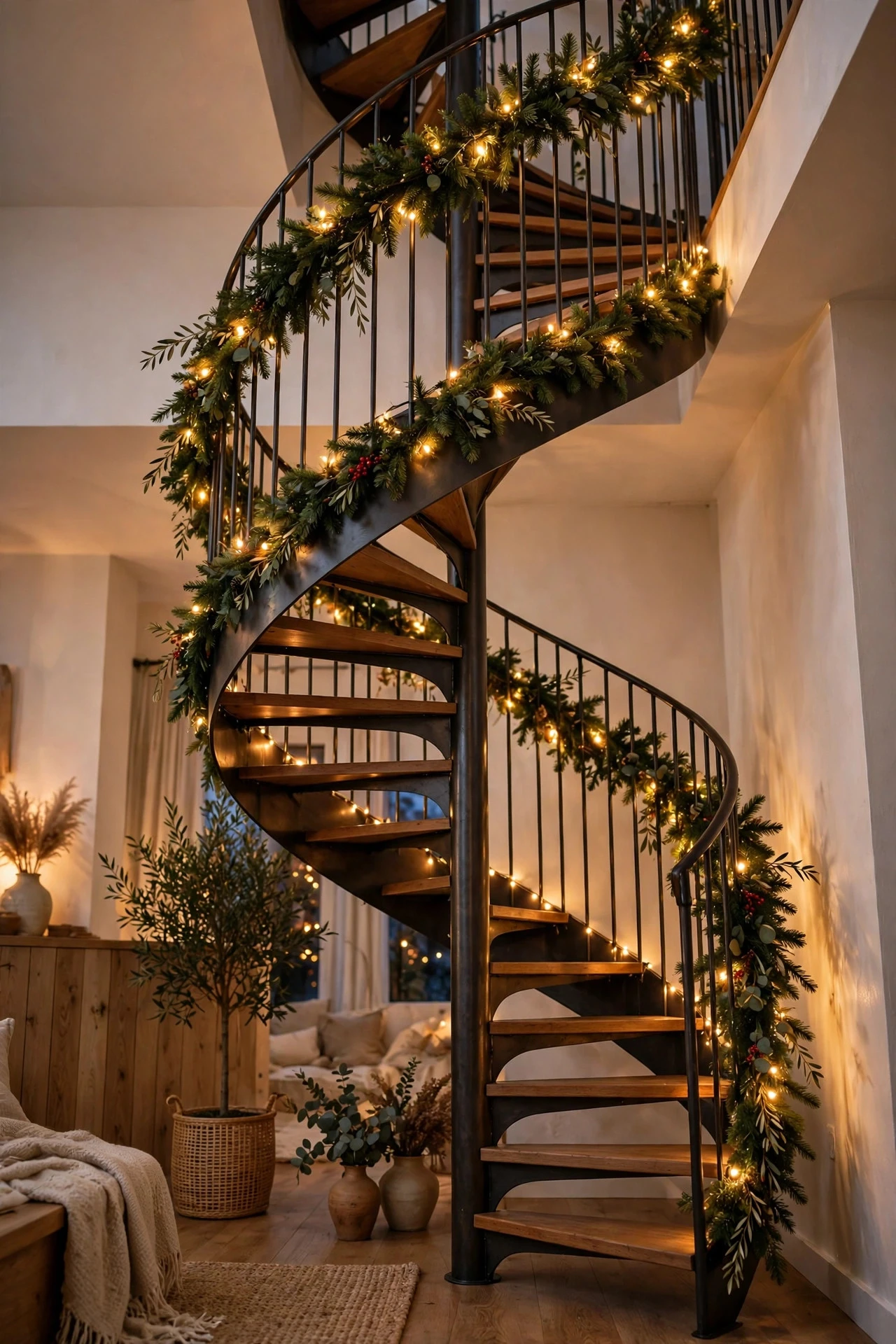
Garlanding a spiral staircase means following the curve with a flexible garland and tying it at every turn, because a spiral rail pulls garland outward and the swags slide downhill if they are not anchored. Use a garland with a strong wire core that you can bend into the curve, and tie it to the rail or balusters every 12 to 18 inches — twice as often as on a straight staircase. Keep the swags shallow, with dips of only 4 to 6 inches, so the garland follows the rail instead of hanging in deep loops that block the narrow treads.
Measure a spiral staircase by running a tape along the outside of the rail, then add 30 percent for the curve and the extra ties. Use battery lights, since a cord has nowhere safe to run on a spiral.
15. How Do You Decorate a Split or Double Staircase?
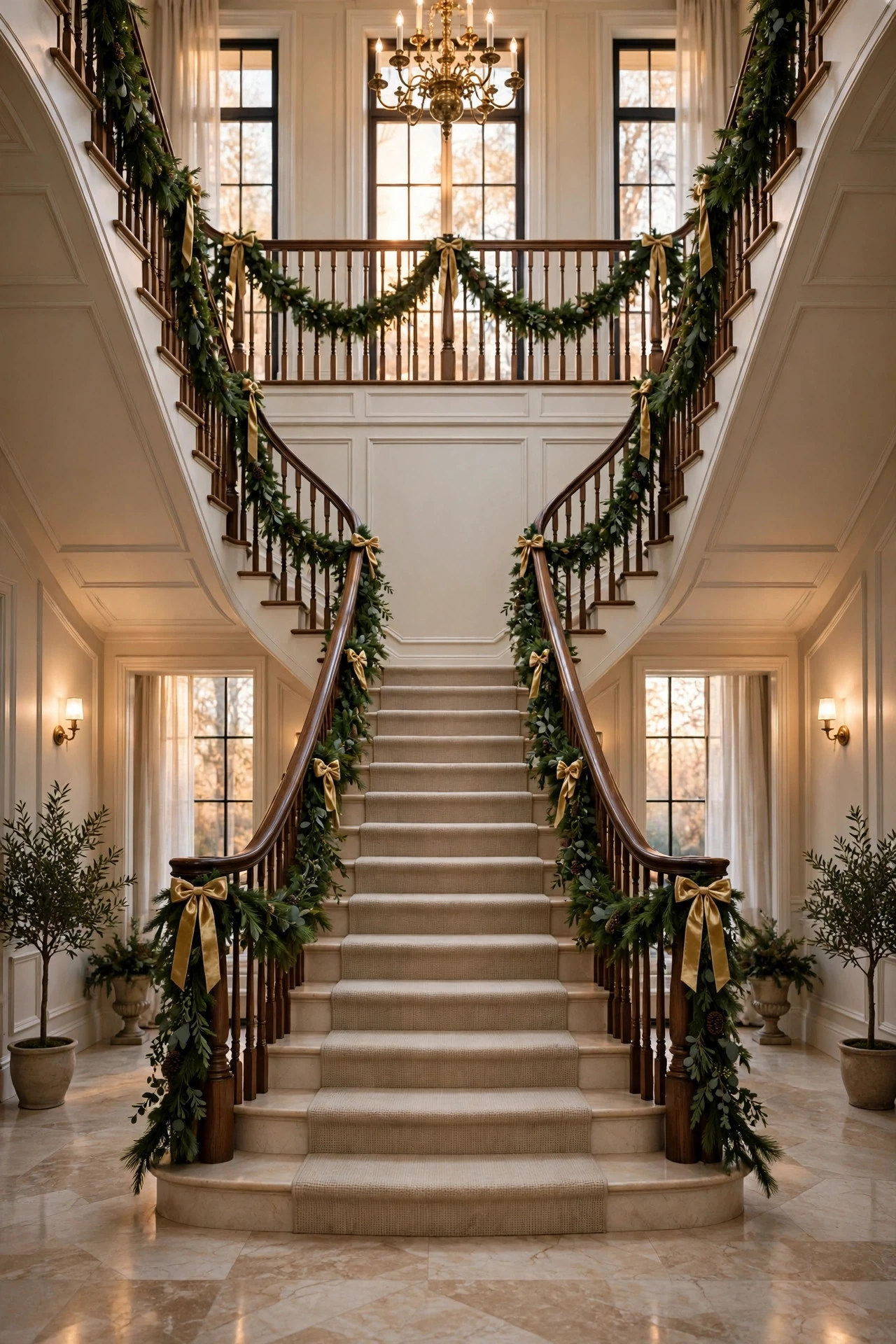
A split or double staircase gives you two banisters to decorate, so the secret is symmetry: mirror the same garland, the same swag depth, and the same bows on both sides, so the staircase reads as one grand design rather than two competing ones. Start both sides at the top landing and work outward, checking from the foyer that the swags match in depth and spacing. A pair of matching newel-post toppers finishes the look and draws the eye to the centre of the entrance.
Buy your garland in one batch so the colour and fullness match — two garlands bought weeks apart can be visibly different shades of green. Keep the centre of the landing clear, because that is where guests pause and turn. Never decorate only one side of a double staircase, since the bare side makes the whole entrance look unfinished.
16. How Do You Tie the Landing Into the Staircase Garland?
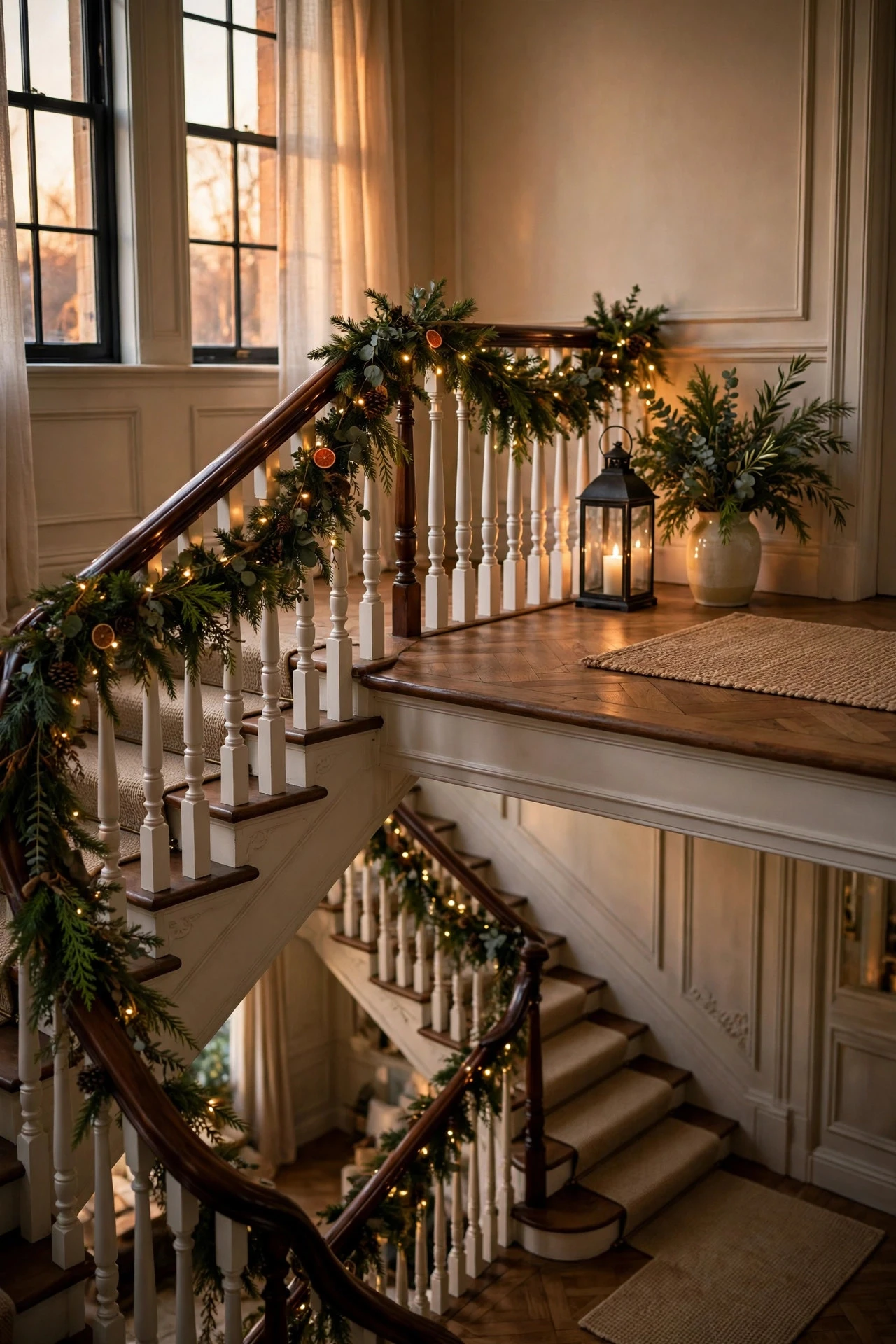
Tying the landing into the staircase garland means carrying the same greenery from the banister onto the landing rail, the console table, or the wall above it, so the decoration flows instead of stopping abruptly at the top step. Run a matching garland along the landing balustrade, add a small wreath or a framed print on the landing wall, and place a lantern or a vase of greenery on the landing table. The landing becomes the destination the staircase garland has been leading to all along.
Use the same greenery type and the same ribbon on the landing as on the stairs, and repeat one ornament colour so the eye connects the two spaces. The landing is also the perfect spot for a snowman door welcome visible from the top of the stairs, tying the entrance and the landing into one festive route.
17. How Do You Add Stockings to a Staircase Garland?
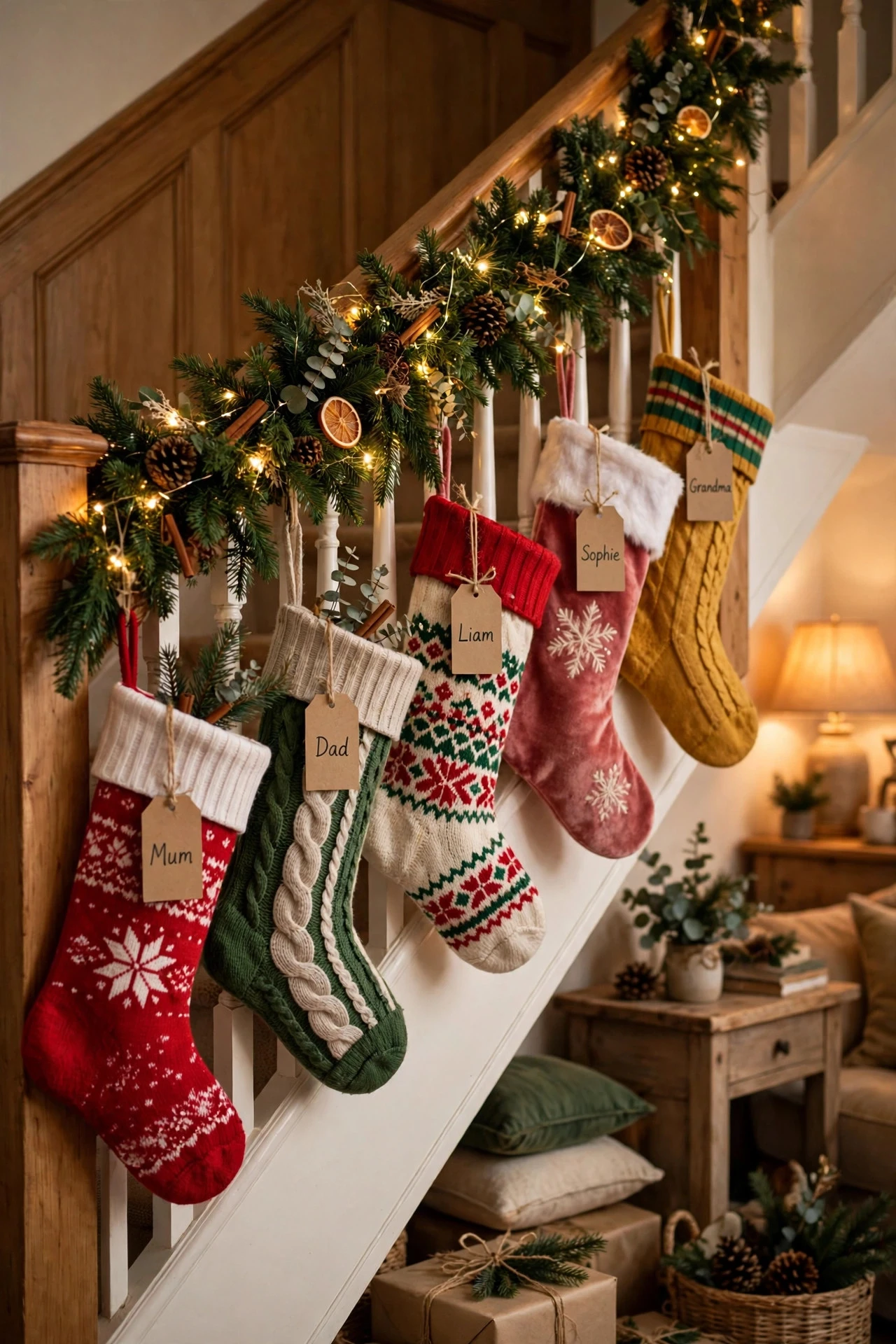
Adding stockings to a staircase garland turns the banister into a mantel when you have no fireplace: hang one stocking per family member from the garland at the swag points, using strong clips or S-hooks that grip the garland's wire core. Space the stockings 18 to 24 inches apart, hang them high enough that they clear the treads, and stuff them lightly so they hold their shape. Small stockings work best — full-size stockings get heavy and pull the garland down.
Use felt or knitted stockings in colours that match the garland's ribbon, and add a name tag to each one so the staircase feels personal. The idea borrows from the classic mantel tradition, but on a staircase it feels fresh and unexpected; a Christmas mirror above the landing doubles the sparkle of the stockings at dusk.
18. What Does Rustic Farmhouse Staircase Garland Look Like?
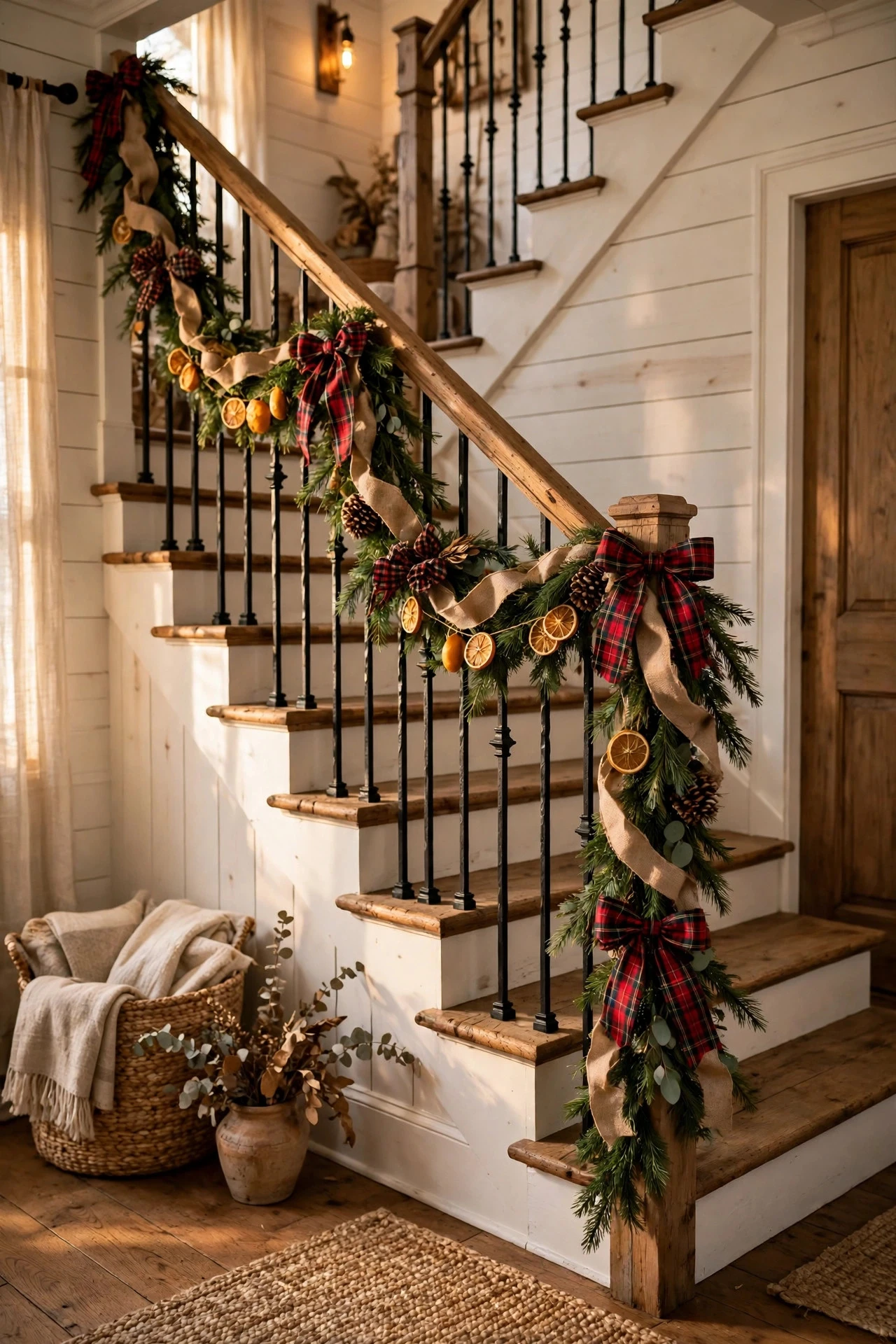
Rustic farmhouse staircase garland is loose, natural, and a little wild: a mixed fir and cedar garland, burlap ribbon woven through in wide loops, pinecones wired in generously, dried orange slices, cinnamon sticks, and a plaid bow at each newel post. The swags hang a little deeper and a little less evenly than a formal garland, which is exactly the point — it should look gathered from the woods, not arranged by a florist. Warm-white lights and a few wooden bead strands finish the look.
Use burlap ribbon 4 inches wide, because narrower burlap frays and disappears into the greenery. Dry orange slices in a low oven for three hours and wire them in pairs, and tie cinnamon sticks in bundles of three with twine. The whole look costs $40 to $70 if you gather the pinecones and dry the oranges yourself.
19. How Do You Make a Luxury Gold-and-Green Staircase?
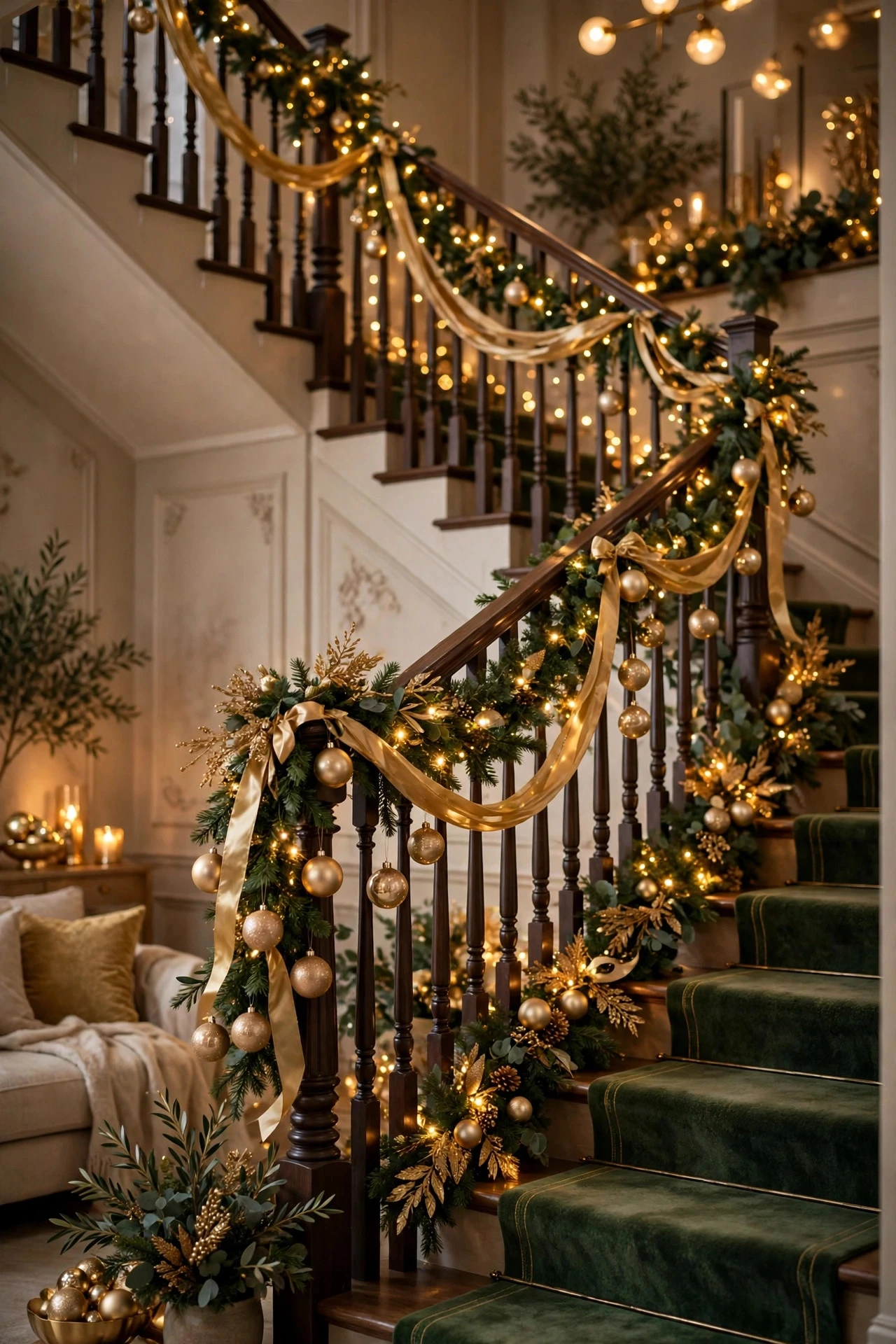
A luxury gold-and-green staircase layers rich materials for a high-end entrance: a full noble fir garland, gold ribbon woven through in wide loops, gold and champagne ornaments in clusters, a gold bow at each newel post, and warm-white lights on a dimmer so the glow feels like candlelight. Add gold leaf picks, metallic eucalyptus, or a few gold-painted pinecones for shimmer, and keep the palette strictly to green, gold, and champagne — no red, no silver, no competing colours.
Spend the money where it shows: a $90 pre-lit garland and real wired ribbon make a bigger difference than a dozen cheap ornaments. A luxury staircase garland costs $120 to $200 all in, but every piece is reusable for years. Architectural Digest's Christmas decorating features show how designers layer metallics for exactly this kind of grand entrance.
20. What Is a Minimalist Scandinavian Staircase Garland?
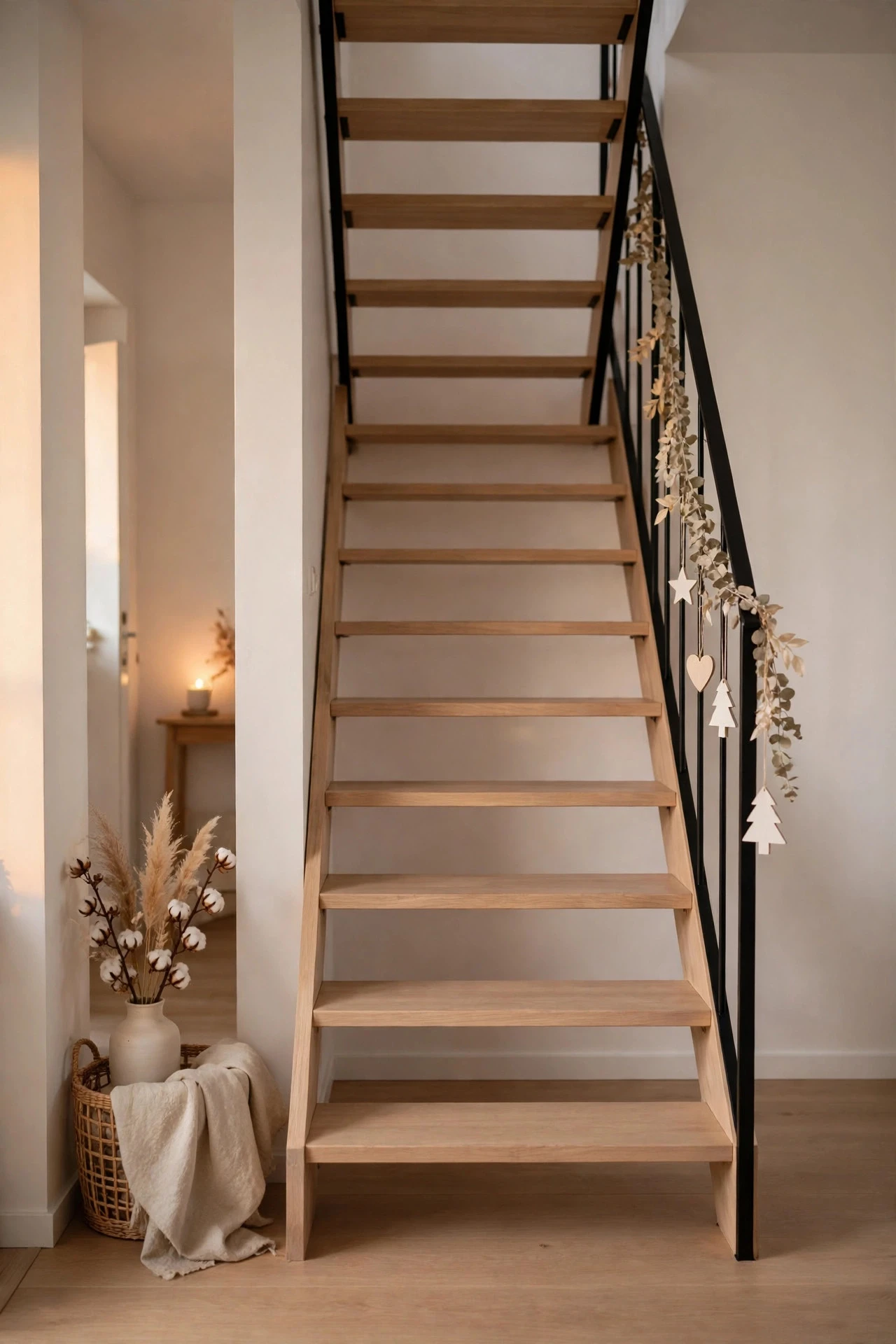
A minimalist Scandinavian staircase garland is deliberately sparse: a single slim strand of fir or eucalyptus, a few white or wooden ornaments, and nothing else — no ribbon, no bows, no glitter. The garland follows the rail in a straight line with almost no swag, the ornaments are spaced widely, and the whole staircase feels calm and pale, like a snowy forest path. It suits white walls, pale wood, and homes where the rest of the Christmas decor is already simple.
Use a slim garland with a narrow profile, and choose ornaments in white, natural wood, and soft grey only. The discipline is in what you leave out: one extra colour or one extra cluster breaks the whole effect. Avoid this look on a dark wood staircase, where a slim pale garland vanishes; if the wood is dark, choose a fuller green garland and keep the ornaments pale.
21. How Do You Garland a Staircase for Under $50?
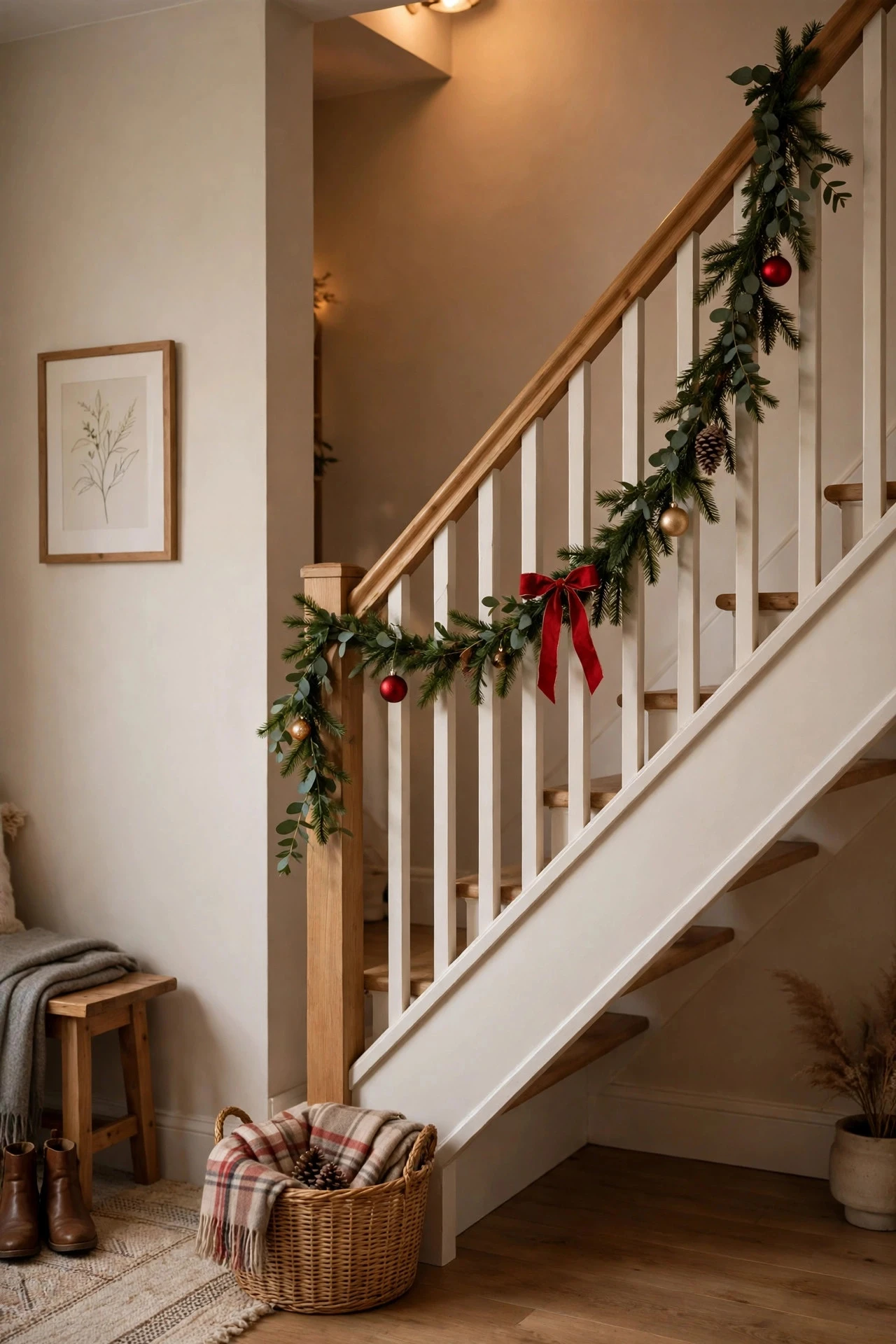
Garlanding a staircase for under $50 starts with one 9-foot faux garland from a discount store, about $20, plus a roll of wired ribbon, a bag of shatterproof ornaments, and a pack of floral wire — all in after Christmas sales or dollar-store finds if you shop early. Fluff the garland until it looks twice as thick, swag it in three deep dips along the banister, tie a big bow from the ribbon at the bottom newel, and tuck the ornaments in clusters at the swag points. The result looks far more expensive than it cost.
Reuse last year's ribbon and ornaments first, and spend the budget on the garland itself, because a full garland carries the whole look. Buy battery fairy lights only if the budget stretches — the garland alone is enough.
22. How Do You Keep Staircase Garland Safe for Kids and Pets?

Keeping staircase garland safe for kids and pets means choosing shatterproof ornaments, securing every tie so nothing dangles within reach, and keeping the handrail itself clear and grippable at all times. Small children pull at anything hanging at their height, and dogs chew anything that dangles, so keep ornaments, berries, and lights above adult waist height on the garland, and never hang anything edible — no candy canes, no dried oranges, no popcorn strings — where a toddler or a pet can reach it.
Tie the garland to the balusters with floral wire twisted tight and the sharp ends tucked into the greenery, so no wire pokes out to scratch a hand. The history of Christmas garlands as protective greenery is older than the modern holiday — the garland on Wikipedia traces how evergreen garlands became part of winter celebration — but today safety comes first, and a beautiful staircase is one nobody trips on.
Practical Tips
Measure first, buy once. Run a tape along the handrail, add 25 percent for swag and 3 feet per newel post, and buy one spare 6-foot length. Garland always runs short at the bottom newel, and a second trip to the shop costs more than the spare strand.
Secure it so it stays, and so the wood stays perfect. Green floral wire and removable zip ties hold garland without marking the banister; test any adhesive on a hidden spot first. Never staple, nail, or hot-glue garland to wood, and never wrap garland over the top of the handrail where hands need to grip.
Keep the handrail grippable and the steps clear. Garland sits below or beside the rail, never on top of it. No trailing ends, no pooling greenery, and no cords across a step. Check the garland after the first week, when ties loosen and swags settle.
Choose fresh or faux with your calendar in mind. Fresh noble fir lasts three to four weeks if you mist it and keep it from heat; faux garland lasts years and never sheds. Put fresh garland up in early December, and take it down before the needles dry out and drop.
Store it for next year. Coil faux garland loosely in a large bin with tissue paper between the layers, and roll ribbon rather than folding it. Label the bin with the staircase length it fits, so next December you start from a plan, not a guess.
Final Thoughts
Garland on a staircase is the grandest Christmas gesture a hallway can make, and it asks for surprisingly little in return — one good garland, a few ties, and an hour of your time. Start with the classic swag if you have never done it, try cedar or eucalyptus when you want a different mood, and always keep the handrail grippable and the steps clear. Measure generously, secure everything twice, and let the garland do what it does best: turn every trip up the stairs into a small celebration, all season long.
Frequently Asked Questions
How much garland do I need for my staircase?
Measure the handrail from newel to newel, add 25 percent for swag dips, and add 3 feet for each newel post you decorate. A standard 12-foot banister needs about 18 feet of garland, and you should buy one spare 6-foot length so the bottom newel never runs short.
Can I put garland on a staircase with kids in the house?
Yes, if you use shatterproof ornaments only, keep decorations above waist height, and never hang anything edible where children can reach it. Tie the garland tightly with floral wire, tuck sharp wire ends into the greenery, and keep the handrail clear so small hands can always grip it.
How do I attach garland to a banister without damaging the wood?
Use green floral wire or removable zip ties looped around the balusters, not the rail itself, and space ties every 24 to 30 inches. Never staple, nail, or hot-glue garland to wood, and test any adhesive hook on a hidden spot before trusting it on a visible banister.
Is fresh or faux garland better for a staircase?
Fresh noble fir smells wonderful and looks lush, but it lasts only three to four weeks and sheds needles on the stairs. Faux garland costs more upfront, lasts five to ten seasons, never sheds, and is the better choice for a busy staircase or a household with allergies.
How do I keep staircase garland from sliding down the rail?
Tie the garland to the balusters every 24 to 30 inches with floral wire, and anchor it firmly at both newel posts. On a spiral staircase, tie every 12 to 18 inches, because the curve pulls garland downhill. Check the ties after the first week, when the garland settles and loosens.
Can garland go on a staircase with a glass or metal balustrade?
Yes — use a lighter garland such as eucalyptus or cedar, and secure it with clear zip ties or suction-cup hooks made for glass. Keep ornaments small and light so the garland never pulls the ties loose, and avoid heavy pinecones or large baubles on a delicate modern balustrade.