22 Bedroom Accent Wall Ideas to Make Your Bed the Star
A bedroom accent wall is a single wall treated differently from the other three, and in a bedroom that wall is almost always the wall behind the bed. It is the wall you see when you walk in, the wall your headboard leans against, and the wall that sets the mood for sleep. Done well, one treated wall makes the whole room feel designed; done badly, it makes the room feel like a paint sample that got out of hand.
The secret is restraint. A bedroom accent wall works when the treatment suits the room's light, the bed's scale and the way you actually sleep — a calm colour in a small room, a tactile material in a plain room, a pattern that stops at the right height. The 22 ideas below cover paint, wood slats, panelling, wallpaper, murals, plaster, fabric and lighting, with exact costs, measurements and the mistakes that ruin each one, so you can pick the treatment that fits your wall, your budget and your landlord.
Looking for more inspiration? Our Nest Decorz homepage gathers the latest home decor ideas, seasonal decorating guides and room-by-room styling tips in one place — start there and explore.
Quick answers
– The bed wall is the accent wall — in almost every bedroom, the wall behind the headboard is the right choice, because it frames the bed and is visible from the door. – Paint is the cheapest start — a single painted accent wall costs $40 to $80 in paint and supplies, while wood slats run $250 to $500 and wallpaper $150 to $400 per wall. – Keep the other three walls quiet — one bold wall plus three calm walls is the formula; two bold walls fight each other and shrink the room. – Renters can still have one — peel-and-stick wallpaper, removable slat panels and painted arches on a single wall all come off cleanly when you move. – Finish matters as much as colour — matte and eggshell hide flaws and glow softly at night, while gloss highlights every bump on a bedroom wall.
1. How Do You Choose the Right Wall for a Bedroom Accent Wall?

Choose the wall behind the bed as your bedroom accent wall, because it is the room's natural focal point and the only wall the bed already anchors. Stand in the doorway and look in: the wall you face, with the headboard against it, is the one your eyes land on first, and treating it makes the bed look intentional rather than pushed against a blank wall.
Measure first. A standard queen bed is 152 cm wide, so the accent treatment should span at least 180 to 240 cm — wider than the bed plus its nightstands — or it will look like a stripe behind the headboard. If the bed wall has a window, pick the wall the bed faces instead, and never choose a wall broken up by a door, a wardrobe or a radiator, because the treatment will be chopped into awkward pieces. In a long narrow bedroom, the short wall behind the bed is still the right call; it pulls the room together instead of stretching it further.
2. What Paint Colour Makes a Bedroom Accent Wall Feel Calm, Not Dark?
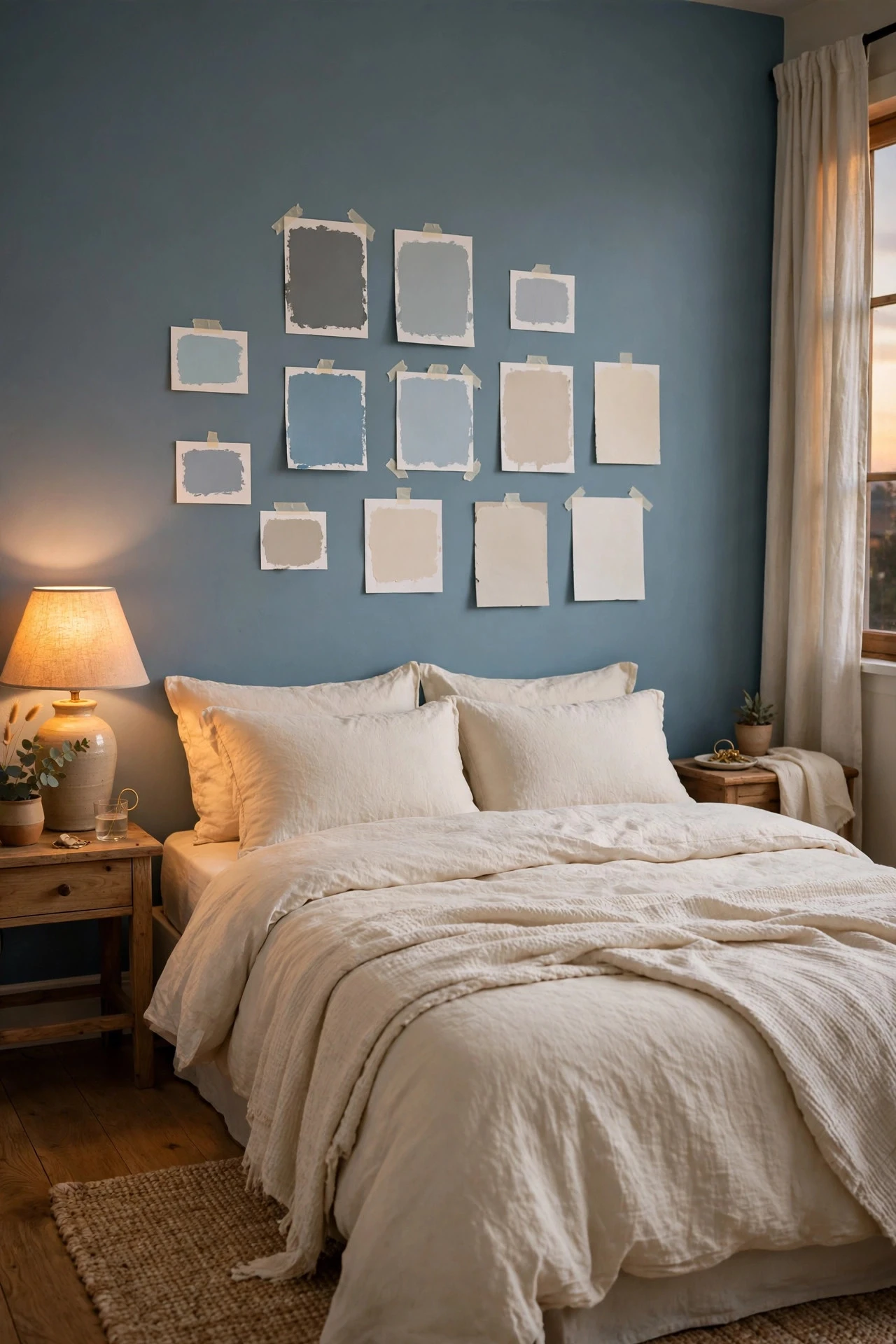
A calm bedroom accent wall comes from a muted, desaturated colour — sage green, dusty blue, warm greige, soft terracotta or deep charcoal used at half strength — rather than a bright or saturated shade. Muted colours absorb light gently and read as restful at night, while bright colours bounce around the room and keep your eyes busy when you should be winding down.
Test the colour on the actual wall, not on a card. Paint a 60 cm square test patch behind the bed, look at it in morning light, evening lamplight and with the curtains closed, and live with it for two days before committing. North-facing bedrooms need warm undertones — a sage with a yellow base, a blue with a grey-green base — while south-facing rooms can take cooler tones. Pair the accent colour with bedding in a lighter tone of the same family, and keep the other three walls a warm white so the accent wall reads as a deliberate choice, not a leftover.
3. How Do You Paint a Two-Tone Accent Wall Behind the Bed?
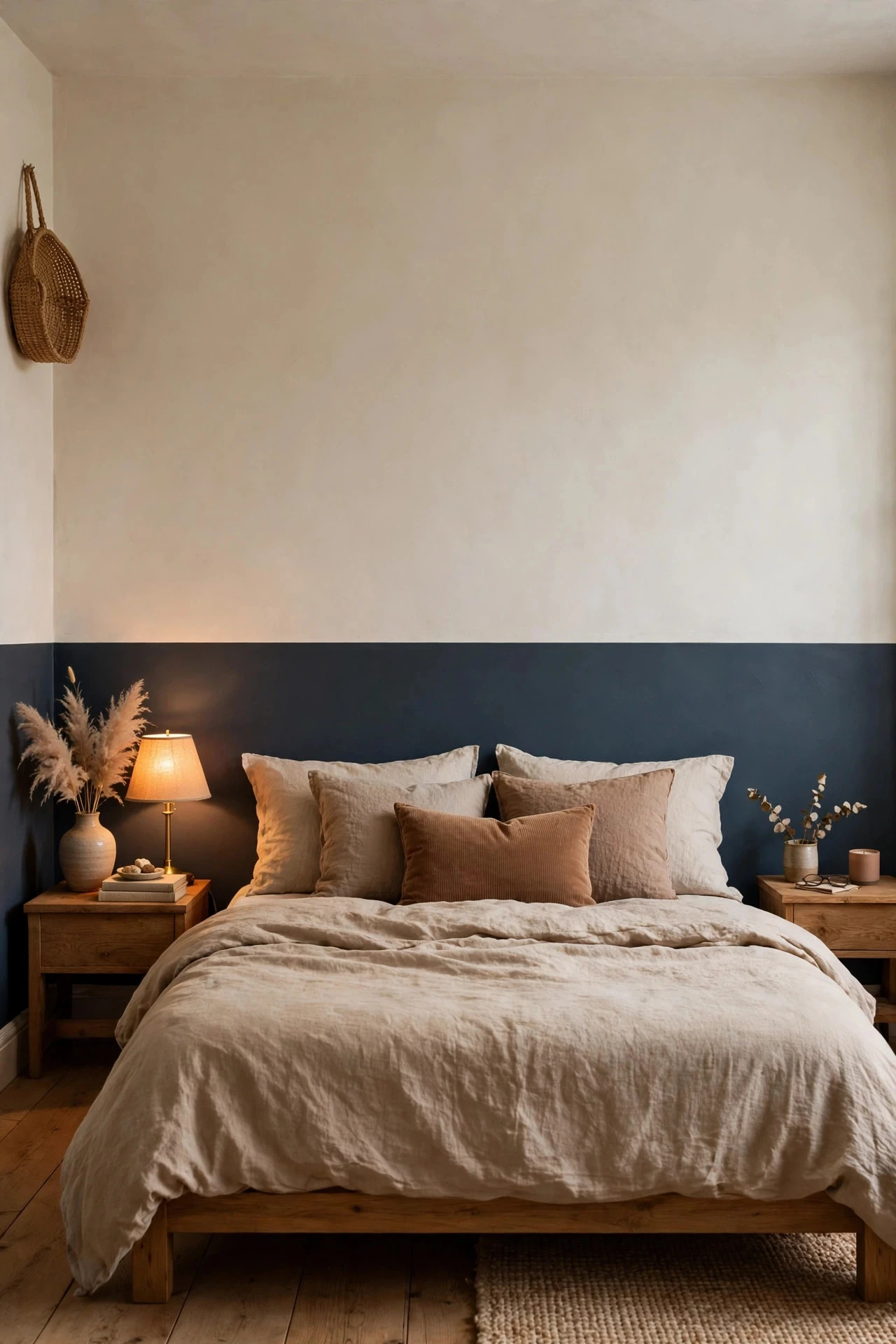
Paint a two-tone accent wall by splitting the bed wall horizontally — usually with the darker colour on the lower two-thirds and the lighter colour above — and separating the two with a crisp taped line at 90 to 120 cm from the floor. The lower band grounds the bed and hides scuffs from pillows and the headboard, while the lighter upper band keeps the ceiling feeling high.
Use painter's tape rated for delicate surfaces, press the edge down with a credit card, and paint the lighter colour first so any bleed is covered by the darker band. A 120 cm split works behind a standard 110 cm headboard because the line sits just above it, creating a framed panel effect. Expect to use about 1 litre of each colour for a 3.6 m by 2.4 m wall, at $30 to $45 per litre for good-quality emulsion. Finish the lower band in eggshell, which wipes clean, and the upper band in matte, which hides the wall's imperfections.
4. Can Wood Slats Turn a Plain Bed Wall Into a Design Feature?

Wood slats turn a plain bed wall into a design feature because the vertical rhythm draws the eye upward, adds texture you can feel, and frames the bed like a backdrop in a boutique hotel. Thin oak, walnut or pine battens, 4 to 6 cm wide with 1 to 2 cm gaps, fixed vertically from floor to ceiling, give a flat wall instant depth without taking up any floor space.
Budget $250 to $500 for a 3 m wide wall, using pine battens at $3 to $5 per 2.4 m length, or $400 to $700 for pre-finished oak slat panels that arrive on a felt backing and fix straight to the wall. Space the slats evenly with a spacer block cut to the gap width, and start from the centre of the wall so the cut slats at the edges match. Leave a 5 mm gap at the ceiling for expansion, and run the slats behind the headboard rather than stopping at it, so the bed looks built into the wall. These 22 bedroom headboard ideas for a bed that looks designed show how the right headboard shape sits against a slatted wall without fighting it.
5. How Do You Install Shiplap on a Bedroom Accent Wall?

Install shiplap on a bedroom accent wall by fixing horizontal or vertical tongue-and-groove boards to battens screwed into the studs, starting from the bottom and working up, with a 2 mm gap between boards for the classic shadow line. Horizontal shiplap widens a narrow bedroom; vertical shiplap makes a low ceiling feel taller, so choose the direction that fixes your room's proportions.
Use 15 cm wide MDF or pine shiplap boards at $2 to $4 per linear metre, and expect $180 to $350 in materials for a 3.6 m by 2.4 m wall. Find the studs with a stud finder and mark them, because boards fixed only to plasterboard will pull away over time. Paint the wall behind the boards the same colour first, so the gaps read as shadow rather than bare plaster, and caulk the edges where the boards meet the ceiling and skirting. Sand the cut ends smooth and fill nail holes before the final coat, or every fixing will show in lamplight.
6. What Is Board and Batten, and Does It Suit a Bedroom?
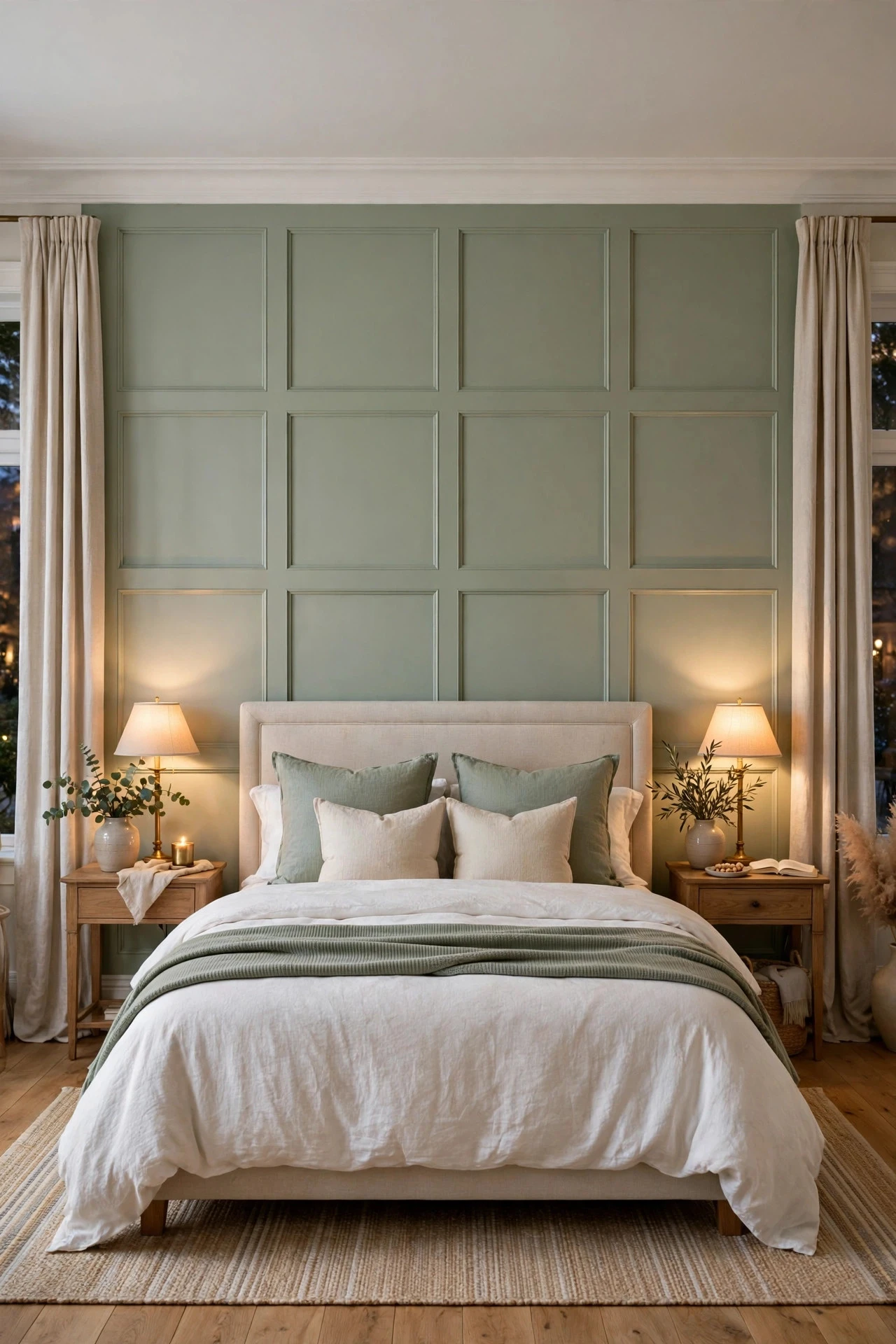
Board and batten is a wall treatment of flat vertical boards — battens — fixed over a flat wall at regular intervals, usually 40 to 60 cm apart, creating a panelled grid that adds architectural detail without the weight of full panelling. It suits a bedroom beautifully because it is quiet, symmetrical and calm, and it gives a plain plaster wall the structure of a period home for very little money.
For a bed wall, run the battens floor to ceiling in a simple grid, or stop them at 120 cm with a horizontal rail to make a dado-height panel that the headboard sits against. MDF battens 6 to 9 cm wide cost $1.50 to $3 per 2.4 m length, so a full wall costs $120 to $250 in materials plus paint. Paint the battens and the wall behind them the same colour — a soft sage, warm white or dusty blue — so the effect is texture and shadow, not contrast. Wainscoting is the older name for this family of wall panelling, and the same principles of proportion and spacing apply. Keep the spacing even by measuring from the centre out, and use a spirit level on every batten, because a leaning batten is visible from the bed every single morning.
7. How Do You Add Picture-Frame Moulding to a Bed Wall?

Add picture-frame moulding to a bed wall by fixing thin rectangular moulding frames — 5 to 8 cm wide — in a symmetrical grid, usually two large rectangles above the headboard or three tall rectangles across the wall, then painting the frames and the wall the same colour. The effect is a Parisian panelled wall that costs a fraction of real panelling and suits both traditional and modern bedrooms.
Measure the wall and sketch the grid on paper first: leave 10 to 15 cm between frames and the same margin at the edges, so the frames breathe. Use lightweight polyurethane or MDF moulding at $2 to $4 per 2.4 m length, cut the corners at 45 degrees with a mitre box, and fix them with grab adhesive plus a pin nail at each corner. Fill the joins with caulk, sand smooth, and paint two coats in the same finish as the wall. A full wall costs $100 to $200. Hang nothing inside the frames — the empty panels are the decoration — and keep the headboard lower than the bottom of the frames so the grid reads as one composition.
8. Which Wallpaper Works Best on a Bedroom Accent Wall?

The best wallpaper for a bedroom accent wall is a paste-the-wall non-woven paper in a large-scale, low-contrast pattern — a soft botanical, a subtle geometric or a textured grasscloth look — because large patterns read calmly from the bed and low contrast will not keep you awake. Small busy patterns feel frantic at close range, and high-gloss papers reflect lamplight in distracting ways.
Budget $150 to $400 per wall: a standard roll covers about 5 square metres, and a 3.6 m by 2.4 m wall needs three to four rolls allowing for pattern matching. Order all rolls from the same batch number, because dye lots vary and a mismatched roll shows in daylight. Paste-the-wall papers are the easiest for a first-timer — you paste the wall, not the paper, so the sheet does not stretch — and they strip off dry when you redecorate. These 22 bedroom wall decor ideas for a calm, personal retreat show how wallpaper sits alongside art and mirrors on the room's other walls without competing with the bed wall.
9. How Do You Hang Peel-and-Stick Wallpaper Without Bubbles?
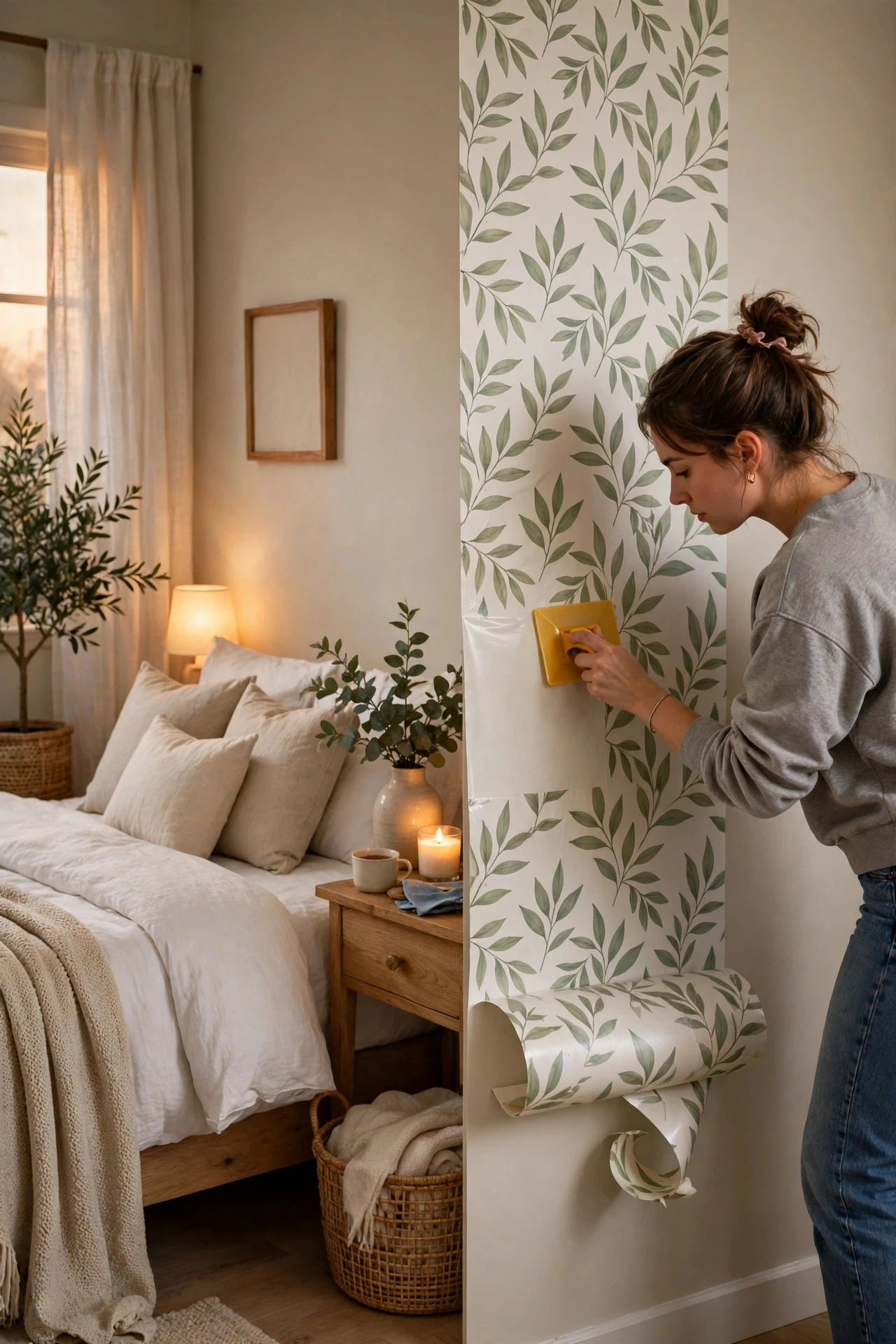
Hang peel-and-stick wallpaper without bubbles by starting at the ceiling, peeling back only 15 cm of backing at a time, and smoothing the paper downward with a plastic smoother in slow overlapping strokes from the centre outward. The trick is patience: the paper is repositionable for the first few minutes, so a wrinkle is fixable if you catch it early and lift the sheet back to the wrinkle, never across it.
Work in a room warmer than 15°C, because cold adhesive grips poorly, and wipe the wall with a damp cloth first so dust does not stop the paper sticking. Cut each strip 5 cm longer than the wall height and trim the excess with a sharp blade after it is up. Match the pattern at eye level — about 150 cm from the floor — because that is where a mismatch shows. A 3.6 m wall needs about $80 to $180 in peel-and-stick paper, and the whole job takes two to three hours for a beginner. If a bubble appears after a day, prick it with a pin and smooth it flat; the hole is invisible at normal distance.
10. Can a Mural Make a Small Bedroom Feel Bigger?

A mural can make a small bedroom feel bigger when it uses depth — a misty landscape, a distant forest, a soft sky gradient — because the eye reads the painted distance as real space beyond the wall. A flat, high-contrast mural does the opposite and closes the room in, so choose imagery with a horizon line, fading tones and plenty of pale sky or mist at the top.
Order a mural sized to your exact wall — most suppliers print to order at $200 to $500 for a 3.6 m by 2.4 m wall — and hang it like wallpaper, matching panels in order from left to right. Keep the bed and bedding plain when the mural is busy: white or oatmeal linen lets the wall do the talking. Place the mural's brightest or busiest area above headboard height, so you are not staring at a dense pattern while you fall asleep. In a windowless bedroom, a mural with a painted window view or a dawn sky can add the light and depth the room lacks, and it costs far less than moving a window.
11. How Does Limewash Plaster Give a Bed Wall a Soft, Cloudy Finish?
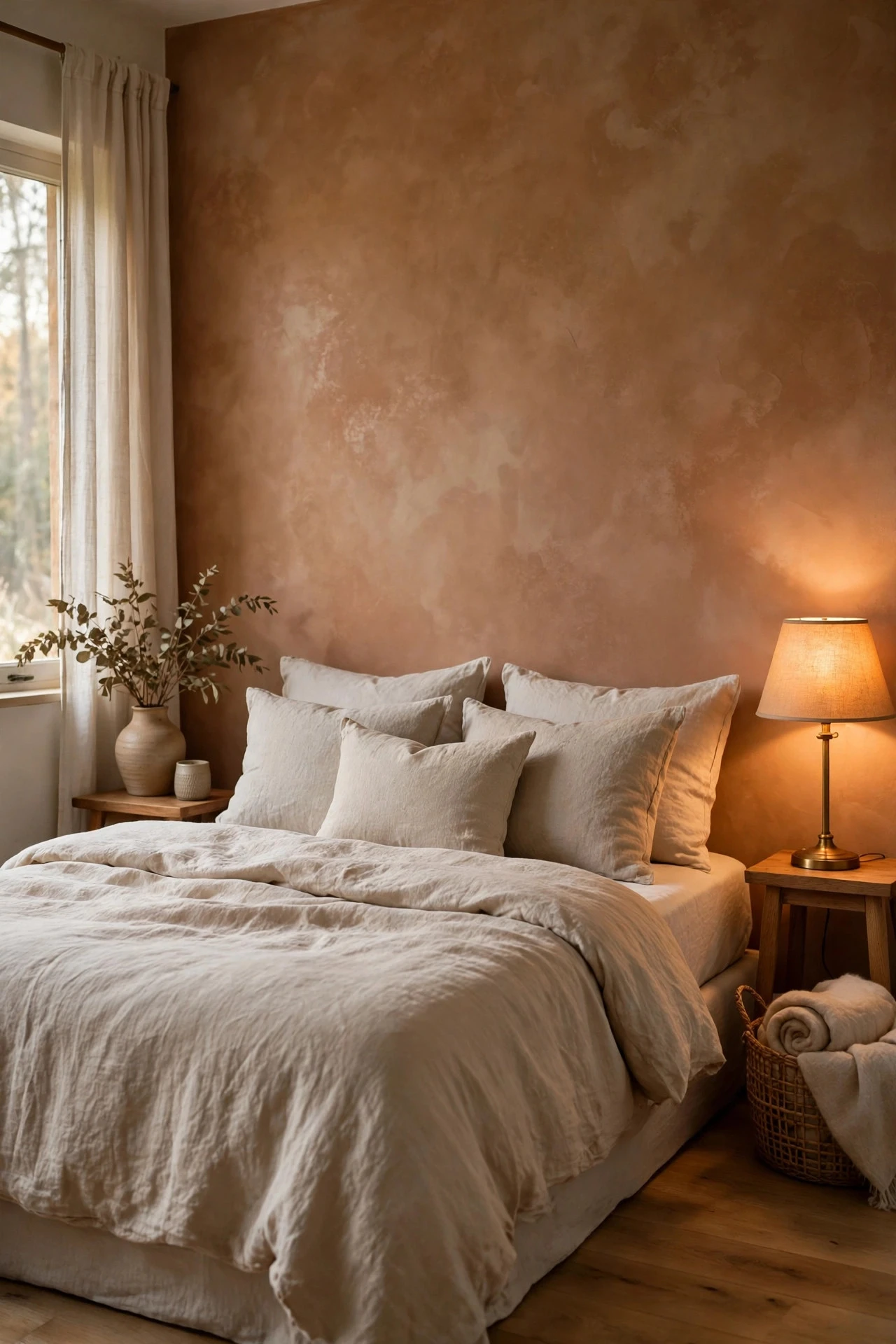
Limewash plaster gives a bed wall a soft, cloudy finish because the mineral paint is applied in thin, uneven layers with a wide brush, and the lime particles catch the light differently across the surface, creating movement without pattern. It is the finish behind the calm, Mediterranean bedrooms in design magazines — matte, chalky and alive in changing light, never flat like ordinary emulsion.
Apply it over a primed, smooth wall with a block brush in loose criss-cross strokes, two to three coats, and do not try to make it even — the variation is the point. A litre covers about 8 to 10 square metres and costs $35 to $60, so a single bed wall needs two litres, $70 to $120, plus a primer. Choose a warm white, pale clay or soft sage; strong colours turn patchy and look like a mistake rather than a finish. The Spruce's guide to limewash paint explains the mineral base and why it suits bedrooms, where its breathable, low-VOC formula is a genuine advantage. Seal it only if the wall gets touched often — a matte sealer dulls the cloud effect slightly.
12. What Is Venetian Plaster, and Is It Worth the Cost?
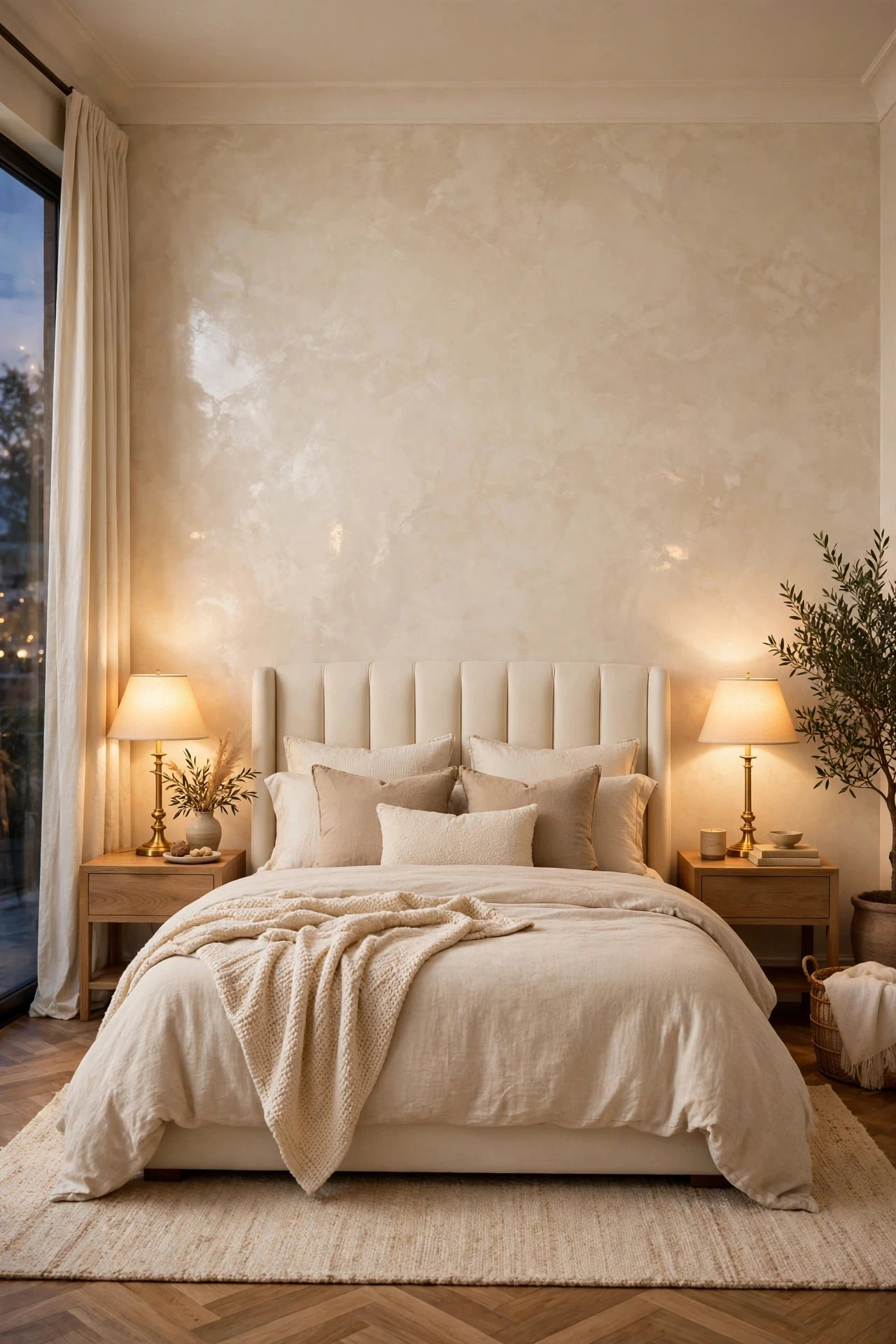
Venetian plaster is a polished plaster finish made from slaked lime and marble dust, burnished with a steel trowel to a smooth, marble-like sheen that shifts as the light moves across it. It is worth the cost — $800 to $1,500 professionally applied for a single bed wall — only if you want a genuinely luxurious, permanent feature and you love the way polished stone looks in low lamplight.
A DIY kit costs $150 to $300 and takes a full weekend: three thin coats, each dried and sanded, then burnished with a trowel held almost flat, and finally sealed with beeswax. The skill is in the trowel pressure — too hard and you gouge the surface, too soft and it stays chalky. Practice on a spare plasterboard offcut first. Venetian plaster suits large bedrooms with generous light, because the sheen needs space to show; in a small dark bedroom it can look grey and cold. Pair it with a simple upholstered headboard and linen bedding, and let the wall carry the luxury on its own.
13. How Do You Use Fabric or an Upholstered Panel Behind the Bed?
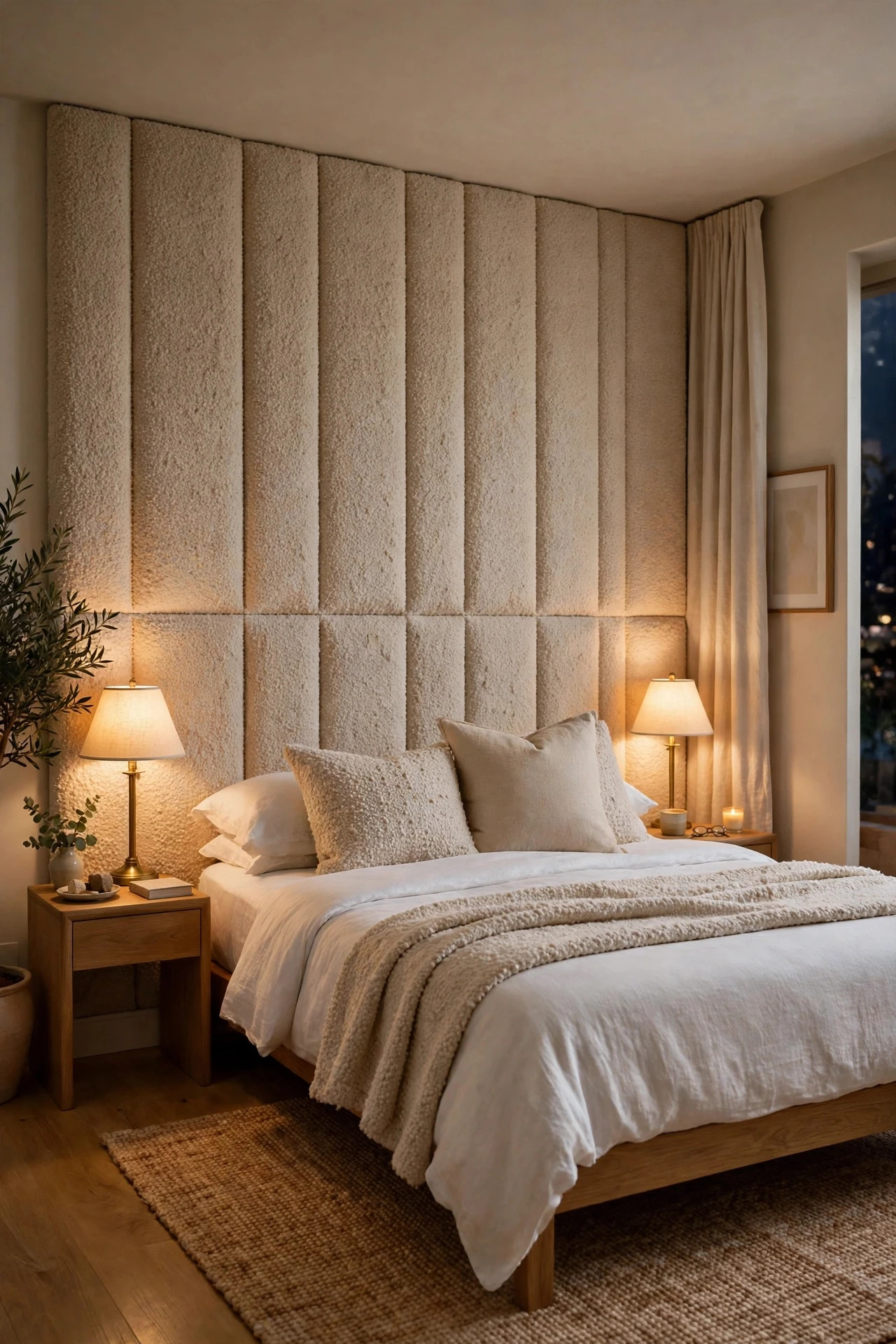
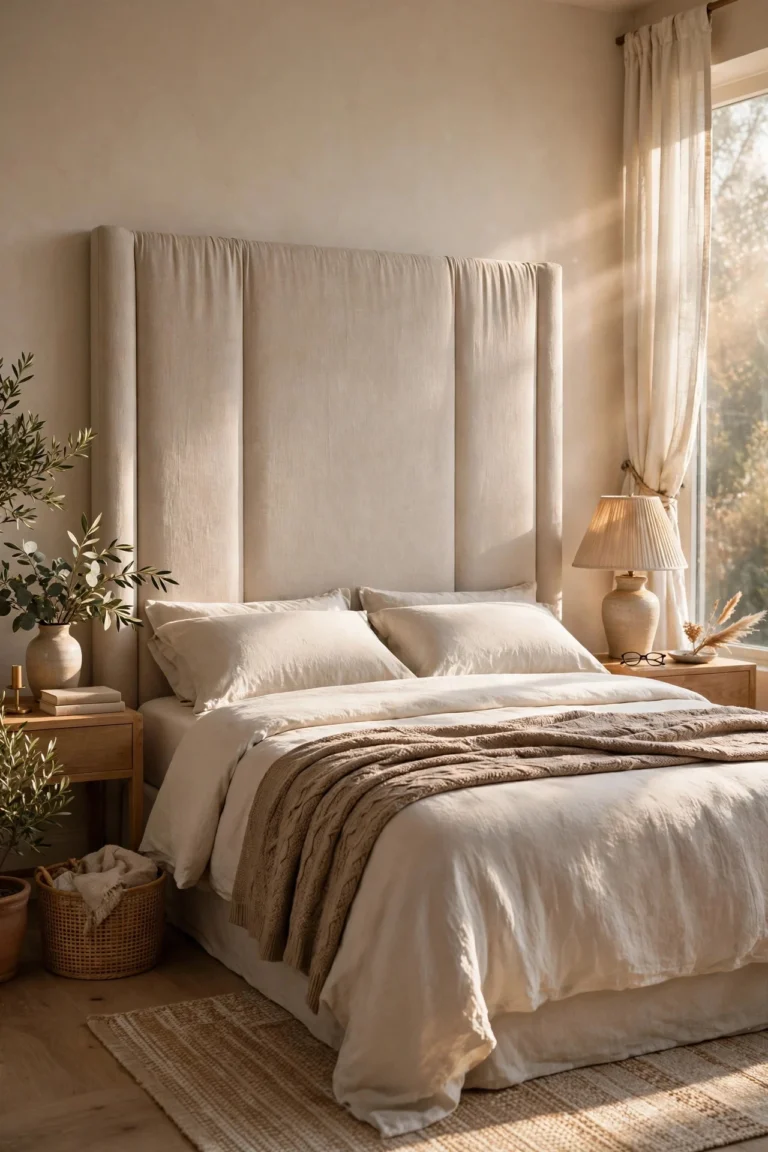
Use fabric behind the bed by fixing a padded upholstered panel — or a full wall of padded squares — to the bed wall, so the wall itself becomes the headboard. A panel 180 cm wide and 120 cm high in a plain linen, velvet or bouclé, padded with 5 cm foam, softens the room acoustically, feels warm to lean against, and turns a hard wall into a cocoon.
Order a made-to-measure panel for $300 to $600, or build one from plywood, foam, batting and fabric for $120 to $250 in materials. Fix it with a French cleat — a bevelled batten screwed to the wall and a matching one on the panel — so it hangs level and comes off easily for cleaning. Choose a fabric with a rub count above 20,000 so it survives daily leaning, and keep the colour one tone darker than the bedding so the bed reads as layered, not matched. These 22 luxury bedroom decor ideas for a five-star hotel feel show how upholstered walls create the boutique-hotel effect without a single hard surface in sight.
14. How Can LED Lighting Make an Accent Wall Glow at Night?
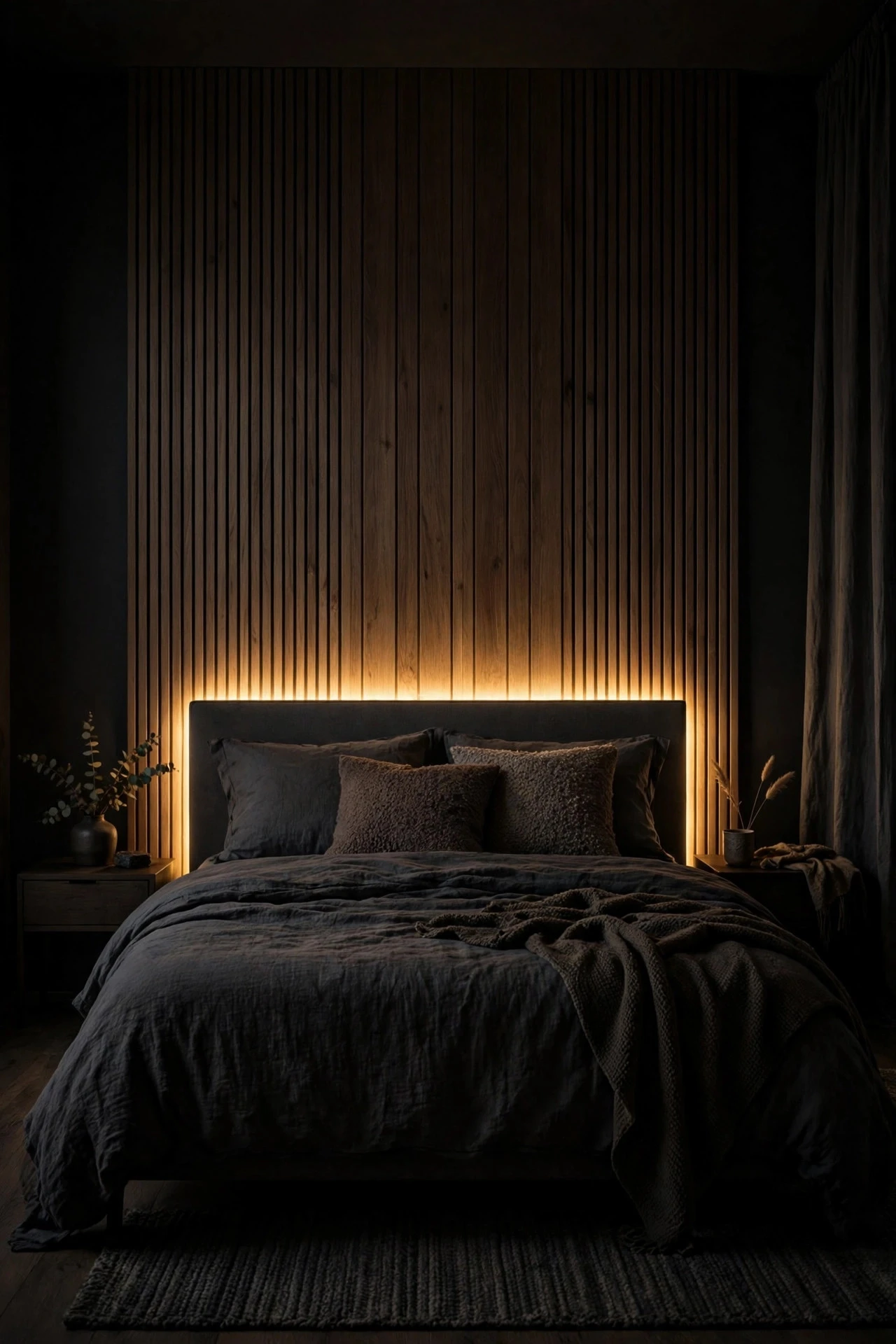
LED lighting makes an accent wall glow at night when it is hidden, not displayed — a warm-white LED strip tucked behind the headboard, along the top of a slatted wall, or in a cove above the bed wall, washing light down the surface so the texture shows and the wall seems to float. Visible bulbs and bare strips ruin the effect; the light itself should be the only thing you see.
Use 2700K warm-white strips at $15 to $30 per 5 m reel, on a dimmer, and mount them so the diodes face the wall, not the room. A strip behind a floating headboard creates a halo that makes the bed look suspended; a strip in a ceiling cove above a limewash wall makes the cloudy finish shimmer. Keep the brightness low — 30 to 40 percent is usually enough — because a glowing wall is a night light, not a spotlight. These 22 bedroom lighting ideas for a warm, restful glow explain how layered bedroom lighting works with an accent wall instead of against it. Never run a strip across the middle of a patterned wallpaper; the line of light will cut the pattern in half.
15. How Do You Style a Brick or Faux-Brick Accent Wall in a Bedroom?
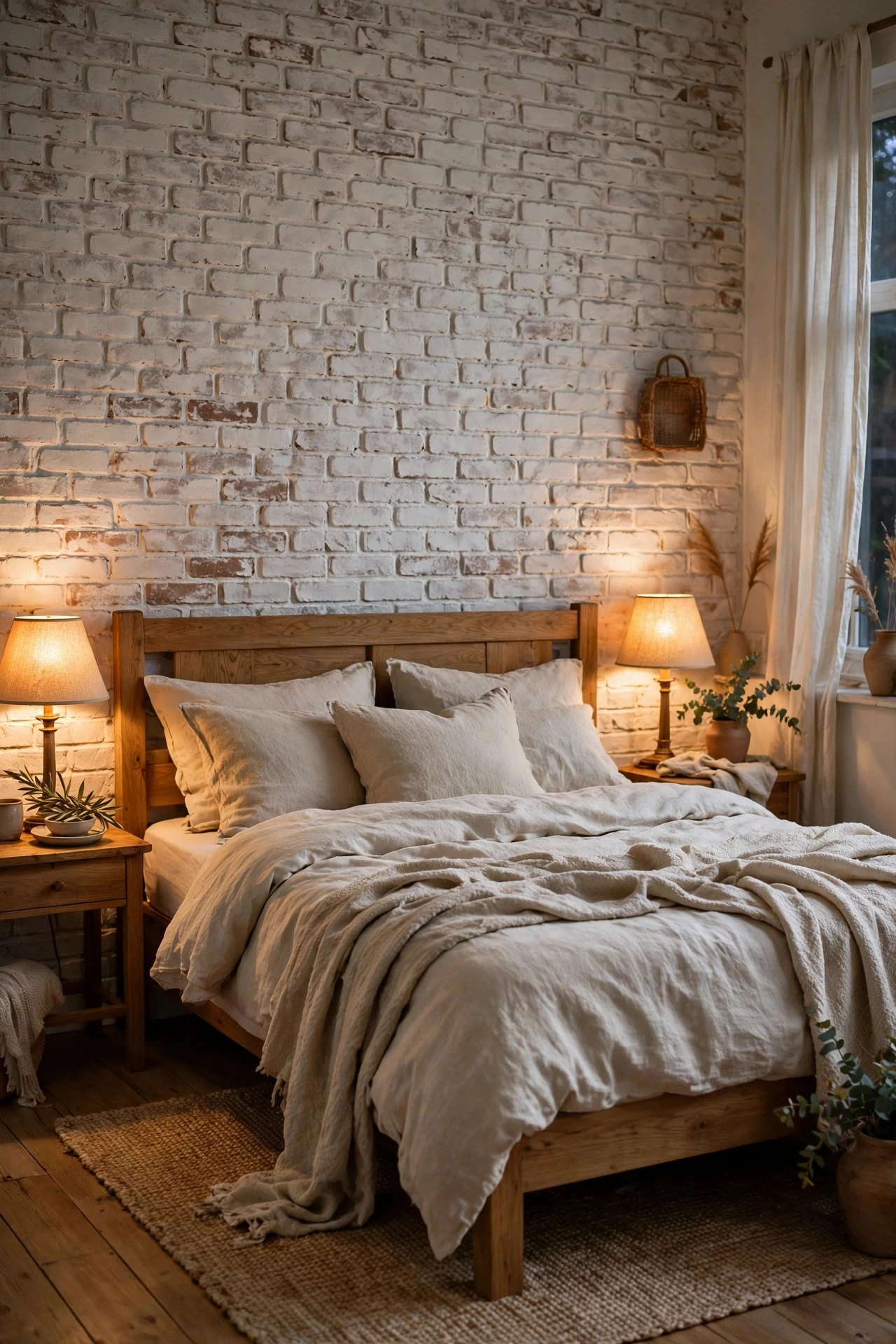
Style a brick accent wall in a bedroom by keeping everything else soft: white or oatmeal linen, a wooden headboard, a wool throw and warm lamplight, so the brick reads as warmth and texture rather than an industrial shell. Real exposed brick is beautiful but dusty and cold to the touch; a thin brick slip or a high-quality faux-brick panel gives the same look without the draughts.
Brick slips cost $400 to $800 per wall installed, while faux-brick panels run $150 to $350 and fix with adhesive in an afternoon. Whitewash the brick with a 50-50 mix of white emulsion and water, brushed on and wiped back, to soften the red and keep the texture. Seal real brick with a matte sealer so it stops shedding dust onto the bedding. A brick wall suits bedrooms with wooden floors and natural textiles best; in a carpeted room with cool grey furniture it can feel like a restaurant, so warm the palette deliberately with timber, rattan and cream.
16. Can Cork, Leather or Textured Panels Warm Up a Bed Wall?

Cork, leather and textured panels warm up a bed wall because they add a material your hand wants to touch, and a bedroom is the one room where touch matters as much as sight. Cork tiles in a warm honey tone absorb sound, insulate the wall and cost $120 to $250 for a bed wall; leather panels in tan or cognac add a club-room richness for $300 to $600; 3D textured MDF panels in a wave or geometric pattern cost $150 to $400 and throw soft shadows in lamplight.
Fix cork tiles with contact adhesive in a staggered brick pattern, and seal them with a matte varnish so they wipe clean. Leather panels usually arrive as 30 cm squares on a self-adhesive backing — press them on in a grid, starting from the centre. 3D panels need a flat wall and a spirit level, because a tilted panel shows immediately in the shadows. Keep the bedding plain when the wall is this tactile, and avoid mixing two textured materials on the same wall; one texture is a feature, two is a fabric shop.
17. How Do You Create a Colour-Blocked Accent Wall in a Renter-Friendly Way?
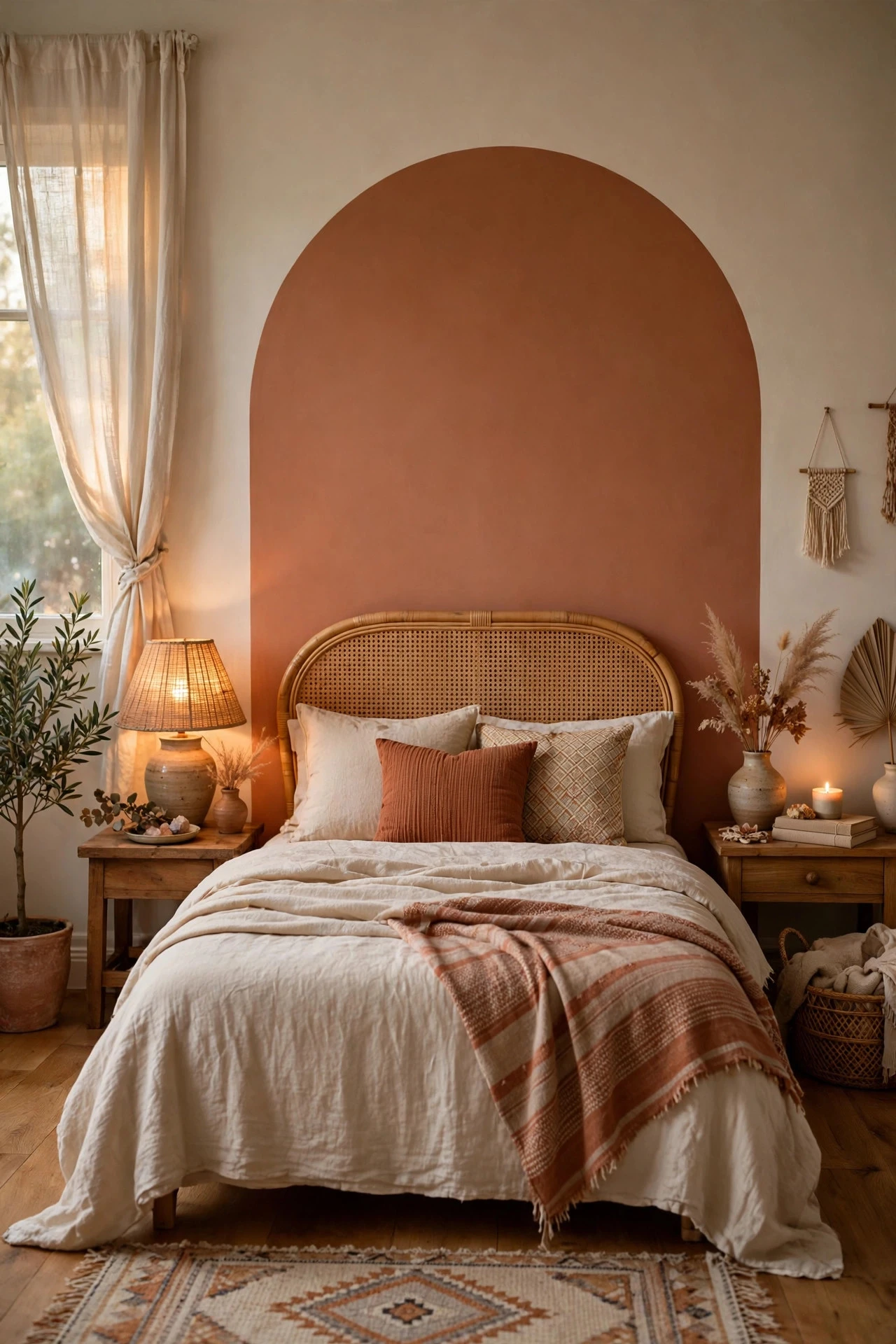
Create a colour-blocked accent wall by painting a large geometric shape — a half-circle arch behind the bed, a wide rectangle, or a soft blob — in one bold colour on an otherwise plain wall, using a shape that frames the headboard like a halo. The arch is the most forgiving shape: it needs no straight edges except at the floor, and it makes a low headboard look tall and deliberate.
Mark the arch with a pencil on a string pinned at the centre point, at the height where the arch should spring from — usually 60 to 90 cm above the bed — then paint inside the line with a small roller and a brush for the curve. Use a sample pot, $8 to $15, because one shape needs less than half a litre. In a rental, paint the arch in a colour you can paint over in one coat when you leave, and photograph the original wall first. A terracotta arch over a white wall with a rattan headboard is the classic combination, and it costs less than a takeaway to try.
18. What Renter-Friendly Accent Wall Ideas Leave No Damage?
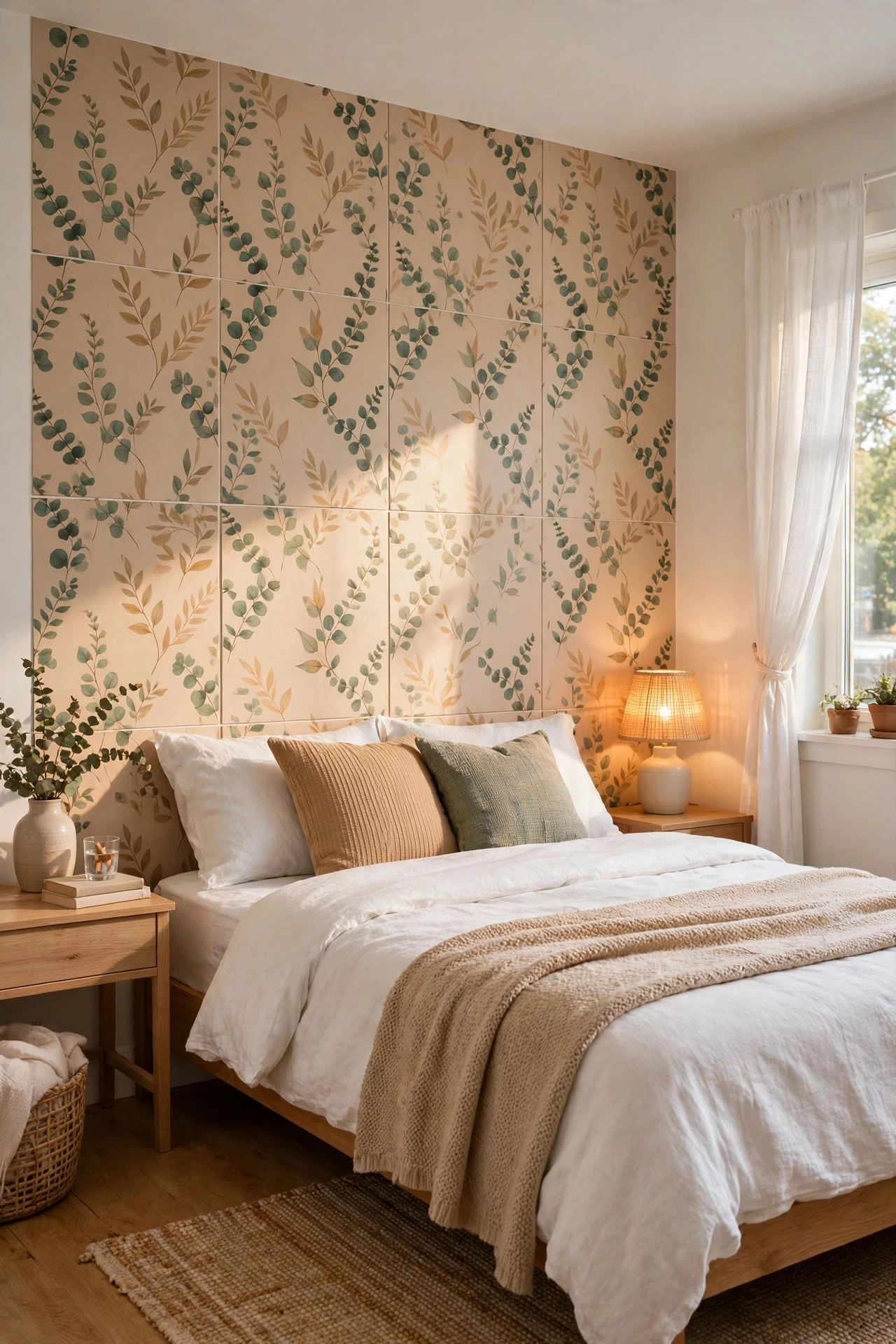
Renter-friendly accent walls leave no damage when they use removable fixings and reversible treatments: peel-and-stick wallpaper, removable wood-slat panels on command strips, a leaning oversized art panel, a fabric wall hanging on a tension rod, or a painted arch you agree to repaint before moving out. The rule is simple — if it needs a drill, a nail or a permanent adhesive, ask the landlord first in writing.
Peel-and-stick wallpaper is the safest bet: it comes off cleanly from smooth painted walls if you warm it with a hairdryer and peel slowly at 45 degrees. Removable slat panels on heavy-duty adhesive strips hold 2 to 3 kg each and leave no mark when the tab is pulled correctly. A large framed textile or a leaning mirror against the bed wall needs no fixing at all and reads as an accent wall from the doorway. Keep your landlord's written permission and the product's removal instructions together, and test every adhesive on a hidden patch for a week before committing to the whole wall.
19. How Do You Match Your Headboard to Your Accent Wall?

Match your headboard to your accent wall by contrast, not by matching: a dark wall needs a light headboard, a patterned wall needs a plain headboard, and a textured wall needs a smooth one. The headboard and the wall are a pair, and pairs work when each one lets the other show — two strong patterns or two dark surfaces merge into one heavy block and the bed disappears.
A pale linen headboard against a deep green painted wall is the safest combination; a walnut timber headboard against a limewash wall adds warmth without competing; a tall upholstered headboard in cream against a slatted wood wall gives the bed a soft centre inside a hard frame. Size matters too: the headboard should be 10 to 20 cm wider than the mattress on each side and at least 90 cm tall, so it holds its own against the treated wall. These 22 master bedroom decor ideas for a calm, elegant retreat show how headboard scale and wall treatment are balanced in larger bedrooms. If the wall is busy, choose a headboard with clean lines and no buttons or tufting.
20. How Do You Add Shelves or a Ledge to an Accent Wall Without Clutter?
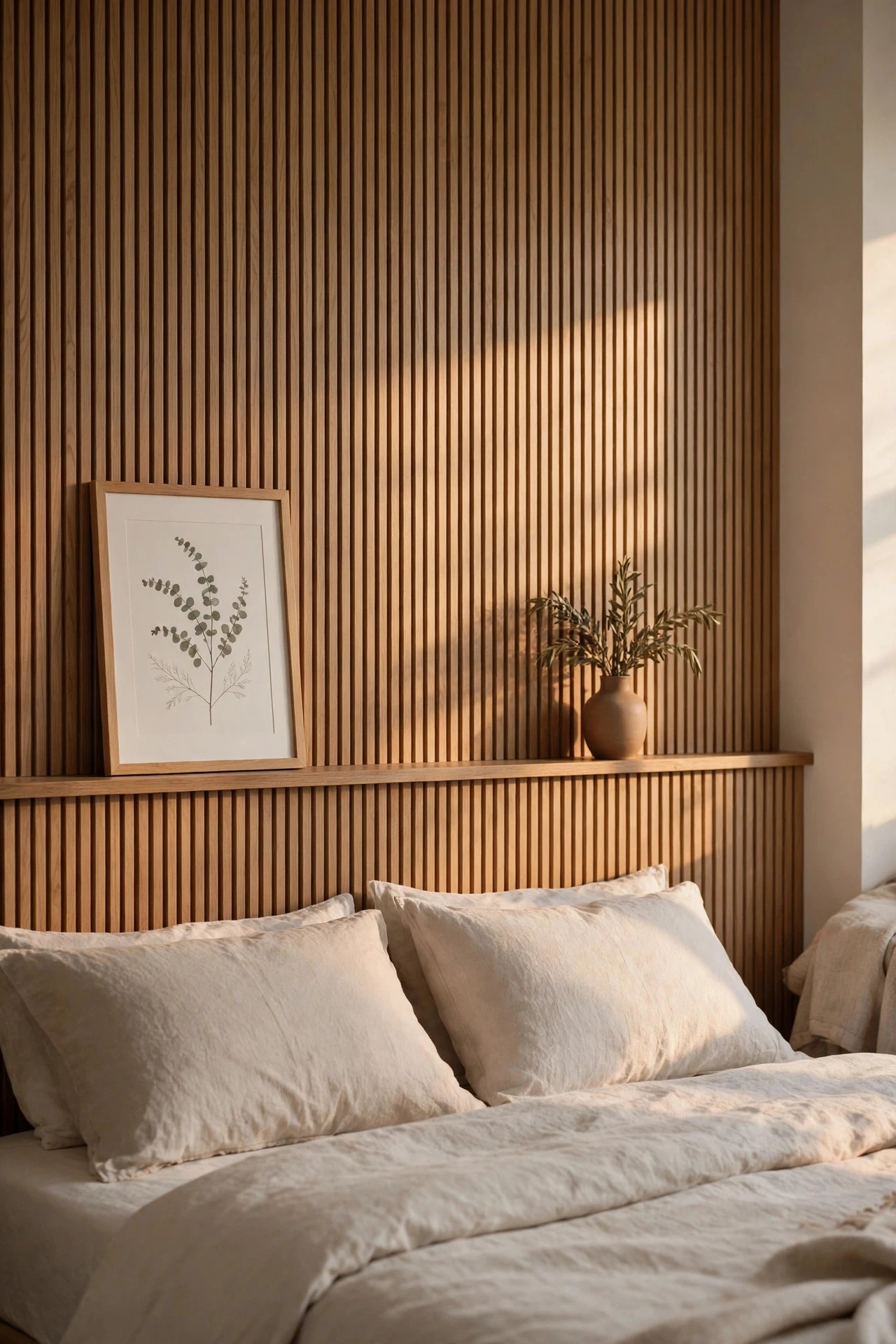
Add shelves to an accent wall by keeping them narrow, few and low: one picture ledge 10 cm deep running the width of the bed at 150 cm from the floor, holding three to five objects — a small framed print, a vase, a book — with empty space between them. A ledge works on an accent wall because it is a display, not storage; the moment it holds chargers, medicines and half-read books, the wall stops being a feature and becomes a shelf.
Fix the ledge into studs with 5 cm screws, because a ledge full of books is heavier than it looks, and keep the total load under 5 kg per metre. Leave at least 30 cm of clear wall above the headboard before the ledge, so the bed and the display do not crowd each other. A single floating shelf in the same wood as the nightstands ties the wall to the furniture, while a black metal ledge on a pale wall adds a graphic line. Dust the ledge weekly — dust shows fast on a feature wall — and rotate the objects seasonally so the wall stays fresh.
21. How Do You Use a Half Wall or Arched Paint Shape Behind the Bed?
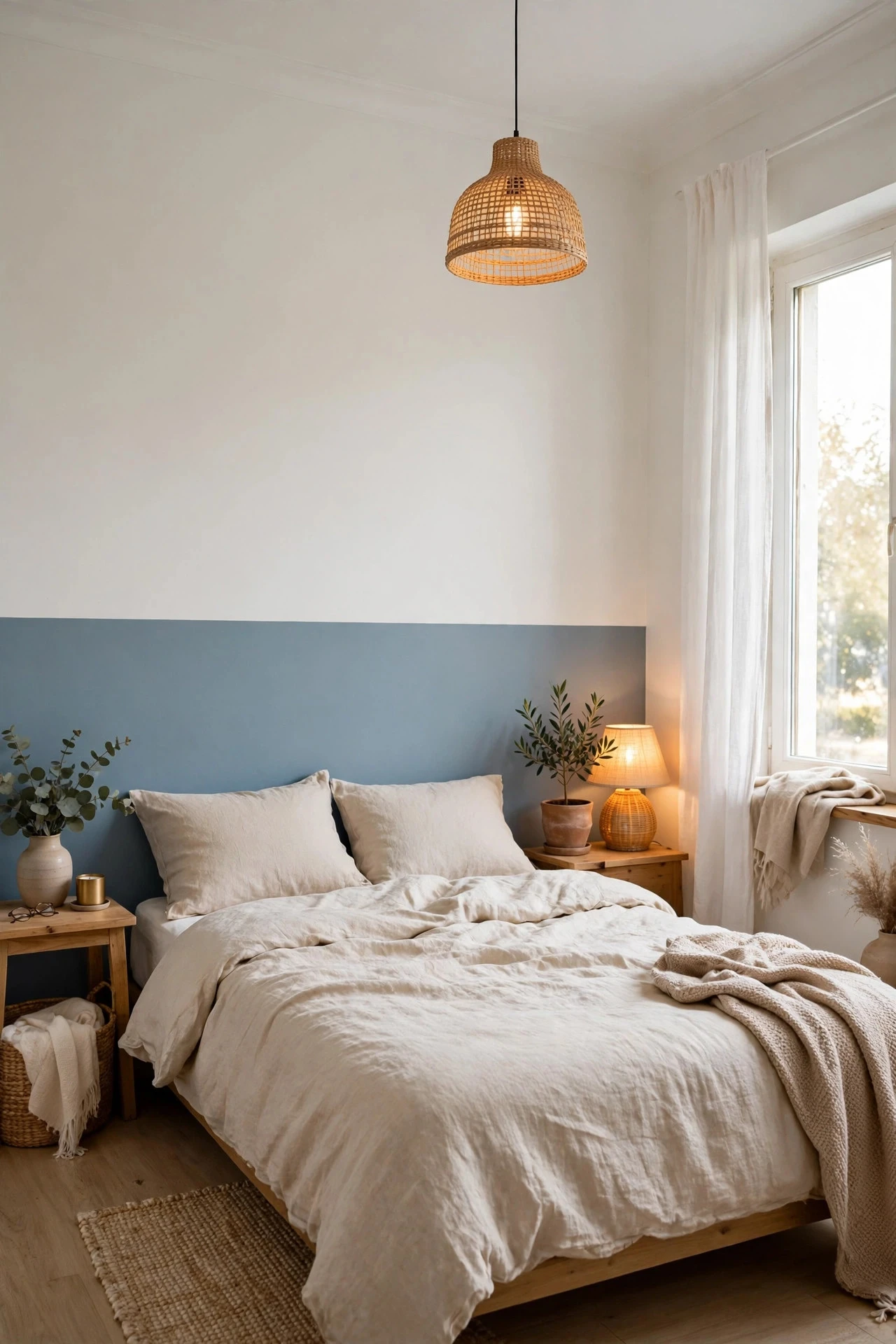
Use a half wall or arched paint shape by painting only the lower half of the bed wall — up to 120 cm — in a strong colour, or painting a wide arch that rises 180 to 200 cm behind the bed, so the treatment frames the bed without swallowing the whole wall. Half-height colour is the best accent wall for small bedrooms, because the white upper wall keeps the ceiling feeling high while the colour grounds the bed.
Paint the lower half in a colour one or two tones deeper than the bedding — deep sage, dusty blue, warm clay — and finish the top edge with a crisp taped line or a thin timber rail for a finished look. An arch needs a centre point marked with a pin and string, and the curve should be at least 40 cm wider than the bed on each side so the bed sits inside it comfortably. Both shapes use under a litre of paint, cost $30 to $60, and take an afternoon. Keep the rest of the room's colour quiet, because the shape is already the room's boldest statement.
22. How Much Does a Bedroom Accent Wall Cost, and Where Should You Spend?

A bedroom accent wall costs $40 to $80 for paint, $120 to $250 for panelling or board and batten, $150 to $400 for wallpaper, $250 to $500 for wood slats, and $800 to $1,500 for professional Venetian plaster, so the honest answer is that the wall costs whatever the material costs plus a weekend of your time. Spend the money where your eye lands first: on the finish quality and the wall preparation, not on the most expensive material.
Budget $50 to $100 for preparation — filler, sandpaper, primer and good tape — because a flawless base makes cheap paint look expensive and a rough base makes expensive wallpaper look cheap. Buy the best paint you can afford in the right finish, and buy one extra roll of wallpaper or one extra box of slats, because running out mid-wall costs more in time than the spare material costs in money. These 22 bedroom reading nook ideas for a cozy, quiet corner show how the same spend-where-it-shows thinking works in the room's other corners. If you can only afford one upgrade, choose a better light — a warm dimmable lamp — over a pricier wall, because light is what makes any accent wall glow.
Practical Tips
Prepare the wall before you buy the material, because preparation decides the result. Fill holes, sand the filler smooth, wipe the dust off with a damp cloth and prime any bare plaster — a treated wall shows every bump in lamplight, and no finish hides a bad base. Buy 10 percent more material than you measured, and keep the leftover paint or wallpaper for repairs, because a scuffed accent wall with no spare paint stays scuffed.
Test everything at night, not just in daylight. A bedroom accent wall lives in lamplight, so switch on the bedside lamps, close the curtains and look at the wall the way you will see it every evening. Colours deepen, gloss turns to glare and wallpaper patterns sharpen under warm light. If the wall looks too strong at night, it is too strong — soften the colour by one shade, or move the treatment to a smaller area, before you commit to the whole wall.
Final Thoughts
One wall is enough. A bedroom accent wall succeeds when it makes the bed the star and lets the rest of the room stay quiet, so choose the treatment that fits your wall, your light and your budget, prepare the surface properly, and stop when the bed looks framed rather than decorated. The best accent wall is the one you stop noticing as a feature and start enjoying as the backdrop to a good night's sleep.
Frequently Asked Questions
Which wall should be the accent wall in a bedroom?
The wall behind the bed should be the accent wall in almost every bedroom, because the headboard already anchors it and it is the first wall you see from the door. The treatment should span wider than the bed plus its nightstands, at least 180 to 240 cm. Avoid walls broken by doors, wardrobes or windows.
What is the cheapest bedroom accent wall idea?
Paint is the cheapest bedroom accent wall idea, costing $40 to $80 for paint, primer and tape for a single wall. A painted arch or a two-tone split costs even less, using under a litre of paint. Peel-and-stick wallpaper is the next cheapest option at $80 to $180, and both are achievable in a single afternoon.
Does an accent wall make a small bedroom look smaller?
An accent wall does not make a bedroom look smaller if you choose a muted colour and keep the other three walls pale, because one treated wall adds depth while three calm walls keep the room open. Dark, glossy or busy patterns can close a room in, so use matte finishes, low-contrast patterns and treatments that stop below the ceiling.
Can I have an accent wall in a rented bedroom?
Yes, you can have an accent wall in a rented bedroom using peel-and-stick wallpaper, removable slat panels, a leaning art panel or a fabric hanging, all of which come off without damage. Check your tenancy agreement first, test adhesives on a hidden patch, and keep written permission from your landlord for anything that needs a fixing.
What colour accent wall suits a bedroom with little natural light?
A bedroom with little natural light suits a warm, muted accent colour such as sage green, warm greige, soft terracotta or dusty blue with a warm undertone. Avoid cool greys and stark whites, which turn cold in dim rooms. Warm colours reflect lamplight gently, so the wall glows in the evening instead of looking flat and grey.
What paint finish should I use on a bedroom accent wall?
Use matte or eggshell paint on a bedroom accent wall, because both hide wall imperfections and glow softly under lamplight. Eggshell is best for the lower half of the wall, since it wipes clean around the headboard. Avoid gloss and silk finishes, which highlight every bump, brush mark and filler patch on the surface.