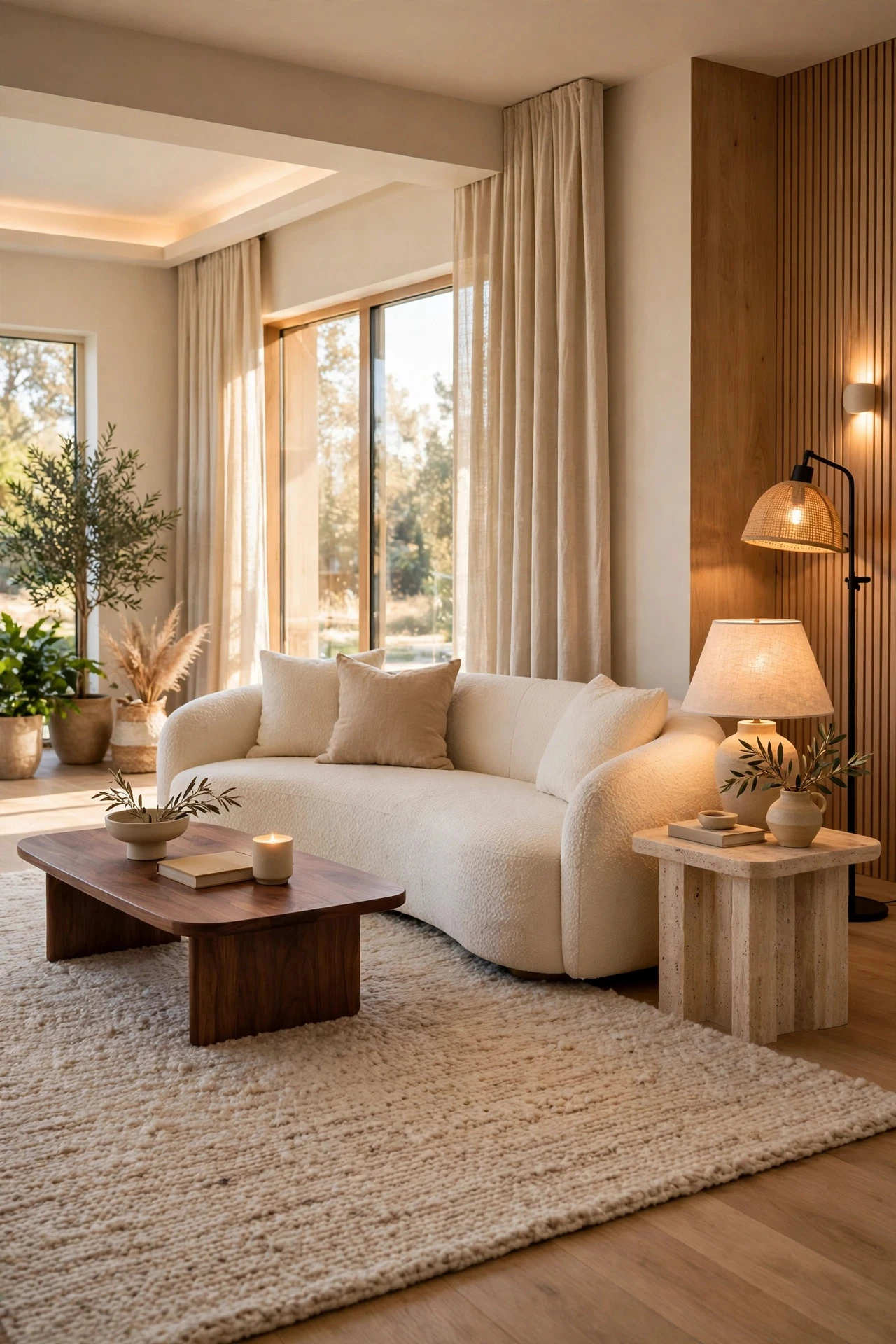
22 Modern Living Room Ideas That Feel Warm, Not Stark
Modern living rooms have a reputation problem. The clean lines, flat surfaces and pale palettes that make them look so good in photos can also make them feel cold, echoey and slightly unwelcoming in real life. The room photographs beautifully and then nobody wants to sit in it for more than ten minutes.
The fix is not to abandon modern style. Warm modern is a real, well-tested look: the same clean lines and uncluttered layouts, but built from warm materials, layered light and soft textures that invite you to stay. The ideas below show how to get there, with the exact measurements, colour temperatures and budgets that make the difference between a showroom and a living room.
Looking for more inspiration? Our Nest Decorz homepage gathers the latest home decor ideas, seasonal decorating guides and room-by-room styling tips in one place — start there and explore.
Quick Answers
– Warm the light first: Swap 4000K+ daylight bulbs for 2700K warm white and add three light sources at different heights — it is the cheapest warmth you can buy. – Add one warm material per surface: Walnut, boucle, travertine, linen and wool each soften a different part of the room, so the modern lines stay but the cold disappears. – Size the rug to the sofa: The rug should extend at least 15 cm past each sofa arm, with front legs on the rug — a too-small rug is the most common reason a modern room feels bare. – Keep 45 cm of breathing room: Sofa to coffee table should sit at 40–45 cm, and walkways need 75–90 cm, so the layout feels generous rather than cramped. – Warmth comes from texture, not clutter: Layer three or four textures in the same warm palette instead of adding more objects, and the room stays calm.
1. How Do You Warm Up a Grey Modern Living Room?
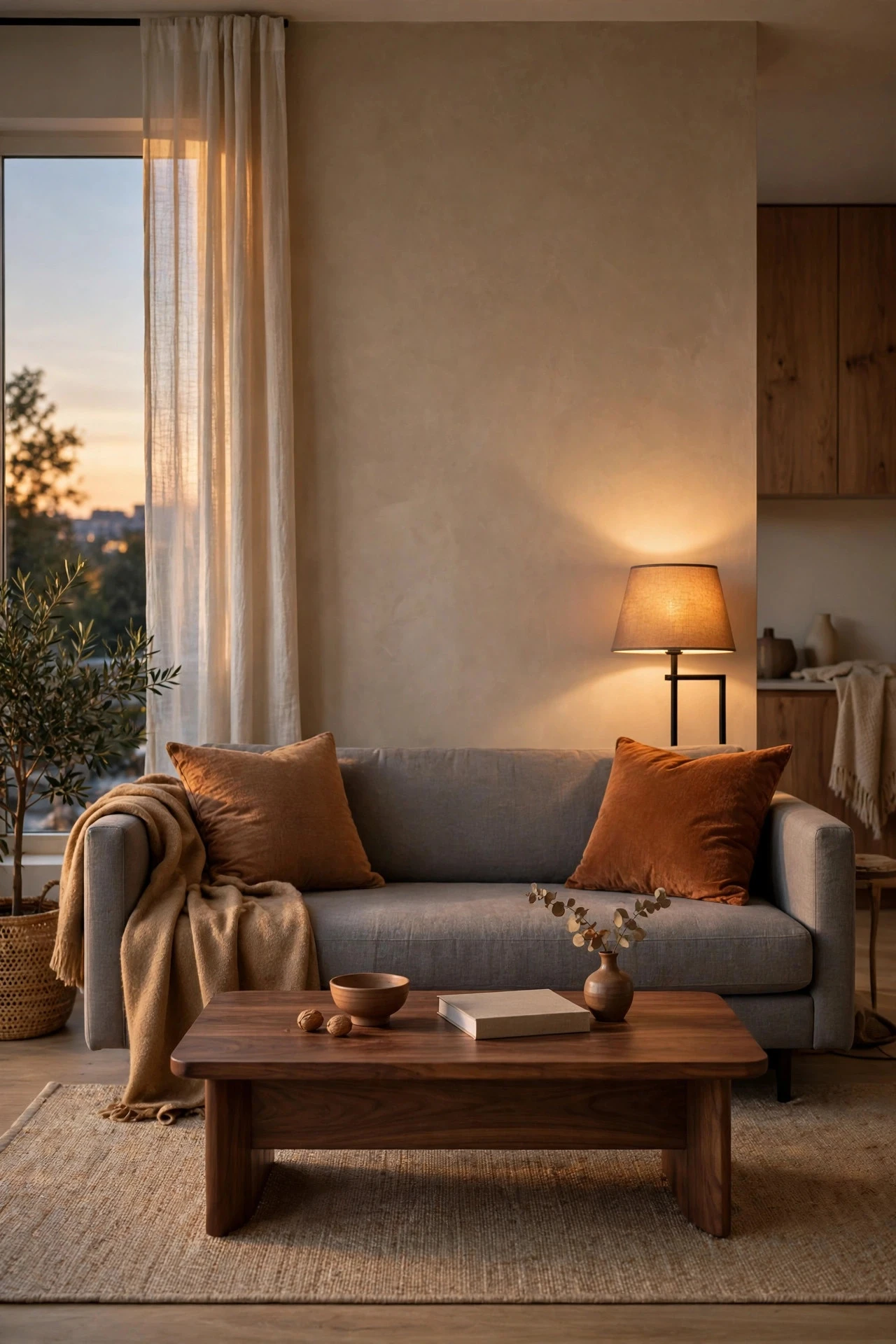
A grey modern living room feels cold when the grey is cool-toned and every surface matches it, because there is nothing warm for the eye to land on. The fix is to shift the grey warmer and break it up: repaint one wall in a warm greige — a grey-beige like a soft mushroom or warm stone — and leave the rest in a warm white rather than a bright, blue-white.
Add warmth through the largest surfaces first, since they set the temperature of the whole room. A walnut coffee table, a boucle or wool throw in camel or rust, and a rug with a warm undertone will do more than a dozen small accessories. Keep the grey in the sofa and the rug's base, but let every layer above it lean warm.
2. What Sofa Fabric Makes a Modern Room Feel Cosy?
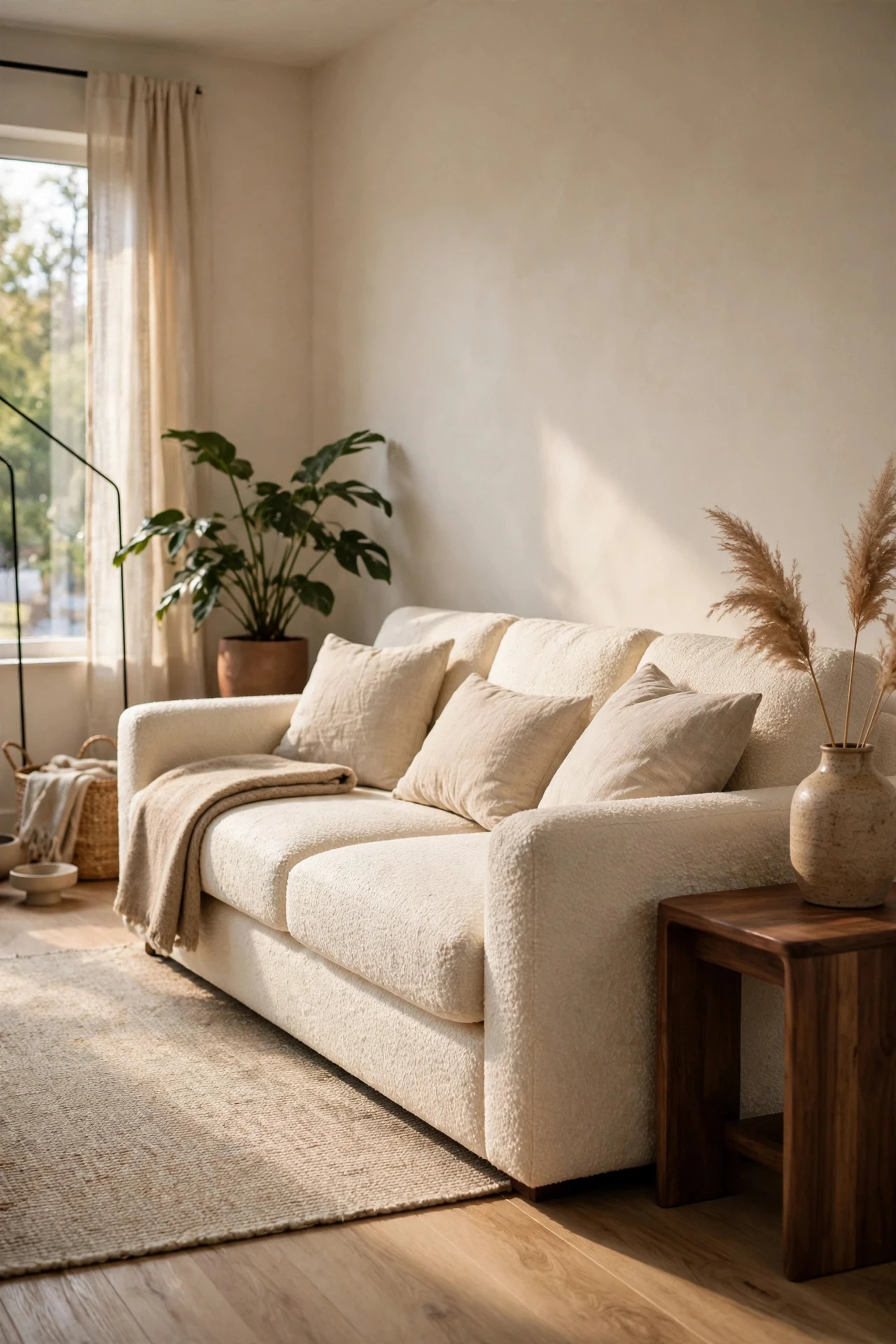
Boucle is the fabric doing the most work in warm modern living rooms right now, because its looped, nubby texture reads soft and inviting even in a strict, straight-lined silhouette. A cream or oatmeal boucle sofa keeps the modern shape but completely changes the feeling of the room, and it photographs beautifully in warm light.
Performance linen is the practical alternative if you have children or pets: it looks relaxed and slightly slubbed, washes well, and never feels slippery or cold the way leather or smooth velvet can. Expect $1,200–$3,500 for a quality three-seater in boucle or performance linen. If a new sofa is not in the budget, a thick wool throw and two linen cushions over your existing sofa give you most of the effect for under $150. For the full buying guide, see how to choose a living room sofa before you commit to a size or fabric.
3. How Do You Layer Lighting So a Modern Room Glows?
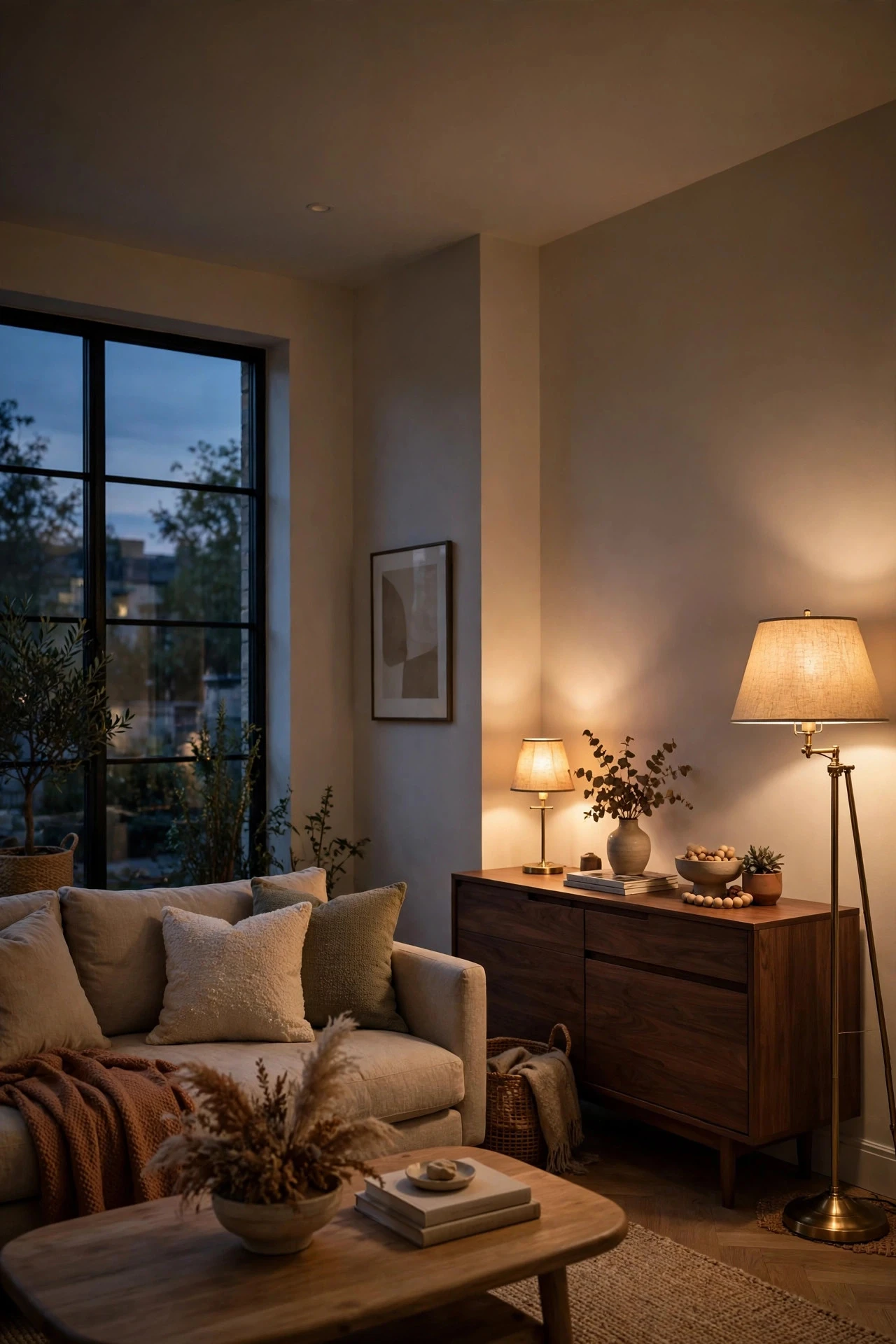
Layered lighting is the single biggest warmth lever in a modern living room, because a single overhead light flattens everything and makes pale surfaces look stark. You need three layers: ambient light from the ceiling, task light from a floor or table lamp, and accent light from a picture light, a candle cluster or a low shelf light.
The temperature matters as much as the layers. Use 2700K warm white bulbs everywhere in the living room, and put the overheads on a dimmer so the room can drop to a soft evening glow. Budget $150–$400 for two good lamps and dimmer switches, and the room will feel different the same evening. Avoid cool 4000K+ daylight bulbs entirely — they are the fastest way to make a modern room feel like an office. Our living room lighting ideas cover more layered combinations for every room size.
4. Which Wood Tones Warm Up Modern Furniture?
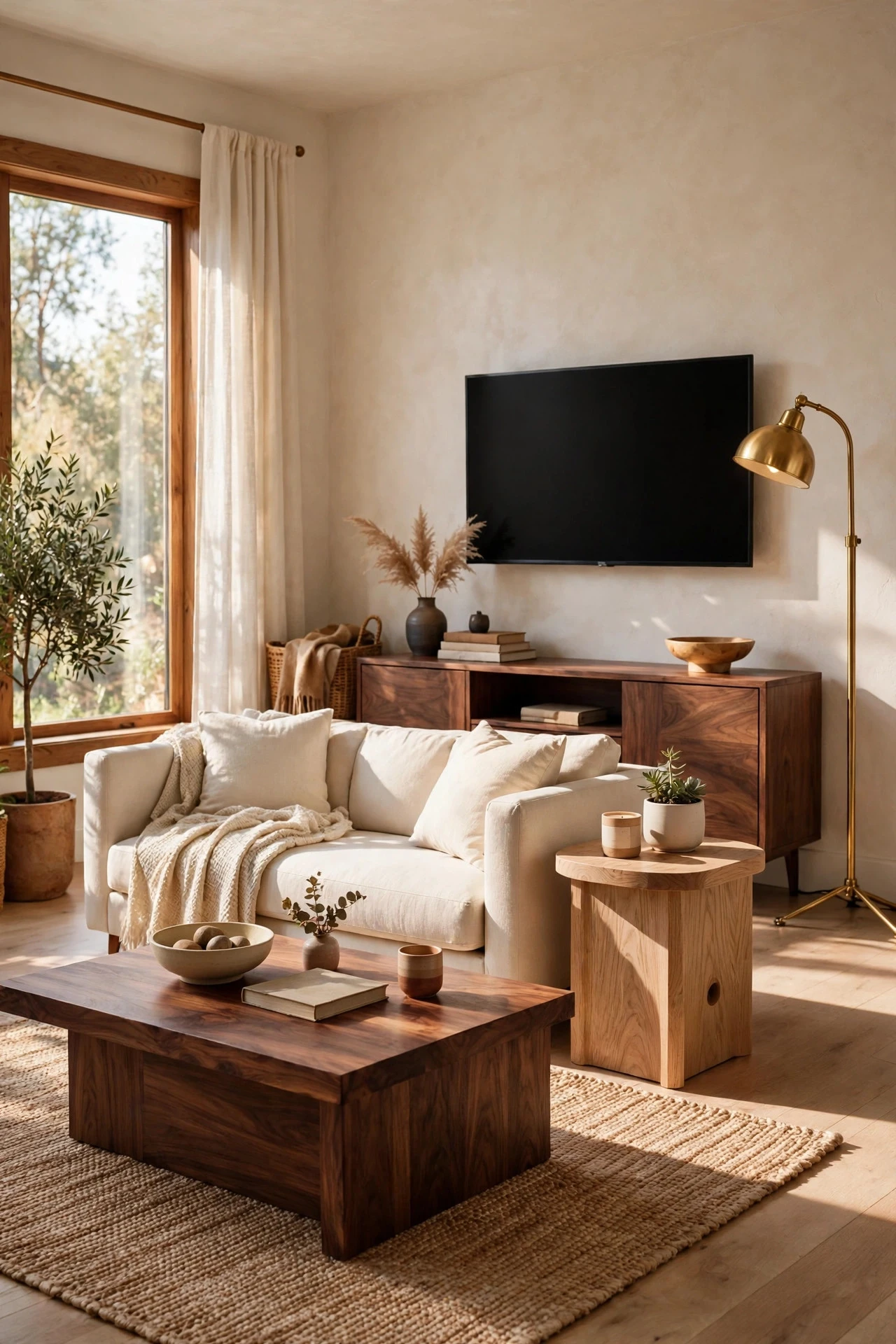
Walnut and white oak are the two wood tones that warm a modern living room without dragging it toward traditional style. Walnut brings depth and richness — a walnut coffee table or media console anchors a pale room the way a dark rug does, but with far more elegance. White oak is lighter and airier, and it suits rooms that need warmth without losing brightness.
The trick is to use one dominant wood tone and repeat it two or three times, so the room feels intentional rather than collected at random. A walnut coffee table, a walnut picture frame and a walnut side table tie together; mixing walnut, cherry, pine and teak in one room creates visual noise. A solid walnut coffee table runs $400–$1,200, while white oak side tables start around $150.
5. How Big Should a Rug Be Under a Modern Sofa?
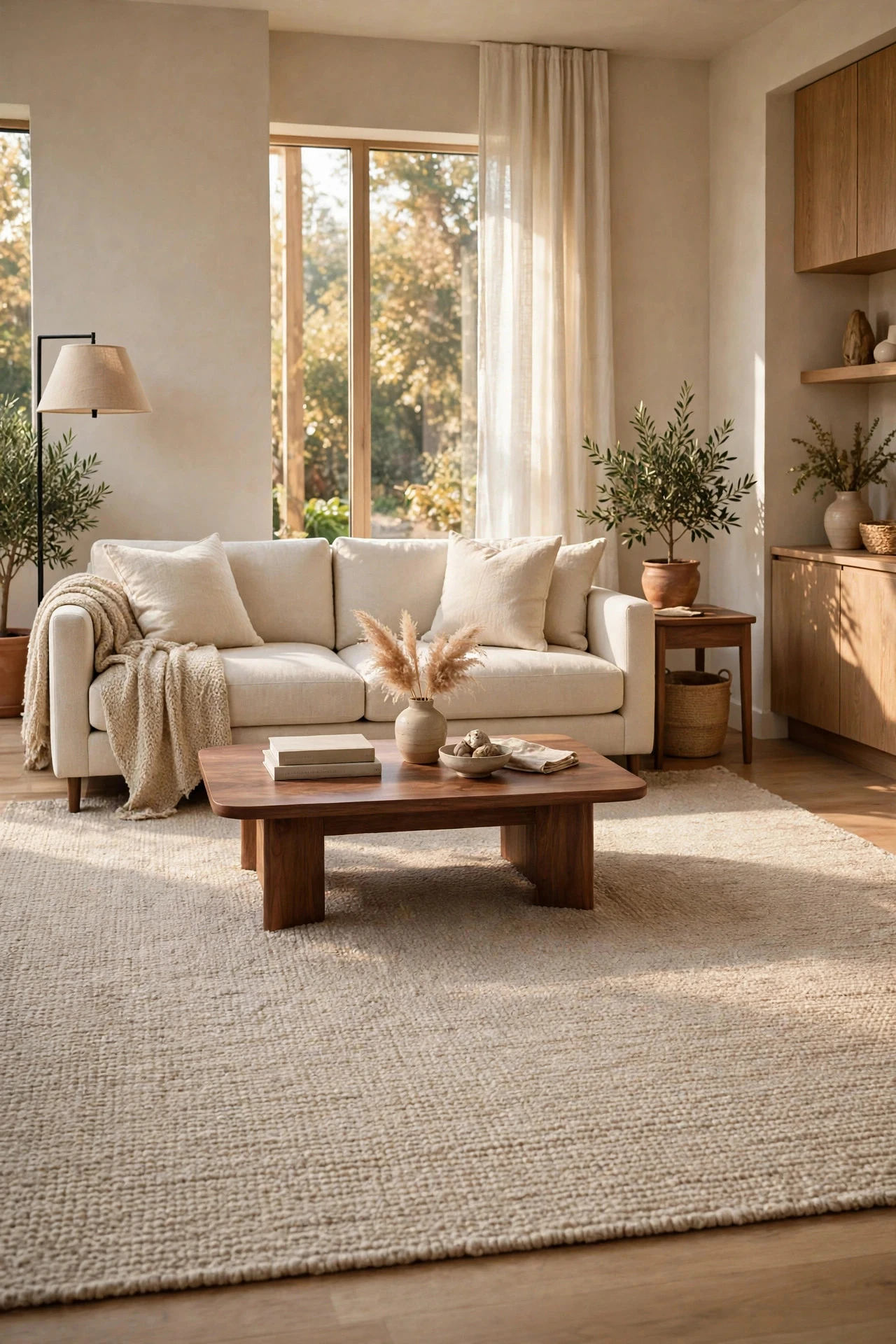
A rug that is too small is the most common reason a modern living room feels bare and unfinished, because the furniture floats on hard floor instead of sitting together as a group. The rule is simple: the rug should be wide enough that the sofa's front legs sit on it, with at least 15 cm of rug extending past each arm, and ideally the same on the chair side.
For a standard three-seater sofa (about 220 cm wide), that means a rug of at least 240 x 300 cm; for a sofa with two chairs, go up to 270 x 360 cm. A quality wool rug in the right size costs $300–$900, and it is worth every penny because it also absorbs sound, which makes the room feel quieter and warmer. For sizing and pattern guidance, our living room rug ideas show how each layout should sit on the rug.
6. Can Travertine and Stone Make a Modern Room Feel Warm?
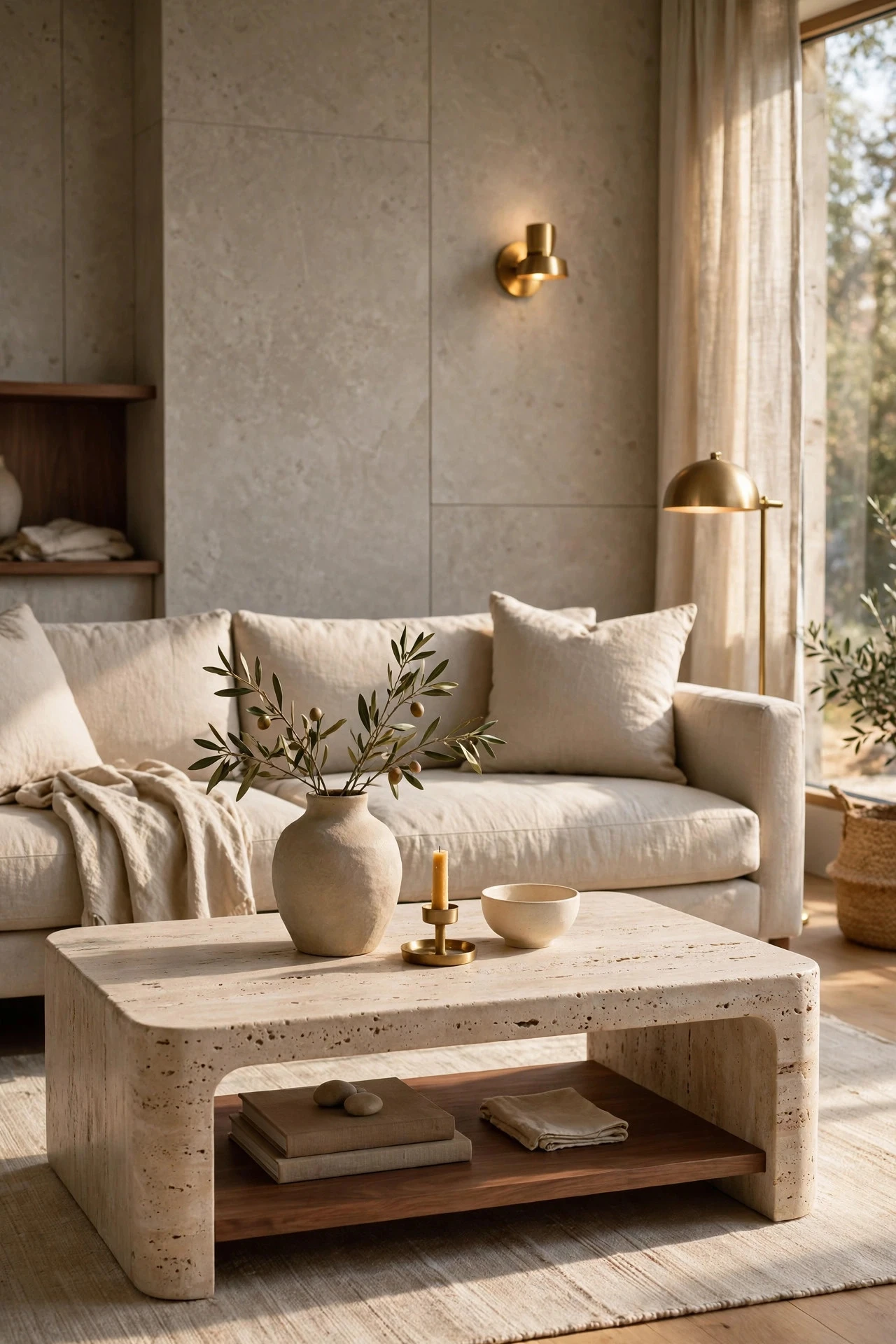
Travertine, limestone and honed marble make a modern room feel warm because their surfaces are naturally imperfect: the pits, veins and soft colour variation catch light the way flat lacquer never does. A travertine coffee table is the classic warm-modern statement — pale, creamy and full of character — and it pairs beautifully with walnut, boucle and brass.
Use stone on one or two pieces only, so it reads as a feature rather than a cold slab. Travertine coffee tables run $500–$1,500, and smaller travertine trays or side tables start around $120. Avoid pairing stone with lots of glass and chrome, which pushes the room back toward stark; warm metals like brass or aged bronze are the right companions.
7. How Do You Style a Modern TV Wall Without It Feeling Cold?
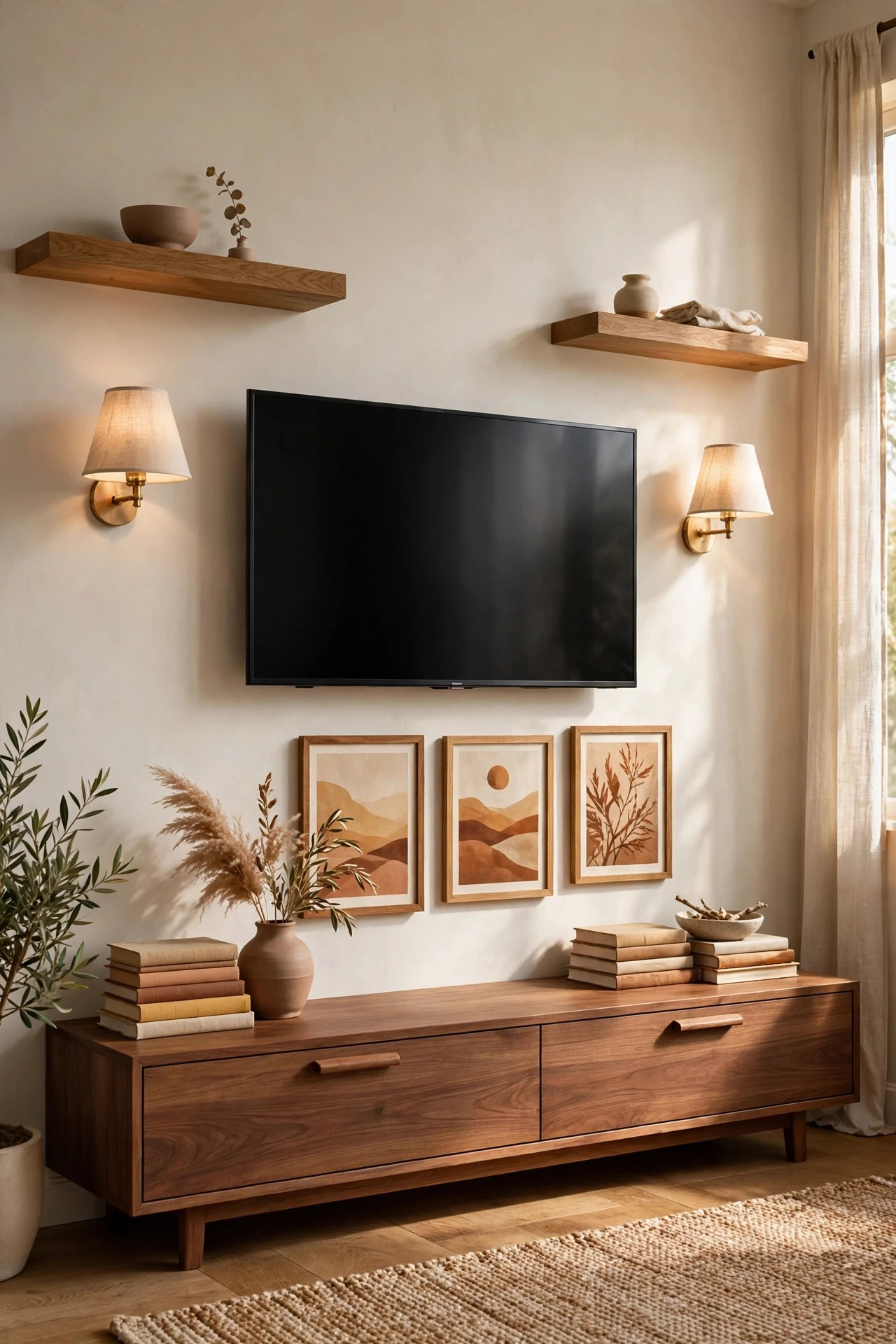
A modern TV wall feels cold when a black rectangle hangs on a bare white wall above a low, empty console, because the screen becomes the room's only focal point. The fix is to treat the wall as a composition: mount the TV at eye level from the sofa — the centre of the screen about 105–110 cm from the floor — and build warmth around it.
Flank the TV with walnut or oak shelving, a pair of linen-shaded sconces, or framed art in warm tones, so the screen is one element among several. A low media console in warm wood, styled with a stack of books, a ceramic vase and a small brass object, grounds the wall. Never mount the TV above a fireplace, and never leave the wall above it empty — a simple oak picture ledge with two warm prints changes the whole wall.
8. What Curtains Soften a Modern Living Room?
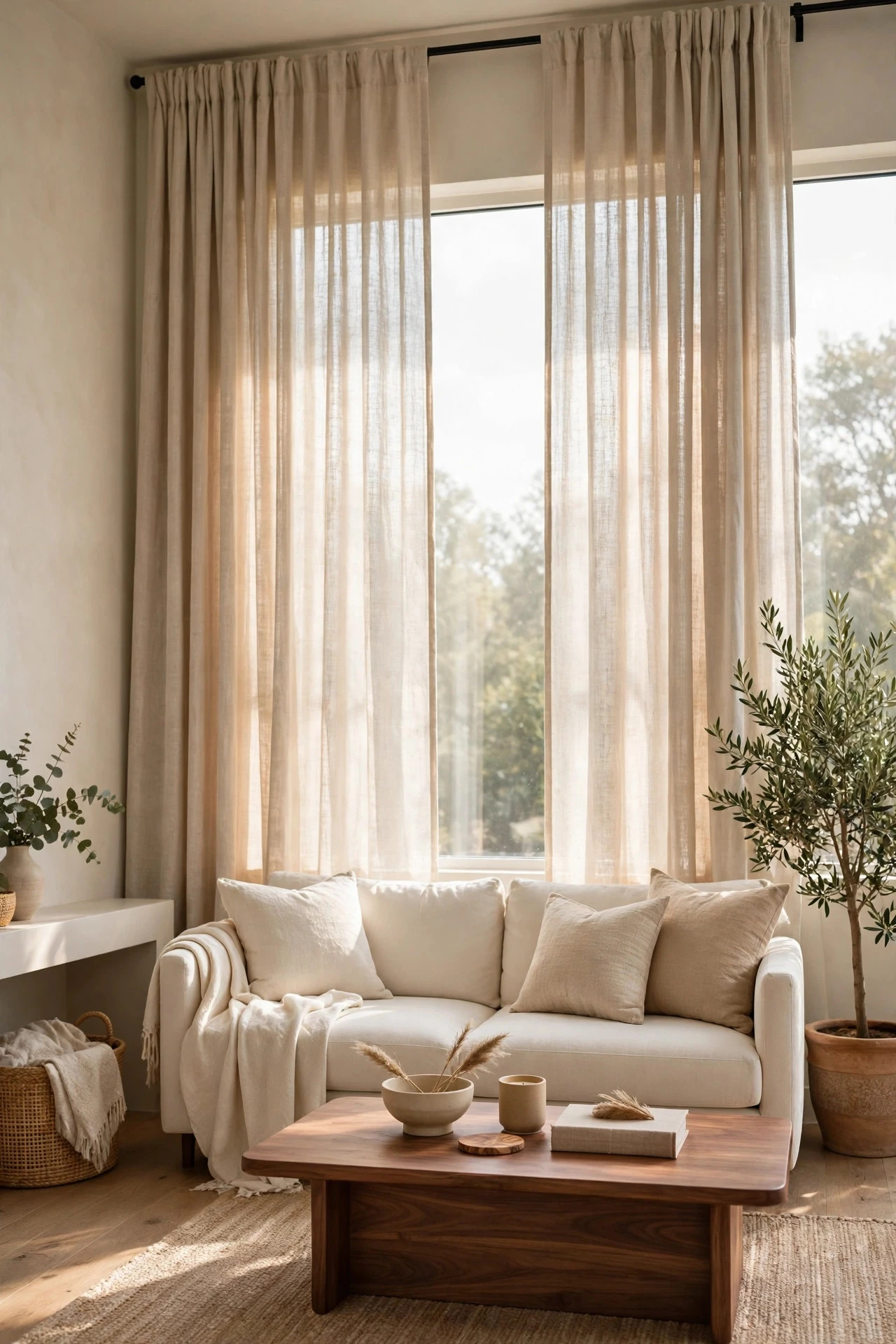
Linen curtains are the fastest softener for a modern living room, because they add height, movement and a warm texture that hard window frames cannot. Hang them high and wide: the rod should sit 10–15 cm above the window frame, and the curtains should extend 15–20 cm past the frame on each side, so the window looks larger and the fabric hangs in full, generous folds.
Choose a warm neutral — oatmeal, natural flax, warm ivory — in a linen or linen-blend fabric, and let the panels just kiss the floor rather than pooling or floating. Avoid sheer white voiles in a modern room, since they read cold and clinical; a lined linen panel filters light warmly and insulates the room at night.
9. How Do You Add Colour to a Modern Room Without Clutter?
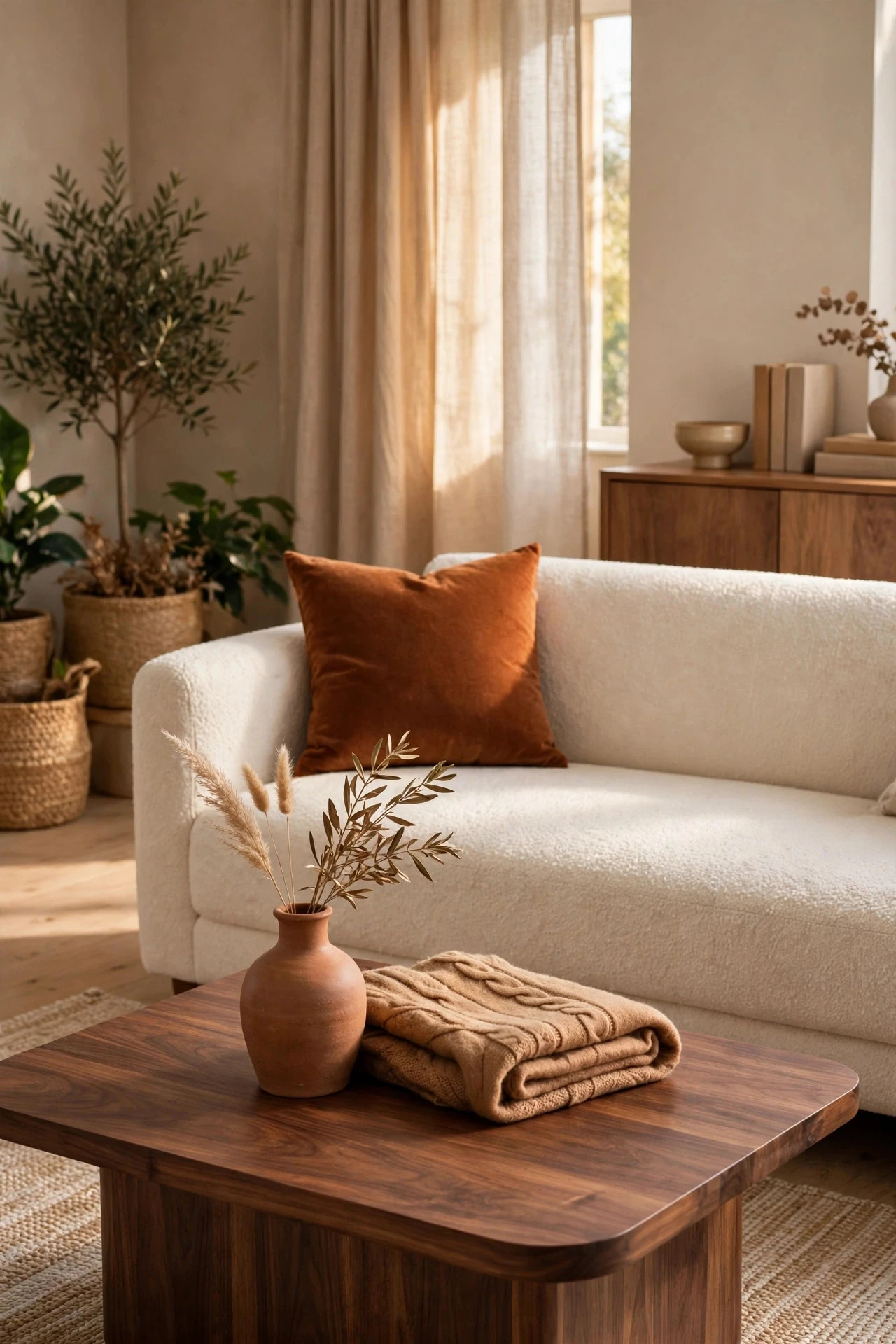
Warm colour works in a modern room when it arrives in three controlled doses rather than scattered everywhere. Pick one warm accent — terracotta, rust, camel, olive or a muted ochre — and use it in a cushion, a throw and one piece of art, then let the rest of the room stay in warm neutrals.
A rust cushion on the sofa, a camel throw over the arm and a small terracotta vase on the coffee table are enough; a fourth or fifth coloured object starts to feel busy. Keep the accent's tone muted and earthy rather than bright and saturated, since modern rooms suit dusty, sun-warmed colours. Avoid adding a second competing accent colour in the same room, and never match the accent exactly to the rug — a tone or two off looks layered, while a perfect match looks like a set.
10. What Is the Right Sofa-to-Coffee-Table Distance?
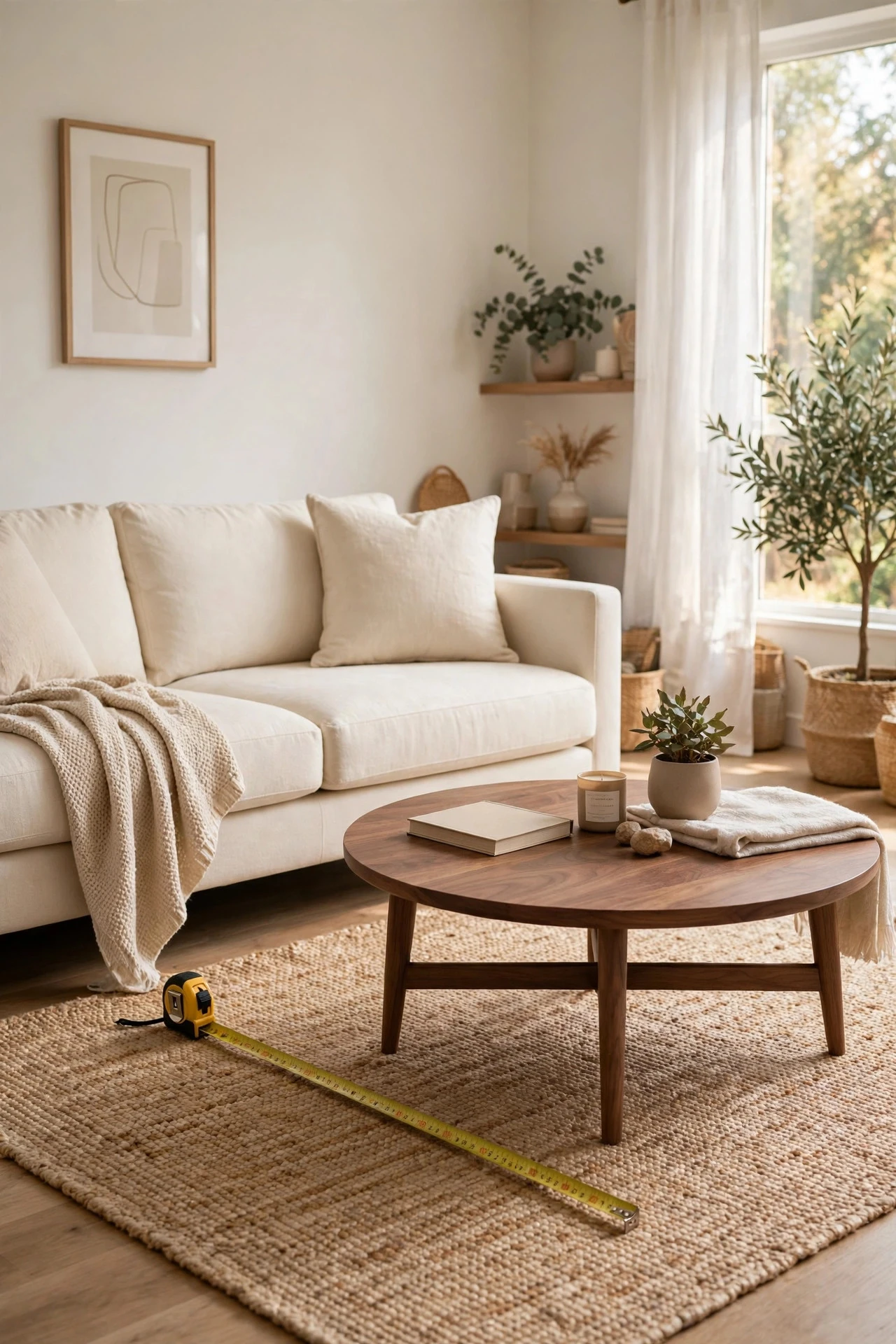
The right distance between sofa and coffee table is 40–45 cm: close enough to reach a mug without leaning, far enough to walk past without turning sideways. This one measurement decides whether a modern living room feels comfortable or awkward, because too close feels cramped and too far feels disconnected.
The coffee table itself should be about two-thirds the length of the sofa and roughly the same height as the seat cushions, or 2–5 cm lower. These clearances cost nothing to get right and save you from buying furniture that never fits. If your room is tight, a round coffee table in walnut or travertine saves space because it has no corners to catch shins, and it softens the straight lines of a modern sofa.
11. How Do You Mix Metals Without Making the Room Feel Stark?
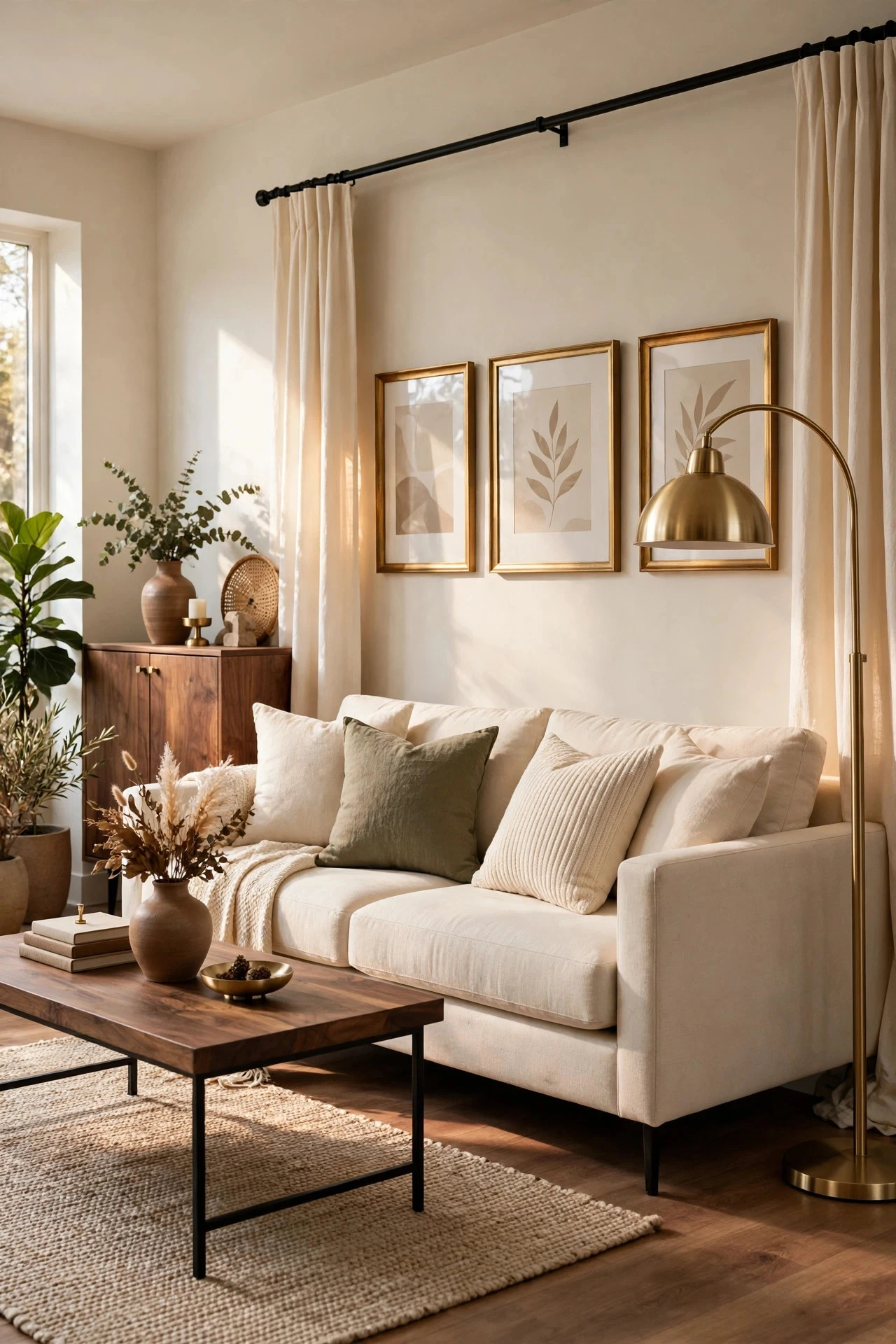
Warm metals — brass, aged bronze, copper and matte black used sparingly — are what keep a modern living room from feeling like a laboratory. Chrome and polished nickel reflect cold, blue-toned light, while brass and bronze reflect warm, golden light, so the choice of metal genuinely changes the room's temperature.
Use one dominant metal and one accent, and repeat each at least twice so the mix looks deliberate. Brushed brass on the floor lamp and the picture frames, with matte black on the curtain rod and the coffee table legs, is a classic warm-modern combination. A brass floor lamp costs $150–$400, and swapping chrome handles for brass ones on a media console is a $30–$60 update.
12. Can a Fireplace Make a Modern Living Room Feel Warm?
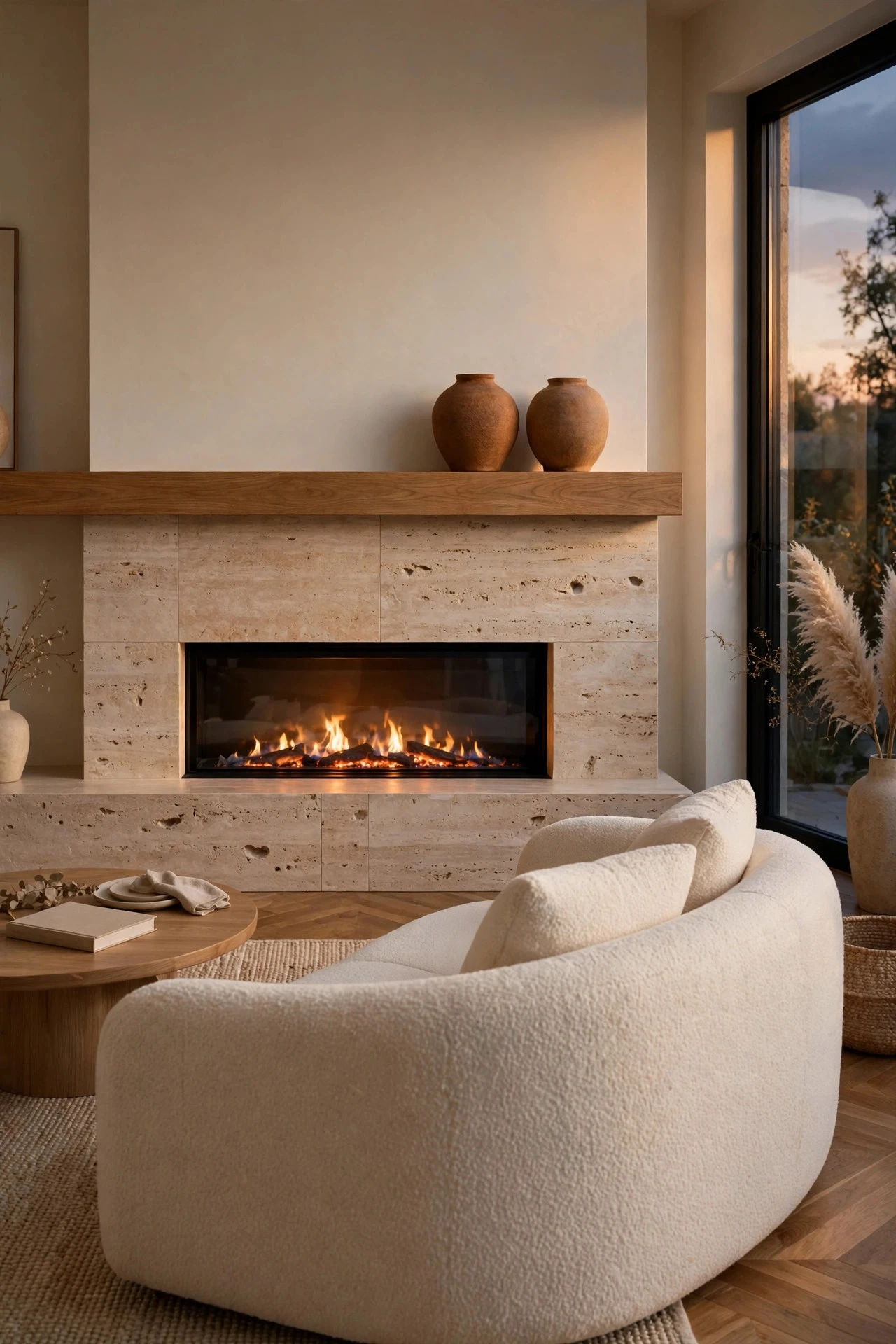
A fireplace is the most literal warmth source a modern living room can have, and a linear electric or bioethanol fireplace fits modern style perfectly. A low, wide linear fire set into a plaster or travertine surround gives you the glow and the flicker without the bulk of a traditional mantel, and it becomes the room's natural focal point.
If a real fire is not possible, a well-styled electric fire with a realistic flame effect and a warm wood or stone surround still changes the room's feeling, especially in the evening. For styling the surround and the mantel shelf, our living room fireplace decor ideas show warm, modern arrangements that keep the fire as the star.
13. How Do You Style Open Shelving in a Modern Living Room?
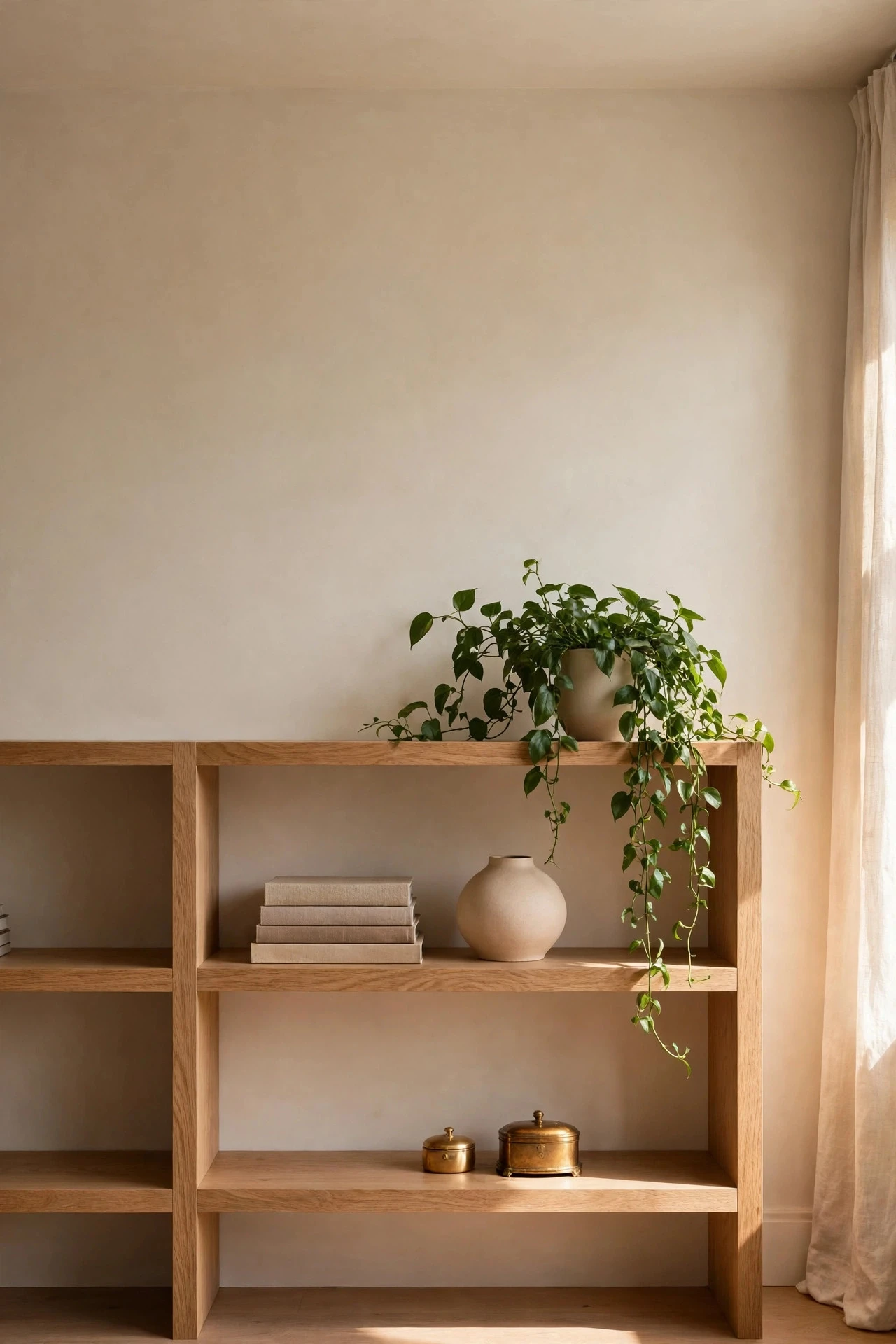
Open shelving warms a modern living room when it is styled as a curated collection rather than a storage dump. The rule is two-thirds filled, one-third empty: leave breathing room between groups so the eye can rest, and group objects in odd numbers — three books, one vase, one small sculpture — rather than lining everything up in a row.
Mix materials on each shelf: a stack of books, a ceramic vase, a small brass object and a trailing plant gives the shelf texture and warmth. A pair of oak floating shelves costs $100–$300, and styling them takes an hour of rearranging rather than a shopping trip. Avoid filling every shelf to the edge, and never mix more than three different materials on one shelf, since the mix starts to look cluttered instead of curated.
14. What Cushions and Throws Make a Modern Sofa Inviting?
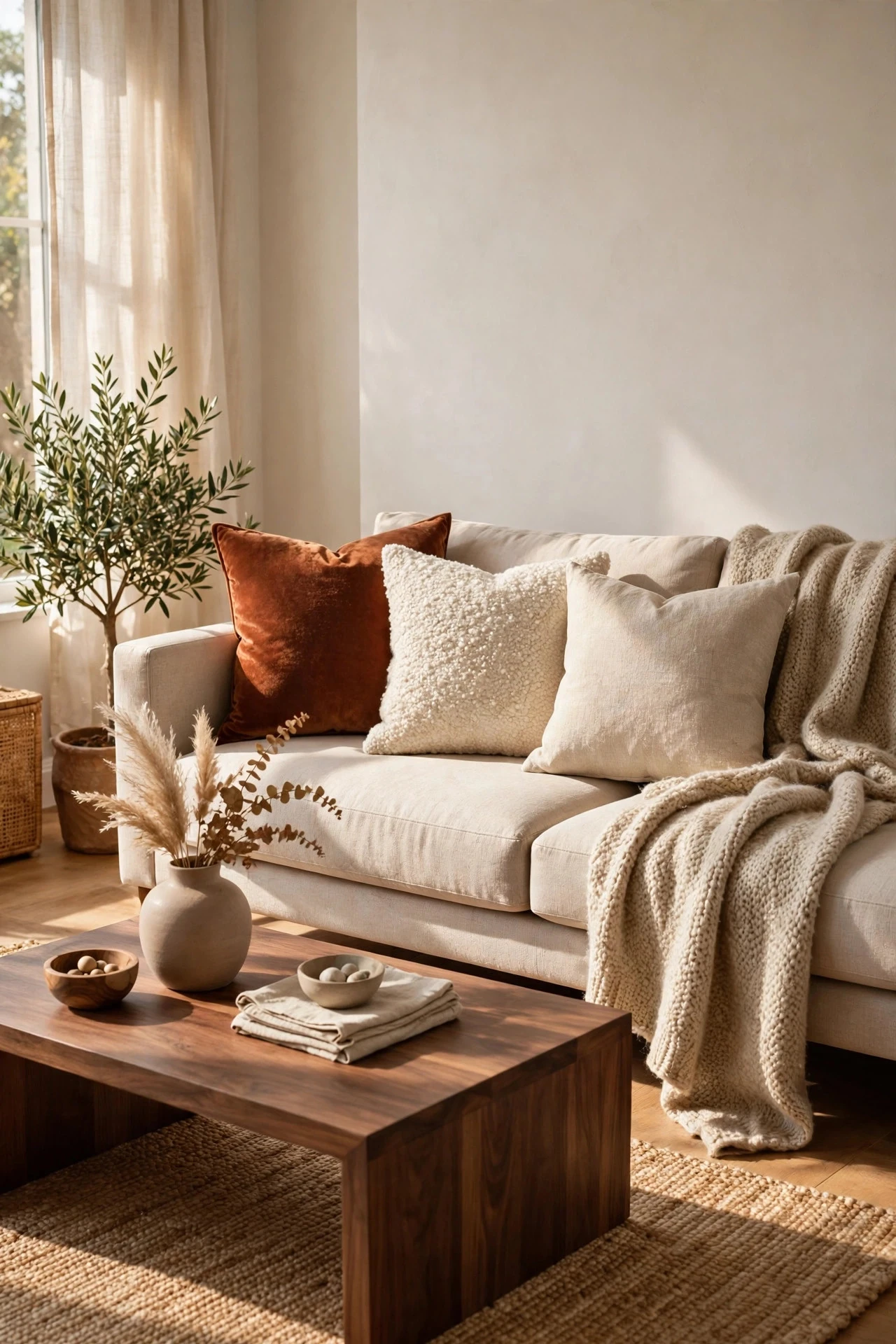
A modern sofa looks inviting when its cushions and throws mix three textures in the same warm palette: something soft, something nubby and something smooth. A velvet cushion in rust, a boucle cushion in cream and a linen cushion in oatmeal, with a wool throw draped over one arm, give the sofa a layered, touchable quality that a single matching set never achieves.
Use odd numbers — three cushions on a two-seater, five on a three-seater — and vary the sizes so the arrangement looks relaxed rather than staged. Avoid matching cushion sets in identical fabric and colour, which look like a showroom display, and avoid more than two patterns in one seating group — one subtle pattern is enough.
15. How Do You Warm Up a Modern Room with Plants?

Plants warm a modern living room because they are the one element that is genuinely alive: their green softens hard edges, their leaves catch light, and their organic shapes break up the straight lines that make modern rooms feel rigid. One large plant does more than five small ones, so start with a single statement plant — an olive tree, a fiddle-leaf fig or a tall snake plant — in a warm terracotta or ceramic pot.
Place the large plant in a corner that needs softening, and add one trailing plant on a shelf or sideboard for a second layer of green. A large olive tree costs $80–$200, and a woven basket pot is $25–$50. Avoid filling the room with tiny succulents on every surface, since a dozen small pots reads as clutter, and avoid fake plants in a room you are trying to make feel warm — their flat plastic leaves do the opposite of what you want.
16. What Is the Best Layout for a Modern Living Room?
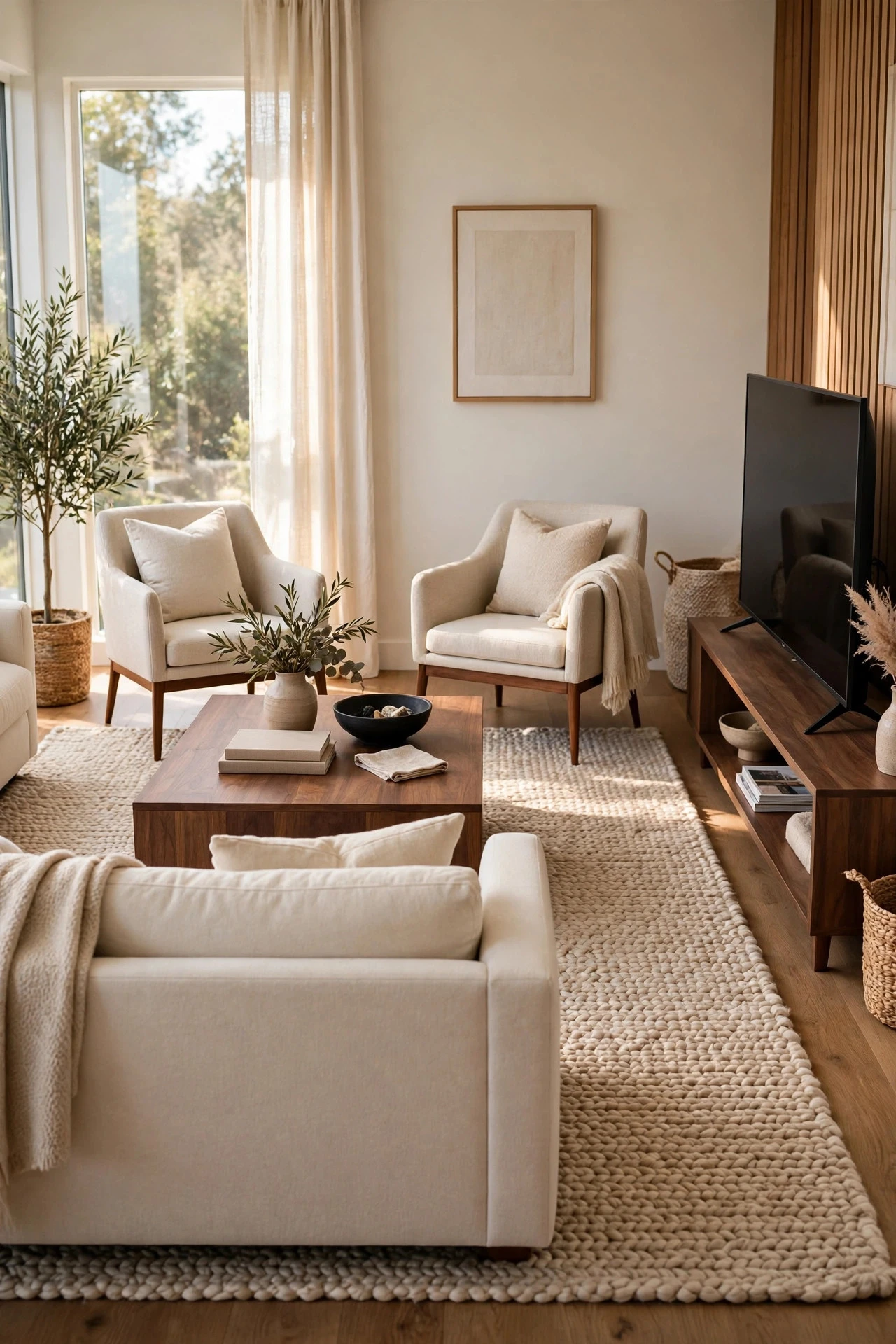
The best layout for a modern living room is a conversation layout: the sofa and chairs facing each other across the coffee table, rather than all facing the TV like a cinema. This arrangement makes the room feel social and warm, because people sit facing each other instead of staring at a screen in a row.
In a rectangular room, float the sofa in the middle of the room with its back to the dining area, and place two chairs opposite it with the coffee table between them. If the TV must be part of the layout, angle the sofa toward it slightly and keep one chair facing the conversation area, so the room works for both. Avoid pushing every piece against the walls, which leaves a dead, empty middle and makes the room feel like a waiting area.
17. How Do You Choose Art for a Modern Living Room?

Art warms a modern living room when it is large, warm-toned and hung at the right height, because a single generous piece gives the room a personality that a cluster of small frames cannot. Choose one large canvas — at least two-thirds the width of the sofa it hangs above — in warm earth tones, soft abstracts or a landscape with warm light, and hang its centre at eye level, about 145–150 cm from the floor.
If you prefer a gallery, keep it to three or four frames in the same finish, with generous spacing, and one warm-toned piece among them. Avoid hanging art too high — a common mistake that disconnects it from the furniture — and avoid black-and-white photography as the only art in a room you are warming up, since it reinforces the cool palette. Our living room wall decor ideas show more warm, modern wall arrangements.
18. Can a Modern Room Feel Warm with Black Accents?
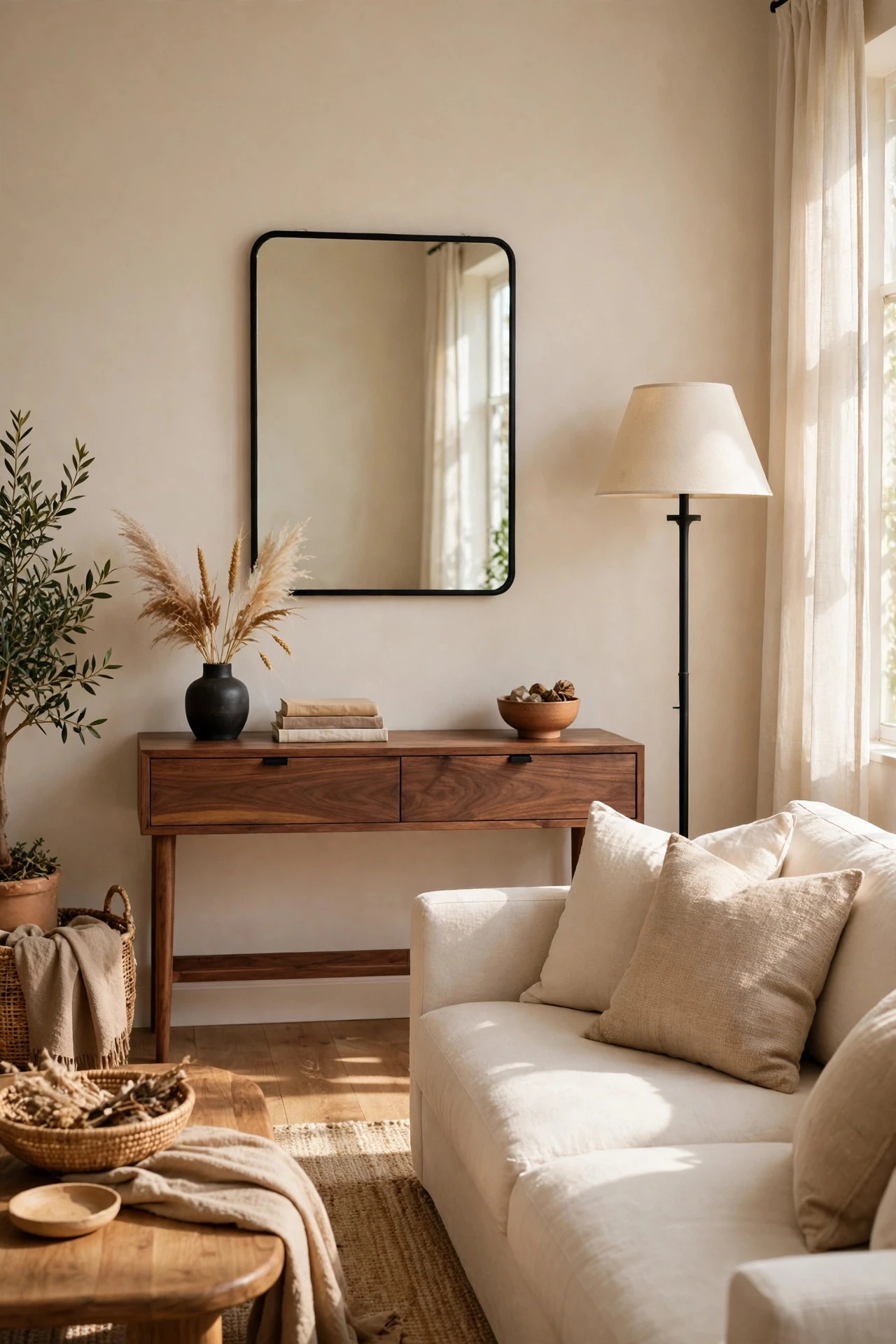
Black accents make a modern room feel warmer, not colder, when they are used as grounding punctuation rather than a dominant colour. A matte black curtain rod, a black-framed mirror, black coffee table legs or a black floor lamp base give the eye a point of contrast that makes the warm neutrals around them look warmer by comparison.
The rule is 10% black at most: a few slim, dark lines in a room that is otherwise warm cream, walnut and brass. A black-framed mirror above a walnut console is the classic example — the dark frame sharpens the warm wood and makes the whole composition feel intentional. A black-framed mirror costs $80–$250, and black hardware is a $20–$40 swap.
19. How Do You Warm Up a Modern Living Room on a Budget?

A modern living room can feel dramatically warmer for under $500 if you spend the money in the right order: lighting first, textiles second, paint third. Swap all bulbs to 2700K warm white and add one linen-shaded floor lamp ($60–$150), then add a wool throw and two linen cushions in warm tones ($80–$150), and finally repaint one accent wall in warm greige ($35–$60).
The trick is to spend on the things you touch and see at eye level — light, fabric and the wall behind the sofa — rather than on small decorative objects. If the budget is tighter, start with just the bulbs and the throw: $100 of light and wool changes the feeling of a room more than $100 of decor ever will.
20. What Flooring Works Best in a Warm Modern Living Room?
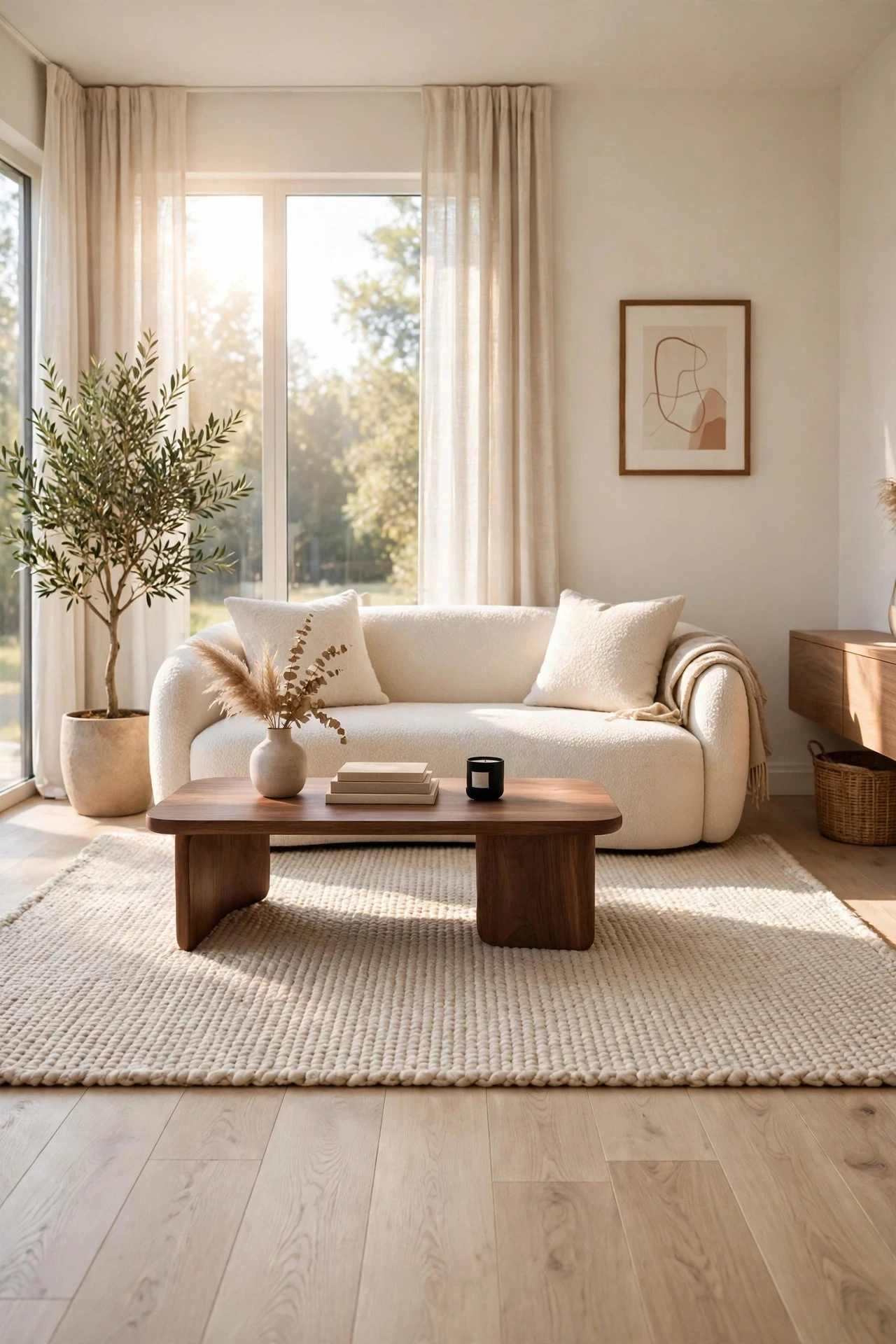
Warm wood flooring is the foundation of a warm modern living room, because the floor is the largest surface in the room and its tone sets the temperature for everything above it. Wide-plank white oak or warm walnut, in a matte or satin finish, gives the room a soft, natural base that works with every warm material in this guide.
If replacing flooring is not an option, a large wool rug in a warm tone covers most of the floor and delivers the same effect for a fraction of the cost. Avoid cool grey laminate and polished concrete in a room you are warming up, since both reflect cold light and make the space feel echoey. Architectural Digest regularly features warm modern living rooms built on oak floors, which show how the floor sets the whole palette.
21. How Do You Add Texture Without Adding Pattern?

Texture without pattern is the warm-modern secret: it gives the eye something to feel without adding visual noise. Layer four textures in the same warm palette — boucle on the sofa, linen on the curtains, wool on the throw, travertine on the coffee table — and the room feels rich and layered even though almost nothing is patterned.
A nubby rug underfoot, a smooth stone table at knee height, a soft linen curtain at the window and a boucle cushion at sitting height give the room a full sensory range. This approach keeps the room calm, which is exactly what modern style does best, while removing the starkness that makes it feel cold. The cost is the same as any cushion and throw refresh — $120–$250 — because you are choosing textures rather than buying more objects.
22. How Do You Keep a Warm Modern Living Room Feeling Calm, Not Cluttered?
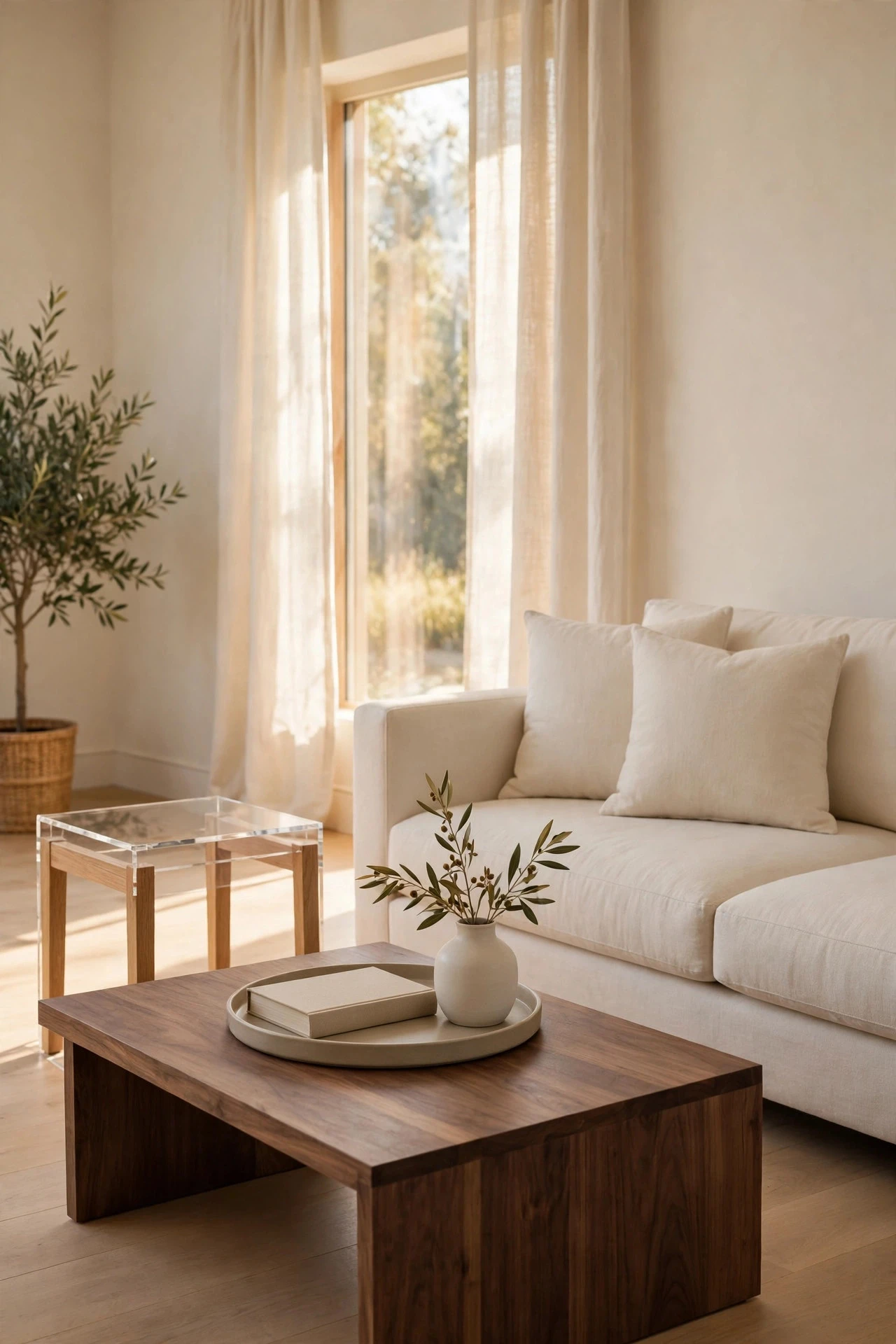
A warm modern living room stays calm when every object earns its place and every surface has breathing room. The test is simple: remove one object from each surface, and if the room looks better, it was clutter. A coffee table needs three things at most — a tray, a book and a vase — and a sideboard needs one lamp and one object, not a row of six.
Warmth comes from materials and light, not from quantity, so resist the urge to keep adding throws, candles and frames. This discipline costs nothing and is the hardest part of warm modern style, because every shop and feed wants you to add more. The Spruce has a useful guide to editing a room, and its core advice matches this one: if you love it and use it, keep it; if you bought it to fill a gap, let it go.
Practical Tips for a Warm Modern Living Room
Start with light, because it is the cheapest change with the biggest effect. Replace every bulb in the living room with 2700K warm white, put the overheads on dimmers, and add a floor lamp and a table lamp so the room has three light sources at three heights. Test the room at night before you buy anything else — most cold modern rooms are simply under-lit and over-lit at the same time.
Measure before you buy furniture. The sofa-to-coffee-table gap is 40–45 cm, walkways need 75–90 cm, the rug must extend 15 cm past each sofa arm, and art hangs with its centre at 145–150 cm from the floor. Tape the footprint of a new sofa or rug on the floor with painter's tape and live with the outline for a day; it prevents the most expensive mistake in the room.
Budget in layers, not all at once. Lighting and textiles ($200–$400) come first, then a rug ($300–$900), then one warm furniture piece like a walnut coffee table ($400–$1,200). A full warm-modern refresh of a standard living room typically lands between $1,000 and $3,000 spread over a few months, and the room improves at every stage. Buy the largest, warmest pieces first and the accessories last, since accessories cannot rescue a cold foundation.
Finally, live with each change for a week before adding the next one. Warmth is a feeling, not a shopping list, and the room will tell you what it still needs — usually less than you think. Keep one surface deliberately empty, keep the palette to warm neutrals plus one accent, and keep the textures varied. If the room starts to feel busy, remove something before you add anything.
Final Thoughts
A warm modern living room is not a different style from a modern one — it is the same clean lines, built from warmer materials, lit with warmer light and softened with textures you actually want to touch. Start with the light, size the rug properly, add one warm wood and one warm fabric, and the room will stop feeling like a showroom and start feeling like home.
Frequently Asked Questions
What is warm modern style in a living room?
Warm modern style keeps modern design's clean lines and uncluttered layouts but builds them from warm materials — walnut, boucle, travertine, linen and wool — with 2700K layered lighting and a warm neutral palette. It feels calm and contemporary without the cold, stark quality that makes many modern rooms unwelcoming.
What colour temperature should living room lights be?
Use 2700K warm white bulbs throughout the living room, with dimmers on the overhead lights so the room can drop to a soft evening glow. Avoid 4000K and higher daylight bulbs, which make pale surfaces look stark. Three light sources at different heights give the best layered effect.
How big should a rug be in a modern living room?
The rug should be wide enough that the sofa's front legs sit on it, extending 15 cm past each arm. For a three-seater sofa, a rug of 240 x 300 cm works. A rug that is too small is the most common reason a modern room feels bare.
What is the cheapest way to warm up a modern living room?
Swap all bulbs to 2700K warm white and add one linen-shaded floor lamp, then add a wool throw and two linen cushions in warm tones. Together these cost roughly $150–$300 and change the room the same evening. A single accent wall in warm greige paint, at $35–$60, is the next best step.
Which wood is best for a warm modern living room?
Walnut and white oak are the best choices: walnut adds depth, while white oak keeps the room bright and airy. Use one dominant wood tone and repeat it two or three times — a coffee table, a side table, a frame — with a matte finish. Avoid mixing four or more wood tones in one room.
How do I keep a modern living room from feeling cluttered?
Keep every surface to three objects at most and leave one surface deliberately empty, since warmth comes from materials and light rather than quantity. Remove one object from each surface; if the room looks better without it, keep it that way. Rotate accessories seasonally instead of adding more.