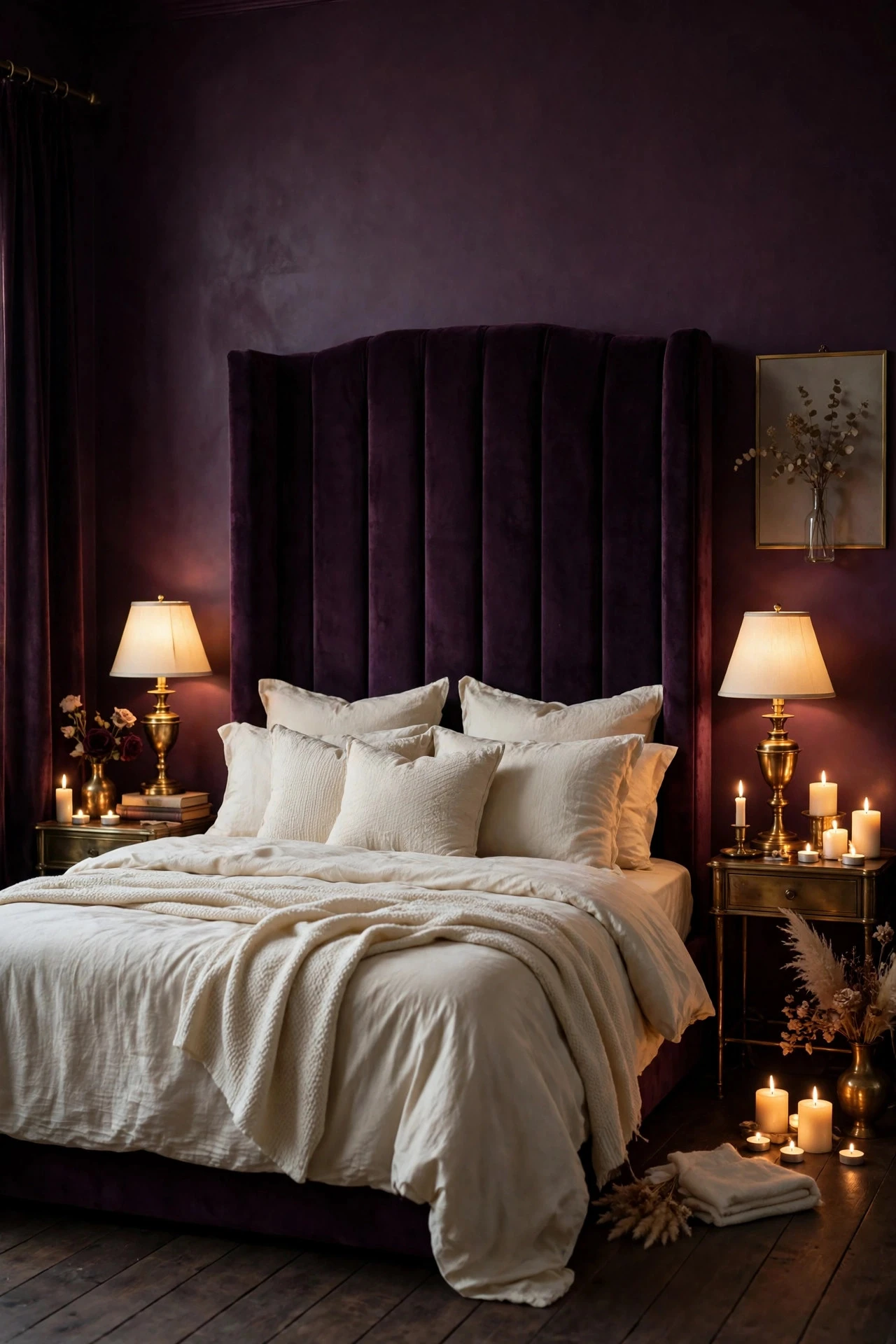
How to Style a Dark Feminine Bedroom That Feels Romantic, Not Gloomy
A dark feminine bedroom is not a black bedroom with a pink cushion thrown in. Done well, it feels like a candlelit hotel suite: deep plum or forest walls, a velvet headboard, brass that catches the lamplight, and soft bedding you actually want to climb into. Done badly, it feels like a cave — flat, cold and hard to wake up in. The difference is light, texture and restraint.
This guide gives you the romantic version, with real paint colours, real measurements and honest budgets. Every idea works at more than one price point, and the renter-friendly options at the end mean you can get the look without touching a paintbrush. Start with the wall colour, then add one layer at a time — velvet, gold, light — and stop before the room gets crowded.
Looking for more inspiration? Our Nest Decorz homepage gathers the latest home decor ideas, seasonal decorating guides and room-by-room styling tips in one place — start there and explore.
Quick answers
– Start with one deep wall colour: plum, forest, charcoal, burgundy or navy — never two dark colours fighting on every wall. – Light is the whole trick: three warm layers at 2700K, plus candles, so dark walls glow instead of closing in. – Velvet does the heavy lifting: a velvet headboard, drapes or throw gives the room its soft, romantic feel. – Gold in small doses: brass handles, a mirror frame and a lamp base are enough — a whole gold room tips into gaudy. – Budget honestly: a textile-and-light refresh runs $250–$600, a paint-and-headboard makeover $800–$1,800, and a full furniture reset starts around $2,500–$5,000.
1. Which Wall Colour Starts a Dark Feminine Bedroom?

Start with plum, because it is the most forgiving dark feminine colour: warm, romantic and flattering to skin tones in lamplight, where a cold grey can turn sallow. Paint the wall behind the bed in Farrow & Ball Brinjal No. 222 or Benjamin Moore Black Raspberry 2072-20, and keep the other three walls in a warm off-white such as Farrow & Ball Wimborne White No. 239 so the room still breathes.
Test the colour at night, not just in daylight: paint a swatch at least 2 x 2 ft and look at it under your lamps at 9 pm. A matt finish suits dark walls best. Budget $60–$120 for a gallon of good paint and a weekend. Avoid painting all four walls plum in a small, north-facing room; one deep wall plus pale companions gives you the romance without the cave.
2. How Do You Use Forest Green Without It Feeling Cold?

Use forest green as a jewel tone, not a woodland one, and warm it up with brass, cream and blush so it reads romantic rather than rustic. Paint the bed wall in Farrow & Ball Studio Green No. 93 or Sherwin-Williams Rookwood Dark Green SW 2816, then add a cream linen throw, blush velvet cushions and a brass lamp — the warm metals and soft pinks stop the green from feeling chilly.
Forest green suits rooms with warm artificial light best, because 2700K bulbs pull out its yellow undertones. If your room faces north and gets little sun, keep the green to one wall and choose pale bedding so the bed glows against it. A painted wall costs $60–$150 in paint; add $80–$200 for brass-look hardware or a lamp to warm it up. Avoid pairing forest green with grey bedding and silver — that combination turns the whole room cold and flat.
3. Is Charcoal or Navy Better for a Dark Feminine Bedroom?

Charcoal is softer and more modern; navy is richer and more classic, and the right choice depends on your light and your furniture. Charcoal walls in Benjamin Moore Kendall Charcoal HC-166 or Farrow & Ball Down Pipe No. 26 suit pale timber, blush pink and chrome, while navy in Farrow & Ball Hague Blue No. 30 or Benjamin Moore Hale Navy HC-154 suits brass, cream and dark timber best.
In a small bedroom, charcoal is usually the safer pick because it reads as a warm neutral, so it forgives a mismatched cushion or a pale rug. Navy makes a bigger statement and needs its companions chosen deliberately — cream bedding, brass light fittings, one blush accent. Whichever you choose, paint one wall first and live with it for a week. Avoid painting the ceiling the same dark colour in a room under 8 ft high; it lowers the ceiling visually and makes mornings feel heavy.
4. How Do You Use Burgundy as an Accent Without Overwhelming the Room?

Use burgundy as the accent, not the base, and give it one clear job: the bedding, the drapes or a single upholstered chair, never all three at full strength. A burgundy velvet throw or a pair of burgundy cushions against plum or charcoal walls adds depth and warmth.
The easiest burgundy entry point is textiles. Try a burgundy velvet cushion pair ($40–$80), a throw in a deep wine tone ($50–$100), or burgundy drapes if the room is large enough to carry them. If you love the colour enough to paint with it, keep it to the bed wall in Farrow & Ball Eating Room Red No. 43 or Benjamin Moore Merlot 2007-10, with cream bedding to break it up. For a full burgundy scheme done properly, see how to style a burgundy and green bedroom that looks rich all year. Avoid burgundy carpet or a burgundy rug under a burgundy bed — the floor disappears and the room loses its footing.
5. What Makes a Velvet Headboard the Centrepiece of the Room?
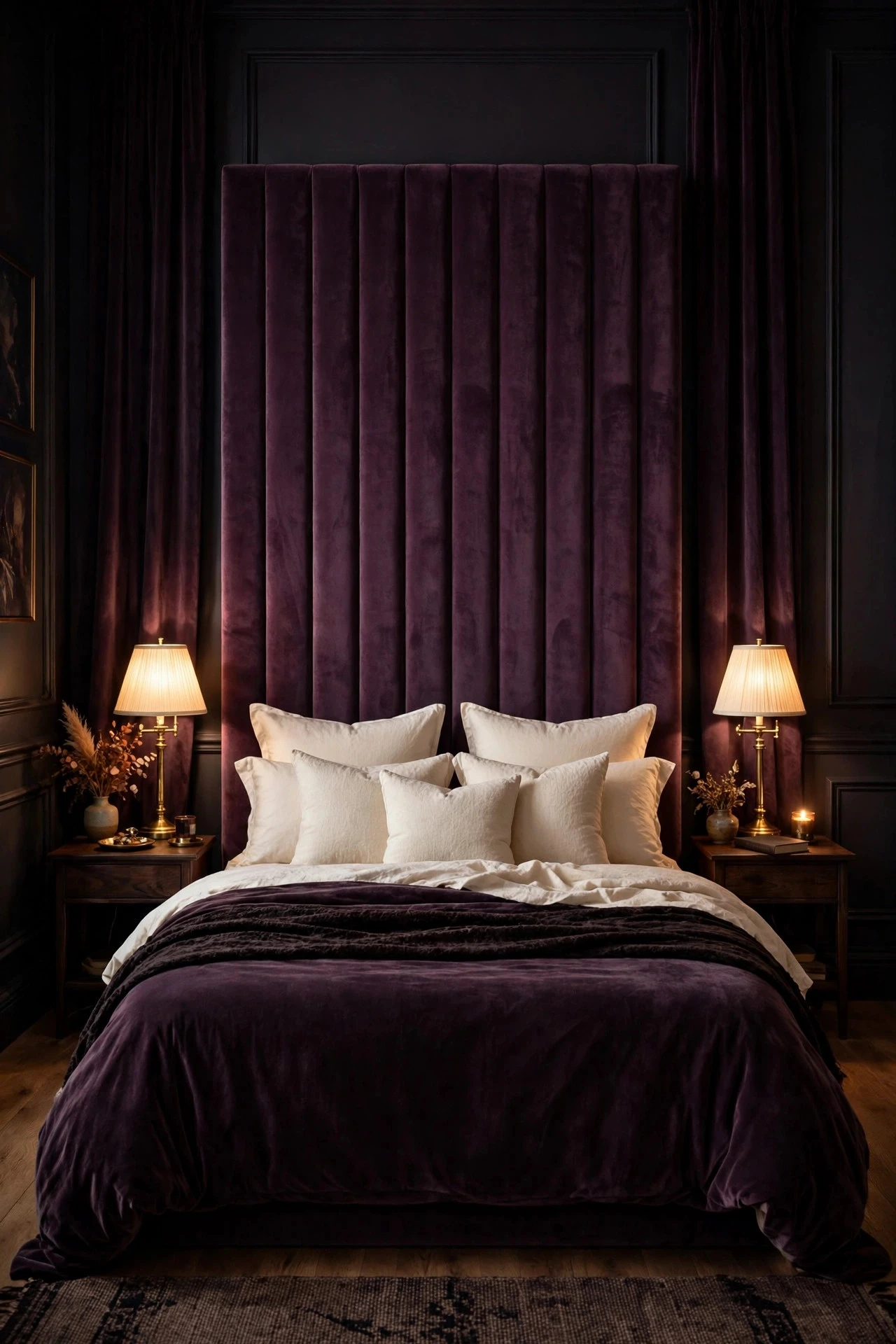
A velvet headboard makes the room because it is the one piece you touch every night and see from the door: it sets the height, the colour and the softness of the whole bed wall. Choose a tall headboard, 48 to 60 inches high, in plum, forest or charcoal velvet, with a simple shape — a tall rectangle, a gentle arch or a channel-tufted panel — and let it rise above the pillows.
Size it to the bed: a queen headboard should be 60 to 64 inches wide, a king 76 to 80 inches, so it frames the mattress rather than disappearing behind it. Budget $300–$900 for a good upholstered headboard, or $120–$250 for a slipcovered version over a basic frame. For shapes, heights and fabrics that suit a dark room, browse these bedroom headboard ideas. Avoid a short headboard that the pillows hide completely, and avoid crushed velvet with a shiny pattern — it photographs well and looks tired in person within a year.
6. How Do You Layer Bedding So a Dark Bedroom Feels Soft, Not Heavy?

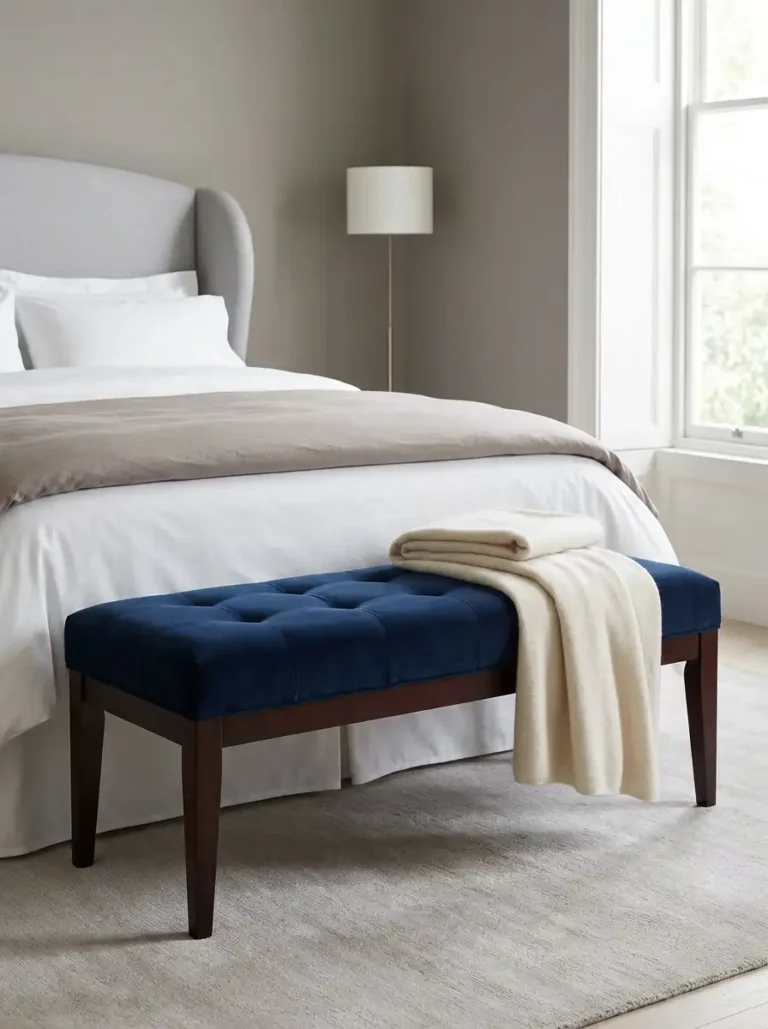
Layer bedding in three tones, not three darks: a pale or cream base, a mid-tone cover, and a dark accent, so the bed glows against the wall instead of blending into it. Start with cream or ivory sheets, add a duvet in dusty rose, soft sage or pale grey, then finish with a velvet throw in plum or burgundy folded across the foot and two velvet cushions in front of the sleeping pillows.
Mix linen sheets, a velvet duvet cover and a faux-fur throw, so the bed invites touch even in dim light. Keep the sleeping pillows cream and the decorative cushions dark. Budget $150–$400 for a full bedding refresh. Avoid an all-black bed set on a dark wall; without a pale layer the bed vanishes, and the room loses its focal point.
7. Where Does Dark Floral Wallpaper Work Best in a Bedroom?
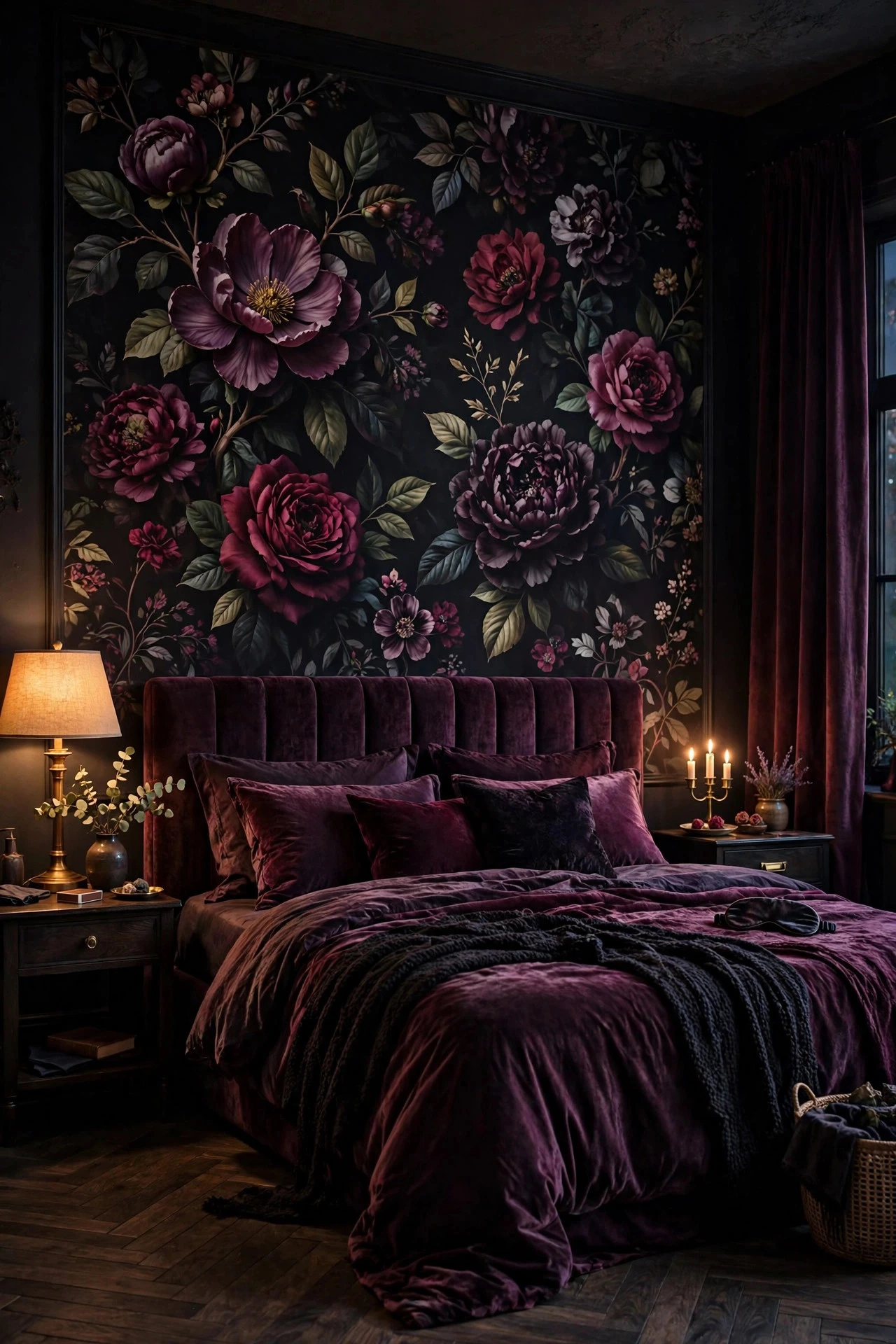
Dark floral wallpaper works best on one wall — the bed wall — where the pattern frames the headboard like art and the rest of the room stays calm enough to let it breathe. Choose a large-scale floral in plum, burgundy or forest on a near-black ground, with the flowers big enough to read from the door, and hang it behind the bed so the headboard sits against the busiest part of the pattern.
Measure the wall before ordering: a standard roll covers about 56 sq ft, and a large-scale pattern needs extra for matching, so order 10 to 15 percent more than the wall area. Peel-and-stick versions cost $60–$150 per roll and suit renters, while pasted paper runs $80–$200 per roll plus paste. For placement, pattern scale and pairing ideas, see these bedroom accent wall ideas. Avoid wallpapering all four walls in a busy dark floral — the pattern closes in, the room feels smaller, and you will tire of it within a year.
8. How Do You Add Gold and Brass Without Tipping Into Gaudy?

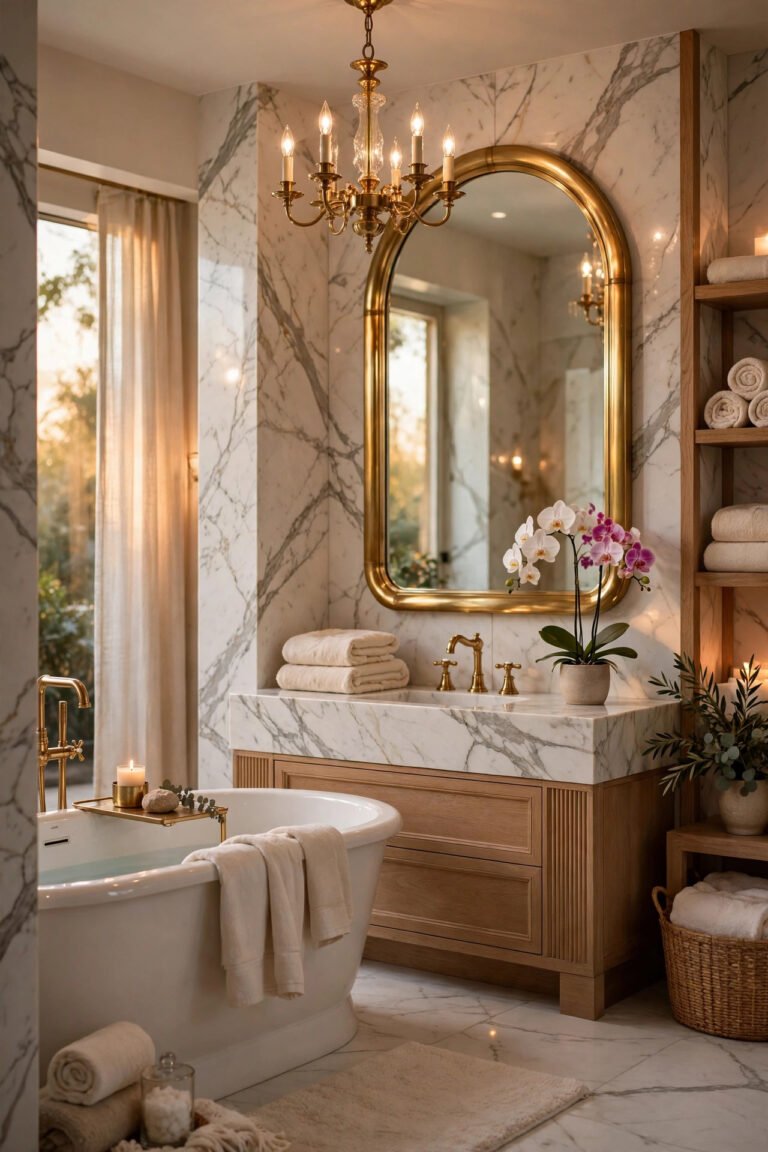
Add gold and brass in small, repeated touches — a mirror frame, a lamp base, drawer pulls and a tray — and keep the finish consistent so it reads as a deliberate thread, not a lucky dip. Warm brass suits plum, forest and burgundy walls best; choose brushed or antique brass rather than shiny polished gold, because the softer finish glows in lamplight instead of glaring.
Repeat the metal at least three times — the bedside lamp, the mirror frame and the curtain rod — so the eye connects them. Budget $80–$250 for a brass table lamp and $100–$300 for a gilt mirror. Avoid gold bedding, gold curtains and a gold headboard together; one gold textile is the limit, and the rest of the gold should be hard surfaces that catch the light.
9. Which Ornate Mirror Makes a Dark Bedroom Feel Bigger?

An ornate mirror makes a dark bedroom feel bigger when it is large, placed opposite or beside a light source, and framed in gilt or dark timber so it reads as art as well as glass. Choose a mirror at least 36 inches wide and 48 inches tall for a wall mirror, or a full-length arched mirror 60 to 72 inches tall leaning against the wall, and hang it where it reflects a lamp or a window, not a blank wall.
A gilt rococo frame adds romance, a dark walnut frame adds drama. Hang the centre of a wall mirror at 57 to 60 inches from the floor. Budget $150–$500 for a good ornate mirror, less second-hand. Avoid a mirror directly opposite the bed if it disturbs your sleep, and avoid a small mirror on a large dark wall — it looks lost and highlights the empty space around it.
10. How Do You Layer Candlelight and Warm Lighting in a Dark Room?
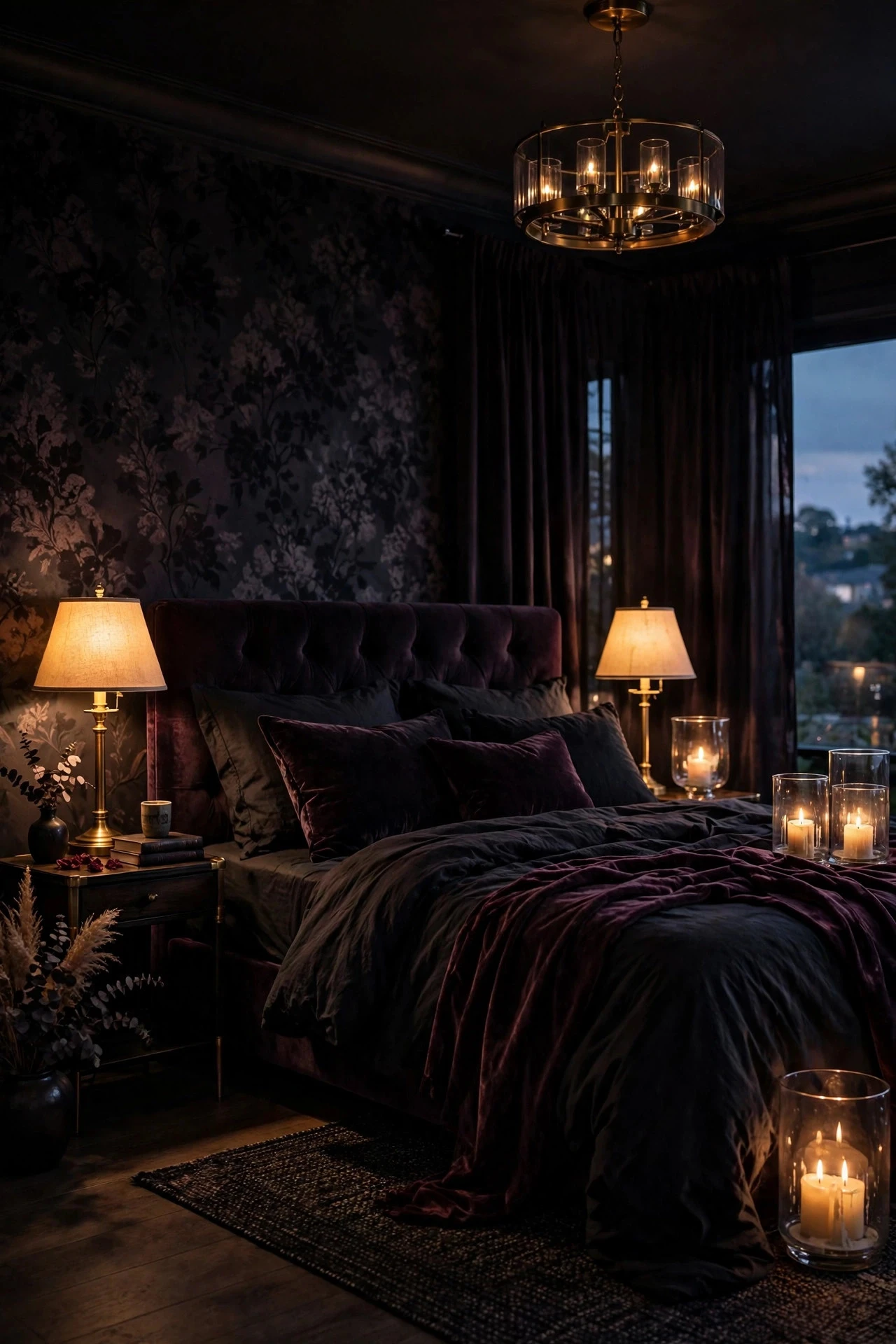
Layer candlelight and warm lighting in three heights — a dimmable ceiling or pendant light, bedside lamps at shoulder height, and candles or fairy lights at low level — all at 2700K, so the dark walls glow instead of swallowing the light. Start with two bedside lamps with warm bulbs and fabric shades, add a dimmer to the ceiling light, then finish with real candles in glass hurricanes or LED pillar candles on the dressing table and windowsill.
Candles need safe placement: on a stable tray, away from drapes and bedding, and never left burning unattended. LED pillar candles with a flicker setting give the same glow in a bedroom where real flames feel risky, and they cost $20–$50 for a set of three. For fitting types, placement heights and dimmer advice, see these bedroom lighting ideas. Avoid cool white bulbs at 4000K or above — they turn plum walls grey, make velvet look dusty, and undo the entire romantic mood in one switch.
11. Why Do Velvet Drapes Change a Dark Feminine Bedroom So Much?
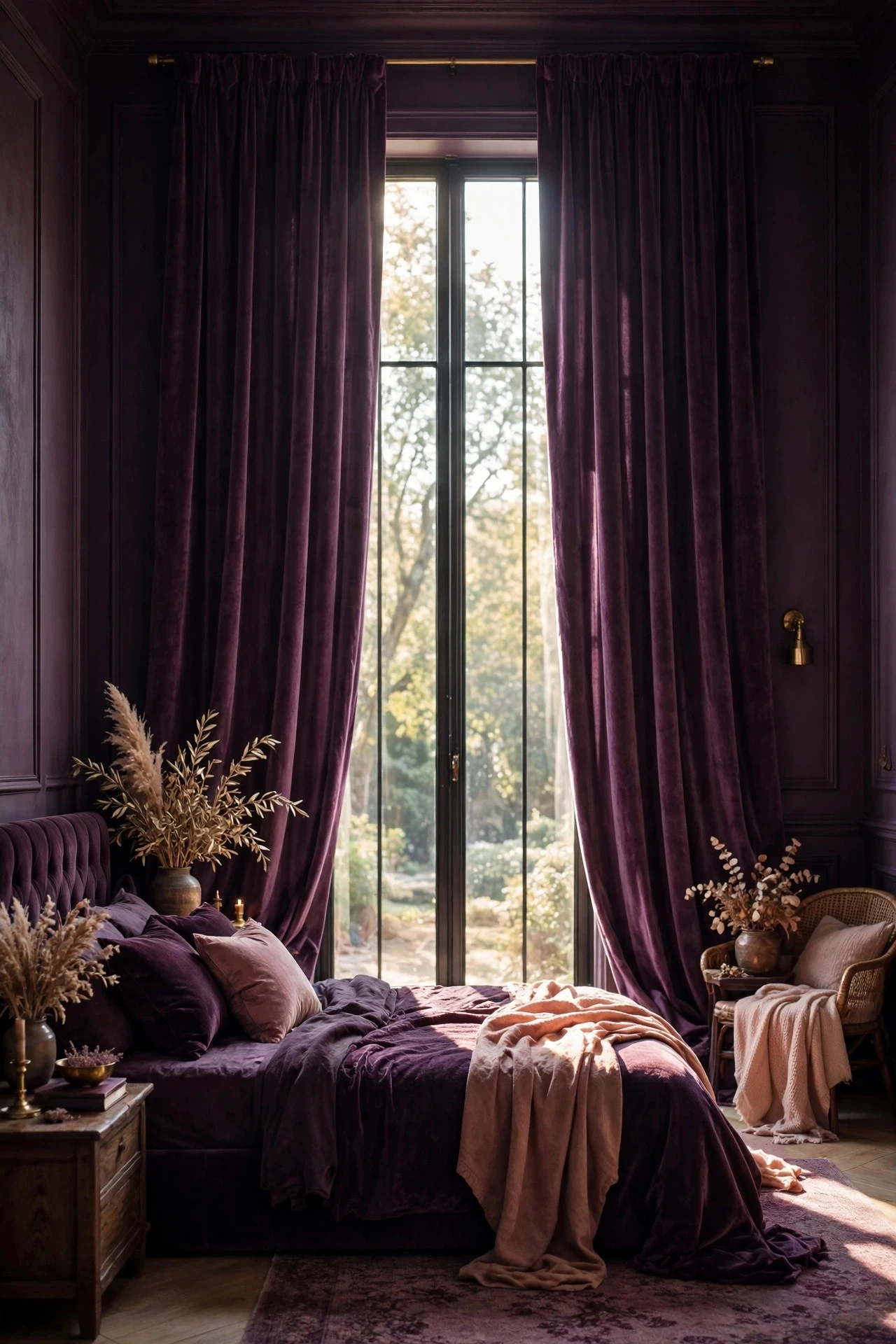
Velvet drapes change the room because they are the largest textile in it after the bedding: they frame the window, absorb sound, block morning light, and add the deep colour and soft fall that makes a dark room feel luxurious rather than bare. Hang them high and wide — the rod 4 to 6 inches above the window and 8 to 12 inches beyond the frame on each side — so the window looks taller and the drapes stack on the wall, not over the glass.
Choose floor-length drapes that just kiss the floor, in plum, forest or charcoal velvet, or soft blush to lighten the room. Line them in blackout fabric if you sleep late. Budget $150–$500 per pair. Avoid short drapes that stop at the sill — they chop the wall in half and make the window look small — and avoid sheer curtains alone, which disappear against a dark wall at night.
12. Does a Crystal Chandelier Suit a Small Dark Bedroom?

A crystal chandelier suits a small dark bedroom when it is scaled to the room and hung at the right height — small and low, not grand and high. Choose a chandelier 18 to 24 inches wide for a bedroom under 12 x 12 ft, hang it so its lowest point sits at least 7 ft from the floor, and put it on a dimmer so it can glow softly in the evening rather than blaze.
A small empire or flush-mount crystal fitting costs $150–$500; a larger statement piece runs $500–$1,200. If the ceiling is under 8 ft, choose a semi-flush fitting that sits close to the ceiling rather than a long drop. Avoid a chandelier wider than the bed, a fitting hung so low you can touch it, and cool white bulbs — crystal under cool light looks like an office, not a boudoir.
13. How Do You Style an Antique Vanity in a Dark Bedroom?
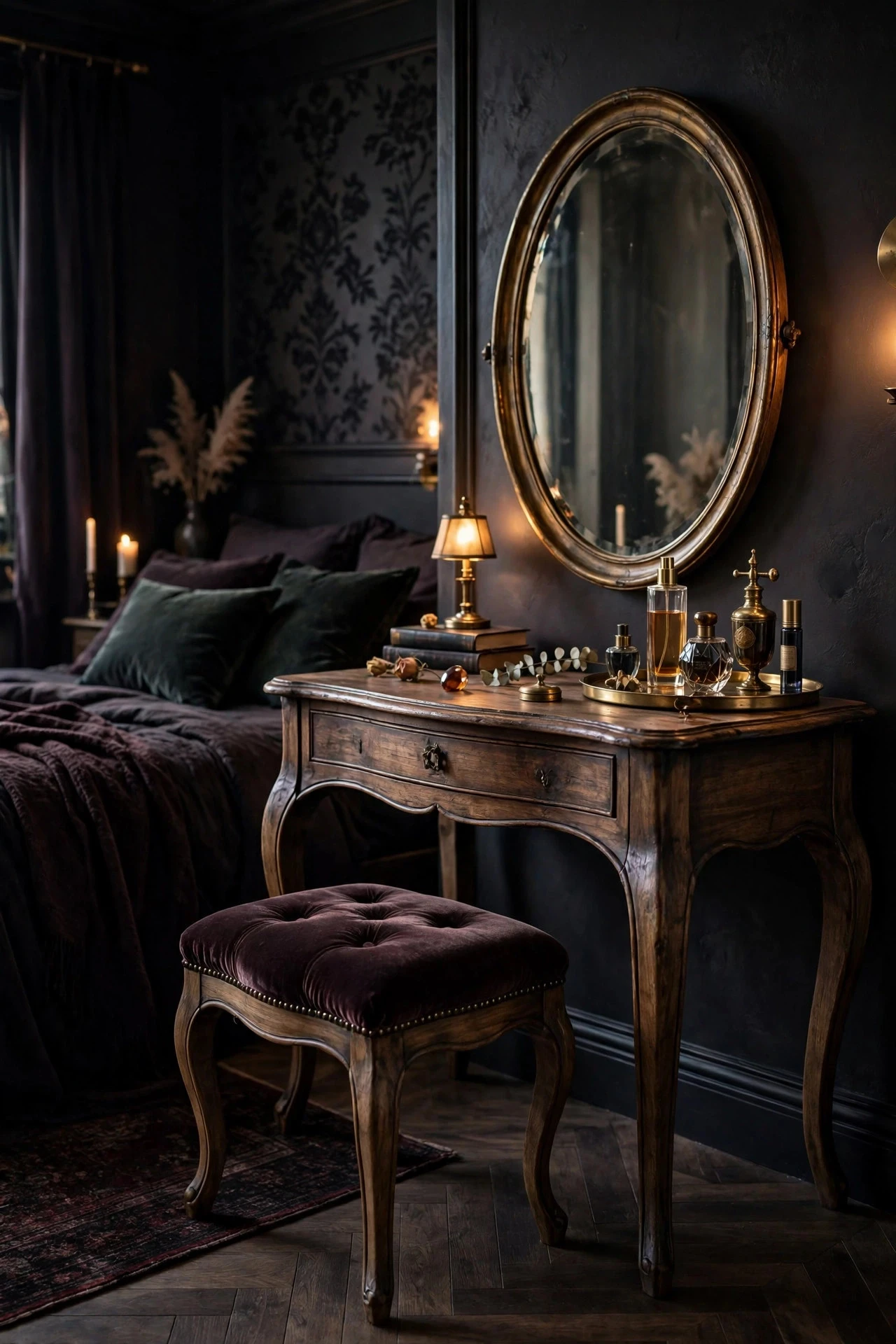
Style an antique vanity as a small dressing ritual, not as extra storage: a mirror, one lamp or pair of candles, a tray for perfume and jewellery, and a stool that tucks underneath. Place it against a side wall where morning light reaches it, or beside the window, and keep the top mostly clear — a vanity crowded with bottles reads as clutter, while three deliberate objects read as romance.
Look for curved legs, a marble or timber top, and a mirror that matches its era. Budget $200–$700 second-hand for a solid timber vanity with a mirror, plus $40–$100 for a velvet stool. If the room doubles as a guest room, the same vanity becomes the feature guests remember — for more guest-room thinking, see these guest bedroom ideas. Avoid a vanity with less than 30 inches of clearance in front of it, and avoid storing everyday clutter on it; the top should stay styled.
14. Is a Four-Poster Bed Worth It in a Dark Feminine Bedroom?
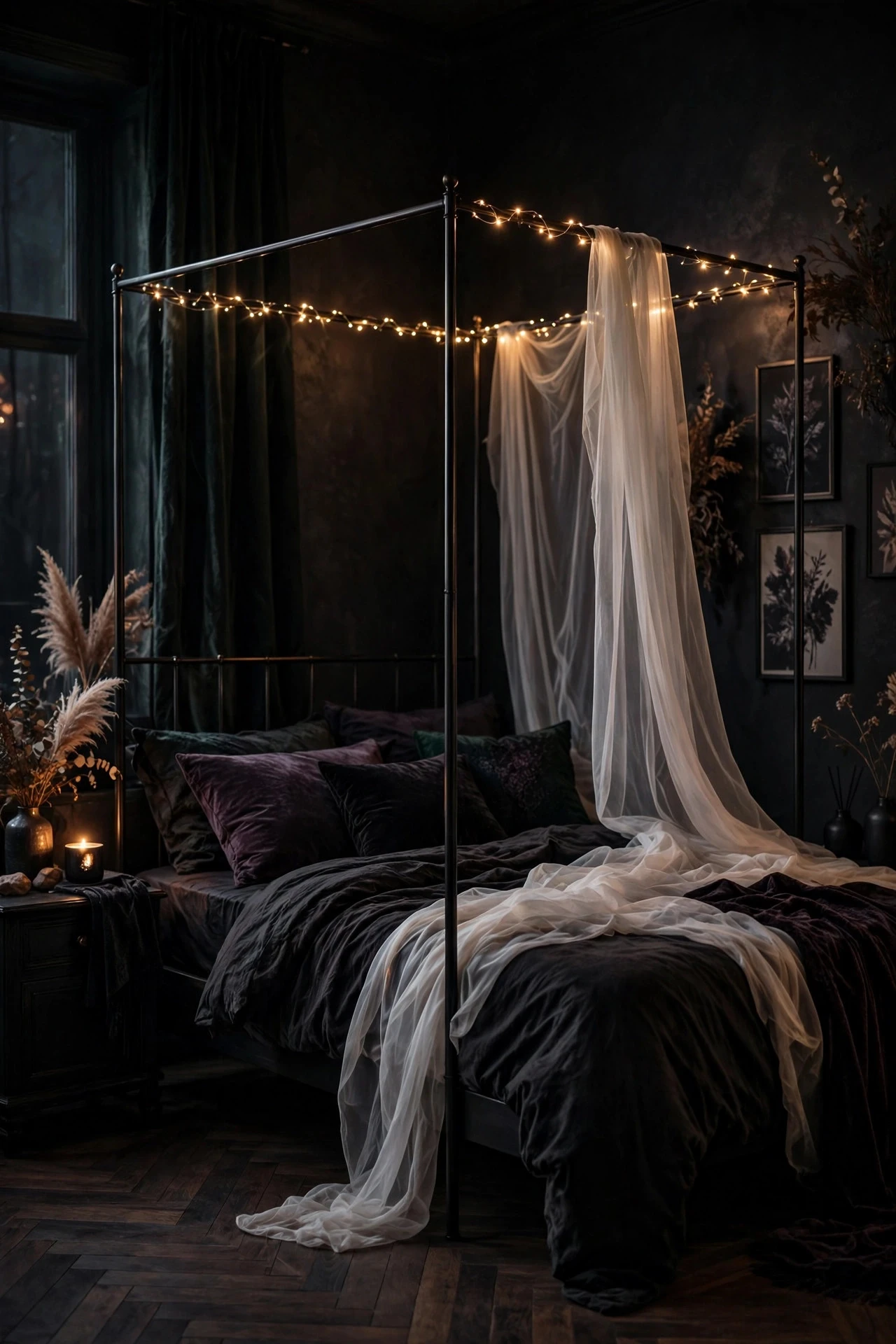
A four-poster bed is worth it when the room is large enough to carry it and the posts are slim, because it gives a dark bedroom its architecture — height, framing and a place to drape sheer fabric or fairy lights. Choose slim turned-wood or black metal posts rather than heavy carved ones, and keep the canopy open or draped with a single sheer panel so the bed feels romantic, not enclosed.
Measure first: a four-poster needs at least 24 inches of clearance on three sides and a ceiling of 8 ft or more, or the posts will crowd the room. A queen four-poster costs $800–$2,000; a king $1,200–$3,000. Drape a sheer voile over one side only, or hang a small string of warm fairy lights along the top rail for evening glow. Avoid a heavy canopy with dark drapes all round in a small room — it turns the bed into a tent and blocks the light you worked so hard to layer.
15. How Do You Use Dried Flowers in a Dark Feminine Bedroom?
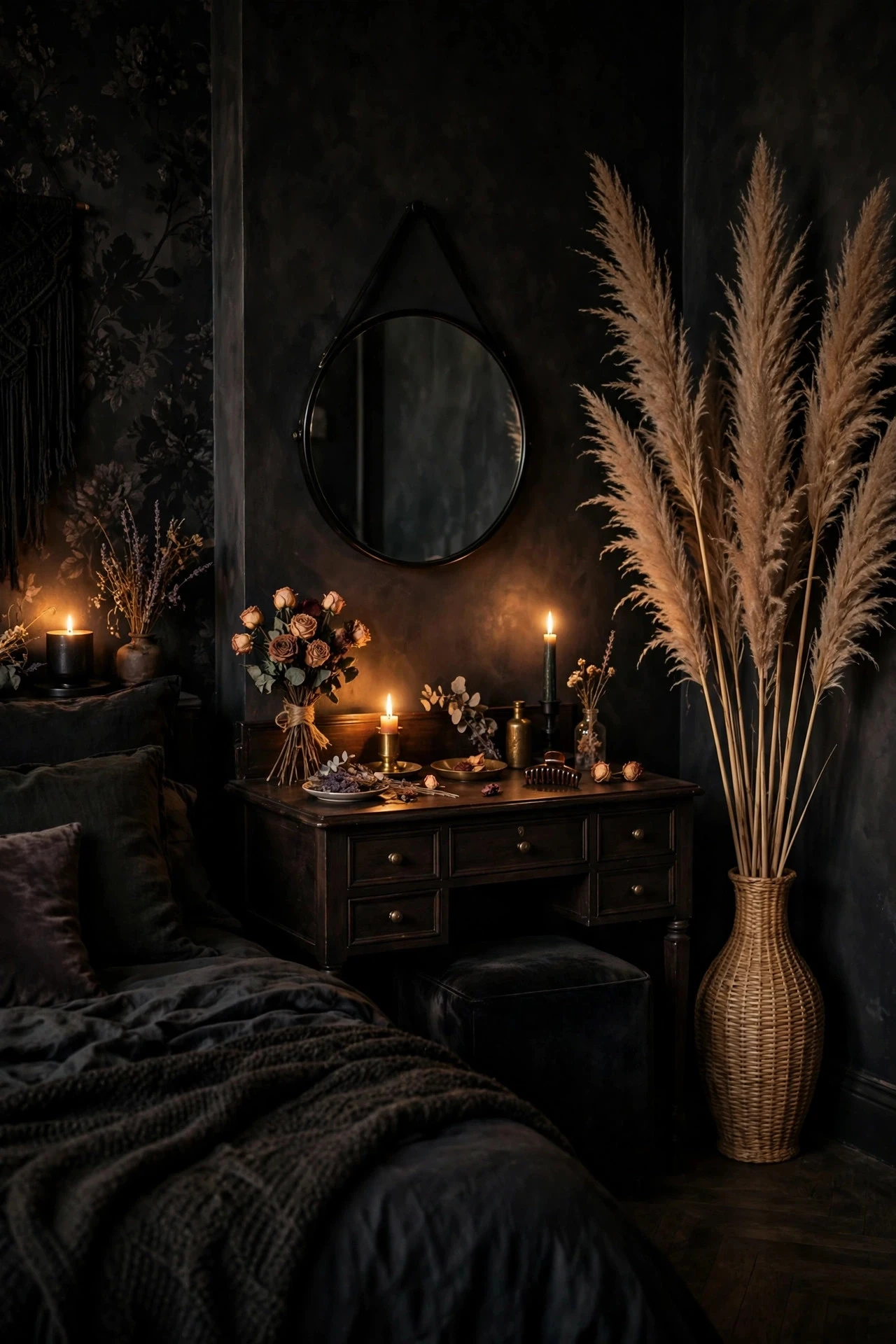
Use dried flowers as a low, sculptural accent — a tall vase of pampas grass in a corner, a small posy of dried roses on the vanity, or a wreath above the bed — and let their muted, dusty tones soften the dark walls without competing with them. Dried flowers suit a dark feminine room because they do not need water, they last for months, and their faded pinks, creams and rusts echo the velvet and brass already in the room.
Choose one large arrangement and one small one, not five scattered bunches. A tall ceramic or brass vase, 18 to 24 inches high, with pampas or dried eucalyptus costs $40–$100 all in; a small vanity posy runs $20–$40. Keep them out of direct sun so they do not fade to grey. Avoid dyed flowers in bright, unnatural colours — hot pink or electric blue clash with plum and burgundy — and avoid an arrangement that sheds constantly onto the bedding.
16. How Do You Hang Dark Art and a Gallery Wall in a Dark Bedroom?
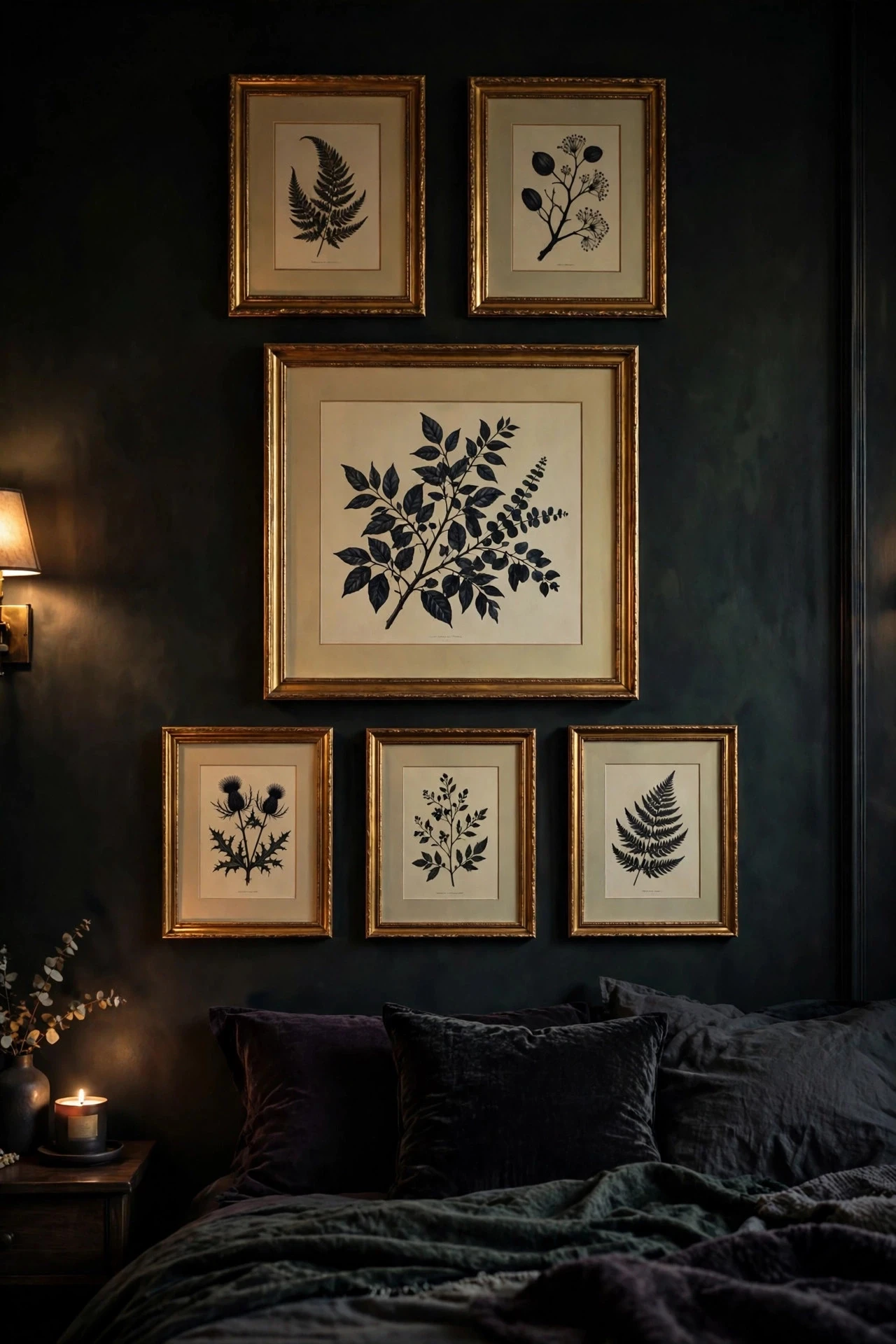
Hang dark art as one calm composition, not a scattered collection, and let the frames do the work: gilt, dark timber or black frames with pale mats, so each picture reads clearly against the wall. Keep 2 to 3 inches of consistent spacing and anchor it with one large piece — a 24 x 36 inch print — at eye level.
Choose art with a romantic thread — botanical prints, vintage portraits or soft landscapes — with a shared colour, plum, blush or gold, running through them. A 5 x 7 ft wall suits six to nine frames. Budget $100–$300 for frames and prints. House Beautiful's dark bedroom ideas show the same rule: pale mats and warm frames keep dark art legible on dark walls. Avoid a gallery of tiny frames spread across a large wall — they read as clutter — and avoid art with no shared colour, which looks accidental rather than collected.
17. What Are the Best Renter-Friendly Ways to Get a Dark Feminine Bedroom Without Paint?
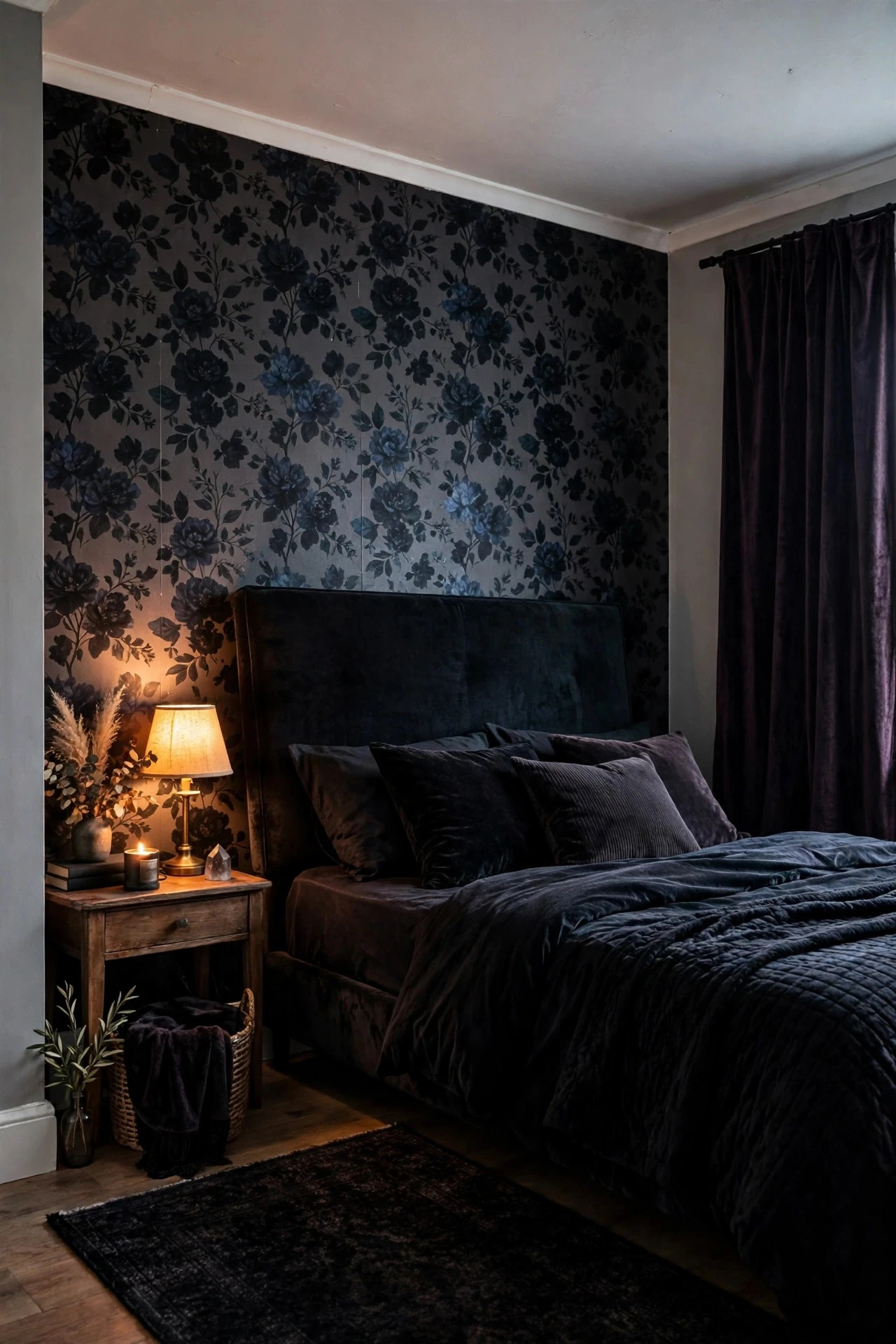
The best renter-friendly route is textiles and removable surfaces: peel-and-stick wallpaper on the bed wall, velvet drapes, dark bedding and a large dark rug, all of which come down cleanly when you move. Start with the highest-impact reversible change — a dark velvet headboard cover or a tall upholstered headboard that leans against the wall — then add peel-and-stick wallpaper in a dark floral behind it for the painted-wall effect.
Removable wallpaper costs $60–$150 per roll and works best on smooth, clean walls; test a small piece first. Add a dark rug ($100–$300) and velvet drapes ($150–$400), and the room reads dark and romantic with no paint at all. Photograph everything before you change it. Avoid drilling into tile, sticking adhesive to textured walls, or painting without written permission — it will lift the finish and cost more than the change was worth.
18. How Do You Style a Small Dark Feminine Bedroom Without Shrinking It?

Style a small dark bedroom by keeping the floor visible, the furniture slim and the dark colour to one wall. Choose a bed with slim legs and no bulky footboard, a rug that leaves 6 to 12 inches of floor showing around its edges, and a single dark wall behind the bed with the other walls in warm white.
Use the walls, not the floor: a wall-mounted shelf and a tall narrow mirror add storage and light without eating floor space. Keep the bedside tables small — 16 to 18 inches wide. A lighter, more playful take on a small bedroom can still feel grown-up; see how to style a whimsical bedroom that feels grown-up, not childish for the balance between personality and polish. Avoid a four-poster, a dark rug wall to wall and more than one oversized piece — in a small dark room, one statement is plenty and two is a crowd.
19. What Does a Dark Feminine Bedroom Cost at Three Budgets?
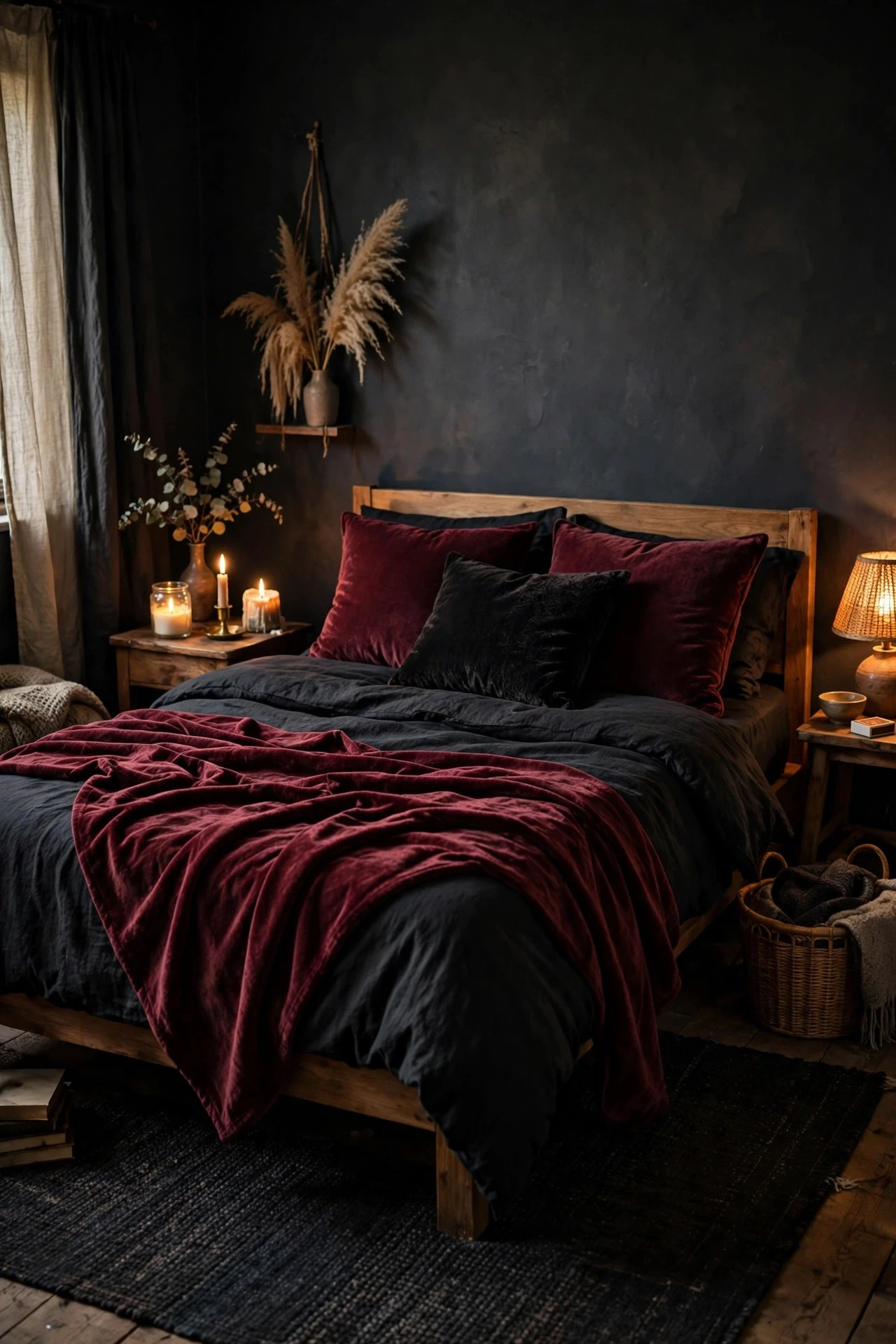
A dark feminine bedroom costs $250–$600 at the refresh level, $800–$1,800 at the makeover level, and $2,500–$5,000 at the full-reset level, and the honest difference is how much furniture changes. At $250–$600 you repaint nothing: new bedding, velvet cushions and a throw, two lampshades, candles and a rug make the room. That is the fastest route to the look, and it works in a rental.
At $800–$1,800 you add paint on one wall, a velvet headboard and velvet drapes, plus a gilt mirror. At $2,500–$5,000 you replace the bed, the vanity and the lighting. Spend in the right order: light first, then the headboard, then textiles, then furniture. Avoid spending the whole budget on one trendy object; a single statement piece in an unchanged room looks like exactly what it is, while five small changes look like a new room.
20. How Do You Keep a Dark Bedroom From Feeling Like a Cave?

Keep a dark bedroom from feeling like a cave by giving it light, reflection and pale contrast in equal measure: three warm light layers, at least one large mirror, and pale bedding, pale curtains or a pale rug to break up the dark. The rule is simple — for every dark surface, give the eye a pale or reflective one nearby, so the room has somewhere to rest.
Open the drapes fully during the day and use sheer panels behind the velvet so daylight still filters in. Keep the ceiling and trim in warm white, because a pale ceiling lifts the room. Add a plant — a trailing pothos or a small olive tree — for a living green note. The Spruce's advice on decorating with dark colours makes the same point: dark rooms need contrast and warm light, not more dark. Avoid dark ceilings in low rooms, dark bedding on dark walls, and closed drapes all day.
21. How Do You Mix Velvet, Silk and Lace Without the Room Feeling Fussy?

Mix velvet, silk and lace by giving each fabric one job and keeping the palette to three colours, so the textures do the talking instead of the pattern. Let velvet carry the weight — the headboard, the drapes, one throw — let silk carry the shine — a cushion cover or a runner on the vanity — and let lace carry the detail — a single pillowcase trim, a lampshade edge or a small table runner, never a full lace bed set.
Keep the colours tight: plum, cream and gold, with the lace in cream and the silk in soft blush. Budget $60–$150 for a silk cushion pair and $30–$60 for lace-trimmed pillowcases. Avoid mixing three patterns at once, and avoid a lace bedspread over velvet drapes over a silk headboard — one fussy layer is charm, three is a theme park.
22. How Do You Finish a Dark Feminine Bedroom So It Feels Romantic Every Night?
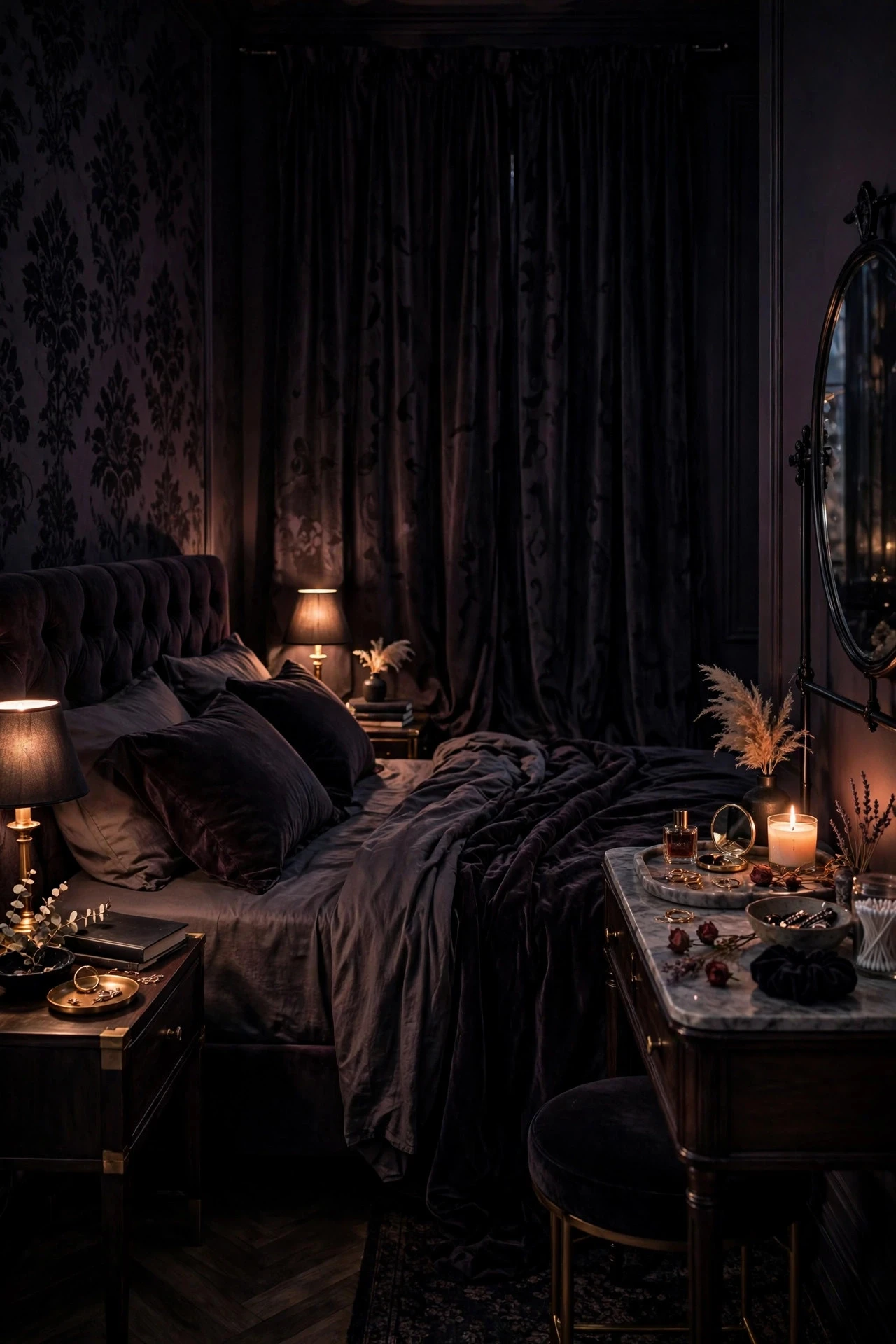
Finish the room with the small evening rituals that make it feel romantic after dark: lamps on dimmers, candles lit, the bed turned down, and one scent — a candle, a linen spray or a small diffuser — that the room always carries. The finish is not another object; it is the moment the room shifts from daytime bedroom to evening retreat, and it should take two minutes, not a redecoration.
Set the scene the same way each night: draw the velvet drapes, switch the ceiling light off and the bedside lamps on low, and light one candle on the vanity tray. Keep a small tray on the bedside table for a book and a glass of water, so the surface stays calm. Avoid adding more decor at this stage; a finished dark bedroom needs editing, not shopping, and the romance is in the light, not the objects.
Practical tips for a dark feminine bedroom
Test the wall colour at night. Paint a 2 x 2 ft swatch and look at it under your lamps at 9 pm. Dark colours change completely between daylight and lamplight, and the evening view is the one you will live with.
Light it warm and low. Keep every bulb at 2700K, put the main lights on dimmers, and make sure at least one lamp sits at bedside height. A dark room lit from above only will always feel like a cave.
Give every dark surface a pale partner. Pale bedding against a plum wall, a cream rug on a dark floor, a gilt mirror on a charcoal wall — contrast is what keeps the room romantic instead of heavy.
Repeat brass three times. A lamp, a mirror frame and a curtain rod in the same warm brass finish tie the room together. One brass object looks random; three look deliberate.
Edit before you add. Remove one thing from every surface before buying anything new. Most dark bedrooms are not under-decorated; they are over-filled, and the fix is subtraction.
Final thoughts
A dark feminine bedroom is not about darkness for its own sake. It is about a plum wall that glows in lamplight, a velvet headboard you lean into, brass that catches the flame of a candle, and a bed dressed in cream and rose. Start with one deep colour, layer the light, and let the textures do the rest — the romance will follow.
Frequently Asked Questions
What is the best wall colour for a dark feminine bedroom?
Plum is the most forgiving starting colour: warm, romantic and flattering in lamplight. Try Farrow & Ball Brinjal No. 222 or Benjamin Moore Black Raspberry 2072-20 on the bed wall, with the other walls in warm white. Forest, charcoal, burgundy and navy work too.
Will a dark bedroom make my small bedroom feel smaller?
Not if you keep the dark colour to one wall and give the room pale contrast and warm light. Use pale bedding, a pale rug edge and a large mirror, keep the ceiling white, and choose slim furniture with visible legs. It feels intimate, not cramped.
Can renters create a dark feminine bedroom without painting?
Yes. Use peel-and-stick wallpaper on the bed wall, velvet drapes, dark bedding and a large dark rug, plus a leaning upholstered headboard. All of it comes down cleanly. Test removable wallpaper on a small area first, photograph the room before you change it, and never paint without written permission.
How do I stop a dark bedroom from feeling gloomy?
Layer three warm light sources at 2700K — ceiling, bedside and candles — add a large mirror to bounce the light, and give every dark surface a pale partner, such as cream bedding against a plum wall. Keep the ceiling white and open the drapes during the day.
What fabrics work best in a dark feminine bedroom?
Velvet does the heavy lifting: a velvet headboard, drapes or throw gives the room its soft, romantic feel. Pair it with linen sheets, a silk cushion or vanity runner for shine, and a small lace detail. Keep the palette to three colours.
How much does a dark feminine bedroom makeover cost?
A textile-and-light refresh costs $250–$600, a paint-and-headboard makeover $800–$1,800, and a full furniture reset $2,500–$5,000. Spend in the right order — light first, then the headboard, then textiles, then furniture — and start with the refresh if you are renting or unsure of the colour.