Kitchen Open Shelving Ideas: How to Style Shelves That Look Curated
Open kitchen shelving looks effortless in photographs and chaotic in real life — the difference is not taste, it is a system. A curated shelf follows a few repeatable rules about what goes where, how much empty space stays empty, and which materials can survive steam, grease and daily use. Get those rules right and your shelves look like a stylist arranged them; ignore them and the same shelves become a cluttered wall of mismatched mugs.
Looking for more inspiration? Our Nest Decorz homepage gathers the latest home decor ideas, seasonal decorating guides and room-by-room styling tips in one place — start there and explore.
Below you will find 22 kitchen open shelving ideas built around styling formulas for a real working kitchen — what to show and hide, weight rules, materials, lighting and dust — with real measurements and the mistakes to avoid, so you can style shelves once and keep them looking good.
Quick answers
– Show the pretty, hide the ugly — display matching dishes, glassware and cookbooks; keep chipped mugs, plastic containers and cleaning products behind closed doors. – Leave 20–30% of every shelf empty — negative space is what makes a shelf look curated instead of crammed. – Heavy goes low, light goes high — stack plates and bowls on the lowest shelf and keep tall, light objects up top. – Repeat three finishes and stop — one wood tone, one ceramic colour and one metal, repeated across every shelf, is what ties the whole wall together.
1. What Should You Show on Open Shelves — and What Should You Hide?
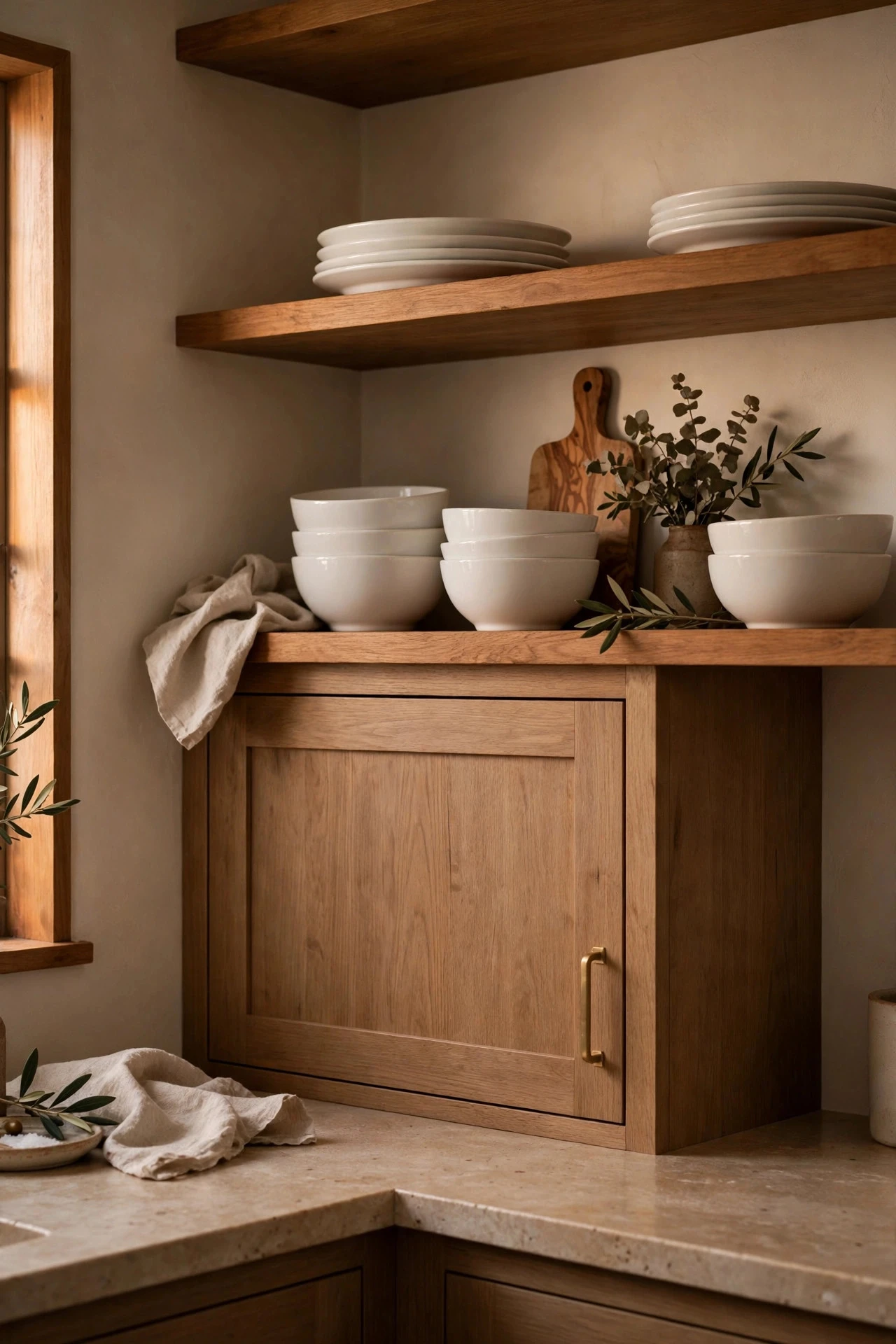
Show the things that are beautiful and used daily — matching plates, bowls, drinking glasses, a row of cookbooks and one or two decorative objects — and hide everything else behind closed doors. Open shelves work as a display for your best everyday pieces, not as overflow storage for the whole kitchen.
Start by pulling everything off the shelves and sorting it into three piles: display, use daily, and hide. The display pile is your prettiest matching sets; the daily pile is the glasses and bowls you reach for every morning; the hide pile is chipped mugs, plastic containers, cleaning sprays, odd saucepans and anything in a clashing colour. Avoid putting food packets, spice jars with torn labels or small appliances on open shelves; they read as clutter at a glance.
2. How Much Empty Space Should Open Shelves Have?
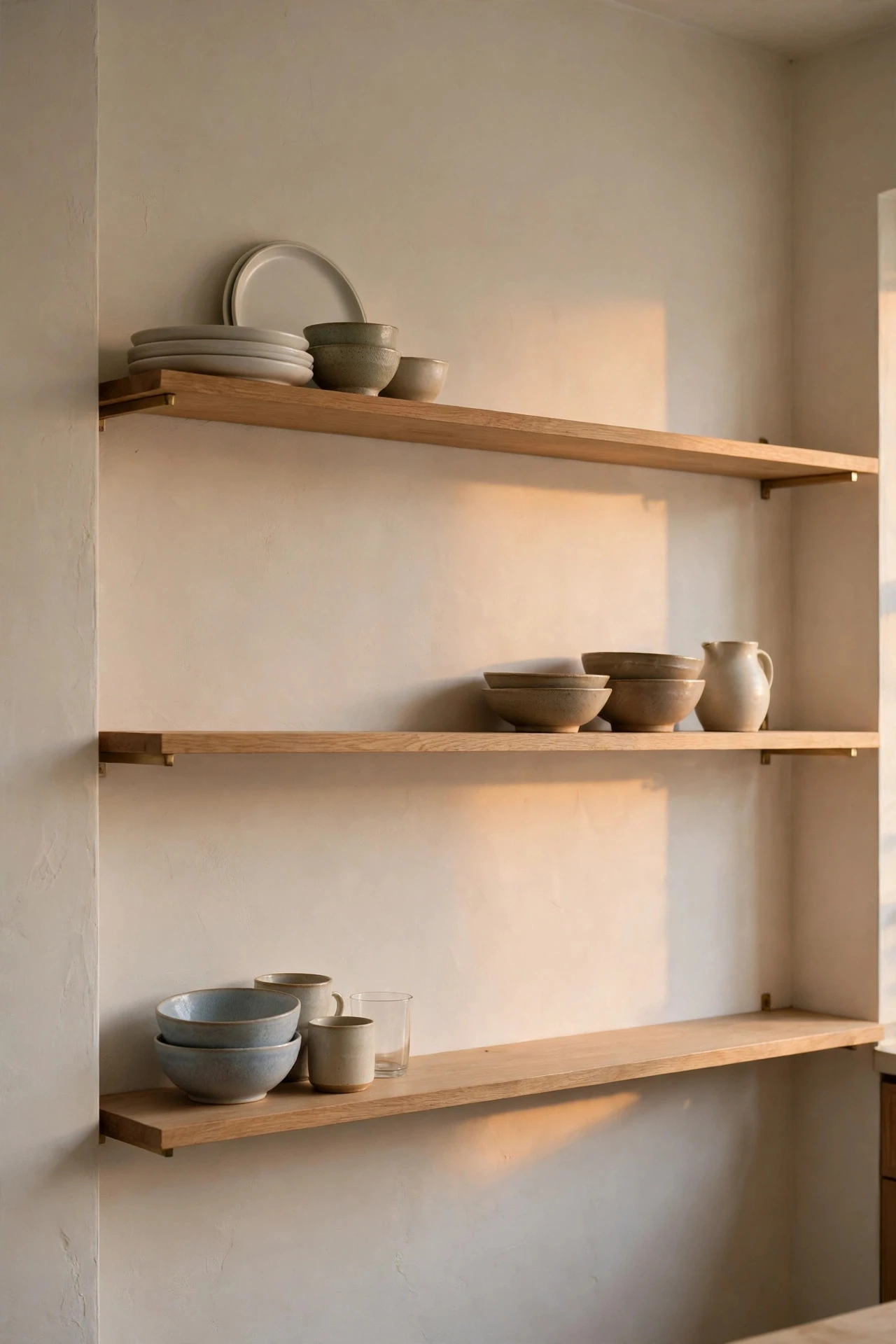
Leave 20 to 30 percent of every shelf visibly empty, because negative space is what separates a curated shelf from a crowded one. When every centimetre is filled, the eye has nowhere to rest and even beautiful objects look like clutter; a gap of empty shelf tells the viewer each group is intentional.
Measure it honestly: on a 90 cm shelf, that means roughly 18 to 27 cm of bare board in total, split into one or two gaps rather than spread as tiny slivers between objects. The easiest way to hold the rule is to style the shelf, then remove one object from every group — the shelf will almost always look better after the removal. Keep the gaps at the ends of shelves rather than the middle, so groups read as framed arrangements.
3. What Is the Height Triangle Rule for Styling Shelves?

The height triangle rule says to arrange each shelf group as a triangle: one tall object, one medium object and one short object, with heights stepping down from one side to the other. This stepped silhouette guides the eye across the shelf, and it stops groups from looking like a flat row of same-height objects.
Build each triangle from real kitchen objects: a tall vase or a stack of cookbooks standing upright as the peak, a medium stack of bowls or a ceramic jug in the middle, and a small plant or a short stack of plates at the low end. The Spruce's styling tips for kitchen shelves make the same point in different words: vary heights and leave breathing room, or the shelf flattens out.
4. How Do You Repeat Finishes So Shelves Look Curated?

Repeat three finishes across the whole shelving wall — one wood tone, one ceramic colour and one metal — and let everything else be a variation on those three. Repetition is the cheapest trick in styling: the brain reads repeated materials as a plan, even when the objects themselves are completely different.
Choose your trio before you style: warm oak with cream stoneware and brass, for example, or pale ash with white porcelain and matte black. Then check every object against the trio before it goes on a shelf — a wooden chopping board, a cream jug and a brass rail hook all belong; a red plastic container and a chrome gadget do not. Avoid introducing a fourth or fifth finish for one small object, because a single outlier breaks the pattern and draws the eye straight to itself.
5. How Much Weight Can a Floating Shelf Really Hold?

A floating shelf on a proper wall fixing holds 15 to 25 kg per 90 cm span when it is fixed into studs or solid masonry with heavy-duty brackets, but only 5 to 10 kg on plasterboard with standard fixings — so always check what is behind the wall before you load it with plates.
The safe formula is simple: heavy, dense things go low and close to the wall, light things go high and near the front edge. A stack of twelve dinner plates weighs around 6 to 8 kg, a stack of stoneware bowls about 4 kg, and a row of cookbooks roughly 5 kg per 30 cm — add it up before you style. A shelf is only as strong as its fixing, so use a stud finder, fix into timber or masonry, and never trust adhesive strips or small rawlplugs for anything heavier than a mug.
6. Should You Choose Floating or Bracketed Shelves?
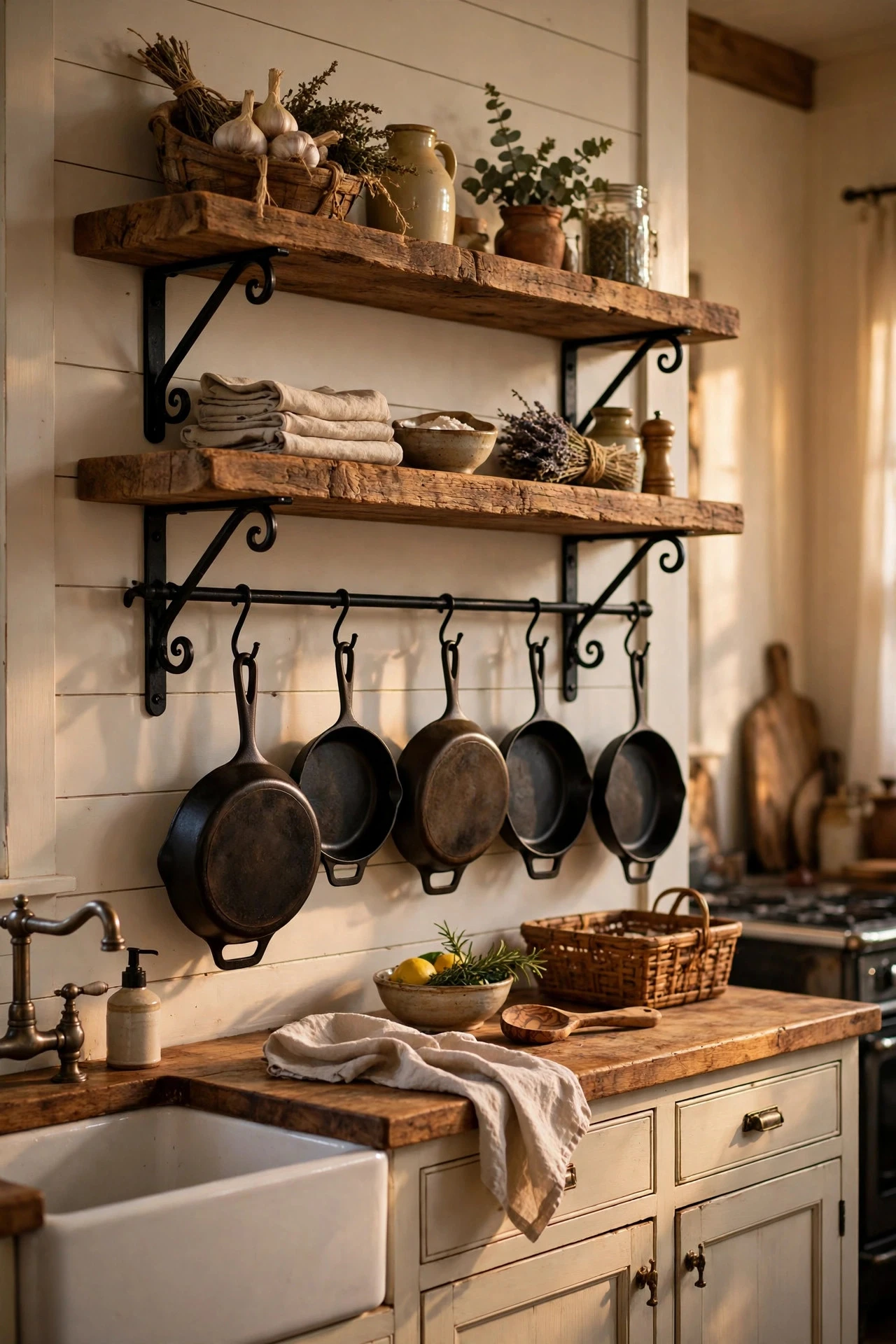
Choose floating shelves when you want a clean, modern look with nothing visible holding them up, and bracketed shelves when you need maximum strength or a farmhouse, industrial character. Floating shelves hide their fixings inside the board and look lighter on the wall; brackets show the hardware and can carry far more weight, often 30 kg or more per shelf.
Floating shelves suit short spans up to 90 cm in a modern or Scandinavian kitchen, where the invisible fixings keep the wall calm. Bracketed shelves suit longer spans, heavy cast-iron cookware and rustic styles — black iron brackets, brass brackets or chunky wooden corbels all add character of their own. Whichever you choose, fix the brackets or hidden rods level to the millimetre; a shelf that is off by even 5 mm shows up the moment you put a glass of water on it.
7. Which Shelf Material Works Best in a Kitchen?
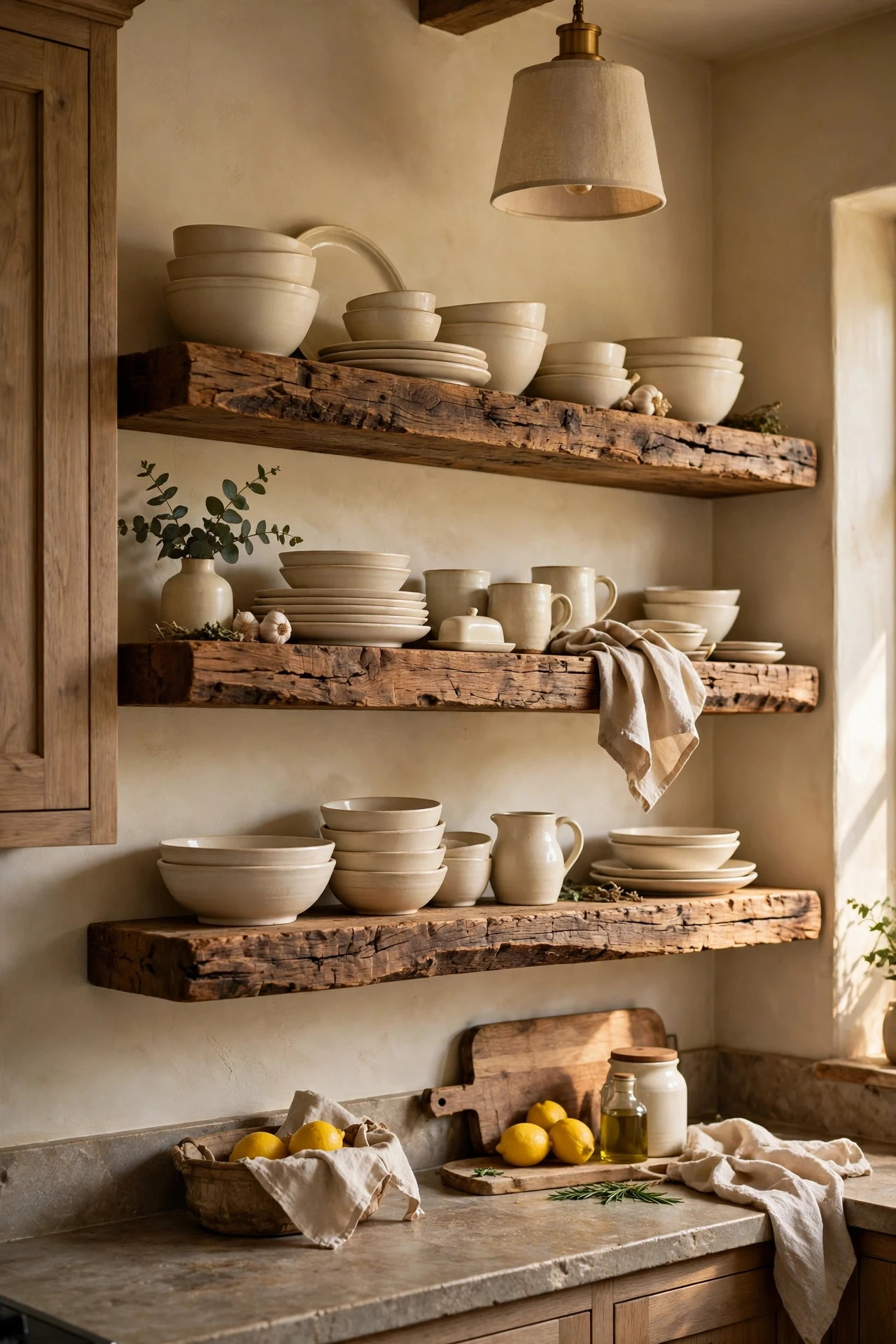
Reclaimed wood is the hardest-working shelf material for a kitchen: it is thick, strong, forgiving of knocks, and its grain and patina hide the small marks that daily use leaves behind. A 4 to 5 cm thick reclaimed oak or pine board, sealed with a food-safe hardwax oil, will carry plates for years and only look better as it ages.
Reclaimed timber costs roughly £40 to £90 per 90 cm shelf depending on thickness and finish, and it pairs with almost any cabinet colour — dark walnut against white cabinets, pale pine against sage green. Seal the board on all six sides before fitting, because steam from a kettle and splashes from the sink attack unsealed end grain first. For a full guide to the wall behind your shelves, these 22 kitchen backsplash ideas for a stylish easy-clean kitchen compare tiles, stone and panels that survive splashes.
8. Are Live-Edge Shelves Practical in a Working Kitchen?

Live-edge shelves are practical in a kitchen if the edge is sealed and the shelf is placed away from the hob and sink, because the natural wavy edge is beautiful but it also collects dust and grease in its crevices. The organic edge softens a boxy kitchen.
Choose a live-edge slab in oak, walnut or ash, 4 to 6 cm thick, and have the bark removed and the edge sanded smooth — a fully raw edge sheds splinters and crumbs into whatever sits below it. Seal with two coats of hardwax oil so the grain resists water, and wipe the edge with a dry brush once a week to keep dust out of the hollows. Live-edge works best as one statement shelf, not a full wall of them, because the irregular edges compete with each other when stacked.
9. Do Glass and Metal Shelves Belong in a Kitchen?

Glass and metal shelves belong in a kitchen when the style is modern, industrial or minimalist — glass keeps a small kitchen feeling open because you can see through it, and stainless steel or blackened metal handles steam and heat better than wood.
Use 10 to 12 mm toughened glass for a shelf that will hold glasses and small bowls, and keep the span under 80 cm so the glass does not flex. Stainless steel shelves, the kind used in professional kitchens, are the toughest option of all: they wipe clean, never warp, and hold heavy pans without complaint, though they can look cold in a family kitchen unless balanced with wood and ceramics. Brass shelves are decorative rather than structural — beautiful for a drinks shelf, wrong for a stack of plates.
10. How Do You Light Open Shelves So They Glow?

Light open shelves with a warm LED strip tucked under each shelf, aimed down at the objects below, because under-shelf light is what makes a styled shelf glow after dark and shows off the texture of wood, ceramic and glass. A shelf without light goes flat and grey in the evening, however well it is styled in daylight.
Use warm-white LED strips at 2700K, fitted in a slim aluminium channel so the light is diffused and the strip itself is invisible from below. Run the strip the full length of the shelf, set back 2 cm from the front edge so it washes the wall and the objects rather than glaring into the room. Add a dimmer so you can drop the shelves to a low glow in the evening. These 22 kitchen lighting ideas for a brighter better kitchen cover pendants, task lights and under-cabinet options that work with open shelving.
11. How Do You Deal with Dust and Grease on Open Shelves?

Deal with dust and grease by keeping open shelves away from the hob, choosing objects that wipe clean in seconds, and building a weekly five-minute wipe-down into your routine — because open shelves in a kitchen will get dusty, and the honest answer is maintenance, not magic.
Place shelves on the wall opposite the cooker or beside the sink, never directly above the hob, and keep the shelf nearest the cooker for objects you wash often, like glasses. Choose glazed ceramics, glass and sealed wood, which wipe clean with a damp cloth, over unglazed terracotta and raw linen, which hold grease. Run the extractor fan every time you cook — it cuts grease settling by more than half — and keep a microfibre cloth in a drawer by the shelves so the wipe-down takes seconds.
12. How Do You Style a Coffee and Tea Station Shelf?
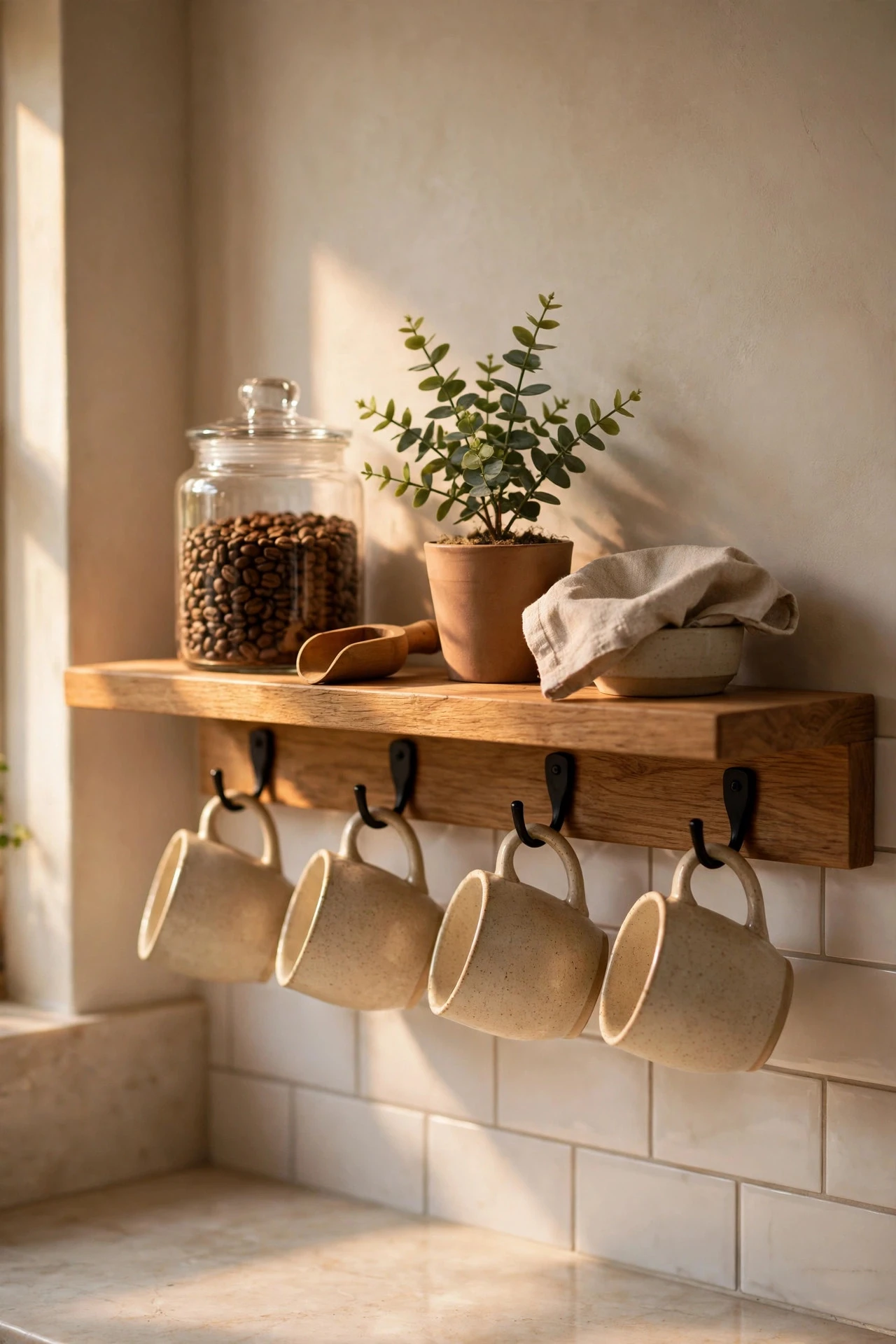
Style a coffee and tea station shelf by giving it one clear job — everything for the morning cup, in one place, at arm's height — with the coffee maker or kettle below and the cups, beans and jars on the shelf above. A dedicated station stops the morning routine from spreading across the whole kitchen.
Keep the shelf at 45 to 55 cm above the worktop so you can reach cups without stretching, and group the pieces in one cluster: two to four matching mugs hung from hooks under the shelf or stacked in pairs, a jar of coffee beans, a small canister of tea, and a tiny plant or framed print for warmth. Hang mugs on brass or black hooks screwed into the shelf underside — it frees shelf space and looks like a café.
13. How Do You Store Plates on Open Shelves Without Chips?
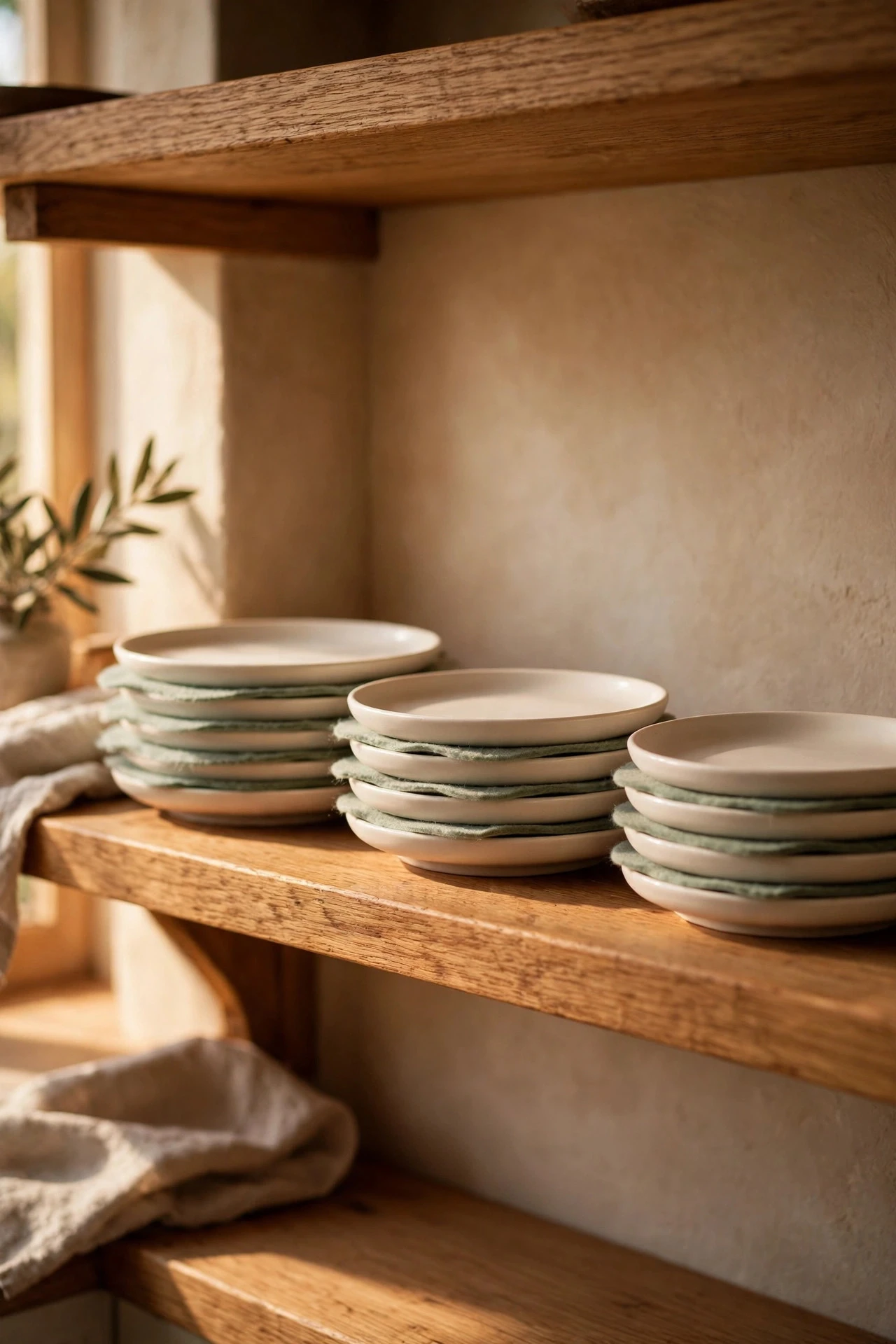
Store plates on open shelves in short stacks of six to eight, with a felt or silicone separator between every second plate, and always lift plates from the top of the stack rather than sliding them out. Chips happen when plates rub and slide against each other, not when they sit still.
Keep the plate stack on the lowest shelf, closest to the dishwasher or sink, so the carry distance is short and the drop risk is low. Use plate stands or a vertical plate rack for your prettiest plates, standing them upright like books — it shows off the pattern and removes the stacking weight entirely. Mix in a row of bowls stacked in twos, never more than four high, because a tall bowl stack is the first thing to topple when a shelf is bumped.
14. What Is the Best Way to Display Chopping Boards?
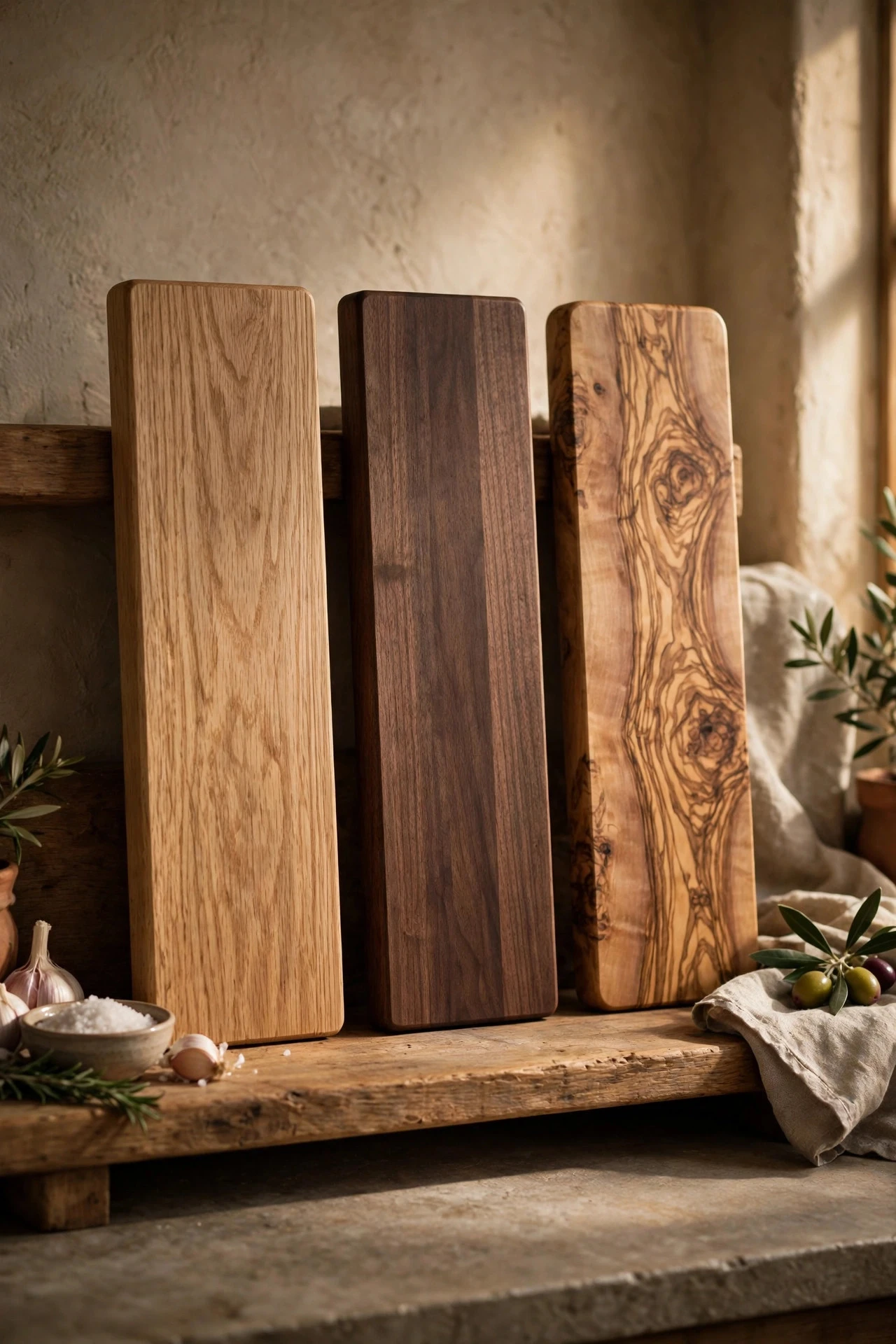
Display chopping boards standing upright in a row, leaning against the wall with the largest at the back, because boards are flat, beautiful and hard to store any other way — and a row of wooden boards is one of the warmest things you can put on a kitchen shelf.
Choose three to five boards in different woods — oak, walnut, olive and acacia — and vary their heights from 25 to 45 cm so the row steps up and down. Stand them on the lowest shelf or lean them against the backsplash, and keep the boards you actually use at the front so you can grab one without moving the display. Wipe boards with a food-safe oil once a month to keep the wood from drying out and cracking.
15. How Do You Make Corner Shelves Work?

Make corner shelves work by using short L-shaped or triangular shelves that turn the dead corner into display space, or by running one long shelf into the corner and styling the corner itself as the anchor point of the wall.
Fit a triangular corner shelf 30 to 40 cm on each side for a single plant or a stack of bowls, or run a floating shelf along one wall and let it wrap 20 to 30 cm around the corner for a continuous line. Place the tallest object in the corner itself — a tall vase, a stack of cookbooks standing upright — so the corner becomes the peak of the arrangement rather than a gap. A small trailing plant softens the corner without taking up shelf space.
16. How Do You Mix Open Shelves with Closed Cabinets?
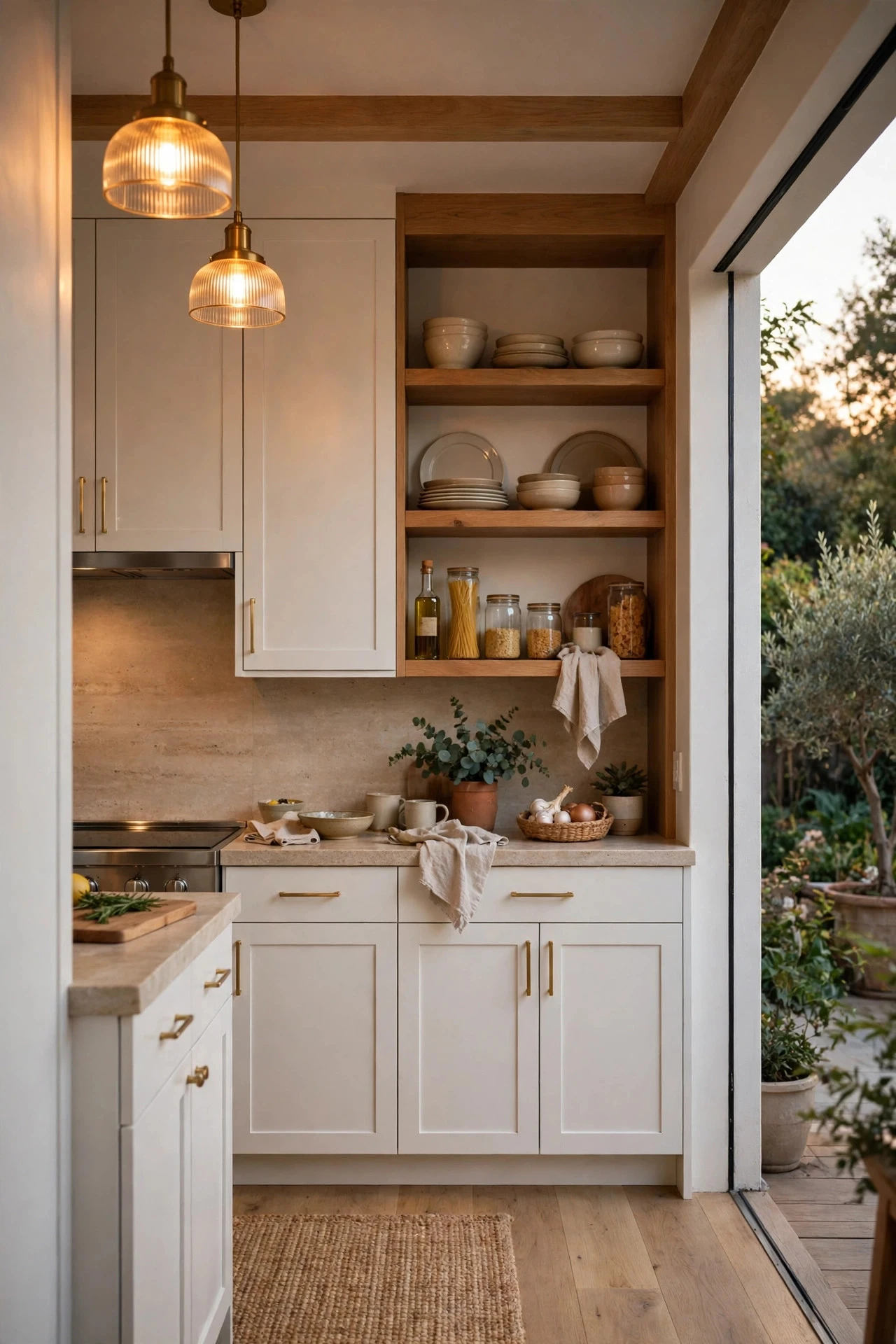
Mix open shelves with closed cabinets by using open shelves for the top 30 to 40 percent of one wall and closed cabinets everywhere else, so the kitchen keeps most of its storage hidden and shows off only its best pieces.
The classic arrangement is one or two open shelves beside the sink or the cooker hood, with closed wall cabinets on the rest of the run, and the same wood tone on the shelf as on the cabinet fronts so the two read as one design. Keep the open shelf for everyday dishes you reach for constantly and the closed cabinets for the rest — the shelf then earns its place instead of being decoration. Houzz's gallery of kitchen with open cabinets ideas shows how well this half-open approach photographs in real homes.
17. How Do You Style in Threes Without Looking Precious?

Style in threes by grouping three objects that share one thing — the same material, the same colour or the same job — but differ in height, shape or texture, so the group feels collected rather than arranged, like objects gathered over time.
Build the trio from one tall, one medium and one short piece: a tall ceramic jug, a medium stack of bowls and a small potted herb, for example, all in the same cream glaze but in different shapes. Leave a hand's width of empty shelf on either side of the trio so it reads as one unit. For more ideas on warming up the whole room around your shelves, these 22 kitchen decor ideas that make a hard-working kitchen feel warm show how colour, texture and lighting work together.
18. How High Should Open Shelves Be Above the Worktop?
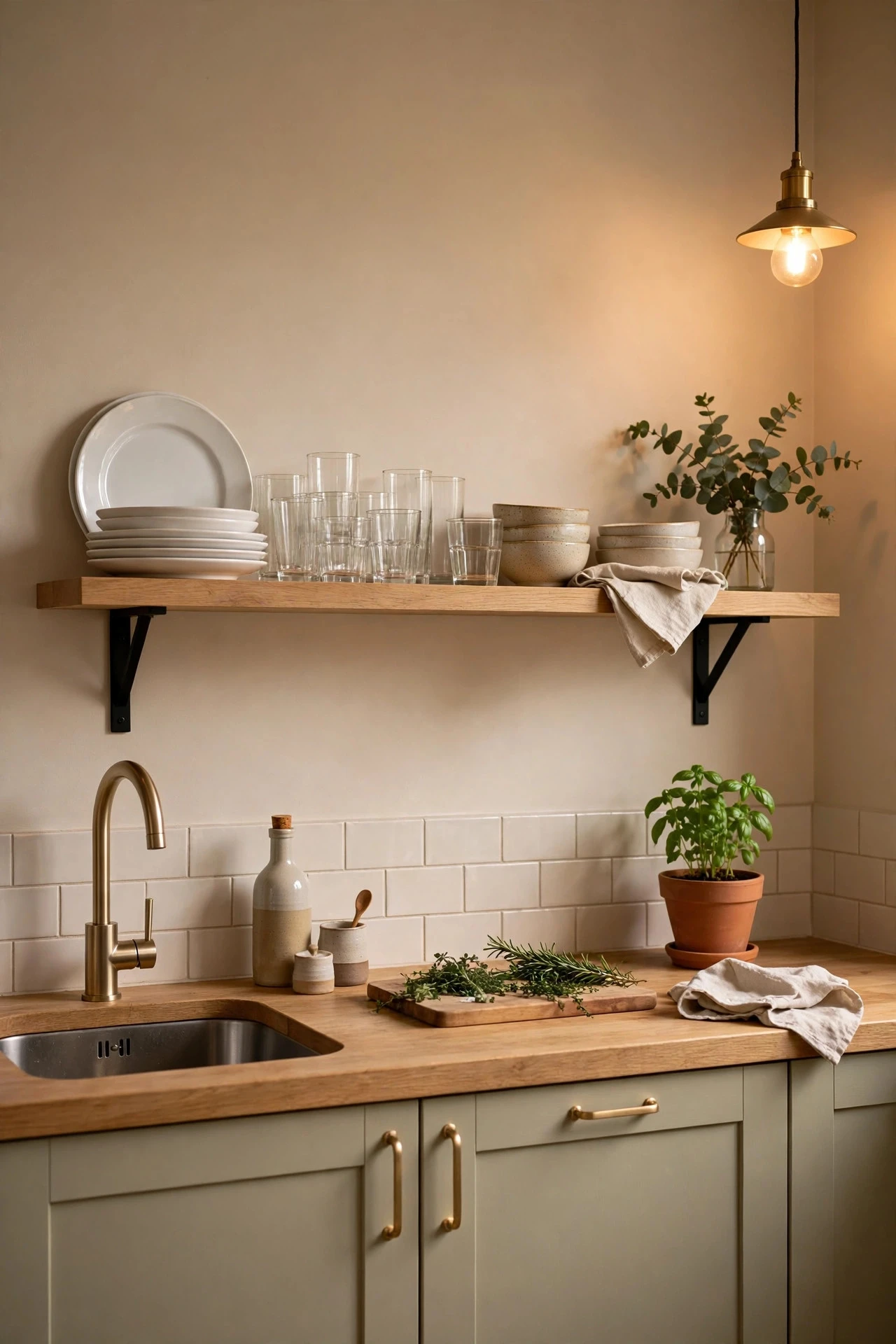
Hang the first open shelf 45 to 60 cm above the worktop, the same height as the bottom of a wall cabinet, so you can reach the lowest shelf without stretching. Too low and the shelf crowds the worktop; too high and the everyday dishes on it are out of reach.
Space the shelves themselves 35 to 45 cm apart vertically, which fits a stack of plates or a row of tall glasses with room to lift them out, and keep no more than three shelves in a stack, because a fourth shelf sits above comfortable reach for most people. The top shelf should be reachable without a step stool — for most adults that means its base sits no higher than about 180 cm. If your household is short, drop the whole run by 5 to 10 cm rather than forcing a daily stretch.
19. How Do You Style Shelves Around a Window or Cooker Hood?
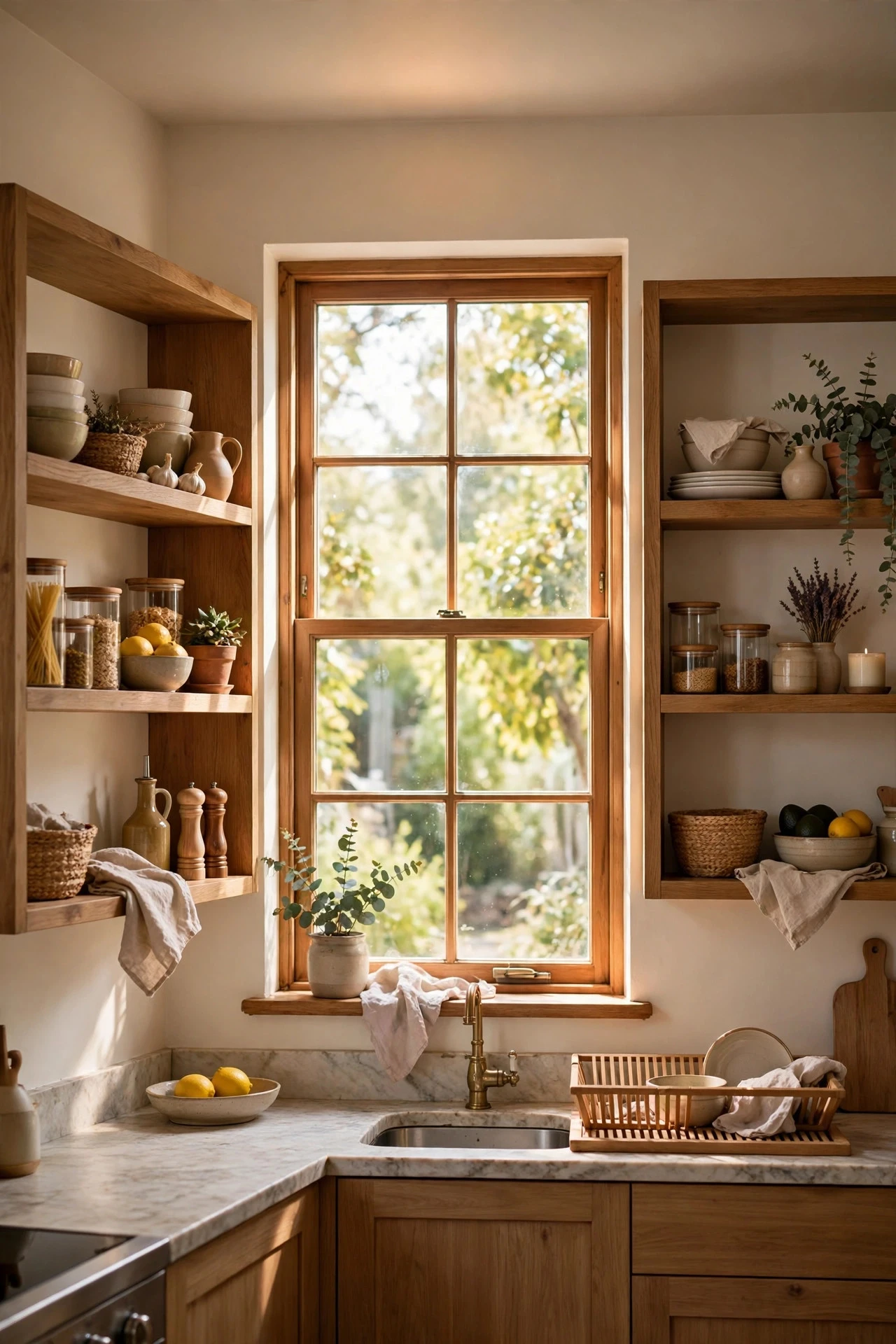
Style shelves around a window or cooker hood by flanking the feature symmetrically — one shelf on each side, at the same height, with a mirrored arrangement — because symmetry is what makes a window or hood look framed rather than crowded. The feature becomes the centrepiece and the shelves become its frame.
Place a pair of short shelves, 60 to 90 cm long, on either side of the window, keeping the inner ends at least 15 cm clear of the window frame so the curtains or blinds can move freely. Mirror the styling loosely rather than exactly: the same number of objects on each side, similar heights, but different pieces, so it reads as balanced rather than duplicated. Around a cooker hood, use two shelves at the same height on either side and keep the lowest shelf at least 60 cm above the hob for fire safety.
20. What Do You Put on the Top Shelf Nobody Can Reach?
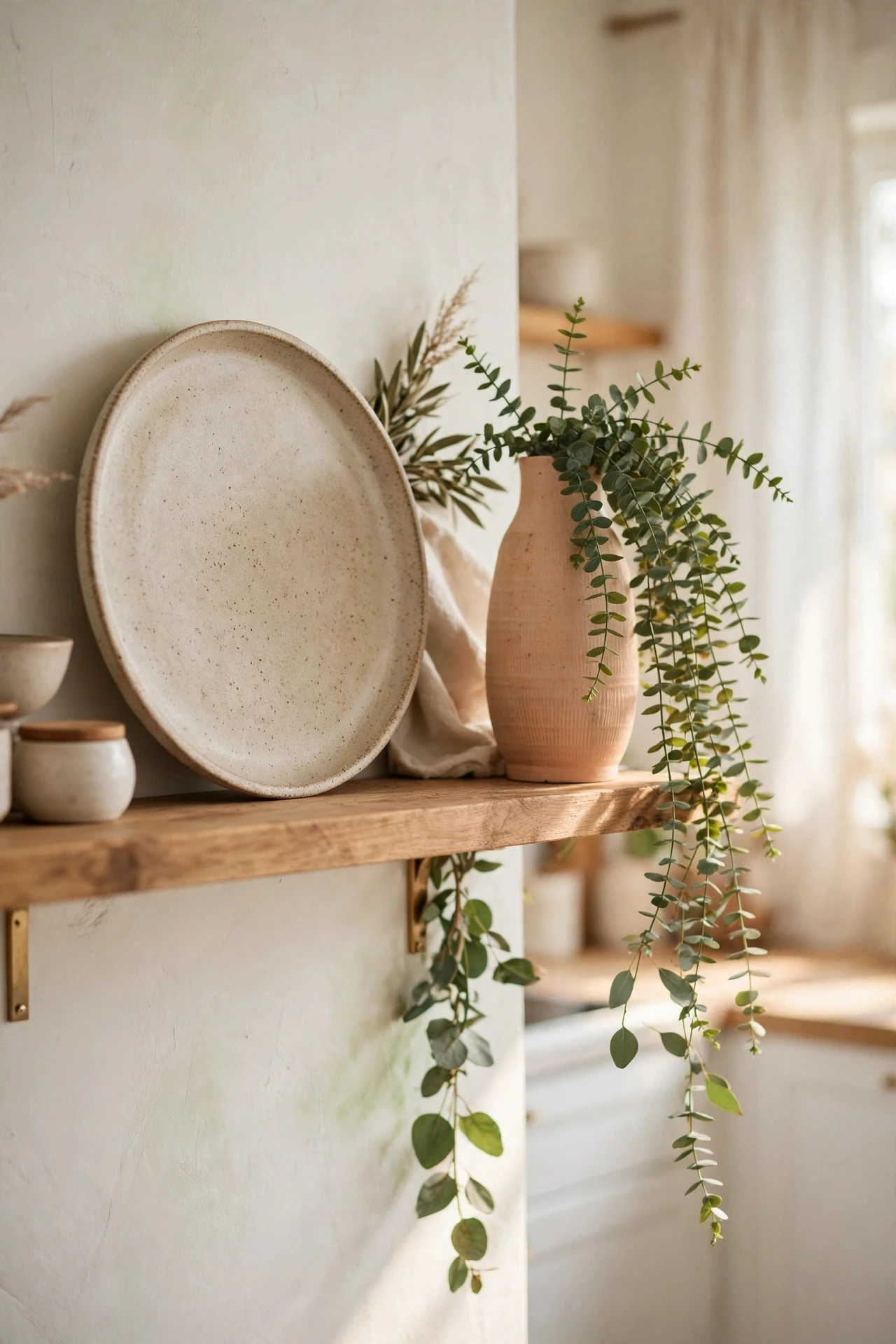
Put beautiful, rarely used things on the top shelf — a large serving platter, a decorative vase, a stack of cookbooks you consult once a month, a trailing plant — because the top shelf is display space, not daily storage. Anything you need weekly should never live where you need a step stool to reach it.
Choose objects that look good from below, since the top shelf is mostly seen from underneath: a platter with a pattern on its underside, a jug with a strong silhouette, a plant that trails down and softens the shelf edge. Keep the top shelf lighter than the shelves below, with only two or three objects and plenty of empty space, so the wall feels lighter at the top and heavier at the bottom — the way a room should feel.
21. How Do You Keep Open Shelves Looking Good in a Small Kitchen?
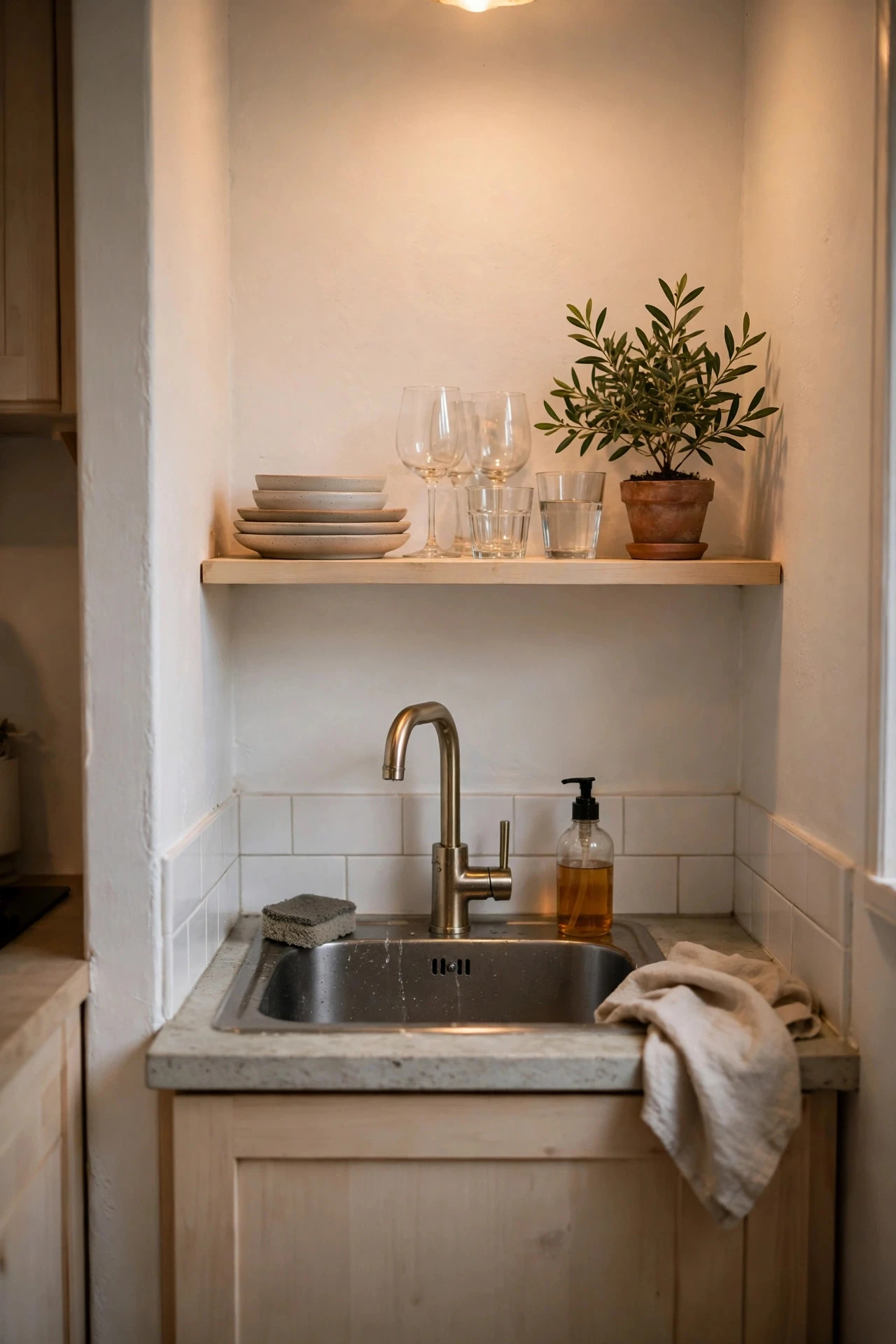
Keep open shelves looking good in a small kitchen by using one short run of shelves instead of a whole wall, keeping the palette to two colours, and storing only the eight to ten things you use every day. A small kitchen cannot afford a shelf of decoration.
Use a single shelf 60 to 90 cm long above the sink or beside the cooker, and limit it to one stack of plates, one row of glasses and one small plant. Small kitchens benefit most from open shelves because they replace a bulky wall cabinet and make the room feel bigger, but only if the shelf stays disciplined. These 22 small kitchen storage ideas that make every inch work show how to squeeze storage from corners, plinths and the backs of doors alongside your shelves.
22. How Do You Refresh Open Shelves Seasonally Without Starting Over?
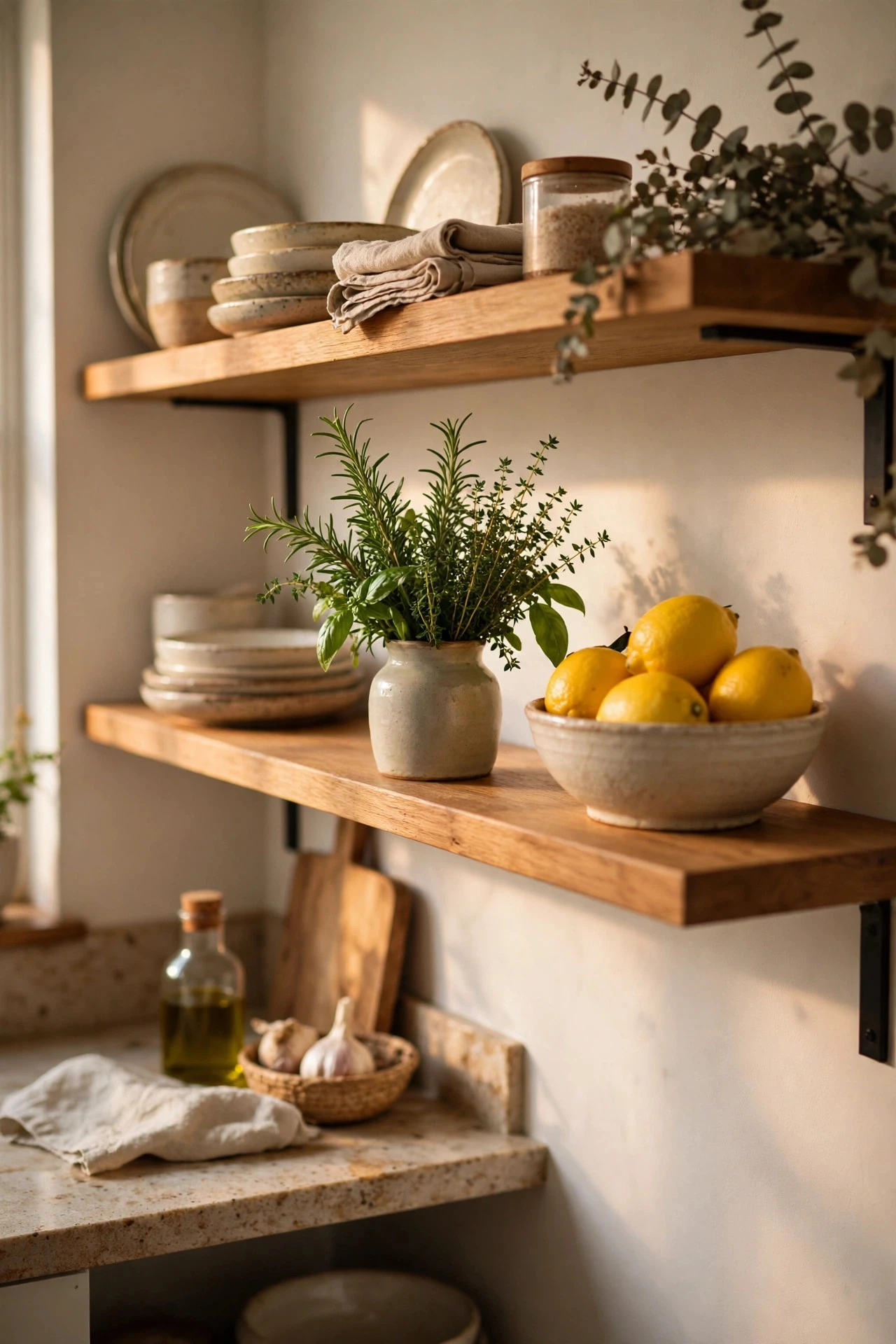
Refresh open shelves seasonally by swapping only the top layer — the small decorative objects and the accent colour — while the plates, glasses and cookbooks stay exactly where they are. A full restyle is unnecessary when a five-minute swap of three or four pieces changes the whole feeling of the wall.
Keep a small box of seasonal swaps: a sprig of eucalyptus in winter, a small vase of fresh herbs in spring, a bowl of lemons in summer, a ceramic pumpkin or a pinecone in autumn. Change the plant and one accent object per shelf, and rotate one shelf at a time rather than stripping the whole wall. This is also the moment to audit the shelves: remove anything chipped, anything you have not used in three months, and anything that no longer matches your three finishes.
Practical Tips
Style one shelf at a time and step back to look at it from the doorway before you move on, because shelves are judged from across the room, not from 30 cm away. Photograph each shelf on your phone — the camera shows clutter and uneven gaps far more honestly than your eyes do. Keep a small box of spares — a spare vase, a spare plant, a spare stack of bowls — so you can swap an object that is not working without leaving a hole.
Fix shelves into studs or masonry, not plasterboard alone, and check them with a spirit level before you load them. Clean the shelves every week with a damp microfibre cloth, keep the extractor fan on while you cook, and audit the shelves every season: if you have not used an object in three months, it belongs in a cupboard.
Final Thoughts
Kitchen open shelving looks curated when it follows a system — show the beautiful, hide the rest, leave a third of the shelf empty, keep the heavy things low and repeat three finishes until the wall reads as one design. Start with one shelf, style it with the triangle rule, and let the rest of the wall follow; a shelf that works in a real kitchen is worth far more than a shelf that only photographs well.
You may also like: our kitchen cabinet colour ideas on how to pick a colour you'll love help you choose the cabinet shade that makes your open shelves and wood tones sit together beautifully.
Frequently Asked Questions
How do you style open kitchen shelves so they don't look cluttered?
Leave 20 to 30 percent of every shelf empty, show only matching dishes and glassware, and group objects in threes using the height triangle rule — one tall, one medium and one short piece per group. Hide chipped mugs, plastic containers and cleaning products behind closed doors.
How much weight can kitchen open shelves hold?
A floating shelf fixed into studs or solid masonry holds 15 to 25 kg per 90 cm span, while the same shelf on plasterboard with standard fixings holds only 5 to 10 kg. Bracketed shelves hold more, often 30 kg or more. Always check what is behind the wall, and keep heavy plates on the lowest shelf.
What is the best material for kitchen open shelves?
Reclaimed wood is the best all-round choice: a 4 to 5 cm thick oak or pine board, sealed with food-safe hardwax oil, is strong, forgiving of knocks and only looks better with age. Glass suits small modern kitchens, stainless steel is the toughest option, and live-edge wood works as a single statement shelf.
How do you keep open kitchen shelves clean from grease and dust?
Keep shelves away from the hob, run the extractor fan every time you cook, and wipe the shelves weekly with a damp microfibre cloth. Choose glazed ceramics, glass and sealed wood, which wipe clean in seconds, and avoid displaying anything you cannot wash within a metre of the hob.
How high should open kitchen shelves be above the counter?
Hang the first shelf 45 to 60 cm above the worktop, the same height as the bottom of a wall cabinet, and space shelves 35 to 45 cm apart vertically. Keep no more than three shelves in a stack, with the top shelf reachable without a step stool — usually no higher than about 180 cm.
Should you replace all your kitchen cabinets with open shelving?
No — replace only the top 30 to 40 percent of one wall with open shelves and keep closed cabinets everywhere else, unless you have a pantry. Open shelves hold roughly half the storage of the cabinets they replace, so a fully open kitchen quickly ends up displaying the ugly things you meant to hide.