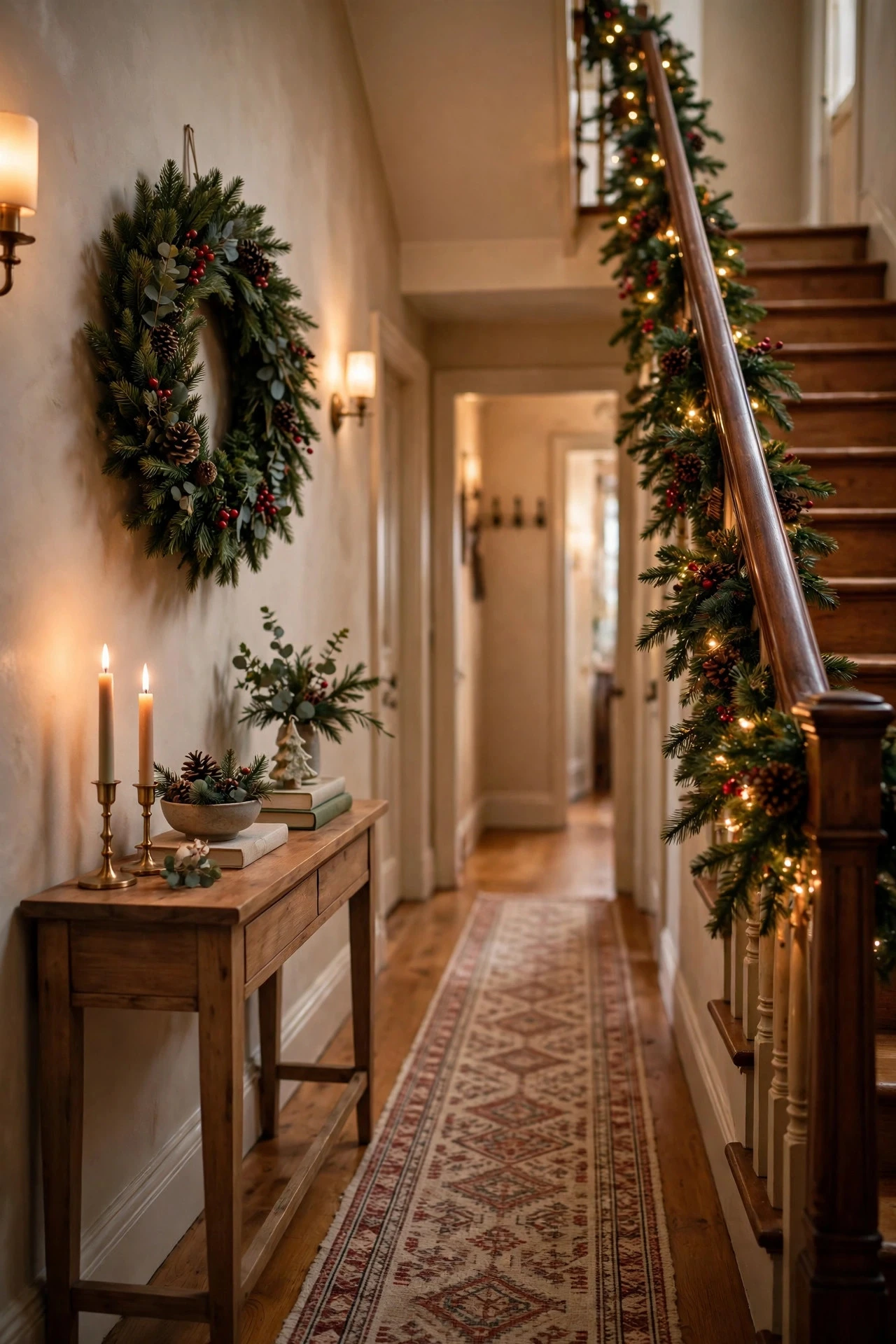
Christmas Hallway Ideas: How to Style a Hallway That Welcomes Guests
A hallway is the first room your guests experience, yet it is the room most homes decorate last. It sets the mood before anyone reaches the living room, and a bare, echoing hall can undo the warmth of the tree next door. A few deliberate touches — a garland, a runner, warm light — turn a corridor into a welcome.
Looking for more inspiration? Our Nest Decorz homepage gathers the latest home decor ideas, seasonal decorating guides and room-by-room styling tips in one place — start there and explore.
Below are 22 Christmas hallway ideas for console tables, runners, banisters, mirrors, wreaths, scent and narrow halls, with honest budgets and exact sizes. Every idea works in a grand entry or a narrow flat corridor, and most take under an hour.
Quick answers
– Start with one anchor piece — a console table, a garland or a wreath — and build everything else around it. – Keep a clear 90 cm walkway at all times; nothing festive is worth a guest tripping over it. – Use warm-white battery lights (2700K) in garlands and lanterns, because cool white reads as office lighting in a hallway. – Budget £25–£60 for a full hallway, and £80–£120 if you add a runner or a new mirror.
1. How Do You Style a Console Table for Christmas?
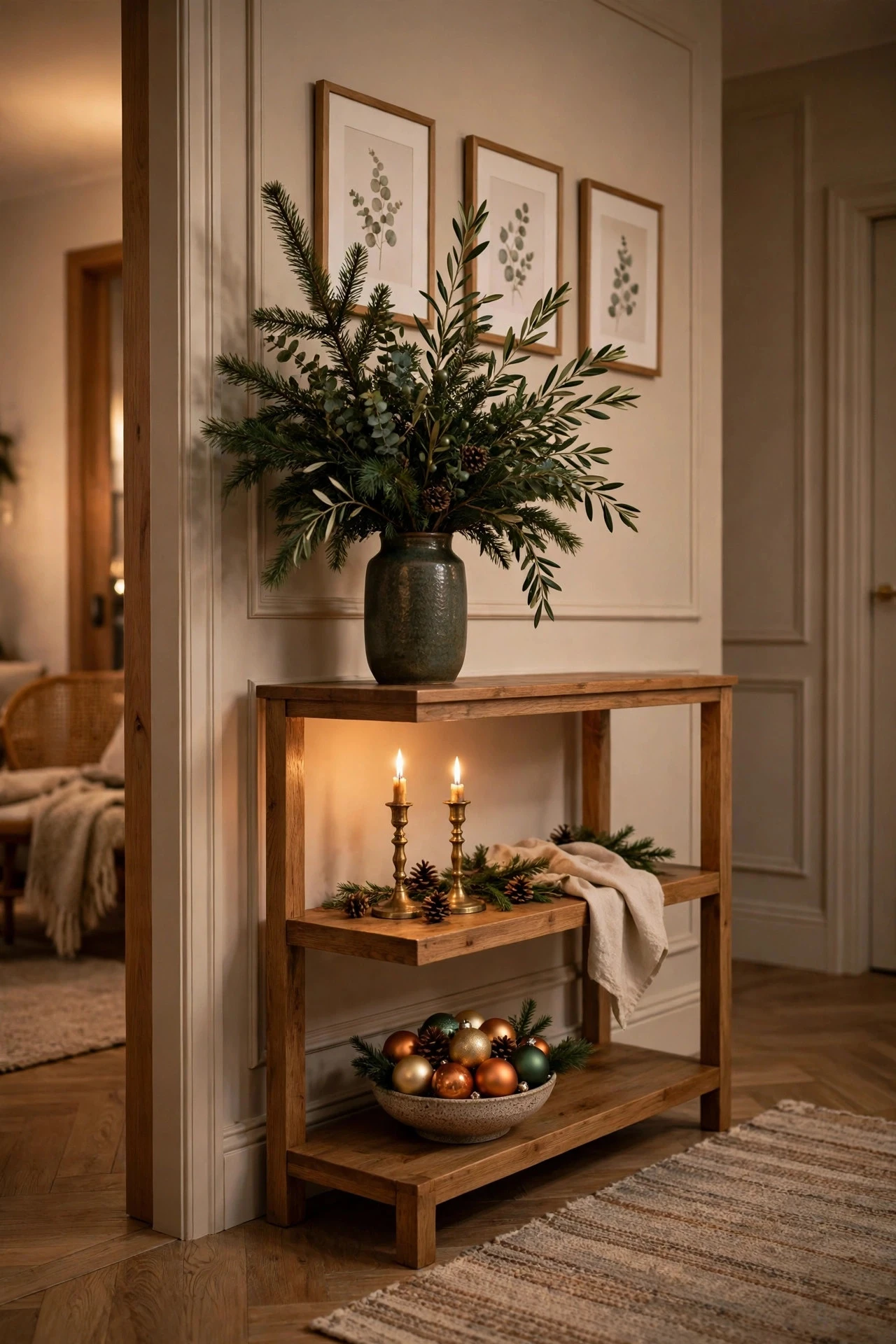
Style a Christmas console table in three layers: something tall at the back, something medium in the middle and something low at the front. A tall vase of evergreen branches, a pair of candlesticks and a small bowl of baubles give the table height, glow and colour without crowding the surface.
Keep the centre clear so keys, post and gloves still have a home. Use odd numbers: three candlesticks, five baubles, one statement vase. A slim table, 25–30 cm deep, suits most halls; if yours is deeper, push the tall pieces to the wall. Fresh eucalyptus and pine cost £8–£15 and last two weeks in water, while a faux garland swag across the table edge costs £12–£20 and stores flat. Avoid anything wider than the table, and skip glass baubles at toddler height.
2. How Do You Hang Garland Along a Banister Without Damaging It?
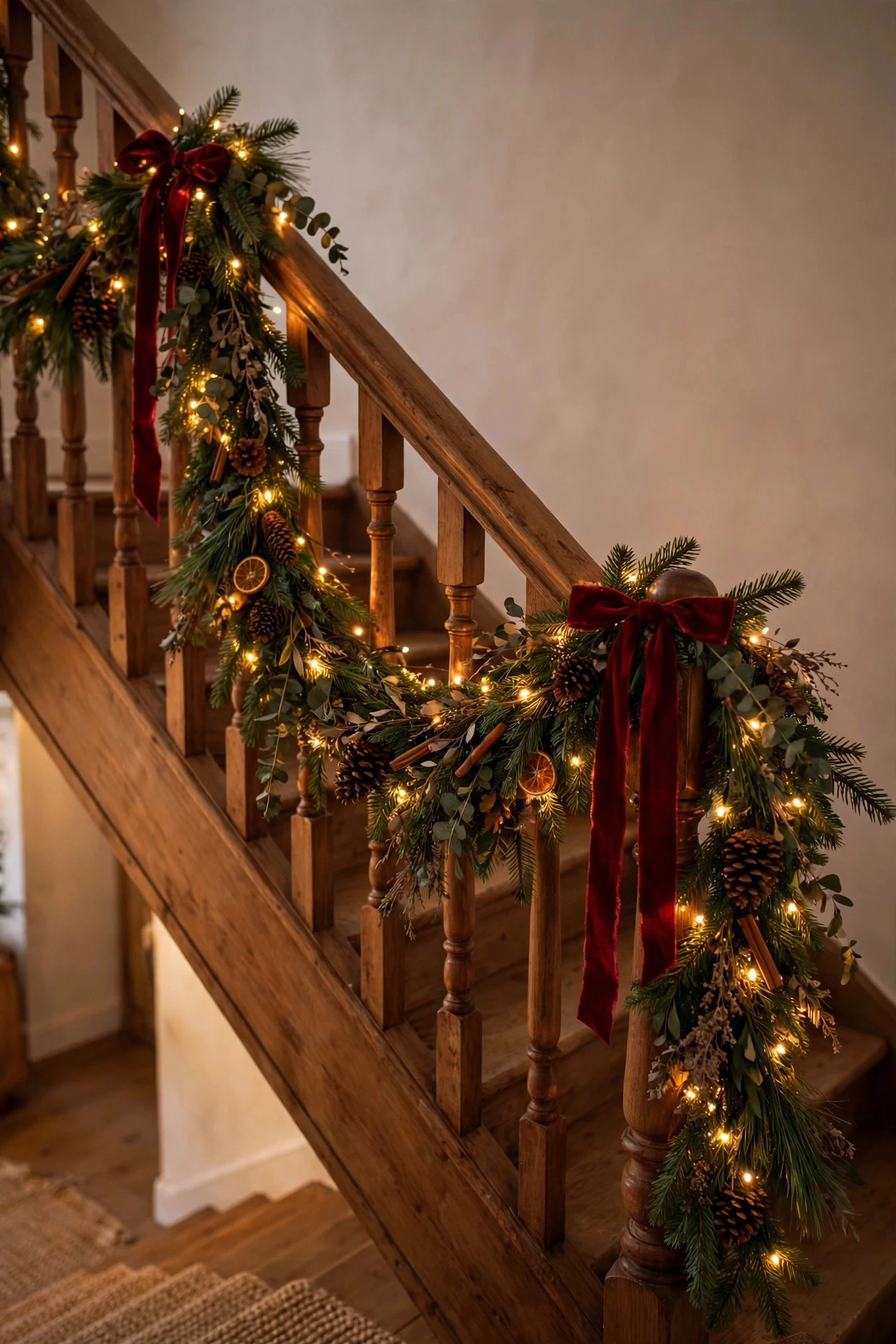
Hang banister garland with removable ties — velvet ribbon, reusable zip ties or garland ties — looped loosely around the rail, never with nails, staples or tape on the wood. Drape the garland in gentle swags between the newel posts, letting it dip 20–30 cm at the centre of each span, so it looks relaxed rather than strung tight.
A 2.7 m faux garland covers one straight flight; a staircase with a landing needs two, joined with a bow at the turn. Weave in one string of warm-white battery fairy lights per garland, hiding the battery pack behind the newel post, and add pinecones every 40 cm for texture. A garland) has dressed doorways and staircases for centuries, and the loose-swags rule still applies. Budget £18–£35 per garland, plus £5–£10 for lights, and check the garland clears the handrail grip.
3. What Runner Works Best in a Christmas Hallway?
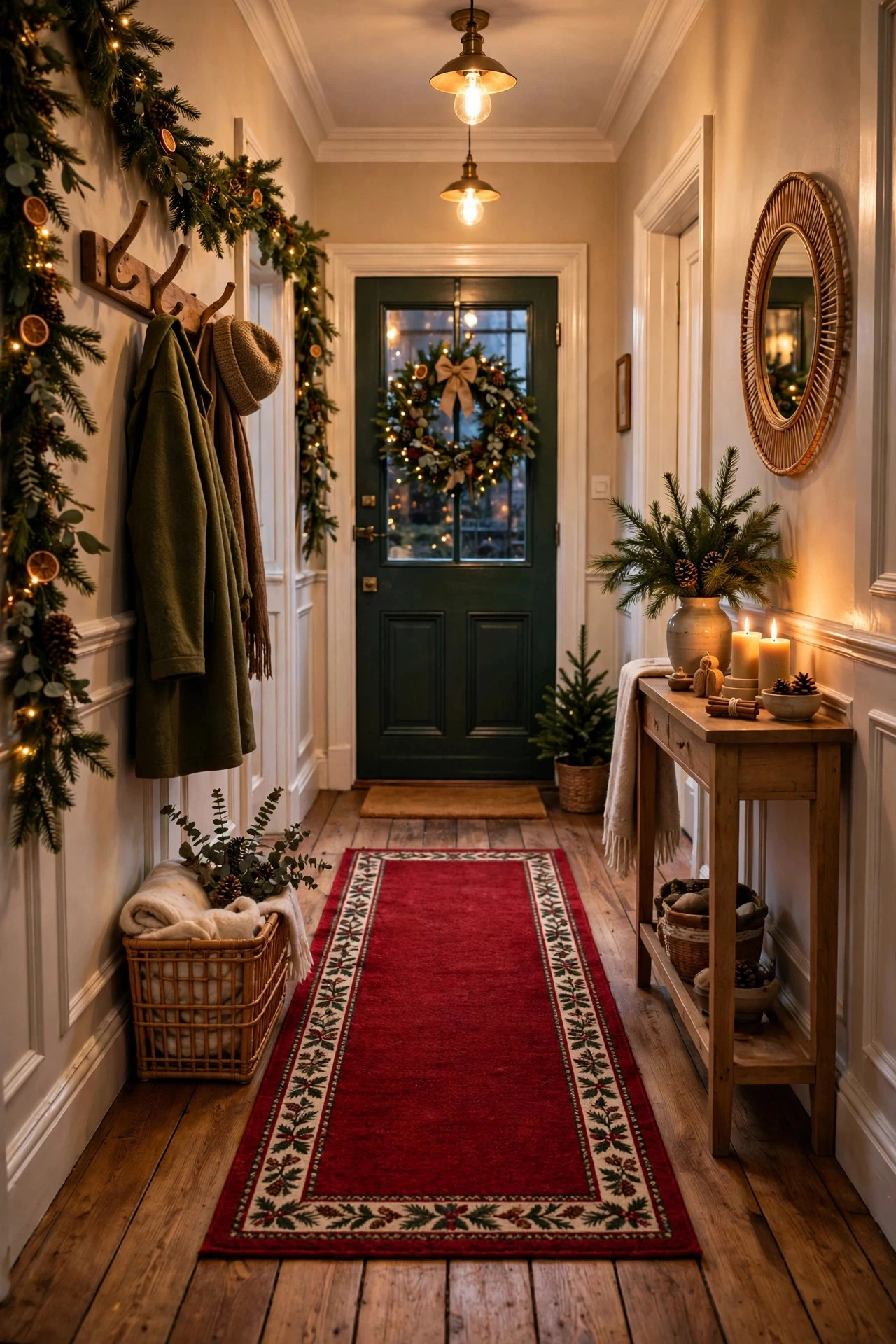
The best Christmas hallway runner is a low-pile wool or washable flatweave runner, 60–80 cm wide and at least 30 cm shorter than the hall, in a deep red, forest green or neutral pattern with a festive border. Low pile matters: thick shag catches heels and door thresholds, while a flatweave lies flat, vacuums easily and stays put underfoot.
Leave 10–15 cm of bare floor visible on each side, and use a non-slip underlay — a sliding runner is a hazard, not a decoration. A washable 60 x 180 cm runner costs £25–£45; a wool runner runs £60–£120 and lasts for years. For stair and landing layering in the same palette, these 22 Christmas garland ideas for mantels, stairs and doors repeat one colour story across the whole entry. Avoid plastic-backed cheap runners: they crack, curl and smell when the heating is on.
4. How Do You Use a Mirror to Double the Light in a Dark Hallway?

Use a mirror to double hallway light by hanging it opposite, or at a right angle to, the nearest light source — a window, a lantern or fairy lights — so it reflects the glow back down the corridor. One large mirror, at least 60 x 90 cm, bounces far more light than a cluster of small ones.
Hang the mirror at eye level, centre 150–160 cm from the floor, and angle it slightly downward if it faces a window, so it catches the sky rather than the ceiling. In a windowless hall, place it opposite a console lamp or a lit garland and the corridor brightens a visible step. A hallway mirror costs £40–£90; vintage frames run £10–£25 and take spray paint beautifully. Avoid hanging a mirror where it reflects a cluttered coat rack — it doubles the mess as faithfully as the light.
5. Where Should the Wreath Go in a Hallway?
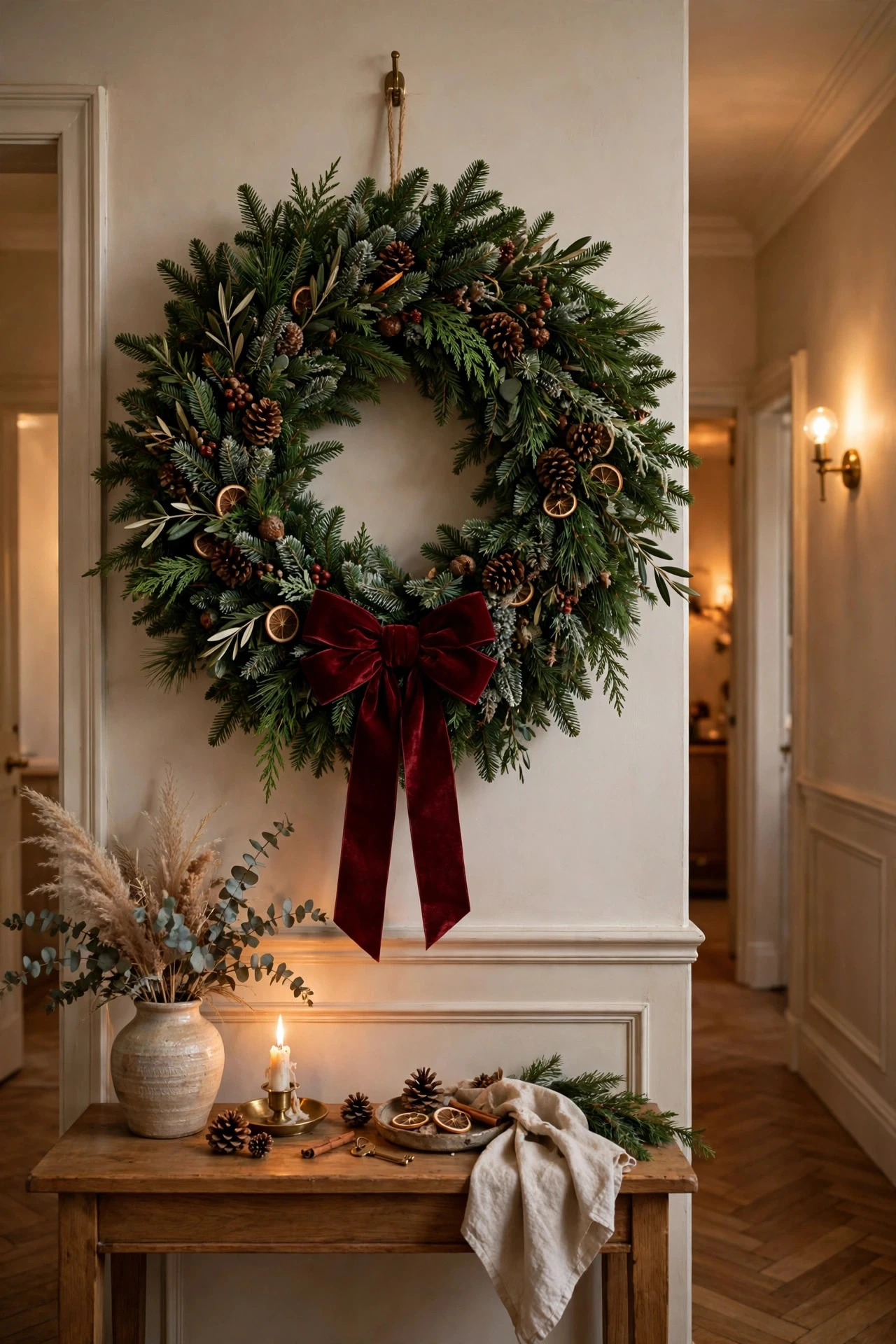
Hang the hallway wreath where guests see it in the first three seconds: on the wall above the console table, on the inside of the front door, or centred on the wall at the end of the hall. Above the console is the classic spot, because the wreath becomes the anchor for everything on the table below it.
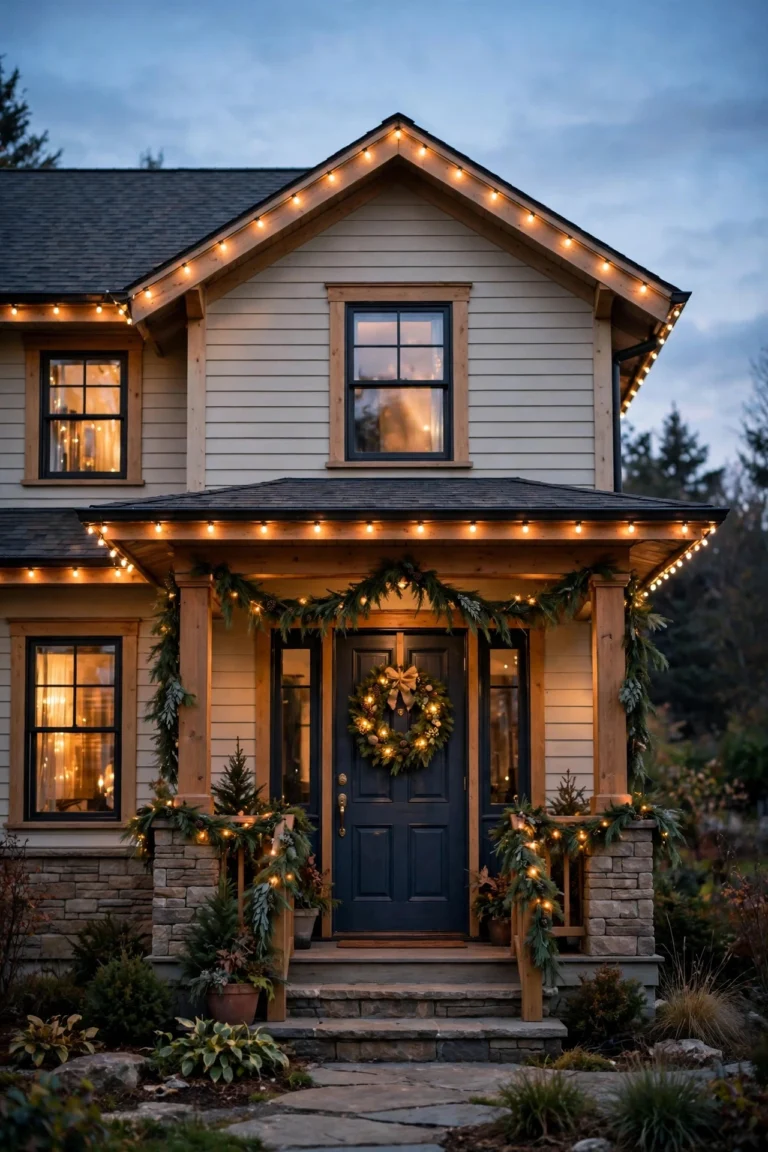
Size the wreath to the wall: 45–60 cm across above a standard console, 60–75 cm on a large end wall, and never wider than the table beneath it. A wreath is traditionally a ring of evergreen, and one with a velvet bow still reads as the most Christmassy shape there is. Hang it from a removable hook rated for twice its weight, centred 20–25 cm above the table. Budget £15–£40 for faux, £12–£25 for fresh. For doors that open onto the hall, our 22 Christmas door decorating contest ideas judges love carry the same thinking to the front door.
6. How Do You Decorate a Narrow Hallway Without Blocking It?

Decorate a narrow hallway by going flat and vertical: wreaths, garlands and pictures on the walls, a slim runner on the floor, and nothing wider than 20 cm sticking out into the walkway. In a hall under 100 cm wide, the walls are your only decorating surface.
Hang a garland high along the picture rail or ceiling line, where it adds colour without narrowing the corridor, and use one slim wall shelf — 12–15 cm deep — for tiny trees or candles instead of a table. Keep the floor to one runner and one doormat, and hang coats behind a door rather than on hooks that jut into the passage. A narrow hall needs £15–£30 of wall decor to feel dressed: one garland, one wreath and a string of lights. Avoid floor lanterns, baskets and planters in a narrow hall; anything on the floor becomes a trip hazard when two people pass.
7. How Do You Style a Staircase for Christmas?
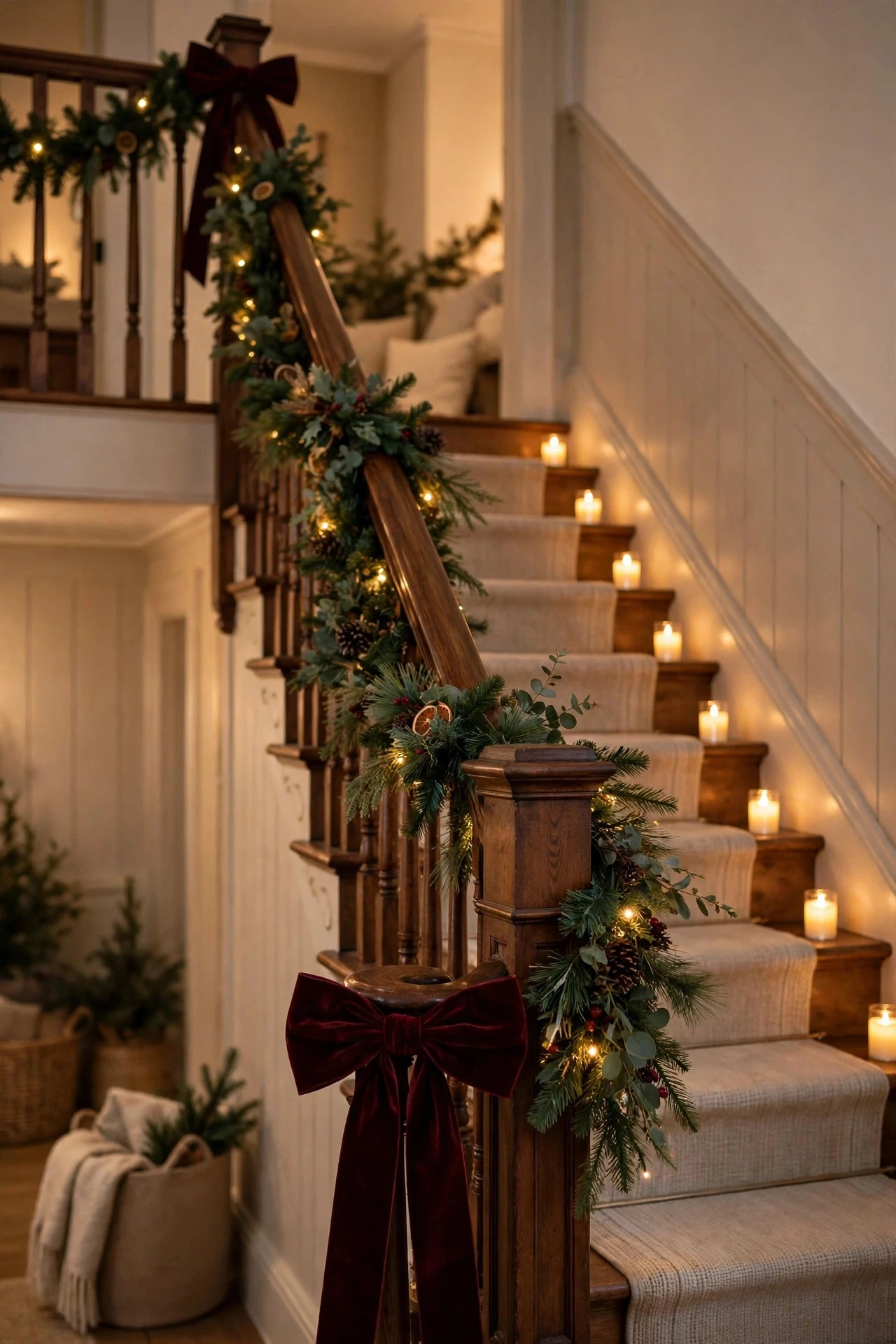
Style a Christmas staircase with one garland along the banister, one ribbon bow at each newel post and warm lights woven through, then stop — a staircase needs restraint, because it is already the most architectural feature in the hall. The garland is the star, and everything else should support it rather than compete with it.
Add a large velvet bow at each newel post, with a sprig of pine and two pinecones behind it, for under £5 per post. On the treads, place a small lantern or three LED candles on every third step, on the wall side only, so the walking line stays clear. A staircase garland costs £18–£35, bows £3–£8 each, LED candles £8–£15 a set. Never place real candles on stairs, and never drape anything across a tread where a foot lands.
8. What Scent Makes a Hallway Feel Welcoming at Christmas?
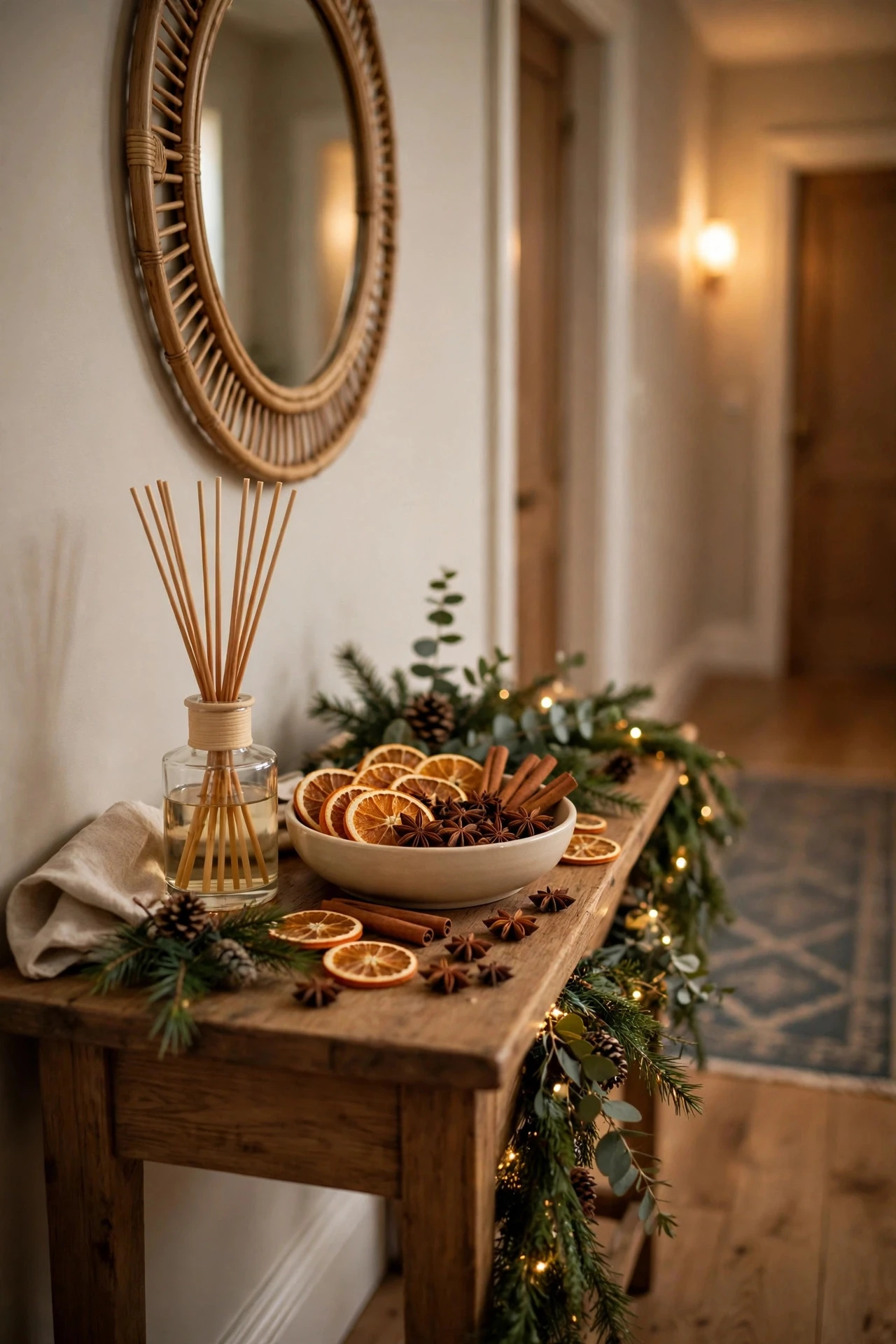
A hallway feels welcoming when it smells of pine, cinnamon and orange — the classic Christmas scent trio — delivered by a reed diffuser or a simmering potpourri bowl near the door, never by a plug-in that overpowers a small space. Keep the scent gentle: guests should notice the welcome, not the fragrance.
Place the diffuser on the console table, away from the door draught, and choose one scent family: pine and cedar for a fresh forest feel, cinnamon and clove for warmth, or orange and star anise for spice. A reed diffuser costs £8–£15 and lasts four to six weeks; a bowl of dried orange slices and cinnamon sticks costs £3–£5 and doubles as decoration. Avoid scented candles in a hallway — the draught makes them burn unevenly — and skip plug-ins in a hall under 2 m wide, where the scent concentrates too fast.
9. How Do You Light a Hallway That Has No Windows?
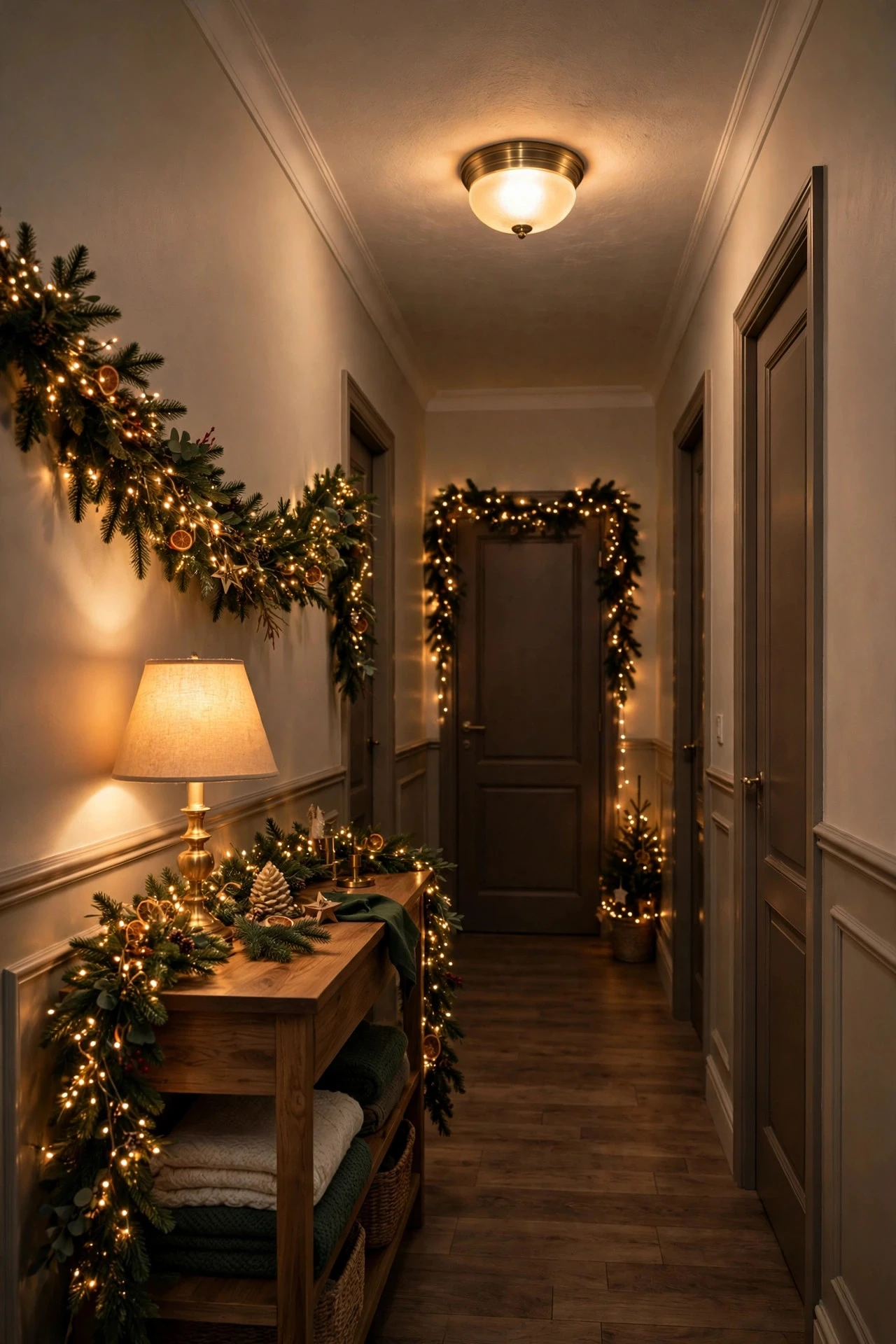
Light a windowless hallway in three layers: a warm ceiling light for general glow, a console lamp or wall sconce for mid-level warmth, and fairy lights or candles at low level for sparkle. One overhead bulb alone creates harsh shadows in a corridor, but three small light sources at different heights make the same hall feel deep and inviting.
Choose warm-white bulbs at 2700K throughout — mixing warm and cool white looks accidental — and put the ceiling light on a dimmer if you can. Battery LED candles in lanterns cost £8–£15 for three and are safe beside coats and garlands, while 100 warm-white fairy lights woven through a garland cost £5–£10. A plug-in console lamp, £20–£40, softens light far better than a bare bulb. Avoid cool-white spotlights and bare Edison bulbs in a windowless hall; they make it feel like an office corridor.
10. How Do You Decorate a Hallway Doorway or Arch for Christmas?

Decorate a hallway doorway or arch by framing it with garland, just as you would a front door, so the opening itself becomes part of the Christmas display. Drape a thick evergreen garland across the top and let the ends fall 60–90 cm down each side, secured with removable hooks.
Weave warm-white fairy lights through the garland and add a ribbon bow at each top corner to hide the join and finish the frame. A standard doorway needs one 2.7 m garland, £18–£35, and one string of lights, £5–£10; a wide arch needs two garlands joined with a large bow. Keep the garland tight to the frame so it does not reduce the clear opening below 80 cm, and check nothing at the top can fall on someone walking through. For the front door that leads into this hall, these 22 Christmas front porch ideas for a warm, welcoming entry carry the same treatment outside.
11. What Goes on the Wall Above a Console Table?
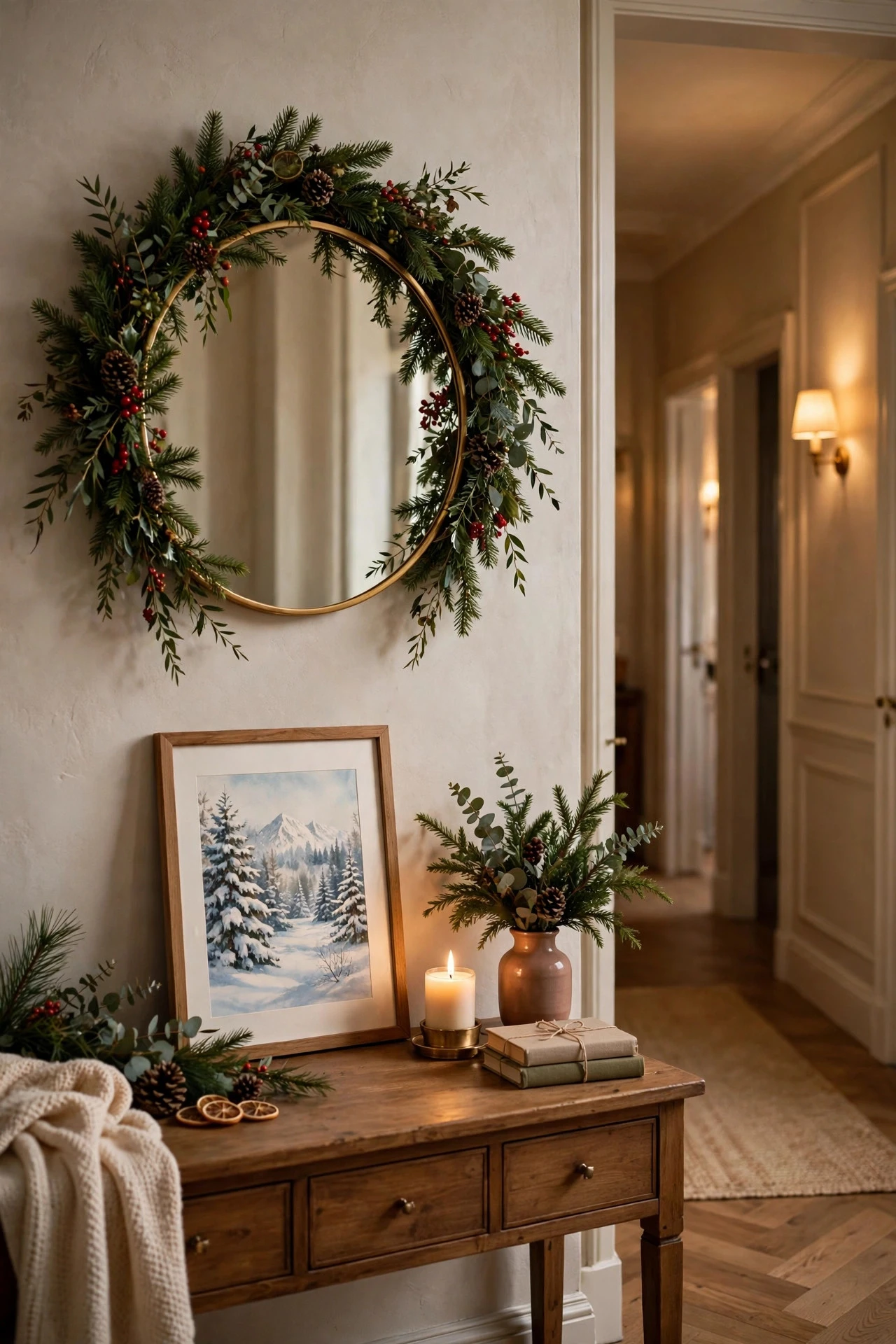
Above a console table, hang one statement piece — a wreath, a large mirror or a framed print — centred over the table and sized to two-thirds of the table's width, so wall and table read as one composition. One strong piece beats a gallery wall in a hallway, where small frames read as clutter at close range.
A round mirror above a rectangular console softens the lines and bounces light down the hall, while a wreath ties the entry to Christmas. If you prefer art, choose one framed winter print — a snowy landscape or a botanical evergreen — in a frame that matches the console. Hang it with its centre 150–160 cm from the floor, leaving 20–30 cm between the frame and the tallest object on the table. A framed print costs £15–£35; a wreath £15–£40. Avoid hanging anything over 3 kg from one adhesive hook, and never hang a picture low enough for a tall guest's coat to brush.
12. How Do You Decorate a Christmas Hallway on a Small Budget?
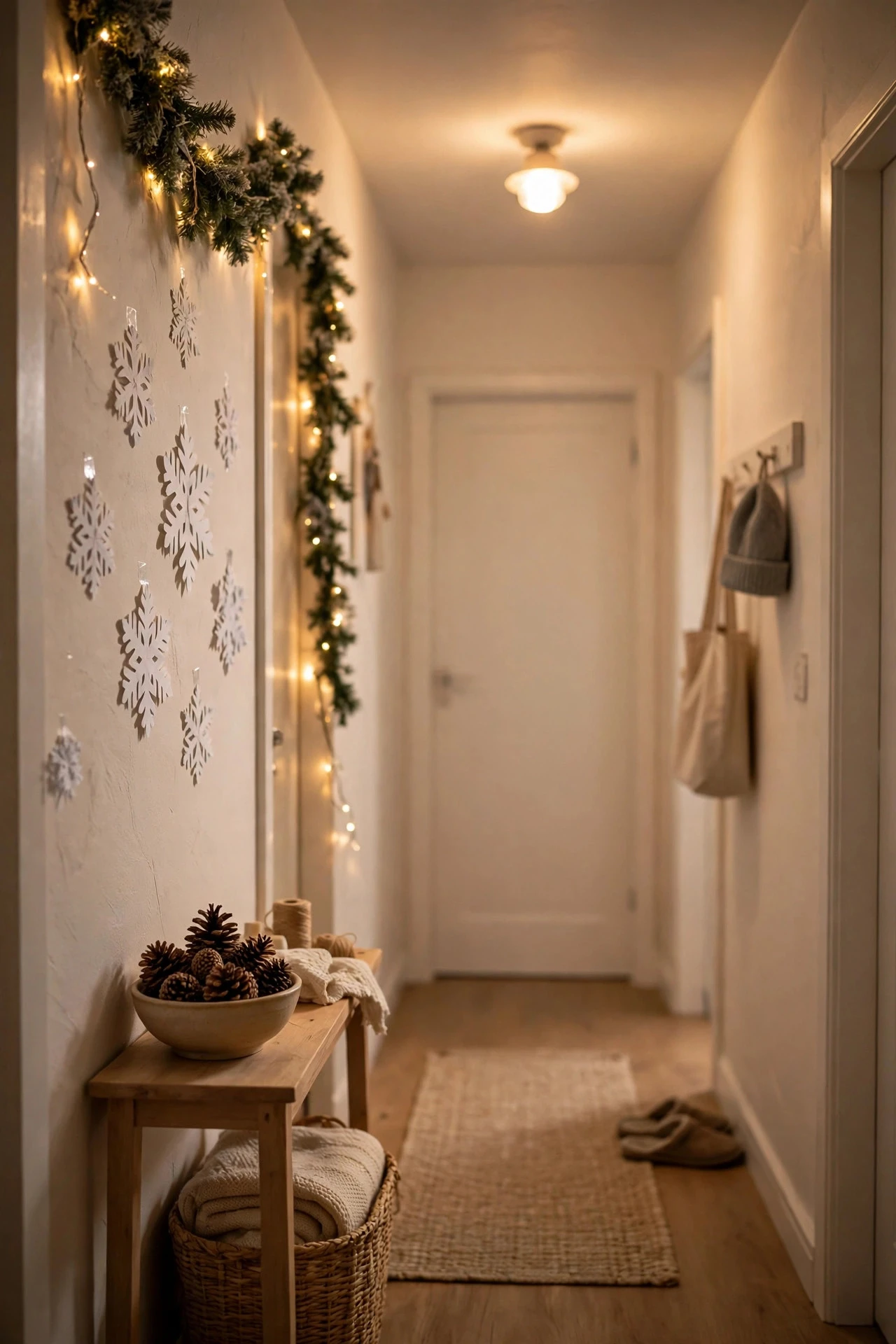
Decorate a Christmas hallway on a small budget by spending on one anchor and making the rest: a £12–£18 faux garland on the banister or console, paper snowflakes on the walls, dried orange slices in a bowl, and one string of battery fairy lights. A £25 hallway can look deliberate if the palette is tight.
Forage first: pinecones, evergreen cuttings and holly from the garden cost nothing and fill a vase beautifully, while brown paper and string make rustic bows for the banister. Cut snowflakes from white printer paper and hang them at different heights on fishing line for a falling-snow effect. Buy the garland and lights first, because they sell out, and add the free details last. Christmas decoration traditions have always mixed bought and handmade pieces, and a hallway that mixes both looks more personal than one bought whole. Avoid pound-shop baubles in bulk: twenty cheap baubles look cheaper than five good ones.
13. How Do You Make a Grand Entry Feel Warm Instead of Empty?
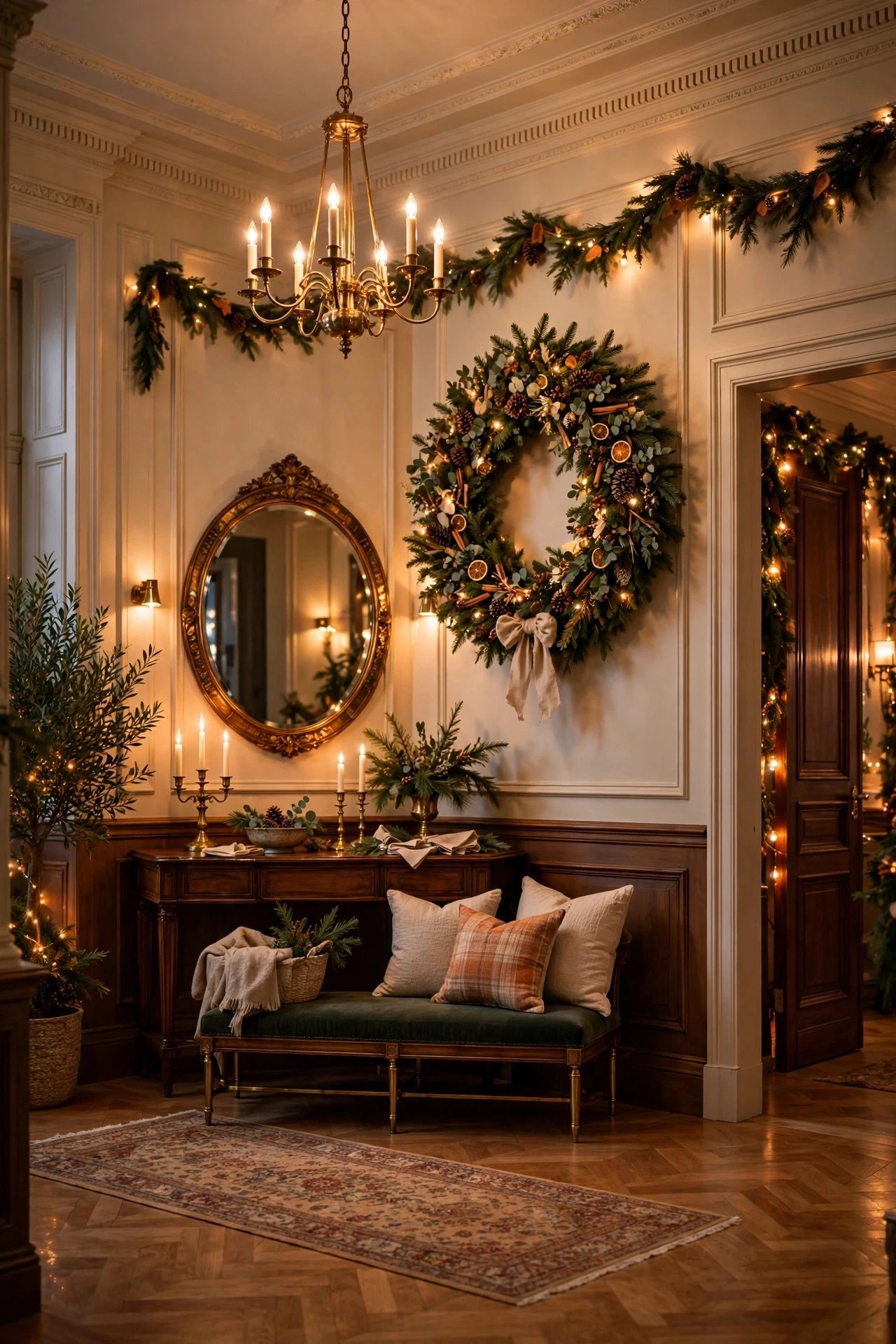
Make a grand entry feel warm by breaking its scale into human-sized zones: a console table and mirror on one wall, a bench or chairs on the other, and a large rug anchoring the middle. Fill the middle band — 90 to 180 cm from the floor — with art, garland and lamplight, since nothing sits at eye level.
Add a large wreath or framed print on the end wall, where the eye lands, and place a tall plant or floor lantern in any corner wider than 60 cm. Layer the lighting: a chandelier or pendant for height, a console lamp for warmth and fairy lights in the garland for sparkle. A grand entry needs £80–£150 of decor to feel dressed, but a single oversized wreath, 75–90 cm across, does more than five small pieces. Avoid scattering small decorations across a large hall — they vanish, and the hall looks emptier than before.
14. How Do You Decorate a Hallway If You Rent Your Home?
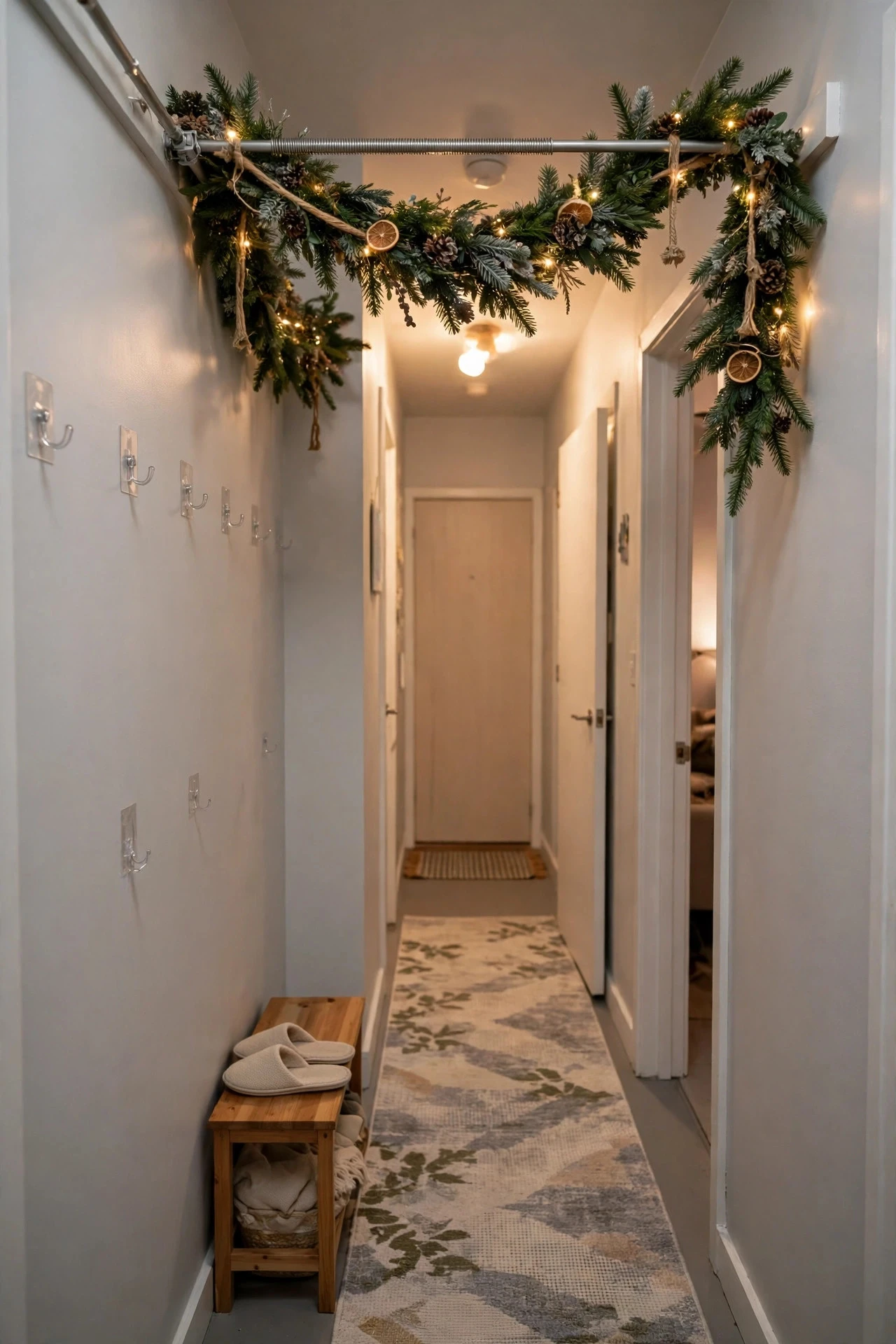
Decorate a rented hallway with removable everything: over-door hooks, command strips, painter's tape, tension rods and freestanding pieces, so the hall returns to its original state on moving day. A rented hallway can look just as festive as an owned one — the only rule is that nothing leaves a mark.
Hang the wreath from an over-door hook, drape garland from a tension rod across a doorway, and use command strips rated for every frame and hook. Choose a freestanding console or narrow bench over wall-mounted shelves, and dress the floor with a washable runner that protects the landlord's flooring. A renter's hallway costs £20–£40 in removable fixings and decor, and the same pieces move to the next home. Photograph the hallway before you start, and test every adhesive on a hidden corner first. Never drill, nail or use hot glue on a rented wall — the repair bill costs more than the decoration.
15. How Do You Use Baskets and Storage in a Festive Hallway?
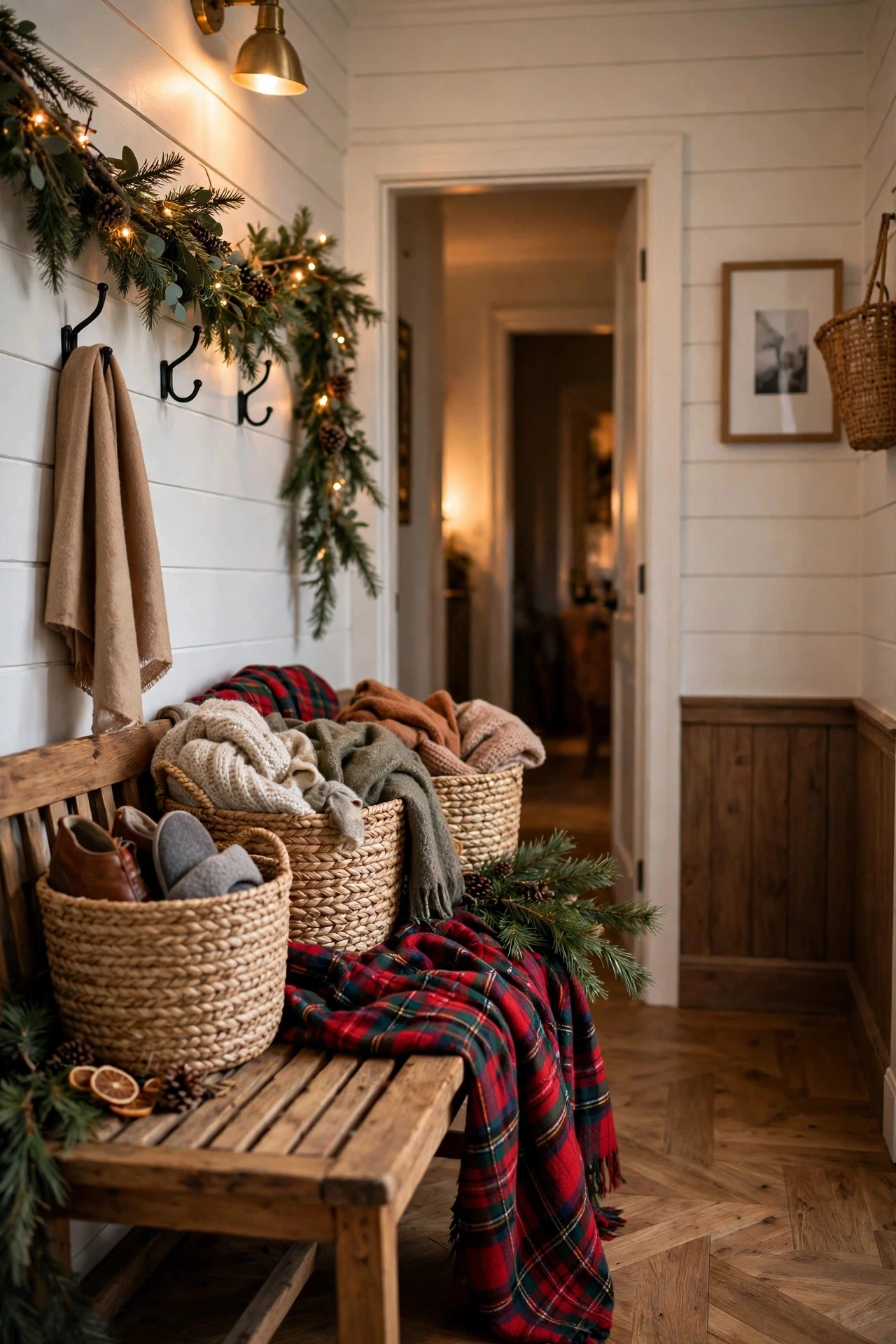
Use baskets in a festive hallway as both decoration and storage: a large seagrass basket for wrapping paper, a woven tray on the console for keys, and a lidded basket under the bench for hats and gloves. Christmas makes hallways messier, so storage that looks like decor is the most useful decoration of all.
Line a basket with a folded tartan throw or a red tea towel, and tuck a sprig of pine into the rim so the storage reads as part of the display. Give each basket one job — shoes, dog leads and umbrellas, or incoming parcels — and keep them against the wall, never in the walkway. Seagrass baskets cost £8–£20 each; a set of three nesting baskets runs £20–£35. Avoid open baskets of loose baubles at floor level — they become a mess the first time a dog or toddler walks past — and never store anything in front of a radiator or a fire exit.
16. What Colours Work Best in a Christmas Hallway?

The colours that work best in a Christmas hallway are the ones used with discipline: classic red, green and gold; elegant all-white with silver; or a bold two-colour scheme like forest green and cream, or navy and gold. In a narrow hall, a tight palette repeated at every level reads as a designed display, while five colours read as clutter.
Pick three colours maximum — a main colour, a secondary and one metallic — and use them on the wreath, the runner, the console display and the stair garland. Red and green is the most classic combination and photographs beautifully; all-white with silver reads expensive in modern halls; navy and gold feels luxurious among a street of red doors. The traditional colours of Christmas decorations are red, green and gold. Avoid using every colour you own, and avoid black as a main colour — in a narrow hall it swallows the light. A disciplined palette costs nothing extra, and it is the cheapest way to make a hallway look designed.
17. How Do You Style a Hallway Bench So Guests Feel Welcome?
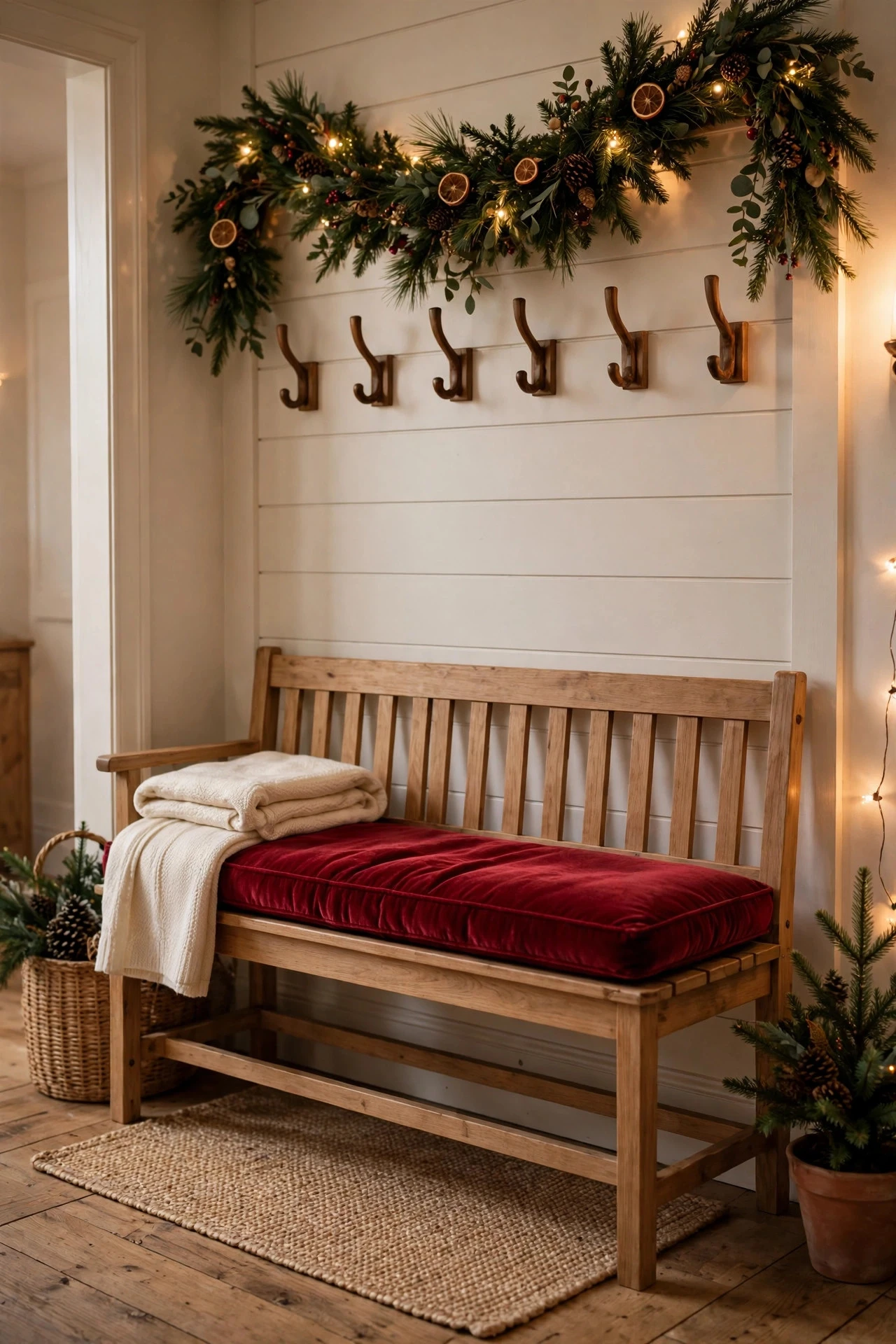
Style a hallway bench so guests feel welcome by giving it three things: a cushion to sit on, a throw folded over one arm, and a clear space beside it for a bag. A bench is the most hospitable piece in a hallway, because it tells guests they can pause and settle in instead of hovering in the doorway.
Choose a cushion in a festive fabric — deep red velvet, forest green wool or a tartan that matches the runner — and fold a soft throw over one end so the bench looks used, not staged. Keep the bench clear of parcels and coats; its job is seating, not storage. A hallway bench costs £60–£150 new, or £20–£40 second-hand with a new £10–£20 cushion. Place it against the longest wall, leaving 90 cm of walkway in front of it, and hang a hook or two above it for guests' coats. Avoid a bench wider than the wall it sits on, and skip glass-topped benches — they show every fingerprint within an hour.
18. How Do You Hang Stockings in a Hallway With No Fireplace?

Hang stockings in a hallway with no fireplace from the banister, the console table edge or a wall-mounted rail, using stocking holders, removable hooks or ribbon loops. The banister is the best spot: hang one stocking per person from the newel post or the rail itself, spaced 30–40 cm apart, so they read as a row rather than a jumble.
Use weighted stocking holders on the console table — they grip the edge and hold a filled stocking — or fix a slim wooden rail to the wall and hang the stockings from brass hooks. Personalise each stocking with an initial, and keep them 90–120 cm from the floor so children can reach theirs. Stockings cost £5–£12 each, holders £3–£8 each, and a wall rail £10–£20. Avoid hanging stockings where they block the handrail grip, and never hang them over a radiator. These Christmas mantel ideas for a mantel that steals the show show how to style a row of stockings as a display.
19. How Do You Keep a Christmas Hallway Safe and Clutter-Free?
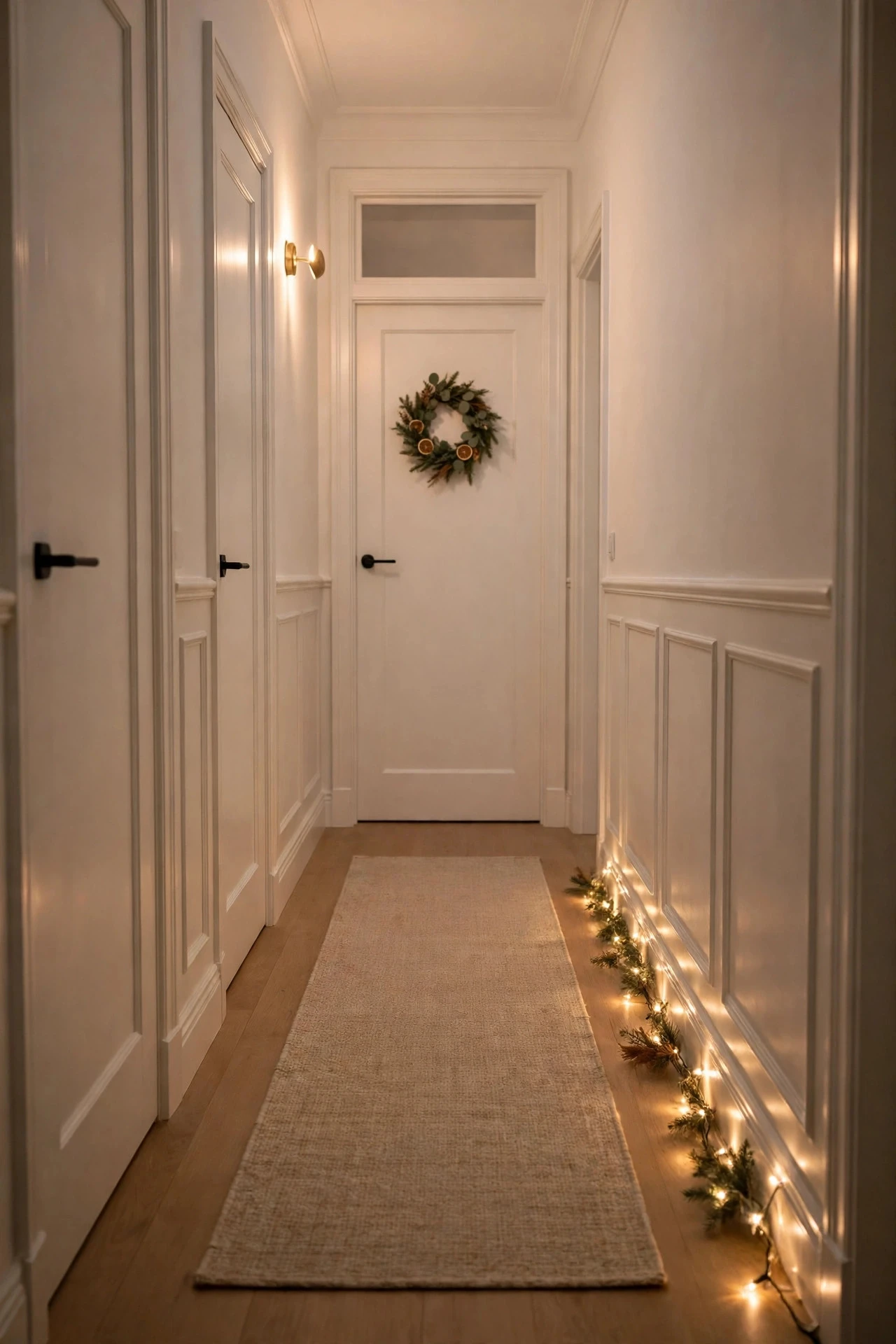
Keep a Christmas hallway safe by treating the walkway as sacred: a clear 90 cm path from door to living room, nothing on the floor except a flat runner, and every cable tucked against the wall. A hallway is an escape route as well as an entrance, and a hall that blocks the way out is a dangerous one.
Use battery lights only — never mains cables across a hallway floor — and hide battery packs behind the console or the newel post, taping wires flat to the skirting board. Keep real candles out of the hallway entirely — use LED candles in lanterns instead — and check every morning that nothing has slipped into the walkway. Give every guest item a home — a tray for keys, hooks for coats, a basket for shoes — so the floor stays clear. Avoid floor lanterns in a hall narrower than 120 cm, and never block the fuse box, the front-door lock or a fire alarm.
20. How Do You Layer Textures in a Hallway Without Overdoing It?

Layer textures in a hallway by choosing three contrasting surfaces and repeating them: something soft, something natural and something metallic. A wool runner underfoot, a pine garland along the banister and brass candlesticks on the console give the hall warmth, nature and shine in one glance, without a fourth texture competing for attention.
Repeat each texture at least twice — the runner's wool echoed in a bench cushion, the garland's pine echoed in a vase of branches, the candlesticks' brass echoed in a mirror frame — so the layers feel deliberate. Add one soft touch at hand height, like a velvet ribbon on the wreath or a folded throw on the bench. A textured hallway costs no more than a flat one; it is about choosing materials, not spending more. Avoid mixing more than three textures, and avoid faux fur — it sheds, holds dust and looks tired by New Year.
21. How Do You Decorate a Hallway Ceiling or Light Fixture?
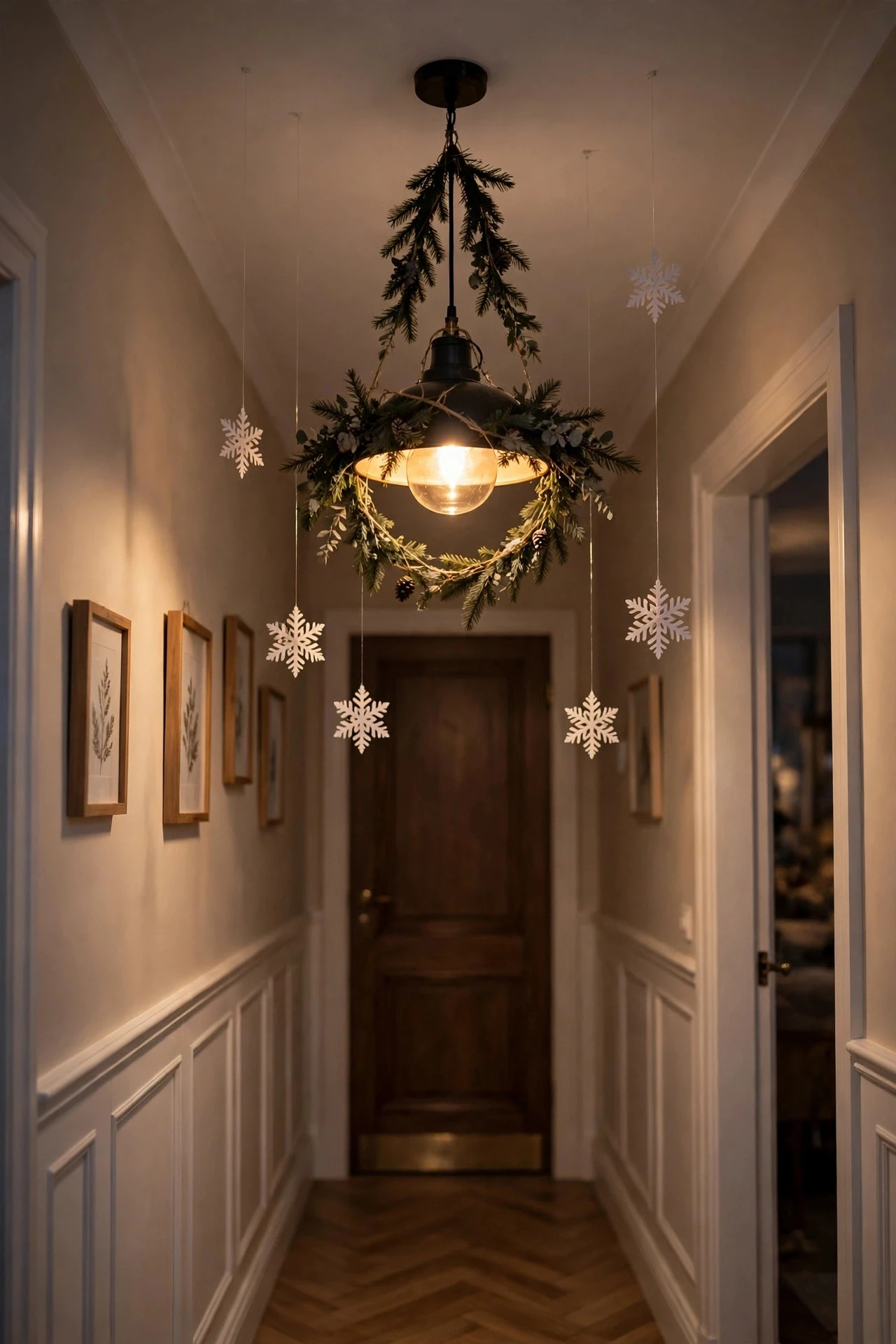
Decorate a hallway ceiling or light fixture by dressing the fitting itself, never by hanging anything low enough to walk into. Wrap a small garland swag around a pendant light's chain or cord, hang three paper snowflakes or baubles from the ceiling rose on fishing line at different heights, and let the light shine through them for a gentle sparkle.
Keep every hanging piece above 210 cm from the floor, so even the tallest guest walks under it, and use fishing line so the decorations appear to float. A pendant light with a warm bulb and a garland swag becomes the hallway's centrepiece, especially where the ceiling is high. Paper snowflakes cost nothing, a small garland swag £8–£15, glass baubles £5–£10. Avoid hanging anything heavy from a light fitting — it strains the wiring — and never drape garland over a bare bulb, where the heat dries the foliage and becomes a fire risk.
22. How Do You Tie the Hallway to the Rest of the House?
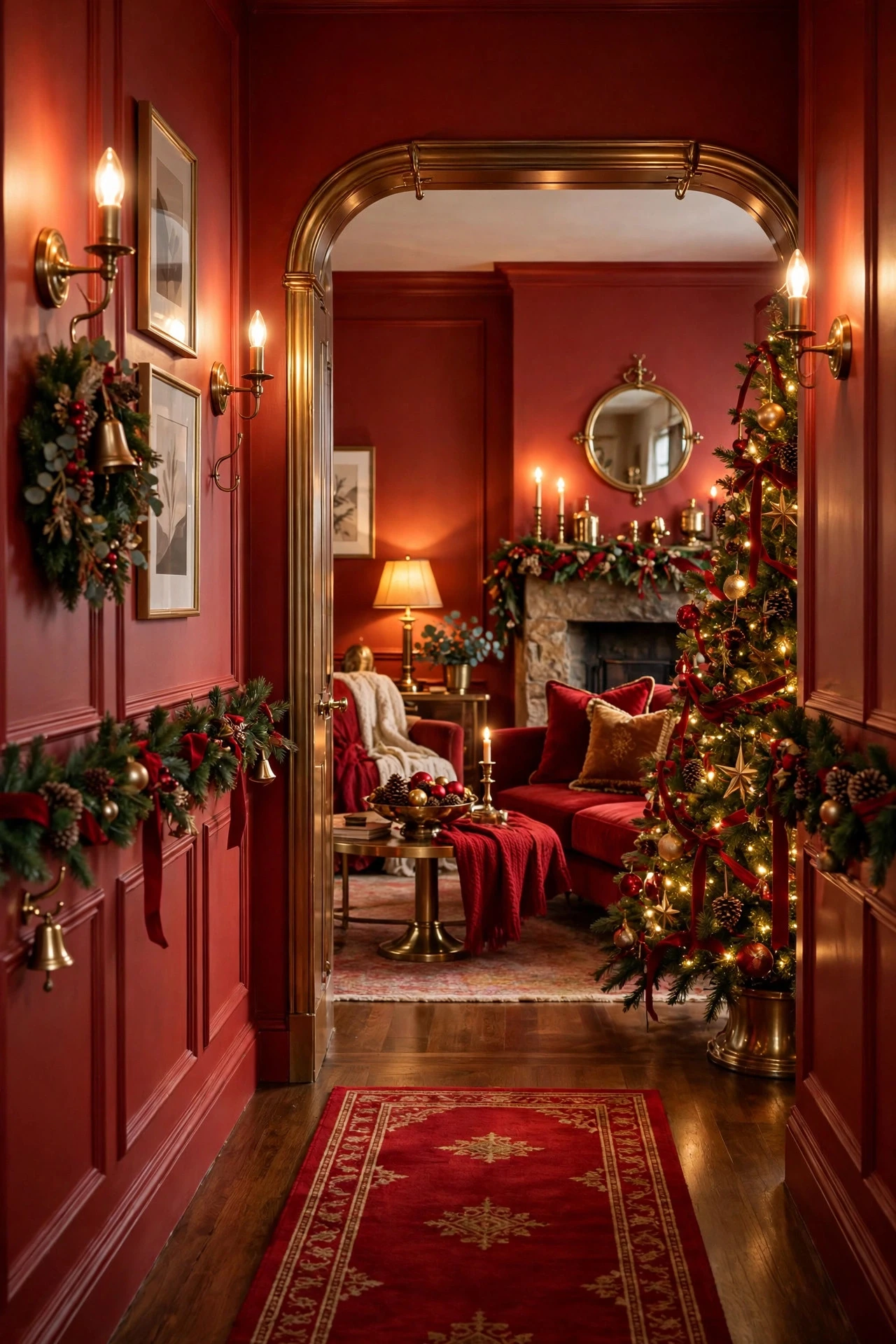
Tie the hallway to the rest of the house by repeating its palette and one signature material in every room it leads to: the same red ribbon on the hall garland and the living-room tree, the same brass candlesticks on console and mantel. Shared colours make the hallway the first chapter of the house, not a separate display.
Carry the runner's colour into the living room as a cushion or a throw, repeat the wreath's bow colour on the dining table, and use the same warm-white fairy lights throughout the house. The link does not need to be loud: one repeated colour and one repeated material are enough. For room-by-room ideas that share this palette, these 22 Christmas room decor ideas for every room in your home show how to carry one Christmas story through the whole house. Avoid giving each room a different theme — a red hallway, a blue living room and a gold kitchen feel like three houses.
Practical Tips
Start your hallway a week before the first guests arrive — garlands take an hour to hang, runners need a day to lie flat, and paint needs a night to dry. Buy the wreath, garland and runner first, because they sell out, and add the small details last.
Keep a small repair kit in the console drawer: spare command strips, extra baubles, a spare battery pack and a marker for touch-ups. Check the hallway every morning — draughts loosen garlands and guests knock stockings off hooks. For storage, coil garlands loosely in a box with tissue between layers, keep the wreath in its own box, and label it by year. Set a budget before you shop — £25–£60 covers a full hallway, £80–£120 with a new runner or mirror — and stick to it.
Final Thoughts
A Christmas hallway that welcomes guests is not the fullest hallway — it is the most deliberate one. One anchor piece, one tight palette, warm light at three heights and a clear path will do more than a hall crammed with decorations ever could.
You may also like: our 22 Christmas porch decorating ideas for a warm welcome will help you carry the same palette from the front step to the front door, so the welcome starts before guests even reach the hall.
Frequently Asked Questions
How much does it cost to decorate a Christmas hallway?
A full Christmas hallway costs £25 to £60, covering a garland, a wreath, fairy lights and a few small decorations. Adding a runner brings the total to £80 to £120, and a new mirror adds £40 to £90. Spend on one anchor piece first, usually the garland, and make the rest from paper and foraged greenery.
What is the best garland for a hallway banister?
The best banister garland is a thick faux evergreen garland, 2.7 metres long, with warm-white battery fairy lights woven through it. Faux garland holds its shape for years, does not shed needles, and costs £18 to £35. Hang it in loose swags with velvet ribbon ties, adding pinecones every 40 cm for texture.
How do you keep a Christmas hallway from looking cluttered?
Keep a Christmas hallway uncluttered by choosing one anchor piece, one tight palette of three colours, and a clear 90 cm walkway at all times. Put every small item on the console table or a wall shelf, keep the floor to one runner, and remove one decoration for every new one you add.
Can you decorate a rented hallway for Christmas?
Yes, you can decorate a rented hallway with removable fixings only: over-door hooks, command strips, painter's tape, tension rods and freestanding furniture. Hang the wreath from an over-door hook, drape garland from a tension rod, and dress the floor with a washable runner. Photograph the hallway before you start, and test every adhesive on a hidden corner first.
How do you light a dark hallway at Christmas?
Light a dark hallway in three layers: a warm ceiling light for general glow, a console lamp for mid-level warmth, and fairy lights or LED candles at low level for sparkle. Use warm-white bulbs at 2700K throughout, and put the ceiling light on a dimmer if you can. Battery fairy lights and LED candles are safe beside coats and greenery.
Where do you hang stockings if you have no fireplace?
Hang stockings from the banister, the console table edge or a wall rail, using stocking holders, removable hooks or ribbon loops. The banister works best: space one stocking per person 30 to 40 cm apart, 90 to 120 cm from the floor so children can reach them. Never hang them where they block the handrail grip, or over a radiator.