How to Style a Burgundy Bathroom That Feels Rich, Not Dark
A burgundy bathroom is the fastest way to make an ordinary washroom feel like a boutique hotel — if the shade is right and the light is handled well. Done badly, deep wine red turns a small bathroom into a cave: walls close in, the mirror goes dim, and the whole room feels smaller than it is. Done well, the same colour wraps the room in warmth, makes white porcelain glow, and turns brass and marble into something genuinely luxurious.
This guide covers the full process: picking the right undertone, testing it before you commit, pairing it with vanities, tiles and metals, lighting it so it reads rich rather than gloomy, and handling small and windowless bathrooms without fear. Every idea includes real measurements, paint and finish specs, budget notes, and the mistakes worth avoiding — plus reversible options if you are not ready to paint a whole wall.
Looking for more inspiration? Our Nest Decorz homepage gathers the latest home decor ideas, seasonal decorating guides and room-by-room styling tips in one place — start there and explore.
Quick answers
– Undertone first: blue-based wine and oxblood read elegant and cool; brown-based garnet reads warm and earthy — test both before you commit. – The safe ratio: keep burgundy to about 30–40% of the room — one wall, the vanity, or the lower half — and let white, marble and light tile do the rest. – Light is everything: 2700K warm-white light flatters burgundy; cool white turns it flat and purple-grey. – Small bathrooms can do it: a burgundy vanity or wainscot, a large mirror and gloss tile keep a compact room bright. – Not ready to paint? Start reversible — towels, a shower curtain, a painted vanity or peel-and-stick tile — for $40–$150.
1. How Do You Pick the Right Burgundy Shade?

Start with the undertone, not the paint chip, because two burgundies that look identical in the shop can behave completely differently on your wall. Blue-based burgundies — wine, oxblood and bordeaux — have a cool, purple-leaning depth that reads elegant and slightly formal. Brown-based burgundies — garnet, merlot and claret — lean warm and earthy, and sit more comfortably beside timber vanities and cream tiles.
Hold the swatch against your existing fixtures before you decide. A blue-based wine flatters chrome and cool white porcelain, while a brown-based garnet flatters brass, walnut and warm marble. Check the light reflectance value on the paint card: anything under 10 will read very dark in a small room, so aim for 10–18 if the bathroom has no window. Buy sample pots of two shades, one from each family, and paint them side by side — the difference will be obvious within a day. Avoid choosing from a phone screen alone; burgundy shifts dramatically between screens and real walls.
2. How Do You Test Burgundy Undertones Before You Commit?
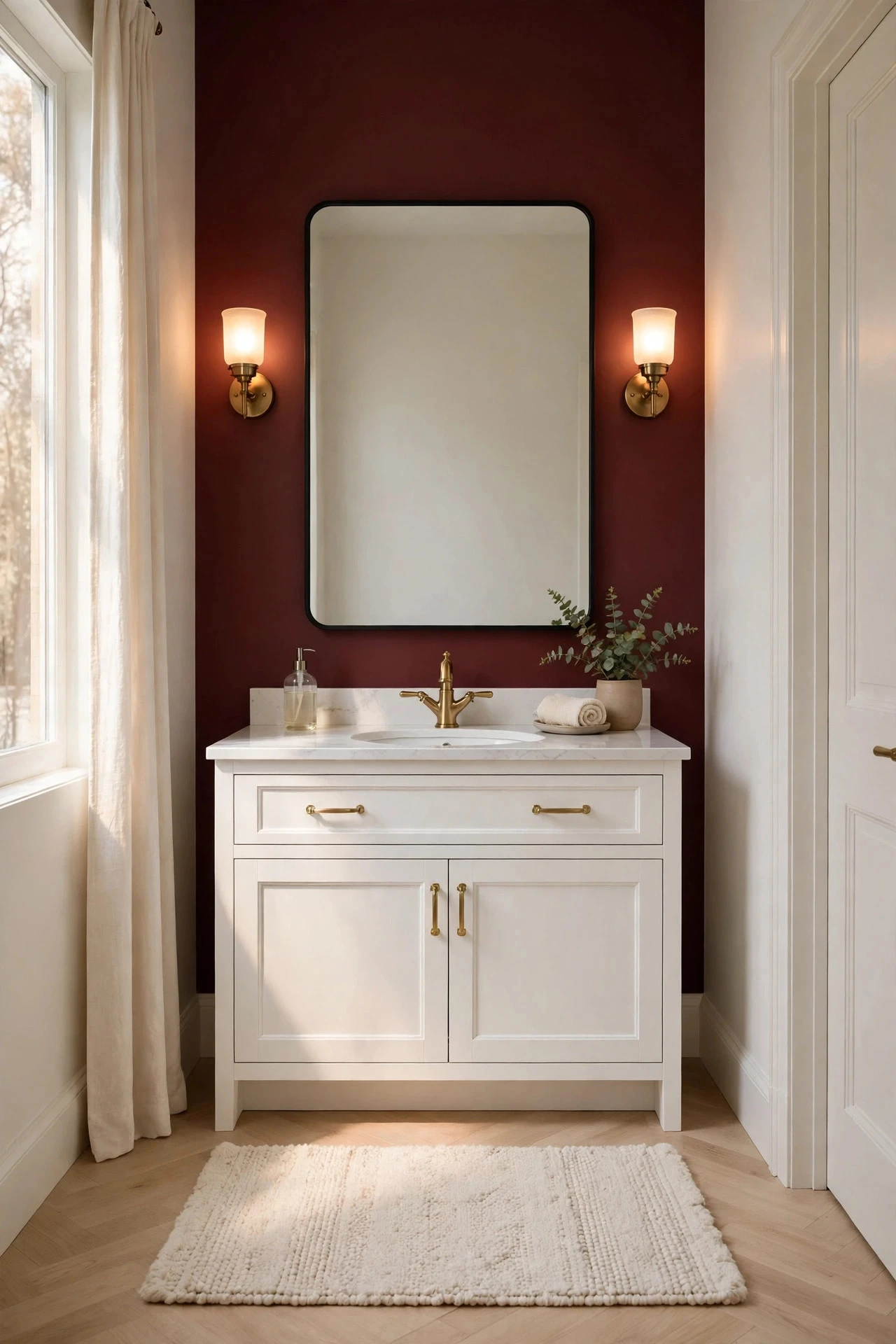
Paint large test patches — at least 24 x 24 inches — on the wall you plan to paint, and live with them for three full days. A tiny swatch lies; a large patch tells the truth about how the colour behaves at 7 a.m. in cold daylight, at noon, and at night under your actual bathroom bulbs. Tape a white card beside each patch so you can see the undertone clearly.
Test the patch in the exact spot it will live, because burgundy next to a white bath reads cooler than burgundy next to a timber vanity. Check it against your towels, your tile and your metal finishes at the same time — a garnet that looks rich beside brass can look muddy beside chrome. If the patch goes purple under your bulbs, the undertone is too blue for your lighting; if it goes brown, it is too warm for your fixtures. The shade that still looks like wine in all three lights is the one to buy.
3. How Much Burgundy Is Too Much in a Bathroom?
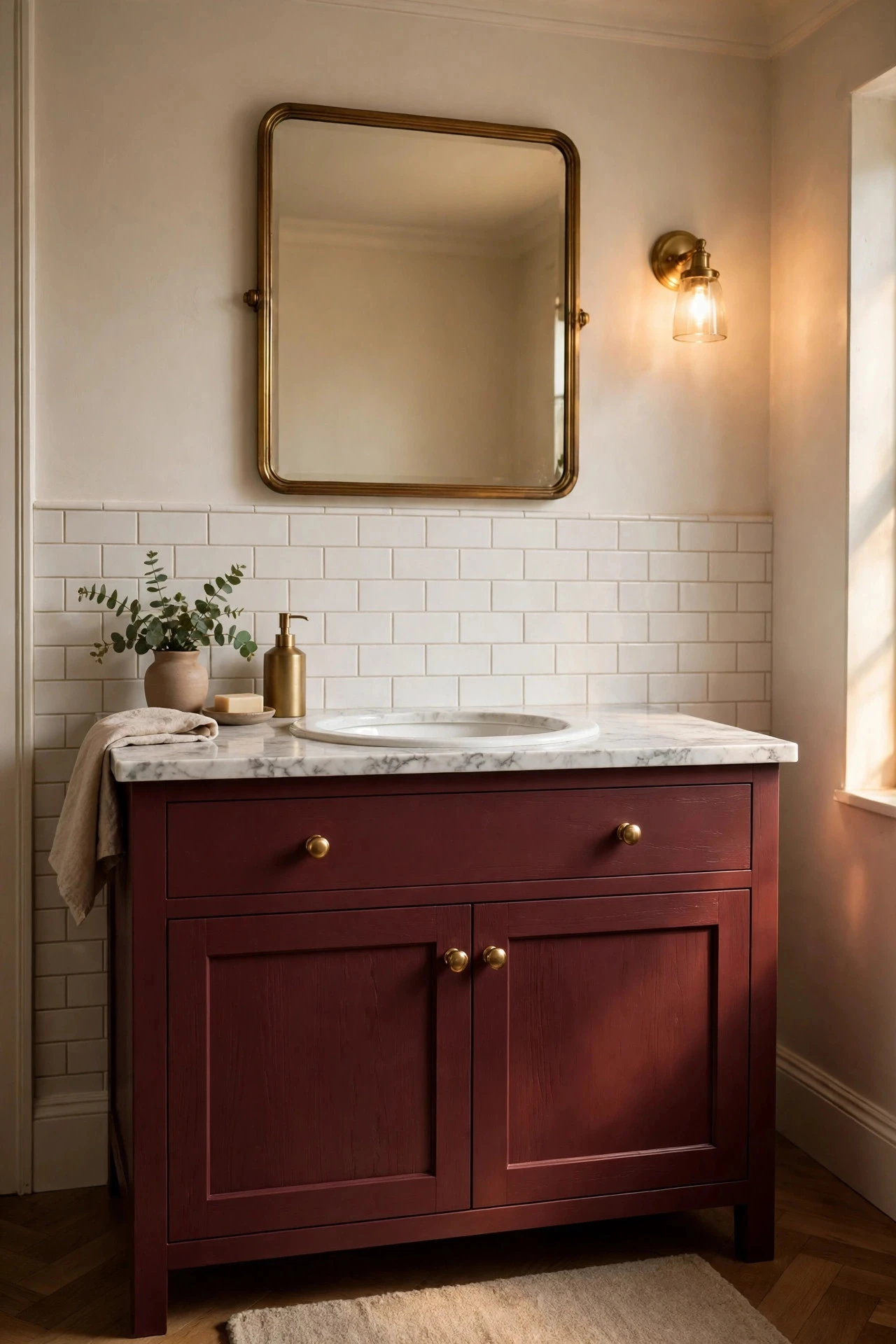
The rule that keeps a burgundy bathroom rich rather than oppressive is proportion: burgundy should cover roughly 30–40% of the visible surfaces, with light neutrals carrying the rest. One burgundy wall, a burgundy vanity, or burgundy wainscot on the lower half of the walls all hit that ratio in a standard 5 x 8 foot bathroom. Four burgundy walls plus a burgundy ceiling is the cave everyone fears.
Think of burgundy as the anchor and white, marble, pale timber or soft grey as the balance. In a large bathroom with a window you can push toward 50% — two walls, or full-height tile in a wine glaze — because daylight does the lifting. In a small or windowless room, stay near 30% and spend the rest on gloss tile, a large mirror and pale flooring so light bounces. A quick check: stand in the doorway and squint. If you see burgundy first and everything else second, you are at the limit; if you see only burgundy, pull back a wall.
4. How Do You Pair Burgundy With a Vanity?

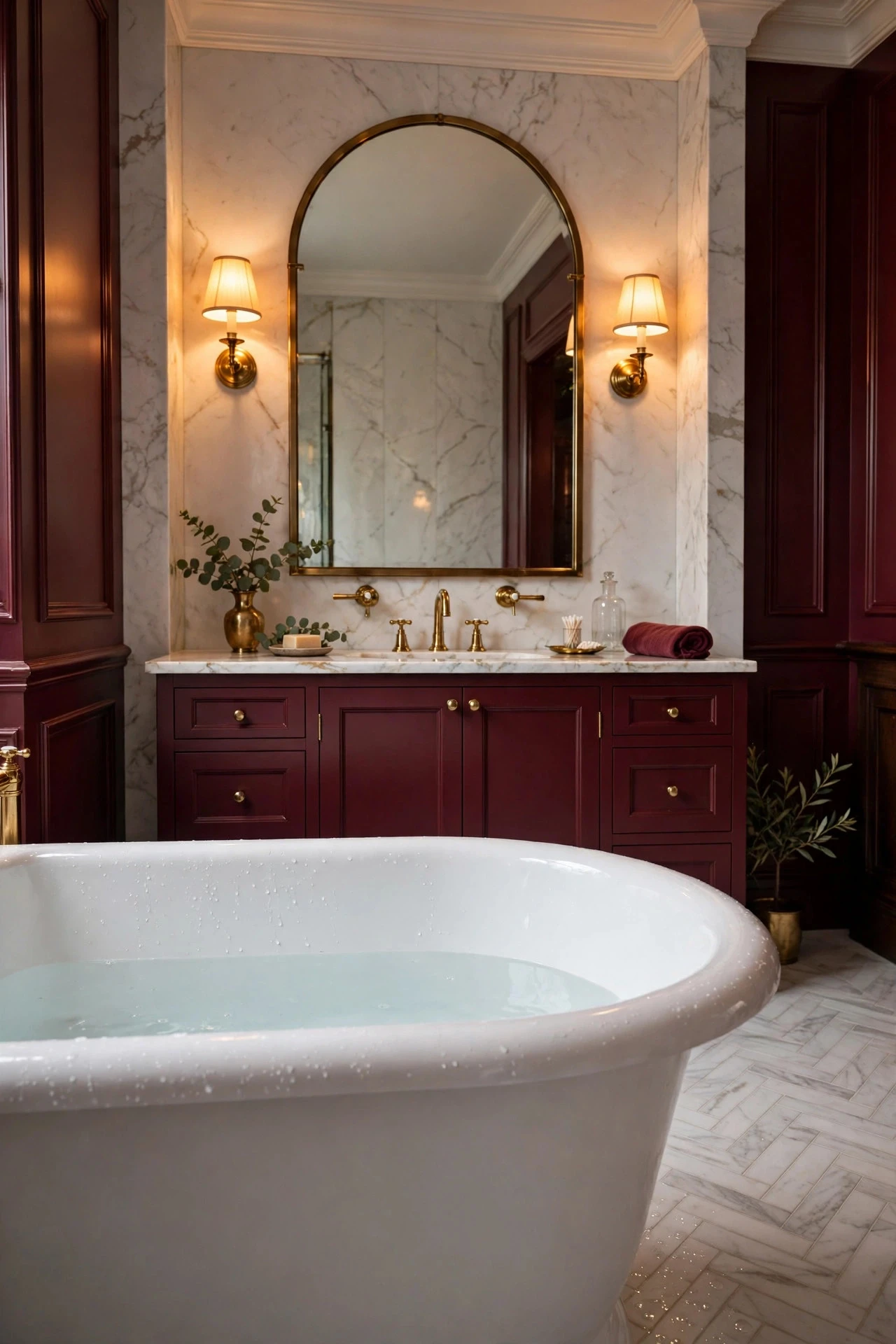
A burgundy vanity is the single most effective burgundy move in a bathroom, because it concentrates the colour in one piece of furniture and leaves the walls light. A deep wine vanity in a satin or semi-gloss finish, with brass knobs and a white quartz or marble top, reads like a piece of furniture rather than a bathroom fixture.
Choose the vanity finish carefully: painted burgundy in a moisture-resistant enamel looks richer than stained wood trying to be wine-coloured, and it is easier to touch up. Pair it with a white vessel or undermount basin so the porcelain breaks up the colour, and keep the splashback pale — white subway tile or pale marble — so the vanity stays the star. For help choosing the right vanity style, proportions and storage, see these luxury bathroom vanity ideas. Avoid a burgundy vanity with a burgundy wall behind it unless the tones are deliberately different; matching them exactly flattens the whole wall into one dark block.
5. What Tile Colours Work With Burgundy Walls?

Burgundy walls need tile that reflects light and gives the eye somewhere pale to rest. White subway tile, warm ivory zellige and pale marble-look porcelain are the safest partners: their gloss bounces light back into the room and their veining echoes the depth of the wine colour.
If you want burgundy in the tile itself, use it as an accent: a single row of wine-glazed tiles as a border, or burgundy penny tiles in the shower niche only. In a walk-in shower, pale large-format tile on the walls with a burgundy accent niche gives you the colour without shrinking the space; our guide to how to design a walk-in shower that feels like a spa covers the layout and tile proportions that make this work. Avoid dark grey or black tile with burgundy walls — the combination swallows light and makes even a large bathroom feel like a basement.
6. How Do You Style a Burgundy Accent Wall?

A burgundy accent wall works when it is the wall the eye lands on first — usually the wall behind the vanity or the wall opposite the door — and the other three walls stay pale. Paint it in a matte or eggshell finish so the colour reads deep and velvety rather than shiny; gloss on a full wall shows every bump and roller mark. A single wall in a blue-based wine, with white trim and a large mirror breaking up the middle, feels deliberate and expensive.
Add texture so the wall does not read flat: wainscoting painted the same burgundy, vertical tongue-and-groove panelling, or a limewash effect that gives the colour movement. Hang one piece of art or a framed print with cream matting on the wall, and keep the rest of the decor minimal — the wall is the decoration. Avoid painting the wall with the towel rail or the door on it; the wall gets visually chopped up, and the burgundy reads as an accident rather than a choice.
7. How Do You Keep a Small Burgundy Bathroom From Feeling Dark?

A small bathroom can absolutely handle burgundy — the trick is to spend the colour low and keep the light high. Put burgundy on the vanity, the lower half of the walls, or the floor tiles, and keep the upper walls, ceiling and shower surround white or very pale. That way the dark colour grounds the room while the pale upper half keeps the ceiling feeling high.
Add the biggest mirror the wall allows, ideally spanning the full width of the vanity, because it doubles the perceived space and bounces every bit of light back into the room. For layout tricks that make a compact bathroom fit a real tub and still feel open, see these tiny full bathroom ideas. Avoid a dark ceiling, a small mirror, and a shower curtain in a dark colour all at once — any one is fine, but together they close the room in.
8. What Lighting Temperature Flatters Burgundy Best?

Burgundy is one of the most light-sensitive colours in home decor, so the bulb temperature matters more than the paint brand. Warm white light at 2700K is the sweet spot: it deepens the wine tones, flatters skin in the mirror, and makes brass look golden. Step up to 3000K and the colour stays true but slightly cooler; go to 4000K daylight white and burgundy turns flat, greyish and oddly purple.
Layer three sources: a ceiling light for general brightness, sconces or a lit mirror at face height on either side of the mirror for grooming, and a small accent light — a picture light, a candle-style sconce or a low shelf light — to make the burgundy wall glow. Put the vanity lights on a dimmer so you can soften the room for a bath and brighten it for makeup. Avoid a single overhead bulb as the only light source; it casts shadows downward and makes the burgundy read muddy from the doorway.
9. How Do You Handle a Windowless Burgundy Powder Room?

A windowless powder room is actually the best place in the house for bold burgundy, because nobody expects daylight there and the drama is the point. Guests spend three minutes in a powder room, so a deep wine wall, a statement mirror and warm sconces feel like a jewel box rather than a cave. The rules change here: you can push burgundy to 50–60% of the surfaces because the room is small and the visit is short.
Light it like a restaurant washroom, not a family bathroom: two sconces flanking the mirror at eye level, a warm 2700K ceiling light on a dimmer, and a lit mirror if you can stretch to one. Use gloss or satin finishes so the light bounces, and choose a large mirror with a brass or dark timber frame to break up the wall. Avoid flat matte paint in a windowless room — it drinks the light — and avoid cool-white bulbs, which turn burgundy into a cold, bruised purple with no warmth at all.
10. Which Metals Pair Best With Burgundy?

Brass is burgundy's best friend. Warm unlacquered brass, brushed brass or antique gold picks up the warm notes in the wine colour and makes the whole room glow, especially under 2700K light. Use it for taps, mirror frames, towel rails, cabinet knobs and light fixtures, and keep the finish consistent across the room so it reads intentional rather than mixed.
Matte black is the modern second choice: it sharpens burgundy and gives it a contemporary edge, but it absorbs light, so use it sparingly in a small bathroom — taps and a mirror frame, not every fitting. Polished chrome and nickel can work with blue-based wine shades, but they cool the colour down and can make brown-based garnet look muddy, so test them against your exact paint patch first. Copper sits between brass and rose gold and suits brown-based garnets beautifully. Avoid mixing three metals in one bathroom; two at most, with one clearly dominant, keeps the room feeling designed rather than assembled from leftovers.
11. How Do You Choose Burgundy Grout and Caulk?

Grout is the detail that decides whether burgundy tile looks expensive or messy. For white or pale tile beside burgundy, choose a warm grey or greige grout — it hides splashes, softens the contrast with the wine wall, and does not go yellow the way bright white grout does. For burgundy tile itself, use a grout one shade lighter than the tile so the tile pattern reads without the grid screaming for attention.
Caulk is simpler: match it to the tile, not the paint, and always use a silicone caulk rated for bathrooms, because standard caulk cracks and mildews within a year in a wet room. Where burgundy paint meets white tile or a white bath, run a neat bead of white silicone and keep the paint edge crisp with a good painter's tape line; a wobbly edge between wine and white is visible from across the room. Avoid dark grout with pale tile — the grid competes with the wine colour — and never leave grout unsealed, because it stains fast.
12. What Paint Finish Survives Bathroom Moisture?
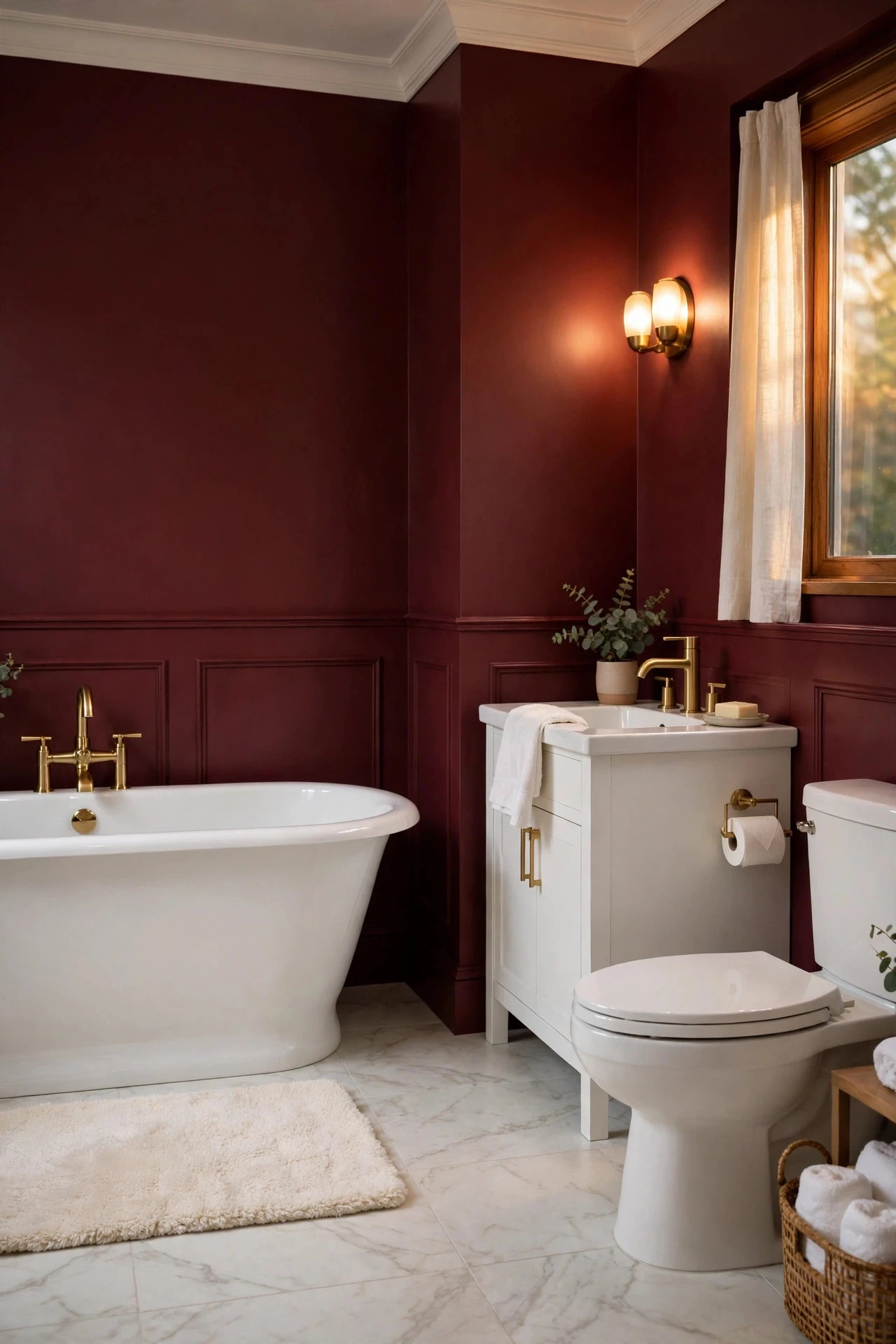
Burgundy shows moisture damage faster than pale colours, so the finish is not a style choice — it is a durability choice. A satin or semi-gloss finish is the right call for bathroom walls: it resists steam, wipes clean, and reflects a little light back into the room. Use a paint labelled specifically for bathrooms or kitchens, which contains mildewcides and handles humidity cycles without blistering.
Flat or matte paint looks velvety and gorgeous in a burgundy bedroom, but in a bathroom it marks with every splash, absorbs steam, and is nearly impossible to clean without leaving a shiny patch. Prepare the wall properly: sugar-soap the surface, fill and sand, prime with a stain-blocking primer if you are painting over a dark or glossy colour, then apply two thin coats rather than one thick one. The Spruce's guide to how to paint a bathroom covers surface preparation and ventilation in detail.
13. How Do You Balance Burgundy With White Fixtures?

White fixtures are what stop a burgundy bathroom from feeling heavy, so treat them as design features, not defaults. A white freestanding bath, a white ceramic basin and a white toilet create three bright anchors that break the wine colour into manageable sections. The contrast is the point: burgundy looks richer precisely because it sits next to clean white porcelain.
Keep the white crisp rather than creamy. A warm cream suite beside a blue-based wine wall can look yellowed, while a bright white suite beside a brown-based garnet can look cold, so check your fixture white against your paint patch in daylight before you commit. Leave breathing room around each fixture — do not run burgundy tile right up to the rim of the bath or basin without a pale border or a strip of white tile to frame it. Avoid an all-burgundy suite — coloured baths and basins date fast, are hard to replace, and make the room feel like a 1970s time capsule rather than a modern boutique bathroom.
14. How Do You Style Burgundy With Marble?

Burgundy and marble are a classic luxury pairing because the stone's cool veining tempers the wine colour's warmth. Carrara marble, with its soft grey veining on white, is the safest partner for both blue-based and brown-based burgundies. Calacatta, with bolder gold veining, suits brown-based garnet especially well, while a darker marble like Nero Marquina with white veining can work in a large bathroom but will darken a small one.
Use marble where it earns its keep: a vanity top, a shower wall, a window sill or a bath surround, and let the burgundy live on the painted walls or the vanity cabinet below it. Marble-look porcelain gives you the same veining at a fraction of the cost — $4–$8 per square foot versus $60–$100 for real stone — and it handles bathroom moisture without sealing. Avoid busy, heavily veined marble on every surface at once; one marble surface plus burgundy plus plain white tile is the right amount of pattern for one bathroom.
15. What Towels and Textiles Soften Burgundy?
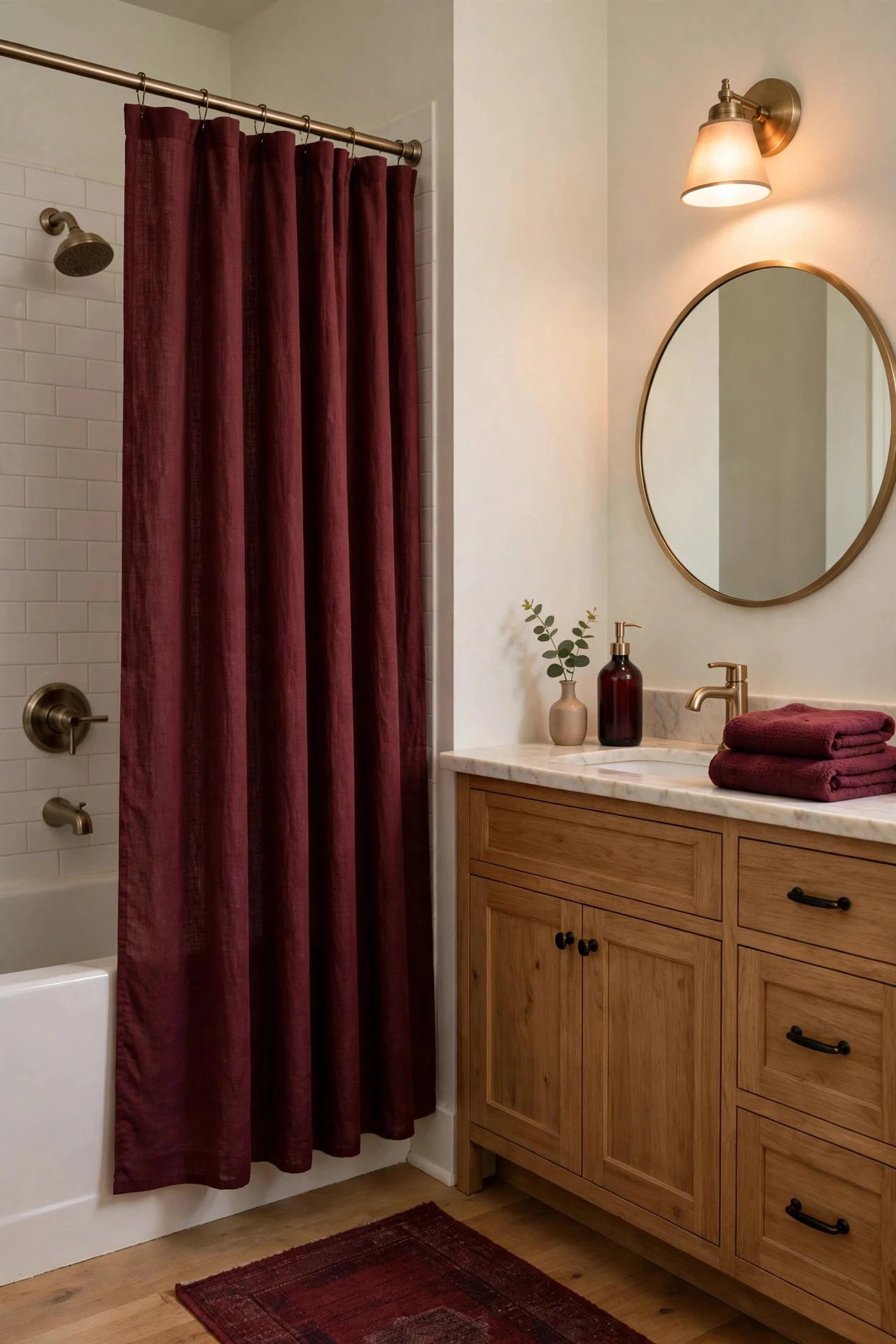
Textiles are the easiest way to soften a burgundy bathroom because they add pale, touchable contrast at exactly the heights where the colour is strongest. Cream, ivory and warm white towels are the classic choice: hang a folded cream bath towel over the rail so it breaks the burgundy wall into two sections, and stack rolled white hand towels in a basket beside the vanity. Blush pink towels are a softer, more romantic option that picks up the red notes in burgundy without competing with them.
Choose texture over pattern here. Waffle weave, Turkish cotton and linen-look towels add warmth and visual interest without introducing another colour or print that fights the wine shade. For storage that keeps spare towels tidy and visible, these small bathroom storage ideas show how baskets and open shelving can hold the soft layers a burgundy room needs. Avoid a full set of burgundy towels, a burgundy bath mat and a burgundy shower curtain together; the room tips from rich to monochrome, and the textiles stop softening anything.
16. How Do You Add Burgundy Without Painting Anything?

If you love burgundy but are not ready to paint, the reversible route gives you 80% of the look for about 20% of the commitment. Start with a burgundy shower curtain in a solid, good-quality fabric — it covers the largest single surface in the room and comes down in a minute. Add matching hand towels, a small rug, and a soap dispenser or toothbrush holder in wine tones, and the room already reads burgundy.
A painted vanity is the next step up: one weekend, a tin of burgundy enamel and new brass knobs transform the focal point for $40–$80. Burgundy is a historic colour with a long story — the Wikipedia article on burgundy) traces the shade from wine to wardrobe to interiors. Avoid buying ten small burgundy accessories at once; three deliberate pieces beat a dozen scattered ones.
17. How Do You Style a Burgundy Freestanding Tub?

A freestanding tub against a burgundy wall is the most photogenic combination in this whole guide, because the white porcelain glows against the wine colour like a sculpture. Place the tub so its long side faces the burgundy wall, leaving at least 6 inches of clearance behind it for cleaning, and centre it on the wall with a tall plant or a floor-standing candle holder on one side for balance.
Keep everything around the tub pale and simple so the contrast does the work: a cream bath mat, a small timber bath tray, white rolled towels on a stool, and a single burgundy candle or a sprig of eucalyptus in a vase. Floor-mounted brass taps in a warm finish complete the look and pick up the wine tones without adding another colour. Avoid a burgundy tub surround or a burgundy tiled plinth under the tub — the porcelain needs white space around it to shine, and burying it in the same colour flattens the whole arrangement.
18. What Mirror Shapes and Frames Suit Burgundy?
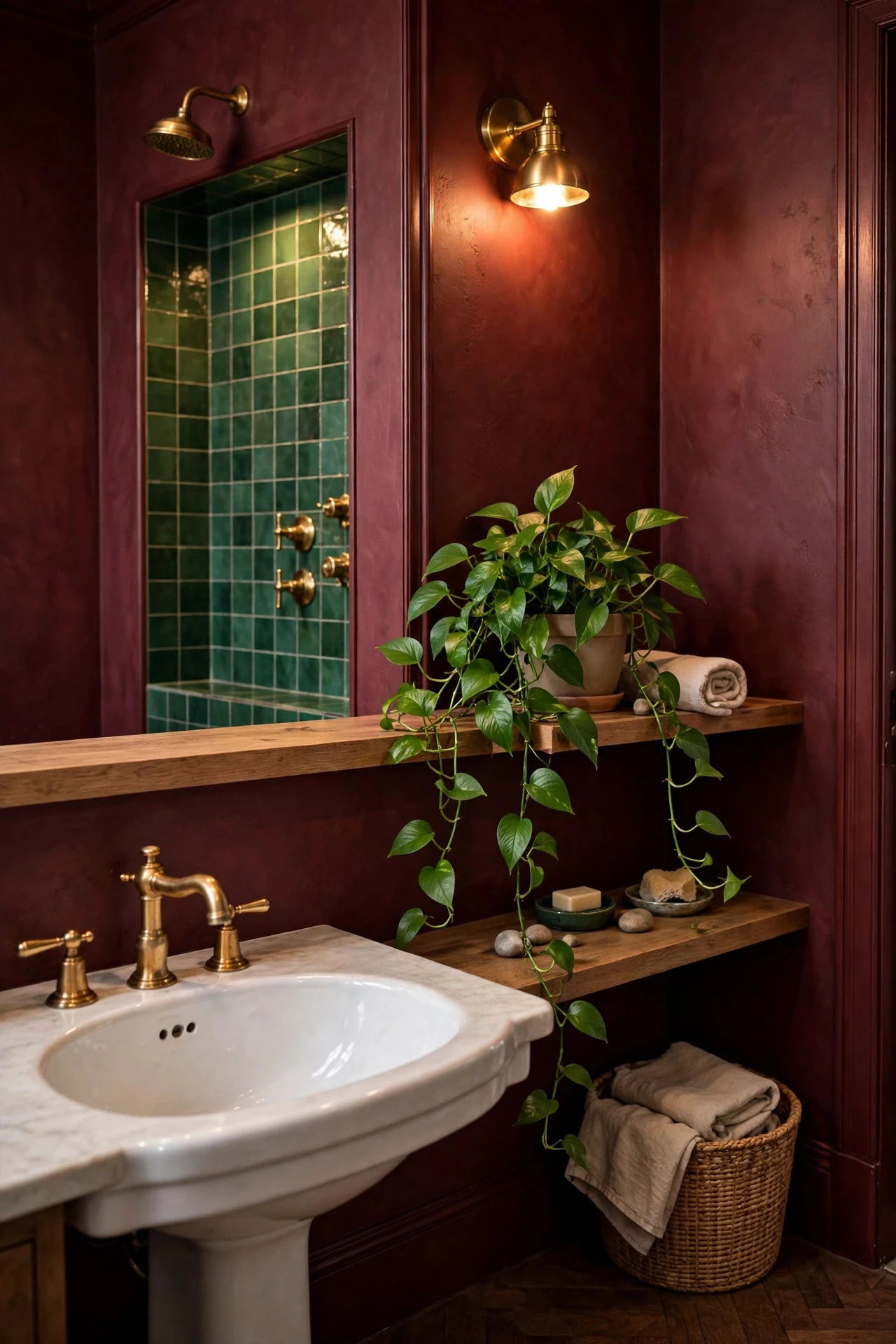
The mirror is the piece that stops a burgundy wall from feeling like a solid block of colour, so its shape and frame deserve real thought. An arched mirror softens the straight lines of a wine wall and adds a gentle curve that echoes a roll-top tub; a tall rectangular mirror with a brass frame adds structure and reflects the most light.
Frame the mirror in a metal that matches your taps — brass for warmth, matte black for contrast — and make it generous: the mirror should be roughly two-thirds the width of the vanity, or span the full vanity width in a small bathroom. Hang the mirror so its centre sits at 57 to 60 inches from the floor, the standard eye level for art and mirrors. Avoid a frameless mirror on a burgundy wall — without a frame the edges disappear into the colour and the mirror looks like a hole in the wall rather than a deliberate feature.
19. How Do You Mix Burgundy With Green in a Bathroom?
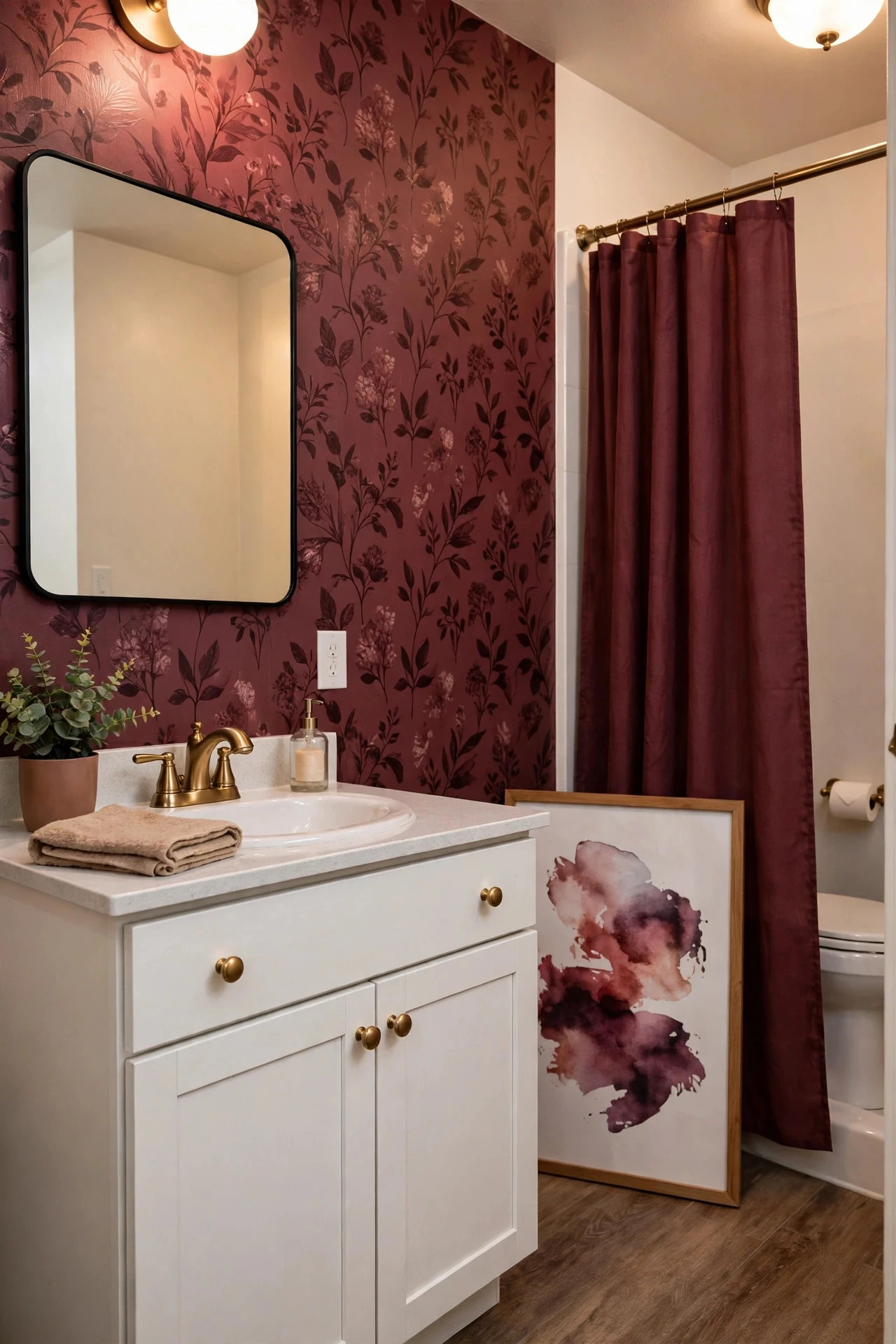
Burgundy and green are natural partners — they sit opposite each other on the colour wheel, and the combination has been used in grand houses for centuries — but in a bathroom the green needs to be the supporting player, not an equal rival. Use a deep forest or sage green in small doses: a plant, a green tiled shower niche, green glass bottles on the shelf, or a single green towel. The burgundy stays dominant at 30–40% of the room, the green at 5–10%.
If you want the combination as a full scheme, our burgundy and green bedroom guide shows how the two colours balance across a whole room, and the same ratio rules apply here — one dominant, one accent, and plenty of white between them. Avoid equal halves of burgundy and green paint, which reads as a Christmas scheme all year round, and avoid lime or mint greens, which clash with the depth of wine red instead of complementing it.
20. How Do You Style a Burgundy Bathroom in a Rental?
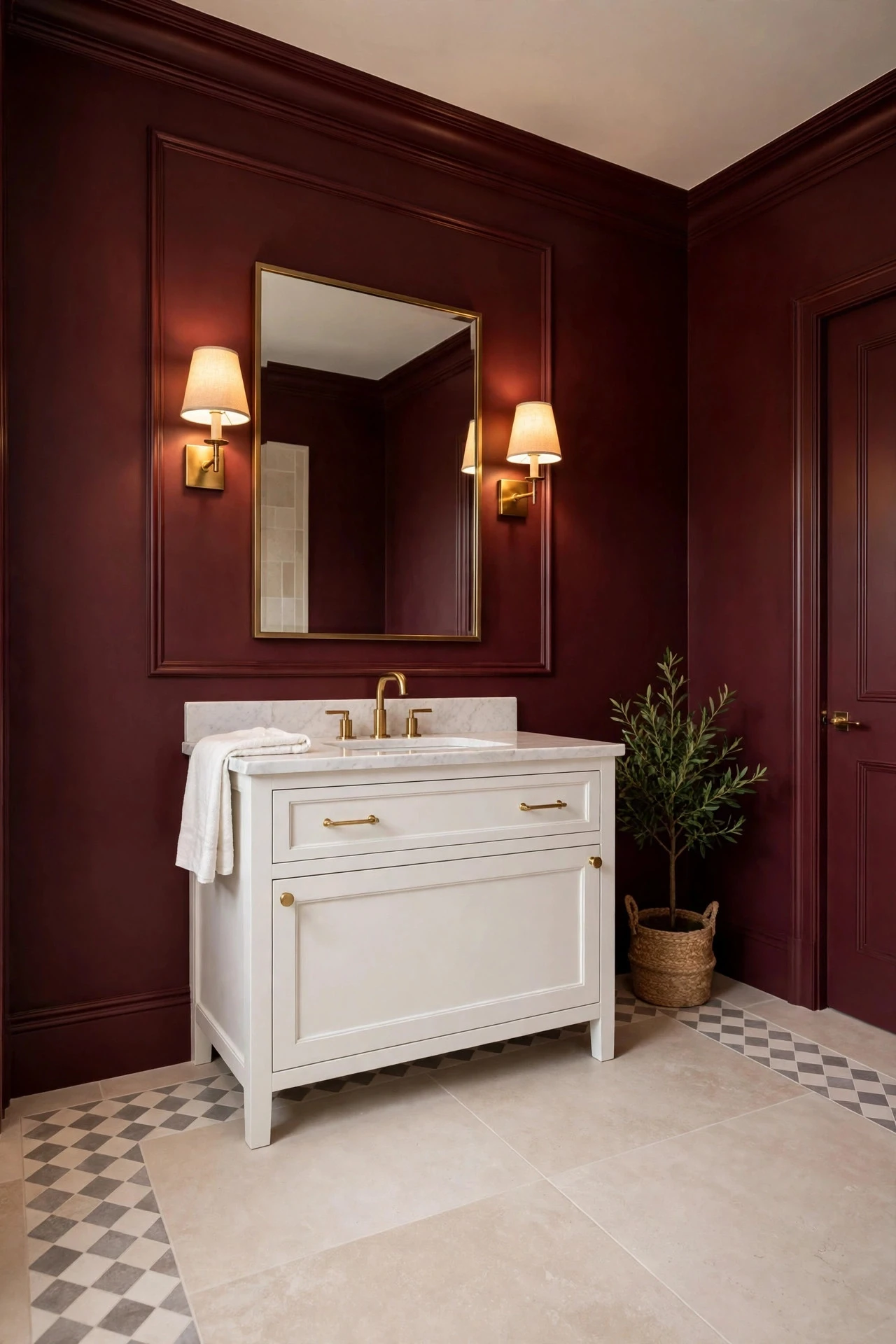
Renters can have a burgundy bathroom without losing a deposit, because the best burgundy moves in this guide are all reversible. Peel-and-stick wallpaper in a wine tone on one wall costs $25–$50, goes up in an afternoon, and peels off cleanly — test a corner first and never apply it to fresh paint or textured walls. A burgundy shower curtain, matching towels and a rug give you the colour at every height for under $100, and they move with you.
Open shelving is your friend in a rental bathroom — these bathroom shelf decor ideas show how to style shelves that add colour and storage without drilling. Avoid painting the landlord's walls, drilling into tile, or sticking anything to a surface you cannot test first; a burgundy bathroom you have to repaint in January is not a bargain.
21. What Flooring Works Under a Burgundy Bathroom?
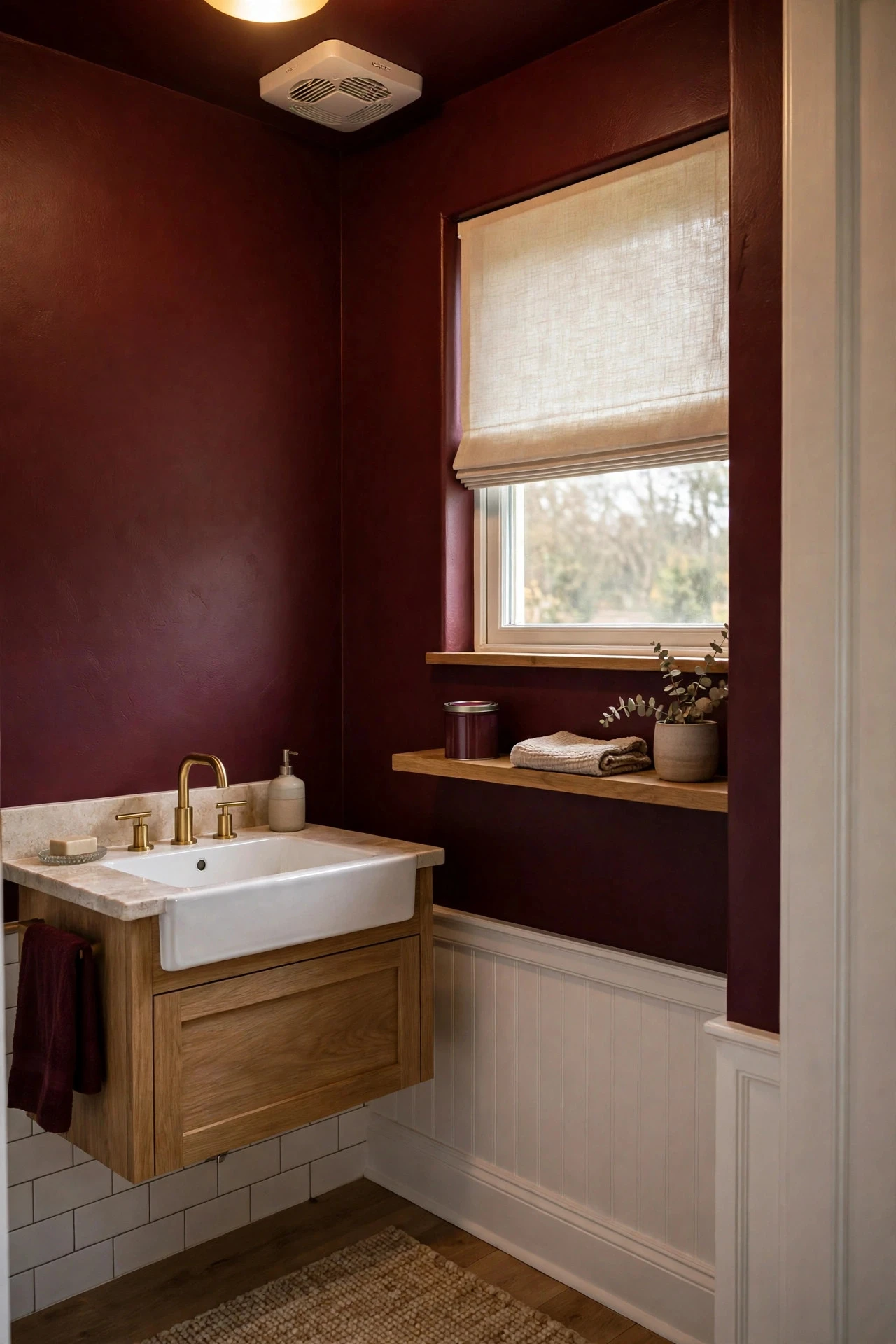
Flooring under burgundy should be pale, warm and practical, because the floor is the surface that balances the dark walls. Large-format porcelain tiles in warm limestone, pale terrazzo or soft greige keep the room bright and are fully waterproof, which matters more than any style consideration in a bathroom. A pale floor with a subtle pattern — a soft checkerboard in cream and warm grey, or a terrazzo with burgundy flecks that echo the walls — ties the whole scheme together without adding a second dark surface.
Timber-look porcelain gives you the warmth of wood with the waterproofing of tile, and it suits brown-based garnet especially well; choose a mid-tone oak rather than a dark walnut, which competes with the burgundy. Avoid dark slate or black floor tiles with burgundy walls — the room loses its pale anchor and the ceiling feels lower — and avoid real timber flooring, which swells and warps in bathroom humidity no matter how well it is sealed.
22. How Do You Keep Burgundy Looking Rich Years Later?

Burgundy fades faster than most colours, so a little maintenance keeps it rich instead of letting it drift toward a tired brown-pink. The main enemy is sunlight: if the bathroom has a window, fit a blind or a UV-filtering film, because direct sun bleaches the red pigments within a year or two. Ventilate well after every shower — run the extractor fan for 20 minutes — because trapped steam lifts paint edges and encourages mildew that shows clearly on dark walls.
Clean the walls with a damp microfibre cloth and a drop of mild detergent, never an abrasive pad, which burnishes a shiny patch into a satin finish. Recoat the room every three to four years rather than waiting until it looks tired — a fresh coat on a well-prepared wall takes a weekend and costs under $60.
Practical tips for a burgundy bathroom
Test undertones in your own light. Paint 24-inch patches of a blue-based wine and a brown-based garnet side by side, and check them morning, noon and night for three days. The shade that still looks like wine under all three lights is the one to buy.
Keep burgundy to 30–40% of the room. One wall, the vanity, or the lower half of the walls is enough. Let white, marble and pale tile carry the rest so the room stays bright.
Use 2700K warm-white bulbs with a CRI of 90 or above. Cool white turns burgundy flat and purple-grey; warm light deepens the wine tones and flatters skin in the mirror.
Spend the colour low, keep the light high. Burgundy on the vanity or wainscot, pale upper walls, a big mirror and gloss tile keep even a small bathroom feeling open.
Buy the touch-up pot on day one. Label it with the brand, shade and date, and store it indoors. Burgundy shows chips more than pale paint, and a quick touch-up keeps the room looking freshly painted for years.
Start reversible if you are unsure. A shower curtain, towels, a painted vanity or peel-and-stick tile give you the look for $40–$150 — and you can live with the colour for a season before committing to paint.
Final thoughts
A burgundy bathroom feels rich, not dark, when the undertone is chosen for your light, the colour is kept to about a third of the room, and warm 2700K lighting does the flattering. Pick a blue-based wine for elegance or a brown-based garnet for warmth, test it in large patches, pair it with brass and marble, and keep the fixtures white so the contrast does the work. Do that, and burgundy stops being a brave choice and becomes the most luxurious room in the house.
Frequently Asked Questions
What burgundy paint colour is best for a bathroom?
A blue-based wine or oxblood suits bathrooms with chrome fixtures and cool white porcelain, while a brown-based garnet suits brass, walnut and warm marble. Look for a light reflectance value of 10–18 in a small or windowless room, and always test 24-inch patches for three days under your own bulbs before committing.
Will a burgundy bathroom make a small bathroom look smaller?
Not if you spend the colour low and keep the light high. Put burgundy on the vanity or the lower half of the walls, keep the upper walls and ceiling pale, add the biggest mirror the wall allows, A dark ceiling and a small mirror together are what shrink a room, not the burgundy itself.
What colour goes with burgundy in a bathroom?
Brass, warm white, pale marble and cream are burgundy's best partners in a bathroom, because they add light and warmth without competing with the wine colour. Sage or forest green works as a small accent through plants or a tiled niche, and matte black adds a modern edge in small doses. Avoid dark grey or black tiles, which swallow light.
Can I use burgundy in a windowless bathroom?
Yes — a windowless powder room is one of the best places for burgundy, because the visit is short and the drama is the point. Use gloss or satin finishes so light bounces, light it with warm 2700K sconces flanking the mirror, and keep the floor pale and the towels cream so there is contrast at every height.
What finish should burgundy bathroom paint be?
Satin or semi-gloss, using a paint labelled for bathrooms or kitchens. These finishes resist steam, wipe clean and reflect a little light back into the room. Flat or matte paint marks with every splash and is nearly impossible to clean in a bathroom, so reserve matte for ceilings or powder rooms that rarely steam up.
How do I add burgundy to my bathroom without painting?
Start with a burgundy shower curtain, matching hand towels and a rug, which give you the colour at every height for under $100 and come down in a minute. A painted vanity with new brass knobs costs $40–$80 and can be repainted, while peel-and-stick burgundy tiles on one wall or in the shower niche cost $30–$60 and remove cleanly.