Home Office Decor Ideas: How to Design a Workspace You Love
A home office is no longer a spare desk squeezed into a corner — it is where you spend eight hours a day, take your video calls, and do the work that pays for the rest of the house. Yet most home offices are decorated as an afterthought: a desk against a blank wall, a harsh ceiling light, and a tangle of cables. The result is a room you avoid, and a working day that feels longer than it should.
Below are 22 home office decor ideas that treat the workspace as a real room — with exact desk and monitor measurements, lighting colour temperatures that protect your eyes, storage that actually hides clutter, and styling that looks good on camera. Most ideas cost under $50 each, and the whole room can be transformed for $300 to $600. Every idea works in a dedicated room, a spare bedroom corner, or a living-room nook.
Looking for more inspiration? Our Nest Decorz homepage gathers the latest home decor ideas, seasonal decorating guides and room-by-room styling tips in one place — start there and explore.
Quick answers
– Start with ergonomics, not decoration — desk height 71 to 76 cm, monitor top at eye level, chair with lumbar support; comfort decides whether you actually use the room. – Light the desk from the side — daylight from a side window plus a 2700K to 4000K task lamp beats any single ceiling light and keeps you off-camera glare-free. – Zone first, decorate second — a rug, a shelf or a screen that marks "this is the office" matters more than any single accessory in a shared room. – Hide the cables before you buy the art — a cable tray and one power strip turn a messy desk into a calm one for under $30. – Budget $300 to $600 for the whole room — spend the most on the chair and the desk, then add lighting, storage and plants.
1. Where Should You Put a Desk in a Home Office?

Put your desk against a wall near a window, with the window to your left or right rather than in front of or behind you. Side light gives you daylight without screen glare or a backlit silhouette on video calls, and the wall behind the desk holds shelves and art.
Avoid facing directly into the window: the bright glass behind your screen washes out the display and strains your eyes by mid-afternoon. Avoid sitting with your back to the window for the same reason in reverse — your camera sees a dark silhouette instead of your face. The side-wall position also keeps your back to the room, which most people find calmer for concentration, while the wall in front of you becomes the room's display surface. Leave at least 90 cm behind the chair so you can push back and stand up without hitting a wall or a bed.
2. How High Should Your Desk and Chair Be for Comfortable Work?
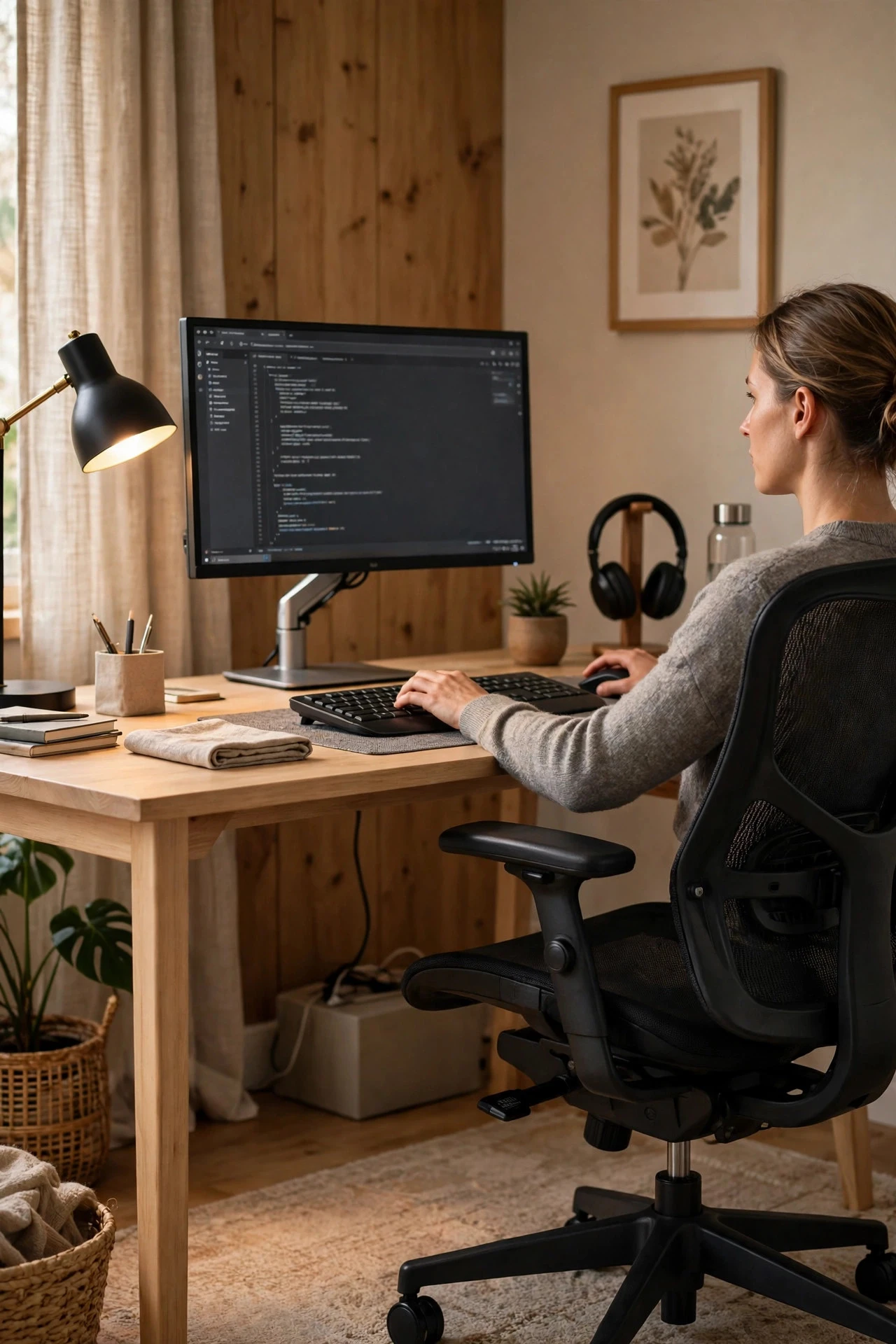
Your desk should be 71 to 76 cm high, with your chair adjusted so your elbows rest at 90 degrees and your feet sit flat on the floor. If the desk is too high, your shoulders rise; if it is too low, you hunch — both cause neck and shoulder pain within a few weeks.
A fixed desk at 73 cm suits most adults between 165 and 185 cm tall. If you are taller, look for a desk at 76 to 81 cm or an adjustable standing desk, which typically moves between 62 and 128 cm and costs $200 to $400. Pair it with a chair whose seat height adjusts between 40 and 55 cm and whose armrests sit level with the desk. The home office as a dedicated workspace has grown from a niche luxury into a standard room, and the furniture industry has followed: most desks now list their exact height range, so check the specification before you buy rather than guessing from a photo.
3. What Is the Best Desk Size for a Small Home Office?

The best desk for a small home office is 100 to 120 cm wide and 50 to 60 cm deep — wide enough for a laptop, a monitor and a notebook side by side, but shallow enough to leave walking room. Anything under 90 cm wide forces you to stack things, and anything deeper than 70 cm wastes floor space in a small room.
A wall-mounted fold-down desk is the smartest choice when floor space is truly tight: it gives you a 90 by 45 cm work surface that folds flat against the wall when the day ends, and costs $80 to $150. A corner desk uses dead space well, but measure the diagonal — a corner unit needs about 120 cm along each wall. Keep the desk surface to three zones: screen, keyboard, and one tray for papers. If the desk cannot hold a second monitor and a lamp, it is too small, and a narrow console table is never a substitute for a real desk.
4. How Do You Set Up Your Monitor at Eye Level?
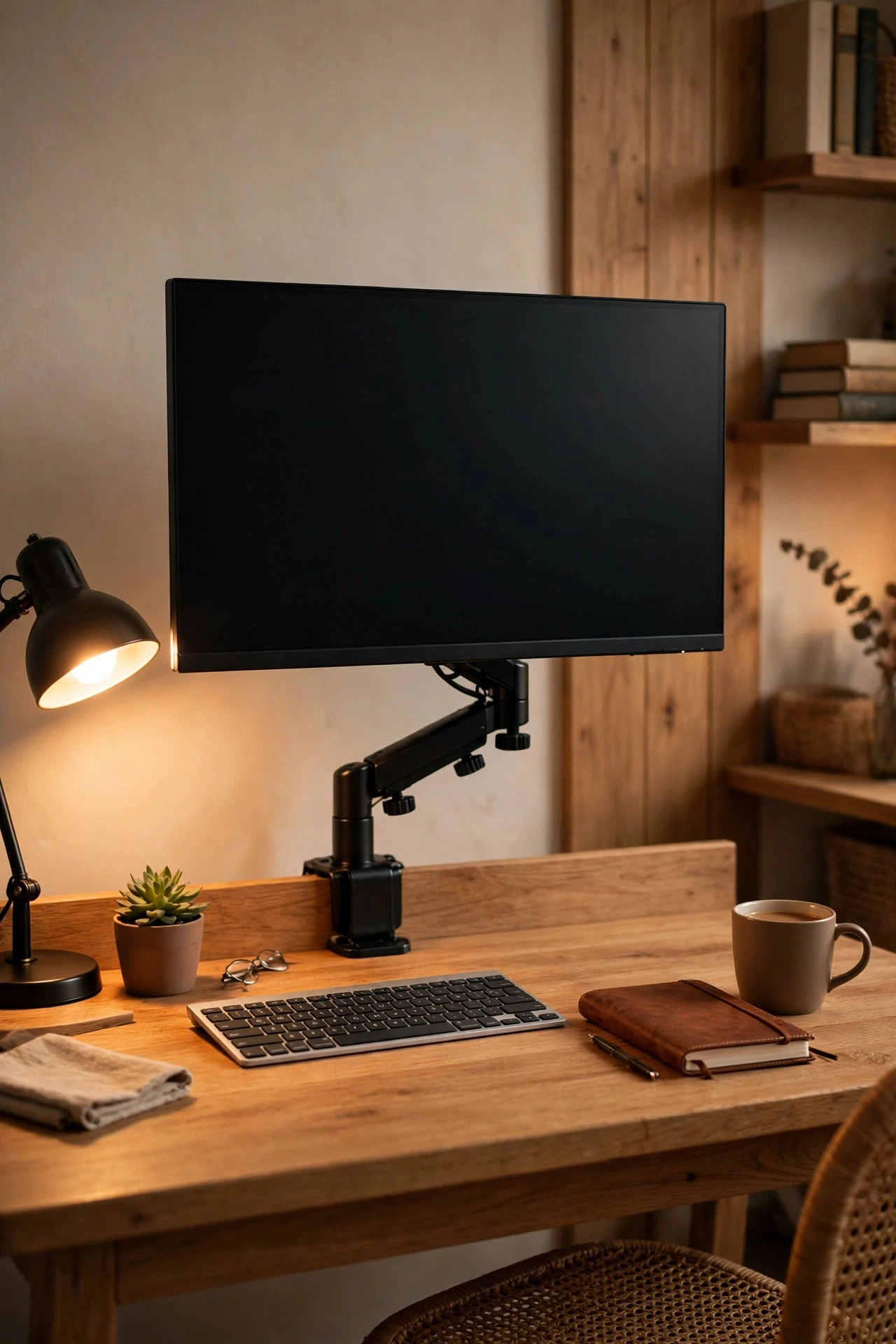
Set your monitor so the top of the screen sits at or just below eye level, about an arm's length — 50 to 70 cm — from your eyes. Your gaze should fall naturally on the top third of the screen, with your neck straight and your shoulders relaxed.
A monitor arm ($30 to $60) is the cleanest fix: it clamps to the desk edge, lifts the screen to the right height, and frees the desk surface underneath. A monitor riser or a stack of books works too, but measure it — a riser should lift the screen 10 to 15 cm. For a laptop, a stand plus an external keyboard is essential: a laptop flat on a desk forces you to look down 30 degrees, which is the single most common cause of home-office neck pain. Dual monitors should sit side by side at the same height, angled slightly inward, with the monitor you use most directly in front of you.
5. What Colour Temperature Is Best for Home Office Lighting?
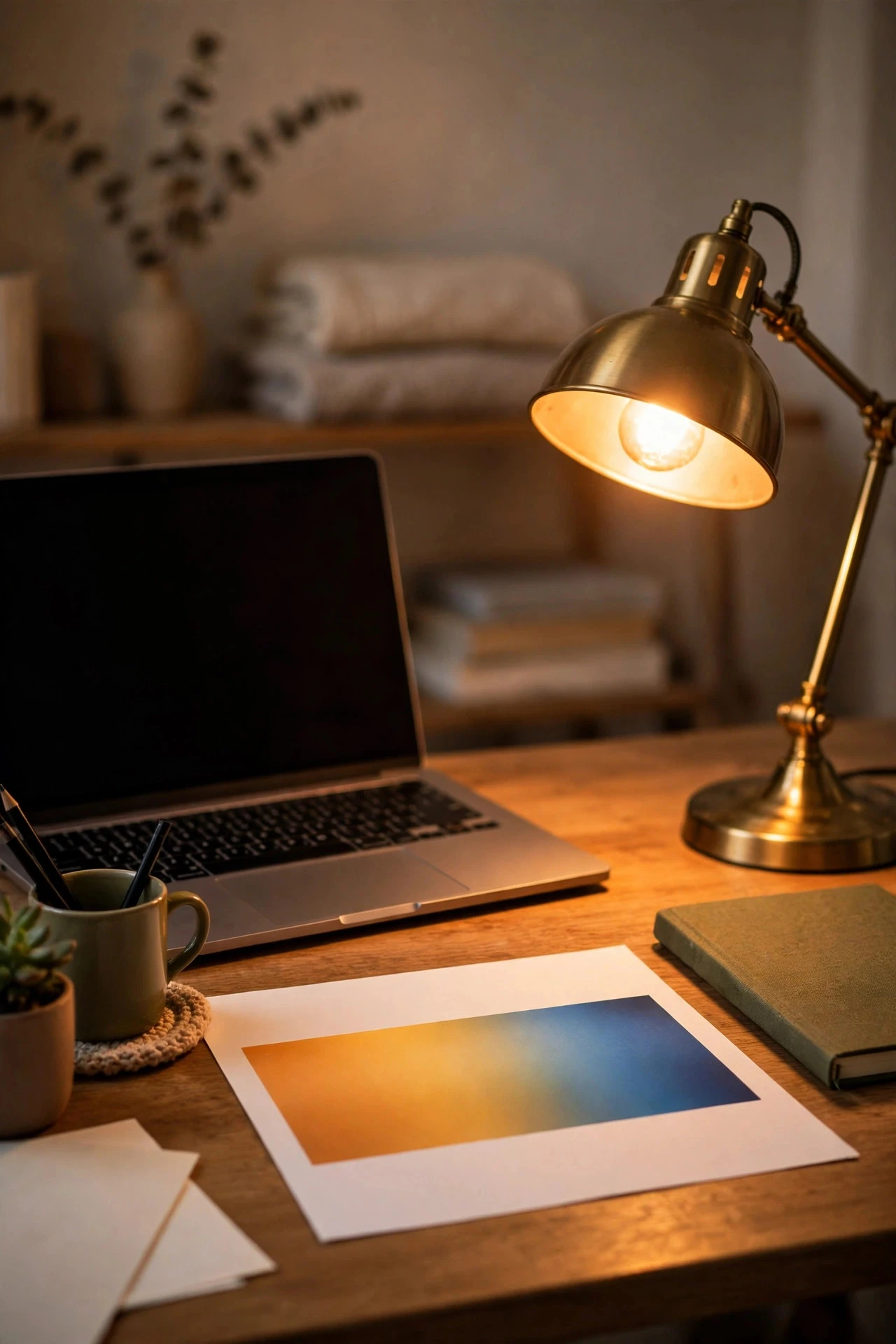
The best colour temperature for home office task lighting is 3000K to 4000K — warm enough to feel comfortable, cool enough to keep you alert. Use 2700K to 3000K for ambient lamps and evening work, and reserve 4000K for the desk lamp during focused daytime tasks.
Colour temperature is measured in Kelvin, and the wrong choice changes how the room feels: 2700K is the warm glow of a living room, 4000K is the crisp white of an office, and anything above 5000K feels like a hospital corridor. Buy bulbs labelled by their Kelvin number, not just "warm" or "cool", and match the desk lamp to the daylight coming through the window — a 4000K lamp next to a north-facing window looks natural, while the same lamp in a warm south-facing room looks harsh. Dimmable bulbs are worth the extra $5 each: you can drop the desk lamp to 2700K brightness in the evening and keep the same fixture.
6. How Do You Layer Lighting in a Home Office?

Layer home office lighting with three sources: daylight from a side window, a 2700K to 4000K desk lamp for tasks, and a soft ambient lamp for background glow. One ceiling light alone creates glare on the screen and shadows on your face, while three layers at different heights make the room feel finished.
Place the desk lamp opposite your writing hand, so your hand never casts a shadow across the page or keyboard. The ambient lamp goes behind or beside you, never behind the monitor, where it reflects in the screen. A floor lamp with a linen shade ($40 to $80) softens the corner and doubles as the video-call light: position it 45 degrees to your face, about a metre away. House Beautiful's living room lighting ideas show the same three-layer principle in rooms of every style, and it works just as well at a desk. These bedroom lighting ideas apply the same warm, layered approach to another room where light has to do two jobs at once.
7. How Do You Create a Home Office in a Corner?
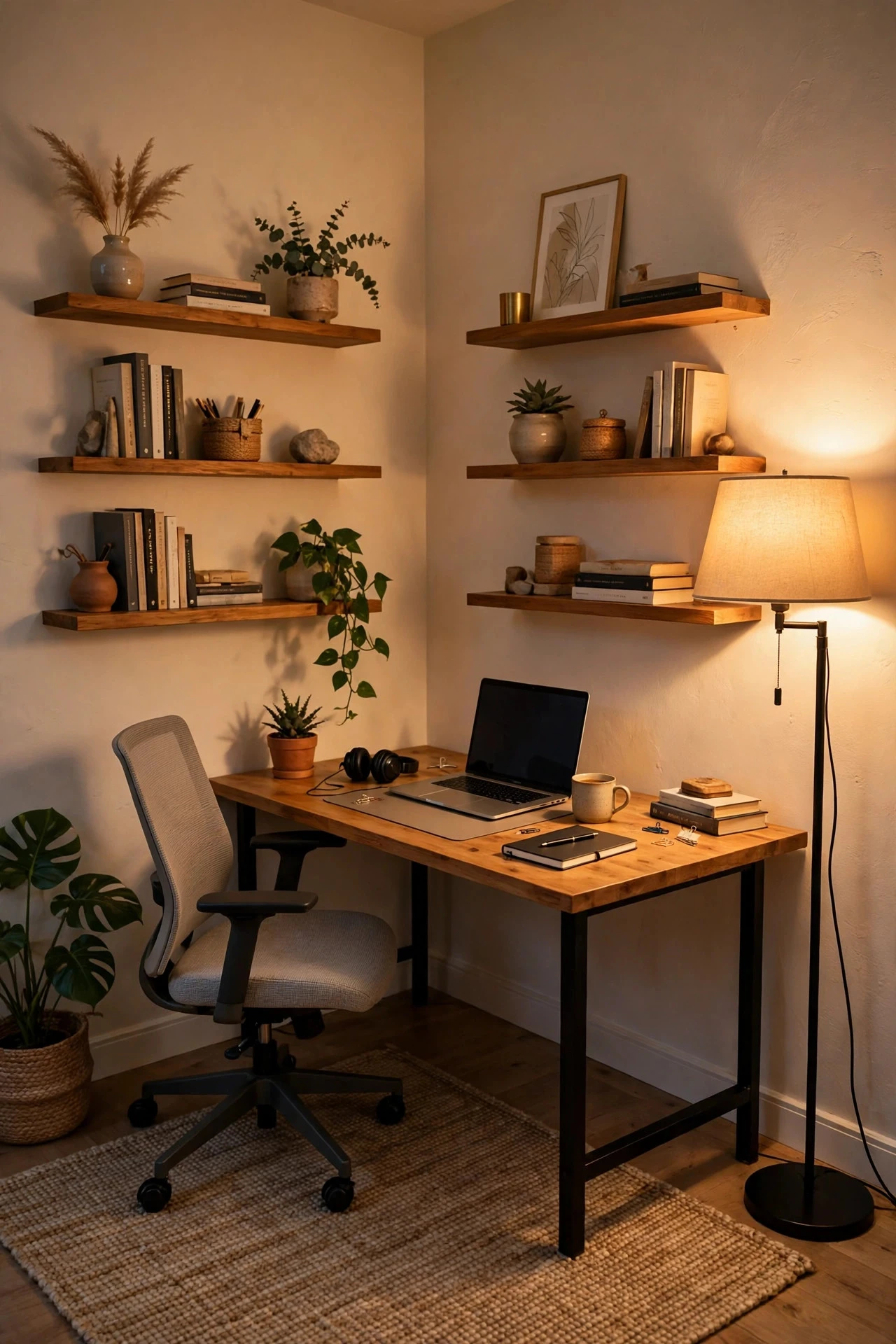
Create a corner home office by placing a desk across the corner at 45 degrees or pushed into one wall, then anchoring it with a rug, a wall shelf above, and a floor lamp on the open side. A corner office needs only 120 cm of wall on each side, and the two walls give you more storage than a flat wall ever could.
An angled desk, pulled 30 cm out from the corner, feels more generous than one flat against a wall, because you get elbow room on both sides and the corner hides cables and a power strip. Add a floating shelf on each wall at 40 cm above the desk, and hang a small pinboard or framed print on the wall you face. Avoid the trap of pushing the desk tight into the corner: you need 15 cm of clearance behind it for cables, and a desk jammed into the corner makes the chair impossible to pull out.
8. Can You Turn a Closet Into a Home Office?
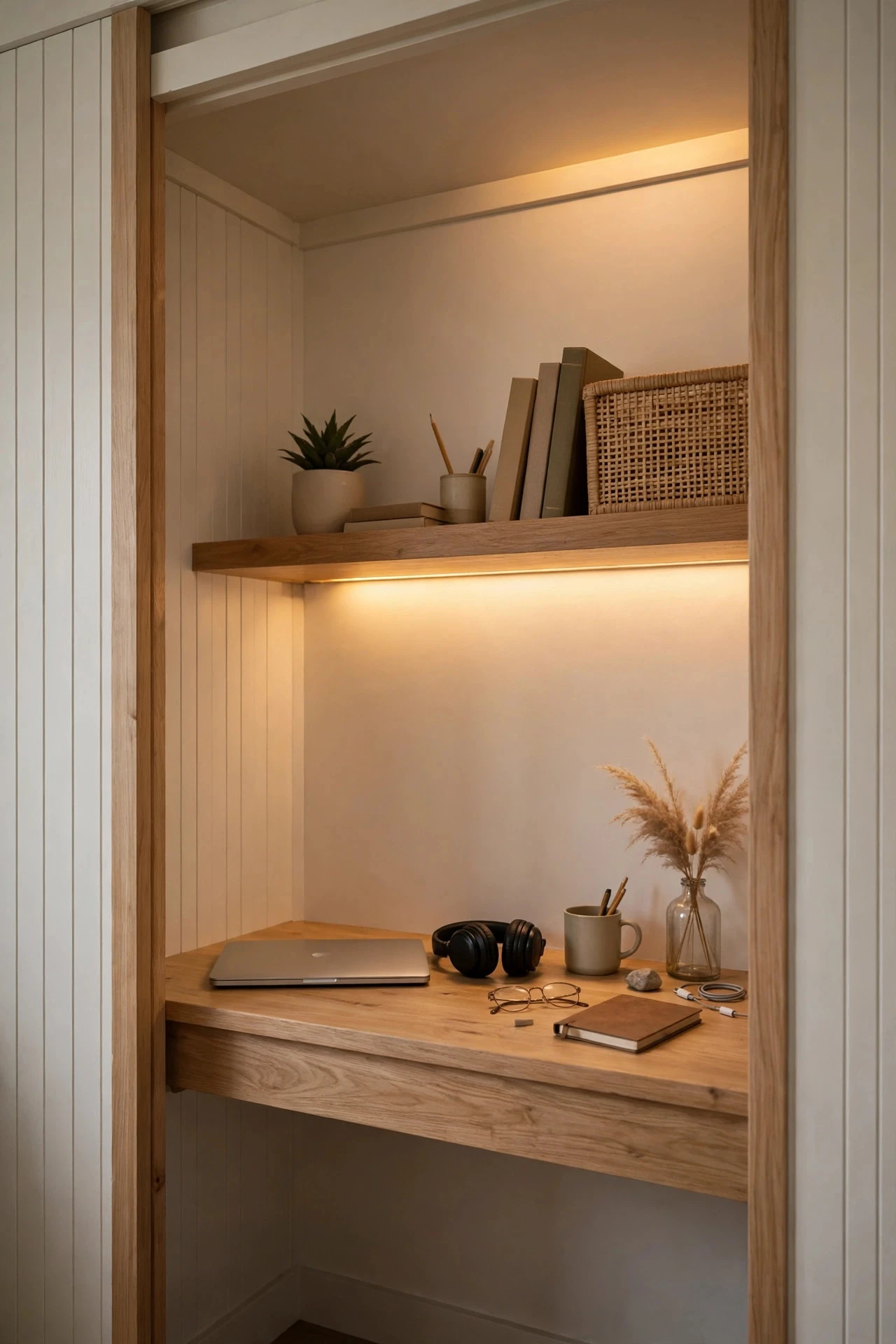
Yes — a standard closet 120 to 150 cm wide makes a surprisingly good home office, known as a "cloffice". Remove the doors, fit a desktop at 73 cm high across the width, add a shelf above for storage, and light it with a battery-powered LED strip or a small desk lamp.
Measure first: you need at least 60 cm of depth for a laptop and your knees, and most reach-in closets are 60 to 70 cm deep, which just works. Paint the inside a light colour — white, pale sage or warm cream — so the small space feels bright, and add a peel-and-stick wallpaper panel on the back wall for personality. Ventilation matters: a cloffice without airflow gets warm, so keep a small USB fan on the desk and leave the space open when you are not working. A curtain on a tension rod hides the office in seconds when guests arrive, and costs less than $20.
9. How Do You Zone a Home Office in a Shared Living Room?
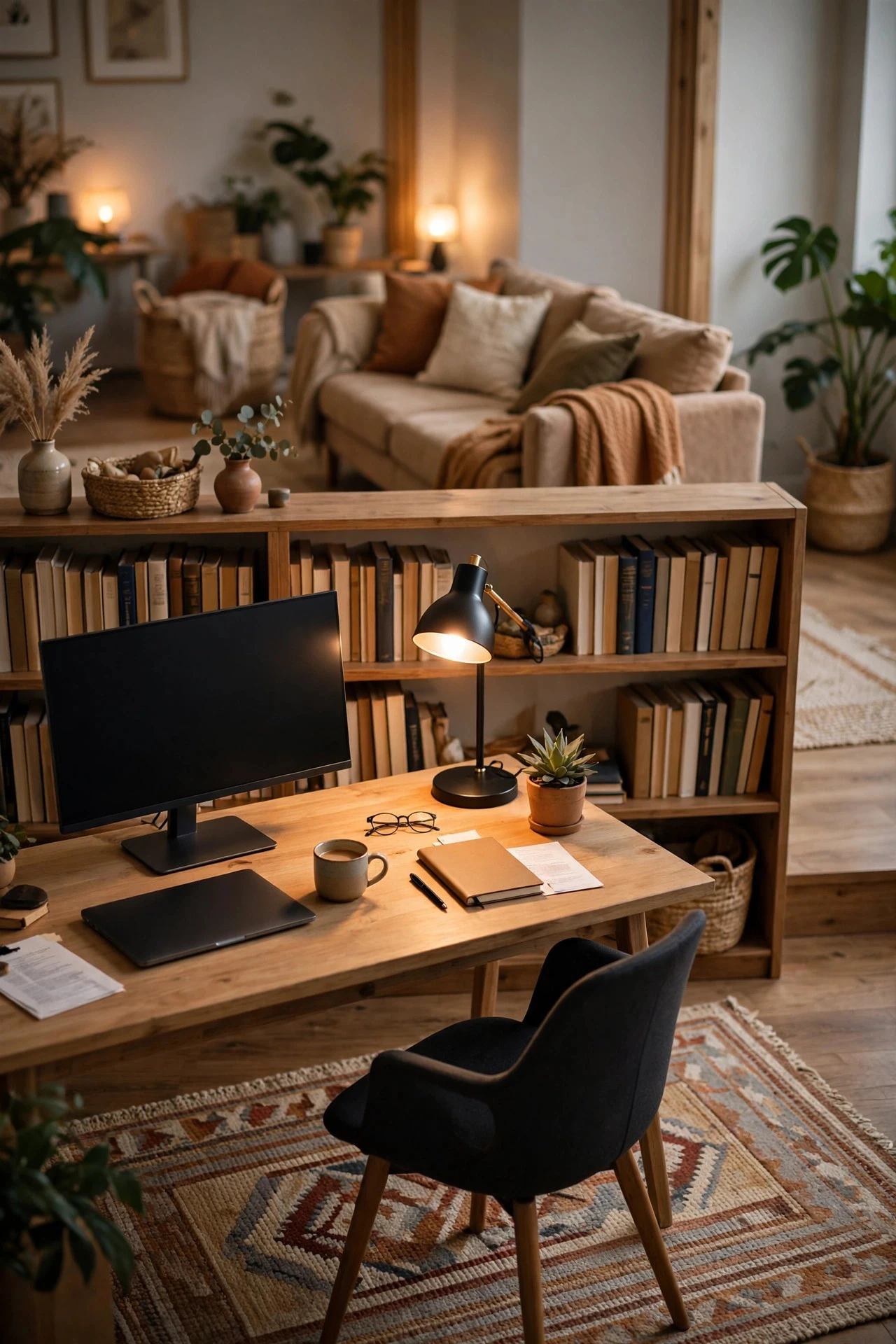
Zone a home office in a shared living room with a rug, a bookshelf turned sideways, or a folding screen — one clear boundary that tells your brain "this is work" and tells everyone else "do not disturb". The zone needs about 2 square metres: desk, chair and a little breathing room.
A rug is the simplest boundary: a 120 by 180 cm rug under the desk and chair marks the office visually without blocking light or conversation. A low bookshelf, 90 to 110 cm tall, works better as a divider than a tall one — it separates the zones while keeping the room open and the light flowing. Place the desk facing the wall or the window, never facing the television, and keep work clutter inside the zone: a rolling cart or a lidded box that lives under the desk holds papers at the end of the day. The goal is a boundary you can see, not a wall you have to build.
10. What Storage Keeps a Home Office Clutter-Free?

The storage that keeps a home office clutter-free is closed storage plus one open shelf: a drawer unit or a cabinet with doors for the mess, and a single styled shelf for the three or four things you actually want to see. Open storage alone becomes a display of clutter within a week.
A three-drawer rolling unit ($60 to $100) slides under or beside the desk and holds papers, chargers and stationery out of sight. Above the desk, one floating shelf 60 to 90 cm wide holds a plant, two books and a small box — nothing else. Paper needs a system, not a pile: one inbox tray for incoming papers, one file box for papers to keep, and a weekly five-minute clear-out every Friday. If a surface holds more than five objects, it is not styled, it is stored — and the desk is the first surface to enforce that rule on.
11. How Do You Hide Cables in a Home Office?

Hide cables with a cable tray under the desk, one power strip mounted to the desk leg, and a cable sleeve for the run from the desk to the wall. A $15 to $25 tray and a $10 sleeve turn a tangle of eight cables into a single neat line in about twenty minutes.
Start by unplugging everything and labelling each cable with a small tag or a strip of masking tape — monitor, laptop, lamp, phone charger — so you can trace any cable later. Mount the power strip under the desktop with adhesive strips or screws, plug everything into it, and run the single strip cable down one desk leg in a sleeve to the wall socket. Use cable clips every 30 cm along the desk edge to stop cables sliding off the back, and keep the phone charger on the desk in a small weighted holder so it never falls behind the desk. Wireless peripherals — a Bluetooth keyboard and mouse — cut two more cables entirely.
12. What Should Be Behind You on Video Calls?
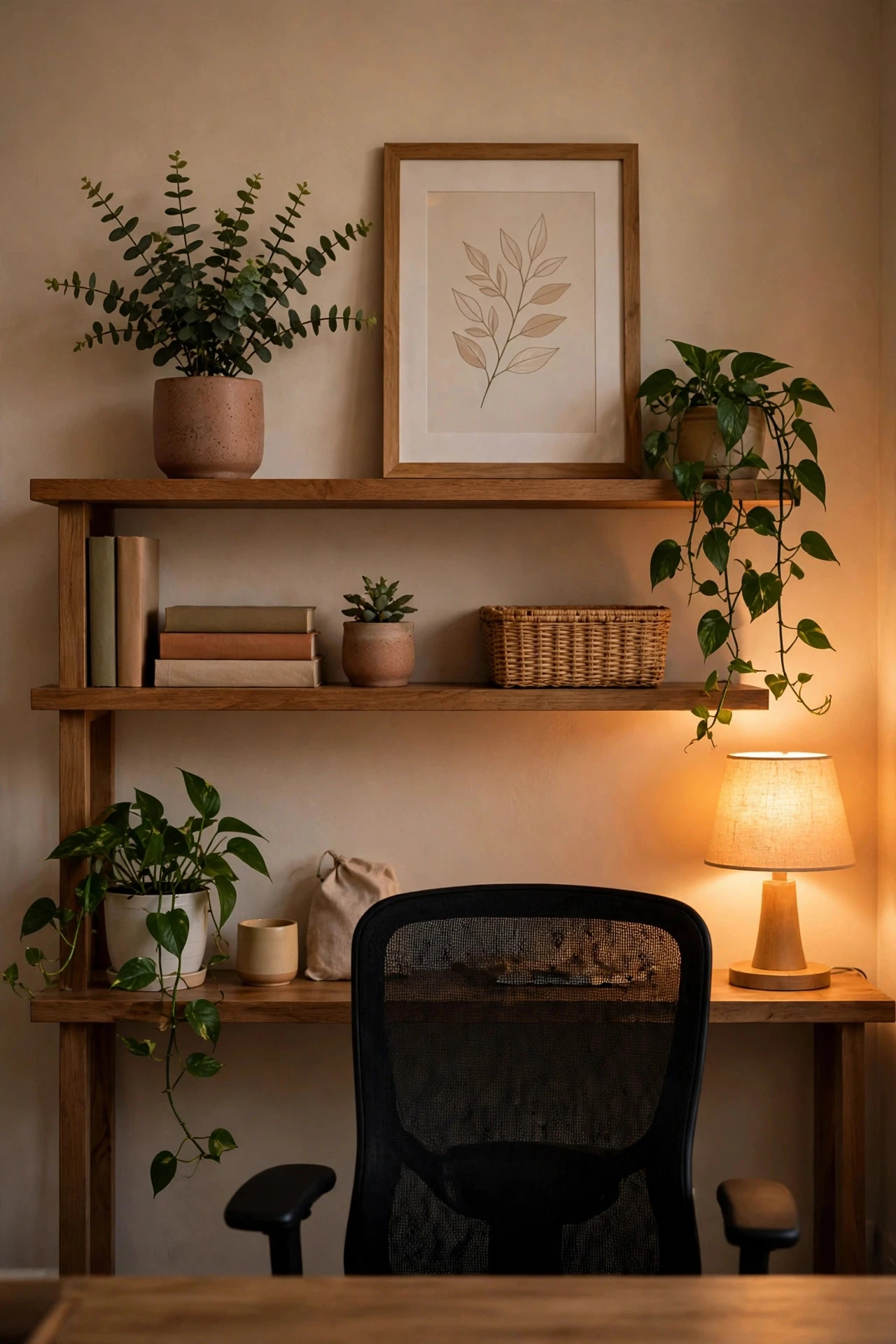
Put a tidy shelf, a plant and one framed print behind you on video calls — three objects at different heights, in calm colours, with nothing moving or flashing. Your background should look like a room someone lives in, not a showroom and not a storage cupboard.
Position the desk so the camera sees the shelf wall, not the bed or the kitchen. A bookshelf with books stacked both vertically and horizontally reads as professional; a blank wall reads as temporary, and a cluttered desk behind you reads as chaotic. Add one warm lamp just out of frame to light your face softly, and check the background on a test call before your first real meeting — sit in the chair, open the camera, and look at what is actually visible, not what you think is visible. Keep the top of the frame clear: a ceiling fan or a smoke alarm in shot is the most common video-call distraction.
13. How Do You Add Plants to a Home Office?

Add one or two low-maintenance plants to a home office — a pothos on the shelf, a snake plant on the floor — and place them where they soften a hard edge without blocking light or the screen. Plants make a workspace feel alive, and the research on biophilic design consistently links greenery with better mood and focus.
Choose plants that forgive neglect: pothos and snake plants survive low light and irregular watering, while a small fiddle-leaf fig needs bright indirect light and a regular routine. Keep the plant off the desk itself unless the desk is large — a trailing pothos on the shelf above the desk gives you the green without losing work surface. Water on a schedule, not when you remember: a small watering can kept on the shelf is the difference between a thriving plant and a dead one. Avoid flowering plants with strong scent near the desk, and avoid any plant that drops leaves onto the keyboard.
14. How Do You Style Open Shelving Above a Desk?
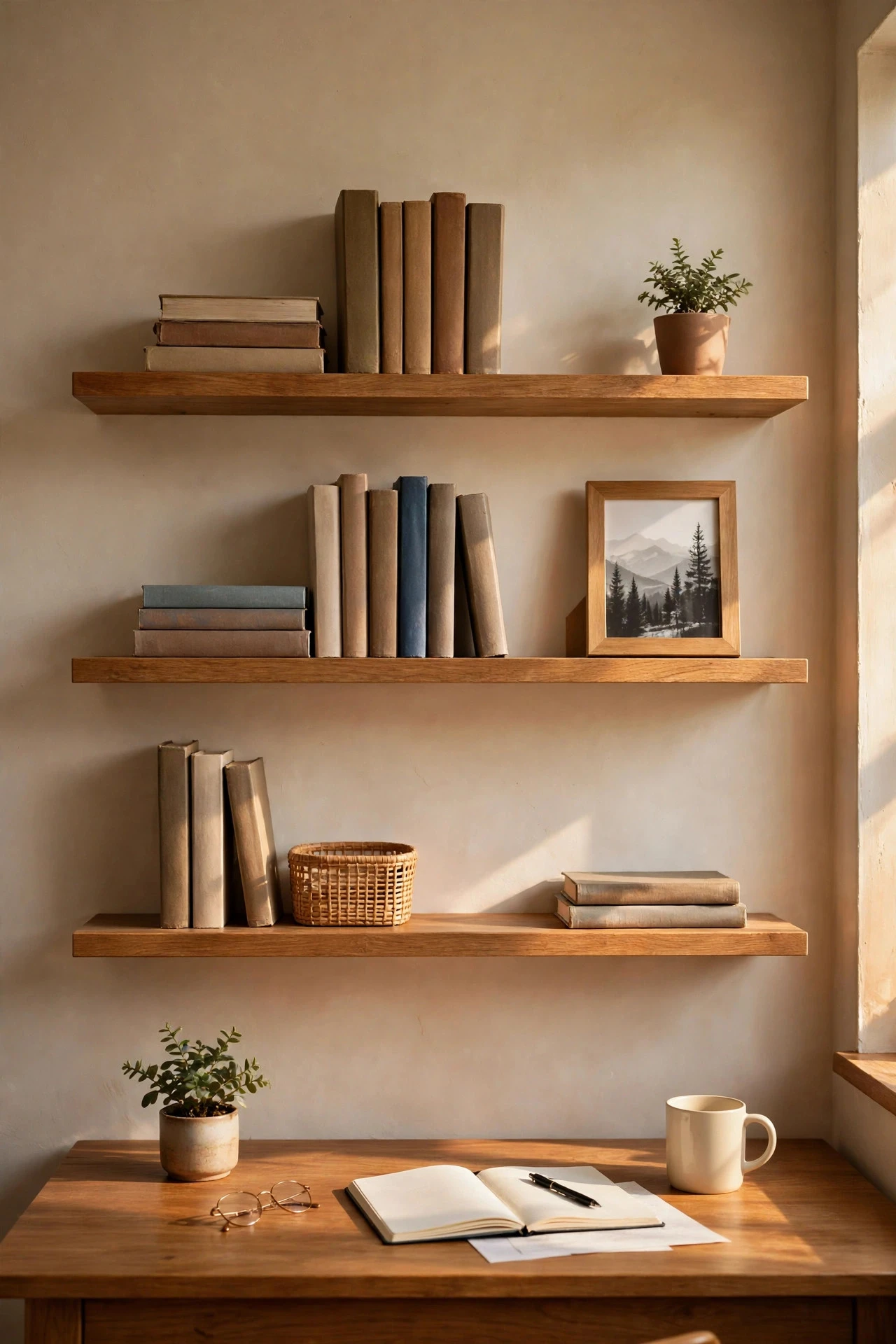
Style open shelving above a desk with the two-thirds rule: fill two-thirds of each shelf and leave one-third empty, mixing books, one plant and one personal object per shelf. A shelf that is packed edge to edge looks like storage; a shelf with breathing room looks designed.
Hang the first shelf 40 to 50 cm above the desktop — high enough to clear the monitor, low enough to reach without standing. Use the same shelf depth as your books, about 20 to 25 cm, so nothing sticks out awkwardly. Group in odd numbers: three books standing, one small plant, one framed photo. Keep work supplies in closed boxes on the shelf rather than loose — a woven box or a linen storage cube hides chargers and notebooks and keeps the shelf looking calm. These kitchen open shelving ideas show the same styling rules — odd groupings, breathing room, one material repeated — applied to shelves that have to work hard every day.
15. What Wall Colour Works Best for a Home Office?

The best wall colours for a home office are soft, low-saturation shades — pale sage, warm greige, dusty blue or soft white — because they keep the room bright without competing with the screen. Avoid pure white, which glares under office lighting, and avoid dark colours on all four walls in a small room.
Paint the wall behind the monitor a slightly deeper tone than the other walls: a soft sage or muted blue reduces the contrast between the bright screen and the wall around it, which eases eye strain. If you rent and cannot paint, a large framed print, a fabric wall hanging or peel-and-stick panels give you the same colour block without touching the walls. Test the colour on the wall you face while working, not the wall behind you — it is the colour you will stare at for eight hours. These living room accent wall ideas show how one deeper wall can anchor a whole room, and the same trick works behind a desk.
16. How Do You Make a Small Home Office Feel Bigger?
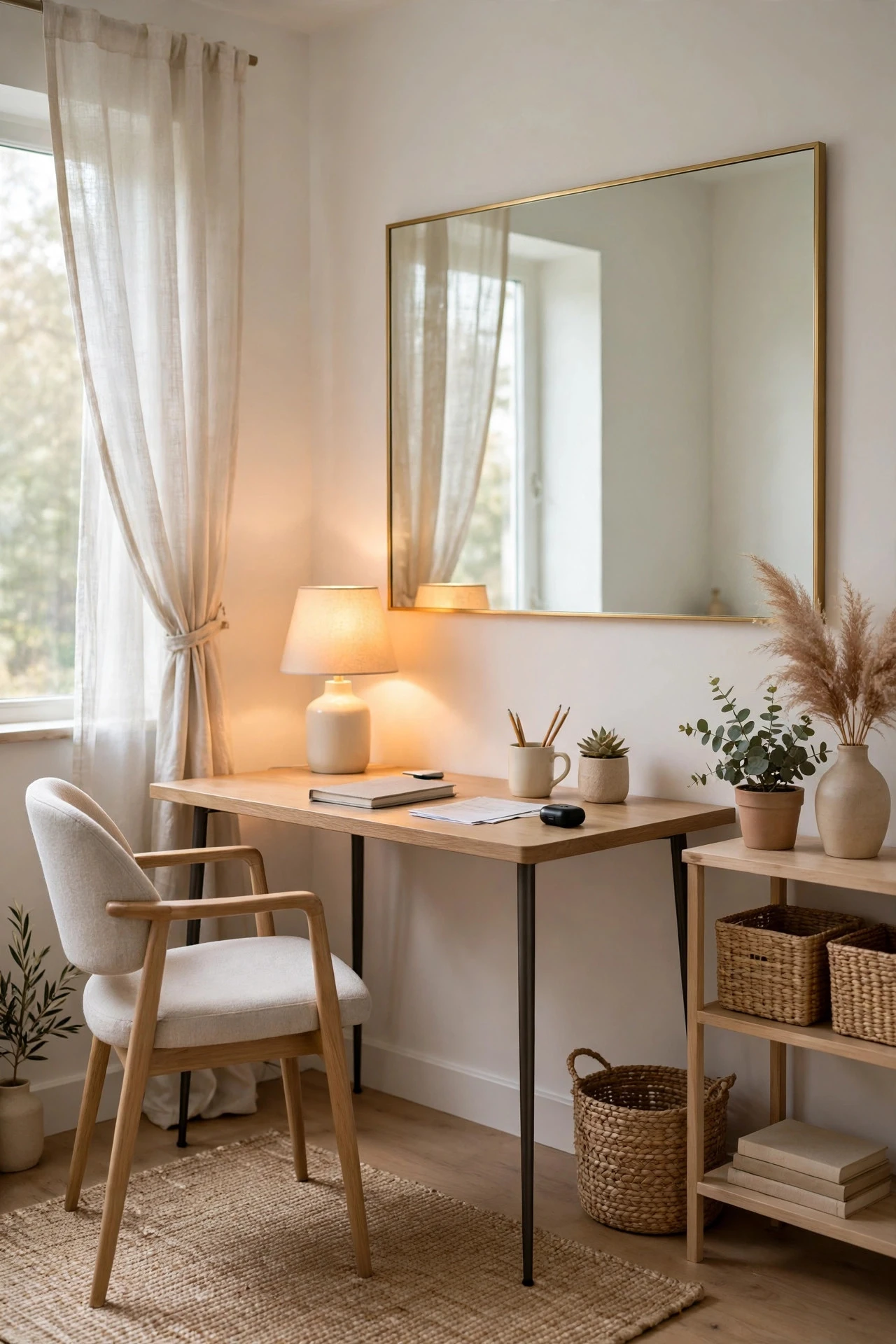
Make a small home office feel bigger with light colours, one large mirror or art print, and furniture that shows the floor — a desk on slim legs, a chair without a bulky base. Visual space comes from what you can see through and under, not from the square metres themselves.
A mirror 60 by 90 cm on the wall opposite the window doubles the daylight and the sense of depth, but never hang it where it reflects the screen — glare defeats the purpose. Choose a desk with open legs rather than a solid panel base, and keep the floor clear: cables in a tray, the bin under the desk, bags on a wall hook. Paint the walls and the desk the same light colour so the furniture recedes, and use a single piece of large art instead of five small frames — one confident piece makes a small room feel intentional, while a cluster of small frames makes it feel busy.
17. What Rug Works Under a Home Office Desk?

The best rug under a home office desk is a low-pile, flat-weave rug at least 120 by 180 cm, large enough for the desk legs and the chair to stay on it when you roll back. A rug that is too small bunches under the chair wheels, and a thick pile rug stops the chair from rolling at all.
Choose a pattern that hides dust and crumbs — a subtle geometric, a faded vintage print, or a two-tone weave — in colours that match the room's palette. A chair mat over the rug solves the rolling problem if you love a thicker rug: a clear polycarbonate mat, about 90 by 120 cm, costs $30 to $50 and lets the chair glide while the rug shows around the edges. Keep the rug's edge at least 30 cm from the wall so it reads as a deliberate zone rather than wall-to-wall carpet, and vacuum it weekly — a home office rug collects more dust than any other rug in the house.
18. How Do You Personalise a Home Office Without Distracting Yourself?
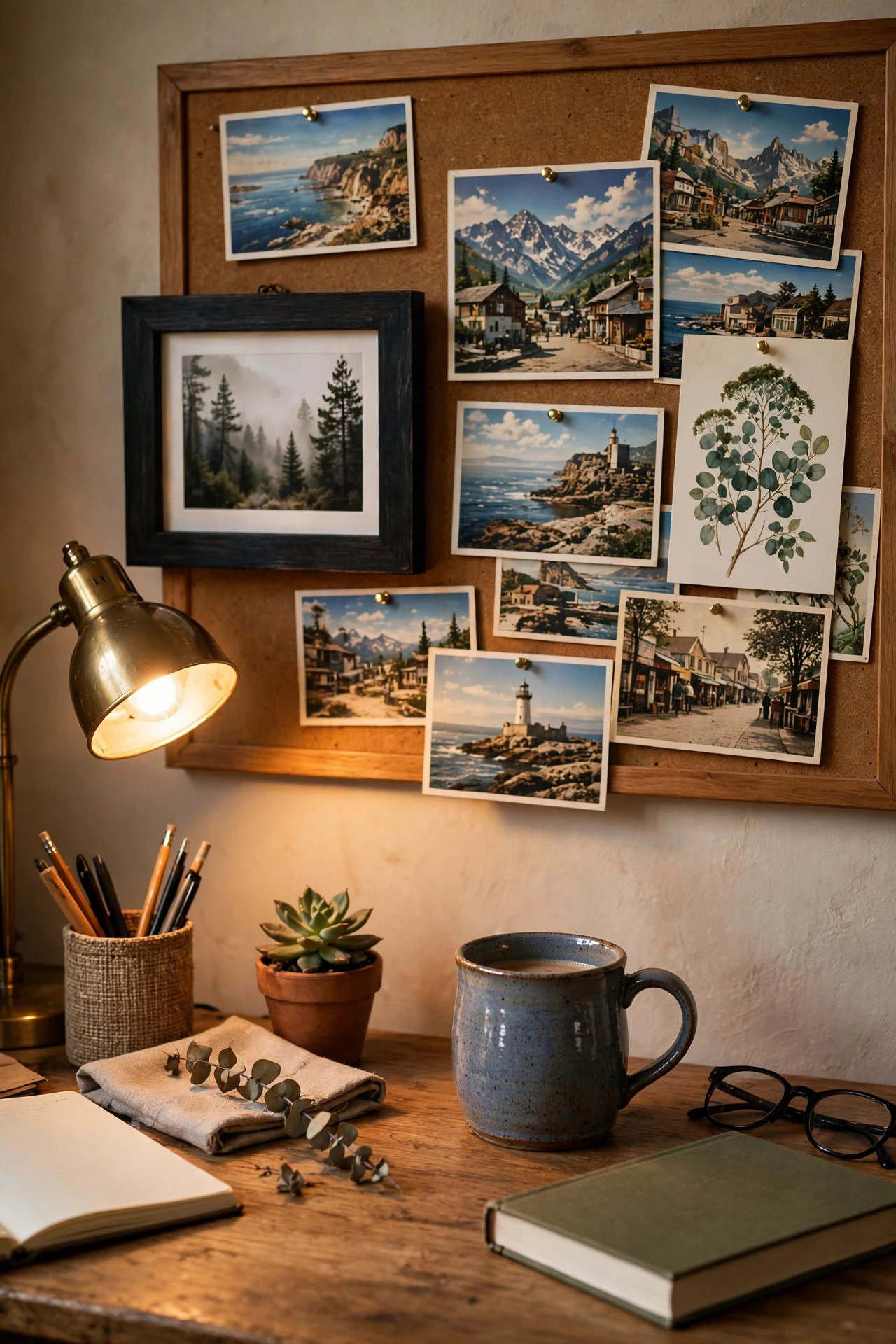
Personalise a home office with three meaningful objects and one colour you love — a framed photo, a souvenir from a trip, a favourite mug — and keep everything else functional. Three personal objects make the room yours; ten make it a museum that competes with your work.
Put the personal objects where you see them when you look up from the screen, not on the desk surface where they crowd your hands. A pinboard or a picture ledge above the desk holds photos and postcards without taking desk space, and you can swap the display every few months. Choose one accent colour — a mustard cushion, a teal notebook, a terracotta pot — and repeat it in two or three small places so the room feels styled rather than random. These cozy home decor ideas show how texture and warmth make a room feel personal, and the same layered textiles work on an office chair and a window.
19. What Is the Best Chair for Long Hours at a Home Office Desk?
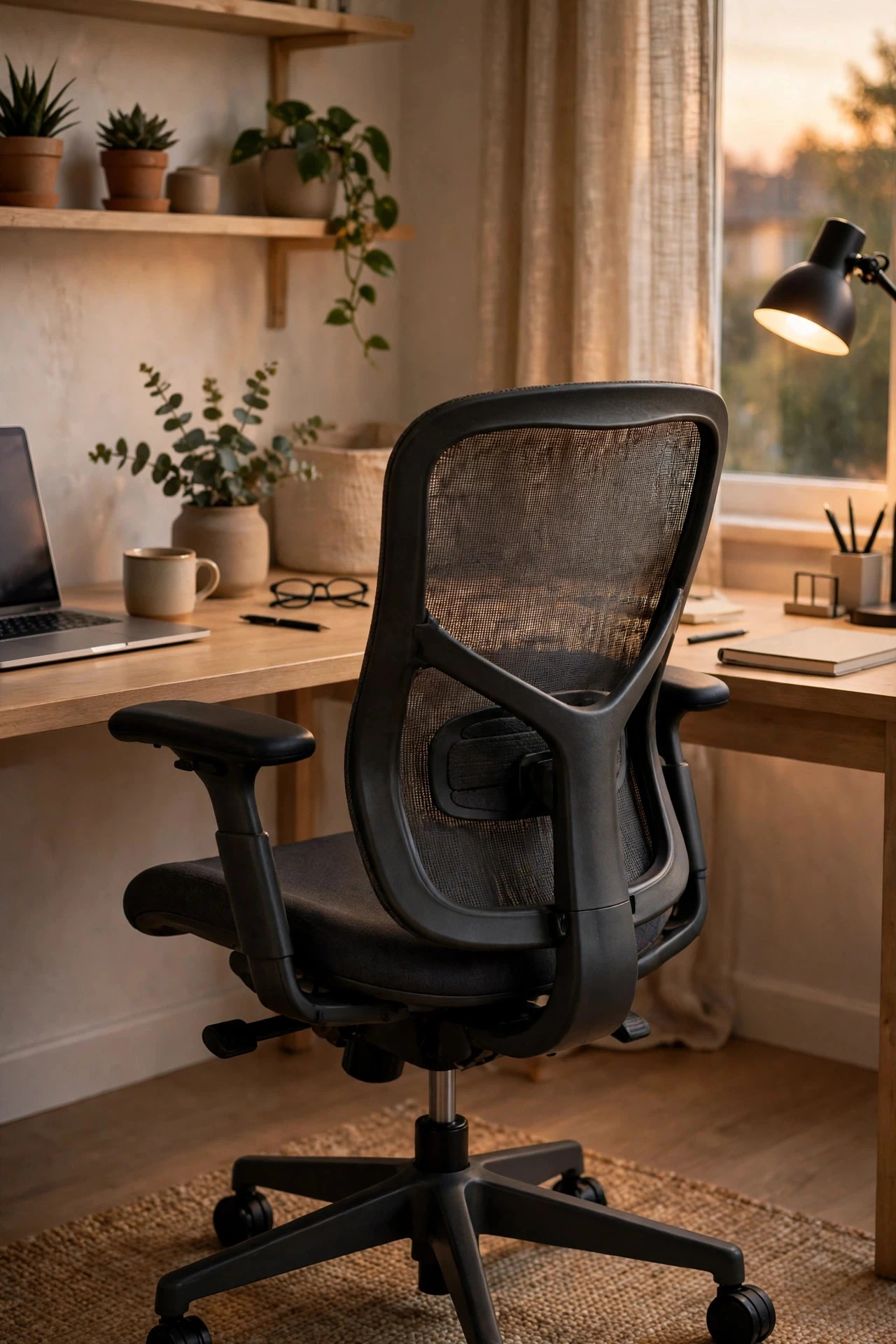
The best chair for long hours is an ergonomic task chair with adjustable seat height, lumbar support, adjustable armrests and a breathable mesh or padded back. Budget $150 to $350 for a chair that will not hurt your back after a full working day, and test the seat depth before you buy.
Seat depth matters: you need 2 to 3 cm between the back of your knees and the seat edge, so look for a sliding seat pan if you are shorter or taller than average. Lumbar support should sit in the curve of your lower back, about 15 to 20 cm above the seat — without it you will slouch within an hour. A dining chair is fine for an hour, but after a week of eight-hour days the lack of support shows up as back pain. If the budget is tight, spend on the chair before the desk: a good chair on a basic desk beats a beautiful desk with a bad chair every time.
20. How Do You Keep a Home Office Organised Day to Day?

Keep a home office organised with a five-minute shutdown ritual: clear the desk to three objects, file today's papers, charge the devices, and write tomorrow's top three tasks on a sticky note. A desk that starts clean stays clean; a desk that starts messy gets worse by lunchtime.
Give everything a home: pens in a cup, chargers in a drawer, papers in one tray, notebooks on one shelf. The "one in, one out" rule stops accumulation — every new notebook or gadget means an old one leaves. Do a ten-minute reset every Friday: wipe the desk, empty the bin, water the plant, and archive the week's files. The ritual matters more than the storage furniture: the tidiest offices are not the ones with the most drawers, they are the ones with a daily habit that takes five minutes and never gets skipped.
21. How Do You Soundproof a Home Office on a Budget?

Soundproof a home office on a budget by adding soft surfaces: a thick rug, heavy curtains, a bookshelf full of books against the shared wall, and a draught excluder under the door. These absorb echo and muffle voices for $50 to $100, without any construction.
A rug with a thick underlay cuts footstep noise and room echo more than any single purchase. Bookshelves work as sound barriers because mass blocks sound — a shelf loaded with books against the noisiest wall is genuinely effective. For calls, a pair of noise-cancelling headphones ($60 to $150) matters more than wall treatment, and a white-noise machine or a fan masks background noise from the rest of the house. Seal the gaps first: a $10 self-adhesive door seal strip stops more sound than a $50 acoustic panel on an unsealed door. Avoid foam acoustic tiles unless you record audio — in a normal office they look like a studio and do little for everyday noise.
22. How Do You Make Your Home Office Feel Finished, Not Temporary?
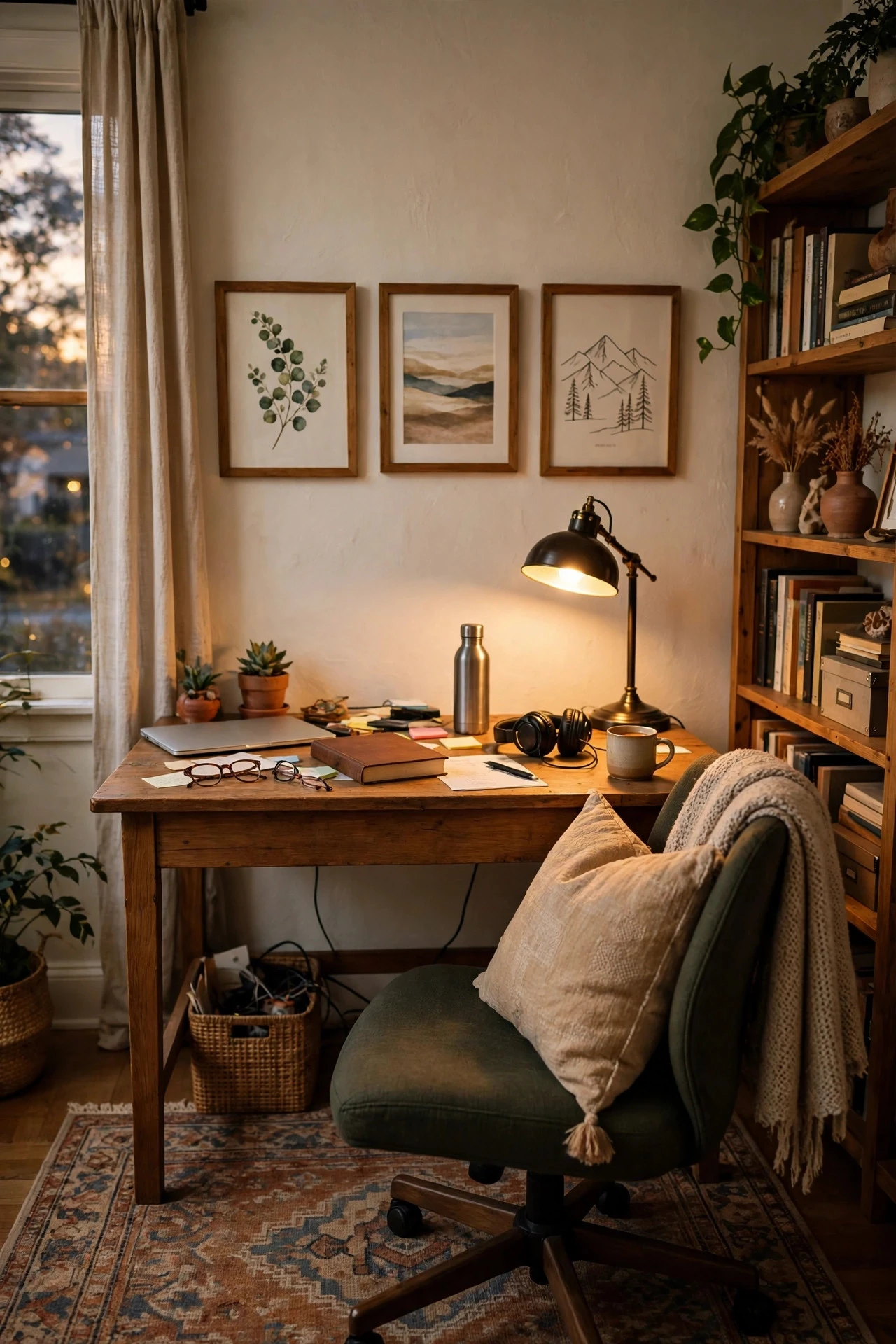
Make your home office feel finished by giving it the same treatment as any other room: a rug that fits, art on the walls, a lamp with a real shade, and nothing left in a cardboard box. A room feels temporary when it has one piece of furniture and a pile of "for now" solutions.
Replace the temporary fixes one at a time: a proper desk lamp instead of a clip-on light, a framed print instead of a taped-up photo, a cable tray instead of loose cables. Add one textile — a cushion or a throw over the chair back — because fabric is what makes a workspace feel like a room instead of a workstation. Stand in the doorway and look at the room as a guest would: if the eye lands on a finished desk, a styled shelf and a plant, the office is done. If it lands on boxes, cables and a bare bulb, one more weekend of finishing is all it needs.
Practical Tips
Buy the chair first and the decoration second, because the chair decides whether your back survives the year and the decoration only decides whether the room photographs well. Measure the desk, the chair clearance and the monitor distance before you shop, and write the numbers on your phone — a desk that is 10 cm too wide blocks the door, and a monitor arm that is 5 cm too short leaves the screen at chin height. Keep a small box of spare cables, clips, batteries and a spare bulb in the desk drawer, because something always fails mid-call.
Set a weekly reset time and keep it. The home offices that stay beautiful are the ones with a five-minute Friday shutdown — desk cleared, papers filed, plant watered — not the ones with the most storage furniture. Photograph the finished room from the doorway, so you can restore the layout after a deep clean, and keep the receipts for the desk and chair: good office furniture holds its resale value, and you will want the model numbers if a part ever needs replacing.
Final Thoughts
A home office you love is not about how much you spend; it is about how well a few chosen pieces fit the way you actually work — the right desk height, light that comes from the side, cables you never see, and a background that looks good on camera. Start with ergonomics, zone the space, layer the light, and leave room for the work to happen — your home office will feel like a room you choose, not a corner you were given.
You may also like: our dream house decor ideas and our living room sofa ideas carry the same warm, lived-in styling into the rest of the house, so the office feels like part of your home rather than a room apart.
Frequently Asked Questions
How much does it cost to set up a home office?
A comfortable home office costs $300 to $800: $150 to $400 for a good desk, $100 to $300 for an ergonomic chair, $30 to $60 for a desk lamp, and $40 to $80 for storage. Spend the most on the chair, since it affects your body every day, and add lighting and plants later.
What is the best desk height for working from home?
The best desk height for most adults is 71 to 76 cm (28 to 30 inches), with your elbows at 90 degrees and your feet flat on the floor. If you are taller than 185 cm, look for a desk at 76 to 81 cm or an adjustable standing desk. A footrest fixes a desk that is too high.
How do you set up a home office in a small room?
Start with a compact desk 100 to 120 cm wide pushed against a wall, add a chair that slides fully underneath, and use the wall above the desk for shelves instead of floor storage. Keep the desk surface to three zones — laptop, lamp and one tray — and store everything else in a rolling cart that tucks away.
What lighting is best for a home office?
The best home office lighting combines daylight from a side window with a 2700K to 4000K desk lamp for tasks and a soft overhead or floor lamp for background light. Avoid a single bright ceiling light, which causes glare, and never sit facing a window, because the backlight turns you into a silhouette on video calls.
How do you make a home office look good on video calls?
Place your desk so a tidy shelf, a plant and one framed print sit behind you, with a warm lamp just out of frame for soft light on your face. Keep the background to two or three objects at different heights, hide cables and clutter, and sit facing a window or a lamp so your face is lit.
Do you need a separate room for a home office?
No — a separate room helps, but a well-zoned corner works just as well for most people. A desk facing a wall, a rug that marks the work zone, and a screen or bookshelf that separates it from the living area give your brain a clear boundary. The key is a dedicated spot you use only for work.