22 Small Entryway Ideas That Make a Tiny Entrance Feel Grand
The entryway is the smallest room in most homes and the one that works the hardest. It is where shoes pile up, keys disappear, coats get dumped on a chair, and guests form their first impression of your home in about ten seconds. Small entryway ideas are not about squeezing more furniture into a tight space — they are about choosing pieces that earn their footprint, keeping the walkway clear, and making a few square feet feel intentional instead of accidental.
Below are 22 small entryway ideas organised by the problems they solve — layout and furniture, storage and organisation, light and colour, rentals and no-foyer apartments, and the finishing touches that make a tiny entrance feel grand. Every idea includes exact measurements, real prices and the mistakes that make a small entryway feel smaller. Most ideas cost under $60 each, and the whole entrance can be transformed for $150 to $300. Nothing here needs a renovation, and every idea works in a hallway or foyer of 20 to 60 square feet.
Looking for more inspiration? Our Nest Decorz homepage gathers the latest home decor ideas, seasonal decorating guides and room-by-room styling tips in one place — start there and explore.
Quick answers
– Measure the walkway first — keep at least 90 cm of clear passage, then choose furniture that fits the remaining depth; a slim console 10 to 14 inches deep is the maximum for most small entryways. – Go vertical, not wide — hooks, a mirror and a floating shelf use wall space your feet never need, so the floor stays open and the entrance feels bigger. – One mirror changes everything — a mirror opposite or beside the door bounces light and doubles the sense of space for $40 to $80, the cheapest transformation in this guide. – Give everything a home — a tray for keys, hooks for coats, a basket for shoes; clutter in a small entryway is not a storage problem, it is a "no designated spot" problem. – Budget $150 to $300 for the whole entrance — spend the most on the console or bench and the mirror, and use paint, hooks and baskets for the rest.
1. What Is the Best Layout for a Small Entryway?
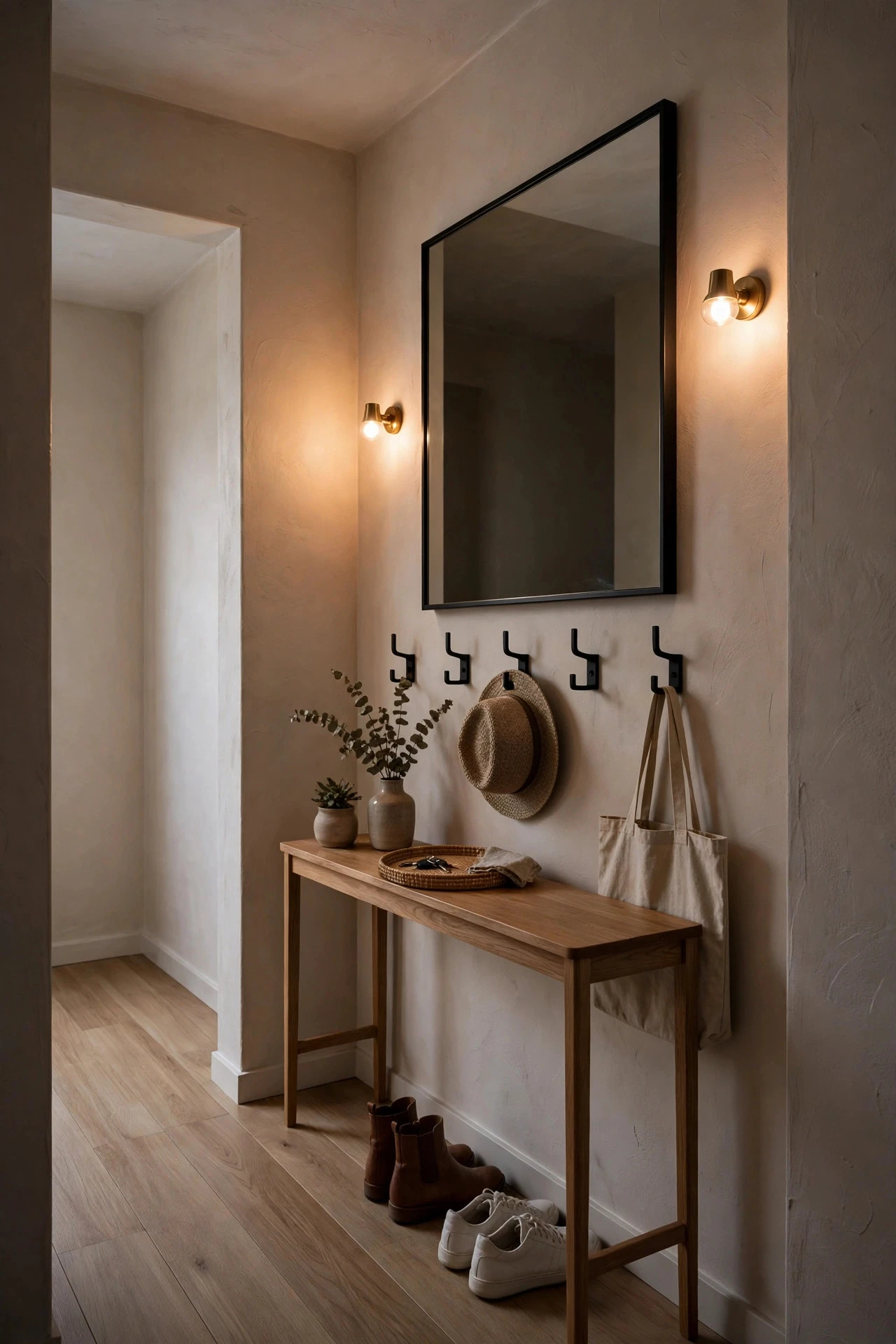
The best layout for a small entryway puts one slim piece of furniture against the longest wall, keeps at least 90 cm of clear walkway, and zones the space into three jobs: drop, hang and store. Trace the path you walk every day first — that path is sacred, and nothing may sit on it.
Sketch the footprint before you buy anything: measure the wall length, the door swing (a standard door needs about 80 cm of clearance), and the depth you can spare. In most small entryways that leaves 25 to 35 cm of usable depth on one wall only. Place the console or bench on the wall the door does not swing toward, hang the mirror above it, and put the hooks on the adjacent wall or above the bench so coats never block the mirror. If two people arrive home at the same time, the layout must let both stand in the entryway without one of them stepping backwards into the hall — that is the real test of a working layout, not how it looks in a photo.
2. How Deep Should a Console Table Be in a Narrow Entryway?
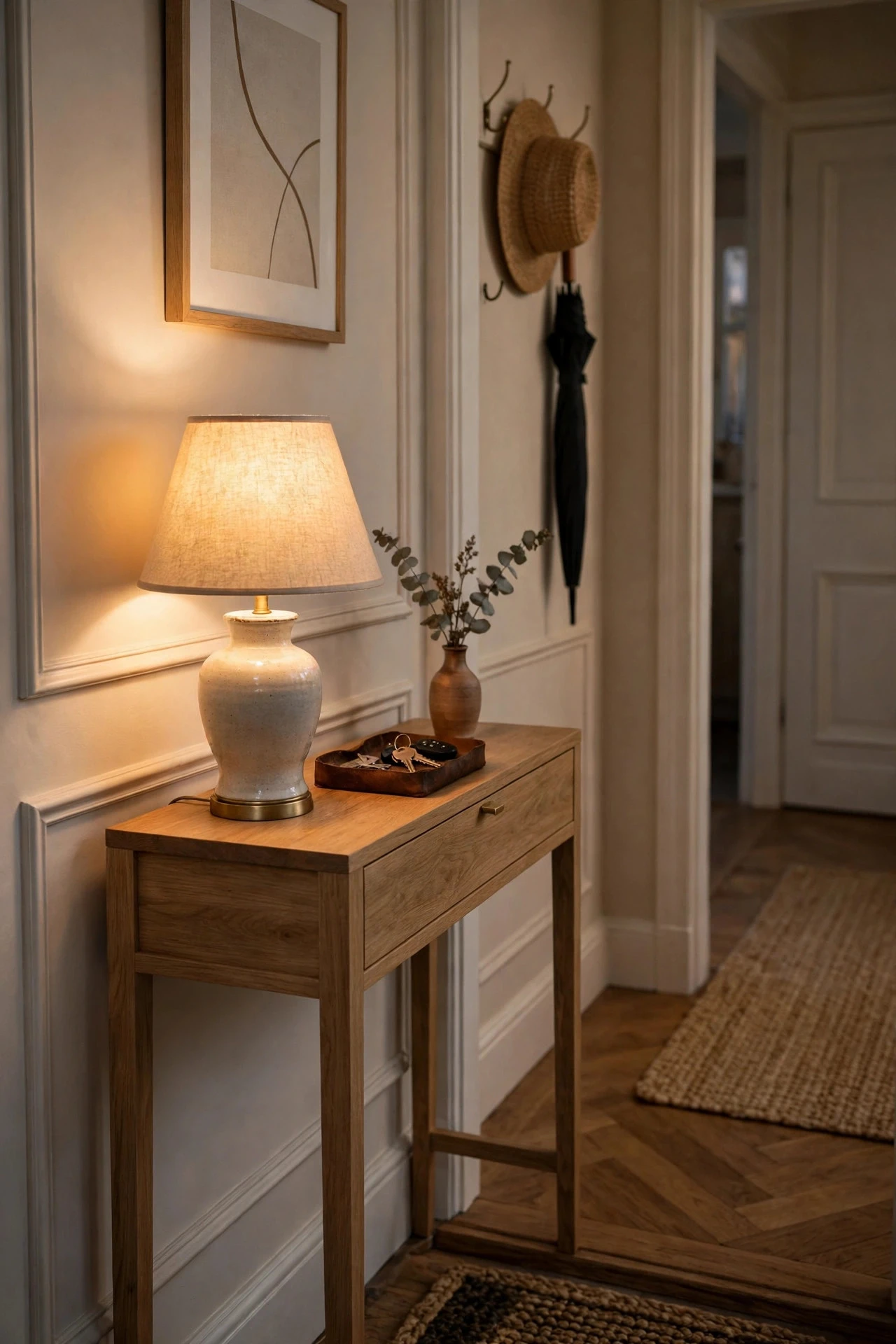
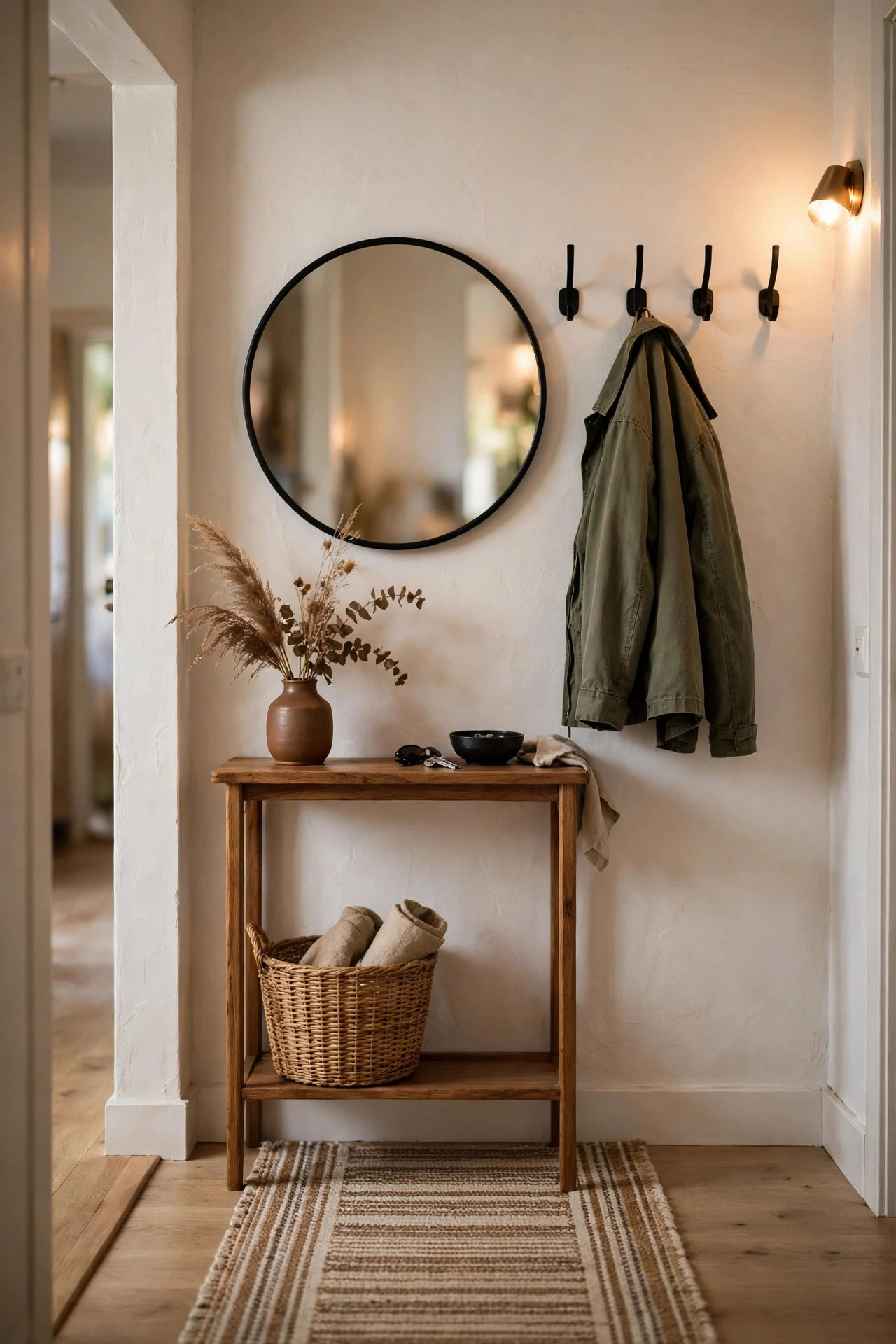
A console table in a narrow entryway should be 10 to 14 inches deep — slim enough to leave a clear walkway, deep enough to hold a lamp, a key tray and a small vase. Anything deeper than 14 inches in a hallway under 120 cm wide turns the passage into a squeeze.
Look for a console with a lower shelf or a slim drawer: the drawer hides the clutter (spare keys, dog leads, batteries), while the lower shelf holds a basket for shoes or a pair of boots. A solid console costs $80 to $180; a simple two-shelf demilune or a wall-mounted ledge costs $40 to $70 and works even better in the tightest halls. Measure your walkway after placing it — if you must turn sideways to pass, the console is too deep, no matter how beautiful it is. In a hallway under 100 cm wide, skip the console entirely and use a floating shelf instead.
3. Can a Floating Shelf Replace a Console Table?
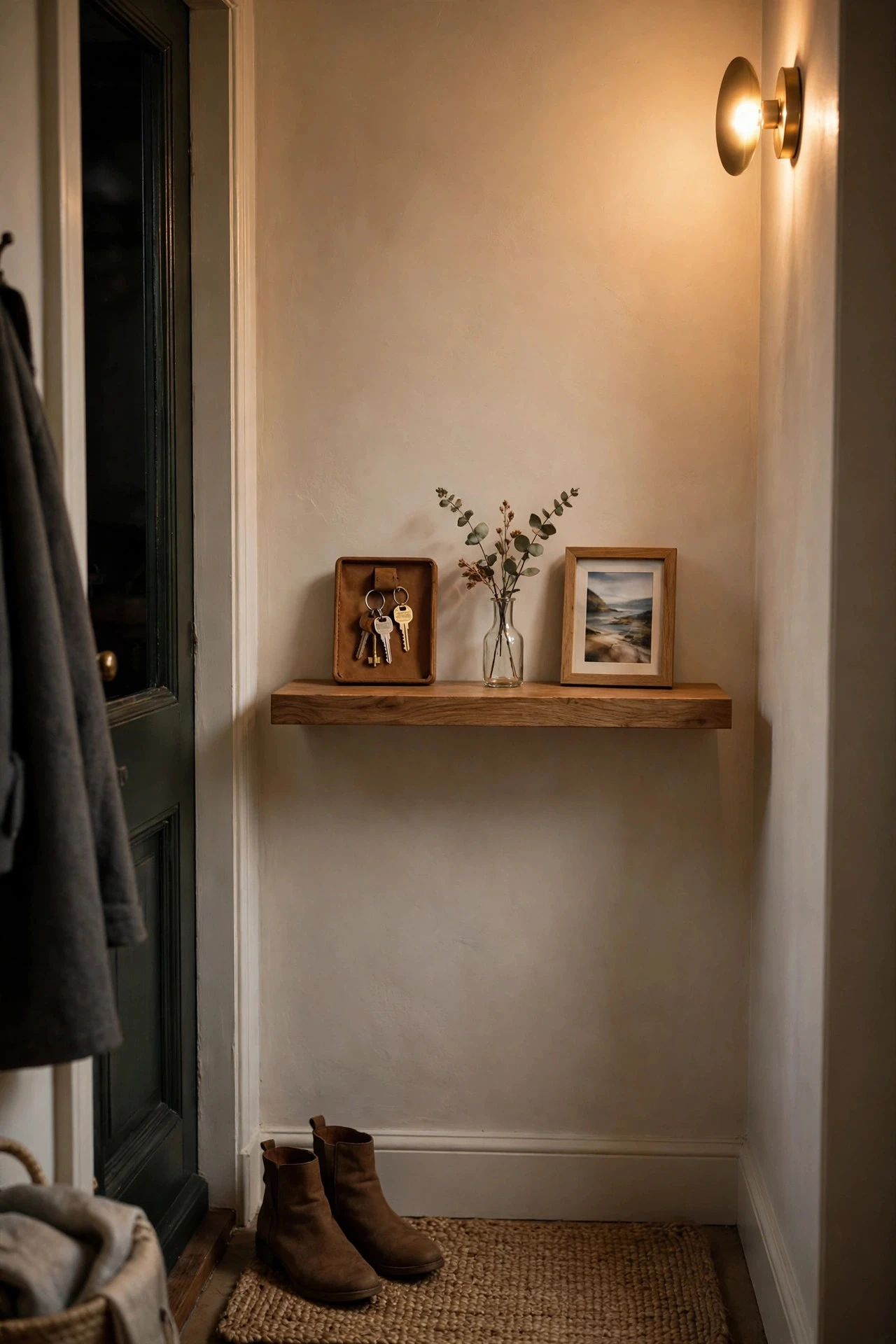
A floating shelf can absolutely replace a console table in a small entryway, and in hallways under 100 cm wide it is the better choice — it gives you a drop zone for keys and mail at zero floor footprint. Mount it at 90 to 100 cm from the floor, the same height as a console top.
Choose a shelf 60 to 90 cm long and 15 to 20 cm deep, in wood, painted MDF or brass, and fix it into wall studs or with heavy-duty plasterboard anchors rated for at least 10 kg. Style it the way you would a console: a small tray for keys on one end, a bud vase or a framed photo in the middle, and nothing else — a shelf this slim forgives no clutter. Add a picture ledge above it for a second layer, or hang two hooks underneath for dog leads and lanyards. The whole setup costs $25 to $50, and because your feet pass underneath it, the entryway feels wider the moment it goes up.
4. How Do You Create an Entryway When You Have No Foyer?
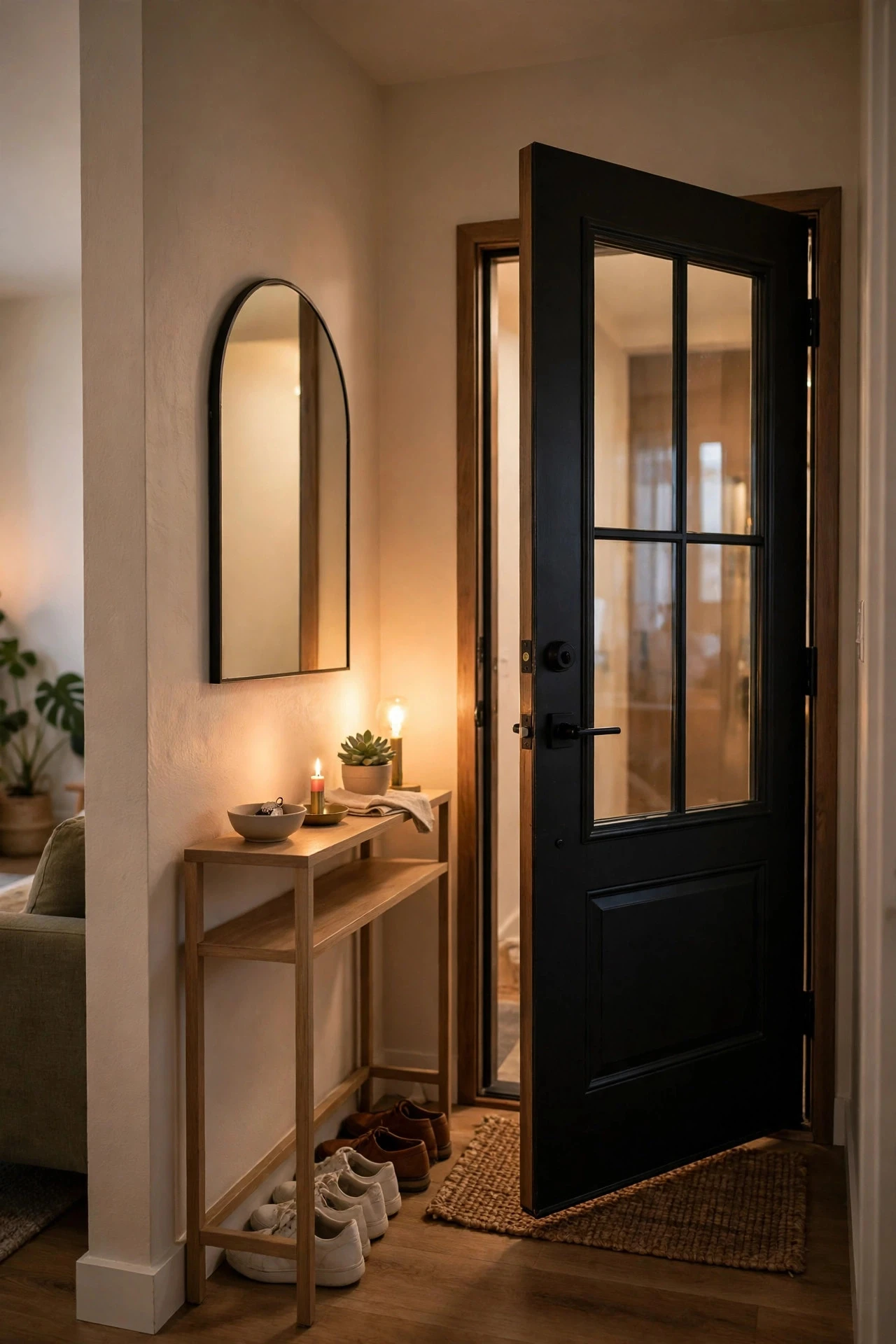
You create an entryway with no foyer by defining the zone with a rug, a piece of furniture and a boundary — the front door opens into the living room, so the entryway has to be invented rather than built. Lay a runner inside the door and place a slim console against the nearest wall, with a mirror above it.
The rug is the most important piece: it tells the eye "this is the entrance" and it tells feet "shoes stop here." A low-pile, washable rug in a pattern that hides dirt costs $30 to $70 and survives daily foot traffic. Add a room divider trick if the space allows — a tall open bookshelf placed perpendicular to the wall creates a partial screen without blocking light. The traditional foyer is an entrance hall with walls on both sides, but in a modern apartment the same job is done by three objects and a rug, and nobody walking in will think anything is missing.
5. What Is the Best Bench for a Tiny Entryway?
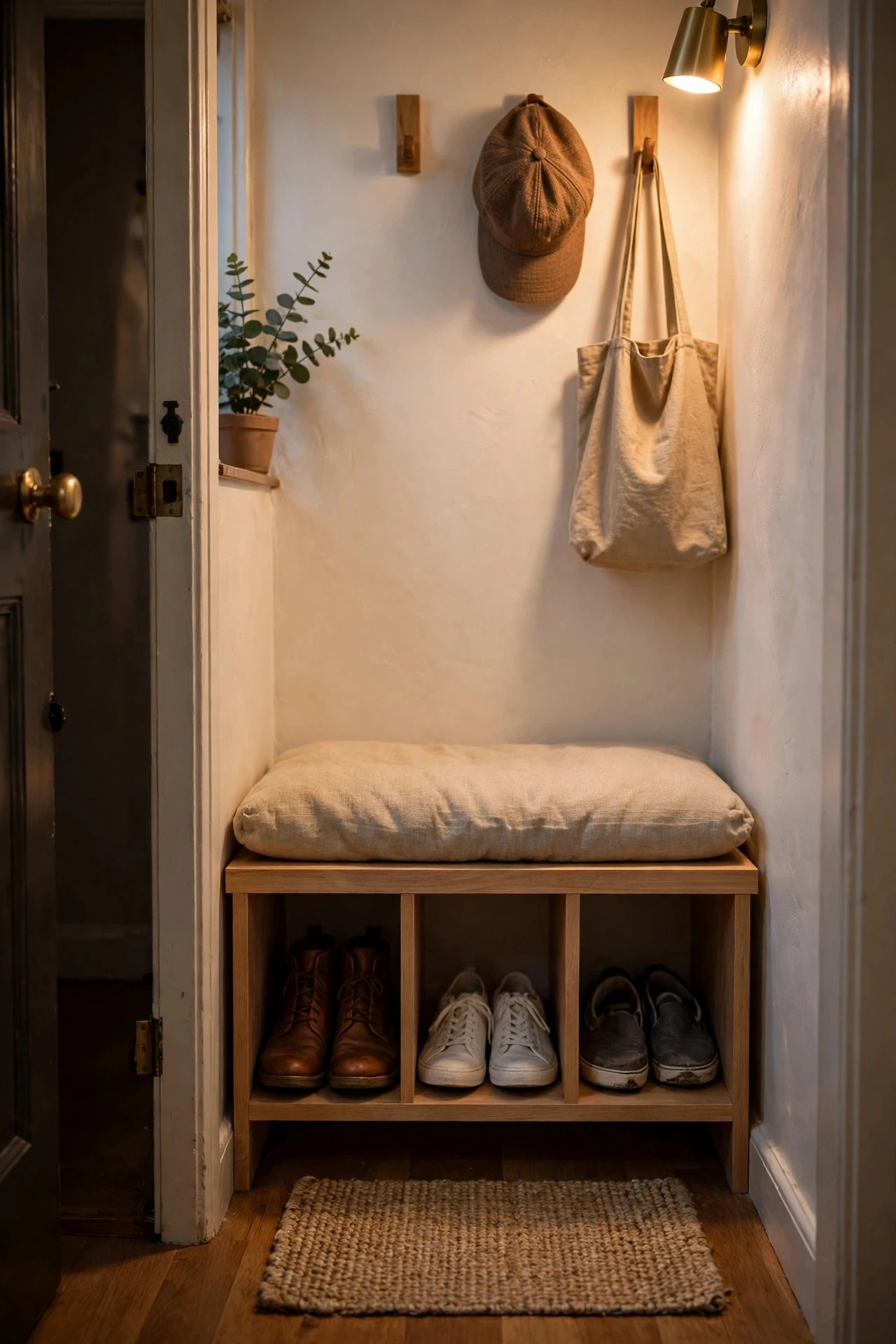
The best bench for a tiny entryway is a slim storage bench 30 to 36 cm deep and 80 to 100 cm long, with a lift-up seat or open cubbies underneath for shoes. It gives you somewhere to sit while putting on shoes, and it hides the shoes instead of leaving them in a row by the door.
Choose a bench with a firm, wipeable seat — wood, leather or a dark performance fabric — because a pale linen bench in an entryway will look grey within a month. Open cubbies suit families (each person gets one cubby, shoes go in, shoes come out), while a lift-up seat suits a cleaner look but hides clutter better. Budget $90 to $200 for a solid storage bench, or $40 to $80 for a simple slatted bench with a basket slid underneath. Keep the bench height at 45 to 48 cm, standard seat height, and leave 60 cm of clear floor in front of it so you can actually sit down without blocking the door.
6. How High Should Coat Hooks Go in an Entryway?
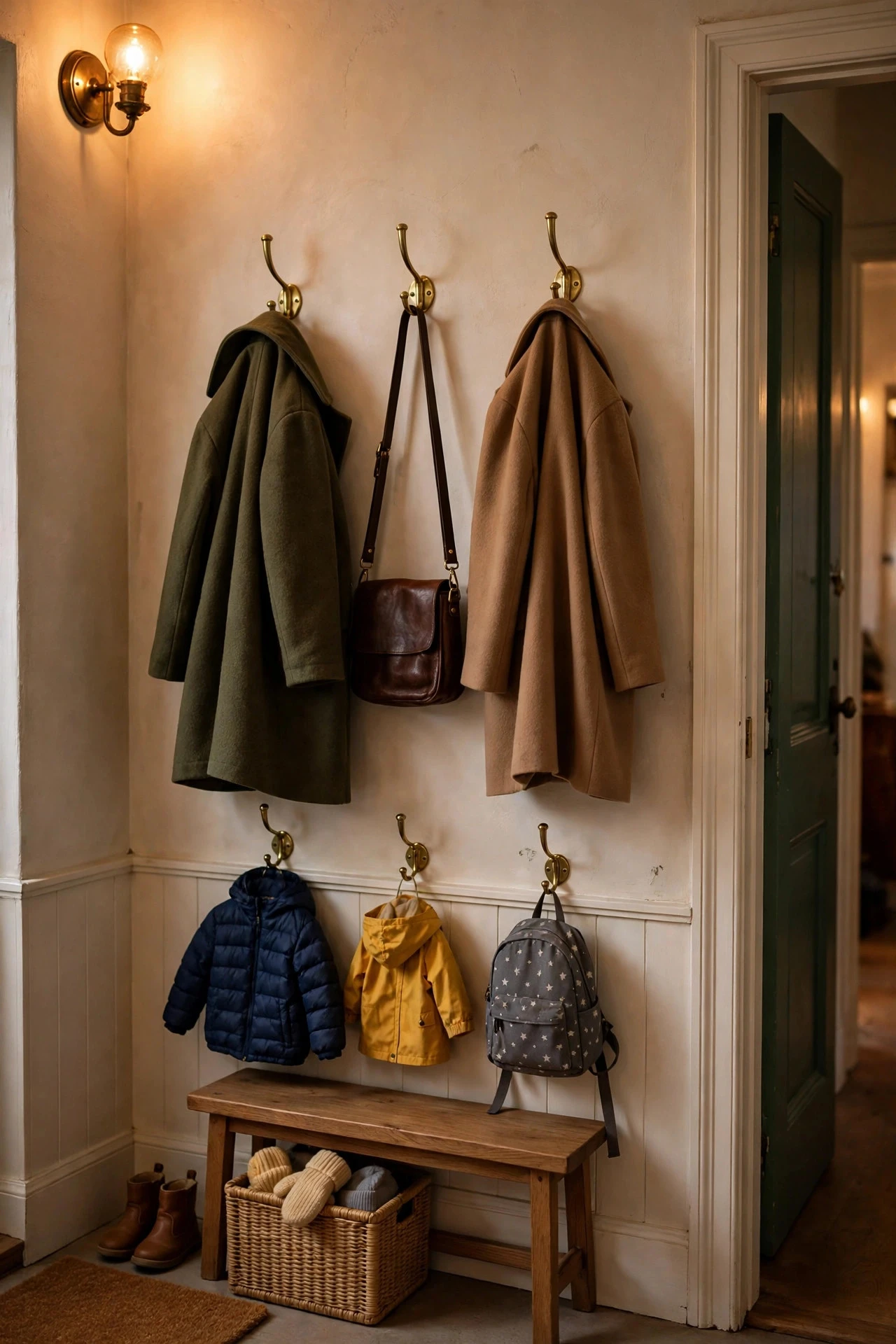
Coat hooks in an entryway should go at 60 to 66 inches high — high enough that a long coat hangs clear of the floor, low enough that most adults can reach them without stretching. In a household with children, add a second row at 120 cm so kids can hang their own coats.
Use individual hooks rather than a peg rail with fixed spacing, because hooks let you space them 15 to 20 cm apart for bulky winter coats and closer together for light jackets. Choose hooks with a double prong — one for the coat, one for the bag or scarf — in brass, matte black or wood to match your console hardware. A set of four good hooks costs $20 to $40, and they must be fixed into studs or with anchors rated for 7 kg each, because a wet winter coat plus a bag is heavier than it looks. Never hang hooks on the back of the front door in a small entryway: the door swings, the coats swing with it, and the whole entrance feels chaotic every time someone comes in.
7. Which Mirror Makes a Small Entryway Look Bigger?
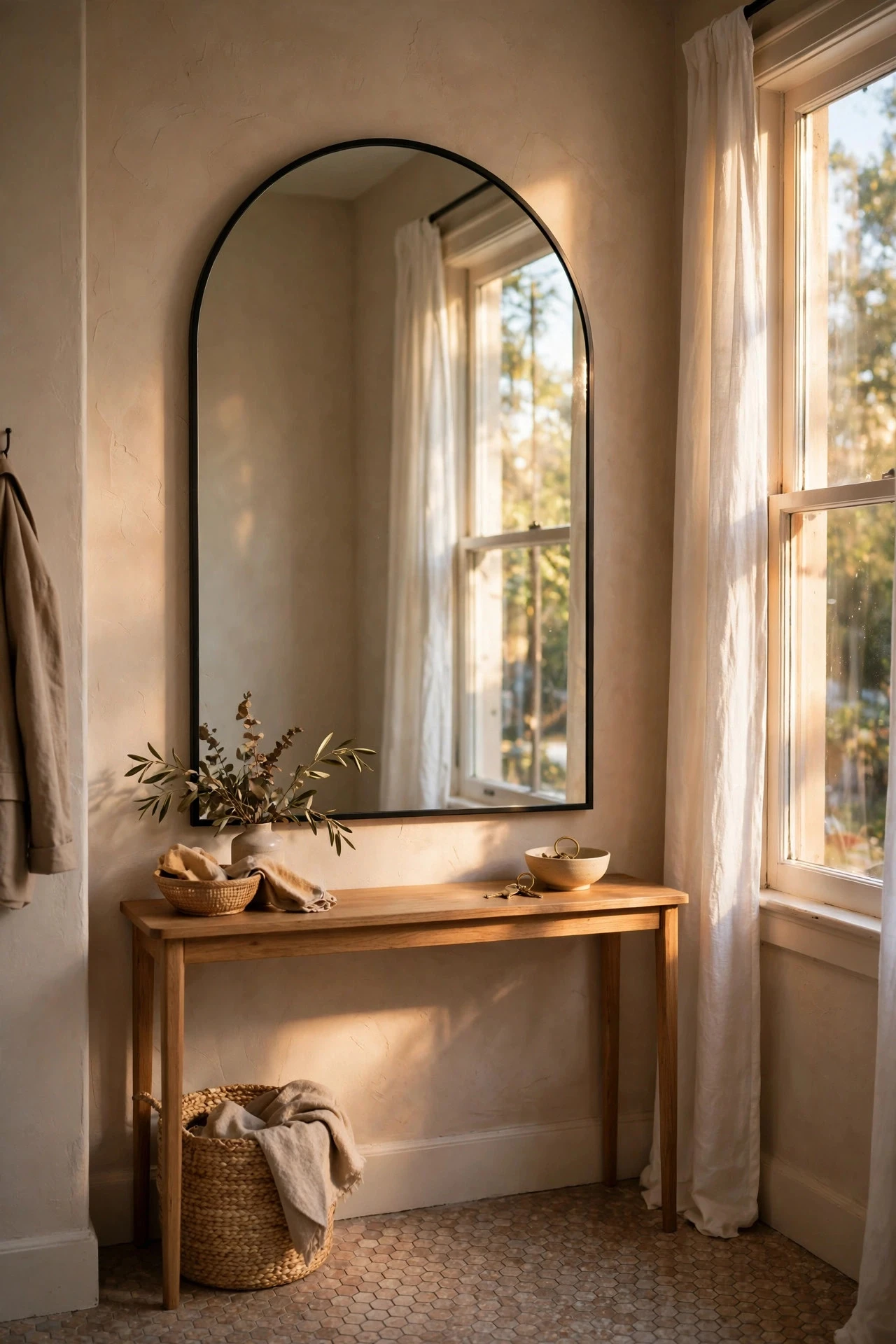
The mirror that makes a small entryway look bigger is a large, simple mirror — at least 60 by 90 cm — hung with its centre at 57 to 60 inches from the floor, where it reflects light from a window or a lamp. It doubles the visual depth of the space and lets you check your outfit before leaving.
Choose a thin frame or no frame at all: a chunky ornate frame eats visual space in a small room, while a slim black, brass or wood frame reads as a window. An arched mirror softens a boxy hallway, a round mirror suits a narrow wall above a console, and a rectangular mirror suits a long wall above a bench. Budget $40 to $90 for a good entryway mirror, and hang it with two fixings, not one, so it sits level and cannot be knocked askew by a passing bag. Avoid hanging a mirror directly opposite the front door if it reflects the street — a mirror facing a window or a lit lamp works far harder than one facing the outside.
8. How Do You Choose a Runner for a Narrow Hallway?
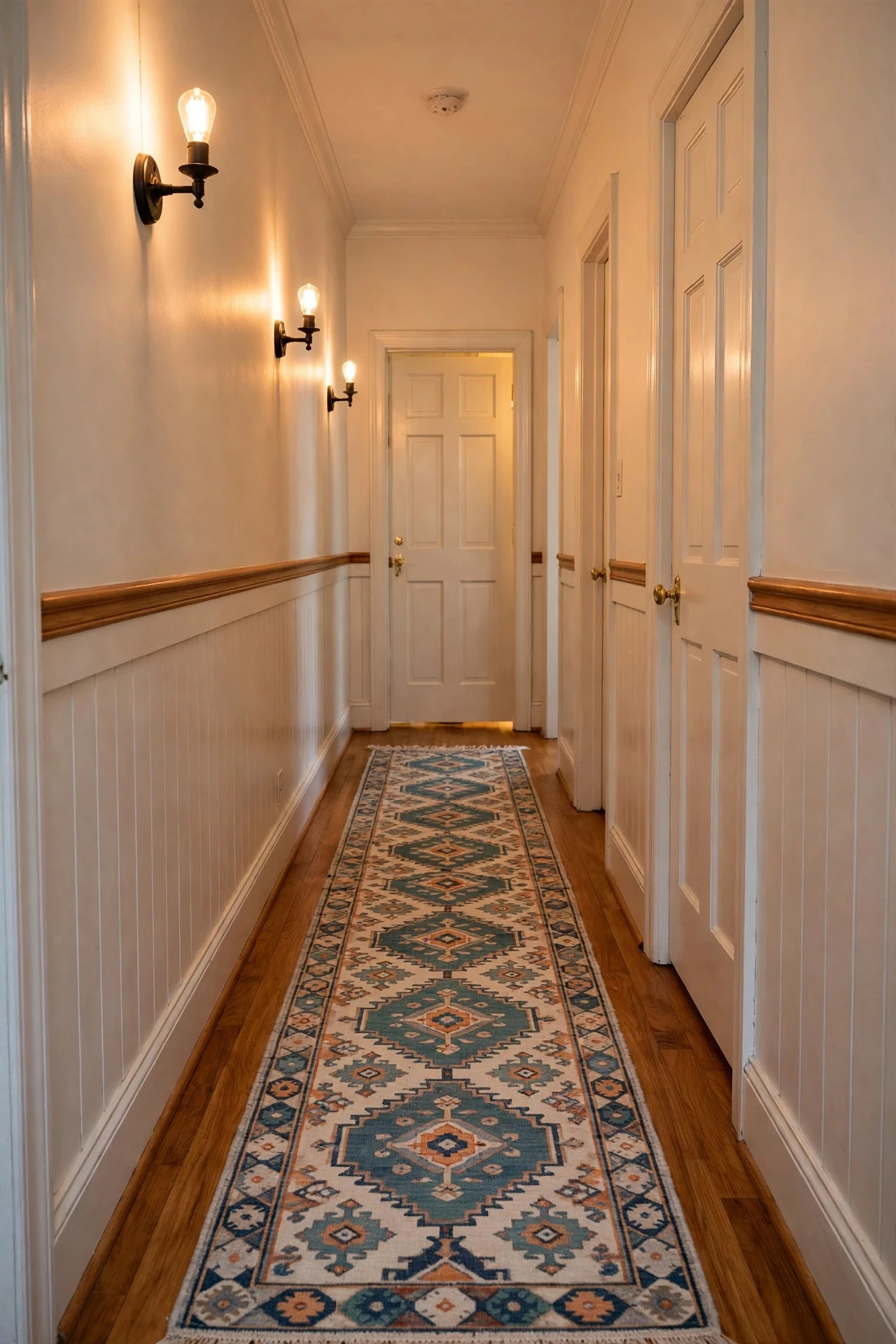
Choose a runner for a narrow hallway by making it 15 to 20 cm narrower than the hall itself, so a strip of floor shows on each side and the hallway looks wider, not narrower. A runner that touches both walls reads as wall-to-wall carpet and shrinks the space.
Measure the hall width, subtract 15 to 20 cm, and that is your runner width — in a 110 cm hall, a 90 cm runner is right. Length matters too: leave 15 cm of bare floor at each end of the hall so the runner does not butt against the door or the skirting. Pick a low-pile, washable runner in a pattern that hides dirt — a vintage-style pattern, a geometric, or a dark border — for $40 to $100, and always use a non-slip underlay, because a runner that slides is a trip hazard in the busiest walkway in the house. In a home with no separate hallway, use a small rug of the same logic just inside the door to mark the entry zone.
9. Where Does the Shoe Storage Go in a Small Entryway?

Shoe storage in a small entryway goes in the shallowest furniture that fits the wall — a slim shoe cabinet 15 to 20 cm deep, a bench with cubbies, or a lidded basket — and the rule is simple: only the shoes you wore today live by the door.
A two-tier slim shoe cabinet that holds 8 to 12 pairs costs $70 to $150 and looks like a console, which is why it is the best solution for most small entryways: the top becomes the drop zone, the tilted shelves inside hold the shoes, and the door stays shut so the mess is invisible. If even that is too deep, use one lidded basket per person, or a boot tray by the door for wet shoes and a single pair each on a wall-mounted shoe rack. Keep the count honest — two pairs per person by the door, maximum — and rotate seasonally, because a small entryway with six pairs of shoes in it is not a storage problem, it is a habit problem.
10. How Do You Add Storage Without Blocking the Walkway?

You add storage to a small entryway without blocking the walkway by using the walls and the vertical space above head height — shallow cabinets, high shelves, hooks and baskets that sit above or beside the path, never in it. The walkway is the floor at knee height and below.
Mount a shallow cabinet (15 cm deep) above the console for the things you need rarely — spare bulbs, the torch, the umbrella stand's overflow — and put a lidded basket on top of the shoe cabinet for hats and gloves. Use the inside of a cupboard door for a key rail, and the space above the front door for a single shelf holding the rarely-used items in matching boxes. The most useful hidden storage in a small entryway is a drawer: one shallow drawer in the console holds the entire daily clutter (keys, post, the dog lead, the spare batteries) and costs nothing extra if you choose a console that already has one. If it cannot fit on the wall or in a drawer, it does not live in the entryway.
11. What Lighting Works Best in a Small Entryway?

The best lighting for a small entryway is layered: one ceiling light or a small pendant for general light, plus a warm lamp or a wall sconce at console height for a welcoming glow. A single bare ceiling bulb flattens a small space and makes it feel like a corridor.
Choose warm-white bulbs at 2700K, because a small entryway is the first thing guests see and cool white light makes it feel like an office lobby. A small pendant hung 210 cm from the floor costs $30 to $80 and suits a hallway with a ceiling above 240 cm; in a low hallway, a flush-mount or a semi-flush fitting is safer. Add a table lamp on the console — a small ceramic or brass lamp, 30 to 40 cm tall — or a battery-powered sconce if there is no socket nearby. If the entryway has no window, put the lights on a timer or a motion sensor so the entrance is never dark when you come home, and never rely on the hallway light from the next room to do the job.
12. How Do You Style a Small Entryway Console?

Style a small entryway console in three layers: something tall at the back, something medium in the middle, and something low and flat at the front — then stop. The classic formula is a mirror or art above, a lamp or tall vase on one side, a key tray at the front, and one-third of the surface left empty.
Start with the practical pieces first, because an entryway console is working furniture: the key tray goes where your hand lands when you walk in, the lamp goes on the side away from the door swing, and the vase goes where it cannot be knocked by a bag. Then add one personal object — a framed photo, a souvenir from a trip, a small sculpture — and one living thing, a sprig of eucalyptus or a small plant. Edit ruthlessly: if you cannot set down a parcel on the console, it is overstyled. The same layered styling — warm textures, one metallic, one living element — makes a small surface feel inviting rather than crowded.
13. What Colour Makes a Small Entryway Feel Larger?
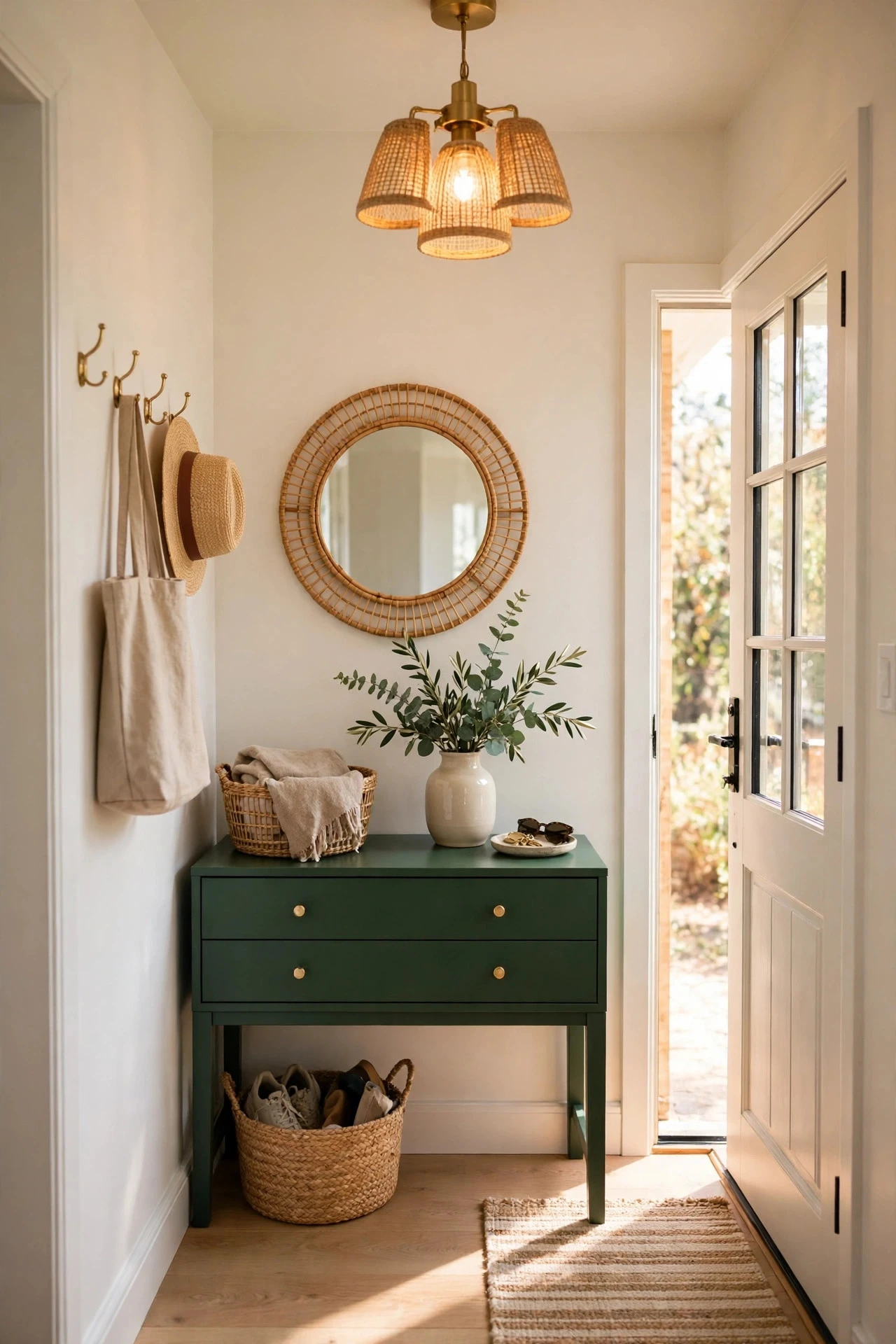
The colour that makes a small entryway feel larger is a pale, warm neutral on the walls — warm white, pale greige or a soft sage — with one deeper accent on a single element, such as the console, the door or a runner. Pale walls reflect light and push the walls outward visually.
Paint the ceiling the same colour as the walls, or one shade lighter, so the eye does not stop at a hard line — in a small space, a white ceiling against coloured walls chops the room in half. Use the deeper accent sparingly: a console in deep green or navy, a front door painted in a rich colour, or a runner with a dark border. A litre of good paint costs $25 to $40 and covers a small entryway in one afternoon, which makes paint the cheapest transformation in this guide. Avoid busy wallpaper on all four walls of a tiny entryway — one feature wall, or the wall behind the console only, gives the pattern without closing the space in.
14. How Do You Organise Keys, Mail and Everyday Clutter?
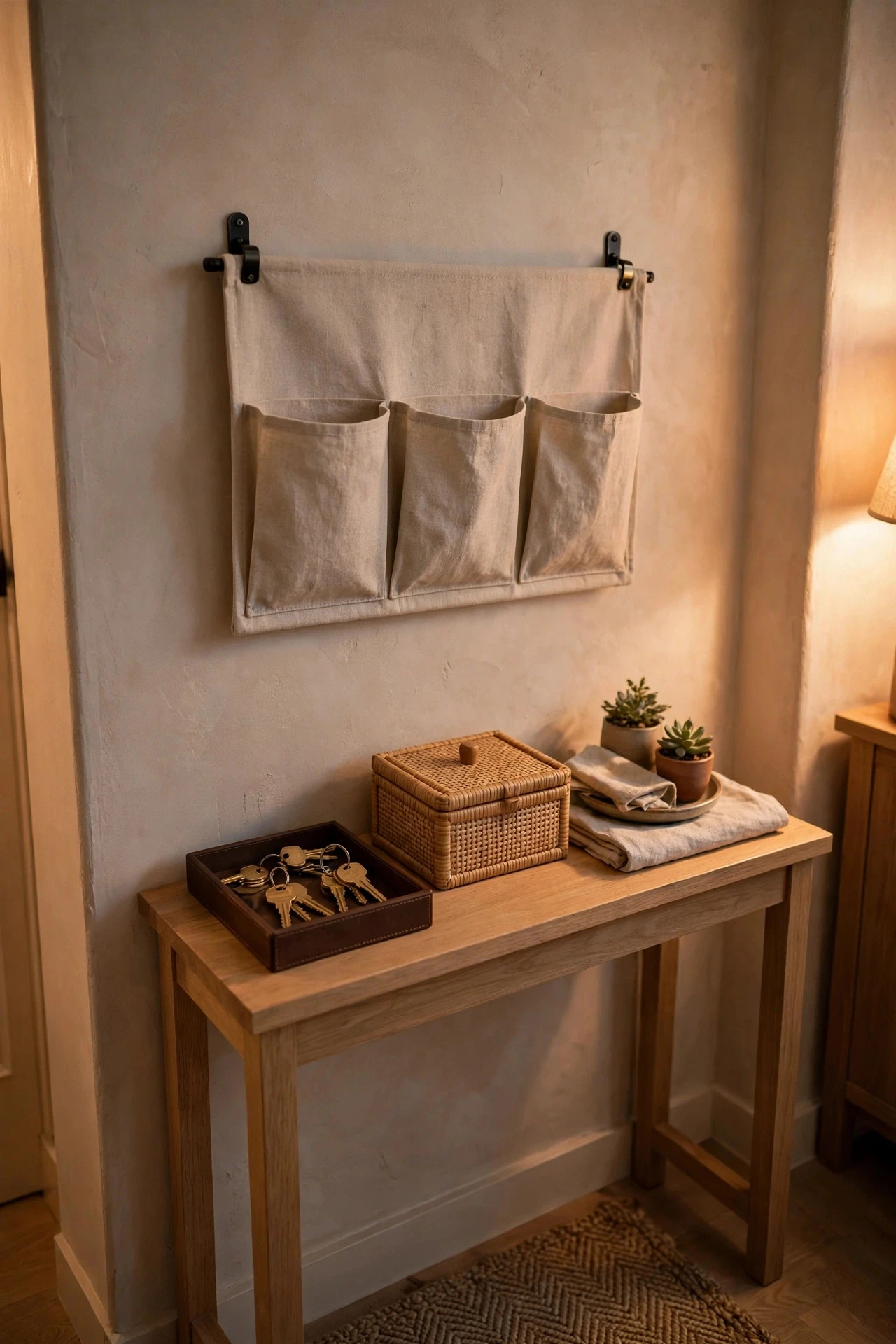
Organise keys, mail and everyday clutter in a small entryway by giving each category one container and one place, and by emptying them on a schedule. A small tray by the door holds the keys, a slim wall-mounted holder holds the post, and a lidded box holds the loose bits.
The container rule is what makes it work: if the tray is full, something leaves; if the mail basket overflows, it gets sorted that evening. Mount the key rail at 150 cm, within easy reach, and keep a small dish for the things that arrive in pockets — coins, the parking ticket, the dog's treats. Sort the mail the moment it arrives: junk goes straight to recycling, bills go in the holder, and nothing sits in a pile on the console for a week. A set of three matching containers — tray, basket, box — costs $20 to $45 and looks deliberate, while three mismatched containers look like clutter even when they are organised.
15. Can a Small Entryway Work as a Mudroom?
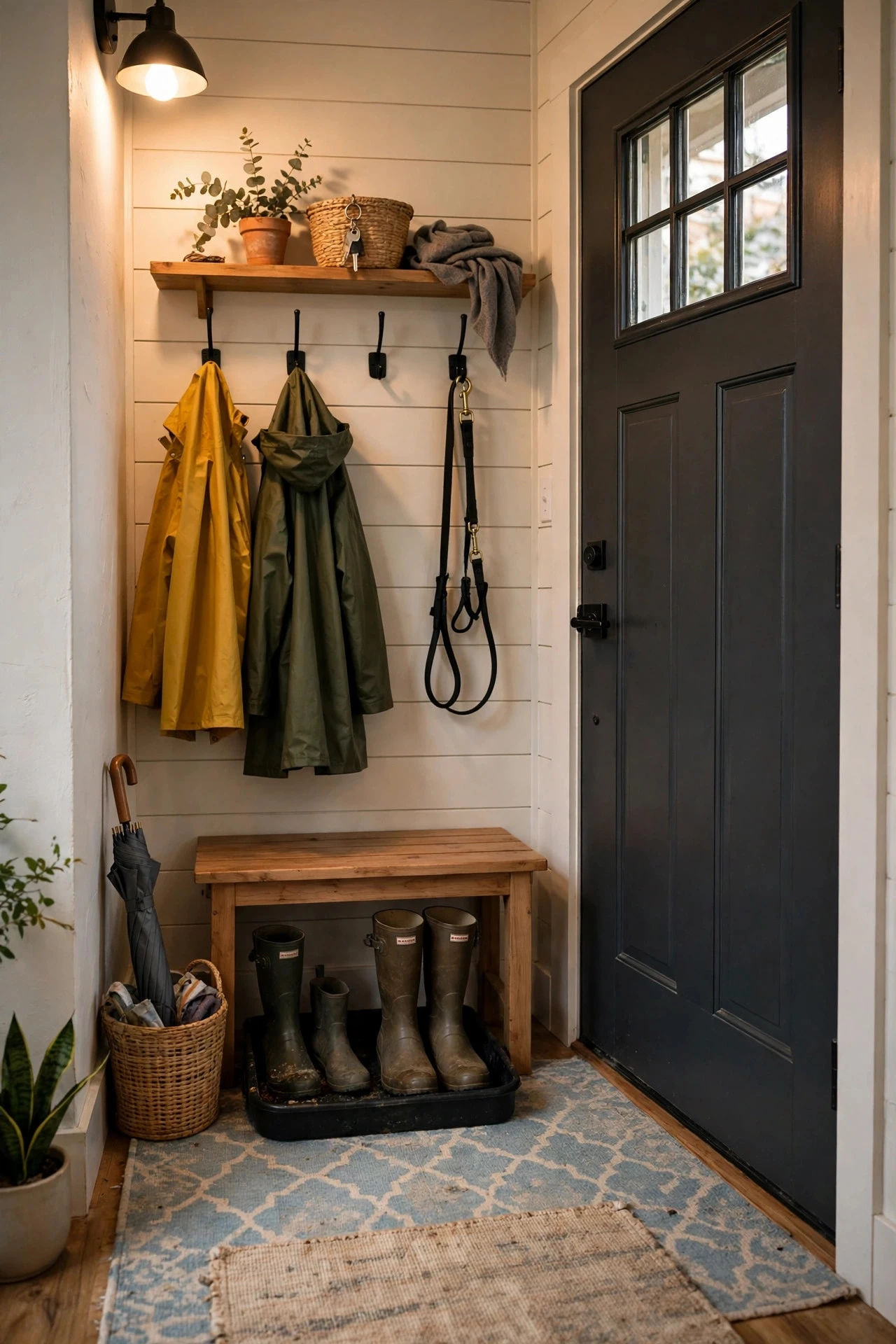
A small entryway can work as a mudroom if you borrow the mudroom's three habits — a wipeable floor, a place for wet things, and a place for dirty shoes — without needing a separate room. The mudroom is traditionally a secondary entrance for muddy boots and coats, but in a small home the front entryway does both jobs.
Lay a washable rug or a boot tray just inside the door to catch mud and rain, and keep a small lidded basket for wet umbrellas and a wall hook for the dog lead and the raincoat. Choose materials that survive water: a console with a sealed or metal top, a bench in wipeable wood or leather, and paint in a washable finish on the lower half of the wall. Add a small lidded bin for the muddy items that need to go to the wash, and a wall-mounted drying hook for the one wet coat that comes in every rainy evening. The trick is the boot tray: a $15 to $25 rubber or metal tray by the door catches the mud, and the entryway stays a living room entrance instead of turning into a utility room.
16. How Do You Decorate a Rental Entryway Without Damage?

Decorate a rental entryway without damage by using nothing that makes a hole — removable adhesive hooks, leaning furniture, freestanding pieces and washable rugs — because the deposit depends on the walls going back to how you found them. A leaning mirror, a freestanding console and a rug transform an entryway with zero fixings at all.
Use command-style adhesive hooks rated for the weight of a coat (most hold 2 to 3 kg each) and remove them with the pull-tab method so they leave no mark. Lean a large mirror against the wall above a console instead of hanging it, and use a freestanding coat stand if hooks are not allowed. A removable wallpaper panel or a large framed print on a picture ledge gives colour without touching the paint. Budget $60 to $120 for a rental-friendly entryway — a rug, a leaning mirror and a set of adhesive hooks — and photograph the walls on move-in day so you can prove any mark was already there. The one thing to avoid is adhesive hooks on fresh paint or on wallpaper: they can lift both, so test one hook in a hidden spot first.
17. What Is the Best Way to Hang Art in a Tiny Entryway?

The best way to hang art in a tiny entryway is one piece, hung with its centre at 57 to 60 inches from the floor, on the wall you face when you walk in — not a gallery wall, which needs space a tiny entryway does not have. One strong piece gives the entrance a focal point.
Choose a piece 40 to 60 cm wide for a standard entryway wall, in a slim frame that matches the mirror or the console hardware, and pick a subject that suits a threshold: a landscape, an abstract in your colour scheme, or a vintage map. If you love the gallery look, use a picture ledge instead — lean two or three small frames on it so they can be swapped without new holes. An oversized piece above a slim console is the classic move: the art and the console share the same width, and the wall reads as one composed unit. Our living room accent wall ideas show how a single bold wall treatment anchors a room, and the same principle works in miniature on one entryway wall.
18. How Do You Keep a Small Entryway Tidy With Kids or Pets?
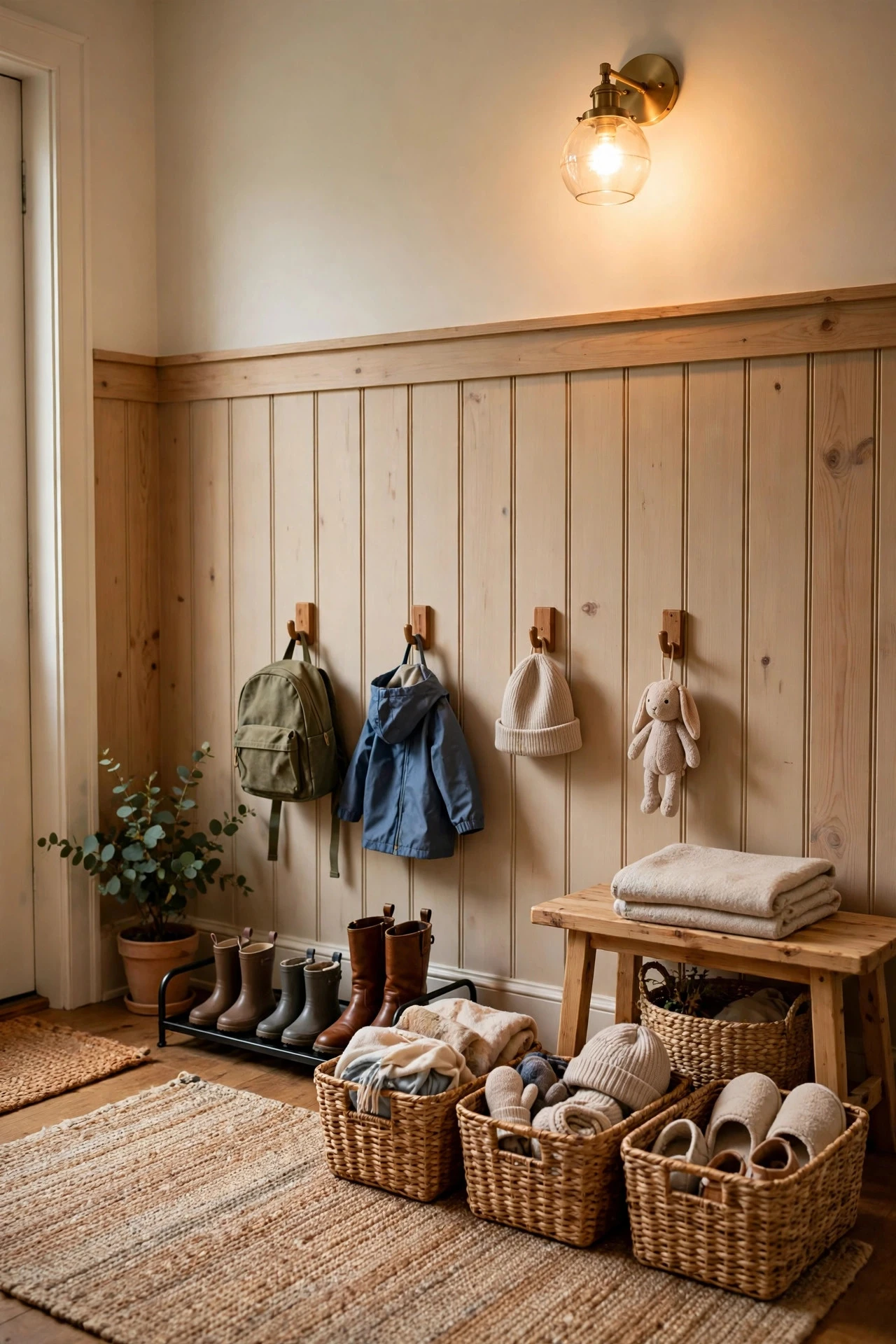
Keep a small entryway tidy with kids or pets by lowering the storage to their height and making tidiness the easy option — a low row of hooks at 120 cm, a basket per child on the floor, and a boot tray the dog's lead hangs above. Children do not hang coats on hooks they cannot reach.
Give each child one hook and one basket, labelled with a name tag or a colour, and make the rule simple: coat on the hook, shoes in the basket, bag on the bench. For pets, keep the lead, the treats and the towel on one hook by the door, and a small mat under the water bowl if the bowl lives near the entrance. Choose materials that survive both: a washable rug, a bench in dark wipeable fabric, and hooks fixed into studs, because a child swinging on a hook will test any fixing. A basket per person costs $10 to $20 each, and the whole system costs under $60 — far less than the daily five minutes of tidying it saves.
19. Which Plants Survive in a Small Entryway?

The plants that survive in a small entryway are the ones that tolerate low light and neglect — a snake plant, a pothos, a ZZ plant or a small olive tree in a pot — because most entryways get little direct sun and nobody remembers to water the plant by the front door.
Place the plant where it will not be knocked: on the console in a heavy pot, on a high shelf, or on the floor in a corner the door does not swing into. A pothos trailing from a high shelf softens a hard corner and needs watering only every two weeks, while a ZZ plant tolerates a windowless hallway better than almost anything. Budget $15 to $40 for a plant in a good pot, and choose a pot with a saucer so watering never drips onto the console or the floor. Avoid a large floor plant in a small entryway — it eats the walkway and gets brushed every time someone comes in — and skip faux plants that look plastic; one real plant in a good pot beats three fake ones.
20. How Do You Make a Dark Entryway Feel Bright?
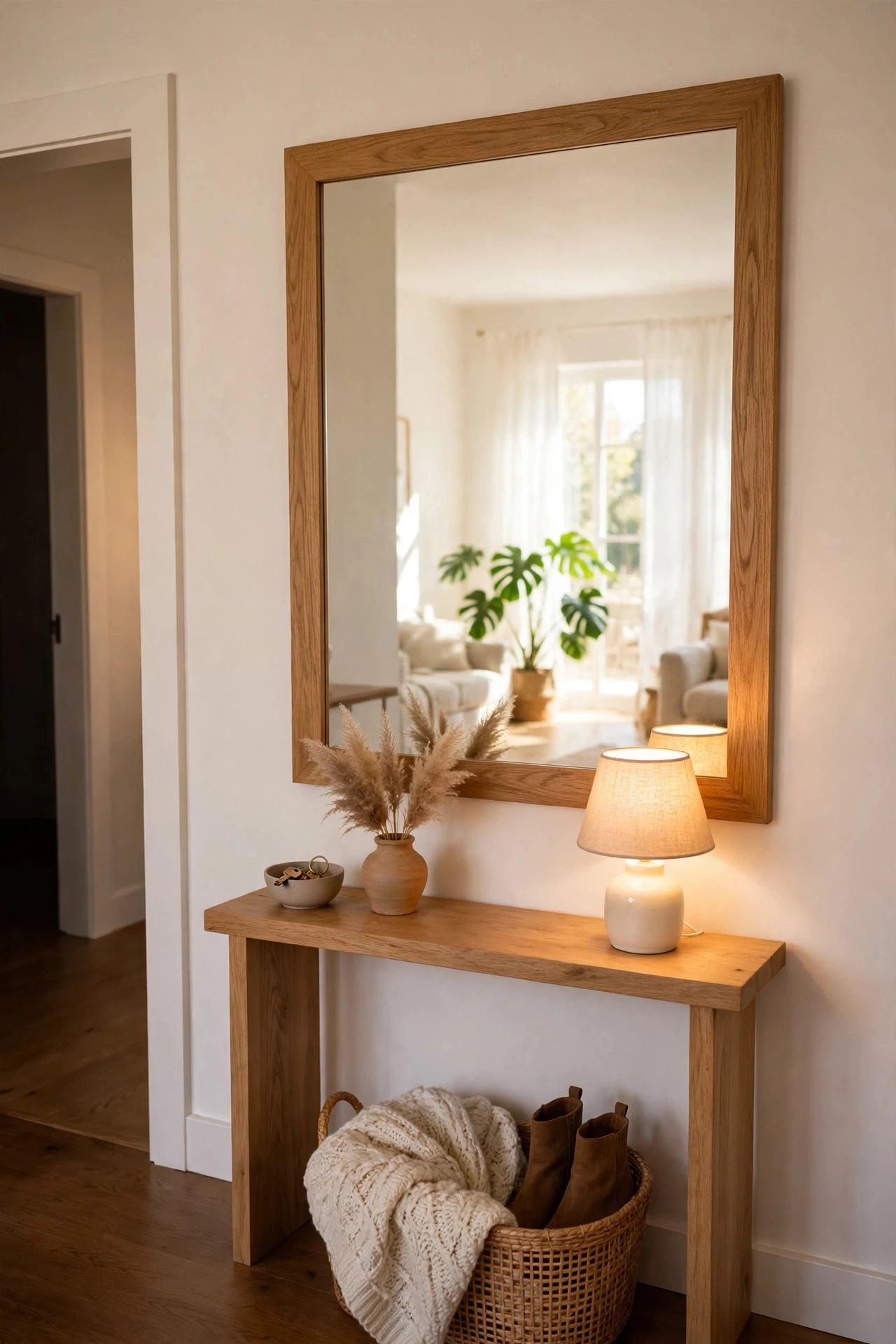
Make a dark entryway feel bright by attacking the three causes at once: pale paint, a mirror to borrow light, and warm artificial light on a sensor. A dark entryway is usually dark because it has no window, so you have to manufacture the light it never gets — and the fix costs less than $100.
Paint the walls a warm white with a light reflectance value above 85, and paint the door and the skirting the same colour so the space reads as one bright box. Hang the mirror on the wall that faces the brightest room, so it pulls light in from the living room or kitchen, and add a second light source at console height — a small lamp or a battery sconce — so the entrance glows at eye level rather than from a single ceiling bulb. Put the ceiling light on a motion sensor or a timer so the entryway is lit the moment the door opens. If the front door has a fanlight or a sidelight, keep it clear — never hang a curtain or a wreath over the one source of natural light the entrance has.
21. What Should You Avoid in a Small Entryway?

Avoid four things in a small entryway: furniture deeper than 14 inches, more than three decorative objects on any surface, open shoe storage, and anything that blocks the door swing. Each one makes the entrance feel smaller, messier or harder to use.
Do not put a full-depth chest of drawers, a wide bookshelf or a large plant in a small entryway; they eat the walkway and become the thing you bump into every day. Do not use open shoe racks, because a row of shoes is the single messiest sight in any entrance — hide them behind a cabinet door or in a basket with a lid. Do not hang coats on the back of the front door, and do not place the console on the wall the door swings toward. And do not treat the entryway as overflow storage for the rest of the house: the moment it holds the vacuum, the drying rack or the parcel pile, it stops being an entrance and becomes a cupboard with a door in it.
22. How Do You Make a Small Entryway Feel Grand on a Budget?
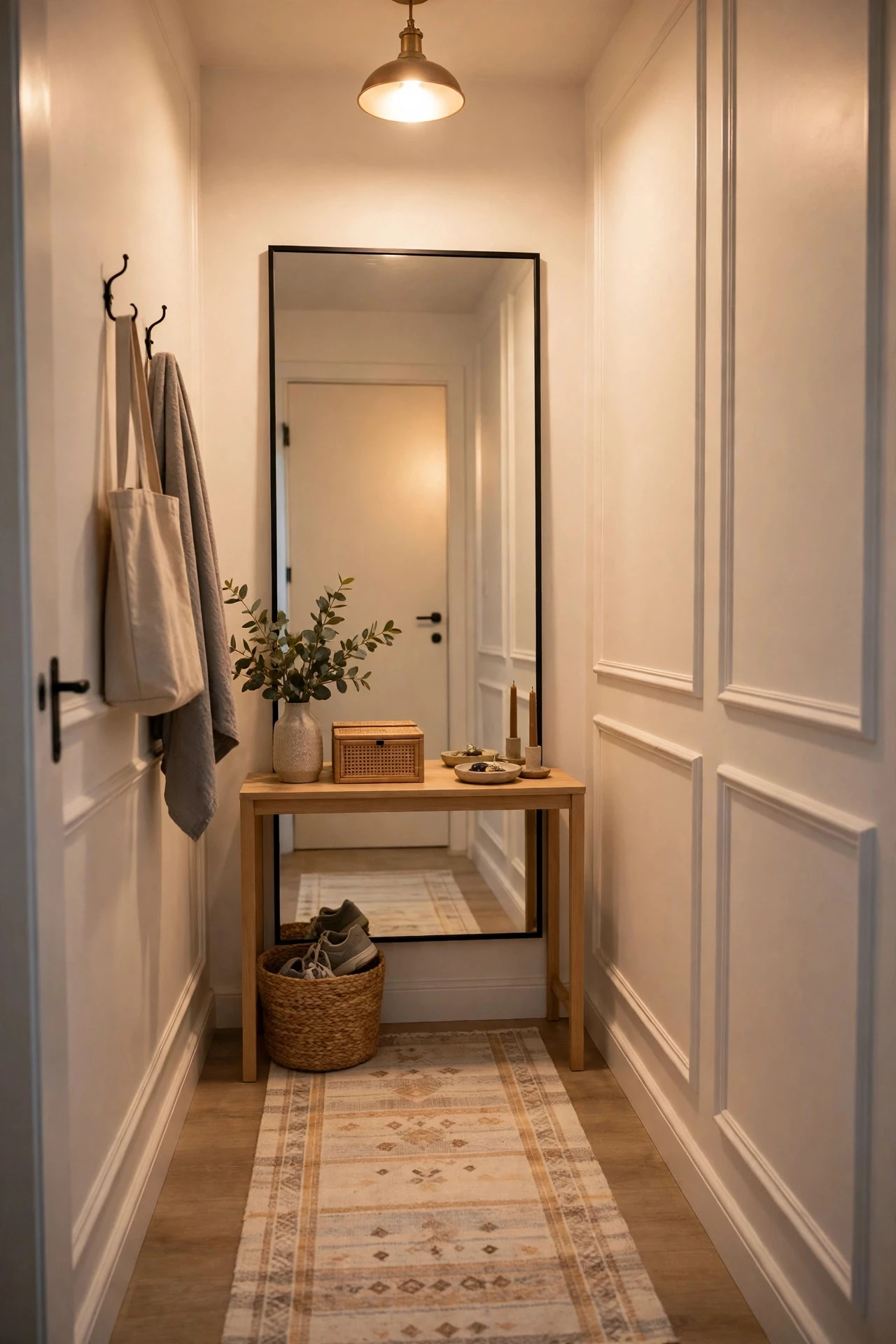
Make a small entryway feel grand on a budget by spending on three high-impact pieces and saving on everything else: a large mirror ($40 to $90), a slim console or bench ($80 to $180), and a washable runner ($40 to $100). Those three pieces define the space.
Start with paint, because a fresh coat of warm white costs $25 and changes the room more than any single purchase. Then add the mirror, which doubles the light, then the console, which gives the entrance its furniture, then the runner, which defines the zone. Finish with the details that cost almost nothing: a bowl for keys from a charity shop, a sprig of eucalyptus in a jar, a framed photo you already own. The total lands at $150 to $300, and the result feels grand because every piece has a job and a place — which is what grand really means in a small space. Our dream house decor ideas show how the same principle — a few chosen pieces, repeated with intention — makes a whole home feel personal and considered, starting at the front door.
Practical Tips
Measure twice and buy once: write the wall length, the walkway width and the door swing on your phone before you shop, because a console that is 5 cm too deep is a console you will trip over for years. Buy the rug first, not last — the rug sets the size of the zone, and everything else fits inside it. Keep a small basket by the door for the things that leave the house with you (the umbrella, the reusable bags, the parcel to post), so the console never becomes a dumping ground.
Set a weekly five-minute reset: Sunday evening, empty the key tray, sort the mail basket, put the spare shoes back in the cupboard, and wipe the console. A small entryway only stays grand if the daily clutter has somewhere to go and someone to move it. Photograph the finished entrance from the doorway, so you can restore the layout after a busy week, and keep the spare hooks, batteries and adhesive strips in the console drawer — the entryway is the first thing you see, so it deserves the same small maintenance as the front door itself. When December comes and you want the same hallway dressed for the season, our Christmas hallway ideas show how the hooks, console and mirror you already own can carry a festive look without any extra furniture.
Final Thoughts
A small entryway does not need more space — it needs better decisions. One slim console, one large mirror, hooks at the right height, a runner that defines the zone and a home for every shoe, key and coat: that is the whole formula, and it costs less than a single piece of living room furniture. Start with the measurements, add the mirror, and let the entrance do what it was always meant to do — welcome you home and send you out the door feeling organised.
You may also like: our 22 living room accent wall ideas that transform a plain wall and our 22 cozy home decor ideas for a warm inviting home carry the same warm, layered styling from the entrance into the rooms beyond it.
Frequently Asked Questions
How do you make a small entryway look bigger?
Make a small entryway look bigger with a large mirror, pale warm-white walls and a runner 15 to 20 cm narrower than the hall. Keep furniture slim — a console 10 to 14 inches deep — leave one-third of every surface empty, and use vertical storage like hooks and shelves so the floor stays open.
What furniture do you need in a small entryway?
A small entryway needs three pieces: a slim console or bench for the drop zone, a mirror above it, and hooks for coats and bags. Add a shoe cabinet or a basket if shoes collect by the door, and a runner to define the zone. Anything beyond those pieces is decoration, not furniture.
How deep can a console table be in a narrow hallway?
A console table in a narrow hallway should be 10 to 14 inches deep, and no deeper than one-third of the hallway's width, so at least 90 cm of clear walkway remains. In a hallway under 100 cm wide, skip the console and use a floating shelf 15 to 20 cm deep instead.
How do you create an entryway in an apartment with no foyer?
Create an entryway in an apartment with no foyer using a rug just inside the door, a slim console or bench against the nearest wall, and a mirror or hooks above it. The rug marks the zone, the console gives you a drop spot for keys, and the mirror makes the space feel like a room.
What is the best storage for shoes in a small entryway?
The best shoe storage for a small entryway is a slim shoe cabinet 15 to 20 cm deep that holds 8 to 12 pairs behind a closed door, or a storage bench with cubbies underneath. Keep only two pairs per person by the door and store the rest in a cupboard.
How much does it cost to style a small entryway?
Styling a small entryway costs $150 to $300: $80 to $180 for a slim console or bench, $40 to $90 for a large mirror, $40 to $100 for a washable runner, and $20 to $45 for hooks, a key tray and baskets. A fresh coat of paint adds $25 to $40 and is the cheapest single improvement you can make.