22 Mudroom Ideas That Make Coming Home Feel Effortless
A mudroom is the hardest-working room in the house, and the one most homes get wrong. It is where wet boots, school bags, dog leads, coats, keys and sports kit all arrive at once — usually in the same thirty seconds, usually with someone already shouting that they are late. When a mudroom has no plan, all of it lands on the floor. When it has one, coming home feels effortless: shoes off, coat hung, bag down, hands free, in under a minute.
This guide gives real measurements for hook heights, bench depth, cubby sizes and boot trays, load ratings for hardware, budget notes and renter-friendly setups — written for a real family entry, not a show-home hallway.
Looking for more inspiration? Our Nest Decorz homepage gathers the latest home decor ideas, seasonal decorating guides and room-by-room styling tips in one place — start there and explore.
Quick answers
– Work the arrival path: shoes off first, then coat, then bag, then keys — lay the room out in that order and it runs itself. – Hook heights: 60–66 inches for adults, 36–48 inches for kids; space hooks 6–9 inches apart so coats do not bunch. – Bench rule: 17–19 inches high and 14–16 inches deep — shallow enough to sit on, deep enough for a shoe cubby underneath. – Wet zone: a 24–36 inch boot tray with a raised lip catches mud before it reaches the floor. – One cubby per person: one 12–15 inch cubby per person ends the daily pile-up.
1. How Do You Map a Mudroom Around the Arrival Path?
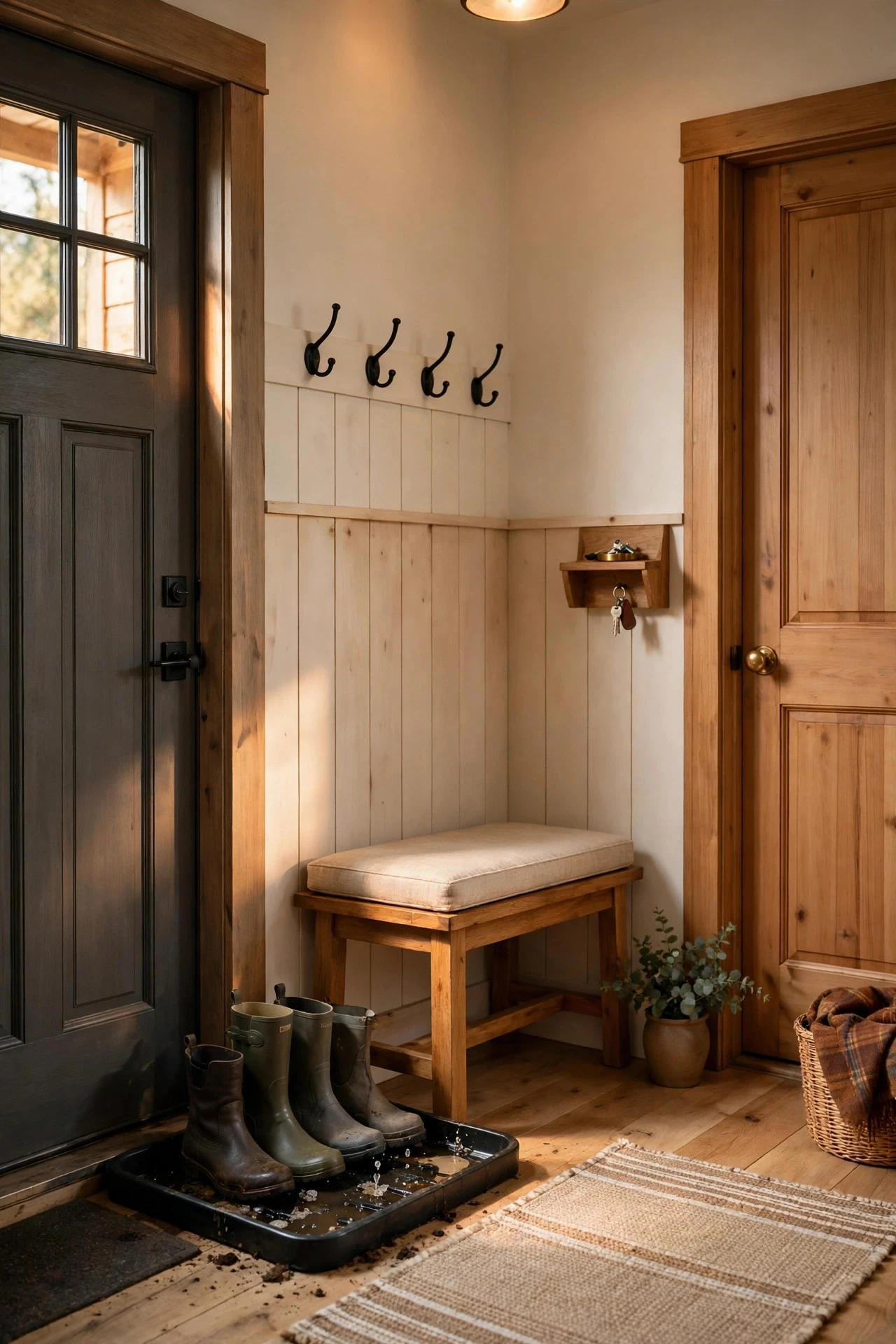
Map your mudroom around the order you actually arrive: shoes off at the door, coat off next, bag down, then keys, sunglasses and the dog lead. Lay the room out in that exact order and it runs itself; lay it out backwards and every trip home becomes a shuffle.
Put the boot tray and shoe storage closest to the door, the bench beside or just past them, hooks on the wall above the bench, and the key landing spot last, nearest the door into the house. For tight entrances, borrow the layouts in these small entryway ideas.
2. How High Should Mudroom Hooks Be?
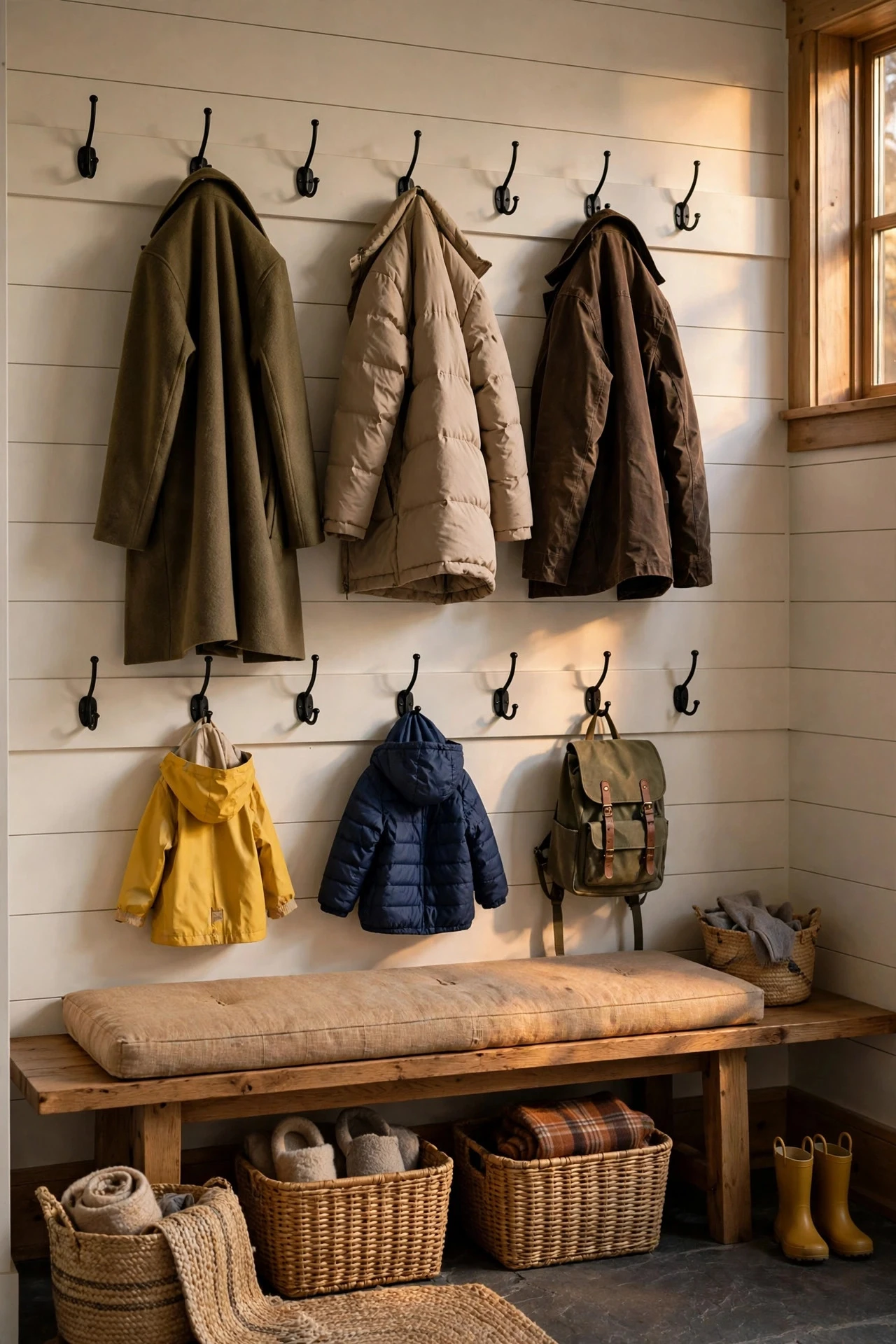
Hang adult hooks at 60 to 66 inches from the floor, and children's hooks at 36 to 48 inches, so every coat lands on a hook its owner can actually reach. A hook hung at 72 inches looks neat on a mood board and fails every day in real life, because wet coats end up on the bench instead.
Two rows work best: an adult row at 60 inches and a kids' row at 42 inches, staggered so lower coats do not block upper ones. Choose hooks rated for at least 15 pounds each — a wet winter coat plus a school bag easily tops 10 pounds. The Spruce's guide to mudroom organization covers hook styles and weight ratings worth comparing.
3. How Far Apart Should Mudroom Hooks Be?

Space mudroom hooks 6 to 9 inches apart, centre to centre, so a hanging coat has room to breathe and does not swallow the hook next to it. Six inches suits light jackets and children's coats; nine inches suits bulky winter coats, puffers and anything with a hood that spreads sideways.
Most mudrooms cram too many hooks onto one rail. Five hooks at 6-inch spacing fill a 30-inch rail, but five winter coats on it become one solid mass that never dries. Double hooks — one prong up, one down — hold a coat and a bag on one fixing, rated to 20 pounds or more.
4. What Bench Height and Depth Actually Work?
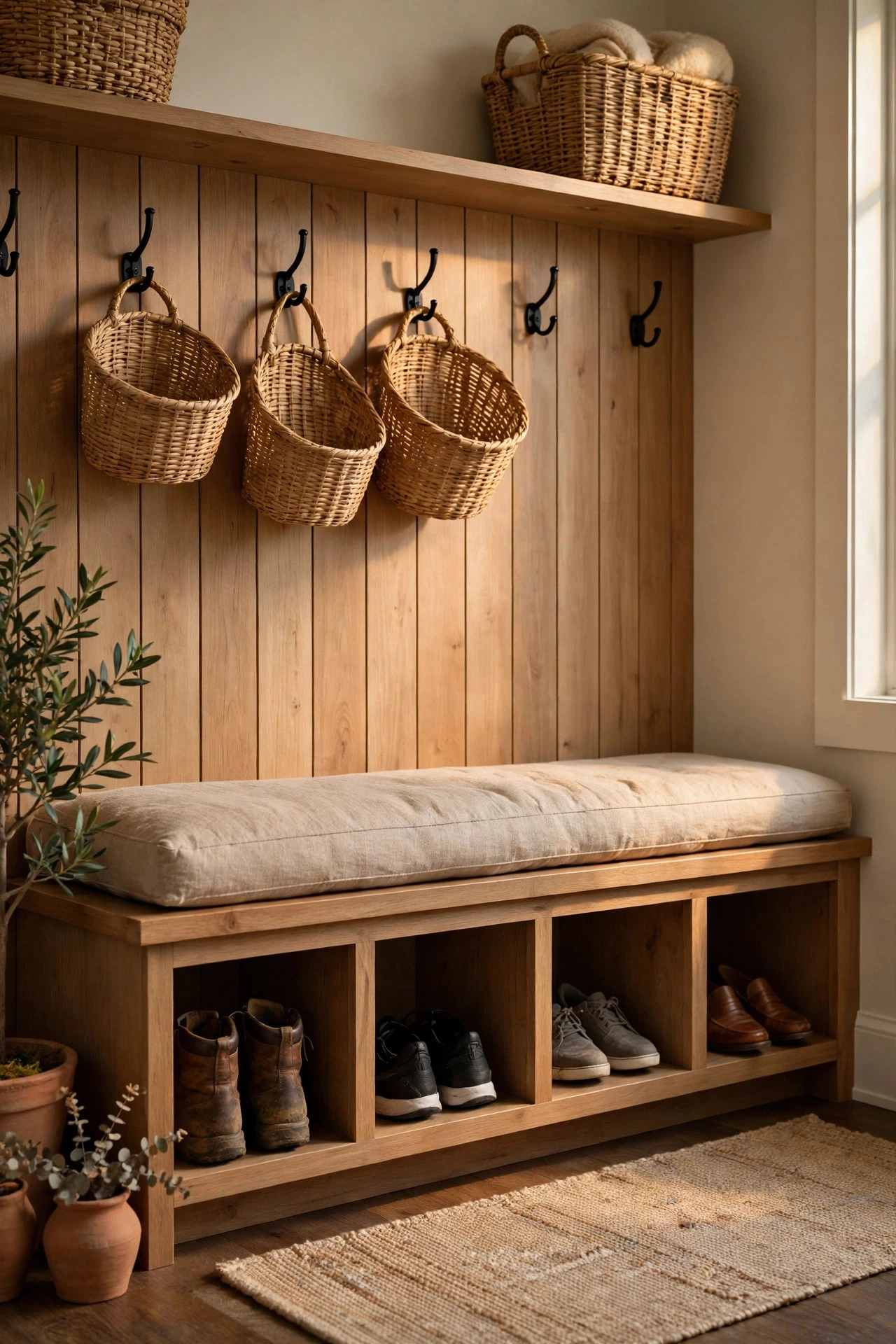
A mudroom bench should be 17 to 19 inches high and 14 to 16 inches deep — the same seat height as a dining chair, shallow enough to sit on comfortably and deep enough to hold shoes underneath. Lower than 17 inches makes standing up in boots a struggle; deeper than 16 inches swallows floor space while your heels dangle.
Under-bench storage works best as open cubbies 12 to 15 inches wide, one per person, so shoes slide in without stacking. A hinged lift-up seat adds hidden storage, but open cubbies are faster — nobody lifts a lid with muddy hands. For a quiet corner using the same sit-and-stay idea, see these reading nook ideas.
5. How Do You Build a Boot Tray Wet Zone?

Place a tray with a raised lip of at least 1 inch directly inside the door, sized 24 to 36 inches wide, so every pair of wet boots lands on it before a single step into the house. The tray is the mudroom's first line of defence: mud, rain and snowmelt stay in the tray instead of spreading across the floor.
Line it with a pebble mat or river stones for drainage, so boots sit above the water, and empty it after heavy rain. The tray should hold two pairs per person with room to spare; a tray that fits only one pair per person gets ignored.
6. How Many Cubbies Does Each Person Need?
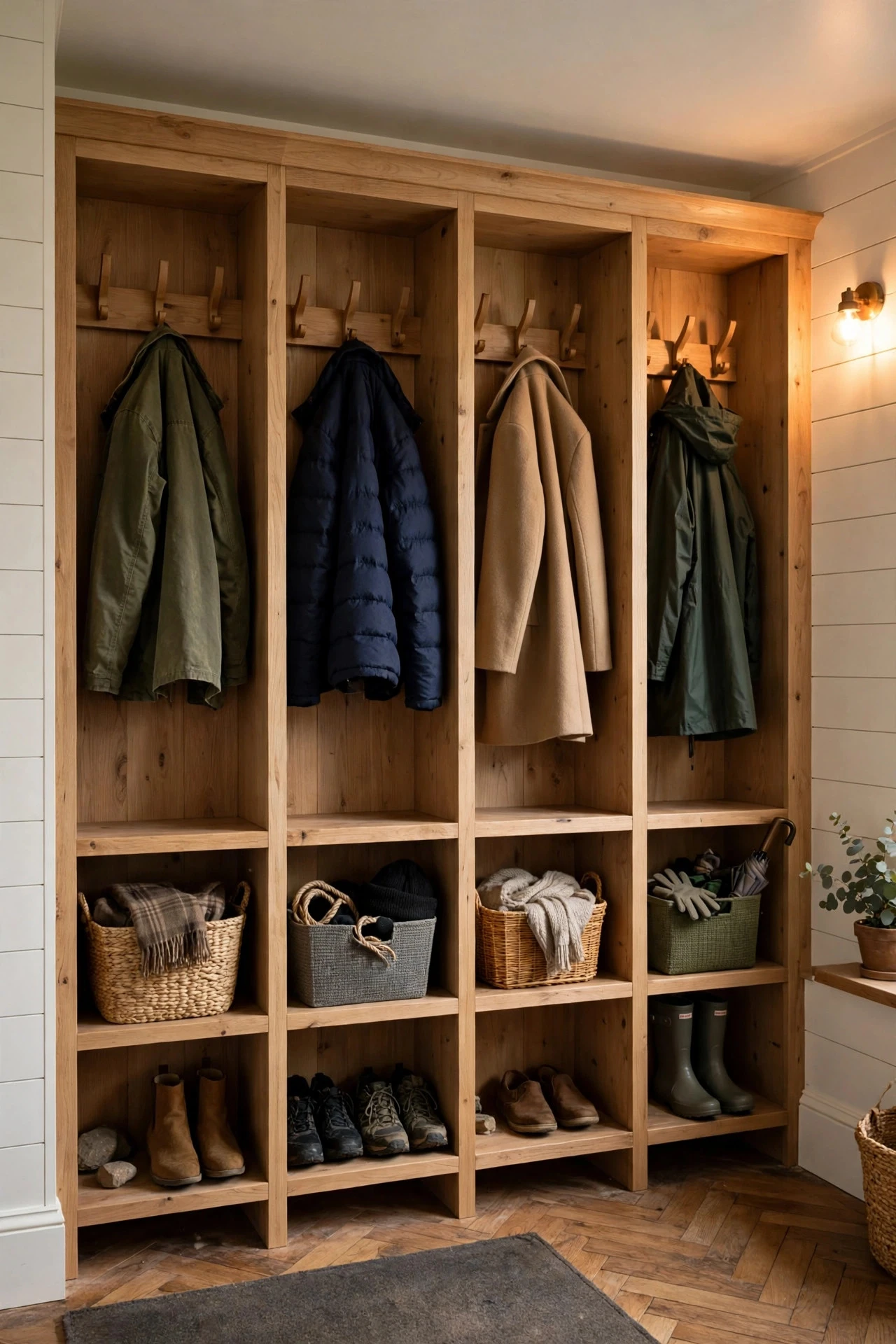
Give each person one cubby 12 to 15 inches wide and 14 to 16 inches deep, with their own hook above it, so their coat, bag, shoes and hat all live in one labelled column. One cubby per person is the rule that ends the daily pile-up, because when storage is shared, the bench becomes the storage.
A family of four needs a 48 to 60 inch run — four columns at 12 inches, plus the frame. Inside each cubby, a shelf at 8 inches from the base creates a shoe slot below and a bag or hat space above, and a small basket holds gloves and scarves. For cubby proportions and built-in layouts, browse Houzz's collection of mudroom designs.
7. Built-In or Modular — Which Mudroom System Wins?
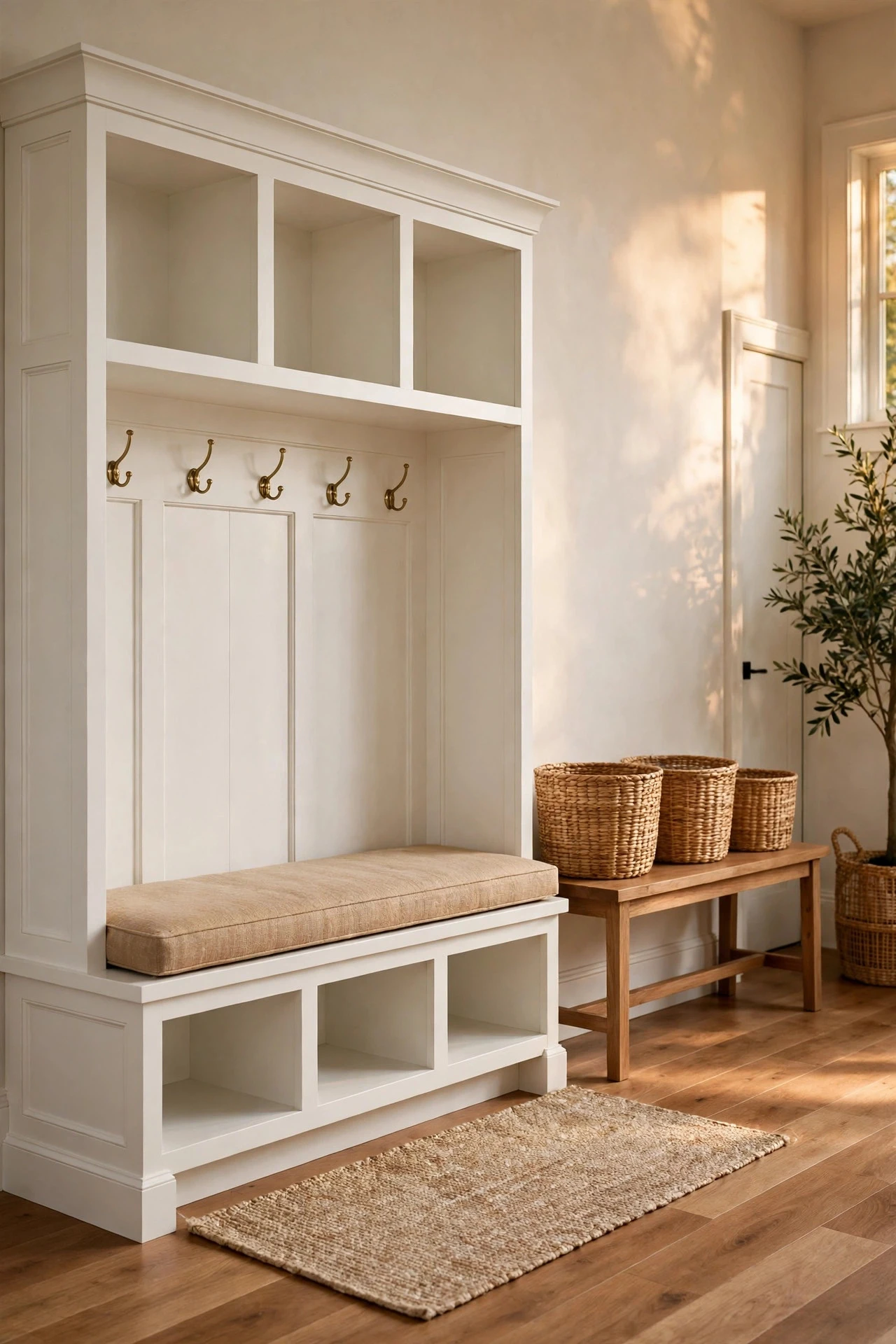
Choose built-ins when the mudroom is a dedicated room or a wide hallway you own, and modular furniture when you rent, move often, or need the room to change with the seasons. Built-ins win on capacity and looks — a floor-to-ceiling unit uses every inch and never wobbles — but they cost $1,500 to $4,000 fitted and cannot move with you.
Modular wins on flexibility: a freestanding bench with cubbies ($150–$400), a wall rail with hooks ($40–$90), and a stack of baskets can be rearranged in an afternoon and taken to the next house. A hybrid works too — a built-in bench with modular baskets and hooks.
8. How Do You Fit a Mudroom Into a 3-Foot Nook?
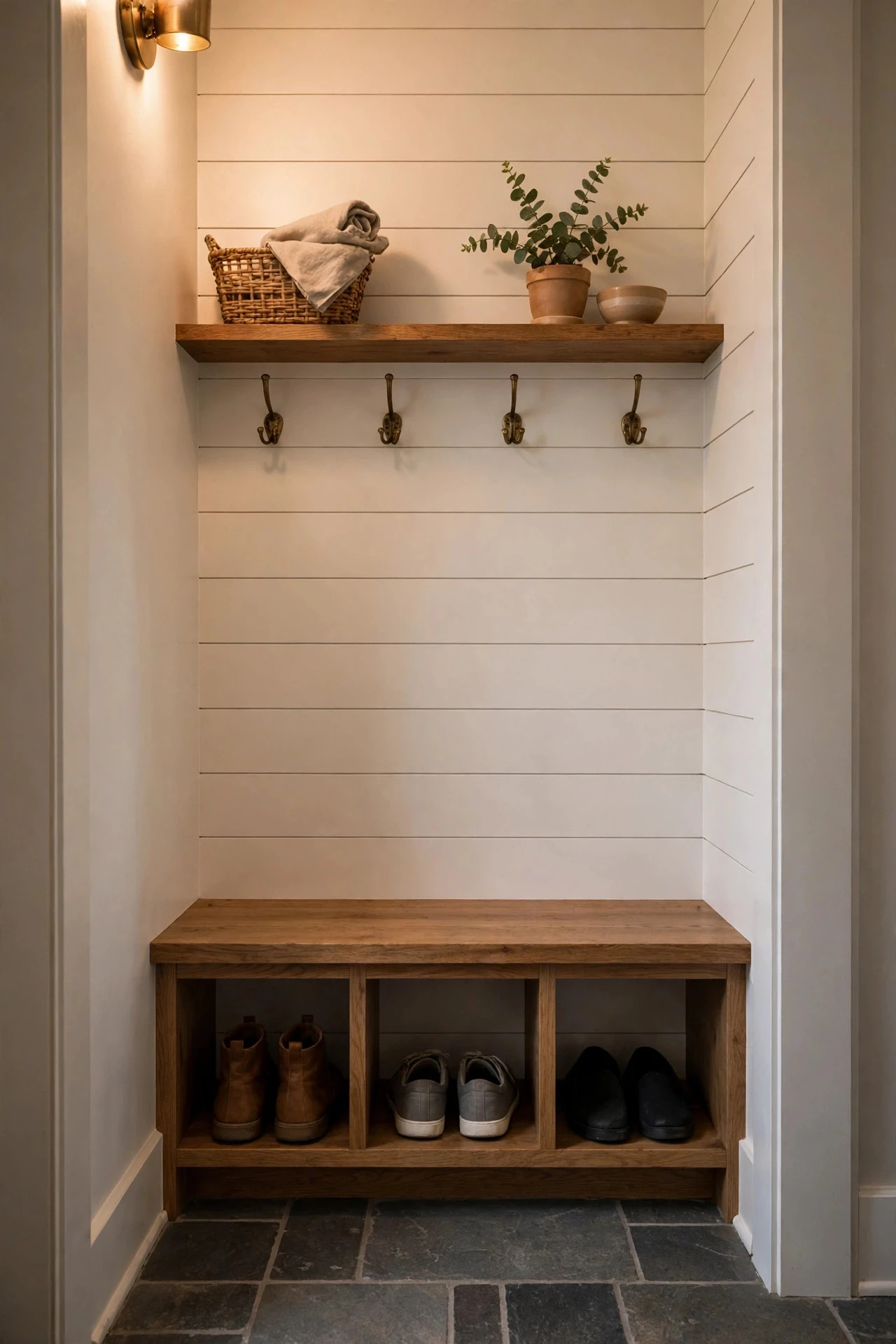
Fit a mudroom into a 3-foot nook by stacking the four zones vertically: hooks on the wall at 60 inches, a bench or stool at 17 inches, shoe storage underneath, and a shelf above for baskets. A 36-inch wide nook holds one person's full kit or two people's coats and shoes, because the sequence — shoes, coat, bag, keys — runs top to bottom instead of left to right.
Use a wall-mounted folding bench or a slim 14-inch deep stool that tucks under a shelf, and mount hooks on a rail so the whole row can be repositioned. A narrow boot tray 24 inches wide fits the floor space, and a small shelf at 72 inches holds out-of-season hats and gloves.
9. When Does an L-Shaped Mudroom Make Sense?

An L-shaped mudroom makes sense when the room is 50 square feet or larger and two walls meet at a corner, because the L gives you two runs of storage — hooks and cubbies on one wall, bench and shoe storage on the other — without blocking the walkway. The corner itself becomes the landing zone, with a shelf or small table for keys, mail and the dog lead.
Plan the L so the longer arm, 60 to 72 inches, carries the hooks and cubbies, and the shorter arm, 36 to 48 inches, carries the bench and boot tray. The bench sits on the short arm facing the door, so you sit down facing the way you came in.
10. How Much Shoe Storage Do You Really Need?
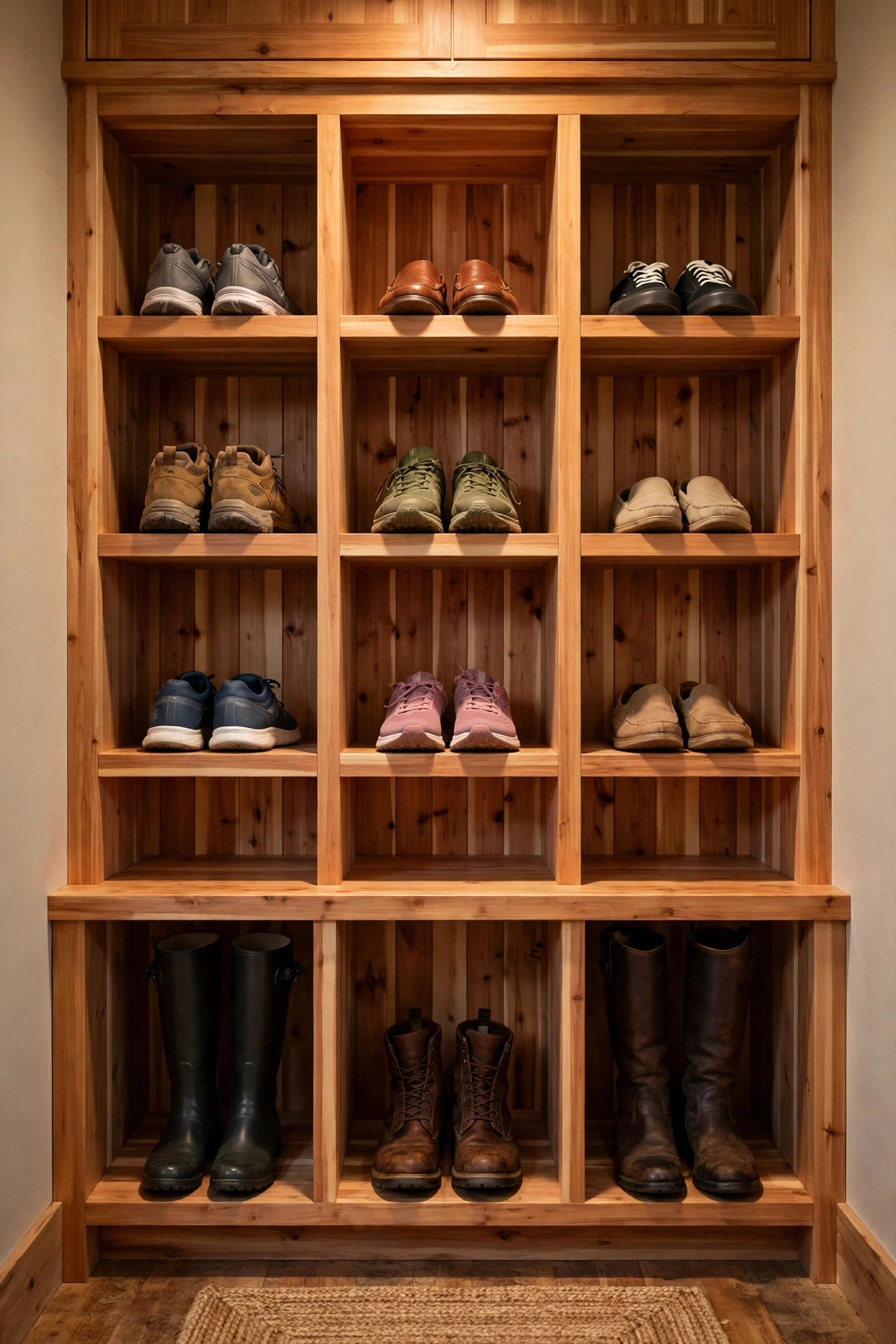
Plan shoe storage for three pairs per person in daily rotation — the pair being worn, a spare, and a wet-weather pair drying — plus one extra slot per person for seasonal overflow. A family of four needs 12 to 16 slots, which is a 60-inch run of cubbies or a two-tier shoe rack 36 inches wide and 24 inches tall.
Each slot needs 12 inches of width and 14 inches of depth for adult shoes; boots need 16 inches of height, so give the bottom row a taller opening or a dedicated boot shelf. Ventilation matters — slatted shelves or open cubbies dry shoes faster than closed cabinets, and cedar shoe inserts control odour for under $10 a pair.
11. Where Do Keys, Sunglasses and the Dog Lead Live?

Give small essentials one dedicated landing spot — a tray, a wall-mounted rail with small hooks, or a shallow shelf — placed at the very end of the arrival path, nearest the door into the house, so you pass it last on the way in and first on the way out. Keys, sunglasses and the dog lead live together because they are the three things you reach for when leaving, and the three things you lose when they have no home.
A tray 10 to 12 inches wide holds keys, sunglasses and a wallet without spreading; three small brass hooks beside it hold the dog lead, a reusable bag and a lanyard. Mount the landing spot at 42 to 48 inches high — counter height, where your hand naturally rests — and keep it no deeper than 6 inches, so it never becomes a dumping ground.
12. How Do You Design a Renter-Friendly Mudroom?

Design a renter-friendly mudroom from freestanding pieces and damage-free fixings, so the whole setup lifts out in an afternoon and leaves no holes, no marks and no deposit dispute. A freestanding bench with cubbies, a leaning coat rack or a tension-rod hook rail, a boot tray, and a stack of baskets give you the full four zones with nothing screwed to the wall.
Use adhesive hooks rated for 5 to 7 pounds for light items — hats, scarves, the dog lead — and lean a tall mirror or a ladder shelf against the wall for the rest. A large coir doormat and a washable runner protect the floor, and felt pads under the bench stop scratches on wood floors. BHG's guide to entryway organization has renter-friendly storage ideas that need no drilling.
13. What Makes a Dog-Washing Station Work?
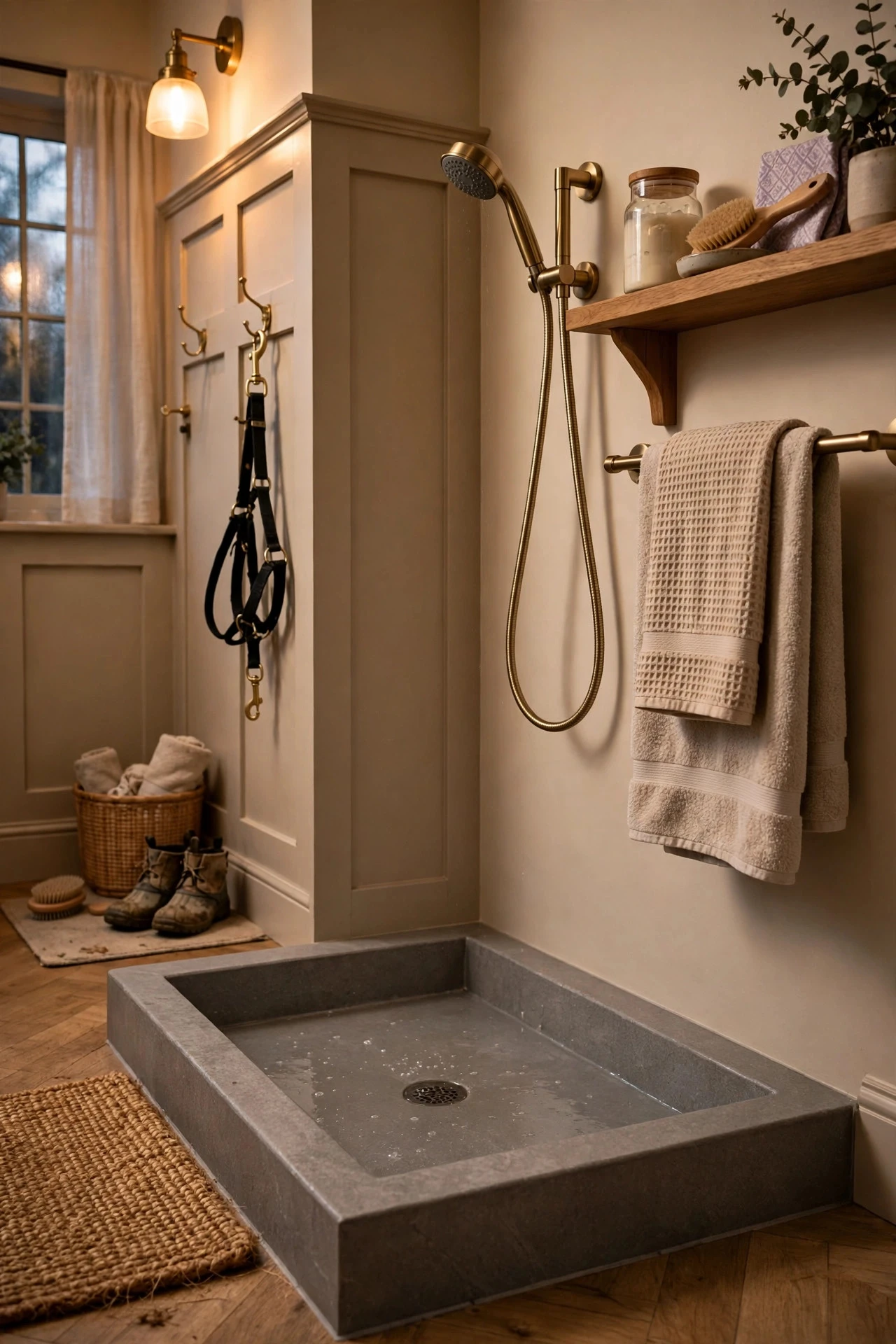
A dog-washing station works when it sits inside the mudroom, at floor level, with a handheld shower, a drain, and a drying shelf within arm's reach — so a muddy dog goes from the door to the wash and back out without crossing the house. A low shower tray 30 by 30 inches with a 4-inch lip, or a repurposed laundry sink set at 24 inches high, gives you a contained wash zone.
Plumb it like a laundry room: a handheld shower head on a 60-inch hose, a non-slip mat in the tray, and a shelf at 36 inches holding towels, shampoo and a brush. A towel rail beside the station and a hook for the lead at 48 inches complete the sequence — wash, towel, lead, out. For plumbing and drainage layouts that share the same wet-zone logic, see how to design a laundry room that makes wash day easier.
14. How Do You Tame Sports Gear in a Mudroom?

Tame sports gear by giving it a tall, ventilated zone of its own — a 24-inch wide section with hooks at 66 inches for bags, a floor-level bin for balls, and a mesh basket for shin guards and gloves — so kit stops migrating onto the bench and the boot tray. Sports gear is the mudroom's biggest invader because it is bulky, smelly and used daily, and it needs space proportional to its size.
Hang each child's sports bag on its own double hook rated to 20 pounds, and give the bag a cubby 15 inches wide so it has a floor spot too. A tall open bin, 18 inches square, holds balls and rackets; a mesh laundry bag clipped to the wall holds wet kit until wash day and lets it breathe.
15. How Do You Rotate Seasons Without Chaos?
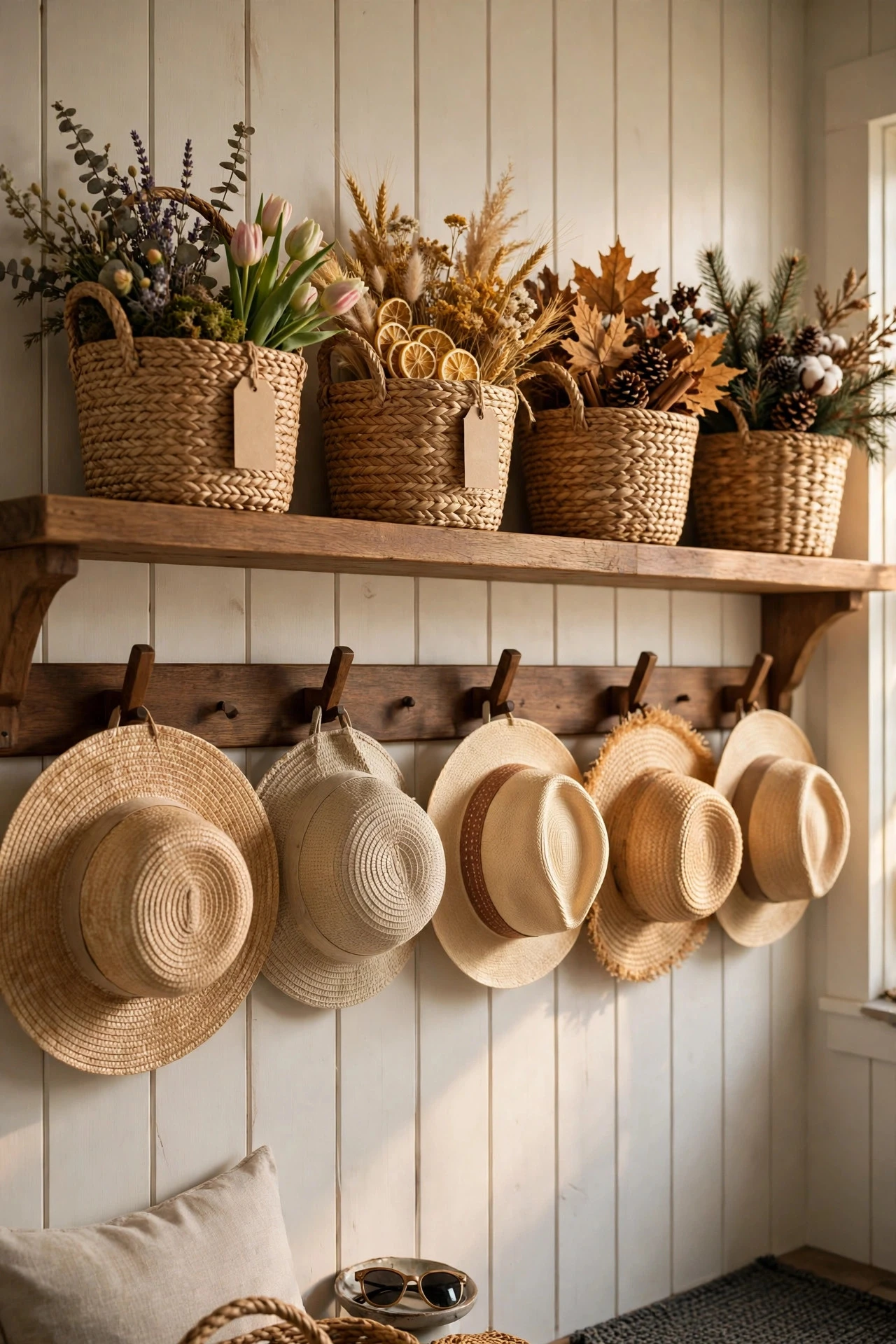
Rotate seasons by keeping one basket per person on the top shelf, labelled by season, and swapping its contents on a fixed date — the first weekend of spring and the first weekend of autumn — so winter coats, hats and gloves leave the hooks the same day summer hats and sunscreen arrive. The swap takes thirty minutes for a family of four and stops the mudroom from carrying two seasons at once.
Store the off-season basket on the highest shelf, 72 inches or above, where it is out of reach but still in the room, and keep the current season's gear on the hooks and in the cubbies. When the festive season arrives, the entryway gets its own small seasonal moment; these christmas entryway table decor ideas show how to add it without losing the landing zone.
16. What Flooring Survives a Mudroom?
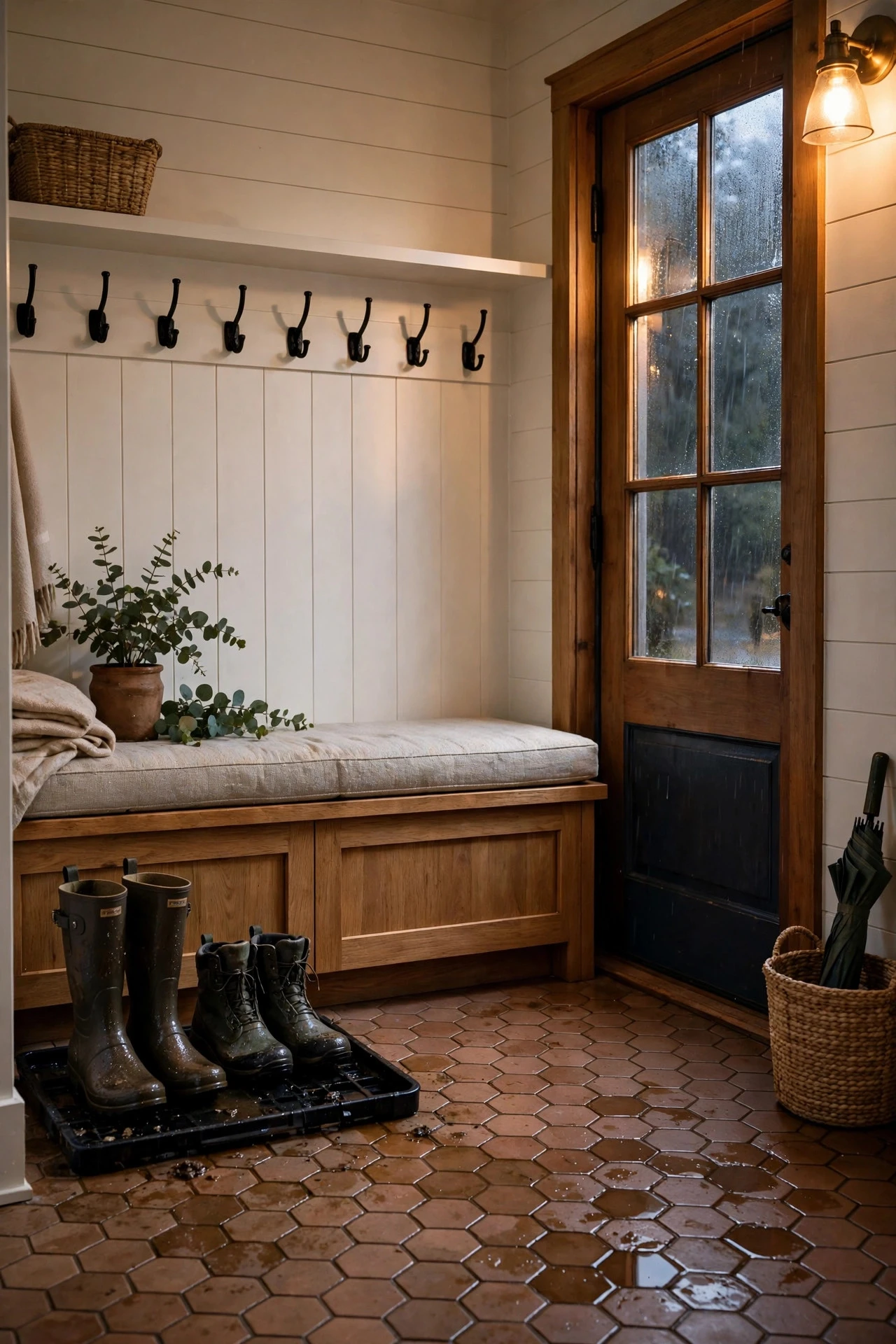
Choose flooring that survives water, mud and grit: porcelain tile, luxury vinyl plank, or sealed natural stone, all of which shrug off wet boots and clean with a mop. Porcelain tile rated PEI 4 or above handles grit without scratching, and a textured or matte finish gives grip when the floor is wet — glossy tile in a mudroom is a skating rink.
Luxury vinyl plank is the budget choice at $3 to $7 per square foot fitted: waterproof, warm underfoot, and a damaged plank can be replaced individually. Whatever you choose, run the same flooring from the door through the mudroom and at least 3 feet into the hallway, so there is no seam where mud collects.
17. What Mats Actually Catch the Mess?

Use two mats, not one: a coarse coir mat outside the door to scrape boots, and a washable indoor mat 24 by 36 inches inside the door to catch what the coir missed. The outdoor mat does the heavy scraping, the indoor mat does the fine trapping, and together they catch up to 80 percent of the dirt that would otherwise reach the floor.
Choose coir with a stiff bristle for the outside — it scrapes mud off treads — and a low-pile washable rug with a rubber backing for the inside, so it stays put and goes in the washing machine. Size the indoor mat to the room: it should cover the floor between the door and the boot tray, at least 36 inches long, so every step lands on mat, not bare floor.
18. How Do You Light a Mudroom Properly?

Light a mudroom with two layers: a bright overhead light for the whole room, and a low light at the bench and hooks so you can see coats, keys and shoe laces without shadows. A flush-mount or semi-flush ceiling light at 800 to 1,000 lumens covers a mudroom up to 60 square feet; add a wall sconce or small pendant at 60 inches high beside the hooks for the second layer.
Warm white bulbs at 2700K to 3000K keep the room welcoming and show true coat colours — cool white makes navy look black and hides a missing glove. A motion sensor switch is worth every penny here, because your hands are full of bags and a dog lead when you walk in; set it to stay on for 5 minutes.
19. How Do You Add Storage Above the Bench?
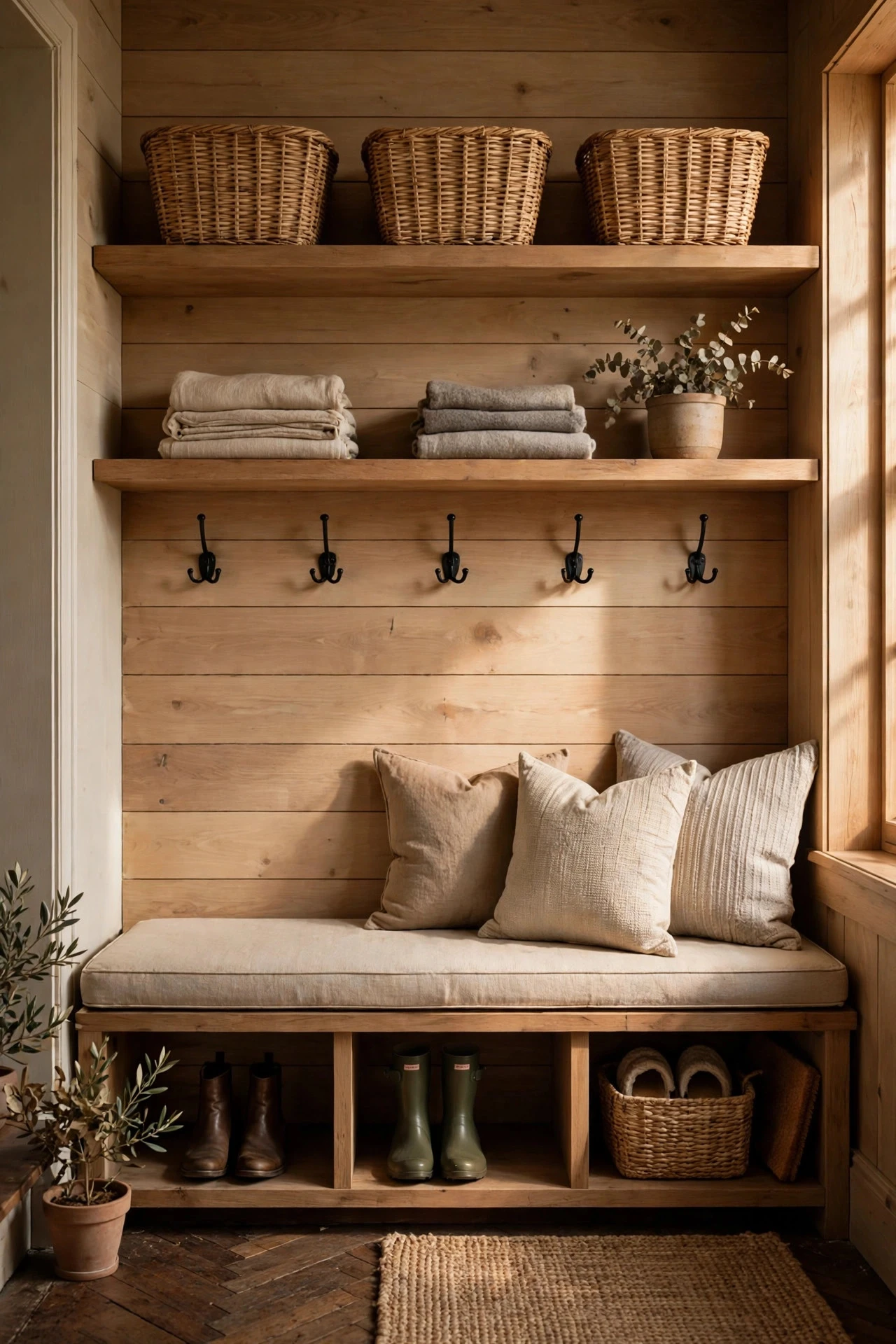
Add storage above the bench with a shelf 12 inches deep mounted at 72 inches high, holding labelled baskets for out-of-season gear, spare gloves and items you need monthly rather than daily. The shelf sits above the hooks, so it uses the dead space between the top of the hooks and the ceiling without stealing a single inch of floor.
Keep the shelf to one row of baskets, each 12 to 15 inches wide, with a label facing out — a shelf stacked two baskets deep becomes a black hole where things vanish. Use brackets rated for 30 pounds per pair, because a basket of winter coats is heavier than it looks, and screw into studs, not just drywall.
20. How Do You Keep a Mudroom Looking Good, Not Just Working?

Keep a mudroom looking good by giving every functional piece a finish that matches the rest of the house — painted cubbies in the hallway colour, hooks in the same metal as the door hardware, baskets in one material — so the room reads as designed, not as a storage cupboard. Function decides the layout; finish decides whether you like walking into it.
Repeat one colour and one metal through the room: black hooks with black basket handles, brass hooks with brass tray edges, oak bench with oak shelf brackets. For hallway-wide styling in the same warm, welcoming tone, browse these christmas hallway ideas.
21. How Do You Mudroom-Proof a Small Entryway on a Budget?

Mudroom-proof a small entryway on a budget by spending on four pieces and improvising the rest: a wall rail with five hooks for $30 to $50, a bench or sturdy stool for $60 to $120, a boot tray for $15 to $25, and a coir mat for $20 to $30 — a full working mudroom for $125 to $225. Everything else comes from the house: baskets you already own, a tray from the kitchen for keys, a shelf from a spare room.
Buy the hook rail first, because it sets the room's capacity, and choose one with hooks rated to 15 pounds — a cheap rail with 5-pound hooks will pull out of the wall within a month. Check measurements before you buy: a bench 14 inches deep fits a hallway a 16-inch bench does not.
22. What Should You Leave Out of a Mudroom?

Leave out anything that does not serve the arrival sequence: decorative objects with no job, open shelves full of ornaments, a second mirror, and anything fragile at bench height. A mudroom is a working room, and every object in it should earn its place by holding something, catching something, or lighting something.
Keep the count of objects low: hooks, bench, cubbies, boot tray, landing tray, mirror, and one or two baskets is a complete mudroom, and anything beyond that is clutter that will be knocked over by a school bag.
Practical Tips
Measure the wall before you buy anything. Hook heights, bench depth and cubby width all come from the wall and floor space you have — a tape measure saves a return trip and a bench that blocks the door.
Build in arrival order. Boot tray first, then bench, then hooks, then the landing tray — so the room works the way you actually come home.
Give every person one column. One hook, one cubby, one basket per person ends the pile-up faster than any amount of extra storage, because shared storage always becomes nobody's storage.
Use hardware rated for real weight. Hooks at 15 pounds or more, shelf brackets at 30 pounds per pair, and screws into studs — a wet winter coat plus a school bag is heavier than it looks, and cheap fixings fail in winter.
Swap seasons on a fixed date. The first weekend of spring and the first weekend of autumn, thirty minutes, one basket per person — and the mudroom never carries two seasons at once.
Final Thoughts
A mudroom works when the arrival path runs in order — shoes on the tray, coat on the hook, bag in the cubby, keys on the tray — and every person has one column. Get the heights, depth and wet zone right, and coming home stops being a daily negotiation with a pile of coats.
Frequently Asked Questions
How high should mudroom hooks be for adults and kids?
Adult hooks go at 60 to 66 inches from the floor, and children's hooks at 36 to 48 inches, so every coat lands on a hook its owner can reach. Two rows work best: adults at 60 inches, kids at 42 inches, staggered so lower coats do not block upper ones.
What size should a mudroom bench be?
A mudroom bench should be 17 to 19 inches high and 14 to 16 inches deep — the same seat height as a dining chair. Under-bench cubbies 12 to 15 inches wide, one per person, hold shoes without stacking. A bench deeper than 18 inches blocks a hallway under 48 inches wide.
How many cubbies does a family of four need?
A family of four needs four cubbies, one per person, each 12 to 15 inches wide and 14 to 16 inches deep — a 48 to 60 inch run in total. A shelf at 8 inches from the base creates a shoe slot below and a bag or hat space above, and a labelled basket holds gloves and scarves.
Can I create a mudroom in a rental?
Yes — build it from freestanding pieces and damage-free fixings: a bench with cubbies, a leaning coat rack or tension-rod rail, a boot tray and baskets. Use adhesive hooks rated 5 to 7 pounds for light items only, and never screw a hook rail into a rented wall without the landlord's written permission.
What flooring is best for a mudroom?
Porcelain tile rated PEI 4 or above, luxury vinyl plank, or sealed natural stone all survive water, mud and grit in a mudroom. Luxury vinyl plank is the budget choice at $3 to $7 per square foot fitted, and a damaged plank can be replaced individually. Avoid hardwood, which cups and stains, and carpet, which holds mud and smell.
How do I keep a mudroom from smelling?
Ventilation is the answer: open cubbies and slatted shelves dry shoes faster than closed cabinets, and cedar shoe inserts control odour for under $10 a pair. Empty the boot tray after heavy rain, wash the indoor mat monthly, and never store damp sports kit in closed baskets, where it grows mildew within days.