22 Living Room Accent Wall Ideas That Transform a Plain Wall
A living room accent wall is the fastest way to give a plain room a focal point. One bold wall — painted, papered, panelled or clad in wood — pulls the eye, anchors the furniture and sets the mood for everything around it, without the cost or disruption of redecorating the whole room.
Looking for more inspiration? Our Nest Decorz homepage gathers the latest home decor ideas, seasonal decorating guides and room-by-room styling tips in one place — start there and explore.
Below you'll find 22 living room accent wall ideas covering bold paint, colour-drenching, wallpaper, murals, shiplap, board-and-batten, picture-frame moulding, fluted wood, limewash, stone and brick, gallery walls, built-ins, arches, mirrors and renter-friendly options — with honest budgets in pounds and the mistakes that shrink a room instead of transforming it.
Quick answers
– The sofa wall is usually the best accent wall — it is the first wall you see and it frames your seating. – One wall only, in a colour 2–3 shades deeper than the rest — two accent walls compete and shrink the room. – Paint is the cheapest route (£30–£60 all-in); wallpaper, panelling and wood start around £80–£150 per wall. – Renters can still have an accent wall — peel-and-stick wallpaper, removable panels and leaning art all come off cleanly.
1. How Do You Paint a Bold Accent Wall Without It Overwhelming the Room?
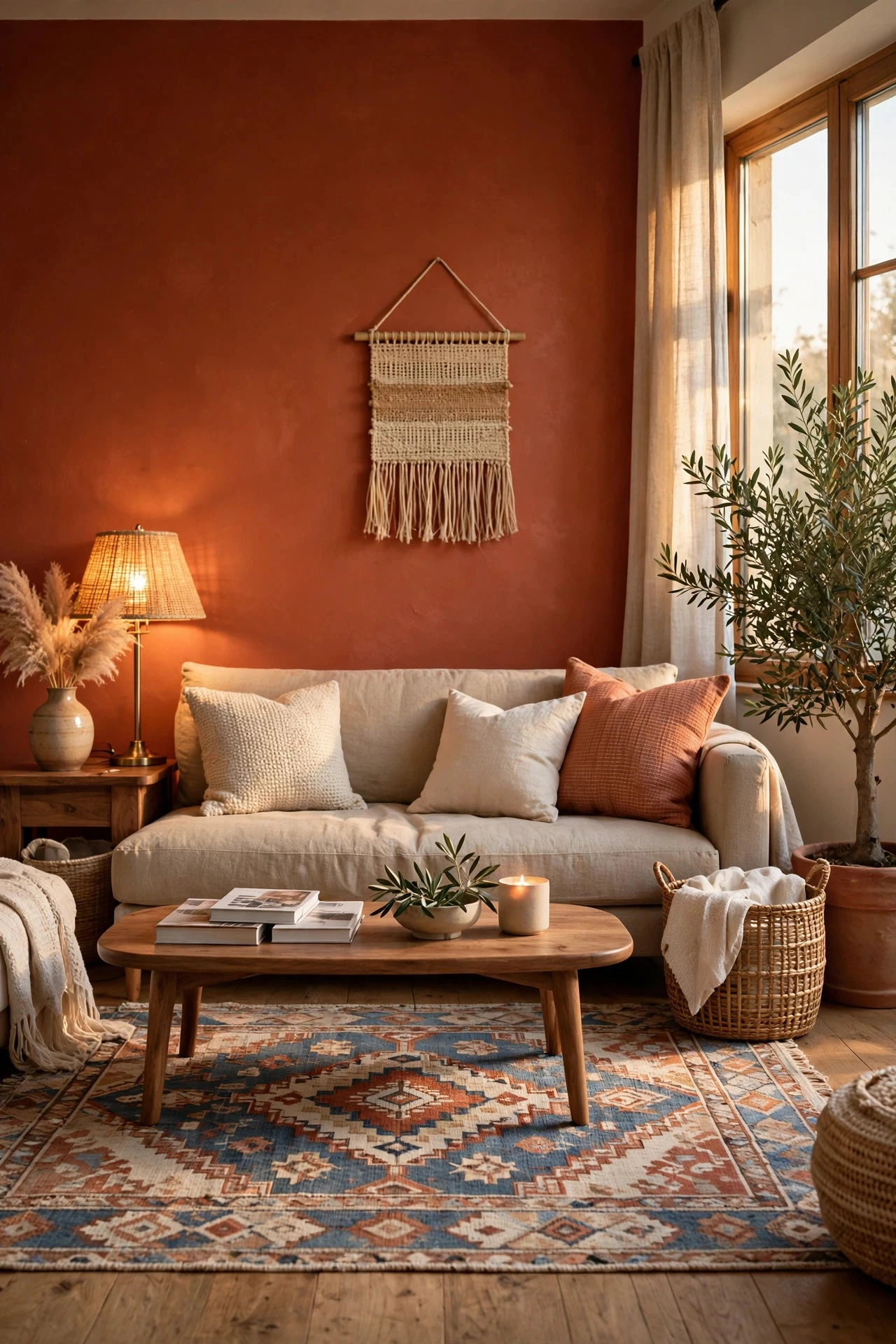
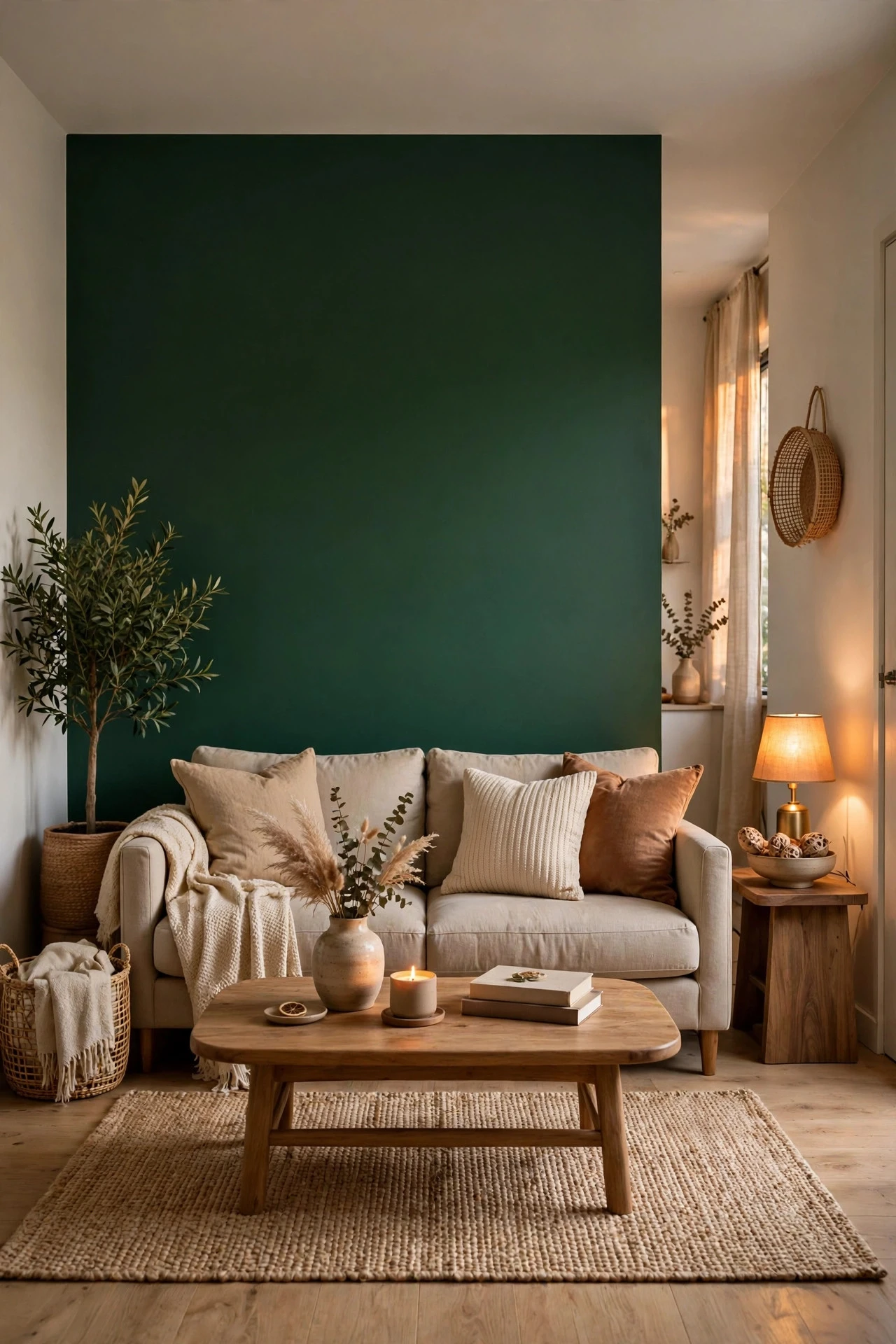
Paint one wall — the sofa wall — in a colour two or three shades deeper than the other three walls, and keep the rest of the room light and calm. The contrast creates depth and a clear focal point, while the pale surrounding walls stop the bold colour from closing the room in.
Choose a colour with the same undertone as your sofa and rug: a warm terracotta with a beige sofa, a deep green with grey, a navy with cream. A 2.5-litre tin of good matt emulsion (£25–£40) covers one large wall with two coats; allow half a day. Keep the skirting and ceiling white, and ground the look with a rug that picks up the wall colour — these living room rug ideas to ground your seating area show how the right rug ties a bold wall to the furniture. Avoid a loud colour behind the television — it competes with the screen.
2. What Is Colour-Drenching and Does It Work in a Living Room?
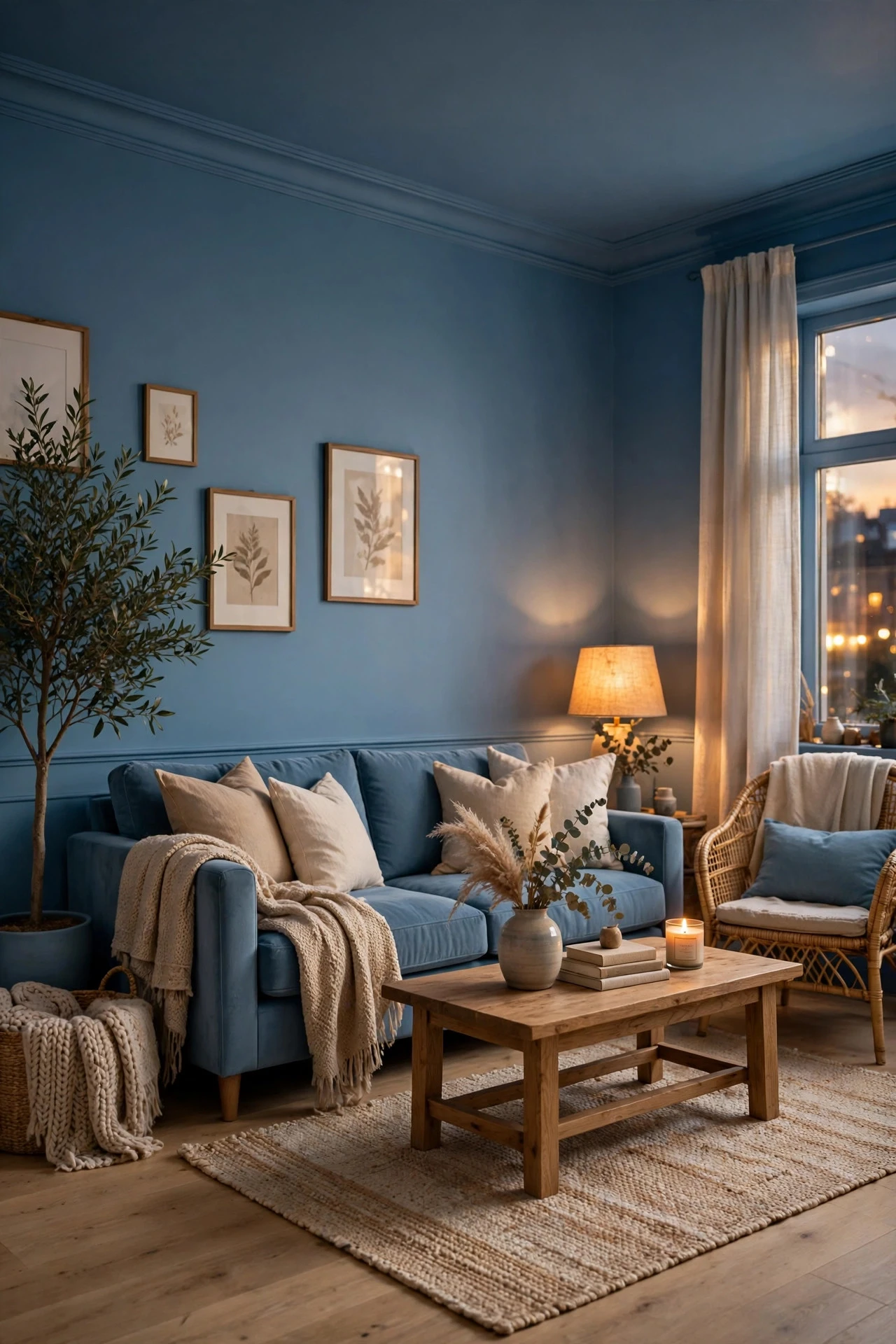
Colour-drenching means painting the accent wall, the skirting, the door, the ceiling and even the shelving in the same colour, so the whole corner reads as one sculptural block. It works beautifully in a living room because it removes visual clutter and makes the room feel deliberate, calm and much larger than it is.
Start with a mid-tone — a sage green, a dusty blue or a warm clay — using matt on the walls and eggshell on the woodwork. Budget £60–£100 for paint for one wall plus its trim, and two days if you are painting the ceiling too. Colour theory explains why this works: one hue in different finishes reads as a single continuous surface, which the eye interprets as space. Avoid drenching a wall with no natural light in a very dark colour — the corner will feel like a cave by 4pm.
3. Can Wallpaper on One Wall Really Change a Living Room?
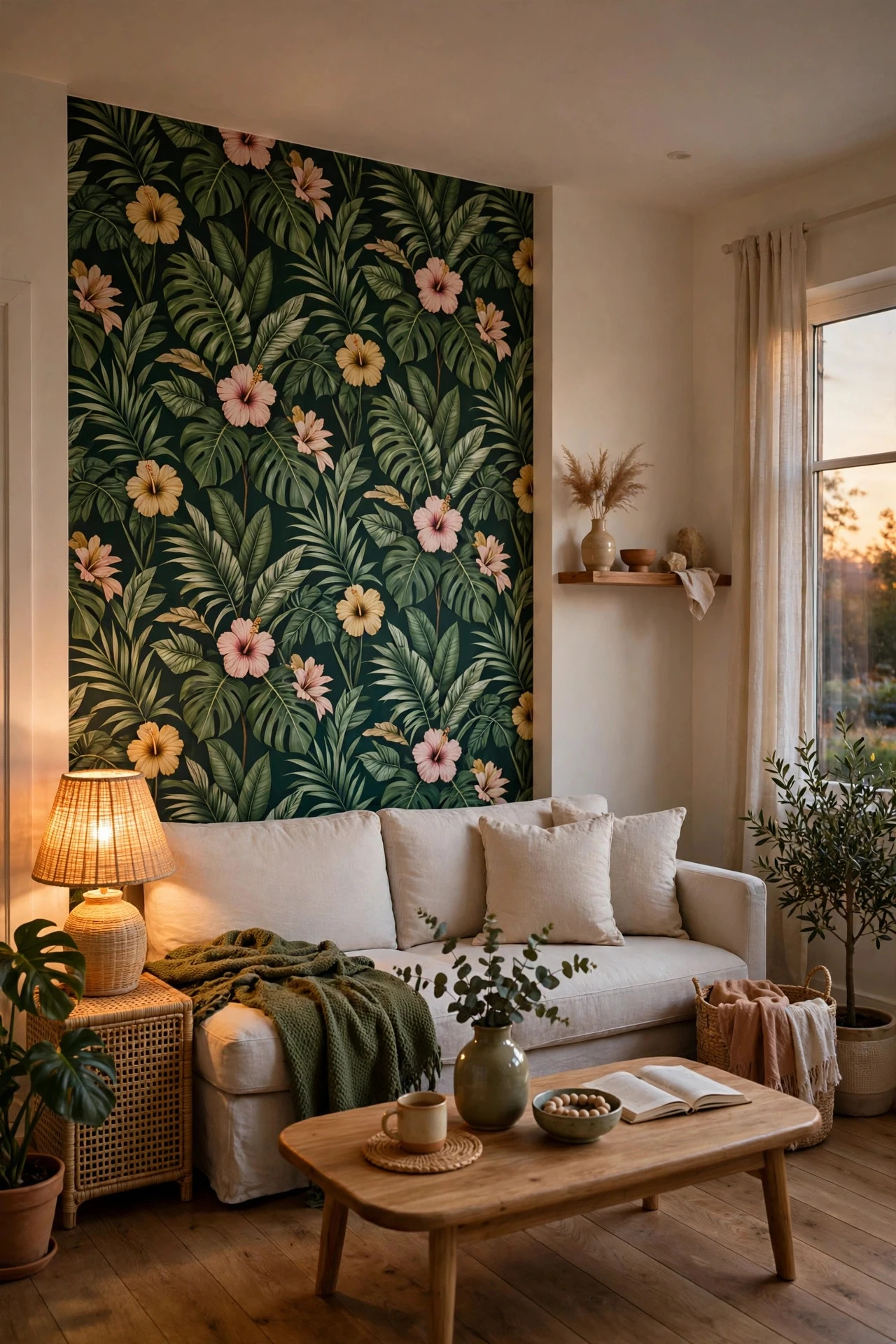
Yes — one wallpapered wall changes a living room more than any other single upgrade, because pattern adds texture, movement and personality that paint alone cannot. A bold botanical, a geometric or a textured grasscloth turns a blank wall into the room's artwork, and the plain walls around it make the pattern feel intentional rather than busy.
A standard 3.6 m by 2.4 m wall needs about three rolls (£30–£60 per roll for a good design), plus £15–£25 for paste and tools. Paste-the-wall papers are the easiest for a first-timer and take a weekend afternoon. Match the print scale to the wall: large-scale patterns for big walls, small tight repeats for narrow ones. Avoid the wall with the most doors and windows — every cut around a frame breaks the pattern and wastes paper.
4. How Do You Choose a Mural Wall That Doesn't Look Like a Gimmick?
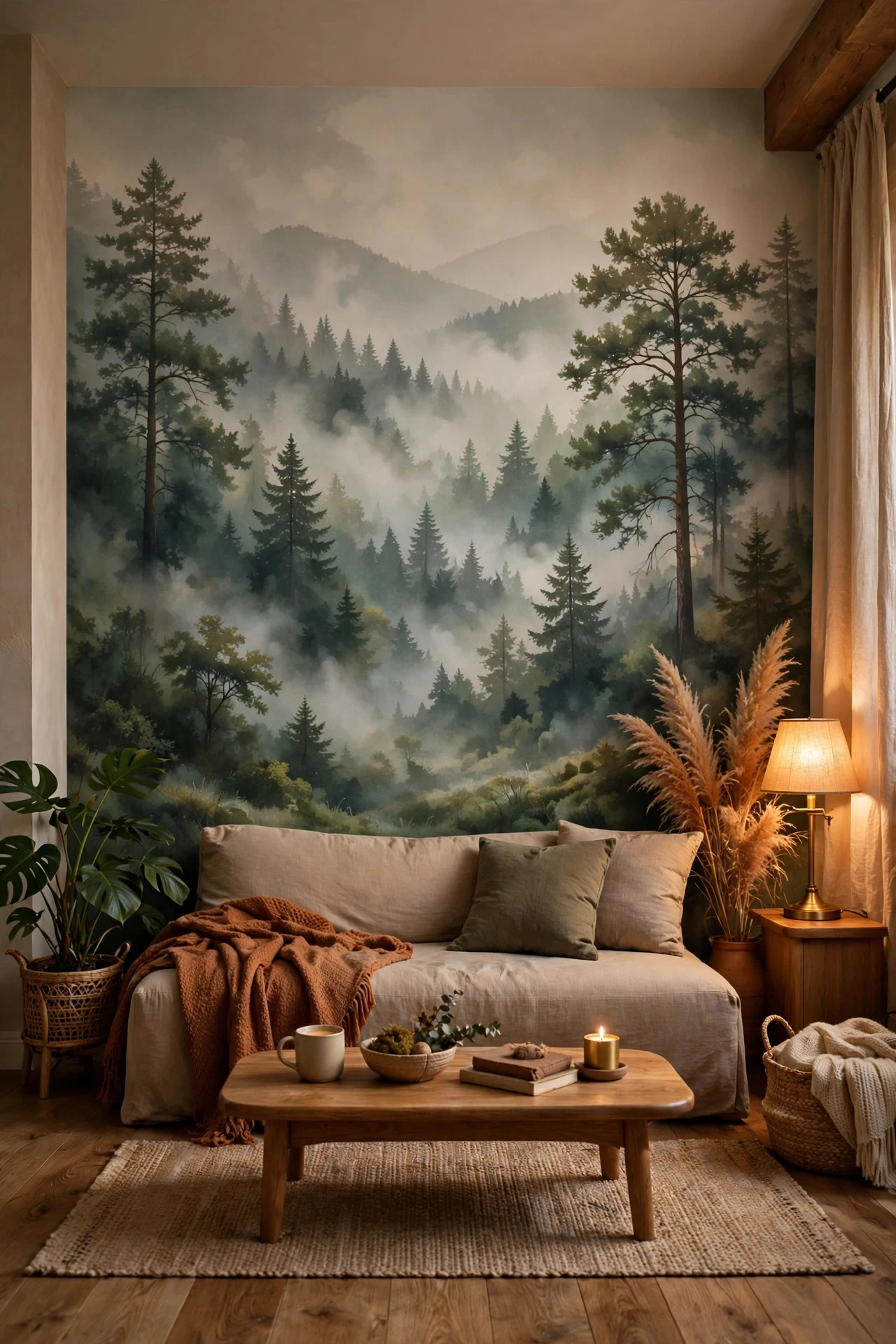
Choose a mural the way you would choose art: pick a scene you would happily look at every day — a misty forest, a soft mountain range, a tonal abstract wash — in colours already present in your room, covering the whole wall edge to edge. A mural looks like a gimmick only when its colours fight the furniture.
Order a made-to-measure mural (£120–£300 for a single wall) rather than a standard-size panel that leaves awkward gaps. Keep the furniture in front of it low and simple — a low sofa, a slim console — so the scene stays visible. Pale, low-contrast murals suit small rooms; deep, dramatic scenes suit large walls with breathing space. Never place a busy mural behind a television or tall bookcase — the screen or shelves chop the image in half.
5. Is Shiplap Still a Good Accent Wall Choice?
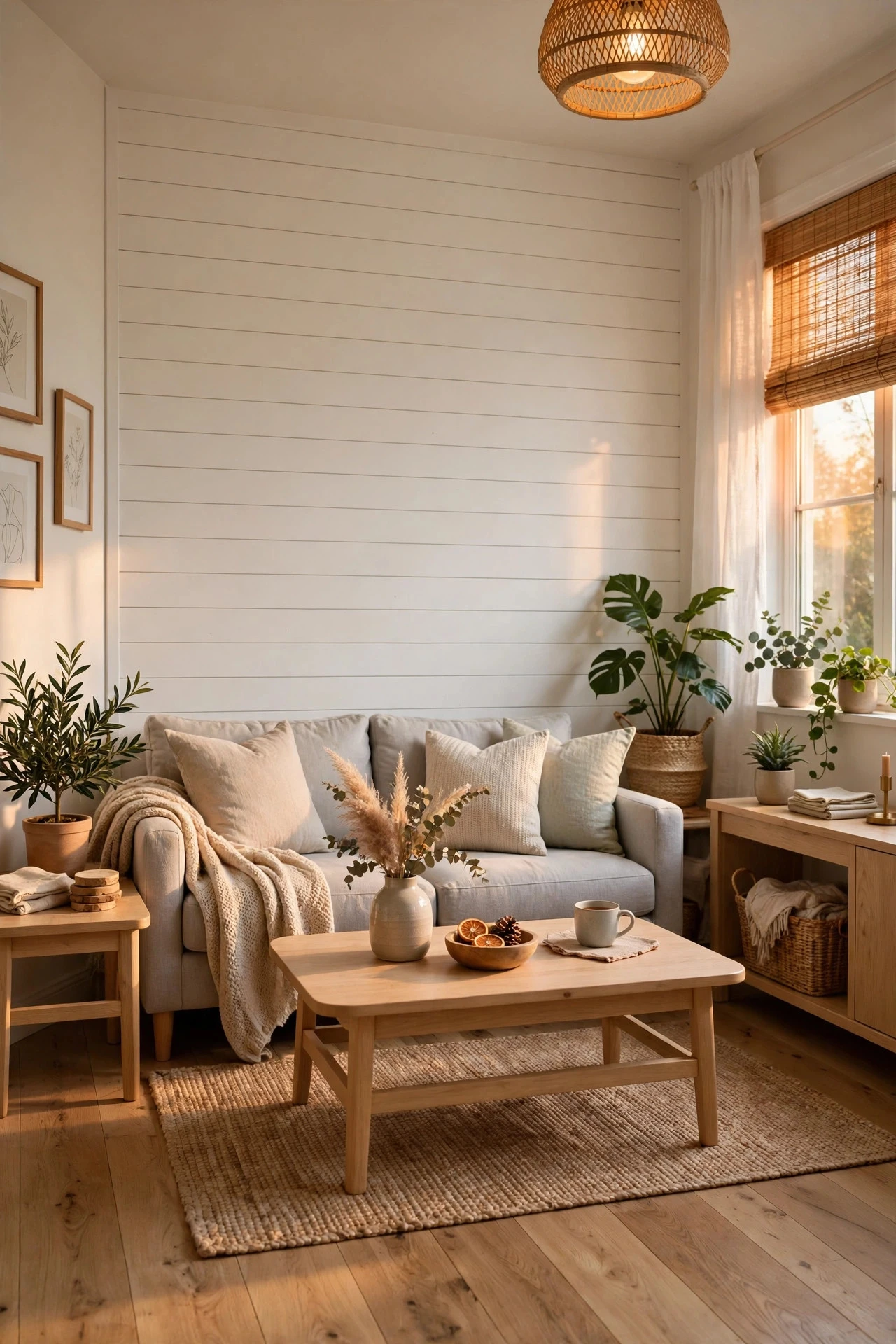
Shiplap is still a good accent wall choice when used on one wall with a clear purpose — behind the sofa or around a fireplace — and painted in a colour that suits the room rather than defaulting to white. The horizontal shadow lines add texture and craftsmanship that flat paint cannot, and the look works far beyond farmhouse style.
Use MDF shiplap (£8–£15 per square metre) for a painted finish, or real pine (£15–£25) for a natural wood look. A single 3.6 m wall costs roughly £80–£150 in materials, plus a day to fit and paint. Paint it the same colour as the other walls for subtle texture, or go bold with deep green or charcoal. It suits a calm, pale scheme — see these Scandinavian living room ideas for a calm, cozy home for how pale shiplap works with light wood and soft textiles. Never shiplap every wall: one wall is texture, four walls is a shed.
6. How Do You Build a Board-and-Batten Accent Wall?
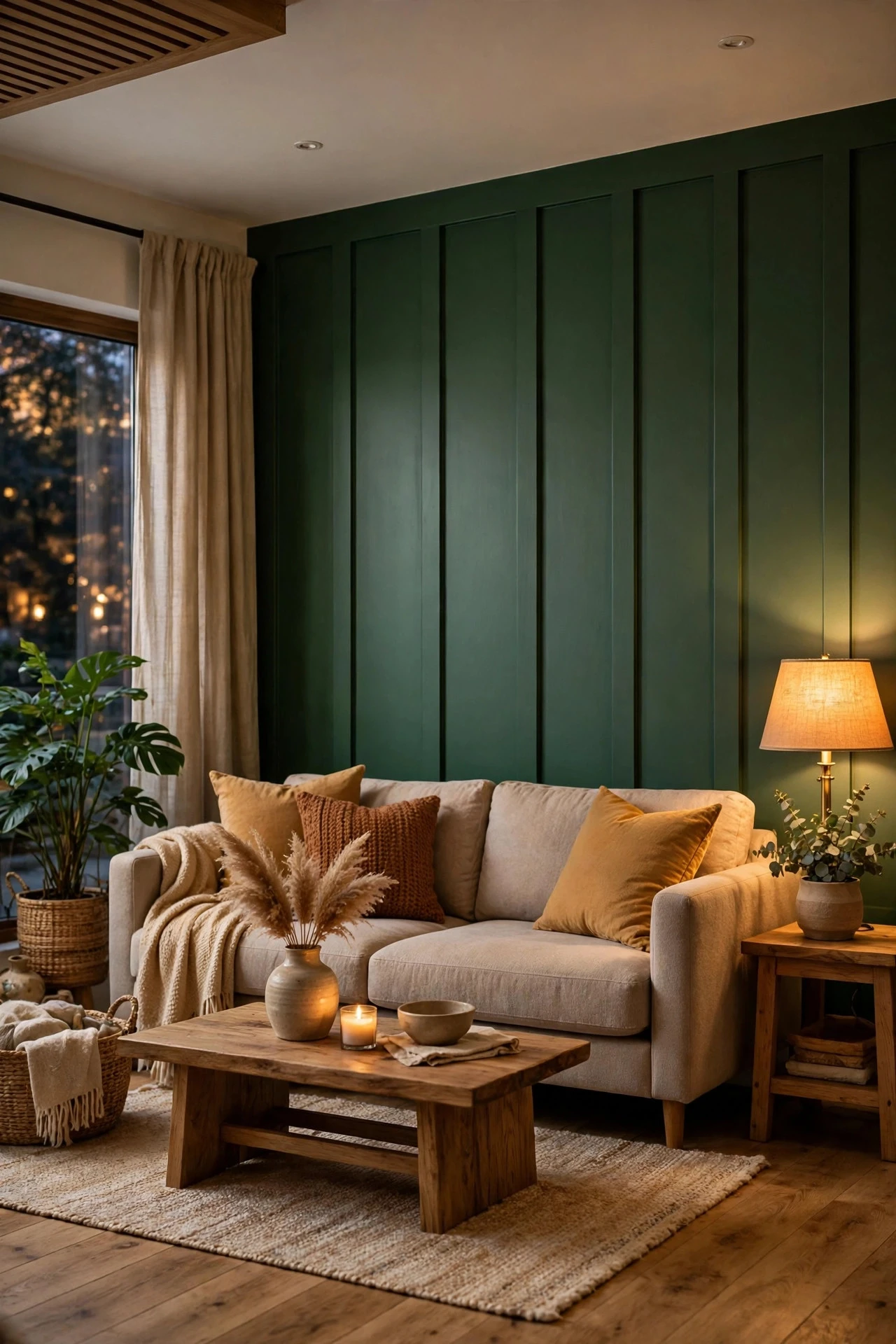
Build a board-and-batten accent wall by fixing vertical battens over a flat wall in a regular grid, then painting the whole wall — boards and battens — in one colour so the shadows do the decorating. The grid adds architecture to a plain plaster wall and makes a new-build living room feel like it has always had character.
Space the battens 40–60 cm apart, with the top rail around 1.2–1.5 m from the floor for a half-height design, or full height for maximum drama. MDF strips cost £1–£3 per metre, so a full wall runs £40–£80 in materials plus £25–£40 for paint and filler. You need a mitre saw, a spirit level, adhesive and a nail gun or pins; allow a full weekend. Paint everything one colour — deep green, navy or warm greige — and the grid reads as panelling. Measure from the centre outwards so the end gaps match, or the spacing will look homemade.
7. What Is Picture-Frame Moulding and Where Does It Belong?
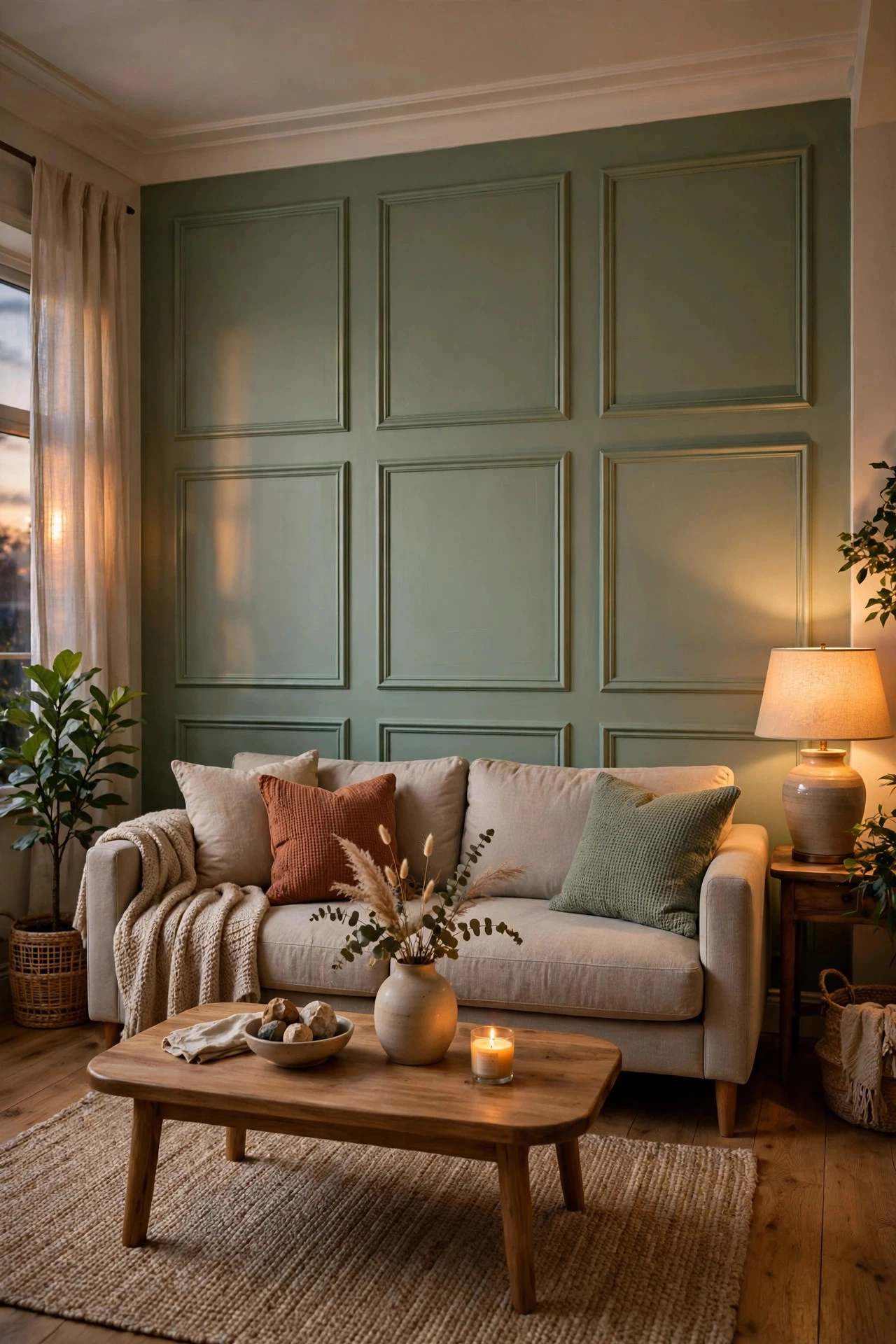
Picture-frame moulding is a set of slim decorative frames fixed directly onto a wall and painted the same colour as the wall, creating the look of classic panelled wainscoting without the cost of full panelling. It belongs on the sofa wall or the wall opposite the windows, where its shadows and proportions can be appreciated in good light.
Use lightweight polyurethane or MDF moulding (£2–£5 per metre) cut at 45 degrees and glued to the wall in rectangles roughly 60 cm by 90 cm, with 10–15 cm gaps between frames. A single wall costs £50–£100 in materials and takes a day to fit and paint. Keep frames in proportion — two large rectangles suit a wide wall better than six small ones — and paint everything one colour. The same trick works in a bedroom too, as these bedroom wall decor ideas for a calm, personal retreat show. Never mix frame sizes on one wall: mismatched rectangles look like a mistake.
8. How Do Fluted Wood Slats Change the Feel of a Living Room?
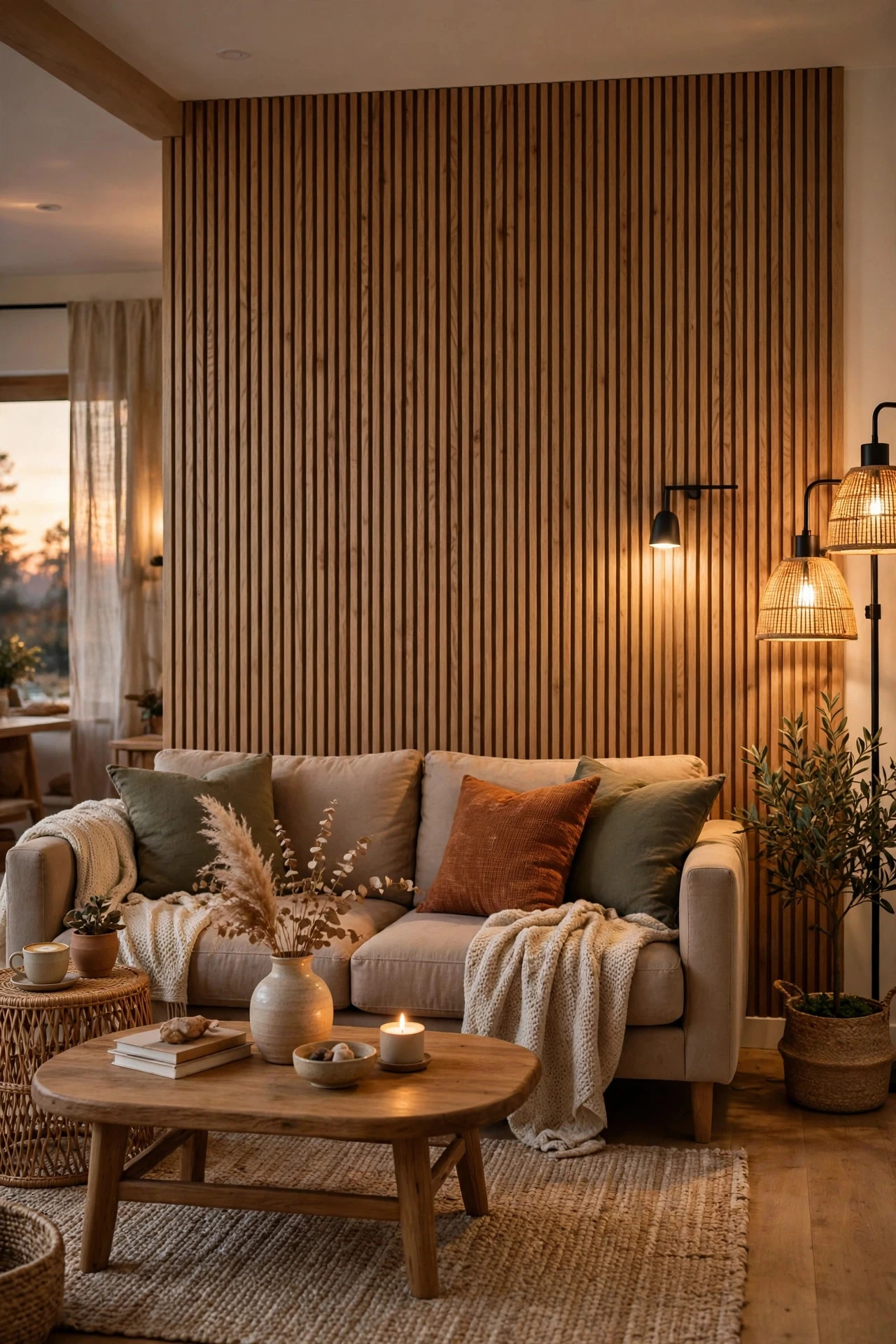
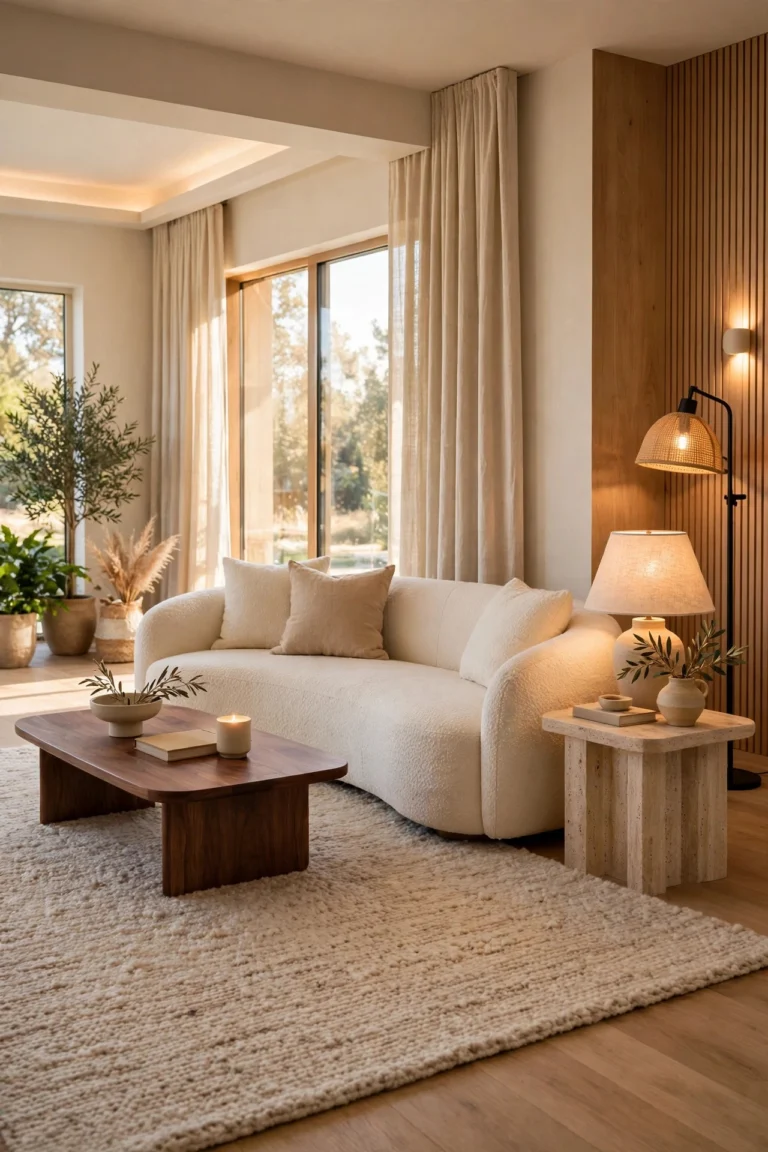
Fluted wood slats — narrow vertical battens fixed side by side — change a living room by adding rhythm, warmth and acoustic softness to a flat wall. The vertical lines draw the eye upward, making the ceiling feel higher, while the wood grain warms up a room that feels cold or echoey.
Buy ready-made slat panels (£60–£120 per square metre) or make your own from 20 mm by 40 mm battens spaced 20 mm apart, which costs roughly half as much. A 3 m wall runs £200–£400 ready-made, or £100–£180 DIY, and takes a day to install. Oak and walnut veneers suit warm, modern rooms; painted black slats suit a moody scheme. Run the slats full height for a built-in look. Avoid walls with a radiator or a door: the slats fight the fixtures, collect dust, and the clean vertical rhythm breaks.
9. Can Limewash Give a Plain Wall a Designer Finish?
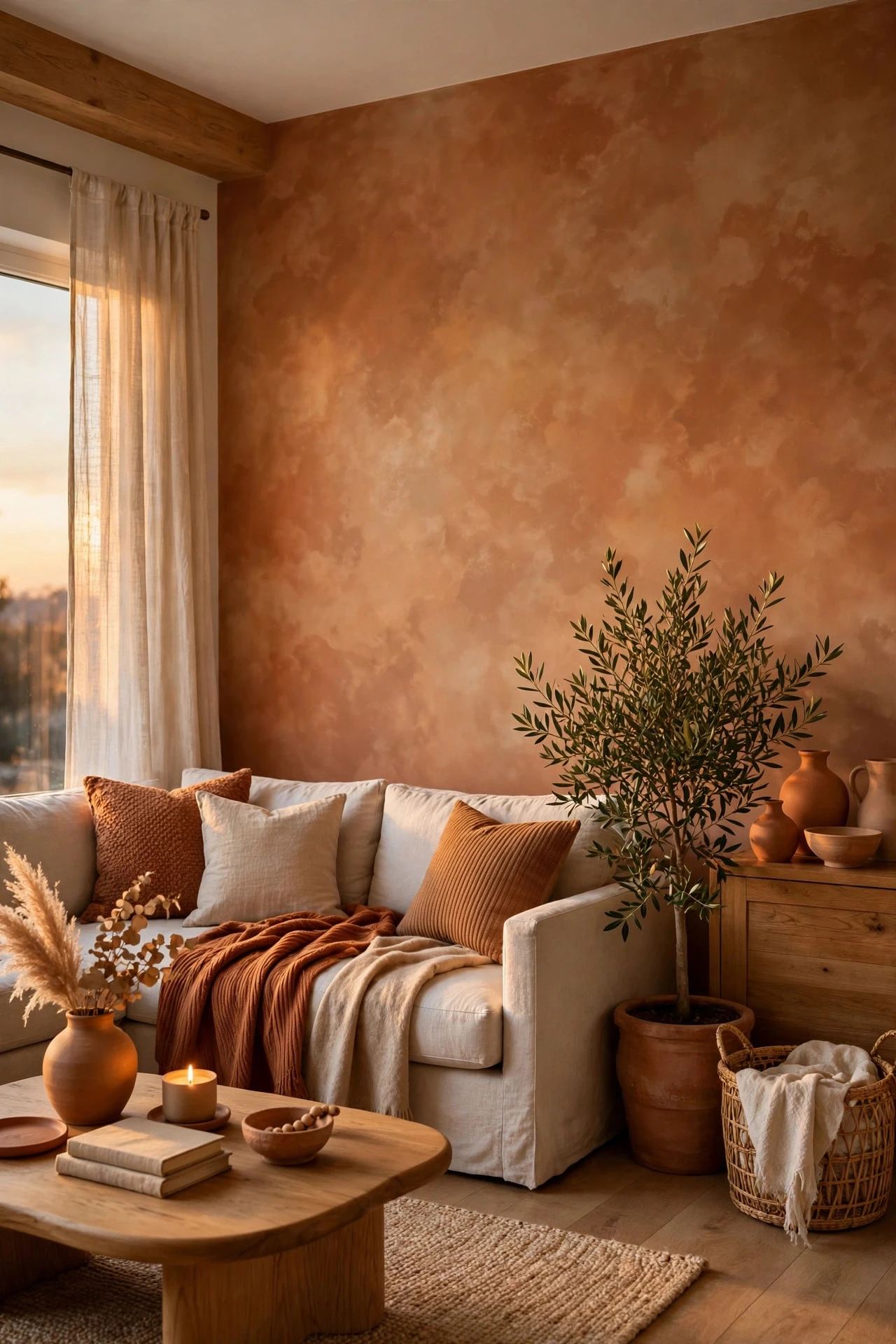
Yes — limewash gives a plain wall a soft, cloudy, mineral finish that looks handmade and expensive, with subtle tonal movement that flat paint never achieves. It suits living rooms that want warmth and texture without pattern, and it photographs beautifully in natural light.
Limewash costs £40–£70 per 2.5 litres; one wall needs one tin plus a large block brush (£10–£15). Apply two coats in loose, criss-cross strokes and let the brush marks show — that is the finish. Allow a full day including drying time, and protect the floor because limewash drips. It works best in warm whites, clay, sage and stone; very dark limewash can look patchy in a dim room. Never roll it on like emulsion: a roller kills the cloudy movement and leaves a flat, blotchy wall.
10. Is a Brick Accent Wall Right for a Modern Living Room?
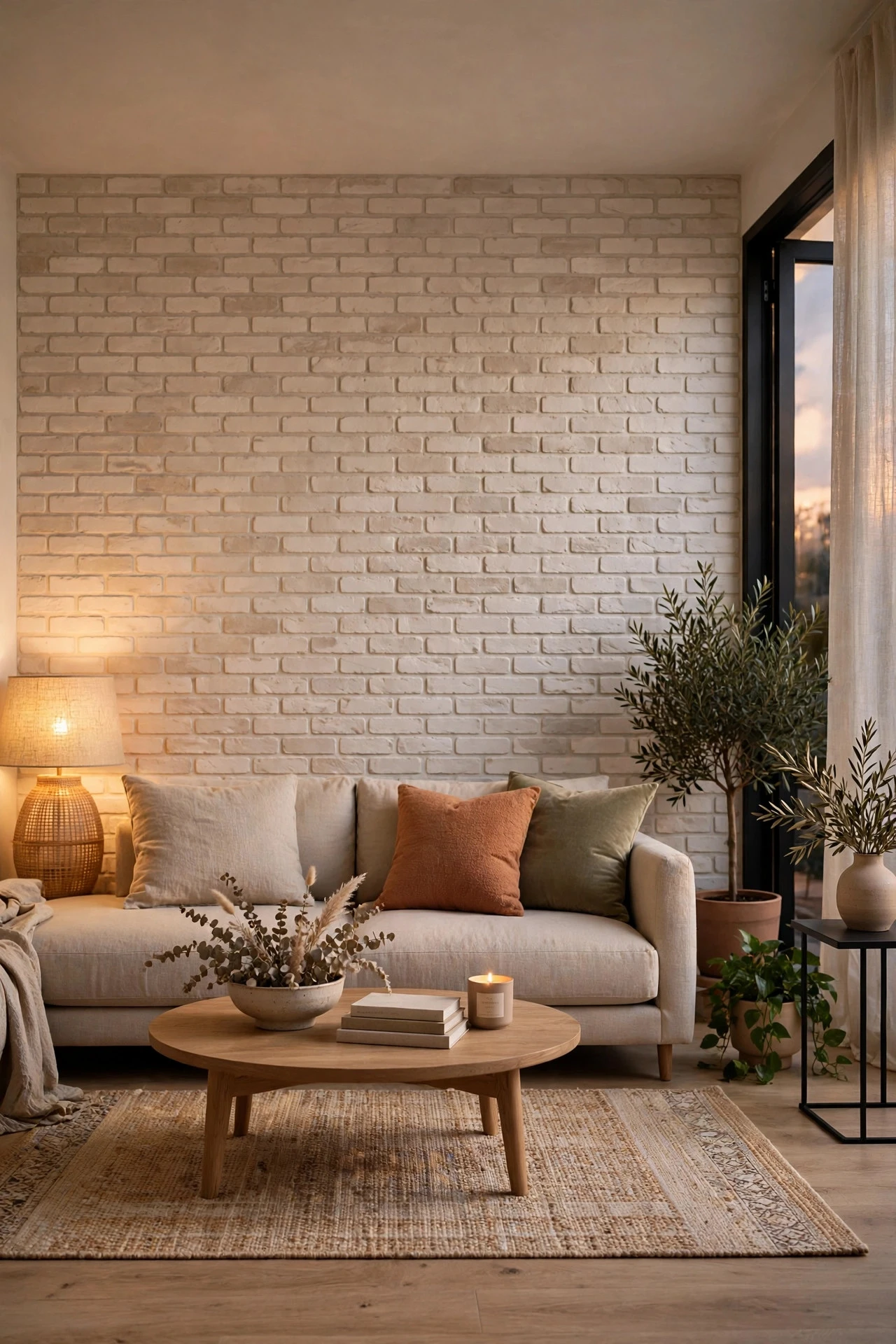
A brick accent wall is right for a modern living room when the brick is treated as texture, not theme — one wall of slim brick slips in a soft, natural tone, paired with clean modern furniture, reads as warm and architectural rather than industrial pastiche. Most homes need brick slips to get the look.
Brick slips cost £40–£80 per square metre, so a single wall runs £250–£500 including adhesive and grout, and takes a weekend plus drying time. Choose a pale, limewashed or soft red slip rather than harsh orange, and seal it with a matt sealer so it does not shed dust onto the sofa. Keep the mortar joints thin. Never brick the wall behind the television: the busy texture competes with the screen, the cables are impossible to hide, and the room ends up looking like a pub.
11. How Do You Use Stone Cladding Without Making the Room Feel Cold?

Use stone cladding on one wall only, in a warm-toned stone — sandstone, travertine or a pale limestone — and balance it with soft textures: a wool rug, linen cushions, warm wood and layered lighting. Stone feels cold only when it is surrounded by more hard surfaces, so the softness around it does the warming.
Stone veneer panels cost £60–£120 per square metre, so a fireplace-width wall runs £300–£600, and most systems are DIY-friendly with adhesive and a tile cutter. Keep the cladding to one wall, ideally the fireplace wall, and leave the rest of the room painted and soft. A slim LED strip or a pair of wall lights washing down the stone brings out its texture in the evening. Pair the stone with elegant furniture and finishes — these luxury living room decor ideas for an elegant home show how natural stone sits beside marble, brass and velvet. Never clad a wall that gets no light: unlit stone in a dark corner looks grey, damp and unfinished.
12. Can a Gallery Wall Work as an Accent Wall?
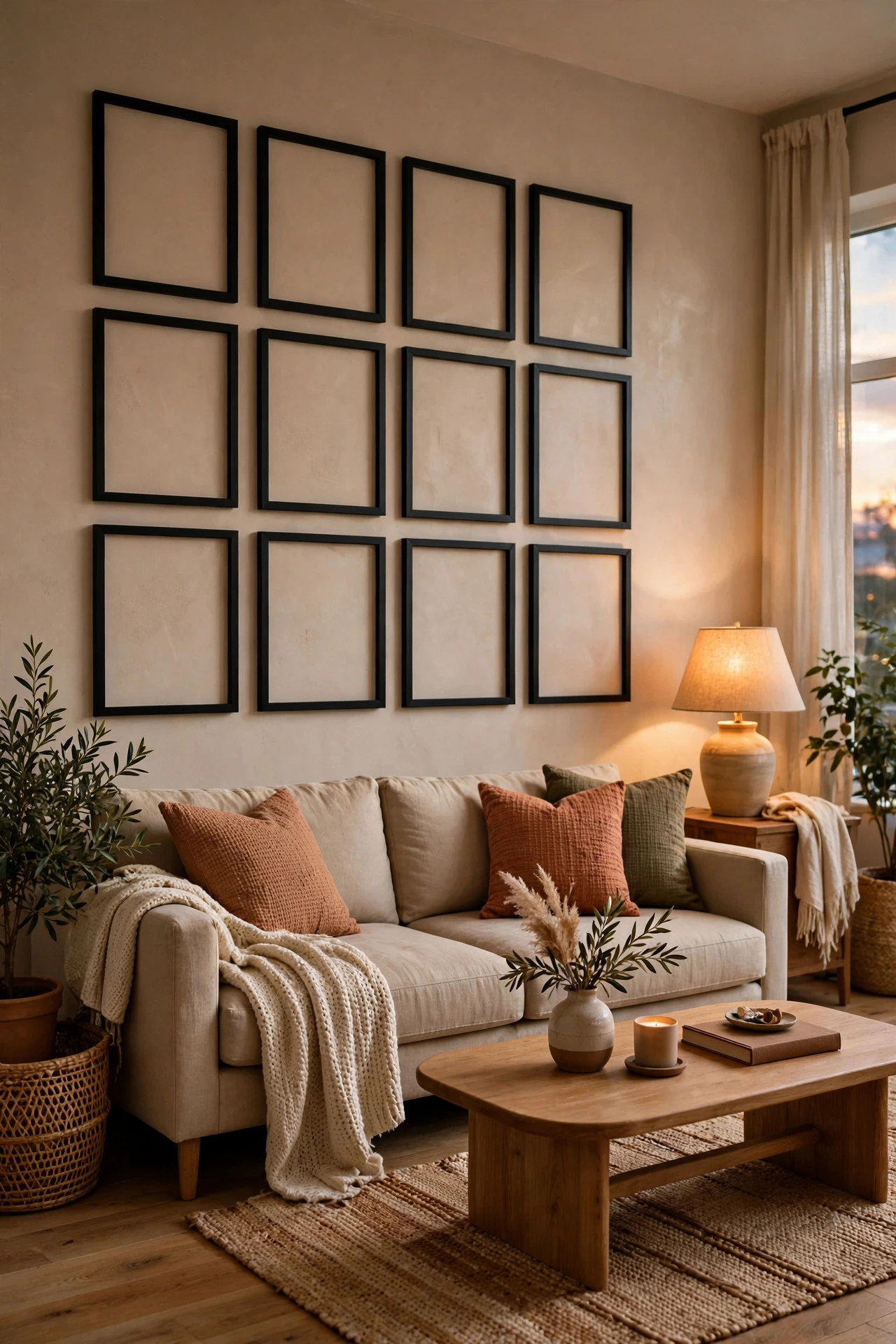
A gallery wall works as an accent wall when treated as one composition, not a random collection — a tight grid of matching frames, or a salon-style arrangement anchored by one large piece, turns a blank wall into the room's focal point without paint or building work. It suits people who love art and change their minds often.
Start with the largest piece first, hang it at eye level (centre around 145 cm from the floor), and build outwards with 5–8 cm gaps between frames. Use one frame colour and one mat style throughout, and mix sizes — one large, two medium, several small — for rhythm. Budget £60–£150 for frames and prints, or far less if you print your own photos. These living room wall decor ideas that transform a blank wall cover gallery layouts, shelves and art in detail. Never hang frames too high or too spread out: a scattered gallery looks like pictures lost in space.
13. How Do Built-In Shelves Create an Accent Wall?
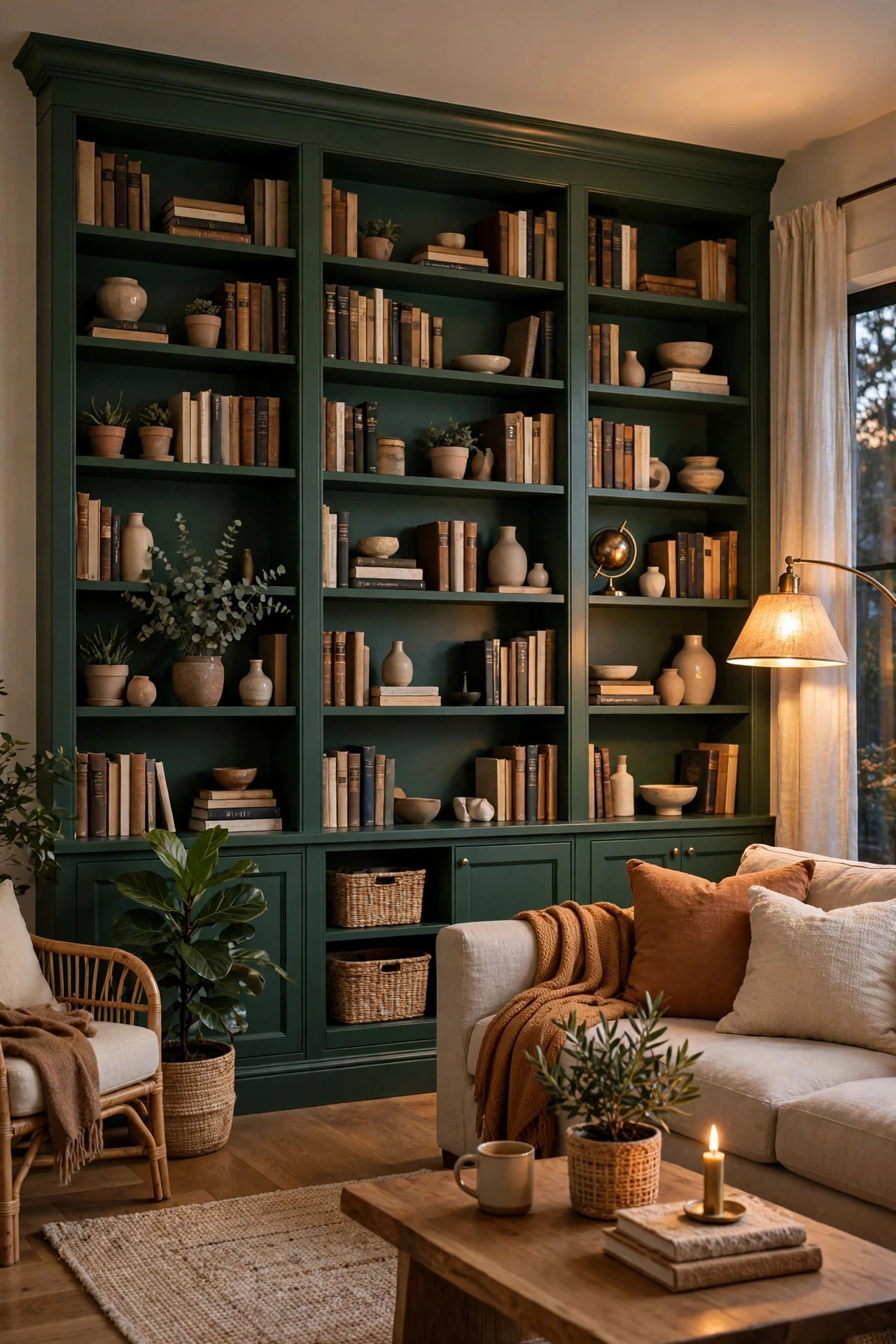
Built-in shelves create an accent wall by turning storage into architecture: floor-to-ceiling shelving painted the same colour as the wall makes the whole wall a feature, while the books, plants and objects on the shelves provide the colour and texture. It is the most practical accent wall because it earns its keep every day.
Budget £300–£800 for a bespoke or flat-pack built-in along one wall, or £150–£300 for a pair of tall bookcases fixed together and trimmed in with MDF for a built-in look. Paint the shelves the same colour as the wall — deep green or navy makes books pop, white keeps a small room airy. Style with the 60-30-10 rule: 60% books, 30% objects, 10% empty space. Leave the bottom shelf for baskets and the top for trailing plants. Never overfill every shelf: a packed wall looks like a storage unit, while a wall with breathing space looks like a library.
14. What Is a Painted Arch and Why Does It Suit Living Rooms?
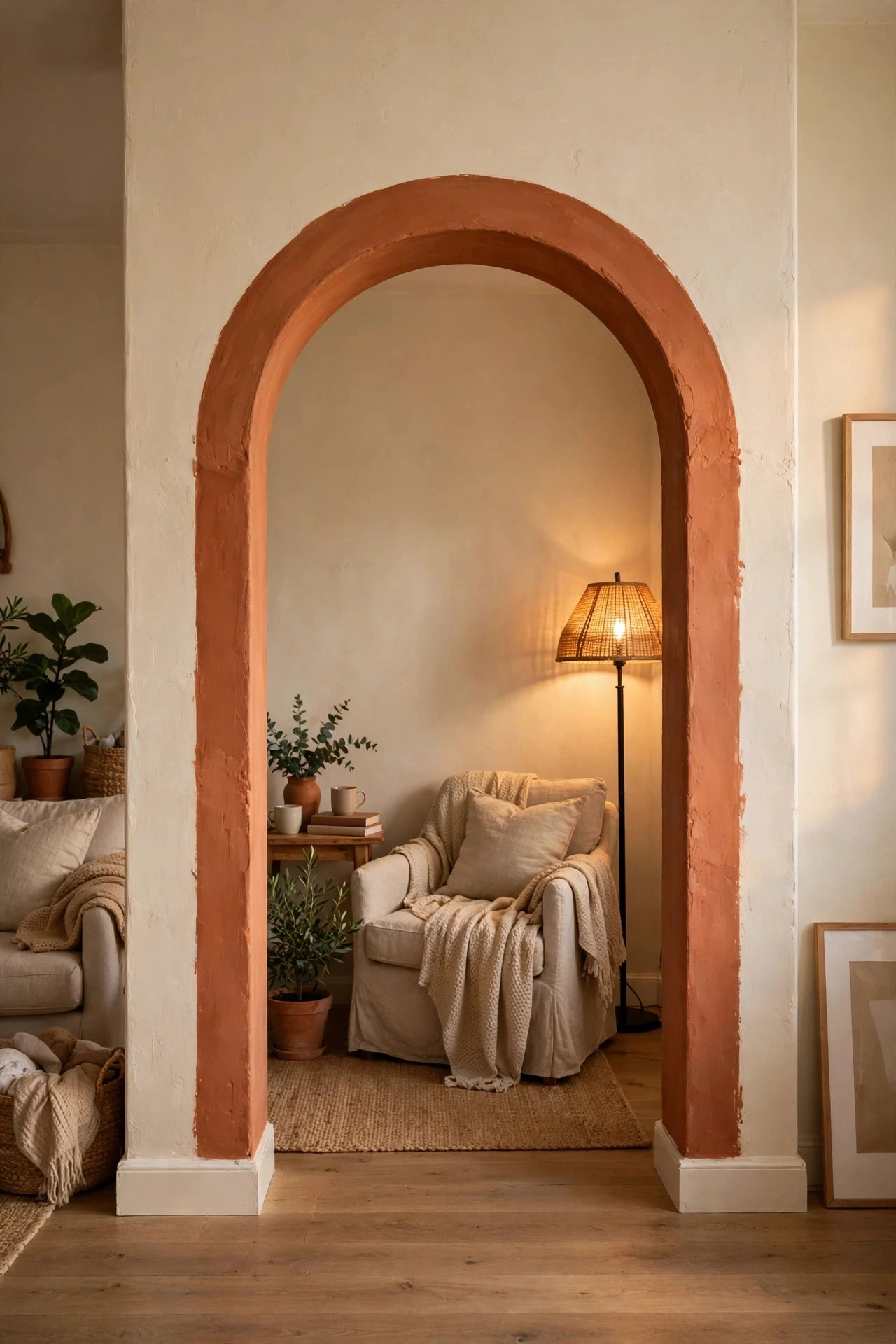
A painted arch is a simple arch shape painted directly onto a wall — usually behind a chair, a plant or a reading nook — that creates a focal point with nothing more than a tin of paint and a steady hand. It adds softness and structure to a boxy room, and it costs almost nothing.
Mark the arch with a pencil, a piece of string and a nail as a compass, then paint inside the line with a small roller and a brush for the curve. One litre of paint (£15–£25) is plenty, and the job takes two to three hours. Make the arch about 1.8–2 m tall and 1–1.2 m wide, in a colour that contrasts with the wall — terracotta on cream, sage on white, navy on pale grey. Place a reading chair, floor lamp or large plant inside it so it frames something real. Never paint the arch too small or too high: a tiny arch floating on a big wall looks like a sticker.
15. How Does a Two-Tone Half Wall Make a Room Feel Taller?

A two-tone half wall — a darker colour on the lower half and a lighter colour above, divided by a horizontal line — makes a room feel taller because the eye reads the pale upper half as height, while the darker lower half grounds the furniture. It costs one extra tin of paint and suits rooms with low ceilings.
Divide the wall at chair-rail height, around 90–100 cm from the floor, or at two-thirds height for a bolder look. Use masking tape and a spirit level for a dead-straight line, and paint the lower half two shades deeper than the upper — deep green below, pale sage above. Budget £40–£70 for two tins of paint and allow a day. Add a thin painted line or slim picture rail along the join for a finished look. Never divide the wall at exactly half height: a 50-50 split cuts the room in two and makes the ceiling feel lower.
16. Can a Mirror Wall Make a Small Living Room Feel Bigger?
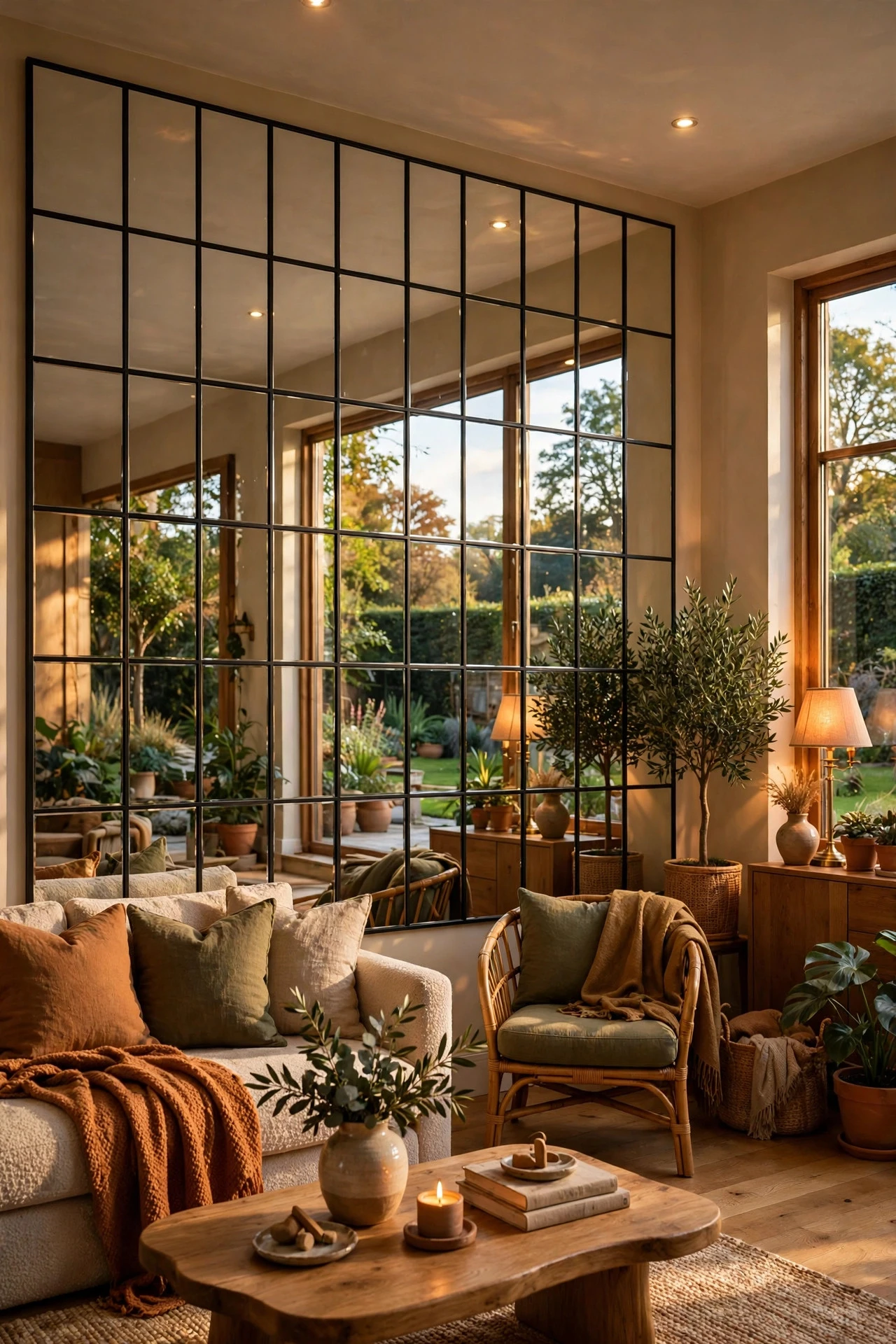
Yes — a mirror wall makes a small living room feel bigger because it reflects light and doubles the sense of space, but it only works when the mirror reflects something worth seeing: a window, a garden view or a beautiful light fitting. A mirror facing a blank wall or a cluttered corner just doubles the clutter.
Use a grid of large square mirrors (£80–£200 for a 1.5 m by 1.5 m arrangement) or a single oversized leaning mirror (£150–£300), rather than lots of small mirrors that chop the reflection into fragments. Hang or lean the mirror opposite or beside the window, never directly opposite the television, where it bounces glare onto the screen. Keep the frame simple — thin black metal or pale wood. Avoid a mirror wall in a room with no good light: in a dark room a mirror just reflects darkness, and the wall ends up looking like a gym.
17. Is Tongue-and-Groove Panelling Worth the Effort?
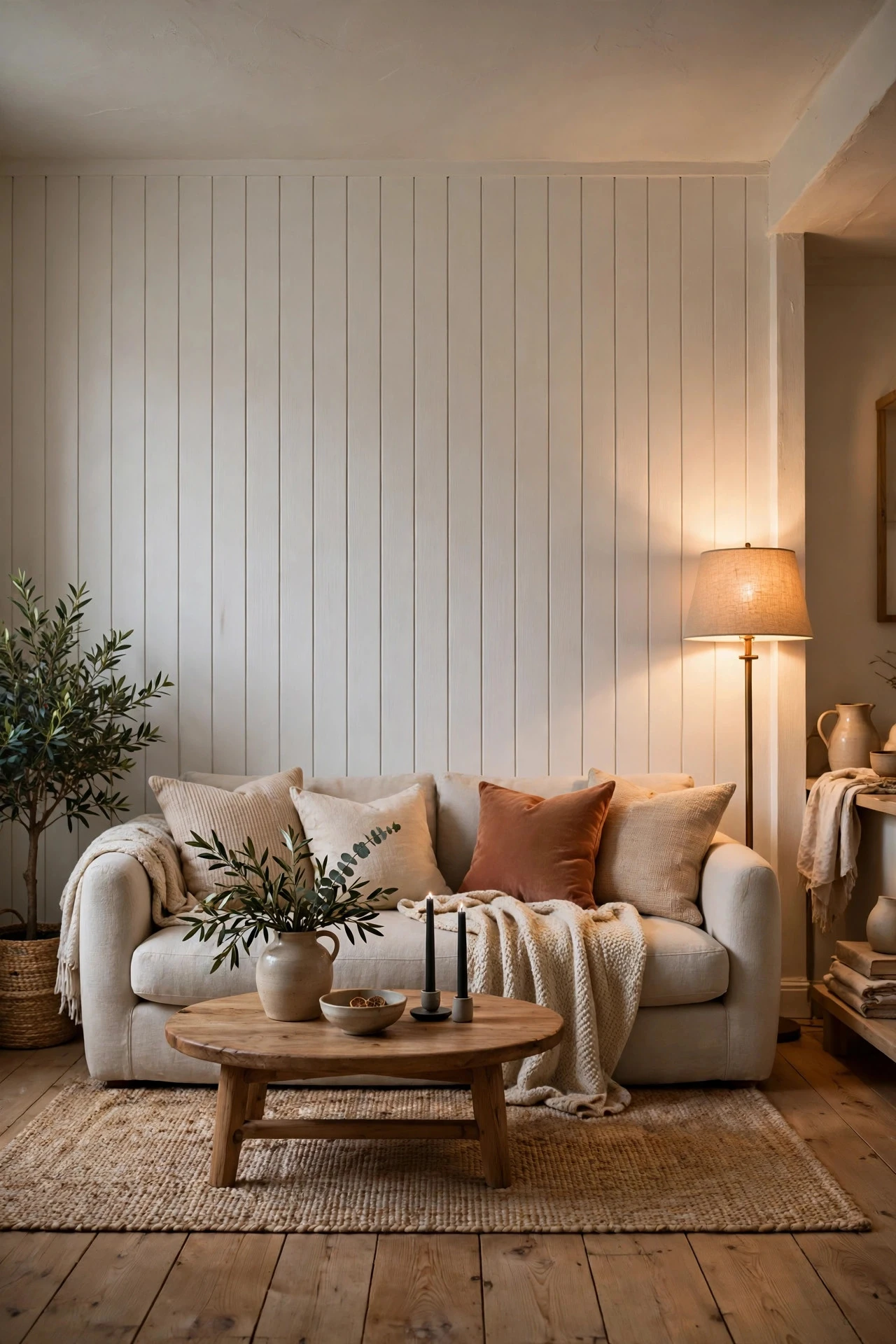
Tongue-and-groove panelling is worth the effort because it adds instant character, hides uneven plaster and gives a living room a crafted, cottage or coastal feel that paint alone cannot. Vertical boards also make the ceiling feel higher, which is a gift in a standard-height room.
Use MDF tongue-and-groove panels (£15–£25 per square metre) for a painted finish, or real pine to keep the wood visible. A full-height wall runs £120–£250 in materials plus paint, and takes a weekend to fit. Run the boards floor to ceiling on the sofa wall, paint them soft white, pale sage or warm greige, and finish with a slim skirting and a small cornice. The boards hide cracked plaster and wonky corners. Never panel a damp or cold wall: trapped moisture warps the boards within a year, so fix the damp first and leave a ventilation gap.
18. How Do You Make a Dark Moody Accent Wall Feel Cosy, Not Gloomy?
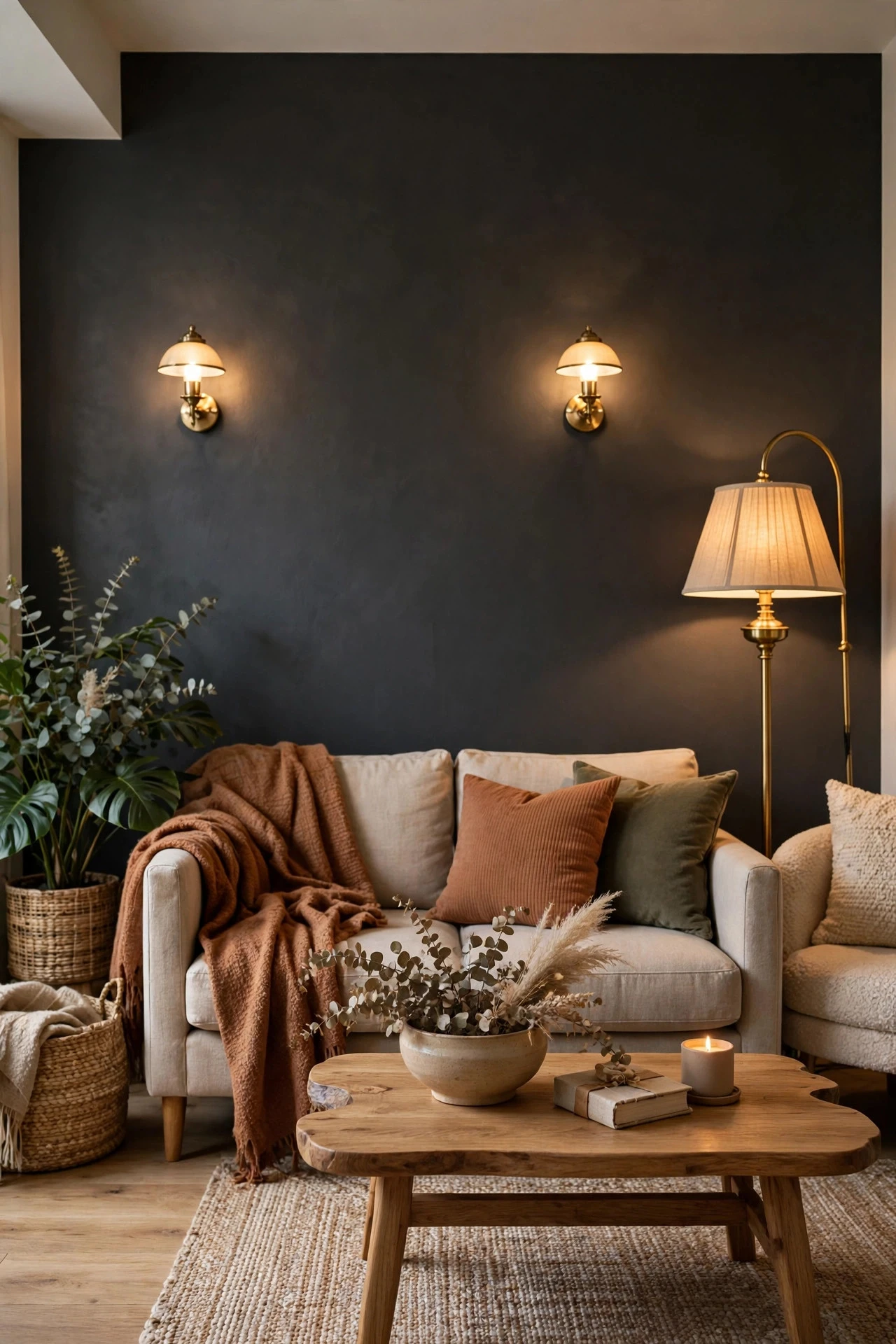
Make a dark accent wall feel cosy by layering warm light onto it: a pair of wall lights, a picture light over art, a floor lamp with a warm bulb and a candle on the sideboard all stop the dark paint from swallowing the room. Darkness feels gloomy only when it is unlit — lit darkness feels like a cocoon.
Choose a warm dark — charcoal with a brown undertone, deep forest green, inky navy — rather than flat black, in a matt finish. Keep the sofa and rug in warm, mid-tone colours, and add texture: velvet cushions, a wool throw, a brass lamp. Lighting is the difference between moody and miserable — these living room lighting ideas for a warm, layered glow show how to layer ambient, task and accent light on a dark wall. Budget £30–£60 for paint and £40–£100 for a pair of wall lights. Never rely on a single overhead light: one harsh downlight on a dark wall creates a pool of gloom, not a cosy corner.
19. How Do You Design a TV Wall That Still Looks Stylish?
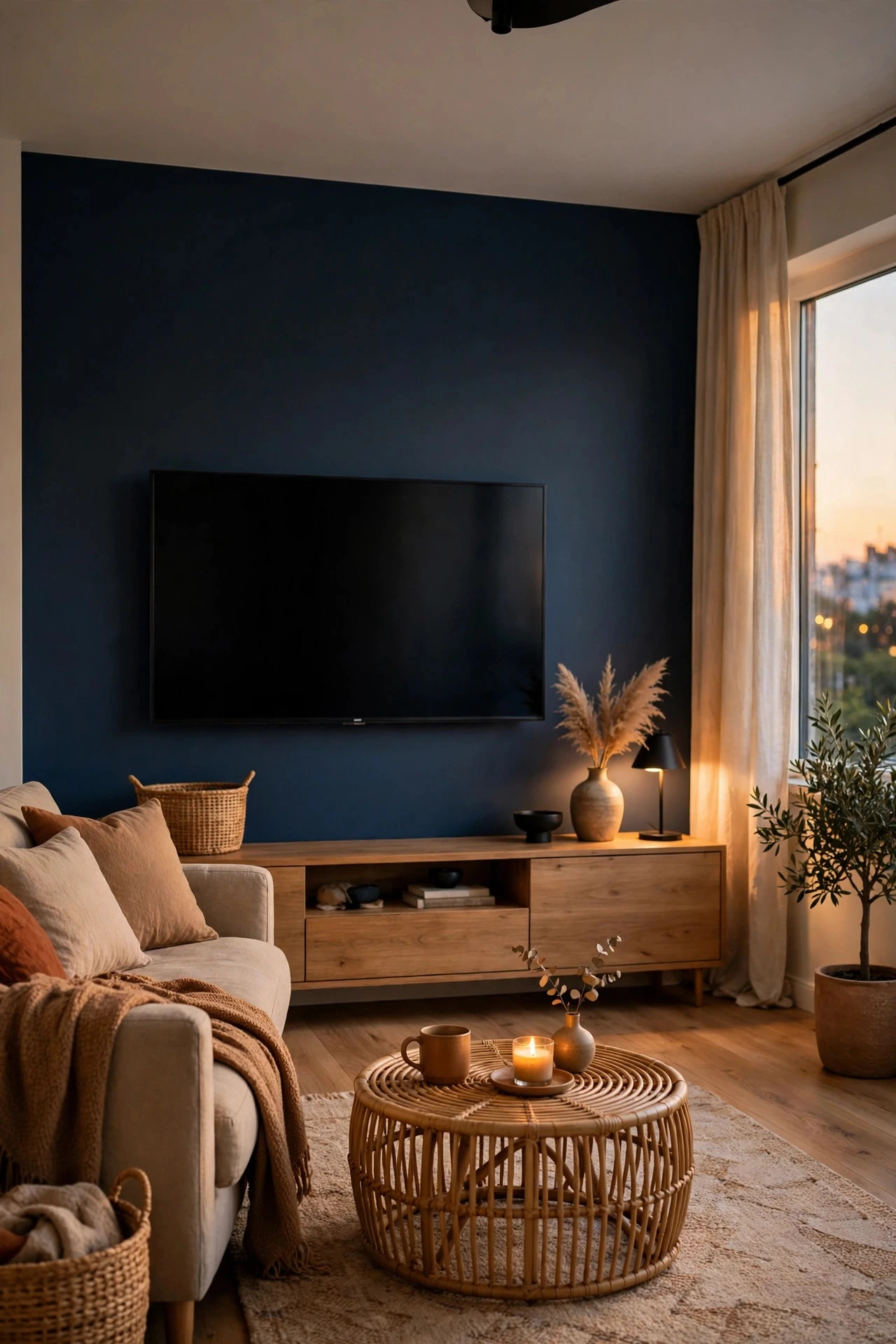
Design a TV wall that still looks stylish by treating the television as part of the wall, not a black rectangle stuck on it: paint the wall a deep, matt colour so the screen disappears into it when switched off, mount the television flush, and hide every cable inside the wall or a slim trunking channel painted the same colour.
Mount the screen at eye level from the sofa — centre around 105–110 cm from the floor — and flank it with low, wide furniture: a media unit, a pair of plants or a low bookshelf. Add a slim floating shelf for a soundbar and a few objects, and use a picture-frame style television, or a simple frame around a standard one, to soften the black rectangle. Budget £30–£60 for paint, £20–£40 for a flush mount, and £15–£30 for cable trunking. Never mount the television too high: a screen above the fireplace forces you to look up all evening, and no styling fixes a sore neck.
20. How Can the Fireplace Wall Become the Room's Best Feature?
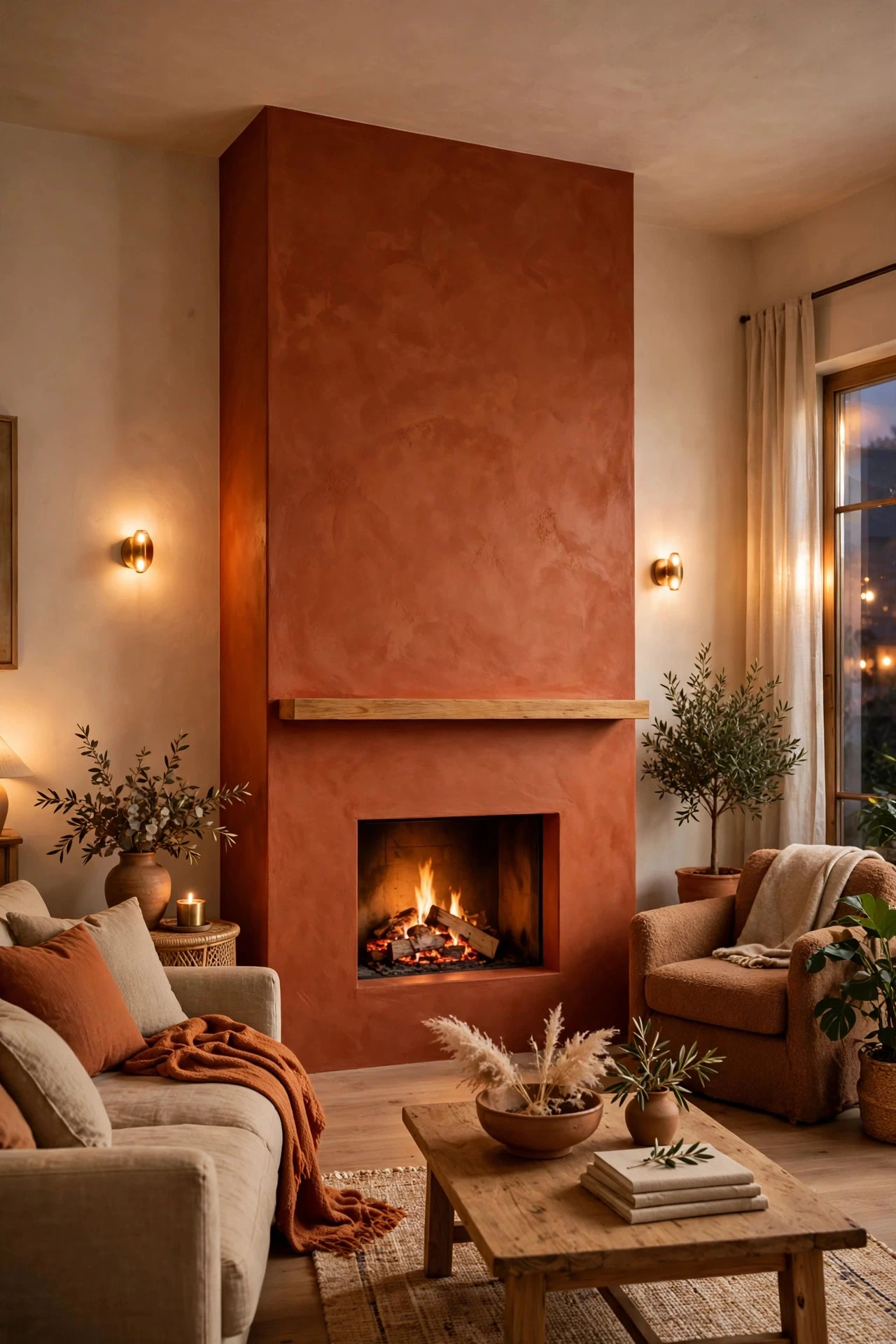
The fireplace wall becomes the room's best feature when the chimney breast is the accent and everything else is kept quiet: paint the breast a bold colour, clad it in stone or wood, or frame it with panelling, then let the mantel carry one or two objects, not a crowded display. The fireplace is already the room's natural focal point.
Paint the chimney breast in deep green, charcoal or warm terracotta (£25–£40 for a tin of paint) and leave the alcoves either side in a pale neutral, or panel the breast with fluted wood or board-and-batten for texture. Keep the mantel simple: a large mirror or one piece of art above it, a pair of candlesticks or a vase on it, and nothing else. If the fireplace is unused, style the opening with candles or a stack of logs. Never paint the wall loud and then fill the mantel with ornaments: the wall and the clutter compete, and the fireplace disappears behind both.
21. What Are the Best Renter-Friendly Accent Wall Options?

The best renter-friendly accent walls are peel-and-stick wallpaper, removable wall panels, a large leaning artwork, a tapestry, or a freestanding room divider placed against the wall — all of them create a focal point without a single hole or a drop of paint, and all of them come down cleanly when you move out.
Peel-and-stick wallpaper costs £25–£60 per roll and goes up in an afternoon; choose a bold pattern, one wall only, and test a small piece first to make sure it peels off cleanly. Removable foam or felt panels (£40–£100 for a wall) add texture and sound-softening, while a large tapestry (£30–£80) on a slim rail gives instant colour. Photograph the wall before you start and note the original paint colour. Never use ordinary wallpaper paste or strong adhesive strips in a rental: they pull paint off on removal and can cost you your deposit.
22. How Do Geometric Paint Patterns Add Drama Without Wallpaper?
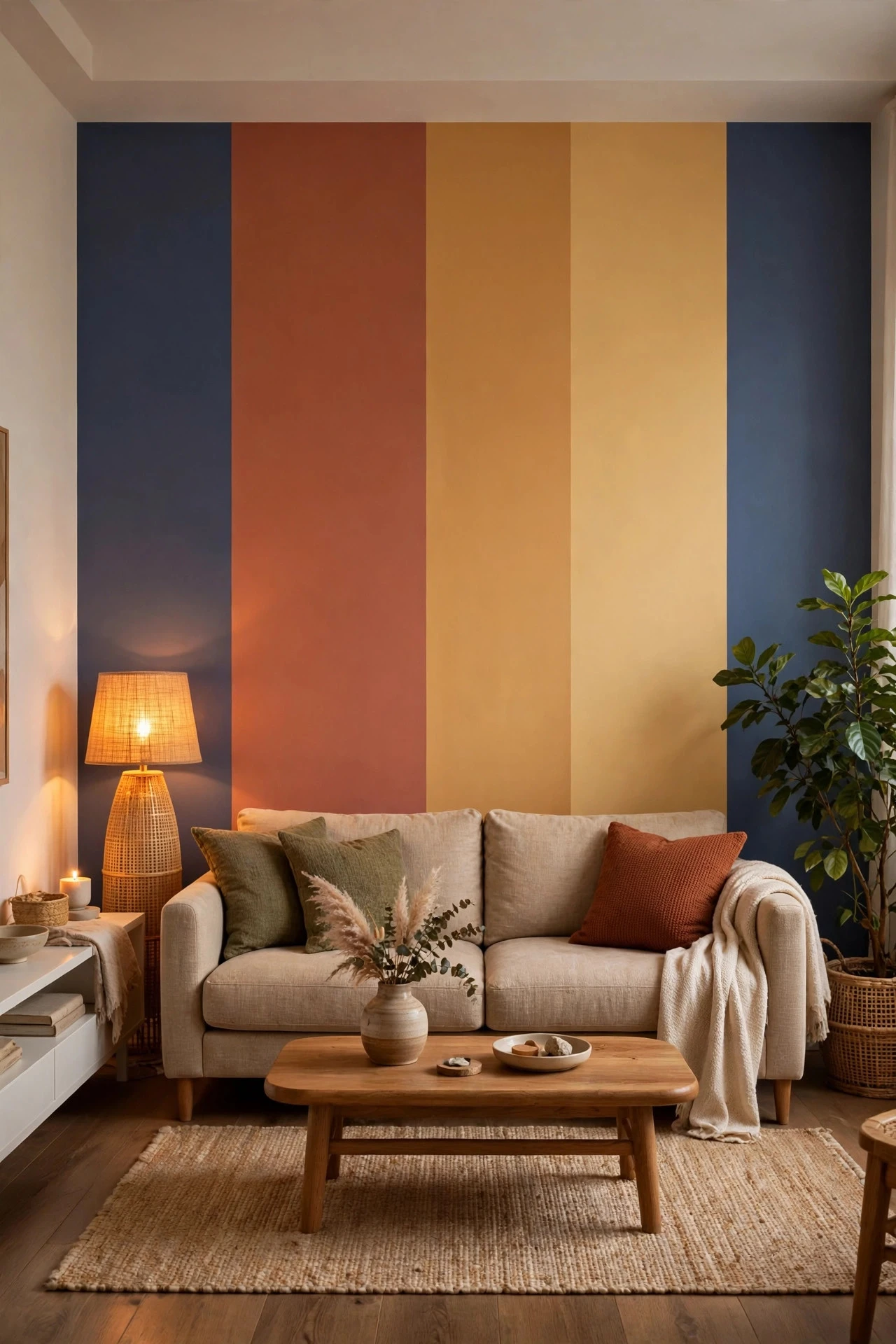
Geometric paint patterns add drama without wallpaper because the shapes themselves do the decorating: bold stripes, oversized colour blocks or a simple grid in two or three colours turn a flat wall into a graphic feature for the price of two tins of paint. It is the cheapest designer look, and easy to paint over when you tire of it.
Choose one simple shape — wide vertical stripes, a single large colour block behind the sofa, or a half-and-half diagonal — and map it out with masking tape and a spirit level before you open a tin. Two tins of paint cost £40–£70, and the job takes a day. Keep the pattern large and the colours to two or three, with one colour matching the rest of the room. A single oversized block behind the sofa is the easiest starting point and the hardest to get wrong. Avoid complicated patterns with thin lines and five colours: it looks busy, the tape lines bleed, and the wall ends up looking like a school art project.
Practical Tips
Choose the right wall first: stand in the doorway and look at the wall your eyes land on — usually the sofa wall. Avoid walls with lots of doors, windows or radiators, because every cut breaks the design and wastes materials. Measure the wall and buy 10% more material than you need.
Set a budget first: paint £30–£60 per wall, wallpaper £80–£200, panelling £50–£250, wood slats £100–£400, stone or brick £250–£600. Test a colour with a large swatch, at least A3 size, and check it morning, afternoon and evening — a colour that looks perfect at noon can look muddy at dusk.
Light the wall properly — a dark or textured wall needs dedicated light, so add a picture light, wall lights or a floor lamp aimed at it. Renters should stick to peel-and-stick options and photograph the wall before starting. Live with the wall for a week before styling around it: the right cushions, art and rug will suggest themselves.
Final Thoughts
A living room accent wall is the single most effective change you can make to a plain room: one wall, one clear idea, and a day's work can give the whole space a focal point, a mood and a sense of intention. Whether you choose bold paint, wallpaper, wood, stone or a renter-friendly peel-and-stick, the rules stay the same — one wall only, a colour that suits the room, good lighting, and furniture that lets the wall breathe.
Frequently Asked Questions
Which wall should be the accent wall in a living room?
Choose the wall your eyes land on when you walk in — usually the sofa wall, the fireplace wall or the wall opposite the windows. It should be the largest uninterrupted wall, with the fewest doors, windows and radiators. Avoid the wall behind the television: a bold colour or busy pattern competes with the screen and strains your eyes.
What colour is best for a living room accent wall?
The best colour is two or three shades deeper than your other walls, with the same undertone as your sofa and rug — warm terracotta with beige, deep green with grey, navy with cream. Warm darks feel cosy, cool darks feel calm and contemporary. Always test a large swatch on the wall in daylight and evening light before committing.
Does an accent wall make a small living room look smaller?
No — one accent wall usually makes a small living room feel larger, because it creates depth and a clear focal point. Keep the other three walls pale and the accent colour warm rather than harsh. Two accent walls, a very dark colour in a windowless room, or a busy pattern on every wall will shrink the space.
How much does a living room accent wall cost?
A painted accent wall costs £30–£60 all-in, wallpaper £80–£200, board-and-batten or picture-frame moulding £50–£250, fluted wood slats £100–£400, and stone or brick cladding £250–£600. Peel-and-stick wallpaper for renters runs £25–£60 per roll. Always budget 10% extra for cuts, mistakes and the tools you do not already own.
Can I do an accent wall in a rented home?
Yes — use peel-and-stick wallpaper, removable foam or felt panels, a large tapestry, a leaning mirror or a big piece of art, all of which come down without damage. Test a small piece first, photograph the wall before you start, and never use ordinary wallpaper paste or strong adhesive strips, which can pull paint off and cost you your deposit.
Should the accent wall be behind the sofa or the TV?
Behind the sofa is usually better, because the sofa frames the wall and the accent becomes the backdrop to your seating. A TV wall works only if it is painted a deep, matt colour so the screen blends in when switched off, with cables hidden. A bright colour or busy pattern behind a television competes with the screen.