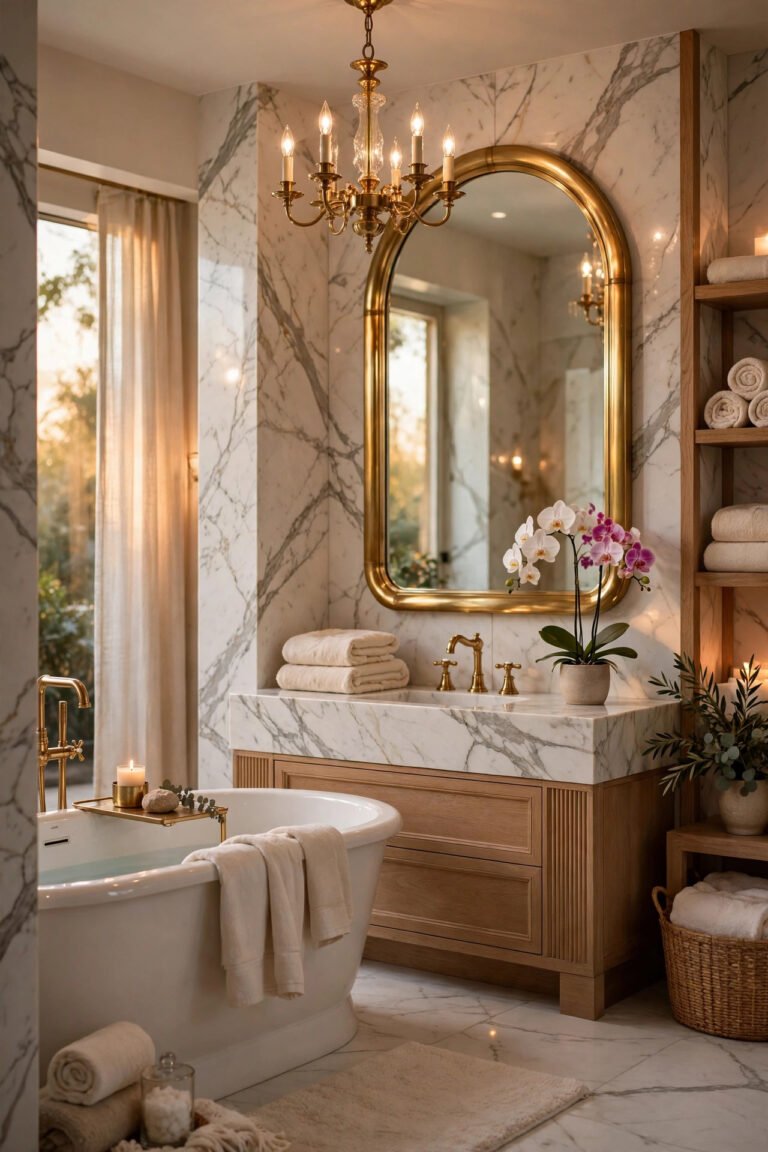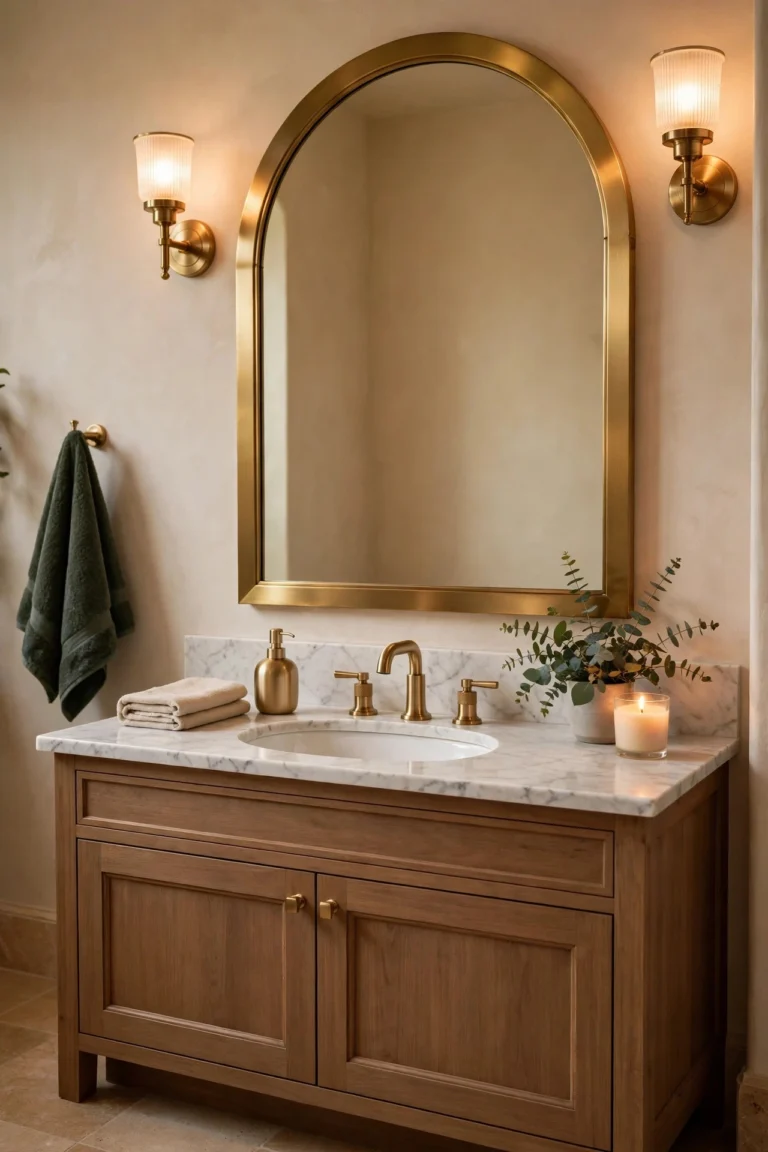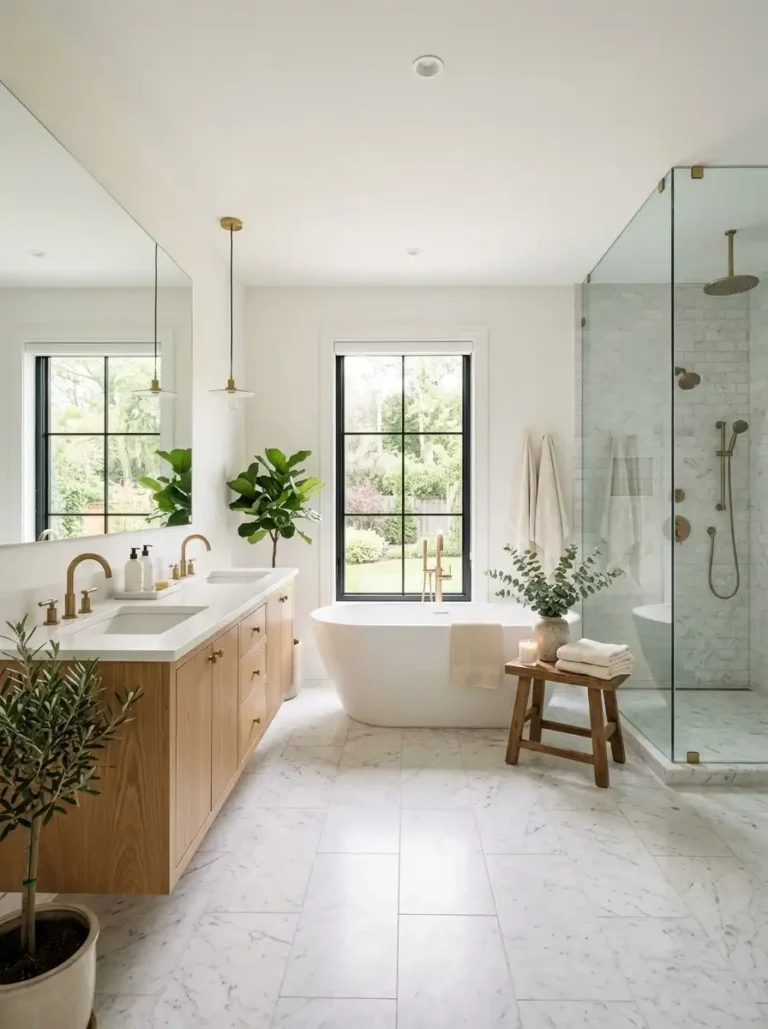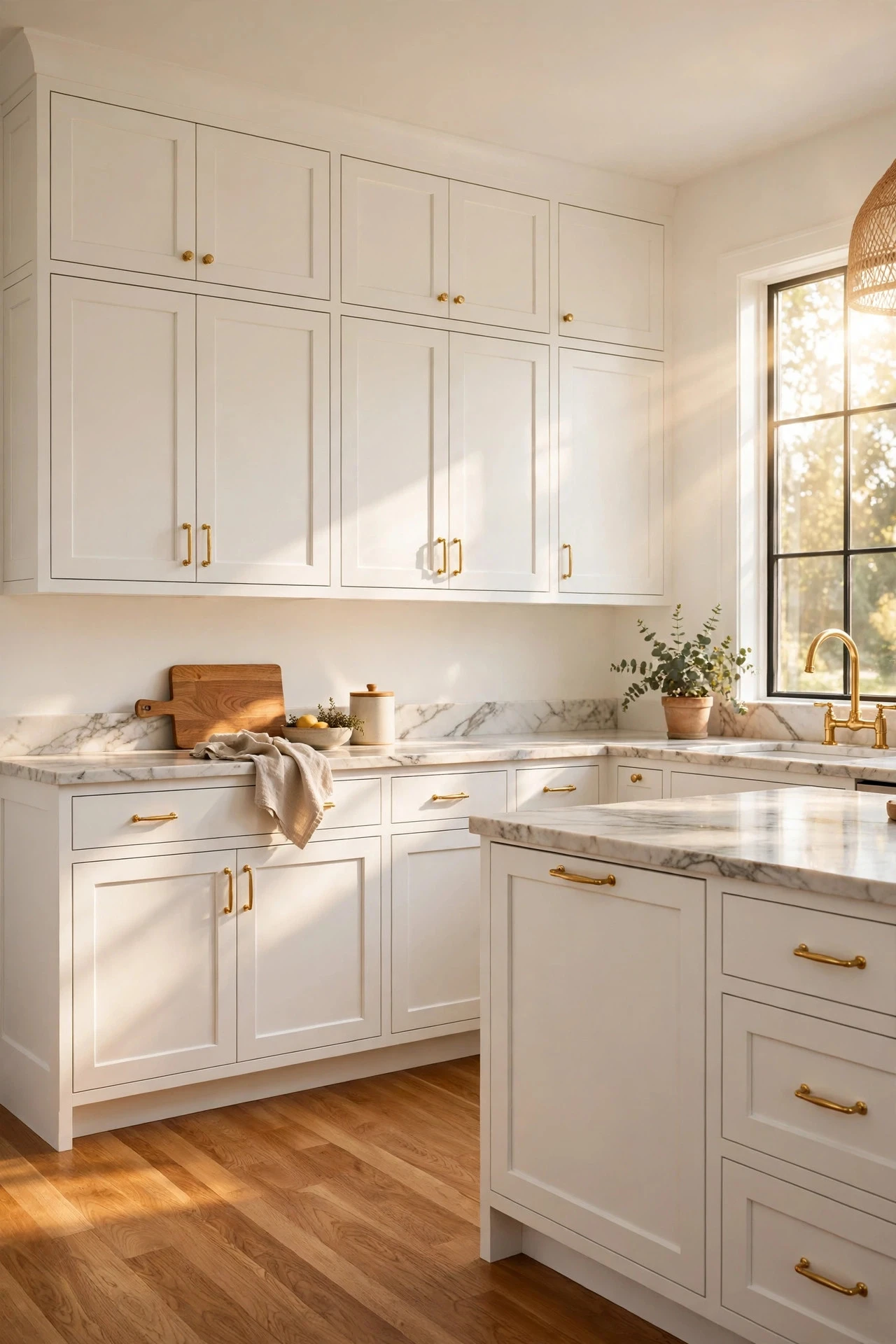
22 White Kitchen Ideas That Stay Bright, Warm and Timeless
A white kitchen never really goes out of style, but a badly planned one can feel cold, flat and hard to live with. The difference between a white kitchen that glows and one that feels like a showroom is not the colour itself — it is the shade of white, the texture of the cabinets, the warmth of the wood, the metal of the handles and the quality of the light. Get those five things right and white becomes the most forgiving background in the house.
Below are 22 white kitchen ideas organised by the decisions that matter most — cabinet finishes, warm versus cool whites, worktops, backsplashes, hardware, shelving, lighting, flooring and cleaning — with realistic prices, exact measurements and the mistakes that make white look stark, such as pairing a cool white cabinet with a cool white floor or choosing a gloss finish in a kitchen that gets harsh afternoon sun. Most ideas cost under $300 each, and a full refresh of paint, hardware and lighting can transform a tired white kitchen for $1,500 to $3,000. Every idea keeps white bright without letting it feel cold.
Looking for more inspiration? Our Nest Decorz homepage gathers the latest home decor ideas, seasonal decorating guides and room-by-room styling tips in one place — start there and explore.
Quick answers
– Choose a warm white, not a brilliant white — shades with a hint of yellow or cream, such as Benjamin Moore White Dove or Farrow & Ball Wimborne White, glow in real light, while pure brilliant white turns blue-grey and clinical. – Mix textures, not just colours — matte cabinets, a honed stone worktop, oak open shelves and woven bar stools stop white from looking flat, even when everything in the room is technically the same colour. – Warm the white with wood and brass — one wooden element and one warm metal, repeated in at least two places, is the fastest way to make a white kitchen feel welcoming. – Light it in layers at 2700K to 3000K — warm-white under-cabinet lighting, a pendant over the island and dimmable ceiling lights keep white bright at night without glare. – Budget $1,500 to $3,000 for a refresh — repainting cabinets, swapping hardware and updating lighting transforms a white kitchen; a full new kitchen with white cabinets starts around $12,000 to $25,000.
1. How Do You Pick the Right White for Your Kitchen?
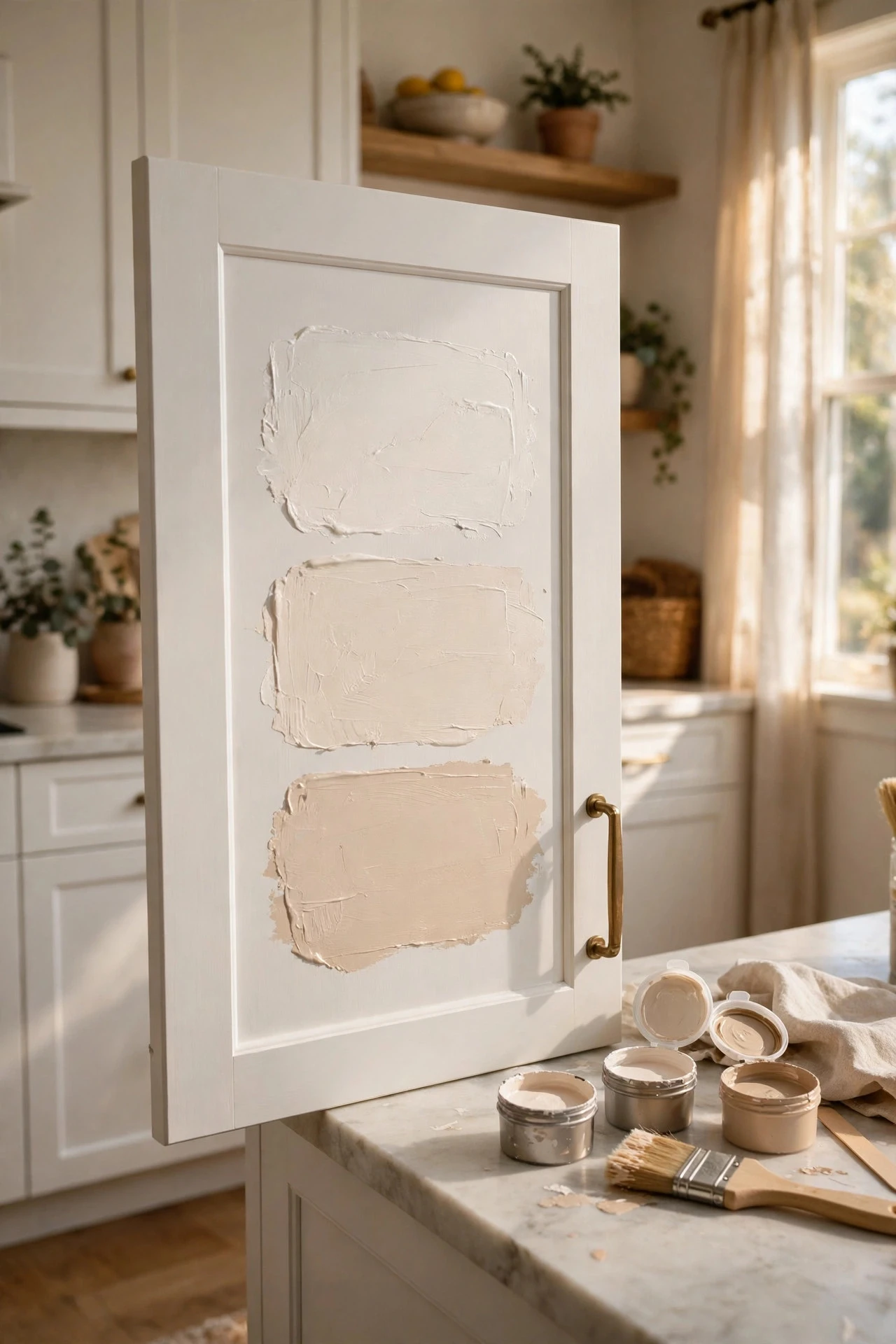
Pick the right white for your kitchen by testing three large swatches on a cabinet door and living with them for three days, checking them in morning light, afternoon sun and evening lamplight. The white that looks clean and warm in all three lights is the right one, because paint changes dramatically with orientation and time of day.
North-facing kitchens need a warmer white with a yellow or pink undertone, because cool northern light turns a neutral white grey. South-facing kitchens can take a cleaner, slightly cooler white, because strong sun warms everything it touches. Paint a swatch at least 30 cm square — a tiny chip lies, while a large swatch tells the truth — and hold it against your worktop, your floor and your backsplash before you commit. Avoid brilliant white on every surface at once; use it on the ceiling only, and choose a softer white for the cabinets so the room has depth.
2. What Is the Difference Between Warm White and Cool White Cabinets?
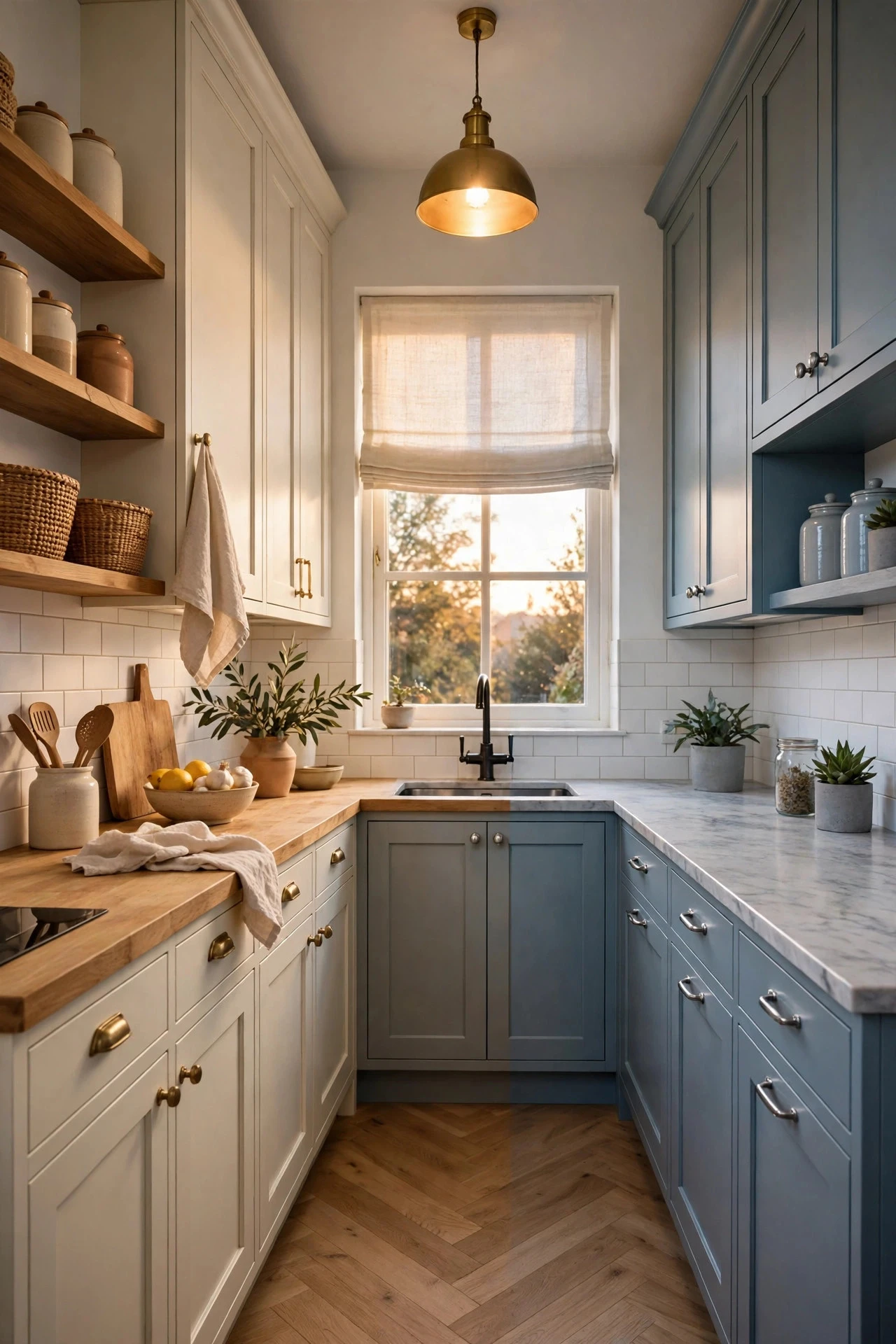
Warm white cabinets have a yellow, cream or pink undertone that makes a kitchen feel sunny and welcoming, while cool white cabinets have a blue or grey undertone that looks crisp and modern but can feel stark. The difference is subtle on a paint chip and obvious on a whole wall of cabinets, so always compare swatches side by side.
Warm whites pair beautifully with oak, walnut, brass and cream stone, which is why they suit traditional, farmhouse and transitional kitchens. Cool whites suit chrome, stainless steel, grey marble and concrete, which is why they appear in minimalist and contemporary kitchens. The most common mistake is mixing the two: a warm white cabinet next to a cool white worktop makes both look dirty. Choose one temperature and carry it through the cabinets, the trim and the ceiling, then let the worktop and floor supply the contrast.
3. How Do Matte White Cabinets Compare to Gloss White Cabinets?
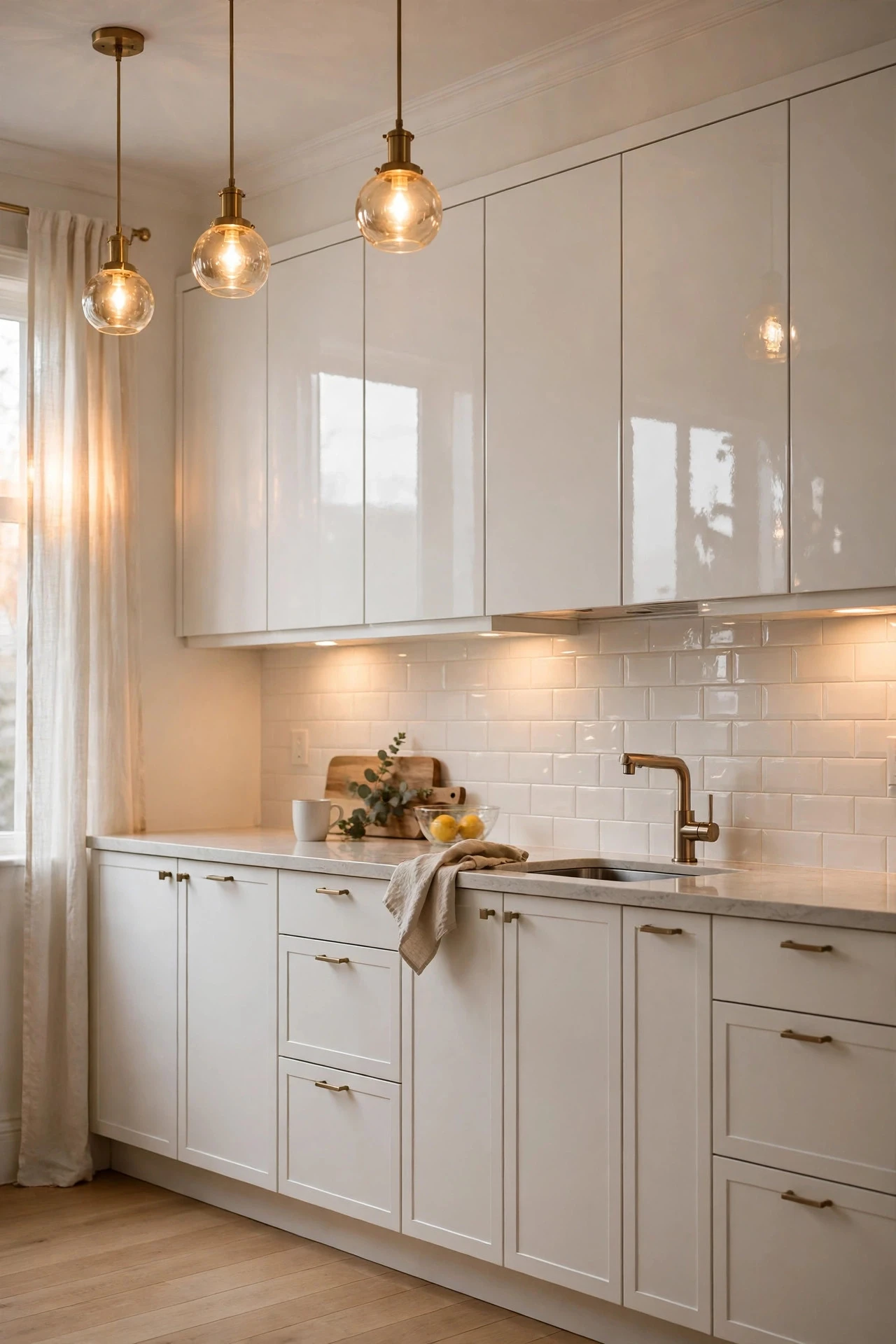
Matte white cabinets hide fingerprints, smudges and small scratches far better than gloss, while gloss white cabinets reflect light and make a small kitchen feel bigger. Matte suits a calm, lived-in kitchen; gloss suits a bright, modern one — and the choice should follow how you actually cook and clean.
Matte finishes, especially matte lacquer and matte laminate, feel soft to the touch and forgive daily wear, which makes them the practical choice for a family kitchen. Gloss finishes bounce light around the room and wipe clean with one pass, but every fingerprint shows, so they need a daily wipe in a busy household. A popular compromise is matte on the lower cabinets, where hands and feet leave marks, and gloss on the uppers, where the reflected light does the most good. The kitchen has always been the hardest-working room in the house, and the finish you choose should respect that reality.
4. Should You Choose Shaker or Slab White Cabinets?
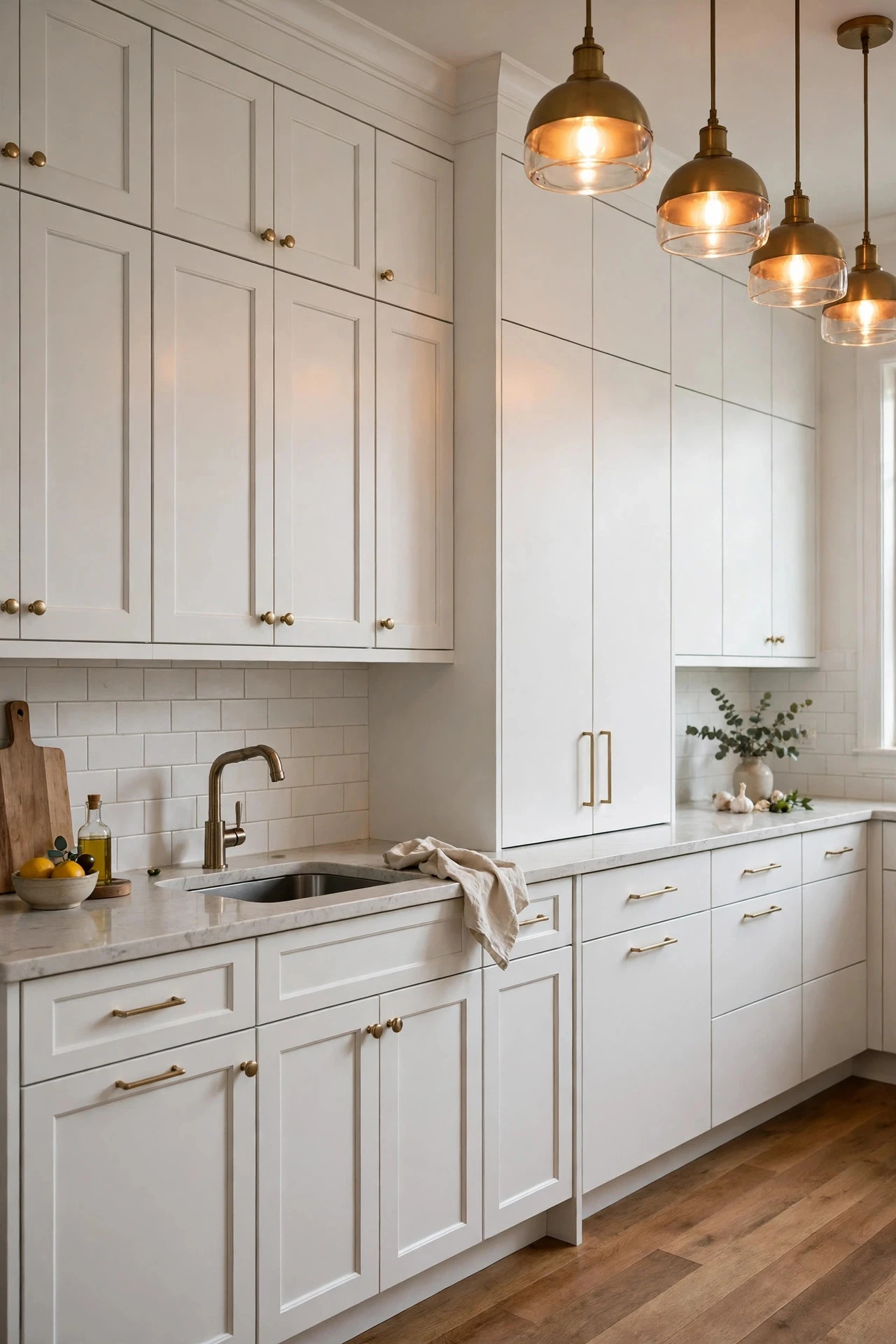
Choose Shaker white cabinets for a timeless kitchen that will still look right in ten years, and slab white cabinets for a clean, contemporary kitchen where you want the lines to disappear. Shaker adds shadow and craft through its recessed panel; slab adds calm through a perfectly flat front.
Shaker cabinets suit almost every house style, from cottage to transitional, and their framed panel hides small dents and paint wear better than a flat slab. Slab cabinets, also called flat-panel, suit handleless designs and small kitchens, because their unbroken surface reflects light and reads as one continuous plane. If you love Shaker but want a modern edge, choose a slim Shaker with a narrow frame — it keeps the craft without the country feel. Either way, order one sample door first and check the paint finish in your own light before ordering the whole kitchen.
5. How Do You Keep a White Kitchen from Feeling Cold or Clinical?

Keep a white kitchen from feeling cold by layering three warm elements — natural wood, a warm metal and a textured fabric — into a room that is otherwise white. White alone reads as a laboratory; white with oak, brass and linen reads as a home, because the eye needs something warm to rest on.
Start with the floor or the island: a pale oak floor, a butcher-block island top or oak open shelves instantly warm the room. Add brass or unlacquered bronze handles, a copper pendant or a brass tap, and repeat the metal in at least two places so it looks deliberate. Finish with texture at seating height — woven bar stools, a linen tea towel, a wooden chopping board left on the worktop — because soft materials at eye level do more than any paint colour. These 22 cozy home decor ideas for a warm inviting home use the same layering trick in living rooms, and it works even better in a kitchen.
6. What Worktop Works Best in a White Kitchen?
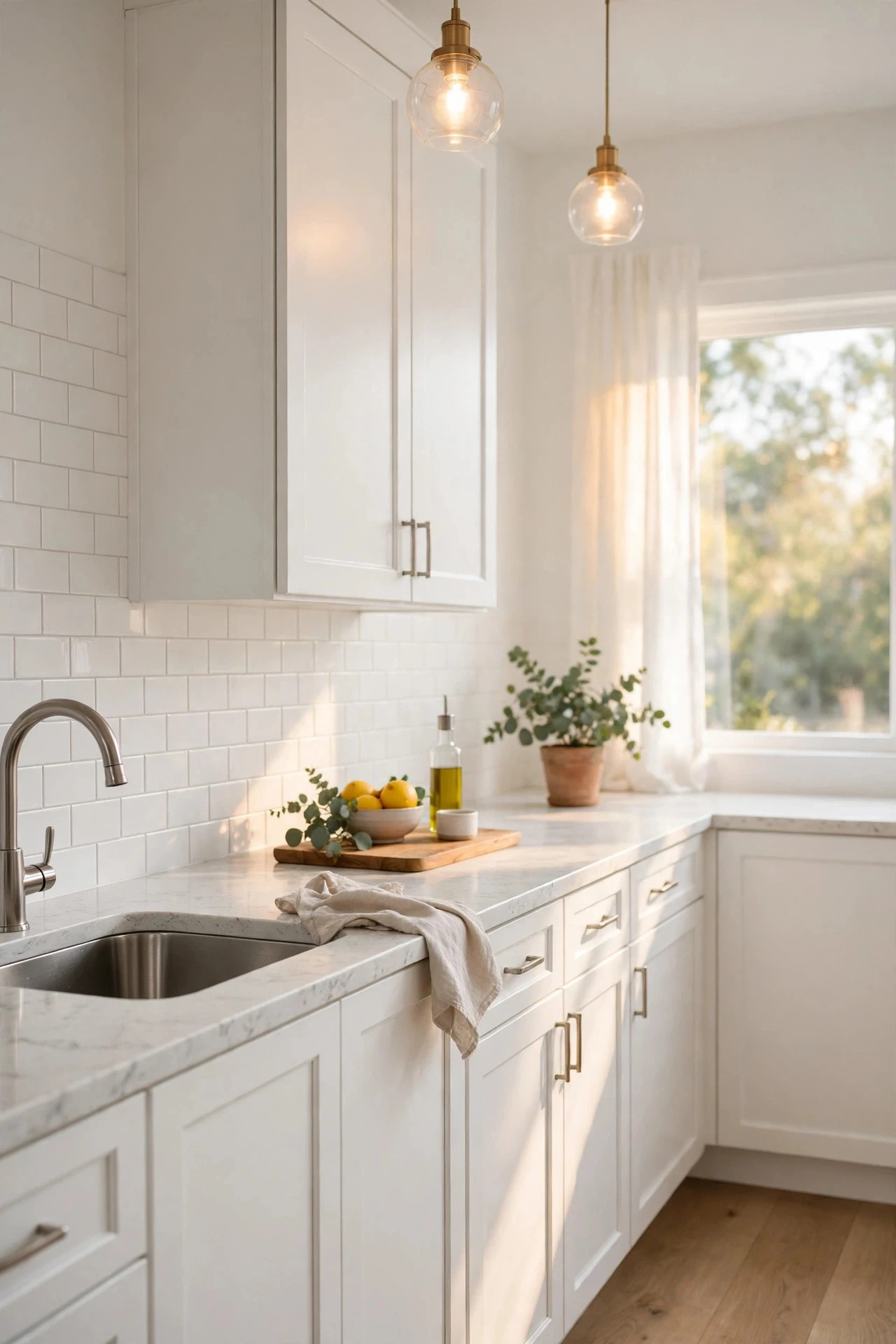
The best worktop for a white kitchen is quartz, because it gives you the look of marble without the staining, sealing and etching that real marble demands. A white or lightly veined quartz worktop costs $60 to $100 per square foot installed, resists coffee, wine and tomato sauce, and needs no sealing at all.
Quartz comes in warm and cool whites, so match its undertone to your cabinets — a warm quartz with cream veining over warm white cabinets, a crisp white quartz over cool white cabinets. If you want visible pattern, choose a quartz with soft grey or gold veining that echoes your backsplash or floor, rather than a bold, high-contrast vein that fights the calm of the room. Keep the edge simple: a straight eased edge or a thin mitred edge looks modern and timeless, while a heavy ogee edge dates a white kitchen fast. For a full guide to the stone itself, quartz explains the mineral behind the engineered surface.
7. Is Marble Worth It in a White Kitchen?

Marble is worth it in a white kitchen only if you love its patina and accept that it will stain, etch and age visibly, because marble is a soft, porous stone that marks from lemon juice, wine and coffee. If you want a pristine worktop forever, choose quartz; if you want a living surface with character, choose marble.
Carrara marble, with its soft grey veining, is the classic white-kitchen choice and costs $70 to $120 per square foot installed. Calacatta marble has bolder gold and grey veins and costs more, but it makes a stronger statement on an island. Seal marble every six to twelve months, wipe spills immediately, and use chopping boards and trivets without exception. Many owners put marble on the island, where its beauty shows, and quartz on the perimeter worktops, where the heavy cooking happens — the best of both worlds. Marble has been used in kitchens for centuries, and its softness is the price of its beauty.
8. How Does Butcher Block Warm Up a White Kitchen?
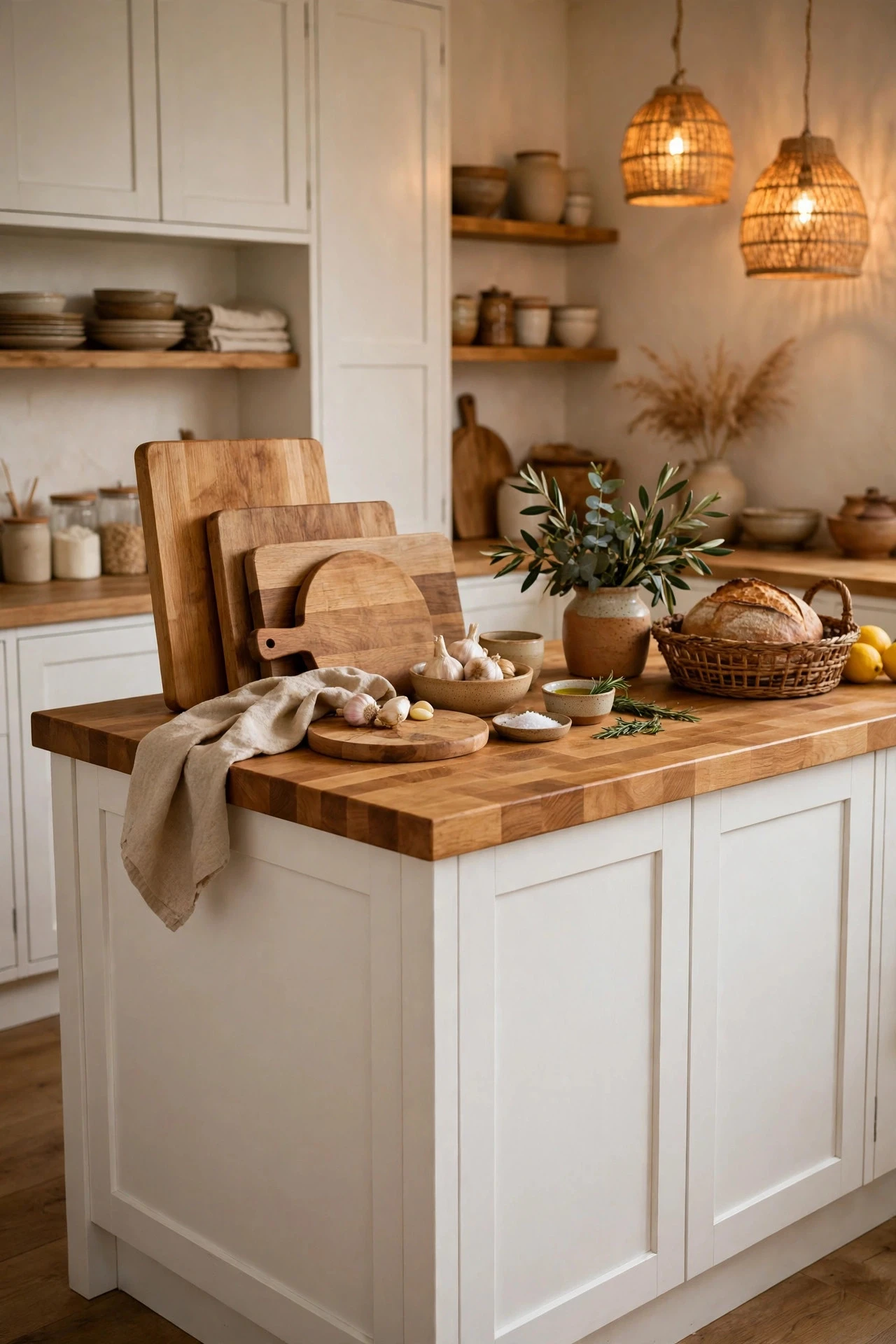
Butcher block warms up a white kitchen by adding a large, honey-toned wooden surface at worktop height, where the eye lands every time you enter the room. A butcher-block island top or a single run of wooden worktop breaks the white-on-white plane and makes the kitchen feel handmade rather than manufactured.
Maple butcher block is pale and calm, walnut is rich and dramatic, and oak sits in between — choose the tone that matches your floor, not your cabinets. A butcher-block island top costs $40 to $80 per square foot, needs oiling every month for the first year and every three months after, and should never sit beside the sink unless you are happy to oil it often. Use it on the island or the baking station, keep stone beside the hob and sink, and the wood becomes a feature instead of a maintenance burden. These 22 kitchen island decor ideas for a stylish functional kitchen show how an island top sets the tone for the whole room.
9. What Backsplash Looks Best with White Cabinets?
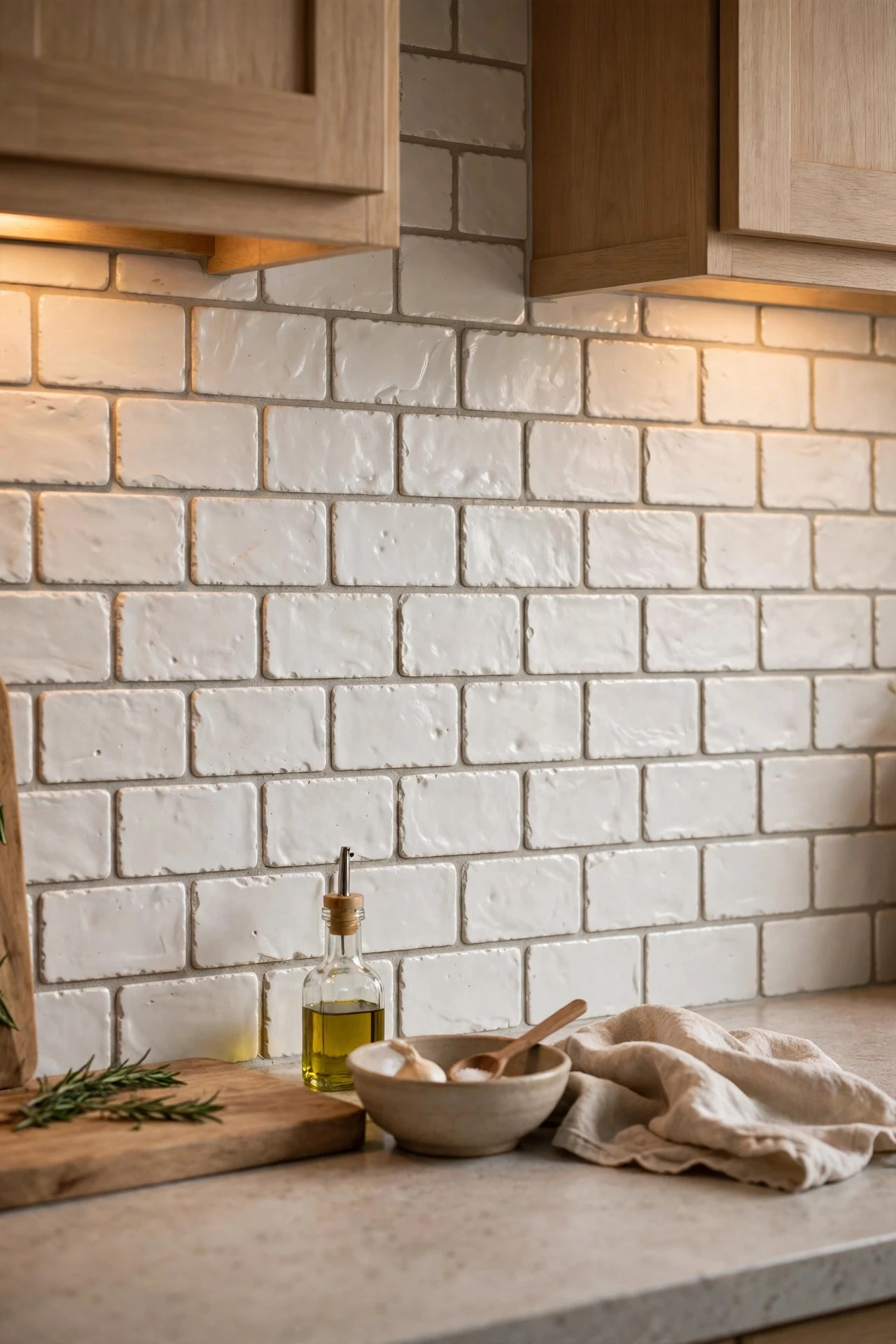
The best backsplash for white cabinets is a handmade-look subway tile in a soft white or pale cream, laid in a brick pattern with a light grey grout, because its slight variation and visible texture stop a white kitchen from looking flat. It costs $8 to $20 per square foot and suits almost every white kitchen.
If you want more pattern, try zellige tiles, whose glazed, uneven surface catches the light differently on every tile, or a marble mosaic behind the hob as a single feature panel. Keep the grout close to the tile colour — bright white grout yellows, dark grout draws a grid over the wall — and run the tile to the underside of the wall cabinets for a finished look. Avoid a busy patterned tile across the whole wall; pattern belongs on one feature strip, with plain tile everywhere else, so the kitchen stays calm.
10. How Do You Choose Hardware for White Cabinets?
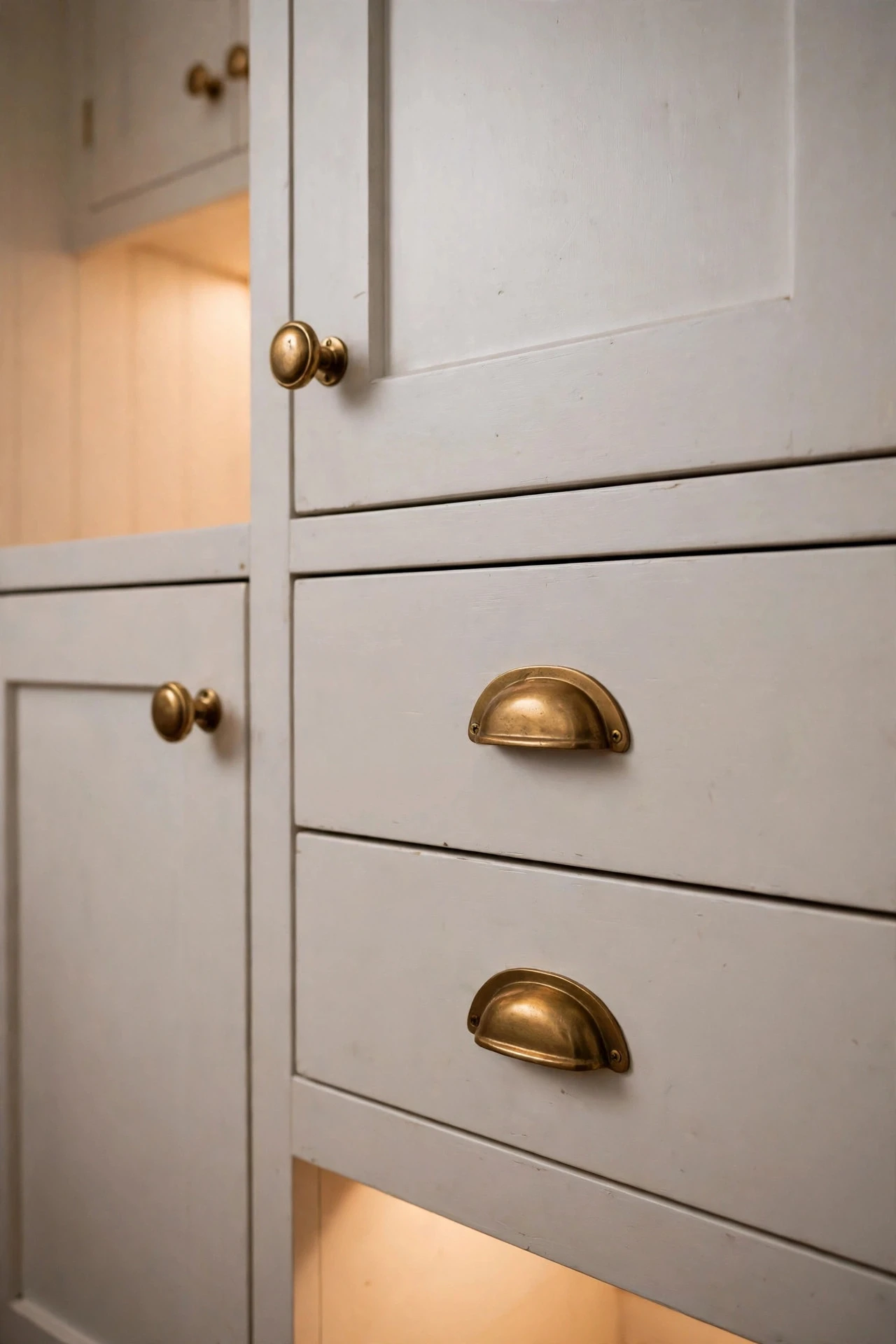
Choose hardware for white cabinets by picking one metal, one finish and one style, then using it consistently across every door and drawer. Mixed metals look collected only when they are deliberate; random mixing looks like a hardware-shop clearance, so decide the story before you buy a single knob.
Knobs suit doors, cup pulls suit drawers, and bar pulls suit both — a common recipe is knobs on the uppers, cup pulls on the lower drawers and bar pulls on the tall pantry doors. Size matters: a 96 mm pull suits a standard drawer, a 128 or 160 mm pull suits a wide drawer, and a tiny knob on a wide drawer looks lost. Buy one of each style first, hold it against a cabinet door in your own light, and check that the finish matches your tap and lighting before ordering the full set.
11. Is Brass Hardware the Best Match for a White Kitchen?
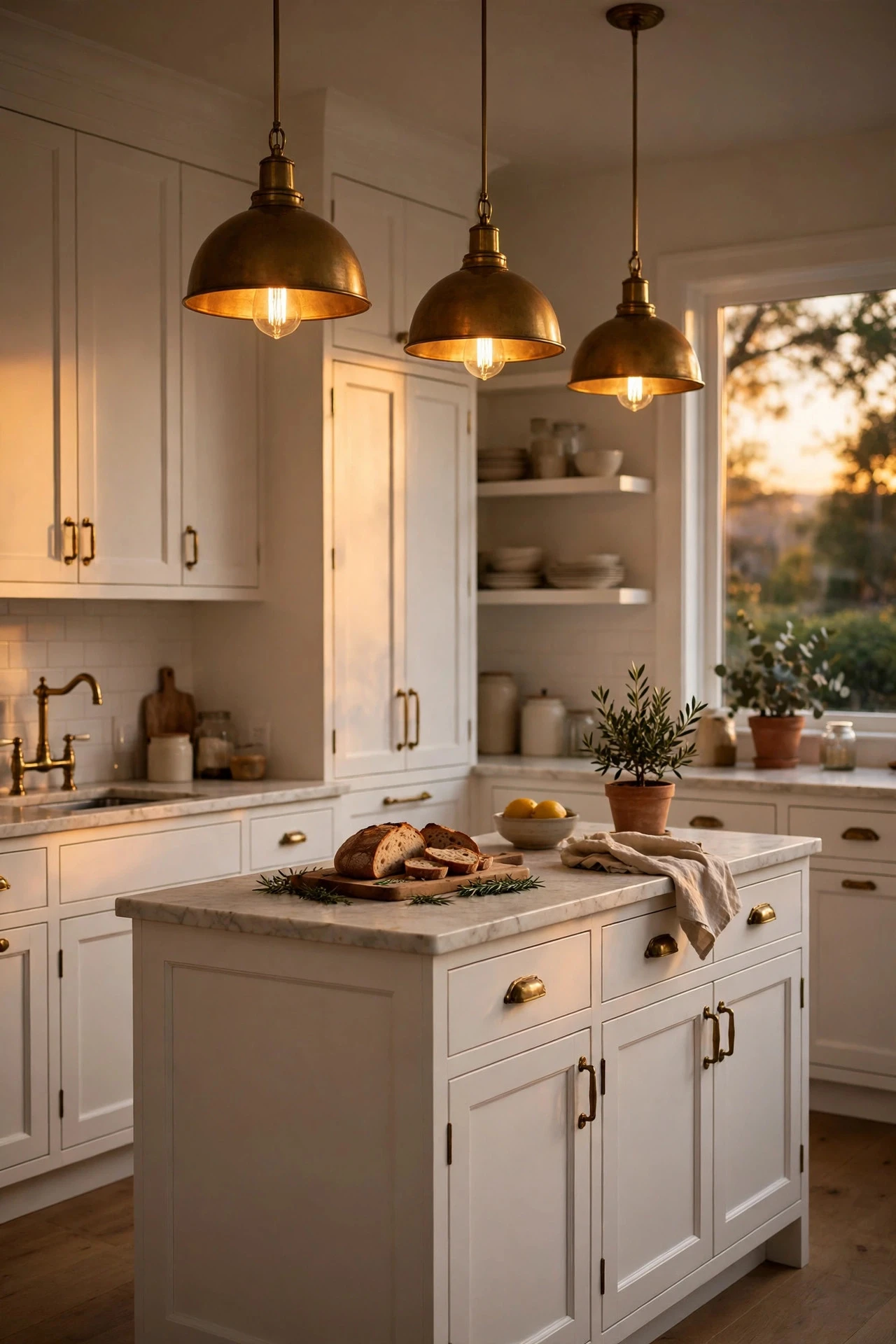
Brass hardware is the best match for a white kitchen when you want warmth, because its golden tone is the warmest metal you can put against white cabinets. Unlacquered brass ages into a soft patina, polished brass stays bright and formal, and satin brass sits in between — all three glow against white.
Use brass on the cabinet handles, repeat it on the tap or the pendant lights, and the kitchen gains a jewellery-like layer that white alone cannot provide. Brass pairs best with warm white cabinets, oak floors and marble worktops; against cool white cabinets it can look yellow, so test a sample first. Budget $8 to $25 per handle for good-quality solid brass, and avoid hollow, lightweight imitations — they feel cheap every time you open a drawer, and handles are touched dozens of times a day.
12. When Does Matte Black Hardware Work in a White Kitchen?

Matte black hardware works in a white kitchen when you want strong contrast and a modern edge, because black handles draw a crisp line across white cabinets and define each door and drawer. It suits slab cabinets, dark worktops and black-framed windows, where the black repeats rather than appearing once.
Use matte black sparingly if your kitchen is small — black on every door can look busy, so many designers use black on the island only and brass or chrome on the perimeter cabinets. Black shows dust and water spots less than chrome but more than brass, and it pairs well with a black tap and black pendant lights for a coherent story. Avoid shiny black plastic handles; powder-coated metal feels solid and keeps its finish, while cheap black paint chips at the edges within a year.
13. How Do You Style Open Shelving in a White Kitchen?
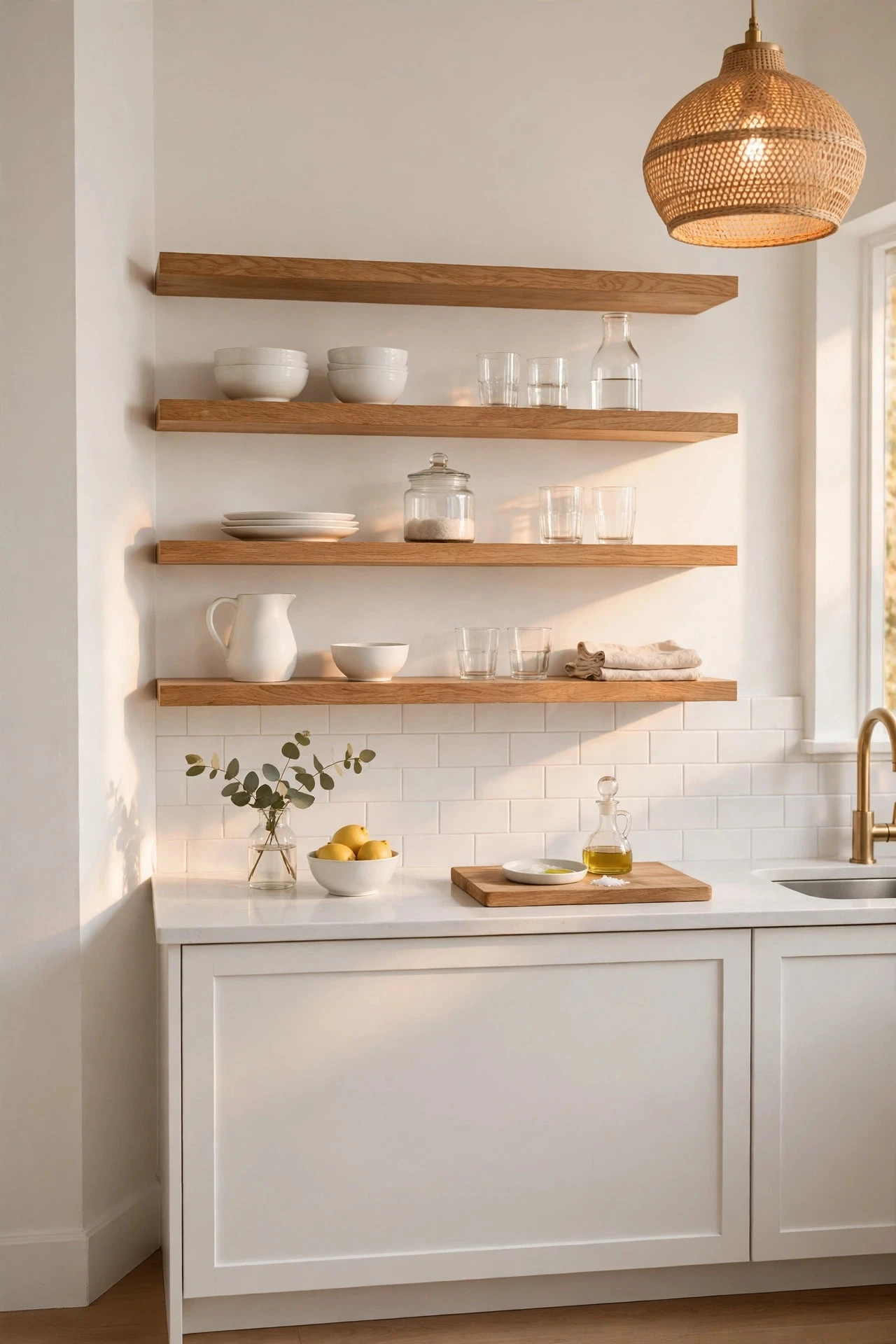
Style open shelving in a white kitchen by keeping it to one or two runs, editing ruthlessly, and repeating one colour across the shelves so the display looks curated, not cluttered. Open shelves work because they break up a wall of white cabinets — but only if what sits on them earns its place.
Use white or cream ceramics, clear glass and one wooden element per shelf, and leave at least a third of each shelf empty so the pieces can breathe. Stack plates vertically, group glasses in threes, and keep everyday items at arm height and display pieces above. Dust is the honest cost of open shelving: choose pieces you use weekly, so they are washed before dust settles, and keep the shelves near the hob closed, because cooking grease coats open shelves fast. These kitchen open shelving ideas for styling shelves that look curated show the editing rules that keep open shelves beautiful instead of busy.
14. What Lighting Keeps a White Kitchen Bright Without Glare?

White kitchens stay bright without glare when lighting comes in three warm layers: under-cabinet strips for the worktop, pendants over the island for atmosphere, and dimmable ceiling lights for general fill. One overhead light alone flattens white and throws shadows; three layers at 2700K to 3000K make it glow.
Fit LED under-cabinet strips at the front edge of the wall cabinets, so the light falls on the worktop and not on your eyes, and choose a colour rendering index above 90 so food and wood look true. Hang island pendants 75 to 90 cm above the worktop, spaced 60 to 75 cm apart, and put every layer on its own dimmer — the kitchen needs full brightness for cooking and half brightness for dinner. Avoid cool-white 4000K bulbs in a white kitchen; they turn warm white cabinets blue-grey and make the room feel like an office.
15. What Flooring Pairs Best with a White Kitchen?
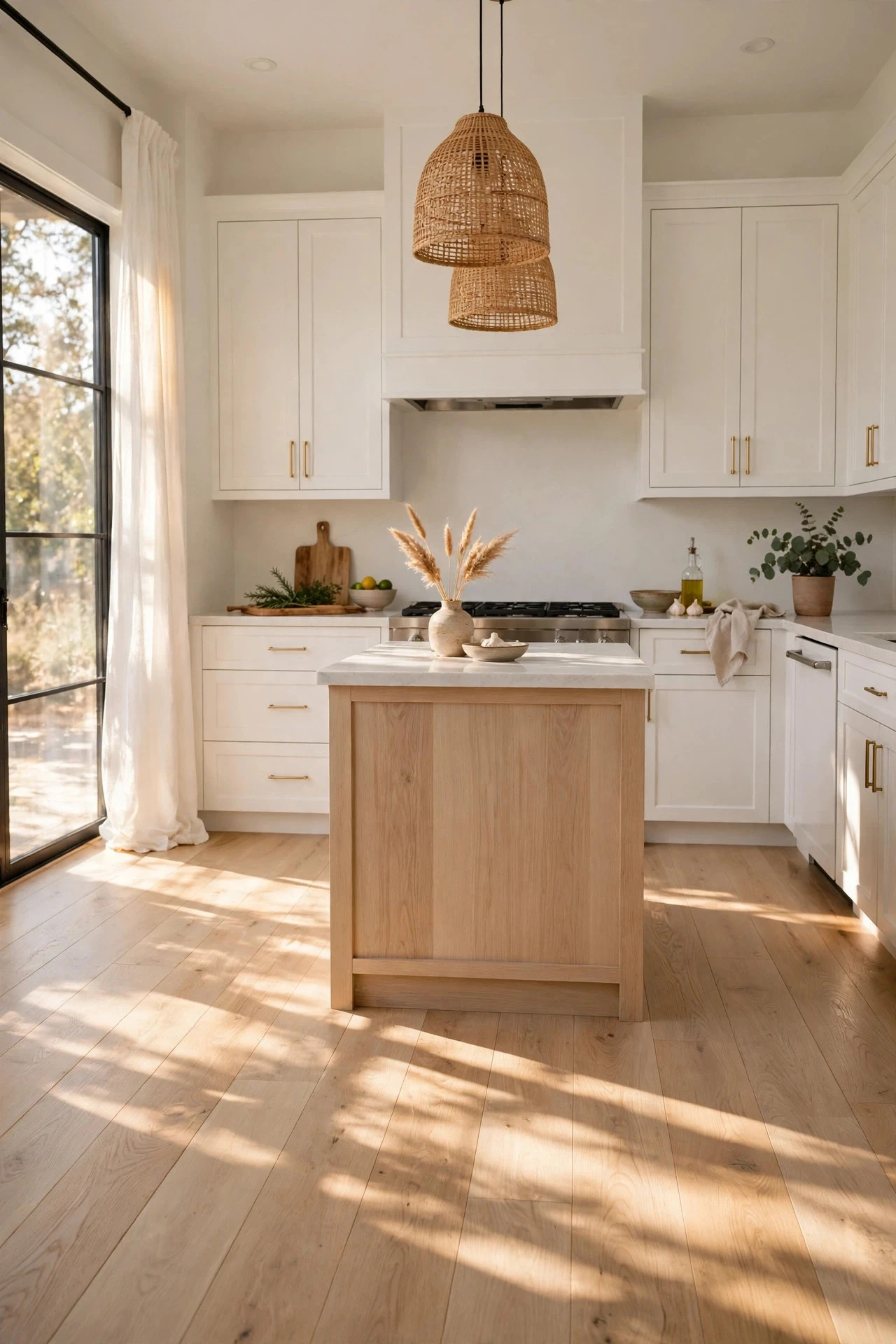
The best flooring for a white kitchen is pale oak or a warm wood-look tile, because a light wooden floor adds warmth underfoot without darkening the room. Wide-plank oak, 150 to 200 mm wide, costs $8 to $15 per square foot installed and makes a white kitchen feel calm, Scandinavian and timeless.
If you prefer tile, choose a large-format porcelain in a warm stone or wood effect, with grout matched to the tile so the floor reads as one surface. Avoid brilliant white tile floors with white cabinets — the room becomes a single white box with no anchor — and avoid very dark floors unless you want a high-contrast, dramatic kitchen. A pale floor also hides crumbs and dust better than a dark one, which matters in a kitchen that is used three times a day. Run the flooring in one direction through the kitchen and into the next room, so the space feels larger.
16. How Do You Add Wood Warmth to a White Kitchen?

Add wood warmth to a white kitchen by introducing timber in at least two places at different heights — for example, oak open shelves up high and a walnut island top or wooden bar stools down low. One wooden element looks like an accident; two look like a decision, and the eye connects them across the room.
Choose one wood tone and stay close to it: pale oak shelves with a pale oak floor, or walnut stools with a walnut chopping board and a walnut-framed mirror. Keep the wood's finish consistent too — all matte, or all oiled — because mixed gloss levels read as mixed intentions. Even small touches count: a wooden utensil holder, a bread board leaning against the backsplash, a timber tray on the island. These 22 small kitchen storage ideas that make every inch work show how wooden accessories can double as storage while they warm the room.
17. What Colour Accents Work Best in a White Kitchen?
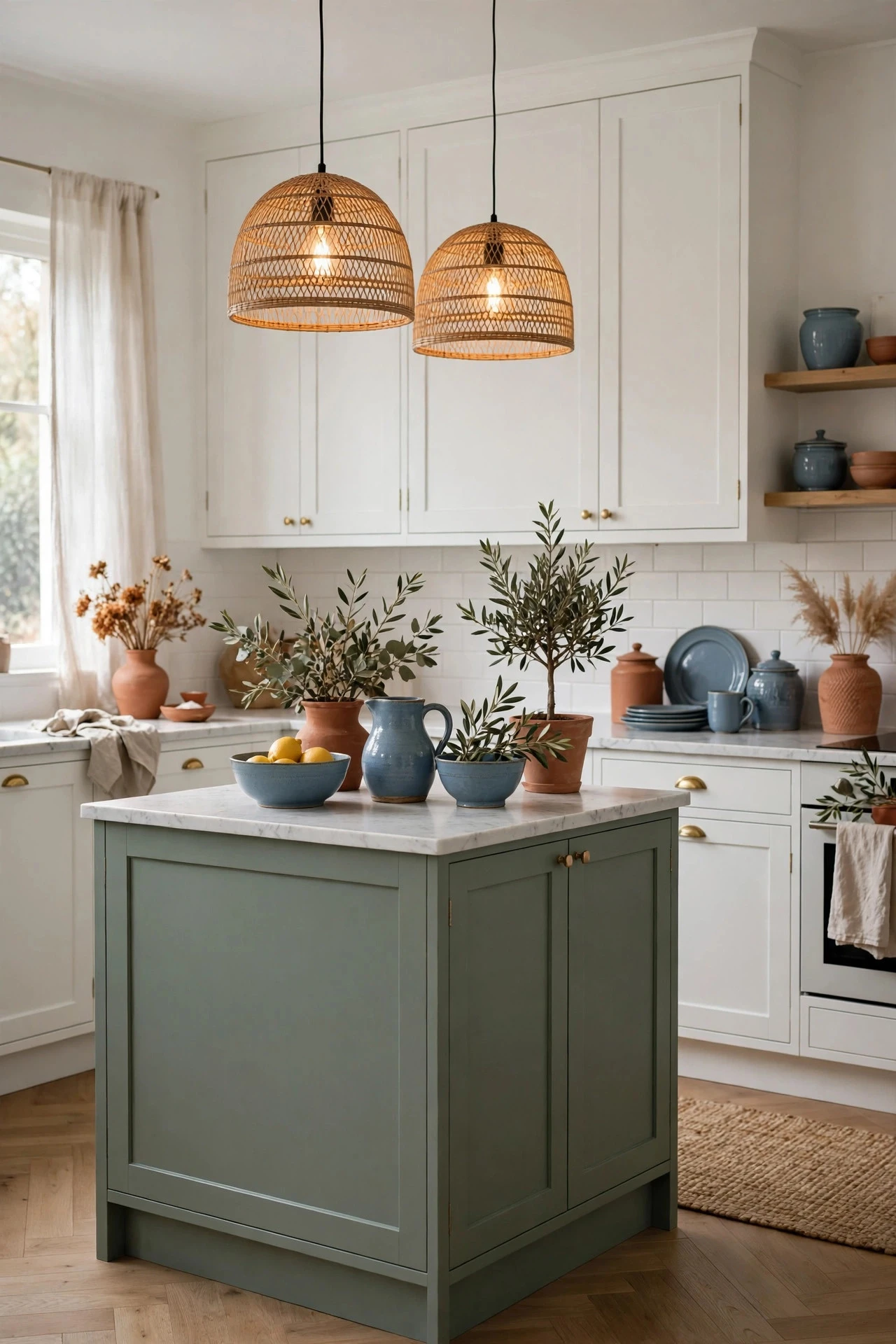
The best colour accents for a white kitchen are soft, nature-inspired tones used in small doses: sage green, dusty blue, warm terracotta and soft blush. One accent colour, repeated in three places — a painted island, a row of ceramics, a set of bar stools — gives white a personality without breaking its calm.
Sage green suits a farmhouse or country white kitchen, dusty blue suits a coastal one, and terracotta suits a Mediterranean one. Keep the accent to about ten percent of the room, because white should stay the dominant colour; a coloured island with white perimeter cabinets is the classic ratio. Avoid using three or four accent colours at once, and avoid neon or very saturated colours in a white kitchen — they shout against white, while muted tones whisper. Change the accent with the seasons through tea towels, flowers and ceramics, so the kitchen evolves without a repaint.
18. How Do You Design a White Kitchen Island That Stands Out?

Design a white kitchen island that stands out by giving it one feature the perimeter cabinets do not have: a contrasting worktop, a painted base, a furniture-style plinth or a statement pendant above it. The island is the kitchen's centrepiece, so it should read as a piece of furniture, not as more of the same cabinets.
A navy, sage or charcoal island base against white perimeter cabinets is the most popular choice, and it lets you introduce colour without committing the whole kitchen to it. Alternatively, keep the island white but give it a butcher-block or marble worktop, turned legs, or a panelled end that echoes a farmhouse table. Leave 90 to 110 cm of clear walkway around the island, and seat stools 60 cm apart so nobody elbows their neighbour. These 22 dream house decor ideas for a home that feels like you show how one confident piece can anchor a whole room, and the island is that piece in a kitchen.
19. How Do You Make a Small White Kitchen Feel Bigger?
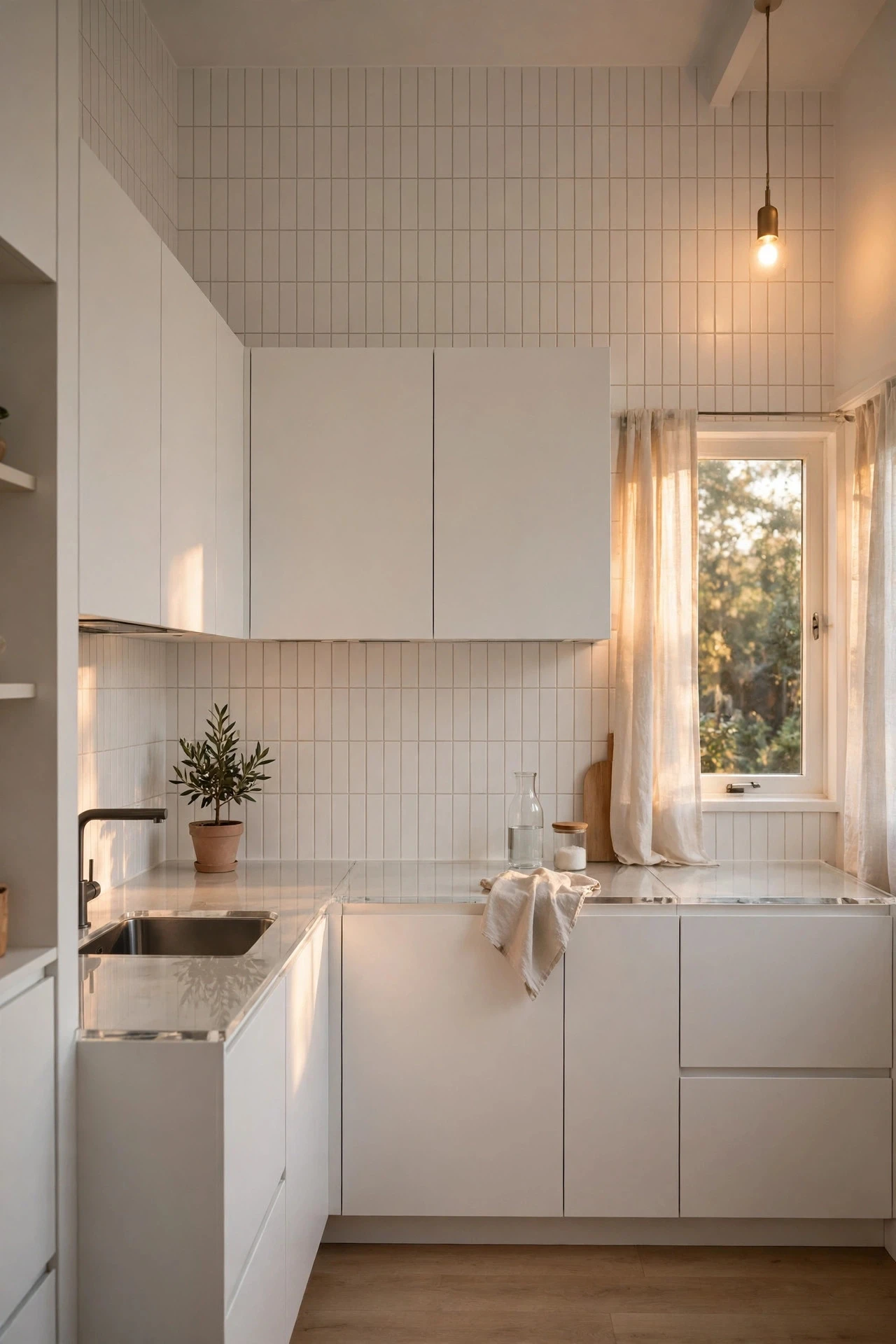
Make a small white kitchen feel bigger by using the same white on the cabinets, walls and ceiling, running the backsplash to the ceiling, and choosing handleless or slim-profile cabinets that reflect light. A single continuous white surface removes visual breaks, so the eye travels further and the room reads larger.
Add a large mirror or a glass-fronted cabinet on one wall, keep the worktops clear except for one or two beautiful objects, and use a light, reflective worktop rather than a dark one. Open shelving on one wall instead of wall cabinets opens the sightline, but keep it to one run so storage does not suffer. Choose a slim pendant or a flush ceiling light rather than a bulky fitting, and paint the skirting boards the same white as the walls so the floor looks wider. The trick is subtraction: every object you remove from a small white kitchen makes it feel a foot wider.
20. How Do You Keep White Cabinets and Worktops Clean?
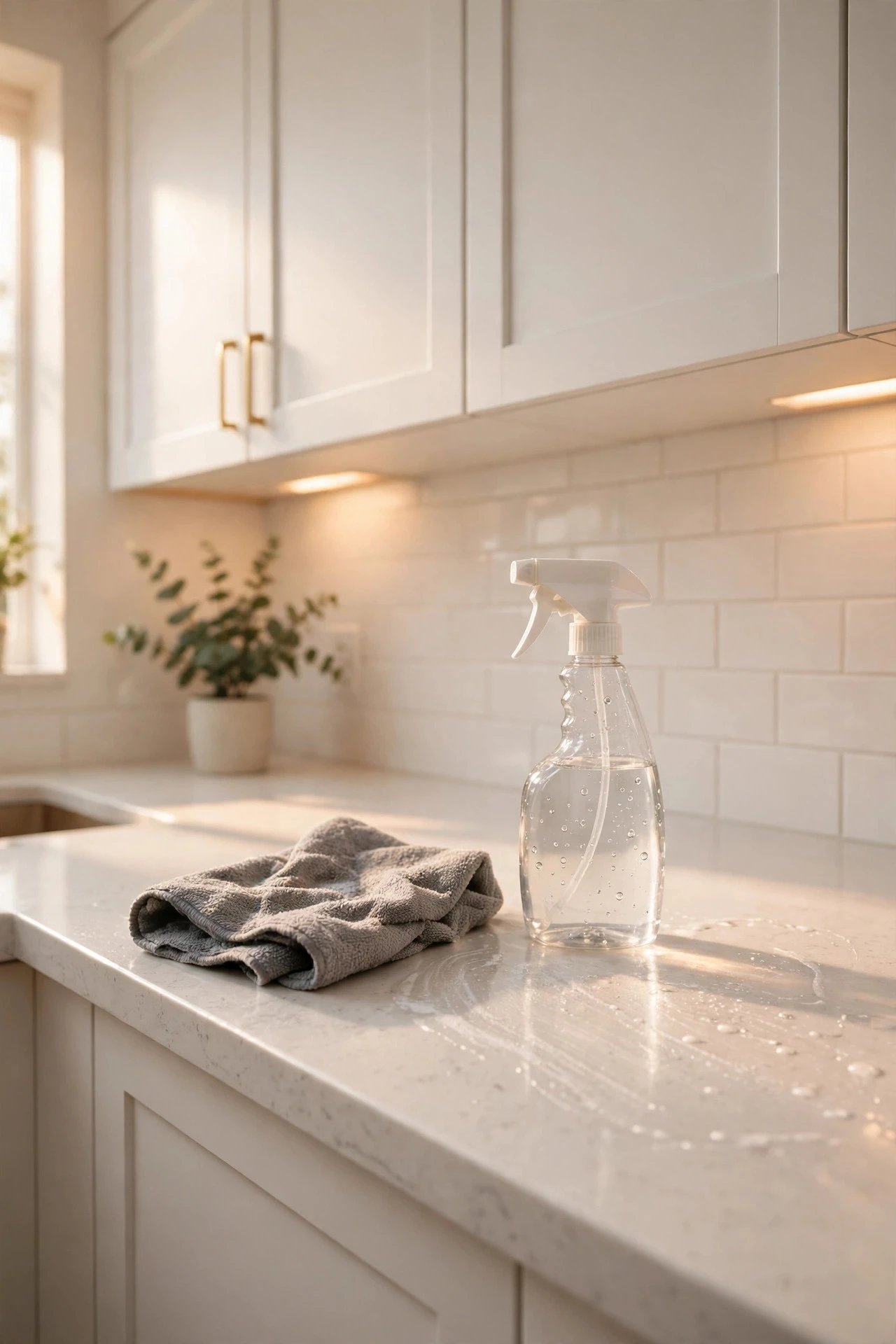
Keep white cabinets and worktops clean with a simple daily habit: wipe the worktops after every meal, wipe cabinet fronts weekly, and deal with spills the moment they happen. White shows marks honestly, which is a gift — you see the mess and clean it before it sets, instead of discovering it months later.
Use warm water with a drop of washing-up liquid for daily cleaning, and a paste of bicarbonate of soda for stubborn marks on worktops — never bleach on quartz, and never abrasive pads on lacquered cabinets. Keep a microfibre cloth under the sink and a small spray bottle of diluted white vinegar for the hob area, and wipe handles weekly, because greasy handles yellow white paint around them. Choose a washable, scrubbable paint for the cabinets and a stain-resistant worktop from the start, and cleaning becomes a two-minute job rather than a weekend project.
21. How Much Does a White Kitchen Cost to Refresh?

A white kitchen refresh costs $1,500 to $3,000 when you repaint the cabinets, replace the hardware and update the lighting, and $12,000 to $25,000 for a full new kitchen with white cabinets. The refresh is the best value in home decor, because paint and handles change the whole room for a fraction of a replacement.
Repainting professionally costs $3,000 to $6,000 for a medium kitchen, while careful DIY painting with a cabinet-grade paint costs $300 to $600 in materials. New handles cost $200 to $600 for a whole kitchen, under-cabinet LED strips cost $100 to $300, and a new tap costs $150 to $400. Spend the most on the paint and the preparation — sanding, priming and two top coats — because cheap paint on white cabinets yellows within a year. Get three quotes for any professional work, and ask to see a kitchen the painter finished two years ago, not two weeks ago.
22. How Do You Make a White Kitchen Feel Timeless, Not Trendy?
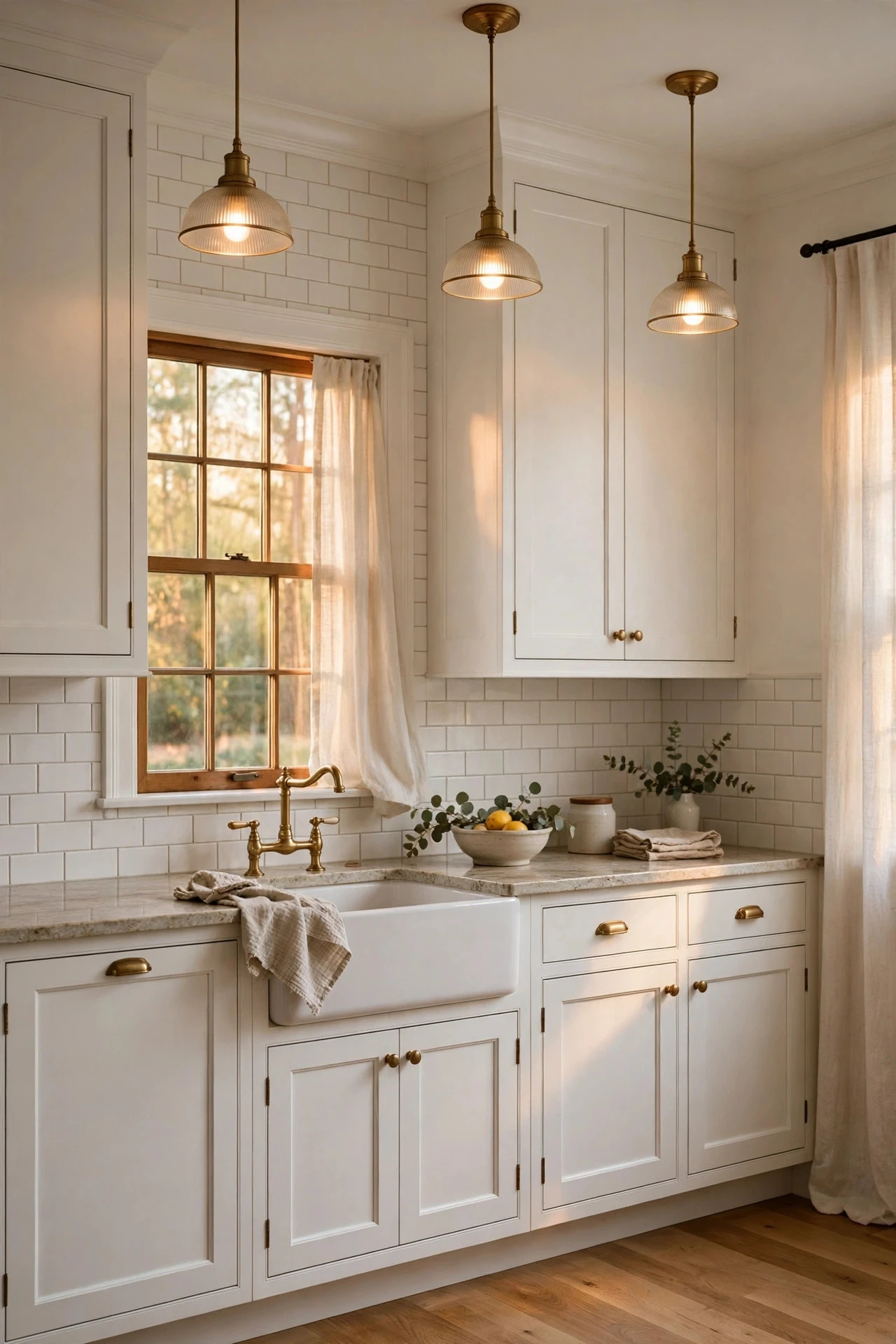
Make a white kitchen feel timeless by choosing classic shapes — Shaker cabinets, subway tile, a simple stone worktop — and letting trends live in the things you can change cheaply, like bar stools, pendant lights and ceramics. The bones of the kitchen should be boring in the best sense: proven, quiet and built to last twenty years.
Avoid trend-driven cabinet colours, ornate handles, patterned worktops and statement tiles across the whole wall, because each one dates the kitchen to the year it was installed. Invest in quality hinges, soft-close drawers and a solid worktop, and keep the layout simple: a clear triangle between hob, sink and fridge, generous worktop beside the hob, and storage where you actually use it. A timeless white kitchen is not the one with the most ideas in it — it is the one where every choice still looks right a decade later.
Practical Tips
Choose the white first and everything else second, because the cabinet colour decides the worktop, the floor and the hardware. Test three swatches on a real cabinet door for three days, in morning, afternoon and evening light, and check each swatch against your worktop and floor samples before ordering anything. A white that looks perfect in the shop can turn grey in a north-facing kitchen, and repainting a whole kitchen costs ten times more than a sample pot.
Clean little and often rather than in big deep cleans: wipe worktops after every meal, wipe cabinet fronts weekly, and keep a microfibre cloth and a spray bottle under the sink so the habit is easy. Budget in this order — paint and preparation first, hardware second, lighting third, accessories last — because the first three change the room and the last one only decorates it. Finally, photograph the finished kitchen in daylight and at night, so you can see whether the white still glows after dark or needs a warmer bulb.
Final Thoughts
A white kitchen that stays bright, warm and timeless is not an accident — it is a warm white, a mix of matte and natural textures, one wooden element, one warm metal and three layers of warm light, chosen once and chosen well. Keep the bones classic, let the trends live in the accessories, and clean little and often, and your white kitchen will still feel fresh, welcoming and entirely yours in ten years' time.
Frequently Asked Questions
What is the best white paint colour for kitchen cabinets?
The best white paint colour for kitchen cabinets is a warm white with a soft yellow or cream undertone, such as White Dove or Wimborne White, because it glows in real daylight and lamplight instead of turning blue-grey. Test three swatches on a cabinet door for three days and check each one against your worktop and floor before committing.
Do white kitchens show dirt more than other kitchens?
White kitchens show dirt more than dark kitchens, but only because the marks are visible, which means they get cleaned before they set. Wipe worktops after every meal, wipe cabinet fronts weekly with warm water and washing-up liquid, and deal with spills immediately. A washable cabinet paint and a stain-resistant quartz worktop make the habit a two-minute job.
Are white kitchens still in style?
White kitchens are still in style because white is a classic, not a trend, and it suits every house style from cottage to contemporary. The kitchens that date are the ones with trend-driven details — ornate handles, patterned worktops or statement tiles — while Shaker cabinets, subway tile and a simple stone worktop still look right after ten years.
What worktop goes best with white kitchen cabinets?
Quartz goes best with white kitchen cabinets for most households, because it looks like marble without the staining, sealing and etching, and it costs $60 to $100 per square foot installed. Match its undertone to your cabinets — warm quartz over warm white, crisp white quartz over cool white — and keep the edge simple for a timeless finish.
How do I stop my white kitchen looking cold?
Stop a white kitchen looking cold by layering wood, a warm metal and a textured fabric into the room: oak shelves or a butcher-block island top, brass handles or a brass tap, and woven bar stools or linen tea towels. Light the room in warm 2700K to 3000K layers, and use a warm white paint rather than a brilliant white.
Is a white kitchen hard to keep clean with children?
A white kitchen is not hard to keep clean with children if you choose the right finishes: matte cabinets that hide fingerprints, a quartz worktop that resists stains, and washable, scrubbable paint. Wipe the most-touched cabinet fronts daily with a damp microfibre cloth, keep handles clean, and store art supplies and messy crafts away from the worktop.