22 Modern Kitchen Ideas for a Clean, Bright, Hard-Working Space
# 22 Modern Kitchen Ideas for a Clean, Bright, Hard-Working Space
Modern kitchens have a reputation problem. Too many of them look like showrooms — glossy, cold, and slightly afraid of being cooked in. The best modern kitchens of 2026 keep the clean lines and clever storage that define the style, then warm them up with timber, texture, layered light, and colour that actually feels like home. This guide is built for real kitchens: family breakfasts, weeknight cooking, coffee at the island, and homework spread across the worktop.
Below you will find 22 modern kitchen ideas with honest budgets, real measurements, and the practical detail most gallery posts skip — how deep a drawer should be, how far apart pendants should hang, and which finishes survive daily life. Use one idea to refresh a tired kitchen, or combine several for a full modern makeover.
Looking for more inspiration? Our Nest Decorz homepage gathers the latest home decor ideas, seasonal decorating guides and room-by-room styling tips in one place — start there and explore.
Quick Answers
– Modern does not have to mean cold: warm whites, natural wood, and textured finishes keep clean lines feeling liveable. – Start with cabinets and worktops: handleless doors, a waterfall island, and a single-slab backsplash deliver the biggest visual change. – Layer your lighting: ceiling, task, and accent light together — never rely on one central fitting. – Hide the clutter: deep drawers, an appliance garage, and integrated appliances keep surfaces clear without extra cupboards. – Budget in tiers: a single idea can cost £150–£500, while a full modern refit typically runs £8,000–£25,000 depending on size and materials.
1. How Do Handleless Cabinets Make a Kitchen Look Modern?
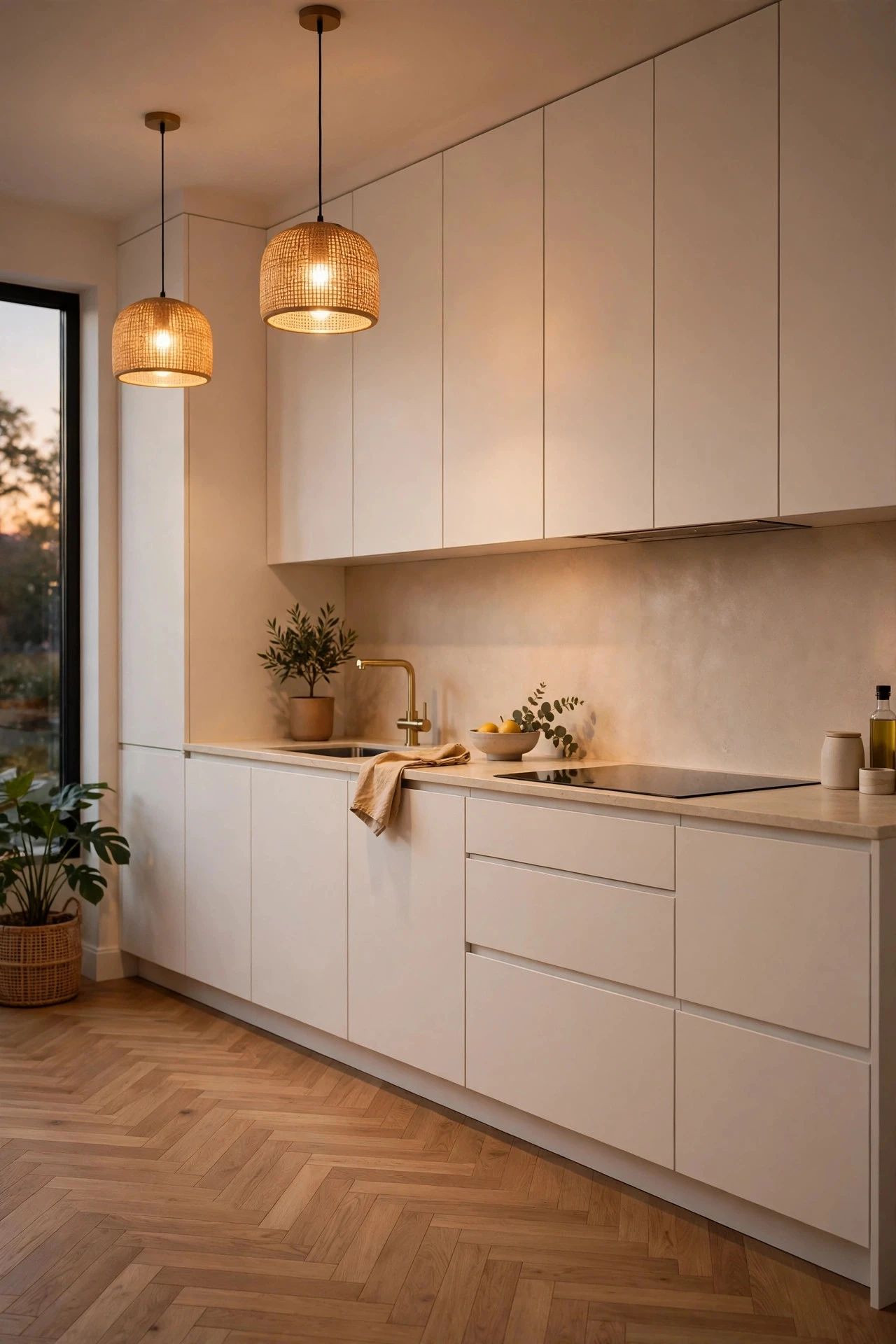
Handleless cabinets create the flat, uninterrupted planes that define modern kitchen design, because nothing breaks the line of the doors. Push-to-open mechanisms, recessed J-pull channels, and true handleless rails all work, but choose by household: push-to-open suits low-traffic kitchens, while a recessed channel is easier with wet or sticky hands. Budget £3,000–£8,000 for a mid-range run of handleless base and wall units, or £800–£1,500 to re-front existing carcasses. Keep the finish matte — gloss shows every fingerprint — and match the plinth and end panels to the doors so the run reads as one continuous surface. Wipe the recessed channels weekly, as dust and crumbs collect there faster than on a handled door. Avoid handleless doors on a fridge or dishwasher unless the mechanism is genuinely easy to grip, or daily use will frustrate you.
2. Can Two-Tone Cabinets Add Warmth Without Losing the Modern Look?
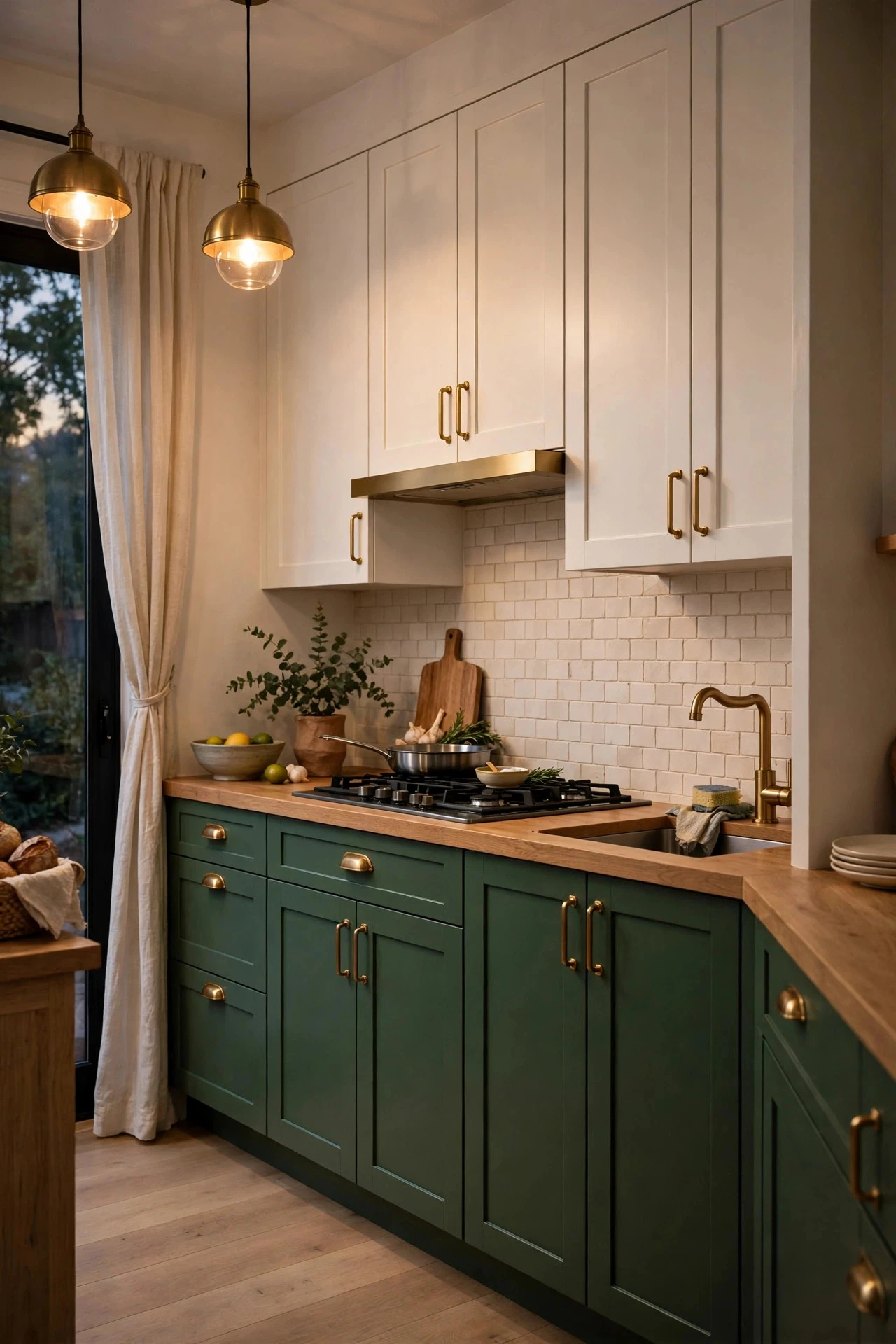
Two-tone cabinets add warmth and depth while keeping a modern kitchen disciplined, provided the split is deliberate. The most reliable formula is a darker tone below and a lighter tone above — deep green, navy, or charcoal base units with warm white wall units, for example. The contrast grounds the room and stops pale kitchens looking washed out. Keep worktops and flooring neutral so the two cabinet colours do the talking, and repeat one of the tones on the island or a tall larder unit to tie the scheme together. Budget £500–£2,000 extra over a single-colour kitchen for the second finish. For colour confidence before committing, read our guide to kitchen cabinet colour ideas and test large swatches in daylight and evening light.
3. What Makes Fluted Cabinet Fronts Feel Modern Rather Than Retro?
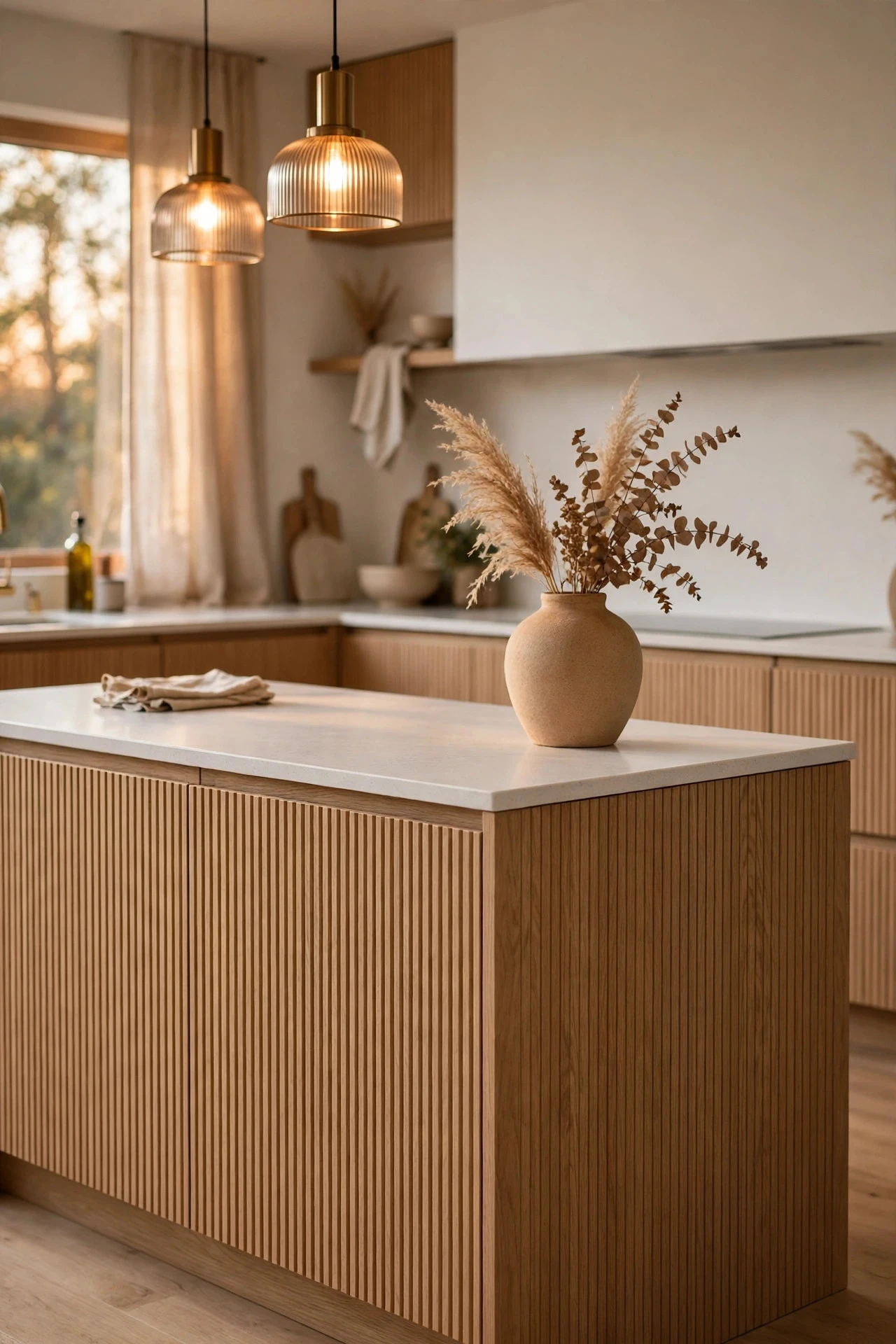
Fluted cabinet fronts feel modern when the reeding is slim, vertical, and used sparingly — a single island front, a tall pantry wall, or a drinks cabinet, not every door in the room. The narrow ribs catch light and add texture to flat modern surfaces, which is exactly why they work in kitchens that otherwise risk looking plain. Choose solid oak, walnut, or painted MDF with a fine 10–15 mm reed; wide, chunky fluting reads more traditional. Pair fluted fronts with smooth worktops and plain splashbacks so the texture stays the feature. Budget £1,200–£3,000 for a fluted island front, or £150–£400 for fluted panels on a small bar area. Avoid fluting near the hob, where grease settles into the grooves.
4. Why Is a Waterfall Island the Centrepiece of a Modern Kitchen?
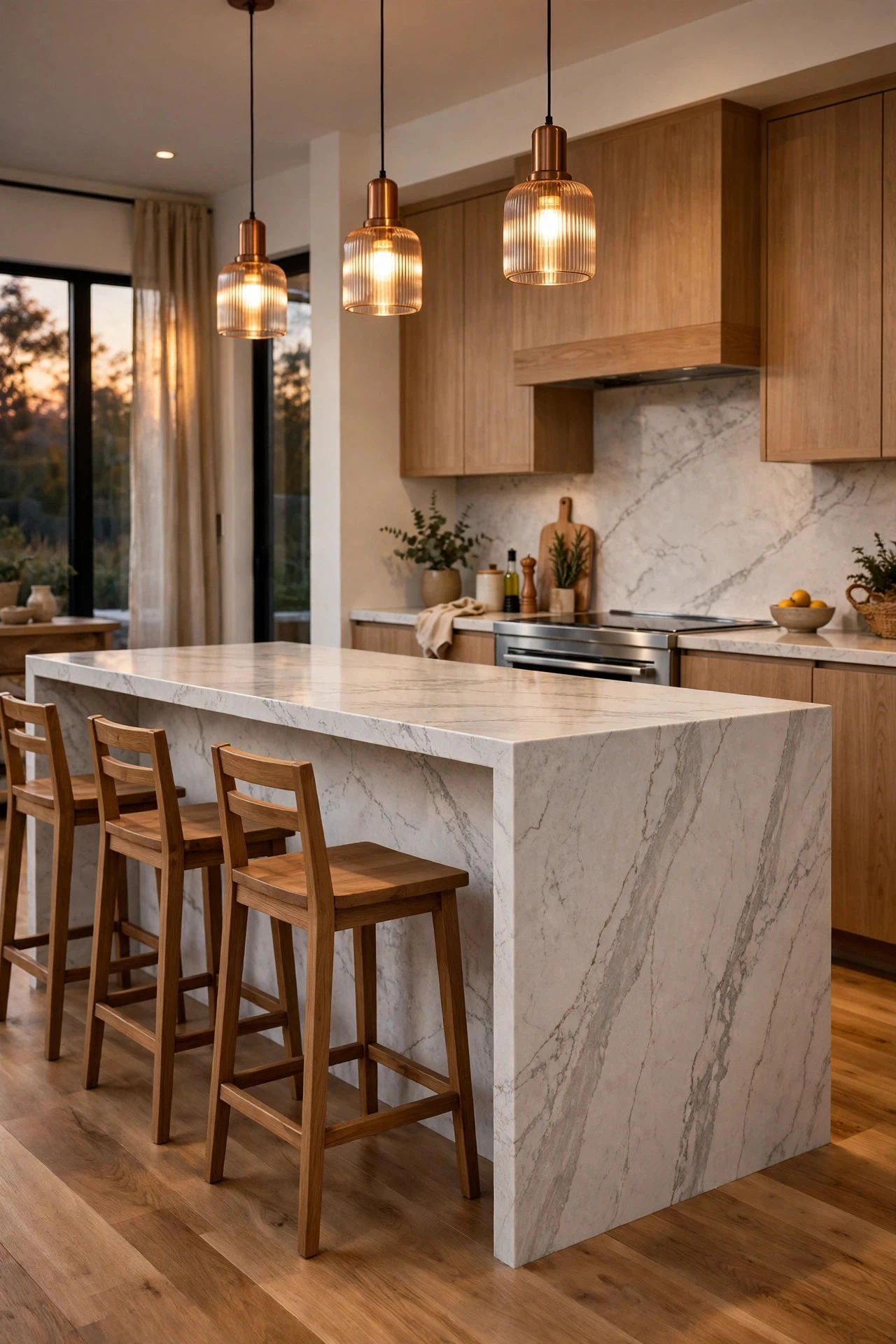
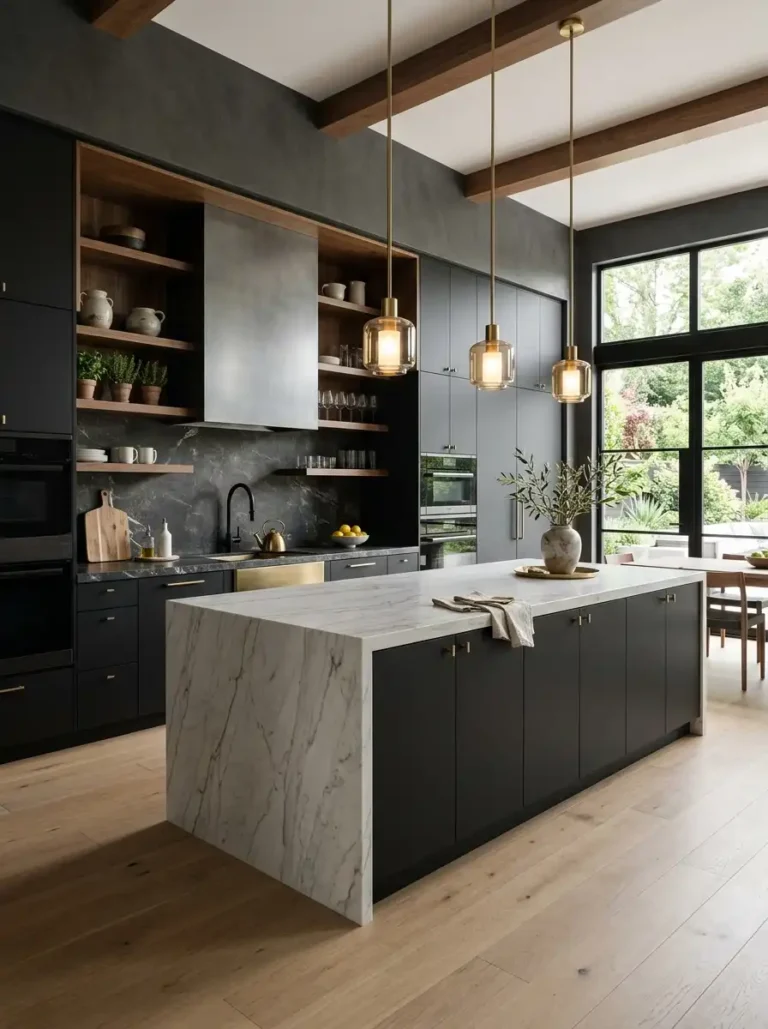
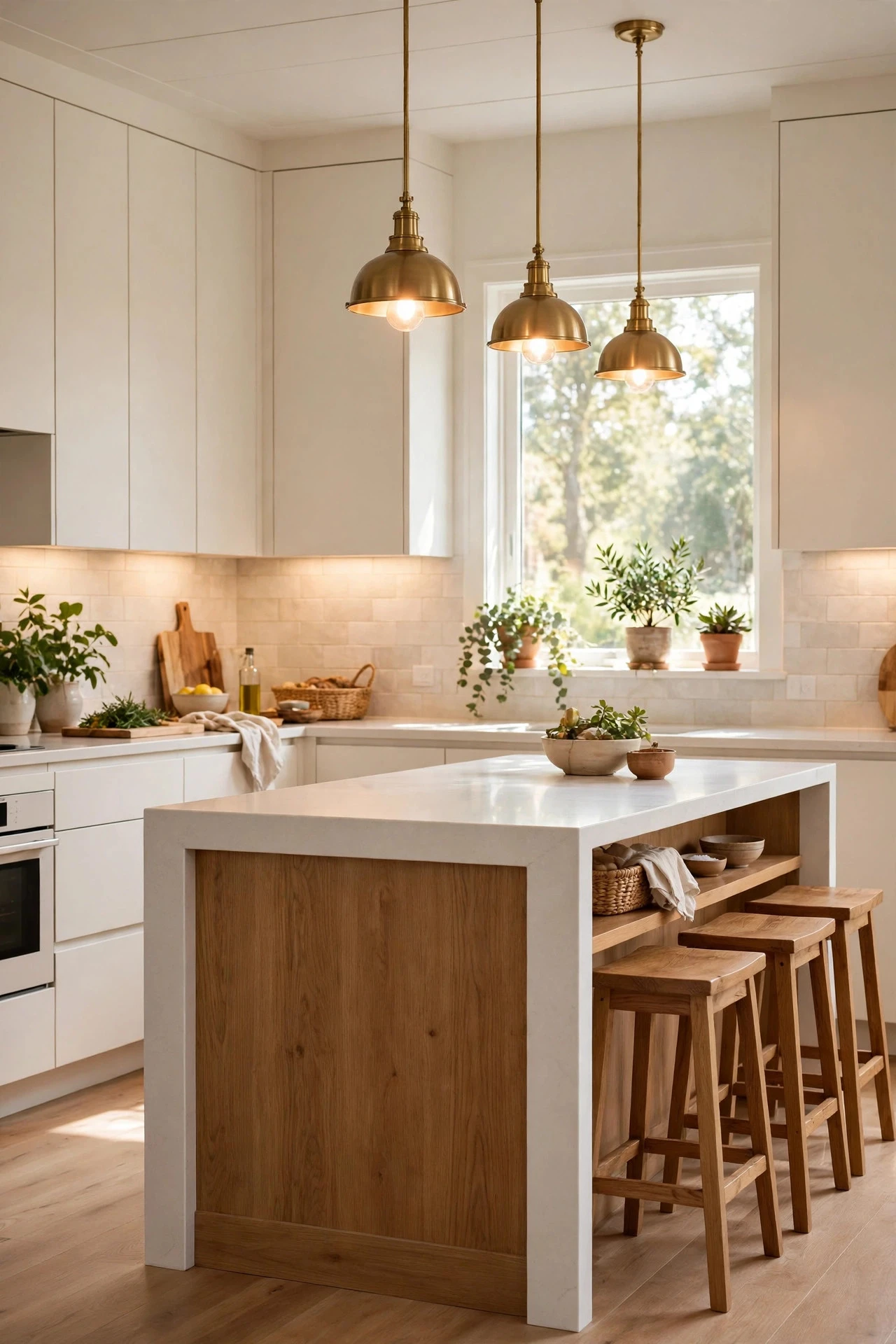
A waterfall island makes a modern kitchen feel designed rather than assembled, because the worktop material continues down both ends to the floor in one continuous slab. Quartz, porcelain, and sintered stone suit this best — they are hard-wearing, heat-resistant, and available in large slabs with convincing veining. Plan an island at least 2.4 m long and 90 cm deep for comfortable seating and prep space, with 30 cm of knee space at the seating side and 1 m of walkway around it. Budget £2,500–£6,000 for a quartz waterfall island, depending on stone and size. Keep the island base simple — handleless doors or plain panels — so the stone remains the star, and choose a waterfall edge only where it will not be kicked daily.
5. How Does a Single-Slab Backsplash Change a Kitchen?
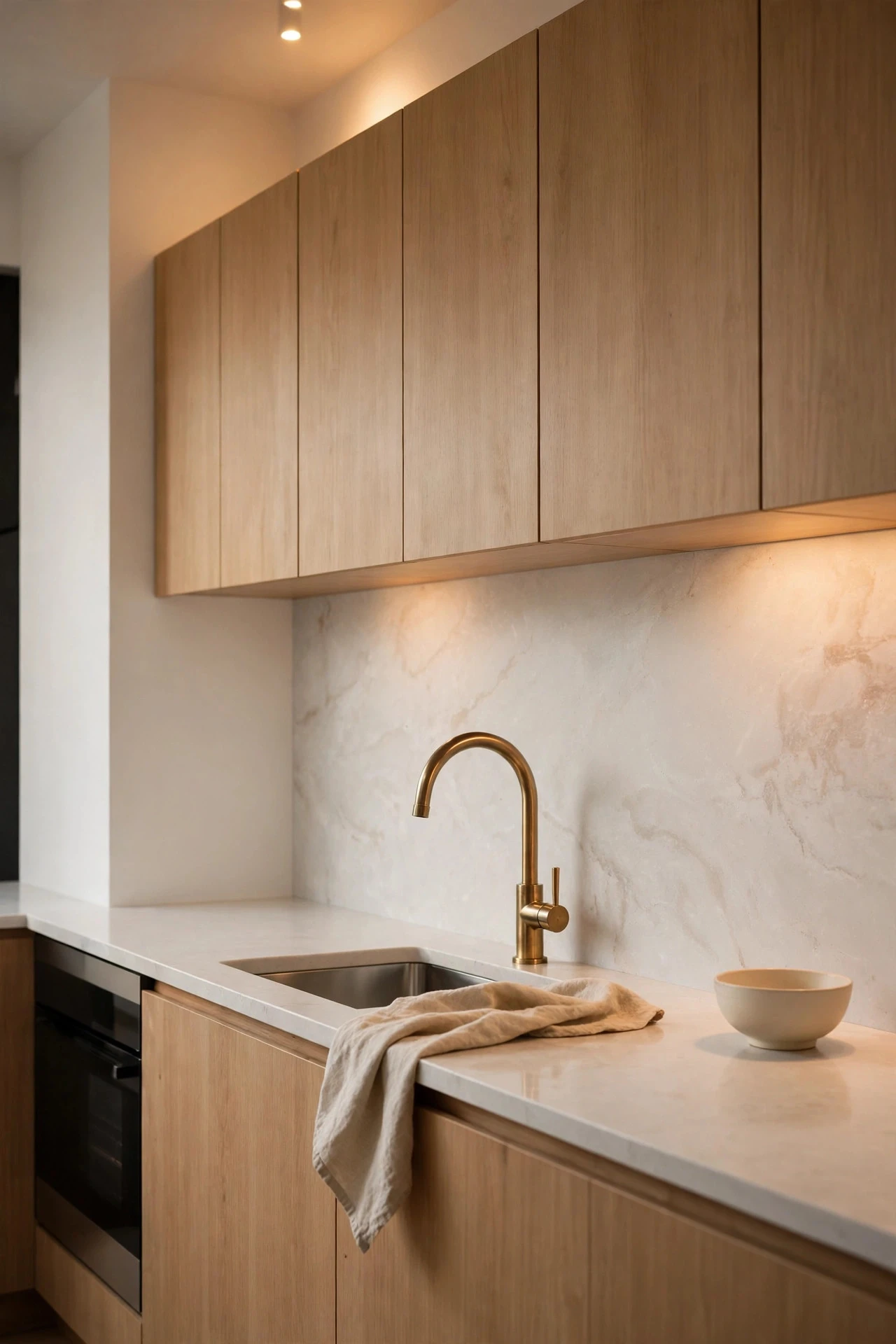
A single-slab backsplash changes a kitchen by removing grout lines and visual clutter in one move, creating a calm, continuous surface from worktop to wall units. Use the same quartz, porcelain, or marble-look slab as the worktop for a seamless effect, or choose a contrasting stone for a deliberate statement. This works best behind the hob and sink, where a wipe-clean surface matters most. Budget £800–£2,500 for a full-height slab behind a standard run, including templating and fitting. Measure carefully around sockets, extractor hoods, and window reveals before ordering — slabs cannot be trimmed on site as easily as tiles. For more splashback options and cleaning advice, explore our kitchen backsplash ideas before you choose between slab, tile, and glass.
6. Which Warm White Paint Keeps a Modern Kitchen Bright but Not Stark?
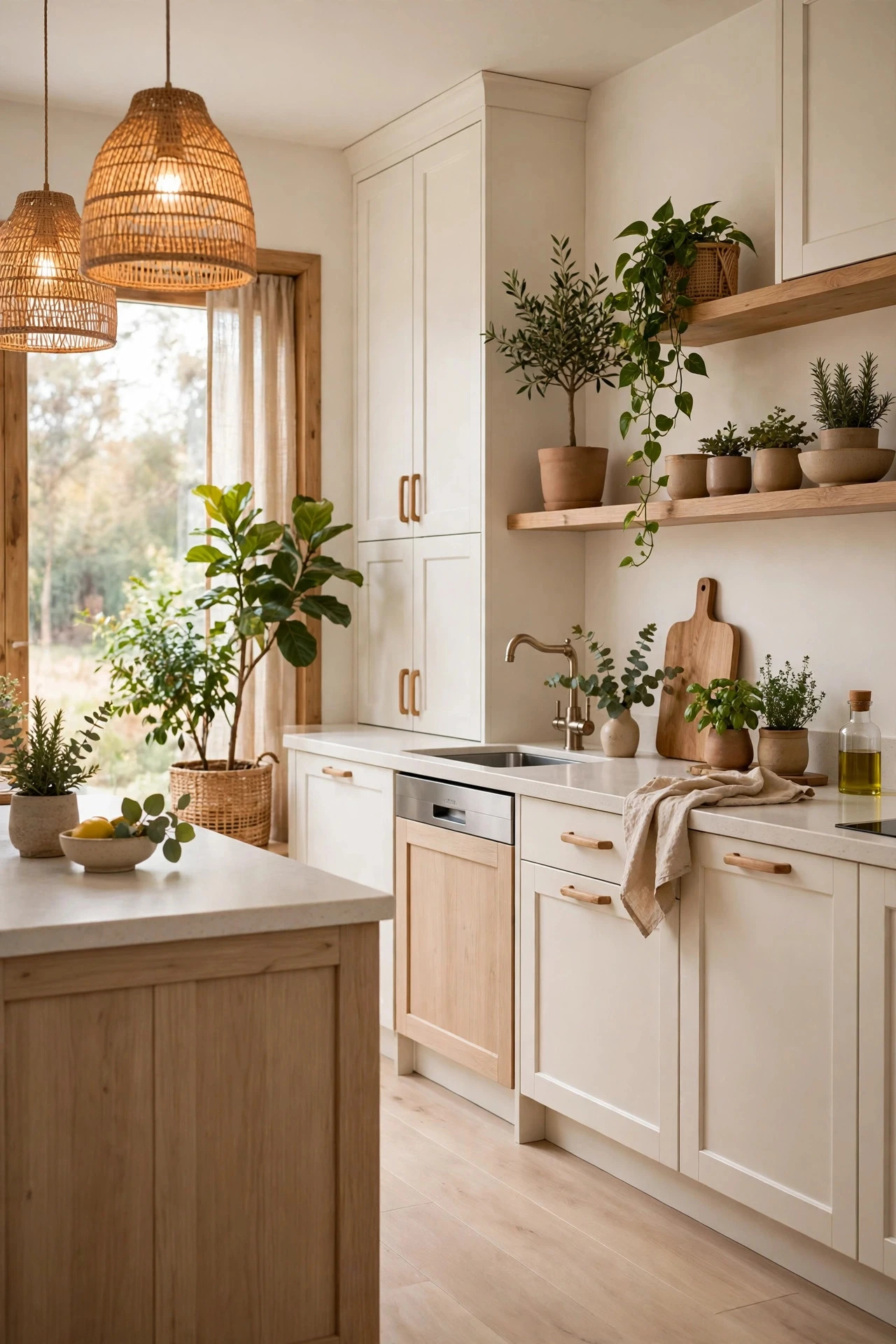
Warm white paint keeps a modern kitchen bright without the clinical glare of brilliant white, because it carries a hint of yellow, pink, or grey undertone. Look for shades with a warm undertone and a Light Reflectance Value above 80, such as a soft chalk white or warm greige, and test them on large boards against your worktop and flooring. Pair warm white walls and cabinets with oak, walnut, or pale ash to stop the room feeling flat, and use a matte or eggshell finish on walls with satin on woodwork for a subtle contrast. Budget £80–£250 for paint and sundries for a repaint, or £1,500–£3,500 for a professional cabinet respray. Avoid brilliant white under cool LED lighting — the combination is what makes modern kitchens feel cold. For styling ideas that keep a pale kitchen cosy, see our kitchen decor ideas that make a hard-working kitchen feel warm.
7. How Do You Use Deep Green or Black Accents Without Darkening the Kitchen?
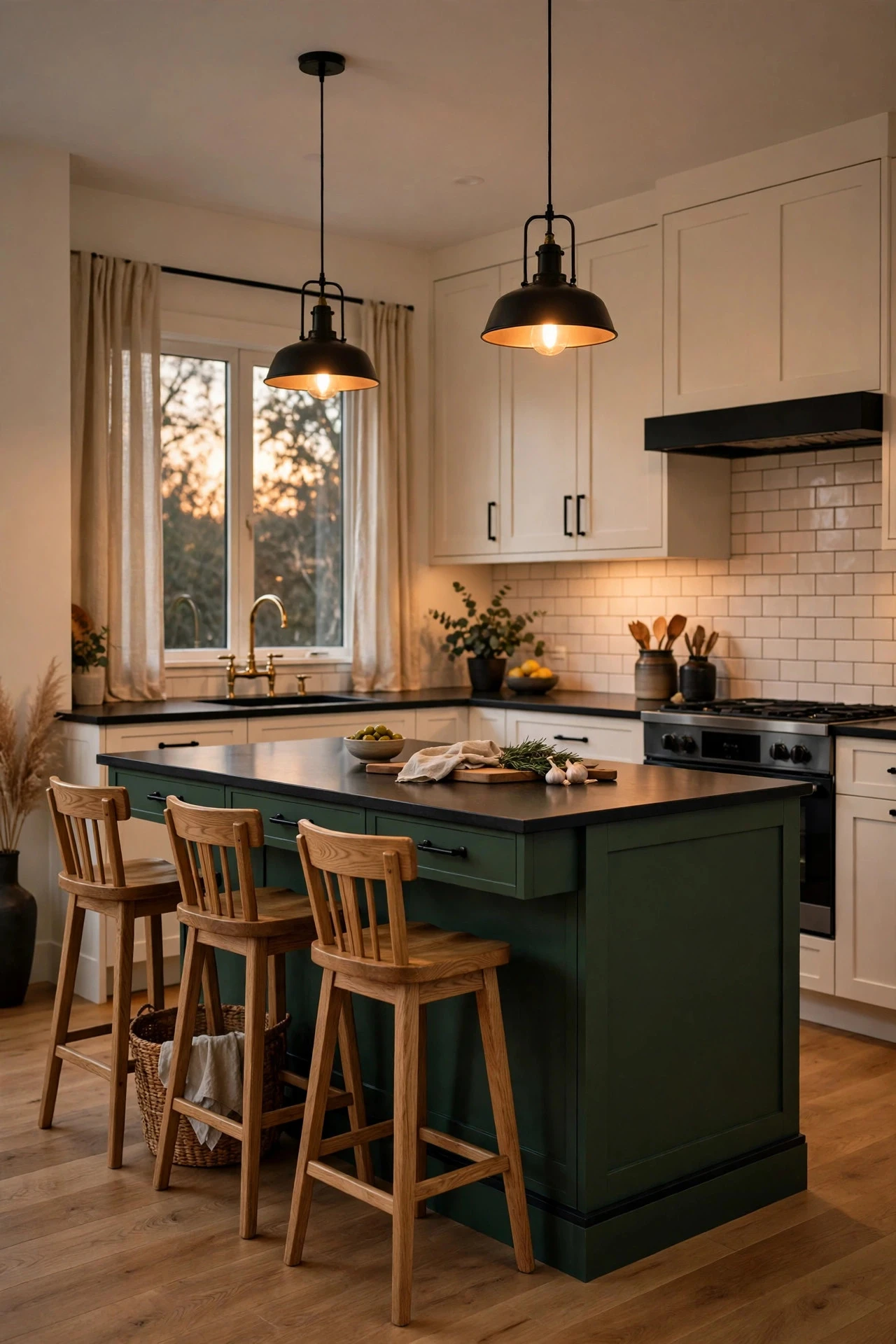
Deep green or black accents add drama to a modern kitchen without darkening it when they are used as a minority colour — roughly 10–20 percent of the visible surfaces. Try a deep green island, black window frames, a black tap and handles, or one run of charcoal base units against warm white walls. The key is contrast: dark accents need pale surroundings and good light to read as intentional rather than heavy. Matte finishes soften black and green, while a single gloss accent — a black pendant or a green glazed tile — adds reflection. Budget £300–£1,200 for dark accent paint, hardware, and a tap, or £1,500–£4,000 for a dark island. Avoid dark worktops and dark floors together, or the room will absorb light from both directions.
8. Why Does Layered Lighting Matter More Than One Big Pendant?
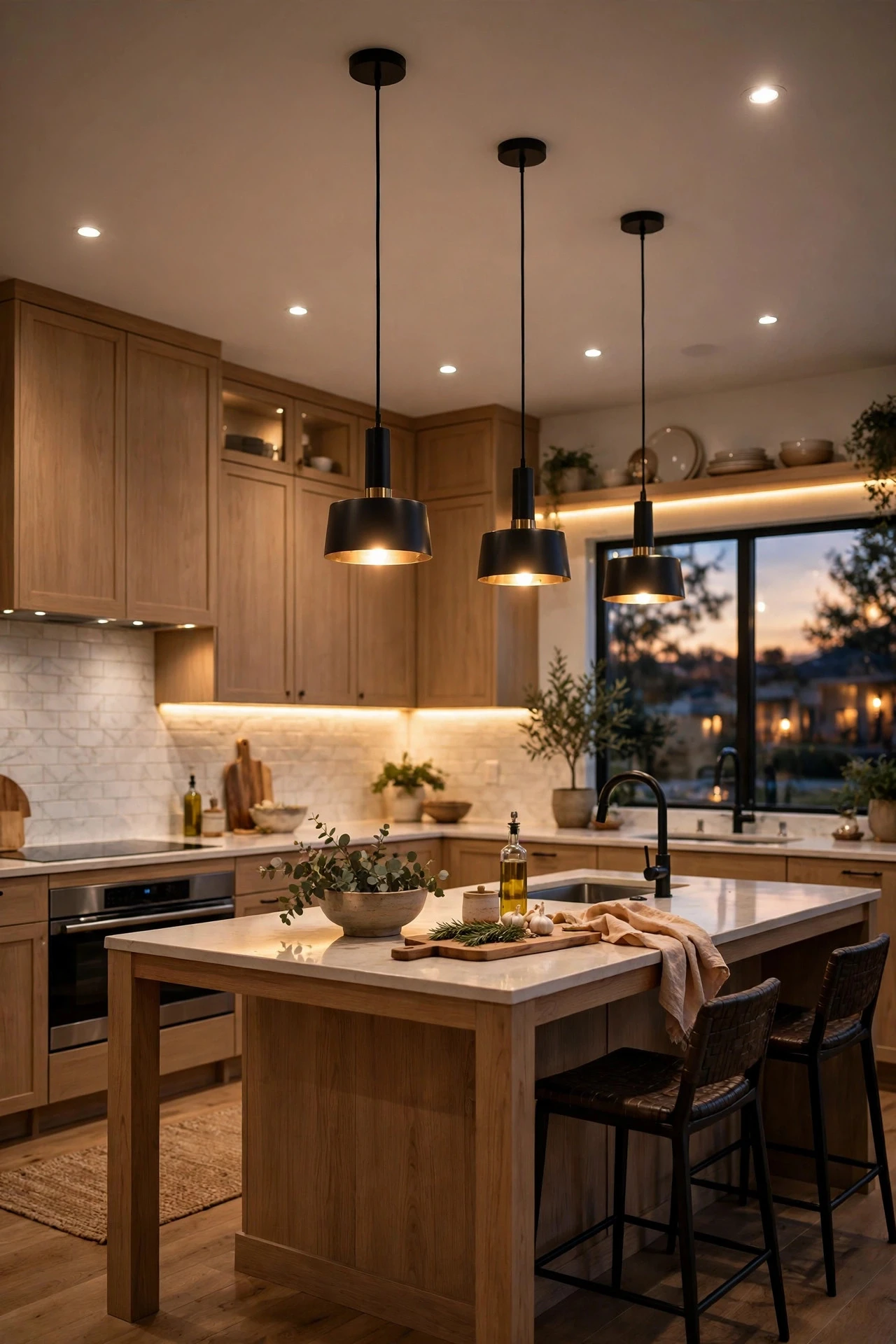
Layered lighting matters more than one big pendant because a kitchen needs three different kinds of light at once: general light to see the room, task light to cook safely, and accent light to show off materials. Start with recessed ceiling spots on a dimmer, add under-cabinet LED strips for the worktop, then finish with pendants or wall lights for warmth and character. Aim for 2700–3000K warm white throughout so the layers blend, and put task and accent circuits on separate switches. Budget £400–£1,200 for a full layered scheme in a medium kitchen, including LED strips and dimmers. Avoid a single central ceiling light — it casts your shadow over the worktop exactly where you need to see. For detailed schemes and fitting heights, see our kitchen lighting ideas for a brighter, better kitchen.
9. How High Should Statement Pendants Hang Over an Island?
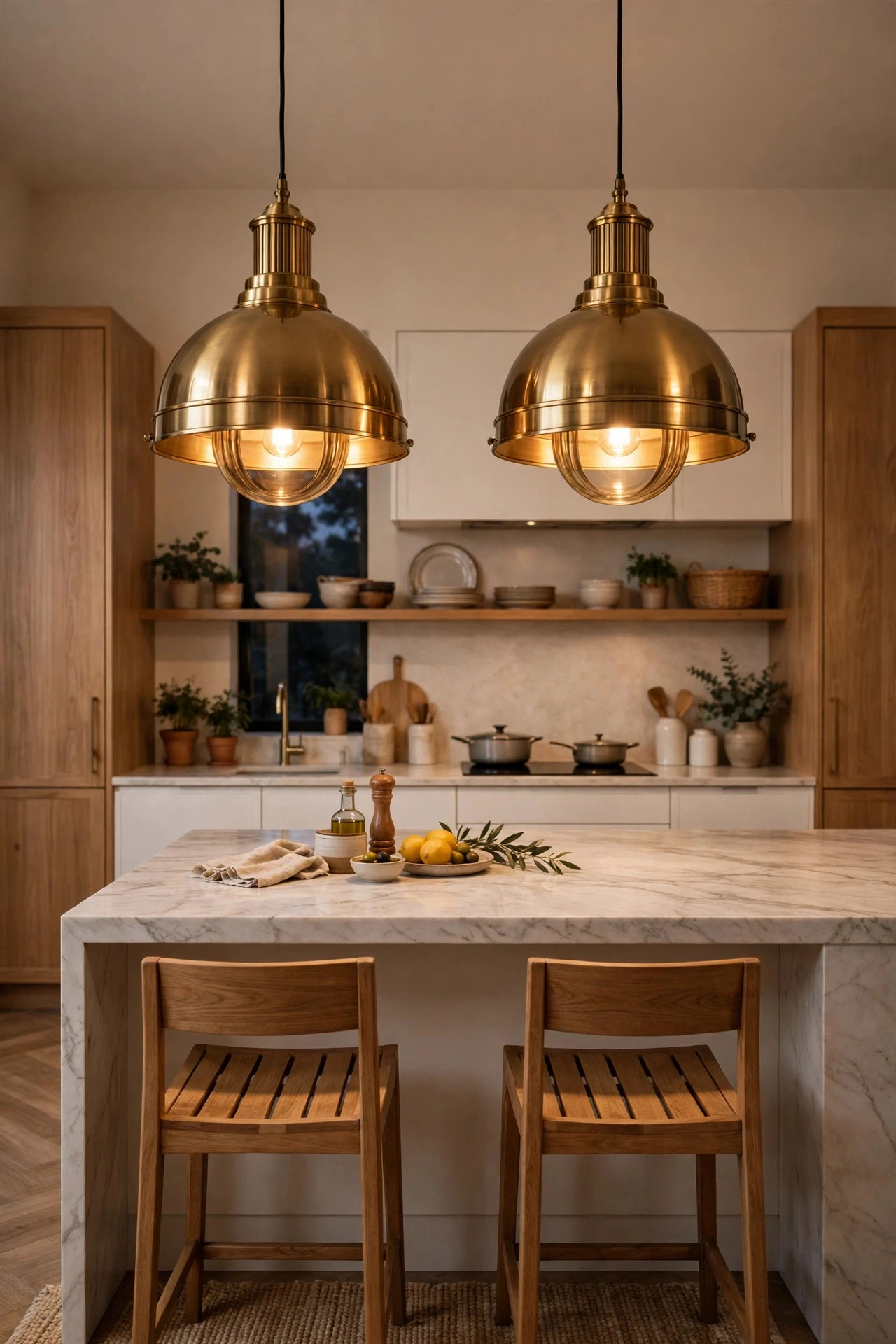
Statement pendants should hang 75–90 cm above the island worktop, with the bottom of the shade at roughly eye level for a standing adult. This height lights the surface without blocking sightlines across the room or dazzling anyone seated at the island. Space two pendants 60–75 cm apart centre to centre on a 2.4 m island, or use three smaller pendants on a longer island. Choose shades in glass, brass, black metal, or rattan — glass keeps sightlines open in small kitchens, while opaque shades give a stronger focal point. Budget £150–£600 for a pair of quality pendants, plus £100–£250 for installation. Avoid oversized shades in a low-ceiling kitchen, and always fit a dimmer so the same pendants work for cooking and for evening dining.
10. What Is the Best Under-Cabinet Lighting for a Modern Kitchen?
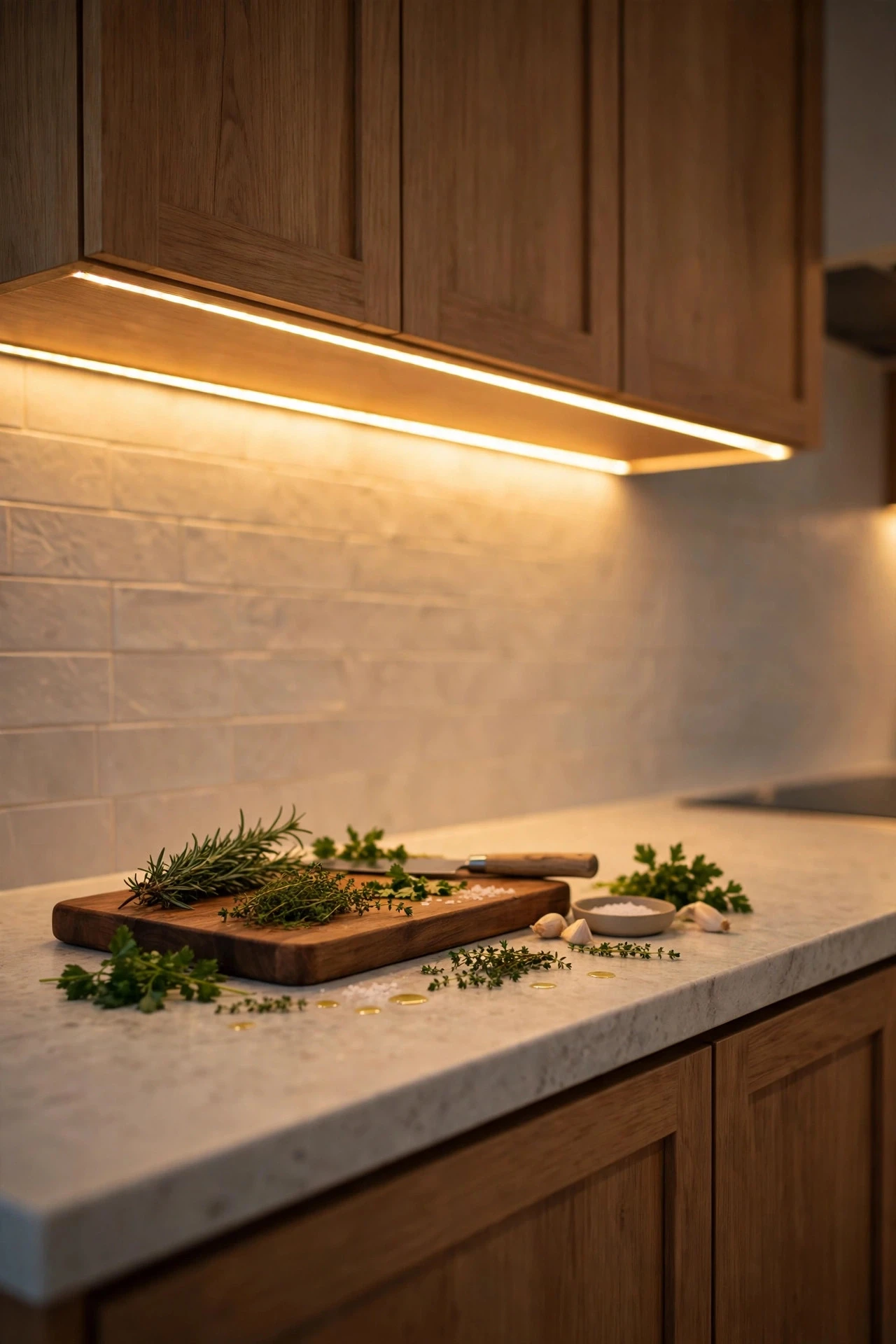
The best under-cabinet lighting for a modern kitchen is a continuous LED strip or slim LED bar mounted toward the front edge of the wall units, so light falls evenly across the worktop with no dark spots. Choose 2700–3000K warm white LEDs with a Colour Rendering Index above 90, so food colours look true and the worktop does not take on a green or blue cast. A diffuser channel hides individual diodes and gives a clean line of light, while a dimmable driver lets you drop the brightness for evening ambience. Budget £80–£300 for a DIY LED strip kit, or £300–£800 professionally installed with a driver and dimmer. Avoid plug-in puck lights spaced far apart — they create pools of light and dark gaps that make prep work harder and the kitchen look unfinished.
11. How Does an Appliance Garage Keep a Modern Kitchen Clutter-Free?
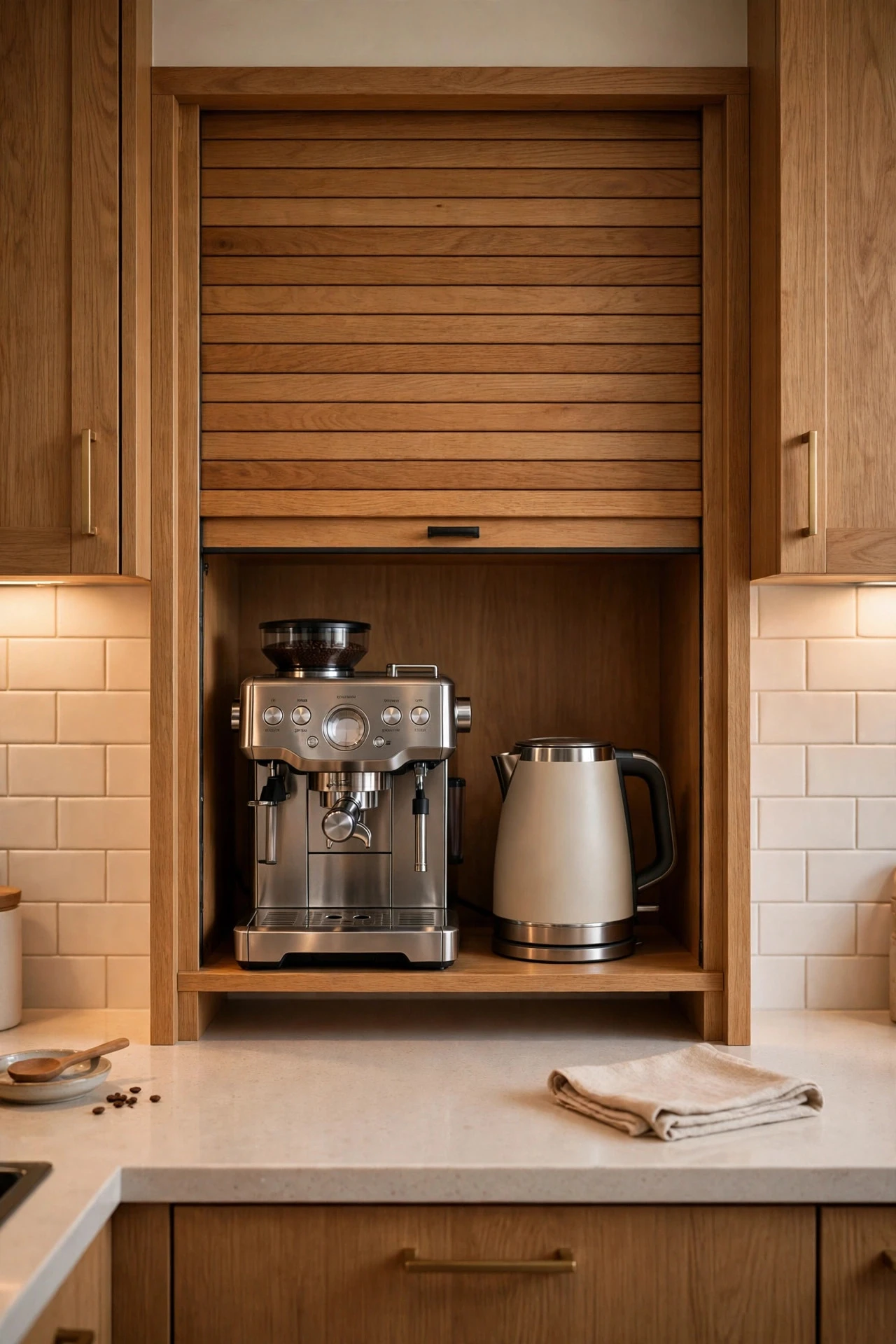
An appliance garage keeps a modern kitchen clutter-free by giving the kettle, toaster, and coffee machine a dedicated home behind a door that closes in seconds. The classic version is a tall unit with a roller shutter or pocket door, a worktop-height shelf inside, and sockets fitted in the back panel so appliances stay plugged in. Plan at least 60 cm wide and 55 cm deep, with 40 cm of clear height above the worktop for a coffee machine. Budget £400–£1,200 for a fitted appliance garage, or £150–£400 for a retrofitted unit with a tambour door. Keep it near the kettle's water source and away from the hob, and choose a door that disappears — a pocket door or roller shutter — rather than a hinged door that blocks the walkway when open. For more ways to hide everyday clutter, explore our small kitchen storage ideas that make every inch work.
12. Are Deep Drawers Better Than Cupboards in a Modern Kitchen?
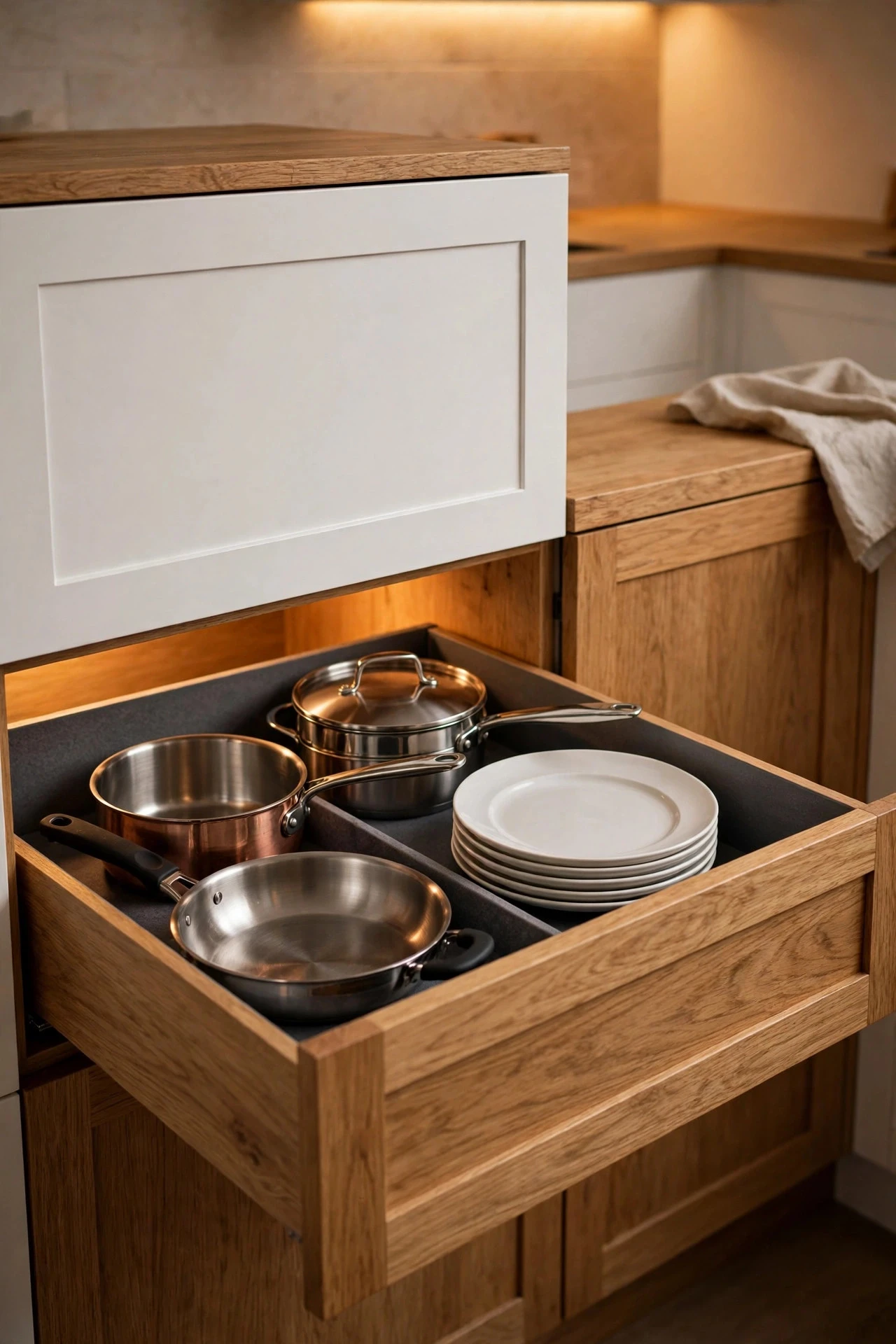
Deep drawers are better than cupboards in a modern kitchen for almost everything below waist height, because you pull the contents toward you instead of reaching into a dark cupboard. Use 60 cm deep drawers for pans, plates, and small appliances, with internal dividers for cutlery, lids, and baking trays. A bank of three deep drawers beside the hob holds most daily cooking kit within arm's reach, while a narrow 15–20 cm pull-out beside the oven stores oils and spices. Budget £200–£600 per drawer bank over standard cupboards, depending on runners and dividers. Choose full-extension, soft-close runners rated to at least 30 kg so heavy drawers glide smoothly when full. Avoid deep drawers for tall items such as cereal boxes and cleaning bottles — a tall larder pull-out suits those better.
13. How Do You Design Island Seating That People Actually Use?
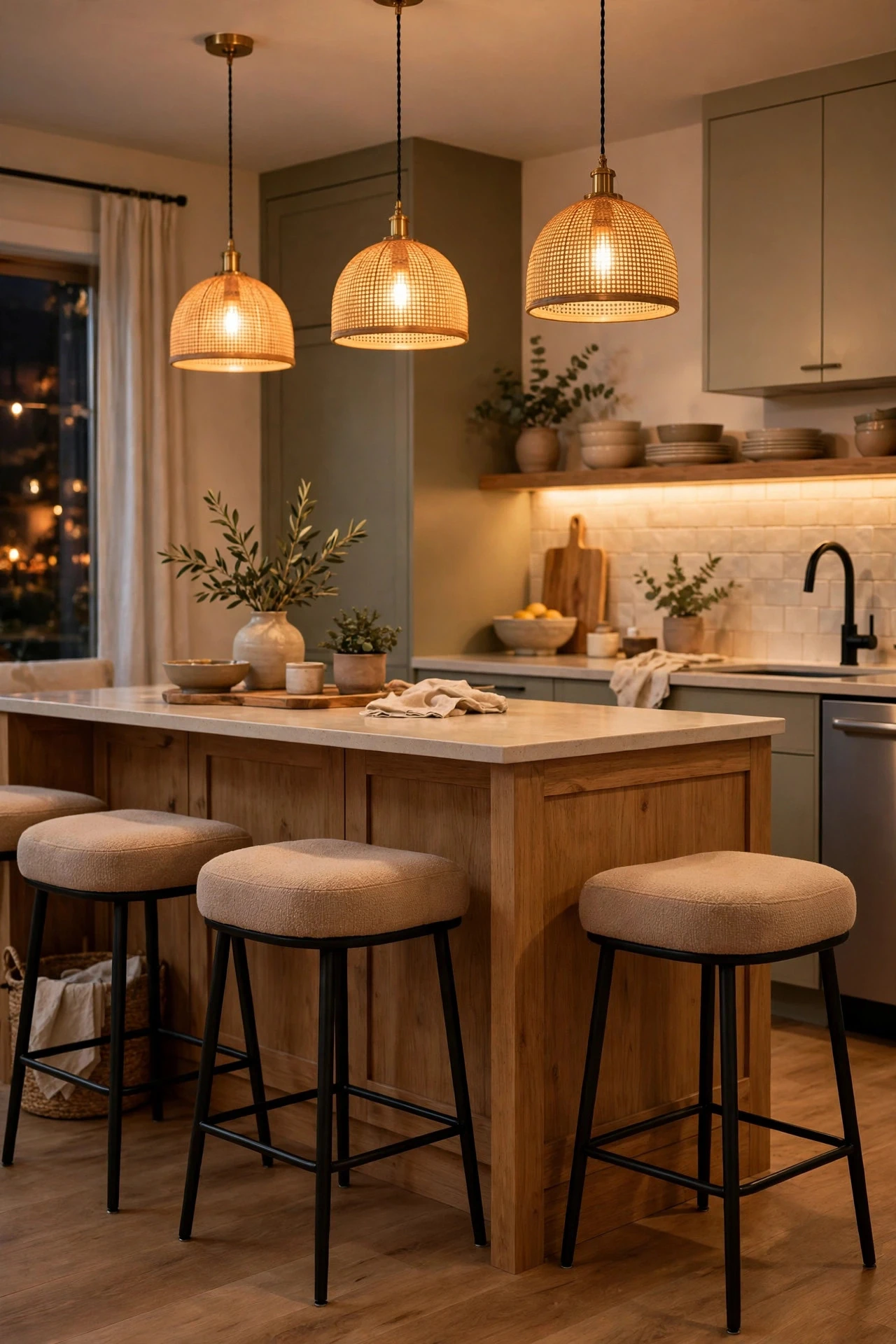
Island seating works when the overhang, stool height, and legroom are planned together, not added as an afterthought. Allow 30 cm of knee space and 60 cm of width per person, with a worktop height of 90 cm for counter stools (seat height 60–65 cm) or 105–110 cm for a raised breakfast bar (seat height 75 cm). Choose backless stools that tuck fully under the island in small kitchens, and stools with a low back and footrest where people linger over coffee. Budget £150–£600 for two to three quality stools, plus £200–£500 if you need to extend the worktop for the overhang. Avoid a seating overhang on the cooking side of the island, and leave at least 1 m behind seated stools so someone can pass without squeezing past.
14. When Does Open Shelving Work in a Modern Kitchen?
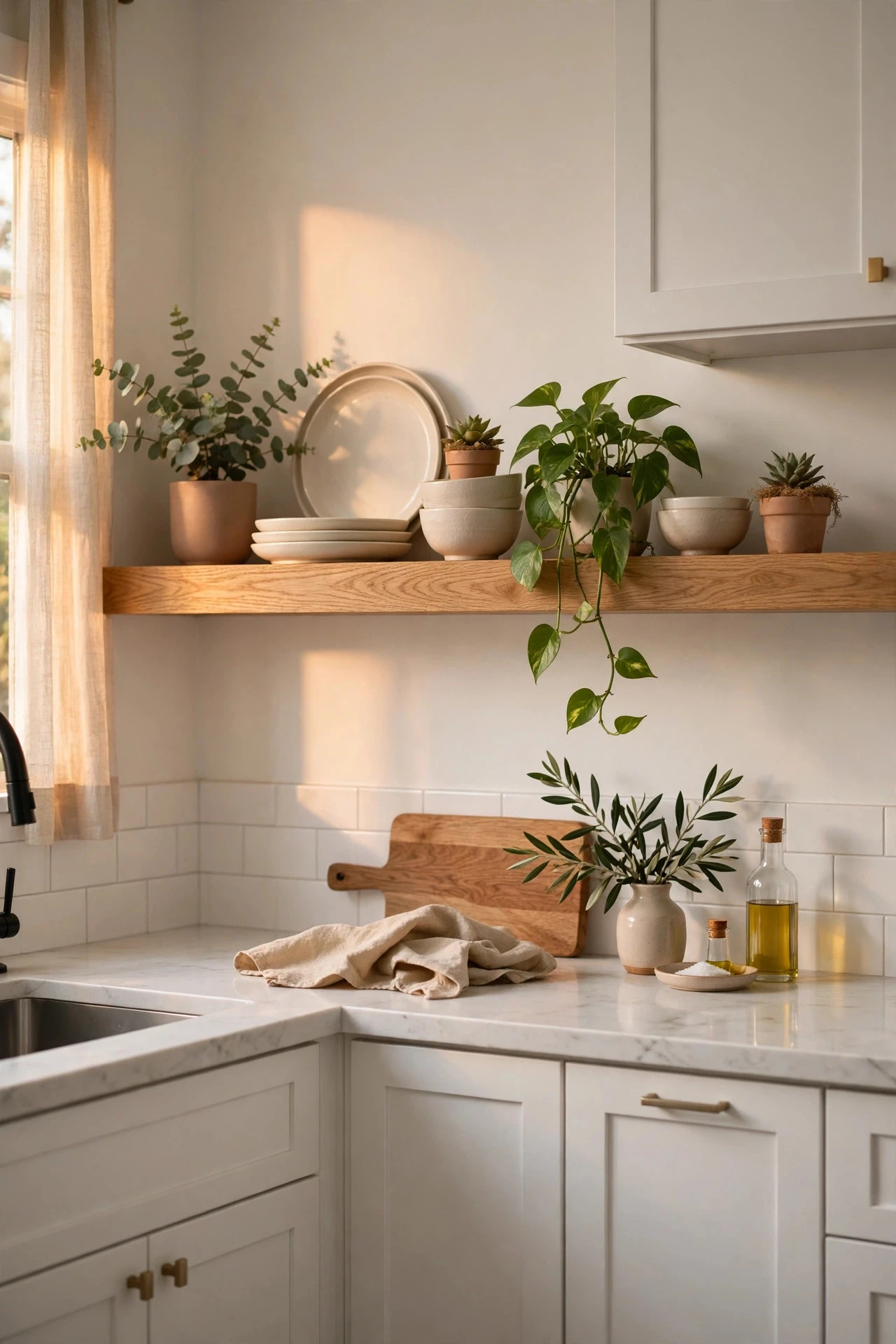
Open shelving works in a modern kitchen when it is limited to one or two shelves, styled with everyday items you actually use, and kept away from the hob. A single run of oak or painted shelves beside a window, holding matching plates, bowls, and a few plants, adds warmth and breaks up a wall of cabinets. Keep the shelf depth to 25–30 cm so items sit comfortably without jutting out, and leave breathing space — a shelf crammed edge to edge looks like storage, not styling. Budget £100–£400 for a pair of solid wood or metal shelves with brackets. Avoid open shelving for mismatched plastics, rarely used gadgets, or anything above the hob, where grease and steam coat everything within weeks. If you need more storage, closed cabinets are the honest answer.
15. Why Choose Integrated Appliances for a Clean Modern Look?
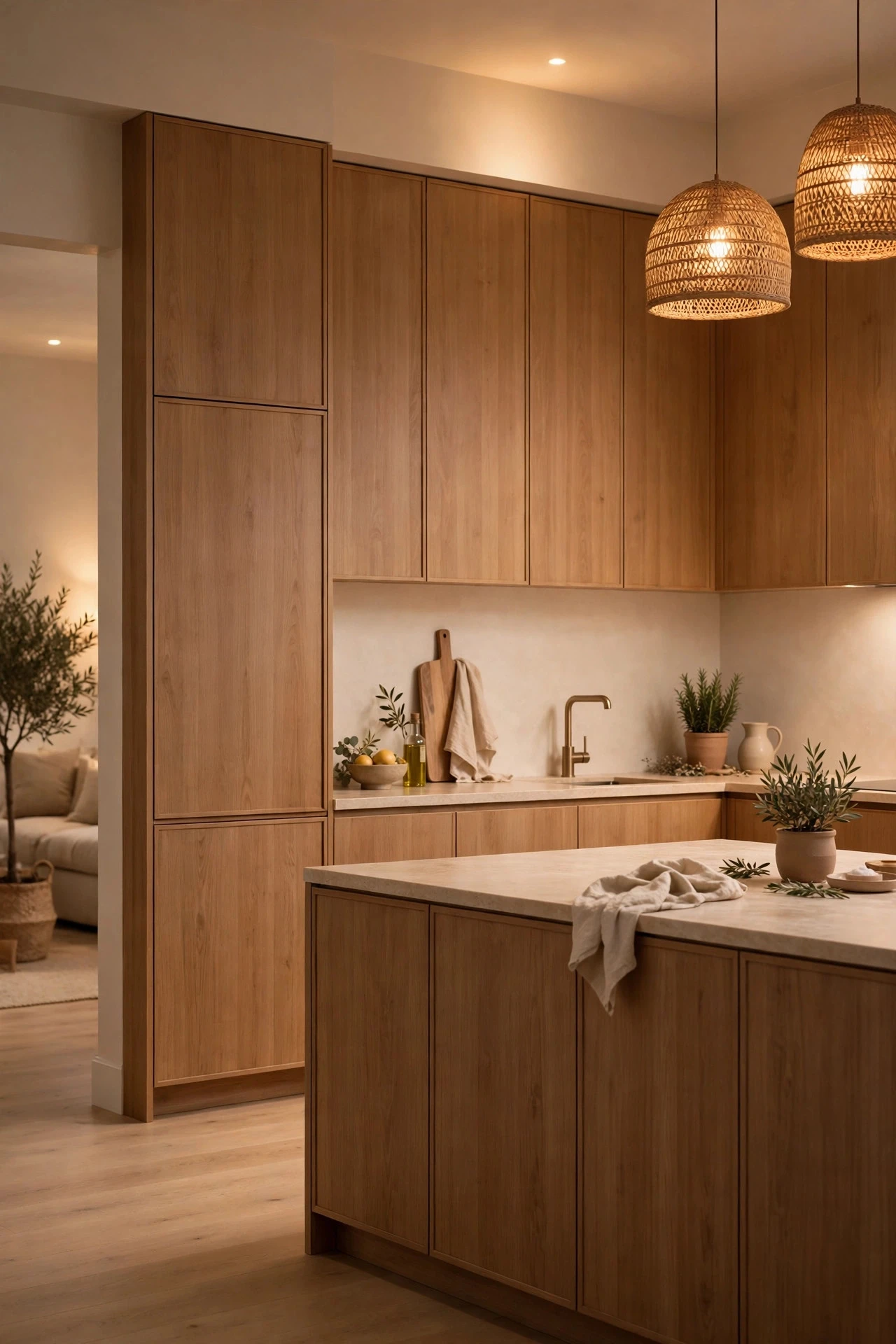
Integrated appliances give a modern kitchen its clean look by hiding the fridge, dishwasher, and washing machine behind matching cabinet doors, so the room reads as furniture rather than a row of machines. A fully integrated fridge-freezer and dishwasher are the two that matter most visually; an integrated oven and microwave in a tall housing unit complete the effect. Check ventilation clearances before ordering — integrated appliances need the manufacturer's specified gaps, and a fridge squeezed too tight will run hot and noisy. Budget £1,500–£4,000 extra over freestanding equivalents, including doors, panels, and fitting. Avoid integrating an appliance you may want to replace quickly, such as a budget dishwasher, unless the door panel is a standard size that fits the next model too.
16. Which Sustainable Materials Suit a Modern Kitchen?
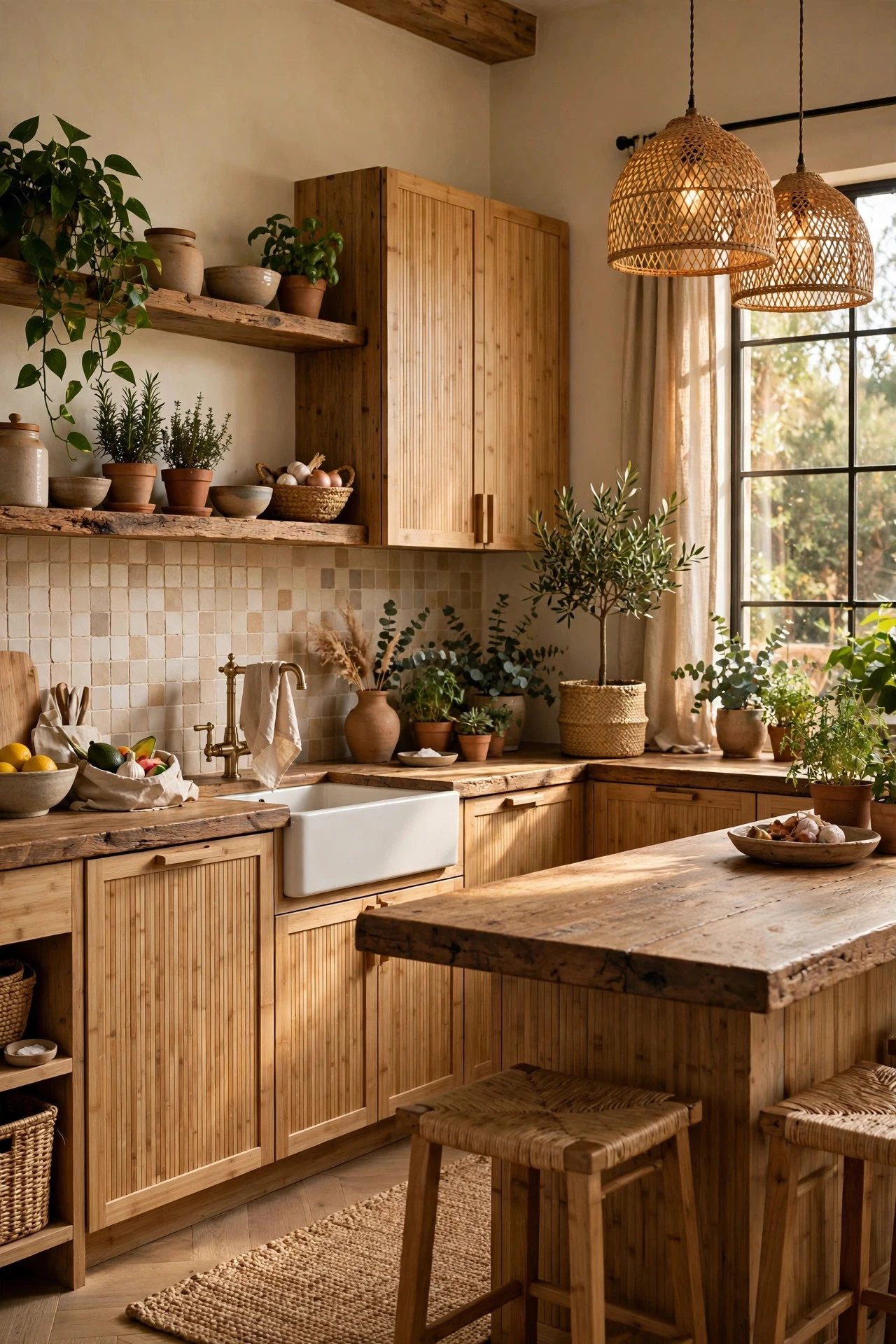
Sustainable materials suit a modern kitchen best when they are durable enough to last decades, because longevity is the greenest choice of all. Reclaimed oak worktops and shelving, bamboo cabinet fronts, recycled-glass worktops, and FSC-certified plywood carcasses all combine low impact with a warm, modern look. Low-VOC paints and water-based lacquers protect indoor air quality, while cork or natural linoleum flooring adds softness underfoot and is easy to repair in sections. Budget £200–£800 extra for FSC timber and low-VOC finishes over standard options, and £1,500–£3,500 for a recycled-glass or reclaimed-timber worktop. Avoid fast-fashion finishes that need replacing in five years — a classic material in a good colour will outlast three trend cycles. The Wikipedia overview of the kitchen gives useful background on how kitchen layouts and materials have evolved toward today's sustainable, open-plan designs.
17. What Smart Kitchen Tech Is Actually Worth It in 2026?
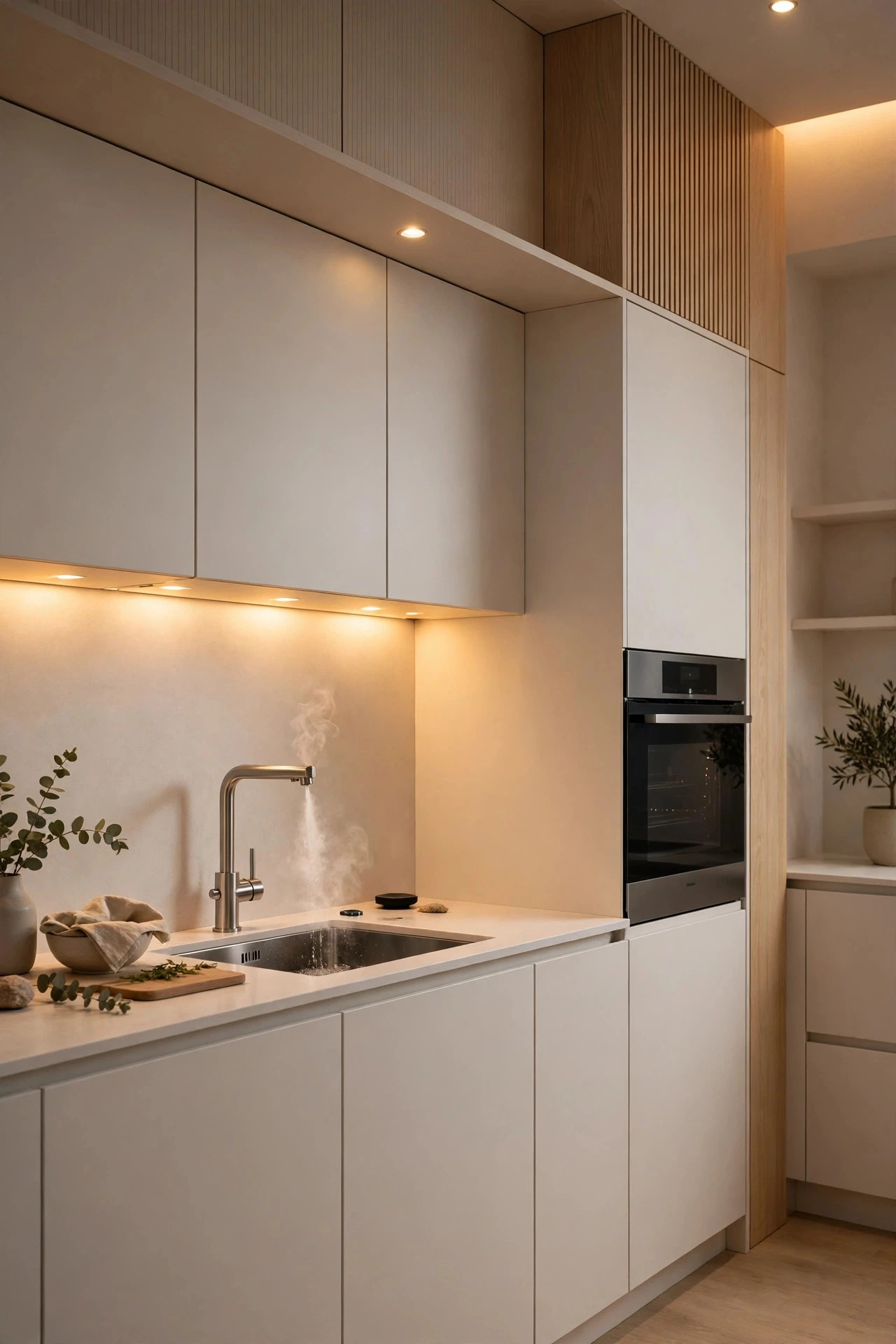
Smart kitchen tech is worth it in 2026 when it solves a real daily problem, not when it adds a screen for its own sake. The genuinely useful upgrades are a boiling-water tap that replaces the kettle, sensor lighting under cabinets, a quiet extractor that adjusts to steam levels, and a smart oven with a food probe that alerts your phone when dinner is ready. A tap with filtered cold water and a boiling function costs £400–£900 fitted and frees a surprising amount of worktop. Budget £1,000–£3,000 for a sensible smart package, and keep every smart device on a standard manual override so the kitchen still works during a Wi-Fi outage. Avoid smart fridges with built-in screens and voice-controlled everything — they age fast, cost more to repair, and rarely justify their price over a well-chosen standard model.
18. How Do You Make a Small Kitchen Look Modern and Spacious?
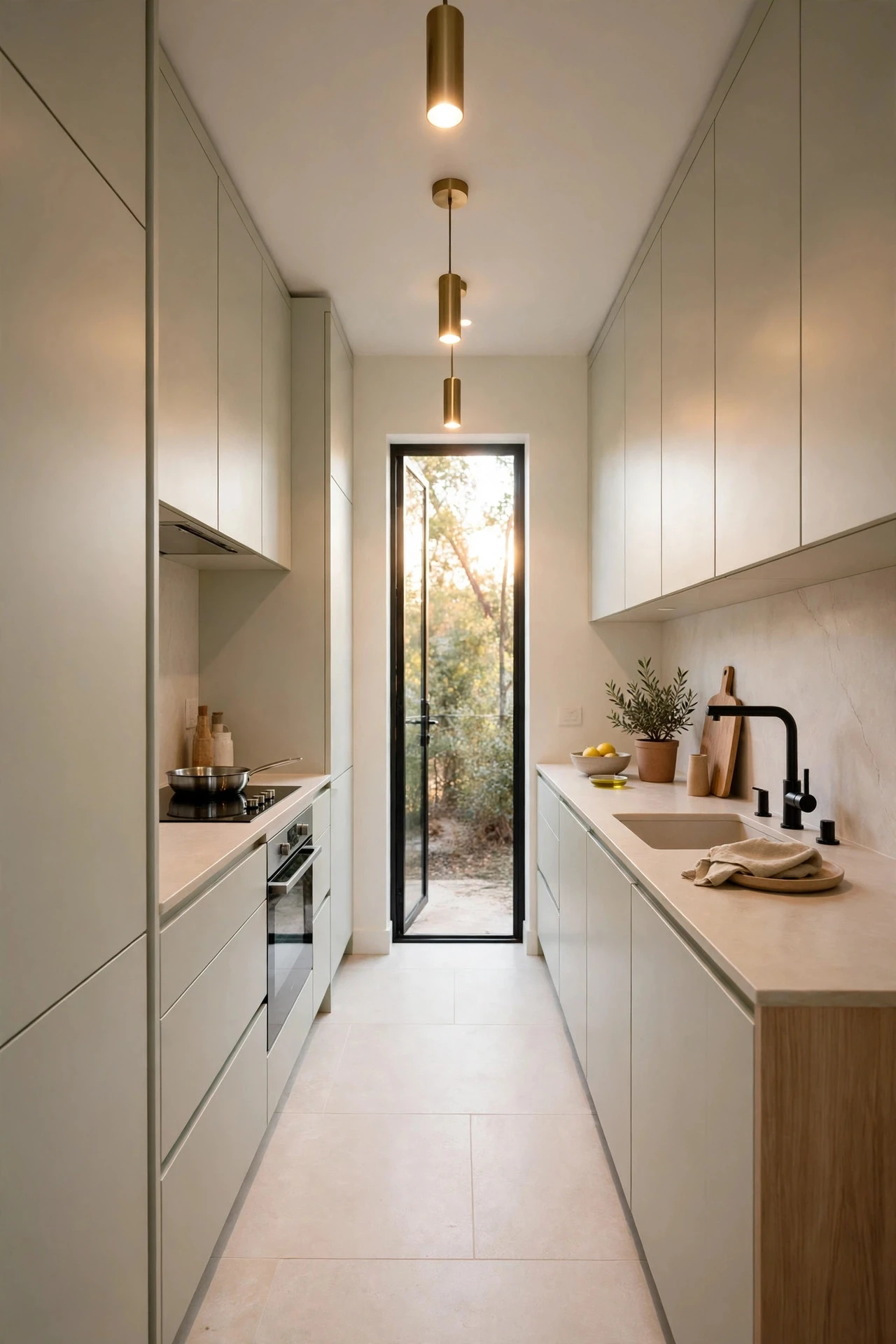
A small kitchen looks modern and spacious when every choice reduces visual clutter: handleless cabinets, a single worktop material, one flooring finish run throughout, and pale warm colours that reflect light. Use a galley or single-wall layout with tall units on one side only, so the opposite wall stays open, and choose a slim 60 cm deep worktop with a 45 cm deep island or peninsula if space is tight. A large-format tile or continuous vinyl floor with no threshold break makes the room feel wider, while a mirrored or glass splashback bounces light across the room. Budget £3,000–£8,000 for a compact modern refit, or £500–£1,500 for a cosmetic refresh of paint, lighting, and handles. Avoid a bulky island, dark upper cabinets, and patterned flooring in a small kitchen — each one shrinks the room visually. Keep the palette pale, the surfaces clear, and the storage deep rather than wide, so the room feels calm instead of cramped.
19. Does Large-Format Flooring Make a Modern Kitchen Feel Bigger?
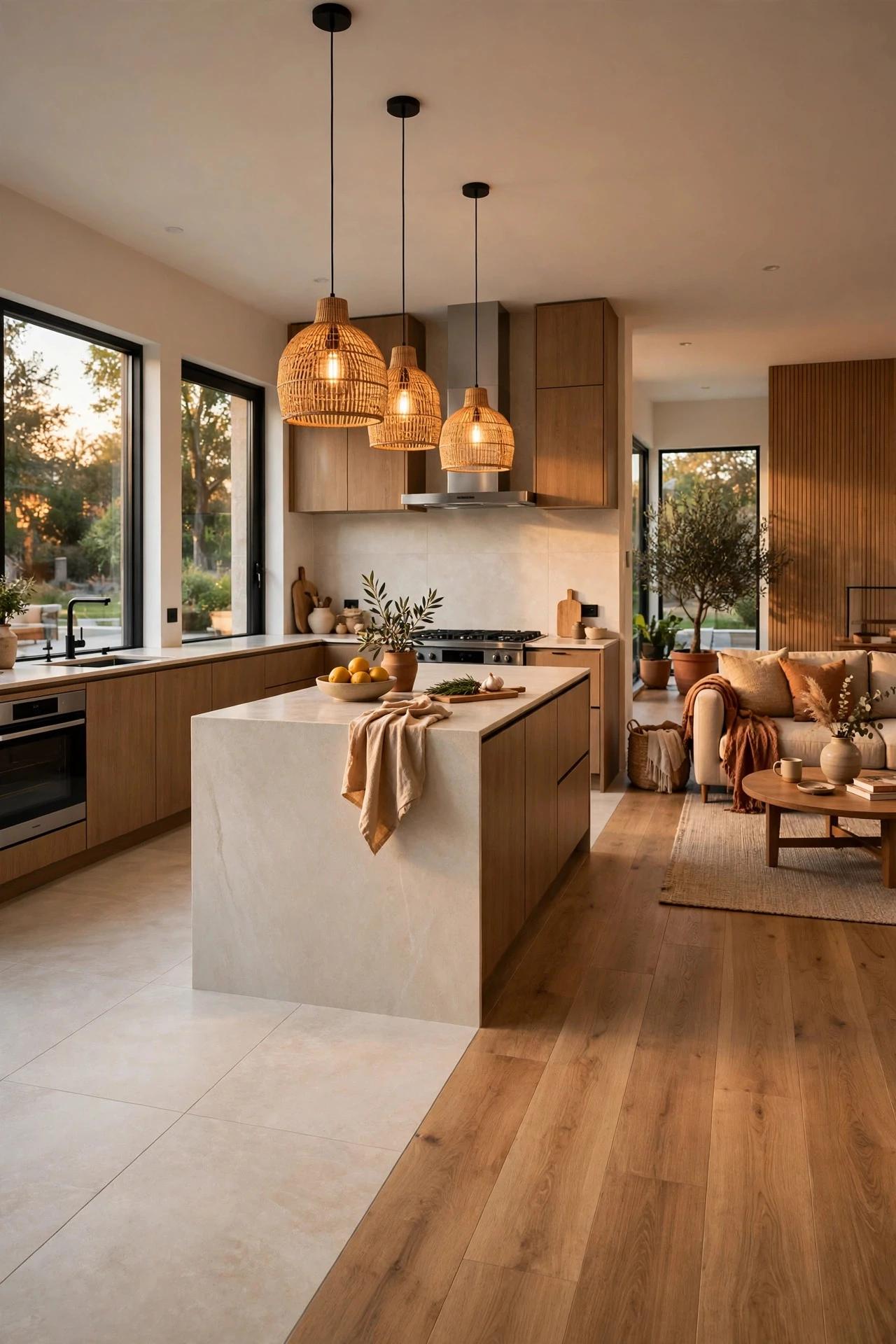
Large-format flooring makes a modern kitchen feel bigger because fewer joints mean fewer visual breaks across the floor. Tiles of 60 x 120 cm or 80 x 80 cm, wide-plank engineered oak, and continuous luxury vinyl all create that seamless effect, especially when the same floor runs into an adjoining living space with no threshold strip. Choose a matte or satin finish — high gloss shows dust and footprints — and keep grout lines to 2 mm in a colour matched to the tile. Budget £40–£90 per square metre fitted for large-format porcelain, or £50–£110 for wide-plank engineered oak. Avoid small mosaic or heavily patterned tiles in an open-plan kitchen, where the pattern competes with the cabinets, and always check slip resistance (R10 or above) for a kitchen floor that gets wet.
20. Should You Choose Matte or Gloss Finishes in a Modern Kitchen?
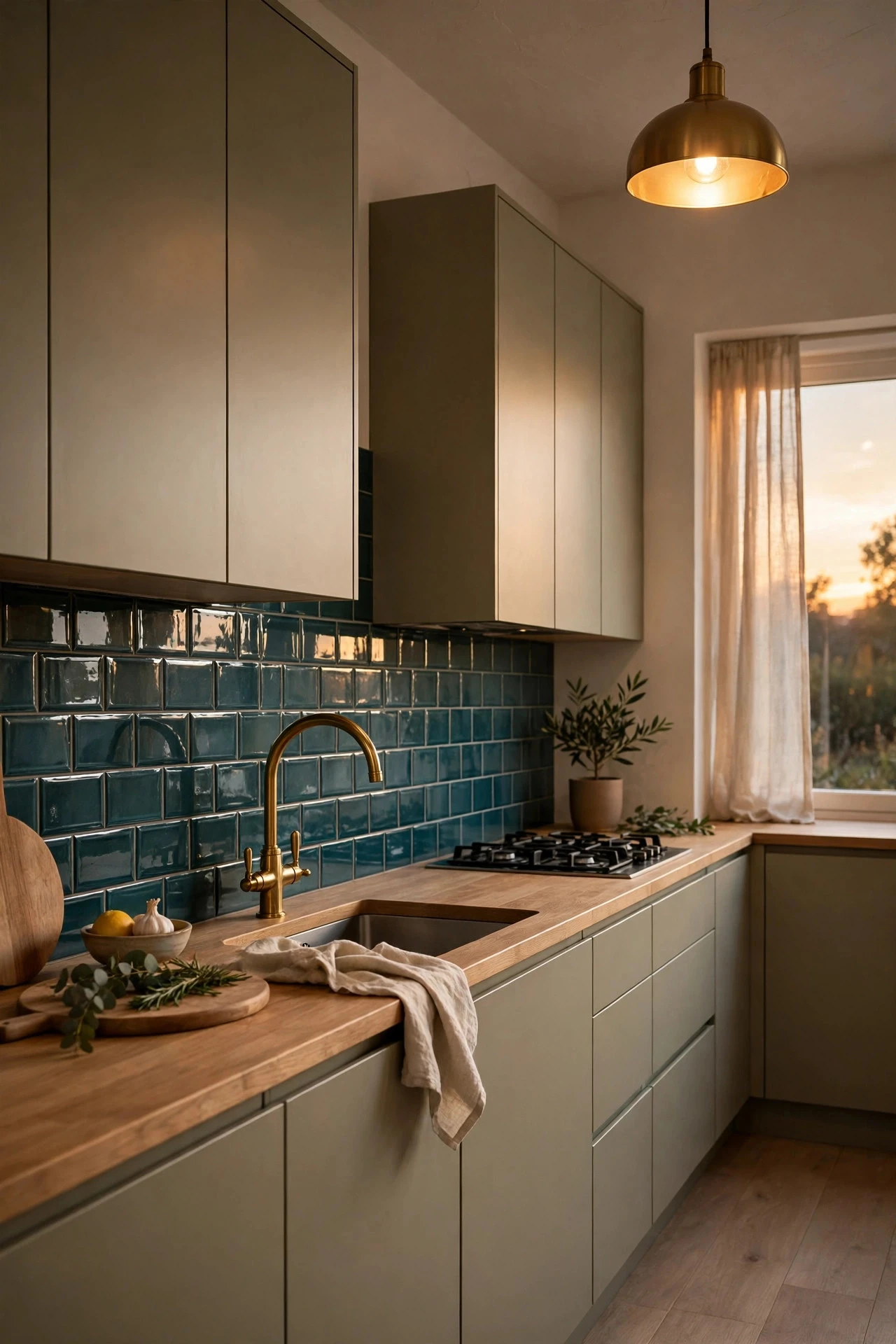
Matte finishes suit most modern kitchens better than gloss, because they hide fingerprints, soften light, and feel warmer to the touch. Use matte on cabinet doors, worktops, and large surfaces, then add gloss in small doses — a glazed tile splashback, a glass pendant, or a polished brass tap — for contrast and reflection. Gloss still has a place in a very small or dark kitchen, where reflective doors bounce light around the room, but expect to wipe them daily. Budget is similar for both finishes at mid-range, with gloss usually £5–£15 per door more for the extra lacquer coats. Avoid mixing matte and gloss on adjacent doors of the same run, or the difference looks like a mistake rather than a design choice. Architectural Digest's kitchen design coverage shows how leading designers balance matte cabinetry with reflective accents to keep modern kitchens warm rather than flat — see Architectural Digest kitchen design ideas for visual inspiration.
21. How Does a Statement Tap Transform a Modern Kitchen?
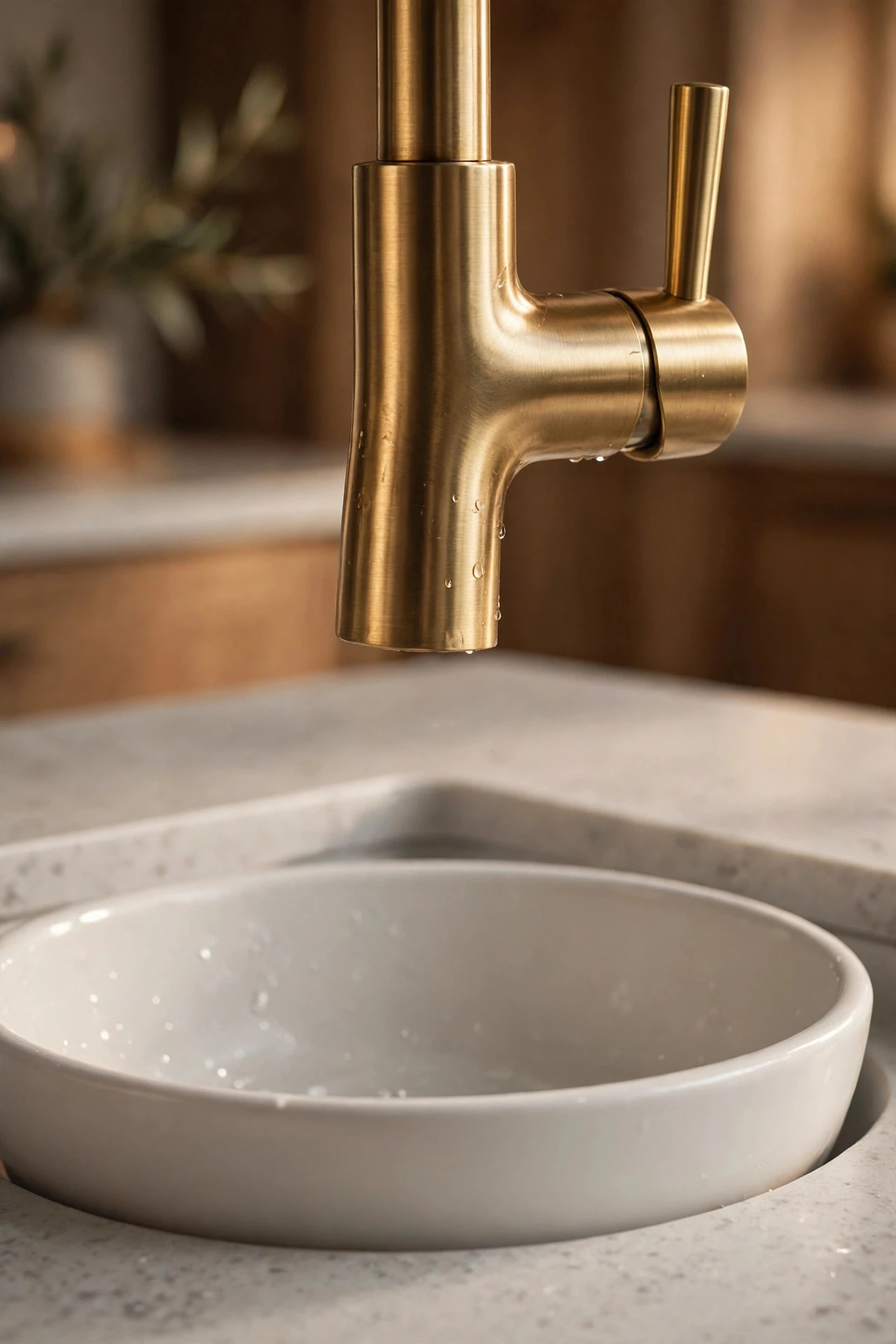
A statement tap transforms a modern kitchen because it is the one fitting you touch and look at dozens of times a day, so its finish sets the tone for the whole room. Brushed brass, matte black, and gunmetal taps pair beautifully with warm white cabinets and wood, while polished chrome suits cooler, more minimal schemes. Choose a single-lever mixer with a pull-out spray for practicality, and match the tap finish to cabinet handles, pendant fittings, or shelf brackets so the metal repeats at least twice in the room. Budget £150–£450 for a quality statement tap, plus £80–£150 for fitting. Avoid a tap that is taller than the splashback allows, and check water pressure before choosing a large waterfall-style spout — low pressure turns a dramatic tap into a disappointing trickle.
22. How Do You Style a Modern Kitchen So It Feels Lived-In?
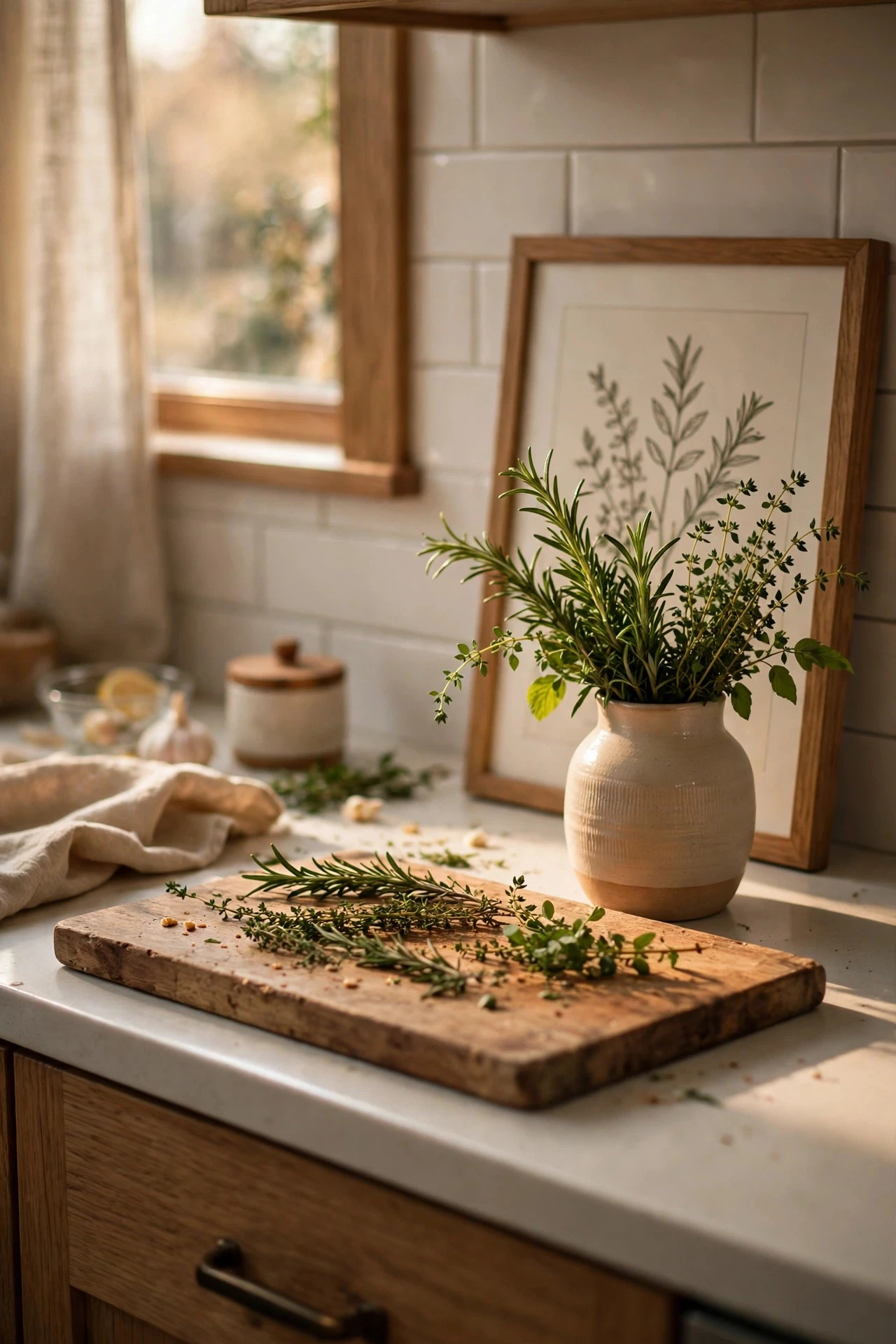
A modern kitchen feels lived-in when the styling layer is personal, natural, and restrained — a wooden chopping board leaning against the splashback, a ceramic vase with fresh herbs, a framed print, and a linen tea towel, not a showroom display. Add one plant that thrives in kitchen humidity, such as a pothos or herb pot on the windowsill, and one piece of art or a favourite cookbook on open shelving. Keep worktops at least 70 percent clear so the room still works for cooking, and rotate seasonal pieces — a bowl of citrus in winter, fresh flowers in spring — rather than filling every surface permanently. Budget £50–£200 for styling pieces, most of which you may already own. Avoid fake plants, matching accessory sets, and cluttered windowsills; the goal is a kitchen that looks used and loved, not decorated for a photograph. The Spruce's guide to modern kitchen ideas offers further styling examples that pair clean lines with warm, personal touches.
Practical Tips
Budget in three tiers. A refresh (£500–£2,000) covers paint, lighting, handles, a new tap, and styling. A partial update (£3,000–£8,000) adds re-fronted cabinets, a new worktop, and a splashback. A full modern refit (£8,000–£25,000) covers new cabinets, appliances, flooring, and lighting. Get three itemised quotes and keep a 10 percent contingency for hidden plumbing or electrical work.
Measure before you order anything. Standard base units are 60 cm deep and 90 cm high including the worktop; wall units sit 50–60 cm above the worktop. Leave 1–1.2 m between parallel runs, 90 cm minimum in front of the oven door, and 30 cm of landing space beside the hob and sink. Draw the layout to scale, including door swings and socket positions, before signing off a design.
Plan lighting on three circuits. Put ceiling spots, under-cabinet task lights, and pendants on separate dimmers so you can cook brightly and dine softly in the same room. Use 2700–3000K warm white everywhere, and check the Colour Rendering Index is above 90 for task lighting.
Store by zone, not by cupboard. Keep pans near the hob, plates near the dishwasher, and food near the fridge and prep area. Deep drawers, a larder pull-out, and an appliance garage cover 90 percent of daily storage needs without extra wall units.
Choose finishes for cleaning, not just looks. Matte quartz, large-format porcelain, and single-slab splashbacks wipe clean in seconds. Fluted fronts, open shelving, and gloss doors near the hob all need more upkeep — use them where they earn their place, not everywhere.
Final Thoughts
A warm modern kitchen is not a compromise — it is the best version of the style. Clean lines, clever storage, and good light do the hard work, while wood, warm white, texture, and a few personal touches make the room somewhere you actually want to spend time. Start with the change that will make the biggest daily difference, whether that is better lighting, deeper drawers, or a calmer colour palette, and build from there.
Frequently Asked Questions
What makes a kitchen modern rather than contemporary?
A modern kitchen follows the modernist design movement: flat-panel cabinets, clean lines, minimal ornament, and honest materials such as wood, stone, and metal. Contemporary kitchens borrow current trends and change with fashion, while modern kitchens keep a timeless, uncluttered structure. Warmth comes from materials and lighting, not from adding decoration back in.
How much does a modern kitchen cost in 2026?
A cosmetic modern refresh costs £500–£2,000, a partial update with new worktops and re-fronted cabinets costs £3,000–£8,000, and a full modern refit typically costs £8,000–£25,000 depending on size, appliances, and materials. Stone worktops, integrated appliances, and bespoke cabinetry push costs higher, so get three itemised quotes before committing.
What colours work best in a modern kitchen?
Warm whites, soft greys, pale wood tones, and one deep accent such as forest green, navy, or charcoal work best in a modern kitchen. Keep the main surfaces pale and warm, use the deep colour on 10–20 percent of the room, and repeat warm metals such as brass or bronze to tie the scheme together.
How do I keep a modern kitchen from looking cold?
Use warm white paint instead of brilliant white, add natural wood through flooring, shelving, or an island front, and layer lighting at 2700–3000K with dimmers. Textured finishes such as fluted panels, linen, and ceramics soften flat surfaces, while plants and personal styling stop the room feeling like a showroom.
Are handleless kitchens practical for families?
Handleless kitchens are practical for families if you choose the right mechanism — recessed channels or J-pull rails work better with wet hands than push-to-open doors. Matte finishes hide fingerprints, and a mix of handleless doors with a few pull-out drawers keeps daily use easy. Avoid handleless doors on heavy fridge and dishwasher doors unless the grip is genuinely comfortable.
What is the best worktop for a modern kitchen?
Quartz is the best all-round worktop for a modern kitchen because it is hard-wearing, stain-resistant, low-maintenance, and available in large slabs for waterfall islands and single-slab splashbacks. Porcelain and sintered stone are close alternatives with excellent heat resistance, while solid wood suits a warmer look but needs regular oiling and care.