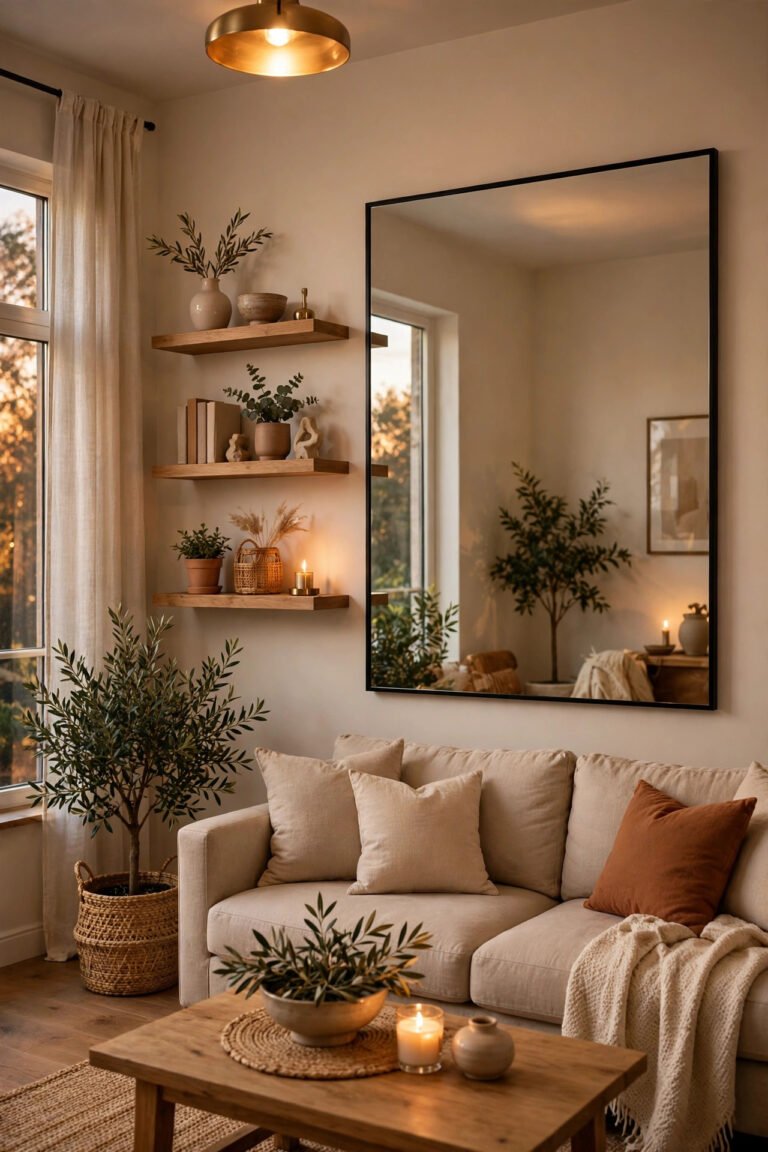
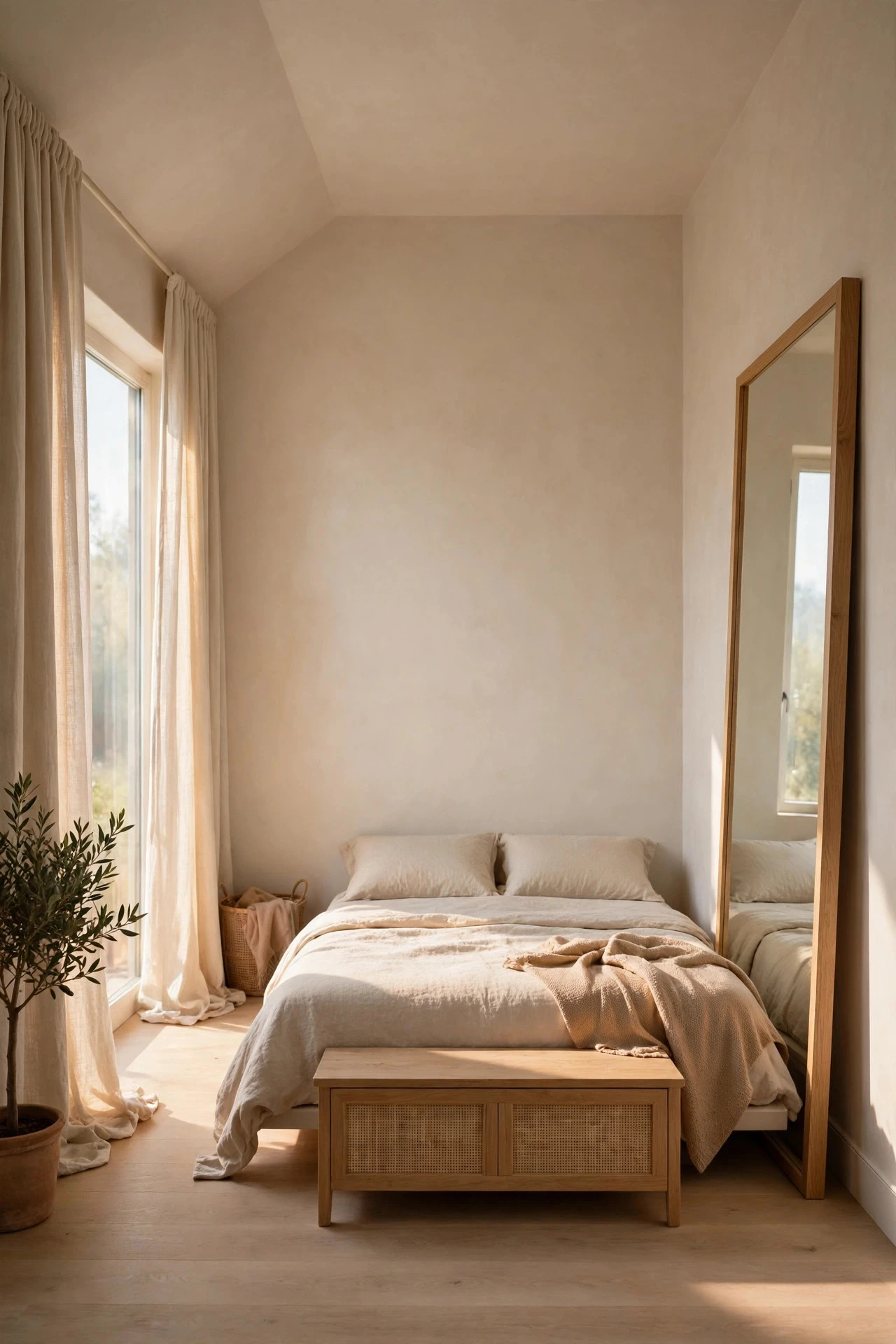
22 Bedroom Inspiration Ideas for Small and Awkward Rooms
A small or awkward bedroom does not need to feel like a compromise, because the rooms that look most inviting are rarely the largest ones. They are rooms where every decision has a reason, and colour and pattern work with the shape instead of fighting it. Bedroom inspiration for tight, sloped, narrow or oddly shaped rooms therefore starts with layout, not shopping, grounded in measurements and storage solutions that change how a small room lives.
Looking for more inspiration? Our Nest Decorz homepage gathers the latest home decor ideas, seasonal decorating guides and room-by-room styling tips in one place — start there and explore.
Below are 22 ideas for small and awkward rooms, covering bed placement, clearance, storage beds, vertical storage, wall lighting, mirrors and colour tricks for sloped ceilings, nooks, narrow rooms, box rooms and shared rooms. Each gives sizes, approximate costs in US dollars, materials and colours, a variation, and one mistake to avoid.
1. Place the Bed Against the Longest Unbroken Wall
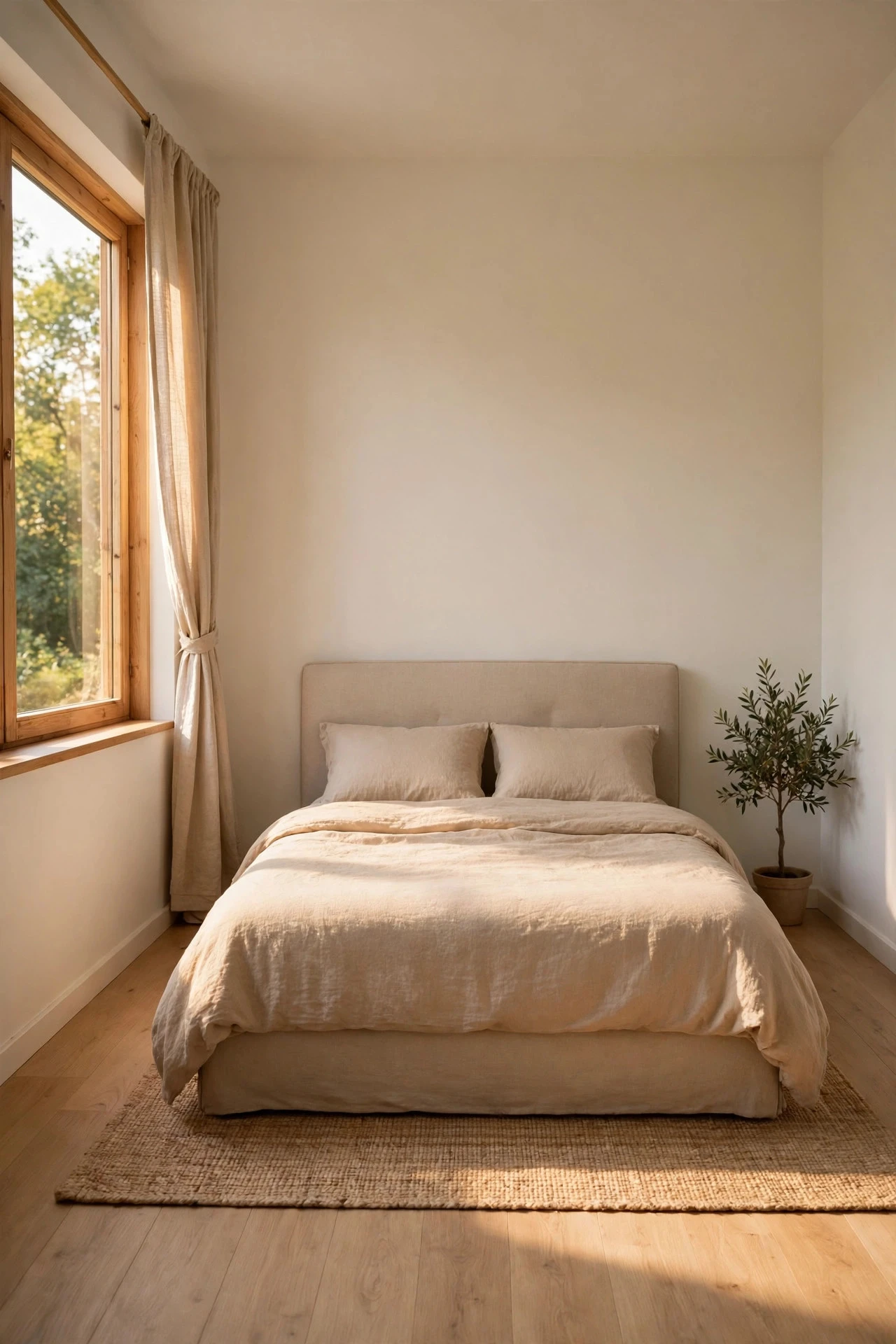
Place the bed against the longest unbroken wall in the room, centred if possible, because that single decision frees the rest of the layout and makes even a tight bedroom feel intentional rather than squeezed in. Measure first: a queen bed needs a wall at least 62 inches wide for the frame alone, plus 24 to 30 inches of clear space on each side for getting in and out comfortably, while a full or double bed needs a 56-inch wall and the same side clearance where the room allows it. In a narrow room, pushing one side against the wall is acceptable if it buys a clear walkway, and a low linen headboard, 48 to 54 inches high, keeps the wall soft. Expect $400 to $1,200 for a frame and $150 to $450 for a headboard. The mistake to avoid is placing the bed under the window by default, which blocks light, invites draughts and wastes the room's best wall.
2. Leave a Measured Walkway, Not a Guessed One
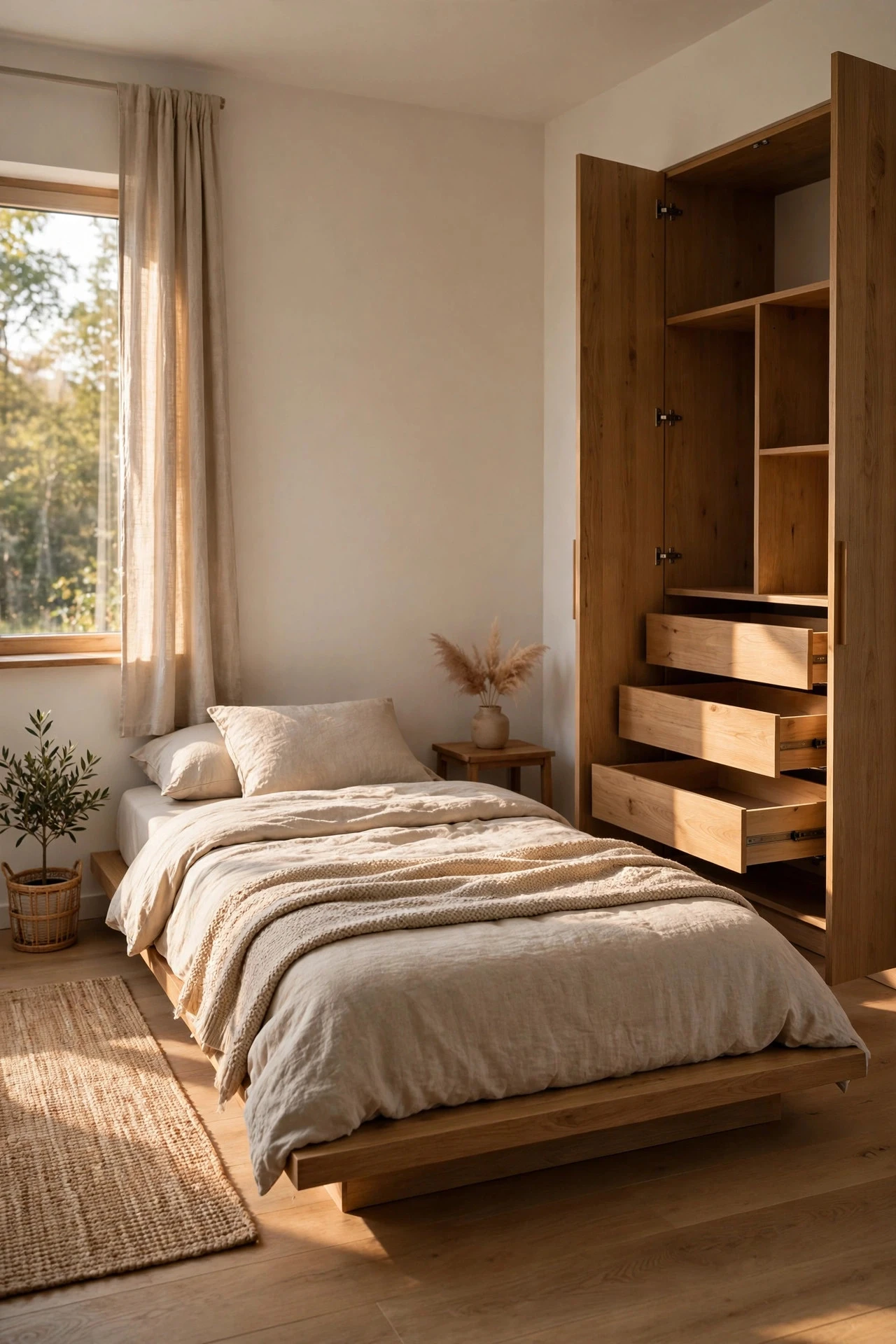
Leave a measured walkway of 24 to 30 inches around the bed and in front of wardrobes and drawers, because a small bedroom feels calm when you can move, dress and open storage without shuffling sideways. Mark the walkway with painter's tape before buying anything, using the real footprint of the bed and wardrobes, and check that doors and drawers open fully without hitting the bed. In a box room, 24 inches is the workable minimum for one side of the bed, while the main route from door to window should stay at 30 inches or more so the room never feels like a corridor. A bench at the foot works only if 24 inches remains beyond it. The mistake to avoid is trusting a floor plan in your head; furniture always looks smaller in a shop.
3. Choose a Storage Bed That Swallows the Clutter

Choose a storage bed with lift-up ottoman storage or deep drawers, because in a small bedroom the space under the bed is often the largest unused storage area in the entire home. An ottoman bed lifts the whole mattress platform on gas pistons to reveal a single large compartment, ideal for spare bedding, seasonal clothes and suitcases, while drawer beds suit rooms where there is no room to lift the mattress fully or where daily access matters more. Look for a solid slatted base, smooth runners, a mattress depth of 10 to 12 inches so the bed does not sit too high, and a frame in oak veneer, painted wood or linen. Expect $700 to $1,800 for a queen ottoman bed and $600 to $1,500 for a drawer bed. The mistake to avoid is filling the storage with things you never use, which turns the bed into an attic.
4. Tuck the Bed Into a Nook or Alcove
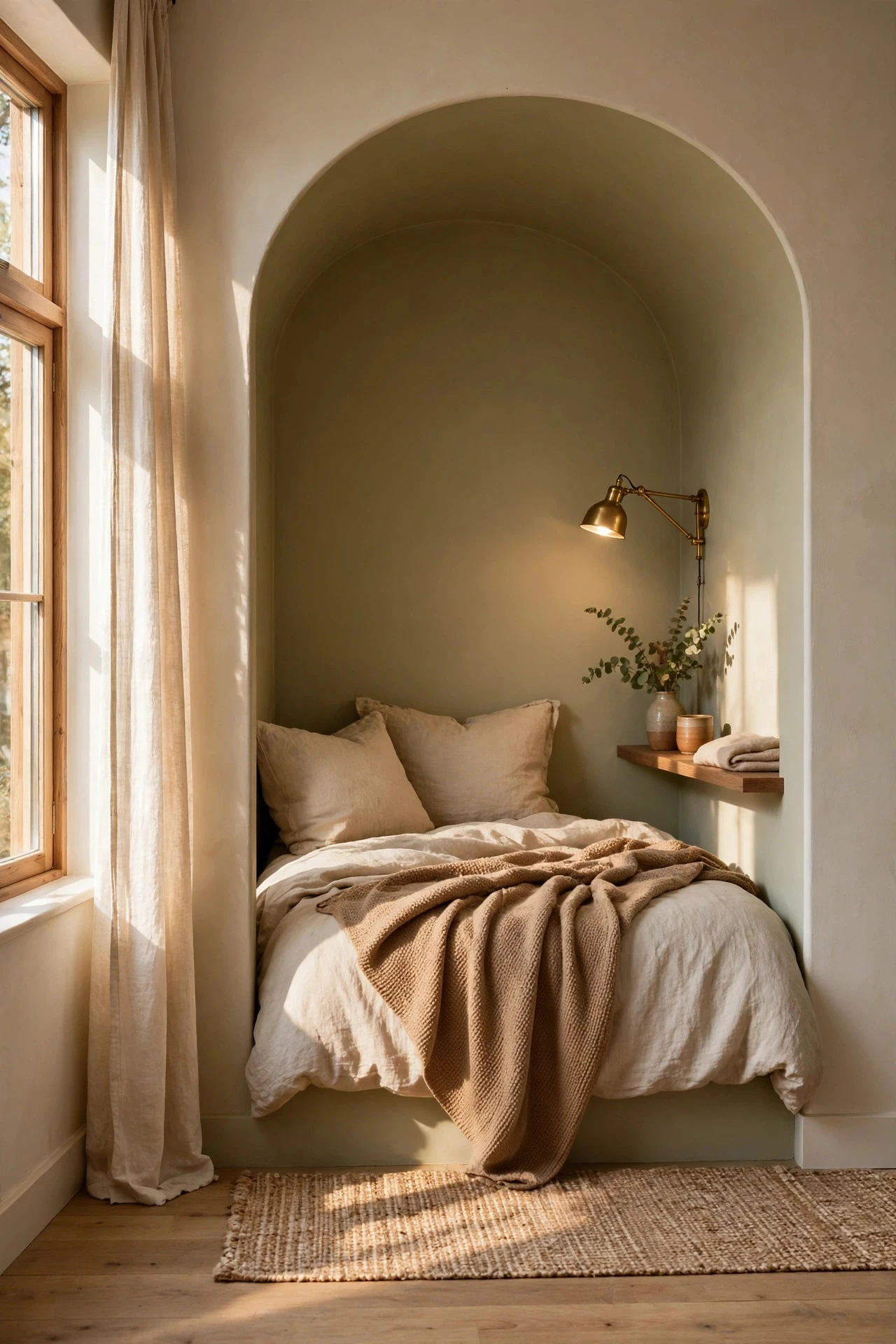
Tuck the bed into a nook, alcove or chimney-breast recess, because an awkward recess becomes a feature when it is treated as a sleeping niche rather than dead space. Measure carefully: a twin needs 40 inches of width, a full needs 56 inches, and at least 80 inches of length, plus room to stand beside it. Paint the alcove the same colour as the walls, or one shade deeper for a cocooning effect, add a wall reading light and a shelf at pillow height, and use a ceiling-track curtain to close the nook at night. A made-to-measure alcove frame costs $500 to $1,400, while a standard frame pushed into the recess costs $300 to $900. The mistake to avoid is forcing a bed that is wider than the recess, which traps bedding against the walls and makes changing sheets a daily struggle.
5. Build Storage Up the Wall, Not Across the Floor
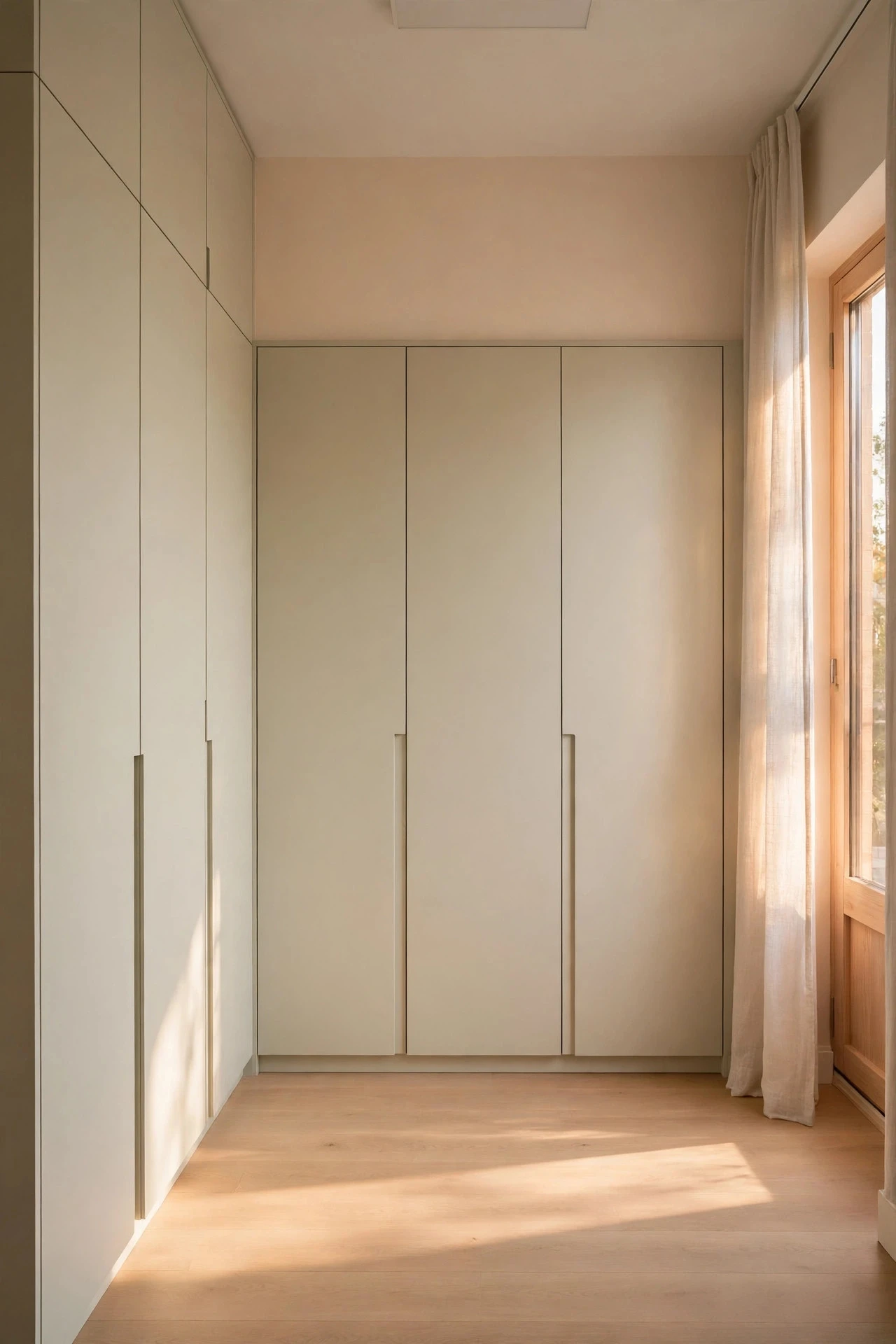
Build storage up the wall with floor-to-ceiling wardrobes or tall shelving, because vertical storage gives a small bedroom far more capacity than a wide chest of drawers while keeping the floor clear and the room feeling open. Choose wardrobes 24 inches deep, in pale paint or light oak matching the walls, with flush handles so nothing snags bedding in a tight walkway. Inside, combine a hanging rail at 66 inches high, shelves above it, and drawers or baskets below, and leave a small gap at the top rather than cramming storage to a low ceiling. Expect $800 to $2,500 for a fitted run and $400 to $1,200 for freestanding tall units. The mistake to avoid is adding a tall unit on every wall, which turns the bedroom into a corridor of furniture and blocks the light the room needs.
6. Work With a Sloped Ceiling Instead of Fighting It

Work with a sloped ceiling by placing the bed or low storage under the lowest part of the slope, where standing height is not needed, and keeping the tallest part of the room open for dressing and movement. The bed head can sit under a ceiling as low as 48 inches if you can sit up, while wardrobes and walkways need at least 72 inches, so map the slope at 12-inch intervals first. Use low, wide furniture under the slope, such as a 14-inch-high bench or drawers 18 inches high, paint slope and walls the same pale colour so the ceiling line disappears, and add a light where the ceiling is highest. Expect $200 to $700 for low under-eaves storage. The mistake to avoid is placing a tall wardrobe against the slope, which leaves a triangular gap above it that collects dust and makes the room feel smaller.
7. Solve a Narrow Room by Turning the Bed Across It
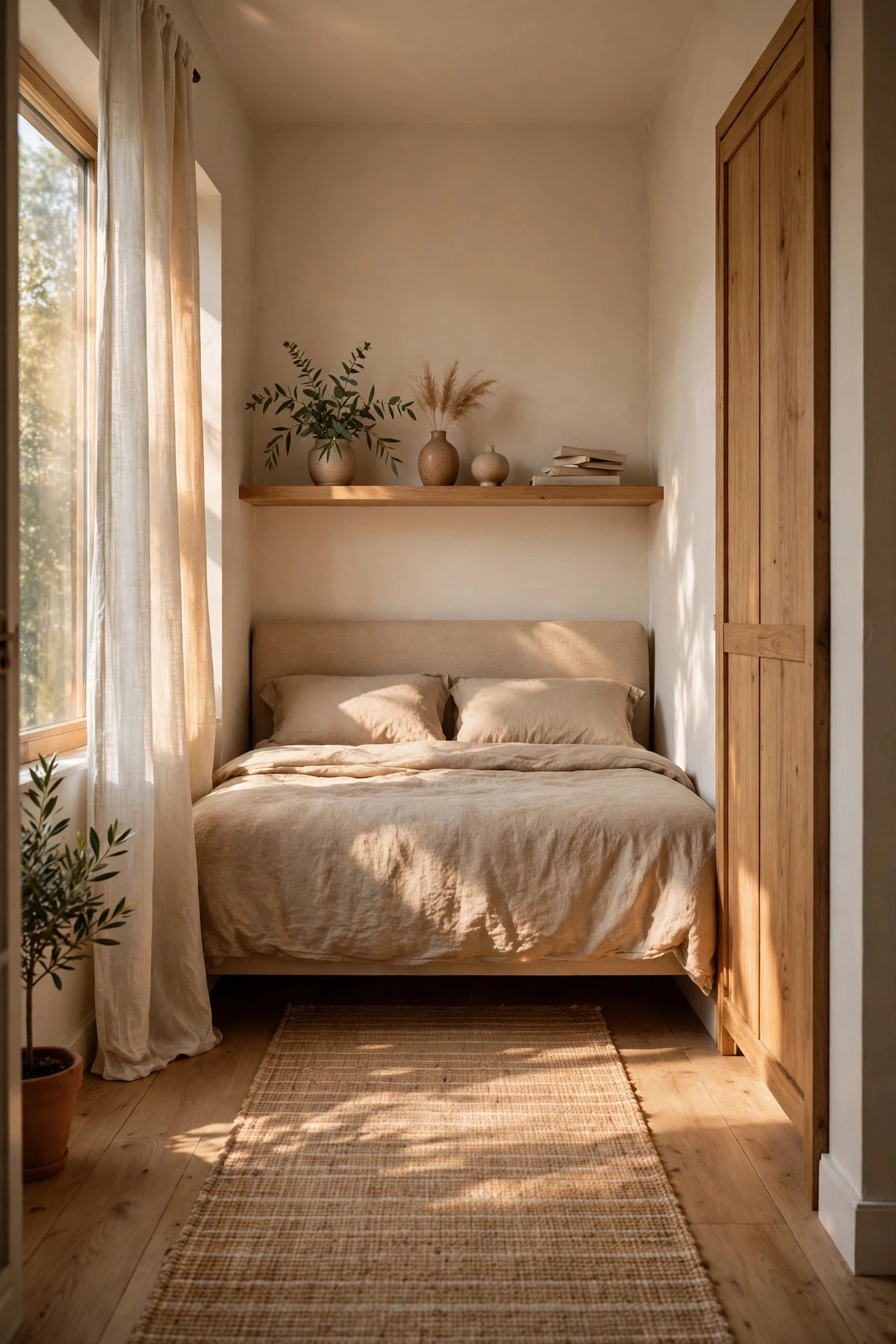
Solve a narrow room by turning the bed across the short wall, headboard against the narrow end, because a bed placed along the long wall in a narrow room leaves two useless strips and no proper walkway at all. It works best when the room is at least 96 inches wide, giving a queen bed a usable passage on one side, or a full bed a route on both sides. Replace nightstands with a floating shelf 18 inches wide, run a rug lengthways under the bed to stretch the room, and use vertical art or a tall mirror on the long wall to balance proportions. A floating shelf costs $40 to $120, and wall-mounted lights cost $60 to $180 each. The mistake to avoid is centring a large bed in a narrow room with equal gaps on both sides that are too tight to use, which wastes space on both sides instead of creating one good walkway.
8. Make a Box Room Work With a Small Double and One Job Per Wall
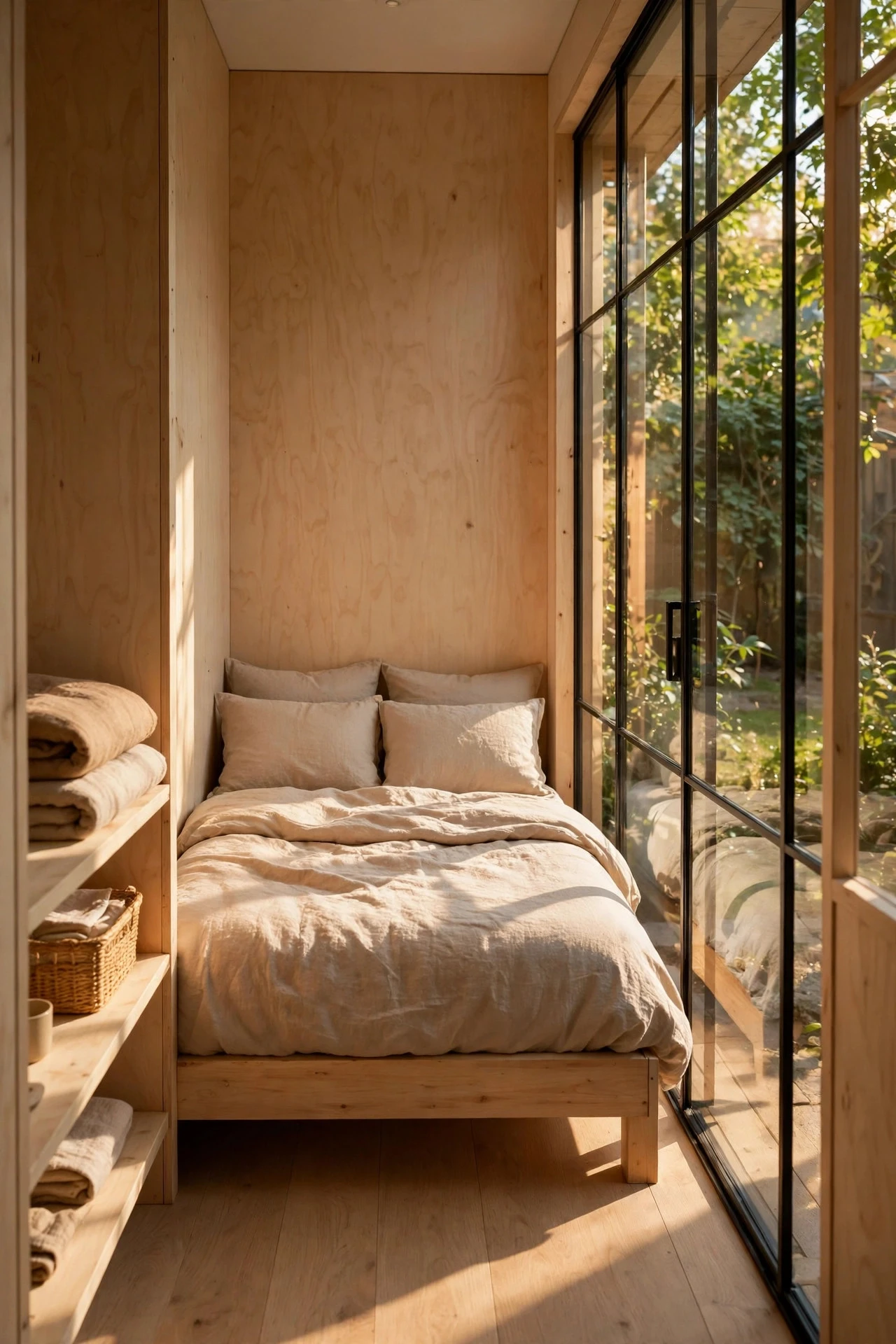
Make a box room work by choosing a small double bed, 48 to 54 inches wide, and giving each wall one clear job, because a room under 100 square feet cannot carry a queen bed, a wardrobe, a desk and a dressing table all at once. Let one wall hold the bed, the opposite wall hold shallow storage no deeper than 16 inches, and the third wall hold a mirror and a hook rail, leaving the door wall clear. A low frame without a footboard saves 4 to 6 inches, pale linen bedding keeps the bed from dominating the room, and a bedside shelf replaces a nightstand that would block the door. Expect $350 to $900 for a small-double frame and $150 to $500 for shallow storage. The mistake to avoid is buying a standard queen bed for a box room, because it leaves no room to open drawers, dress, or walk past the foot of the bed without turning sideways.
9. Double the Light With a Large Mirror in the Right Place
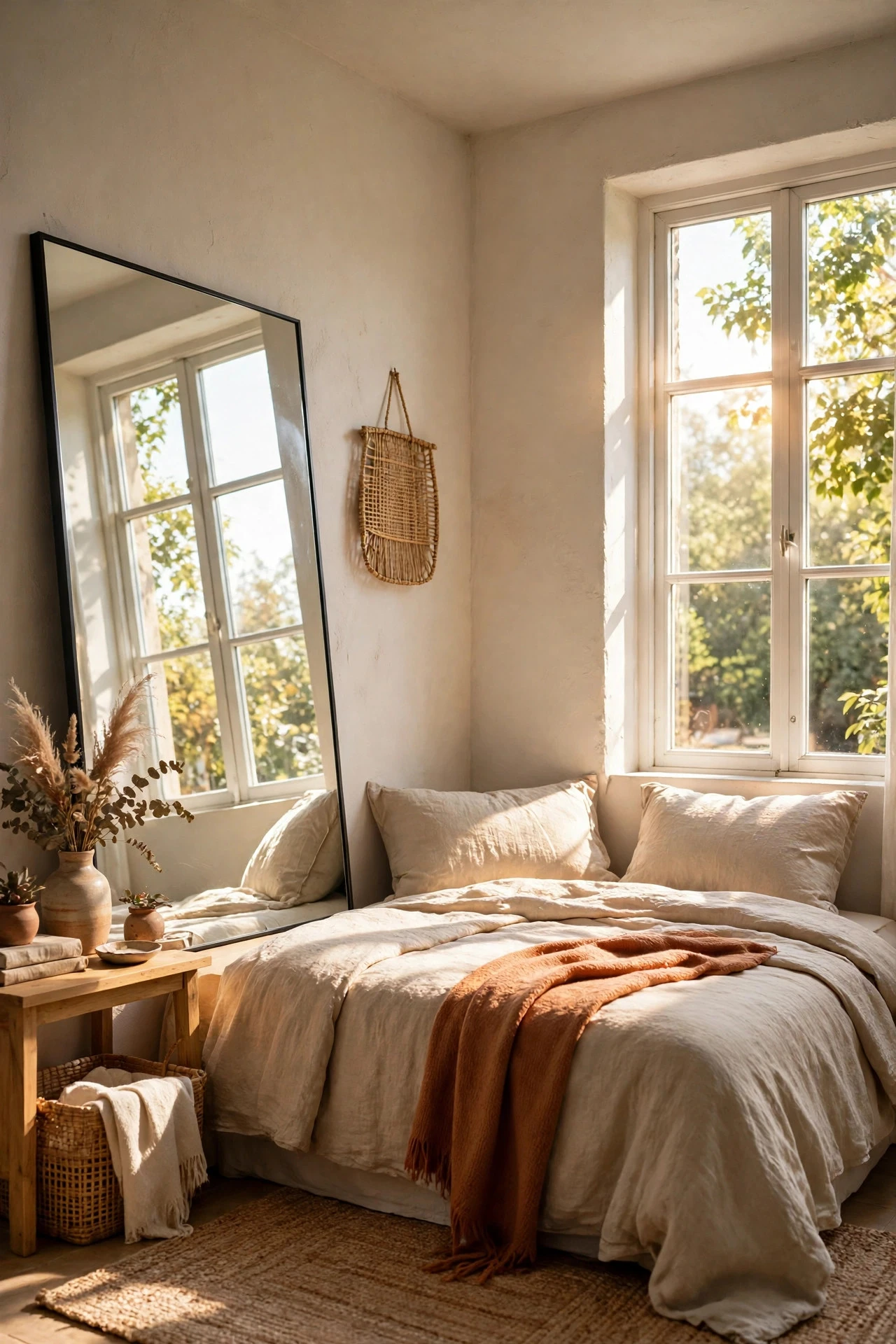
Double the light in a small bedroom with one large mirror placed opposite or beside the window, because a mirror that reflects daylight makes the room feel wider, brighter and less boxed in. Choose a mirror at least 36 inches wide and 48 inches tall, lean it against the wall or hang it with its centre at about 60 inches from the floor, and keep the glass free of clutter in front of it so it reflects light and a calm view rather than a pile of clothes. A slim brass, black or oak frame suits most small rooms, an arched top softens hard rectangles, and a mirrored wardrobe door achieves the same effect while hiding storage. Expect $120 to $450 for a large leaning mirror and $300 to $900 for mirrored wardrobe doors. The mistake to avoid is hanging several small mirrors on different walls, which fragments the reflection and looks busy.
10. Free the Nightstand With Wall-Mounted Lighting
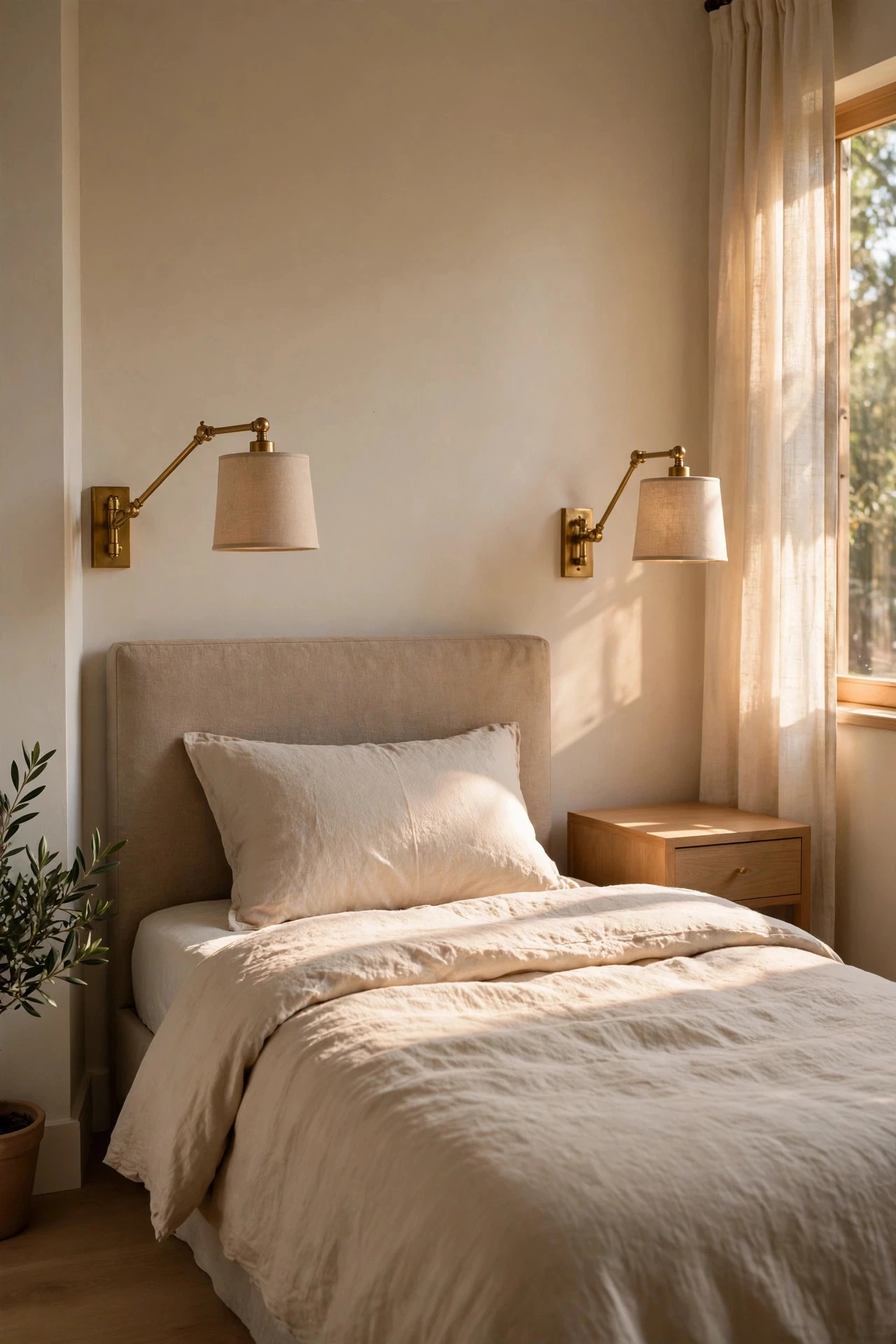
Free up precious nightstand space with wall-mounted sconces or swing-arm reading lights, because in a small bedroom the surface beside the bed is often the only place for a phone, a glass of water and a book. Mount sconces 55 to 60 inches from the floor, about 12 inches above the pillow, extending 8 to 12 inches from the wall so light falls on the book, and choose warm 2700K bulbs on a dimmer. Swing-arm lights suit awkward walls and corners, while a plug-in sconce avoids rewiring in a rental. Expect $60 to $220 per sconce, plus $80 to $200 for hardwiring if needed. The mistake to avoid is choosing a large pendant or table lamp that eats the only surface beside the bed, forcing essentials onto the floor where they are knocked over in the dark.
11. Use One Pale Palette With a Single Deeper Accent
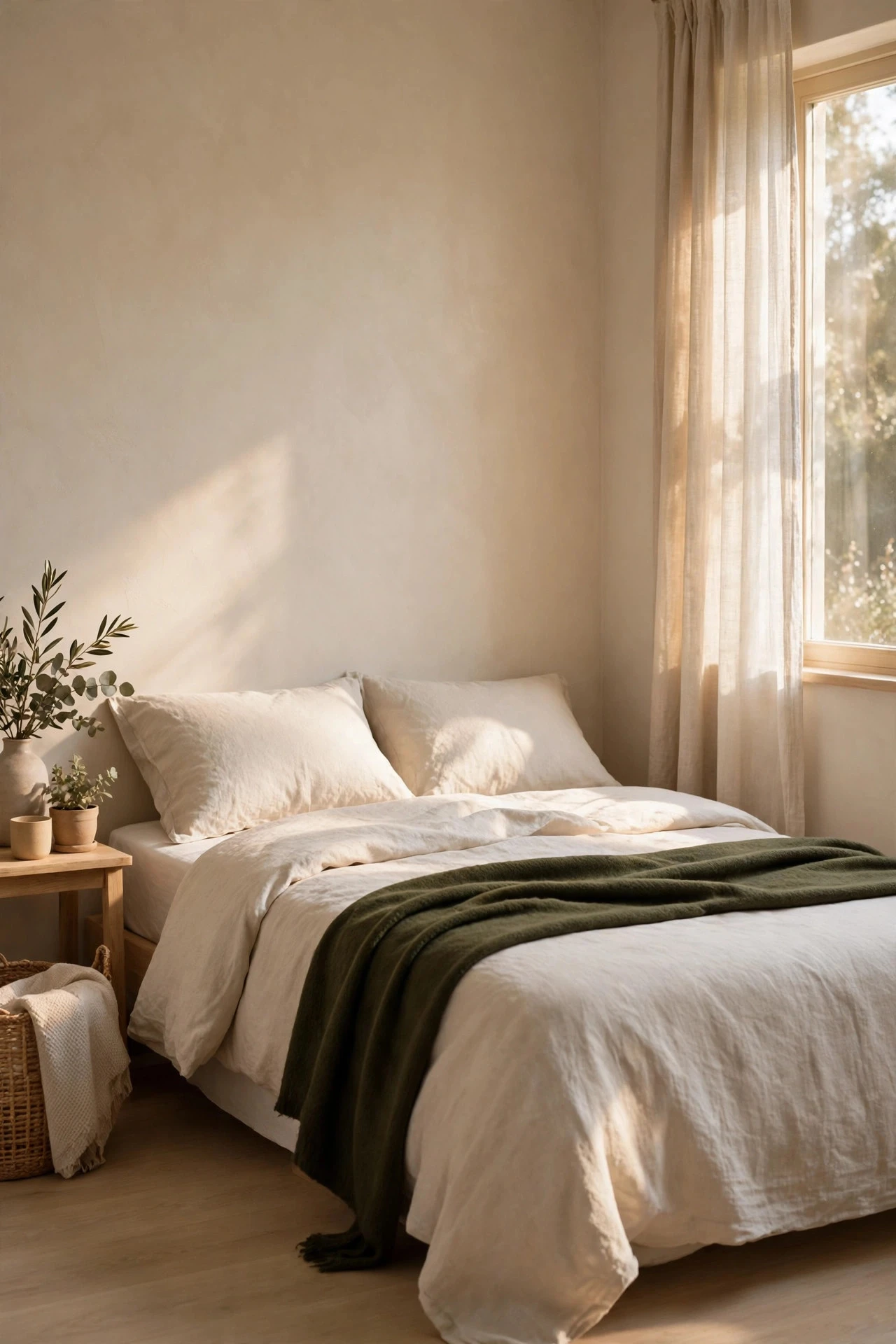
Use one pale, warm palette across walls, bedding and large furniture, with a single deeper accent colour, because a small awkward room feels calmer and larger when the eye is not stopped by a dozen competing colours. Choose warm white, pale greige or soft sage for the walls, repeat the tone in the headboard and curtains, then add one accent — deep olive, dusty blue or walnut — kept to about 10 percent of the room. Paint skirting boards and doors the same colour as the walls to blur the edges, and keep bedding mostly plain, letting texture — washed linen, waffle cotton or a knitted throw — do the decorative work. Paint costs $40 to $90 per gallon, and bedding sets cost $80 to $250. The mistake to avoid is painting each wall a different colour to define zones, which chops an awkward room into even smaller pieces and highlights every uneven angle.
12. Stretch the Room With Rug Direction and Vertical Pattern
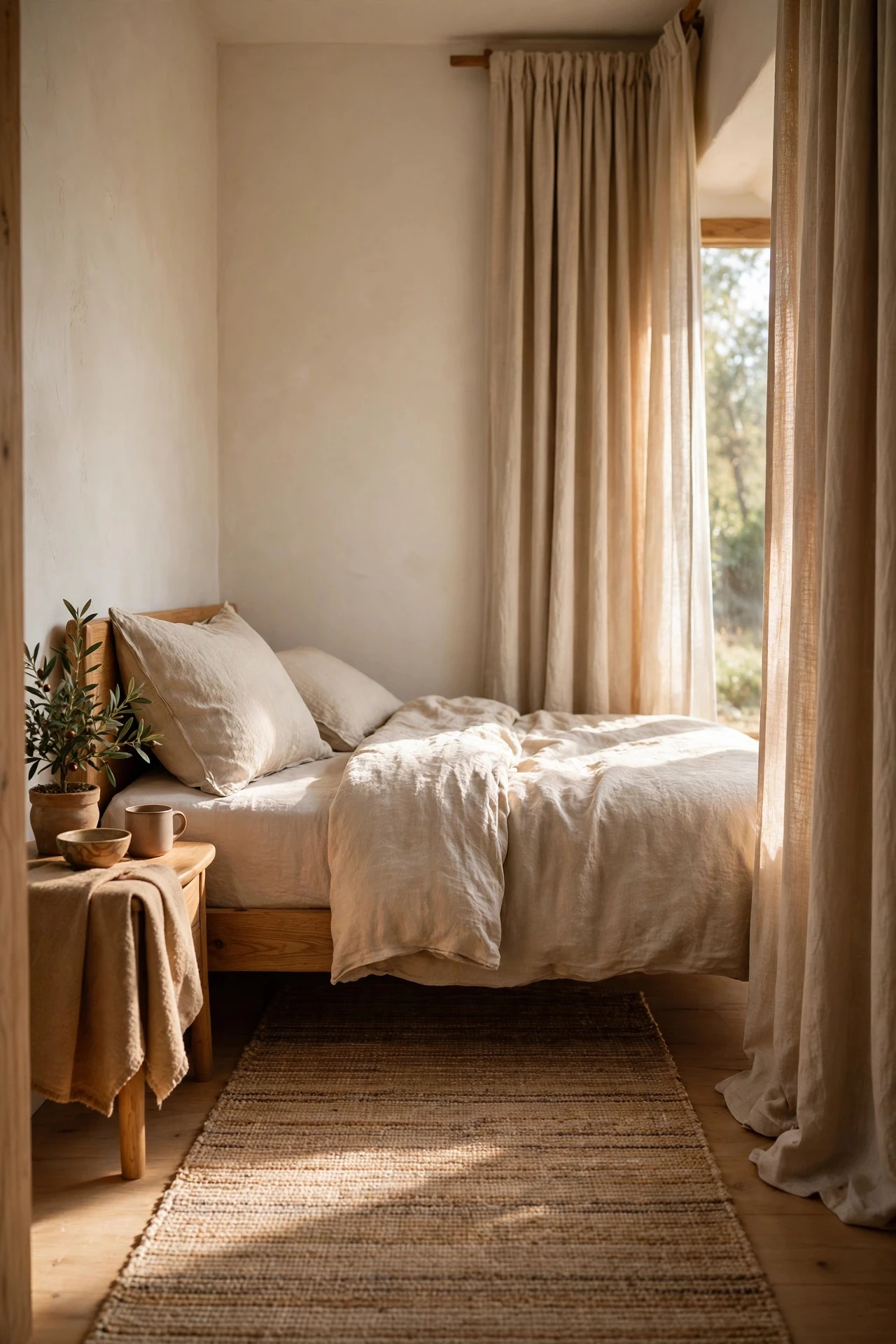
Stretch a small bedroom visually by running a rug lengthways, from the head of the bed towards the door, and by using vertical pattern sparingly on curtains or a headboard wall. A rug should extend at least 18 inches beyond each side of the bed, or 24 inches in a room where space allows, so feet land on softness and the floor reads as one continuous plane rather than a patchwork of bare boards. Choose a low-pile wool or cotton rug in a pale tone with a subtle stripe, keep the pattern scale small, and let matching curtains hang from ceiling to floor to draw the eye upwards. Expect $150 to $600 for a 5-by-8-foot rug and $80 to $250 for ready-made floor-length curtains. The mistake to avoid is using a rug that is too small for the bed, which floats in the middle of the floor, makes the bed look oversized, and breaks the room into disconnected islands.
13. Hang Curtains From the Ceiling to Make the Room Feel Taller
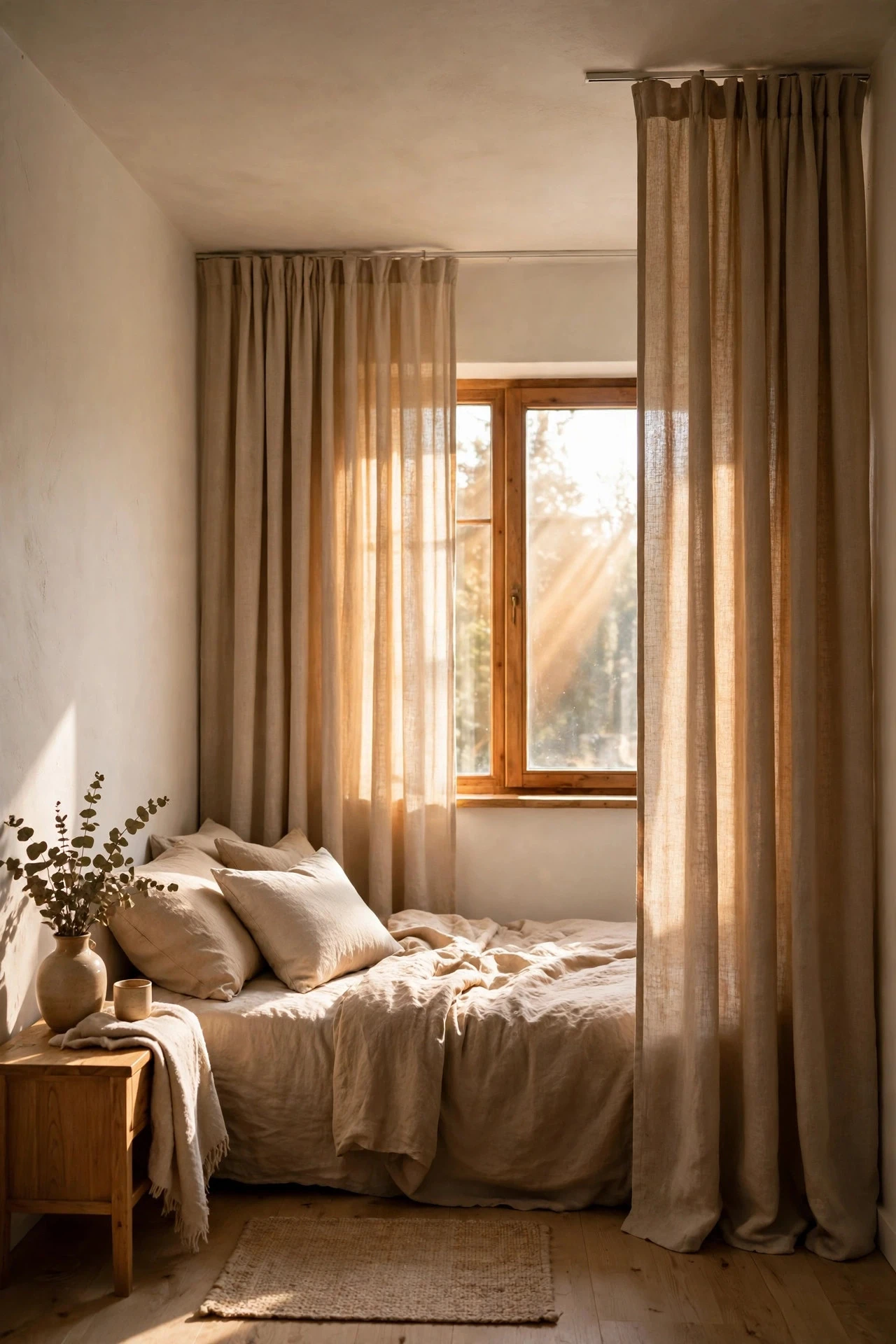
Hang curtains from a ceiling track or a rod fixed just below the ceiling line, because floor-length curtains that start at the ceiling make a low or awkward bedroom feel taller and hide uneven window heights and sloping ceilings. Choose curtains 2 to 4 inches longer than the drop, in a fabric matching the walls, and extend the rod 6 to 10 inches beyond the window so curtains stack clear of the glass. With a sloped ceiling, a ceiling track follows the line more cleanly than a rod, and a sheer layer gives privacy without blocking daylight. Expect $60 to $200 for a ceiling track and $80 to $300 for curtains. The mistake to avoid is hanging short curtains that end at the windowsill, which cut the wall in half, emphasise a low ceiling, and make the window look smaller than it is.
14. Reclaim Space With Sliding, Pocket or Reversed Doors
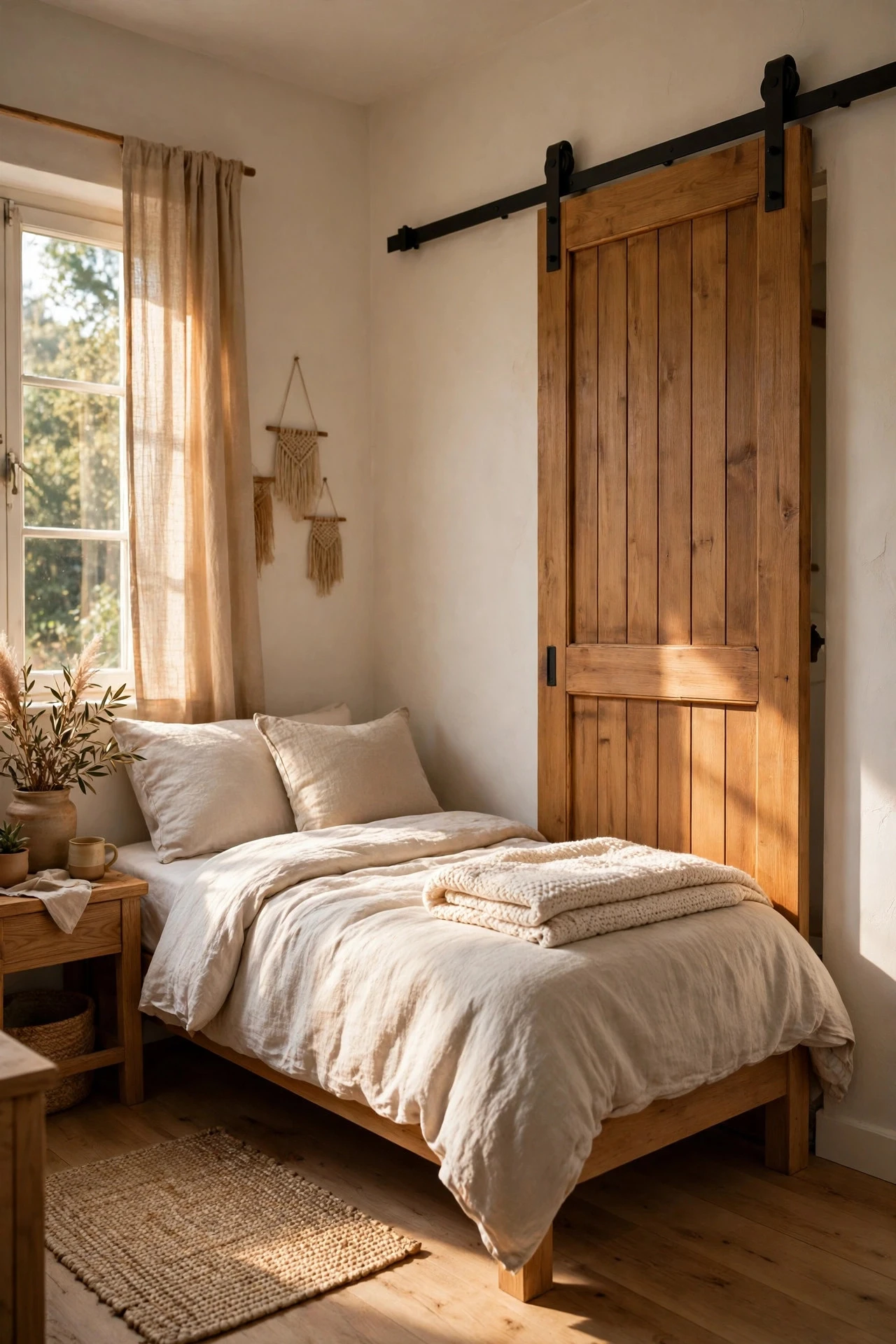
Reclaim up to 10 square feet of usable floor space by replacing a swinging bedroom door with a sliding barn door, a pocket door, or simply reversing the swing so it opens against a wall instead of into the room. A standard door sweeps an arc of about 32 inches, which often collides with the bed or a wardrobe, so measure the swing before planning furniture near it. Sliding doors need a clear wall run of at least twice the door width, pocket doors need a hollow wall and professional fitting, and reversing the hinges is the cheapest fix, often costing nothing but an hour of work. Expect $150 to $500 for a sliding-door kit and $600 to $1,500 for a pocket door installation. The mistake to avoid is planning a wardrobe or bed in the door's swing and discovering the clash only after delivery, when moving the furniture means blocking the only route in and out.
15. Turn Under-Eaves and Dead Corners Into Hidden Storage
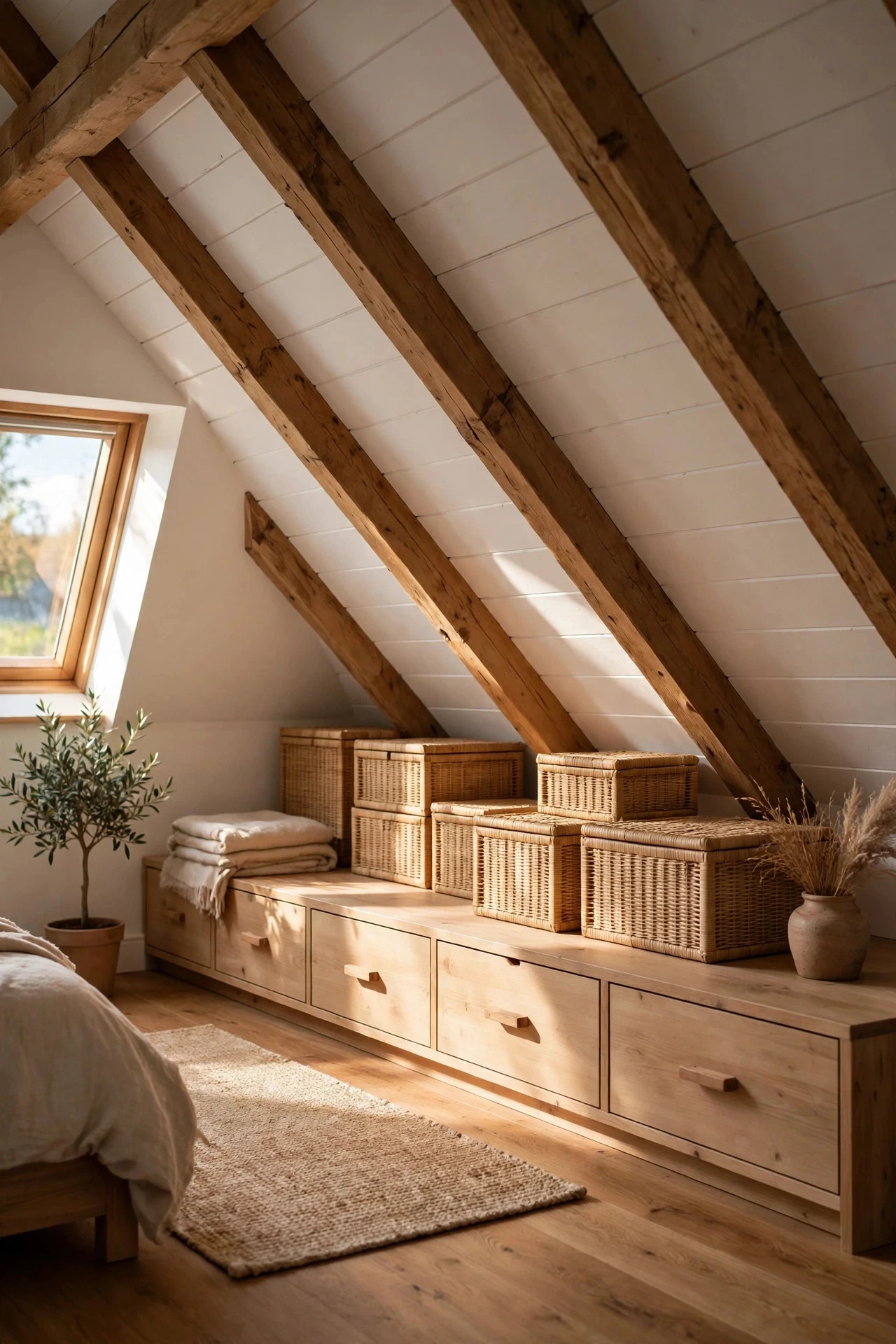
Turn under-eaves space and dead corners into hidden storage with low drawers, lidded boxes or made-to-measure cupboards, because the lowest, most awkward parts of a sloped or L-shaped bedroom are perfect for things you do not need every day. Use drawers 16 to 20 inches high under a slope for out-of-season clothes and spare bedding, label the fronts, and keep them in the same pale finish as the walls so storage reads as architecture, not boxes. In an L-shaped room, the short leg of the L makes an ideal dressing corner with a mirror, a hook rail and a single tall unit, leaving the main rectangle clear for the bed. Expect $200 to $800 for under-eaves drawers and $100 to $350 for quality storage boxes and baskets. The mistake to avoid is leaving under-eaves space open and unused, where it gathers dust, looks unfinished, and tempts you to pile clutter that is always visible from the bed.
16. Choose Furniture That Does Two Jobs in a Small Room
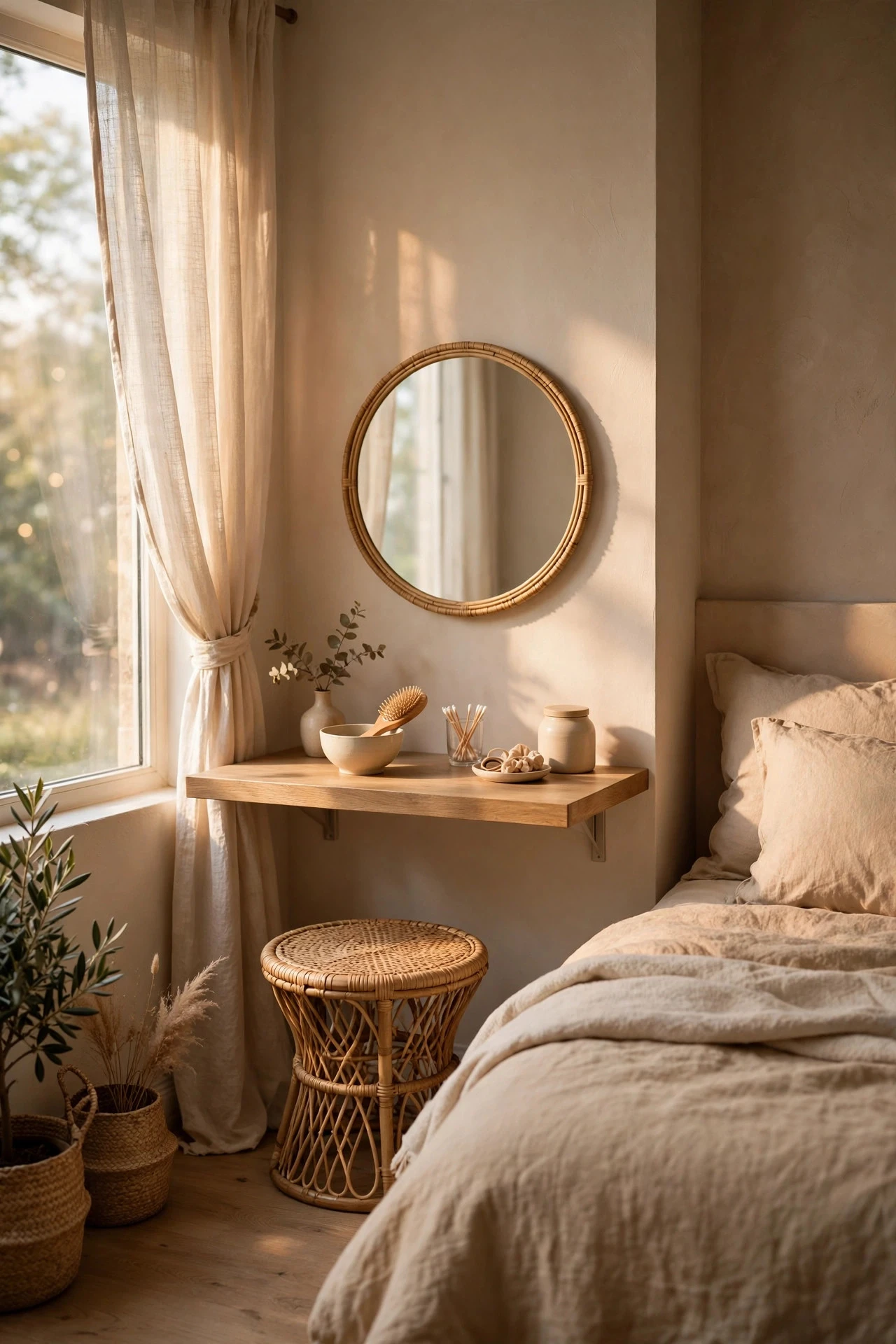
Choose furniture that does two jobs, such as a desk that doubles as a dressing table, a bench with storage at the foot of the bed, or a wardrobe with a fold-down ironing or dressing shelf, because every piece in a small bedroom must earn its floor space twice over. A wall-mounted desk 36 to 42 inches wide, with a mirror above and a stool tucked underneath, works for both work and getting ready, while a 48-inch storage bench holds shoes and throws within reach of the bed. Keep dual-purpose pieces in the same finish as the bed frame — oak, painted white or walnut — so the room reads as one calm scheme. Expect $150 to $500 for a wall-mounted desk and $120 to $400 for a storage bench. The mistake to avoid is buying a piece that does two jobs badly, such as a desk too shallow to write at or a bench too high to sit on comfortably, which ends up used for neither purpose and only takes up space.
17. Zone a Shared Bedroom Without Building a Wall
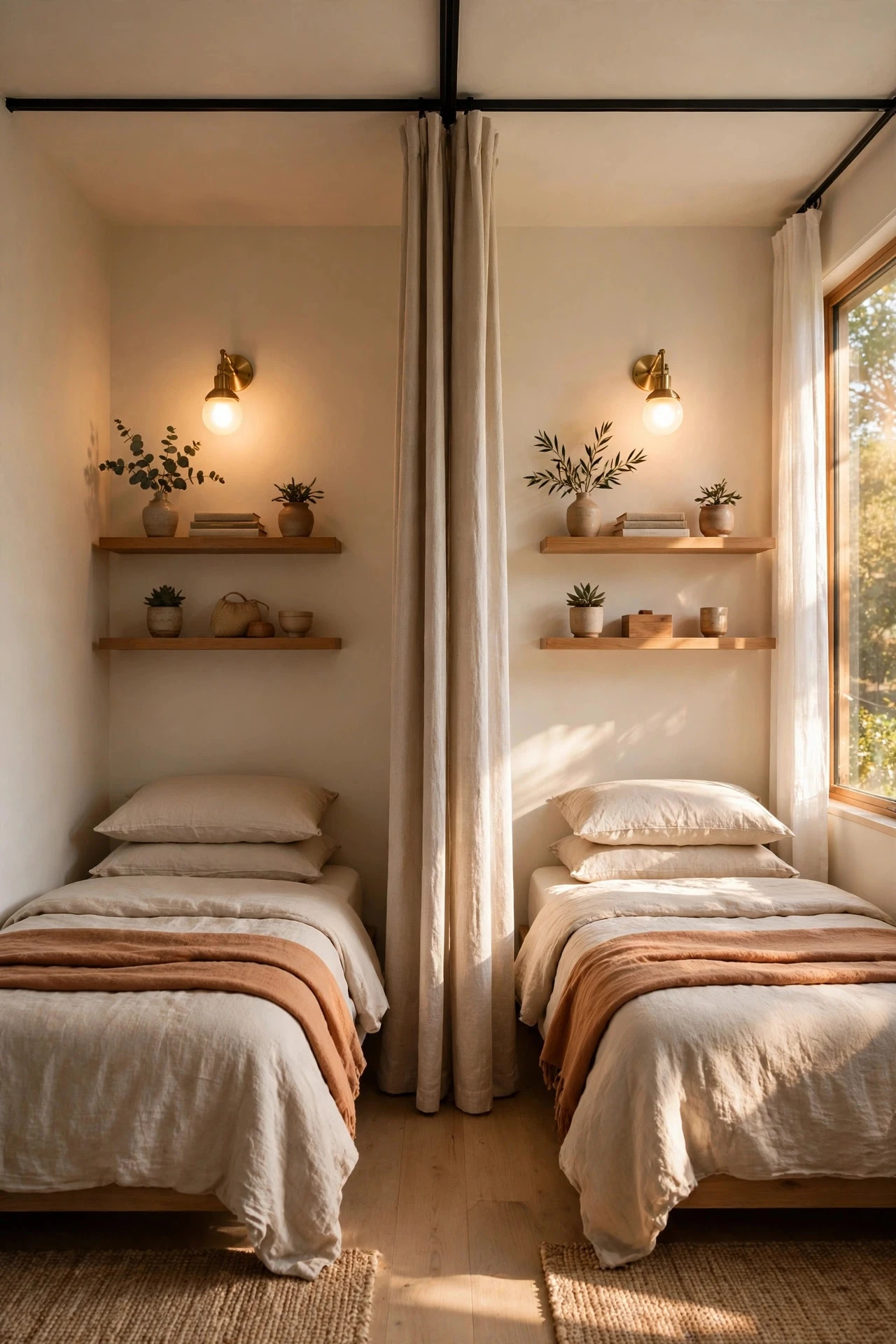
Zone a shared bedroom without building a wall by giving each person a defined side, a personal light and a personal storage spot, so two people sharing a small or awkward room each feel they have a place of their own. Use a rug, a curtain on a ceiling track, or a tall open bookshelf placed at right angles to the wall to suggest a division without blocking light, and repeat the trick on both sides: a wall light, a shelf, a hook and a basket each, in matching finishes. For siblings or a couple on different schedules, a curtain divider drawn at night costs far less than a partition and can be removed when the room's use changes. A ceiling-track curtain costs $80 to $250, and a bookshelf divider costs $150 to $500. The mistake to avoid is dividing the room with a solid wardrobe placed across the middle, which blocks daylight, traps heat, and makes both halves feel like cupboards rather than bedrooms.
18. Keep Furniture Low and Small in Scale
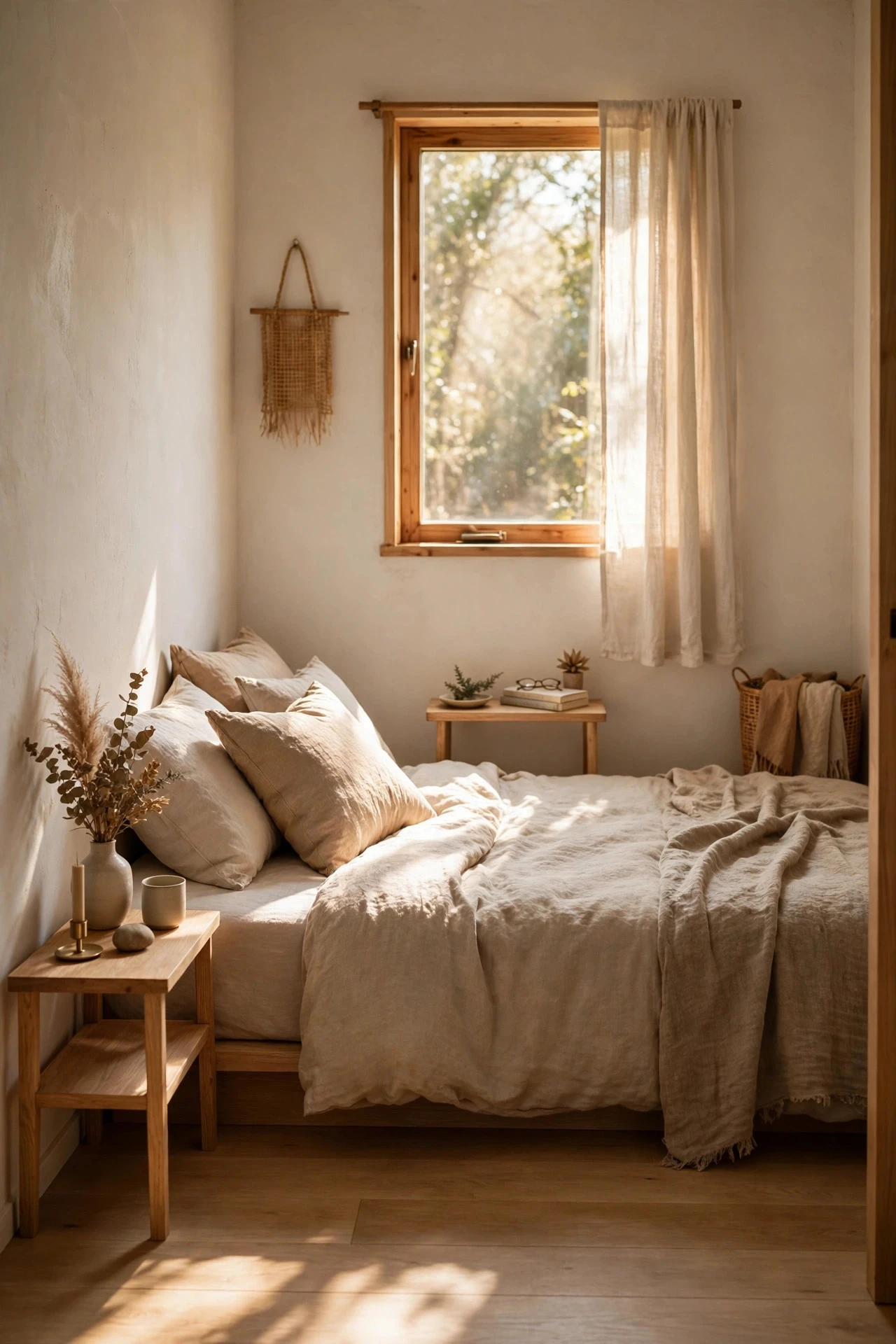
Keep furniture low and small in scale, because oversized, high furniture makes a small bedroom feel crowded even when the floor plan technically fits. Choose a low-profile bed frame 10 to 14 inches high before the mattress, nightstands no wider than 16 to 18 inches, and a dresser no deeper than 16 to 18 inches, with legs or a floating design that lets you see floor underneath, which tricks the eye into reading more space. A headboard 48 to 54 inches high anchors the bed without looming, and one statement piece, such as a sculptural lamp or framed print, gives character without bulk. Expect $300 to $900 for a low-profile frame and $80 to $300 for slim nightstands. For proportion and surface ideas, see these cozy bedroom flooring ideas. The mistake to avoid is importing living-room-scale furniture into a bedroom, where a deep armchair or a wide chest of drawers blocks walkways and leaves no room to actually live in the space.
19. Layer Light for Dark Corners and Windowless Walls
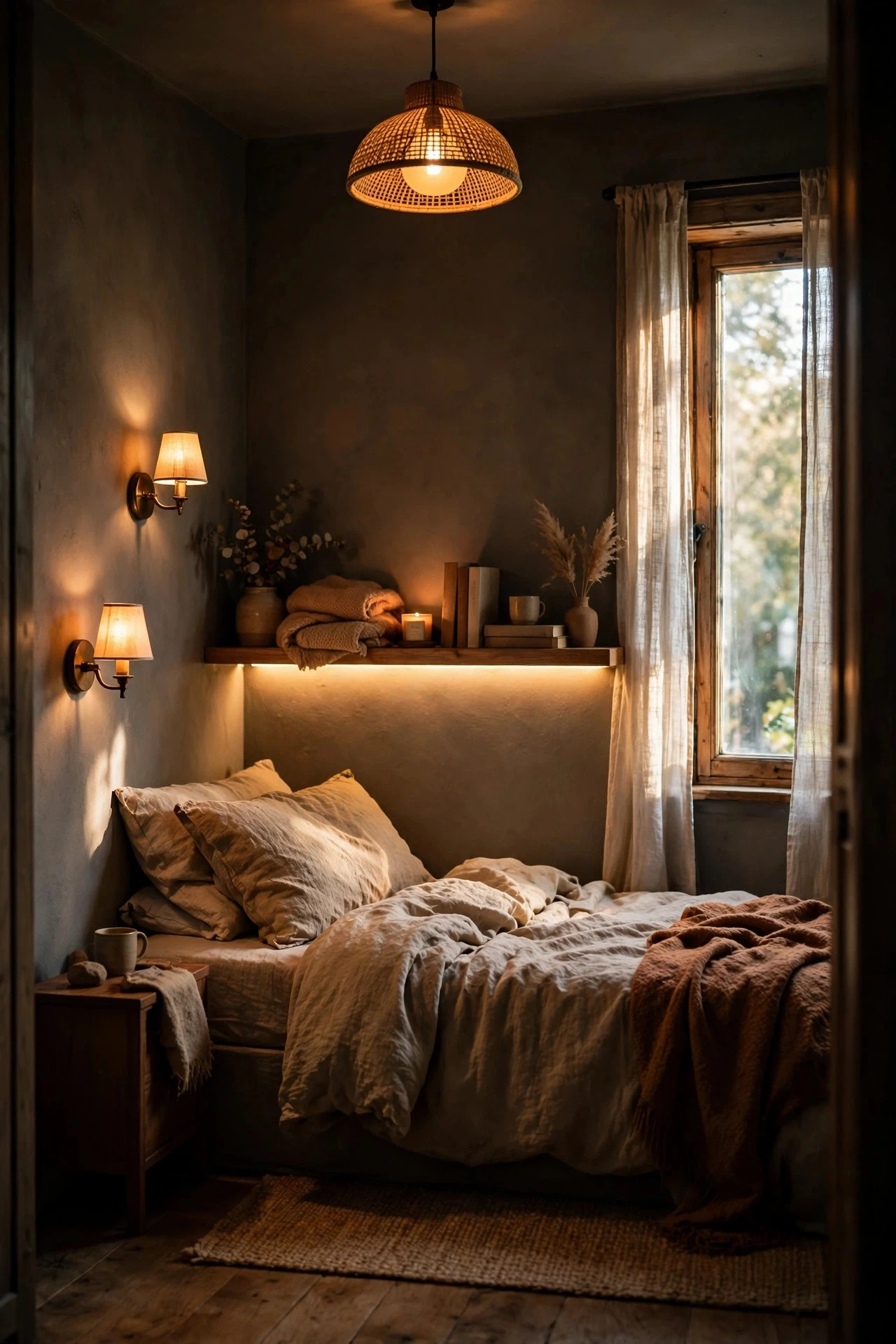
Layer light in a small bedroom with dark corners, a north-facing window or an awkward wall with no window at all, because one ceiling light leaves shadows that make the room feel smaller and gloomier than it is. Combine three layers: a dimmable 2700K ceiling light, wall sconces beside the bed for reading, and a small lamp or LED strip under a shelf for evening glow, all at the same warm temperature so they blend. In a windowless corner, a mirror opposite a light source and a pale wall bounce light further than any single brighter bulb, and a daylight bulb in a dressing mirror helps for getting ready. Expect $100 to $350 for a layered lighting scheme in a small room. The mistake to avoid is relying on a single harsh overhead light, which flattens the room, casts shadows under the eyes in the mirror, and makes an awkward shape look harsher instead of softer.
20. Let the Floor Do the Work With Pale, Continuous Surfaces
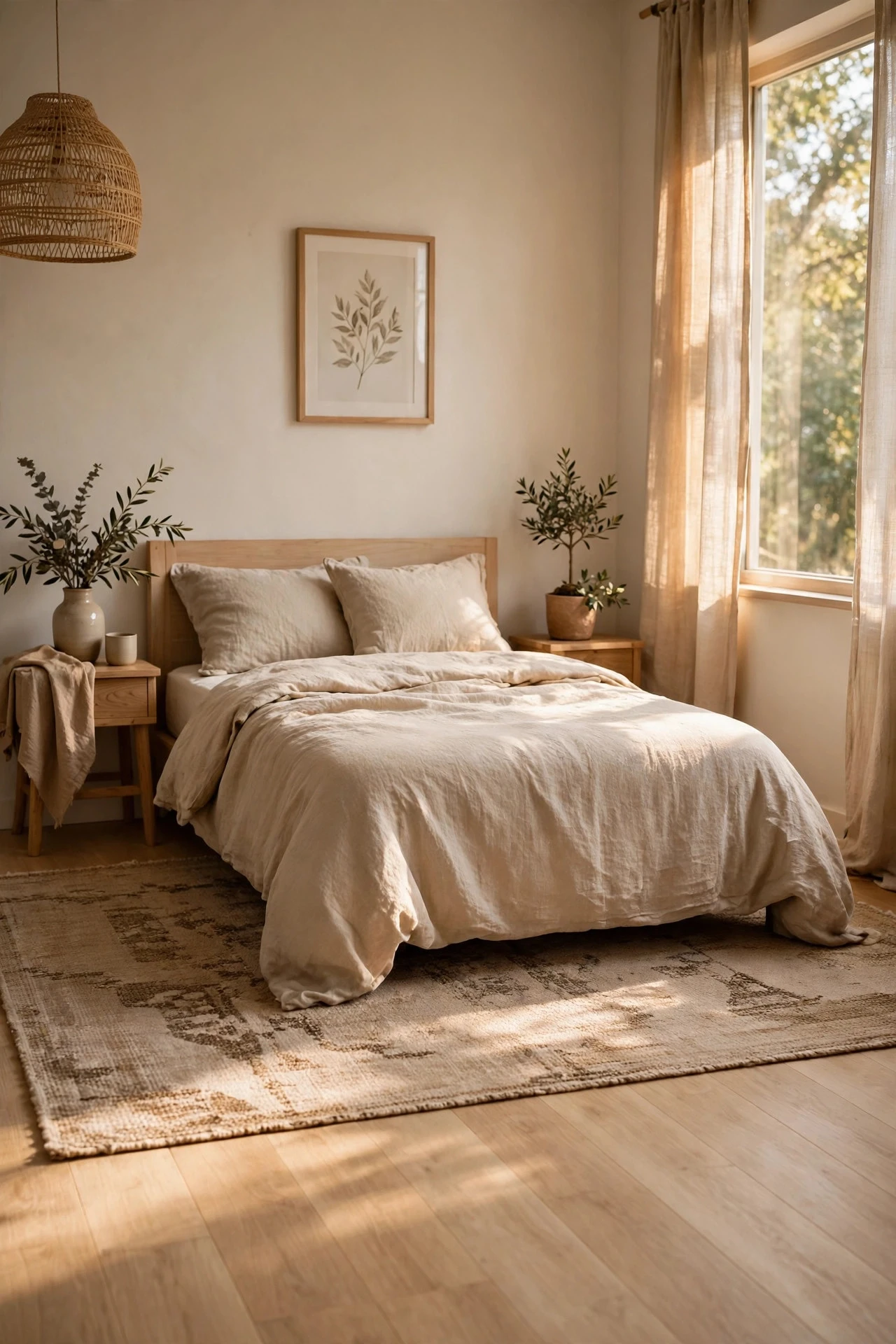
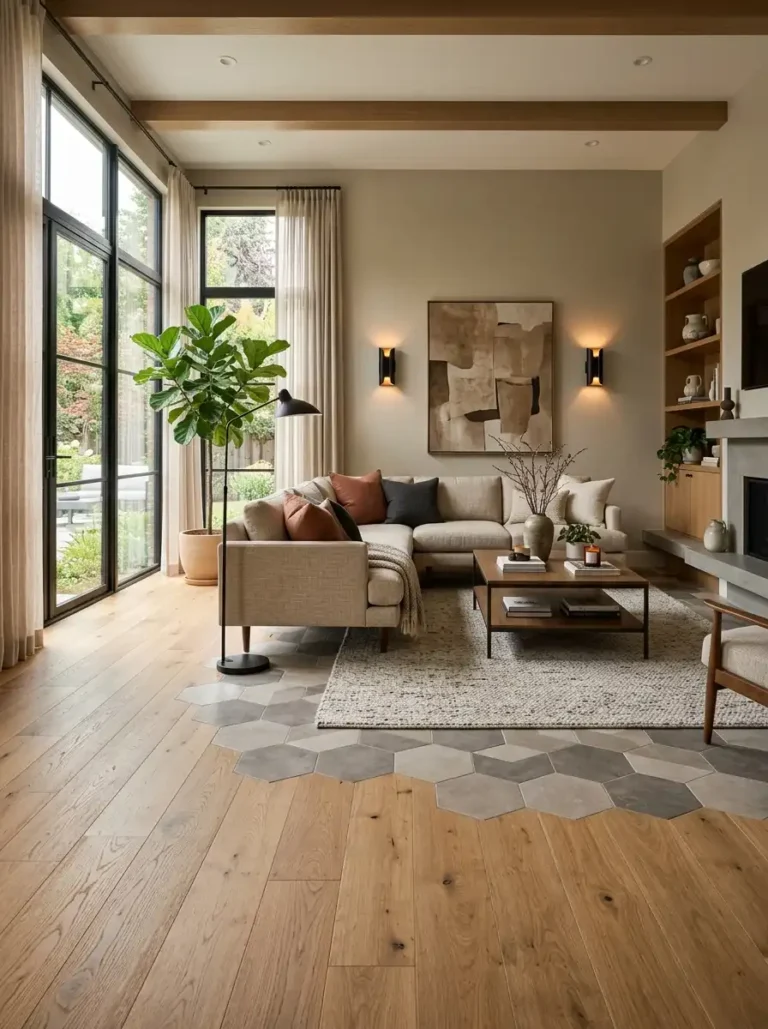
Let the floor do the work in a small bedroom by keeping it pale, continuous and free of thresholds and fussy borders, because a single uninterrupted surface makes the room read as larger than a floor broken into rugs, mats and different materials. Pale oak, washed wood or large-format pale tile all work; if you prefer carpet, choose low-pile, single-tone warm white or pale greige. Run the same flooring into an en-suite where possible, keep skirting slim and painted to match the walls, and use one large rug rather than several small ones. Flooring costs $4 to $12 per square foot installed for wood-look options and $3 to $7 per square foot for carpet. The mistake to avoid is laying dark, busy flooring in a small room and then covering most of it with rugs, which hides the floor you paid for and makes the room feel darker and more fragmented.
21. Hide the Clutter and Show Only One Statement

Hide everyday clutter behind closed doors and show only one statement piece at a time, because a small bedroom looks calm when surfaces are clear and the eye has one place to rest. Give every category a home: clothes in the wardrobe, shoes in the storage bed, chargers in a drawer, laundry in a lidded basket. Then choose one statement to display — a framed print, a sculptural vase, a throw or a single plant — and keep everything else off the surfaces. A lidded laundry basket costs $30 to $90, drawer organisers cost $20 to $60, and a cable-management box costs $15 to $35. The mistake to avoid is displaying five or six decorative objects on every surface in an effort to make the room feel styled, which in a small room reads as clutter and makes the space feel smaller with every added item.
22. Embrace the Awkward Feature and Make It the Focal Point
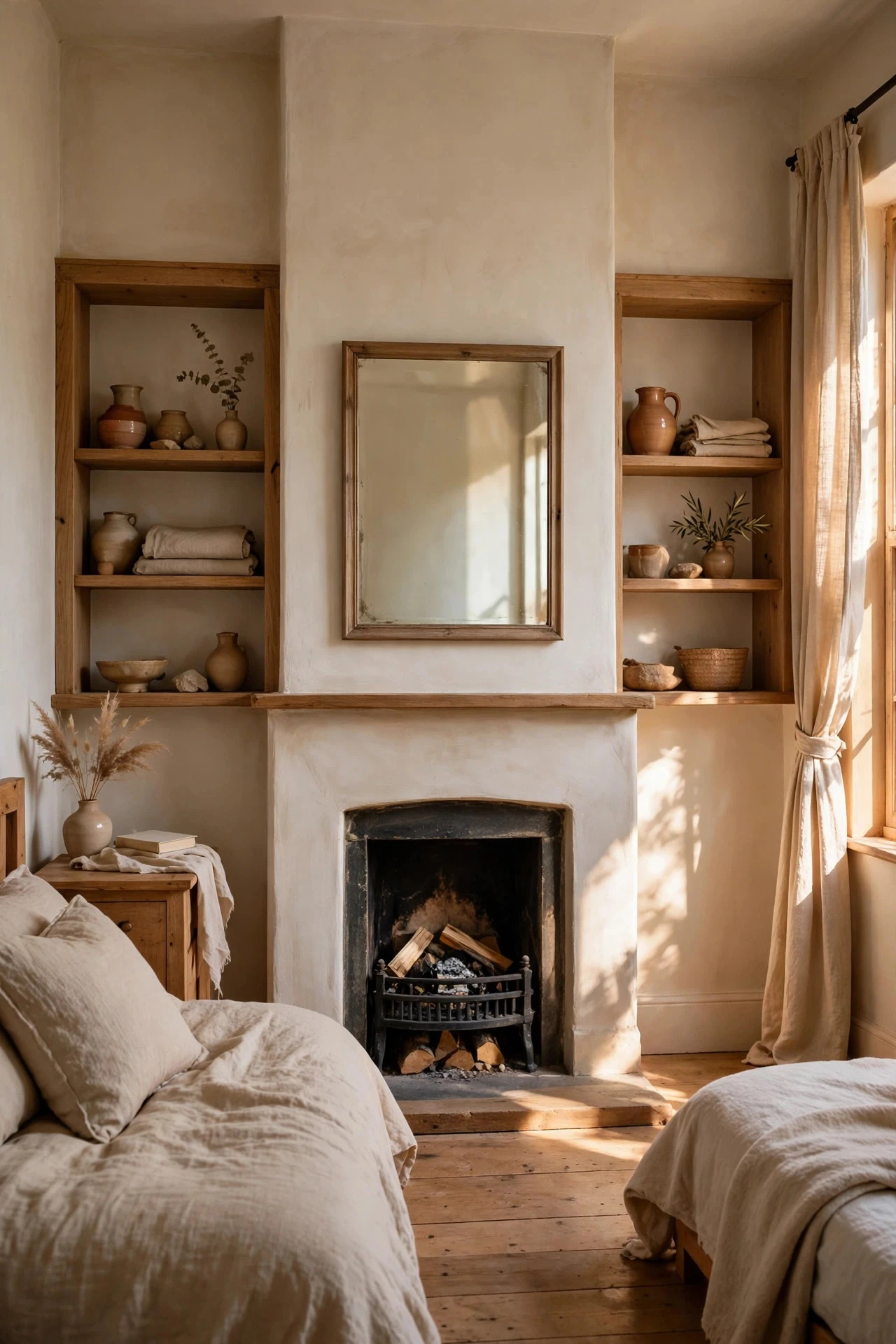
Embrace the awkward feature, whether it is a chimney breast, a protruding beam, a boxed-in pipe or an odd step, and make it the focal point instead of trying to hide it. Frame a chimney breast with matching shelves and a picture light, paint a beam the same colour as the ceiling so it reads as architecture, or turn a boxed-in section into a display ledge with a vase and a book. With a step or split level, use the height change to define the sleeping zone, bed raised and storage below, and mark the edge safely with a low rail or a change of flooring. Framing shelves cost $200 to $600, and a picture light costs $50 to $150. A calm, natural palette helps an awkward feature settle in, as these Mediterranean bedroom design ideas show. The mistake to avoid is covering every awkward feature with furniture pushed hard against it, which hides the architecture, wastes the nook, and leaves the room feeling both cluttered and unfinished.
Practical Tips
Plan in three budget tiers, so layout and storage come first. At $200 to $600, focus on taping the layout, a storage bed or under-bed boxes, wall lights, a large mirror and pale paint, which change how the room feels without building work. At $800 to $2,000, add floor-to-ceiling storage, a sliding or reversed door, floor-length curtains and a properly sized rug, and at $2,500 to $6,000, consider fitted under-eaves storage, a pocket door or a made-to-measure alcove bed. Before a large purchase, compare sizing guidance in The Spruce bedroom guides and check the piece matches the measurements taped on the floor, not just the product page.
Measure and plan on paper before you buy anything, because a small awkward room punishes guesswork more than a large room ever will. Draw the room to scale, marking the door swing, window, radiator, sockets and ceiling slope at 12-inch intervals, then move paper templates for bed, wardrobe and drawers until walkways, drawer openings and the door-to-window route all work. Photograph the taped layout from the doorway and check it at night as well as in daylight, since a layout that works in bright light can feel cramped once lamps are on. Keep one list of every measurement.
Keep the room calm and uncluttered by giving everything a home, limiting open storage to items that look good on display, and reviewing the room once a season to remove what has crept back in. Keep laundry in a lidded basket, chargers in a drawer, and do a two-minute evening reset so the room feels spacious every morning. For fresh inspiration, browse Houzz bedroom ideas for real small rooms with the same awkward shapes, save ones matching your ceiling height and width, and adapt one idea at a time rather than copying a whole room photographed in a larger space.
Final Thoughts
A small or awkward bedroom becomes a favourite room when its shape is treated as a brief, not a problem: measure first, put bed and storage where height and light allow, build upwards, and let pale colour, good lighting and clear surfaces do the quiet work. Start with layout and one storage solution, live with it for a few weeks, and add the next idea only when you can name what is still missing.
You May Also Like: – 24 Cozy Bedroom Design Ideas to Create a Peaceful and Stylish Retreat – 20 Beautiful Bedroom Bench Ideas for a More Elegant Space – 22 Master Bedroom Decor Ideas for a Calm Elegant Retreat
Frequently Asked Questions
Where should the bed go in a small, awkward bedroom?
Place it against the longest unbroken wall, centred where possible, with 24 to 30 inches of clear space on at least one side for getting in and out. In a narrow room, turn it across the short wall instead. Avoid blocking the window or the door swing, and tape the footprint on the floor before buying.
What size bed fits a box room?
A small double, 48 to 54 inches wide, usually fits a box room best, leaving room to walk, dress and open storage. A twin, 38 inches wide, suits a single sleeper or a child's room. Measure the wall, allow 24 inches beside the bed, and choose a low frame without a footboard to save length.
How do I use space under a sloped ceiling?
Put the bed head or low storage under the lowest part of the slope, where standing height is not needed, and keep walkways and wardrobes where the ceiling is at least 72 inches high. Use drawers 16 to 20 inches high, paint slope and walls the same pale colour, and add light where the ceiling is highest.
How can I add storage without bulky wardrobes?
Use a storage bed for bedding and seasonal clothes, floor-to-ceiling wardrobes in a pale finish that matches the walls, and under-eaves drawers for items you rarely need. Add baskets inside wardrobes, a storage bench at the foot of the bed, and hooks behind the door for robes and bags.
What colours make a small, awkward bedroom feel larger?
Warm white, pale greige and soft sage make a small room feel larger, especially when walls, skirting and doors share the same colour so edges disappear. Add one deeper accent, such as olive or dusty blue, in throws and cushions only, and keep bedding mostly plain so texture, not pattern, adds interest.
How do two people share a small bedroom comfortably?
Give each person a side with their own wall light, shelf, hook and basket, and use a curtain, rug or open bookshelf to suggest a division without blocking daylight. Keep shared storage in a storage bed or wardrobe, agree where chargers and laundry live, and keep surfaces clear so neither person's belongings spill into the other's space.