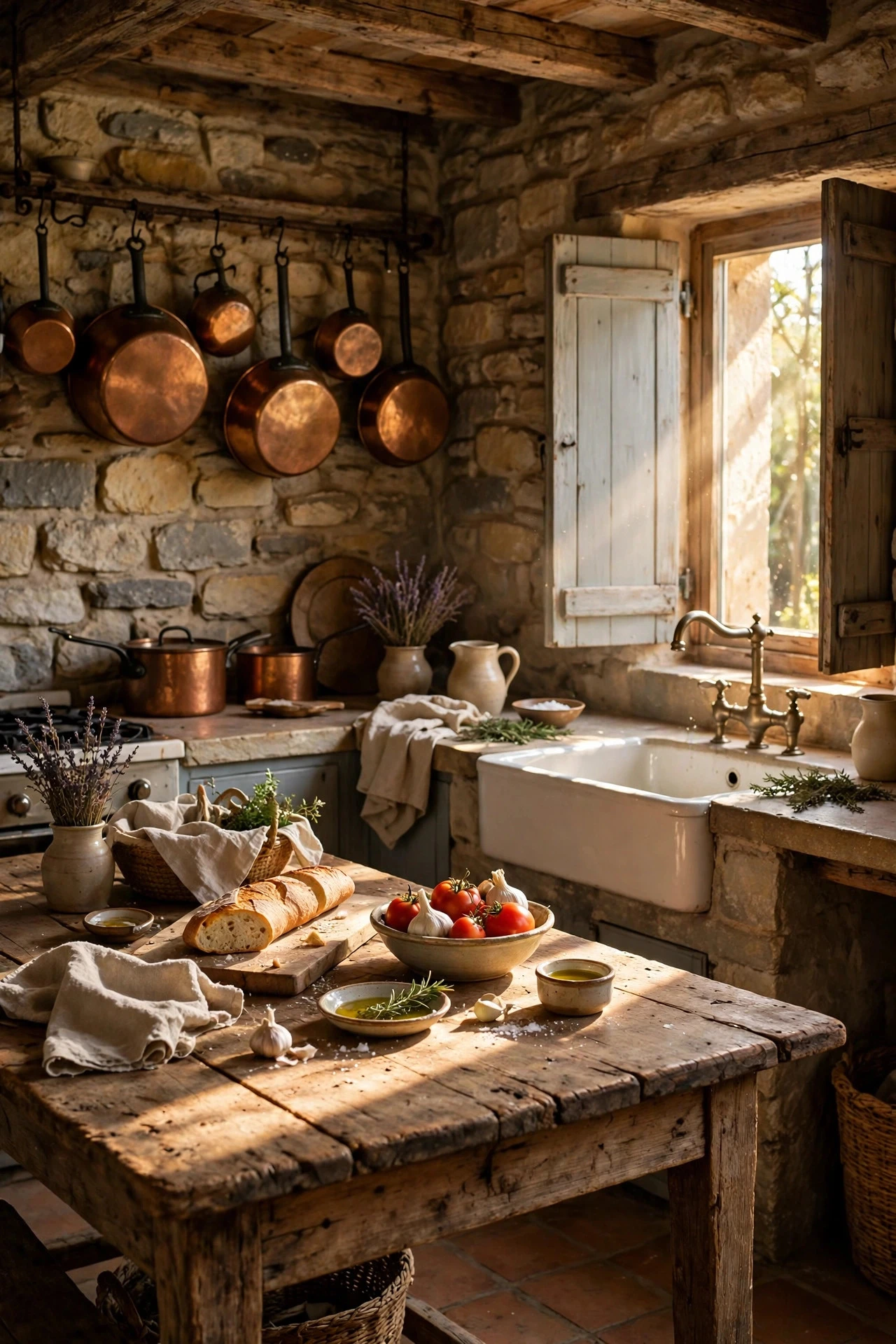
22 French Country Kitchen Ideas for a Warm, Elegant Heart of the Home
# 22 French Country Kitchen Ideas for a Warm, Elegant Heart of the Home
A French country kitchen feels like the heart of a house that has been loved for generations. It is not a showroom — it is a working room with a worn farm table, copper pots that have cooked a thousand dinners, stone that has softened with age, and linen that never looks ironed. The style comes from the farmhouses of Provence and Burgundy, where beauty grew out of usefulness: thick plaster walls kept rooms cool, timber beams held up the roof, and open shelves made everything easy to reach.
Looking for more inspiration? Our Nest Decorz homepage gathers the latest home decor ideas, seasonal decorating guides and room-by-room styling tips in one place — start there and explore.
Quick Answers
– Colours that define it: warm white plaster, dusty blue, sage green, soft cream, terracotta, and touches of muted lavender — never bright or glossy. – The single most French element: an apron-front farmhouse sink, ideally with a linen skirt beneath it instead of a cabinet door. – Budget starting point: swap hardware to unlacquered brass, add open shelving, and dress the table with linen and stoneware — no renovation needed. – French country vs English country: French is sun-warmed and Mediterranean (stone, terracotta, lavender, iron), English is cooler and garden-led (floral chintz, painted wood, tweed tones). – Small kitchens: keep the palette pale, use one open shelf instead of upper cabinets, and let a single statement piece — a copper pot rail or a plaster hood — do the talking.
1. What Colours Define a French Country Kitchen?
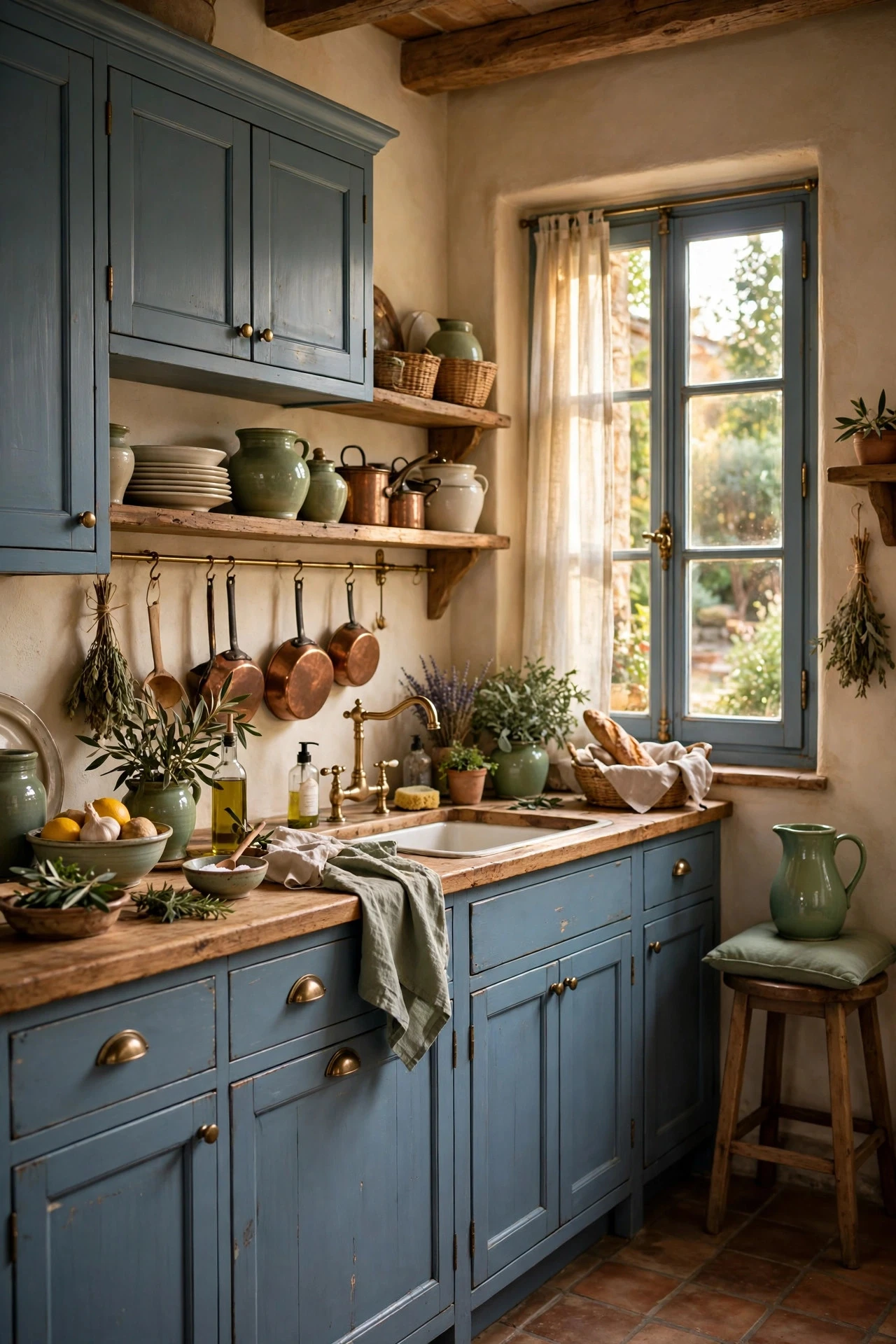
French country colour starts with warm plaster white and builds from the landscape: dusty blue like Provençal shutters, sage green like olive leaves, soft cream, terracotta from roof tiles, and a whisper of lavender. These colours are always muted, as if they have faded in the sun for a century. Paint cabinets in one of these dusty tones, keep walls a warm white rather than a cold one, and let wood and stone add the deeper notes.
Avoid glossy, saturated paint and stark white — both feel too new. If you love a darker room, a deep slate blue on a single wall or island reads French, while charcoal or black reads modern farmhouse instead. Test paint in daylight and lamplight, because these chalky tones shift with the sun. For a darker, moodier take on the same bones, compare our moody kitchen ideas before you commit.
2. How Do Timber Beams Change a Kitchen?
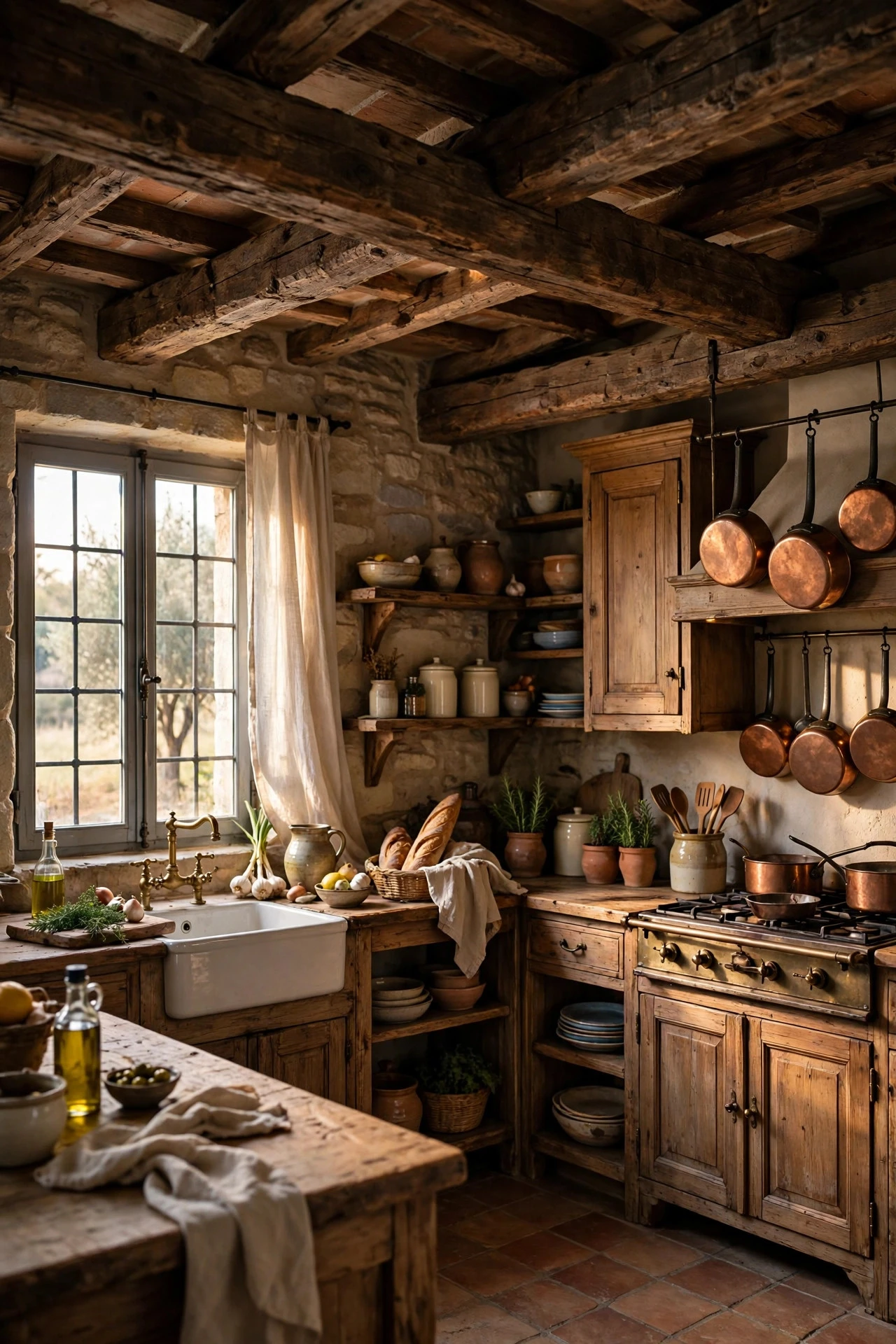
Exposed timber beams are the signature overhead detail of a French country kitchen: rough-hewn, darkened with age, and slightly irregular, they turn a plain ceiling into the room's oldest feature. Real beams are heavy and structural, but most kitchens achieve the look with hollow box beams in reclaimed oak or pine, stained dark walnut and distressed at the edges. Space them evenly and let them run across the shortest span.
Keep beams unpainted — painted beams look like a cottage, not a farmhouse — and never use shiny polyurethane; a matte wax finish keeps the wood looking old. In a low-ceiling kitchen, use shallow beams (four to six inches deep) so the room does not feel pressed down. Pair them with plaster walls and a wrought-iron light for the full effect.
3. What Makes Stone and Plaster Walls Feel Authentic?
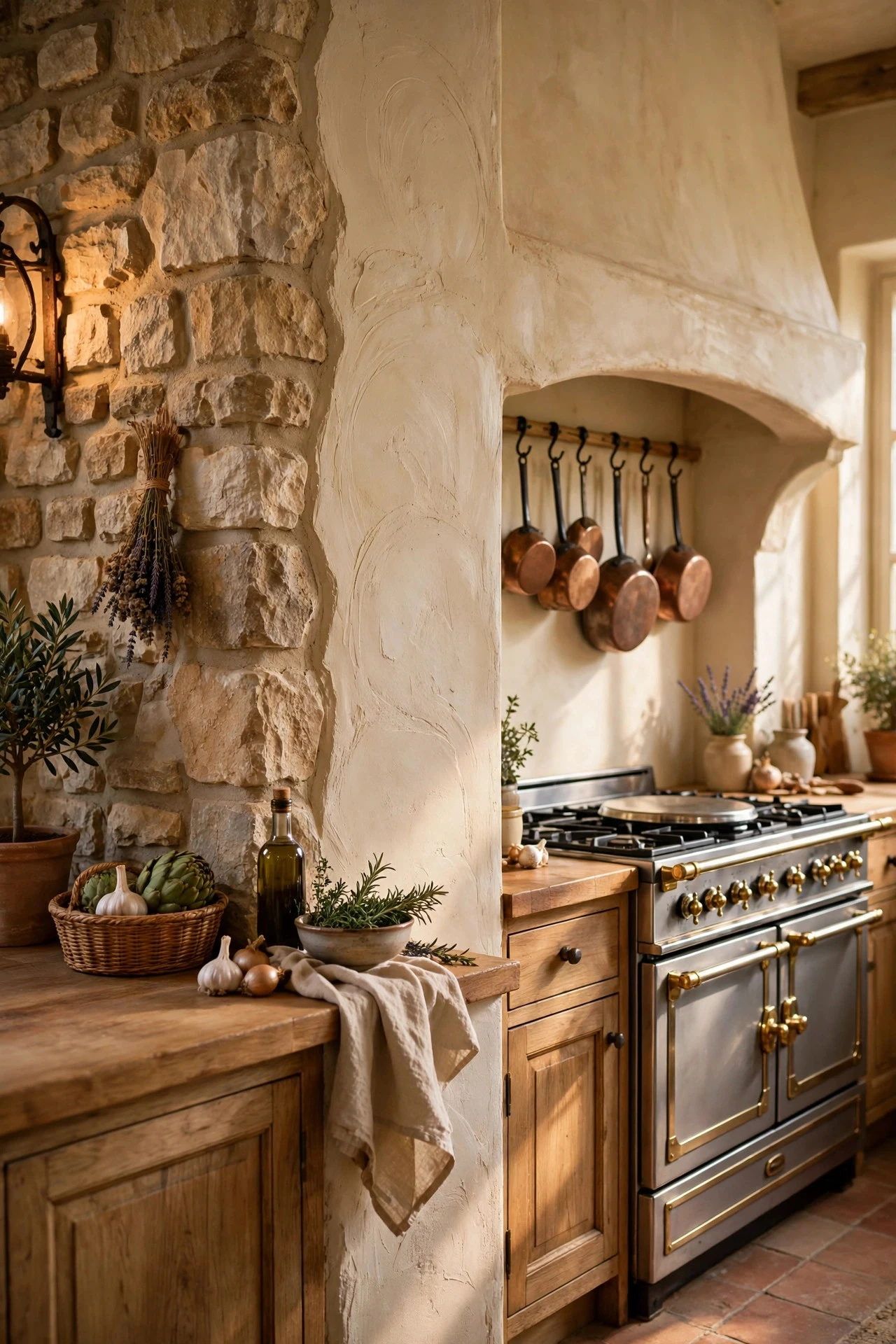
Stone and plaster walls give a French country kitchen its sense of age: a rough limestone or tumbled-stone feature wall, or plaster finished with a soft, hand-troweled texture instead of a flat modern skim. Lime plaster is the traditional choice — it breathes, it ages beautifully, and its uneven surface catches light in a way flat paint never does. A single stone wall behind the range or sink is often enough.
If real stone is out of budget, thin stone veneer or a textured limewash paint gives a convincing effect. Avoid fake stone wallpaper with a repeating pattern; the eye spots the repeat instantly. Keep the rest of the walls a warm cream so the stone reads as a feature, not a cave, and seal stone near the sink and hob against splashes.
4. Why Is the Apron-Front Sink the Heart of the Room?
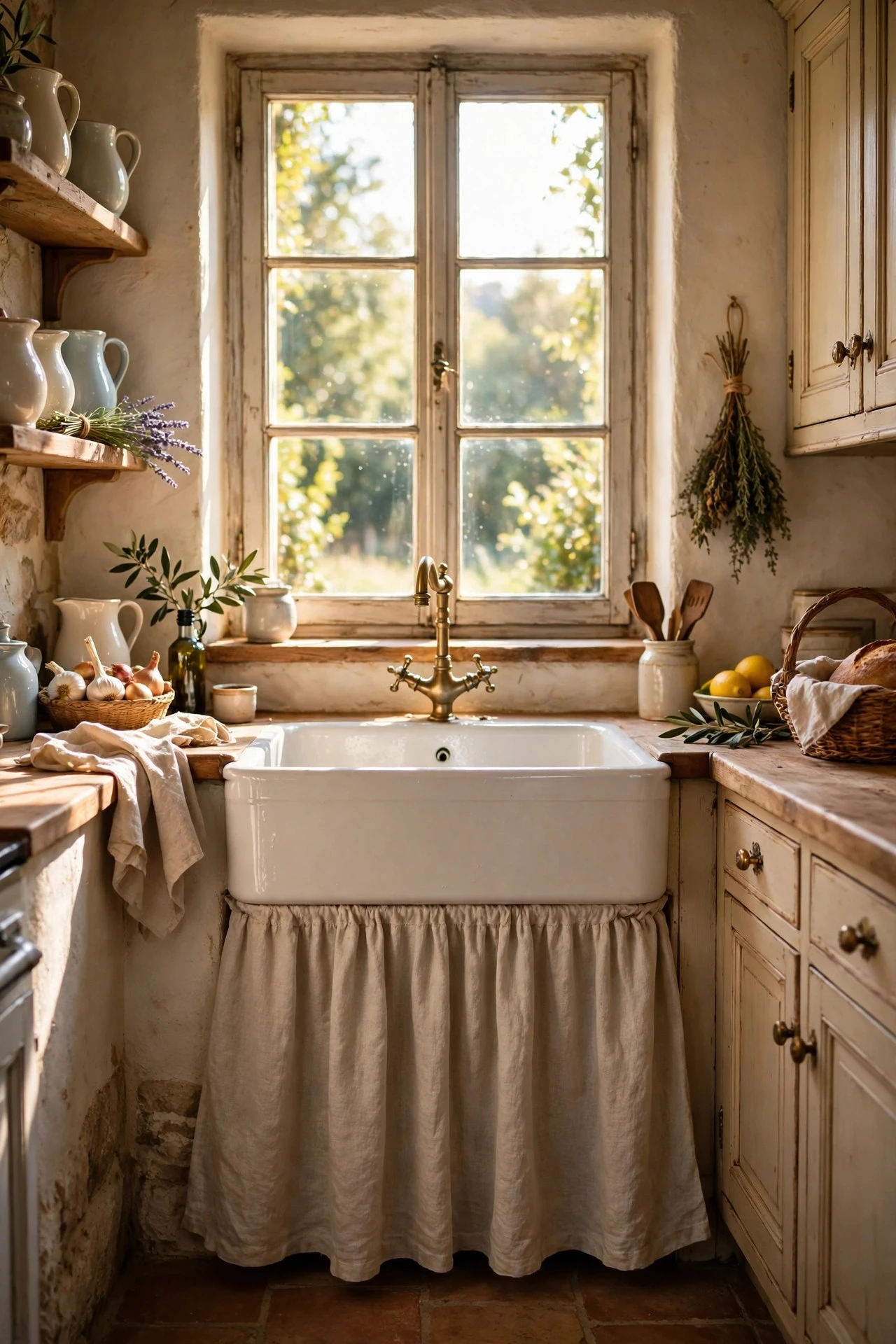
The apron-front farmhouse sink is the working heart of a French country kitchen: deep, wide, and built for washing everything from a stockpot to a basket of vegetables. A fireclay or cast-iron sink with a visible front apron is the classic choice; fireclay resists chips and stains better than enamel over decades. Pair it with a bridge faucet in unlacquered brass, which will patina gently rather than staying shiny.
Fit the sink under a window if you can — the light makes washing up feel less like a chore. A skirt of linen or ticking stripe hung from a small rod beneath the sink softens the base cabinets and hides cleaning supplies. Keep the counter around it clear of clutter so the sink itself is the visual anchor.
5. How Do You Style Dusty Blue and Sage Cabinets?
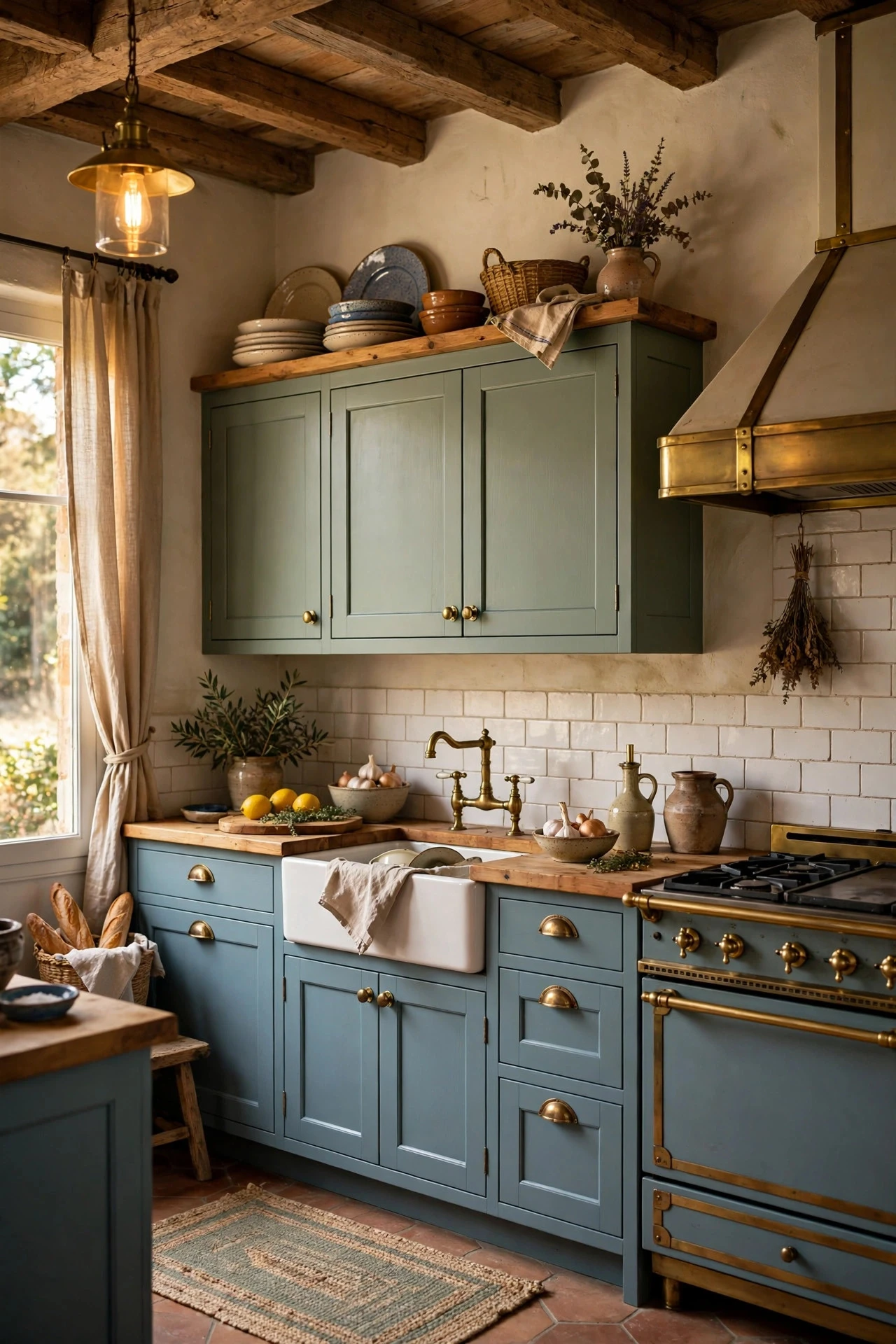
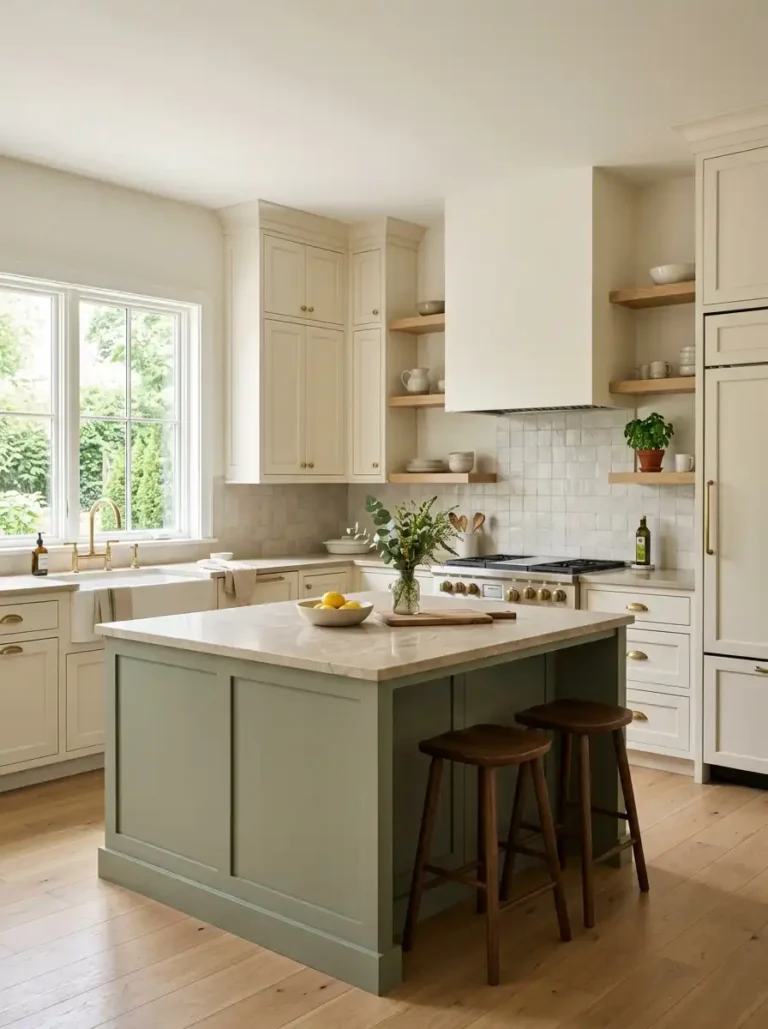
Dusty blue and sage green cabinets are the painted heart of French country style: chalky, muted, and softer than any navy or forest green. Paint lower cabinets in dusty blue and leave uppers white, or go sage on the island and cream elsewhere, so the colour feels like an accent rather than a flood. Use a matte or eggshell finish, and distress the edges very lightly for a hand-painted look.
Swap the hardware to unlacquered brass cup pulls and small round knobs — the warm metal against a dusty cabinet is the combination that makes the room. Avoid stainless steel handles, which read contemporary, and avoid matching the wall colour exactly; the cabinets should sit a few tones deeper than the walls. A butcher-block counter keeps the scheme warm rather than cold.
6. Are Terracotta Tile Floors Worth It?
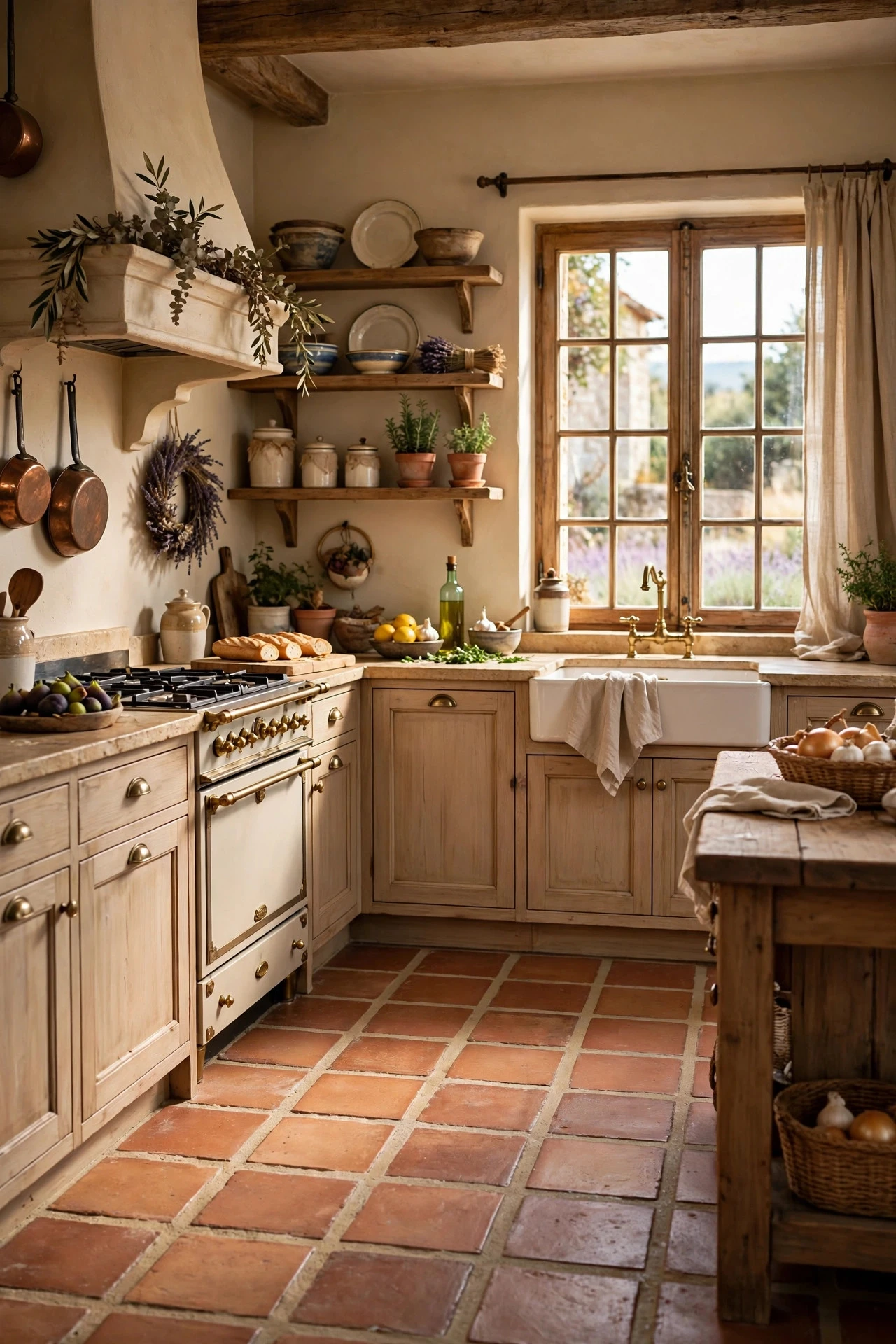
Terracotta tile floors are the warm, earthy base of a French country kitchen: handmade-look tiles in soft orange-brown, laid with wide grout lines, that grow more beautiful as they wear. Unglazed terracotta is the most authentic, but it needs sealing — use a penetrating sealer and reapply yearly in a working kitchen. Glazed terracotta-look tiles are the practical compromise, easier to clean and still warm underfoot.
Choose large-format tiles (twelve inches or more) in a small kitchen so the floor does not look busy, and keep grout a sandy colour rather than bright white. A terracotta floor pairs beautifully with cream cabinets and a dark wood table. If your floor is already wood, a terracotta-toned rug runner gives a hint of the same warmth without replacing anything.
7. How Do You Display Copper Pots Properly?
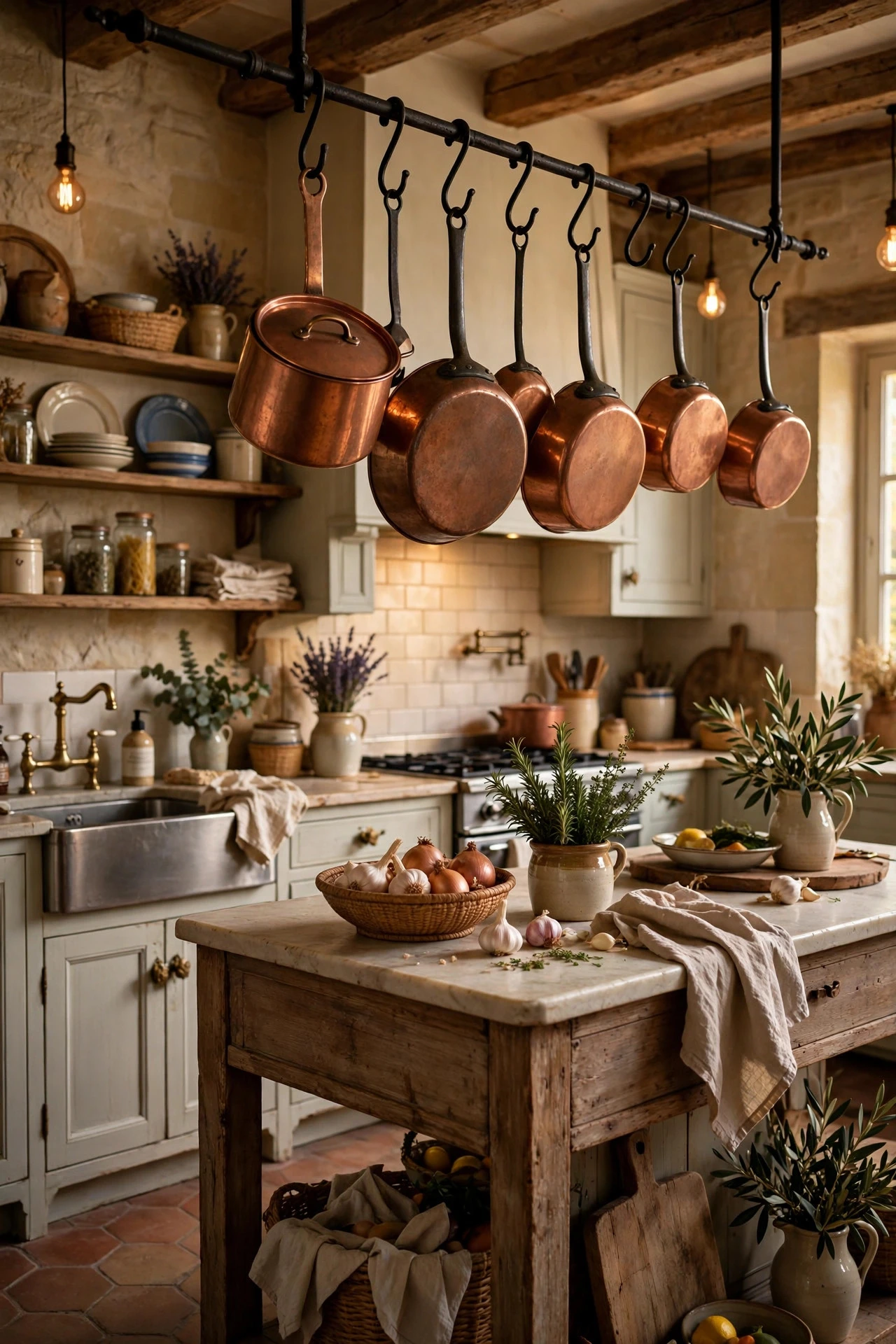
Copper pots on display are both decoration and daily tools in a French country kitchen: hang them from a wrought-iron rail or a ceiling pot rack above the island, where they catch the light and stay within reach. Use real copper — unlined for display, lined for cooking — and let it develop a patina rather than polishing it to a mirror shine every week. A few well-used pots beat a wall of never-touched ones.
Hang the largest pots at the ends of the rail and the smallest in the middle, so the arrangement reads balanced. Keep the rail at a height you can reach without a step stool. If ceiling space is tight, a single row of hooks on a wall rail beside the range works just as well. Never hang copper above a dining table, where steam and drips become a problem.
8. What Belongs on Open Shelving?
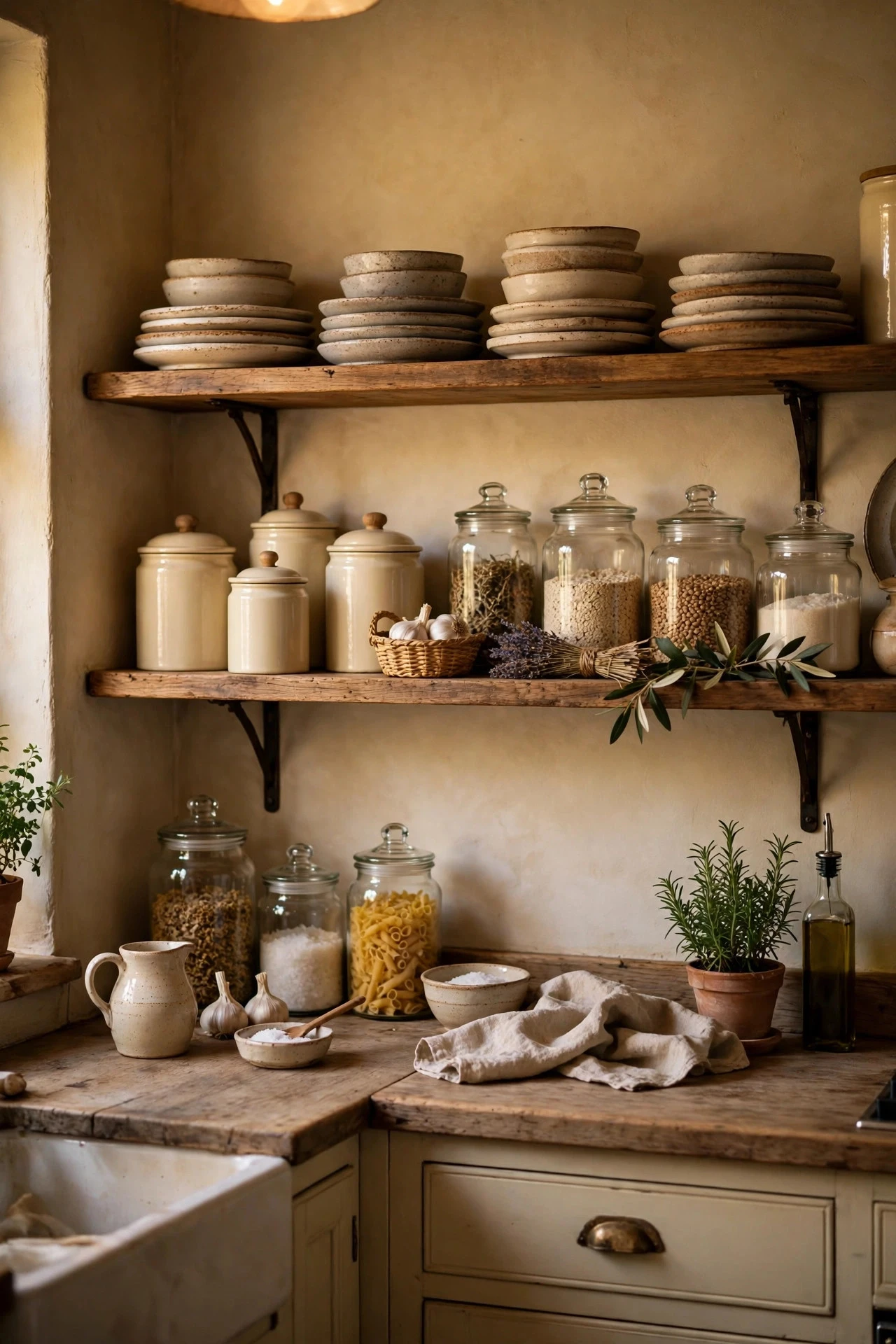
Open shelving in a French country kitchen holds the beautiful everyday: stacks of stoneware plates, cream canisters, glass jars of dried beans and pasta, a row of pitchers, and a few cookbooks with worn spines. Use thick wood shelves with simple iron brackets, and keep the palette to cream, stone, and one accent colour so the shelves read calm rather than cluttered. Two shelves are usually enough; a whole wall of them overwhelms a small kitchen.
Store the pieces you actually use on the shelves and hide the mismatched plastic behind closed doors. Group items by height — tall pitchers at one end, stacked bowls at the other — and leave breathing room between groups. Dusting is the price of open shelves, so keep them away from the hob where grease settles. For more shelf styling ideas, see our kitchen island decor ideas for balancing display with a working surface.
9. How Does Toile de Jouy Work in a Kitchen?

Toile de Jouy brings a French country kitchen its storytelling fabric: a single-colour pastoral print — blue, red, or sage on cream — showing country scenes, animals, and farm life. Use it sparingly, because a little toile goes a long way: cafe curtains on one window, a tablecloth on the farm table, or seat cushions on ladder-back chairs. One toile element per room is the rule; two compete and three look like a theme park.
Pair toile with plain linen and solid colours so the print has room to breathe, and keep the rest of the pattern palette quiet — ticking stripes and plain checks only. Washable cotton toile is the practical choice for a kitchen, and a lined curtain hangs better than an unlined one. Avoid toile wallpaper in a kitchen; steam and grease age it fast.
10. What Is a Plaster Range-Hood Arch?
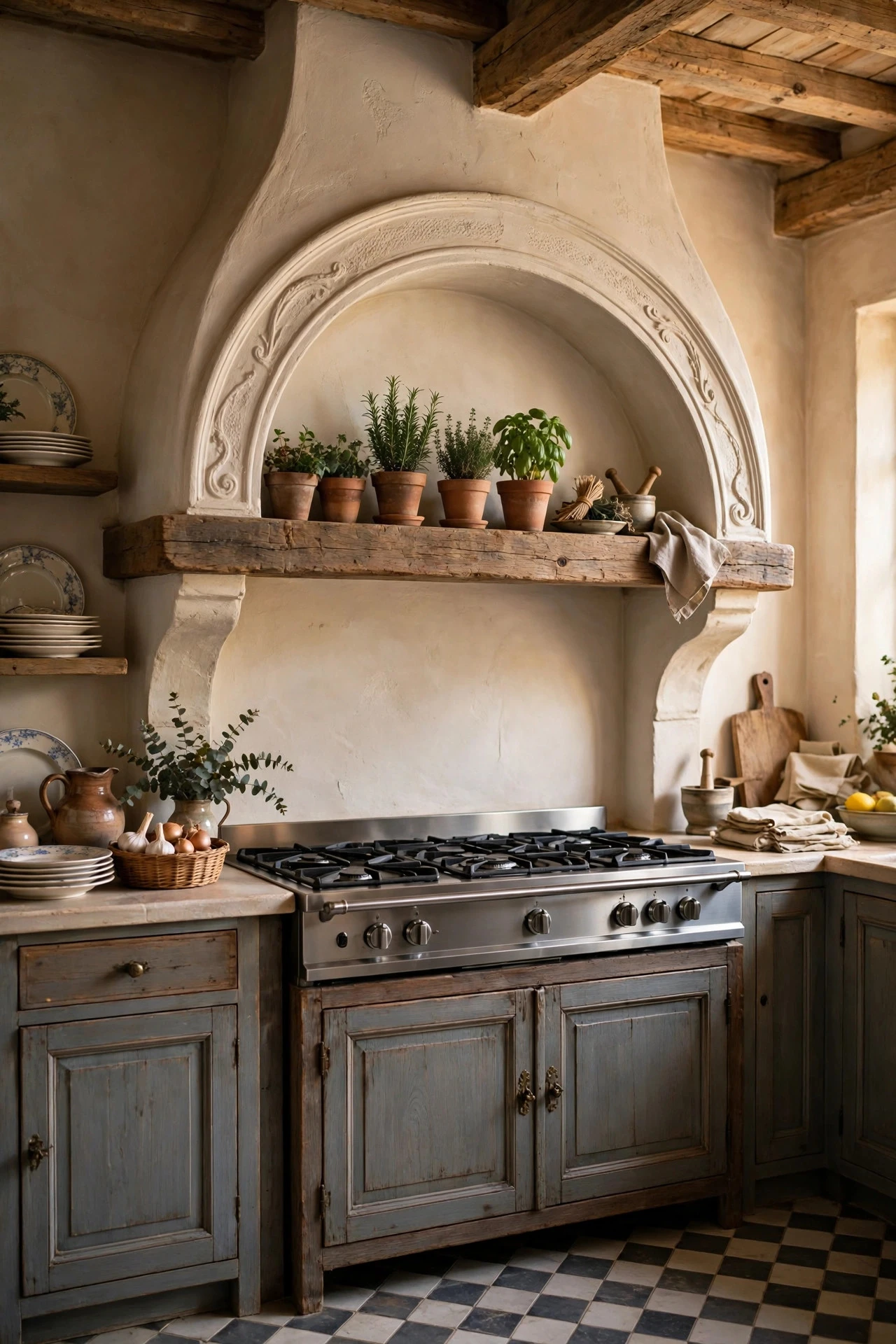
A sculpted plaster range-hood arch is the architectural centrepiece of a French country kitchen: a curved, hand-plastered hood over the range, often with a simple corbel or a shallow arch detail, that reads like part of the wall rather than an appliance. Build it over a standard extractor insert so it works as well as it looks, and finish it in the same lime plaster as the walls so it blends seamlessly.
The arch shape matters more than the size — a gentle curve feels French, a sharp point feels Gothic. Keep the hood's depth shallow enough that it does not block the light over the hob, and add a small timber mantel shelf beneath it for a row of tiny herb pots. If a full plaster hood is too much, a simple curved plaster valance above the range gives a hint of the same shape.
11. How Do You Choose a French Farm Table?
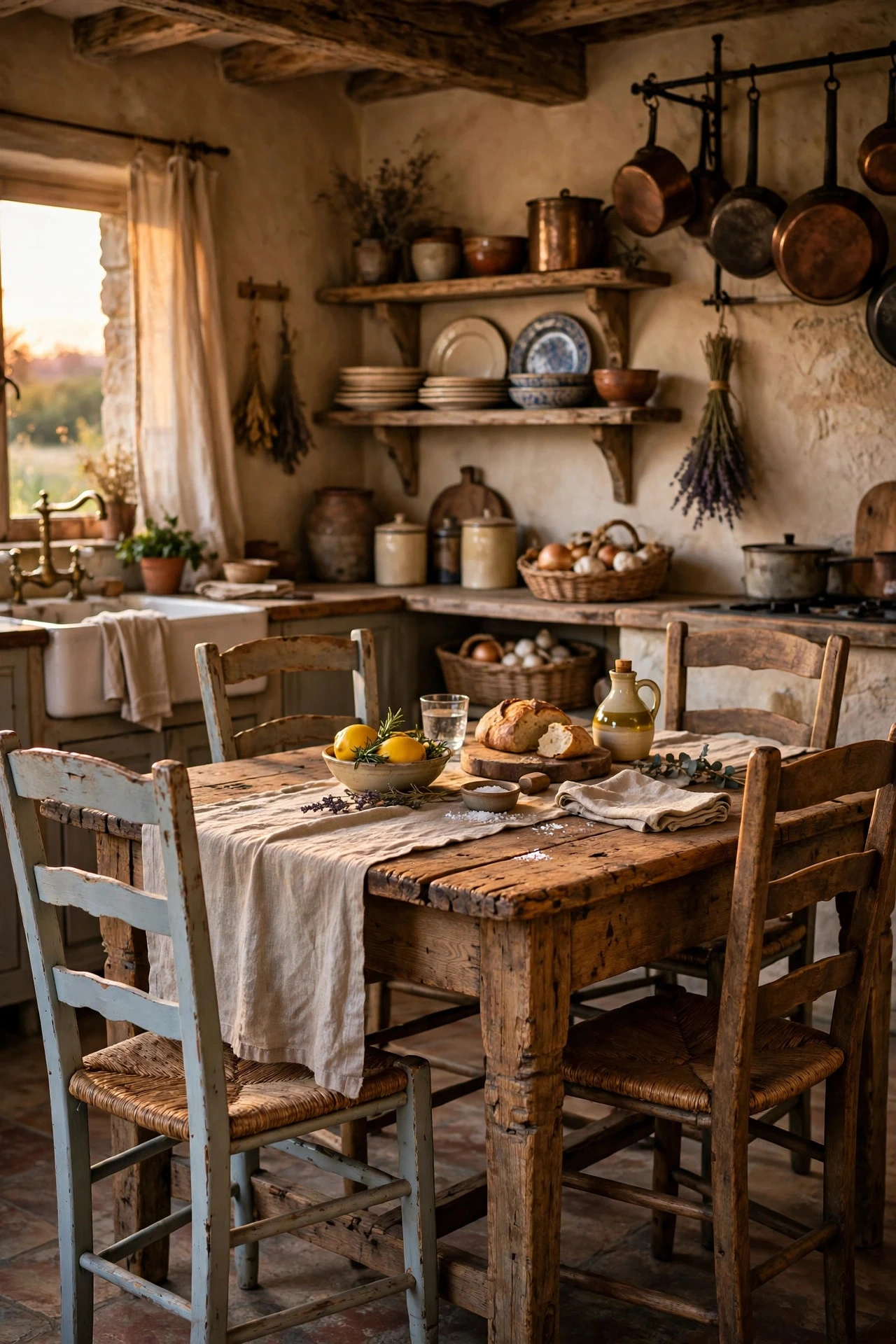
A worn farm table is where a French country kitchen gathers: a long, thick-topped table in oak or pine, with visible grain, softened edges, and a finish worn pale by years of use. Choose a table with a stretcher base or turned legs rather than a modern pedestal, and size it so four people can sit comfortably with a chair's width to spare at each end. A 72-inch table suits most family kitchens.
Pair it with mismatched ladder-back chairs — the same wood, different heights — rather than a matching set, which looks too formal. A linen runner down the centre and a stoneware jug of herbs are all the dressing it needs. Never cover a beautiful farm table with a plastic cloth; a washable linen cloth for messy meals protects it without hiding it.
12. Which Tile Backsplash Feels Hand-Painted?
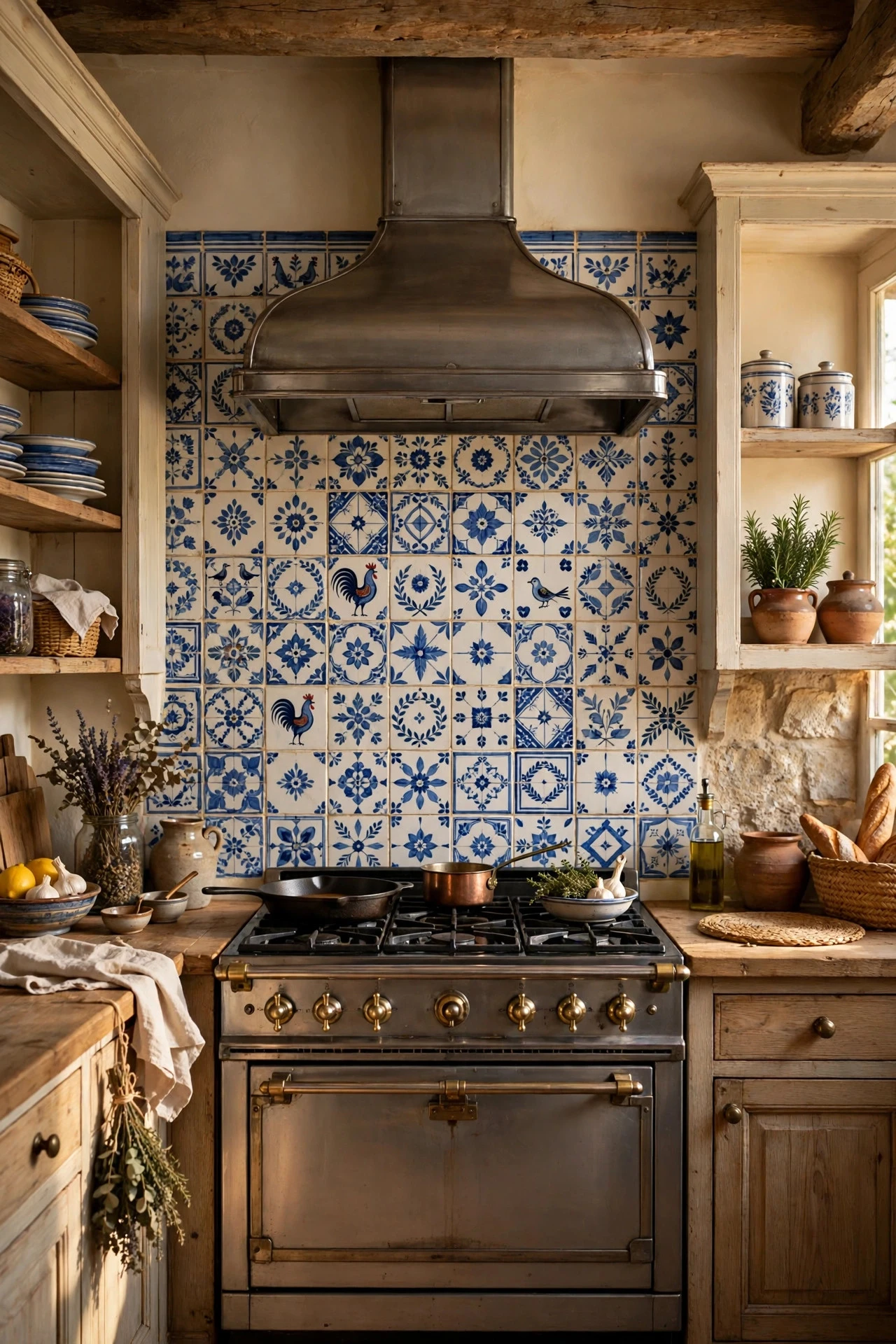
A blue-and-white hand-painted tile backsplash is the jewellery of a French country kitchen: small square tiles with folk motifs — flowers, birds, simple borders — in cobalt or dusty blue on white, laid in a running bond or a simple grid. Use them as a feature strip behind the range, framed by plain cream subway tiles, so the pattern feels special rather than overwhelming. Hand-painted tiles vary slightly from tile to tile, and that variation is the charm.
Seal the grout well, because a backsplash takes the worst of the cooking splashes. If genuine hand-painted tiles are out of budget, printed lookalikes in the same blue-and-white palette are a convincing stand-in — just check the pattern repeat before ordering. Our kitchen backsplash ideas cover more patterns and cleaning tips for busy cooks.
13. What Lighting Suits a French Country Kitchen?
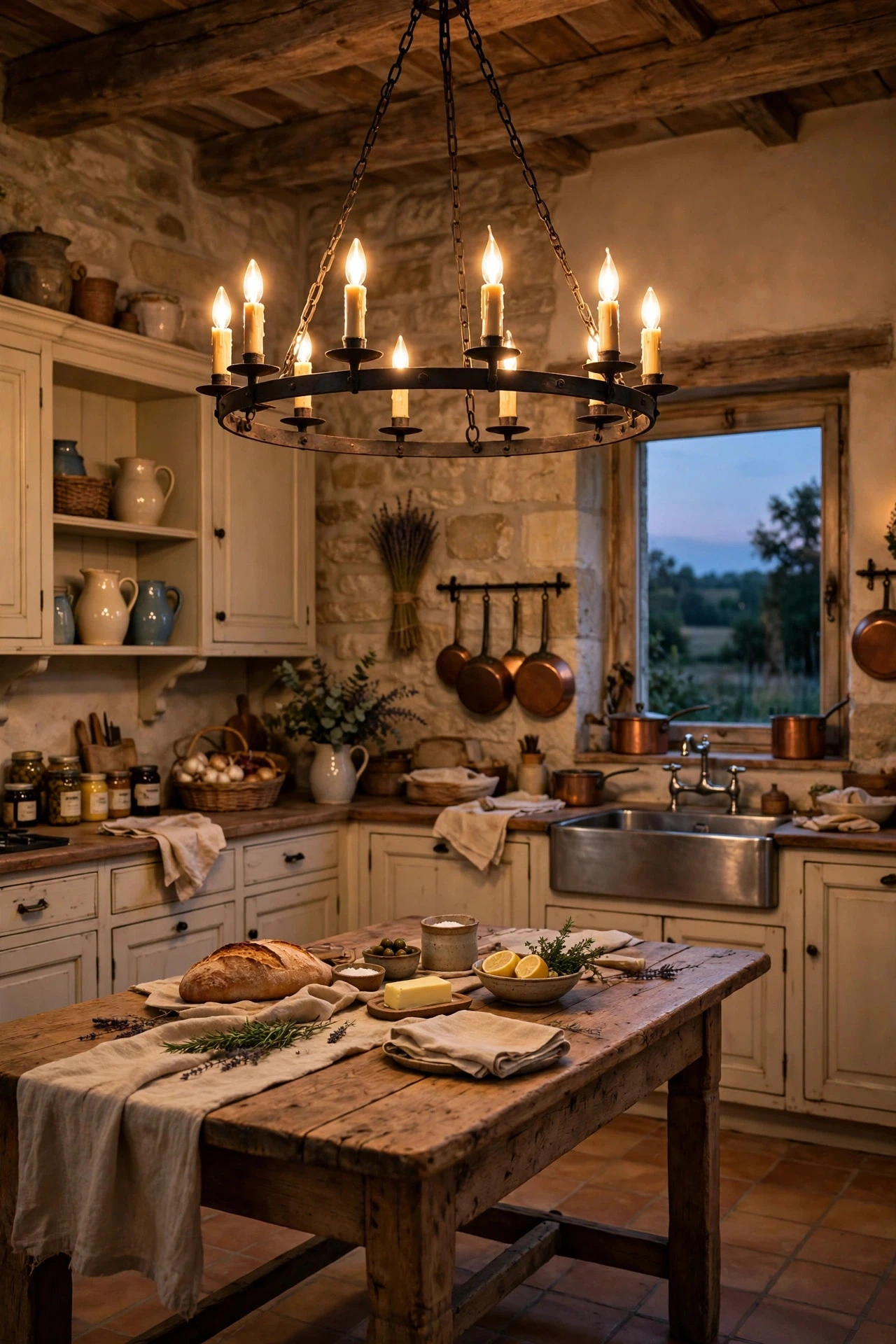
Wrought-iron chandeliers and lanterns give a French country kitchen its evening glow: a simple iron ring chandelier with candle-style bulbs over the farm table, and a pair of small lantern pendants over the island or sink. Iron should be matte black or dark bronze, never shiny chrome. Add a dimmer to every light, because French country rooms are meant to glow at dinner, not blaze like a laboratory.
Layer the light: the chandelier for the table, pendants for work surfaces, and a small wall sconce or two for corners. Keep bulbs warm — 2700K or below — so the plaster, wood, and copper all look their best. Avoid recessed downlights as the only source; they flatten the room. For more layering ideas, browse our kitchen lighting ideas.
14. How Do You Style Fresh Produce and Herbs?
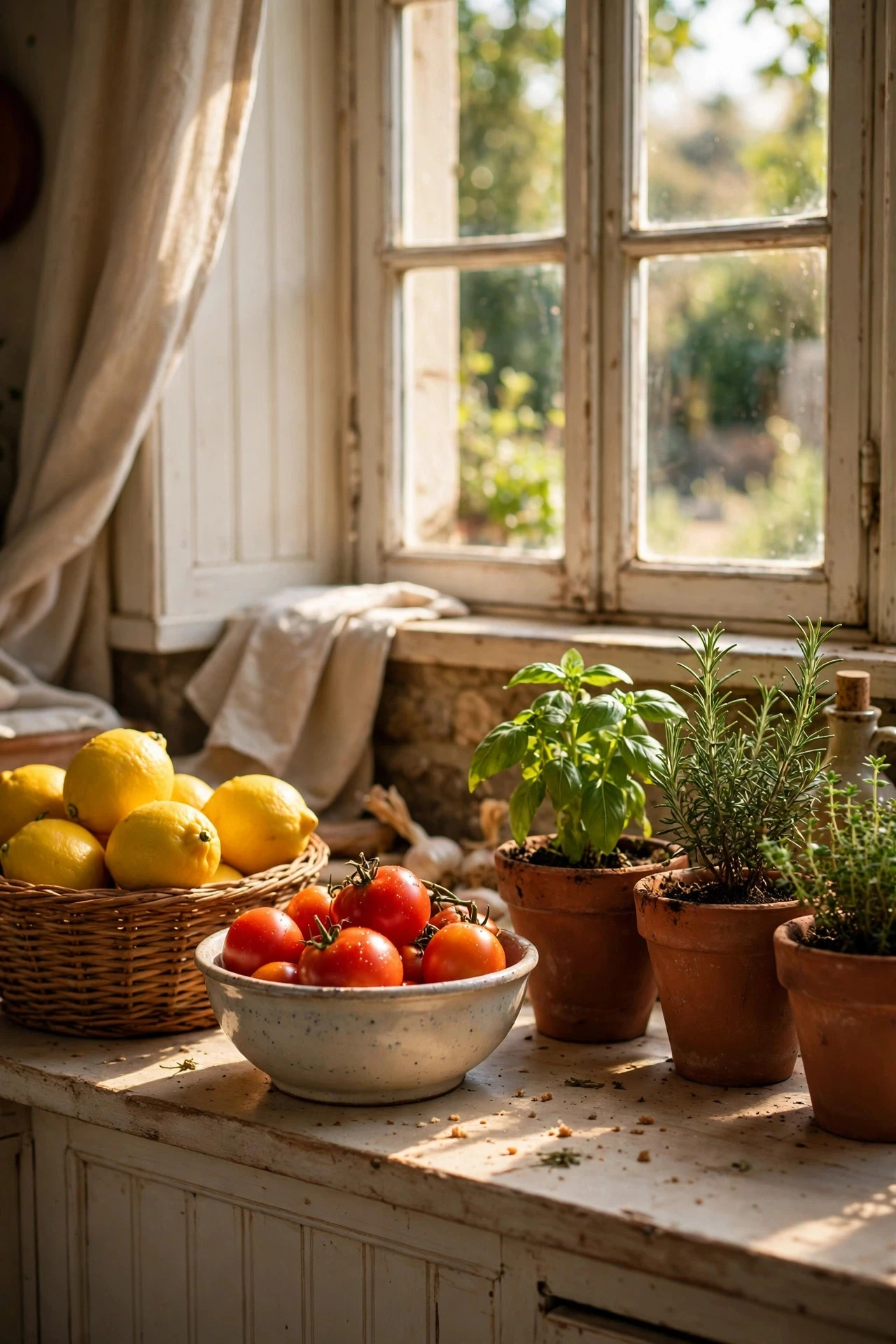
Fresh produce and herbs on display are the living decor of a French country kitchen: a basket of lemons on the counter, a bowl of tomatoes by the window, a row of terracotta pots with basil, thyme, and rosemary on the sill, and a bunch of dried lavender tied with twine. The rule is simple — display what you will actually cook with this week, and eat it before it wilts. A wire basket of onions and garlic hanging near the range is both useful and beautiful.
Use natural containers: wood bowls, woven baskets, stoneware crocks, and glass jars — never plastic tubs or branded packaging. A small wooden crate of eggs on the counter and a jug of olive oil beside the hob complete the look. Rotate the display with the seasons: artichokes and asparagus in spring, figs and grapes in late summer. The history of French cuisine explains why the kitchen, not the dining room, has always been the heart of a French home.
15. Why Butcher-Block Counters Work Here?
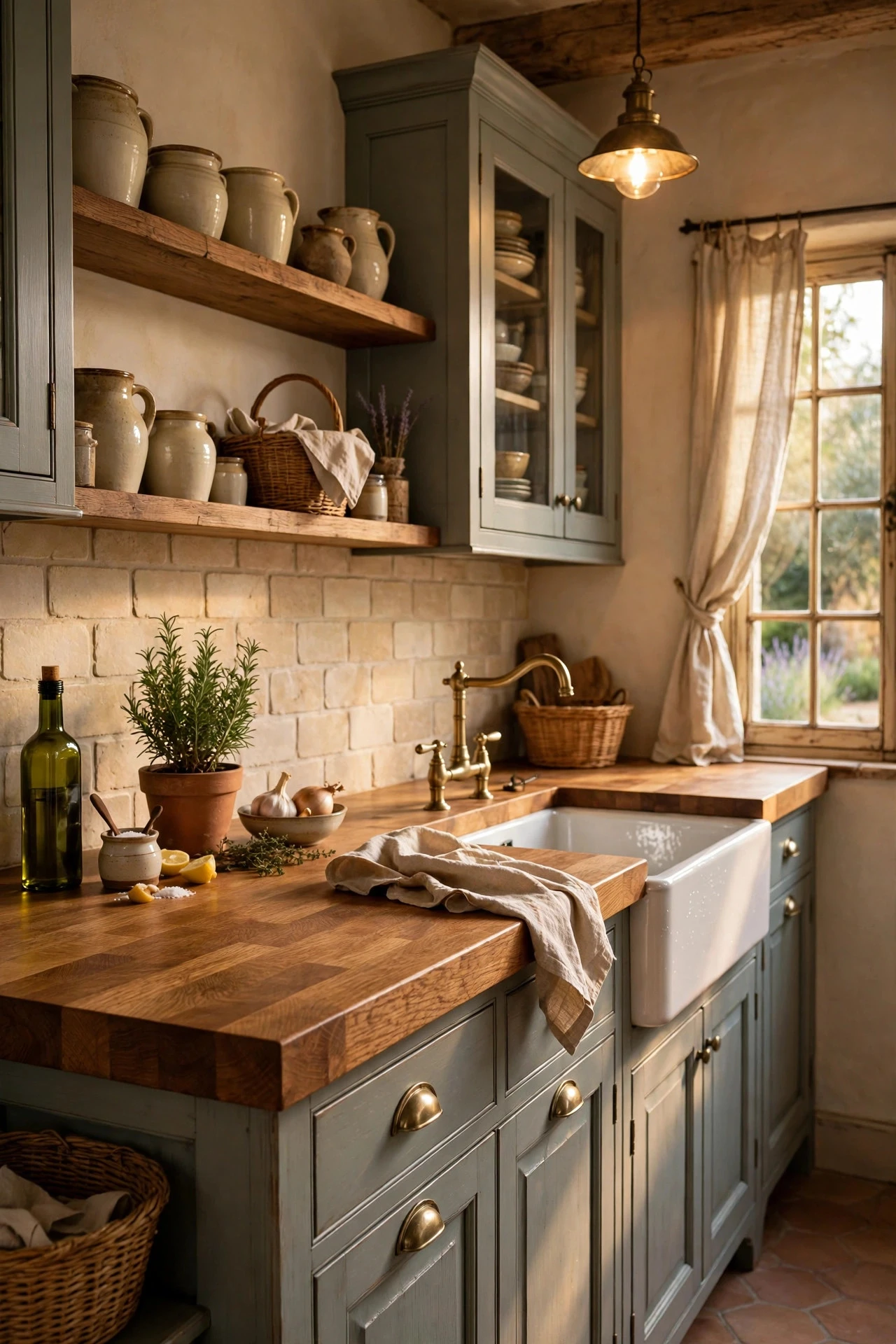
Butcher-block counters bring warmth and workability to a French country kitchen: thick wood slabs in oak, walnut, or maple, oiled rather than varnished, that you can chop on, knead on, and live with. Oil the surface monthly with food-safe mineral oil or a beeswax blend, and accept that knife marks and stains are part of the patina — they tell the story of a kitchen that cooks. Keep one section, usually near the sink, as the dedicated prep zone.
Butcher block suits an island or a single run of counters best; pairing it with stone on the perimeter gives you a heat-proof surface by the hob. Never place a hot pan directly on oiled wood, and wipe up water promptly so the boards do not warp. If your budget is tight, a butcher-block island top over painted base cabinets gives the look for a fraction of a full refit.
16. How Do Vintage Bread Boards and Labelled Jars Add Charm?
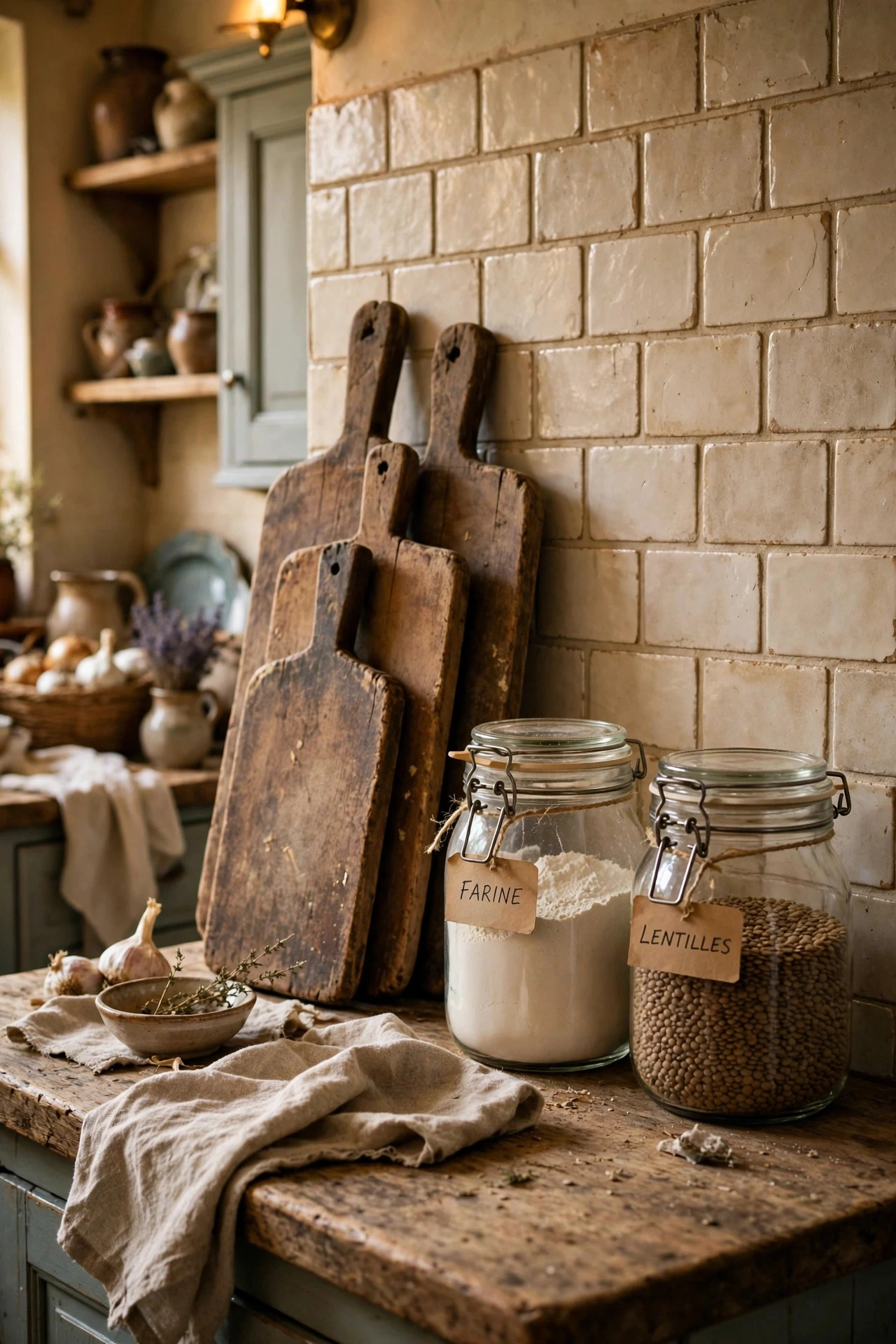
Vintage bread boards and labelled jars are the small, honest details that make a French country kitchen feel collected rather than decorated: a stack of old bread boards leaning against the backsplash, a row of glass jars with handwritten paper labels — flour, sugar, lentils, rice — and a wooden butter dish by the hob. Buy bread boards at flea markets and antique shops, where the wear is real and the price is low; a board with knife scars and a darkened centre has more character than a new one.
Label jars in a simple script on kraft paper tags tied with twine, and keep the labels consistent across the whole row. Display the boards in graduated sizes, largest at the back, and never hang them where steam from the kettle will warp them. These details cost little, but they are the difference between a kitchen styled for a photograph and one that feels lived in. Our apothecary kitchen ideas share the same love of labelled jars and vintage storage.
17. How Do You Make a Small French Country Kitchen Work?
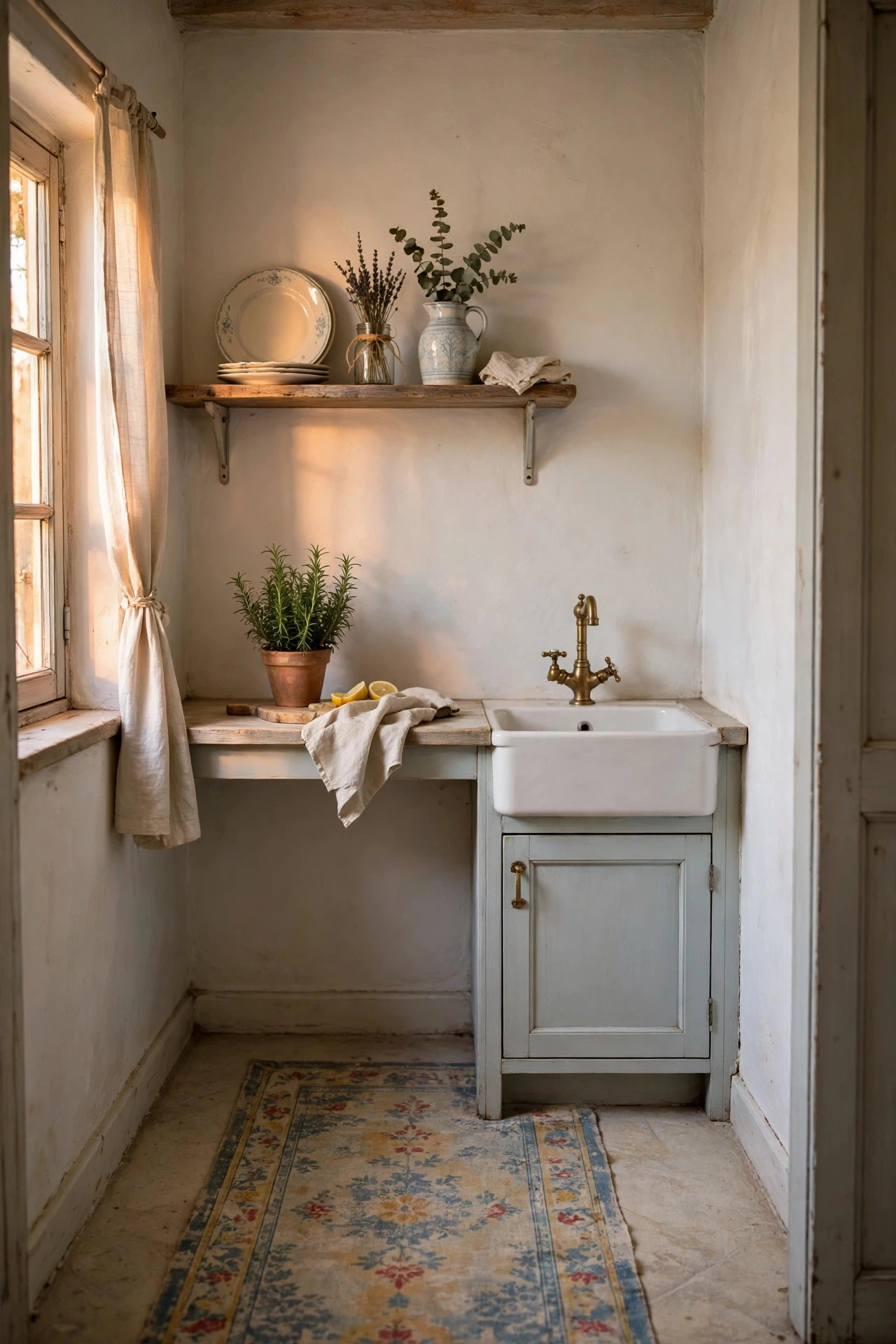
A small French country kitchen needs editing, not shrinking: keep the palette pale cream and dusty blue, use one open shelf instead of upper cabinets on one wall, and let a single statement piece — a copper pot rail or a plaster hood — carry the style. Choose a slim apron-front sink, a narrow farm table that doubles as a prep surface, and a folding ladder-back chair or two that tuck away. Light colours and a mirror or glass-fronted cabinet make the room feel larger.
Avoid filling every surface; a small kitchen with one clear counter run feels bigger than one crowded with decor. Use vertical space — hooks for mugs, a rail for utensils, a high shelf for the pieces you use weekly. A runner rug in a faded Provençal pattern adds colour without taking up space. If the room is truly tiny, a galley layout with the sink and hob on opposite walls keeps the workflow short and the style intact.
18. What Works in a French Country Galley Kitchen?
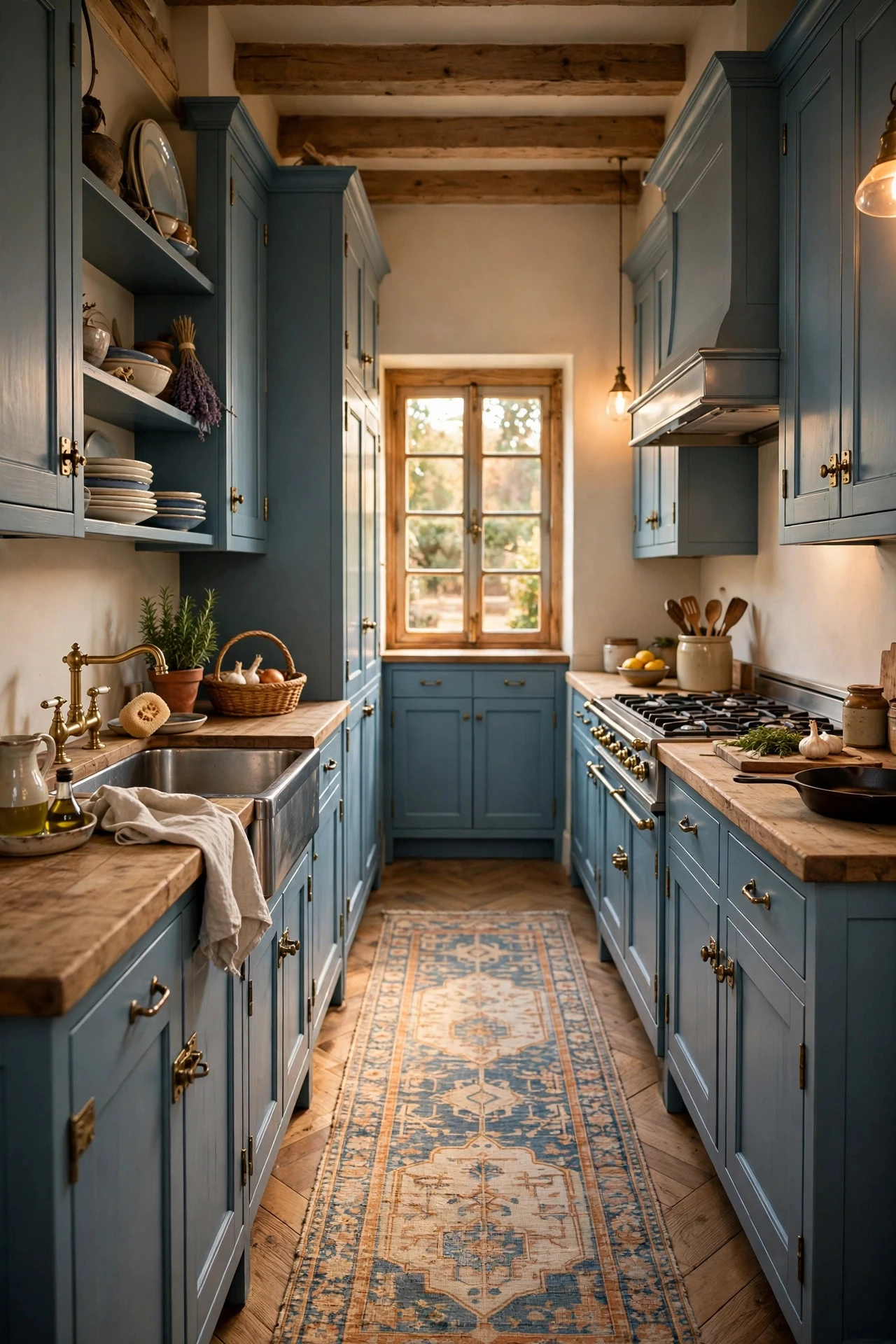
A galley kitchen suits French country style surprisingly well, because its narrow, linear layout echoes the working kitchens of old farmhouses: one wall for cooking, one for the sink and prep, and a clear path between them. Keep the two runs in the same dusty cabinet colour, run the same terracotta or wood floor the full length so the room reads as one space, and hang a long runner rug down the centre. A single open shelf at the far end gives the eye somewhere to rest.
Light is the challenge in a galley, so keep the far wall pale and add a mirror or a window if one exists. Hang two small iron pendants in a line rather than one large light, and keep the counters clear except for one or two beautiful objects — a copper kettle, a stoneware jug. Avoid dark cabinets on both walls; one dark run and one pale run keeps the corridor from feeling like a tunnel.
19. How Do You Get the Look Without Renovating?
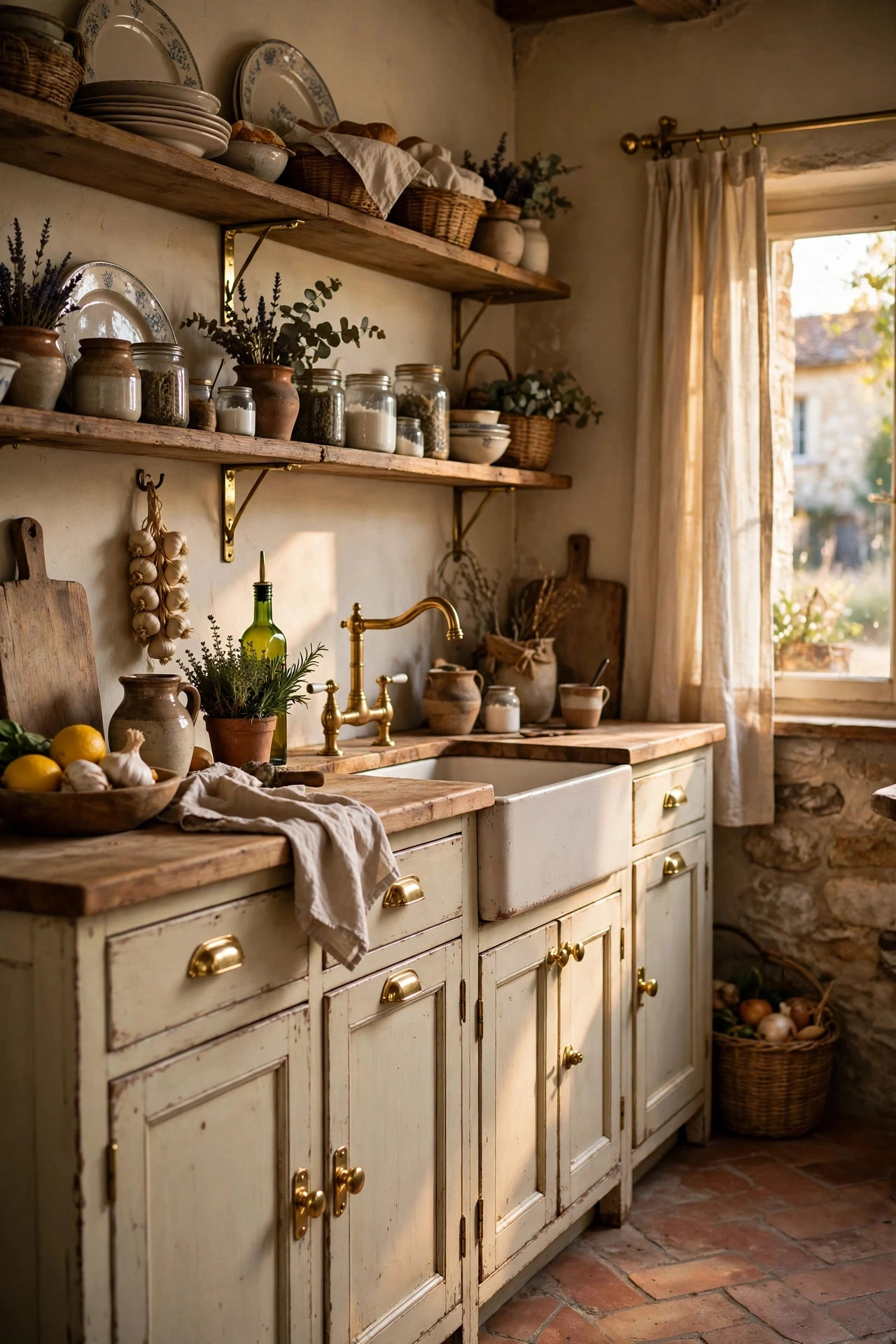
Getting the French country look without renovating is a matter of swaps, not construction: change the cabinet hardware to unlacquered brass, hang a linen skirt under the sink, replace the faucet with a bridge style, add two open wood shelves, and dress the table with linen, stoneware, and a jug of herbs. Paint is the biggest single change — one weekend of painting cabinets dusty blue or sage transforms the room for the price of a few tins.
Swap the light fixture over the table for a wrought-iron chandelier, add a faded Provençal runner, and hang a row of copper pans on a wall rail. None of this touches plumbing or walls, and all of it can be reversed. Renters should stick to these reversible swaps — hardware, textiles, lighting, and display — and skip anything that needs a drill into tile. The Spruce's guide to French country decorating has more renter-friendly ideas for the same look.
20. What Is the French Country vs English Country Difference?
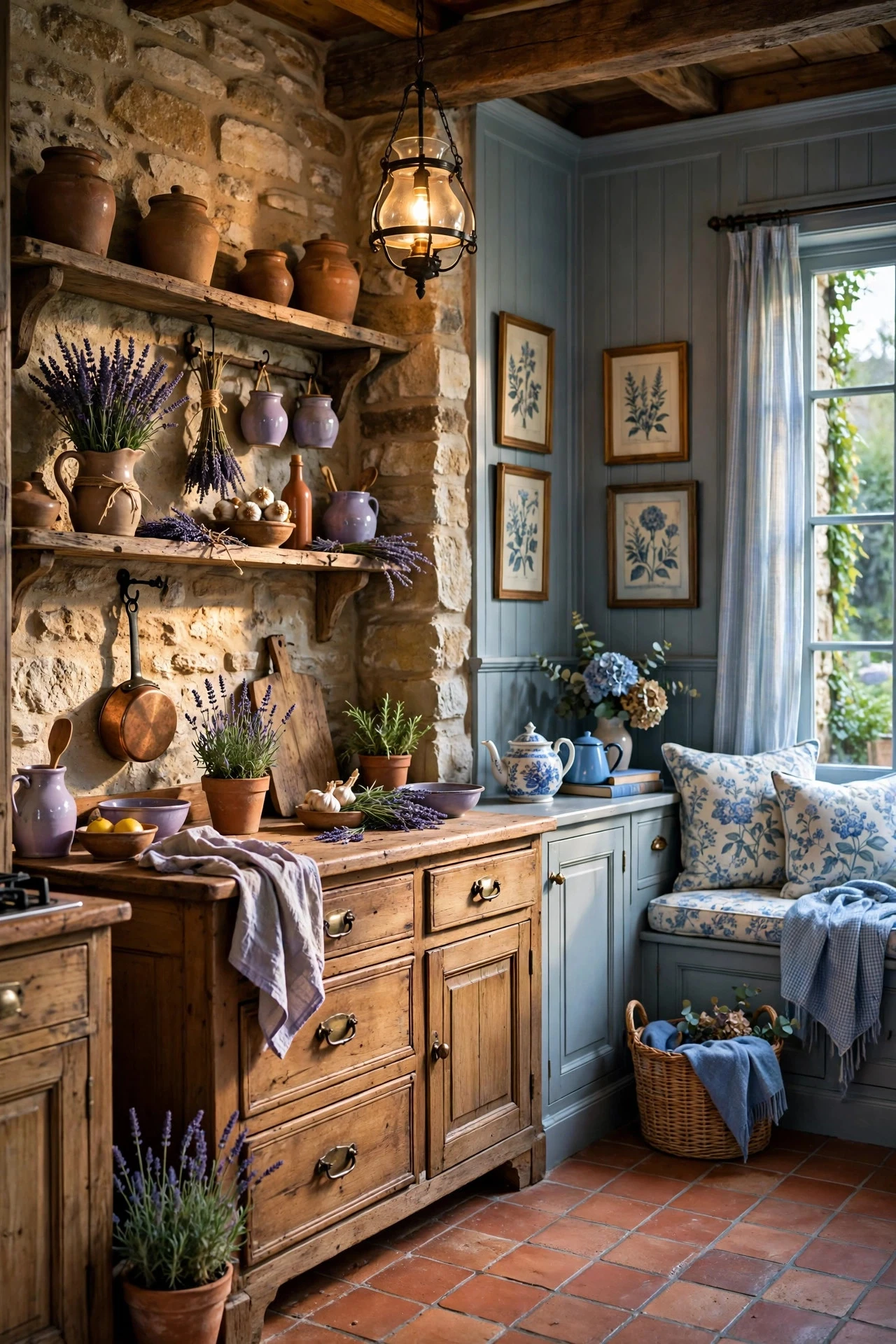
French country and English country kitchens are cousins, not twins: French country is sun-warmed and Mediterranean — stone walls, terracotta floors, lavender and dusty blue, wrought iron, and copper — while English country is cooler and garden-led — floral chintz, painted pine, tweed tones, and rose-patterned china. French rooms feel airy and sun-bleached; English rooms feel cosy and layered, with more pattern and more clutter.
The distinction matters because mixing them carelessly blurs the style: a toile curtain is French, a chintz curtain is English, and using both in one kitchen fights itself. Choose one direction and let the other inform only the smallest details — perhaps an English-style floral jug on a French stone shelf. When in doubt, ask whether the piece would survive a Provençal summer: stone, linen, copper, and iron will; heavy velvet and dark mahogany will not. Architectural Digest's look at French country interiors shows how designers keep the style sunlit rather than fussy.
21. Which Finishes and Fabrics Complete the Room?
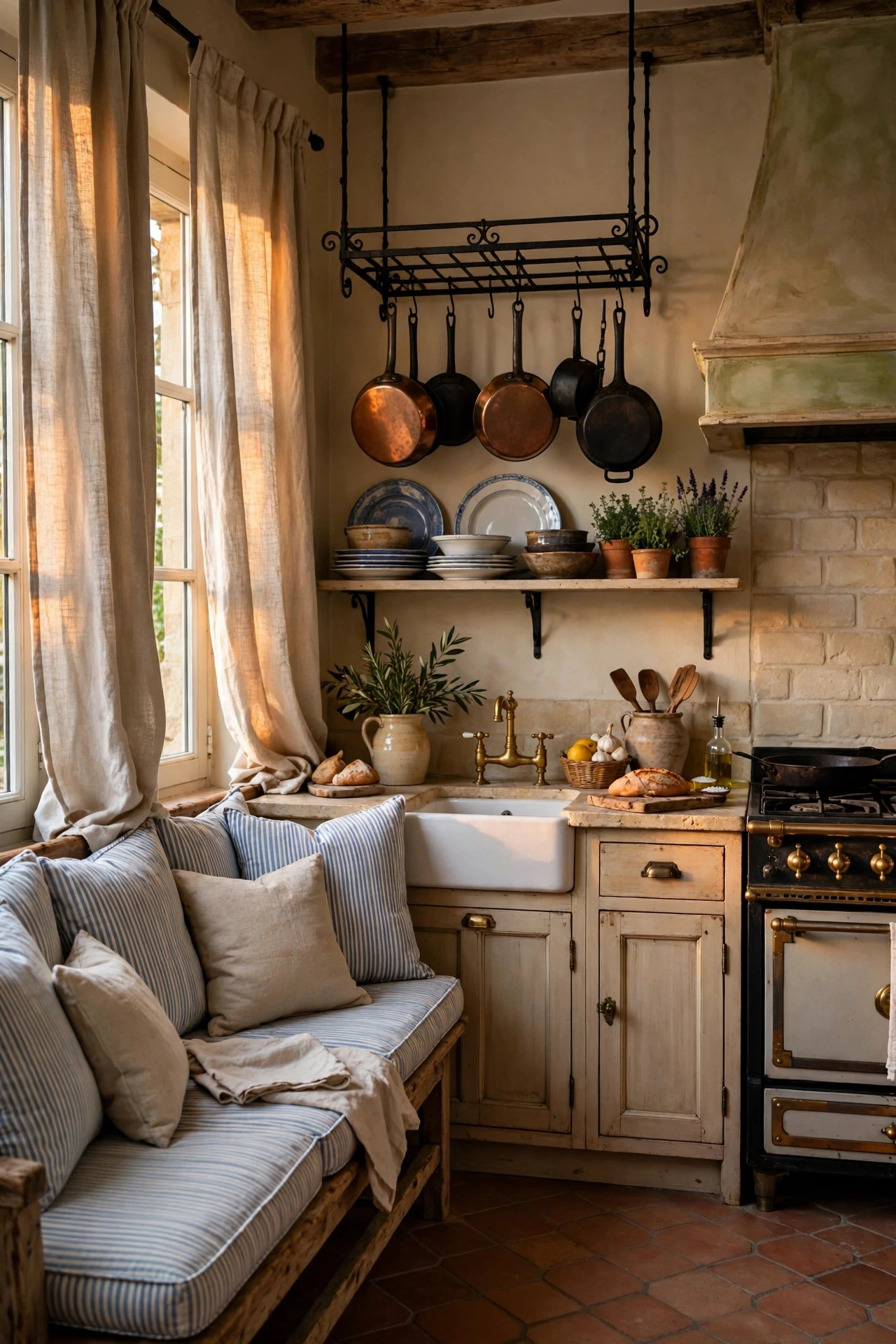
The finishing layer of a French country kitchen is natural and soft: washed linen curtains, ticking-stripe seat cushions, a faded Provençal tablecloth, unlacquered brass, matte black iron, and honed stone. Fabrics should look washed and lived in, never crisp or starched — linen that wrinkles is the point. Use cotton and linen only; polyester sheers and shiny satin break the spell instantly. A wool or cotton rug in a faded pattern softens a stone or terracotta floor.
Keep metals to two families — warm brass and dark iron — and never mix in chrome or nickel. Choose honed or leathered stone over polished, and matte paint over gloss. The test for every finish is simple: if it would look wrong with a smudge of flour on it, it is too precious for this kitchen. For a brighter base to layer these finishes over, our white kitchen ideas show how warm whites keep a kitchen light without feeling cold.
22. What Should You Avoid in a French Country Kitchen?
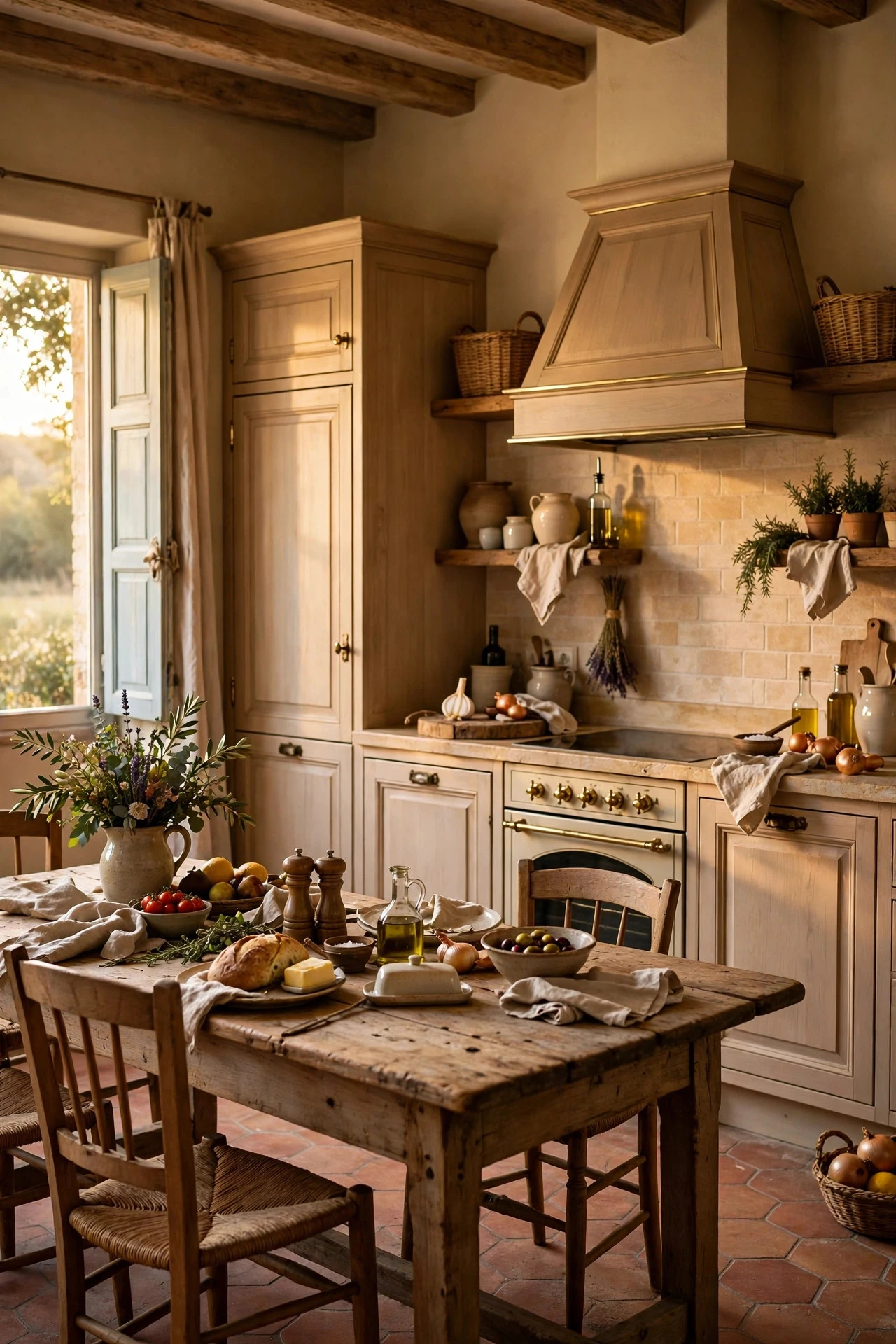
The fastest way to lose the French country feeling is to add the wrong modern details: glossy white cabinets, chrome hardware, granite with heavy speckling, stainless steel appliances on display, and anything that looks mass-produced or plastic. Open-plan minimalism is the enemy too — a French country kitchen is a room with walls, a door, and a table in the middle, not a showroom island floating in a great room. Keep appliances panelled or tucked away where you can.
Avoid too many patterns at once — toile plus checks plus florals plus stripes turns a kitchen into a fabric shop. Avoid perfect symmetry; French country rooms are slightly irregular, with a chair that does not match and a shelf that is not quite level. And avoid buying everything new at once: the style is built slowly, piece by piece, from flea markets, family hand-me-downs, and honest materials that age well. The 2027 kitchen trends point toward exactly this kind of warm, collected look — a style built slowly, piece by piece, rather than bought in one weekend.
Practical Tips
Start with paint and hardware. Painting cabinets dusty blue or sage and swapping to unlacquered brass pulls is the highest-impact, lowest-cost change you can make. One weekend, two tins of paint, and a bag of new pulls will transform a plain kitchen before you spend anything else.
Buy materials that age well. Stone, terracotta, solid wood, copper, linen, and iron all improve with use — they patina, soften, and tell a story. Glossy laminates, chrome, and plastic do the opposite: they look tired within a year. Spend on the surfaces you touch daily and save on the display pieces.
Edit before you add. A French country kitchen is collected, not crowded. Remove one thing from every surface before you add anything new, and keep at least one counter run completely clear. The room should feel like it has room to breathe — and room to cook.
Layer light and textiles. Warm bulbs, a dimmer, linen curtains, and a faded runner do more for atmosphere than any single piece of furniture. Change the textiles with the seasons — lavender in summer, heavier linen in winter — and the room stays fresh without a renovation. House Beautiful's French country kitchen ideas offer more seasonal styling inspiration.
Final Thoughts
A French country kitchen is not a look you buy in a weekend — it is a room you build slowly, around cooking, gathering, and the materials that age gracefully. Start with the colours and the farm table, add copper and linen as you find them, and let the room collect its character over time. The best French country kitchens feel as though they have always been there, because in a sense they have: the style is a hundred years of practical, beautiful living, distilled into one warm room.
Frequently Asked Questions
What colours work best in a French country kitchen?
Warm plaster white, dusty blue, sage green, soft cream, terracotta, and a whisper of lavender define the palette. Keep every colour muted and chalky, as if faded by the sun, and avoid glossy or saturated paint. Cabinets sit a few tones deeper than the walls, with unlacquered brass hardware warming the whole scheme.
Can I get a French country kitchen on a budget?
Yes — start with paint and hardware, which transform a kitchen for the price of a few tins of paint and new brass pulls. Add open shelving, a linen sink skirt, and thrifted copper and stoneware before spending on anything structural. Reversible swaps like textiles and lighting give renters the same look without renovation.
How is French country different from English country style?
French country is sun-warmed and Mediterranean, built on stone, terracotta, lavender, dusty blue, wrought iron, and copper. English country is cooler and garden-led, with floral chintz, painted pine, and rose-patterned china. Choose one direction per room, because mixing toile with chintz blurs the style.
What is the best sink for a French country kitchen?
A deep apron-front farmhouse sink in fireclay is the classic choice, because it is wide enough for stockpots and vegetable baskets and its visible front apron is the style's signature detail. Pair it with a bridge faucet in unlacquered brass and, if you like, a linen skirt beneath it.
How do I style a small French country kitchen?
Keep the palette pale, use one open shelf instead of upper cabinets on one wall, and let a single statement piece — a copper pot rail or a plaster hood — carry the style. Choose a slim apron-front sink, keep one counter run clear, and use hooks and rails for vertical storage so the room feels larger.
Do copper pots need to be polished in a French country kitchen?
No — a gentle patina is part of the charm, so polish copper only occasionally and let it darken naturally between cleanings. Display the pots you actually cook with on a rail or rack within reach, and keep the arrangement balanced with the largest pots at the ends.