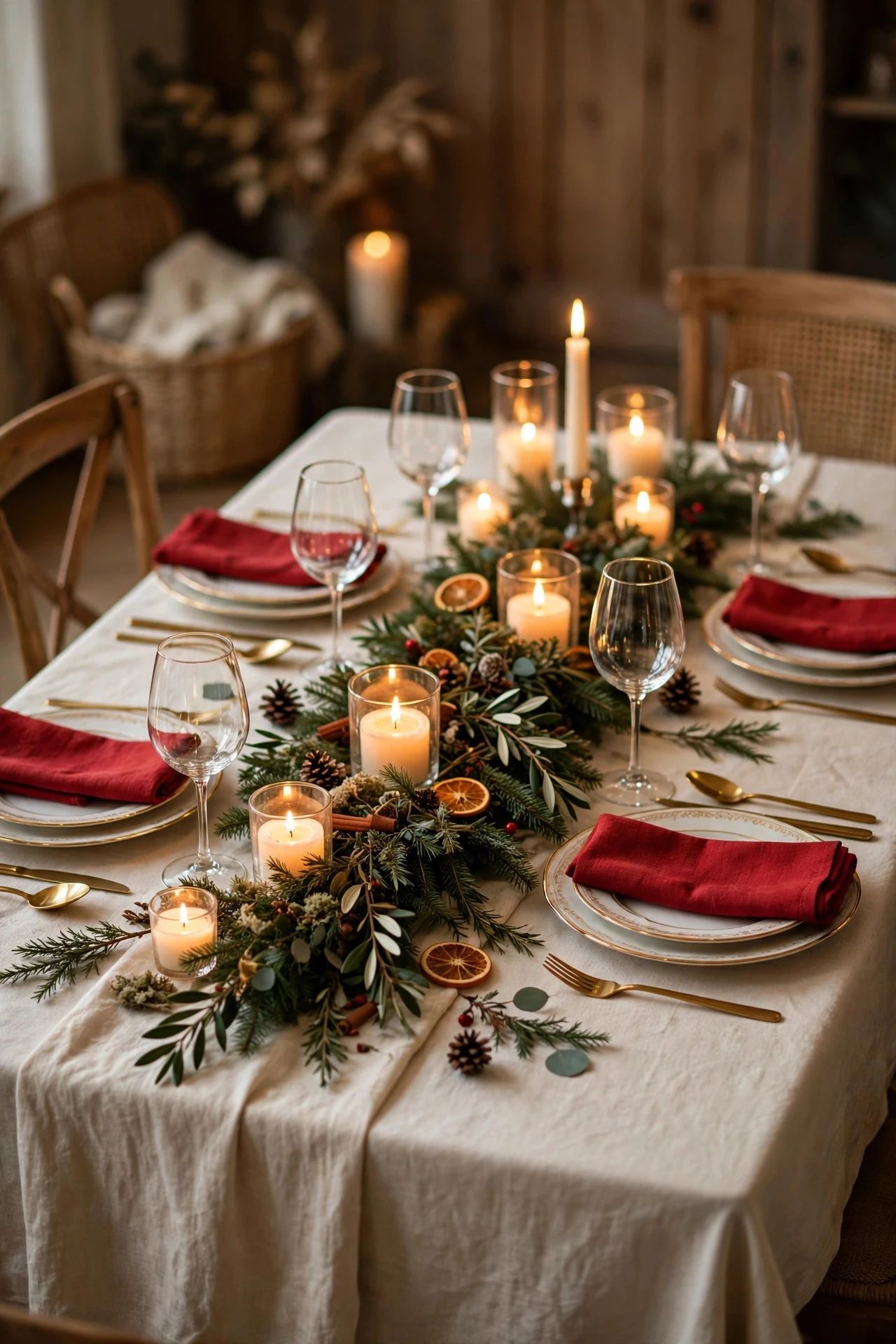
How to Decorate a Christmas Dining Table That Feels Festive, Not Cluttered
A Christmas dining table should make guests want to sit down, not make them afraid to touch anything. The difference between festive and cluttered is almost always space: room for elbows, room for plates, and a clear line of sight across the table so people can actually talk to each other. Everything in this guide protects that space first and adds decoration second.
You do not need a new table, a matching set of anything, or a big budget. A plain tablecloth, a strip of greenery, three candles and the dishes you already own can look more festive than a table buried under ornaments. The ideas below work on round tables, long banquet tables and small four-seaters, with real measurements and honest budgets.
Looking for more inspiration? Our Nest Decorz homepage gathers the latest home decor ideas, seasonal decorating guides and room-by-room styling tips in one place — start there and explore.
Quick answers
– Keep the centrepiece low: nothing taller than 12–14 inches in the middle of the table, so guests can see each other across it. – Give each guest 24 inches: a place setting needs 24 inches of width and 15 inches of depth, elbows included. – Pick two colours plus one metallic: red and green with gold, or white and pine with silver — a third colour is where clutter starts. – Layer in threes: a cloth or runner, then chargers or placemats, then plates — three layers read as styled, five read as crowded. – Light it warm: 2700K warm-white light and flameless candles after dark beat bright white bulbs on a Christmas table every time.
1. How Do You Start With a Bare Table?
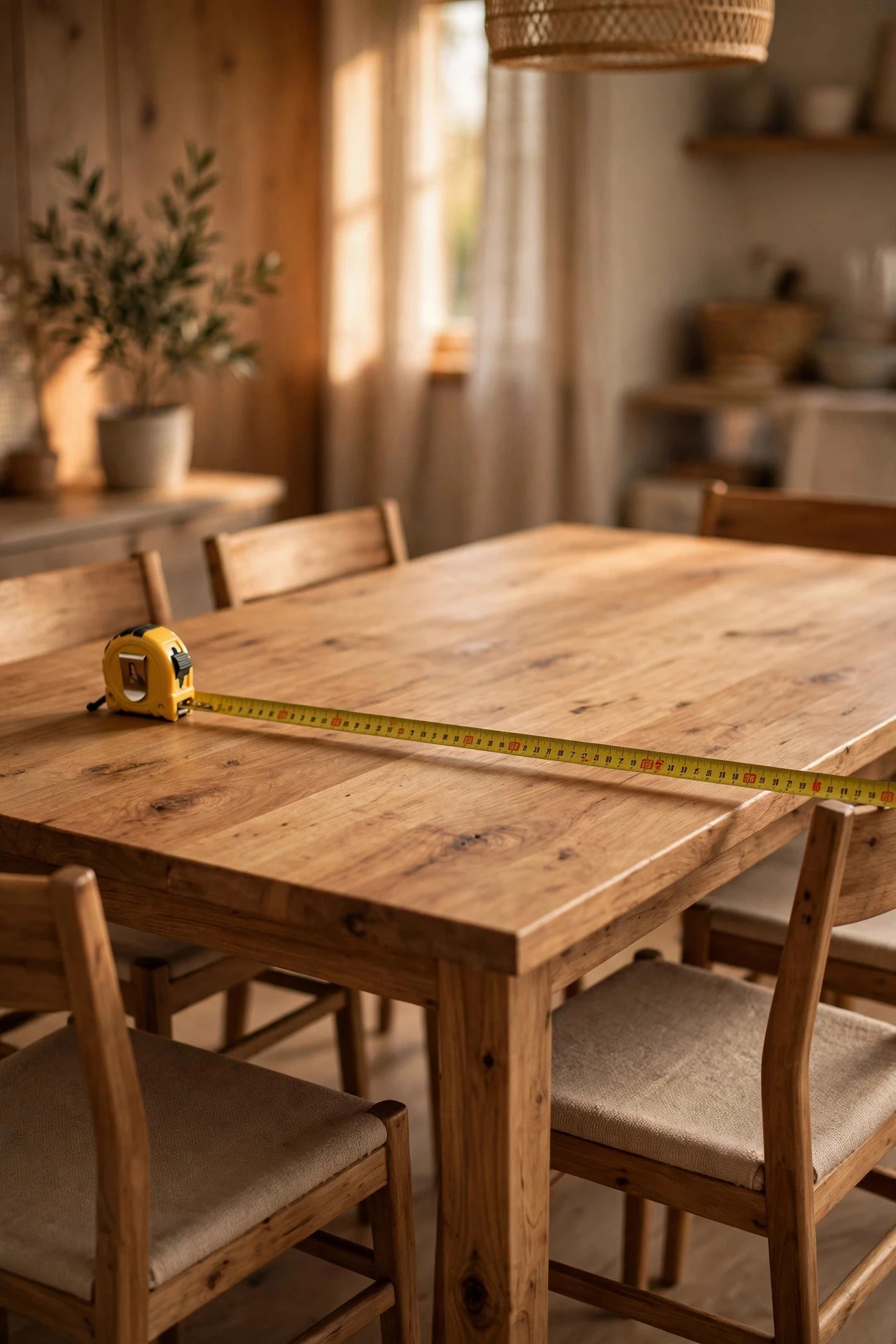
Start by stripping the table completely bare and measuring it. Note the length, the width and the height — a standard dining table is 30 inches high, 36 to 42 inches wide and 60 to 72 inches long
Decide how many people are actually eating before you buy or place a single thing. Count chairs, not wishes: six chairs means six settings at 24 inches each, which needs at least 72 inches of table length per side for three per side. For a front door that sets the same welcoming tone before guests reach the table, see this snowman door that greets them with cheer.
2. How Do You Choose a Tablecloth or a Runner?
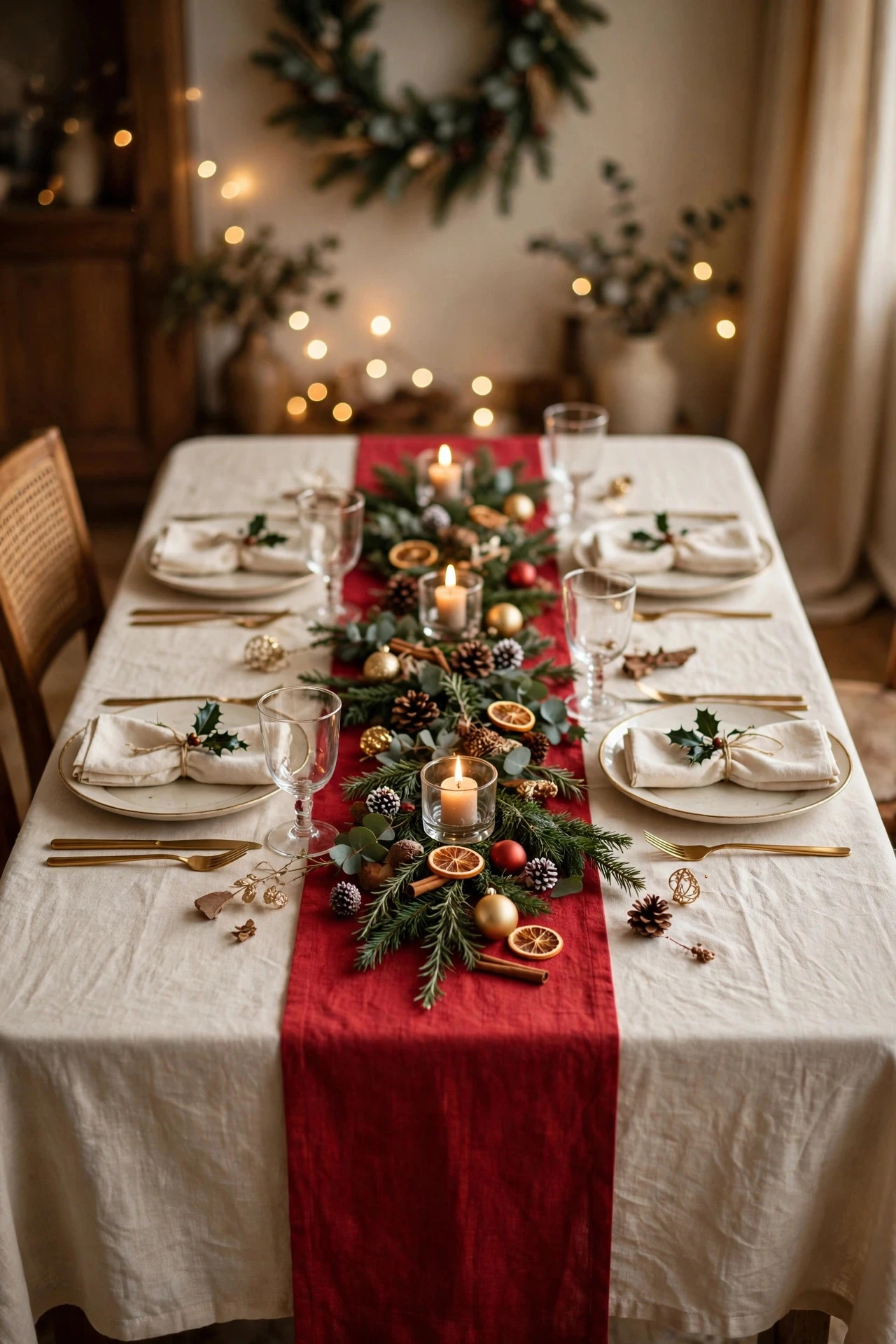
A tablecloth should hang 8 to 12 inches over each edge — on a 72-inch table that means a cloth 88 to 96 inches long. A drop shorter than 6 inches looks like a mistake, and a drop that pools on chair seats will be sat on and pulled. Press or steam the cloth the day before so the creases fall out overnight.
A runner is the better choice when you want to show off a wood table. It should be 12 to 18 inches wide and hang 6 to 12 inches over each end, never wider than a third of the table. Avoid a runner so wide it sits under the plates — it will bunch, stain and slide.
3. How Do You Layer Placemats and Chargers?
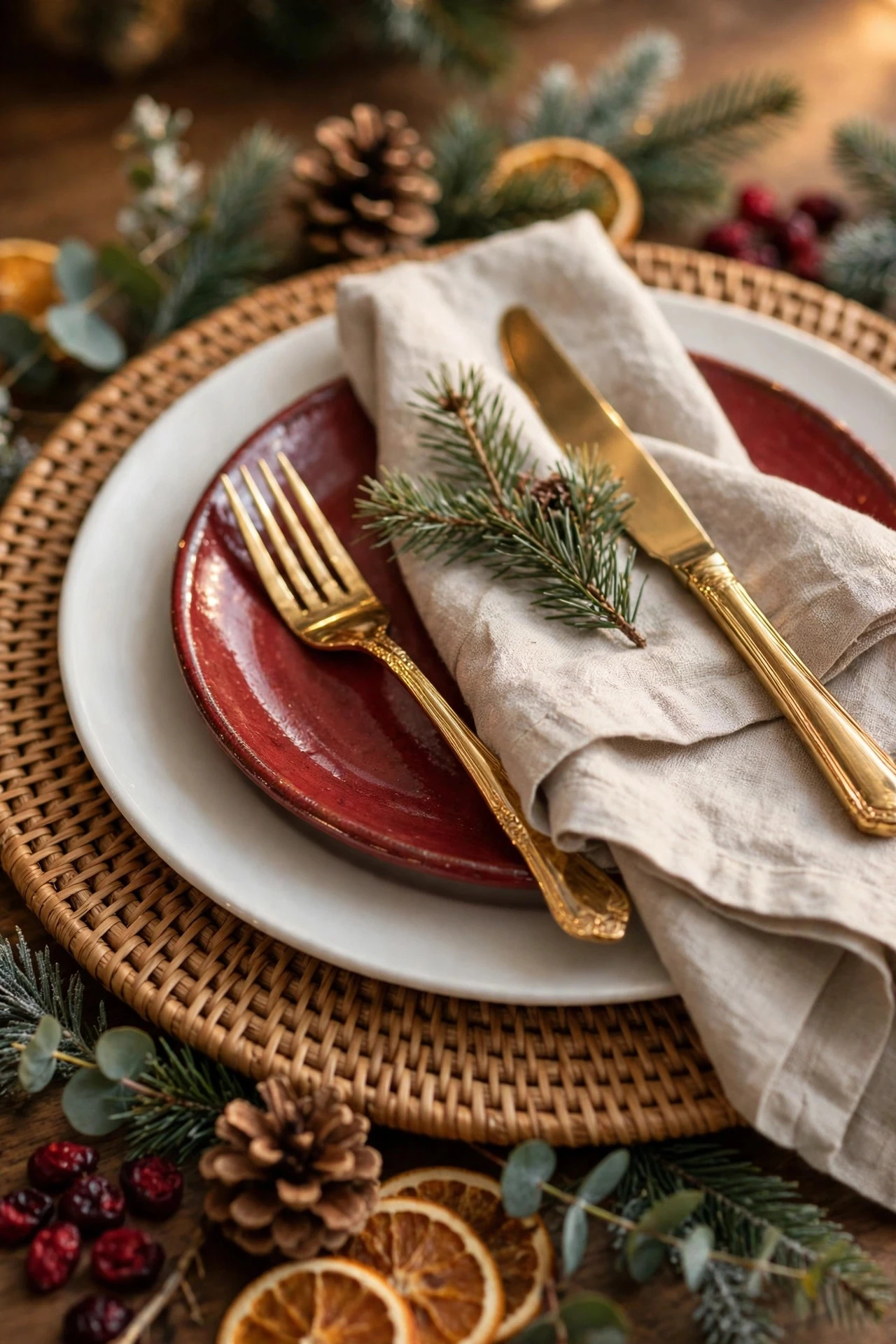
Layer from the bottom up: placemat or charger first, then the dinner plate, then the salad plate or bowl. A charger is 12 to 13 inches across, a placemat 12 by 18 inches, and both should sit 1 inch in from the table edge with 2 inches between neighbouring settings.
Choose one patterned layer and keep the rest plain — a patterned charger with plain plates, or plain chargers with a patterned runner. Two patterns at the same setting fight each other and make the table look busy before the food arrives. Avoid mixing patterns and textures at one place; one statement layer per setting is enough.
4. How Do You Build a Low Centerpiece?
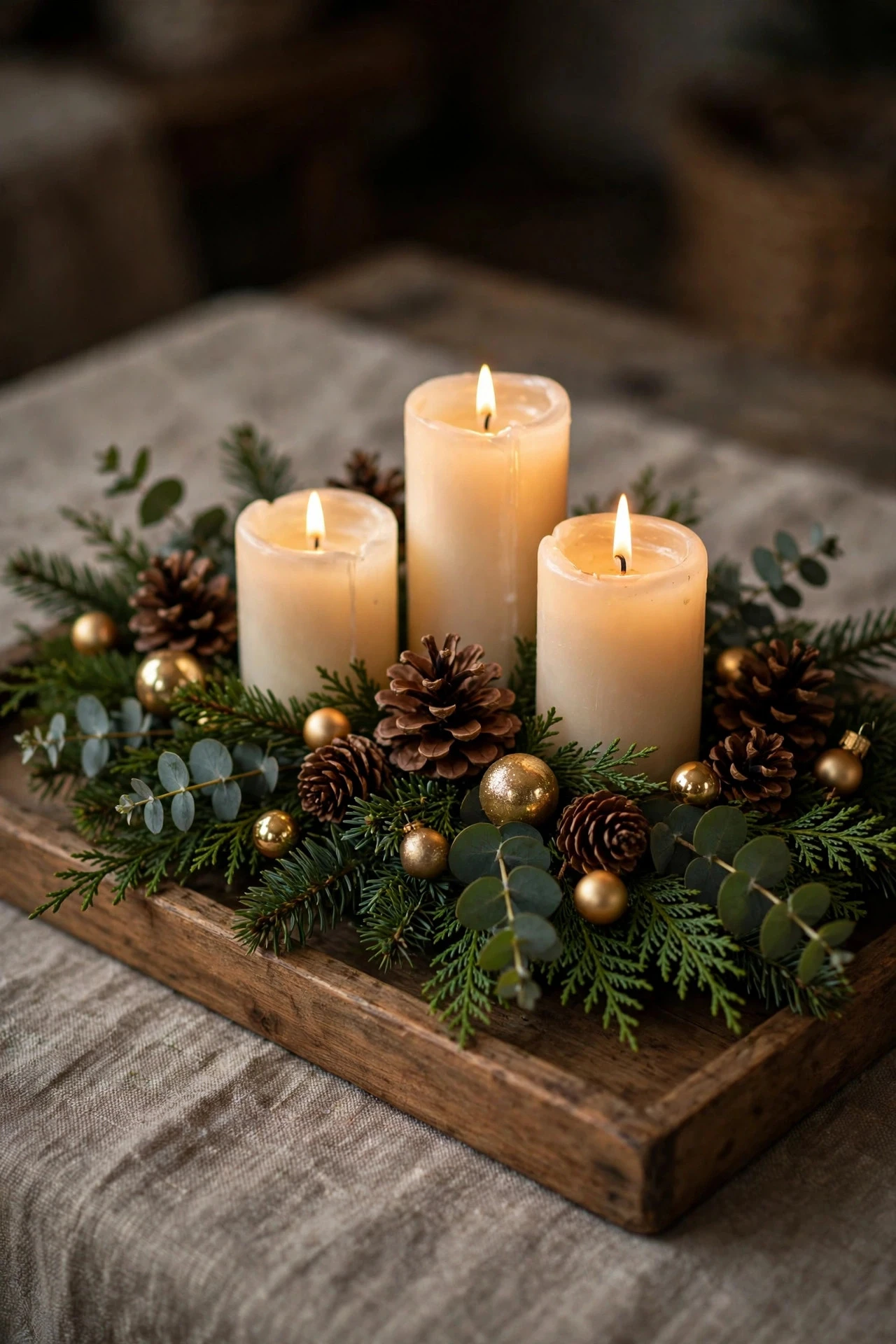
Build the centrepiece along the middle of the table and keep every element under 12 inches tall, ideally 8 to 10 inches. A low wooden tray 24 inches long by 8 inches wide holds the whole arrangement in one moveable unit. Fill it with three pillar candles, a few pinecones and small ornaments, leaving 6 inches of empty table on each side.
Sit in a chair and look across the table before you call it finished. If you cannot see the face of the person opposite, something is too tall — cut it down or lay it flat. A centrepiece that blocks eye contact kills conversation, and no amount of glitter makes up for a silent dinner. Avoid tall candlesticks where people sit opposite each other.
5. How Do You Run a Garland Down the Middle?
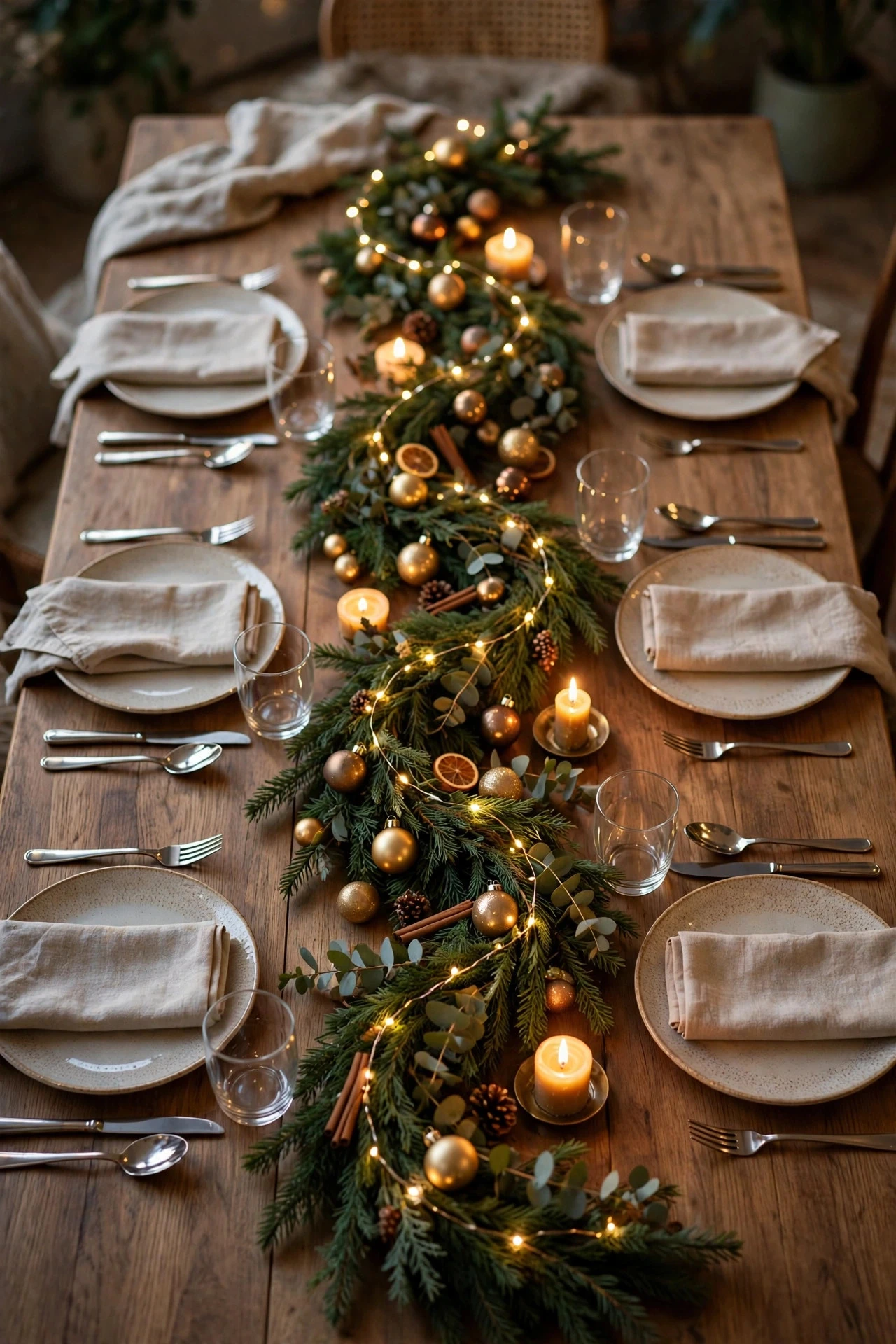
A table garland should run the full length of the table and hang 6 to 12 inches over each end, just like a runner. Lay it straight down the centre line, then push it into gentle S-curves so it reads as a river of green.
Keep the garland narrow — 6 to 8 inches wide — so plates still fit on either side of a 36-inch-wide table with at least 12 inches of clear space per setting. Tuck in fairy lights, a few baubles and pinecones, keeping the top flat and below 4 inches high. For a garland you can make yourself to match the table, see this christmas ribbon garland that looks store-bought. Avoid a garland so thick it sheds needles into the food.
6. How Do You Add Candles Without a Fire Risk?
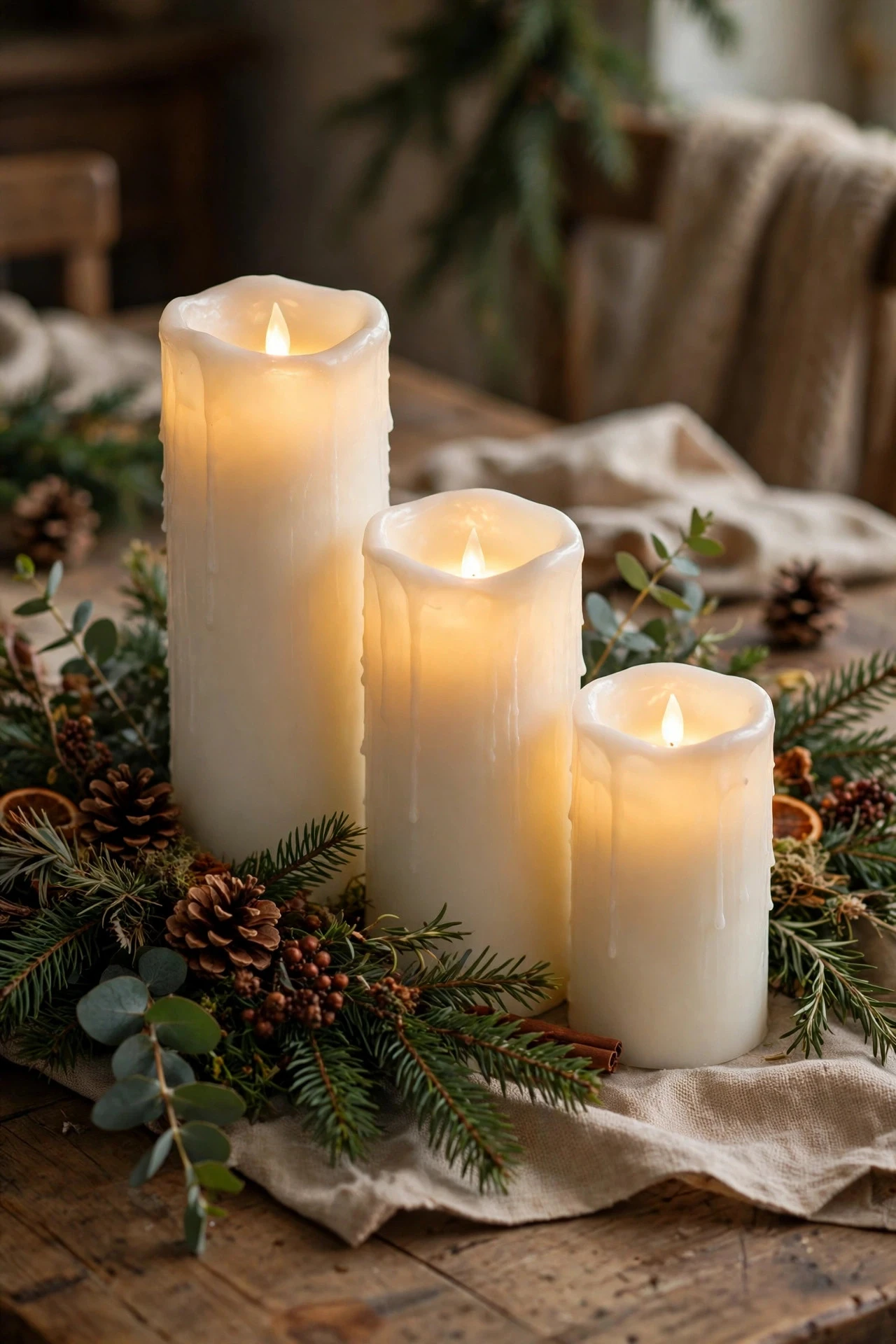
Use flameless LED pillar candles on a dining table, especially with a garland, a runner or children nearby. A set of three LED pillars — 4, 6 and 8 inches tall — costs $12 to $20, runs on a timer, and gives the same warm glow with zero risk.
Place candles in clusters of three at different heights, at least 12 inches from the nearest plate and 6 inches from any greenery. The Spruce's guide to flameless candles covers the timer and battery features worth paying for, and the same logic applies to table candles. Avoid scented candles at the dinner table — they fight the smell of the food.
7. How Do You Set Places for a Crowd?
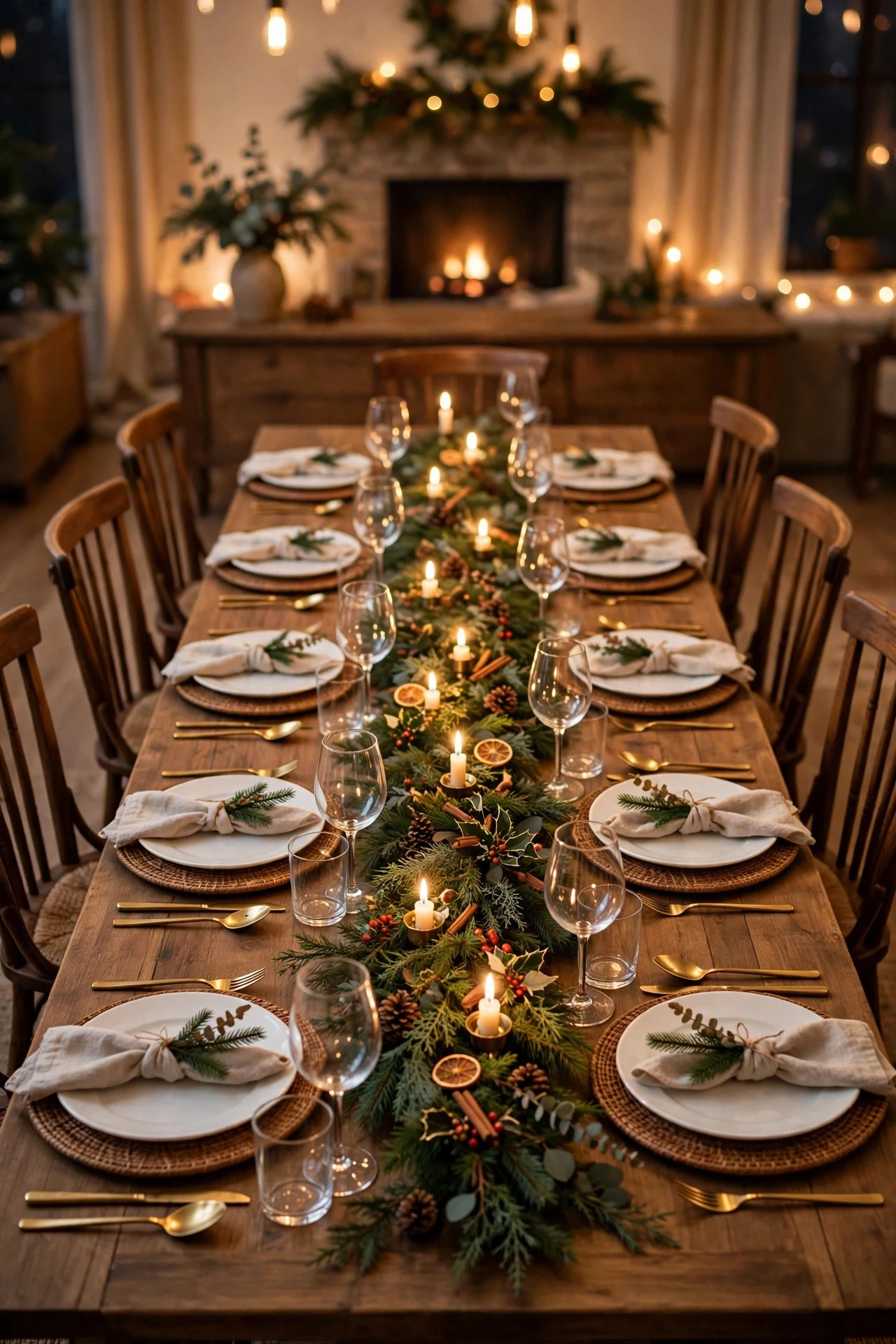
Allow 24 inches of width per person and 15 inches of depth, and count the table honestly before you invite people. A 72-inch table seats three per side comfortably and four per side only if nobody minds touching elbows; the ends add one more seat each.
Set the table the same way for every guest: fork on the left, knife and spoon on the right, glass above the knife, napkin on the plate or to the left of the fork. The classic layout is covered in the table setting guide, and following it means guests never have to guess which fork is theirs. Avoid mixing up the sides from place to place — inconsistency reads as carelessness.
8. How Do You Mix Everyday Dishes With Christmas Pieces?
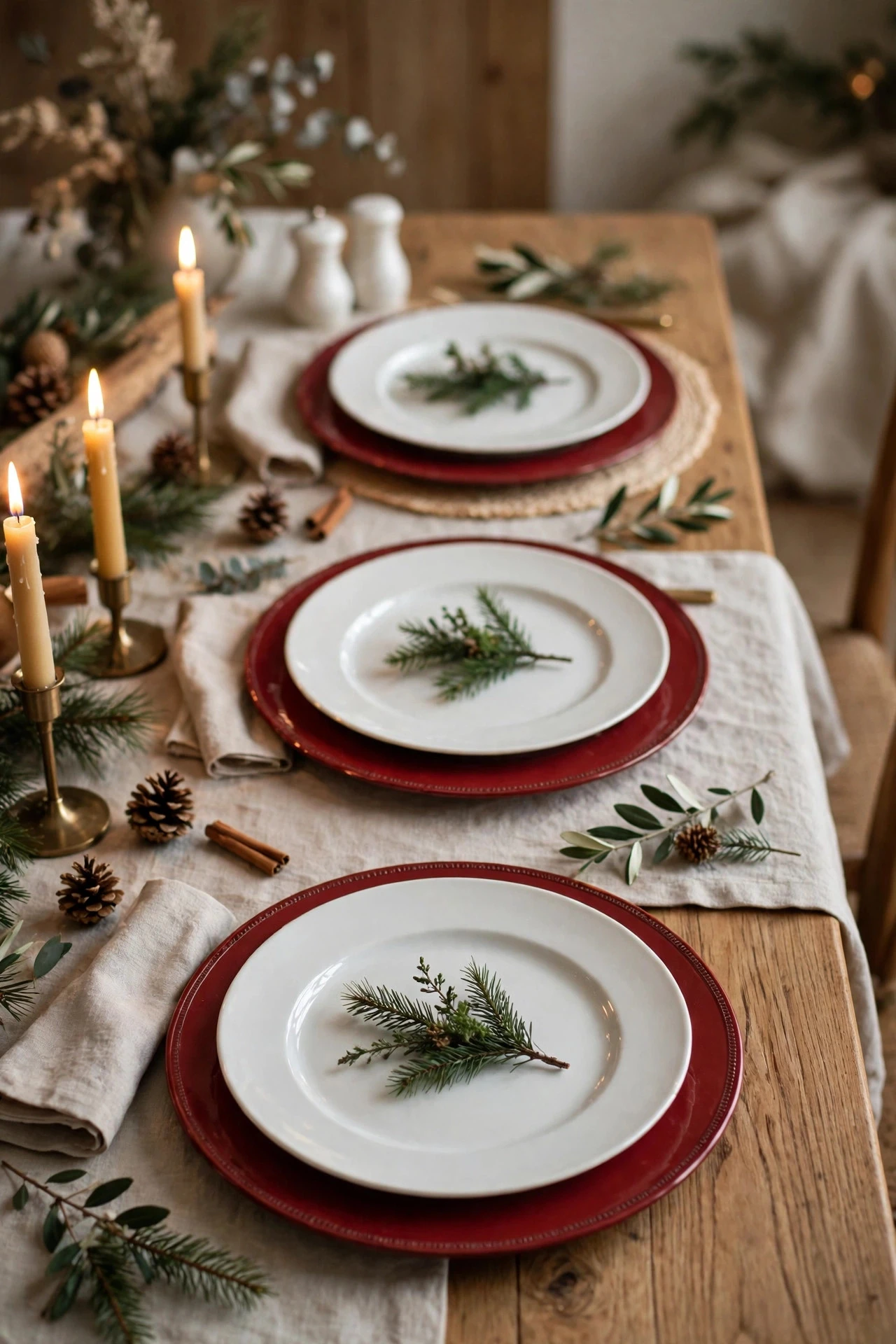
Use your everyday white plates as the base and add Christmas only at the edges — a red charger, a sprig of greenery on the plate, a patterned salad plate. White dishes make food look good, go with any colour scheme, and mean you only buy the accent pieces instead of a whole Christmas dinner service that gets used twice a year.
Keep the Christmas pieces to one or two per setting: a charger plus a napkin ring, or a patterned plate plus a sprig. Three or more themed pieces per place turns dinner into a novelty shop. If your everyday dishes live behind decorated cupboard doors, these christmas cabinets show how to dress the storage without the clutter. Avoid buying a full themed set the first year; add one piece per Christmas.
9. How Do You Pick a Colour Palette for the Table?
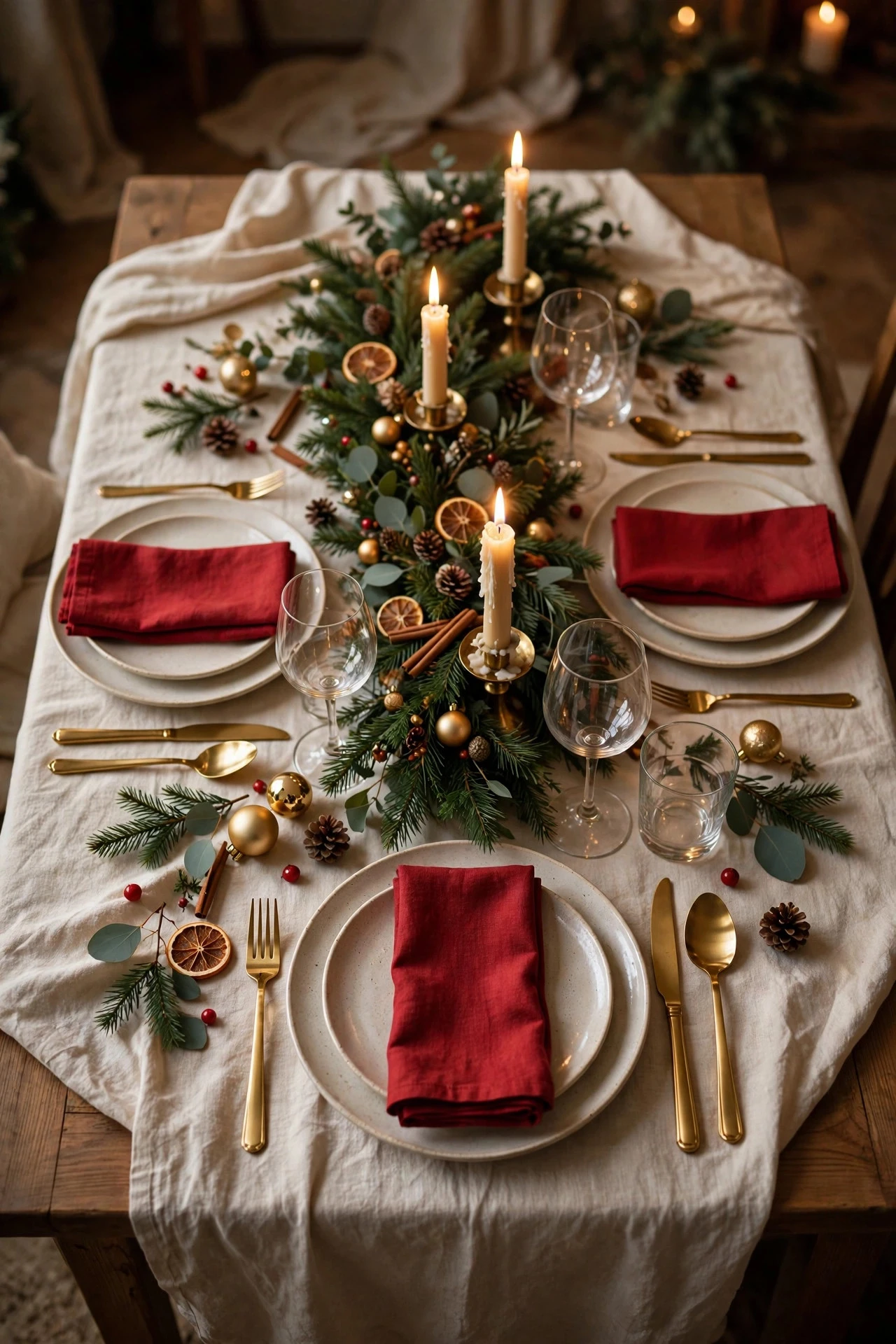
Pick two colours plus one metallic and stop there. Red and green with gold is the classic; white and pine green with silver is calmer; navy and white with gold feels modern; burgundy and cream with brass feels rich.
Let the biggest surface carry the calmest colour — a white or cream cloth, or bare wood — and spend the strong colour on the small things: napkins, ribbon, ornaments, candle holders. A good ratio is 60 percent neutral, 30 percent main colour, 10 percent metallic. Avoid mixing warm gold and cool silver in the same setting.
10. How Do You Add Natural Greenery That Lasts?
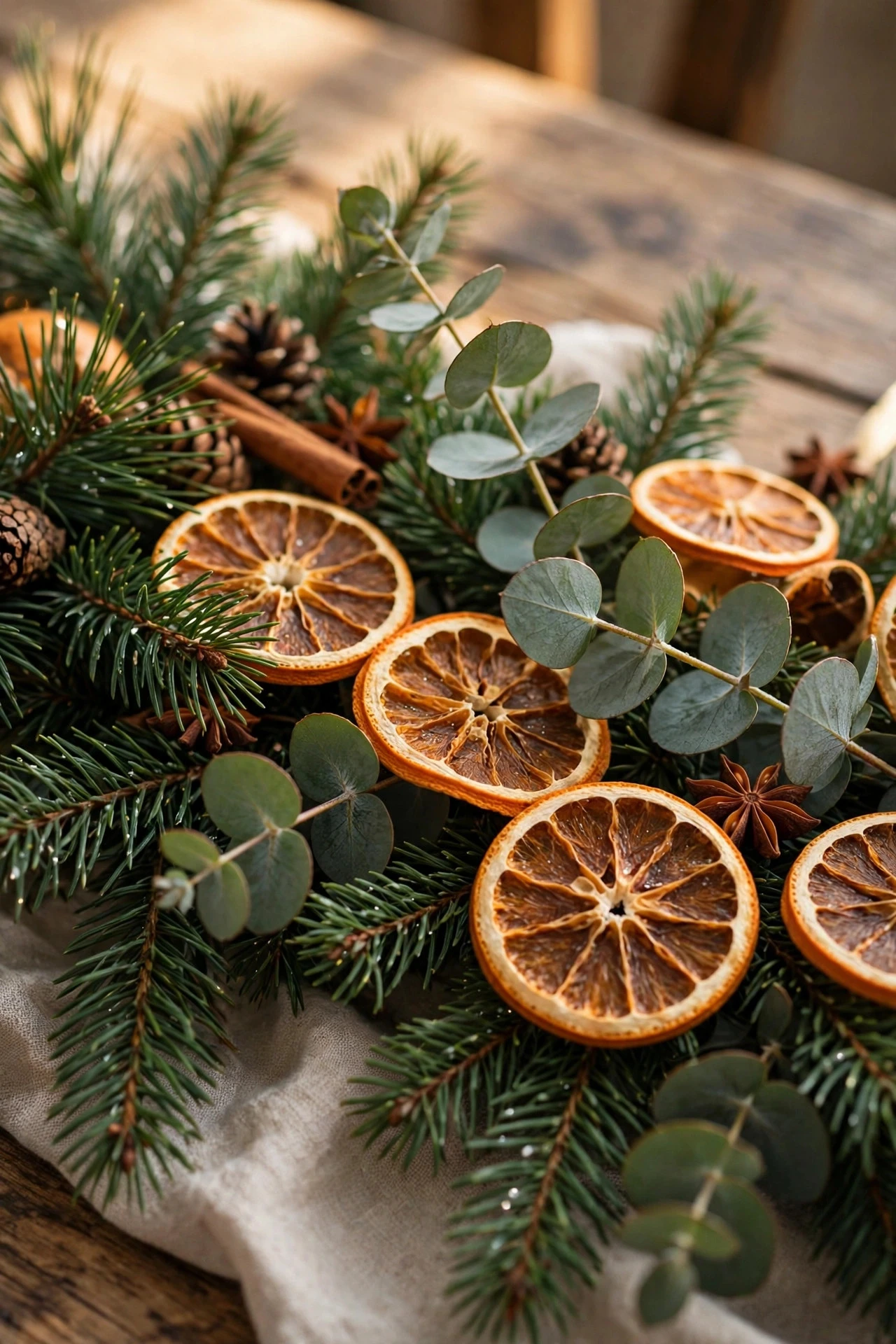
Use fresh-cut pine, fir, cedar or eucalyptus, and cut the stems the morning you decorate so they stay fresh for a week. A bunch of eucalyptus costs $5 to $8, a bag of pine clippings $3 to $5 from a tree lot, and both will last through Christmas dinner if you keep them out of direct heat and mist them lightly once a day.
Mix one type of greenery with one texture — pine plus pinecones, or eucalyptus plus dried orange slices — and leave the rest out. Three kinds of green at once look like a forest floor, not a table. Avoid holly with sharp leaves at place settings where hands will brush it, and avoid any greenery that sheds heavily over the plates.
11. How Do You Use Ornaments on the Table?
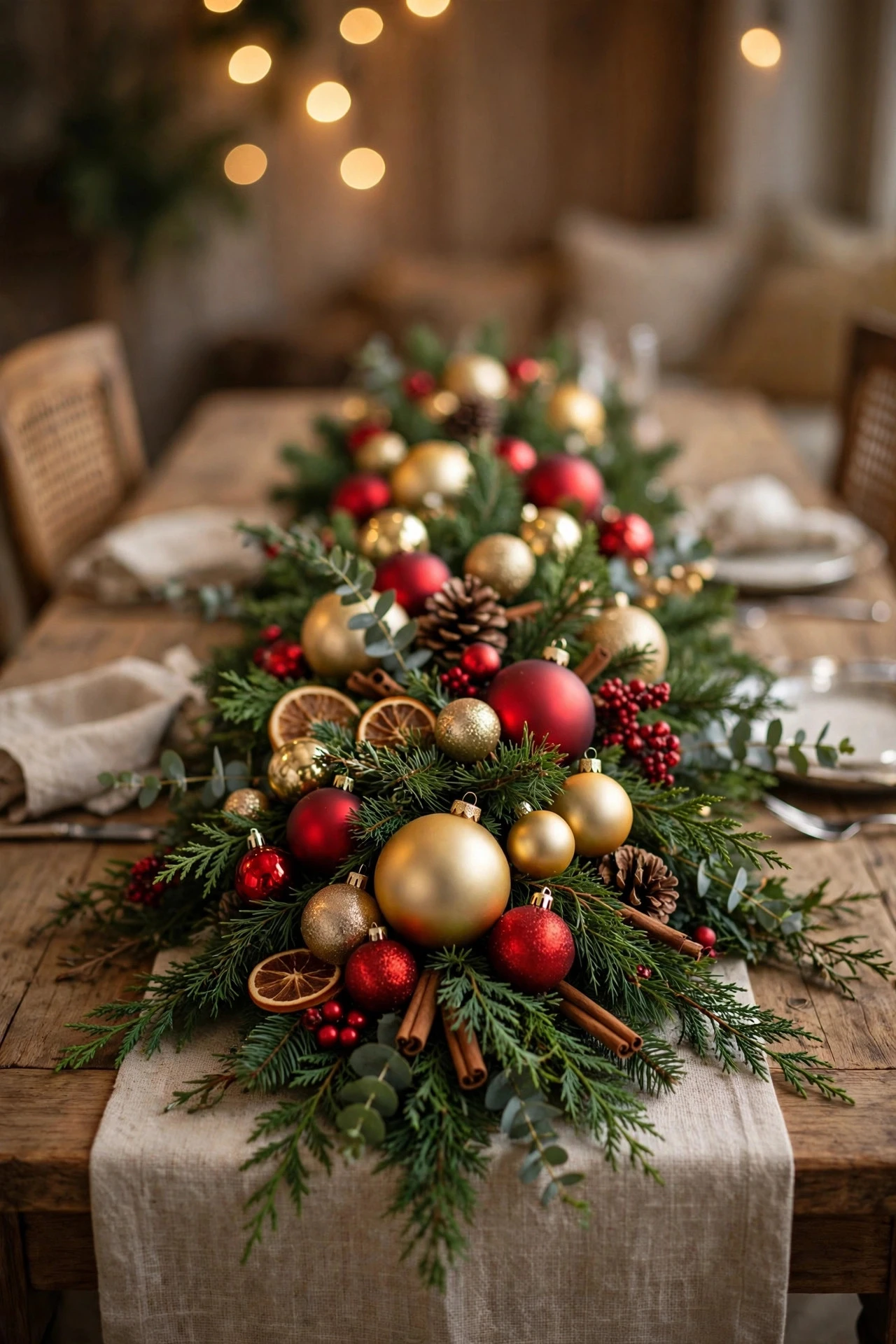
Use ornaments as table jewellery, not as the main event: three to five ornaments per foot of table, in two sizes, tucked into the garland or the centrepiece tray. Small baubles 2 inches across fill gaps; one or two larger ones 3 to 4 inches across anchor each cluster.
Keep ornaments inside the centre line — inside the tray or the garland — and never on a plate, on a chair, or loose where they roll. A rolling bauble ends up on the floor or in the gravy, and a glass bauble that breaks near food ends the meal. Avoid hanging ornaments from a chandelier above the table unless they are secured and well above head height.
12. How Do You Style a Small Dining Table for Christmas?
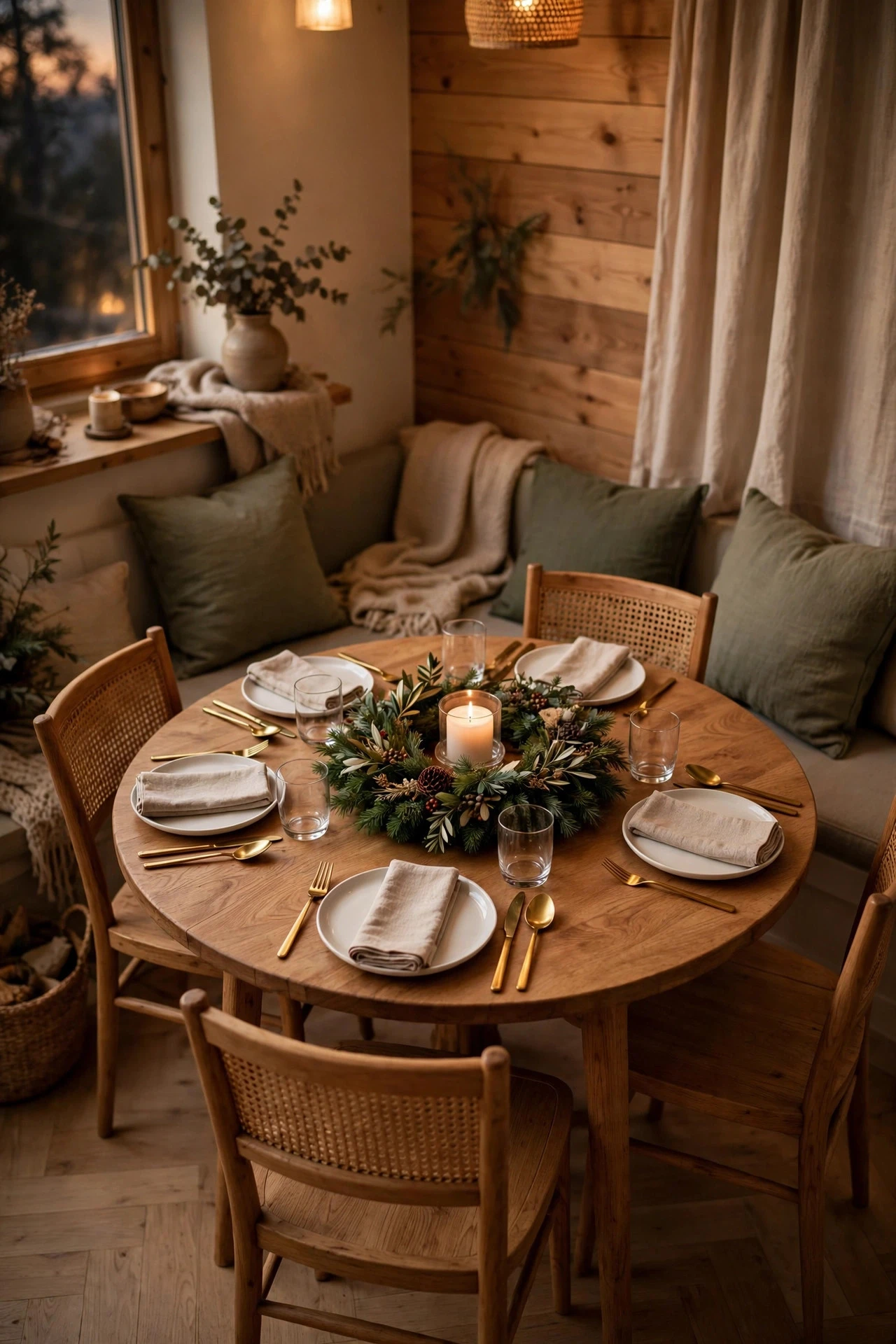
Scale everything down and use fewer pieces, not smaller versions of everything. On a 36-inch round table or a four-seater, one centrepiece is enough: a single candle cluster, a small wreath 12 inches across with a candle in the middle, or a short garland looped into a circle.
Skip the tablecloth on a small table and use a runner or four placemats instead — a cloth that hangs too far over a small table eats the legroom and gets pulled every time someone stands up. Use one colour plus one metallic, skip the chargers, and let the plates be the decoration. Avoid a centrepiece wider than a third of the table.
13. How Do You Dress a Long Banquet Table?
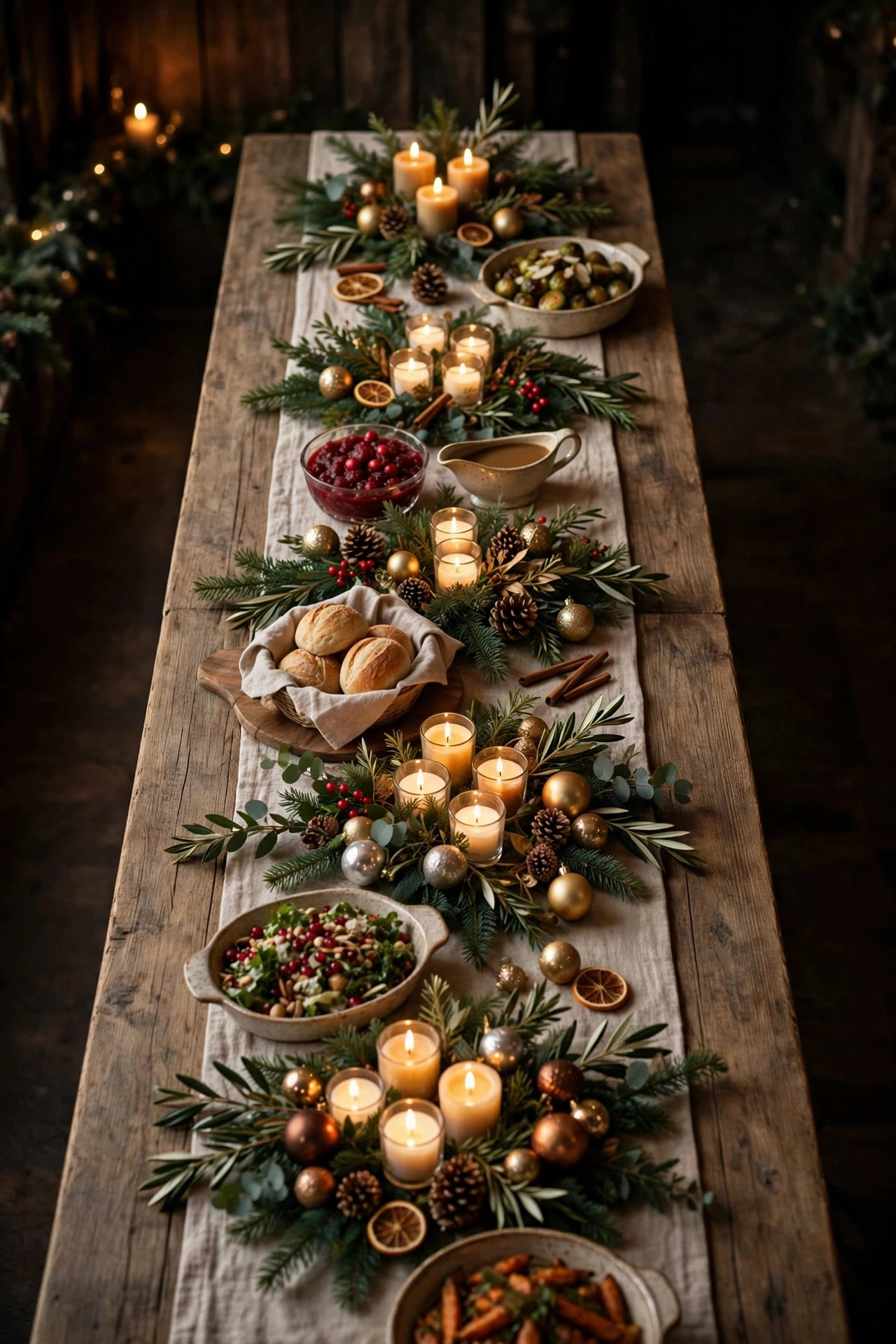
Repeat a small vignette every 24 to 30 inches instead of building one giant centrepiece. Each vignette is the same trio: a candle cluster, a small bunch of greenery and two or three ornaments, set inside the centre line.
Leave a 12-inch gap of empty table between vignettes so serving dishes have somewhere to land — a long table needs landing space for bowls and platters more than a small table does. If the table is longer than 96 inches, add a second, slightly different vignette at the middle to mark the centre. Avoid one continuous row of candles down the whole table; it looks like a runway and leaves no room for food.
14. How Do You Add Height Without Blocking Faces?
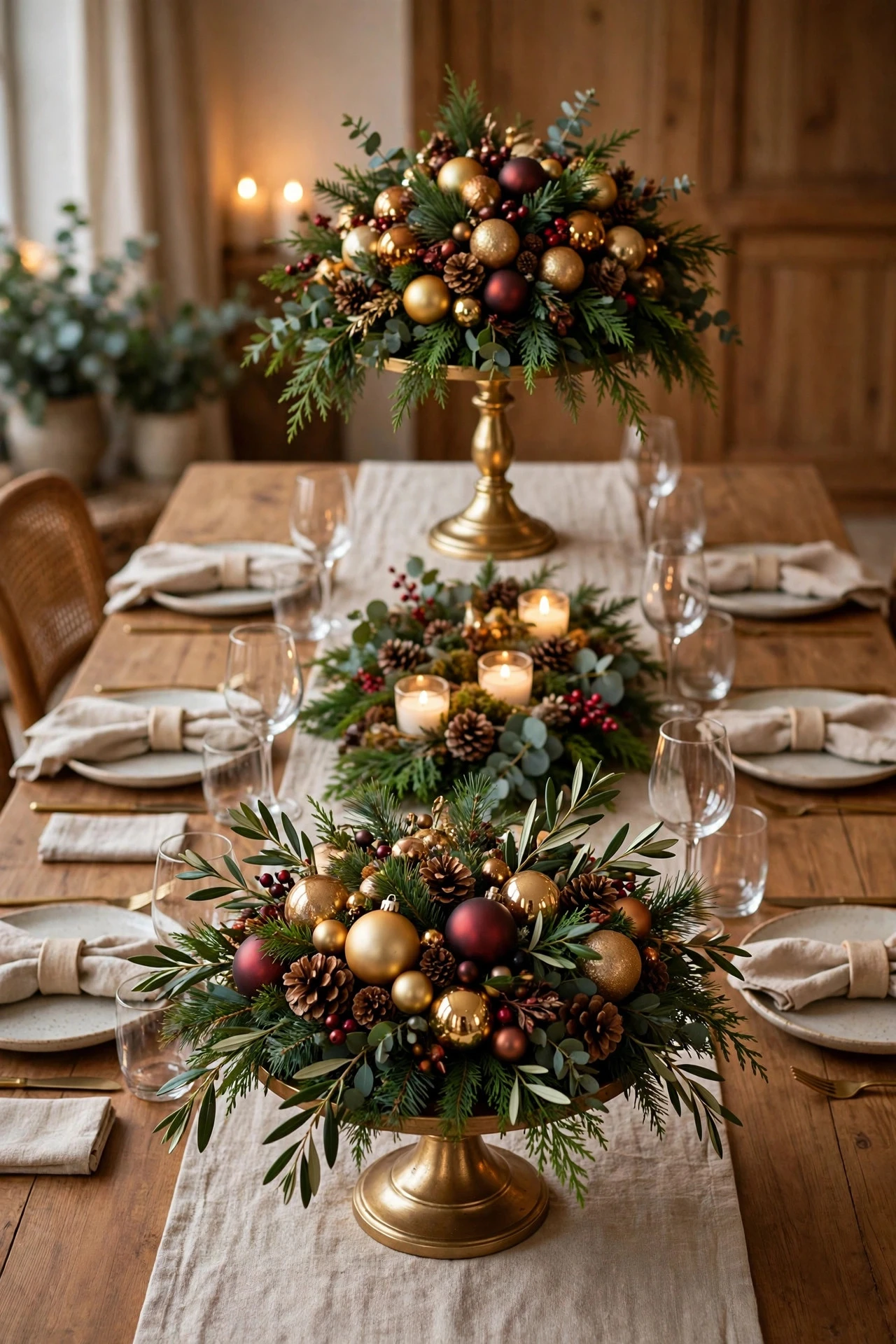
Add height at the ends of the table and at the corners, never in the middle where people sit opposite each other. A cake stand 10 to 12 inches tall at each end holds a small arrangement, a bowl of ornaments or the dessert, and lifts the eye without blocking a single face.
Use height in odd numbers — one tall piece at each end, or three pieces of different heights grouped at one end — and keep everything else low. Two tall candlesticks flanking a low garland give the table shape; six tall candlesticks in a row give it a fence. Avoid tall arrangements in the centre of a table where guests sit on both sides.
15. How Do You Fold Napkins for Christmas?
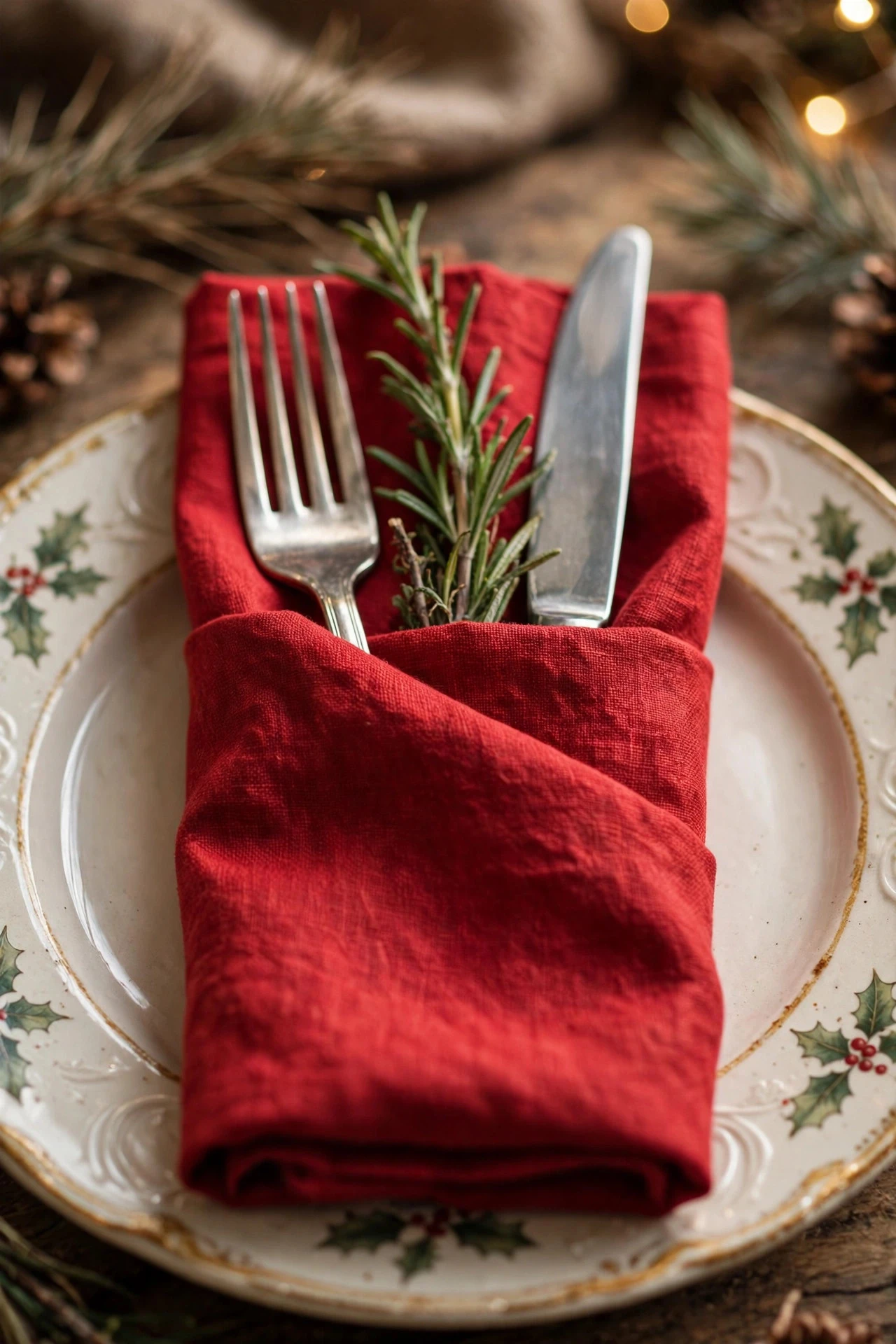
Learn one fold well and repeat it at every place — consistency beats complexity on a table. A simple pocket fold holds the cutlery and a sprig of greenery, takes thirty seconds per napkin, and looks neat from every angle.
Use cloth napkins 18 to 20 inches square in a solid colour from your palette, with a napkin ring or a 12-inch length of ribbon tied around the middle. Slip a 4-inch sprig of rosemary or pine under the ribbon for a fresh touch that costs nothing and smells wonderful. Avoid a different fold at every place setting.
16. How Do You Add Place Cards That Guests Will Keep?
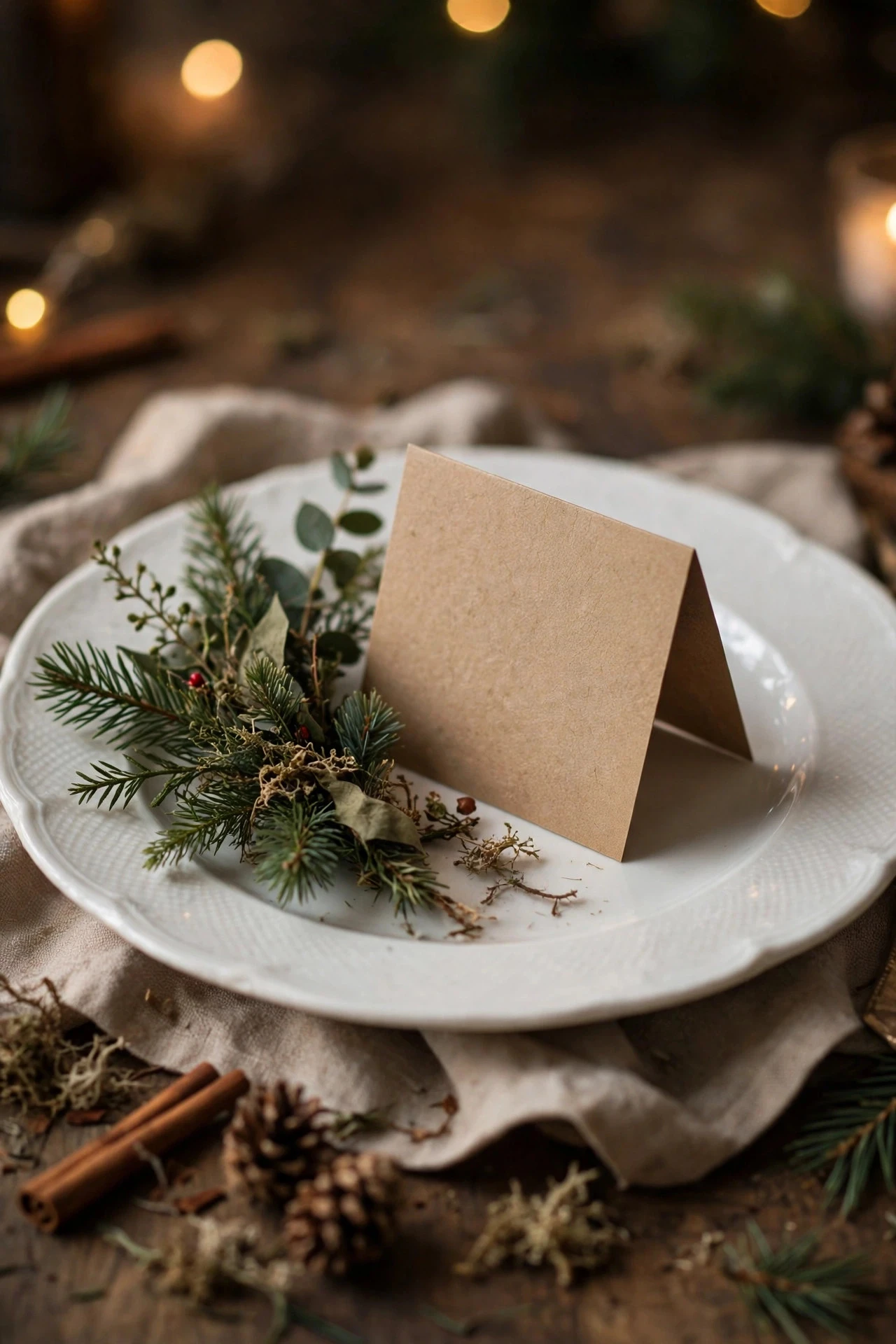
Make place cards small, readable and personal: a 2-by-3-inch card tented on the plate or leaning against the glass, with the guest's name in a handwriting everyone can read. Write first names only unless two guests share one.
Tie the card to the table's theme with one small detail — a sprig of greenery tucked behind it, a tiny pinecone beside it, or a ribbon in your palette colour. Keep the card off the food and out of the wine glass, and place it where the guest sees it when they sit down. Avoid place cards so large they cover the plate or so fancy nobody can read the name.
17. How Do You Light the Table for Dinner?
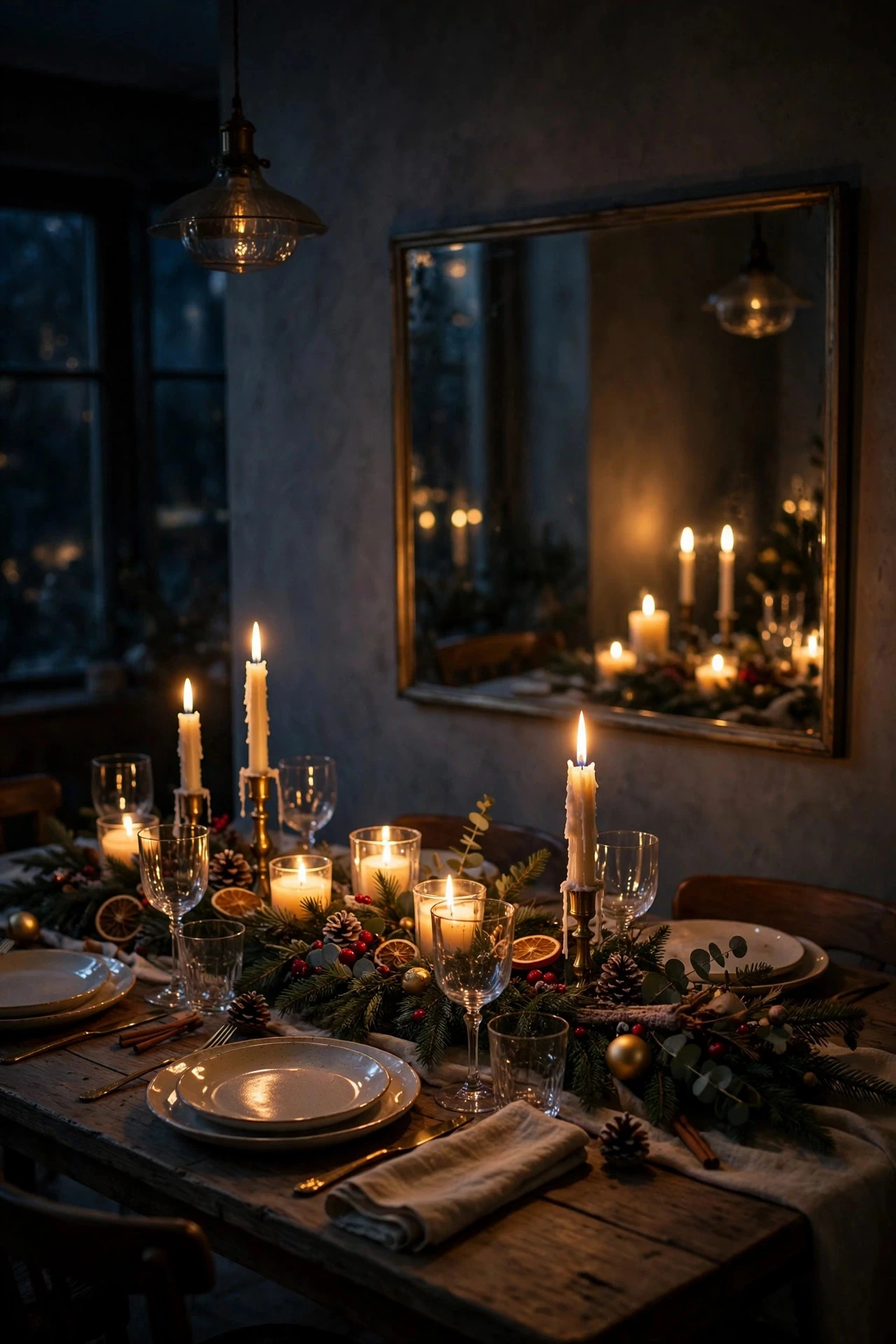
Light the table warm and low: dim the overhead light to half, switch the bulbs to 2700K warm white, and let candles do the rest. A dimmer switch costs $15 to $25 and is the single best upgrade for a dining room; without one, use a lower-wattage bulb for the evening, around 40 watts equivalent, so the room feels like candlelight rather than an office.
Add a mirror on the wall behind the table or a mirrored tray under the candles to double the glow without adding a single flame. For mirror styling that doubles light across a room, see these christmas mirror ideas. Test the lighting the night before with the candles lit and the room lights dimmed. Avoid a bare bulb or a spotlight pointing straight down onto the table.
18. How Do You Style a Rustic Christmas Table?
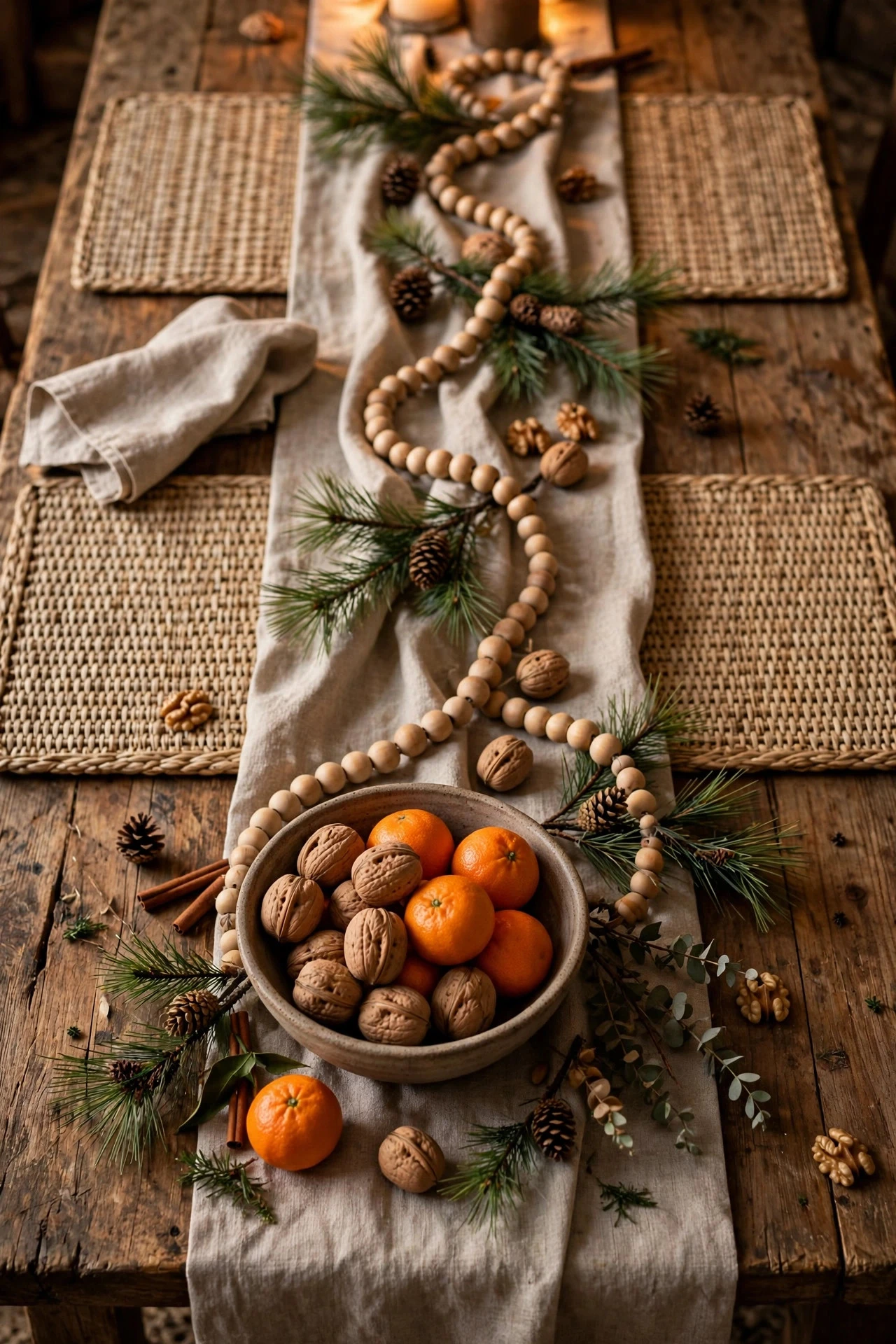
Build a rustic table from wood, linen and greenery, and let the materials do the work. A bare wood table or a natural linen runner, woven placemats, plain cream plates, pine sprigs and wooden bead garlands are the whole scheme.
Keep the palette to cream, pine green and wood tones with no metallic at all, or one brushed brass accent if the room needs warmth. Use mismatched vintage glasses and chipped enamel candle holders — imperfections are the point of rustic, and a table that looks slightly lived-in feels more welcoming than a perfect one. Avoid plastic imitations of wood or linen; on a rustic table, fake materials are obvious.
19. How Do You Style a Glamorous Christmas Table?

Build a glamorous table from shine: a metallic runner, glass chargers, crystal or cut-glass candle holders, and ornaments in one metallic only. Gold with cream and white is warm; silver with white and ice blue is cool; pick one and commit.
Keep the greenery minimal on a glamorous table — a few sprigs of frosted eucalyptus or white-painted pine sprigs, not a full green garland, so the metallics stay the stars. Polish the glasses the day before, because fingerprints show twice as much under candlelight. Avoid mixing gold and silver, and avoid glitter, which sheds onto plates, glasses and food.
20. How Do You Keep the Table Kid-Friendly?
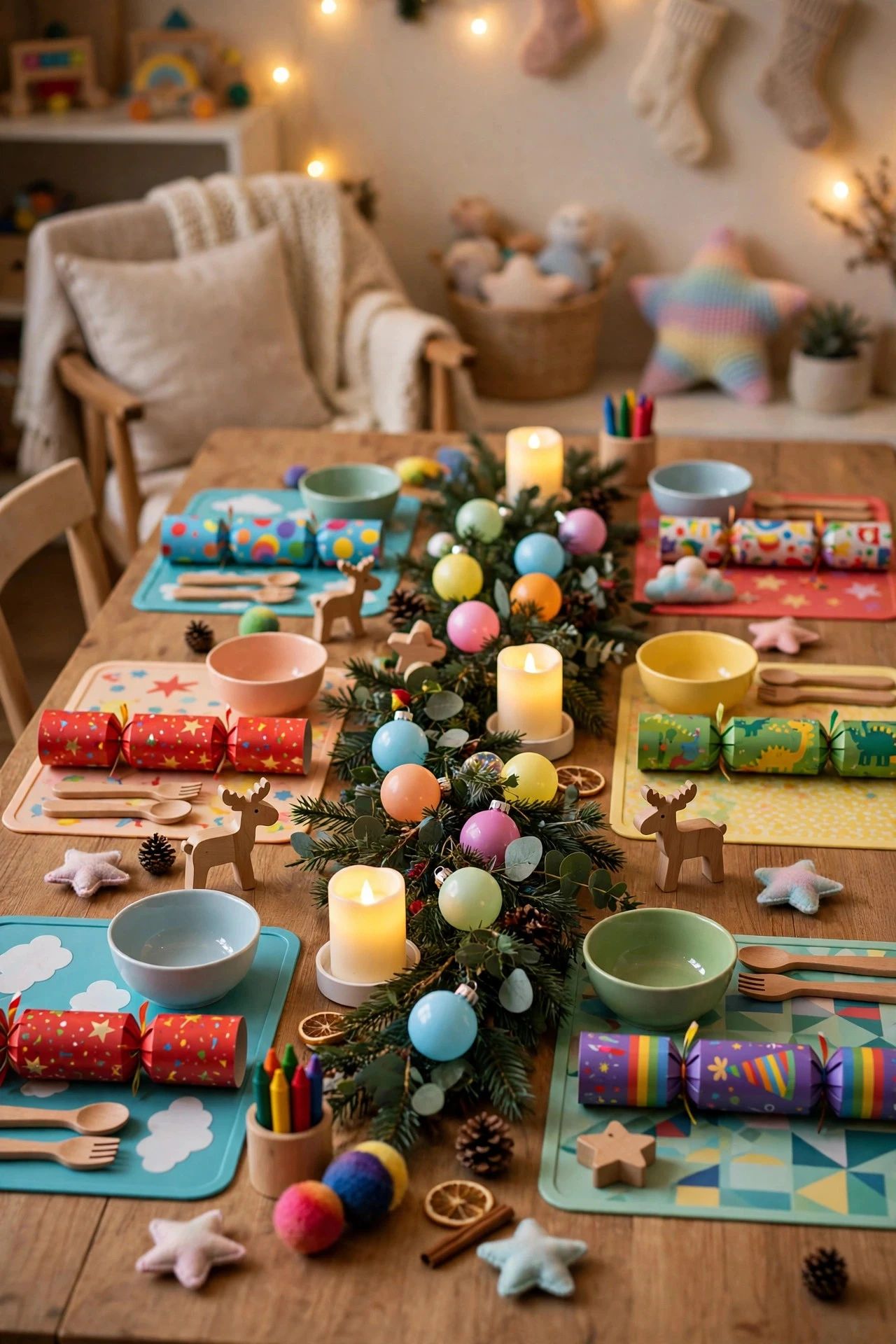
Give children a table they can touch without breaking anything. Use shatterproof ornaments, LED candles, cloth napkins they can wipe hands on, and a low centrepiece they can see over — and keep glass baubles, real flames, sharp holly and anything smaller than a golf ball off the children's end of the table entirely.
Seat children at one end together with an adult at the corner, and give them a job: folding napkins, placing the name cards, or choosing which ornament goes where. A small activity at each child's place — a paper Christmas cracker, a colouring card, a candy cane — keeps small hands busy while the adults talk. Avoid a white tablecloth on a table full of children under eight.
21. How Do You Set the Table the Night Before?
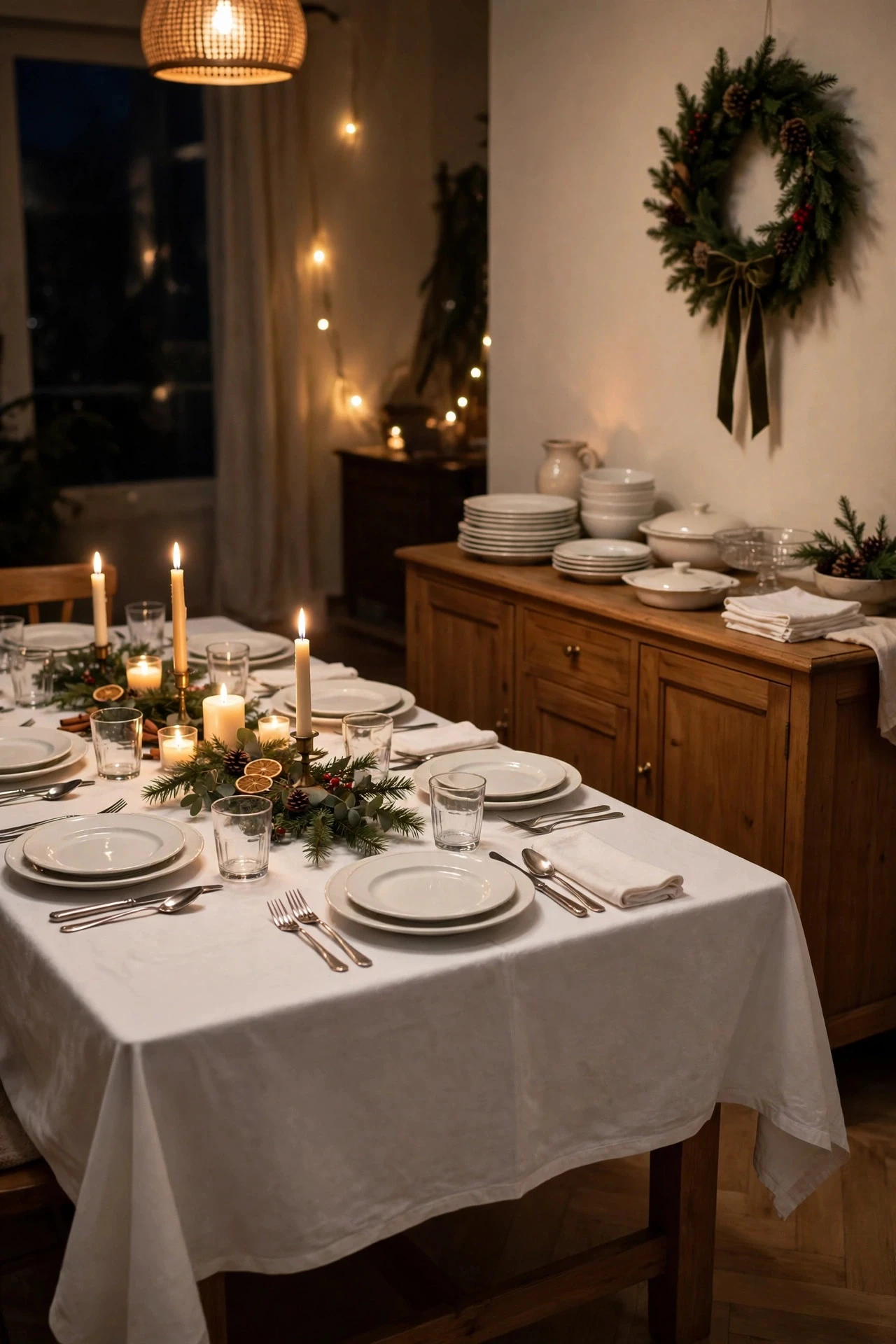
Set everything the night before except the food, the water glasses and anything fresh. Lay the cloth, the runner, the chargers, the plates, the cutlery, the glasses, the candles and the centrepiece, then cover the whole table with a clean sheet to keep the dust off overnight. In the morning, lift the sheet, add the greenery and the napkins, and the table is done in fifteen minutes instead of two hours.
If the entryway holds the overflow, dress it to match the table; these christmas entryway table ideas show how an entryway table welcomes guests in style. Plan the meal around the table — the Christmas dinner traditions in your family decide how many courses, and therefore how many plates, the table must hold. Avoid setting fresh greenery the night before; cut it in the morning so it looks alive at dinner.
22. What Should You Leave Off a Christmas Table?
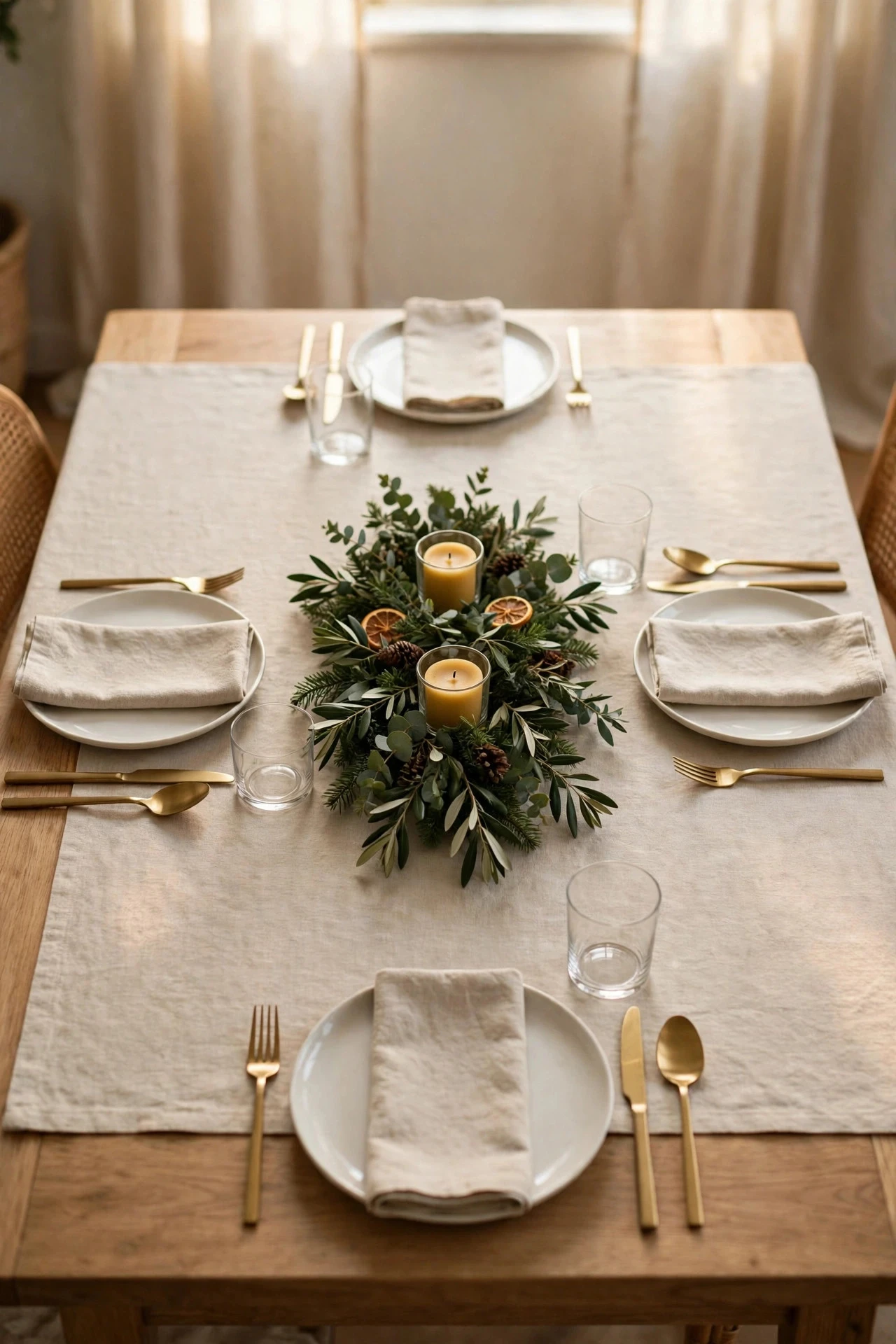
Leave off anything that does not earn its place: a second centrepiece, a third pattern, ornaments that roll, anything taller than 12 inches in the middle, and anything guests have to move to eat. The test is simple — sit down, put your hands where your plate will be, and look across the table. If anything is in the way of your hands, your plate or your view, take it off and put it on the sideboard instead.
A good Christmas table has one clear focal point, breathing room between settings, and empty space for the food. When in doubt, remove one thing and live with the table for an hour — if you do not miss it, it did not belong there. Avoid the urge to fill every inch; empty space is what makes the decorated parts look special.
Practical Tips
Measure the table before you shop. Length, width and the number of seats decide the runner, the cloth and the centrepiece size — a tape measure saves a return trip and a centrepiece that does not fit.
Keep the centrepiece under 12 inches. Guests should see each other's faces across the table, and serving dishes need landing space on both sides of the centre line.
Give every guest 24 inches. A place setting needs 24 inches of width and 15 inches of depth, elbows included — count chairs honestly before you invite people.
Choose two colours plus one metallic. A fourth colour is where festive turns cluttered; let the biggest surface stay neutral and spend strong colour on the small things.
Light it warm and low. Dim the overhead light, use 2700K warm-white bulbs, and let flameless candles do the rest — warm light flatters food, faces and red wine.
Final Thoughts
A Christmas dining table feels festive when the centrepiece is low, the colours are limited, the layers are few and every guest has room to eat and talk. Get those four things right, add one soft touch like fresh greenery and one glow like warm candles, and the table stops being a display guests are afraid to touch and becomes the place where Christmas dinner actually happens.
Frequently Asked Questions
How wide should a Christmas table runner be?
A runner should be 12 to 18 inches wide, never more than a third of the table's width, and it should hang 6 to 12 inches over each end. On a 36-inch-wide table that leaves at least 12 inches of clear space on each side for plates, glasses and elbows.
How tall can a Christmas centerpiece be?
Keep it under 12 to 14 inches tall, and ideally 8 to 10 inches. Sit in a chair and look across the table — if you cannot see the face of the person opposite, the centrepiece is too tall and needs cutting down or laying flat.
How much space does each guest need at a Christmas table?
Allow 24 inches of width and 15 inches of depth per person. A 72-inch table seats three per side comfortably, plus one at each end. If the maths does not work, add a leaf or a second small table rather than squeezing guests in.
Can I use real candles on a Christmas dining table?
You can, but flameless LED candles are safer and look nearly identical in warm light. Real candles need stable holders, a 12-inch clear circle around every flame, and someone in the room at all times. Never use real candles near a garland, a runner or children's seats.
How do I decorate a small dining table for Christmas?
Scale down and use fewer pieces, not smaller versions of everything. One centrepiece — a 12-inch wreath with a candle, or a short garland looped into a circle — is enough on a four-seater. Skip the tablecloth, use a runner or placemats, and let the plates be the decoration.
When should I set the Christmas table?
Set everything the night before except the food, water glasses and fresh greenery, then cover the table with a clean sheet overnight. In the morning, lift the sheet, add the greenery and napkins, and the table is ready in fifteen minutes instead of two hours of last-minute rushing.