22 Kitchen Window Christmas Decor Ideas for a Bright, Festive Kitchen
# 22 Kitchen Window Christmas Decor Ideas for a Bright, Festive Kitchen
The kitchen window is the hardest-working window in the house, and at Christmas it deserves to be the prettiest one too. It is the view you stare at while washing dishes, the light source over the sink, and the first thing guests see when they step in for cocoa. A garland across the frame, a mini wreath on the glass, or a row of tiny trees on the sill turns an ordinary chore view into the festive heart of the room.
Looking for more inspiration? Our Nest Decorz homepage gathers the latest home decor ideas, seasonal decorating guides and room-by-room styling tips in one place — start there and explore.
Quick Answers
– Easiest kitchen window Christmas decor: a faux evergreen garland swagged across the top of the frame with a 20-light fairy string, hung from two removable hooks in about ten minutes for under $25. – Best for windows over the sink: a mini wreath on a suction hook plus a slim sill display, because nothing hangs low enough to get splashed and nothing blocks the light you need to wash up. – Renter-friendly pick: static-cling snowflakes, suction-cup hooks, and tension-rod valances — all come down in January with no holes, no residue, and no lost deposit. – Steam-proof rule: use faux greenery, LED candles, and sealed or laminated pieces near the hob and kettle, because real foliage wilts and paper curls in kitchen steam within days.
1. How Do You Hang a Christmas Garland Across a Kitchen Window?
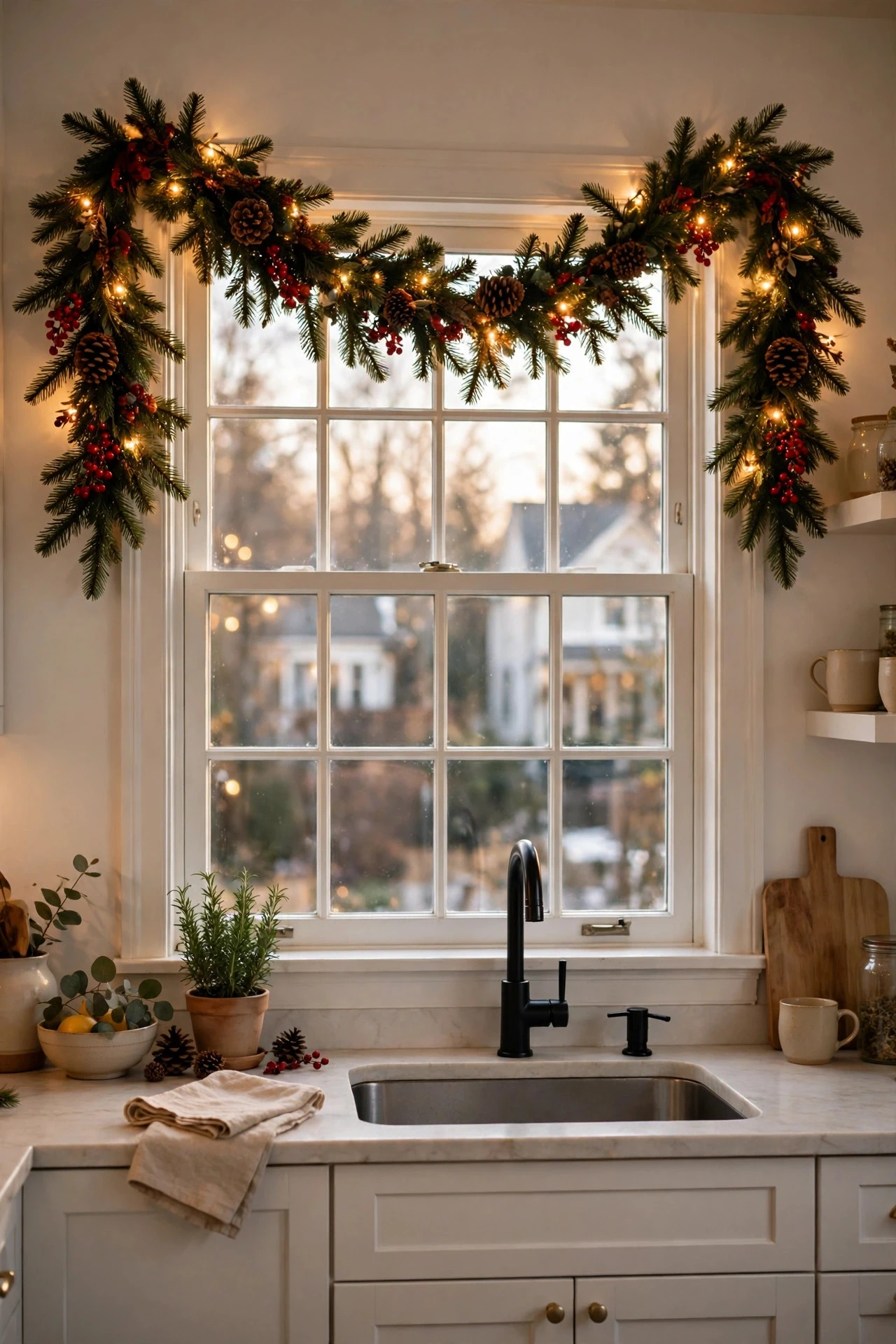
Hang a Christmas garland across a kitchen window by draping a 6-foot faux evergreen garland along the top of the frame, fixing it with two removable adhesive hooks, and letting the centre dip 4 to 6 inches. Tuck in pinecones, red berries, and a small bow, then weave a fairy-light string through it for an evening glow.
Choose a garland that is at least 6 inches longer than the window is wide, so the swag has room to dip without pulling tight. Faux greenery is the smart choice here: real pine sheds needles into the sink and dries out fast above a radiator or near a warm hob. Fluff the branches outward before hanging, hide the battery pack behind the frame, and keep the garland at least 12 inches from the hob. For the rest of the room, pair it with our 22 kitchen Christmas decor ideas for a warm working kitchen so the window and the cabinets share one colour story.
2. What Is the Best Mini Wreath for a Kitchen Window?
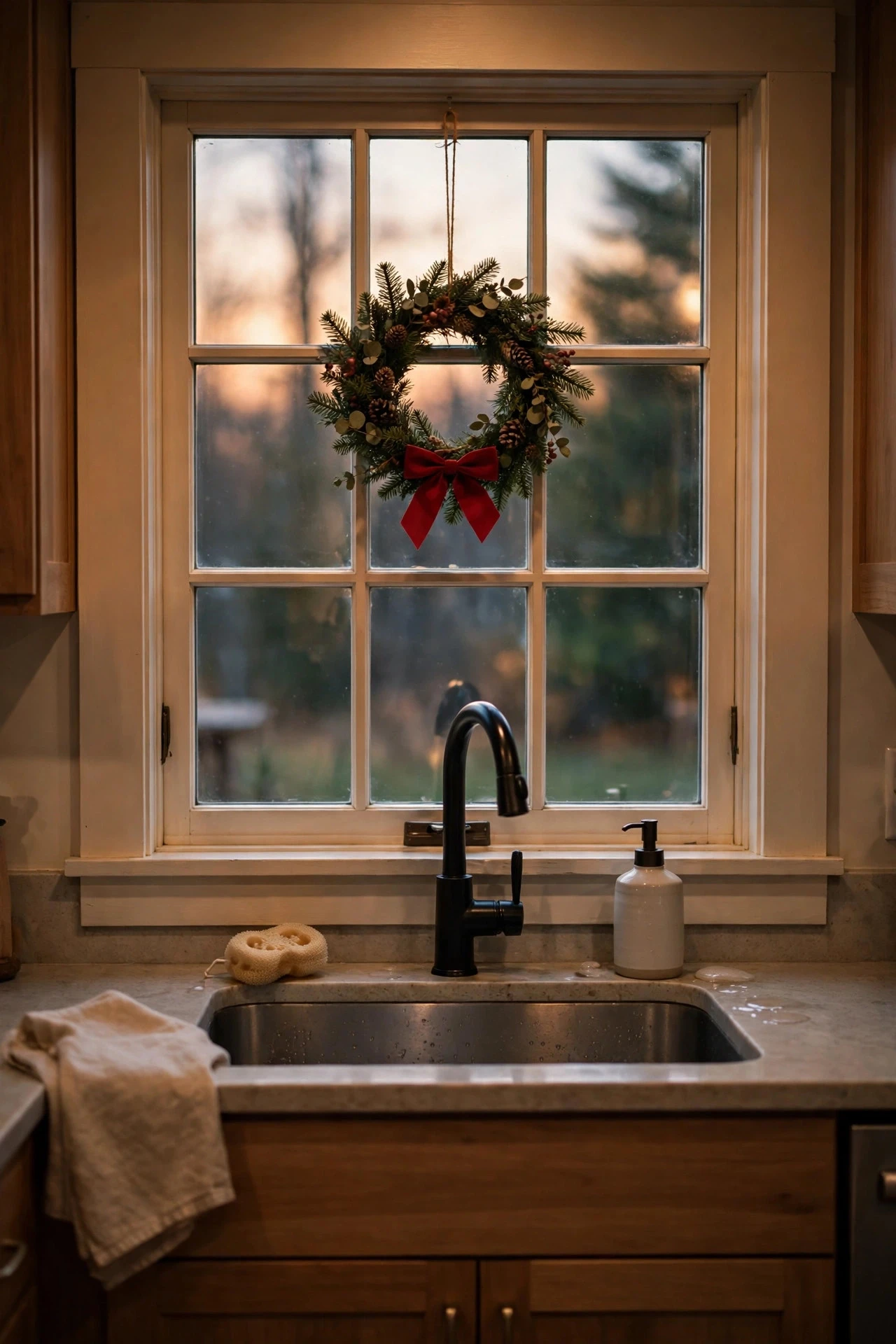
The best mini wreath for a kitchen window is a 10 to 12 inch faux evergreen wreath with a single red bow, hung on the glass from a clear suction-cup hook. That size fills a standard 24 to 36 inch window without blocking daylight, and the hook holds the weight without drilling a hole in the frame.
Hang the wreath from a ribbon looped over the suction hook so it sits about one-third down from the top of the glass, and add three small pinecones or a sprig of red berries for texture. A wreath under 10 inches disappears on a wide window, while anything over 14 inches crowds a small sink window and blocks the view. Use a suction hook rated for at least 2 pounds, press it onto clean dry glass, and re-press it once a week, since kitchen steam slowly weakens the seal. A second matching wreath on the opposite window gives the room a balanced, finished look.
3. How Do You Frame a Kitchen Window With Fairy Lights?
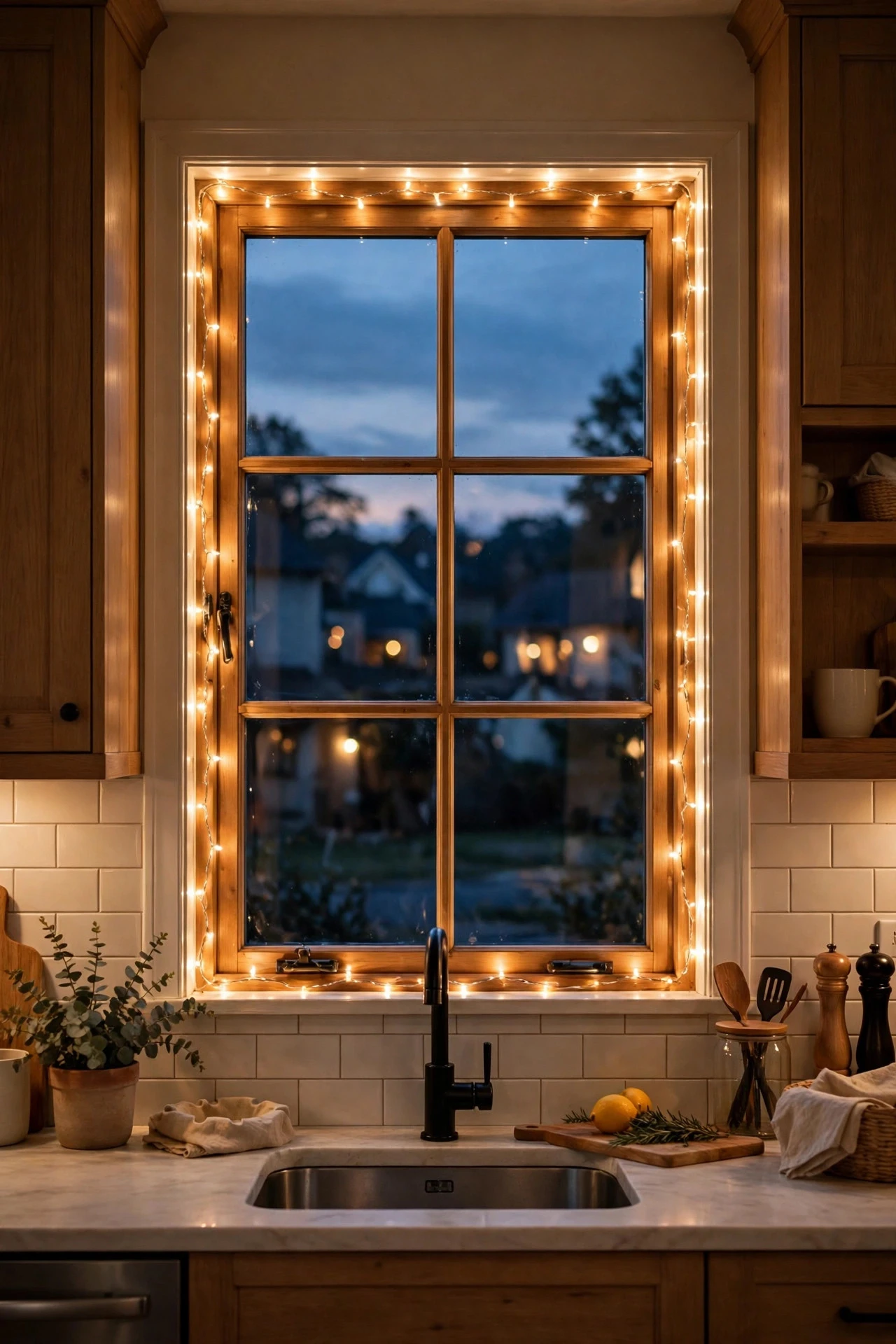
Frame a kitchen window with fairy lights by running a 100-light warm-white LED string around the inside edge of the frame, fixing it with clear removable clips every 6 inches. Set the lights on a timer to switch on at dusk and off at bedtime, and the window becomes a glowing picture frame every evening.
Warm white at 2700K suits kitchens best, because cool white can look clinical against stainless steel and white tiles. Battery-powered LED strings are safest here: no trailing mains cable near the sink, no plug hunt, and the battery pack tucks behind the frame out of sight. A light curtain across the whole pane is a softer alternative for wide windows, but keep the strands behind a sheer curtain so they never touch the glass directly. Lights bouncing off the glass double the glow, which is why mirrors do the same trick — see our 22 Christmas mirror decor ideas that double the glow in every room for the matching effect elsewhere in the house.
4. Can Window Clings Make a Kitchen Window Festive?
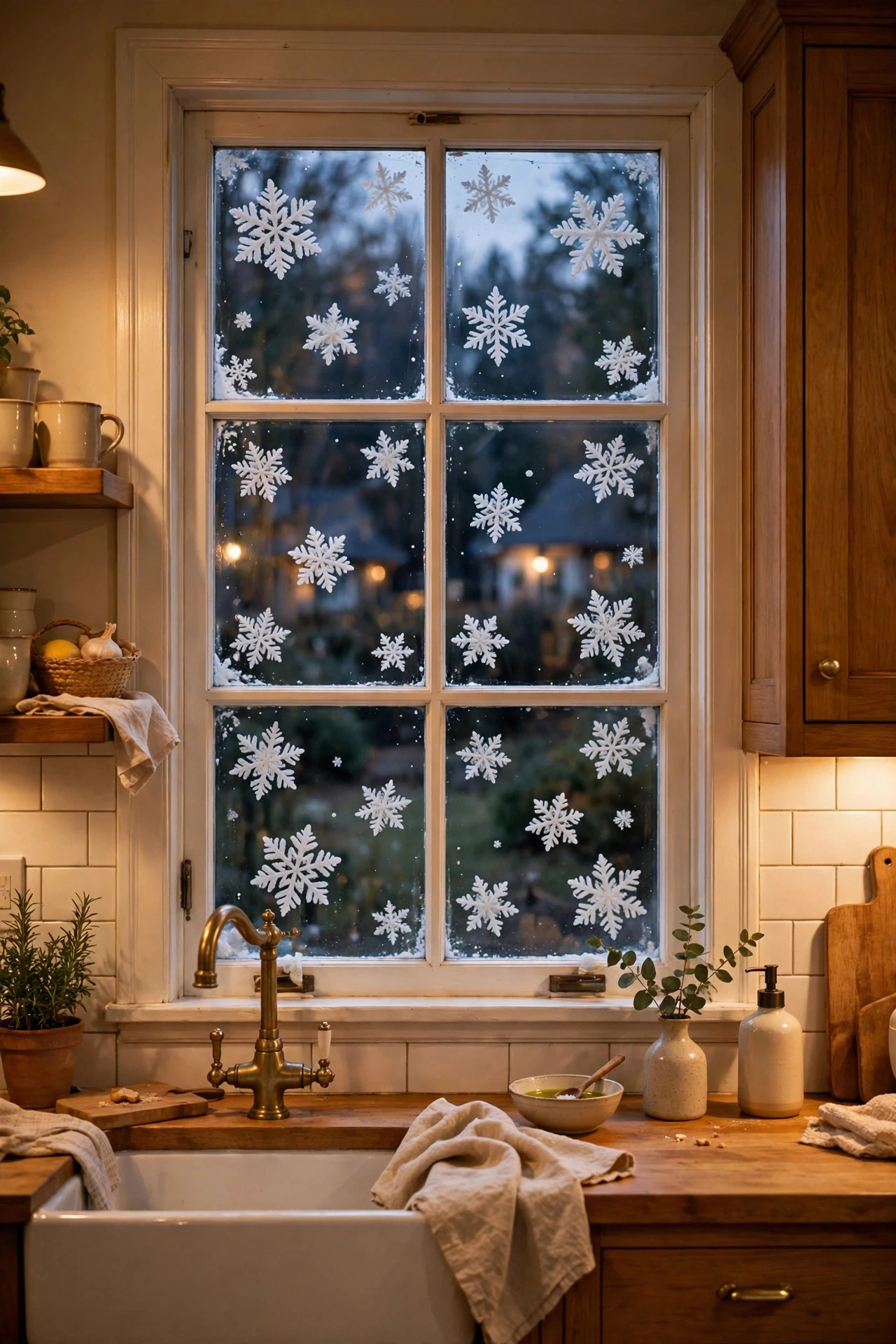
Window clings can make a kitchen window festive in about five minutes: peel snowflakes, stars, or reindeer shapes from their backing sheet, press them onto clean glass, and smooth out the air bubbles with a dry cloth. They cost $5 to $12 a pack, come off cleanly in January, and leave no sticky residue on the glass or the frame.
Clean the glass first with a damp cloth and let it dry completely, or the clings will not grip. In a cold kitchen, warm each cling with a hairdryer on low for a few seconds so it moulds to the glass. Place larger snowflakes high on the pane and smaller ones lower down, leaving the centre of the glass clear so you can still see out while washing up. Static clings work best on single panes; on textured or frosted glass they fall off, so use removable vinyl decals instead. The Spruce's winter window box ideas show the same low-effort approach working outside the window too, with greenery and berries doing most of the work.
5. How Do You Draw Christmas Art on a Kitchen Window?
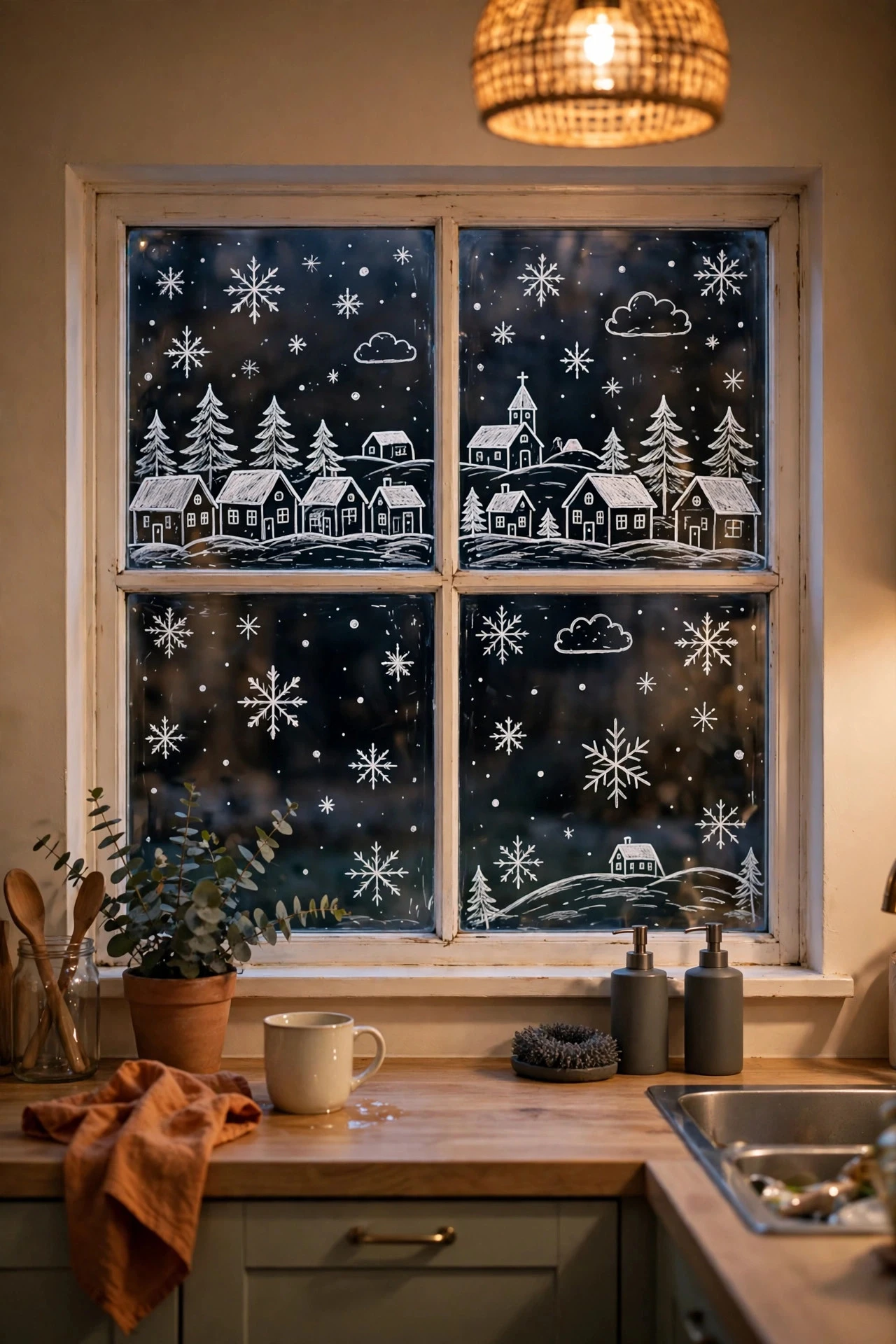
Draw Christmas art on a kitchen window with a white chalk marker: sketch a snowy village skyline along the bottom of the pane, add snowflakes and stars across the upper glass, and frame it with a border of dots and swirls. Chalk markers wipe off with a damp cloth, so the art lasts all December and vanishes in January.
Plan the design on paper first, then work from the outside in — background flakes first, foreground houses last — so you never smudge a finished section. Keep the art to the top third and the bottom edge of the glass, leaving a clear band at eye level so the window still works as a window. Use a fine tip for lettering like "Merry Christmas" and a thick tip for snowdrifts and tree shapes. Chalk art has a long festive history, and the Christmas decoration page on Wikipedia traces how window displays became part of the season. Avoid chalk markers on tinted or coated glass until you have tested a corner, since some coatings stain.
6. What Goes on a Christmas Kitchen Window Sill?
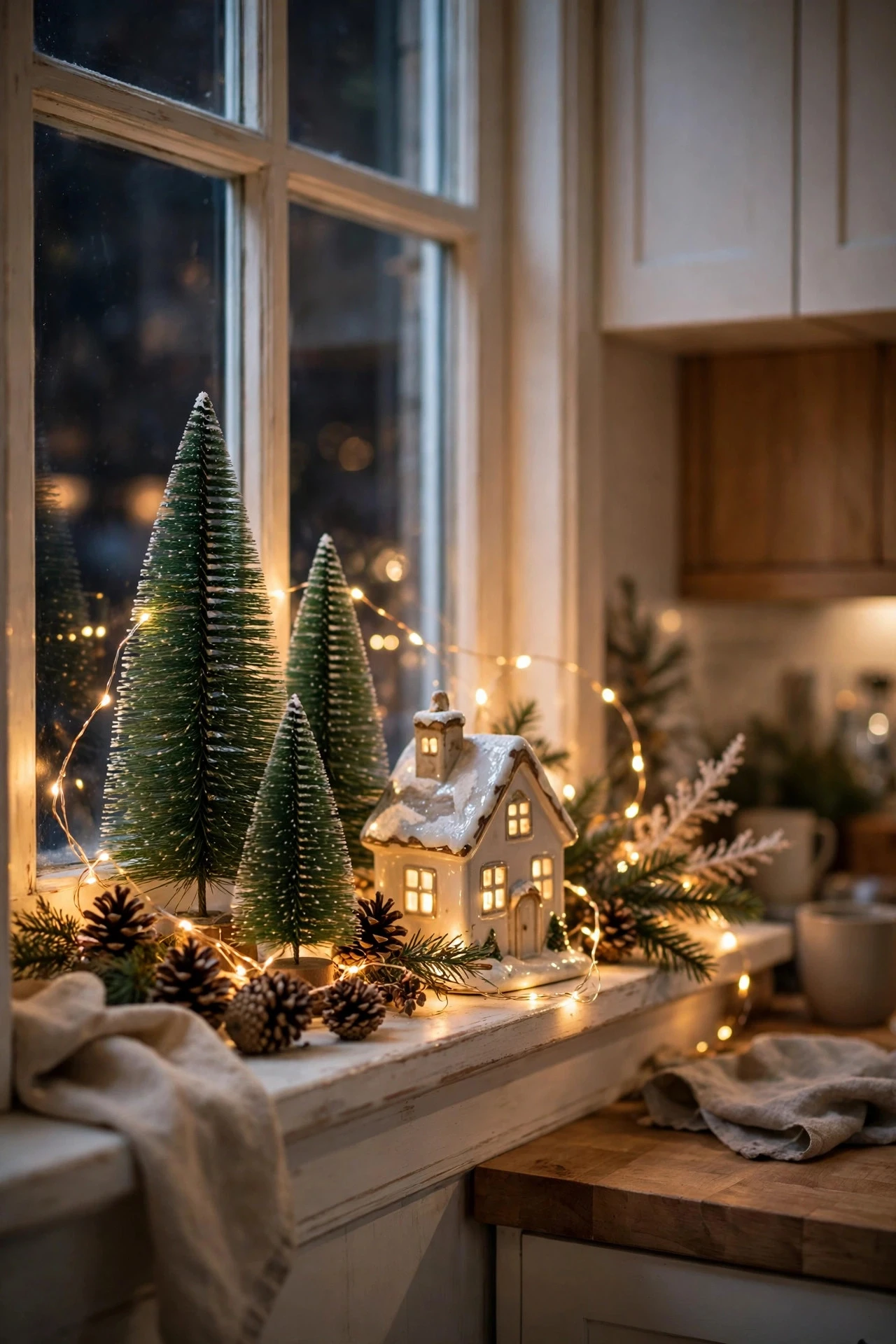
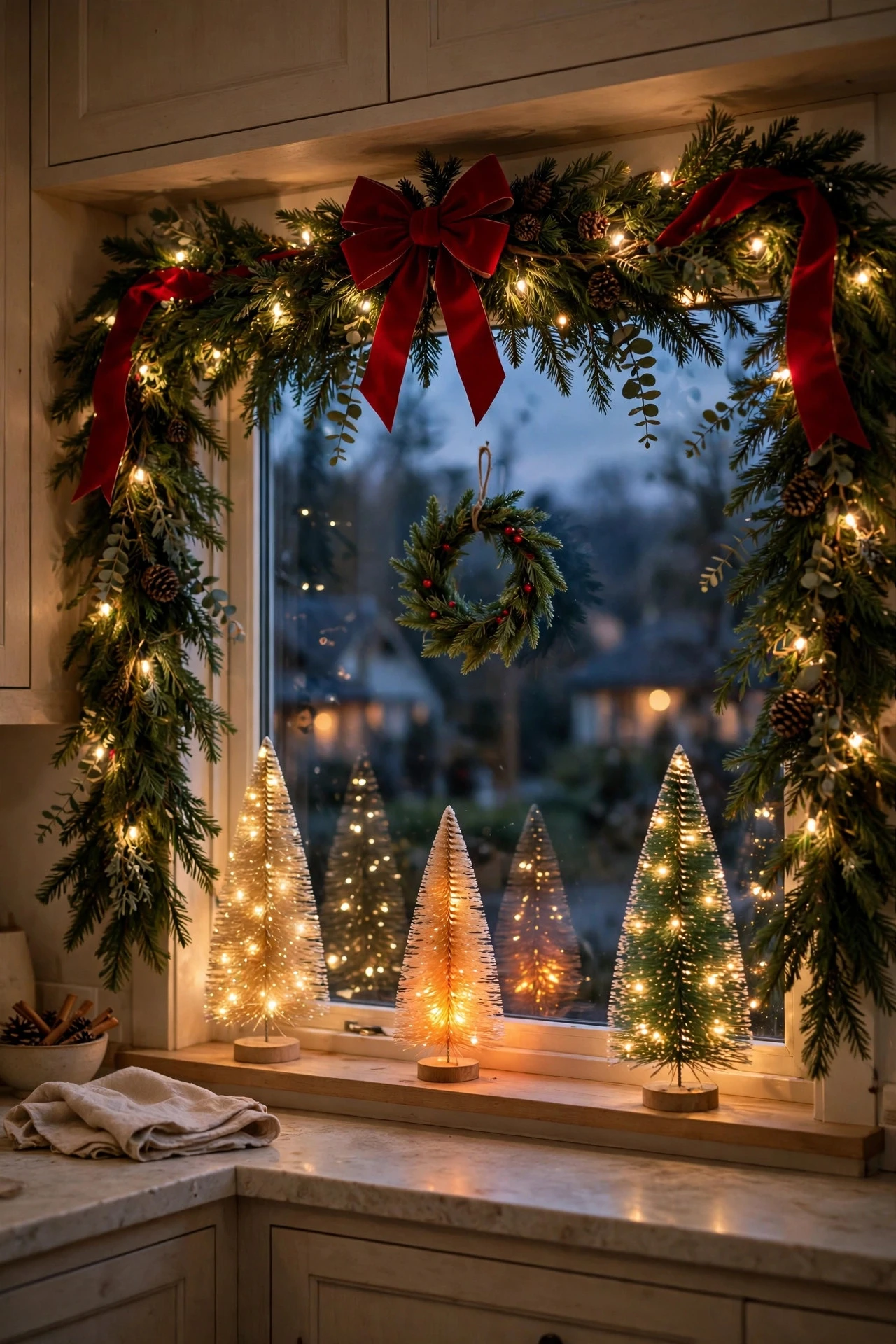
A Christmas kitchen window sill holds a slim display in three layers: three bottle-brush trees in graduated heights at the back, a string of battery fairy lights snaked between them, and pinecones, a cinnamon-stick bundle, and a tiny ceramic house at the front. Keep everything under 8 inches tall so it never blocks the light or the view.
Measure the sill depth first — most kitchen sills are 4 to 6 inches deep, so a tray or a narrow wooden board keeps the pieces corralled and stops them sliding when the window opens. Use shatterproof ornaments and ceramic pieces rather than glass, because a knocked ornament lands in the sink or on a hard worktop. Battery candles in small hurricane jars add height at the ends without an open flame. Never place paper, dried flowers, or loose tinsel on a sill above the hob, where heat and steam will ruin them within a week.
7. Are Candles Safe on a Kitchen Window Sill?
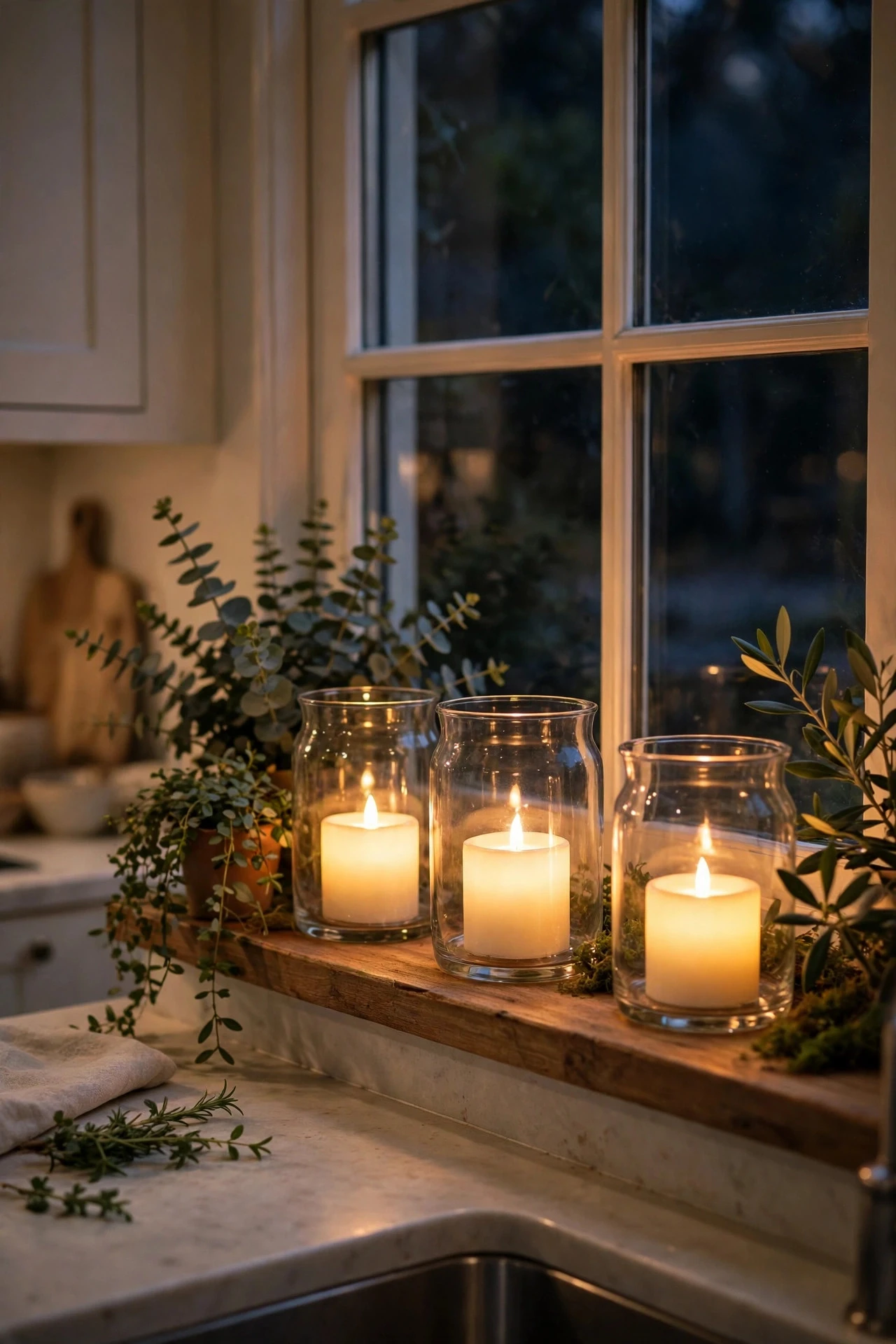
Candles are safe on a kitchen window sill only if they are LED candles in hurricane jars, set at least 12 inches from the hob, the kettle, and any curtain or tea towel. Real flames are risky in a kitchen: steam and draughts make an open flame a fire risk, while LED candles give the warm flicker with no heat.
Choose LED pillar candles in three heights — 4, 6, and 8 inches — and group them at one end of the sill so the other end stays clear for herbs or washing-up liquid. Look for candles with a built-in timer, so they switch themselves on at dusk and off after six hours without you touching them. Frosted glass hurricanes diffuse the light beautifully and protect the candle from splashes. Never leave a real candle burning on a sill above the sink, and never place any candle where a curtain can blow onto it when the window is open.
8. How Do You Display a Gingerbread House in a Kitchen Window?

Display a gingerbread house in a kitchen window by placing it on a round wooden board or a cake stand at one end of the sill, with fake snow underneath and a tiny bottle-brush tree beside it. The window light shows off the icing detail, and the house becomes the centrepiece of the whole window.
Build the house from a kit rather than from scratch if you want it to last: kit gingerbread is baked hard and holds its shape for weeks, while soft homemade gingerbread sags in kitchen humidity. Seal the finished house with a light spray of clear food-safe glaze, and keep it out of direct steam from the kettle or the dishwasher vent, which softens icing fast. A gingerbread house costs $15 to $30 as a kit and takes an evening to decorate. For the shelves above the window, borrow height ideas from our above-cabinet Christmas decor ideas for that empty gap so the window display and the cabinet tops feel like one design.
9. What Is the Best Christmas Valance for a Kitchen Window?
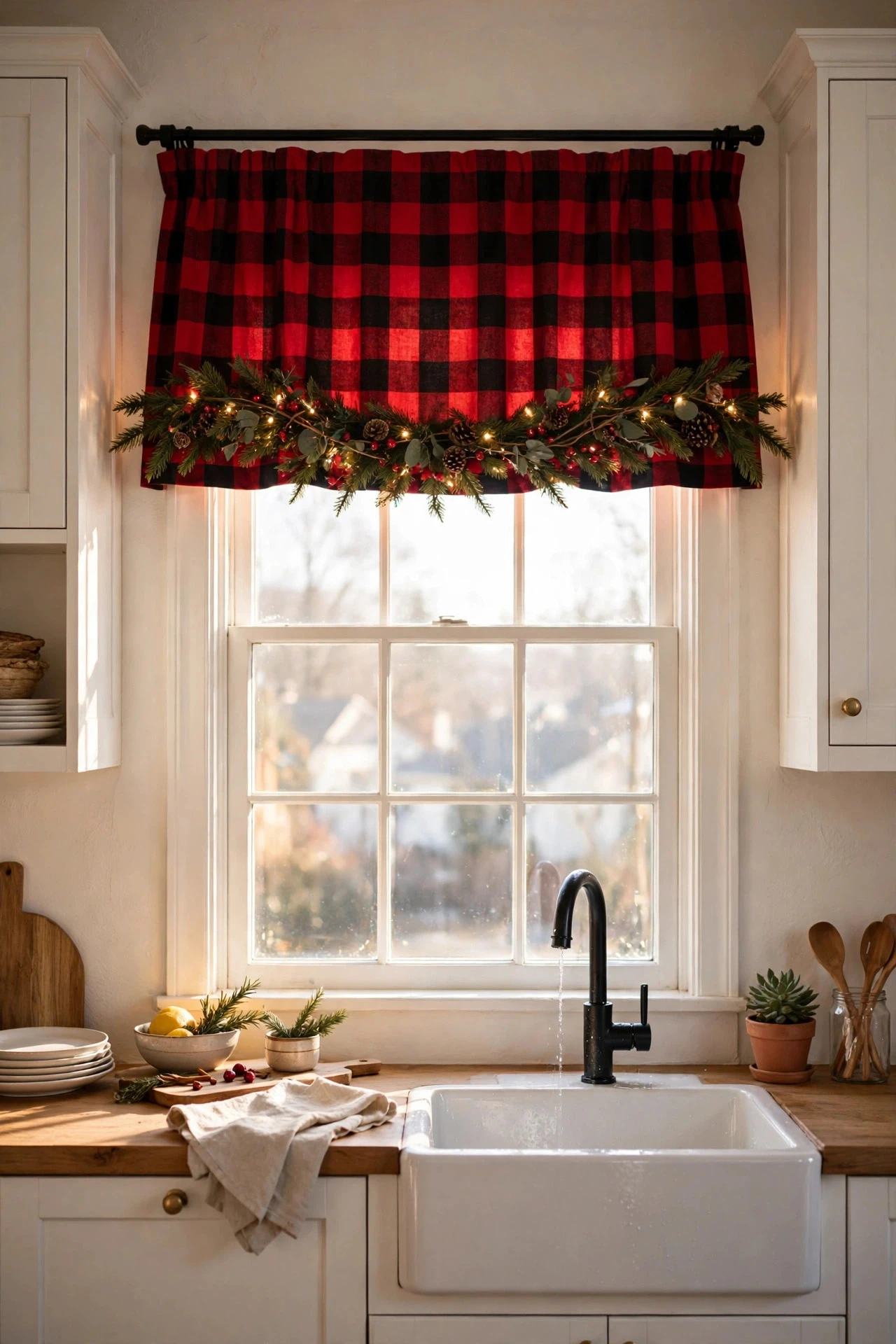
The best Christmas valance for a kitchen window is a short plaid or buffalo-check valance, 12 to 14 inches deep, hung on a tension rod inside the frame so it covers only the top quarter of the glass. It adds festive colour, hides the curtain hardware, and leaves the lower three-quarters of the window clear for light and the view.
A tension rod costs $8 to $15, needs no screws, and wedges between the frame sides in seconds, which makes it ideal for renters. Choose a washable cotton or polyester fabric, because kitchen valances absorb cooking smells and steam, and plan to wash it twice during December. A valance with a scalloped or pointed hem looks more finished than a straight cut, and a small bow at each end softens the corners. Avoid heavy velvet or lined drapes over a sink window — they soak up steam, stay damp, and grow musty by January.
10. How Do You Decorate the Window Over the Kitchen Sink?
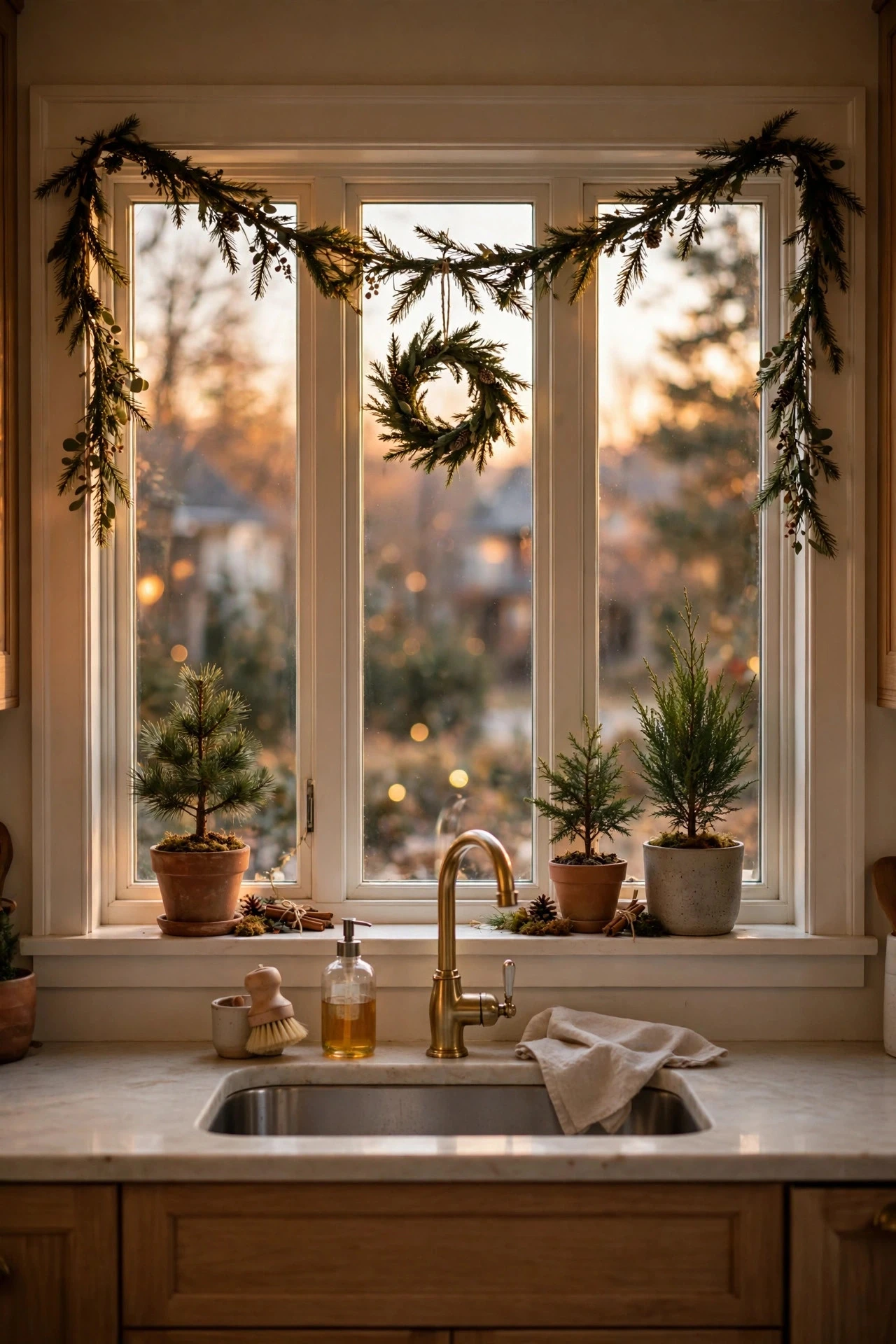
Decorate the window over the kitchen sink with a light touch: a slim garland across the top of the frame, a mini wreath hung high on the glass, and a sill display of three bottle-brush trees and one LED candle. Keep every piece above splash height and 6 inches back from the tap, so washing up never soaks the decor.
The sink window is the most looked-at window in the house, so it earns the best pieces, but it is also the wettest spot in the kitchen. Use faux greenery and sealed or laminated decorations only — paper snowflakes curl, felt absorbs water, and real pine drops needles into the washing-up bowl. A suction-cup hook holds a wreath without drilling, and a small suction-cup soap dish keeps the sill clear for decor. Wipe the glass and the decor once a week, since splashes and steam leave a film that dulls fairy lights fast. The golden rule is simple: nothing at sink level, everything at eye level or above.
11. How Do You Style a Window Over the Kitchen Counter?
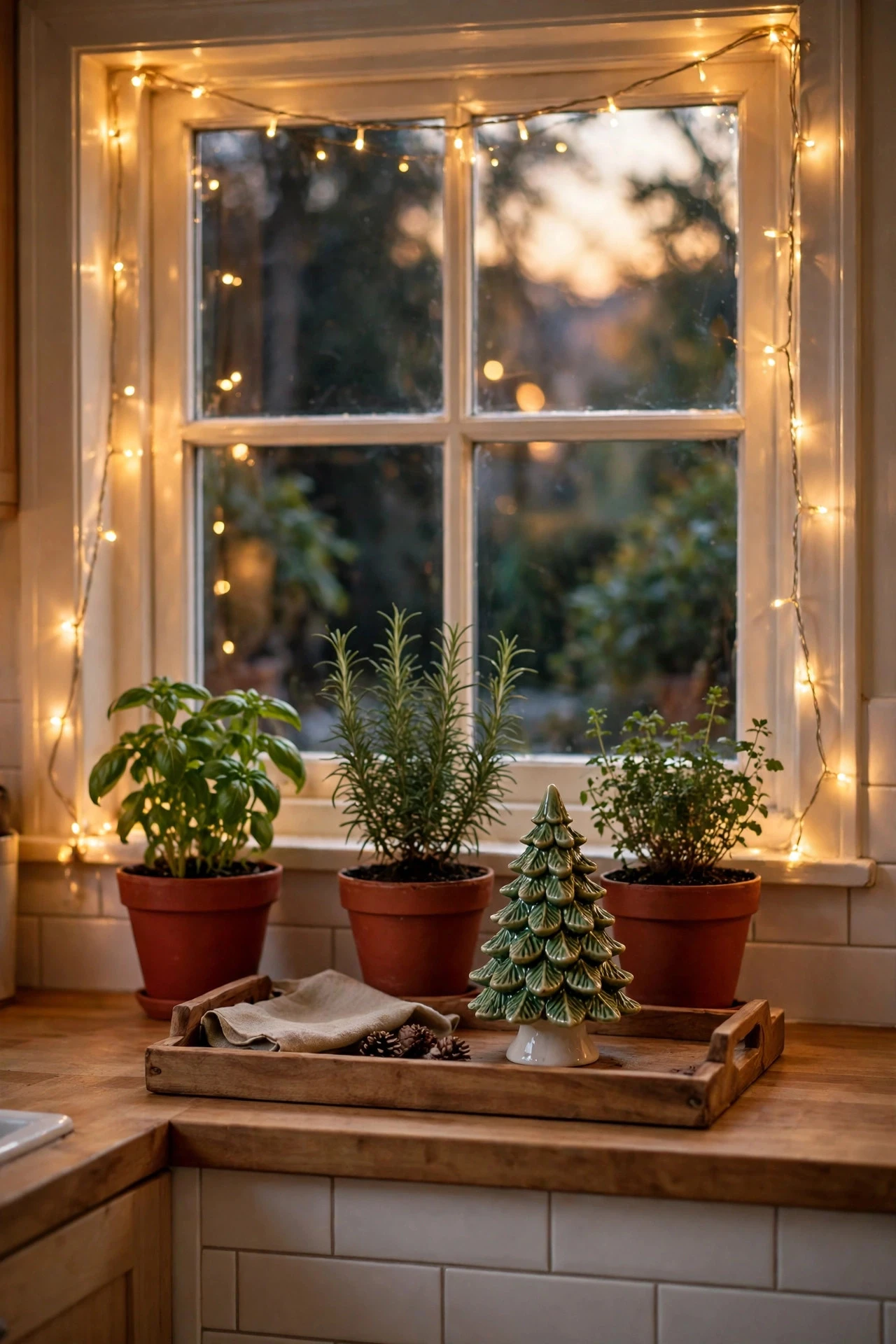
Style a window over the kitchen counter by treating the sill as a display: potted herbs in red and white pots, fairy lights along the frame, and a wooden tray holding a small ceramic tree, a jar of candy canes, and festive tea towels. The herbs stay useful, the lights add warmth, and the tray keeps everything tidy and movable.
Keep the centre of the counter clear for chopping and prep, and push the display to the back edge of the sill so it never crowds the work surface. Rosemary, thyme, and mint all suit a sunny kitchen window, and their scent doubles as Christmas fragrance when you brush past them. Use pots with saucers so watering never drips onto the worktop. A tray is the secret here: when you need the whole counter for baking, lift the tray away in one move. For the rest of the room, our 22 kitchen island decor ideas for a stylish functional kitchen shows the same tray-and-cluster method working at island scale.
12. What Are the Best Renter-Friendly Kitchen Window Decorations?
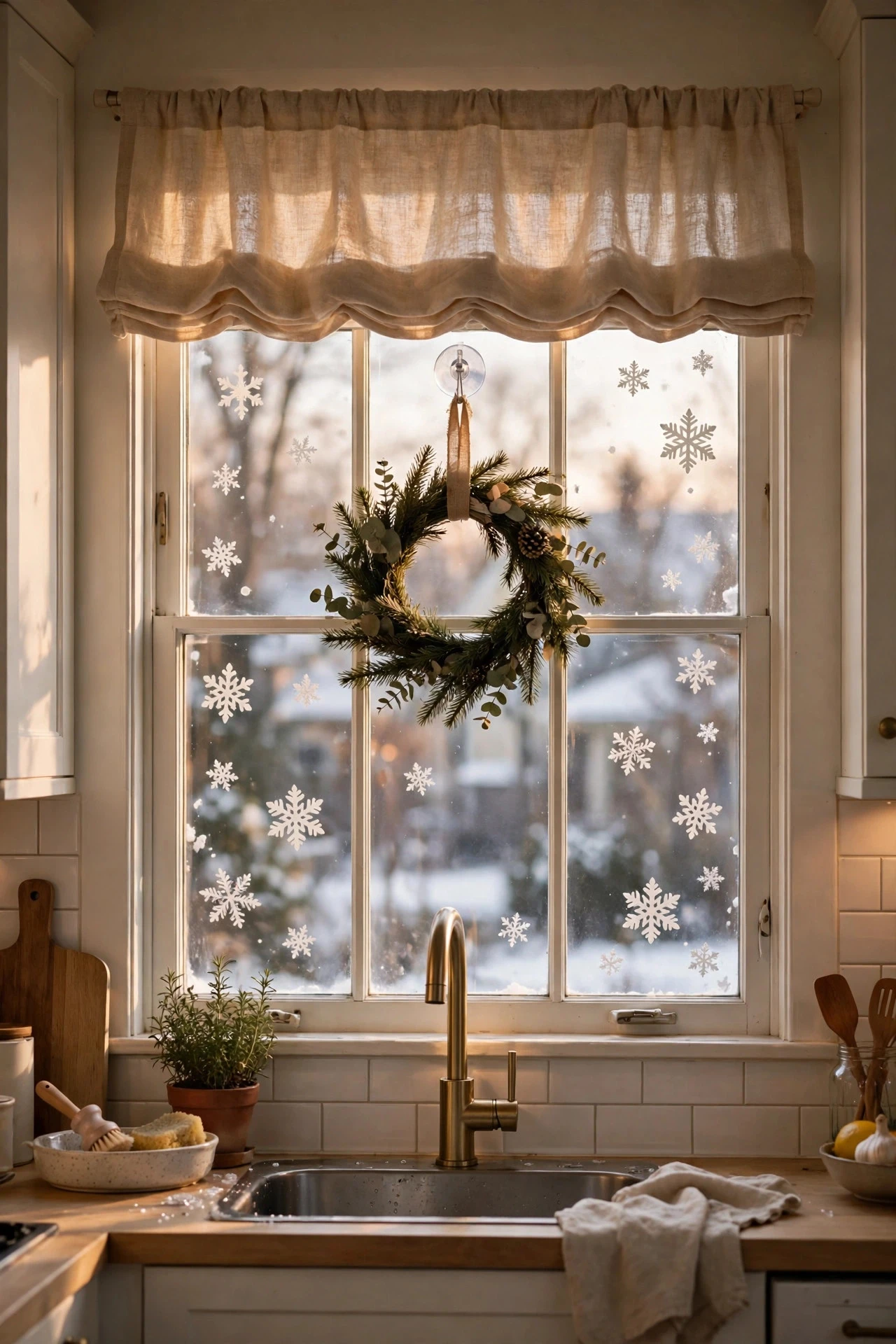
The best renter-friendly kitchen window decorations are static-cling snowflakes, suction-cup wreath hooks, tension-rod valances, and magnetic clips for hanging ornaments from a metal frame. Every one of them comes down in January with no holes, no paint damage, and no lost deposit, and most cost under $15 each.
Start with the window itself: clings for the glass, a suction hook for the wreath, and a tension rod for the valance, then add a sill display that simply sits there — no fixing needed at all. Test every suction cup on clean, dry glass, and re-press it weekly, because kitchen steam is the enemy of suction. Avoid command strips on painted window frames in older rentals, since they can lift flaking paint on removal, and skip nails, screws, and hot glue entirely. If your lease bans window decorations, put the display on the inside of the sill and keep the glass clear — you still see it every time you cook.
13. How Do You Keep Privacy and Light at a Christmas Kitchen Window?
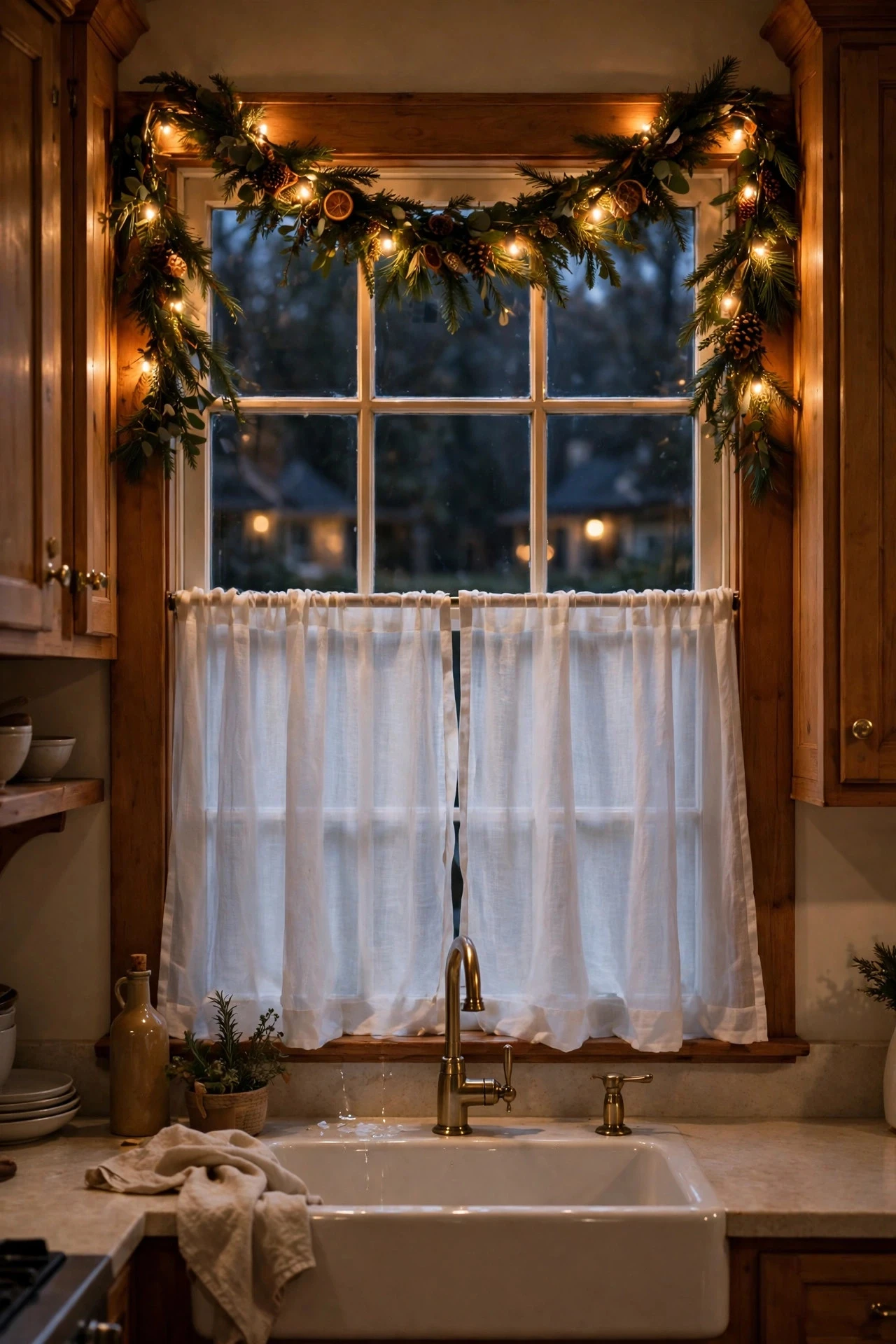
Keep privacy and light at a Christmas kitchen window by layering a sheer white cafe curtain across the lower half of the glass, with the display above it. The sheer diffuses the view from outside, lights stay visible, and daylight still floods the sink. A frosted window film on the lower pane does the same job for $10 to $20.
Hang the cafe curtain on a tension rod at mid-height so the top half of the window stays open, and choose a lightweight voile or linen-look fabric that lets light through. For evening privacy, add a battery fairy-light string behind the sheer — it glows like a lantern from the street while hiding the kitchen behind it. Snowflake window film is a festive alternative to plain frosted film, giving privacy and decoration in one step. Avoid heavy curtains that block the light you need to cook, and never cover the whole window with opaque fabric, or the kitchen feels dark all December.
14. How Do You Steam-Proof and Grease-Proof Window Decor?
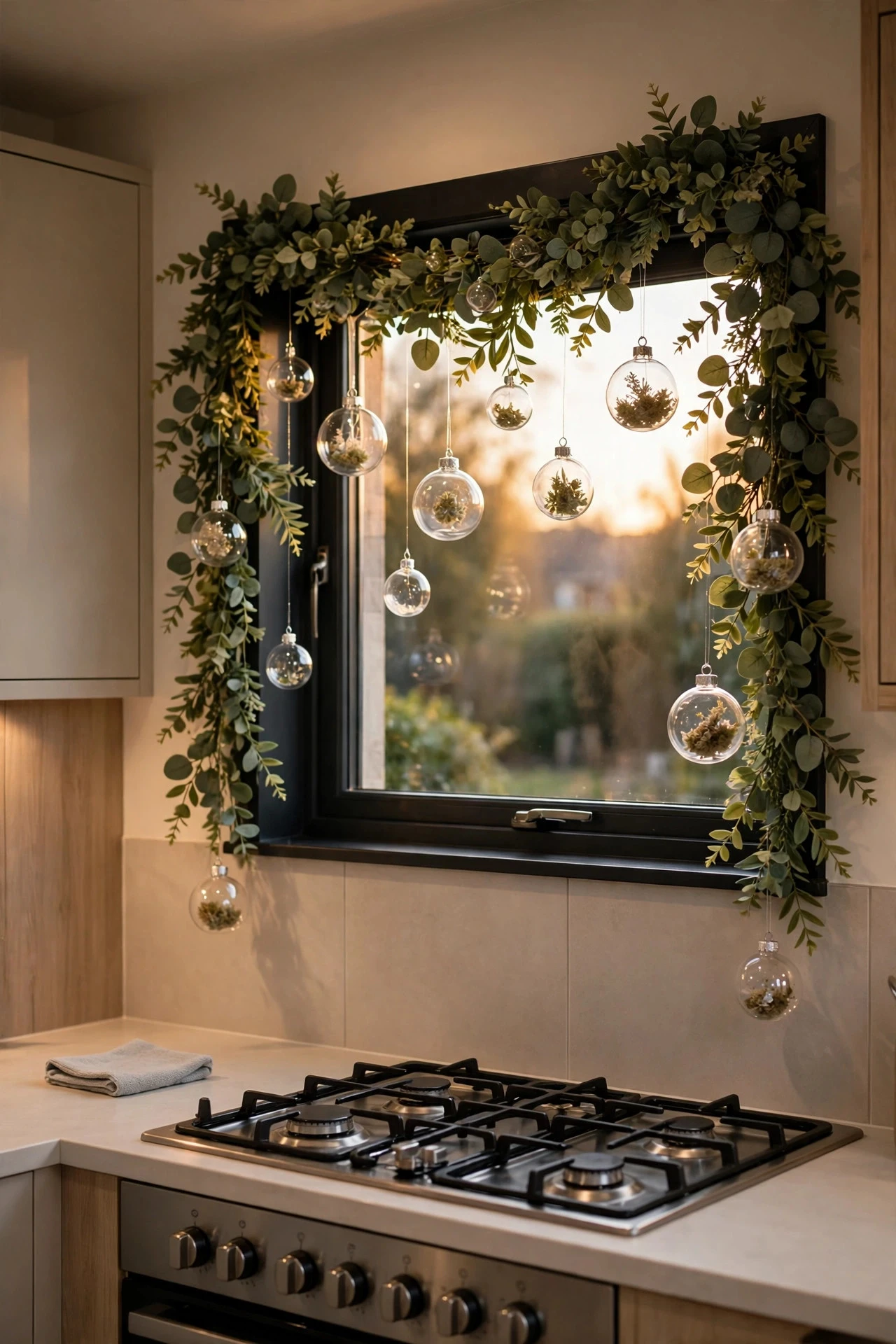
Steam-proof and grease-proof your kitchen window decor by choosing sealed, wipeable materials: faux greenery instead of real pine, LED candles instead of real flames, laminated paper instead of plain card, and glass or ceramic ornaments instead of fabric or felt. Wipe the display and the glass once a week, and the decor looks fresh from December to January.
Position matters as much as material. Keep decor at least 12 inches from the hob and the kettle, and never hang paper, dried orange slices, or ribbon directly above a steaming pot. A thin coat of clear spray sealant on chalk-marker art and paper ornaments adds a surprising amount of steam resistance for a few dollars. Faux greenery can be rinsed under the tap and dried before re-hanging, which real greenery cannot survive. If your kitchen has no extractor fan, accept that the window over the hob gets only wipeable decor, and save the delicate paper and fabric pieces for a window across the room.
15. How Do You Hang Ornaments in a Kitchen Window?
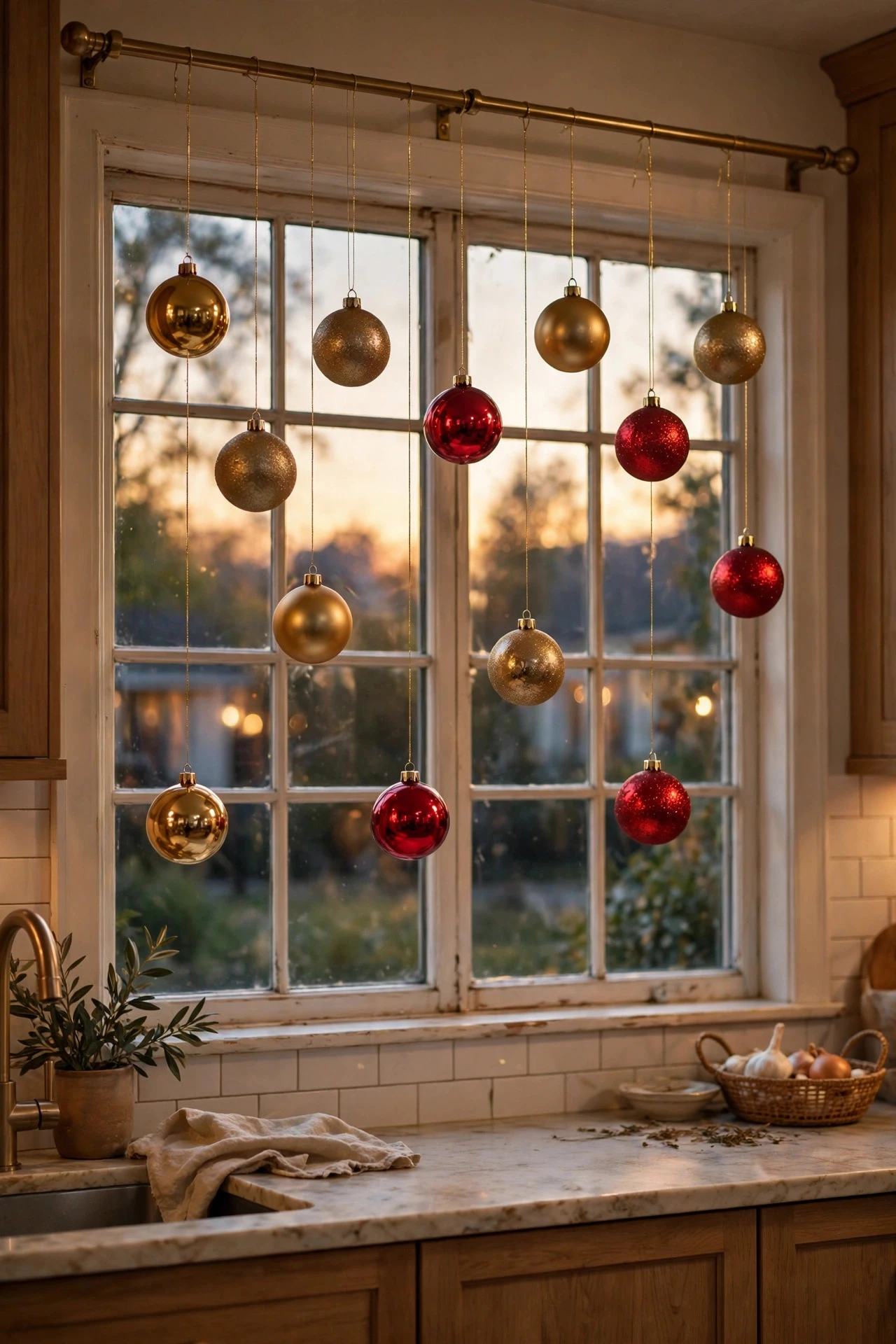
Hang ornaments in a kitchen window by suspending them from the curtain rod or a tension rod on fishing line, at three heights so they catch the light like a mobile. Use lightweight shatterproof baubles in two colours — red and gold, or silver and white — and space them 4 to 6 inches apart so they never clink together.
Cut the fishing line to staggered lengths — 6, 9, and 12 inches — so the baubles form a gentle wave across the window rather than a flat row. Tie each line with a small loop over the rod so you can slide ornaments along to adjust the spacing. Shatterproof plastic baubles are essential here: glass baubles above a hard worktop or a sink are an accident waiting to happen, and a dropped glass ornament near food is a real hazard. Keep the ornaments at least 8 inches above the sill so they never knock against the trees or candles below, and take them down before opening the window wide on a windy day.
16. What Does a Buffalo Check Kitchen Window Look Like at Christmas?
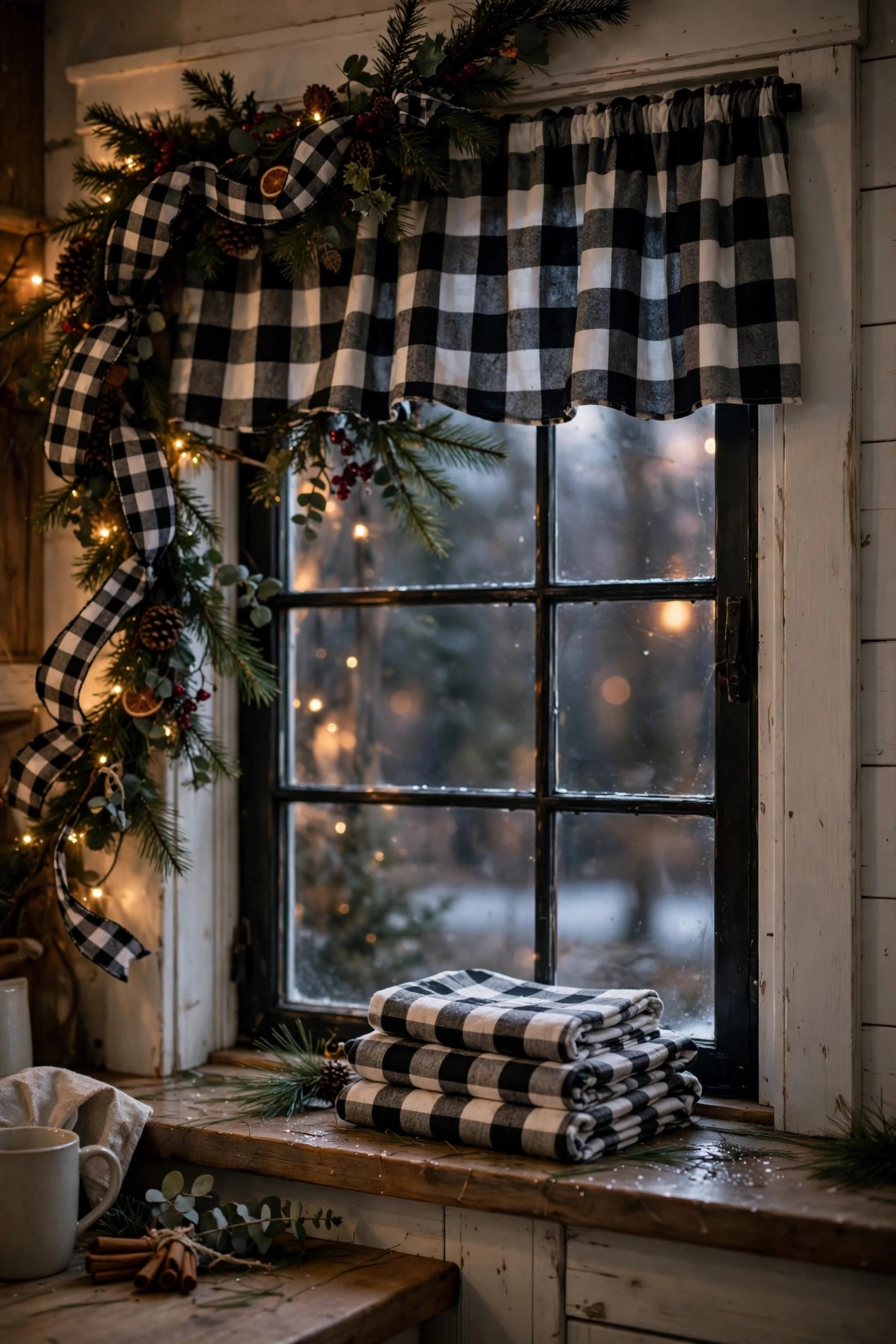
A buffalo check kitchen window at Christmas pairs a red-and-black checked valance with a matching bow on the garland, checked ribbon woven through the greenery, and small checked tea towels folded on the sill. The bold checks read clearly from across the room, feel warm and farmhouse, and tie the window to the rest of a red-and-black kitchen scheme.
Keep the check to two or three elements — valance, bow, and ribbon — and let the greenery and lights do the rest, or the pattern overwhelms the window. A black-and-white buffalo check is the calmer alternative for kitchens that already have a lot of red, and it pairs beautifully with silver ornaments and white bottle-brush trees. Buy the valance and the ribbon in the same check scale so they match rather than clash. Avoid mixing buffalo check with plaid or gingham in the same window; two busy patterns fight each other, and the window ends up looking messy instead of cosy.
17. How Do You Use Natural Greenery and Dried Citrus in a Kitchen Window?
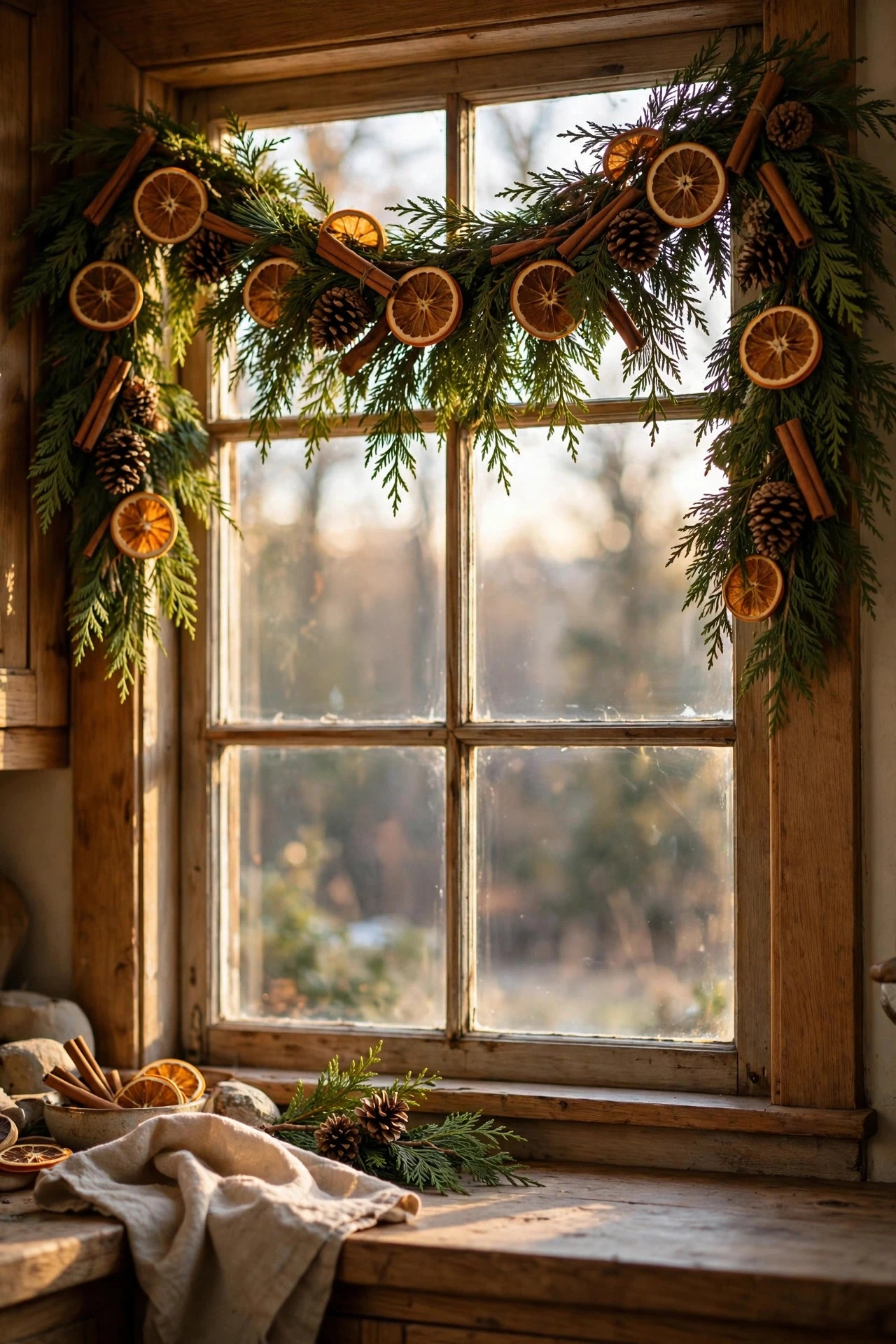
Use natural greenery and dried citrus in a kitchen window by draping a fresh cedar or fir garland across the top of the frame, then tucking dried orange slices, cinnamon sticks, and pinecones into the branches at 8-inch intervals. The greenery smells wonderful every time the window opens, and the orange slices catch the light like stained glass.
Dry the orange slices yourself: slice them a quarter inch thick, bake at 200°F for two to three hours until crisp, and thread them on twine with a needle. Fresh greenery lasts two to three weeks in a cool kitchen, so hang it in early December and plan to refresh it once before Christmas. Mist the garland lightly every few days to slow drying, and keep it away from the hob, where heat turns fresh pine brown in days. This natural, unfussy style suits a country kitchen perfectly — our 22 French country kitchen ideas for a warm elegant heart of the home uses the same greenery, wood, and linen palette across the whole room.
18. How Do You Build a Mini Christmas Village on a Kitchen Window Sill?

Build a mini Christmas village on a kitchen window sill by lining up five to seven small ceramic or wooden houses along the sill, tucking cotton batting between them as snow, adding bottle-brush trees between them, and finishing with a fairy-light string woven through the scene. The window light behind the houses makes the village glow at dusk.
Use houses in mixed heights — 3 to 6 inches — so the skyline looks like a real village rather than a flat row, and put the tallest house in the centre. Battery tea lights inside the ceramic houses make the windows glow after dark; look for houses with a small opening at the back for the light. A narrow tray under the whole scene keeps the cotton snow contained and lets you lift the village away in one piece when you need the sill. Keep the village to one end of a wide sill if the window opens, so the opening side stays clear and nothing gets knocked over.
19. What Is a Candy Cane Kitchen Window Theme?
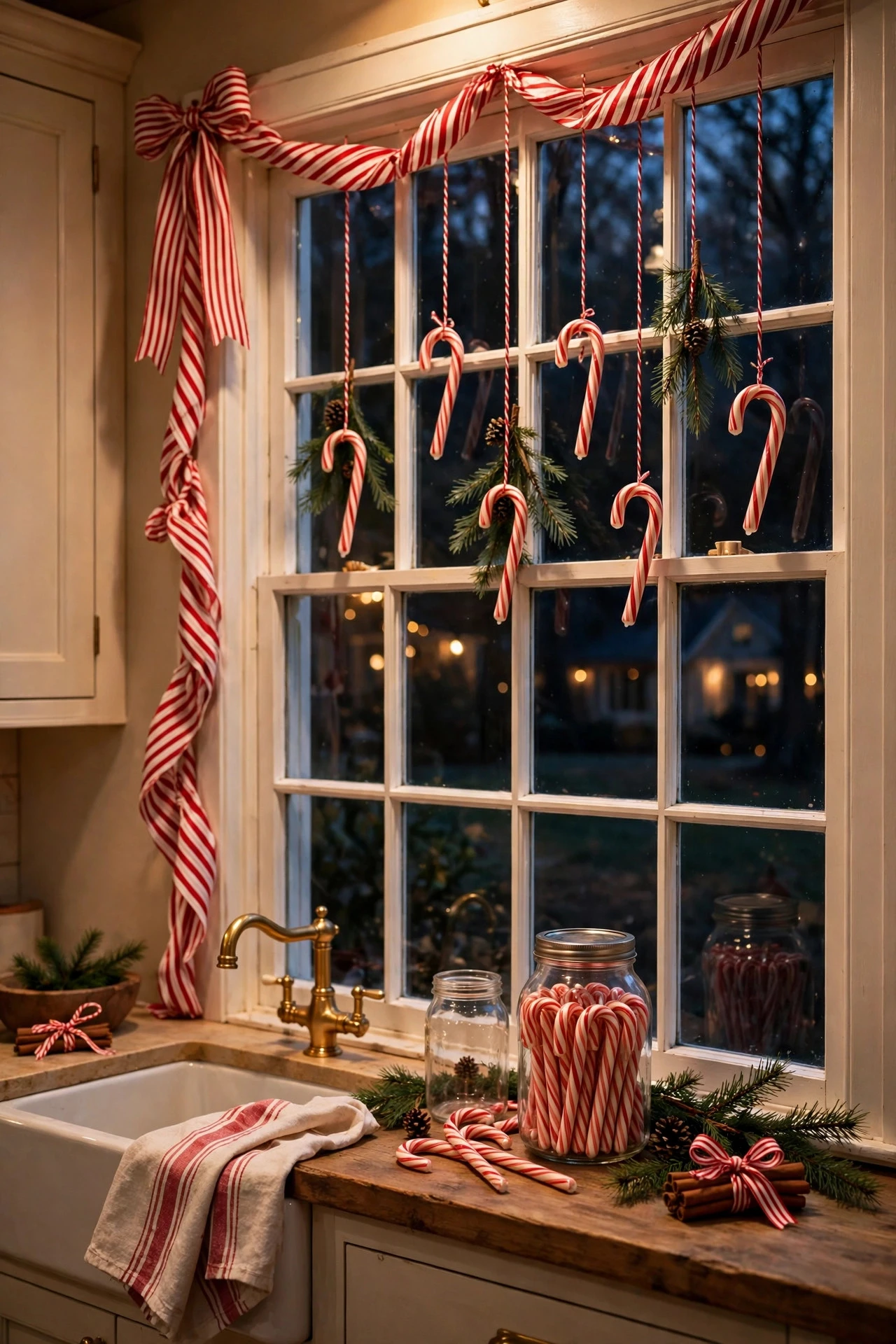
A candy cane kitchen window theme uses a strict red-and-white palette: a white valance with a red bow, red-and-white striped ribbon woven through the garland, candy-cane ornaments hanging from the rod, and a jar of real candy canes on the sill beside a small white ceramic tree. The palette is cheerful, instantly readable, and photographs beautifully in a bright kitchen.
Limit the theme to the window and one or two matching touches nearby — a striped tea towel, a red mug tree — so the kitchen feels festive rather than like a sweet shop. Use shatterproof candy-cane ornaments for the hanging pieces and real candy canes only in a sealed jar on the sill, because kitchen steam makes unwrapped candy canes sticky within days. A red-and-white striped ribbon is the cheapest way to commit to the theme: one $5 roll transforms a plain green garland. Avoid adding green to this palette, since red, white, and green together turns a crisp candy theme into generic Christmas.
20. How Do You Create a Gold and White Christmas Kitchen Window?
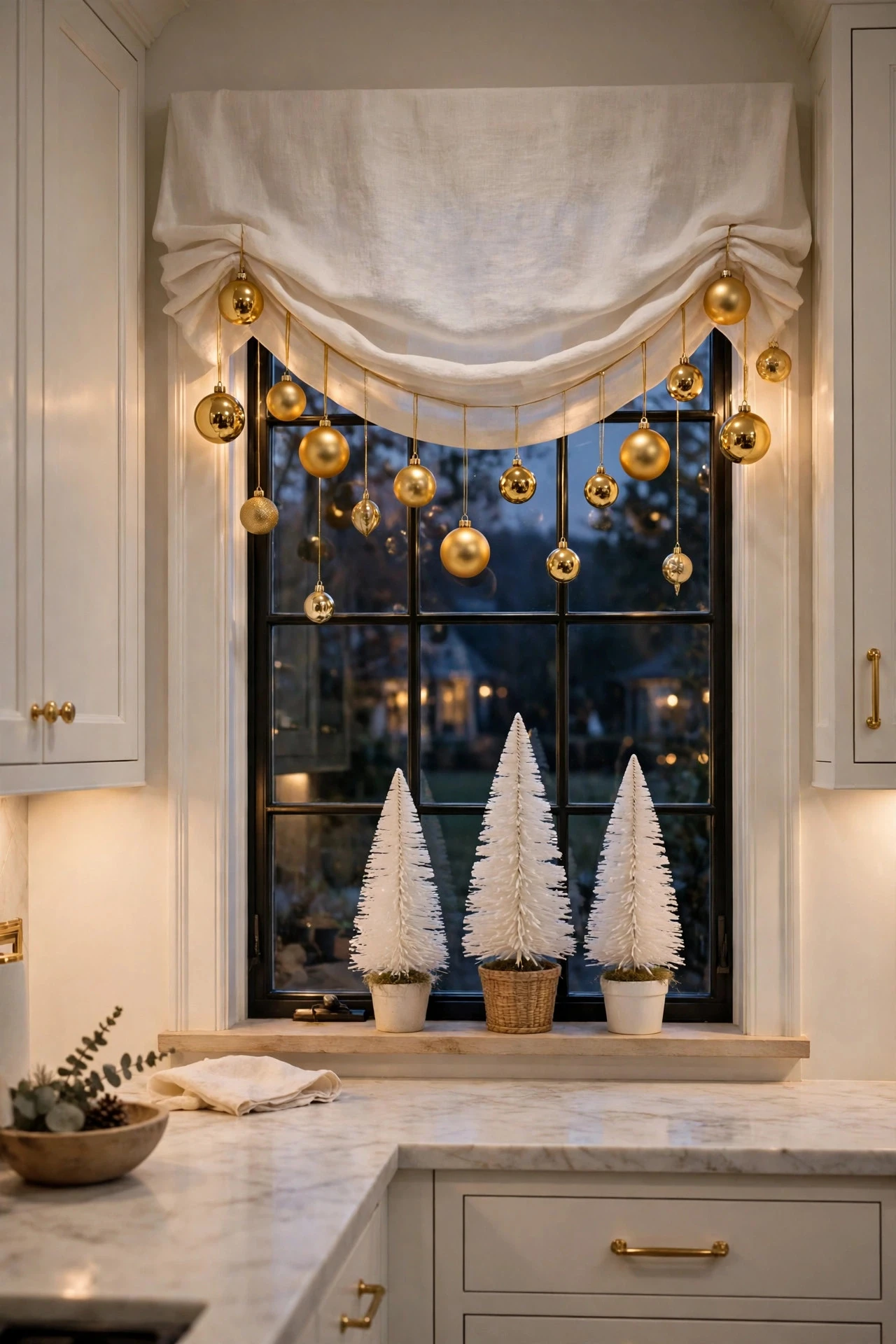
Create a gold and white Christmas kitchen window by pairing a white linen valance with a gold-beaded garland across the frame, gold baubles hanging at varied heights, and a sill display of white bottle-brush trees, gold LED candles, and a ceramic house. The palette is calm, elegant, and bright, and it suits a modern kitchen better than red and green.
Choose warm gold rather than bright yellow gold, and mix two finishes — shiny baubles and matte gold ribbon — so the display has depth instead of glare. White fairy lights at 2700K keep the glow warm, and a gold tray on the sill bounces the light around the room. This restrained palette works best in kitchens with white cabinets and light worktops, where it reads as luxury rather than emptiness — for the wider look, our modern kitchen ideas for a clean bright hard-working space shows how the same gold-and-white discipline carries across the whole room. Avoid gold glitter, which sheds onto worktops and into food; use solid gold ornaments and ribbon instead.
21. Can Kids Decorate the Kitchen Window for Christmas?
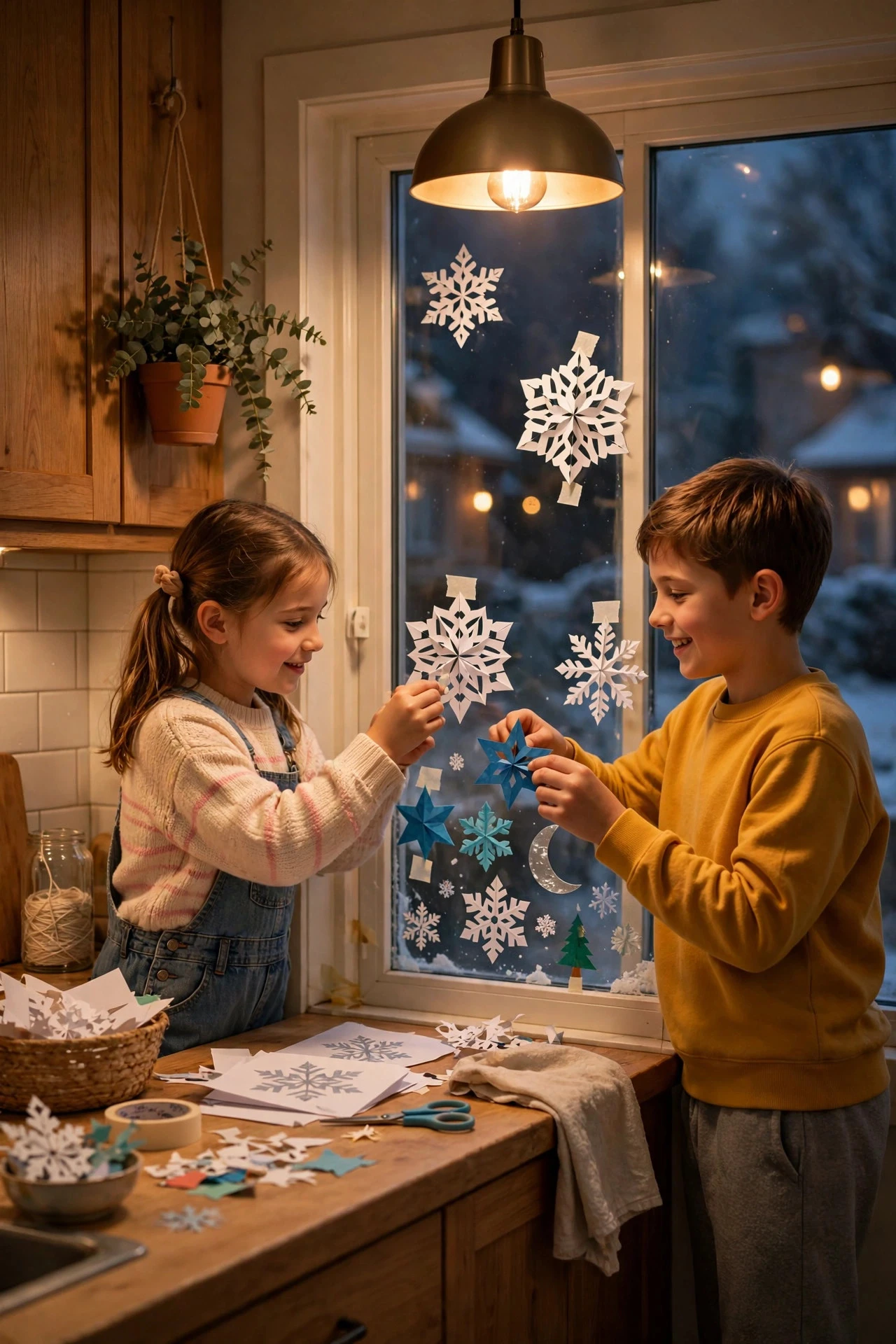
Kids can decorate the kitchen window for Christmas with paper snowflakes, static-cling shapes, and a chalk-marker drawing zone on the lower pane — all safe, removable, and entirely theirs. Give each child a section of glass, a pack of clings, and a white chalk marker, and let them build a snowy scene while you cook beside them.
Paper snowflakes need only white paper, safety scissors, and a few dots of removable putty, and a full window takes one happy afternoon. Keep the children's art on the lower half of the glass, where small arms can reach, and keep your garland and lights on the upper half, where they stay safe from sticky fingers. Use washable chalk markers only, and test one corner first so the art wipes off cleanly. Avoid glass paint and permanent markers on kitchen windows, since both stain and are almost impossible to remove from the frame, and never let children hang anything from a curtain rod above the hob.
22. How Do You Decorate a Kitchen Window for Christmas for Under $20?
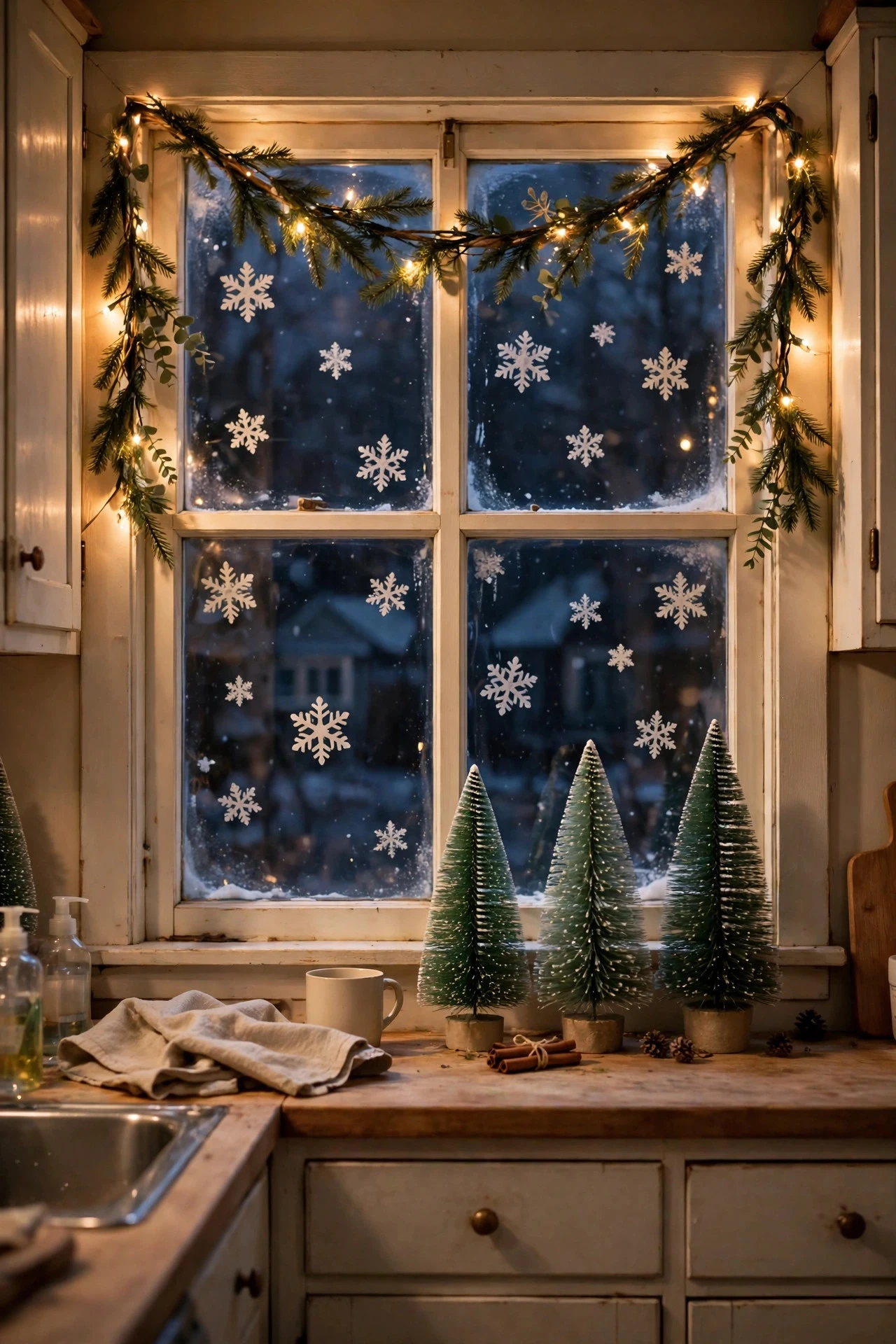
Decorate a kitchen window for under $20 on a dollar-store budget: a $5 faux garland across the top of the frame, a $3 pack of static-cling snowflakes, a $4 string of fairy lights, and three $2 bottle-brush trees for the sill, with a red ribbon bow to finish it. Twenty minutes, and it looks far more expensive than it is.
Buy the garland first and build around it, since it sets the colour of everything else. Fluff the cheap garland well — ten minutes of fluffing makes a $5 garland look like a $20 one — and tuck the battery pack behind the frame so no wires show. Reuse last year's ribbon, bows, and ornaments, and spend the savings on the fairy lights, which do the most work after dark. Avoid thin tissue-paper snowflakes, which tear while you cut them and sag in kitchen steam; clings and card cost the same and last the whole season. For more seasonal ideas on a tight budget, Better Homes & Gardens' Christmas decorating guides are a reliable source of fresh inspiration each year.
Practical Tips
Decorate high, keep the work surface clear. Garlands, wreaths, and hanging ornaments belong on the frame, the glass, and the rod — never on the counter or the sill edge where they block chopping, washing, and cooking. A tray under any sill display lets you lift the whole scene away in one move when you need the space.
Choose wipeable materials near steam and grease. Faux greenery, LED candles, laminated card, and ceramic or glass ornaments survive a working kitchen; paper, felt, and real foliage curl, wilt, and stain within days. Wipe the glass and the decor once a week so splashes never dull the fairy lights.
Keep every flame out of the kitchen window. Use battery LED candles only, at least 12 inches from the hob, the kettle, and any curtain or tea towel. Real candles and a busy cook's elbow are a bad combination, and steam alone will ruin a real candle's wax.
Plan the takedown before you decorate. Use suction hooks, tension rods, and static clings so everything comes down cleanly in January, and store the garland, wreath, and ornaments in labelled boxes. A window that takes ten minutes to decorate should take ten minutes to undo.
Final Thoughts
The kitchen window earns its Christmas decoration more than any other window in the house, because it is the one you look through while you cook, wash up, and wait for the kettle. Start with a garland across the top and a mini wreath on the glass, add fairy lights for the evenings and a small sill display for the daytime, and keep everything wipeable, shatterproof, and clear of the hob. The best kitchen window at Christmas is not the most elaborate one; it is the one that still lets the light in, still lets you see out, and makes the washing-up feel a little bit magical.
Frequently Asked Questions
How do I hang a garland on a kitchen window without nails?
Use two removable adhesive hooks on the top corners of the frame, or a tension rod wedged inside the frame, and drape a 6-foot faux garland across with a 4 to 6 inch dip in the centre. Both options hold a garland and fairy lights, come off cleanly in January, and work in rented homes with no holes.
What is the best wreath size for a kitchen window?
A 10 to 12 inch mini wreath suits a standard 24 to 36 inch kitchen window, hung dead centre on the glass from a suction-cup hook. Smaller wreaths disappear on wide windows, while wreaths over 14 inches block daylight and crowd a small sink window, so measure the glass before you buy.
Are fairy lights safe around a kitchen window?
Yes, if they are battery-powered LED strings fixed with removable clips, kept at least 12 inches from the hob and the kettle, and set on a timer. LED lights stay cool, use almost no electricity, and have no trailing mains cable near the sink, which makes them the safest choice for a working kitchen.
How do I stop window decorations getting ruined by steam?
Choose sealed, wipeable materials — faux greenery, LED candles, laminated paper, and ceramic or glass ornaments — and keep everything at least 12 inches from the hob and the kettle. Wipe the display and the glass once a week, and save paper, felt, and dried flowers for a window across the room.
Can I decorate a kitchen window if I rent my home?
Yes — static-cling snowflakes, suction-cup wreath hooks, tension-rod valances, and sill displays that simply sit there all come down with no holes or paint damage. Test suction cups on clean dry glass, re-press them weekly, and avoid nails, screws, and hot glue on rented frames.
How much does it cost to decorate a kitchen window for Christmas?
A full window costs $20 to $50: a faux garland for $10 to $20, a mini wreath for $8 to $15, a battery fairy-light string for $5 to $10, and a small sill display for $10 to $15. A budget version using dollar-store garland, clings, and lights costs under $20 and still looks festive after dark.