How to Hang Christmas Window Lights That Glow All Season
Christmas window lights are the easiest way to make a whole house feel festive from the street, and the hardest thing to get right up close. A glowing window looks magical from the pavement, but from inside the room a sagging strand, a visible tangle of wires or a single dead bulb can undo the effect in seconds. This guide fixes that, with the hanging methods, measurements and budgets that keep lights bright, straight and safe all season.
It covers every window you are likely to face: small cottage windows, wide picture windows, bay windows, double windows and rented flats where drilling is not an option. Every idea works at more than one budget, and most need nothing more than clips, a timer and an hour of your time.
Looking for more inspiration? Our Nest Decorz homepage gathers the latest home decor ideas, seasonal decorating guides and room-by-room styling tips in one place — start there and explore.
Quick answers
– Buy LED, not incandescent: LEDs use about 80% less power, stay cool to the touch and last for years. – Outline the frame first: a single strand around the window frame gives the cleanest glow, then add shapes or curtains inside it. – Clips beat tape and nails: outdoor-rated light clips hold through wind and rain and leave no holes or residue. – Put them on a timer: six hours a night, roughly 4 pm to 10 pm, is plenty — and it halves the electricity bill. – Budget honestly: one window costs $20–$60 with clips and a timer, a whole house front runs $120–$300.
1. Which Christmas Window Lights Last the Longest?
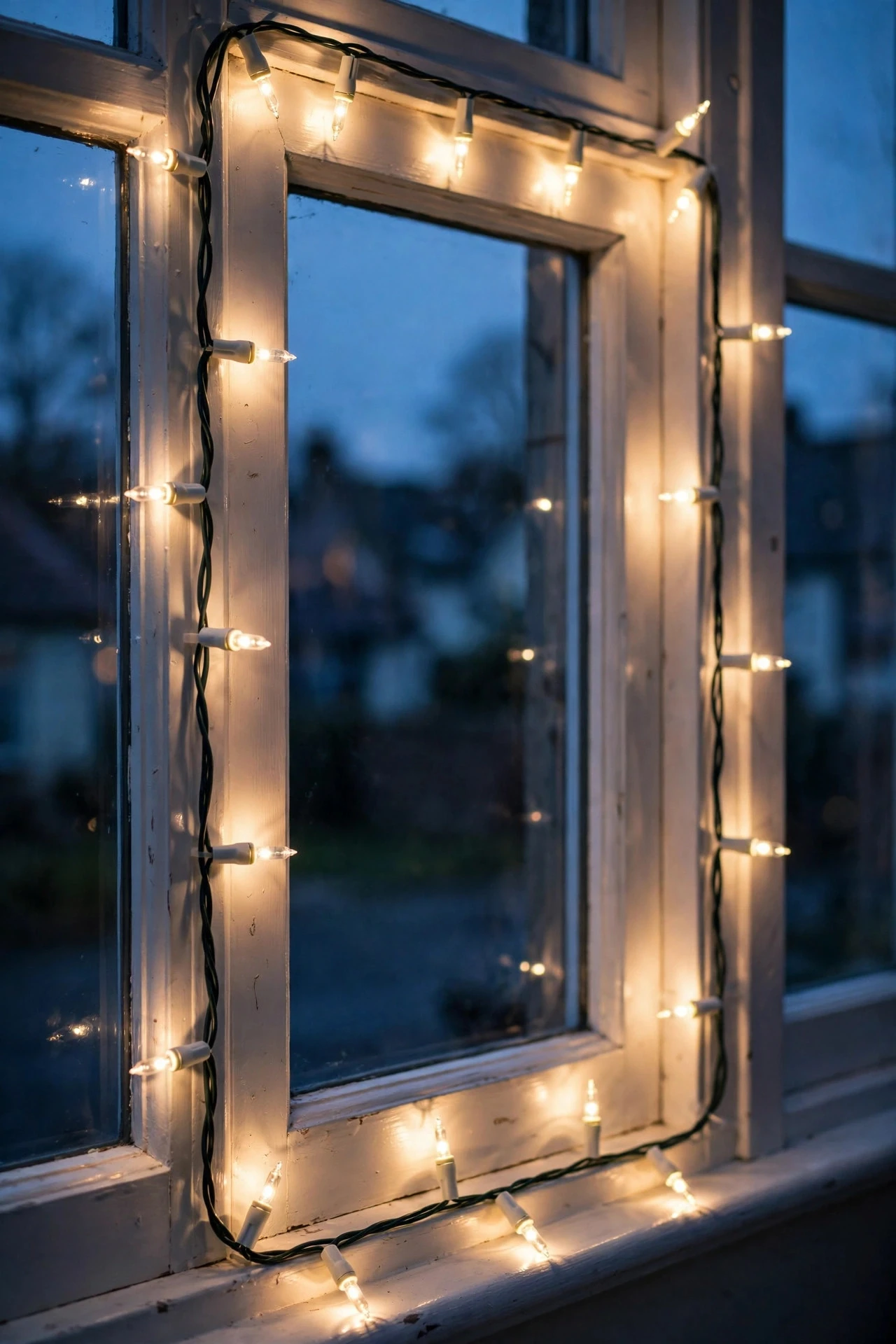
LED strands last the longest by a wide margin, typically 25,000 to 50,000 hours against roughly 1,000 to 2,000 hours for a traditional incandescent strand. That means a good LED set will glow for many Christmases, while an incandescent set often loses bulbs or whole sections after a single damp season outdoors.
LEDs also stay cool, so they are safer against curtains, timber frames and dry garland, and they use about a tenth of the electricity of an equivalent incandescent strand. Look for sealed, waterproof sockets rated IP44 or higher for outdoor windows. Expect $15–$40 for a quality 100-count LED strand. Avoid cheap unbranded sets with thin wire and loose sockets; they fail at the plug first.
2. Warm White or Cool White — Which Glow Suits Your Home?
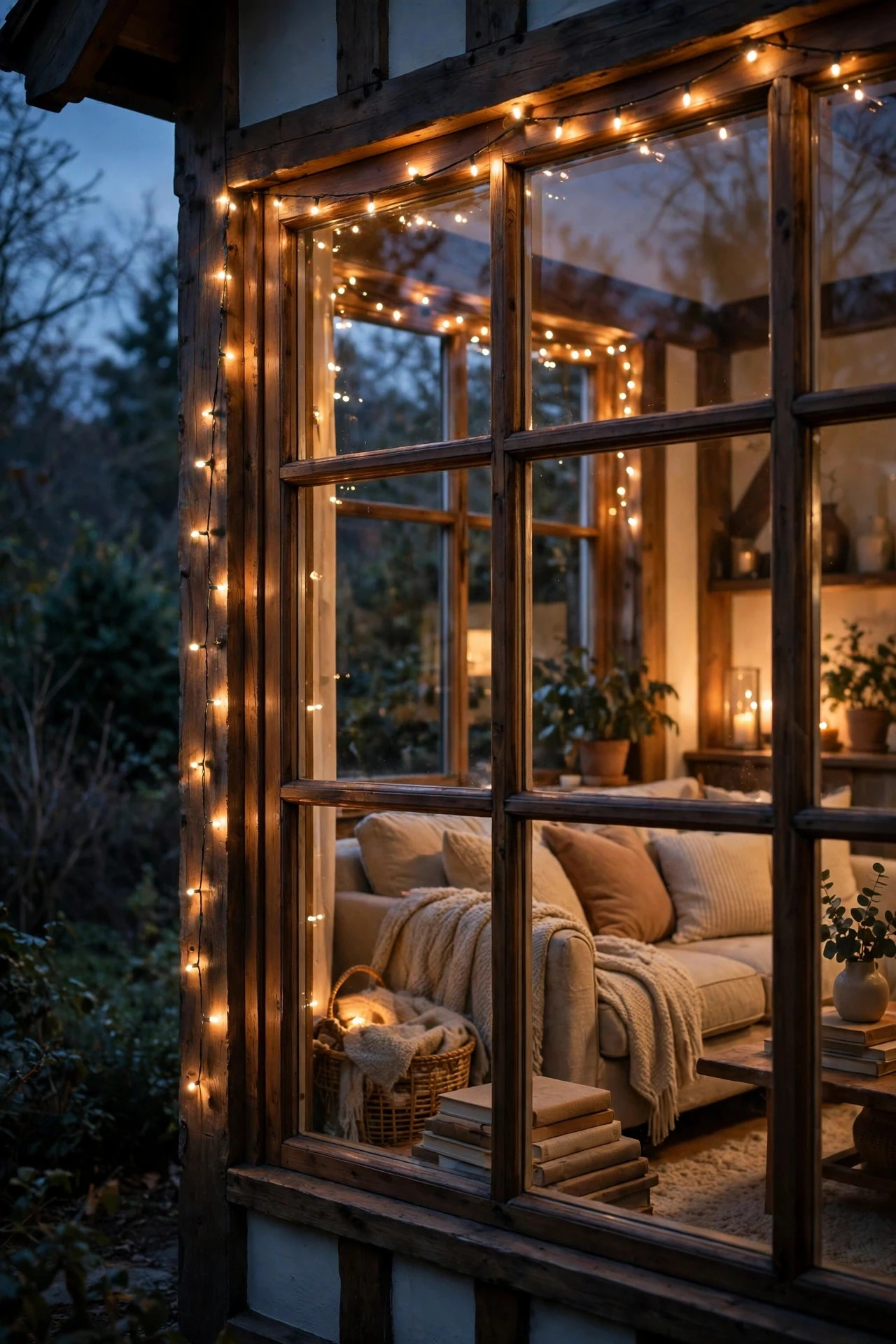
Warm white, at 2200K to 2700K, suits almost every home, because it matches candlelight and the glow of a fireplace and makes brick, timber and painted trim look inviting. Cool white, at 4000K to 5000K, reads icy and modern, and it works best on white or grey houses and on minimalist schemes where the lights should look like frost.
The mistake is mixing the two on the same window or the same house front: warm and cool side by side make both look wrong, as if one strand is faulty. Pick one temperature for the whole front of the house and check the box before you buy, because packaging marked simply "white" can be either. Walk the street at dusk first and match the mood of the houses around you.
3. Icicle, Curtain or Net Lights — Which Shape Fits a Window?

Icicle lights suit wide windows and rooflines, curtain lights suit tall windows and French doors, and net lights suit nothing on a window at all — they are made for bushes and hedges. Match the shape to the glass: icicles hang in uneven drops along the top of the frame, and curtains fall in vertical lines from a top bar.
For a standard window 36 to 48 inches wide, a 10-foot icicle strand or a curtain panel 3 feet wide by 6 feet tall fills the frame without bunching. Curtain lights look best from inside too, because the vertical drops read like a glowing waterfall behind sheer curtains. Avoid net lights on windows: their grid pattern fights the frame, and the result looks like a fishing net rather than a decoration.
4. How Do You Hang Window Lights Without Damaging the Frame?
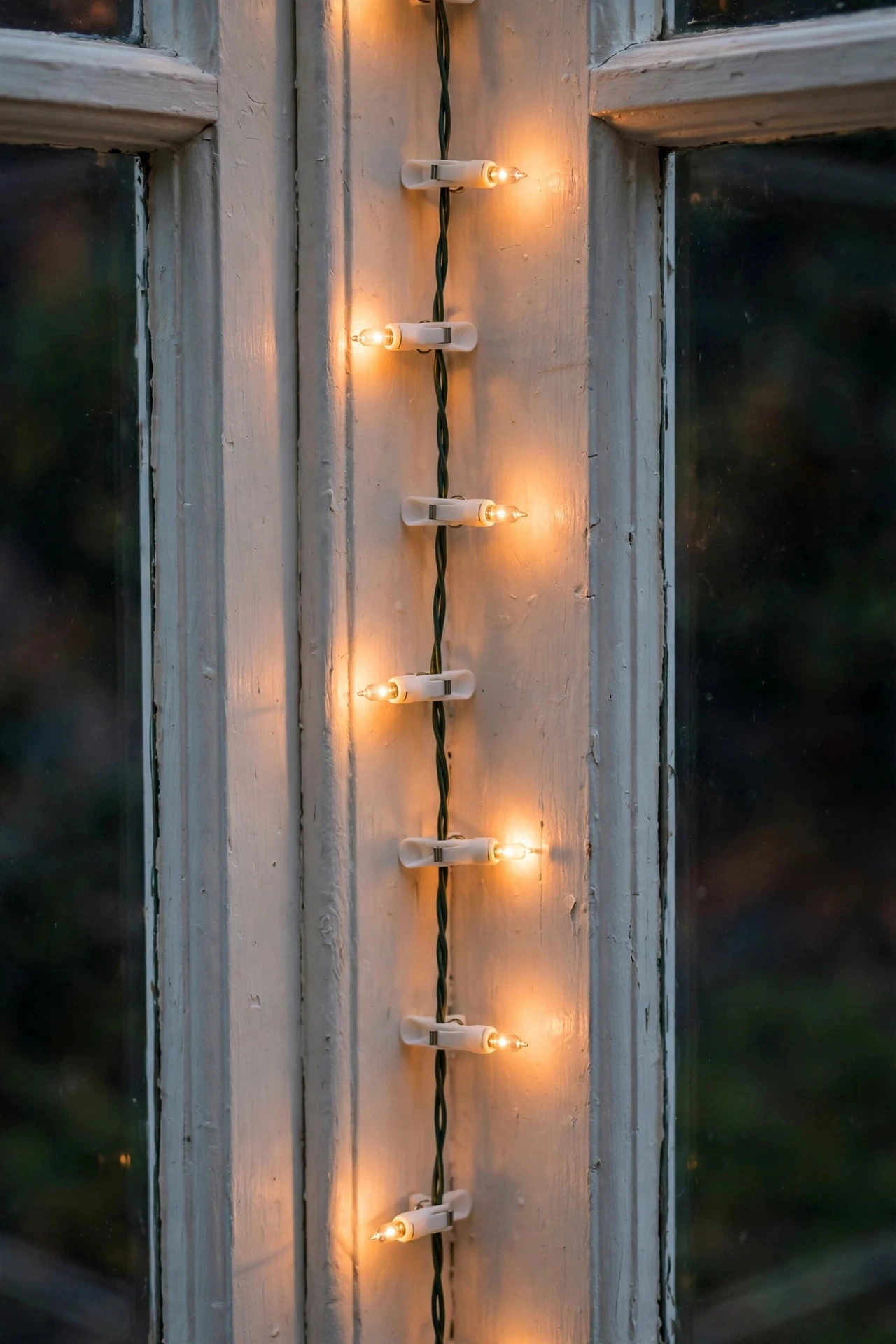
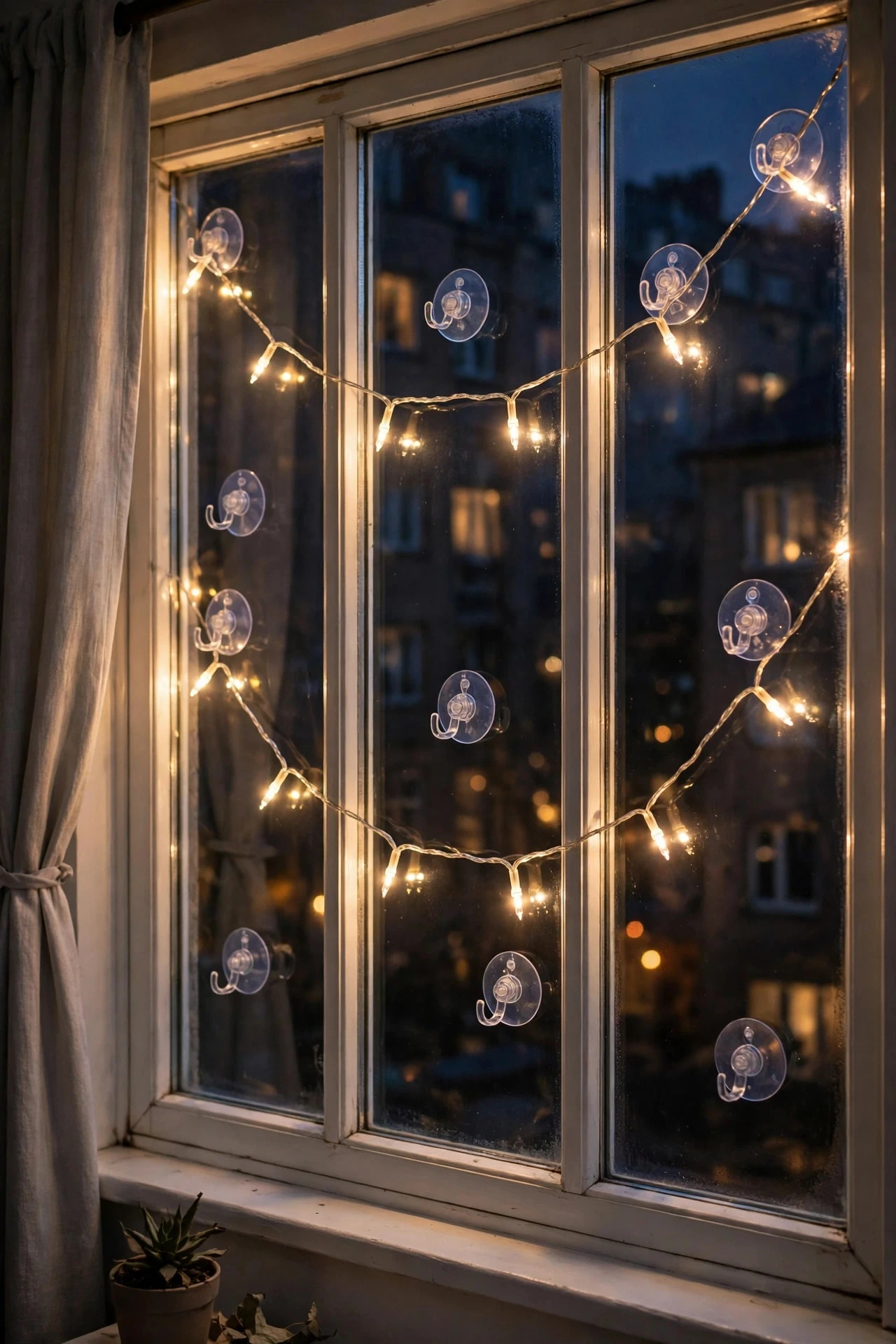
Use outdoor-rated plastic light clips, not nails, staples or tape, because clips grip the frame or the gutter without piercing anything and come off cleanly in January. All-in-one clips slide onto window trim, brick clips grip mortar joints, and suction-cup hooks hold on smooth glass, so there is a clip for every surface your house offers.
Space clips every 12 to 18 inches so the strand hangs straight instead of sagging between fixings, and press each clip firmly before you load it with wire. A pack of 100 all-in-one clips costs $8–$15 and covers three to four windows. For more ideas on framing a window for the season, see these christmas window decorations. Avoid stapling through the wire — one nicked strand can trip a breaker or kill the whole run — and avoid masking tape outdoors, which peels off in the first rain.
5. Suction Cups or Clips — Which Holds Better on Glass?

Clips hold better on frames and trim, while suction cups are the only sensible choice for hanging lights directly on the glass itself. A good suction cup with a small hook holds a lightweight LED strand on clean, smooth glass for weeks, and it leaves no mark at all when you peel it off.
The trick is preparation: clean the glass with warm soapy water, dry it fully, then press the cup flat and squeeze out every bubble of air before you hang anything on it. Use one cup every 12 inches for a straight run, and two cups at each corner where the strand changes direction. Expect $6–$12 for a pack of 20 cups with hooks. Avoid suction cups on textured, frosted or dirty glass — they will not seal — and avoid hanging anything heavier than a mini LED strand from them, because a falling strand at 2 am is nobody's idea of Christmas.
6. Indoor or Outdoor-Rated Strands — Does It Matter?

It matters a great deal, because outdoor-rated strands have sealed sockets, thicker insulation and plugs designed to keep rain out, while indoor strands do not. An indoor strand on an outside window can short out in wet weather and trip your breaker, so always check the rating before you hang anything outside the glass.
Look for UL-listed outdoor strands with an IP44 rating or better, and for indoor windows choose strands labelled indoor or indoor-outdoor. Outdoor strands cost only $5–$10 more per set than indoor ones. Keep the plug and any connection point under a covered porch or inside a weatherproof connection box, and never let a join sit in a puddle on the sill. The Spruce's guide to hanging Christmas lights safely covers the same outdoor-rating rule and the right clips to use with it.
7. How Do You Outline a Window Frame With Lights?

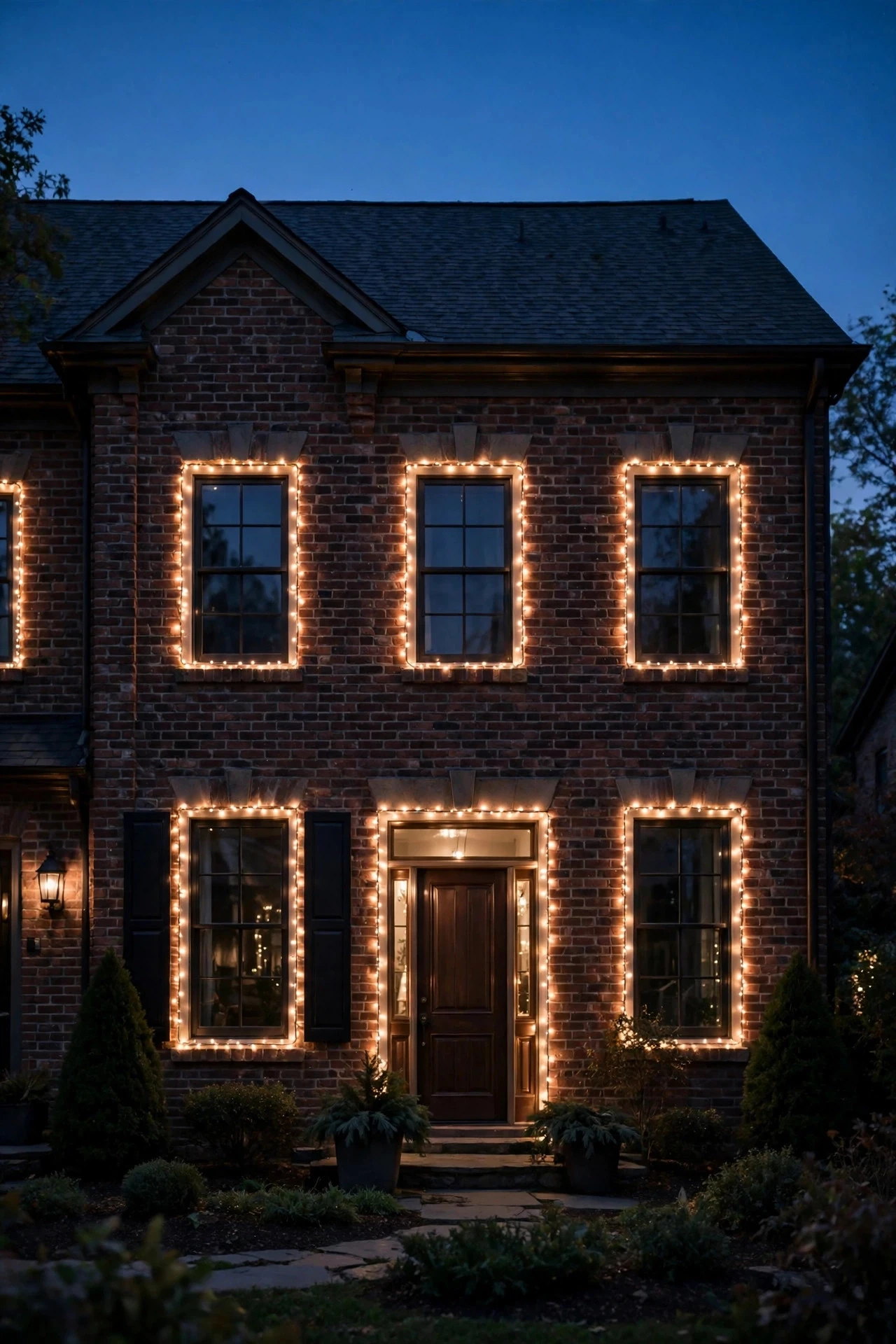
Start at the bottom corner nearest the plug, work up one side, across the top and down the other side, keeping the strand taut and clipping every 12 to 18 inches. A clean outline uses one continuous strand with no joins visible from the street, and the corners should turn neatly rather than looping out into the air.
Measure first: a window 36 inches wide and 60 inches tall needs about 16 feet of lights for the outline, plus 3 to 4 feet to reach the outlet, so a 25-foot strand gives you comfortable slack. Mark the corners with a clip before you start, and hang the top edge first so gravity works with you. Avoid leaving a loose loop of spare wire dangling at the end; coil it neatly behind the curtain, because a dangling loop is the first thing the eye catches.
8. Star and Snowflake Silhouettes — How Do You Hang Them Straight?

Hang silhouette lights from two points, not one, so they sit flat against the glass instead of swinging and twisting. A star or snowflake hung from a single hook turns in the draught and ends up sideways; two suction cups or two small command hooks, one at each top point, hold it level all season.
Place the silhouette in the centre of the window, roughly at eye level from the street, and keep it 2 to 3 inches clear of the glass so the light spreads softly rather than glaring. Battery-operated silhouettes cost $10–$25 each and need no trailing wire, which makes them ideal for upper-floor windows. Avoid hanging a silhouette larger than two-thirds of the window width — it crowds the frame and blocks the daylight — and avoid mixing three different shapes in one window, because one clear shape reads festive and a jumble reads like a sale rack.
9. Battery or Plug-In — Which Powers Window Lights Better?

Plug-in strands are better for any window near an outlet, because they run brighter, never fade as batteries drain, and cost nothing to keep going all season. Battery strands are better for windows far from an outlet, for upper floors and for renters, because they need no extension cord trailing across the room.
A battery strand running six hours a night on a timer lasts about two to three weeks on a set of three AA batteries, so budget for rechargeables if you plan to run it all season. Plug-in strands need an outlet within 6 to 10 feet or a single outdoor-rated extension cord, never a daisy chain of indoor cords. For a full outdoor scheme that ties windows into the rest of the front, browse these christmas outdoor decor ideas. Avoid connecting more strands end-to-end than the box allows — usually three to five.
10. Timers and Smart Plugs — How Do You Automate the Glow?
A simple mechanical timer is the cheapest fix, and a smart plug is the best one: both switch the lights on at dusk and off at bedtime. Set the timer for roughly 4 pm to 10 pm, which gives six hours of glow a night and keeps the house lit through the hours people actually walk past.
Mechanical timers cost $8–$15 and need their pins set by hand; smart plugs cost $12–$25 each, work from your phone and can follow sunset times automatically. Either one pays for itself in a single season by cutting the hours the lights run. Place the timer indoors or in a weatherproof box, never loose on a wet sill. Avoid leaving lights on all night: it doubles the electricity, annoys neighbours, and shortens the life of the bulbs for no extra joy.
11. How Do You Layer Lights With Garland and Curtains?
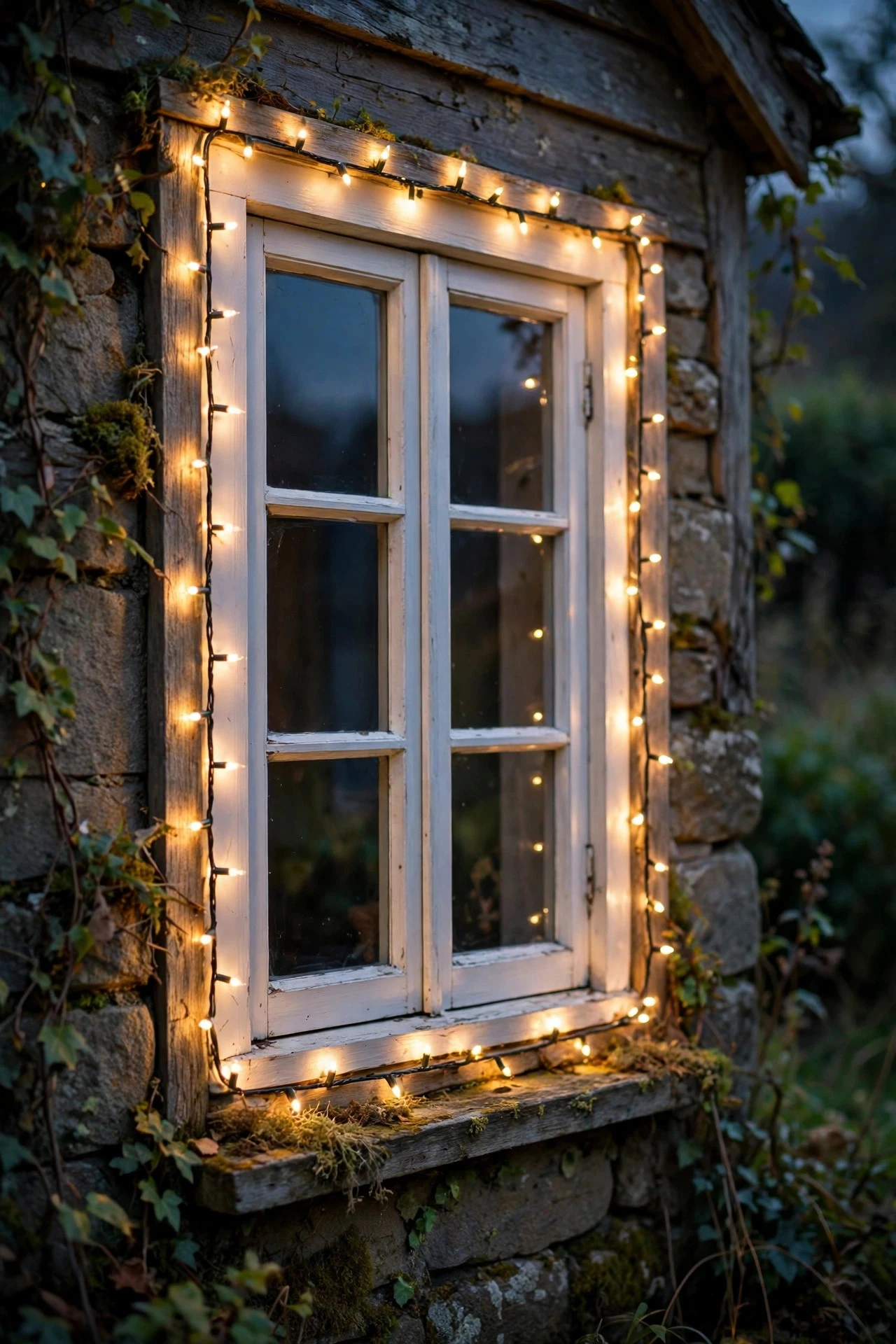
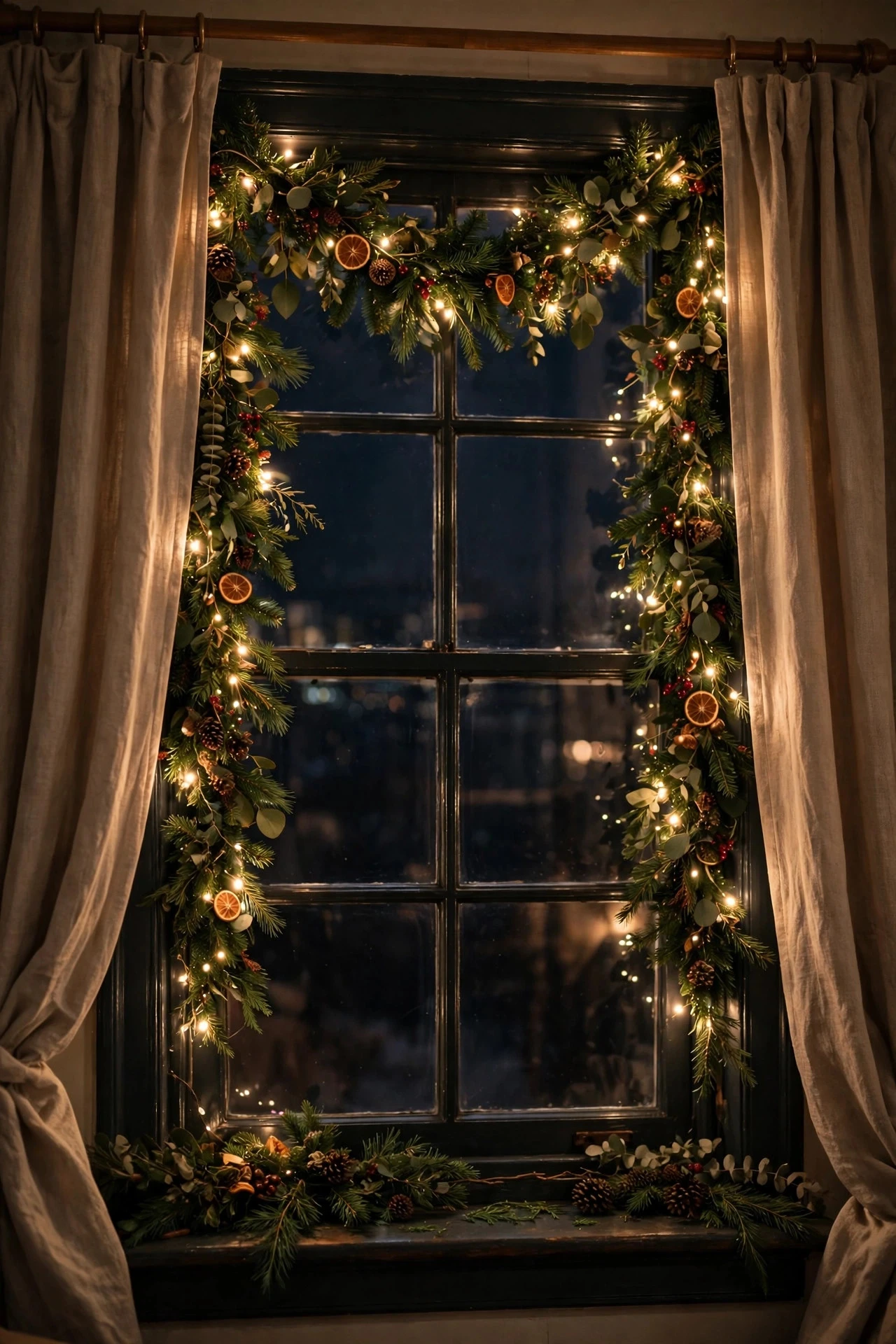
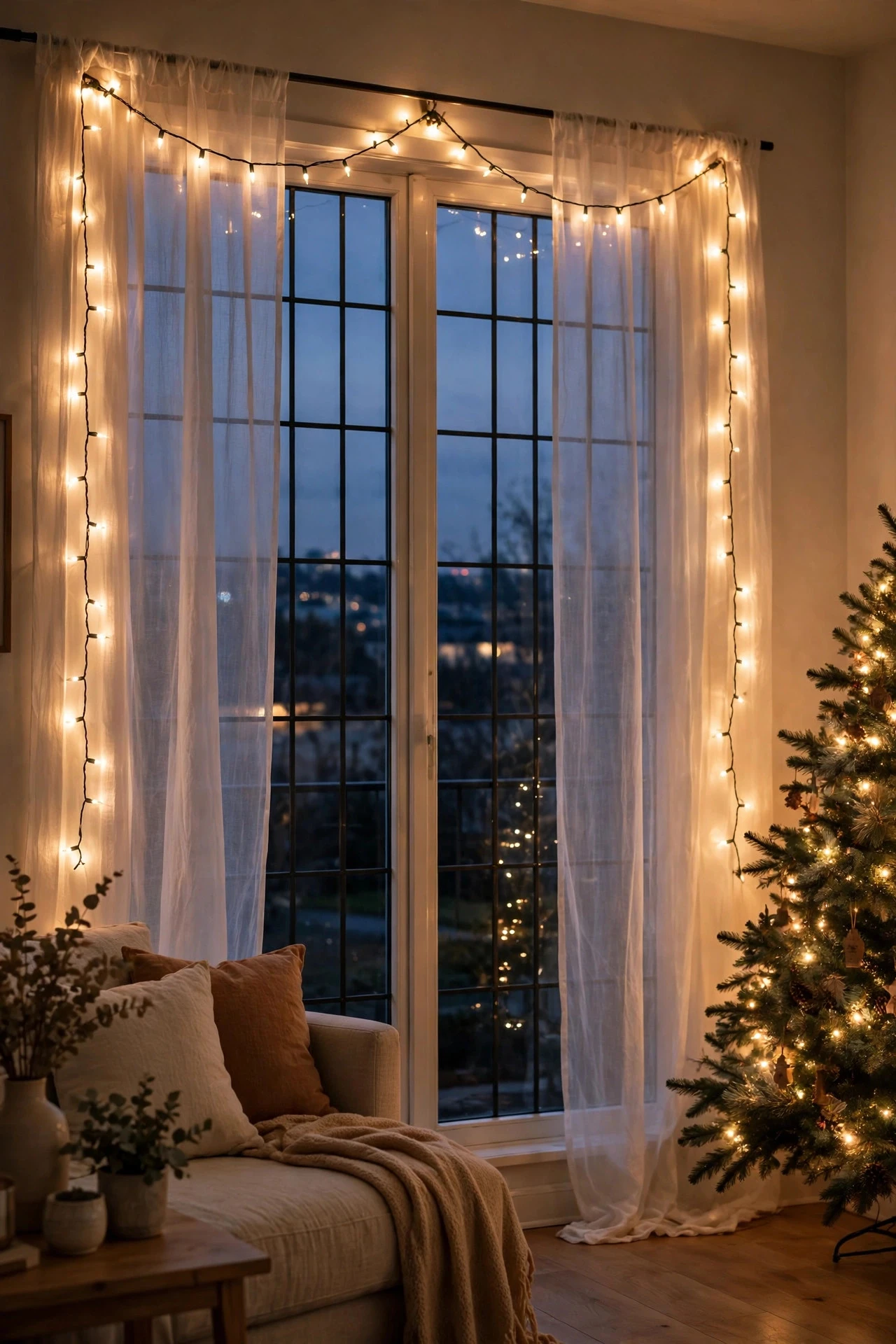
Layer in order: lights first, against the glass or frame, then garland over the lights at the top of the window, then curtains framing the whole arrangement. The lights glow through and around the greenery, the garland hides the wire and the clips, and the curtains soften the edges so the window reads as one styled composition.
Use a 6-foot garland for a standard window and a 9-foot garland for a wide or double window, draping it with a gentle swag that dips 6 to 8 inches in the middle. Tuck a second, shorter strand of warm-white fairy lights inside the garland itself so the greenery glows from within rather than sitting dark against the bright frame. Avoid piling garland over the whole window — it blocks the light and the view — and avoid real pine touching a warm incandescent strand, because dry needles and hot bulbs are a combination to retire.
12. Small Windows — How Do You Light Them Without Overcrowding?

A small window needs one idea, done well, not three competing ones. A single short strand outlining the frame, or one small silhouette in the centre, is enough: the frame is the decoration, and the light should trace it rather than fill it.
For a window under 24 inches wide, a 10-foot mini LED strand with 50 lights is plenty, and a star or snowflake 8 to 10 inches across fits without crowding the glass. Keep the wire tight to the frame and hide the battery pack behind the curtain or on the sill in a small basket. Avoid curtain lights on a small window — the vertical drops overwhelm the glass and the window looks stuffed — and avoid mixing warm and cool white in a small space, where the clash is impossible to miss.
13. Bay Windows — How Do You Light Three Panels Evenly?

Light a bay window as three separate panels with one shared plan, not as one long run dragged around the corners. Give each panel its own outline or its own curtain drop, run the strands to a single timer, and keep the same bulb colour and spacing on all three so the bay reads as one glowing unit.
Measure each panel separately — a typical bay has a 48-inch centre panel and two 24-inch side panels — and allow about 25 feet of lights per panel including the run to the outlet. Hang the centre panel first, then mirror the side panels so the design is symmetrical. For ideas on tying the bay window into the room behind it, see these living room christmas decor ideas. Avoid a single strand stretched across the angles: it sags at the corners, and one failed bulb takes out the whole bay.
14. Double Windows — How Do You Make a Pair Look Like One Display?

Treat a pair of double windows as one display by giving both windows the identical treatment: same strand, same shape, same height, same timer. Symmetry is the whole trick — two matching glowing rectangles read as deliberate design, while two different treatments read as a mistake, even if each one is pretty on its own.
Hang both outlines at exactly the same height, using a tape measure rather than your eye, and start both strands from the same side so the plugs and battery packs sit together. If you add silhouettes, use the same shape in both windows, centred in each. Budget $40–$80 for a matching pair with clips and a shared timer. Avoid giving one window icicles and the other curtain lights — the mismatch doubles the visual noise — and avoid hanging one strand higher than the other, because the street will notice the difference before you do.
15. How Much Electricity Do Christmas Window Lights Really Use?

A 100-count LED strand uses about 4 to 8 watts, so running one strand six hours a night for a month costs roughly 5 to 15 cents in electricity. Even a whole house front with ten LED strands costs under $2 for the season, which is why LEDs have made big displays affordable for everyone.
Incandescent strands are a different story: a 100-count incandescent strand uses 40 to 60 watts, so the same display costs ten times as much and runs hot enough to warm the glass. Do the maths before you buy by multiplying watts by hours and dividing by 1,000 to get kilowatt-hours. Avoid leaving old incandescent sets running all night, and avoid plugging a whole display into one outlet without checking its load.
16. How Do You Keep Window Lights Safe Around Children and Pets?
Keep every wire out of reach, every plug behind furniture, and every battery pack secured where small hands and curious paws cannot pull it down. Children and pets are drawn to glowing windows, so run wires along the top of the frame and down the side nearest the wall, never across the middle of the glass at grabbing height.
Use battery strands with the pack taped or velcroed to the frame above sill height, and choose LED strands that stay cool — a child can touch a lit LED safely, but an incandescent bulb burns. Keep extension cords behind the sofa or under a cord cover, and check weekly for chewed wire if you have a puppy or a kitten. The history of Christmas lights shows how far the technology has come from hot, fragile bulbs to cool, safe LEDs. Avoid curtain lights that hang low enough for a toddler to pull.
17. Renter-Friendly Methods — How Do You Hang Lights With No Drilling?

Renters can hang a full window display with suction cups, removable adhesive hooks and tension rods, and take all of it down in January without a mark. Suction-cup hooks hold mini LED strands on the glass, adhesive hooks hold strands on painted trim, and a tension rod across the top of the frame carries curtain lights.
Test every hook on a hidden spot first: press it on, leave it a day, then pull it off — good removable hooks leave nothing behind. A renter's kit of 20 suction cups, 20 adhesive hooks and one tension rod costs $20–$35 and covers two to three windows. For the room the window looks into, these christmas tree ideas show how to keep the whole space coordinated without touching the walls. Avoid drilling, stapling or using heavy-duty outdoor adhesive on a rental — the repair bill in January will cost more than the lights did.
18. Extension Cords — How Do You Run Power Safely to a Window?

Use one outdoor-rated extension cord, as short as possible, run it along the wall rather than across a walkway, and keep every connection off the ground and out of puddles. A 25-foot, 16-gauge outdoor cord costs $15–$25 and handles a full window display easily; a thin indoor cord outdoors is a fire risk and a false economy.
Run the cord from the outlet to the window along the skirting board or behind furniture, and secure it with cord clips every 2 feet so nobody trips over it. Where a connection must sit outside, use a weatherproof connection box or a plastic bag tied loosely over the join — never a sealed bag that traps condensation. Avoid running cords under rugs, through doorways that close on them, or across wet lawns, and avoid joining two extension cords end to end to reach a far window — buy the right length instead.
19. How Do You Make Window Lights Glow Brighter From the Street?

Brightness from the street is about contrast, not wattage: dark glass, a dark frame and a dark room behind the window make the same strand look twice as bright. Close the curtains behind the lights or hang a dark backing panel, and the glow pops; leave the room lights on behind the window and the glow washes out.
Double the strand on the outline — two runs side by side, 2 inches apart — for windows that face a wide street or sit far back from the pavement. Clean the glass inside and out before you hang anything, because a film of dust cuts the light more than a dead bulb does. Budget an extra $15–$30 per window for the second strand. Avoid pointing a spotlight at the window to "help" the lights — it kills the contrast and flattens the glow — and avoid cool-white strands on a red-brick house, where warm white always reads richer.
20. How Do You Store Window Lights So They Work Next Year?

Wind each strand around your elbow and hand into a loose figure-eight, or around a short piece of cardboard, and store it in a labelled zip bag with its clips and timer. A strand stored loose in a box tangles, kinks and breaks at the sockets; a strand stored wound and labelled unrolls in minutes next December.
Test every strand before you pack it away, and throw out any strand with cracked sockets, frayed wire or more than a couple of dead bulbs — it will not heal in the cupboard. Keep the bags in a dry box indoors, not in a damp garage, and write the window name and the strand length on the bag. For the hearth below the window wall, these christmas fireplace decor ideas show how to carry the same glow through the room. Avoid winding strands tightly around your hand, which kinks the wire, and avoid storing them with heavy boxes on top.
21. How Do You Fix a Strand When Half the Lights Go Out?

Start at the plug and work along the strand, because most failures are a loose bulb, a blown fuse in the plug, or one failed bulb breaking the circuit for its whole section. Check the plug fuse first — a spare usually comes with the plug — then push each bulb in its section until the lights return.
For LED strands, look for the one dark bulb in the dead section and replace it with a matching spare; for older incandescent sets, a light-tester tool that finds the failed bulb costs $10–$15 and saves an hour of guesswork. Keep a small spares kit in the decoration box: fuses, five spare bulbs and a tester. Avoid throwing away a whole strand for one dead bulb, and avoid forcing a bulb from a different set into the socket — the wrong voltage bulb can blow the section it was meant to save.
22. How Do You Plan a Whole-House Window Display on a Budget?
Plan the display on paper before you buy a single strand: sketch the front of the house, mark every window, and assign each one the same outline treatment with one feature window carrying the silhouettes or curtain lights. A uniform plan looks expensive, costs less than a random collection of sale items, and lets you buy strands in matching multipacks.
A five-window front costs $120–$300 all in — five LED strands at $15–$30 each, clips at $8–$15 a pack, two timers at $10–$15 each, and one or two extension cords. Buy the strands first, hang the ground-floor windows, then add the upper floor only if the budget allows. Better Homes & Gardens has a good roundup of Christmas light ideas for scaling a display window by window without overspending. Avoid buying one strand at a time from different shops — mismatched colours will show from the street — and avoid starting with the hardest upper window.
Practical tips for christmas window lights
Measure the window before you buy the strand. A tape measure costs nothing and a wrong-length strand costs a return trip. Add the outline length plus 3 to 4 feet to reach the outlet, and buy the next size up if you are between lengths.
Hang the top edge first, then the sides. Gravity pulls a strand down, so starting at the top keeps the outline straight and lets you adjust the sides without the whole run sliding. Clip every 12 to 18 inches and step back to check from the street before you finish.
Put every window on the same timer. One timer, one on-time and one off-time for the whole house front looks deliberate, saves electricity and means you never have to go out in the cold to switch lights on. Six hours a night, roughly 4 pm to 10 pm, is the sweet spot.
Test the whole display indoors first. Plug every strand in on the living-room floor before you climb a ladder or stick a single hook to the glass. Finding a dead section indoors takes two minutes; finding it halfway up a ladder takes twenty and a lot of patience.
Photograph the display at dusk, from the street. The camera shows sagging wires, dark corners and mismatched colours that your eyes miss from inside. Fix what the photo shows on the same evening, while the ladder is still out.
Final thoughts
Christmas window lights work best when they are simple, straight and safe: one colour temperature, one hanging method, one timer and a clean outline on every window. Start with the window you see most, get that one glowing properly, and let the rest of the house follow the same pattern. Done that way, the lights will glow all season, come down without a mark, and go back up next year without a single surprise.
Frequently Asked Questions
How many lights do I need for one standard window?
A standard window 36 inches wide and 60 inches tall needs about 16 feet of lights, plus 3 to 4 feet to reach the outlet, so a 25-foot strand is the comfortable choice. For curtain lights, one panel 3 feet wide by 6 feet tall fills the same window.
Are LED Christmas window lights safe to leave on overnight?
LED strands are much safer than incandescent ones because they stay cool and use very little power, but leaving any lights on all night is still wasteful and unnecessary. Put them on a timer for six hours, roughly 4 pm to 10 pm, so the house glows through the evening and switches itself off before bedtime.
Can I hang Christmas window lights without drilling holes?
Yes, and most people should. Outdoor-rated plastic clips grip window trim without piercing it, suction-cup hooks hold mini LED strands directly on clean glass, and a tension rod across the frame carries curtain lights with no fixings at all. All three methods come down cleanly in January, which makes them ideal for renters too.
What colour temperature looks best on Christmas window lights?
Warm white at 2200K to 2700K suits almost every home, because it matches candlelight and makes brick, timber and painted trim look inviting. Cool white at 4000K to 5000K suits white or grey houses and minimalist schemes, but never mix the two on the same house front, because the clash makes one strand look faulty.
How do I stop my window lights from sagging?
Space your clips every 12 to 18 inches so the strand has no long unsupported run, and hang the top edge first so gravity works with you. Start at the bottom corner nearest the plug, work up one side, across the top and down the other side, keeping the strand taut.
How should I store Christmas window lights after the season?
Wind each strand into a loose figure-eight and store it in a labelled zip bag with its clips and timer. Test the strand before packing it away, throw out any set with cracked sockets or frayed wire, and keep the bags in a dry box indoors so the lights work first time next December.