How to Give Your Bedroom a Cozy Christmas Makeover
A Christmas bedroom makeover does not mean turning your sleep space into a second living room. The best ones change a few high-impact layers — bedding, light, scent and one green focal point — and leave the rest of the room alone. Think of it as a before-and-after you can finish in a single weekend afternoon, on any budget, without drilling a single hole.
Looking for more inspiration? Our Nest Decorz homepage gathers the latest home decor ideas, seasonal decorating guides and room-by-room styling tips in one place — start there and explore.
The makeover rule that matters most is sleep-first: warm low light instead of bright white, soft textures you actually want to touch, and nothing that buzzes, blinks or glows all night. Every idea below follows that rule, and each one is tagged with a budget tier — under $25, $25–75, or splurge — so you can build the look in the order that gives you the biggest effect first.
Quick Answers
– Start with the bed: layered bedding and a Christmas throw change the whole room for the least money. – Warm light wins: fairy lights at 2700K or below, on a timer, beat bright white every time. – One green focal point is enough: a small tree, a garland, or a wreath — not all three fighting for attention. – Keep it renter-friendly: command hooks, tension rods and draped garlands leave no marks behind. – Sleep comes first: no plug-in lights left on overnight, no real candles burning, and clear floor space around the bed.
1. How Do I Start a Christmas Bedroom Makeover Without Redecorating the Whole Room?
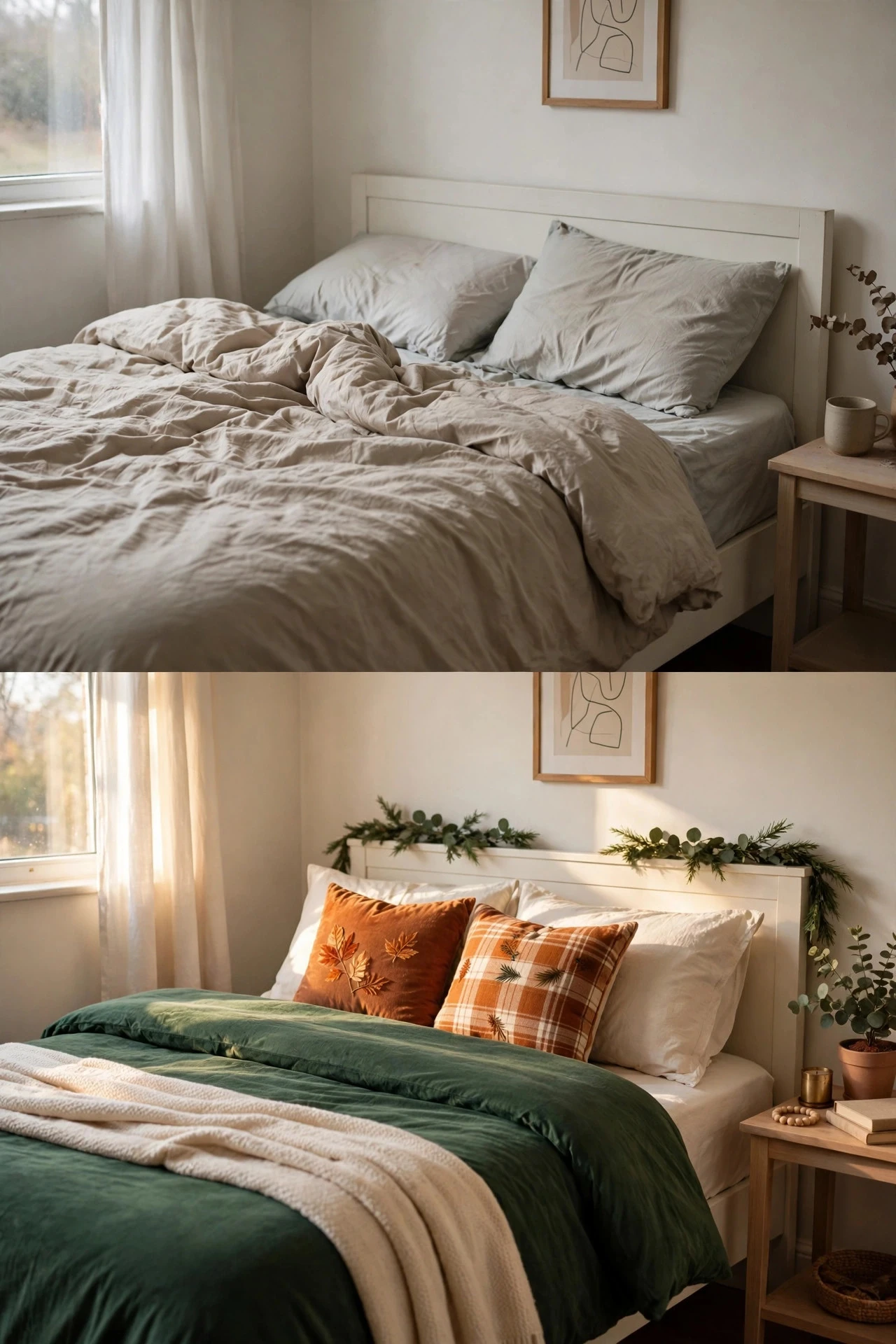
Start with the bed, because it sets the colour story in one move. Swap in a deep red, forest green or cream duvet cover, add a folded throw across the foot, and add two seasonal cushions. That single change reads as a makeover from the doorway, and it costs under $75 if you shop your linen cupboard first.
The sequence matters more than the shopping list. Change the bed first, then add light, then add greenery, and only then decide on a tree. People who buy the tree first usually end up with a room that feels crowded, because every later choice has to work around it. If your budget is tight, a $20 throw and a pillow swap alone can carry the whole look.
2. What Bedding Layers Make a Christmas Bedroom Feel Cozy, Not Heavy?

Layer three textures: a cotton duvet in cream or deep green, a chunky knit throw folded across the foot, and a lighter blanket tucked between them. The contrast of smooth, nubby and plush reads as cozy, so keep the palette to two colours plus one metallic accent.
Avoid flannel sheets under a thick duvet unless your room runs cold, because overheating ruins sleep and the whole point is a restful room. For a finished feel, iron or steam the duvet cover before making the bed; wrinkles undo expensive fabric fast. Smooth cotton, nubby knit and soft velvet together beat any single fabric. If you want more seasonal bedding inspiration, browse our Christmas bedding ideas for a cozy festive bedroom for colour pairings that work with the layers here.
3. Which Christmas Colour Palette Works Best in a Bedroom?

A restful Christmas bedroom uses one deep colour, one warm neutral and one small metallic accent. Deep green with cream and brass feels woodland and calm; burgundy with blush and gold feels rich and romantic; charcoal with ivory and silver feels modern and quiet.
The mistake to avoid is mixing every Christmas colour at once — red, green, gold, silver and white in equal amounts turns a bedroom into a shop window. Let the neutral do most of the work: cream walls, natural wood and white bedding carry the deep colour, which then only needs to appear in three or four places. Our guide on how to style a burgundy and green bedroom shows how those two deep tones behave together across a whole year, not just December.
4. How Can I Add a Small Christmas Tree Without Losing Floor Space?

Choose a slim pencil tree or a tabletop tree between two and four feet tall, and place it where dead space already exists: the corner by the wardrobe, on top of the dresser,. A slim tree needs only about eighteen inches of floor, and a tabletop tree needs none at all.
The modern Christmas tree tradition of bringing a small evergreen indoors suits a bedroom perfectly, since the tree stays small and manageable. Battery lights with a six-hour timer are ideal here, because they switch themselves off and you never have to reach behind furniture at midnight. Keep the tree away from curtains, bedding and any heat source, and never leave plug-in lights running while you sleep. A small tree also makes a lovely nightstand companion if you keep the base weighted and the lights low.
5. What Is the Best Warm Lighting for a Cozy Christmas Bedroom?

Warm light between 2200K and 2700K is the whole secret: it flatters skin, deepens reds and greens, and signals your brain that it is time to wind down. Use one string of warm white fairy lights along the headboard or window, one bedside lamp with a warm bulb, and nothing else.
Avoid cool white or multicolour lights in the bedroom; cool white feels clinical and multicolour keeps the eye busy when it should be resting. Put fairy lights on a timer set for six hours so they are off long before deep sleep, and never drape lights across the bed where they can tangle or overheat. Test the glow from the doorway before bedtime: if you can read the room's mood in one glance, the light is right.
6. How Do I Style a Christmas Garland on a Headboard or Mirror?

Drape a faux cedar or pine garland along the top of the headboard, letting the ends fall a few inches down each side, and secure it with clear command hooks rather than nails. Add three or four small ornaments, a thin velvet ribbon woven through, and a short string of warm fairy lights tucked inside the greenery.
Real pine smells wonderful but drops needles into bedding, so faux is the practical bedroom choice; add scent separately with a pine-scented sachet tucked behind a pillow. If your headboard is upholstered, use the mirror or the window frame instead — the same garland works beautifully across the top of a dresser mirror. Check the hooks weekly, because garlands slowly slide, and a sagging garland looks tired rather than festive.
7. Can a Christmas Wreath Work in a Bedroom, and Where Should It Hang?

A wreath works best on the inside of the bedroom door, above the dresser, or on the wall opposite the bed. Choose one between twelve and eighteen inches across, in the same greenery and palette as the rest of the room, and hang it from a removable adhesive hook or a ribbon looped over the door.
Add a single bow in your palette's accent colour and stop there — no extra baubles needed. If you love real eucalyptus or dried orange slices, a bedroom wreath is the perfect place for them, because the room is cool and dry and the scent lasts for weeks. Hang it where it will not brush your head when you walk past, and keep it clear of the radiator so it does not dry out and drop.
8. How Do I Make My Bedside Tables Feel Festive Without Clutter?

Clear each bedside table to three objects: the lamp, one seasonal piece, and one practical item such as a book or a glass of water. The seasonal piece can be a mini bottle-brush tree, a small pine sprig in a bud vase, or a flameless candle in a glass hurricane.
The trick is subtraction first. Remove the charger cables, the spare change and the half-read magazines before you add anything festive, because Christmas decor layered on top of everyday mess reads as more mess. Keep the surface clear enough that you can reach your lamp and your phone without knocking anything over in the dark. A bedside table is a working surface first and a display second. Wipe the surface before you style it, so the few objects you keep look deliberate rather than dusty.
9. What Throw Blankets and Cushions Give the Biggest Cozy Payoff?
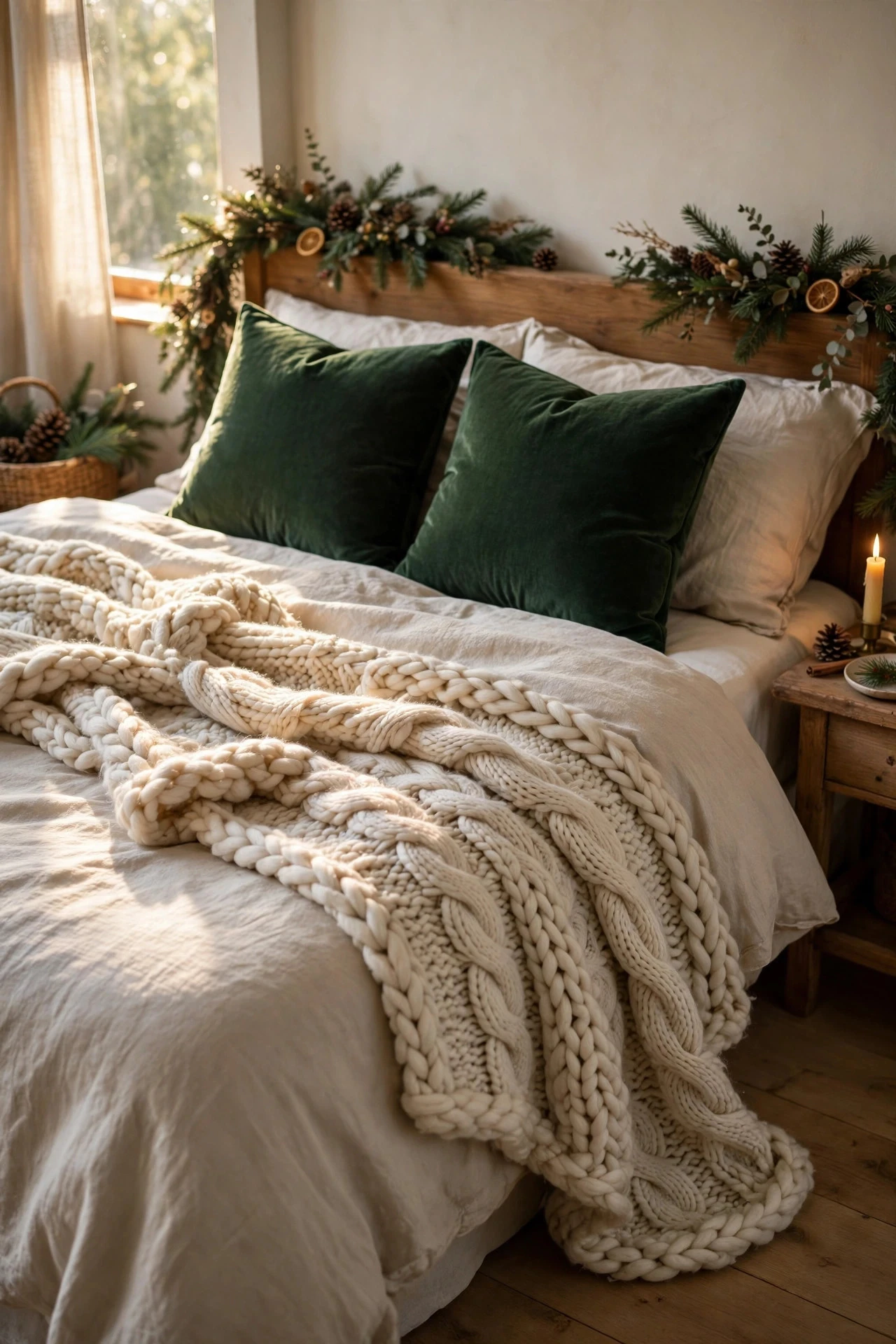
One chunky knit throw in cream or oatmeal, draped diagonally across the foot of the bed, plus two velvet cushions in your deep palette colour, deliver more coziness per dollar than any other purchase. The knit adds texture you can see from the doorway, the velvet adds depth when the light hits it, and both invite touch.
Mix textures deliberately: knit with velvet, faux fur with linen, cable knit with smooth cotton. Avoid buying a matching set of everything, because identical fabric everywhere looks flat; the contrast is the style. Fold the throw in thirds and drape it with one corner trailing lower than the other for a relaxed, lived-in look rather than a hotel fold. Store the everyday throw you replaced in the wardrobe so the swap takes seconds next year.
10. How Do I Add Christmas Scent Without Candles or Overpowering the Room?

Use a pine or cedar sachet tucked behind a pillow, a reed diffuser on the dresser, or a simmer of orange peel and cinnamon on the stove before bed — never a burning candle left unattended in a bedroom. Scent should be noticeable when you enter the room and invisible after five minutes.
Flameless candles with a timer give you the flicker without the flame, and they pair beautifully with a pine sachet for the scent layer. A few drops of cedarwood oil on a cotton ball inside a drawer scents your pyjamas gently. Refresh the sachet weekly, and air the room every morning — fresh air is part of the scent, not the enemy of it. For more flame-free fragrance ideas, BHG's Christmas decorating guides cover seasonal scent layering alongside tree and mantel styling.
11. What Should I Change First If I Only Have $25 to Spend?

Buy one seasonal throw and one string of warm fairy lights, and spend the rest of your time restyling what you already own. Move your best cushion to the front of the bed, fold your existing blanket differently, and clear every surface before you add anything.
Borrow greenery from the garden — a few pine, holly or eucalyptus stems in a jar cost nothing and smell wonderful. Check charity shops first: second-hand throws and fairy lights in good condition cost a fraction of new ones. If you do buy, buy the throw first, because it is the only item you will still use in January. The $25 makeover proves the point of this whole post: the biggest effect comes from the bed and the light, not from the number of decorations.
12. How Can Renters Decorate a Christmas Bedroom Without Damage?

Renters should build the whole look on removable fixings: command hooks for garlands and wreaths, tension rods for window swags, washi tape for lightweight paper stars, and freestanding pieces like trees, lanterns and trays for everything else. Nothing needs a nail, a screw or a drilled hole, and everything comes down in January without a trace.
Lean on textiles and freestanding decor, which landlords never object to: seasonal bedding, throws, cushions and a small tree in a basket change the room completely with zero wall contact. A garland draped over a mirror or headboard needs only gravity and two hooks, and fairy lights can be wound through a bed frame or curtain rod without a single fixing. If you want more small-space, low-budget inspiration, our dorm room Christmas decorating guide is written for renters and tiny rooms, and most of its tricks transfer directly to a rented bedroom.
13. How Do I Decorate a Christmas Bedroom With Kids or Pets Around?
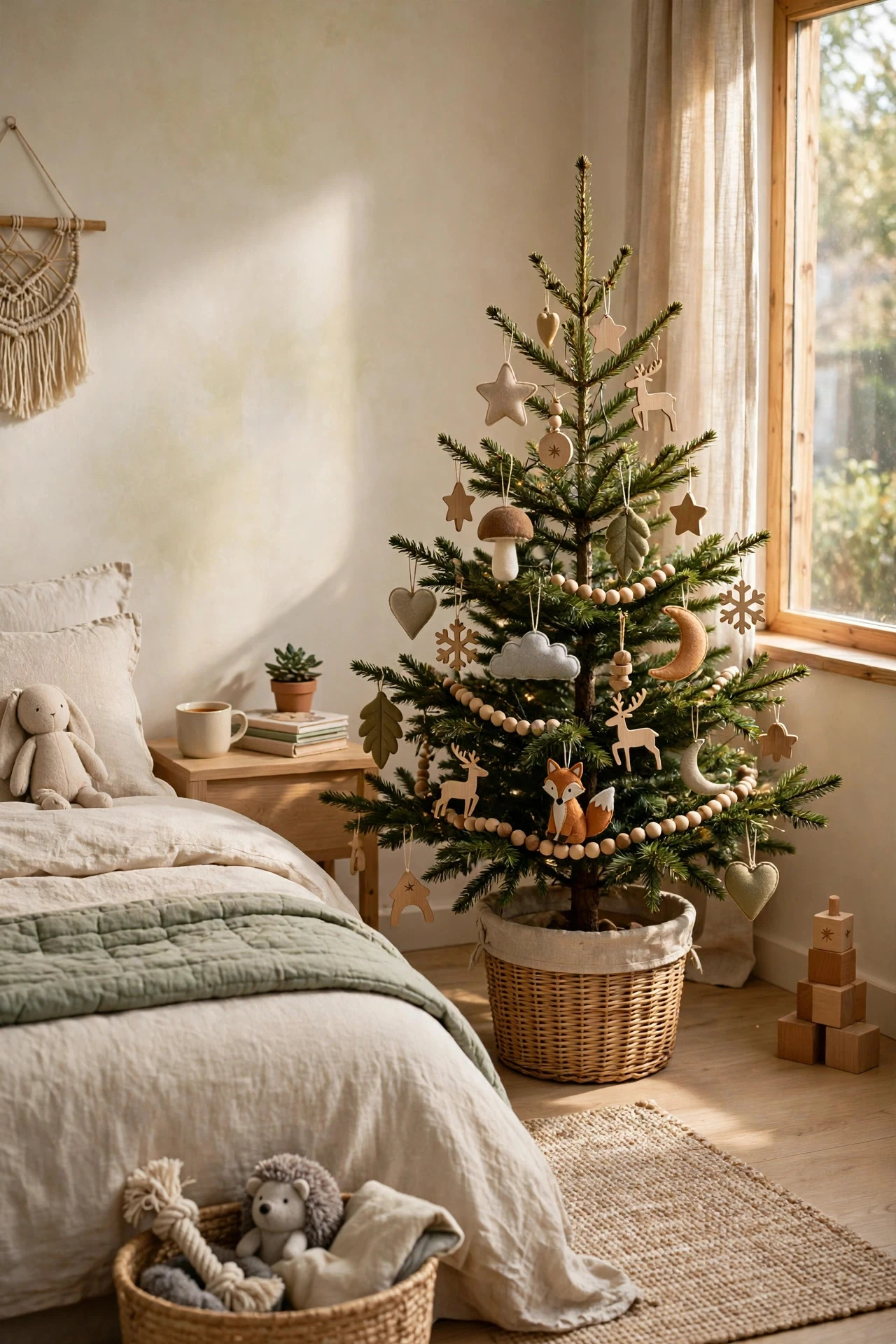
Choose unbreakable ornaments, secure the tree so it cannot topple, and keep small decorations above waist height. Felt, wood and fabric ornaments survive being batted by a cat or grabbed by a toddler; glass baubles do not. A heavy basket base beats a light plastic stand every time.
Keep fairy light cables tucked behind furniture and out of reach, and use battery lights with a timer so there are no trailing cords to trip over. A felt advent calendar on the wall doubles as decoration and a daily ritual, and it is completely safe to touch. Involve children in one safe job — hanging felt ornaments or placing the star — and the room becomes theirs too. Check the tree's stability every few days, because little hands rearrange things when you are not looking.
14. What Window Dressing Makes a Christmas Bedroom Feel Magical at Night?
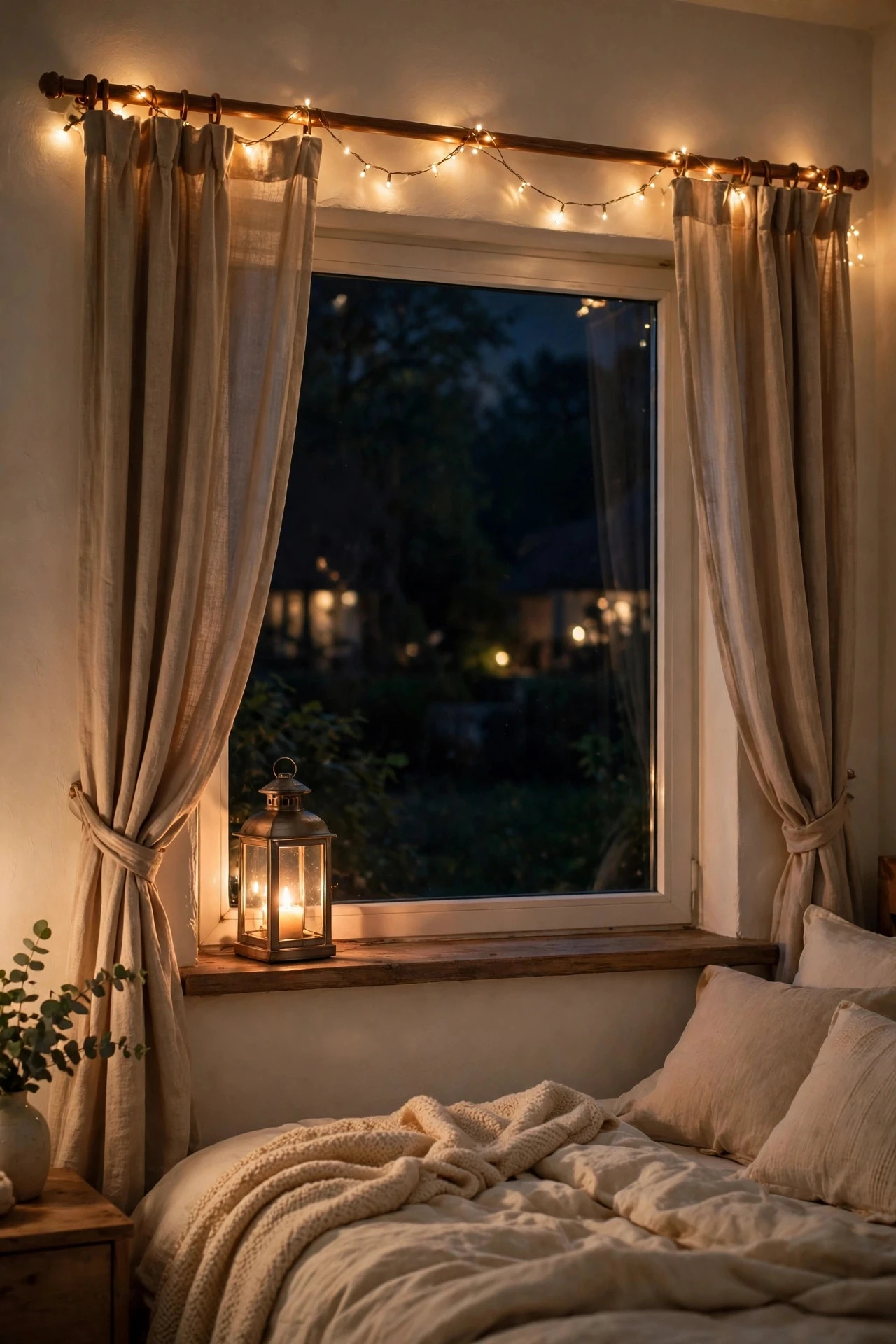
Hang one short string of warm fairy lights along the curtain rod or the window frame, and let the curtains themselves do the rest: heavy velvet or lined cotton in your palette colour blocks the cold draught. From outside, the lights glow softly through the glass; from inside, they frame the dark window like a picture.
A paper star or a single lit lantern on the windowsill adds a focal point without competing with the lights. If your bedroom faces the street, remember neighbours see the display too — warm white reads as elegant, while flashing multicolour reads as a shop sign. Close the curtains at dusk to trap the warmth and the glow together, and open them wide in the morning for daylight.
15. How Do I Style the Dresser and Mirror for Christmas?

Treat the dresser top like a small stage: a garland along the back edge, a lantern or flameless candle cluster at one end, and a small vase of greenery at the other. The mirror doubles whatever you place in front of it, so two objects in front of a mirror read as four.
Clear the everyday clutter first: perfume bottles, charging cables and loose change all go into a drawer for December. Group the seasonal pieces in odd numbers — three is ideal — and vary their heights so the eye moves across the surface. A stack of two books with a mini tree on top adds height without buying anything new. If the dresser is small, one lantern and one sprig of greenery is a complete look; restraint is the style.
16. What Floor and Rug Changes Complete a Christmas Bedroom Makeover?

A thick rug beside the bed is the makeover's secret weapon: it warms cold feet on winter mornings and anchors the whole colour scheme. Choose a plush wool or high-pile rug in cream, deep red or a muted plaid, large enough to extend eighteen inches beyond each side of the bed.
Keep the rug low-pile near the door so it does not catch, and vacuum it weekly because pine needles and glitter travel. A rug also softens sound, which matters for sleep, and it hides the everyday wear on the floorboards that December light exposes. If your room is carpeted already, a folded knit blanket draped over the bed's foot and a pair of warm slippers by the bed deliver the same cozy signal for less.
17. How Do I Use Plaid, Velvet and Faux Fur Without Overdoing It?

Pick one statement texture per zone: plaid on the throw, velvet on the cushions, faux fur on the bedside bench or the reading chair. Each texture gets its own place, so the eye enjoys the variety without feeling overwhelmed. The rule is three textures maximum in the room, repeated in small doses.
Velvet absorbs light and looks richer after dark, which makes it ideal for cushions and a bed runner. Faux fur belongs where you touch it: a throw, a cushion, or a stool cover, never on the wall. If you already own a plaid throw and a velvet cushion, you do not need to buy anything else in those textures; add a plain knit instead. Step back to the doorway and check: if one texture shouts over the others, remove it or move it to a smaller role.
18. Can I Mix Christmas Decor With My Existing Bedroom Style?

Yes, if you let your existing style lead and Christmas follow it. A minimalist bedroom takes a single green wreath and white lights; a boho bedroom takes macramé, dried oranges and warm wood ornaments; a glam bedroom takes gold, velvet and mercury glass. The Christmas layer should look like your room dressed up.
A Scandinavian room wants pale wood, white and one green sprig; a traditional room wants plaid, brass and deep red. Remove one everyday object for every Christmas object you add, so the room's balance stays the same. If a decoration clashes with your style, it will look wrong all month — trust that instinct and leave it in the shop. Our whimsical bedroom styling guide shows how playful pieces can sit comfortably in a grown-up room, which is exactly the balance a Christmas bedroom needs.
19. How Do I Plan the Makeover Sequence for the Biggest Effect First?

Work in this order: declutter, bed, light, greenery, tree, finishing touches. Decluttering costs nothing and makes every later step look twice as good. The bed is the biggest visual surface, light is the biggest mood change, greenery adds the scent and the season, and the tree is the cherry on top.
Give each step a time box: thirty minutes to declutter, twenty to make the bed, fifteen to hang lights, fifteen for greenery, and ten for the tree. The whole makeover fits in under two hours, and doing it in one session keeps the vision coherent. If you run out of energy halfway, stop after the light step — a decluttered room with a made bed and warm light already looks like a makeover. The tree can wait until tomorrow.
20. What Storage Plan Keeps Christmas Bedroom Decor Easy Next Year?

Store each zone's decor together in one labelled box: bedding and throws in one bag, ornaments and ribbons in another, lights coiled around a piece of card so they never tangle. Label the box with the room name and the year, and keep it where you can reach it without moving five other boxes.
Wrap ornaments in tissue, not newspaper, because newsprint stains pale baubles. Keep fairy lights in their original box or wound around a cardboard tube, and test them before you pack them away so you are not surprised next year. A tidy pack-down is part of the makeover: it protects your investment and it means next year's version starts from a good place, not from a tangled mess.
21. How Do I Keep the Room Restful When Christmas Decor Gets Busy?

Set a limit before you start: one focal point, three decorated surfaces, and nothing on the floor except the rug and the tree. When you reach the limit, stop. A bedroom needs empty space to rest in; every surface you fill is a surface your eyes have to process when you are trying to fall asleep.
Remove one thing every evening for the first week and notice whether the room feels better without it — the things you never miss were clutter, not decor. Keep the bedside tables clear, the floor clear, and the ceiling light off after dark. Sleep is the room's job, and Christmas is the guest: the guest should never take over the house. A restful room is the real luxury, and it costs nothing.
22. What Splurge Is Actually Worth It in a Christmas Bedroom Makeover?

If you splurge on one thing, make it quality bedding or a real wool throw: you touch them every night, they last for years, and they carry the whole look. A beautiful duvet cover in a deep seasonal colour, or a thick wool throw that survives washing, will still be earning its keep in February.
The second-best splurge is a dimmable warm bedside lamp with a beautiful shade, because it sets the room's light every evening for the whole year. Avoid trendy ornaments that date within a season, and avoid anything that needs batteries you will forget to buy. Spend where your body meets the room: the bed, the light and the rug. Those three decide whether the room feels luxurious, and they are the only splurges you will still be glad about in January.
Practical Tips for a Cozy Christmas Bedroom Makeover
Budget in three tiers and buy in order: under $25 covers a throw, a string of lights and garden greenery; $25–75 adds cushions, a small tree and a wreath; splurge covers quality bedding, a wool throw or a good lamp. Never buy the splurge first, because a beautiful duvet in a cluttered room still looks cluttered. Shop your home first, borrow what you can, and keep receipts for anything you are unsure about.
Safety is non-negotiable in a bedroom: use flameless candles only, put all lights on timers, keep every light and decoration clear of bedding and curtains, and never leave plug-in lights on overnight or while the room is empty. Battery lights are safer than mains lights near the bed. Check cords for damage before you hang them, and keep a clear path from the bed to the door at all times.
Timing matters: start the weekend after Thanksgiving, when the light is low and the evenings are long, and finish in one session so the look stays coherent. Take the decor down in the first week of January, while you still like it, and pack it using the storage plan above. If you want a fuller seasonal bedroom look to compare against, our bedroom Christmas decor ideas cover the classic list this makeover builds on.
Final Thoughts
A cozy Christmas bedroom makeover is not a shopping project; it is a sequence. Make the bed, warm the light, add one green focal point, and stop while the room still feels like a place to sleep. The before-and-after that matters is not the photograph — it is the first evening you climb into a warm, softly lit bed in December and think, this feels right. Start with the bed, spend where you sleep, and let the rest of the room stay quiet.
Frequently Asked Questions
How much should a Christmas bedroom makeover cost?
A convincing makeover can cost under $25 if you restyle what you own and add one throw. A comfortable mid-range version runs $25–75 with cushions, a small tree and a wreath. Splurge only on bedding, a wool throw or a good lamp, because those are the pieces you touch every night and keep using after December.
Is a real Christmas tree safe in a bedroom?
A small real tree can work if it is watered daily, kept away from radiators and bedding, and lit only with low-heat LED lights on a timer. Most bedrooms are better with a faux tree or a tabletop tree, because they drop no needles into bedding and need no watering. Never leave any tree lights on overnight.
How do I keep fairy lights safe while I sleep?
Put fairy lights on a timer so they switch off well before deep sleep, keep them clear of bedding, curtains and pillows, and use battery lights where possible. Check cords for damage before hanging, never drape lights across the bed, and never leave plug-in lights running overnight or while the room is empty.
What colours make a Christmas bedroom feel cozy rather than cluttered?
One deep colour, one warm neutral and one metallic accent is the formula: deep green with cream and brass, or burgundy with blush and gold. Repeat that palette in the bedding, the tree and the throw, and let plain fabrics do most of the work. Mixing every Christmas colour at once is what makes a room look cluttered.
Can I decorate a rented bedroom for Christmas?
Yes, and nothing needs a nail. Use command hooks for garlands and wreaths, tension rods for window swags, and freestanding pieces like small trees, lanterns and trays for the rest. Seasonal bedding, throws and cushions change the room completely with zero wall contact, and everything comes down in January without a trace.
When should I start and take down a Christmas bedroom makeover?
Start the weekend after Thanksgiving, when evenings are long and the makeover can be finished in one session. Take the decor down in the first week of January while you still like it, and pack each zone's pieces together in labelled boxes with a photo of the styled room tucked in the lid for next year.