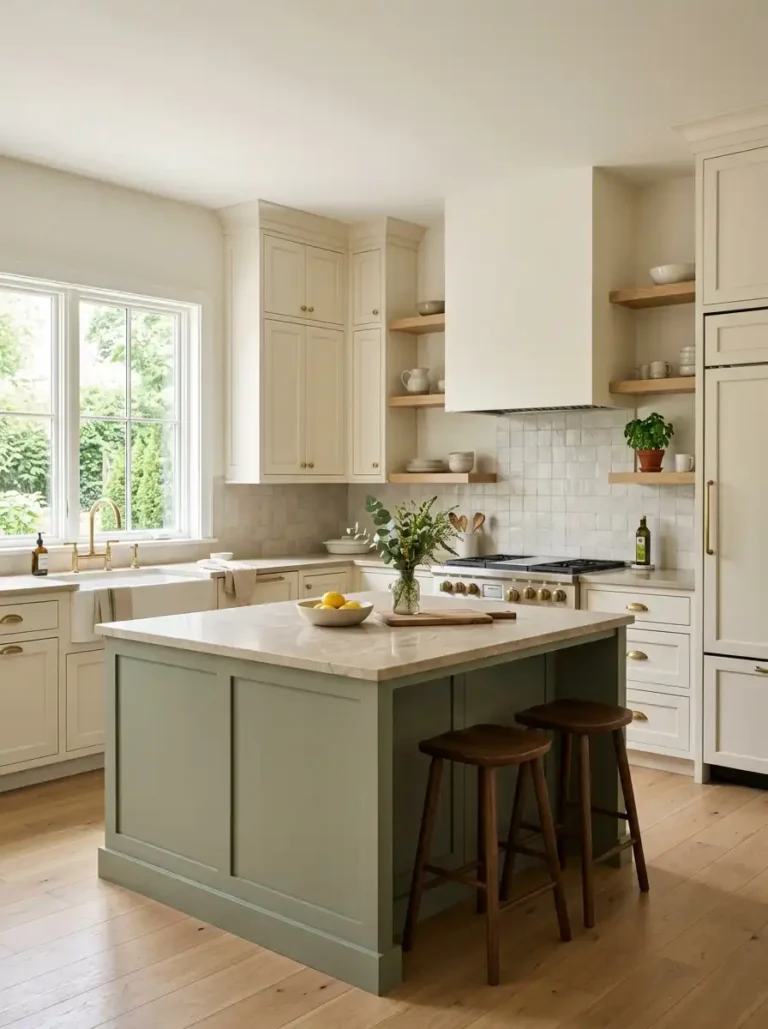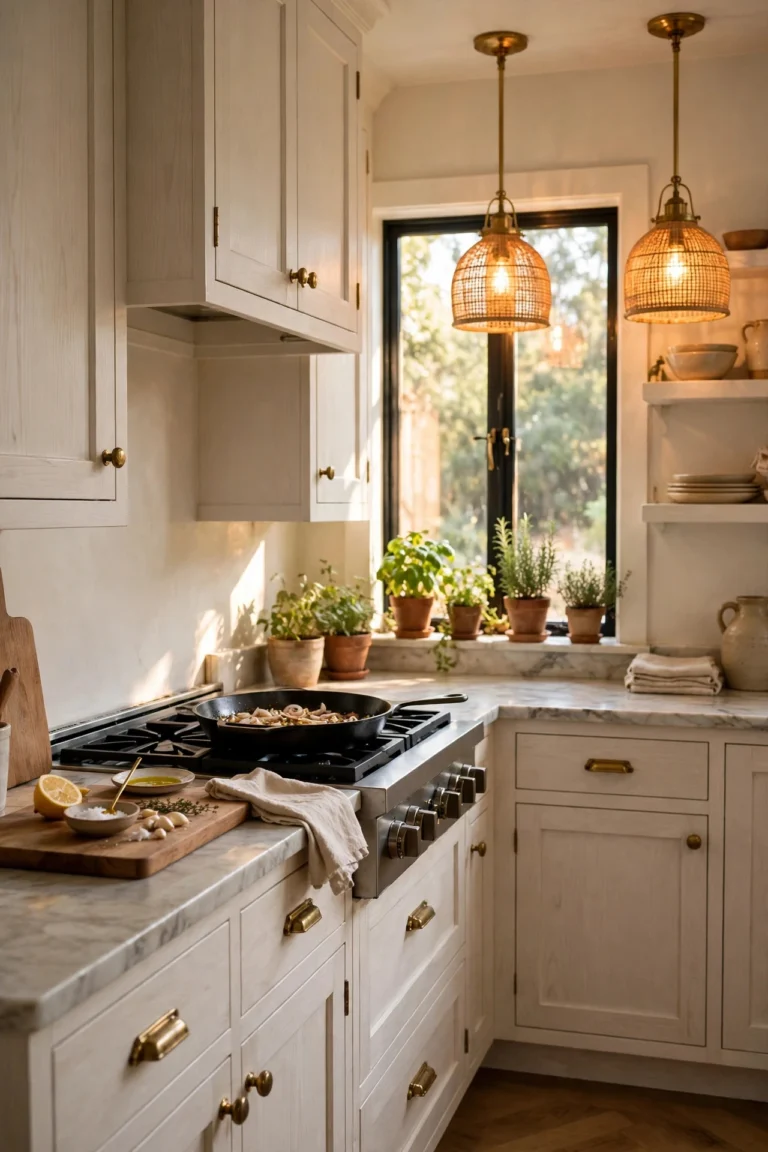
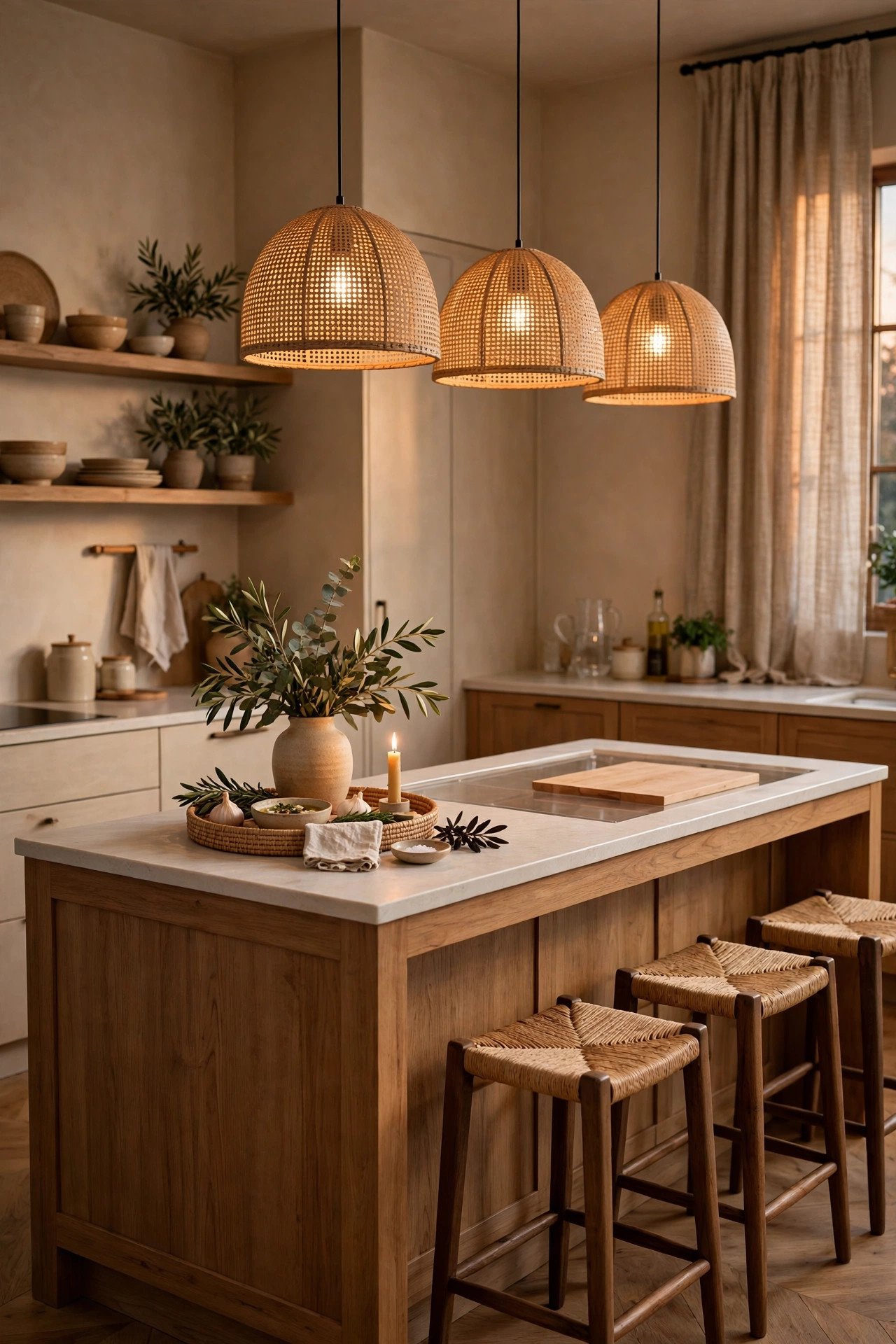
22 Kitchen Island Decor Ideas for a Stylish, Functional Kitchen
A kitchen island has to do two jobs at once: it is the hardest-working surface in the home, where meals are prepped, homework is spread out and bags are dropped, and it is also the room's stage, the first thing guests see when they walk in. Too little decor and the island looks bare and unfinished, while too much turns valuable counter space into an obstacle course. The ideas below solve that tension with scale rules you can measure, clear-workspace limits you can keep, and materials that survive real cooking, so your island looks styled every day.
Looking for more inspiration? Our Nest Decorz homepage gathers the latest home decor ideas, seasonal decorating guides and room-by-room styling tips in one place — start there and explore.
Every idea that follows uses the same practical framework: match decor to island length, keep at least 24 inches of clear prep space, and choose one focal point rather than five competing ones. An island under 5 feet needs a single compact vignette, a 5 to 7 foot island suits a tray with three objects, a 7 to 9 foot island can carry two groupings with open counter between them, and an island over 9 feet needs repetition or a long low arrangement so it does not look empty at the ends. Use those bands as you read, check the costs and materials for each idea, and avoid the named mistake, and you will have an island that cooks as well as it photographs.
1. A Tray Vignette That Anchors the Centre
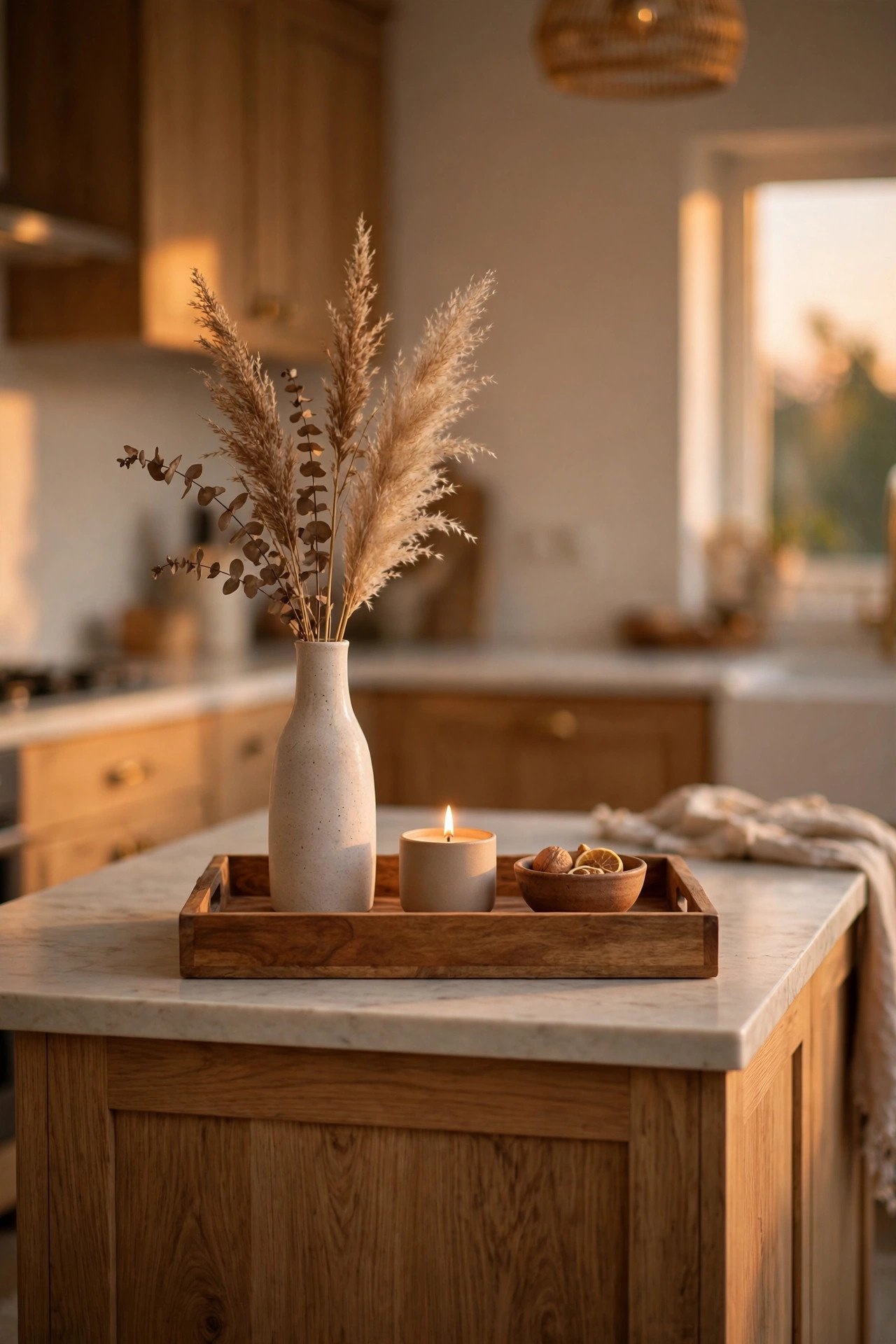
A tray vignette makes an island look intentional by corralling small objects into one clear grouping. Choose a tray about one-third of the island length: 16 to 18 inches under 5 feet, 20 to 24 inches at 5 to 7 feet, 28 to 32 inches at 7 to 9 feet, and 36 inches or two trays over 9 feet. Follow the rule of three with tall, medium and low objects, and keep 24 inches of clear counter on the working side. Wood trays cost $25 to $60, marble trays $40 to $90, and rattan trays $20 to $45. Explore these white kitchen ideas for a bright backdrop that lets a wood tray stand out. The mistake to avoid is a tray so large it becomes a landing pad for mail, keys and chargers.
2. A Statement Vase With Tall Branches
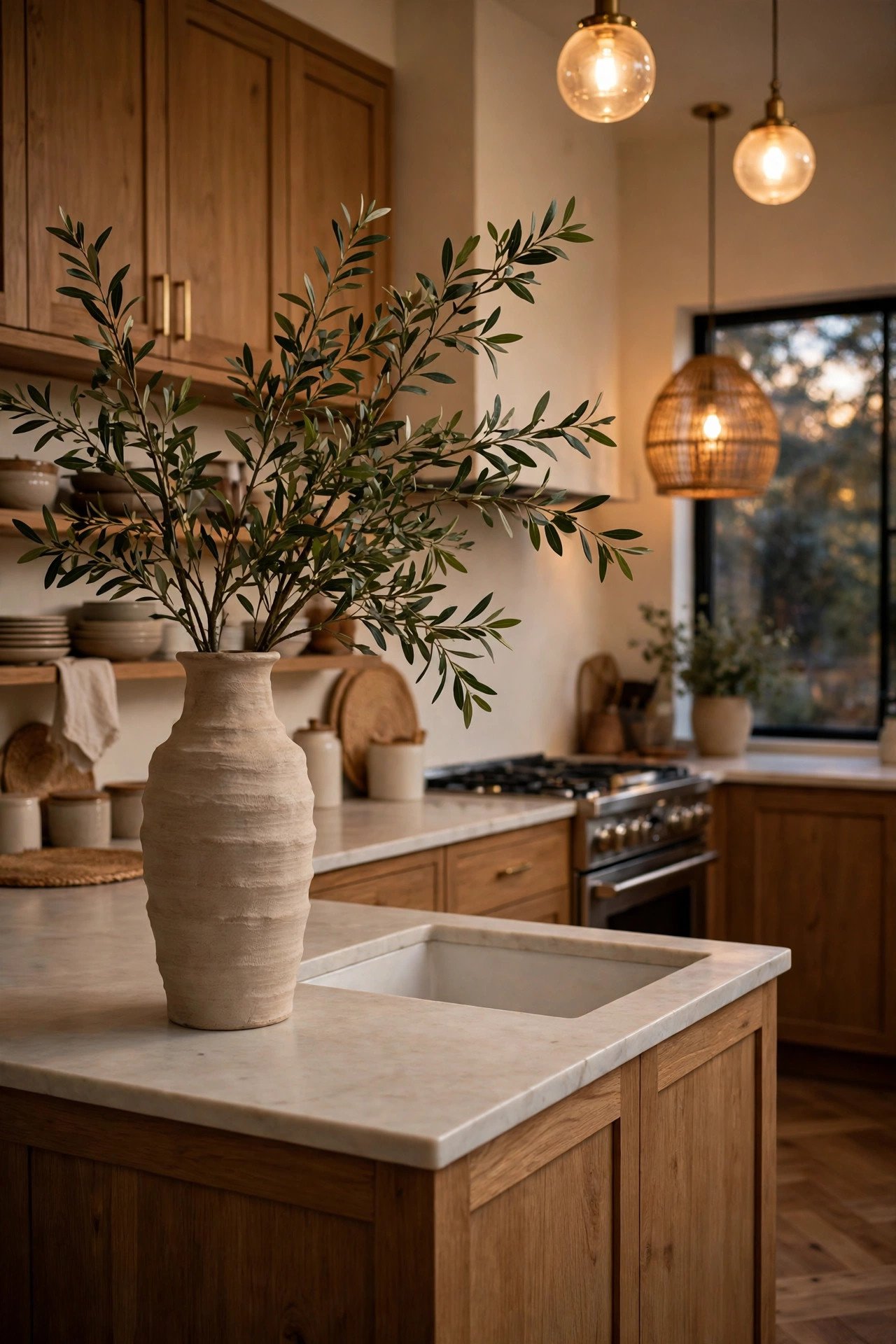
A tall vase with branches gives an island height and movement without taking much counter space. Pick a vase 12 to 18 inches tall under 7 feet and 18 to 24 inches tall for longer islands, with branches 12 to 18 inches above the rim, below pendant lights. On a 7 to 9 foot island, place the vase one-third along from one end rather than dead centre, leaving 24 inches or more of clear workspace beside it, and on an island over 9 feet use one tall vase plus a low bowl at the far end. Ceramic vases cost $30 to $80, faux branches $15 to $40, and fresh eucalyptus $8 to $15. The mistake to avoid is a top-heavy arrangement in a narrow vase, which tips easily when someone brushes past.
3. A Small Herb Garden in Matching Pots
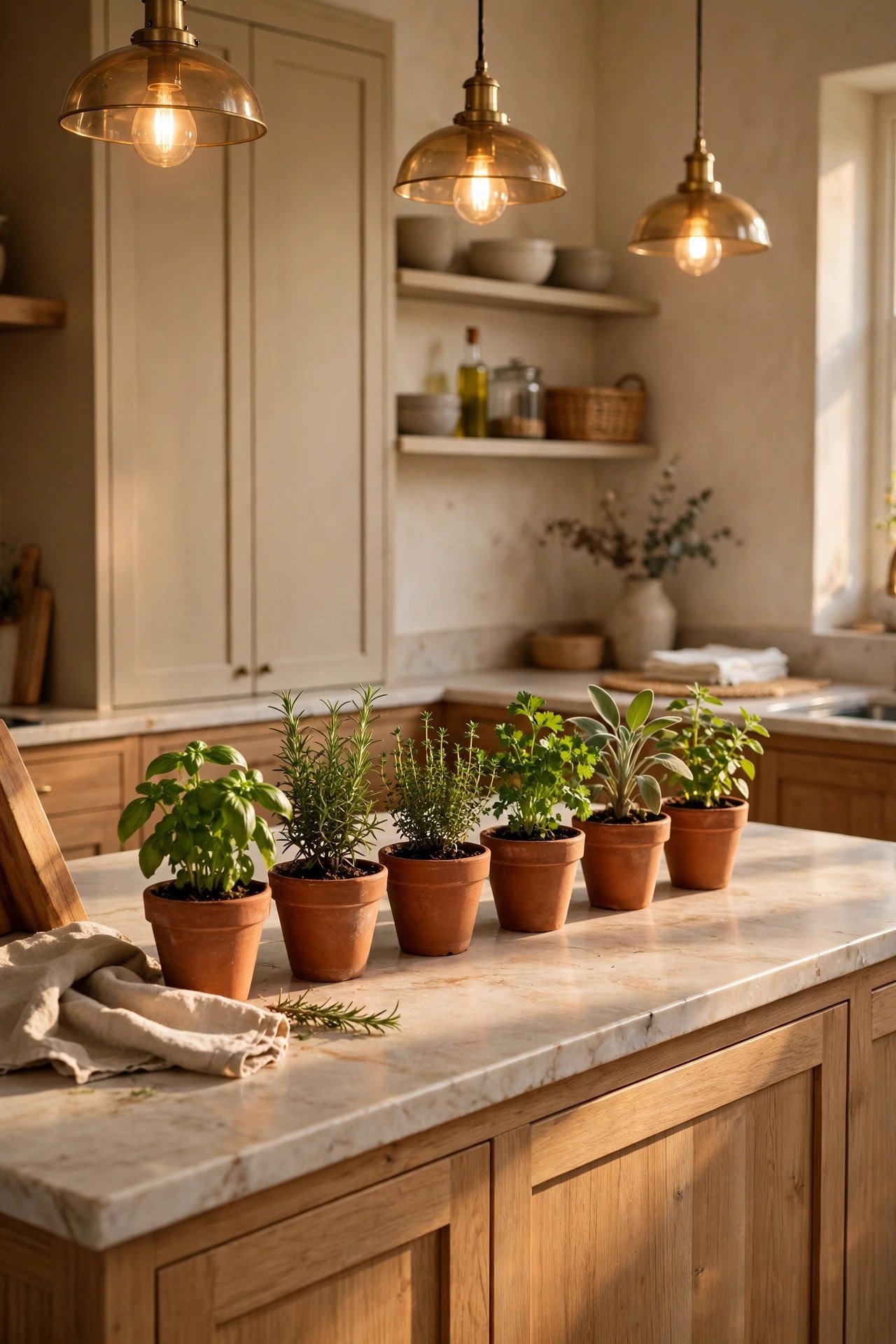
A herb garden is useful decor: basil, mint and parsley stay within reach while you cook, and green softens stone and cabinetry. Use three small pots in a row for a 5 to 7 foot island, a single trough planter 18 to 24 inches long for an island under 5 feet, and two clusters of three pots for 7 to 9 feet or longer, always keeping the pots away from the main prep zone with 24 inches clear beside them. Choose terracotta or ceramic pots 4 to 6 inches wide on saucers, and rotate them weekly for even growth. Pots cost $8 to $25 each, herbs $3 to $6 per plant, and a lined wooden trough $30 to $65, so a full garden usually totals $45 to $110. The mistake to avoid is overwatering on stone, because saucers overflow and water leaves rings that are hard to remove from marble.
4. A Fruit Bowl That Doubles as Colour

A fruit bowl is the lowest-effort centrepiece: it adds colour and height in seconds and actually gets used. Choose a low, wide bowl 12 to 14 inches across for islands under 5 feet, 14 to 16 inches for 5 to 7 feet, and 16 to 18 inches, or a footed bowl, for 7 feet and longer, filling it with one or two kinds of fruit so the colour reads clearly from across the room. Keep the bowl at one end with at least 24 inches of clear prep space beside it, and refill with lemons, limes, apples or oranges for a deliberate colour story. Wood bowls cost $25 to $60, ceramic $30 to $70, and a pedestal base lifts fruit clear of crumbs. The mistake to avoid is a deep bowl piled high, because the bottom layer bruises unseen and the display looks messy within days.
5. A Stack of Cutting Boards Leaning by the Wall

A stack of cutting boards turns storage into decor, adding warm wood tones without consuming the work surface. Lean two or three boards against a raised panel, or lay them flat at one end of a flat island, within a 12 to 14 inch footprint and 24 inches of clear counter beside it. For a 5 to 7 foot island one stack is enough, while a 7 to 9 foot island can carry a leaning stack at one end and a small bowl at the other, and islands over 9 feet suit two stacks in matching wood tones. Acacia boards cost $20 to $55 each, so three usually total $60 to $140. The mistake to avoid is leaning heavy boards where they can slide onto a hob or sink, or stacking boards while damp, which warps wood.
6. A Cookbook Stand With an Open Book

A cookbook stand makes an island feel lived in, because an open book suggests cooking is about to happen. Choose a stand 10 to 12 inches wide under 7 feet and up to 14 inches for longer islands, angled toward seating and at least 24 inches from prep, clear of splashes and hot pans. Wood stands cost $20 to $45, metal stands $25 to $55, and acrylic stands $15 to $30, and a weighted or lip-front design stops pages flipping when the extractor fan runs. Rotate the book with the dishes you cook most, and keep a second closed book underneath for height. This everyday, working display sits at the heart of good kitchen design, where tools and beauty share one surface. The mistake to avoid is placing the stand beside the hob, where steam and grease coat the pages.
7. A Trio of Pendant Lights Overhead

Pendants define the island's length from above, add glow after dark, and draw the eye to the surface below. Hang pendants 30 to 36 inches above the countertop, measured from counter to the bottom of the shade, spacing them 24 to 30 inches apart centre to centre, with two pendants for a 5 to 7 foot island, three for 7 to 9 feet, and three or four, or one long linear fixture, for over 9 feet. Under 5 feet, one pendant or a small pair avoids crowding, set at least 6 inches in from the ends. Shades cost $40 to $150 each, installation $100 to $250 per fixture when an electrician is needed, and dimmable warm bulbs at 2700K keep the glow flattering. The mistake to avoid is hanging pendants too high, where they light the ceiling, or too low, where guests bump their heads.
8. Bar Stools That Style the Seating Side
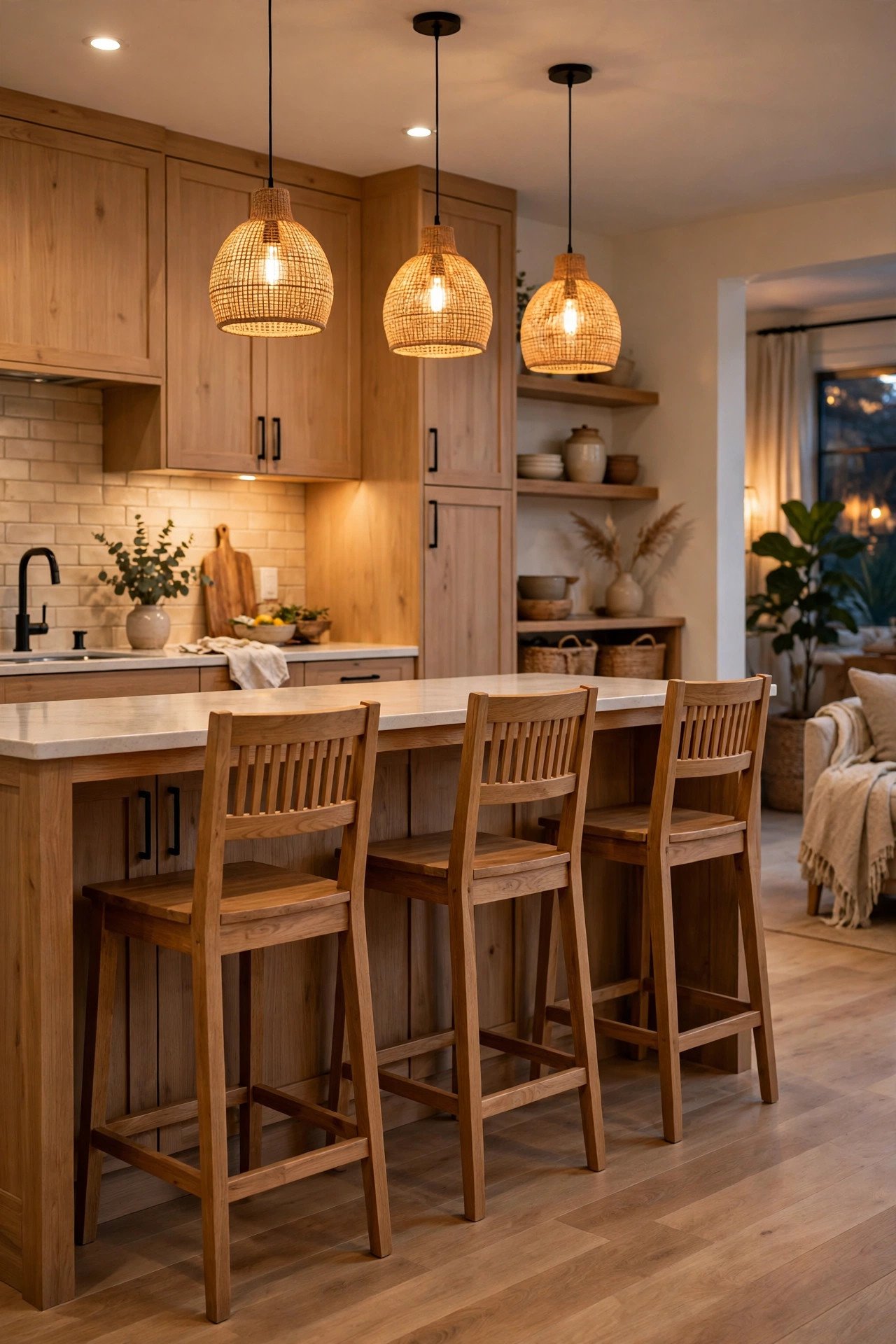
Bar stools are the largest visual element on the seating side, so choosing them well matters most. Allow 15 inches of knee overhang per seat, meaning a 12 inch deep overhang is too shallow for comfort, and plan 24 inches of width per stool: two stools for a 5 to 7 foot island, three for 7 to 9 feet, and four for over 9 feet, with 6 inches of breathing room between stools. Counter stools need a 24 to 26 inch seat for a 36 inch island; bar stools need 30 to 32 inches for a 42 inch island. Wood stools cost $80 to $250 each, upholstered stools $120 to $350 each, and metal stools $60 to $180 each. The mistake to avoid is backless stools pushed fully under the island with no overhang, which forces sitters to perch sideways with knees pressed against the panels.
9. A Candle Cluster in Mixed Heights
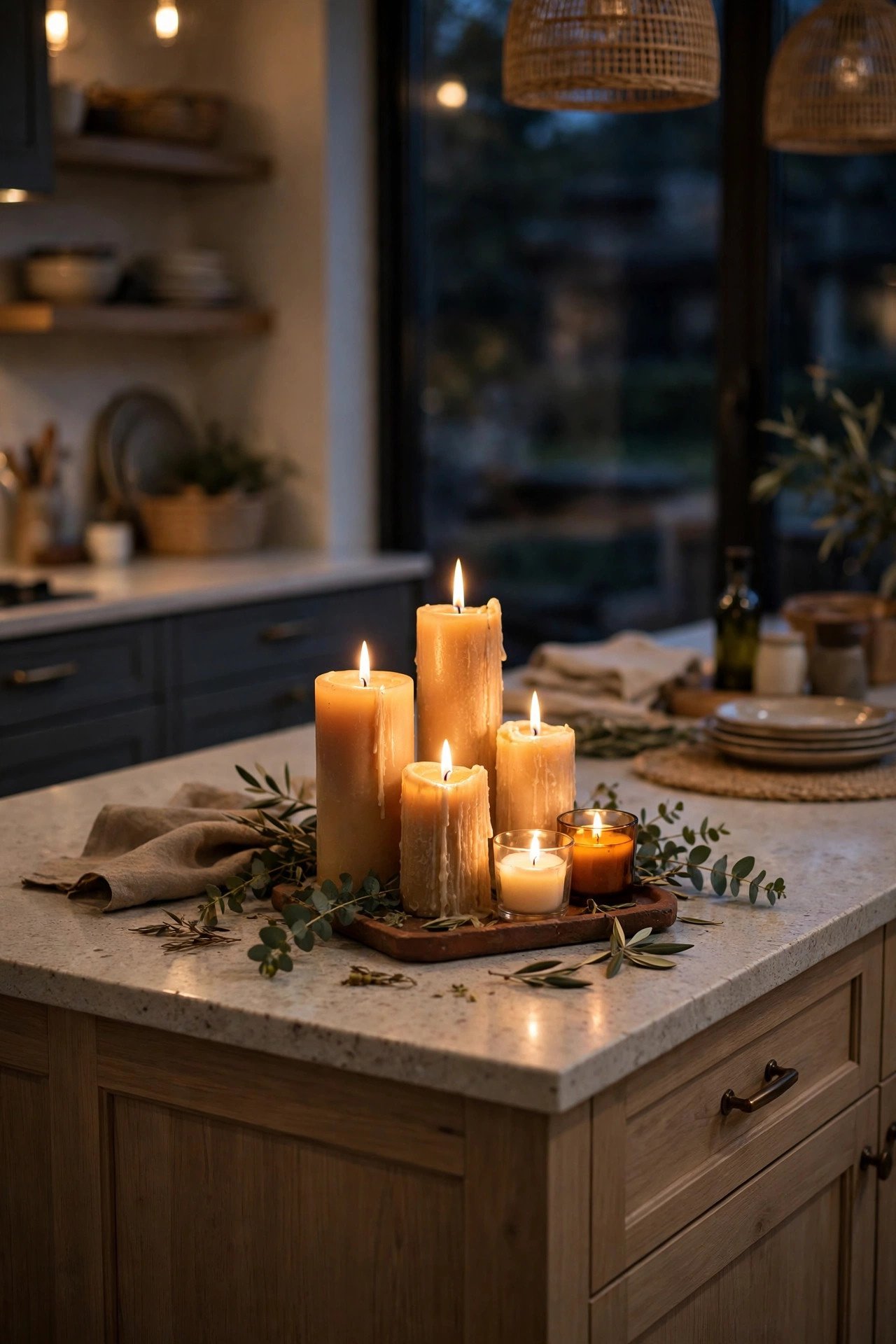
A candle cluster adds warm, low evening light without the height of a tall vase. Group three candles in graduated heights, such as 4, 6 and 8 inches, on a small tray or heatproof coaster for islands under 5 feet, use two clusters at opposite ends for 7 to 9 feet, and repeat the cluster in matching holders for islands over 9 feet, always keeping flames at least 24 inches from the prep zone and away from branches and paper. Choose pillar candles or lanterns in glass, stone or metal, within a 12 inch footprint, so the cluster lifts away in one move. Candles cost $8 to $25 each, holders $12 to $35 each, and a full cluster usually totals $40 to $110. The mistake to avoid is leaving lit candles unattended beside a hob or under low pendants, where heat and splashes turn a calm centrepiece into a hazard.
10. A Tiered Tray for Small, Changeable Objects

A tiered tray stacks decor vertically, adding display space without claiming much counter. Choose a two-tier tray 12 to 14 inches wide under 5 feet, three tiers 14 to 18 inches at 5 to 7 feet, and a tiered tray plus low bowl at 7 to 9 feet or longer, with 24 inches clear beside it. Follow the rule of three on each tier, with tall, medium and low pieces, repeating one material across tiers so it reads as one object. Metal tiered trays cost $25 to $55, wood trays $30 to $65, and the small objects to fill them $20 to $60 in total. Guidance from Better Homes & Gardens on grouping small objects by height and material is a useful check before you buy. The mistake to avoid is overfilling every tier, which makes the tray look like storage rather than styling.
11. Marble and Wood Boards as a Layered Base
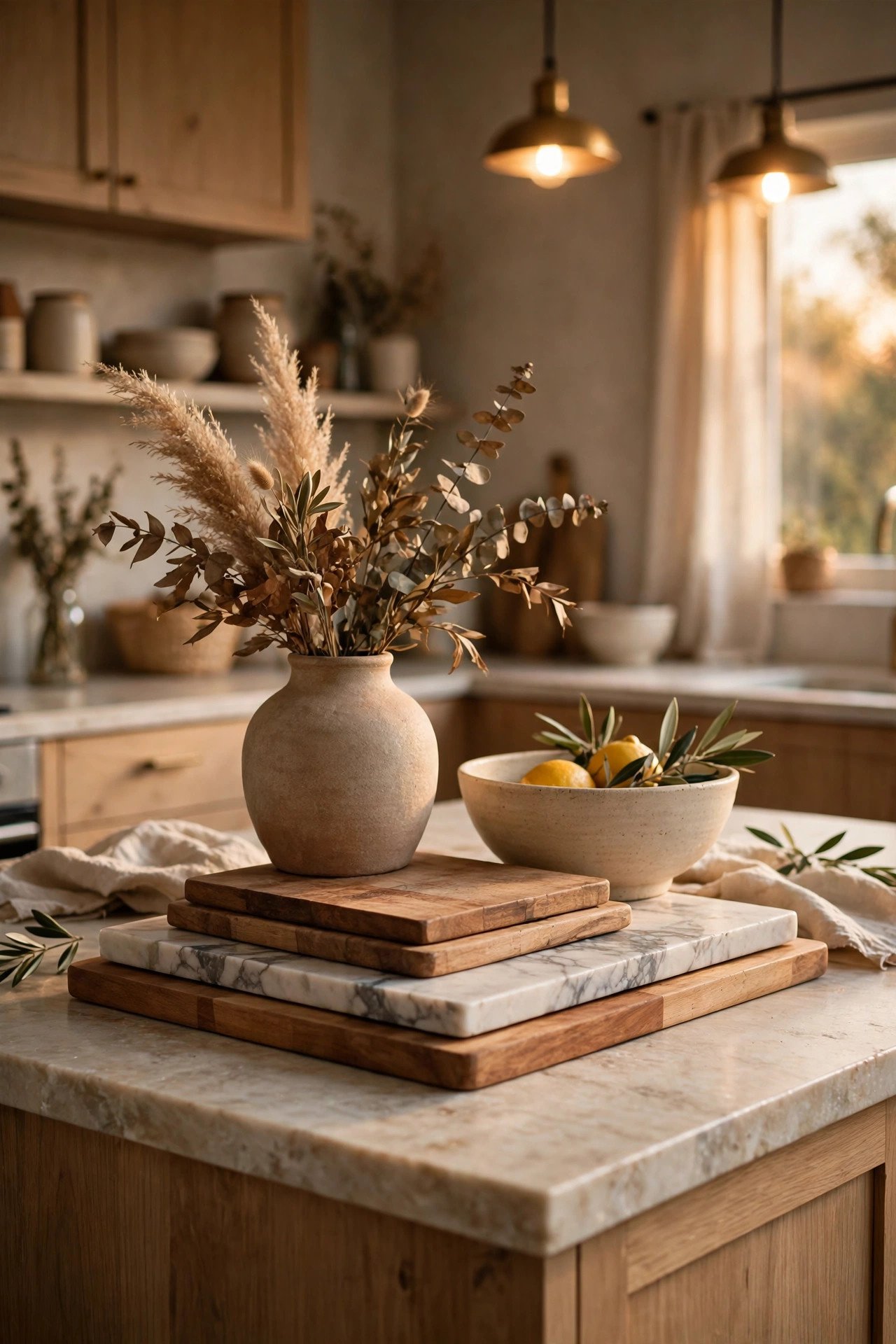
Boards layered under a vase or bowl create a finished base that protects the countertop and ties objects together. Use an 18 to 24 inch board under the vignette at 5 to 7 feet, two boards with open counter between them at 7 to 9 feet, two groupings over 9 feet, and one 14 inch board under 5 feet. Keep at least 24 inches of clear prep space beyond the boards, choose honed marble, butcher block or acacia for durability, and seal wood boards regularly so water and oil do not stain them. Marble boards cost $35 to $80, wood boards $25 to $60, and a layered pair usually totals $60 to $130. The mistake to avoid is placing an unsealed marble board under citrus, wine or vinegar, because acidic spills etch marble quickly and leave dull marks that polishing rarely removes fully.
12. A Sculptural Bowl as a Single Statement
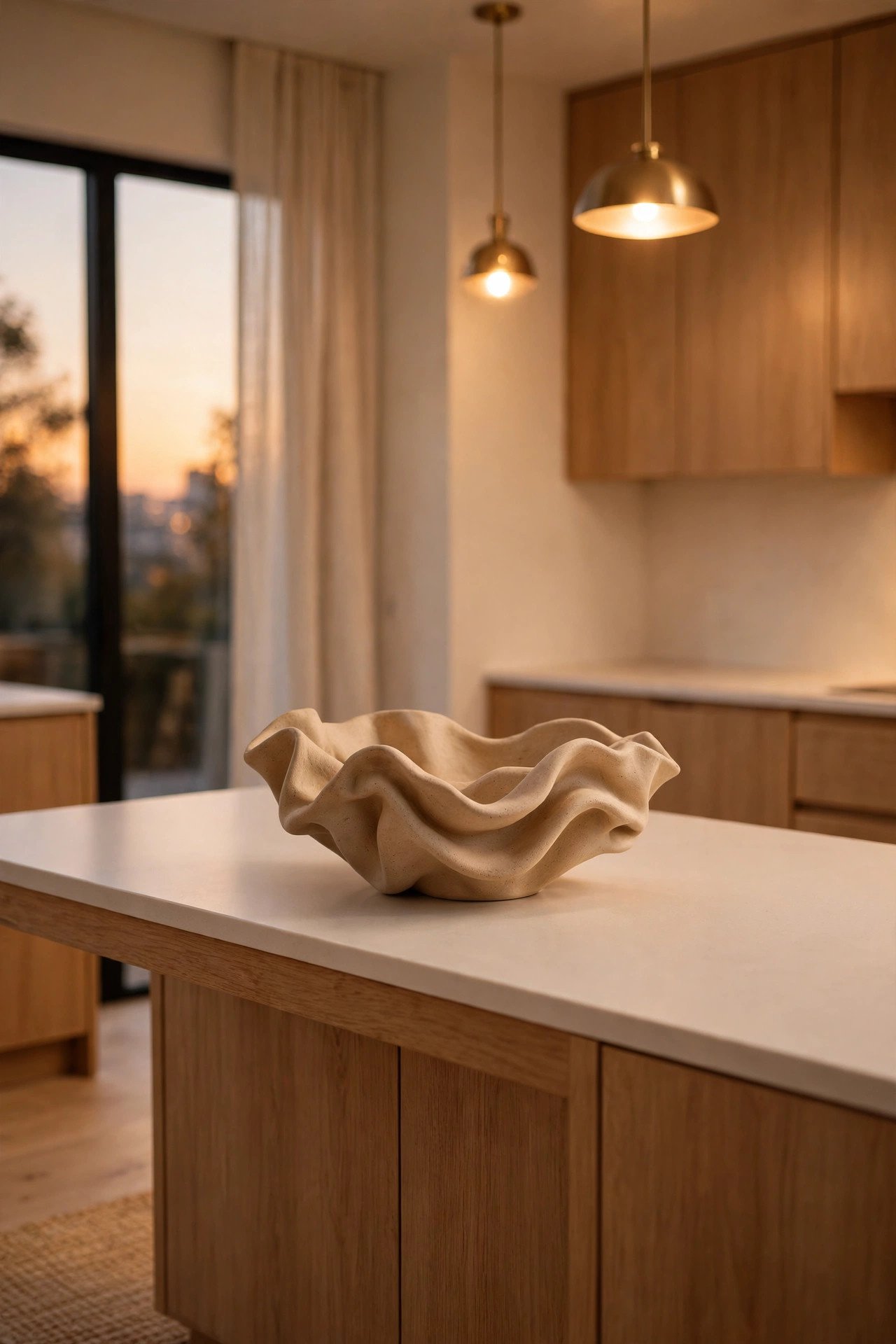
A sculptural bowl works when you want one bold object, because its shape alone carries the island. Choose a bowl 14 to 16 inches wide for a 5 to 7 foot island, 16 to 20 inches for 7 to 9 feet, and a long, low sculptural piece up to 30 inches for an island over 9 feet, placing it off-centre with 24 inches or more of clear counter on the working side. Hand-thrown ceramic adds texture, hammered metal adds shine, carved stone adds weight, and matte finishes let form stand out. Ceramic bowls cost $45 to $120, metal $60 to $150, and stone $80 to $200, and an empty bowl works only when its shape holds attention alone. The mistake to avoid is filling a sculptural bowl with potpourri, shells or mixed trinkets, which hides the shape you paid for and turns a statement into clutter.
13. A Coffee Station Corner at One End
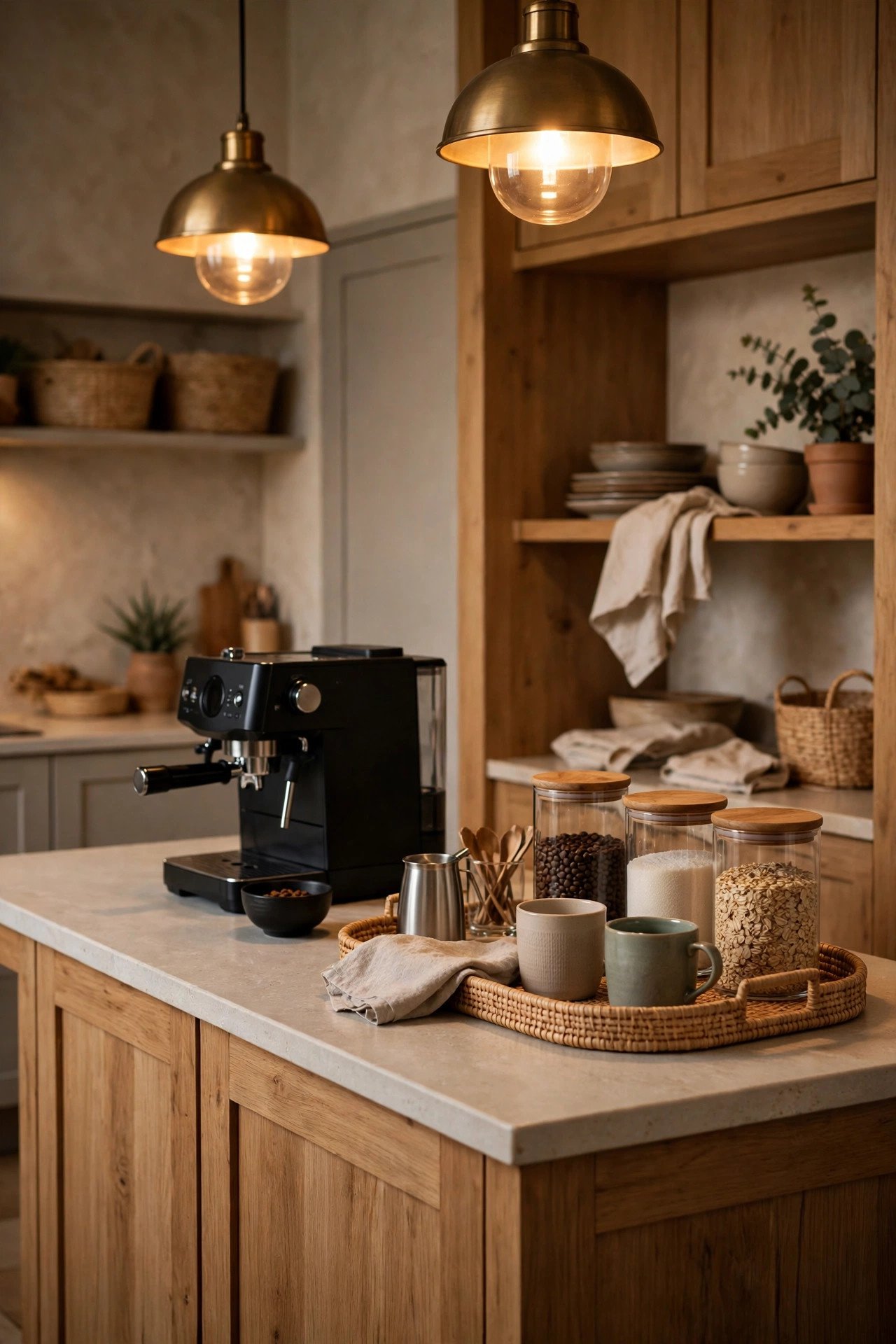
A coffee station gives the island a daily ritual while keeping coffee gear in one defined zone. Dedicate 18 to 24 inches at one end at 5 to 7 feet, 24 to 30 inches at 7 to 9 feet, and a full end zone over 9 feet, keeping 24 inches clear beyond it and the machine near an outlet. Use a tray or board as the base, add two or three mugs, a small jar for beans or pods, and a tiny vase or candle for softness, choosing heatproof materials like stone, ceramic and wood. A tray costs $25 to $60, mugs $10 to $25 each, and jars $12 to $30, while the machine itself is usually already owned. The mistake to avoid is trailing cords across the walkway side or placing the machine where steam rises into pendant lights, which fogs shades and leaves water marks.
14. A Wine Rack Display With Glasses Nearby
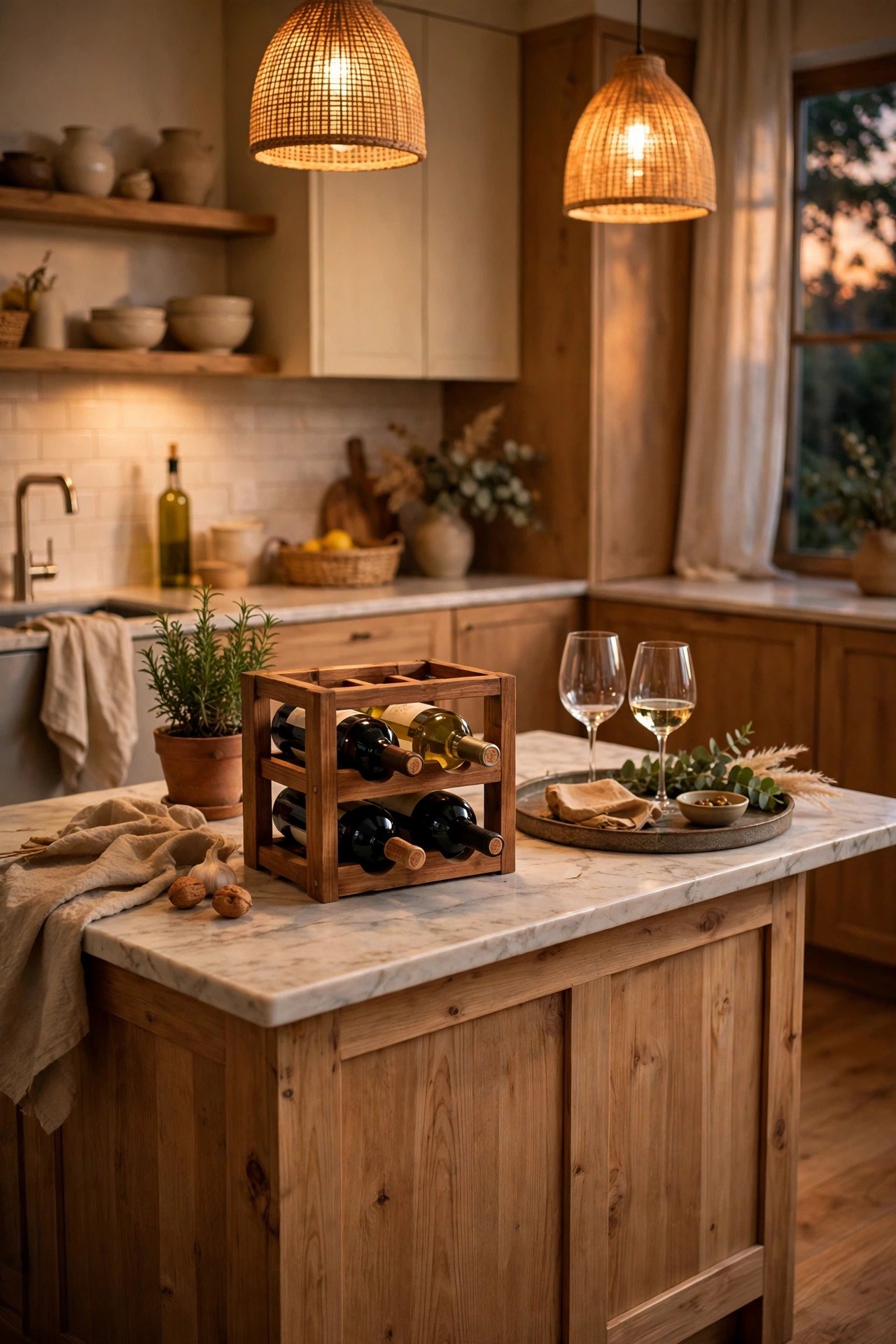
A wine rack adds an entertaining feel, provided bottles are decor with a purpose rather than a bar taking over the counter. Use a rack for three to six bottles at 5 to 7 feet, a rack plus two glasses at 7 to 9 feet, and a rack and decanter at opposite ends over 9 feet, keeping bottles flat, out of sunlight and 24 inches from prep. Wood racks cost $30 to $70, metal $25 to $60, and a tray keeps glasses and opener together. On an island under 5 feet, skip the rack and use one bottle plus two glasses on a small tray, so the display never crowds the work surface. The mistake to avoid is storing wine on the island long term in a warm, sunny kitchen, because heat and light spoil wine faster than almost any other storage mistake.
15. Woven Baskets Underneath for Hidden Storage
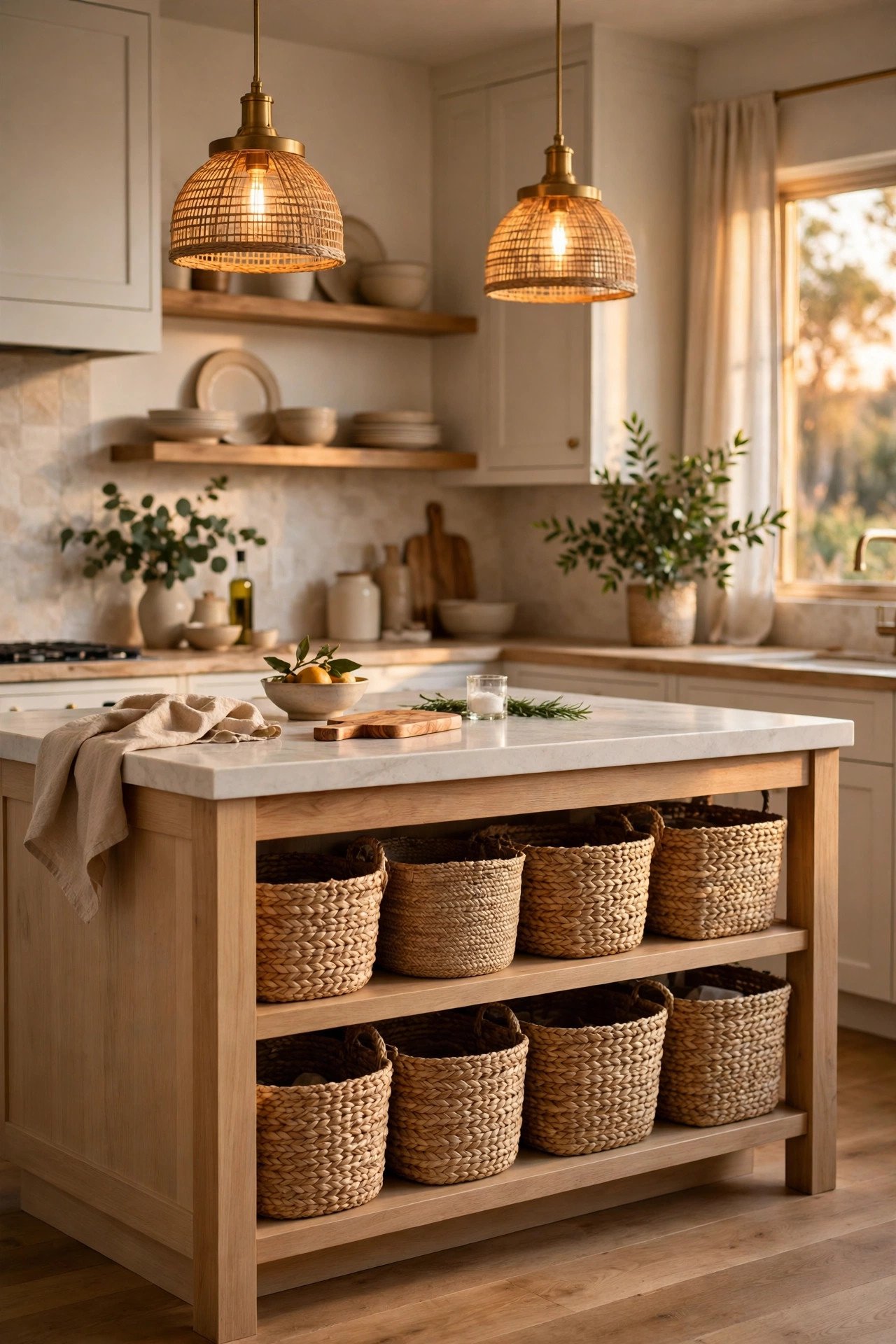
Woven baskets underneath keep the countertop clear by moving clutter below, often more effective than any object on top. Measure knee space first, then choose baskets 12 to 16 inches wide and 10 to 14 inches tall: two under 5 to 7 feet, three under 7 to 9 feet, four over 9 feet. Seagrass, rattan and water hyacinth baskets cost $20 to $50 each, lined baskets suit linens and placemats, and lidded baskets hide chargers, cloths and pet supplies neatly. Keep heavy items low so baskets slide out without tipping, and label baskets discreetly on the inside rim if several people use the kitchen. The mistake to avoid is baskets so deep they block stool knees, because the 15 inch overhang rule only works when nothing intrudes into the space where legs need to go.
16. A Swap Base Layer You Refresh Often
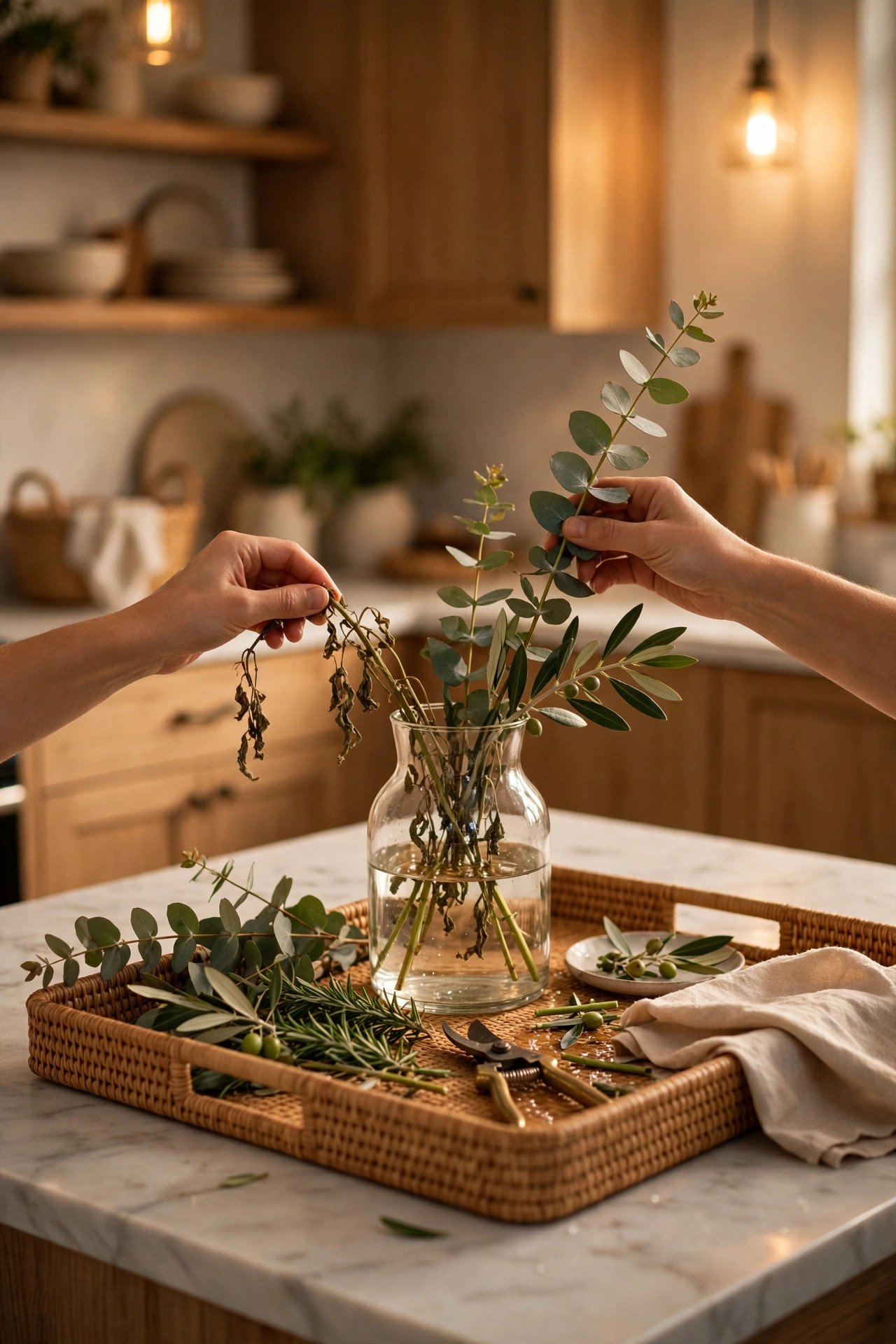
A swap base layer is a permanent foundation refreshed with small changes, so the island always looks styled. Build the base from a tray, vase or bowl plus one low object, about one-third of the island: 16 to 18 inches under 5 feet, 20 to 24 inches at 5 to 7 feet, 28 to 32 inches at 7 to 9 feet, two bases over 9 feet, with 24 inches clear beside it. Swap only the small layer, such as stems, fruit or candle colour, keeping the tray and tall-medium-low formula unchanged, so each refresh takes five minutes. The base costs $50 to $120 once, each refresh costs $5 to $25 for stems, fruit or candles, and a small box of spare objects in a cupboard makes swaps quick. The mistake to avoid is changing everything at once, including the tray and tall object, which costs more and usually ends with an island that looks newly bought rather than calmly lived in.
17. A Minimalist Single Object With Breathing Room
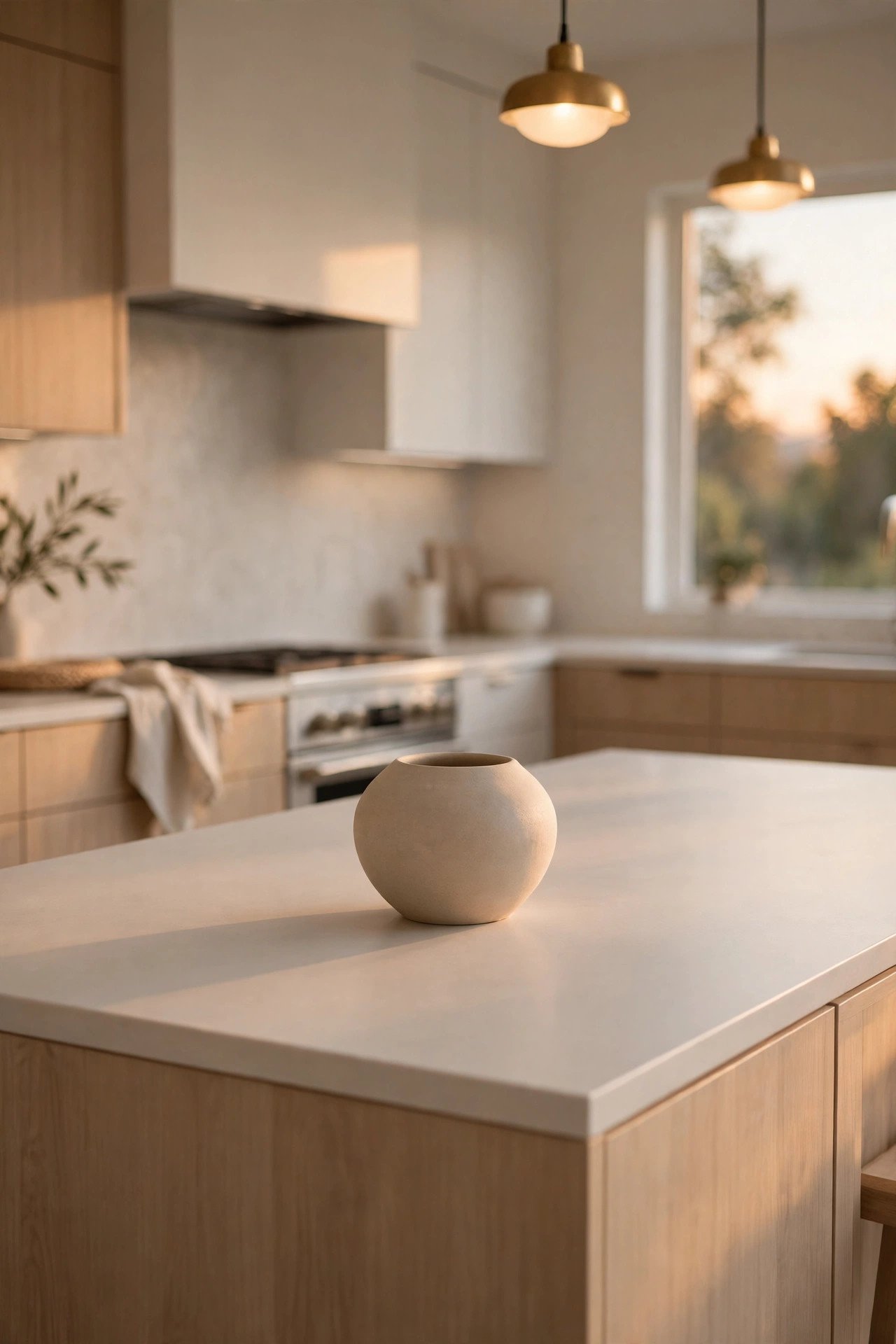
One strong piece plus empty counter reads as confident rather than unfinished, suiting cooks who want the whole island available. Choose a ceramic vessel 14 to 18 inches tall at 5 to 7 feet, a stone bowl at 7 to 9 feet, and a long low vessel over 9 feet, placed one-third along, with 30 inches clear around it. On an island under 5 feet a single small vase or bowl 10 to 12 inches wide is enough, and the empty space itself becomes part of the design, so keep the counter genuinely clear rather than filling edges with small appliances. Single statement pieces cost $40 to $150 depending on material, and matte ceramic, honed stone and brushed metal all suit a calm palette. The mistake to avoid is adding just one more small object beside the single piece, because the second object breaks the breathing room and the island slides back into clutter.
18. A Farmhouse Pitcher With Fresh Stems
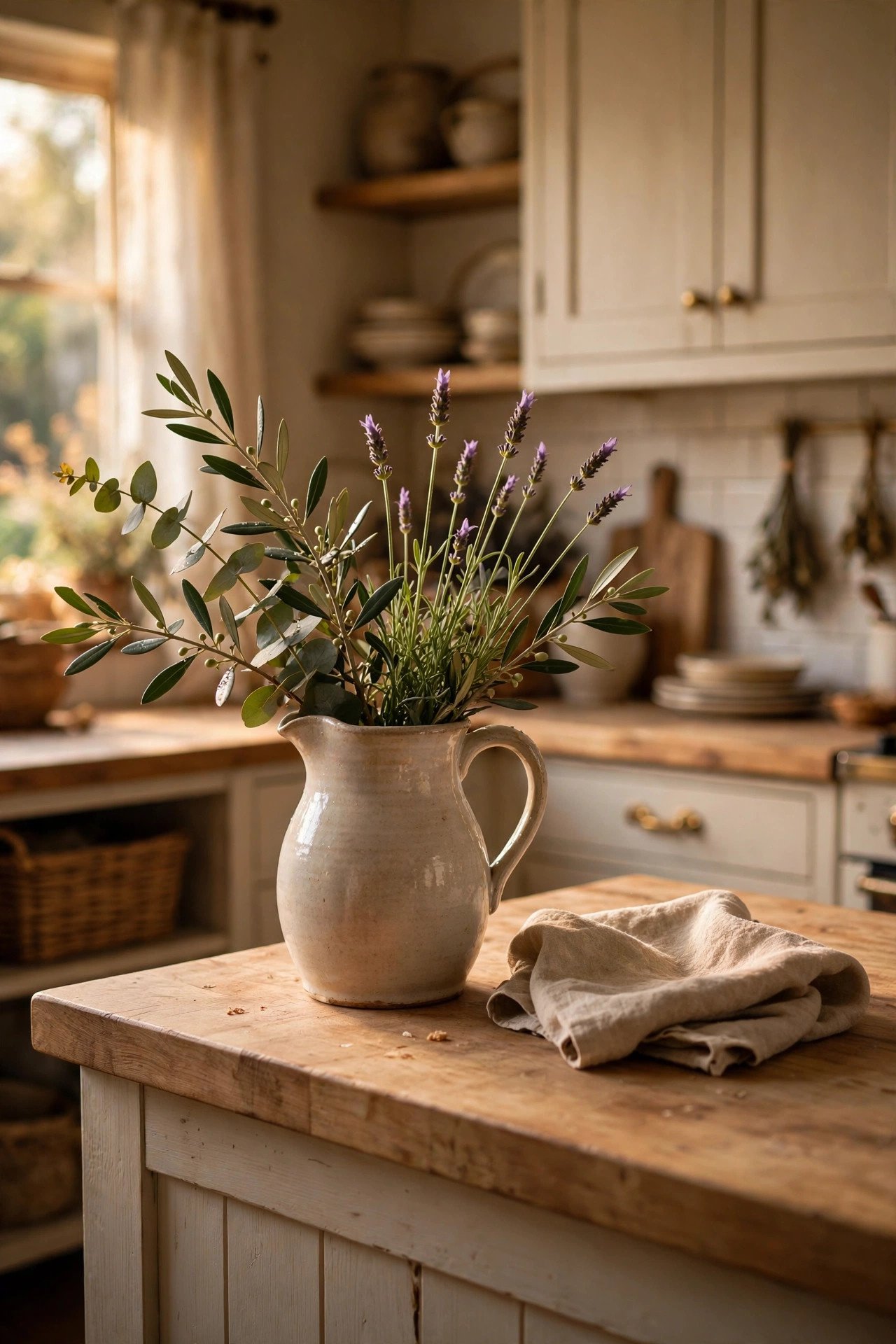
A farmhouse pitcher brings soft, rustic texture, especially in kitchens with wood or warm white cabinetry. Choose a pitcher 10 to 12 inches tall under 5 feet, 12 to 14 inches at 5 to 7 feet, and 14 to 16 inches longer, with stems about one and a half times its height, so it looks generous without blocking conversation. Place the pitcher at one end with 24 inches of clear prep space beside it, pair it with a small wood board or a folded linen cloth for texture, and use ceramic, stoneware or enamel pitchers that hold water without leaking. Pitchers cost $25 to $60, fresh stems $8 to $20 per bunch, and a linen cloth $10 to $25. The mistake to avoid is a pitcher so wide it eats the centre of a small island, or dried stems left until they shed debris across the counter every time someone walks past.
19. Black and Brass Accents for Contrast
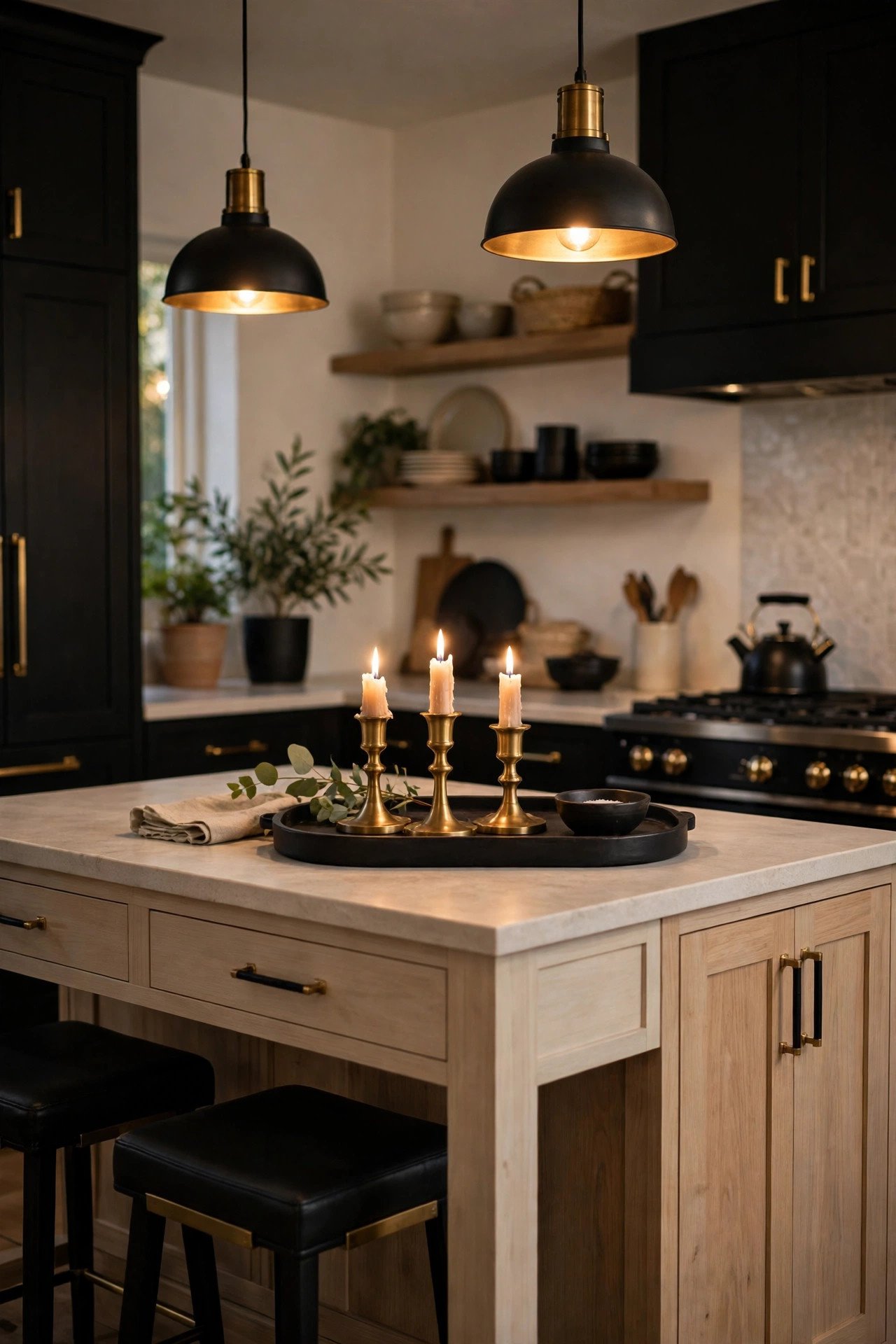
Black and brass add contrast and polish, especially against light stone, without a large or expensive change. Use a black tray with brass handles, a matte black vase with brass holders, or black stools with brass footrests, in a grouping one-third of the island: 16 to 18 inches under 5 feet, 20 to 24 inches at 5 to 7 feet, 28 to 32 inches at 7 to 9 feet, repeated over 9 feet. Keep 24 inches clear beside the grouping, and repeat brass in no more than two other places, so it feels deliberate. Black trays cost $30 to $65, brass candle holders $15 to $35 each, and black stools $90 to $260 each. For dark cabinet inspiration that keeps this contrast from feeling harsh, see these black kitchen ideas and match the black tone across tray, stools and hardware. The mistake to avoid is mixing brass, gold, copper and chrome in one grouping, which reads as accidental.
20. Breakfast-Bar Styling for Morning Use

Breakfast-bar styling treats the seating side as the morning hub, with placemats and a small centrepiece, while cooking stays clear. Set two placemats at 5 to 7 feet, three at 7 to 9 feet, and four over 9 feet, with 24 inches per setting and 15 inches of overhang, and a centrepiece under 10 inches tall. Use woven or linen placemats $12 to $30 each, a low bowl or tray $25 to $55, and small bud vases $10 to $20 each, and remove placemats after breakfast if the island doubles as the main prep surface. On an island under 5 feet, use a single runner and one place setting rather than crowding two, and fold placemats into a basket underneath when not in use. The mistake to avoid is a tall centrepiece in the middle of the breakfast bar, which blocks eye contact and gets knocked by serving dishes.
21. A Kids and Homework Zone That Stays Tidy
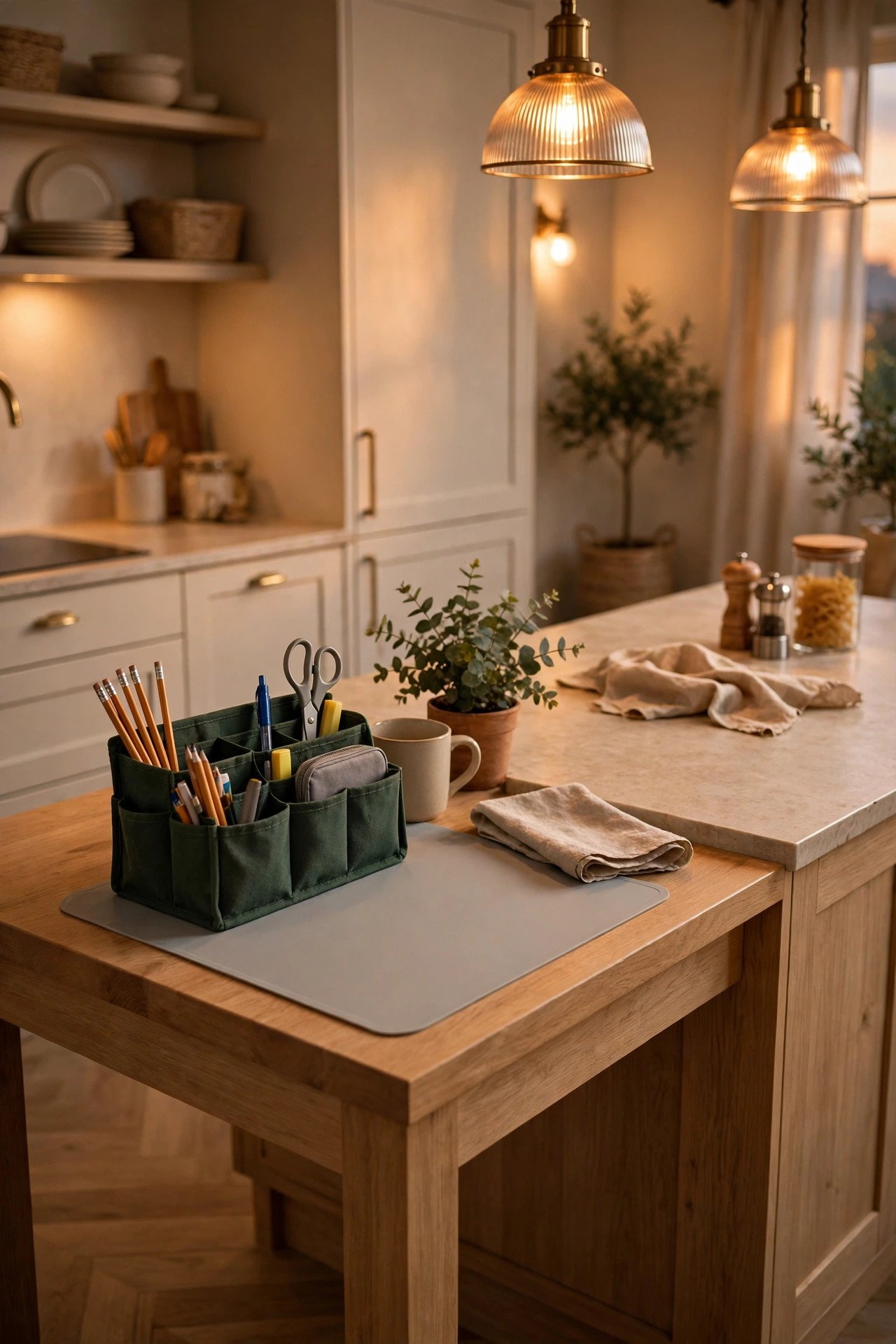
A homework zone keeps schoolwork contained on one part of the island instead of spreading across the kitchen. Dedicate 24 to 30 inches for one child at 5 to 7 feet and 36 to 48 inches for two at 7 to 9 feet or longer, with 15 inches of overhang and 24 inches per child, keeping the cooking end clear with 24 inches of prep space. Use a lidded caddy $20 to $45 for pencils and notebooks, a wipe-clean mat $15 to $30, and one jar of pens, with stools with footrests so feet do not dangle. On an island over 9 feet, give homework its own end and keep decor at the opposite end so the two zones never compete. The mistake to avoid is letting homework supplies live permanently on the island, because notebooks, chargers and snack wrappers quickly cover the styled centrepiece and the island stops working for cooking.
22. Double-Island Styling With Two Distinct Roles

Double islands need two distinct roles, or both end up decorated the same way and the kitchen looks repetitive. Give the cooking island one tray vignette, one-third of its length, with 24 inches clear, and the second island a social treatment, such as seating or a coffee station, with pendants 30 to 36 inches above it. Apply each island's own length band, repeat one material across both to link them, and vary heights so one carries the tall object and the other stays low. A second tray costs $25 to $60, a second vase $30 to $80, and a repeated stool set $60 to $250 per stool, so budget the pair as one project. The mistake to avoid is mirroring identical tall arrangements on both islands, which blocks sightlines and makes the space between them feel like a corridor.
Practical Tips
Measure before you buy anything, because island styling fails most often on scale rather than taste. Record the island length, depth and overhang, note where the hob, sink and seating fall, and mark the prep zone you use most, then choose decor that fits the length band for your island and leaves the working side open. A tape measure and five minutes of planning will save you from a tray that is too long, a vase that blocks a pendant, or stools that cannot slide in because the overhang is too shallow.
Keep at least 24 inches of clear prep space on the working side at all times, and treat that rule as non-negotiable on cooking days, even if it means lifting the tray or bowl to a side table while you work. Clean stone with a pH-neutral cleaner and a soft cloth, never vinegar or abrasive pads on marble, seal wood boards and trays regularly, wipe brass with a dry cloth and avoid harsh polishes on lacquered finishes, and empty vases and wipe saucers weekly so water rings never get a chance to set.
Check pendant and cord safety together with your budget, because lighting and electrics are the one part of island styling you should never improvise. Keep pendants 30 to 36 inches above the counter, use dimmers and warm 2700K bulbs, keep cords short, tidy and away from walkways, and hire an electrician for new pendant positions or heavier fixtures. For budgeting, plan $40 to $110 for a simple tray or bowl refresh, $150 to $400 for a mid-range restyle with a vase, tray and lighting accessories, and $500 to $1,200 or more for new stools plus pendants.
Final Thoughts
The best kitchen island decor is the kind you barely notice while you are cooking and genuinely enjoy while you are standing with a coffee, talking to family or welcoming guests. Start with your island length, protect your clear prep space, choose one focal grouping with tall, medium and low heights, and let materials and costs guide you rather than trends that will date quickly. Change the small layer often, keep the base calm, and your island will stay both beautiful and usable through every ordinary day, which is exactly what a well-styled kitchen should do.
You May Also Like: – 27 Kitchen Color Ideas That Make Your Space Look Modern, Warm & Expensive – 24 Cozy Farmhouse Kitchen Designs That Feel Like Home
Frequently Asked Questions
What should I put on my kitchen island?
Put one clear focal grouping on your island, such as a tray with tall, medium and low objects, a vase, or a fruit bowl, sized to about one-third of the island length. Keep at least 24 inches of clear prep space beside it, choose materials that wipe clean, and avoid filling every inch with small objects.
How much clear space should I leave on a kitchen island?
Leave at least 24 inches of clear counter on the working side of your island for chopping, serving and setting down hot pans. On small islands under 5 feet, use one compact vignette at one end so the rest stays open, and lift decor away completely on heavy cooking days.
How high should pendants hang above a kitchen island?
Hang pendants 30 to 36 inches above the countertop, measured from the counter surface to the bottom of the shade, so they light the work surface without blocking sightlines. Space multiple pendants 24 to 30 inches apart, keep them 6 inches in from the island ends, and use dimmable warm bulbs.
How much seating space does each stool need at a kitchen island?
Allow 24 inches of width per stool and 15 inches of knee overhang beneath the counter for comfortable seating. That means two stools for a 5 to 7 foot island, three for 7 to 9 feet, and four for longer islands, with breathing room between stools so nobody feels squeezed.
What size tray works best on a kitchen island?
Choose a tray about one-third of your island length: 16 to 18 inches for islands under 5 feet, 20 to 24 inches for 5 to 7 feet, and 28 to 32 inches for 7 to 9 feet. Use the rule of three inside it, with tall, medium and low objects, and keep the tray liftable for cleaning.
How do I style a small kitchen island without clutter?
Use one compact grouping, such as a small tray, a single vase, or a low bowl, placed at one end of an island under 5 feet. Keep 24 inches or more clear for prep, store extras in baskets underneath, and resist adding a second grouping that competes for the same small surface.