
22 Halloween Living Room Decor Ideas for a Spooky Yet Stylish Space
The living room is where Halloween actually happens — the movie nights, the party conversations, the candy bowl that empties by 8 p.m. Halloween living room decor means styling your main gathering space for the season without turning it into a haunted house you have to live in for a month. The goal is atmosphere you can relax in: moody but comfortable, festive but livable.
This guide treats the living room as a set of zones — sofa, coffee table, shelves, windows, lighting — and gives you 22 ideas that work in real rooms, including small spaces and rentals. Every idea includes materials, placement, and what to avoid, because a living room has to function on November 1st too.
Unlike the thin roundups currently ranking, this is built for people who actually sit in the room: comfort-first styling, renter-safe methods, and lighting plans that flatter both the decor and the people in it.
Looking for more inspiration? Our Nest Decorz homepage gathers the latest home decor ideas, seasonal decorating guides and room-by-room styling tips in one place — start there and explore.
Quick Answers
– The living room Halloween formula: textile swaps (pillows, throws) + one focal vignette (mantel or shelves) + layered warm lighting. Three moves, whole room transformed. – Best colors: black, deep orange, and warm neutrals you already own — add plum or forest green for a designer edge. – Small-space rule: decorate vertically (walls, shelves, mantel) and with light, not floor-cluttering props. – Renter-safe: command hooks, static clings, tension rods, and freestanding pieces — zero holes, zero damage. – Lighting: dim the overheads, layer table lamps with warm bulbs, candles, and string lights. Light does 70% of the Halloween work.
1. How Do You Set the Halloween Mood Without Redecorating Everything?

Start with the 60-30-10 rule applied seasonally: keep 60% of your room exactly as it is, swap 30% with seasonal textiles, and add 10% pure Halloween. In practice, that means your sofa, rug, and main furniture stay; pillow covers and throw blankets change to Halloween colors; and a mantel vignette, coffee table styling, and lighting provide the seasonal 10%. This approach takes an afternoon, costs little (pillow covers and throws are the cheapest transformation in decorating), and reverses in minutes on November 1st. The psychological trick: because the room's bones stay familiar, the Halloween layer reads as intentional styling rather than a costume the room is wearing.
2. What Throw Pillows Work Best for Halloween?
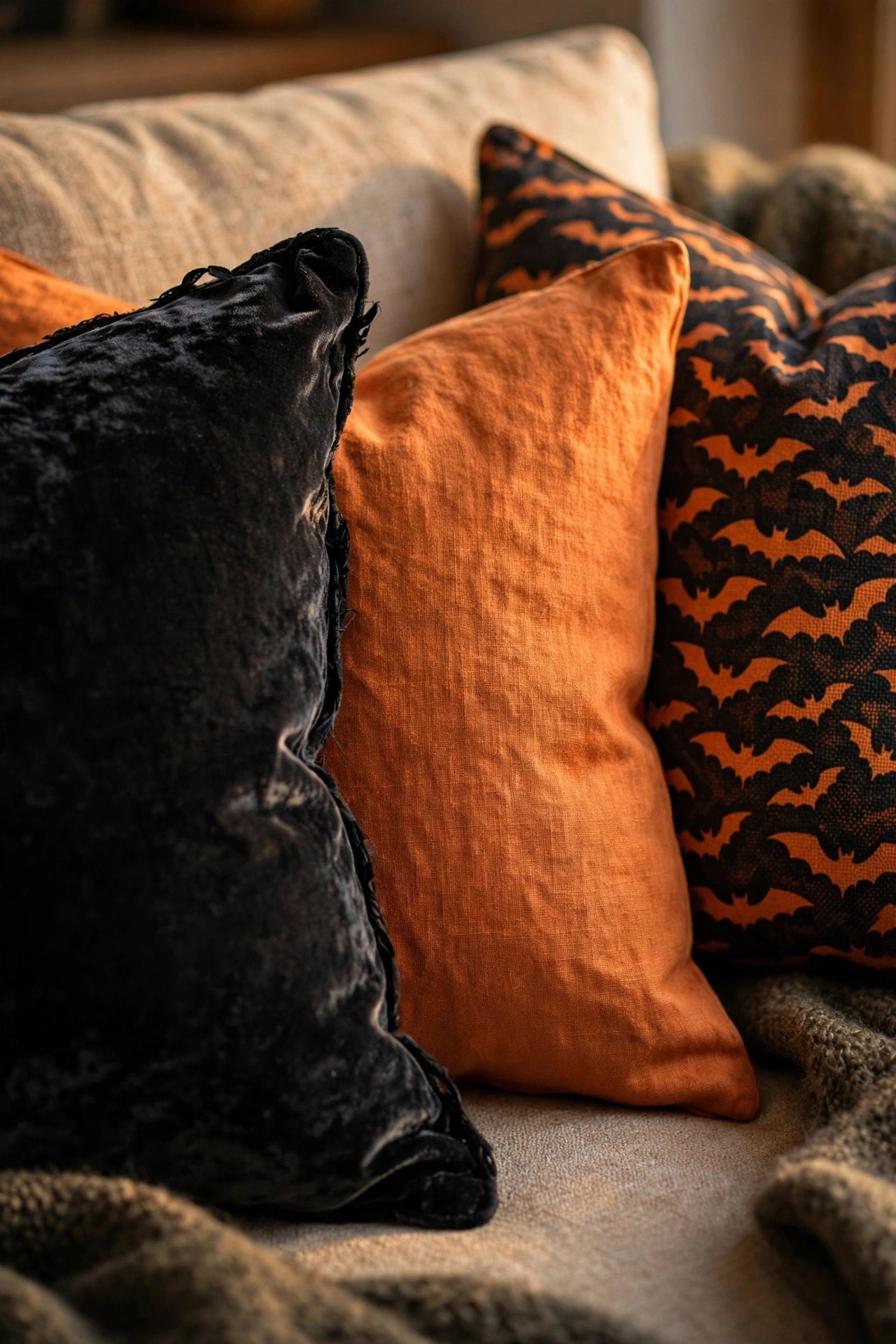
Swap pillow covers — not whole pillows — into Halloween mode. The winning combinations: black velvet covers, orange linen covers, and one or two patterned covers (bats, moons, vintage Halloween illustrations). Mix textures deliberately: velvet reads luxe, linen reads rustic, and the contrast makes both look better. A 3-2-1 formula works on most sofas: three solid covers in your Halloween palette, two patterned, one small lumbar in a metallic or contrasting texture. Store the off-season covers flat in a labeled bag; quality covers last for years. Avoid pillow covers with glued-on 3D elements (plastic spiders, protruding eyes) — they are uncomfortable to lean on, which defeats the purpose of a living room.
3. How Do You Style a Halloween Coffee Table?
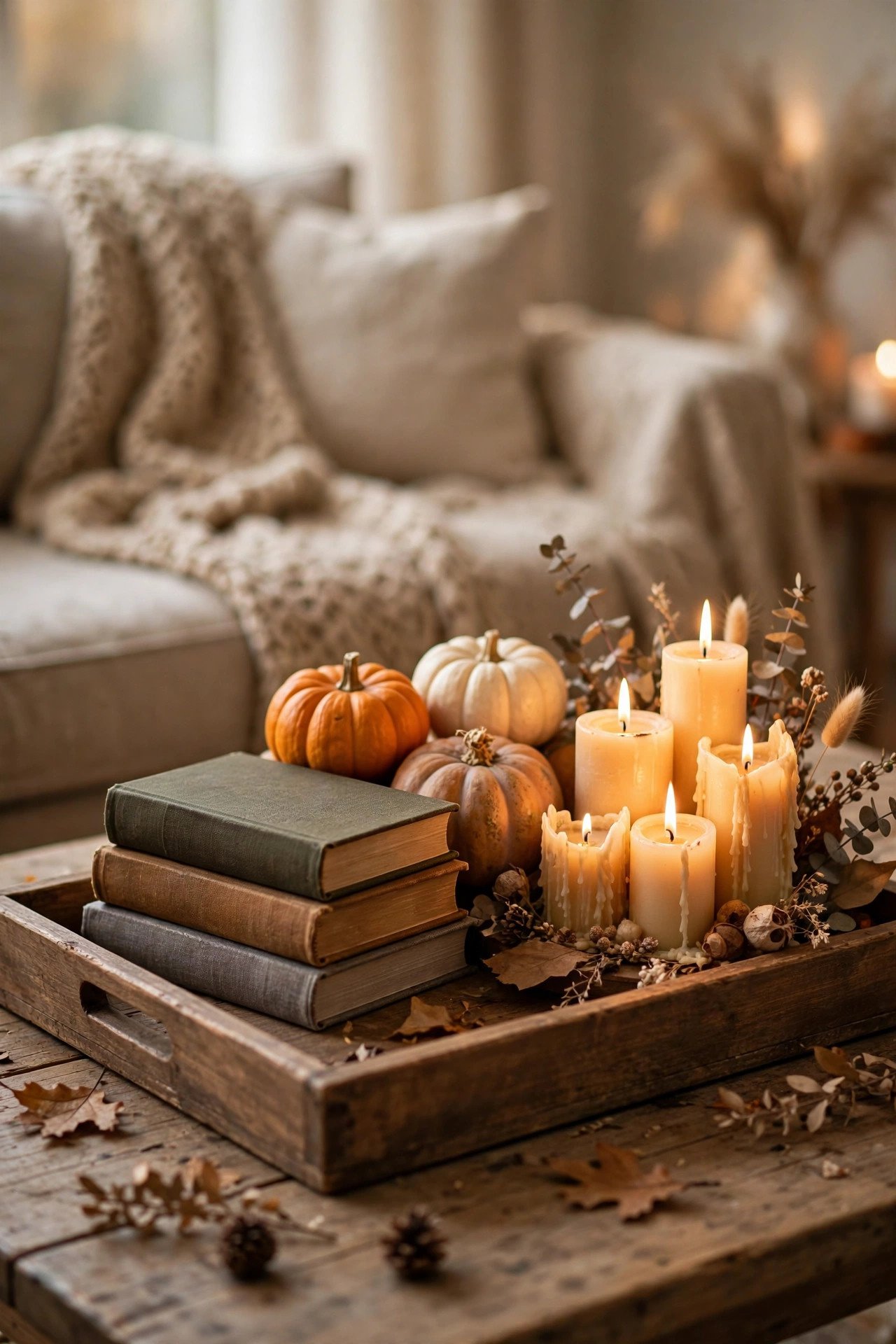
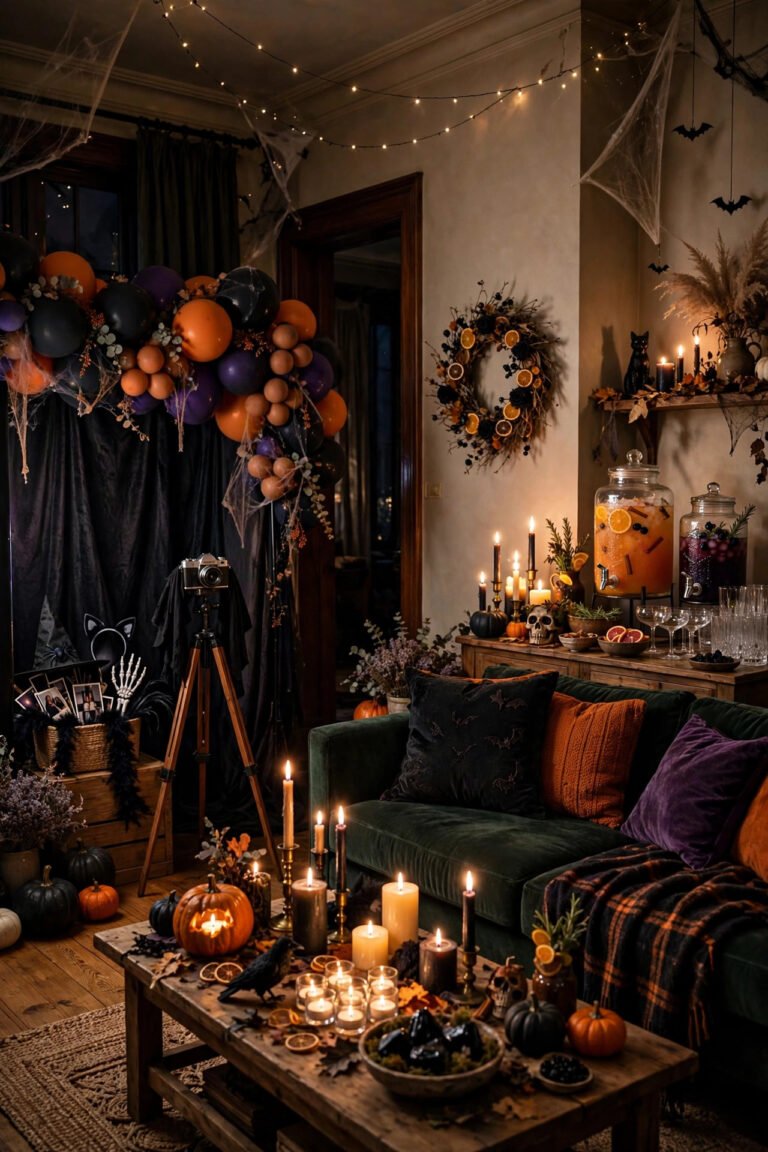
The coffee table is the room's centerpiece, so style it in layers: a tray as the base (contains the look and protects the table), then a mix of heights — a stack of books with a small pumpkin on top, a candle cluster, a bowl of candy or mini pumpkins. The tray is the key insight: it turns "random Halloween stuff on the table" into "a styled vignette," and you can lift the whole tray away when you need the surface. Keep the total height under 12 inches so sightlines across the room stay open. For party nights, swap the candy bowl for a punch bowl or snack tray using the same tray base. One styling session, two functions.
4. What Is the Best Halloween Lighting Plan for a Living Room?

Lighting is the highest-impact, lowest-effort Halloween move. The plan: turn off or dim the overhead light (overheads flatten everything), then build three warm layers — table lamps with warm-white bulbs (2700K) for general glow, candles or LED candles in clusters for flicker and intimacy, and string or fairy lights woven through garlands, shelves, or window frames for sparkle. Orange or amber bulbs in one lamp add seasonal color without the haunted-house effect of red or green. Put the accent lights on a timer for dusk. The result is a room that feels like candlelit October evening — atmospheric for guests, flattering for faces, and genuinely relaxing to sit in.
5. How Do You Decorate Living Room Shelves for Halloween?

Treat each shelf as a mini vignette with a simple formula: something tall at the back (a branch in a vase, a candlestick), something medium in the middle (a pumpkin, a framed print), something small in front (a tiny ghost, a pinecone, a candle). Leave breathing room — a crowded shelf reads as clutter, not decor. Tuck Halloween pieces among your everyday books and objects rather than clearing the shelf entirely; the mix of normal and seasonal is what makes it feel like a styled home rather than a seasonal display. Drape a strand of fairy lights along one shelf for evening magic. Work shelf by shelf, stepping back after each one — restraint is the difference between curated and chaotic.
6. Should Your Halloween Mantel Be Spooky or Elegant?

It should be yours — but the mantel deserves to be the room's Halloween anchor either way. Build it in layers: a garland or branch base across the mantel top, height from candlesticks or vases at the ends, and character pieces in the middle. For the full playbook, see these Halloween mantel decor ideas. No fireplace? Apply the same formula to a console table, the top of a bookshelf, or a wide windowsill — the "mantel" is really just any long horizontal surface at eye level. Mirror the mantel's palette in the rest of the room (two or three repeated colors) so the whole space feels connected.
7. How Do You Make a Small Living Room Feel Halloween-Ready?

Small rooms need vertical and luminous decorating, not floor props. Go up: paper bats on the wall, a garland across the window, art swapped for Halloween prints. Go luminous: candles, fairy lights, and glowing pumpkins create atmosphere without occupying a single square foot of floor. Use the "one strong moment" rule — a single well-styled shelf or windowsill beats ten small items scattered around. Choose a tight palette (two colors plus metallic) so the small space feels intentional rather than busy. And keep pathways completely clear; in a small room, a tripping hazard is not decor, it is a liability. Wall decals and window clings are the small-room heroes: maximum visual impact, zero footprint.
8. What Halloween Window Treatments Work in a Living Room?

Living room windows are prime Halloween real estate because they are visible from inside and outside. From inside: hang a garland across the top, place glowing pumpkins or candle clusters on the sill, or apply static-cling decals to the glass. From outside at night, backlit silhouettes (black paper shapes with a lamp behind them) turn your windows into the neighborhood show. For the complete window system, see these Halloween window decor ideas that glow after dark. In the living room specifically, keep window decor to the sides or top of the glass so daylight still enters during the day — you live here, after all, and a fully blacked-out window gets depressing by week two.
9. How Do You Use Pumpkins in Living Room Decor?

Pumpkins are the hardest-working Halloween decor because they span every style: real carved jack-o'-lanterns for tradition, painted faux pumpkins for color control, velvet pumpkins for texture, mercury glass for glow. In the living room, use the rule of three sizes: one large statement pumpkin (on the hearth, a side table, or the floor by the sofa), medium pumpkins in clusters (coffee table tray, shelf), and minis as scatter (windowsill, books stacked, mantel ends). Mixing materials — a velvet pumpkin next to a real one next to a glass one — looks collected and designerly; a dozen identical plastic pumpkins looks like a store display. Real pumpkins last 1-2 weeks indoors; switch to faux for anything you want to keep past mid-October.
10. What Throw Blankets and Textiles Say Halloween?

Textiles do the seasonal heavy lifting. Swap in: a chunky knit throw in burnt orange or deep plum, a black-and-cream plaid blanket, or a velvet throw in forest green. Drape — do not fold precisely — over the sofa arm or the back of an accent chair; the casual drape reads cozy, the precise fold reads showroom. Add a Halloween-themed lumbar pillow or two, and consider swapping curtain tiebacks for black ribbon in October. The textile swap is also the easiest way to shift the room's color temperature: warm textiles (orange, rust, gold) make the whole room feel warmer even before you touch the lighting. Wash and store them clean; next October they come out good as new.
11. How Do You Create a Spooky Reading Nook?
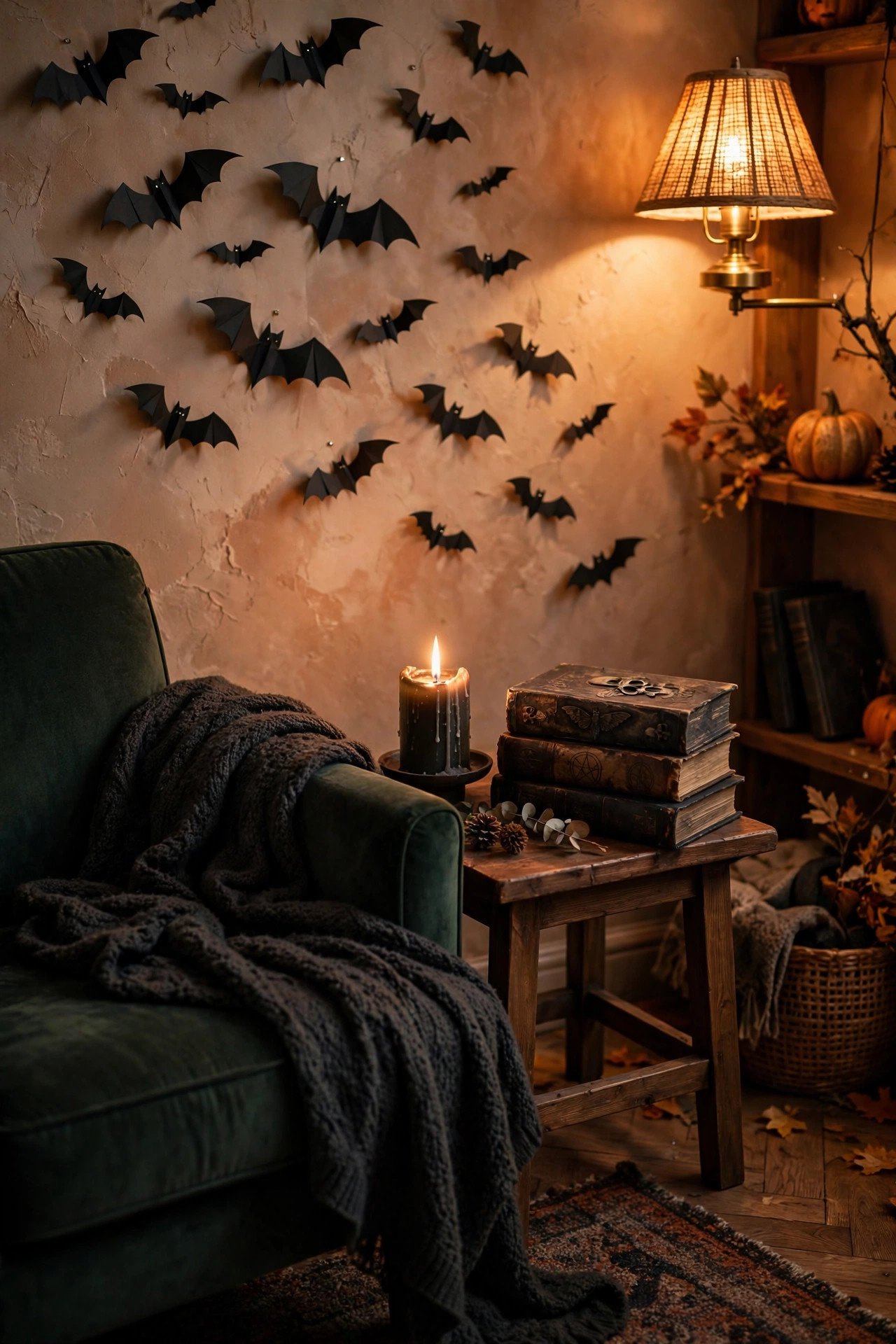
Carve a Halloween reading corner out of any armchair: drape it with a dark throw, add a Halloween pillow, place a small side table with a candle and a stack of spooky books, and hang a paper bat or two on the wall above. A floor lamp with a warm bulb behind the chair creates the perfect reading pool of light. This is a high-charm, low-cost move — it uses furniture you own plus about $15 of seasonal pieces — and it gives the room a destination. For Halloween night itself, it becomes the candy-distributor's throne or the scary-story chair. The reading nook proves a point: Halloween decor works best when it creates experiences, not just visuals.
12. What Wall Art Swaps Work for October?
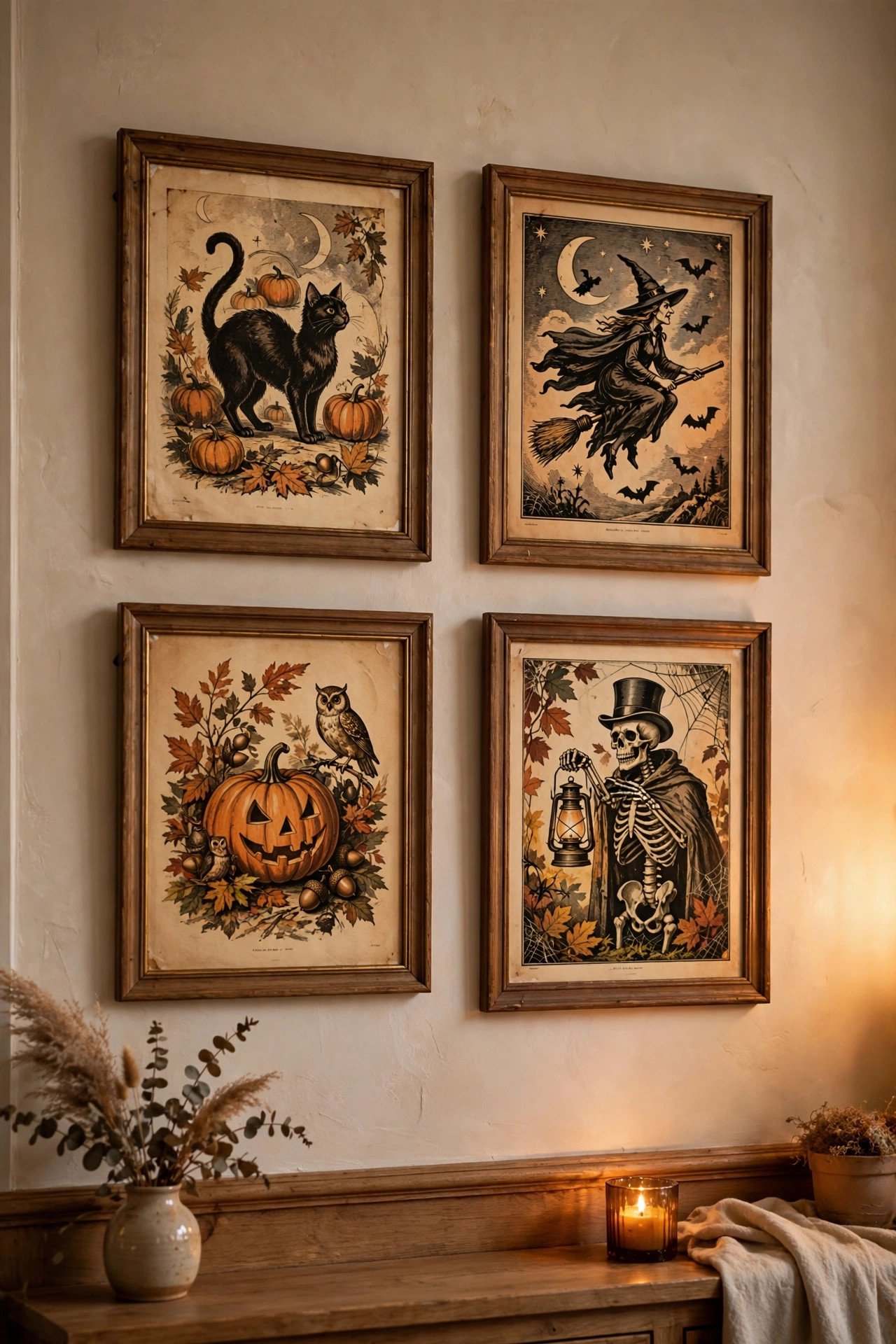
Temporarily replacing two or three pieces of wall art is one of the most transformative Halloween moves, and it costs nothing if you print at home. Swap in: vintage Halloween illustrations (public-domain postcard art is free and gorgeous), black-and-white spooky photography, or simple typographic prints ("Trick or Treat," "Happy Haunting"). Lean larger pieces on a console or mantel instead of hanging — no holes, and the casual lean looks intentional. Keep the frames you already own; just change the art inside. One caution: choose art you genuinely like looking at for a month. The joke print is funny for a day; the beautiful vintage illustration is enjoyable for thirty.
13. How Do You Decorate Around a TV Without It Looking Odd?
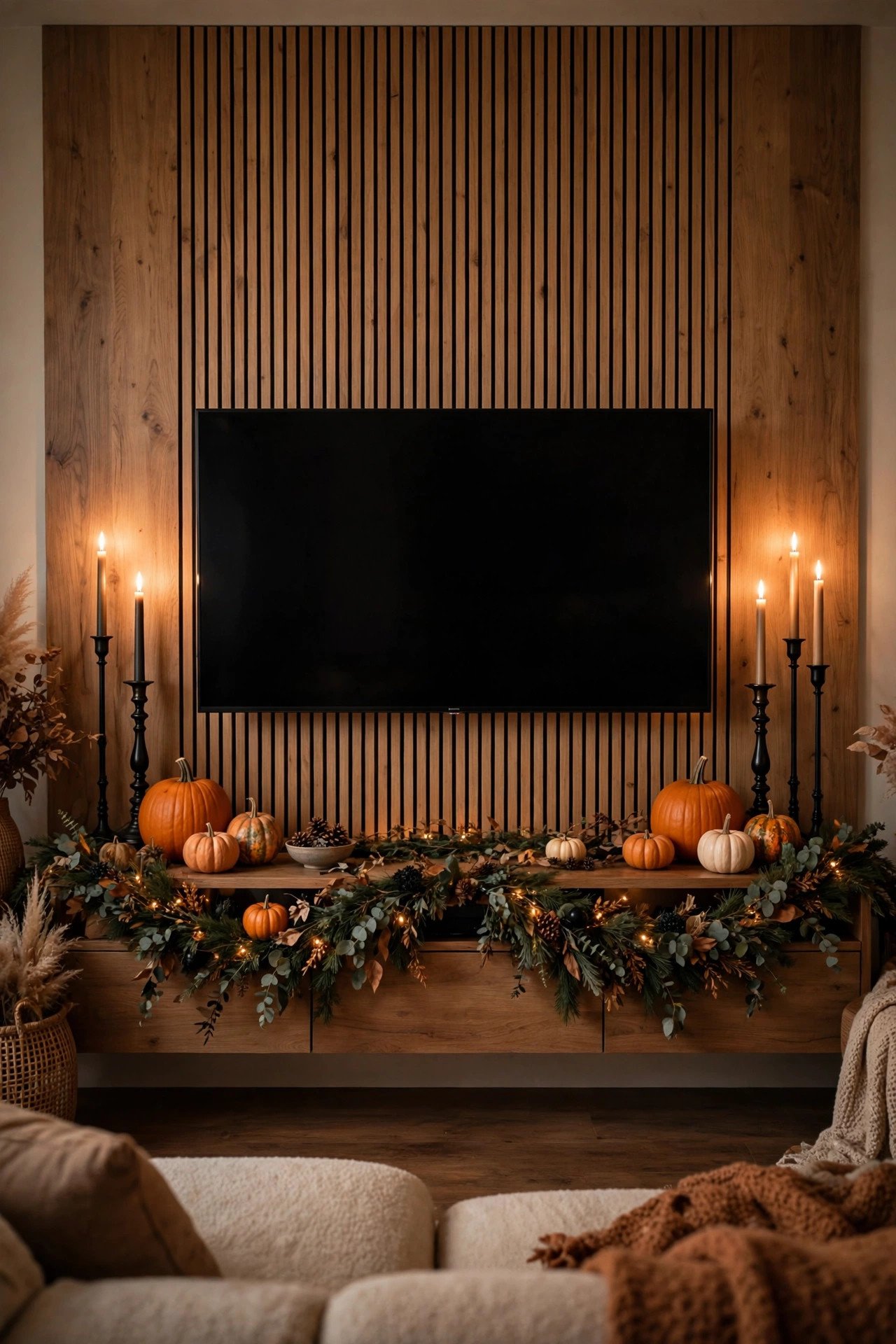
The TV wall is the awkward zone of Halloween decorating — a big black rectangle that resists styling. Solutions: flank the TV with symmetrical Halloween pieces (two candlesticks, two pumpkins, two framed prints) so it reads as part of a composed wall; hang a garland along the top of the media console; or style the console surface below with a low vignette that does not block the screen. Never hang anything on the TV itself, and keep candles at least a foot from electronics (heat). For movie nights, dim everything except a few candles — the TV glow plus candlelight is genuinely cinematic. The TV wall will never be the star of your Halloween decor, and that is fine; let it be a quiet supporting player.
14. What Scents Make a Living Room Feel Like Halloween?

Scent is the invisible half of atmosphere. The Halloween scent palette: cinnamon, clove, pumpkin spice, apple cider, woodsmoke, and vanilla. Deliver it through candles (the obvious choice), simmer pots (orange peels, cinnamon sticks, cloves, and star anise in water on low — the whole house smells like October), or reed diffusers for flameless scent. One scent at a time; layered competing fragrances give people headaches. Match the scent to the visual palette — a cinnamon-apple simmer pot under a harvest-styled mantel is multisensory coherence. This is also the cheapest atmosphere upgrade: a $4 bag of cinnamon sticks and some orange peels outperforms a $40 candle.
15. How Do You Style an Entryway-to-Living-Room Flow?
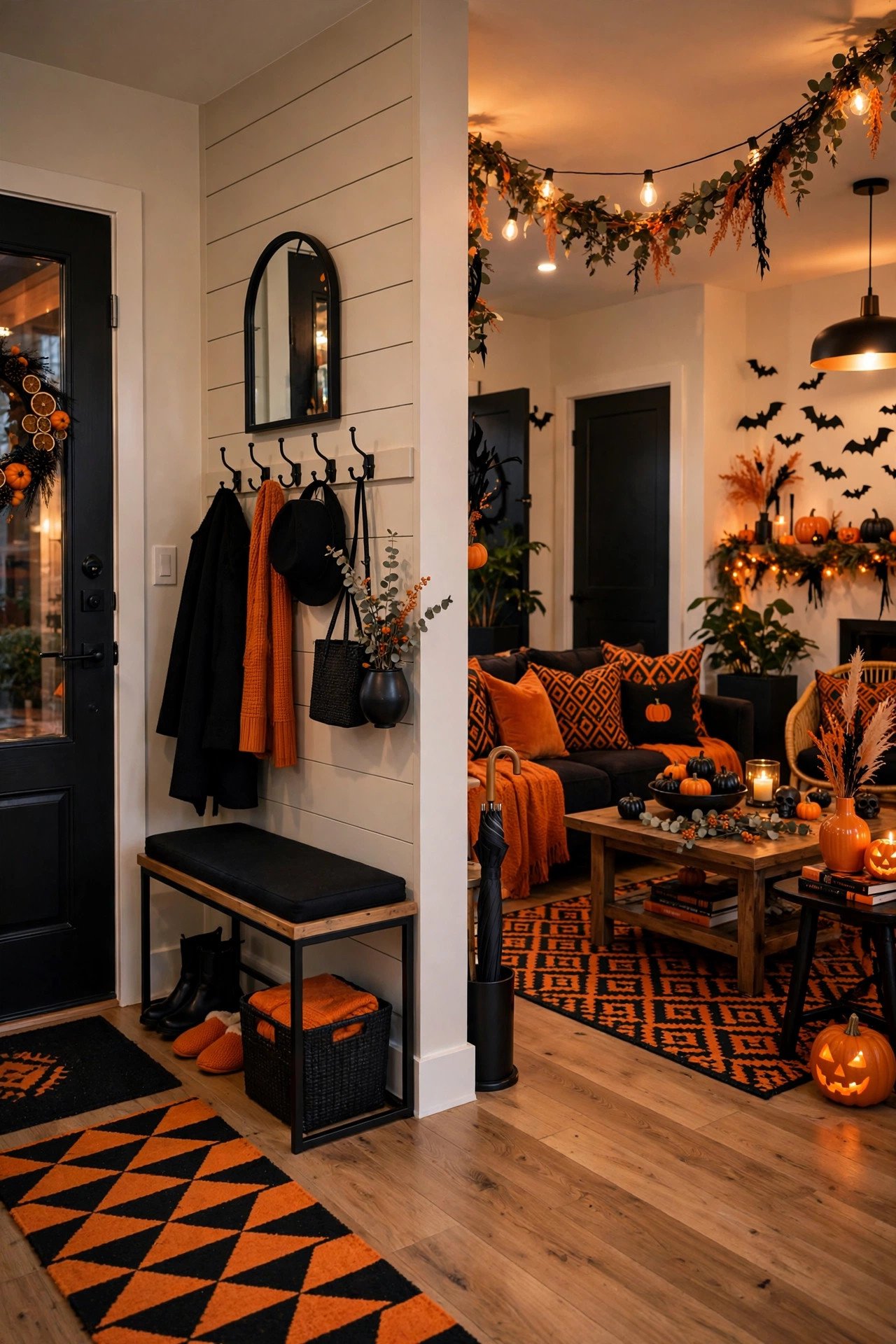
If your front door opens into or near the living room, style the transition as one continuous story. Repeat two elements from the porch inside: if the porch has orange mums and black lanterns, echo orange and black in the entryway console and the living room textiles. Place a "welcome" moment at the door (a styled console or bench), then let the Halloween intensity build as guests move deeper — entryway hints, living room full atmosphere. For the entryway-specific playbook, see these Halloween entryway decor ideas. The flow principle: no jarring jumps. A guest should never walk from a fully decorated porch into a completely undecorated living room, or vice versa.
16. What Kid-Friendly Halloween Touches Work in the Main Living Space?

Keep the living room's Halloween friendly at the levels kids touch: plush ghosts and pumpkins on the sofa, a bowl of candy corn on the coffee table, smiling (not snarling) pumpkin faces, and a "costume corner" with dress-up hats for play. Reserve anything genuinely spooky for high shelves or the mantel top — visible for atmosphere, out of small reach. Battery-operated candles everywhere; no real flames at kid height, ever. A felt Halloween advent-style calendar or a "countdown to Halloween" garland gives kids a daily ritual attached to the decor. The test: a four-year-old should be able to play in this room without crying or breaking anything valuable.
17. How Do You Add Halloween to a Neutral or Minimalist Living Room?
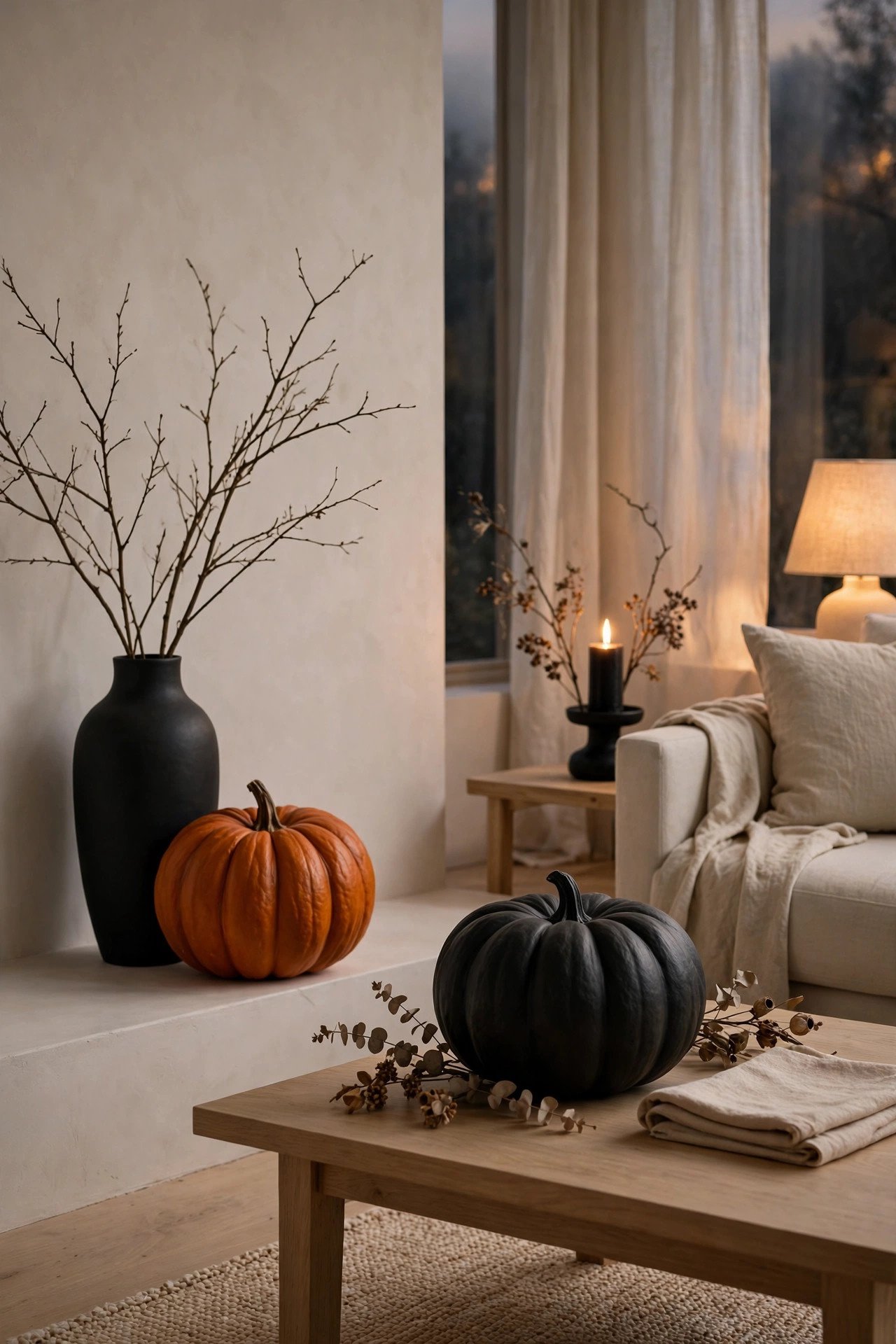
Minimalist rooms take Halloween beautifully because every seasonal piece gets full attention. The formula: three statement pieces, nothing else. A large black vase with bare branches on the coffee table. A single dramatic pumpkin — matte black or white — on the mantel. Black taper candles on the dining table. That is the whole decoration, and it looks intentional and chic. Choose pieces with strong silhouettes and honest materials (ceramic, glass, real branches); in a minimal room, cheap plastic props are brutally exposed. For the full refined approach, see these elegant Halloween decor ideas that are chic, not scary. Minimalist Halloween is also the fastest to set up and take down — a genuine advantage.
18. What About Halloween Rugs and Floor Decor?

Floor-level Halloween is high-risk (tripping, wear, pets) but high-reward for coziness. Safe moves: layer a Halloween-themed doormat at the entry, swap in a dark or patterned area rug for October if you have one, or lay a flat-weave runner with autumn colors. Avoid: anything that slides, anything with small parts at floor level, and fog machines indoors (they set off smoke alarms and leave residue). A pumpkin or two on the floor by the fireplace is fine; a graveyard scene across the walkway is not. If you have pets, assume anything on the floor will be investigated — choose accordingly. The rug swap is underrated: a deep-toned rug changes the room's whole color temperature from the ground up.
19. How Do You Host a Halloween Party in Your Living Room?
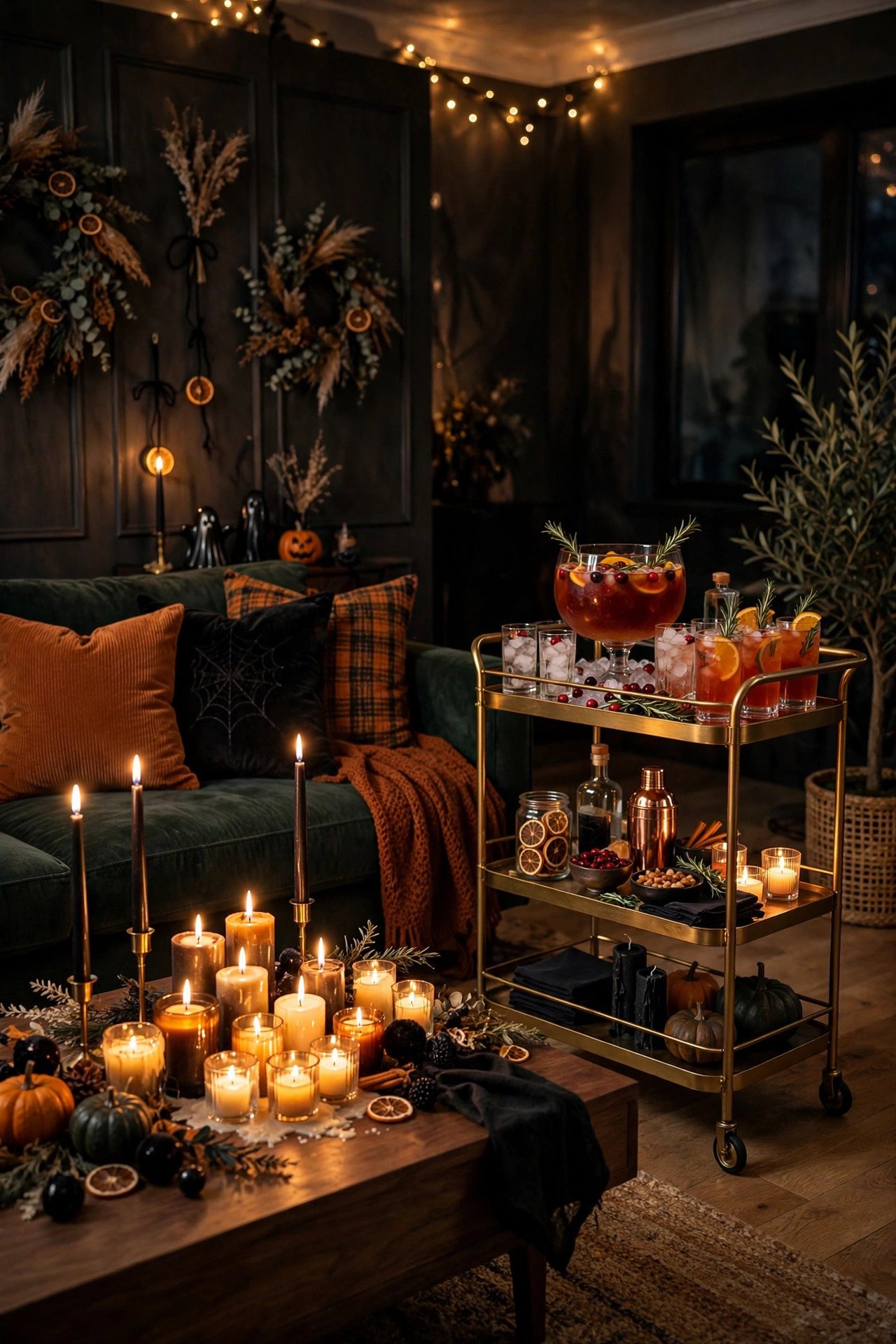
Party mode is regular Halloween decor plus three upgrades: lighting goes dimmer and warmer (candles everywhere, lamps off), the coffee table converts to food/drink service (tray vignette lifts off, serving pieces go on), and one interactive element appears (a photo backdrop corner, a costume voting station, a themed cocktail bar on the bar cart). Clear pathways wider than usual — guests with drinks need more room than family. Set up the drink station away from the main seating so traffic flows. The history of Halloween is a history of home parties, so lean into it: parlor games (murder mystery, costume contest) need no decor at all, just space and lighting. After the party, the room resets in twenty minutes.
20. How Do You Decorate on a $50 Halloween Living Room Budget?

Fifty dollars, spent in order: $15 on pillow covers (the biggest visual change), $10 on LED candles or string lights (the atmosphere), $10 on real mini pumpkins and gourds (the texture), $10 on paper decorations (bats, garland — the whimsy), $5 on cinnamon sticks and orange peels for a simmer pot (the scent). That is a fully transformed living room. The principles: textiles and light first (they change the room), natural materials second (cheap and beautiful), paper goods third (disposable charm). For more budget builds, see these DIY Halloween decorations on a budget. Shop your house first — branches from the yard, books you own, candles you have — and spend the $50 only on what you cannot improvise.
21. How Do You Keep Halloween Decor From Clashing With Fall Decor?
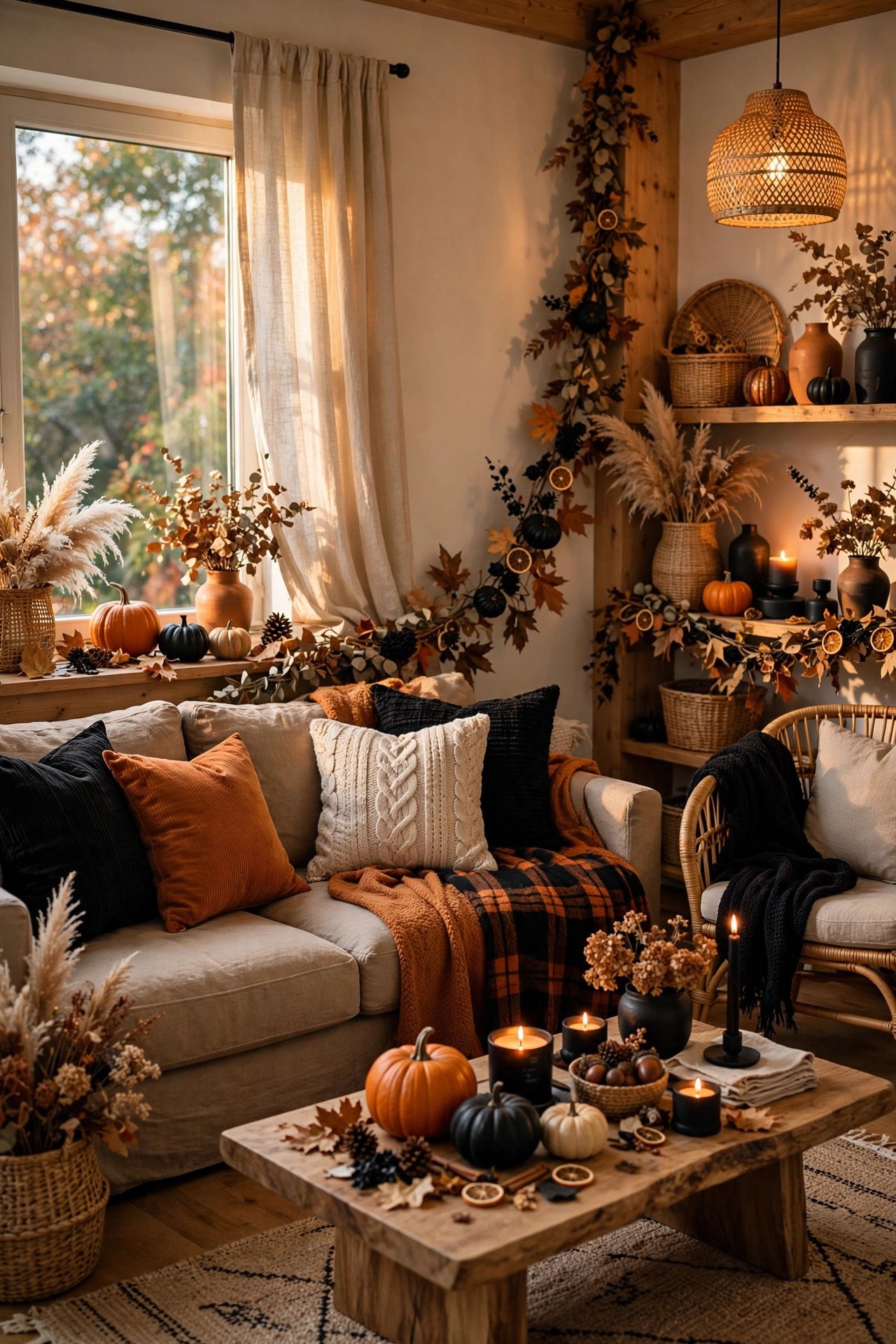
Halloween and fall decor share a season but not a palette — the fix is a shared base. Use the same warm neutrals, natural textures, and candlelight for both, then let the accents differ: Halloween gets black, orange, and playful motifs; fall gets deeper tones, wheat, and harvest textures. The transition trick: decorate in layers. Bottom layer (early October through Thanksgiving): pumpkins, warm textiles, candles, natural elements. Top layer (Halloween week only): the spooky/playful pieces — bats, witches, ghosts, "Trick or Treat" signs. On November 1st, lift off the top layer and the room is instantly Thanksgiving-ready. Buying pieces that work for both holidays (velvet pumpkins, brass candlesticks, eucalyptus garlands) halves your seasonal budget.
22. What Is the Fastest Halloween Living Room Reset for November?
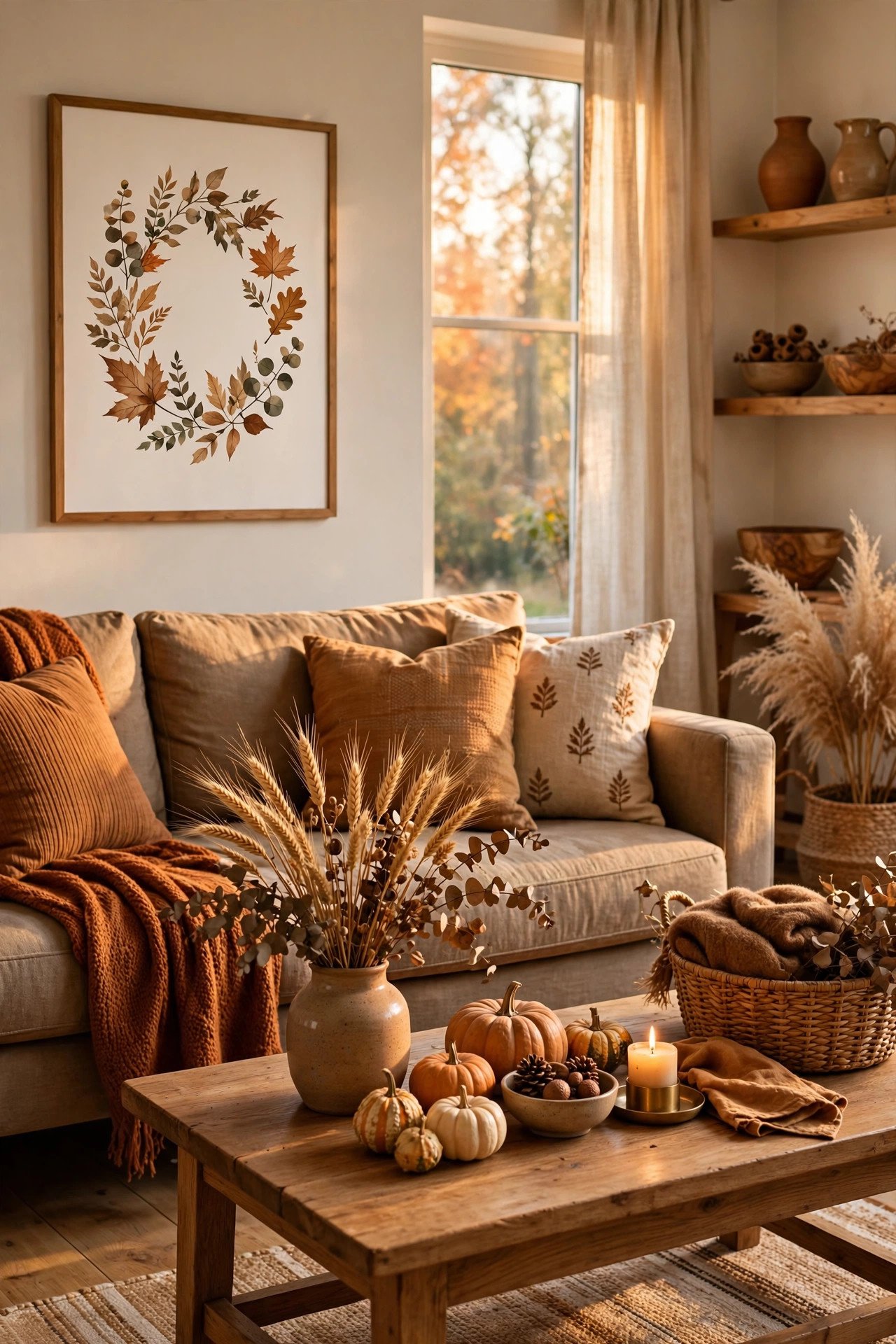
Plan the exit when you decorate. Keep all Halloween-specific items (as opposed to general fall items) corralled: one labeled bin, tissue between fragile pieces, pillow covers folded together. On November 1st: remove the Halloween-only pieces (bats, ghosts, signs, themed pillows), keep the fall base (pumpkins, warm throws, candles, natural garlands), and add one Thanksgiving signal (a "Give Thanks" print, wheat stems). The room transitions in under an hour because you designed it in layers. Photograph each styled surface before packing — next October's setup takes half the time. The jack-o'-lantern tradition ends with the holiday, but the harvest warmth underneath it carries straight through to Thanksgiving.
Practical Tips for Halloween Living Rooms
– Textiles and light first. Pillow covers, throws, and layered warm lighting transform the room more than any prop collection. – One focal point per room. A mantel, a styled shelf wall, or a tablescape — then small echoes elsewhere. Scattered props read as clutter. – Decorate vertically in small spaces. Walls, shelves, mantels, windows — keep the floor clear and the pathways safe. – Warm light only (2700K). Dim the overheads; layer lamps, candles, and string lights. Avoid red/green/purple unless you want a haunted house. – Renter-safe everything. Command hooks, static clings, tension rods, freestanding pieces. Photograph the "before" so move-out is painless. – Kid and pet rules. LED candles below three feet, shatterproof at kid height, no small detachable parts, real flames only where adults supervise. – Design the exit. Layer Halloween over a fall base so November 1st is a lift-off, not a redecoration.
Frequently Asked Questions
How can I decorate my living room for Halloween without it looking cluttered?
Focus on three moves: swap textiles (pillow covers and throws in Halloween colors), create one focal vignette (a styled mantel, shelf, or coffee table tray), and layer warm lighting. Decorate vertically — walls, shelves, mantels — rather than filling the floor with props. A tight two-to-three-color palette keeps everything feeling intentional, and the "one strong moment per room" rule prevents the scattered-props look.
What colors work best for a Halloween living room?
Black, deep orange, and the warm neutrals you already own form the classic base. For a more designer look, add plum, forest green, or dusty purple as accents, plus metallics (brass, copper, gold) for warmth. Keep it to two or three main colors plus one metallic. Avoid neon tones and the red/green/purple combination unless you specifically want a haunted-house effect.
How do I decorate a small living room for Halloween?
Decorate vertically and luminously: paper bats on walls, garlands across windows, art swaps, candles, and fairy lights create full atmosphere without using floor space. Follow the "one strong moment" rule — a single well-styled shelf or windowsill beats ten scattered items. Keep pathways completely clear, and use wall decals and window clings, which deliver maximum visual impact with zero footprint.
Is it safe to use real candles in Halloween decor?
Real candles are safe only with strict rules: never leave them unattended, keep them away from paper decorations and costumes, use stable holders, and keep them out of reach of kids and pets. For most living room Halloween styling — especially around paper bats, garlands, and fabric — LED candles are the smarter choice. They provide the same warm flicker with zero fire risk, and modern LED candles look convincingly real in dim light.
When should I start decorating my living room for Halloween?
Early to mid-October is ideal for the full living room treatment — early enough to enjoy it, late enough that real pumpkins survive until the 31st. Put out the reusable base (textiles, candle holders, faux pumpkins) in early October, add real pumpkins and fresh elements in the final week, and save anything perishable or weather-sensitive for the last few days. Take it down November 1st-2nd, keeping the fall base layer for Thanksgiving.
How do I make Halloween decor look stylish instead of cheap?
Three principles: honest materials (velvet, glass, ceramic, real branches beat plastic every time), a tight color palette (two to three colors, repeated deliberately), and restraint (one focal vignette plus small echoes, not props on every surface). Good lighting does enormous work — the same decorations look expensive under warm candlelight and cheap under harsh overheads. And mix heights and textures within each vignette for a collected, designer feel.
Final Thoughts
A Halloween living room succeeds when it is a room first and a Halloween display second. Textiles, light, and one strong focal point do the real work; everything else is garnish. Style it in layers so the spooky top notes lift off on November 1st, leaving a warm fall base that carries you to Thanksgiving.
Start this weekend: swap the pillow covers, dim the overheads, light the candles. The room will tell you what it needs next.
You May Also Like:
– Halloween mantel decor ideas for a haunted fireplace – Halloween window decor ideas that glow after dark – Elegant Halloween decor ideas that are chic, not scary – DIY Halloween decorations on a budget that look expensive