
22 Thanksgiving Wreath Ideas for a Warm Welcome
# 22 Thanksgiving Wreath Ideas for a Warm Welcome
The first thing your guests touch with their eyes is your front door. A wreath sets the emotional temperature of the whole visit — harvest abundance says you planned, warmth says you care. Thanksgiving wreaths get this exactly right: they trade the spooky drama of October for golden wheat, weathered grapevine, magnolia leaves, and the kind of textures that make a November doorway feel like a hug.
Looking for more inspiration? Our Nest Decorz homepage gathers the latest home decor ideas, seasonal decorating guides and room-by-room styling tips in one place — start there and explore.
Below you'll find 22 ideas that actually work in real homes — half DIY builds with real material lists, half smart store-bought options worth your money. We've sized every wreath to its placement, called out budgets, and flagged what goes wrong so yours doesn't. And if October got you here, our spooktacular Halloween wreath ideas are this post's spooky predecessor — same craft, warmer palette.
Quick Answers: Thanksgiving Wreath Ideas at a Glance
– Best all-around base: an 18- to 24-inch natural grapevine wreath — sturdy, forgiving for beginners, and reusable season after season. – Longest-lasting look: preserved boxwood, dried wheat, and faux elements hold their color through a full November outdoors; fresh cuts fade within days. – Size rule: your wreath should span roughly half to two-thirds the width of your door for a balanced, intentional look. – Budget sweet spot: a full DIY harvest wreath costs $25–$45 in materials; quality store-bought versions run $60–$120. – Secret to longevity: keep natural wreaths under a covered porch and out of direct rain, and mist dried botanicals with clear sealant before hanging.
1. Which Wreath Base Lasts Longest Outdoors?
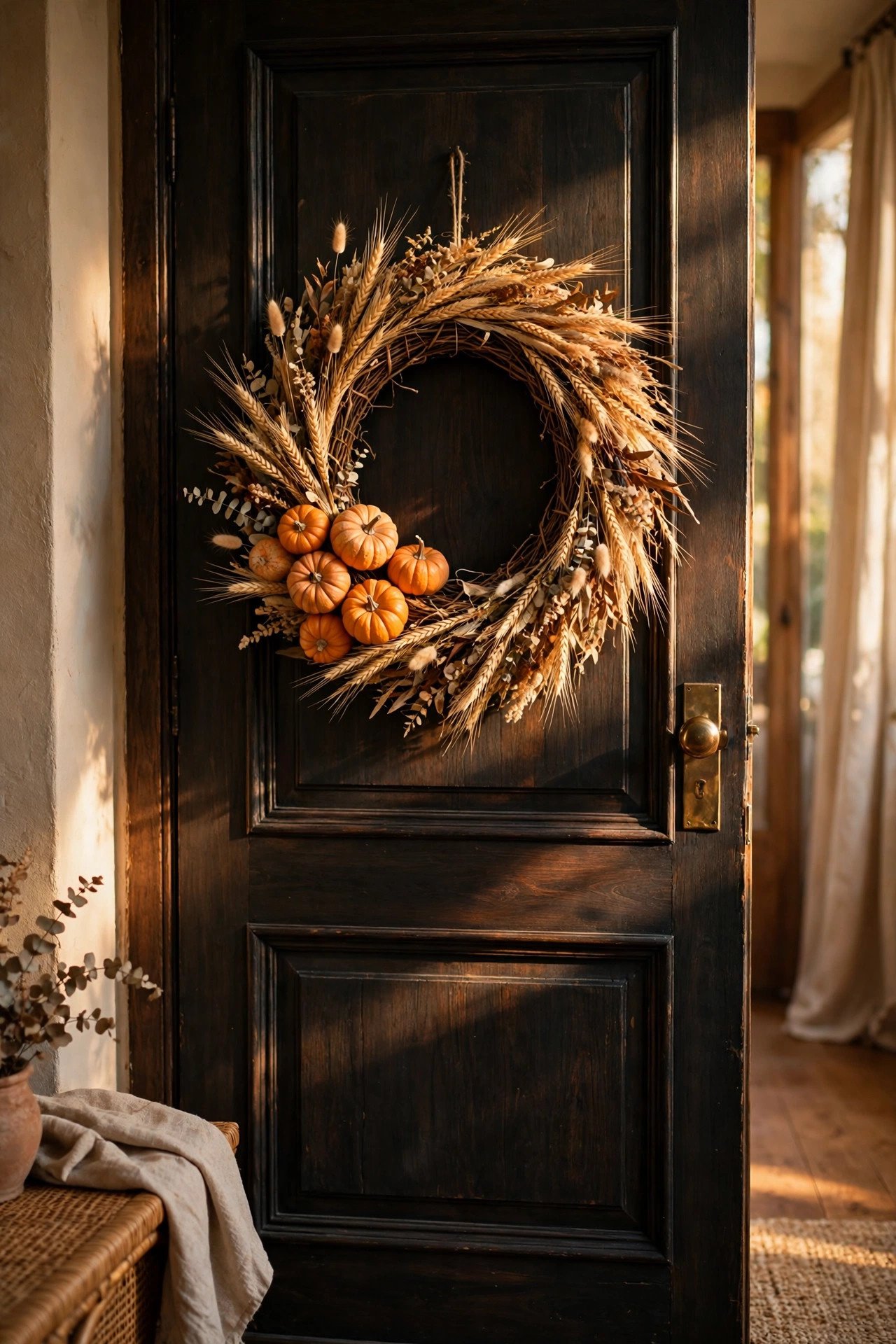
A natural grapevine wreath base outlasts almost everything else outdoors because its twisted vines are dense, weather-tolerant, and naturally camouflaged if bits shed over time. Unlike foam or straw forms, grapevine survives November rain and temperature swings intact, and the same base can be stripped and rebuilt for years of holidays.
Start with an 18-inch grapevine base and wire in bunches of dried wheat, faux berries, and three to five miniature pumpkins clustered at the lower left. Secure heavier pieces like pumpkins with 22-gauge floral wire — hot glue alone will fail in November cold. Budget around $35 total. Avoid real miniature pumpkins on a door that gets direct sun; they wrinkle within a week. Faux mini pumpkins cost about $1 each and look identical from three feet away, which is where everyone sees them anyway.
2. How Do You Make a Dried Wheat Wreath From Scratch?
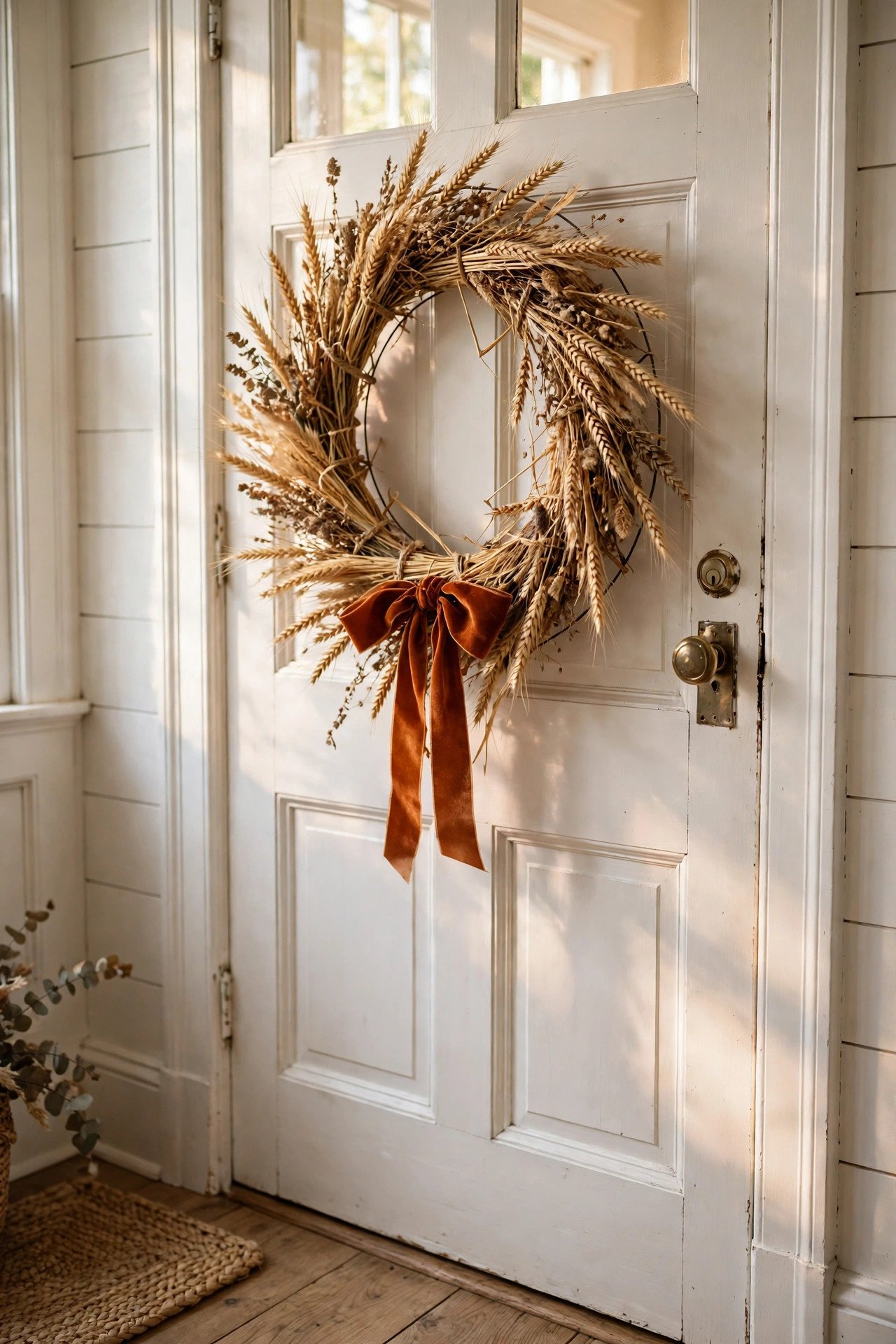
Bind two dozen dried wheat stalks into small bundles and attach them in overlapping layers to a wire wreath form, all pointing the same direction, for a lush golden harvest wreath. Consistent direction is the key detail — it creates the full, feathered look that separates a professional result from a sparse, patchy one.
This is the simplest true-DIY build on this list. Buy a 12- to 14-inch wire wreath frame and dried wheat in bundles of 50 ($8–$12 total). Zip-tie or wire five-stalk bundles to the frame, each bundle overlapping the stems of the last, working clockwise. Finish with a single velvet ribbon loop at the top — rust or burnt orange velvet reads harvest, not Christmas. Hang it where it's protected from rain; wet wheat goes limp and musty. Total cost: under $20, about 45 minutes of work.
3. What Wreath Works for a Modern Farmhouse Thanksgiving?

A eucalyptus and magnolia leaf wreath delivers the modern farmhouse look — muted greens, matte textures, and a soft neutral palette that reads calm rather than rustic. Silver dollar eucalyptus dries without losing its sage tone, and the two-sided magnolia leaves add depth that flat greenery simply cannot match.
Silver dollar eucalyptus dries beautifully and keeps its sage color for weeks. Pair it with magnolia leaves (glossy top, velvety brown underside) for contrast on a simple 20-inch grapevine or embroidery-hoop base. Add a cream linen ribbon tied in a loose bow. Suits white and gray doors, and works indoors above a mantel. Skip the pumpkins here — the palette is the point. Budget $40–$55 DIY; preserved eucalyptus costs more than fresh but lasts the entire season without shedding. For the rest of the room, our cozy Thanksgiving living room ideas build on this same palette.
4. How Do You Get Rich Jewel Tones Without Looking Christmassy?

Layer berry picks, pinecones, and deep-toned foliage in burgundy, burnt orange, and bronze — jewel tones stay autumnal when copper and amber dominate and true reds and greens are avoided. Keeping bright red and kelly green out of the mix is what stops the wreath from reading as premature Christmas decor.
This is a moody, elegant wreath for a dark or stained-wood door. Use a 22-inch base and cluster artificial burgundy eucalyptus, copper-painted pinecones, preserved oak leaves, and dark orange billy balls. The trick is contrast: mix matte (lotus pods, bark) with glossy (lacquered berries, ribbon). Avoid anything with glitter — that tips the look toward December. Store-bought versions of this style run $80–$110 and are worth it, since artificial berries and preserved leaves are pricey individually.
5. Can You Make a Beautiful Wreath for Under $15?

Yes — a corn husk wreath costs almost nothing and looks surprisingly high-end because the dried husks take on a ruffled, petal-like texture when layered. Soaked husks become pliable enough to curl and shape, and three staggered rows of overlapping husks give you full, flower-like coverage for about ten dollars.
Soak dried corn husks in warm water for 20 minutes to make them pliable, then hot-glue or pin them in overlapping rows onto a 14-inch straw wreath form, curling the edges outward. Layering matters: three staggered rows give full coverage. Add one or two dried wheat bundles at the base of the bow for color. Total cost: roughly $10–$14. This wreath is delicate, so keep it on an interior door, above a mantel, or under a deep covered porch. It stores flat between seasons — one of the few wreaths that does.
6. What's the Best Store-Bought Thanksgiving Wreath Splurge?

A preserved boxwood wreath with a velvet ribbon is the single best splurge: it looks fresh for months, works through Thanksgiving into winter, and never sheds. Glycerin-treated real boxwood keeps its green for a year or more without water, so it survives sun, rain, and wind that would destroy a fresh wreath.
Preserved boxwood is real boxwood that's been glycerin-treated, so it keeps its green for a year or more without water. An 18-inch one costs $70–$100. It pairs with everything — navy doors, brick, white trim. Dress it for Thanksgiving with a rust-colored velvet ribbon wired to the top; after the holiday, swap the ribbon to deep green and it carries you through December. Hang it anywhere, including full sun and rain, with zero maintenance. Avoid cheap foam-based "boxwood" mats; they look plastic in daylight. Real preserved boxwood has natural variation that reads as alive.
7. How Do You Add Real Autumn Scent to a Wreath?

Build a dried orange slice, cinnamon stick, and star anise wreath — it perfumes your entryway naturally every time the door opens. Translucent dried citrus glows in porch light and the cinnamon-anise scent reads instantly as the holidays, making this the most welcoming wreath style you can hang.
This is one of the most welcoming wreaths you can hang, especially on a covered porch near the entry. Thread dried orange slices onto a 16-inch grapevine base with floral wire, tucking bundles of three cinnamon sticks and star anise clusters between them. The scent carries on warm November afternoons. Budget $30–$40; pre-dried orange slices from craft stores are about $6 a bag and save you two hours of oven-drying. Keep this one out of direct rain — wet citrus darkens and loses its translucency. Indoors, it doubles as a gorgeous Thanksgiving dining room wall accent.
8. What Looks Modern and Organic Without Any Pumpkins?

A lotus pod and natural pod wreath in tan and cream tones creates a sculptural, modern look that's entirely pumpkin-free and reads more gallery than farmhouse. The secret is restraint: wide spacing between sculptural elements like palm spears and protea lets each texture breathe instead of competing.
Lotus pods, dried palm spears, bleached ruscus, and cream protea on a slim 18-inch rattan base give you texture and negative space instead of harvest clichés. This style suits minimal, Scandinavian-leaning, or mid-century homes where orange clashes with the interior. It also transitions effortlessly from October through Thanksgiving since nothing in it is season-specific. DIY cost: $45–$60, since dried exotics run higher. Avoid overfilling — the beauty is in the spacing. Five well-placed elements beat fifteen crowded ones here.
9. How Do You Make a Bold Statement on a Plain Door?
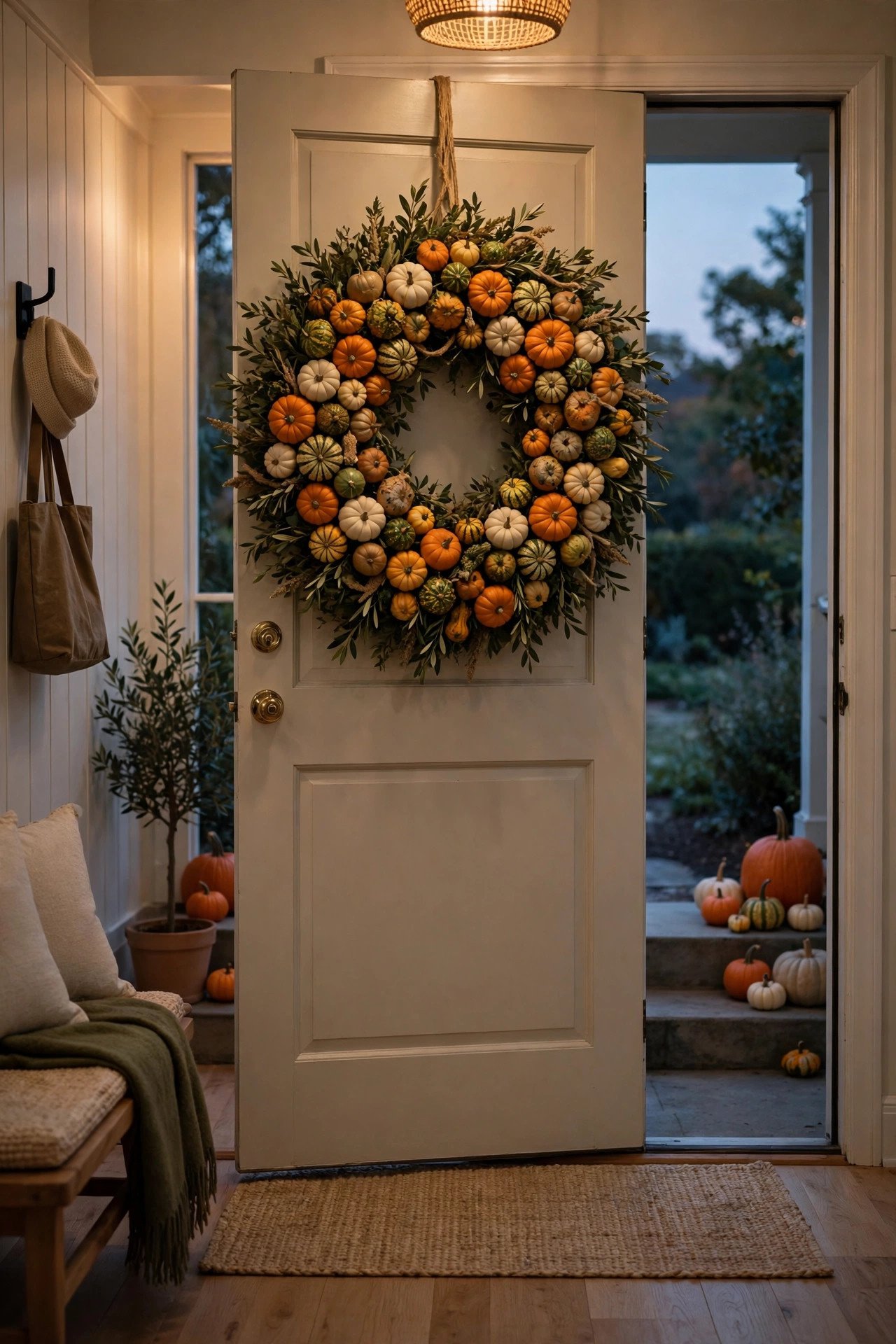
Go oversized and pumpkin-dense: a 26- to 30-inch wreath crammed with mini pumpkins, gourds, and faux fall leaves turns a flat door into the neighborhood talking point. Scale is the most underused design tool in wreath styling — a wreath that fills two-thirds of your door panel always looks more expensive than a small one.
Scale is the secret weapon most wreaths miss. On a standard 36-inch door, a 28-inch wreath fills the upper panel dramatically. Attach foam and plastic mini pumpkins in white, orange, and green to a heavy-duty 24-inch grapevine base with 20-gauge wire (hot glue won't hold that weight), filling gaps with faux maple leaves and berry sprays. Budget $60–$80 DIY. One caution: it gets heavy, up to 8 pounds, so use an over-the-door hook rated for 15 pounds or a sturdy magnetic hanger on metal doors. Pair it with pumpkins flanking the steps for a complete Thanksgiving front porch.
10. Is There a Wreath You Can Build in Under 30 Minutes?
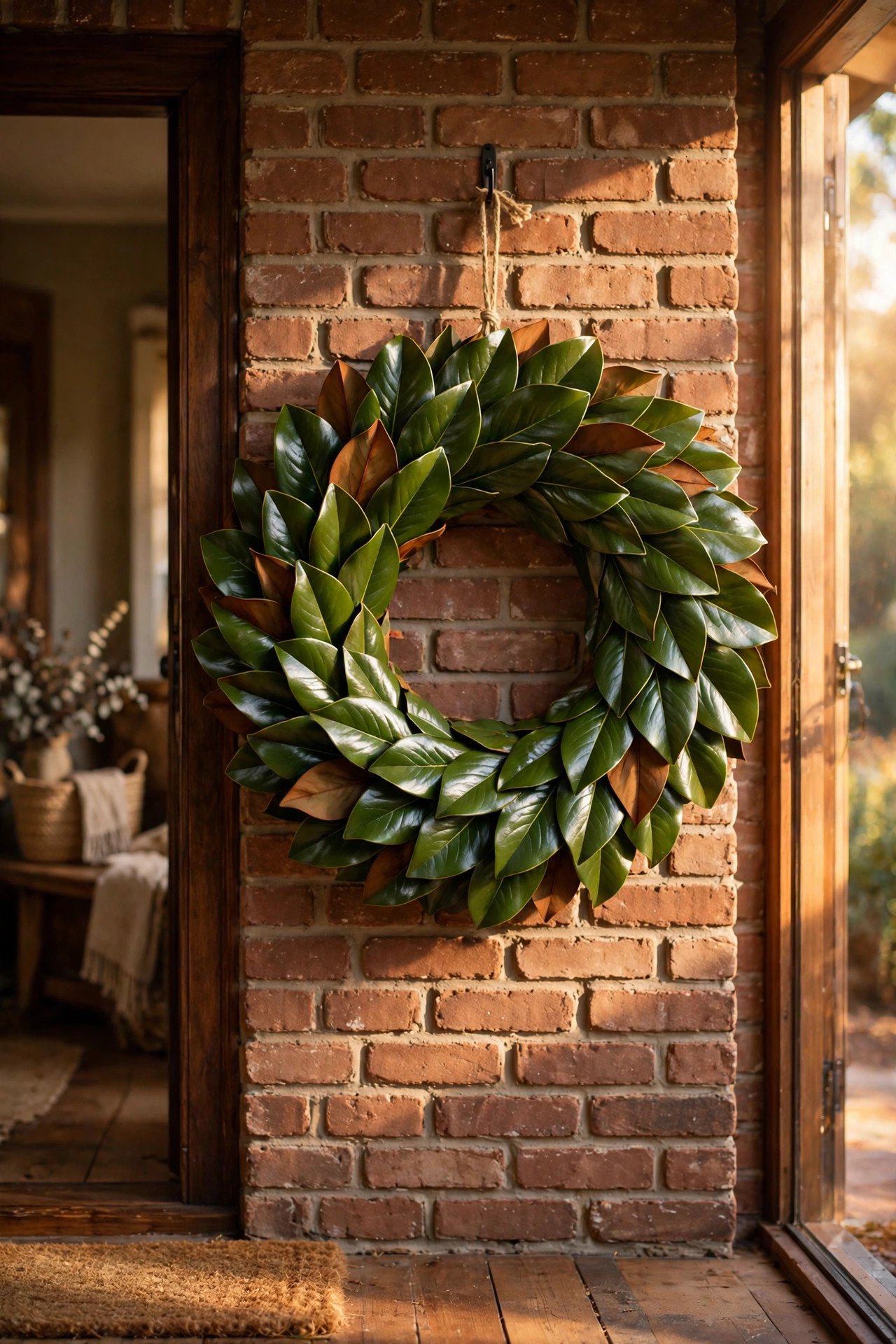
Yes — a magnolia leaf shingle wreath is the fastest impressive DIY: overlap whole magnolia leaves around a foam ring like roof shingles, and you're done in half an hour. Fresh magnolia leaves dry naturally right on the wreath and darken to a rich bronze, so the piece actually improves with age.
Buy or cut a 16-inch foam wreath form and about 60 fresh or faux magnolia leaves. Hot-glue leaves in a single direction, each one overlapping the previous by half, working in rings until the form disappears. Fresh magnolia leaves dry naturally on the wreath and darken to a gorgeous bronze-brown — many people prefer them after two weeks. Faux leaves cost $12–$18 for a pack and look identical up front. This wreath suits both doors and interior walls and needs zero maintenance. Avoid sparse shingling; gaps in the foam are the one thing that makes it look amateur.
11. How Do You Make a Rustic Wreath Feel Refined?
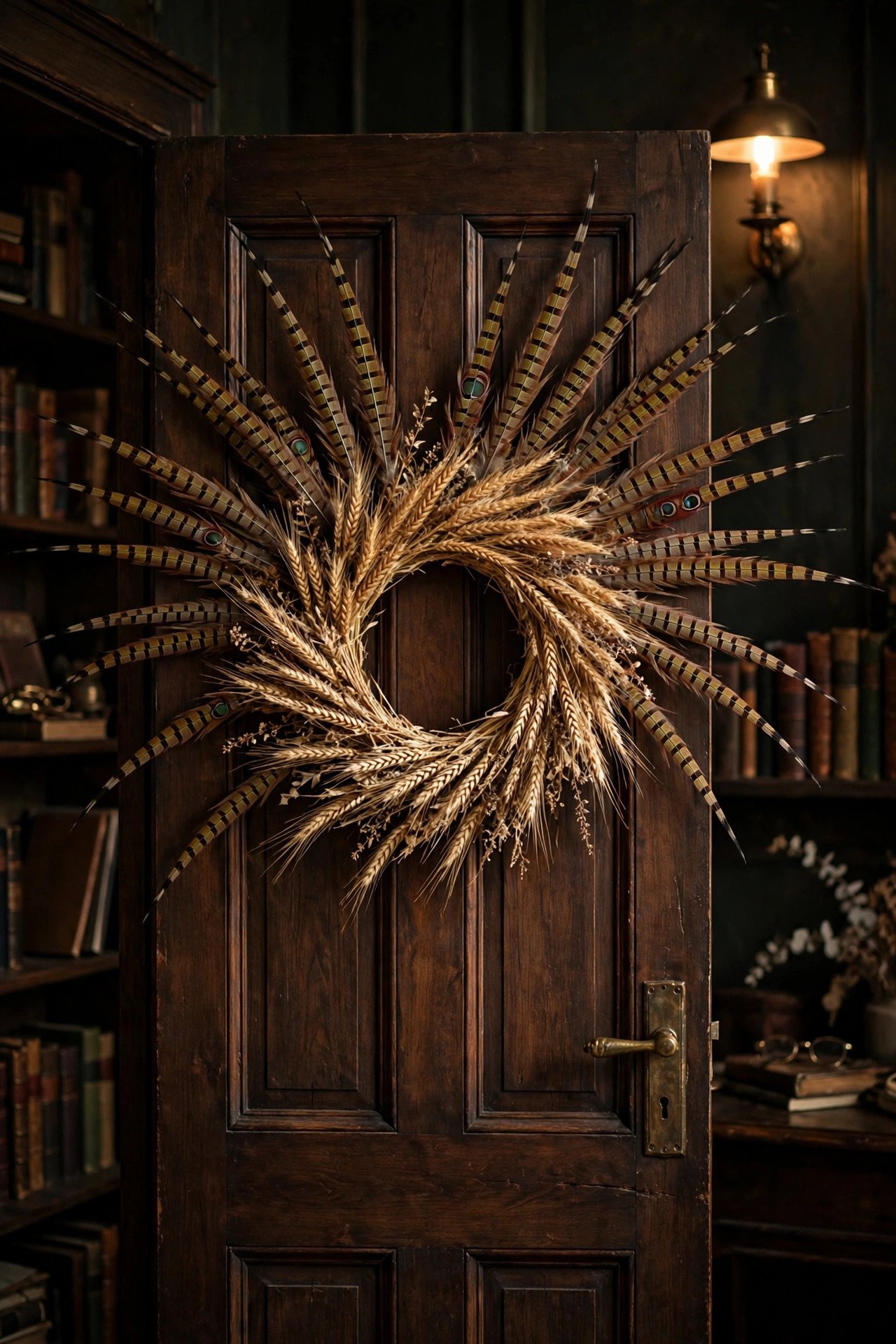
Combine dried wheat with pheasant feathers — the feathers add height, iridescence, and a sporting-lodge elegance that elevates the whole arrangement. The copper-green sheen of the feathers catches porch light at dusk, adding a layer of movement and luxury that plain botanicals cannot achieve.
This is the wreath for homes with leather, wood, and brass. Start with a 20-inch wheat-stalk base (see idea #2) and wire in six to eight pheasant tail feathers at the upper right, fanning them outward. Tuck in a few dried artichokes or lotus pods for weight contrast. The feather's copper-green sheen catches porch light beautifully at dusk. Budget $35–$50; craft-store feather packs run about $8. Keep feathers dry — rain mats them permanently.
12. Which Faux Wreath Actually Looks Real?
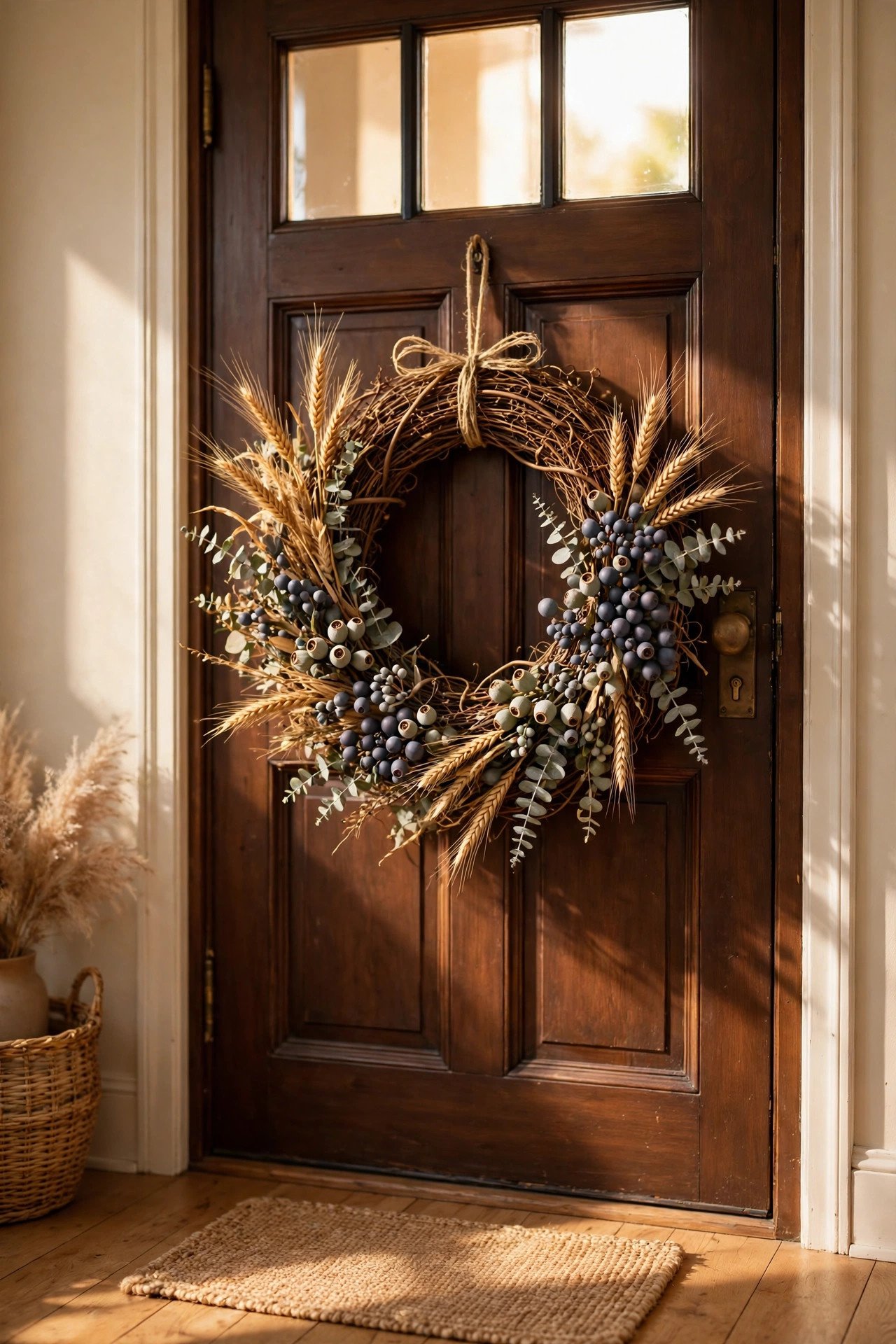
The best faux harvest wreaths use a mix of dried-look textures — wheat, seeded eucalyptus, and matte berries — on a realistic grapevine base, with nothing glossy or neon-orange. Varied stem lengths and matte finishes are the giveaways: uniform, shiny construction is what makes cheap faux wreaths look plastic in daylight.
Faux wreaths earn their keep on uncovered doors and in harsh sun, where real botanicals fade in days. Look for: varied stem lengths (uniform = fake), matte finishes, and wire-wrapped (not glued) construction so you can fluff and reshape. Expect to pay $60–$120 for a convincing 24-inch version; under $40 almost always looks plastic. Before hanging, steam it lightly or leave it in a warm bathroom to relax the flattened shipping creases — this one step separates realistic from sad. Store it in a wreath bag in a cool closet and it will serve five or more Thanksgivings.
13. What Wreath Suits a Soft, Neutral Interior?
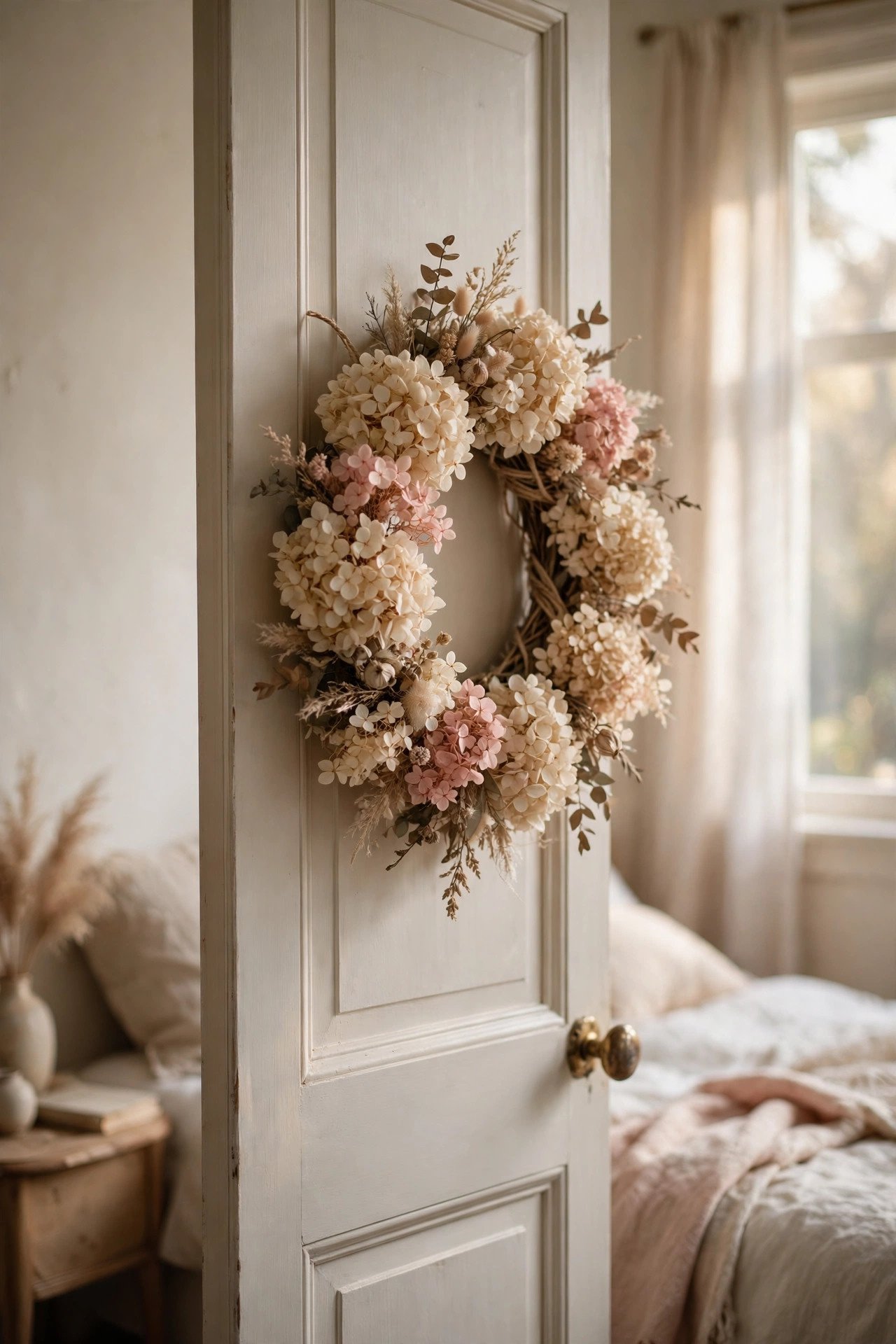
A dried hydrangea wreath in cream, blush, and sage gives you a soft, romantic texture that's perfect for interior doors, bedroom walls, and above consoles. Dried hydrangea heads fade naturally to vintage tones, so you can cut them fresh from the garden and let time do the styling for you.
Dried hydrangea heads are featherlight and naturally fade to vintage tones — you don't even have to dry them yourself, though hanging fresh-cut heads upside down for two weeks works. Glue or pin 20–25 dried heads onto a 14-inch straw form, tucking preserved ferns or baby's breath between them. This wreath is too fragile for wind and rain, so treat it as an indoor piece. Budget $25–$35 if you dry your own; pre-dried heads cost about $1.50 each. Hang it on an interior pantry door or powder room door for an unexpected Thanksgiving touch guests will comment on.
14. How Do You Style a Woodland Thanksgiving Wreath?

Build around pinecones, acorns, and bark textures in browns and coppers for a woodland wreath that feels like a walk through late-autumn woods. Foraged materials keep this wreath nearly free, and mixing matte bark with lacquered acorns creates the texture contrast that makes woodland designs feel rich rather than plain.
Start with a 20-inch grapevine base and wire in large sugar pinecones, clusters of small cones, acorns on picks, dried oak leaves, and a few curled birch bark pieces. Copper spray paint on half the pinecones adds warmth without glitter. A burlap bow finishes the rustic story. Forage cones and acorns yourself to keep the budget near $20; buy them and it's $35–$45. Avoid this wreath on doors in high wind — pinecones act like sails and the whole thing can bounce and scratch the door. It also pairs beautifully with a Thanksgiving mantel styled with the same woodland elements.
15. What's the Most Design-Forward Wreath Shape?

A crescent (asymmetrical) wreath — botanicals clustered on just the lower third of a bare grapevine ring — looks straight out of a florist studio and suits modern homes. The exposed vine is the design, so choose a base with character: twisted, weathered grapevine beats a smooth, uniform ring for this style.
This is the minimalist's answer to the harvest wreath. Leave two-thirds of an 18-inch grapevine ring exposed; wire dried grasses, wheat, a few dark plums (faux), and eucalyptus into a lush crescent along the bottom. The negative space is the design. It reads artistic on white and black doors and over mirrors indoors. Budget $30–$40. The common mistake is a crescent that's too sparse — the clustered section needs to be dense and layered to balance the bare ring. Secure everything with floral wire, not glue, since the cluster bears all the visual weight on one side.
16. Where Do You Hang a Wreath If Not the Front Door?
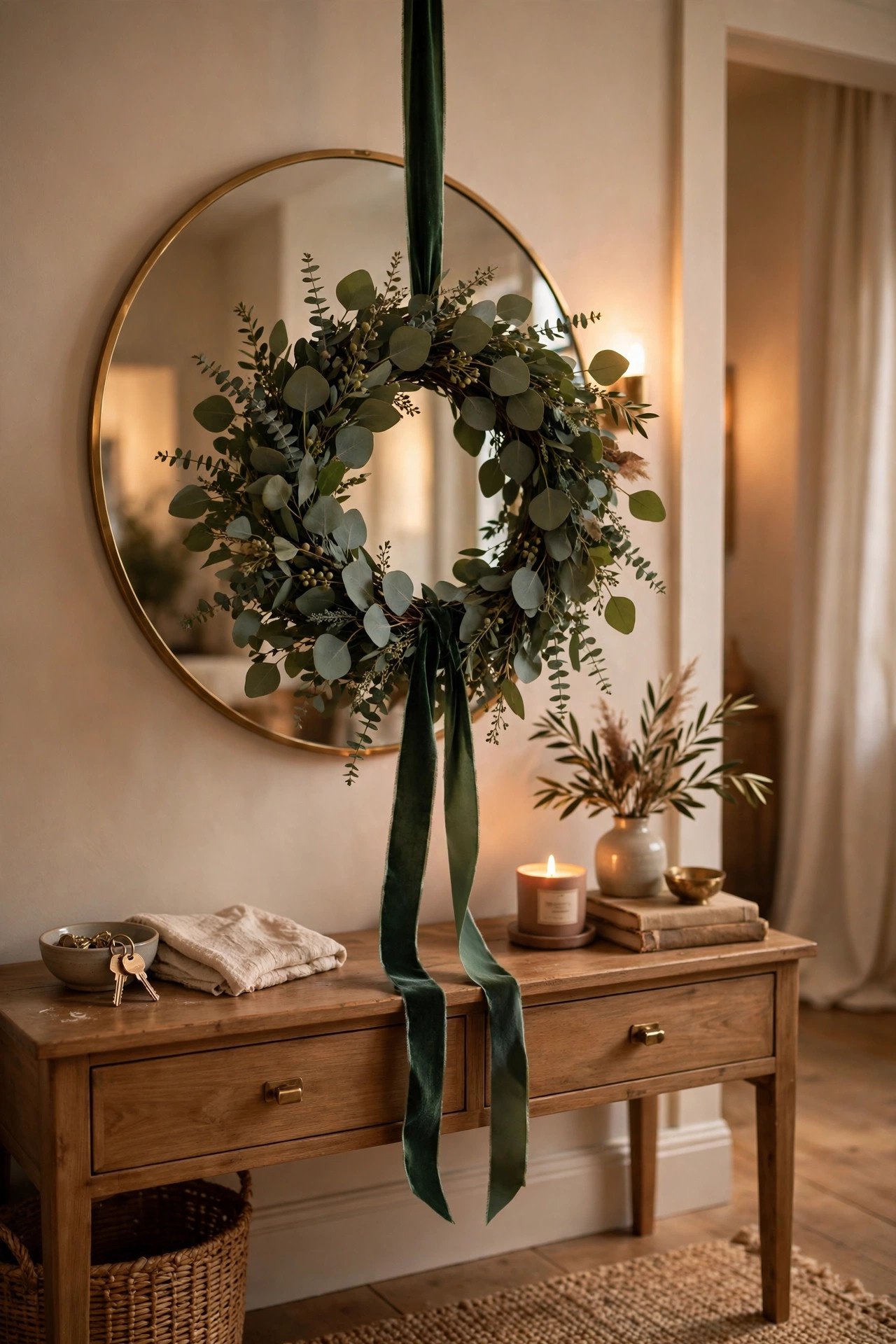
Above a console table or over a mirror in the entryway — a 16- to 18-inch wreath with a long velvet ribbon becomes the focal point guests see the moment they step inside. Floating the wreath a few inches in front of a round mirror doubles the greenery in the reflection, turning one wreath into a much grander moment.
This is where the Thanksgiving entryway really earns its welcome. Hang the wreath from the ceiling or a picture hook with a 3-foot ribbon so it floats 6–8 inches in front of a round mirror; the reflection doubles the greenery. Center it 60 inches from the floor — gallery height. Avoid anything with shedding materials above upholstered furniture; dried wheat rains tiny bits for weeks. Vacuum-friendly faux options shine in this spot.
17. Can You Put Wreaths on Kitchen Cabinet Doors?

Yes — mini 8- to 10-inch wreaths hung on cabinet doors with suction hooks are one of the cheapest ways to make a kitchen feel dressed for Thanksgiving. A pair of five-dollar minis on symmetrical cabinet doors flanking the stove delivers more festive impact than most full-size decorations in the room.
Pick simple designs: small grapevine rings with a single berry pick and a gingham or burlap bow. Hang one on each of two symmetrical cabinet doors flanking the stove, or on the pantry door alone. Use clear suction-cup hooks (rated 3+ pounds) on smooth cabinet fronts, or removable adhesive hooks on textured wood. Budget $5–$8 per mini wreath. Avoid real food items like dried fruit in the kitchen — steam from cooking rehydrates and spots them. These tiny wreaths also transition to Christmas instantly with a ribbon swap, doubling their value.
18. How Do You Layer a Wreath Into Mantel Decor?

Hang a 24-inch wreath centered above the mantel, then layer garland and candlesticks in front so the wreath reads as the anchor of a full vignette, not a lone circle. Asymmetry in the supporting pieces — tall candlesticks one side, a low pumpkin cluster the other — keeps the composition from looking stiff or staged.
The mantel is Thanksgiving's interior stage. Center the wreath on the chimney breast, 4–6 inches above the mantel shelf, using a brick or stone hanger if needed. Run a eucalyptus or faux-leaf garland along the shelf, add three candlesticks of varying heights on one side and a small pumpkin cluster on the other for asymmetry. A wheat or magnolia wreath keeps the palette warm; skip anything with pinecones directly above a lit fireplace. Keep all greenery at least 12 inches from open flames. Budget for the wreath itself: $30–$60.
19. How Do You Wreath Double Doors Without It Looking Busy?

Hang matching wreaths on each door, but scale them down to 16–18 inches — two medium wreaths read elegant, while two full-size ones crowd the center seam. Identical wreaths and identical hangers make the pair read as one deliberate design, which is the entire point of decorating double doors symmetrically.
Symmetry is the whole trick on double doors. Use identical wreaths (or mirror-image DIY builds) and identical hangers so the pair reads as one intentional design. Keep the design simpler than a single-door wreath — a boxwood or eucalyptus ring with one ribbon — because duplication doubles visual weight. Center each wreath on its door panel. Budget: buying two means $120–$200 store-bought, or $50–$70 for a DIY pair. Avoid hanging one large wreath spanning the seam; it blocks the doors from opening and looks like a mistake.
20. What Wreath Makes a Dining Room Wall Feel Finished?

An oversized 28- to 32-inch harvest wreath hung on a blank dining wall acts like art — it fills the vertical space above a sideboard the way a painting would. At a fraction of framed-art prices, a big textured wreath gives a dining room the finished, intentional look that guests register the moment they sit down.
Dining rooms often have one sad empty wall, and a big wreath solves it for a fraction of art prices. Choose wheat, dried grasses, and cream tones so it complements rather than competes with your Thanksgiving dining room table. Hang it on a sturdy picture hook or French cleat — at this size it can weigh 6–10 pounds. Center it 8–10 inches above the sideboard. Budget $70–$100 DIY (large bases and more materials), $120+ store-bought. Avoid dark, dense designs on already-dark walls; they disappear. Light, textured wreaths with negative space read best from across the table.
21. How Do You Make a Sunflower Wreath That Isn't Kitschy?
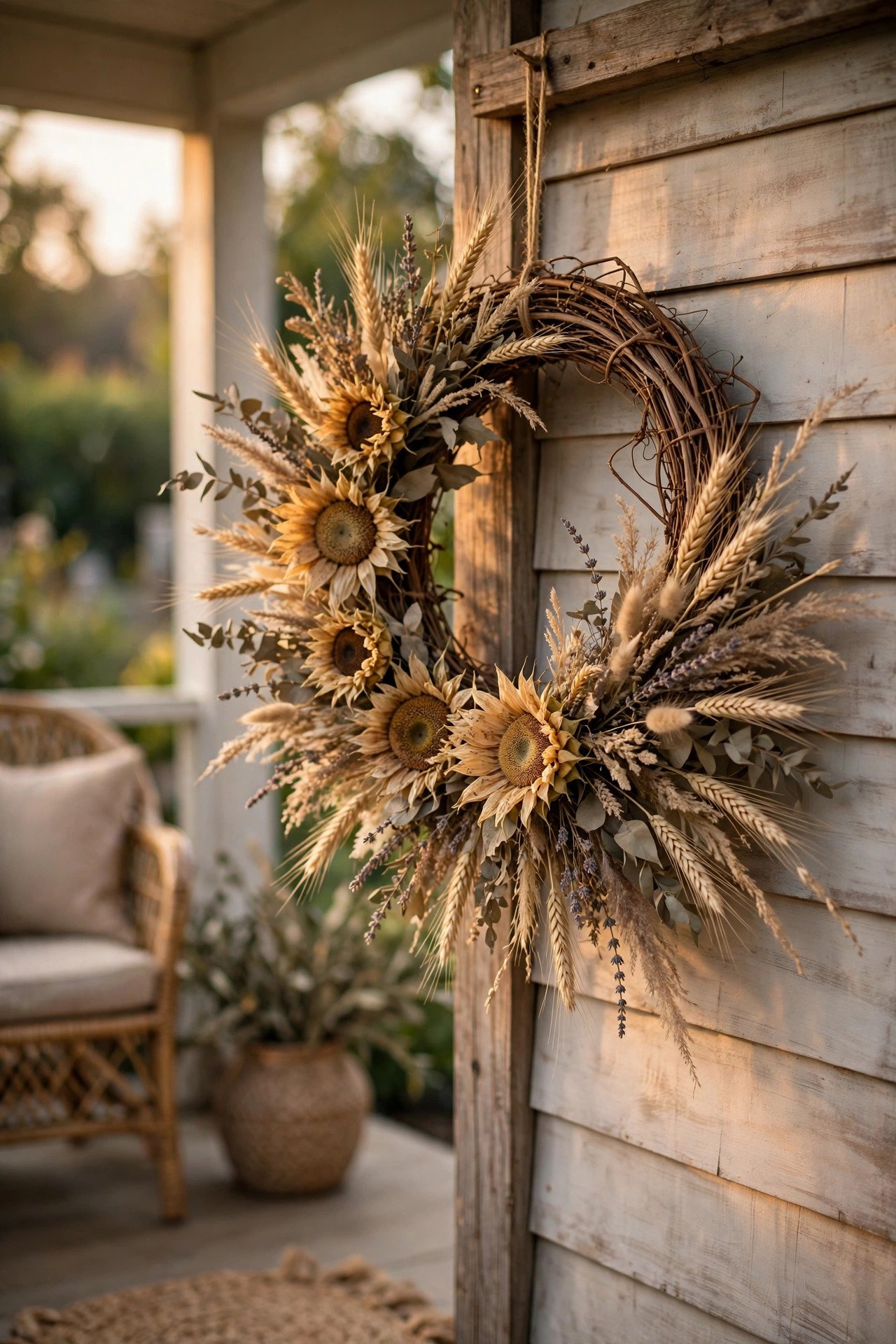
Use dried or muted-tone sunflowers — brown-centered, rust and ochre petals — mixed with wheat and grasses, keeping the design loose rather than a tight sunflower ring. Placing five to seven sunflowers asymmetrically as accents, largest at the lower right, reads artful; a tight circle of identical blooms is what tips the style toward kitsch.
The kitschy sunflower wreath is the tight circle of identical bright-yellow blooms; the elegant version uses sunflowers as accents, not the whole story. Start with a 20-inch grapevine base, add dried wheat and grasses first, then place five to seven dried sunflowers (real dried ones work best) asymmetrically, largest at the lower right. A few lotus pods fill gaps. Budget $30–$45. Hang it where it's sheltered — dried sunflower petals are brittle and shatter in wind. Indoors on a wall or covered porch, it's a warm, cheerful classic.
22. Can One Wreath Carry You From Thanksgiving to Christmas?

Yes — build a neutral evergreen-free base of wheat, dried grasses, and natural pods, then swap only the ribbon and accents to shift it from harvest to holiday. Ten minutes of ribbon-and-accent swapping after Thanksgiving doubles the working life of your wreath and halves your seasonal decorating cost.
This is the smartest wreath investment on this list. A 22-inch base of dried wheat, lotus pods, and cream berries with a rust velvet ribbon is pure Thanksgiving. On the weekend after the holiday, remove the ribbon and wheat accents, wire in a deep green or burgundy velvet ribbon plus a few frosted pinecones, and the same wreath reads winter. Two holidays, one base, about $50 in materials total. Avoid building the base with anything overtly Thanksgiving (no pumpkins wired in) — keep the base neutral and let the swappable accents do the seasonal talking.
Practical Tips for Hanging, Weatherproofing & Storing
Match the hanger to the door. Over-the-door hooks work on standard doors but scratch glass or French doors — use suction-cup or magnetic wreath hangers (rated 10+ pounds) there instead. For wreaths over 6 pounds, skip adhesive hooks entirely; they fail in November temperature swings.
Weatherproof natural materials before hanging. Spray dried botanicals with a clear matte floral sealant or hairspray in two light coats. It slows color fading from sun and adds mild moisture resistance. Keep real wreaths under a covered porch whenever possible — direct November rain is the number one killer of dried arrangements. The Spruce has a solid primer on making and preserving wreaths techniques if you want deeper how-to detail.
Refresh a fading wreath mid-season. Pull off browned leaves, fluff flattened sections, and add three or four fresh berry picks or a new ribbon. A five-minute refresh in mid-November buys you another three weeks of good looks. Rotate the wreath 180 degrees if one side is sun-faded — the protected back often looks brand new.
Store wreaths flat, never crushed. Hang large wreaths on nails in a closet or garage, or lay them flat in a wreath storage bag with tissue between layers. For more on the history of the wreath as a symbol of welcome, Wikipedia's wreath article is a surprisingly good read.
Transition to Christmas with a ribbon swap. As covered in idea #22, keep your base neutral and change the ribbon color plus two or three accents. Rust velvet becomes deep green or champagne; wheat picks become frosted berries. The whole transformation takes ten minutes and doubles your wreath's working life.
Thanksgiving Wreath FAQs
What size wreath should I get for a standard front door?
Choose a wreath 24 to 28 inches in diameter for a standard 36-inch door — roughly two-thirds the door's width. Smaller than 20 inches looks lost; larger than 30 overwhelms the panels and can interfere with the door knocker or handle. Size up for glass-paneled doors, which visually shrink anything hung on them.
Can I hang the same wreath on double doors?
Yes, but use two matching 16- to 18-inch wreaths, one centered on each door, rather than one large wreath spanning the seam. Identical designs keep the look intentional. Make sure each wreath sits fully within its own door so both doors can still open and close freely.
How long do fresh-material wreaths last in November weather?
Fresh-cut greenery lasts 1–2 weeks on a covered porch but fades within days in sun and rain. Dried materials (wheat, preserved boxwood, dried botanicals) hold for 4–6 weeks or the entire season. For a wreath that must look good from early November through Thanksgiving dinner, dried or faux is the practical choice.
How do I keep my wreath from molding in damp weather?
Hang it under cover with airflow behind it — at least an inch of clearance from the door so moisture doesn't trap. Seal dried botanicals with matte floral sealant, and bring the wreath inside during multi-day rainstorms. If you spot mold, wipe it with diluted white vinegar and dry the wreath indoors before rehanging.
How can I hang a wreath without a wreath hanger or nails?
Use a removable adhesive hook rated for your wreath's weight on smooth doors, a magnetic wreath hanger on metal doors, or a suction-cup hook on glass. For heavy wreaths, an over-the-door hook is the most reliable no-damage option. Always check the weight rating — a wet grapevine wreath can weigh twice its dry weight.
Can I reuse my wreath base across seasons?
Absolutely — a natural grapevine or wire base lasts for years. Strip off the seasonal accents with wire cutters, store the bare base, and rebuild it for each holiday. Many crafters keep two or three bases in rotation and simply re-dress them. It's the most economical approach: your per-season cost drops to just ribbon and a few fresh picks.
Final Thoughts
A Thanksgiving wreath is the smallest decoration with the biggest welcome. Whether you spend an afternoon wiring wheat to a grapevine base or invest in one preserved boxwood wreath that serves you for years, the formula is the same: right size for the door, materials matched to the weather, and a palette that says harvest without shouting.
You May Also Like:
– 22 Thanksgiving Front Porch Decor Ideas for a Warm Welcome – 22 Thanksgiving Entryway Decor Ideas for a Warm First Impression – 22 Thanksgiving Mantel Decor Ideas for a Cozy Fireplace – 22 Halloween Wreath Ideas for a Spooktacular Front Door — October's predecessor to this post
—
Frequently Asked Questions
What size wreath should I get for a standard front door?
Choose a wreath 24 to 28 inches in diameter for a standard 36-inch door — roughly two-thirds the door's width. Smaller than 20 inches looks lost; larger than 30 overwhelms the panels and can interfere with the door knocker or handle. Size up for glass-paneled doors, which visually shrink anything hung on them.
Can I hang the same wreath on double doors?
Yes, but use two matching 16- to 18-inch wreaths, one centered on each door, rather than one large wreath spanning the seam. Identical designs keep the look intentional. Make sure each wreath sits fully within its own door so both doors can still open and close freely.
How long do fresh-material wreaths last in November weather?
Fresh-cut greenery lasts 1–2 weeks on a covered porch but fades within days in sun and rain. Dried materials (wheat, preserved boxwood, dried botanicals) hold for 4–6 weeks or the entire season. For a wreath that must look good from early November through Thanksgiving dinner, dried or faux is the practical choice.
How do I keep my wreath from molding in damp weather?
Hang it under cover with airflow behind it — at least an inch of clearance from the door so moisture doesn't trap. Seal dried botanicals with matte floral sealant, and bring the wreath inside during multi-day rainstorms. If you spot mold, wipe it with diluted white vinegar and dry the wreath indoors before rehanging.
How can I hang a wreath without a wreath hanger or nails?
Use a removable adhesive hook rated for your wreath's weight on smooth doors, a magnetic wreath hanger on metal doors, or a suction-cup hook on glass. For heavy wreaths, an over-the-door hook is the most reliable no-damage option. Always check the weight rating — a wet grapevine wreath can weigh twice its dry weight.
Can I reuse my wreath base across seasons?
Absolutely — a natural grapevine or wire base lasts for years. Strip off the seasonal accents with wire cutters, store the bare base, and rebuild it for each holiday. Many crafters keep two or three bases in rotation and simply re-dress them. It's the most economical approach: your per-season cost drops to just ribbon and a few fresh picks.